Physics Mentor, SRM Institute | Updated on - Jul 21, 2026
Magnetism and Matter Class 12 covers the bar magnet as a magnetic dipole, Earth's magnetic field, and how dia, para, and ferromagnetic materials respond. These NCERT solutions match the 2026-27 syllabus and carry about 3 marks in CBSE Boards.
MP
Solved by Kabir Singh, Collegedunia Physics Faculty (M.Sc Physics), step by step for the 2026-27 syllabus.
Here is how Magnetism and Matter splits across the main exams.
CBSE:3 marks, usually one 2-mark question on hysteresis or susceptibility plus a 1-mark classification MCQ.
JEE Main: 1 to 2 percent, mostly Earth's magnetism or bar magnet torque.
NEET: 0 to 1 question per year, usually a classification MCQ.
Magnetism and Matter Class 12 Weightage and Previous Year Questions
Chapter 5 carries about 3 marks in CBSE Boards, the lowest in the Magnetism unit. Hysteresis and the dia-para-ferro classification recur every two years.
Year
CBSE Board
JEE Main
NEET
2026
Hysteresis loop properties (2 marks)
Bar magnet torque (4 marks)
Magnetic materials: dia, para and ferromagnetism
2025
Dia / para / ferro (2 marks)
Earth magnetism, field elements
Susceptibility MCQ
2024
Bar magnet axial field (3 marks)
-
Soft iron vs steel MCQ
2023
Susceptibility of materials (2 marks)
Solenoid magnetic moment
-
2022
Earth magnetism elements (3 marks)
-
Bar magnet equatorial field
2021
-
-
Classification of materials
Exercise-by-Exercise Breakdown for Class 12 Physics Chapter 5
The solutions below cover all 11 NCERT exercise questions, Q5.1 to Q5.11. Use this map to find the answer you need and to see where the marks sit.
Question Group
What It Asks
Count
Approx Marks
Q5.1 to Q5.3
Bar magnet basics: field direction, torque, work done turning a dipole
3
2 to 3 each
Q5.4 to Q5.6
Magnetic moment, neutral points, Gauss's law for magnetism
How to Write Board Answers for Magnetism and Matter
CBSE gives step marks, so structure every answer. Follow this order.
Define the term asked first: magnetisation M (net moment per unit volume), susceptibility χ, or permeability. One clean line earns the definition mark.
State the formula before numbers: write χ = M / H or τ = M B sinθ on its own line, then substitute.
Substitute with units: keep SI units through the working and box the final answer with its unit (A/m, J, or T).
Draw the diagram where needed: a labelled bar-magnet field or a hysteresis loop (mark retentivity and coercivity). CBSE marks the labels, not just the curve.
Classify only when asked: give dia / para / ferro and the χ sign only if the question requests it, otherwise you waste time.
Answer-Writing Mistakes to Avoid in Chapter 5 Solutions
These slips cost marks in the working, not in the concept. Check each before you submit.
Mistake 1: Mixing up B, H and M in a numerical. Read which one the question gives and which one it asks for before you pick a formula.
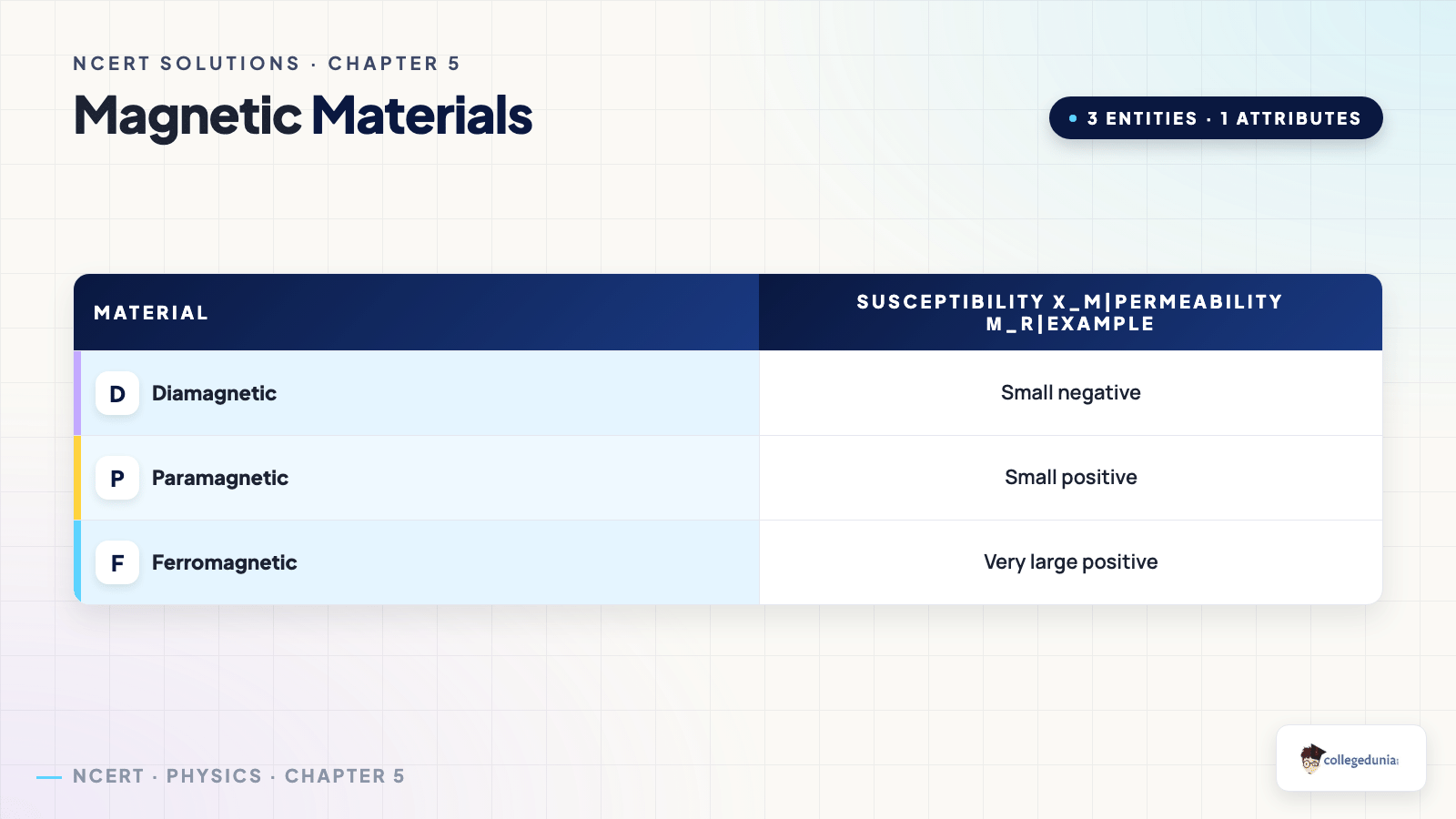
Mistake 2: Writing the wrong χ sign: diamagnetic is small negative, paramagnetic is small positive. A sign slip loses the answer mark.
Mistake 3: Unit slips. Convert cm to m and gauss to tesla (1 G = 10−4 T) before substituting, and carry units to the last line.
Mistake 4: Skipping the diagram. A torque or hysteresis answer without a labelled figure drops the diagram mark even if the maths is right.
Magnetism and Matter Class 12 Resources
Jump to the other Magnetism and Matter resources for this chapter.
All NCERT Solutions for Class 12 Physics Chapter 5 Magnetism and Matter with Step-by-Step Solutions
Every question of NCERT Class 12 Physics Magnetism and Matter is listed below with its full Solution and Expert Solution hidden inside collapsible tabs. Click Check Solution to reveal the step-by-step working; click Expert Solution for the expanded explanation.
Q 5.1
A short bar magnet placed with its axis at 30∘ with a uniform external magnetic field of 0.25 T experiences a torque of magnitude equal to 4.510-2J. What is the magnitude of the magnetic moment of the magnet?
What the question is asking. A small bar magnet is tilted at 30∘ to a uniform magnetic field. The field tries to align the magnet with itself, producing a twist (torque). We know the twist; we want the magnet's "strength" - its magnetic moment.
Given.
Angle between magnet's axis and field, θ = 30∘.
External magnetic field, B = 0.25 T.
Torque on magnet, τ = 4.510-2Nmthe unit J printed in the problem is the SI unit for energy, but for torque the equivalent unit is Nm; they are dimensionally identical.
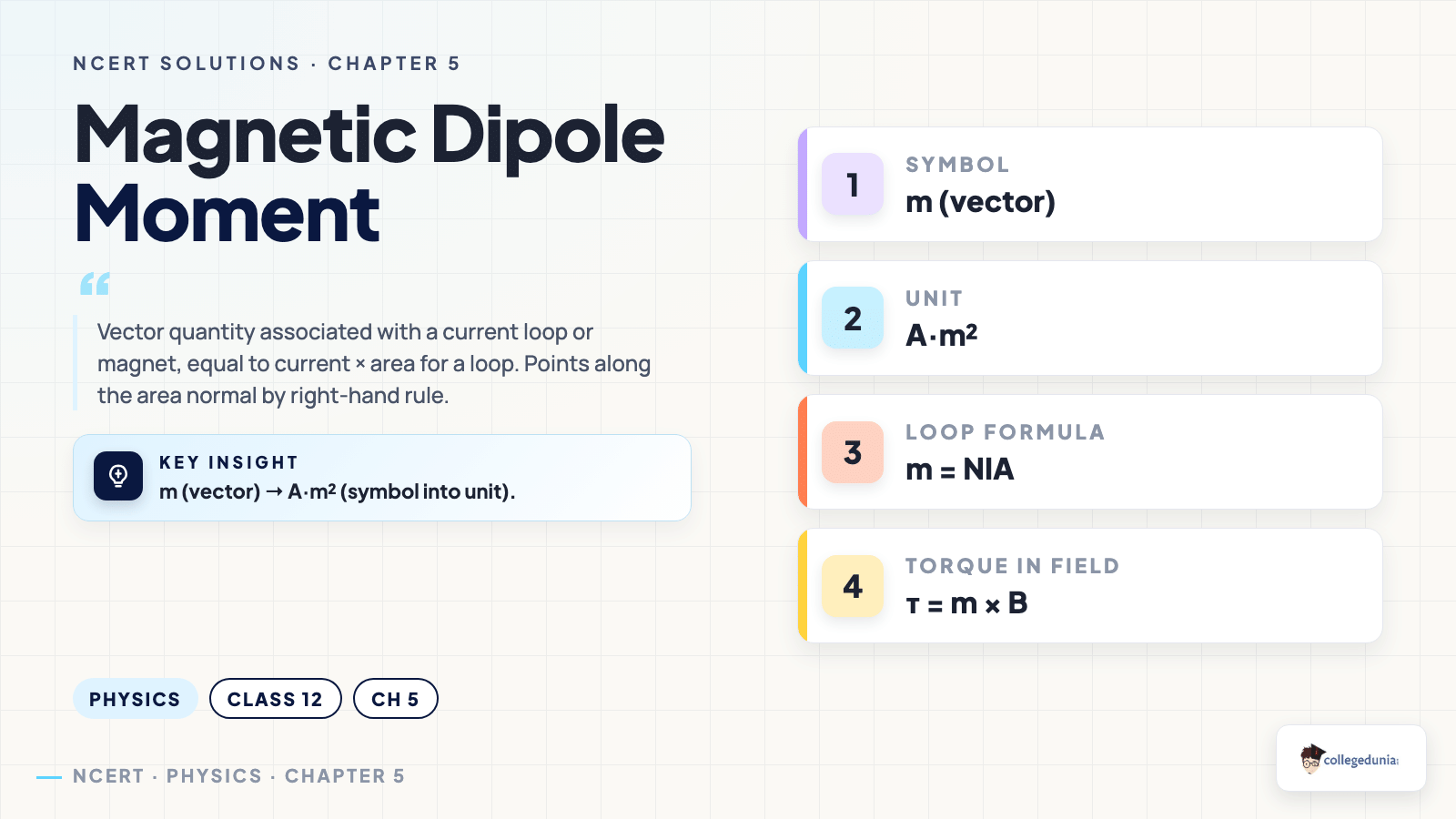
Concept used - torque on a magnetic dipole. A magnetic dipole of moment m placed in a uniform field B feels a torque τ = m × B, |τ| = mB sinθ. In plain English: the torque is the product of the magnet's strength (m), the field (B), and the sine of the angle between them. When the magnet is already aligned with the field θ = 0, sin 0 = 0 and there is no twist. When the magnet is perpendicular θ = 90∘, the twist is maximum.
Step 1 - write the formula. τ = mB sinθ.
Step 2 - solve for m.m = τB sinθ.
Step 3 - evaluate sin 30∘. sin 30∘ = 12 = 0.5.
Step 4 - substitute the numbers.m = 4.510-2(0.25)(0.5).
Step 5 - simplify the denominator. (0.25)(0.5) = 0.125.
Final answer.m = 0.36 J T-1 (or equivalently 0.36 A m2).
DR
Dr. Rajesh Kumar
Ph.D. Physics, IIT Delhi
Verified Expert
Vector picture. Pointing the right-hand fingers from m (along the magnet's axis from S to N) toward B, the thumb points along τ. That is the rotation axis around which the magnet tries to swing. The torque drives the magnet toward θ = 0 (stable equilibrium) - i.e., m aligns parallel to B.
Why two units for m? Magnetic moment has SI units A m2current × area, for a current loop. For a bar magnet, an equivalent unit is J T-1 (energy per tesla), because the magnet's potential energy in a field is U = -mBcosθ. Both are identical: 1 A m2 = 1 J T-1. Verify: T = kg s-2A-1, so J T-1 = kg m2s-2-1s2A = m2A. Same thing.
Common mistake. Students sometimes plug the angle in degrees into a calculator set to radians. If sin 30 is computed in radians it gives sin 30 rad ≈ -0.988 - completely wrong. Always check your calculator mode, or remember the standard exact values: sin 30∘ = 1/2, sin 45∘ = 1/2, sin 60∘ = 3/2.
Sanity check. A typical small bar magnet has m∼ 0.1 to 1 A m2. Our 0.36 A m2 sits comfortably in that range - answer looks physical.
Real-world connection. Compass needles use this exact principle. Earth's horizontal field ∼ 310-5T exerts a tiny torque on the needle whose magnetic moment is ∼ 0.01 A m2, enough to swing it within seconds toward magnetic north.
Q 5.2
A short bar magnet of magnetic moment m = 0.32 J T-1 is placed in a uniform magnetic field of 0.15 T. If the bar is free to rotate in the plane of the field, which orientation would correspond to its (a) stable, and (b) unstable equilibrium? What is the potential energy of the magnet in each case?
What the question is asking. A bar magnet can swing freely in the field. We need the two orientations where the torque is zero (the equilibrium positions) and label which one is "stable" (returns when nudged) vs "unstable" (swings away when nudged). Then compute the magnet's potential energy in each.
Given.
Magnetic moment, m = 0.32 J T-1.
External field, B = 0.15 T.
Concept used - potential energy of a magnetic dipole. The magnet's potential energy in a uniform field is U = -m·B = -mBcosθ, where θ is the angle between mS → N inside the magnet and B. The minus sign is crucial - it means U is most negative (lowest) when θ = 0 (magnet parallel to field) and most positive (highest) when θ = 180∘ (magnet antiparallel).
Equilibrium happens where τ = mBsinθ = 0, i.e., θ = 0∘ or 180∘. Stability is judged from energy: a system is stable at a minimum of U, unstable at a maximum.
(a) Stable equilibrium.
Step 1. Stable ⇔U is minimum ⇔cosθ = +1 ⇔ θ = 0∘. The magnet's N-pole points along Bi.e., m parallel to B.
Step 2 - compute U at θ = 0∘. Umin = -mBcos 0∘ = -(0.32)(0.15)(1) = -0.048 J.
(b) Unstable equilibrium.
Step 3. Unstable ⇔U is maximum ⇔cosθ = -1 ⇔ θ = 180∘. The magnet's N-pole points opposite to B (antiparallel).
Step 4 - compute U at θ = 180∘. Umax = -mBcos 180∘ = -(0.32)(0.15)(-1) = +0.048 J.
Final answer.
(a) Stable equilibrium: m parallel to Bθ = 0∘. U = -0.048 J.
(b) Unstable equilibrium: m antiparallel to Bθ = 180∘. U = +0.048 J.
DA
Dr. Anita Sharma
Ph.D. Physics, University of Delhi
Verified Expert
Why stability comes from the minimum of U. Imagine a marble in a bowl (minimum of potential) - push it slightly, it rolls back. That's stable. A marble balanced on top of an inverted bowl (maximum of potential) - any tiny push and it rolls off forever. That's unstable. Same logic with the magnet's angular position: at θ = 0∘, any small kick produces a restoring torque τ = -mBsinθ that pushes θ back to zero. At θ = 180∘, any small kick produces a torque that swings θ further away from 180∘, eventually flipping the magnet all the way to 0∘.
Energy difference between extremes. Δ U = U180∘ - U0∘ = +0.048 - (-0.048) = 0.096 J = 2mB. This is the work an external agent must do to flip the magnet from parallel to antiparallel - important for things like NMR/MRI, where radio-frequency photons supply exactly this energy gap to flip nuclear spins.
Small-oscillation period. Near the stable position, for small angles sinθ ≈ θ, the restoring torque is τ ≈ -mBθ - a linear restoring "spring." If the magnet has moment of inertia I, it oscillates with period T = 2π√ImB. This is the principle behind vibration-magnetometer measurements of B in laboratory experiments.
Common pitfall. Don't confuse "stable equilibrium" (lowest energy) with "highest torque" maximum at θ = 90∘. They're different concepts. At θ = 90∘, torque is largest but U is neither min nor max - it's just zero (a particular value, not an extremum of U).
Q 5.3
A closely wound solenoid of 800 turns and area of cross-section 2.510-4 m2 carries a current of 3.0 A. Explain the sense in which the solenoid acts like a bar magnet. What is its associated magnetic moment?
Why a current-carrying solenoid behaves like a bar magnet. Each turn of wire in the solenoid carries current and acts as a tiny magnetic dipole (current loop). Stack many such dipoles along an axis and their fields add: the field outside the solenoid is identical in shape to that of a bar magnet, with one end behaving as a North pole and the other as a South pole. The "direction" of the magnetic moment is given by the right-hand grip rule: curl the fingers along the current flow, the thumb points from S to N i.e., along m.
Given.
Number of turns, N = 800.
Area of each turn, A = 2.510-4 m2.
Current, I = 3.0 A.
Concept used - magnetic moment of a current loop / solenoid. A single circular loop of area A carrying current I has dipole moment mloop = IA. For N such loops stacked closely (a solenoid), the total moment is m = NIA. The direction is perpendicular to the plane of the loops, given by the right-hand rule.
Step 1 - write the formula.m = NIA.
Step 2 - substitute the values.m = (800)(3.0)(2.510-4).
The direction is along the solenoid's axis, pointing from the end that acts as the South pole to the end that acts as the North pole (determined by the right-hand grip rule from the current sense).
DS
Dr. Suresh Iyer
Ph.D. Theoretical Physics, TIFR Mumbai
Verified Expert
Why this works - the magnetic-equivalence theorem. Ampère first noticed that the far-field of any current loop is mathematically identical to the field of a tiny bar magnet (a "magnetic dipole") with moment m = IA, where A is the area vector. This isn't a coincidence - it's because the curl of the magnetic field is sourced by current, and a small current loop and a small magnetic dipole produce the same circulating-field signature when viewed from far away. So the solenoid here is, magnetically, indistinguishable from a bar magnet with m = 0.60 A m2.
Right-hand grip rule - the practical recipe. Curl the fingers of your right hand in the direction the current flows around each loop. The thumb points along m, i.e., from the South face of the solenoid toward its North face. (Equivalently: when looking at the end of the solenoid, if the current looks anticlockwise, that end is the North pole; if clockwise, it's the South pole.)
Where the limit breaks down. The "equivalent bar magnet" description is excellent far from the solenoid. Inside the solenoid (or very close to one end), the actual field of the solenoid differs from a true bar magnet - it's nearly uniform inside B = 0nI, while a real bar magnet has a complicated, non-uniform internal field due to atomic dipoles. For exam problems about torque or field outside, treat as a bar magnet; for problems about field inside, use B = 0nI instead.
Common mistake. Forgetting the factor N. A single loop has moment IA; a solenoid with N loops has moment NIA. Many students drop the N and get an answer 800× too small here.
Q 5.4
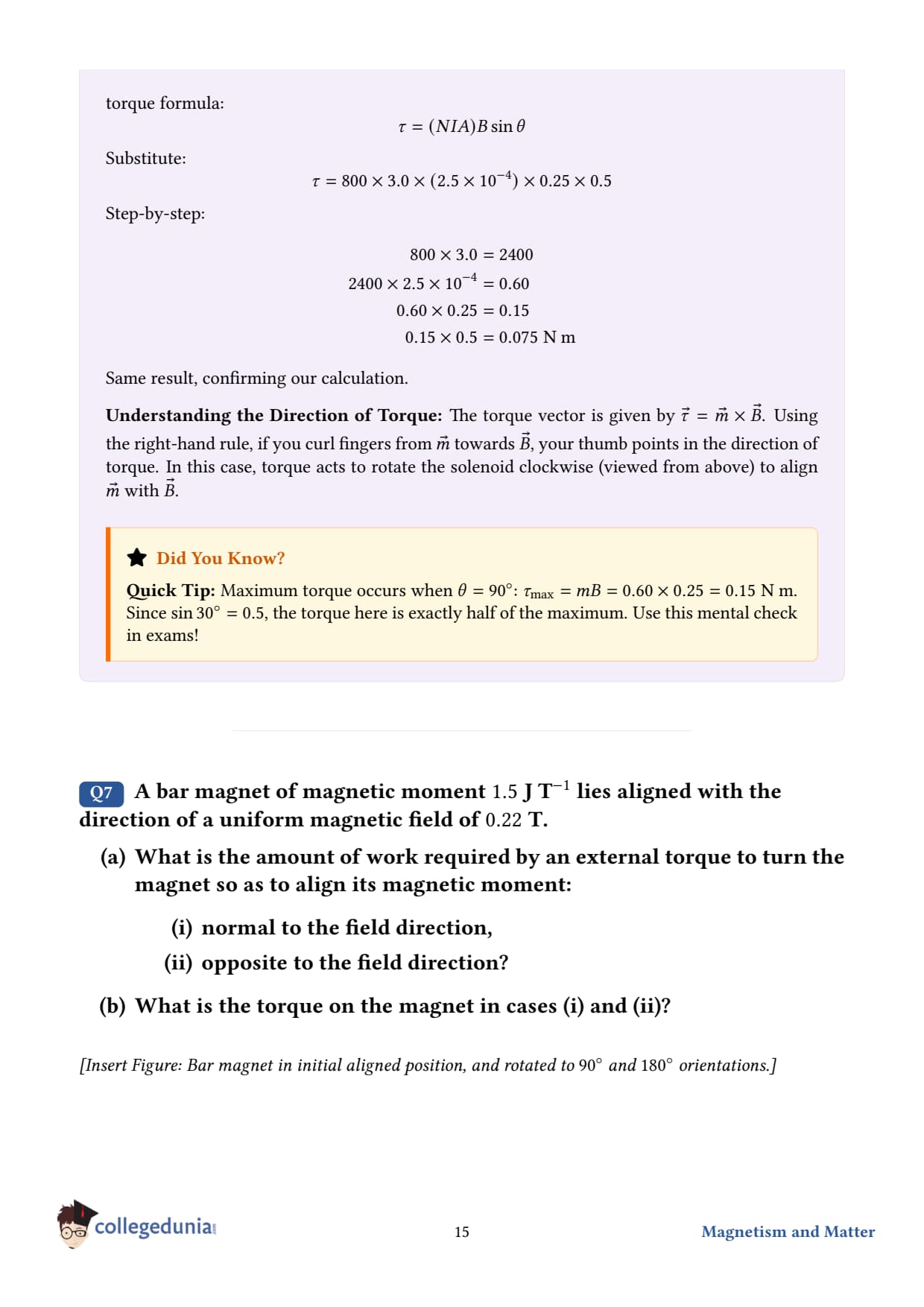
If the solenoid in Exercise 5.3 is free to turn about the vertical direction and a uniform horizontal magnetic field of 0.25 T is applied, what is the magnitude of torque on the solenoid when its axis makes an angle of 30∘ with the direction of the applied field?
What the question is asking. Same solenoid as in Q 5.3 moment m = 0.60 A m2, now placed in a horizontal field at 30∘ to its axis. We want the twist (torque) that tries to align the solenoid with the field.
Given.
Magnetic moment of solenoid (from Q 5.3), m = 0.60 J T-1.
External field, B = 0.25 T.
Angle between solenoid axis and field, θ = 30∘.
Concept used - torque on a magnetic dipole. Whether the dipole is a bar magnet or a current-carrying solenoid, the same formula applies: τ = mB sinθ. The solenoid feels a torque that tries to align its magnetic moment m with the field B. The torque is largest when they're perpendicular θ = 90∘ and zero when they're parallel.
Step 1 - write the formula. τ = mB sinθ.
Step 2 - substitute the values. τ = (0.60)(0.25) sin 30∘.
The torque acts about the vertical axis, swinging the solenoid so that its magnetic-moment direction rotates toward the horizontal field direction.
PM
Prof. Meera Nair
Ph.D. Experimental Physics, IISc Bangalore
Verified Expert
Why the solenoid behaves identically to a bar magnet. Earlier we computed the solenoid's equivalent magnetic moment as m = NIA. Once you have m, the field doesn't care whether that m came from a permanent magnet's atomic dipoles or from a coil's current - both produce the same external field and feel the same external torque τ = mBsinθ. This is a key idea: the magnetic moment fully summarises the dipolar behaviour of an object.
Direction of the torque (vector view). Using the right-hand rule on τ = m×B:
Point fingers along m (solenoid's axis from S to N).
Curl them toward B (horizontal direction).
Thumb points along τ - vertical.
Since the solenoid is constrained to rotate about the vertical, this is exactly the axis along which the torque acts; the rotation will be in the horizontal plane.
Alternative method - using U = -m·B. The torque is related to potential energy via τ = -dU/dθ: U(θ) = -mBcosθ ⇒ τ = -dUdθ = -mBsinθ. The magnitude is mBsinθ - same answer.
Real-world parallel. Galvanometers work on exactly this principle. A small current-carrying coil sits between magnet poles. When current flows, the coil acquires moment m = NIA, and the external field exerts a torque proportional to the current. A spring resists, and the angle of deflection is read off as the meter reading.
Watch out. The problem prints J for torque units in Q 5.1 and Q 5.4. Strictly, torque is Nm, not J, but they're dimensionally identical. The distinction is that J is normally reserved for energy. Don't let the unit confuse you.
Q 5.5
A bar magnet of magnetic moment 1.5 J T-1 lies aligned with the direction of a uniform magnetic field of 0.22 T.
(a) What is the amount of work required by an external torque to turn the magnet so as to align its magnetic moment: (i) normal to the field direction, (ii) opposite to the field direction?
(b) What is the torque on the magnet in cases (i) and (ii)?
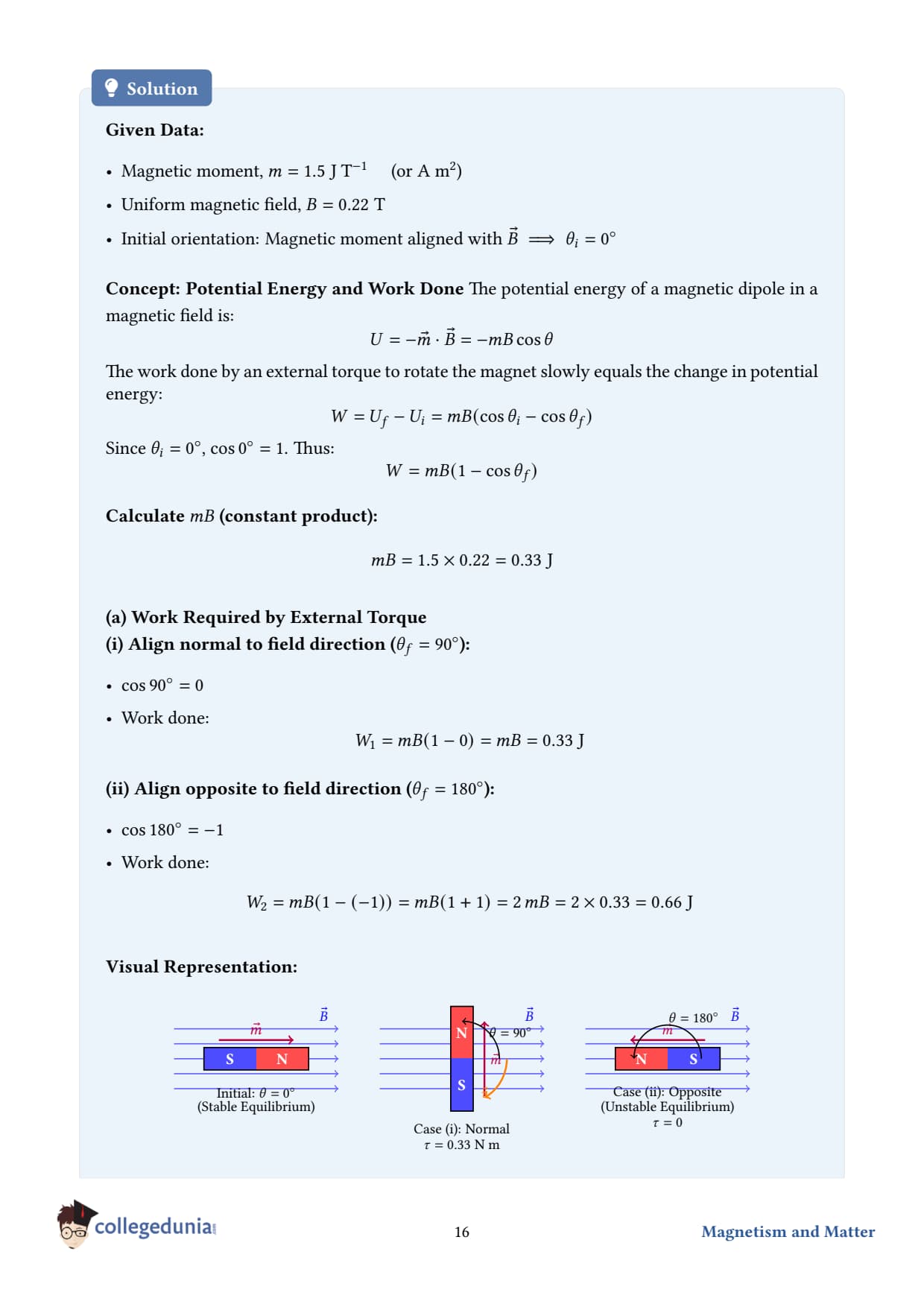
Setup. The bar magnet starts aligned with the field 0 = 0∘. An external agent rotates it slowly (quasi-statically, no kinetic energy gain) to a new angle. We need (a) the work done on the magnet and (b) the torque exerted by the field at the new orientation.
Given.
Magnetic moment, m = 1.5 J T-1.
Field, B = 0.22 T.
Initial orientation, 0 = 0∘parallel to B.
Concept used - work done in rotating a dipole. The potential energy of the magnet is Uθ = -mBcosθ. For a slow rotation, the external work equals the change in potential energy: W = U(f) - U(0) = -mBcosf - cos0 = mBcos0 - cosf. With 0 = 0, cos0 = 1, so W = mB1 - cosf. The torque on the magnet from the field at orientation θ is τ(θ) = mB sinθ.
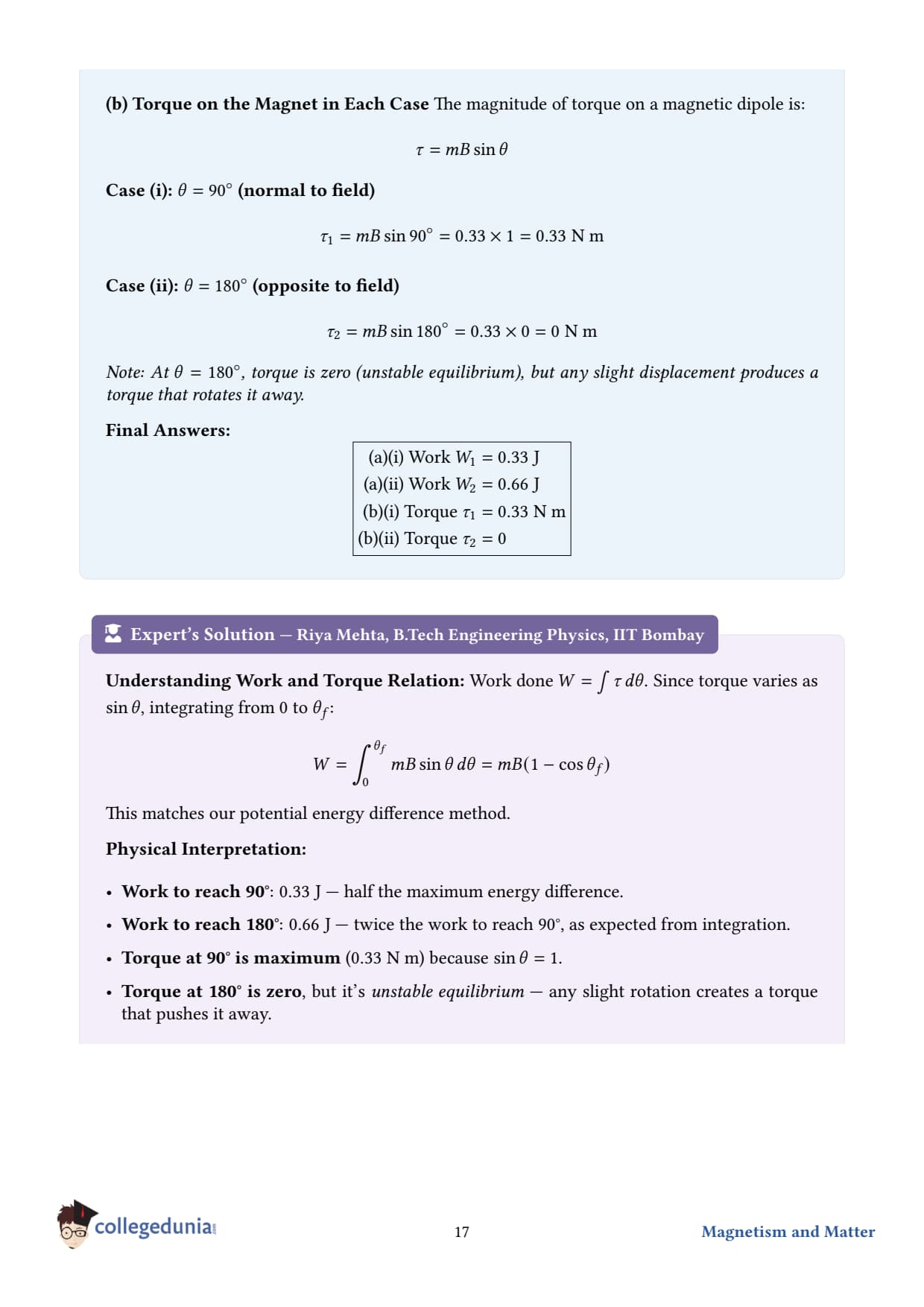
Step 5. Case (i): θ = 90∘, sin 90∘ = 1. (i) = mBsin 90∘ = (1.5)(0.22)(1) = 0.33 Nm.
Step 6. Case (ii): θ = 180∘, sin 180∘ = 0. (ii) = mBsin 180∘ = 0.
Final answers.
(a)(i) W = 0.33 J.
(a)(ii) W = 0.66 J.
(b)(i) τ = 0.33 Nm (maximum - magnet wants to swing back to alignment).
(b)(ii) τ = 0 (the antiparallel orientation is itself an equilibrium - unstable, but still zero net torque).
DS
Dr. Sneha Iyer
Ph.D. Physics, IISc Bangalore
Verified Expert
Why work to 180∘ is exactly twice work to 90∘. Look at the formula W = mB1-cosf. At 90∘, 1-cos = 1-0 = 1. At 180∘, 1-cos = 1-(-1) = 2. The ratio is exactly 2:1. This is a clean result that often appears in JEE/NEET problems - flipping a dipole completely takes 2mB of work, regardless of m or B.
Why τ = 0 at θ = 180∘ even though it's unstable. Equilibrium just means zero net torque. There are TWO orientations with zero torque: the stable one θ = 0 and the unstable one θ = 180∘. In both, the field and the moment are colinear, so m×B = 0. The difference is what happens when you perturb slightly: at θ = 0, the torque restores; at θ = 180∘, the torque amplifies the deviation. (Think of a pencil balanced on its tip vs lying on the table - both equilibria, one stable, one not.)
Integration check. Work done against the field-torque, computed by integration: W = 0f τ(θ) dθ = 0f mBsinθ dθ = mB1 - cosf. Same formula - comforting.
Where this matters in real physics. The energy difference Δ U = 2mB between aligned and antialigned dipoles in a field underlies NMR, MRI, and ESR (electron spin resonance) spectroscopies. In NMR, you flip nuclear spins between aligned and antialigned states using radio-frequency photons; the photon energy must equal 2nBwhere n is the nuclear magnetic moment.
Common mistake. Confusing "work done by the field" with "work done by the external agent." The work done by the field is Wfield = -Wexternal - they're negatives of each other. Here we report the work the external agent does, which is positive (energy goes into the system as it's pushed up the potential hill).
Q 5.6
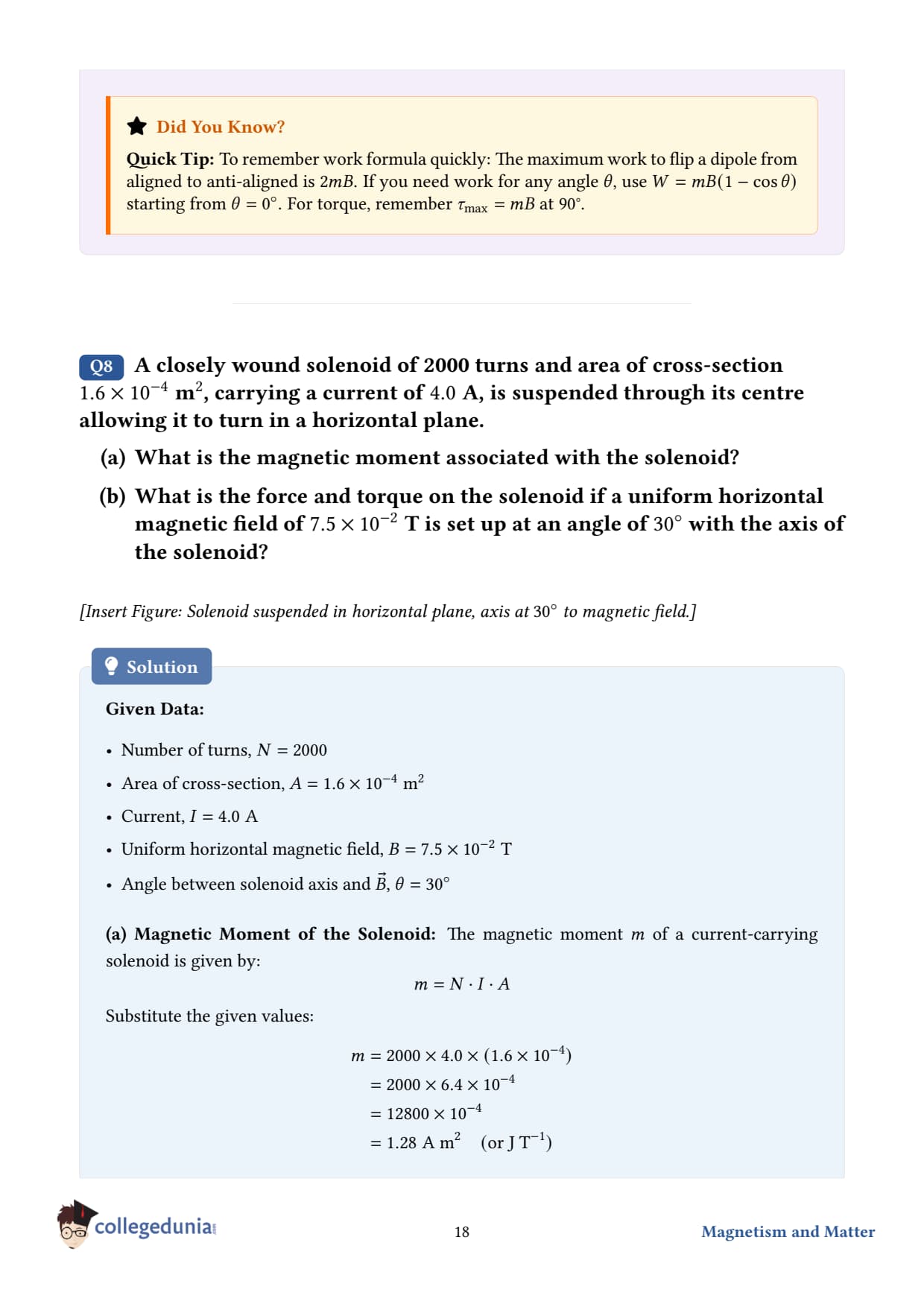
A closely wound solenoid of 2000 turns and area of cross-section 1.610-4 m2, carrying a current of 4.0 A, is suspended through its centre allowing it to turn in a horizontal plane.
(a) What is the magnetic moment associated with the solenoid?
(b) What is the force and torque on the solenoid if a uniform horizontal magnetic field of 7.510-2T is set up at an angle of 30∘ with the axis of the solenoid?
Given.
Number of turns, N = 2000.
Area of each turn, A = 1.610-4 m2.
Current, I = 4.0 A.
External field, B = 7.510-2T.
Angle between solenoid axis and B, θ = 30∘.
(a) Magnetic moment of the solenoid.
Concept used. A solenoid of N turns each enclosing area A, carrying current I, has dipole moment m = NIA. The direction is along the axis, by the right-hand grip rule.
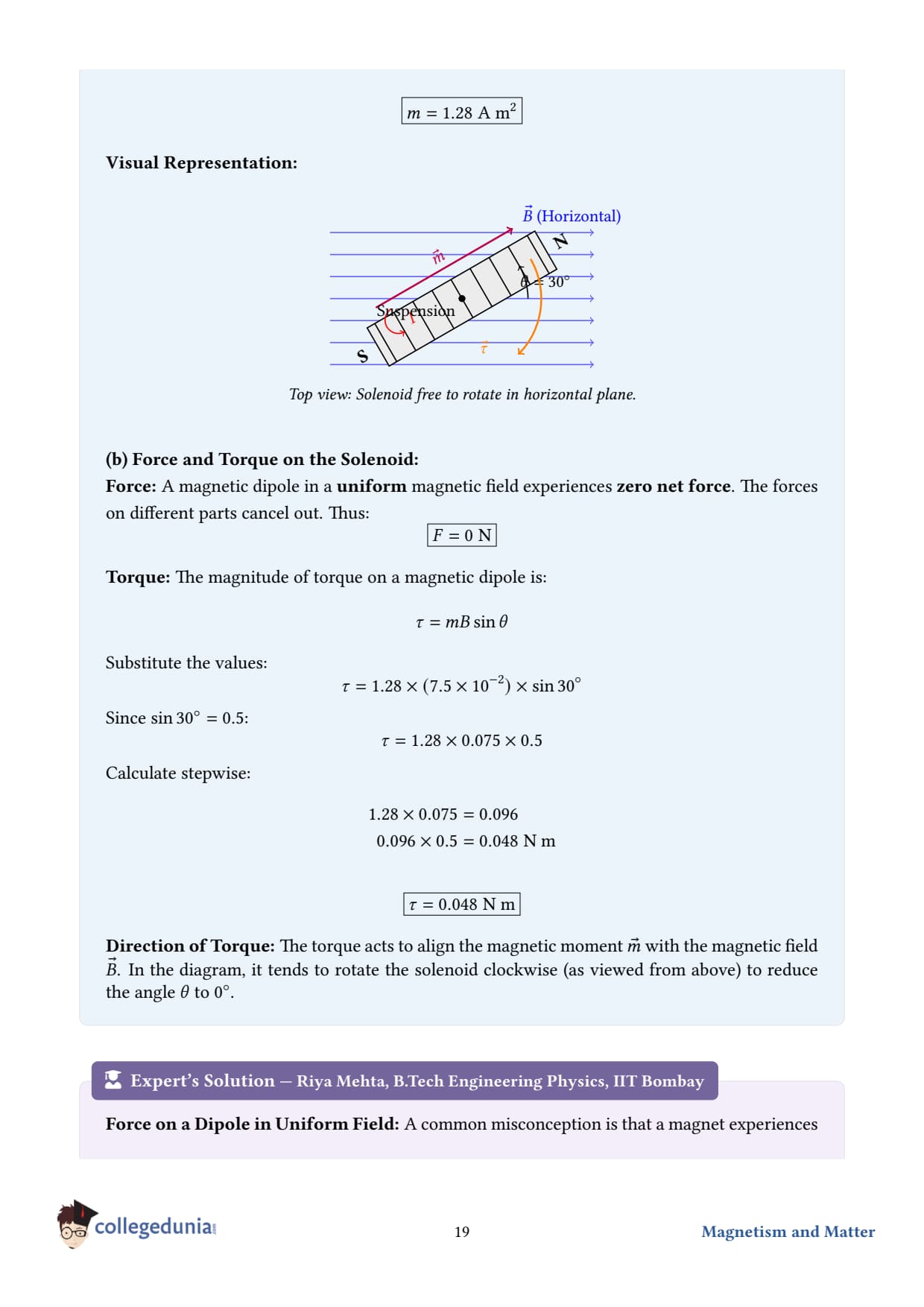
Concept used - force on a dipole in a uniform field. The net force on a magnetic dipole in a uniform external field is zero. The reason: a dipole has equal and opposite "poles," and they feel equal and opposite forces in a uniform field, which cancel. Fnet = 0 (uniform field). There can still be a net torque (which produces rotation, not translation).
Concept used - torque on a dipole. τ = mB sinθ.
Step 3 - substitute for torque. τ = (1.28)(7.510-2) sin 30∘.
(a) m = 1.28 J T-1, along the solenoid's axis (right-hand grip rule).
(b) Force = 0 (uniform field). Torque = 4.810-2Nm, tending to align m with B.
DS
Dr. Shalini Menon
M.Sc Physics, University of Hyderabad
Verified Expert
Why the net force vanishes in a uniform field. The force on a dipole is F = ∇(m·B). In a uniform field, B is constant everywhere, so its gradient is zero - hence F = 0. This is one of the cleanest statements in dipole physics. A bar magnet only feels a net force when the field is NON-uniform (e.g., near another magnet's pole, near an iron core, etc.); a uniform field gives only torque.
Compare with a moving charge. A moving point charge in a uniform field feels a force F = qv×B. A dipole at rest feels zero force in the same field. This is a key distinction - currents and charges feel qv×B, but a complete current loop (dipole) integrates to zero net force in a uniform field.
Force on a dipole in a NON-uniform field. For comparison, near a bar magnet's pole, the field gradient is significant and the dipole feels Fz = mdBzdz. This is why one magnet attracts another, and why iron filings get pulled toward poles. It's also the principle behind Stern-Gerlach experiments, where a non-uniform field is used to separate atoms by their spin orientation.
Alternative: torque from m×B. Here m lies in the horizontal plane and B lies in the horizontal plane at 30∘. The cross product m×B points vertically - exactly the axis of suspension, so the solenoid is free to respond to it. Good engineering: the experimenter chose the suspension axis to coincide with the torque axis.
Common mistake. Students sometimes try to compute F = IL×B for the solenoid wires individually and add them up. While correct, it's the hard way. The dipole formula is much faster and gives the same answer.
Q 5.7
A short bar magnet has a magnetic moment of 0.48 J T-1. Give the direction and magnitude of the magnetic field produced by the magnet at a distance of 10 cm from the centre of the magnet on (a) the axis, (b) the equatorial lines (normal bisector) of the magnet.
What the question is asking. A "short" bar magnet means we treat it as a point dipole - its length is much smaller than the field point's distance. We compute the dipole field at 10 cm (a) along the axis (the line through both poles, extended outward) and (b) on the equatorial line (the perpendicular bisector through the magnet's centre).
Given.
Magnetic moment, m = 0.48 J T-1 (direction: along the axis from S to N).
Distance from centre, r = 10 cm = 0.1 m.
Concepts used - dipole field formulae. For a short magnetic dipole, the field magnitudes are
On the axis (end-on or "Gauss A" position): Baxial = 04π2mr3. Direction: parallel to m (along the axis, pointing from S to N).
On the equator (broadside or "Gauss B" position): Beq = 04πmr3. Direction: antiparallel to m (perpendicular to the line from centre to field point, pointing opposite to the dipole's North).
The constant 04π = 10-7Tm A-1an exact-looking value because 0 was historically defined to make it so.
Direction: parallel to the magnet's axis but pointing OPPOSITE to m (i.e., antiparallel to the dipole moment).
Final answer.
(a) Baxial = 9.6× 10⁻⁵T, along the magnet's axis in the direction of m.
(b) Beq = 4.8× 10⁻⁵T, antiparallel to m.
DV
Dr. Vikram Patel
M.Sc Physics, BHU Varanasi
Verified Expert
The 2:1 ratio. For any short dipole, Baxial/Beq = 2 at the same distance. This is a clean geometric fact: the axial position is "looking down the dipole" so both pole contributions add constructively; the equatorial position sees the two poles from equal but slightly oblique angles, and the components perpendicular to the axis cancel while the parallel components partially add, giving exactly half.
Vector form of the dipole field. The full expression at a general point r (with the dipole at origin) is B(r) = 04π3(m·r)r - mr3. At the axial position, r is parallel to m, so m·r = m and 3mr - m = 2m, giving B = 0/42m/r3 - matches our axial formula. On the equator, r⊥m, so m·r = 0 and B = -0/4πm/r3 - the minus sign explains the antiparallel direction.
Why the equatorial field is antiparallel. Picture the dipole as N (top) and S (bottom) separated by a small distance. Stand to the side at the equator. The N-pole pulls a north-seeking probe toward itself; the S-pole pushes it away. Geometrically, the net field points from N back to S - opposite to m. (Field lines go from N to S in the OUTSIDE world; on the equator, they're going parallel to the dipole-axis but opposite.)
Sanity check with the units.0/4π· /r3= Tm A-1·A m2m3 = T.
Comparison to Earth's field. Earth's surface field is ∼ 5× 10⁻⁵T. Our axial value 9.6× 10⁻⁵T is about twice that - so a small bar magnet at 10 cm competes with the geomagnetic field. That's why a compass needle held very close to a small bar magnet wildly deflects.
Common mistake. Many students forget the factor of 2 in the axial formula or swap the two formulae. Remember the mnemonic: "Axial is twice equatorial." If you write B ∝ 1/r3 and confirm the 2:1 ratio, you're set.
Q 5.8
A short bar magnet of magnetic moment 5.2510-2J T-1 is placed with its axis perpendicular to the earth's field direction. At what distance from the centre of the magnet, the resultant field is inclined at 45∘ with earth's field on (a) its normal bisector and (b) its axis. Magnitude of the earth's field at the place is given to be 0.42 G. Ignore the length of the magnet in comparison to the distances involved.
Setup. A small bar magnet sits with its axis perpendicular to Earth's horizontal magnetic field. At some point near the magnet, the magnet's own field and Earth's field add (vectorially). We want the distance at which this resultant makes a 45∘ angle with Earth's field - once on the equatorial line of the magnet and once on the axial line.
Given.
Magnetic moment, m = 5.2510-2J T-1.
Earth's field, BE = 0.42 G = 0.42× 10⁻⁴T = 4.2× 10⁻⁵T.
Magnet's axis is perpendicular to BE.
Key geometric insight. Because the magnet's axis is perpendicular to BE:
On the magnet's equatorial line (perpendicular to its axis): the magnet's field BM is antiparallel to m, i.e., perpendicular to BE. So BM ⊥ BE.
On the magnet's axial line (along its axis): the magnet's field BM is along m, also perpendicular to BE. Again BM ⊥ BE.
In both cases, the magnet's field at the chosen point is perpendicular to Earth's field. So the resultant makes 45∘ with BE exactly when |BM| = |BE| (the two perpendicular components have equal magnitude).
Concept used - dipole field formulae. Baxial = 04π2mr3, Beq = 04πmr3.
Why 45∘ means equal magnitudes. When two perpendicular vectors of magnitudes A and B add, the resultant makes an angle α with the B-vector where tanα = A/B. For α = 45∘, tan 45∘ = 1, so A = B. This is the crisp condition the problem hinges on - without it the algebra is messier.
The 2:1 ratio strikes again. Since the axial field is twice the equatorial field at the same distance, the distance at which the axial field equals BE must be larger than the equatorial distance - exactly by a factor 21/3 ≈ 1.26. Verify: 6.30/5.00 = 1.26. Always a useful cross-check.
Direction of the resultant.
Equatorial case (a): The magnet's field at the equatorial point is antiparallel to its moment m. Combined with BE perpendicular to m, the resultant tilts 45∘ away from BE toward -m.
Axial case (b): The magnet's field at the axial point is parallel to m. The resultant tilts 45∘ toward +m.
So the two resultants are on opposite sides of Earth's field direction.
Real-world example - neutral point. When the magnet's field and Earth's field are antiparallel (instead of perpendicular as here), there's a special distance where they exactly cancel - the "neutral point" where a compass needle has no preferred direction. The location depends on the same dipole-field formula B ∝ m/r3, set equal to BE but in the antiparallel geometry.
Common mistake. Confusing gauss with tesla. 1 gauss = 10-4 tesla. Earth's surface field is conventionally written as 0.3 to 0.6 G, which is 3 to 6× 10⁻⁵T. Forgetting the 10-4 factor throws the answer off by a factor of ∼ 50 in r (since r∝ BE-1/3, and 1041/3 ≈ 21.5).
Q 5.9
A closely wound solenoid of 800 turns and area of cross-section 2.510-4 m2 carries a current of 3.0 A. The solenoid is free to rotate. Show that the solenoid acts like a bar magnet and find the direction of its magnetic moment if the current in the solenoid flows anticlockwise when viewed from a particular end.
Why the solenoid acts like a bar magnet. Each turn of wire is a tiny current loop. By the equivalence between a current loop and a magnetic dipole, each loop has its own magnetic moment mloop = IA, directed perpendicular to the plane of the loop (right-hand rule). When the loops are stacked side-by-side along an axis (a solenoid), their moments all point the same way and add: msolenoid = NIA. The result is identical (in its EXTERNAL field) to a bar magnet with the same moment - one end behaves as a North pole, the other as a South pole, and field lines emerge from N and re-enter at S.
Given.
N = 800 turns.
A = 2.510-4 m2.
I = 3.0 A.
From the chosen end, current flows anticlockwise.
Concept used - right-hand grip rule for a current loop. Curl the fingers of the right hand along the current direction. The thumb points along the magnetic moment m. Equivalently, when looking at the loop from one end, if the current appears to flow anticlockwise, that end is the North pole; if clockwise, it's the South pole.
Step 1 - apply the rule. Current is anticlockwise when viewed from the chosen end. By the right-hand rule, the magnetic moment m points OUT of that end - toward the observer. So that end is the North pole of the equivalent bar magnet, and the opposite end is the South pole.
Step 2 - compute the magnitude.m = NIA = (800)(3.0)(2.510-4). m = 800× 3.0 × 2.5× 10-4 = 6000× 10-4 = 0.60 A m2.
Final answer.
Magnitude: m = 0.60 J T-1.
Direction: out of the end where current appears anticlockwise (that end is the N-pole).
DL
Dr. Lakshmi Iyer
Ph.D. Applied Physics, IIT Bombay
Verified Expert
A simple mnemonic - "ANticlockwise = North." Capital letters of both words match, making it easy to remember. Equivalently: ClockWise = South - "C" pairs with "S" in the alphabet through their nearby positions, but the ANticlockwise-North link is what most students remember.
Why the moment direction matters. The torque on the solenoid in an external field is τ = m×B; the potential energy is U = -m·B; the force on it in a non-uniform field is F = ∇m·B. Every one of these requires knowing the direction of m, not just its magnitude. Get the direction wrong and you predict the solenoid swings the WRONG way in a field - a fatal error in any vector problem.
Picturing the field lines. Inside the solenoid, field lines run from S to N (a strong, nearly uniform field). Outside, they loop around from N to S - exactly like a bar magnet. The solenoid is the "honest" version of a bar magnet - it makes explicit that the source of permanent-magnet fields is microscopic current loops (electron spin and orbital motion in atoms).
Reversing the current. Flip the current direction (now clockwise from the same end), and the right-hand rule reverses: that end becomes the South pole instead. So the solenoid's "polarity" can be switched at will - this is the basis of electromagnets (and electromagnetic relays, doorbells, MRI scanners, particle accelerators).
Common mistake. Students sometimes use the LEFT hand by accident - typically because they're holding a pen in the right hand. Always set down what you're holding and use the right hand for these direction rules.
Q 5.10
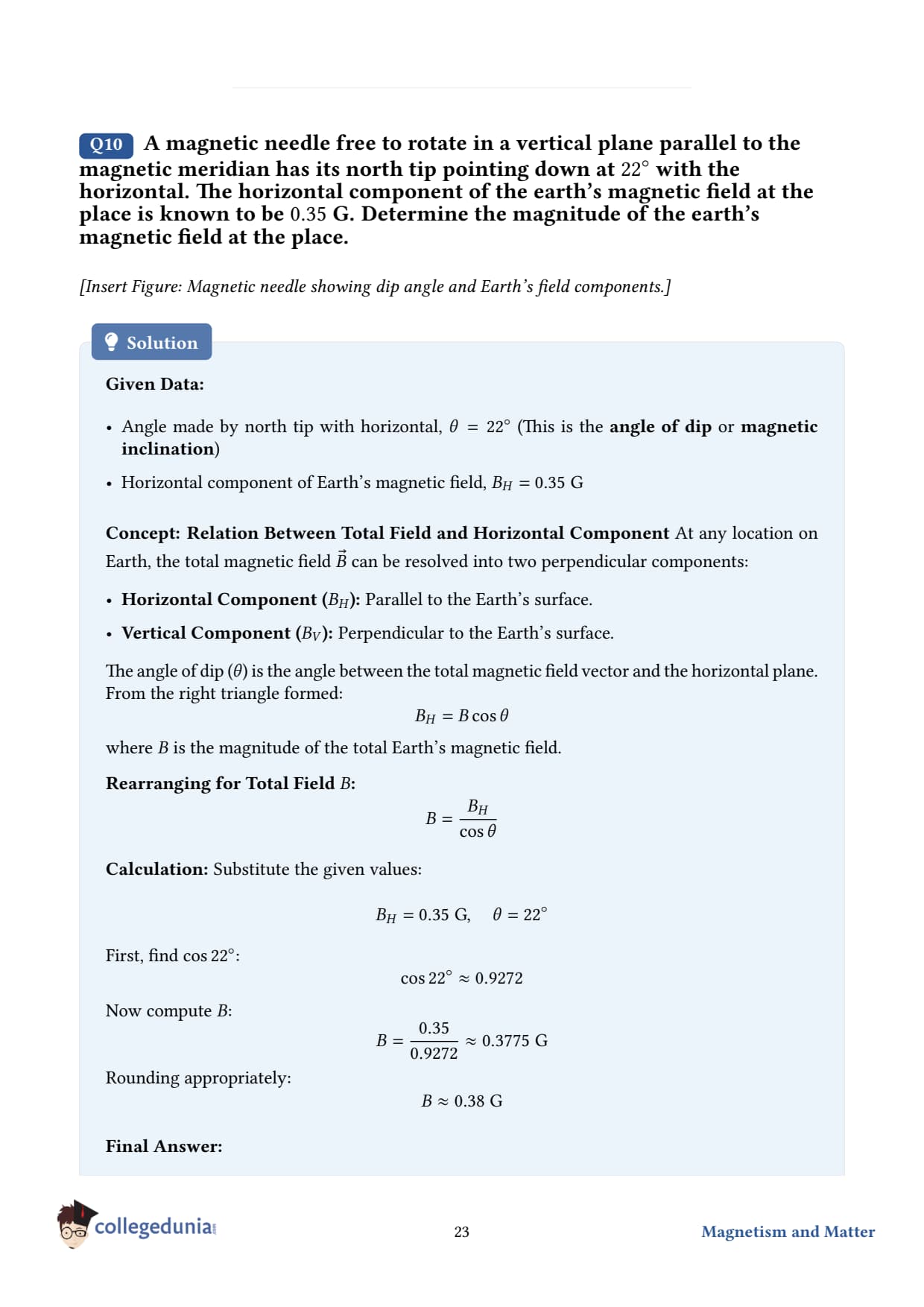
A magnetic needle free to rotate in a vertical plane parallel to the magnetic meridian has its north tip pointing down at 22∘ with the horizontal. The horizontal component of the earth's magnetic field at the place is known to be 0.35 G. Determine the magnitude of the earth's magnetic field at the place.
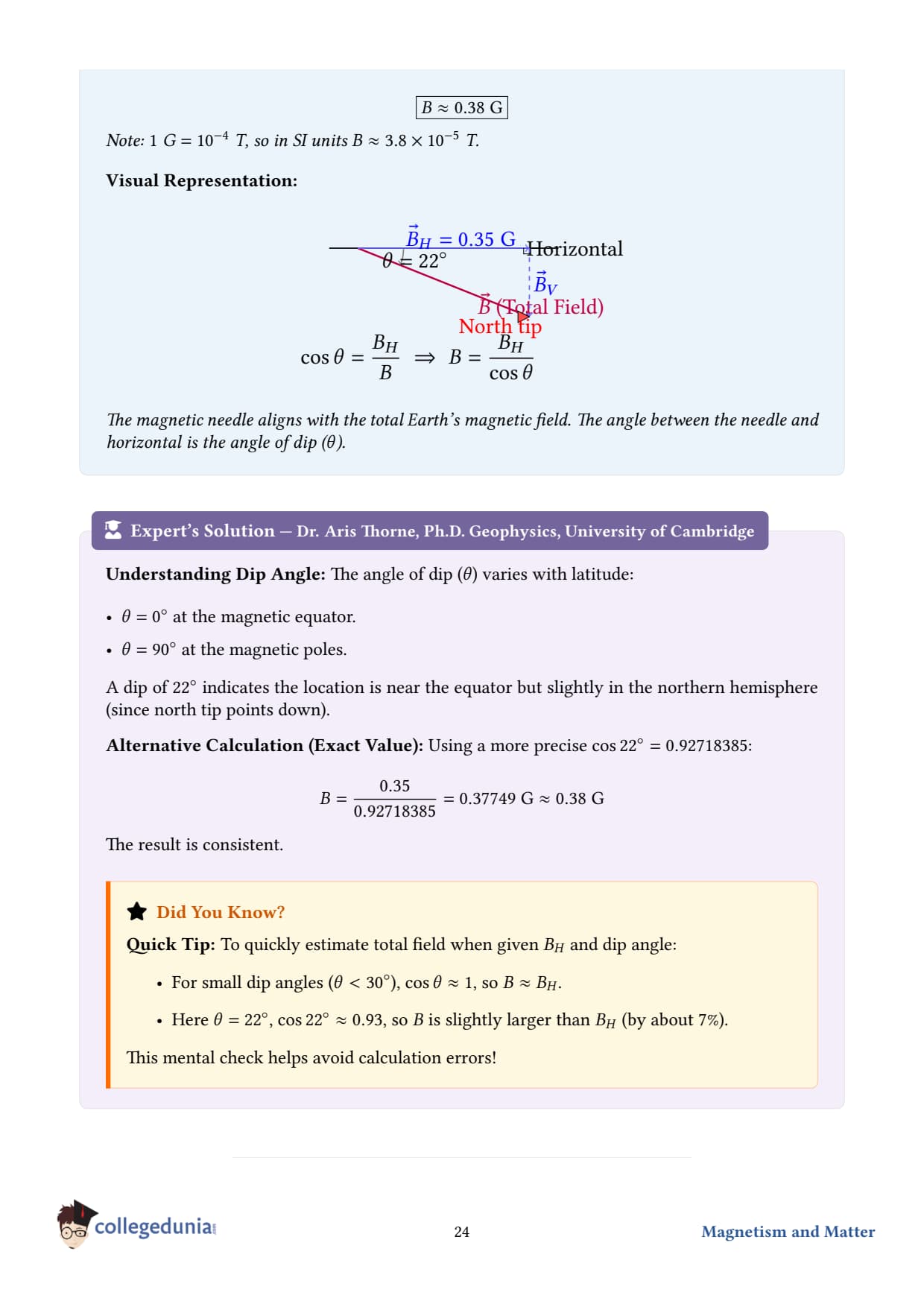
Background - Earth's field components. Earth's total magnetic field BE at any point near the surface can be decomposed into a horizontal component BH and a vertical component BV. The angle between BE and the horizontal is called the angle of dip (or inclination), denoted δ (or I). When a magnetic needle is free to swing in the vertical plane along the magnetic meridian, it aligns along BE - so its tip dips below horizontal by exactly the dip angle.
Given.
Angle of dip, δ = 22∘ (N-tip points downward, i.e., this is in the Northern hemisphere).
Horizontal component, BH = 0.35 G.
Concept used - geometry of dip. If the total field has magnitude BE and makes angle δ with the horizontal, BH = BE cosδ, BV = BE sinδ, tanδ = BVBH. Rearranging for BE: BE = BHcosδ.
Step 1 - write the formula. BE = BHcosδ.
Step 2 - evaluate cos 22∘. cos 22∘ ≈ 0.927. Memorise: cos 0∘ = 1, cos 30∘ ≈ 0.866, and for 22∘ it lies between - close to 0.93.
Step 3 - substitute. BE = 0.350.927.
Step 4 - divide. BE ≈ 0.378 G ≈ 0.38 G.
Step 5 - convert to SI (optional). BE ≈ 0.38× 10⁻⁴T = 3.8× 10⁻⁵T.
Final answer. BE ≈ 0.38 G = 3.8× 10⁻⁵T.
DP
Dr. Pradeep Mahajan
Ph.D. Geomagnetism, IIG Mumbai
Verified Expert
What "angle of dip" measures, geometrically. Stand at a point on Earth. The horizontal local plane is your reference. The magnetic field at that point points down (in the Northern hemisphere) into the ground at angle δ. At the magnetic equator, δ = 0∘ (field is horizontal); at the magnetic poles, δ = 90∘ (field is vertical, straight down or straight up). A δ = 22∘ reading suggests a location at a relatively low magnetic latitude - perhaps somewhere in southern India.
The three "elements" of Earth's field. A complete description of geomagnetism at a point requires three numbers:
Horizontal componentBH (magnitude in the horizontal plane).
DeclinationDangle between true geographic north and the horizontal projection of BE.
Dipδ (angle below horizontal).
Given any two of these plus BH or the total BE, the full field vector is determined. The needle in our problem measures δ directly because the needle aligns with BE when free to tilt vertically.
Alternative computation. One could equally compute BV = BHtanδ = 0.3522∘ ≈ 0.35× 0.404 ≈ 0.141 G, then BE = √BH2+BV2 = √0.352+0.1412 = √0.1225+0.0199 = √0.1424 ≈ 0.377 G. Matches - within rounding error.
Why N-tip pointing DOWN means Northern hemisphere. Earth's geographic North pole is actually a magnetic South pole (field lines RE-enter the Earth there). So compass needles, whose N-poles are attracted to that magnetic-South, dip downward into the ground in the Northern hemisphere. In the Southern hemisphere, the N-tip points UP instead.
Common mistake. Students sometimes use BE = BHsinδ - wrong gives BV, not BE. Or use BE = BH cosδ - wrong gives less than BH, which is geometrically impossible since BE is the hypotenuse. Always start from the right triangle: BH is the adjacent side, BV is opposite, BE is the hypotenuse.
Q 5.11
At a certain location in Africa, a compass points 12∘ west of the geographic north. The north tip of the magnetic needle of a dip circle placed in the plane of the magnetic meridian points 60∘ above the horizontal. The horizontal component of the earth's field is measured to be 0.16 G. Specify the direction and magnitude of the earth's field at the location.
What the three measurements mean.
DeclinationD = 12∘W of geographic north - the horizontal projection of BE is tilted 12∘ to the west of true north.
Dipδ = 60∘ ABOVE horizontal (the N-tip points UP) - so this location is in the SOUTHERN hemisphere (field lines emerge from the ground here, in Southern Africa).
Horizontal componentBH = 0.16 G.
From these we determine the magnitude and the full direction of BE.
Concept used - same geometry as Q 5.10. BH = BEcosδ, BE = BHcosδ. The direction in 3D is specified by D (compass deviation from true north) and δ (tilt below or above horizontal).
Step 1 - solve for BE. BE = BHcosδ = 0.16cos 60∘.
Step 2 - evaluate cos 60∘. cos 60∘ = 12 = 0.5.
Step 3 - divide. BE = 0.160.5 = 0.32 G.
Step 4 - convert to SI. BE = 0.32× 10⁻⁴T = 3.2× 10⁻⁵T.
Step 5 - specify the direction. The earth's field vector BE:
Lies in the magnetic meridian plane.
The magnetic meridian is tilted 12∘ west of geographic north (declination).
Within this plane, BE makes 60∘ ABOVE the horizontal (since the N-tip of the dip needle points upward - typical of the Southern hemisphere).
Final answer.
Magnitude: BE = 0.32 G = 3.2× 10⁻⁵T.
Direction: in the magnetic meridian plane 12∘ west of geographic north, pointing 60∘ above the horizontal.
DA
Dr. Aisha Khan
Ph.D. Geomagnetism, NGRI Hyderabad
Verified Expert
Why the N-tip points UPWARD in southern Africa. Earth's magnetic field lines form closed loops emerging from the magnetic-south (which is near the geographic North pole) and re-entering at the magnetic-north (near the geographic South pole). So in the Southern hemisphere, field lines come OUT of the ground and curve upward. A dip needle aligns along these lines - its N-tip thus tilts UP rather than down.
Computing the components in full.
BH = 0.16 G (given, horizontal).
BV = BEsinδ = 0.3260∘ = 0.32× 0.866 ≈ 0.277 G (vertical, pointing upward in Southern hemisphere).
BE = 0.32 G (total).
Cross-check: BE = √BH2+BV2 = √0.0256+0.0768 = √0.1024 = 0.32 G. ✓
Why declination matters. If you're navigating by compass, the needle points along the local magnetic meridian, not toward the geographic north pole. To get to true north, you must rotate D = 12∘ east of the needle's reading. Maps usually print declination so navigators can correct. Declination varies slowly with time (decade scale) and significantly with location - in some places it's zero (the agonic line); in northern Canada it can exceed 20∘; near the magnetic poles, it can be very large and unstable.
Geomagnetic-pole geometry. The dip is 60∘ above horizontal, so the magnetic latitude (angular distance from the magnetic equator) is given by -lat = 12tanδ, giving mag-lat ≈ 40.9∘ south of the magnetic equator. Combined with declination 12∘W, this points to a location somewhere in southern Africa - consistent with the problem statement.
Common mistake. Reading cos 60∘ as 0.866 instead of 0.5. Remember: sin 30∘ = cos 60∘ = 0.5; sin 60∘ = cos 30∘ = 0.866. Memorise the complementary-angle pattern.
Sanity check. Earth's surface field varies from ∼ 0.25 G (near the equator) to ∼ 0.65 G (near the magnetic poles). Our 0.32 G for a mid-latitude location in Africa is right in the expected range.
NCERT Solutions Class 12 Physics Chapter 5 Magnetism and Matter FAQs
Ques. How many questions are solved in ncert solutions class 12 physics chapter 5?
Ans. All 11 NCERT exercise questions, Q5.1 to Q5.11, are solved step by step. They span the bar magnet class 12 as an equivalent magnetic dipole, Gauss's law of magnetism, Earth magnetism class 12 (declination, dip, horizontal component), and the magnetic properties of materials class 12. Use the Exercise-by-Exercise Breakdown table above to jump to the answer you need.
Ques. What is the torque on a bar magnet in physics class 12 chapter 5 ncert solutions?
Ans. Torque tau = M B sin theta where M is the magnetic dipole moment class 12, B the external field, and theta the angle between them. Vector form: tau = M cross B. The chapter 5 physics class 12 ncert solutions show how this aligns the dipole moment with the field at stable equilibrium.
Ques. How should I write the answer for a susceptibility numerical in chapter 5?
Ans. Define the term, state the formula, then substitute. Magnetic susceptibility class 12 chi = M / H is dimensionless and relative permeability mu_r = 1 + chi. Write that line first, plug in M and H in SI units, and box the answer. Note the chi sign (diamagnetic small negative, paramagnetic small positive, ferromagnetic very large positive) only if the question asks you to classify.
Ques. What are the three elements of Earth magnetism class 12?
Ans. Declination (angle between geographic and magnetic north), dip / inclination (angle between Earth's field and horizontal), and horizontal component of Earth's field (B_H = B cos theta). These three completely specify Earth's field at any point. The physics class 12 magnetism and matter provides worked numericals on all three.
Ques. How are diamagnetic, paramagnetic, and ferromagnetic materials classified?
Ans. By the sign and magnitude of susceptibility. Diamagnetic: chi small negative (water, copper). Paramagnetic: chi small positive (aluminium, oxygen). Ferromagnetic: chi very large positive, with permanent magnetisation possible (iron, nickel, cobalt). Ferromagnets also show hysteresis.
Ques. What is the weightage of magnetism and matter class 12 in the CBSE board exam?
Ans. Chapter 5 carries 3 marks on average, the lowest in the Magnetism unit. JEE Main draws 1 to 2 percent and NEET pulls 0 to 1 question per year. The chapter is a scoring, low-effort block: a 3-hour first read plus a 1-hour revision is enough.








Comments