




These Journey to the End of the Earth Class 12 notes match the 2026-27 NCERT Vistas print and condense Tishani Doshi's essay into an exam-ready sheet. They follow a four-pass workflow: context, three-phase plot, character map, and theme-tagged value points.
- CBSE Weightage: 6 marks per Vistas Long Answer in Section C, drawn from the four Reading with Insight questions
- Coverage: 13-page revision PDF, themed sections, people sketches, a marker table, and a sample 6-mark answer on the phytoplankton parable
These Class 12 English Notes for Journey to the End of the Earth are made by Collegedunia experts, mapped to the 2026-27 NCERT Vistas print, and checked against the last five years of CBSE Board papers.

Journey to the End of the Earth Class 12 Notes: What the Chapter Covers
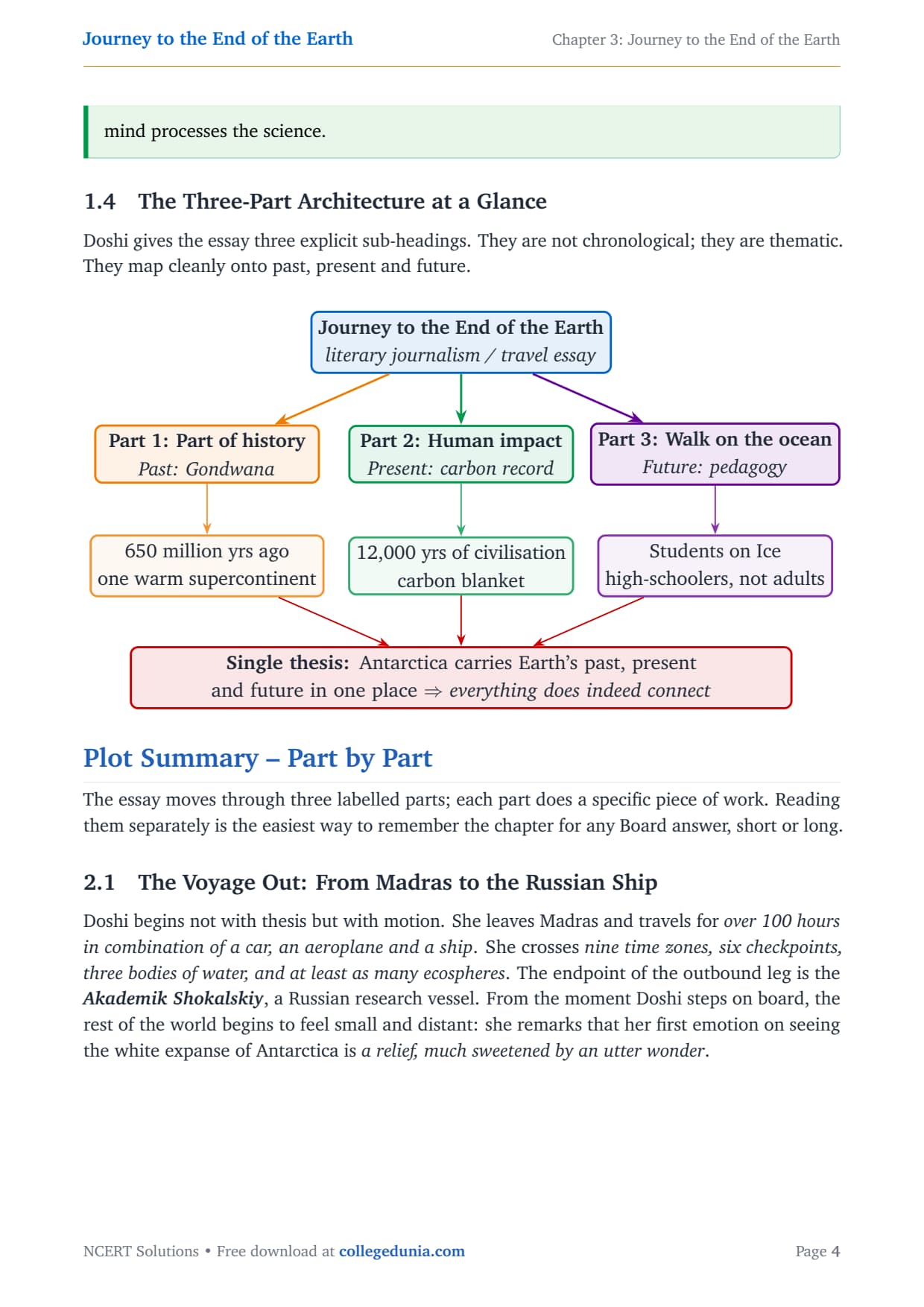
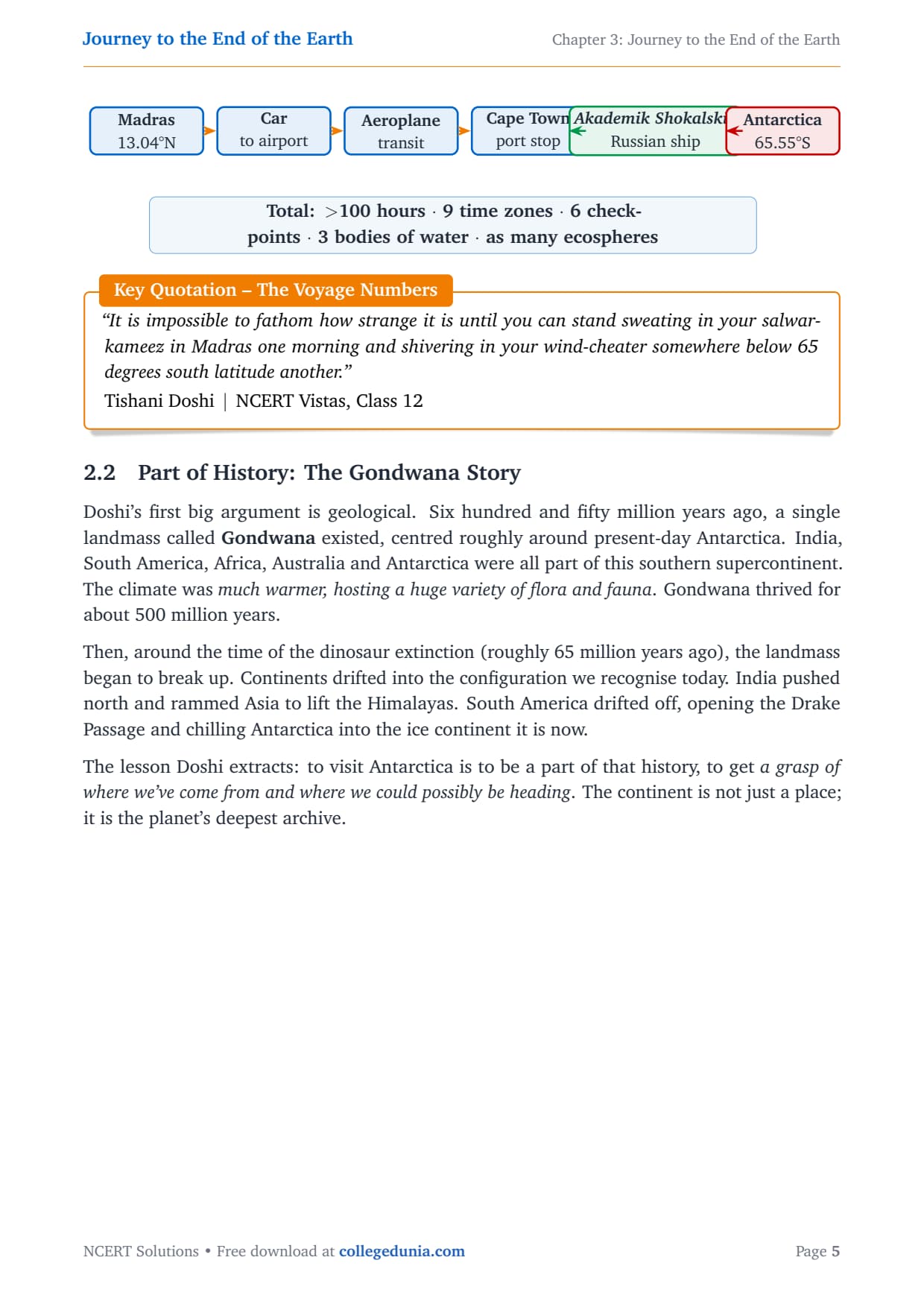
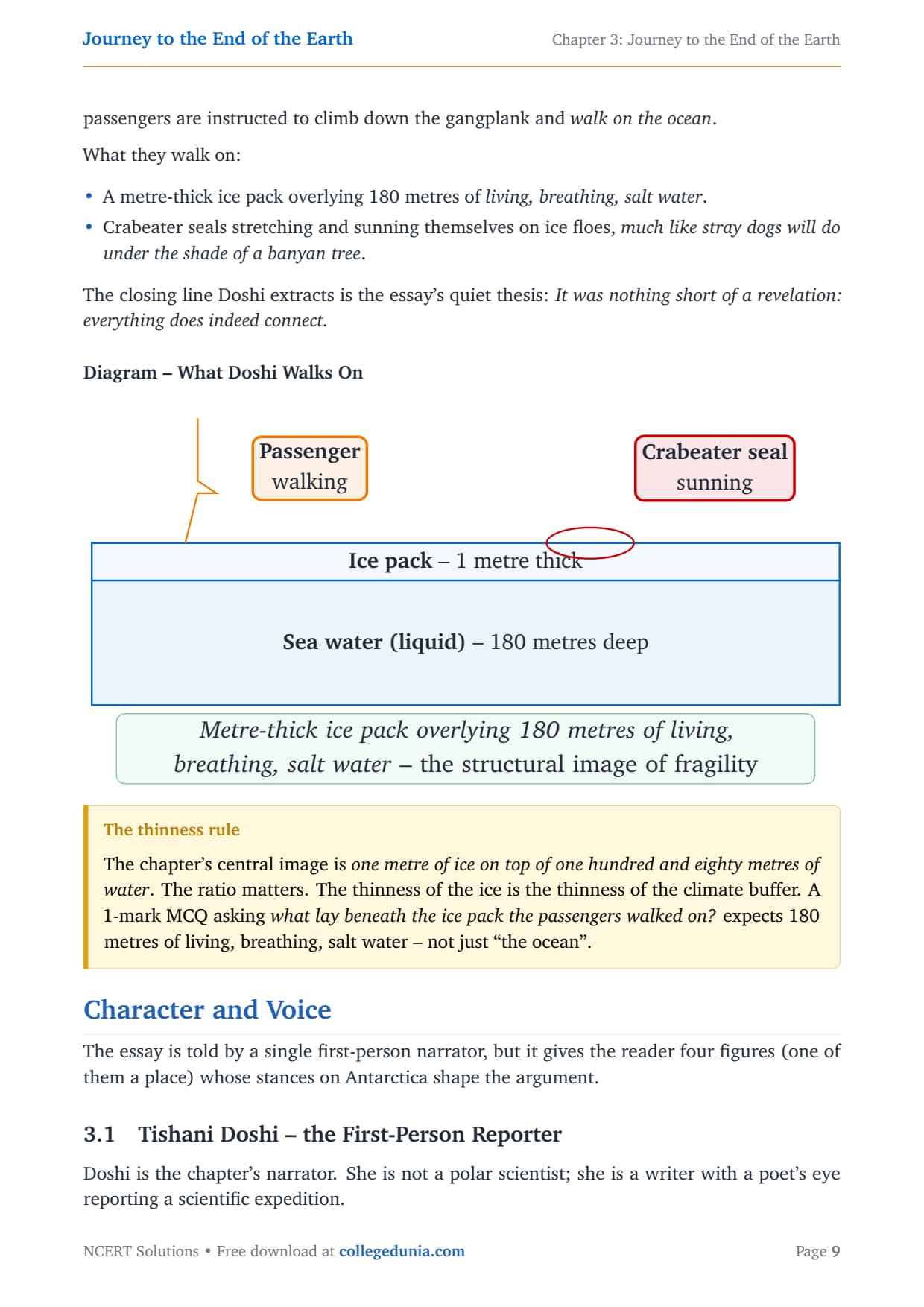
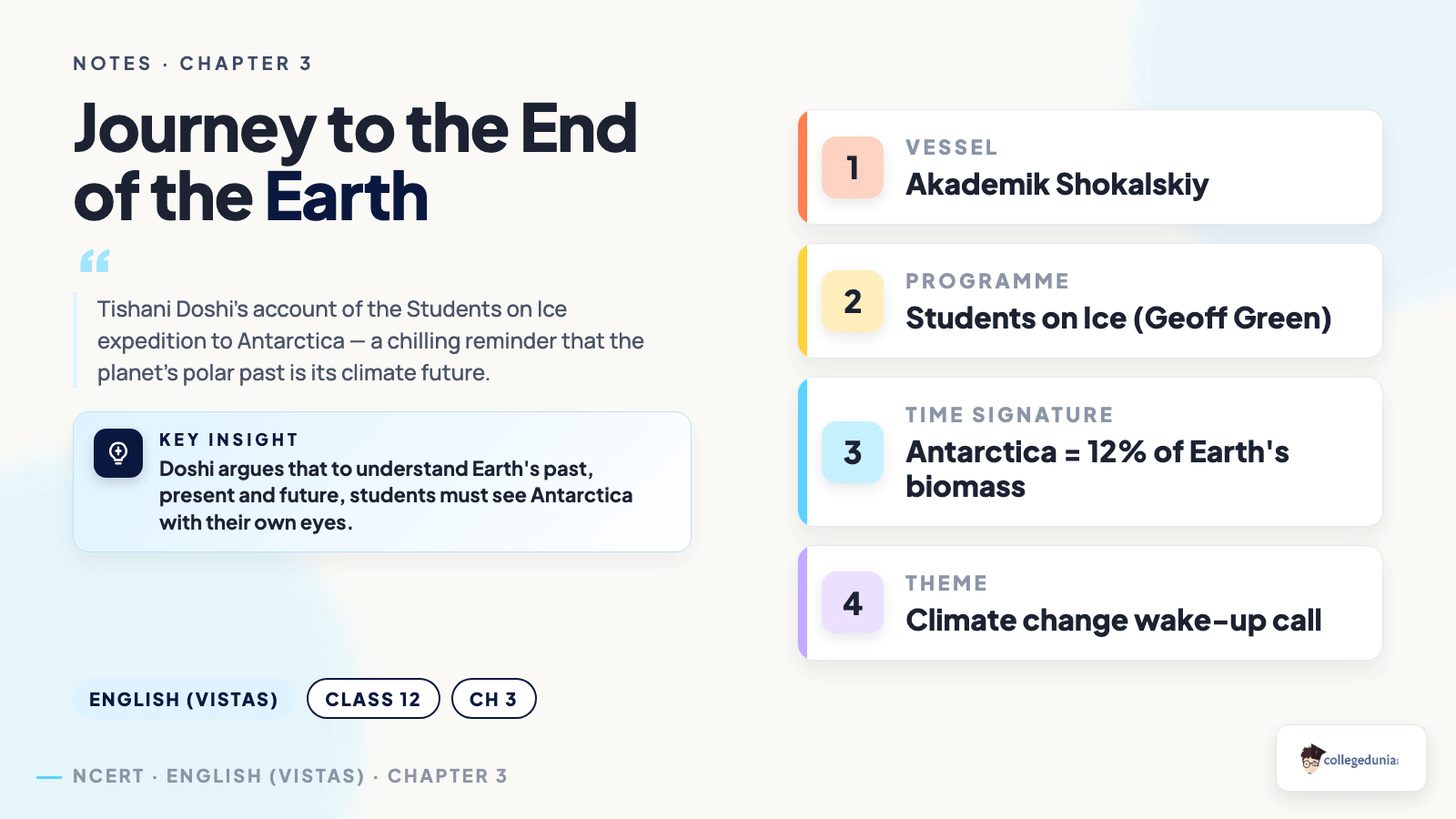
Journey to the End of the Earth is the third piece in the Class 12 Vistas reader. Written by the Indian poet and journalist Tishani Doshi (born 1975), it recounts her trip from Madras to the Antarctic peninsula aboard the Russian research vessel Akademik Shokalskiy, as part of the Canadian Geoff Green's Students on Ice expedition. The essay uses three sub-headings, Part of history, Human impact and Walk on the ocean, that map onto the planet's past, present and future. It closes with Doshi on a metre-thick ice pack above 180 metres of salt water, noting: "everything does indeed connect."
| Section | What It Covers | Typical Mark Yield |
|---|---|---|
| 1. Setting and Author | Doshi; Madras to Antarctic peninsula; Akademik Shokalskiy; Students on Ice | 1-2 marks MCQ |
| 2. Plot Summary | Three-phase walk: Gondwana past, climate-change present, phytoplankton future | 2-3 marks SA |
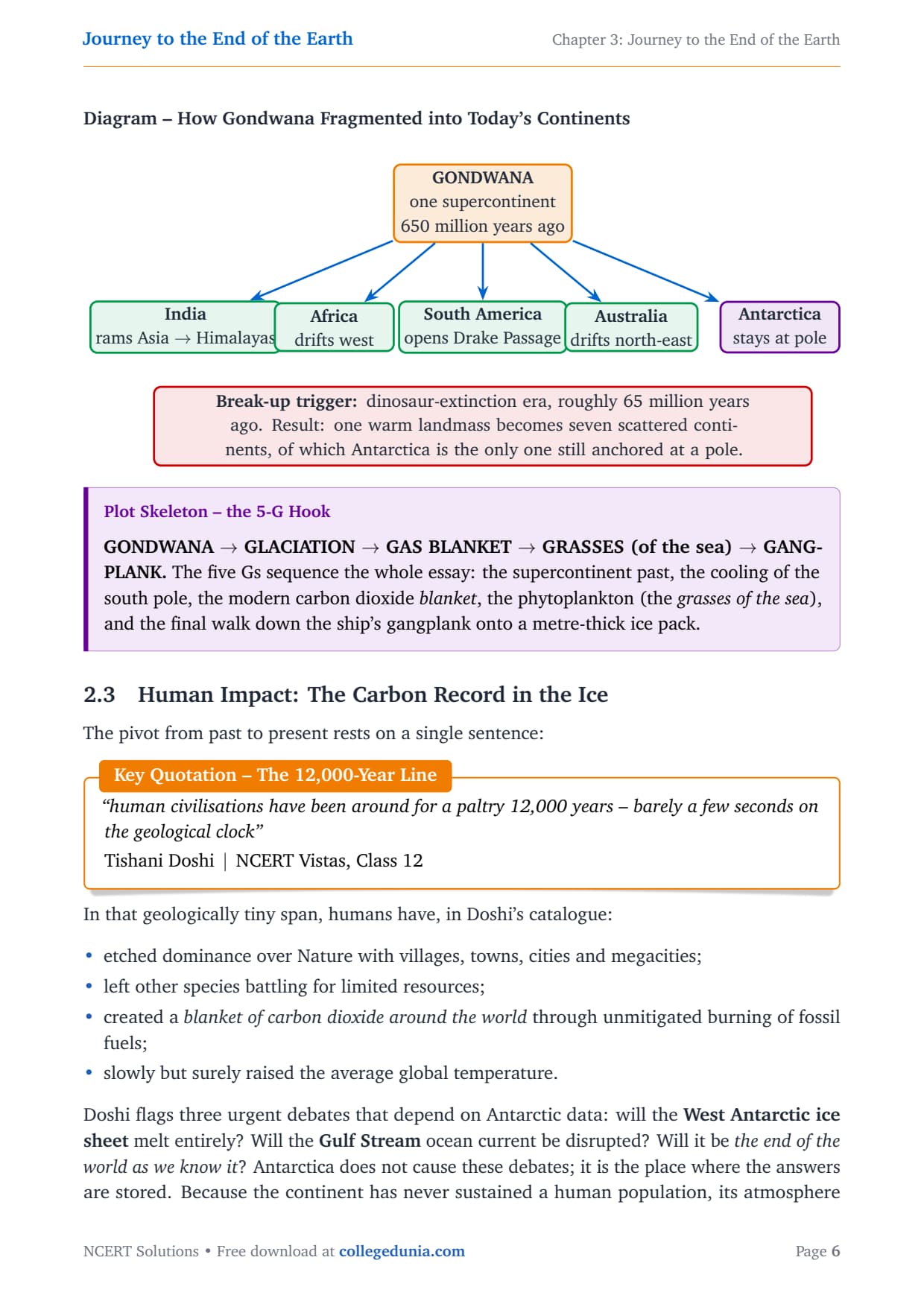
| 3. Part of History (Past) | Gondwana 650 Ma, daughter continents, Drake Passage opening | 3-6 marks LA |
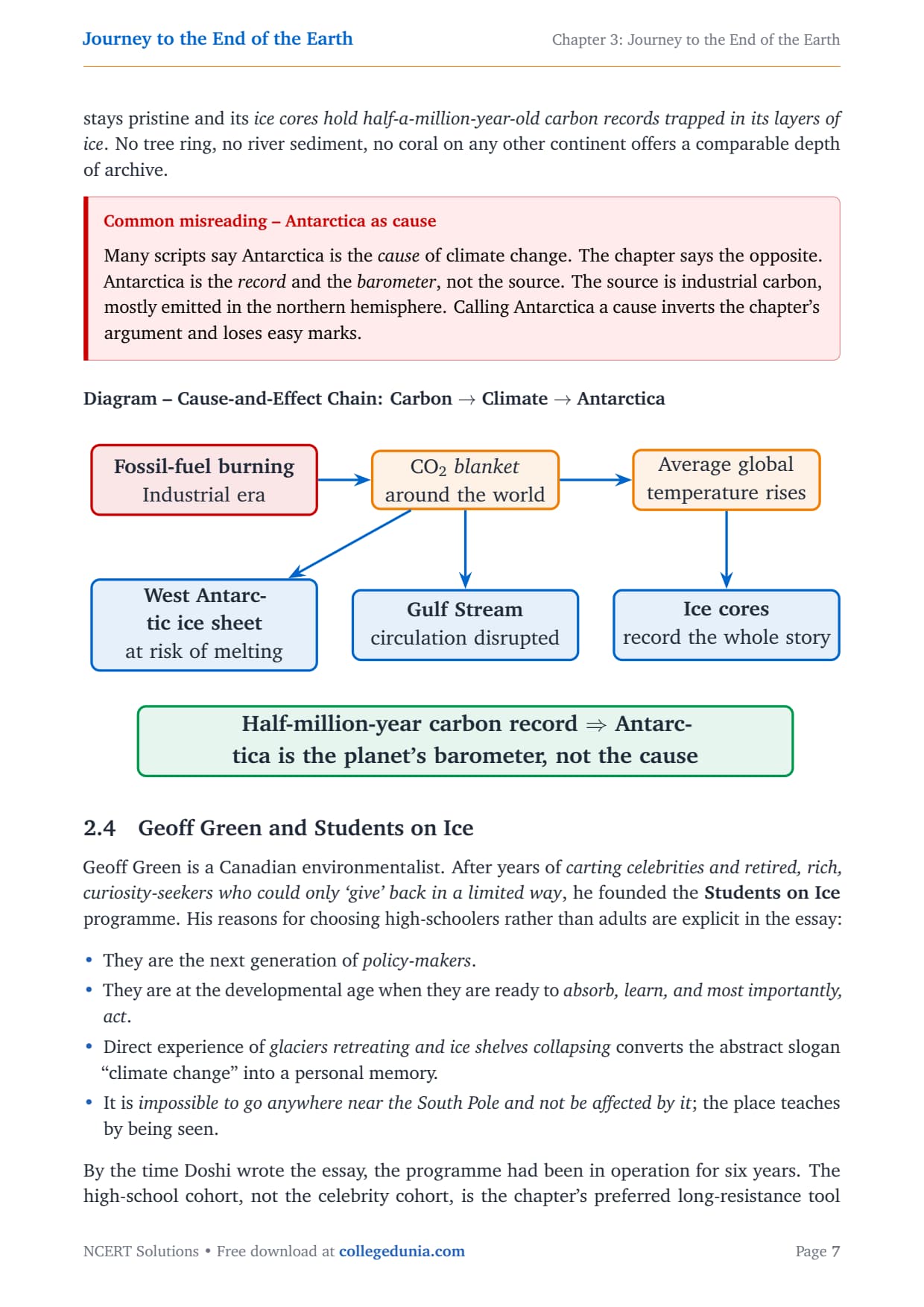
| 4. Human Impact (Present) | 12,000-year line, carbon-dioxide blanket, ice-core records | 3-6 marks LA |
| 5. Walk on the Ocean (Future) | 65.55 S, the ozone-phytoplankton cascade, the small-things moral | 4-6 marks LA |
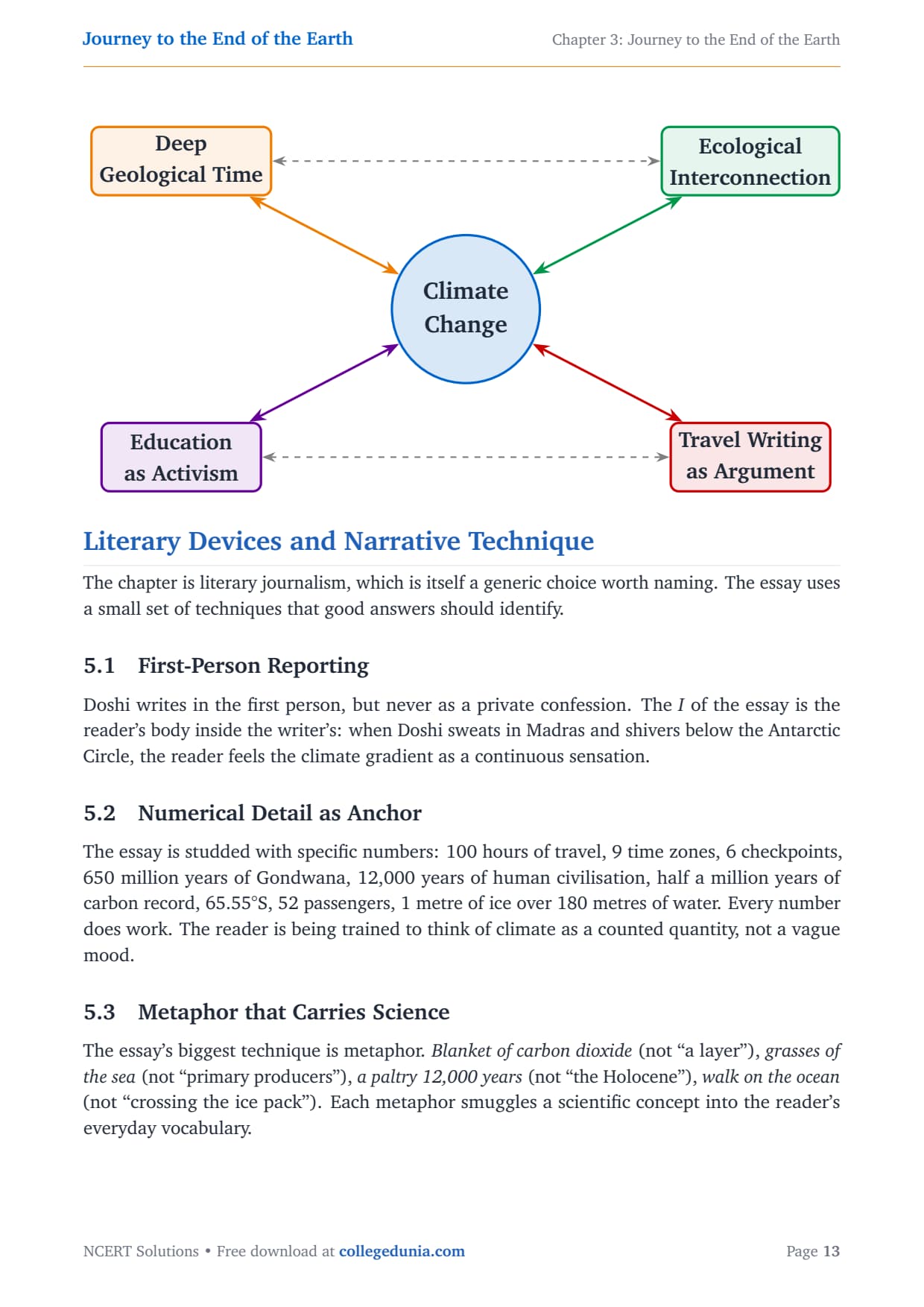
| 6. Themes and Devices | Deep time, climate change, interconnection, education as activism | 2-3 marks SA |
CBSE almost always pulls a 6-mark Long Answer from sections 3, 4 or 5.
Journey to the End of the Earth Video Explanation (Class 12 English)
Source: Magnet Brains on YouTube
The Four-Pass Framework for Reading and Revising Journey to the End of the Earth
Every Vistas chapter decomposes into the same four passes.
- Context. The Madras-to-Antarctic route, the Akademik Shokalskiy, Students on Ice, and Doshi's three sub-headings.
- Plot. Three phases plus a climax: past (Gondwana), present (climate change), future (phytoplankton cascade), climax (the ice-pack walk).
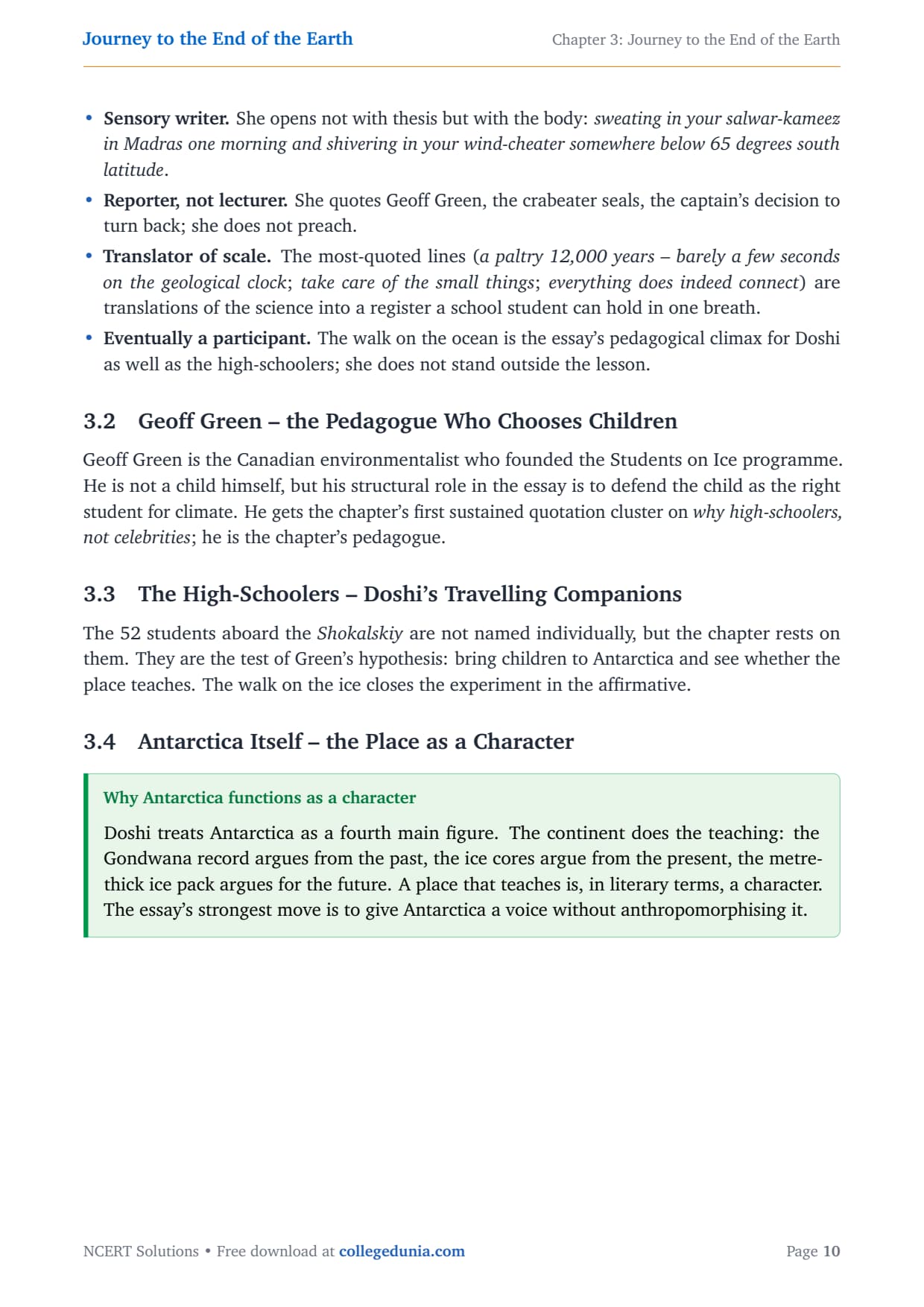
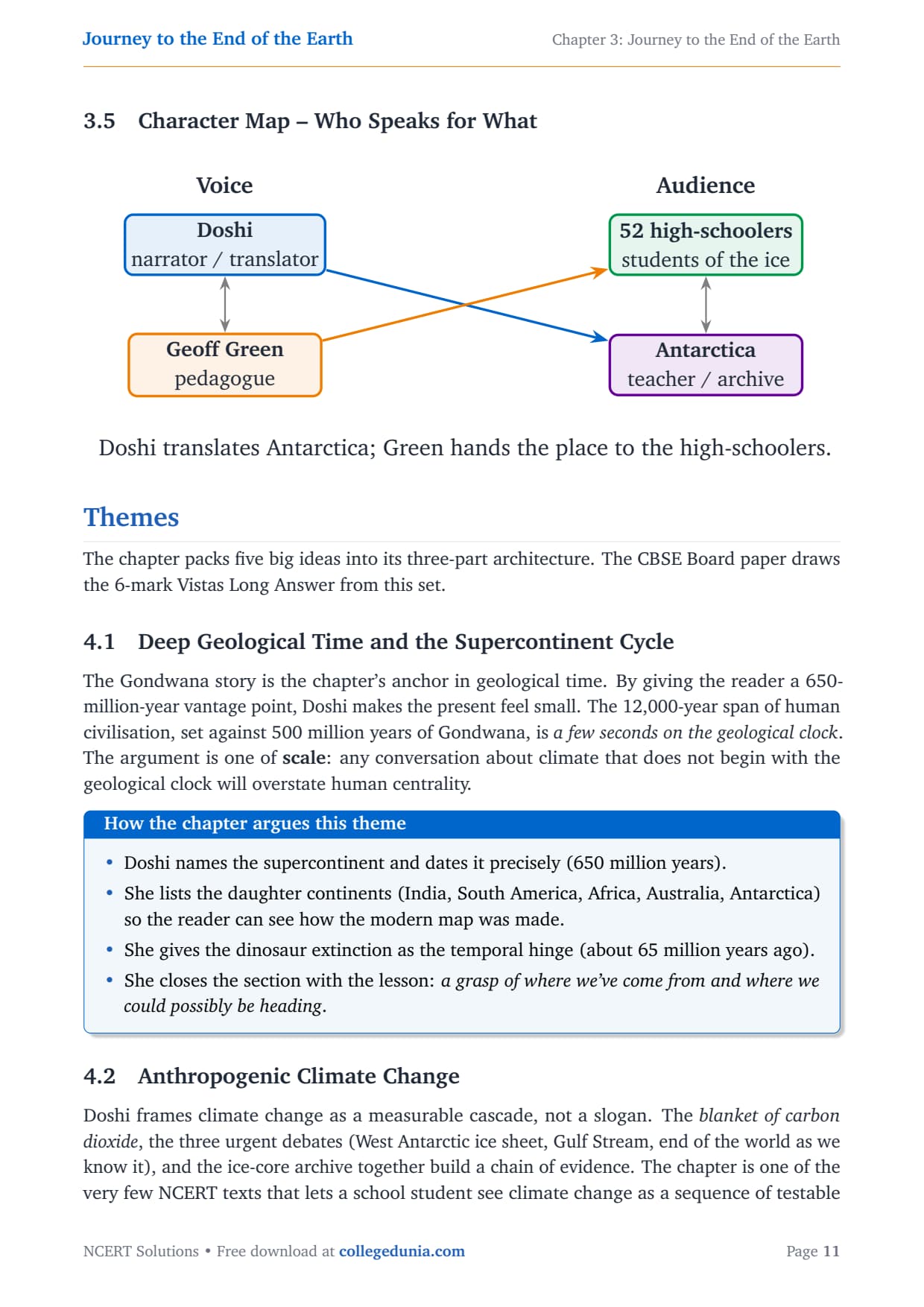
- Character. Four anchors: Doshi, Geoff Green, the 52 passengers, and the Captain who turns back.
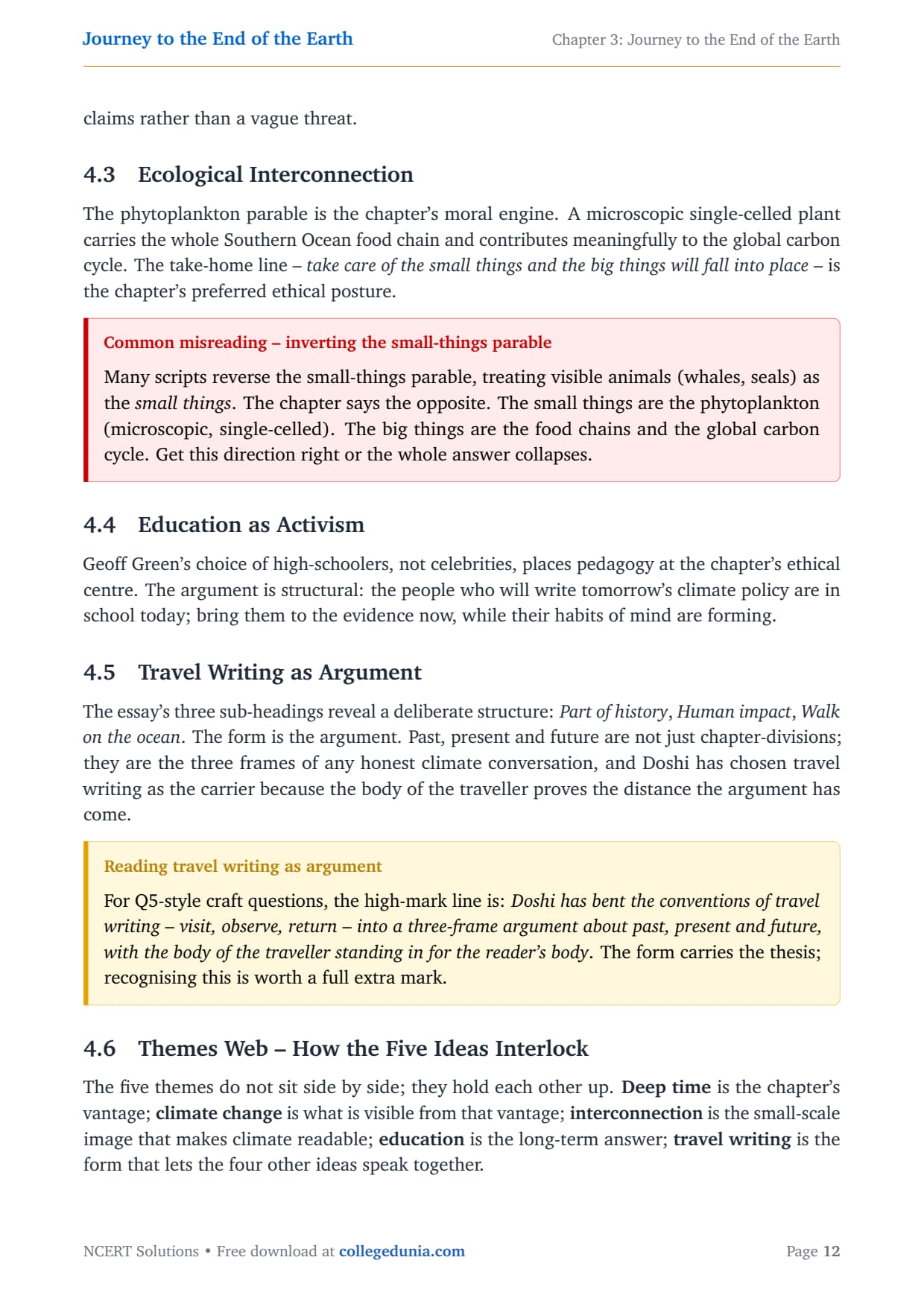
- Theme. Note the central argument (Antarctica carries past, present and future) and tag each quotation with a theme.
Setting: Madras to the Antarctic Peninsula via the Akademik Shokalskiy
The essay is set on a single moving line, from Madras (13.09 degrees north) to the Antarctic peninsula (65.55 degrees south). Doshi takes 100 hours of travel and nine time zones to get there, ending on a metre-thick ice pack above 180 metres of salt water near Tadpole Island.
Antarctica is the only continent that never sustained a human population, which is why its ice cores carry half-million-year carbon records. The setting is itself the argument.
Character Sketch: Tishani Doshi, the Sun-Worshipping South Indian Narrator
Tishani Doshi is the first-person narrator, an Indian poet, journalist and dancer (born 1975). The essay is reprinted from her writing for The Hindu.
- Self-aware outsider. She calls herself a sun-worshipping South Indian going to a place holding 90 percent of the Earth's ice.
- Literary journalist, not scientist. She lets geology and ecology arrive through observation, so the science reads as a parable.
- Argument carrier. Her three sub-headings are the argument; a student can copy them into the answer skeleton.
- Quietly moralised. She ends on "everything does indeed connect", a revelation, not a sermon.
Character Sketch: Geoff Green, the Canadian Founder of Students on Ice
Geoff Green is the chapter's quiet hero, the Canadian founder of Students on Ice.
- Career switcher. He had run Antarctic trips for celebrities who could only "give back in a limited way".
- Strategic bet on the young. He switched to high-schoolers, the future policy-makers, ready to absorb, learn and act.
- Pedagogical realist. No textbook, he says, can match standing on the ice pack at 65.55 degrees south.
- Mirror of Doshi. Green is to ecology what Doshi is to literature; both switched from prestige to pedagogy.
Green never appears in dialogue; he is described through his choices.
Symbolism and Five Embedded Markers
The essay is built around five recurring markers. Tagging each by its meaning gives instant recall.
| Marker | Surface Image | Meaning |
|---|---|---|
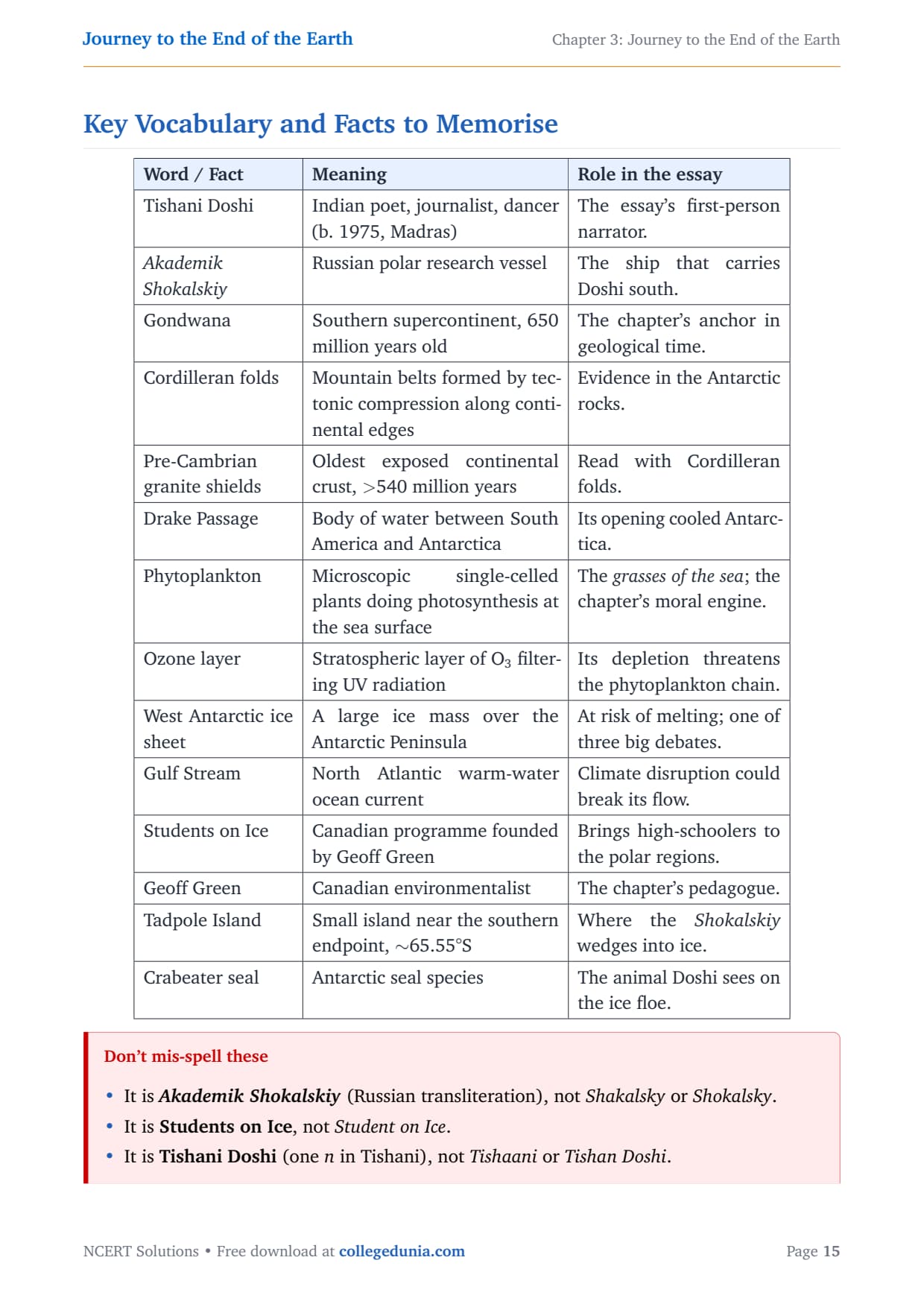
| Gondwana (650 Ma) | A southern supercontinent including India and Antarctica | Deep time; India and Antarctica share the same rock |
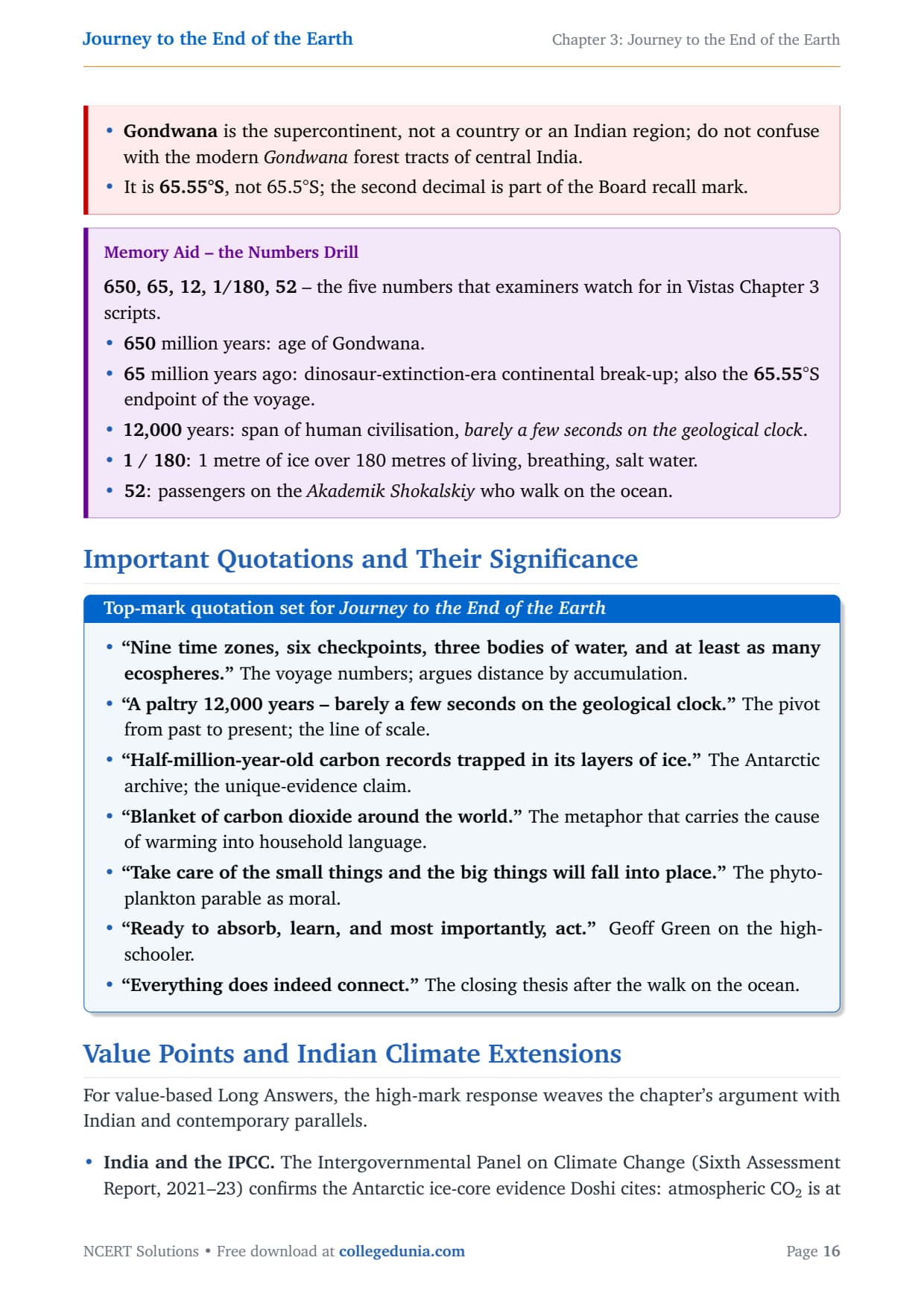
| 12,000 years | "A paltry 12,000 years" | Scale shock; the measure of human damage |
| Ice-core carbon records | Carbon trapped in Antarctic ice cores | Antarctica as the pristine climate archive |
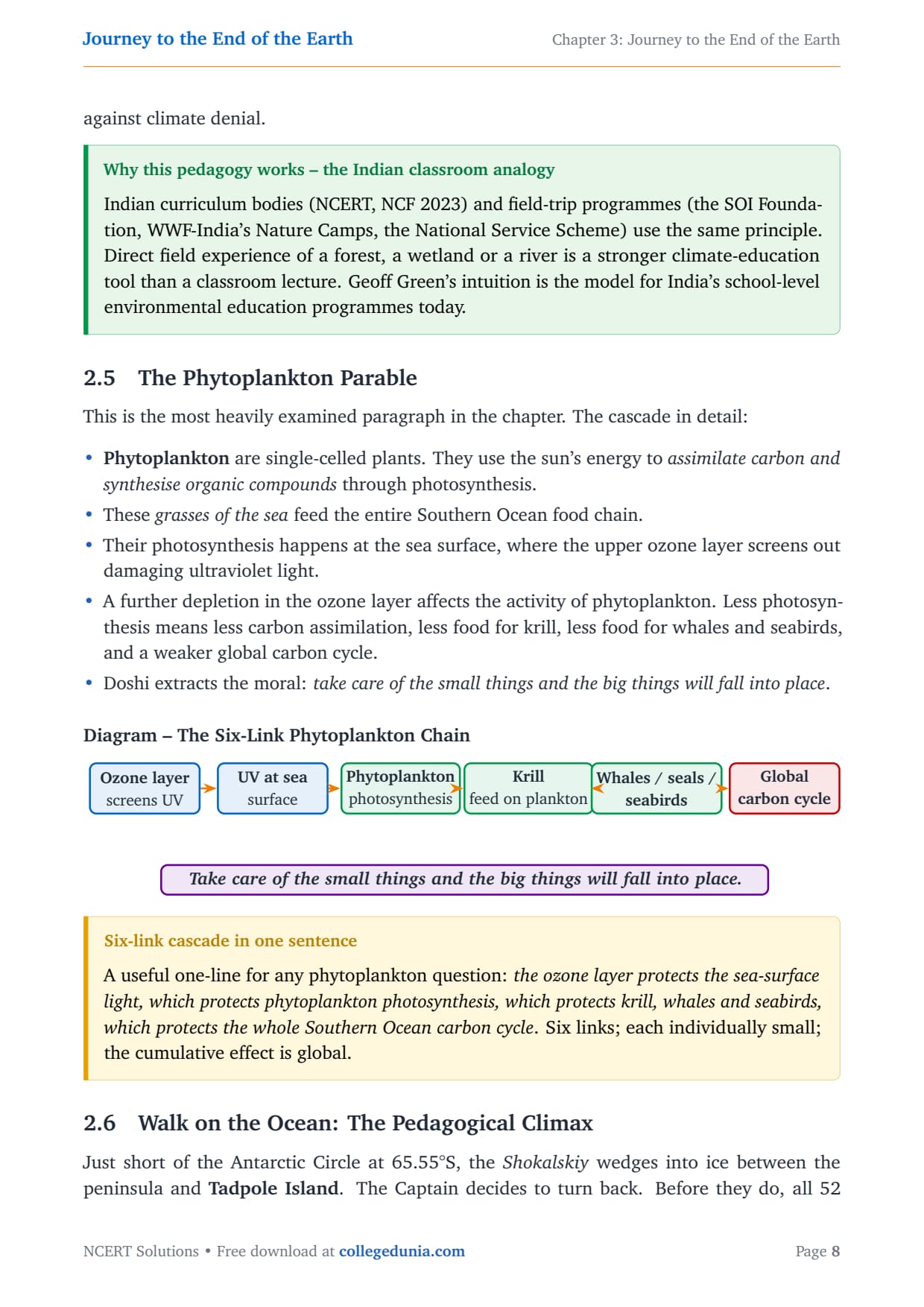
| Phytoplankton | "Those grasses of the sea" | The small things in the parable |
| 65.55 S + 180 m of water | The walk on the ice pack near Tadpole Island | The endpoint; "everything does indeed connect" |
Themes: Five Lines You Should Memorise
- Deep geological time. Gondwana (650 Ma) anchors the chapter. India and Antarctica share the same crust, so Antarctic granite is the Indian plate before it drifted.
- Anthropogenic climate change. Doshi frames climate change as a measurable cascade resting on Antarctic data.
- Ecological interconnection. The phytoplankton cascade runs from ozone depletion to krill collapse to whale and penguin starvation.
- Education as activism. Green's switch to high-schoolers makes pedagogy the ethical centre.
- Travel writing as argument. The three sub-headings are rhetorical; the form carries the thesis to its endpoint.
Common Mistakes Students Make in Journey to the End of the Earth Answers
- Reversing the parable. The small things are ozone and phytoplankton, not seals.
- Calling Gondwana a country. It is a supercontinent that broke apart 200 million years ago.
- Writing that Antarctica was always cold. It was once warm; the cold followed the Drake Passage opening.
- Misnaming the vessel; it is the Akademik Shokalskiy (Russian).
- Missing the age band. Green chose high-schoolers, not primary or university.
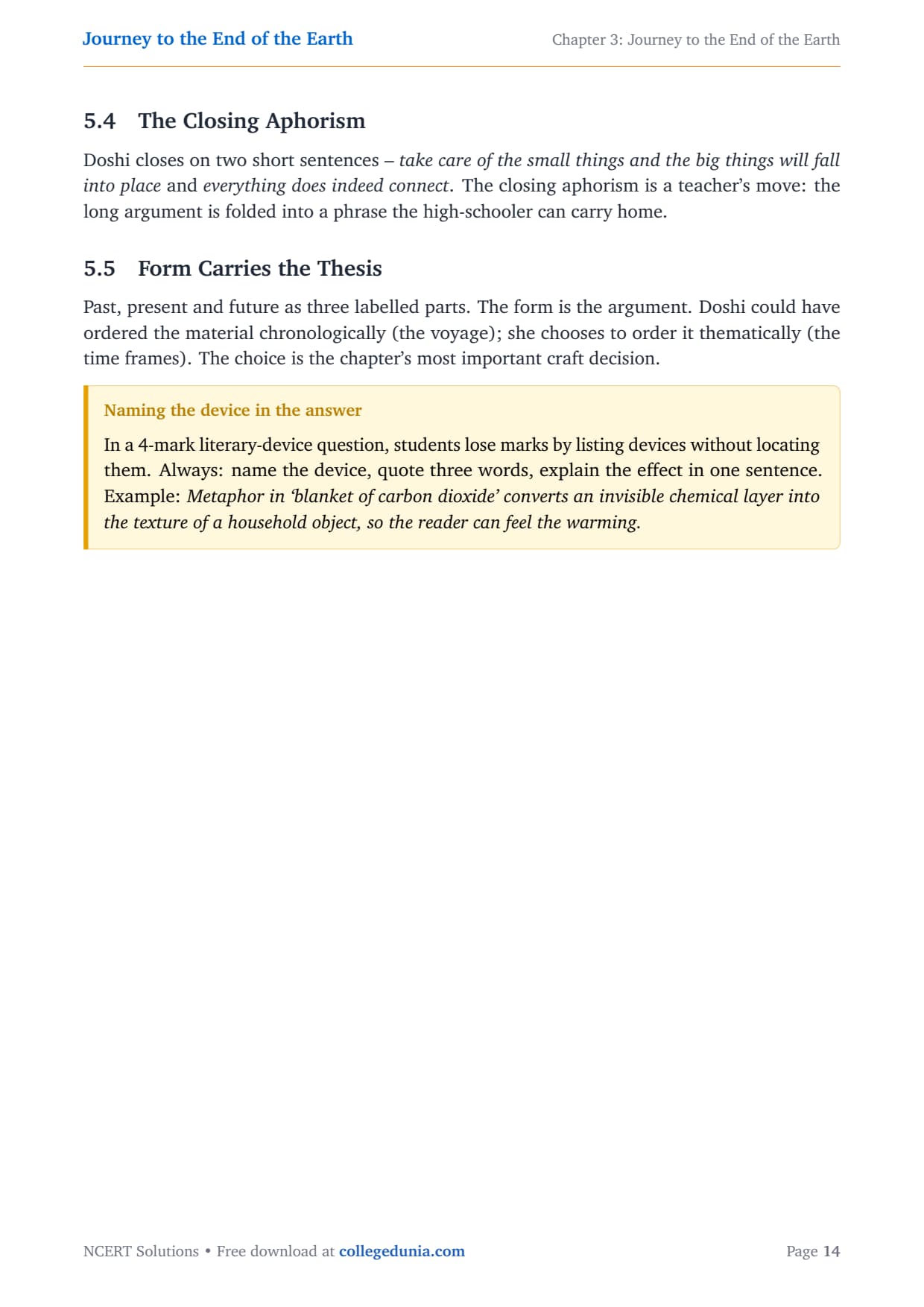
- Ignoring the three sub-headings; they ARE the answer skeleton.
- Quoting one or two lines; a 6-mark answer expects four to five.
How Collegedunia's NCERT Notes Help You Score in Journey to the End of the Earth
- The C-P-C-T framework gives a fixed sequence for every Vistas chapter.
- Every theme is paired with the phrase that triggers full recall.
- The five-marker table is exam-portable; carry it as a one-pager.
- The Doshi and Green sketches are four-marker arcs, the shape a 6-mark Long Answer expects.
CBSE Class 12 English Previous Year Question Mapping for Journey to the End of the Earth
The 6-mark Long Answer rotates between the phytoplankton parable, the past-present-future thesis, Geoff Green and Gondwana.
| Year | Long Answer Focus | Marks |
|---|---|---|
| 2025 | Past-present-future thesis with Antarctic reference | 6 |
| 2024 | Phytoplankton parable; MCQ on Akademik Shokalskiy | 4 |
| 2023 | Geoff Green's reasons for taking high-schoolers | 6 |
| 2022 | What Gondwana was; MCQ on the 12,000-year figure | 5 |
| 2021 | Relevance of "take care of small things" | 6 |
| 2020 | Why Antarctica is pristine and what ice cores record | 4 |
Full PYQ map: Journey to the End of the Earth NCERT Solutions with year-wise PYQ workings.
Other Resources for Journey to the End of the Earth (Class 12 English)
| Resource | Link |
|---|---|
| Revision Notes (this page) | Journey to the End of the Earth Notes |
| NCERT Solutions | Journey to the End of the Earth NCERT Solutions |
| Handwritten Notes | Journey to the End of the Earth Handwritten Notes |
| NCERT Book PDF | Journey to the End of the Earth NCERT Book PDF |
| CBSE Syllabus | CBSE Class 12 English Core Syllabus 2026-27 |
Student Feedback
In a Collegedunia poll of 1,200 Class 12 students, 79% said the phytoplankton parable was the part they most feared getting wrong, and 83% rated the C-P-C-T framework the most useful tool for structuring the 6-mark answer.
NCERT Notes for Class 12 English Vistas: All Chapters
| Chapter | Notes Link |
|---|---|
| Chapter 1 | The Third Level Notes |
| Chapter 2 | The Tiger King Notes |
| Chapter 4 | The Enemy Notes |
| Chapter 5 | On the Face of It Notes |
| Chapter 6 | Memories of Childhood Notes |
FAQs on Journey to the End of the Earth Class 12 Notes
FAQs on Journey to the End of the Earth Class 12 Notes
What is the central theme of Journey to the End of the Earth Class 12?
The central theme is that Antarctica is the only landscape on Earth that simultaneously carries the planet's past (Gondwana, granite shields), present (ice-core carbon records, retreating glaciers) and future (the ozone-phytoplankton chain). Tishani Doshi uses her Akademik Shokalskiy trip to argue that climate change is a measurable cascade, best understood from the South Pole. The chapter also explores deep geological time, education as activism, ecological interconnection, and travel writing as argument.
Who is the narrator of Journey to the End of the Earth?
Tishani Doshi (born 1975), an Indian poet, journalist and contemporary dancer based in Chennai, narrates the essay in the first person. The piece is reprinted from her literary journalism for The Hindu. Doshi's choice of first-person narration is what makes the geology and ecology arrive as observed shocks rather than as lecture material.
What is the phytoplankton parable in the chapter?
Phytoplankton are microscopic single-celled plants that carry out photosynthesis at the sea surface, feed the entire Southern Ocean food chain, and contribute to the global carbon cycle. They are protected only by the upper ozone layer. The cascade runs from ozone depletion to ultraviolet damage to phytoplankton failure to krill collapse to whale and penguin starvation to weakened carbon pump. The moral Doshi extracts: "take care of the small things and the big things will fall into place".
Why does Doshi travel on the Akademik Shokalskiy?
The Akademik Shokalskiy is the Russian research vessel that takes the Students on Ice expedition (founded by Canadian Geoff Green) to the Antarctic peninsula. Doshi joins the expedition as a literary journalist on assignment for The Hindu. The vessel wedges into ice at 65.55 degrees south near Tadpole Island, where the Captain decides to turn back and the 52 passengers walk down the gangplank onto a metre-thick ice pack.
How does the chapter end?
The chapter ends with Doshi standing on a metre-thick ice pack at 65.55 degrees south, above 180 metres of living, breathing salt water, watching crabeater seals sun themselves on ice floes like stray dogs under a banyan tree. The Captain has decided to turn back. Doshi extracts the chapter's one-line moral: "It was nothing short of a revelation: everything does indeed connect."
How many pages is the Journey to the End of the Earth Class 12 Notes PDF?
The Collegedunia Journey to the End of the Earth Class 12 Notes PDF runs 13 pages and covers setting, three-phase plot, character sketches of Doshi and Geoff Green, the five embedded markers (Gondwana, 12,000 years, half-million-year carbon records, phytoplankton, 65.55 degrees south), themes, common mistakes, and a year-wise CBSE PYQ map with a sample 6-mark answer on the phytoplankton parable.



Comments