Senior Physics Editor, 14 Yrs | Updated 3+ months ago
Wave Optics is Chapter 10 of Class 12 Physics, covering Huygens' principle, interference, Young's double slit, diffraction, and polarisation. This page has the full NCERT solutions PDF plus every back-exercise.
GS
Solved by Vikram Saxena, Collegedunia Physics Faculty (M.Sc Physics), step by step for the 2026-27 syllabus.
What this chapter is worth:
Weightage: about 5 marks in CBSE Class 12 Physics.
Wave optics answers lose marks on presentation, not just the final number. Use these steps for every question.
Draw the setup first. A labelled YDSE or single-slit diagram (slit, screen, D, d) earns the first mark on its own.
State the path difference. Write Δ = d sinθ first.
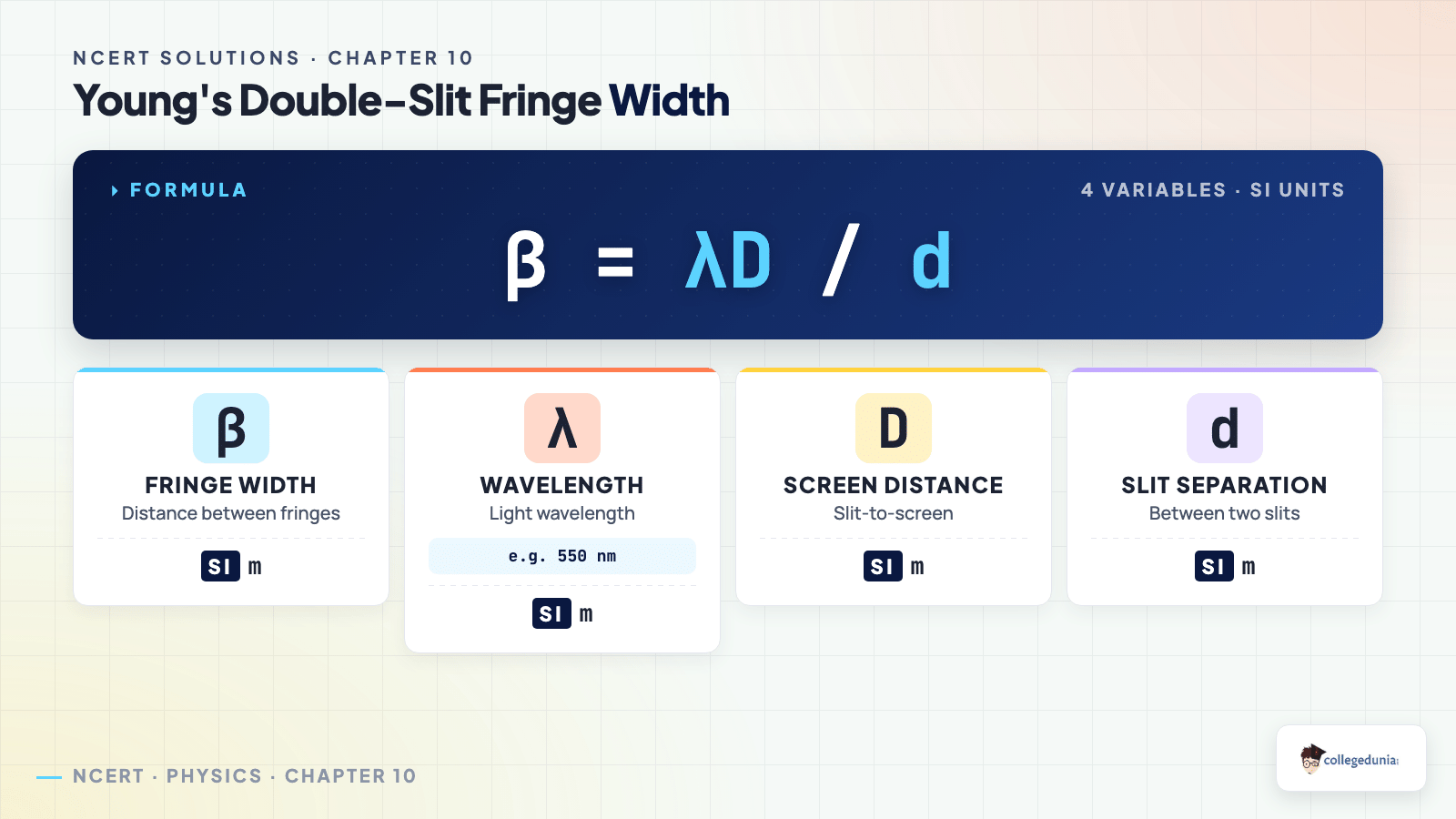
Write the fringe-width formula. State β = λD/d, then substitute the values with their units.
Label maxima and minima. Bright fringes use Δ = nλ; dark use Δ = (n + ½)λ.
State the small-angle assumption sinθ ≈ tanθ ≈ θ where used.
Answer-Writing Mistakes to Avoid in Wave Optics Class 12
These slips recur in CBSE scripts.
Mistake 1: Mixing fringe width (β, the gap between two bright fringes) with the spacing of a single order. Keep β = λD/d as the gap between consecutive fringes.
Mistake 2: Leaving λ in nm when D and d are in metres. Convert λ to metres (1 nm = 10⁻⁹ m) first, or the answer is off by a power of ten.
Mistake 3: Forgetting the half-integer factor for minima. Dark fringes use Δ = (n + ½)λ; dropping the ½ flips the answer.
Mistake 4: Skipping the diagram. A YDSE answer with no labelled figure loses the presentation mark.
All NCERT Solutions for Class 12 Physics Chapter 10 Wave Optics with Step-by-Step Solutions
Every question of NCERT Class 12 Physics Wave Optics is listed below with its full Solution and Expert Solution hidden inside collapsible tabs. Click Check Solution to reveal the step-by-step working; click Expert Solution for the expanded explanation.
Q 10.1
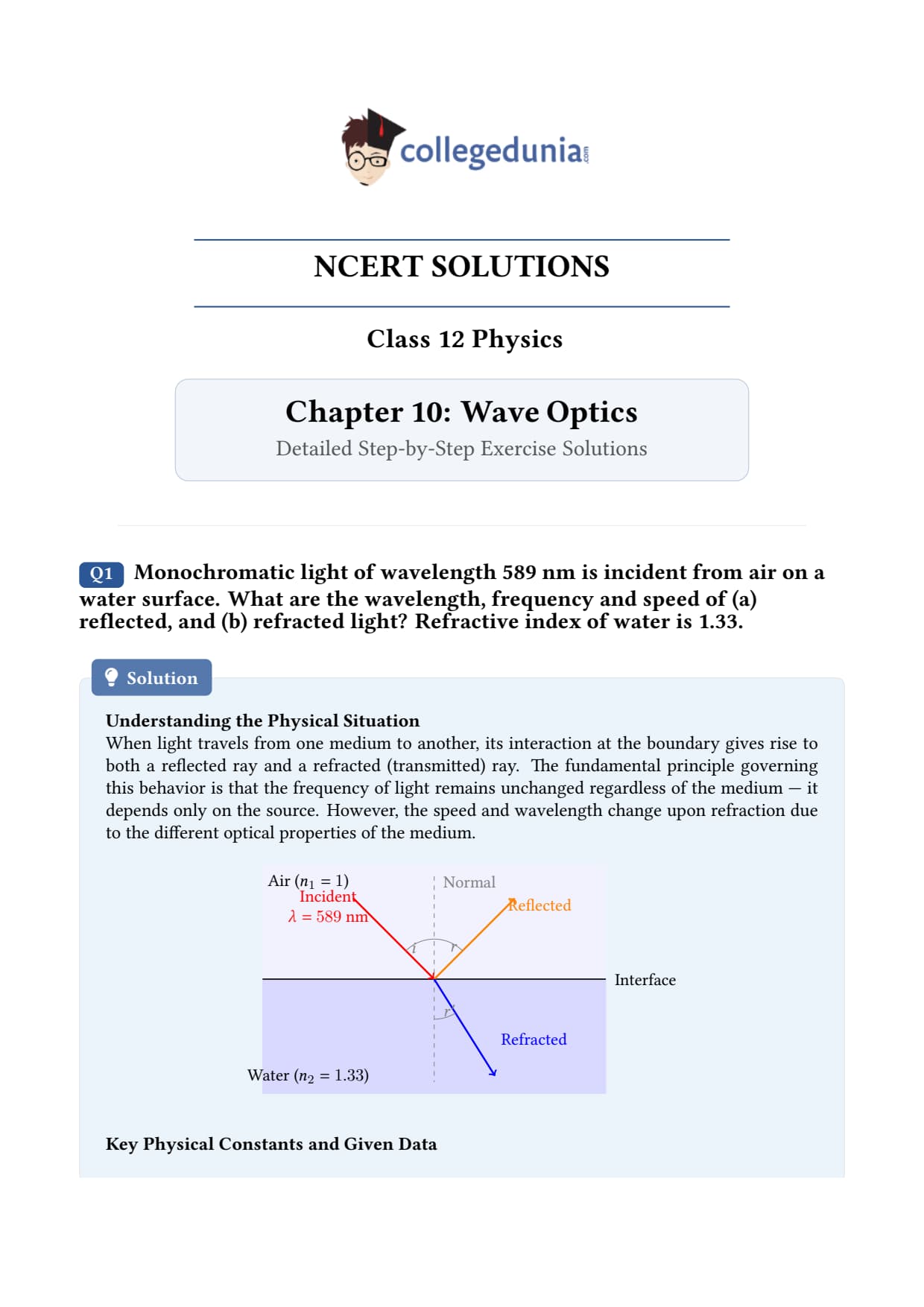
Monochromatic light of wavelength 589 nm is incident from air on a water surface. What are the wavelength, frequency and speed of (a) reflected, and (b) refracted light? Refractive index of water is 1.33.
What the question is asking. A single colour of light (wavelength fixed in air) strikes a water surface. Part of it bounces back (reflection), part goes into the water (refraction). For each, we want: wavelength, frequency, speed.
Given.
Wavelength in air (incident), air = 589 nm = 58910-9m
Refractive index of water, nw = 1.33
Speed of light in vacuum (and effectively in air), c = 3108m/s
Concept used - the frequency rule. When light passes from one medium to another, its frequency stays the same. Frequency is set by the source (the atom that emitted the photon). What changes are wavelength and speed: vmedium = cn, medium = vacuumn. The product vλ equals ν (frequency), which is unchanged.
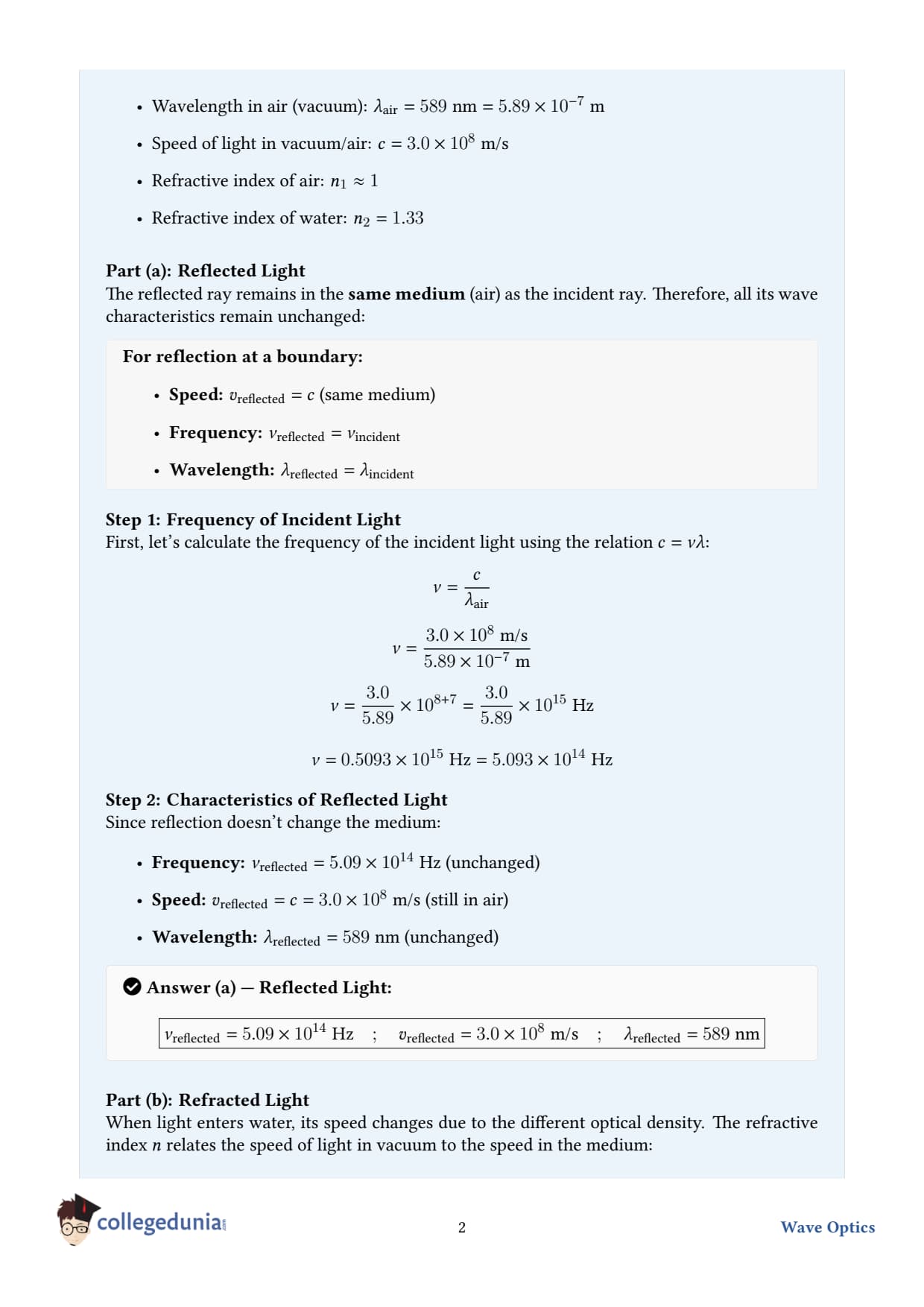
Step 1 - find the frequency of the incident light. ν = cair = 310858910-9 = 35891017. Compute: 3/589 ≈ 5.09310-3. So ν ≈ 5.091014 Hz.
Step 2 - (a) reflected light. Reflection happens in the SAME medium (air). So nothing changes:
Wavelength: r = 589 nm
Frequency: r = 5.091014 Hz
Speed: vr = c = 3108m/s
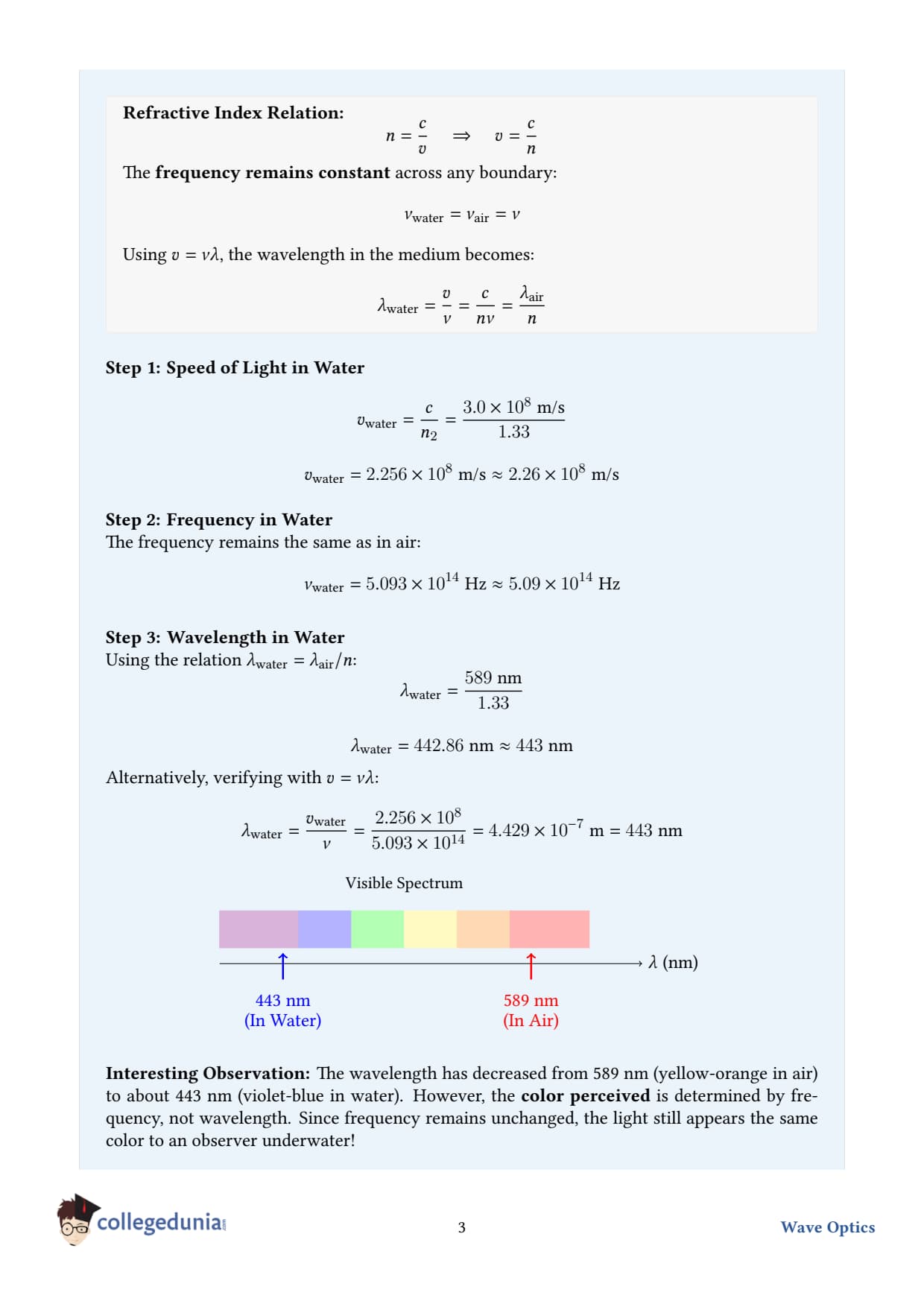
Step 3 - (b) refracted light. Frequency. Frequency is unchanged on crossing the interface: refr = 5.091014 Hz.
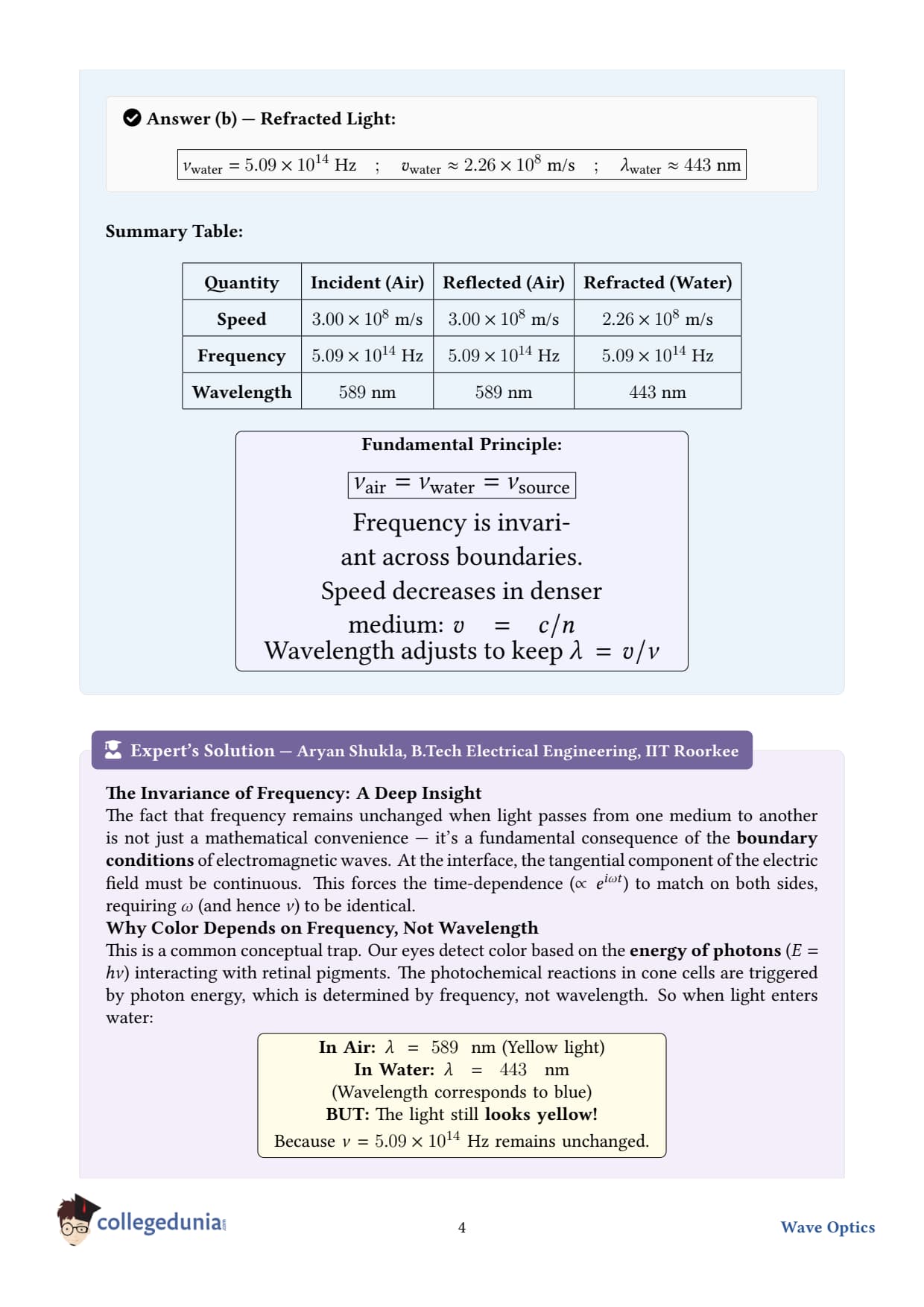
Why does frequency stay constant? At the boundary, the electromagnetic wave on both sides must oscillate in lock-step - otherwise the wave fields wouldn't match across the interface at every instant. The "ticking rate" of the wave (frequency) is therefore continuous across boundaries. Wavelength and speed can both change; only their product (frequency) is fixed.
Why colour doesn't change underwater. Although the wavelength of light shortens in water (589 nm → 443 nm), our eyes register colour by the frequency of the photon, which is unchanged. So a yellow sodium lamp viewed from inside a swimming pool still looks yellow - even though its in-water wavelength corresponds to violet on the air-wavelength scale.
Huygens' picture of refraction. Picture a planar wavefront hitting the water at an angle. The bottom edge of the wavefront enters the water first, where it slows down. While the top edge is still racing through air, the bottom edge crawls - pivoting the wavefront and bending the propagation direction toward the normal. Snell's law n1sin1 = n2sin2 is just the geometry of this pivoting.
Common mistake. Students often write water = nair (multiply by n instead of dividing). Sanity check: light slows down in water, so its wavelength must shorten. If you got a number larger than 589 nm, your formula is upside-down.
Q 10.2
What is the shape of the wavefront in each of the following cases:
(a) Light diverging from a point source.
(b) Light emerging out of a convex lens when a point source is placed at its focus.
(c) The portion of the wavefront of light from a distant star intercepted by the Earth.
Concept used - what a wavefront is. A wavefront is the locus (surface) of all points where the wave has the same phase at one instant - for example, all crests of the wave at a given time. Wavefronts are always perpendicular to the direction of wave propagation (the "rays"). Their shape depends on the source geometry.
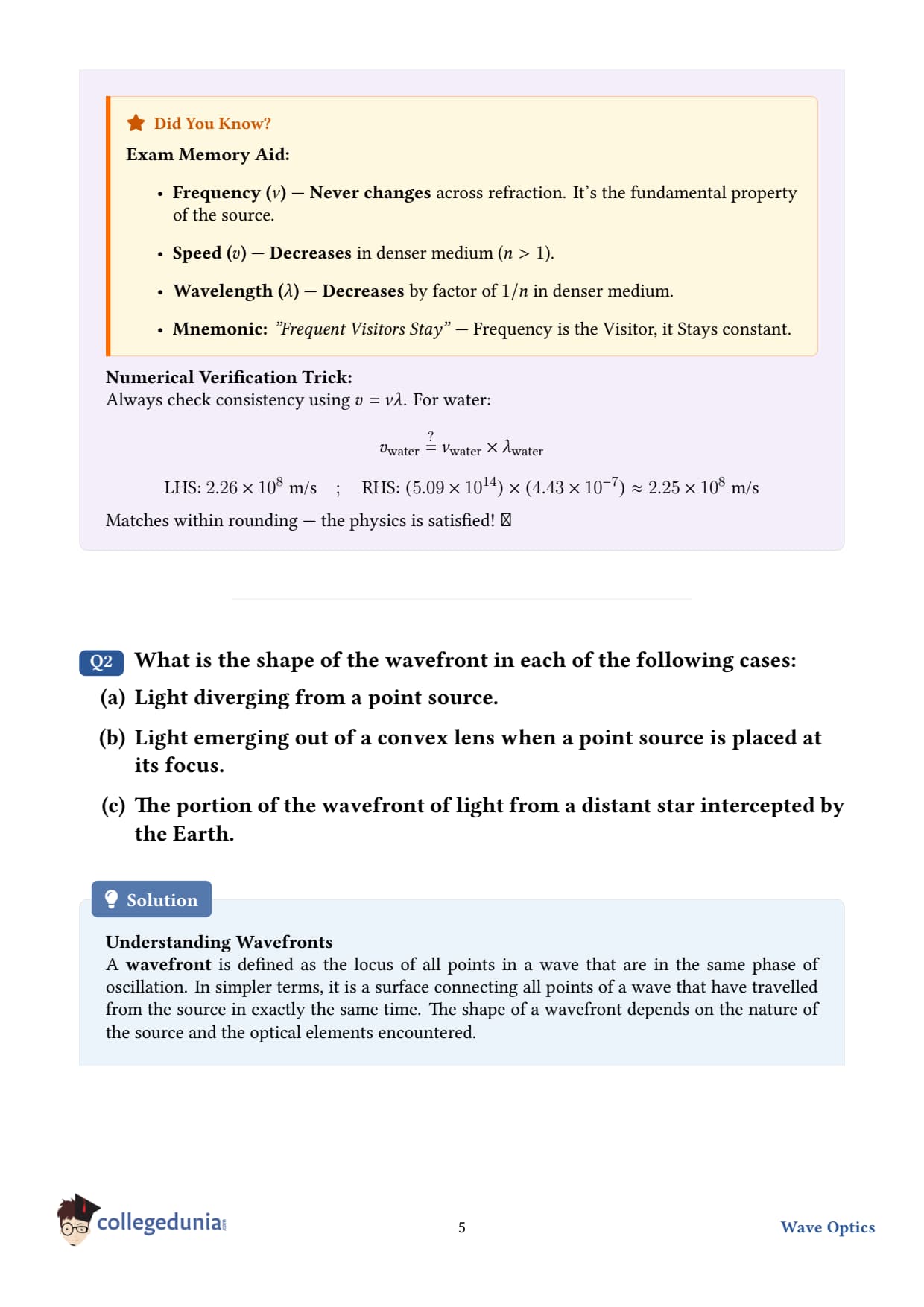
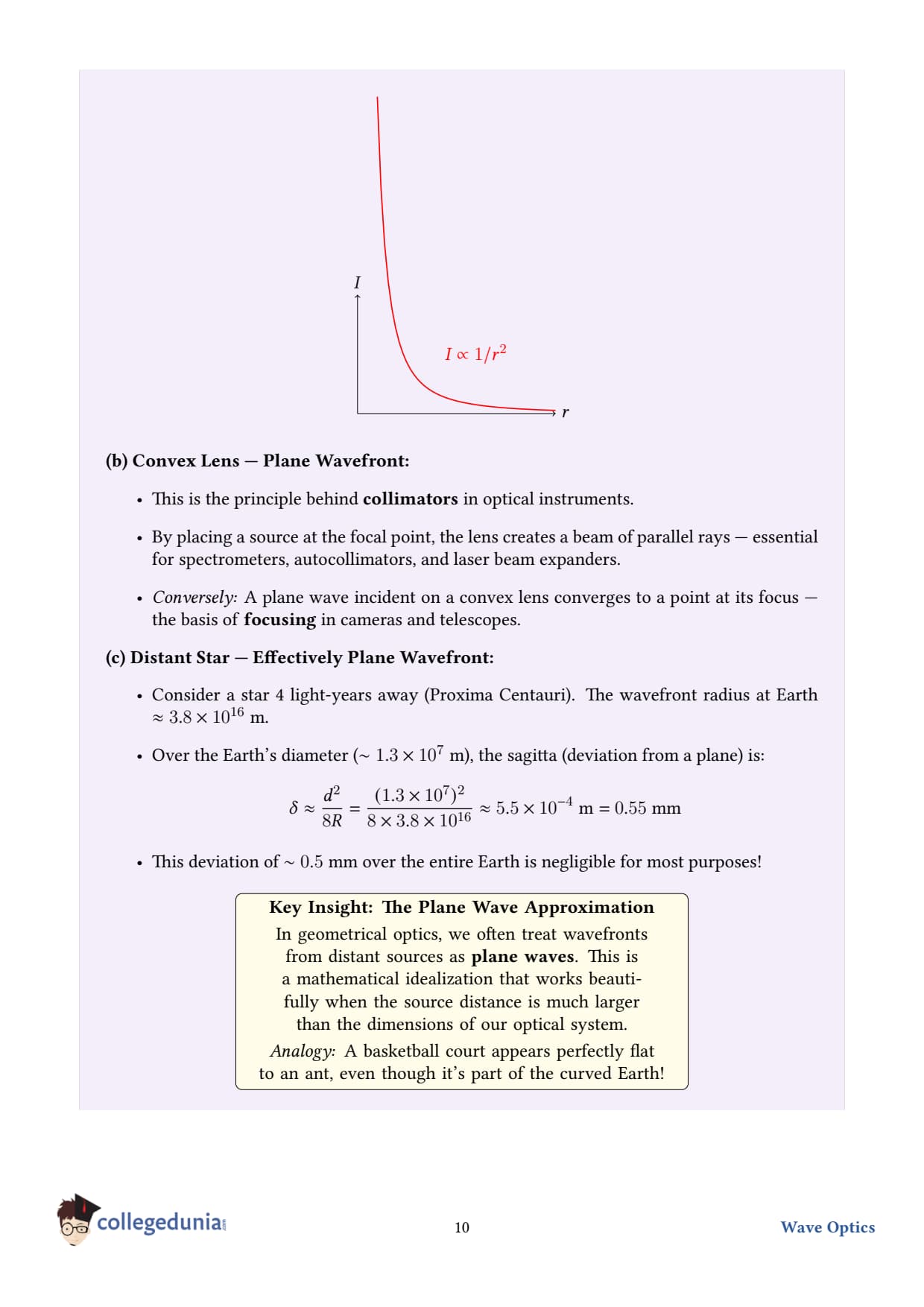
(a) Point source. A point source radiates equally in every direction (isotropic). At any instant, all points that the wave has reached are at the same distance r = ct from the source. So the wavefront is the set of points at fixed distance from a single point - a sphere (in 3D), with the source at its centre. As time passes, the sphere expands.
So the wavefront from a point source is spherical, diverging outward.
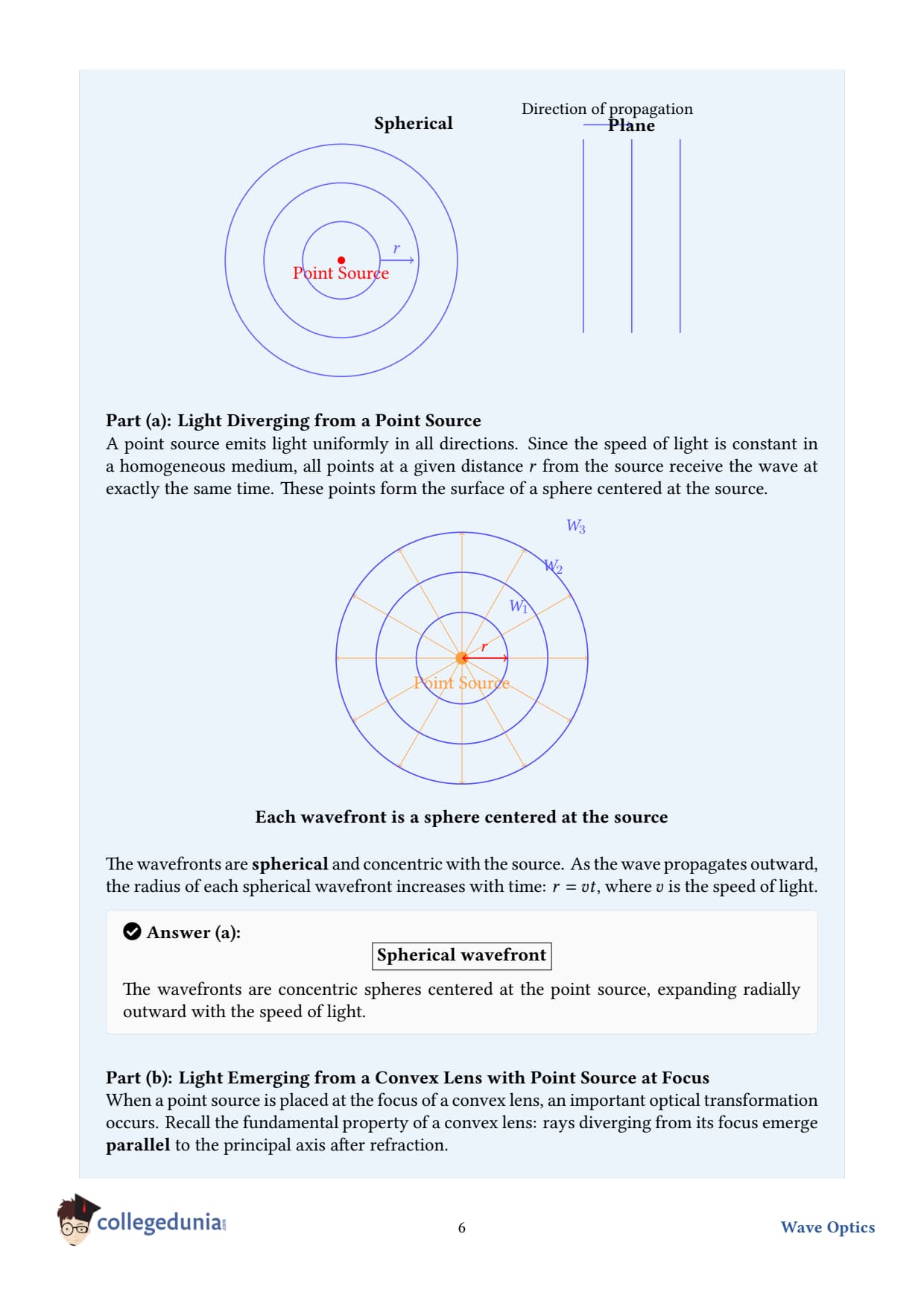
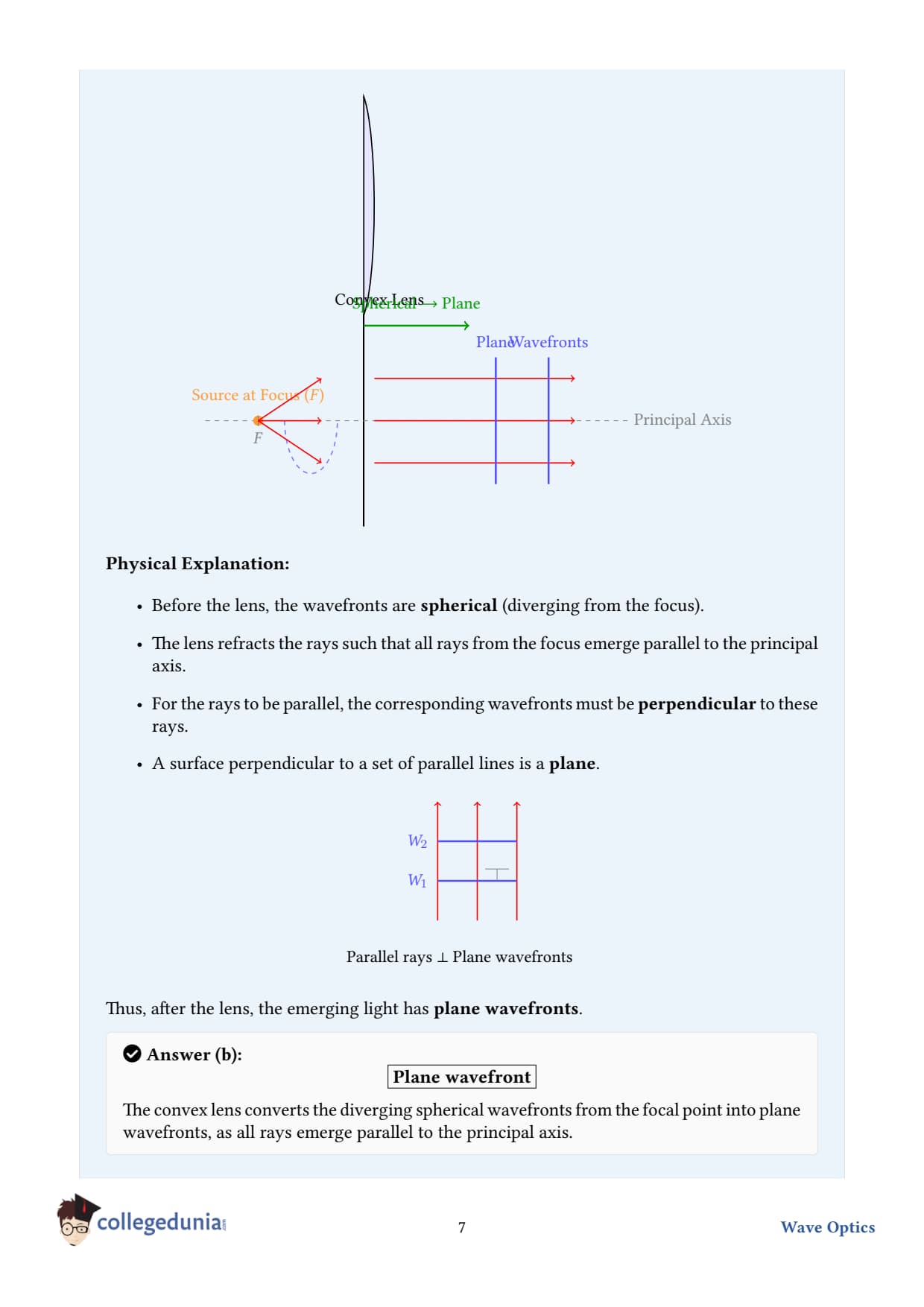
(b) Point source at the focus of a convex lens. Place a point source at the front focal point F of a convex lens. Rays from F emerge from the lens parallel to the principal axis (this is the defining property of the focal point). Parallel rays have wavefronts perpendicular to themselves, which are flat - i.e., plane wavefronts (parallel planes), propagating along the axis.
Picture-wise: the lens converts the diverging spherical wavefronts from F into outgoing plane wavefronts. This is one of the main practical uses of a converging lens.
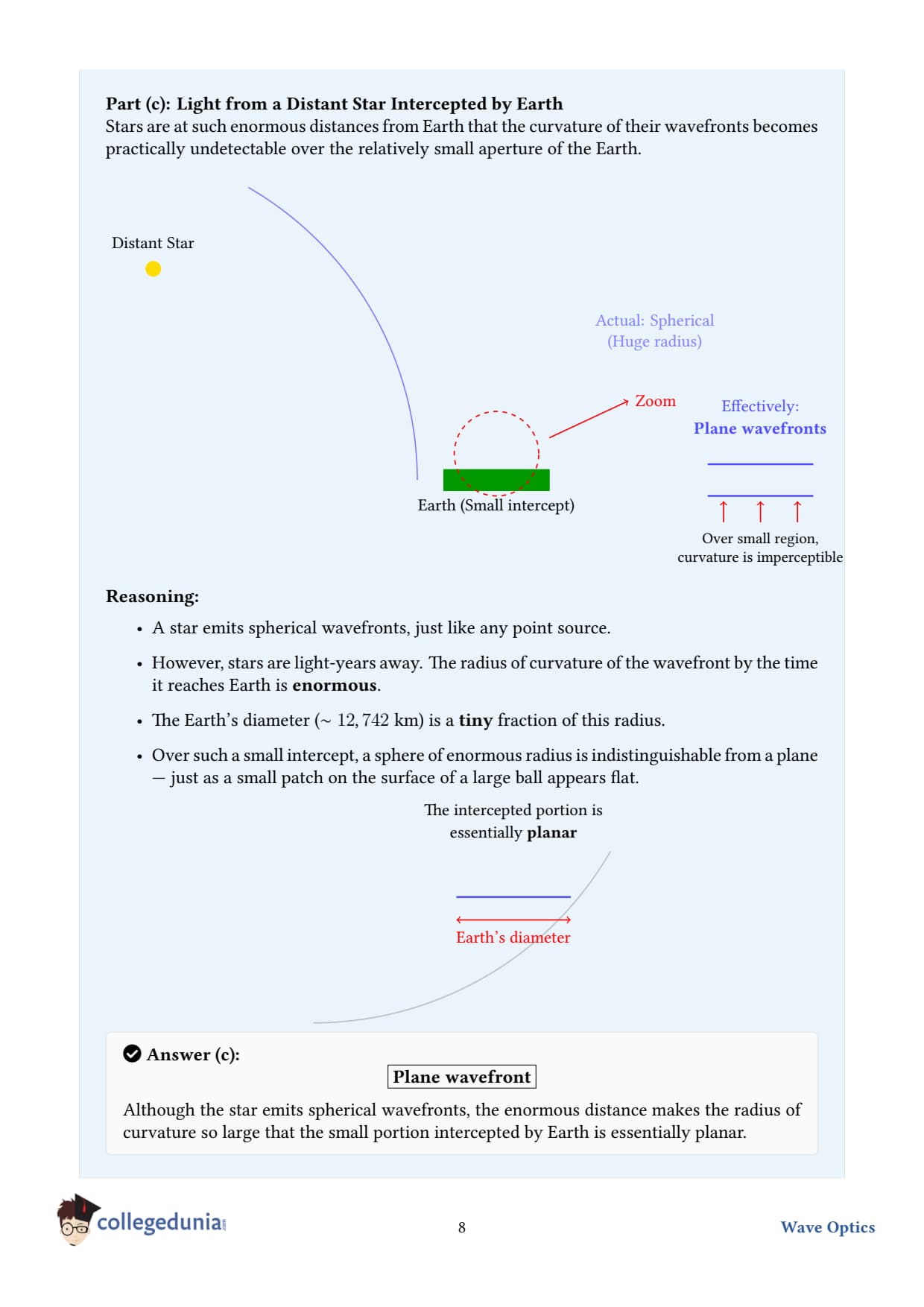
(c) Wavefront from a distant star at the Earth. A star is essentially a point source (its angular size is negligible at astronomical distances). Its wavefronts are spherical, but the sphere has an enormous radius (typically light-years). When such a tiny slice of an immense sphere arrives at Earth, it appears nearly flat - like how the Earth's curved surface looks flat to a person standing on it.
So the wavefront of starlight, as intercepted by the Earth, is to an excellent approximation a plane wavefront.
Final answer.
(a) Spherical (diverging).
(b) Plane (parallel planes).
(c) Plane (because the source is infinitely far away).
DA
Dr. Anita Sharma
Ph.D. Physics, University of Delhi
Verified Expert
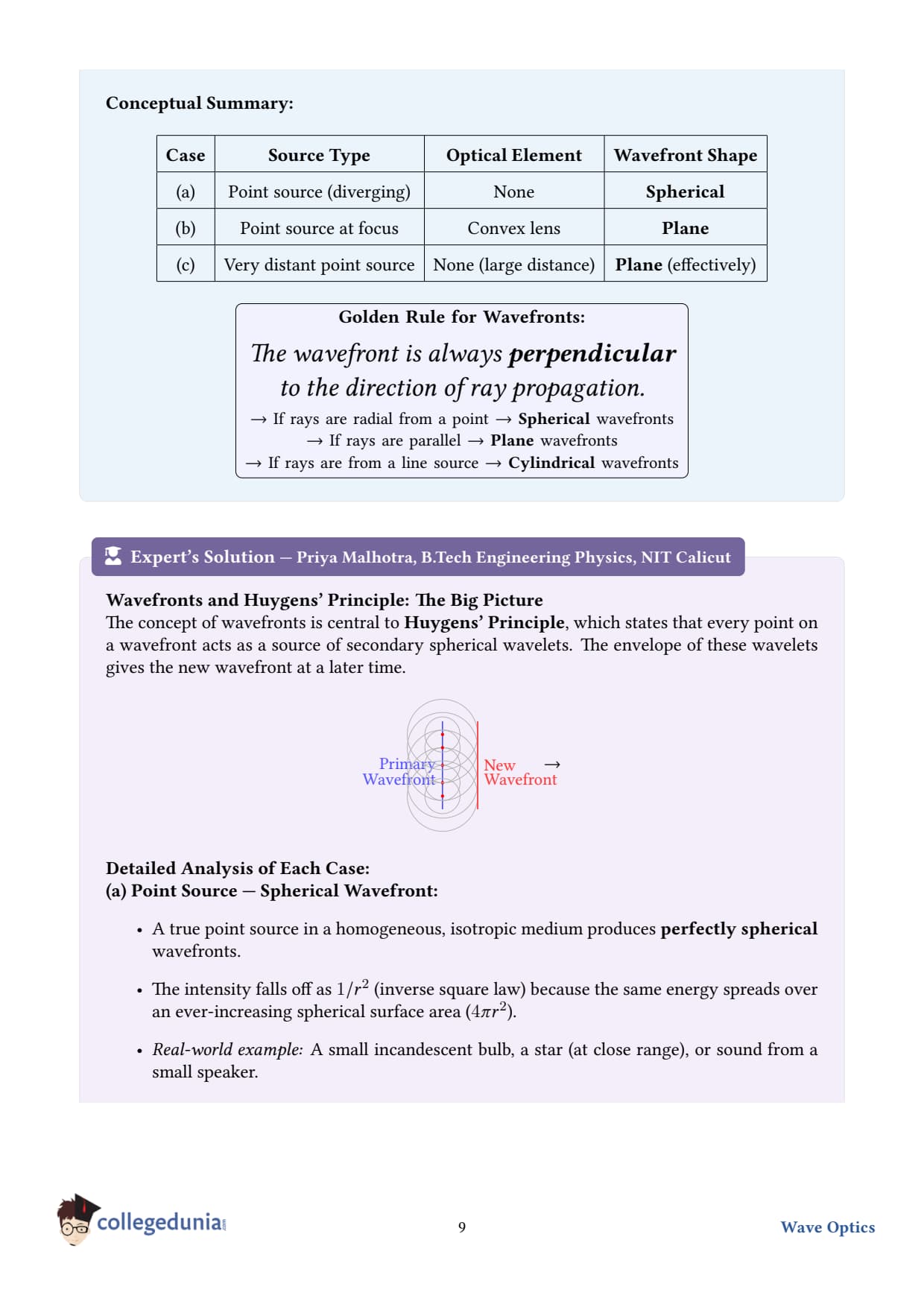
Huygens' principle in action. Each point on a wavefront acts as a secondary source that emits its own little spherical wavelet. The envelope of all these wavelets, a moment later, is the new wavefront. For a spherical wavefront, the envelope of secondary wavelets stays spherical (just bigger). For a plane wavefront, the envelope is another parallel plane. This is why wavefronts maintain their shape as they propagate in a uniform medium.
Why a convex lens "collimates" a point source. The lens delays the central rays (which pass through more glass) more than the edge rays. For a source at the focus, this differential delay is exactly the right amount to convert outgoing spherical wavefronts into flat ones. Reverse-running: a plane wavefront incident on a lens converges to a point at the focus.
Real-world - parabolic mirrors and antennas. The same principle underlies satellite dishes, car headlamp reflectors, and astronomical telescopes. A parabolic mirror takes the spherical wavefronts from a source at its focus and reflects them as a parallel beam (plane wavefront). For receiving, the reverse: parallel incoming wavefronts (from a distant satellite or star) converge to the focus, where the detector sits.
Common mistake. Students sometimes say "cylindrical" for case (b). Cylindrical wavefronts come from line sources (like a slit), not from a point source after passing through a lens. A line source plus a cylindrical lens would give plane wavefronts; a point source plus a spherical (ordinary) lens gives plane wavefronts.
Q 10.3
(a) The refractive index of glass is 1.5. What is the speed of light in glass? Speed of light in vacuum is 3.0108m s-1.
(b) Is the speed of light in glass independent of the colour of light? If not, which of the two colours red and violet travels slower in a glass prism?
Given.
Refractive index of glass, ng = 1.5
Speed of light in vacuum, c = 3.0108m/s
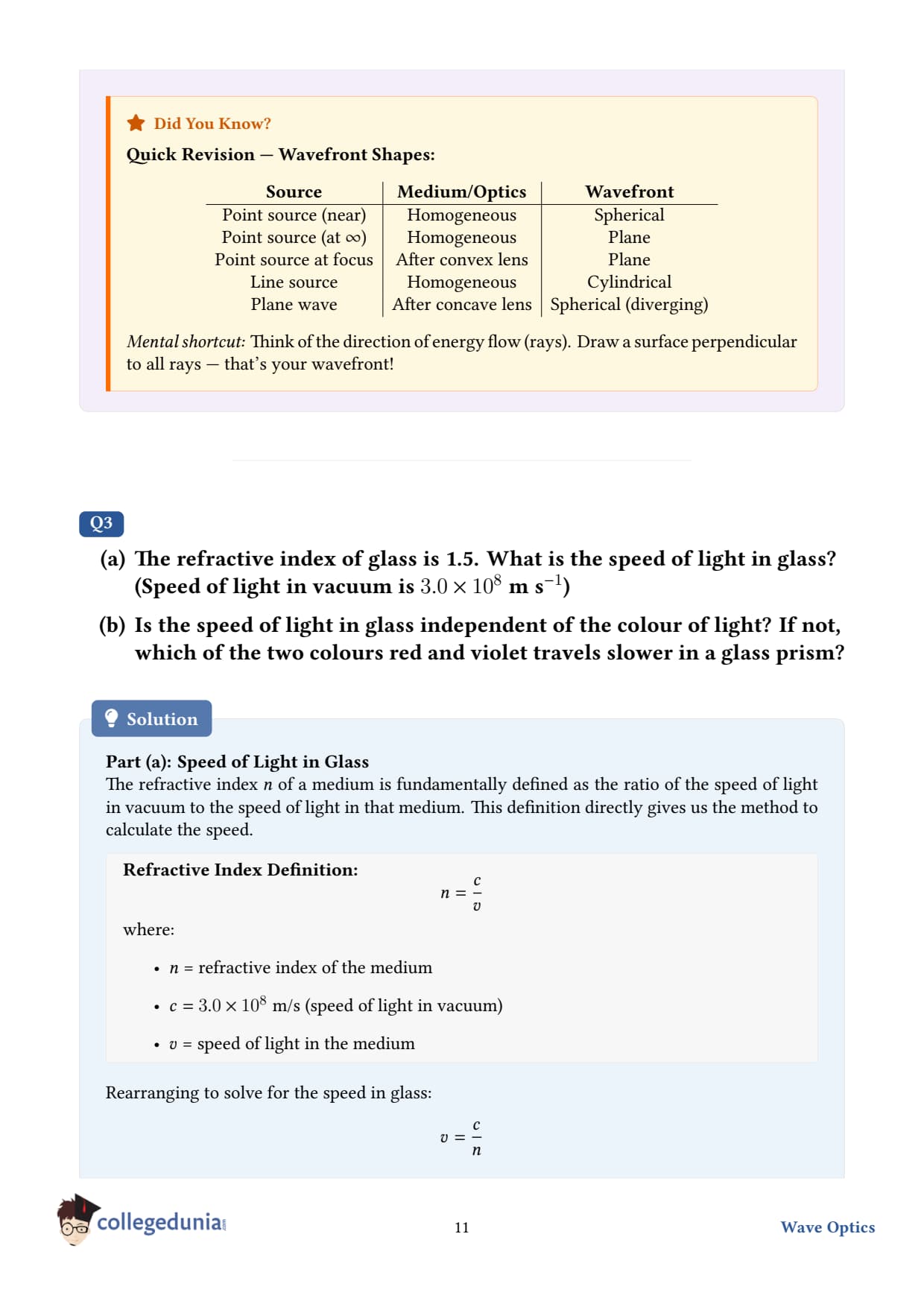
Concept used - refractive index and speed. The refractive index of a medium is defined as the ratio of the speed of light in vacuum to its speed in the medium: n = cv, so v = cn.
(a) Step 1 - substitute. vglass = 3.01081.5.
Step 2 - divide. vglass = 2.0108m/s.
Light in this glass moves at two-thirds the vacuum speed.
(b) Does vglass depend on colour?
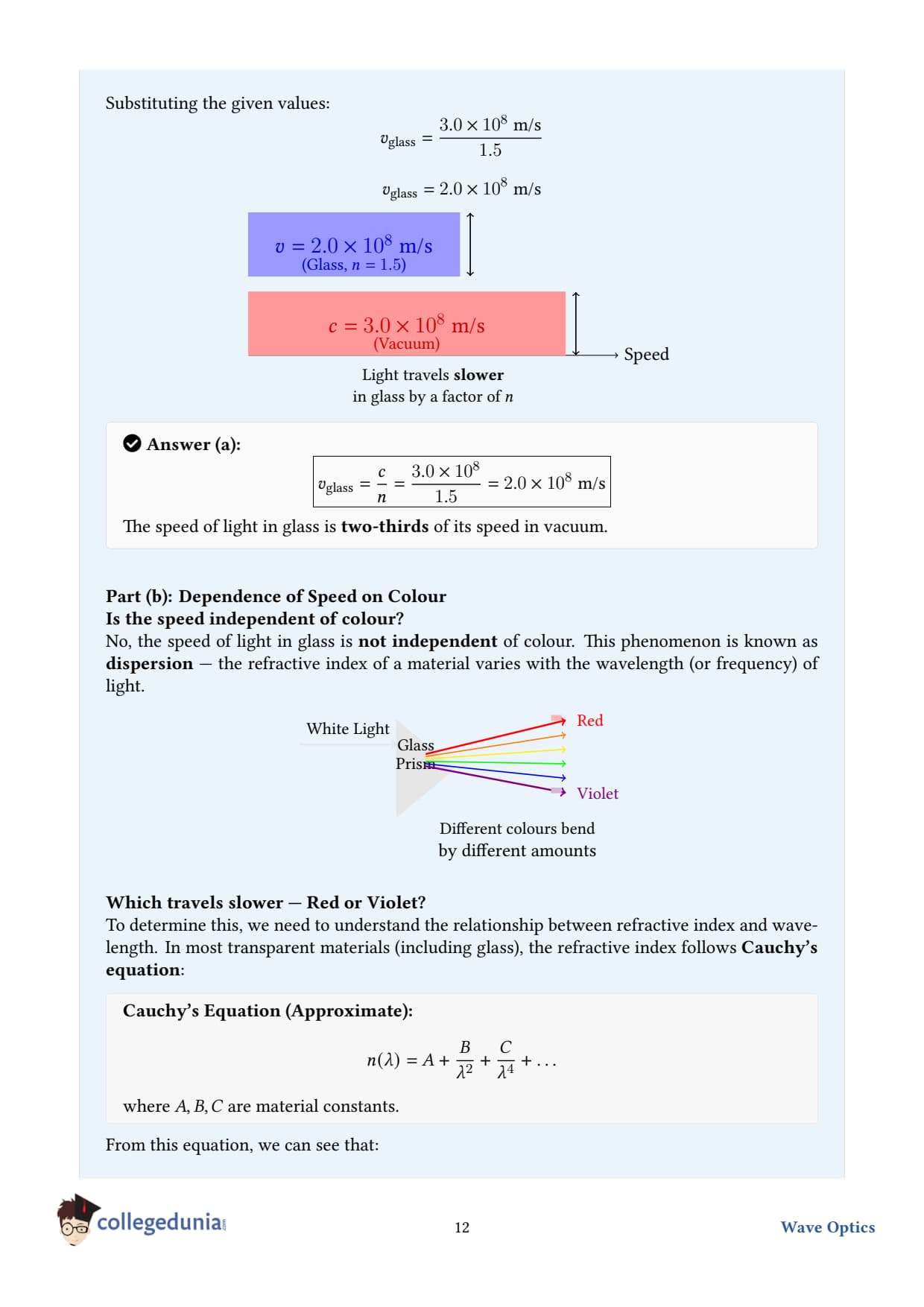
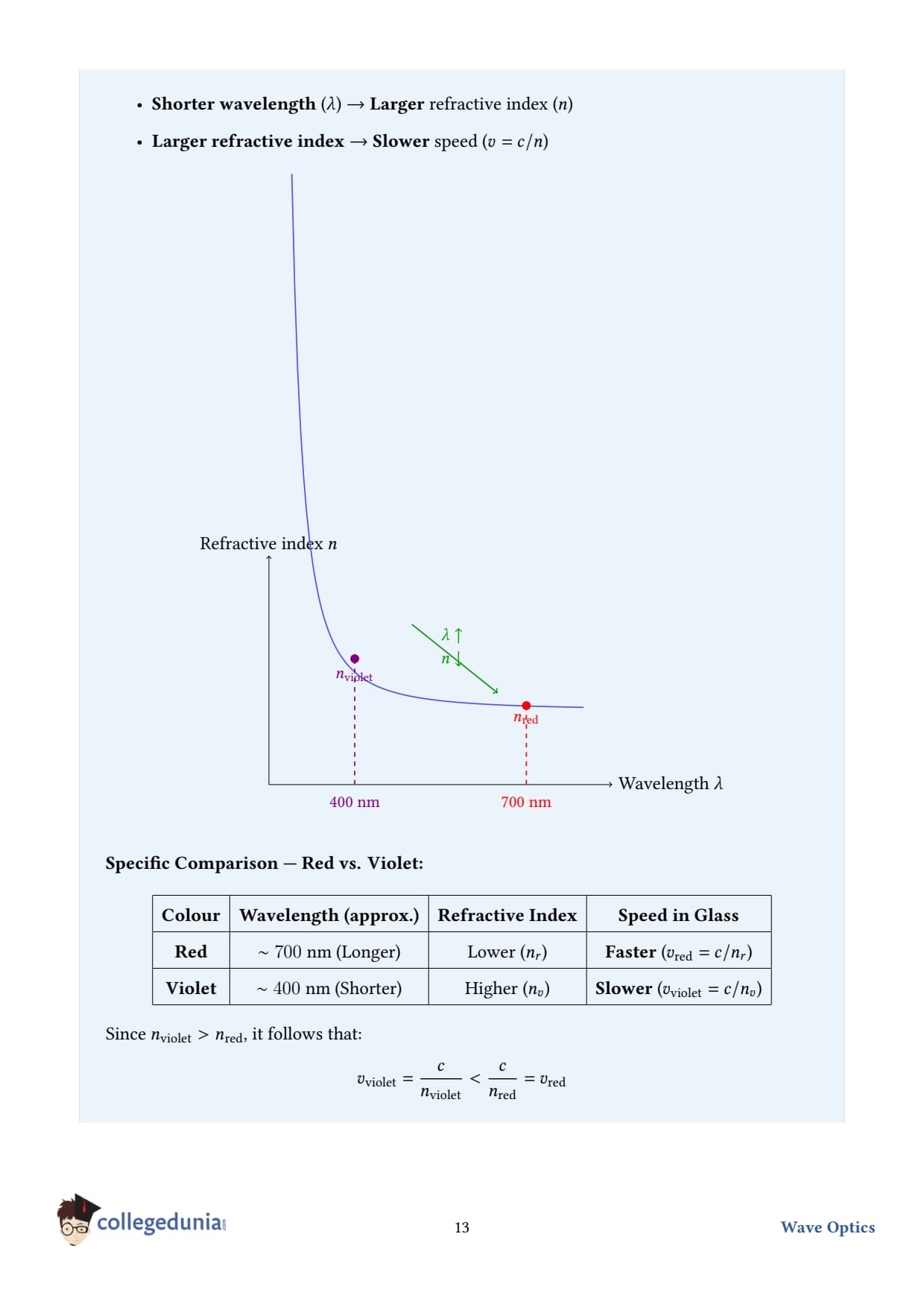
Yes - speed in any material medium depends on colour (wavelength). This phenomenon is called dispersion. Different colours have different refractive indices in glass:
For violet light, nv is slightly larger ∼ 1.53.
For red light, nr is slightly smaller ∼ 1.51.
Since v = c/n, a larger n means a smaller v. So
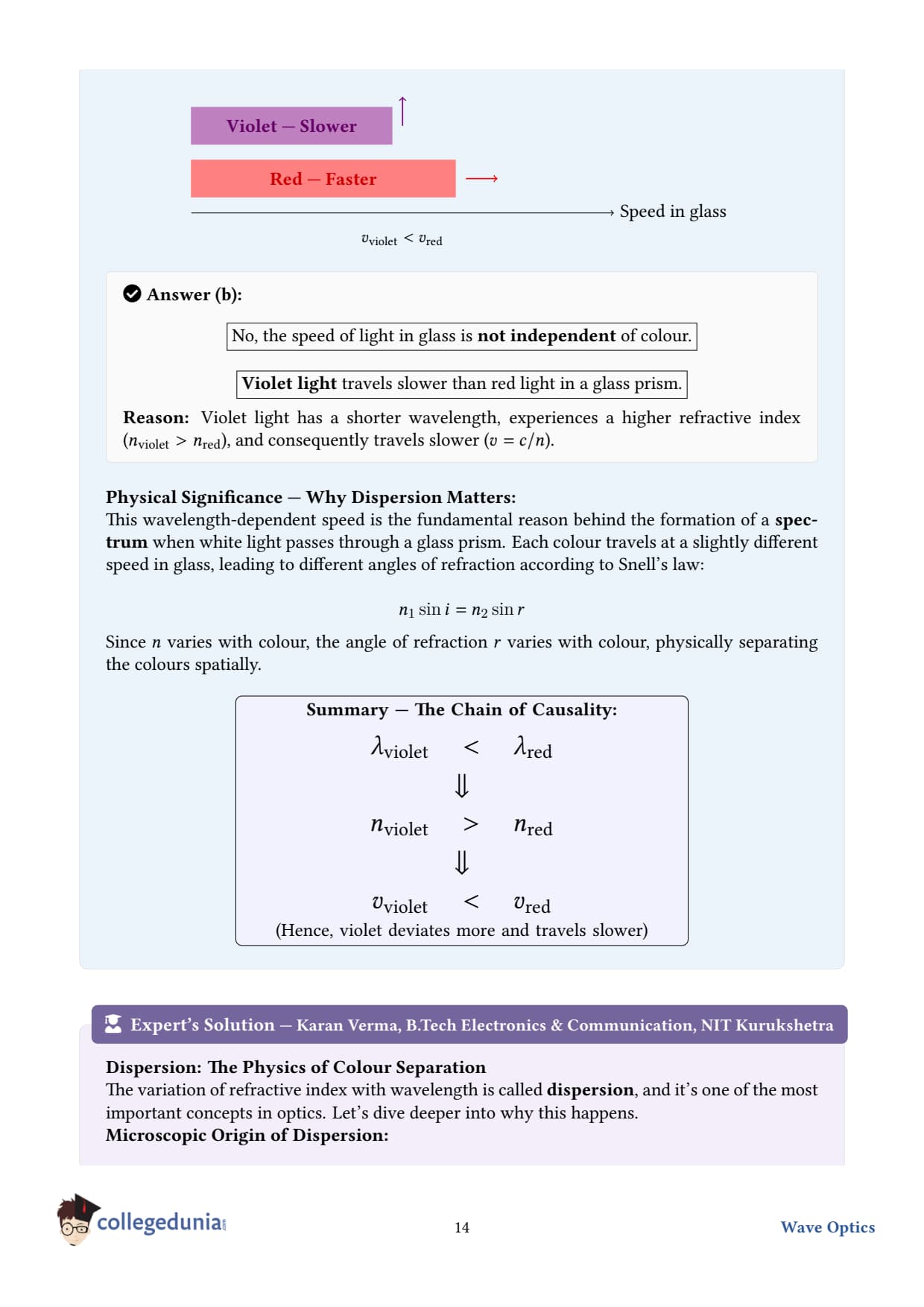
Violet light has the larger n → smaller v → travels slower.
Red light has the smaller n → larger v → travels faster.
Final answer.
(a) vglass = 2.0108m/s.
(b) No - speed depends on colour. Violet travels slower than red in glass.
DS
Dr. Suresh Iyer
Ph.D. Theoretical Physics, TIFR Mumbai
Verified Expert
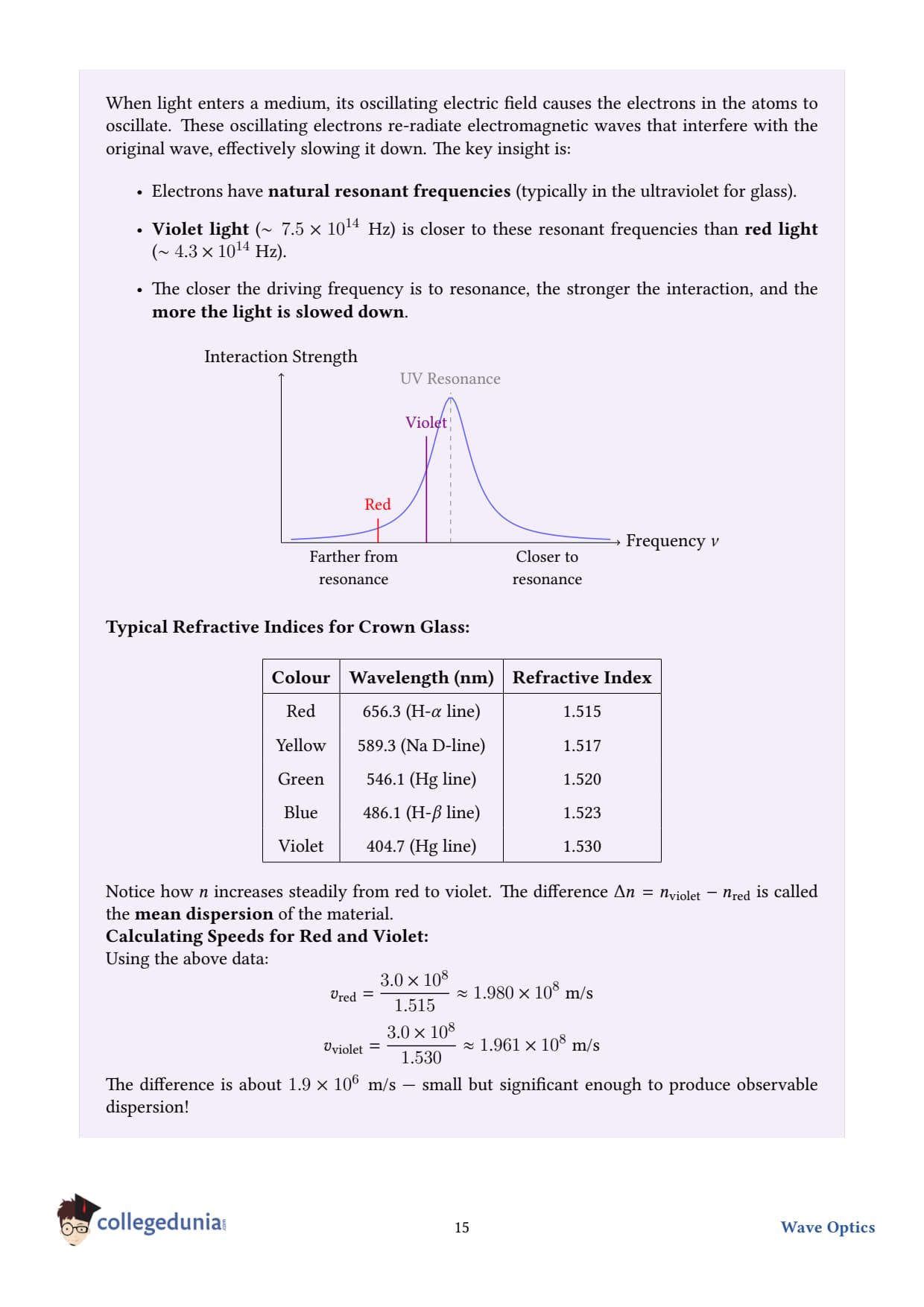
Why dispersion happens. Inside glass, light interacts with the electrons in the atoms, which resonate at certain natural frequencies (in the ultraviolet for most glasses). Light frequencies closer to a resonance interact more strongly and are slowed down more. Visible violet is closer to the UV resonance than red - so violet "feels" the glass more, and travels slower.
Why a prism separates colours. When white light enters a prism, each colour refracts by a slightly different angle (because each has a different n). Violet bends most (largest deviation), red least. After passing through both refracting surfaces, the colours fan out into a spectrum. This is exactly what creates a rainbow when sunlight hits raindrops.
Real-world - chromatic aberration. Simple convex lenses focus different colours at slightly different points (because f depends on n which depends on colour). This is why old camera lenses produced colour fringes around bright objects. Modern lenses use combinations of glass types (crown + flint) whose dispersions cancel - called "achromatic doublets."
Common mistake. Students sometimes say "red is faster in vacuum than violet." No - in vacuum, ALL colours travel at exactly c = 3108m/s. Dispersion is a medium effect; it disappears in vacuum.
Quick numerical check. The numerical difference in speed between red and violet in glass is tiny (~1%), but enough over the path length of a prism to create a clearly visible separation of colours.
Q 10.4
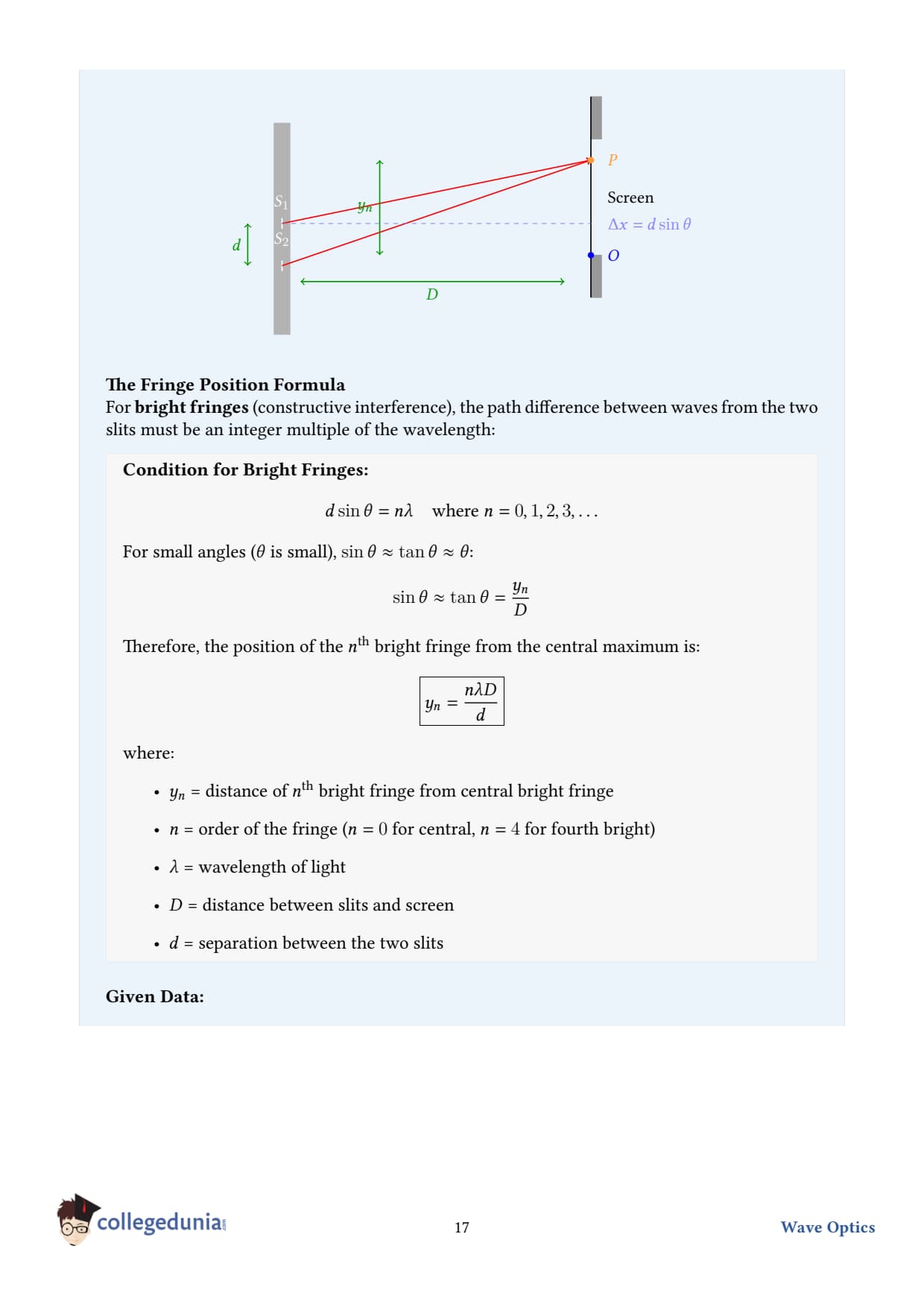
In a Young's double-slit experiment, the slits are separated by 0.28 mm and the screen is placed 1.4 m away. The distance between the central bright fringe and the fourth bright fringe is measured to be 1.2 cm. Determine the wavelength of light used in the experiment.
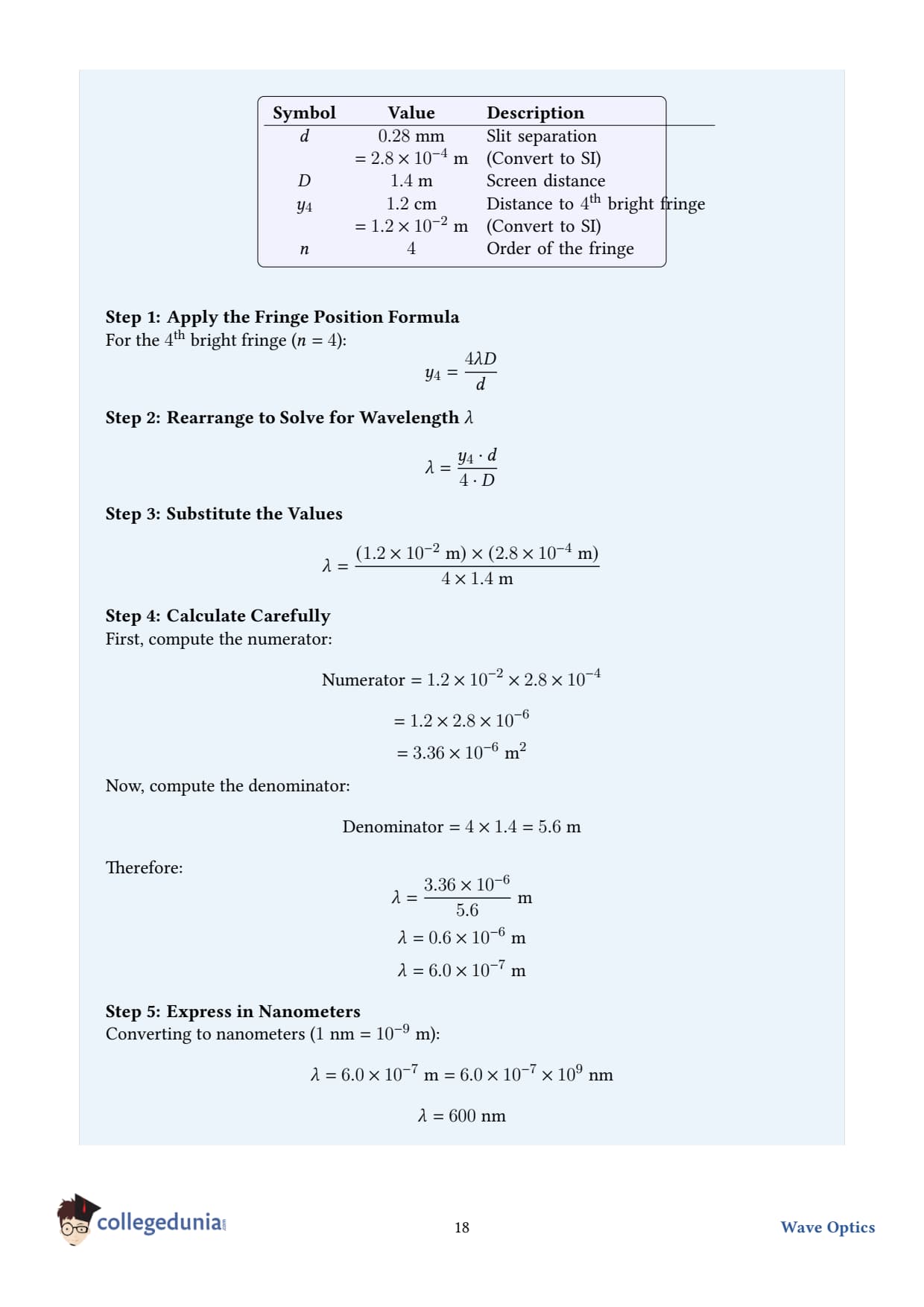
Given.
Slit separation, d = 0.28 mm = 0.2810-3m = 2.810-4m
Distance from slits to screen, D = 1.4 m
Position of the 4th bright fringe from the central maximum, y4 = 1.2 cm = 1.210-2m
Order of fringe, n = 4
Concept used - Young's double-slit fringe formula. In the small-angle limit, the position of the n-th bright fringe (measured from the central maximum, on the screen) is yn = nλ Dd. The spacing between consecutive bright fringes (the "fringe width") is β = λ Dd. For the n-th fringe, simply yn = nβ.
Step 1 - rearrange for λ. From yn = nλ D/d, λ = yndnD.
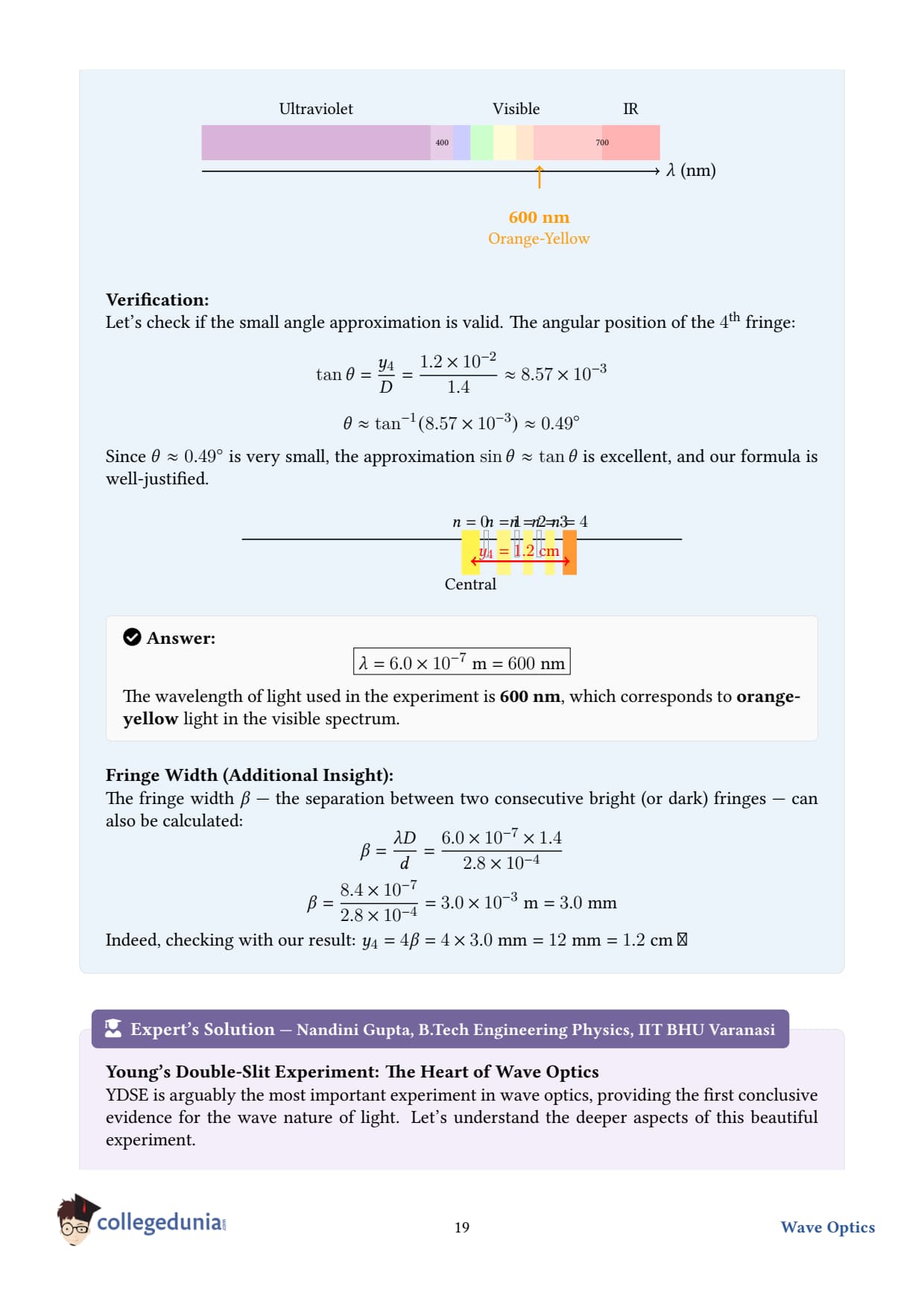
This is in the orange-yellow part of the visible spectrum.
Final answer. λ = 610-7m = 600 nm.
PM
Prof. Meera Nair
Ph.D. Experimental Physics, IISc Bangalore
Verified Expert
Where the formula comes from (Huygens picture). Light from the two narrow slits S1 and S2 acts as two coherent point sources. At a point P on the screen at perpendicular distance y from the central axis, the path difference is approximately Δ = S2P - S1P ≈ ydD (using the small-angle approximation). For constructive interference (a bright fringe), Δ = nλ, giving yn = nλ D/d.
Alternative method - use fringe width directly. β = y44 = 1.24 cm = 0.3 cm = 310-3m. Then λ = β d/D = 310-32.810-4/1.4 = 610-7m - same answer.
Common mistake - confusing path difference with phase difference. Be sure to use Δ = nλ for bright fringes (path difference is an integer number of wavelengths) and Δ = (n+1/2)λ for dark fringes. The corresponding phase difference is φ = 2Δ/λ.
Common mistake - fringe width vs distance to n-th fringe. Some students write β = 1.2 cm instead of β = y4/4. Remember: yn is the distance from the centre to the n-th bright fringe, NOT the spacing between adjacent fringes.
Real-world. The same physics underlies thin-film interference (soap films, oil slicks, anti-reflection coatings on camera lenses), Michelson interferometers used to measure tiny distances, and the Laser Interferometer Gravitational-wave Observatory (LIGO), which first detected gravitational waves in 2015.
Q 10.5
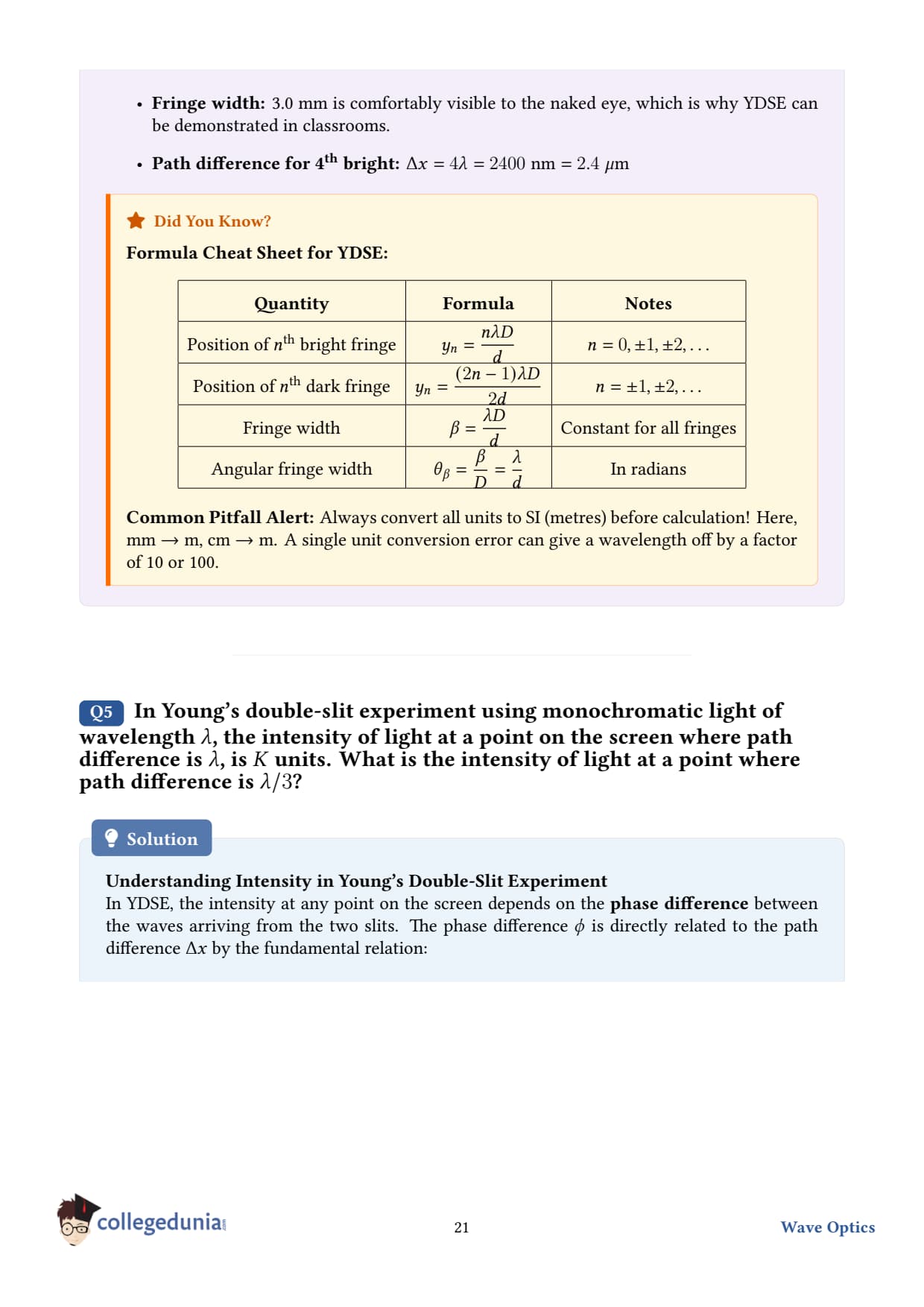
In Young's double-slit experiment using monochromatic light of wavelength λ, the intensity of light at a point on the screen where path difference is λ, is K units. What is the intensity of light at a point where path difference is λ/3?
What the question is asking. In a two-slit interference pattern, intensity at a point depends on the path difference Δ between the two interfering waves. We know intensity at Δ = λ is K. Find intensity at Δ = λ/3.
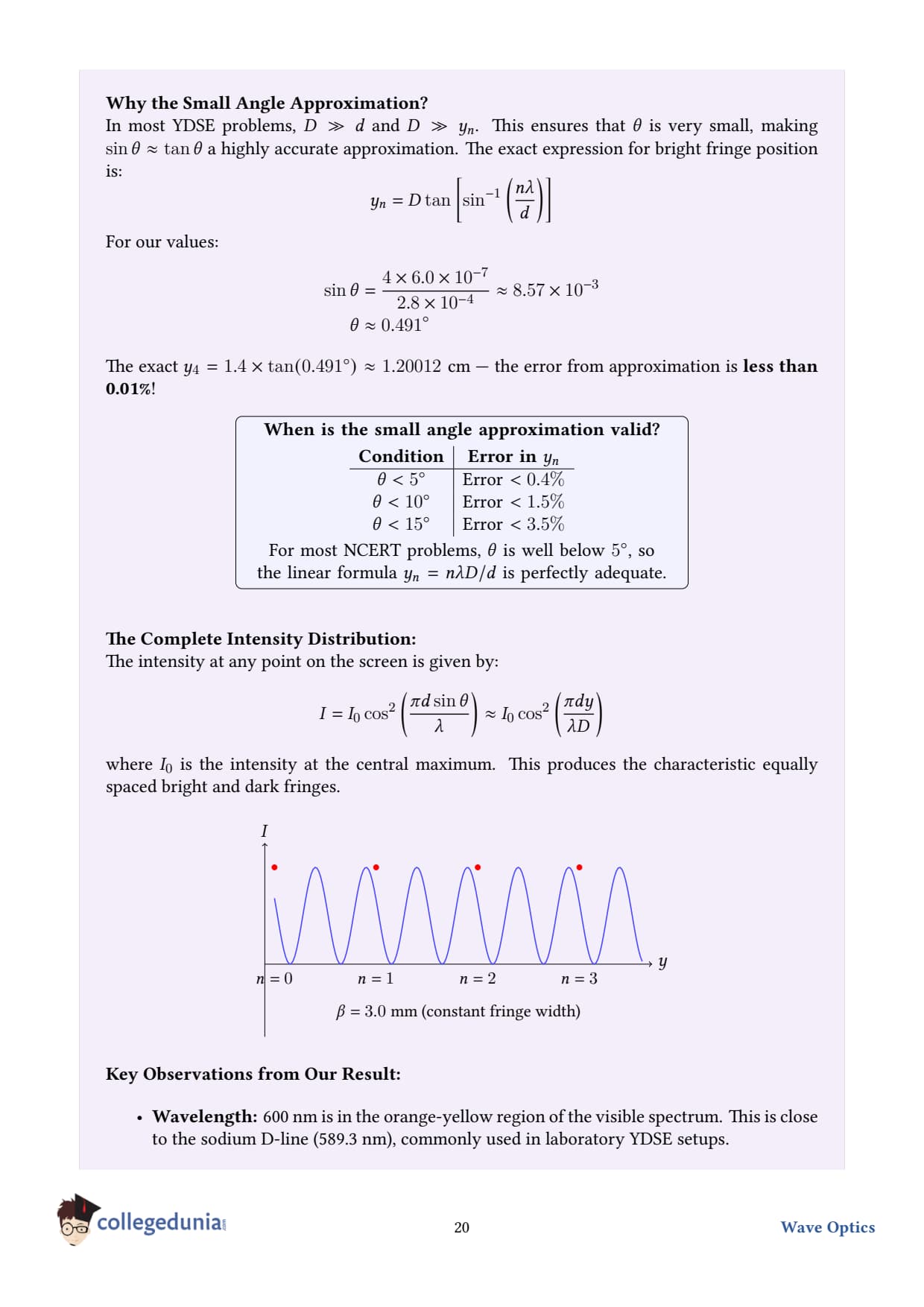
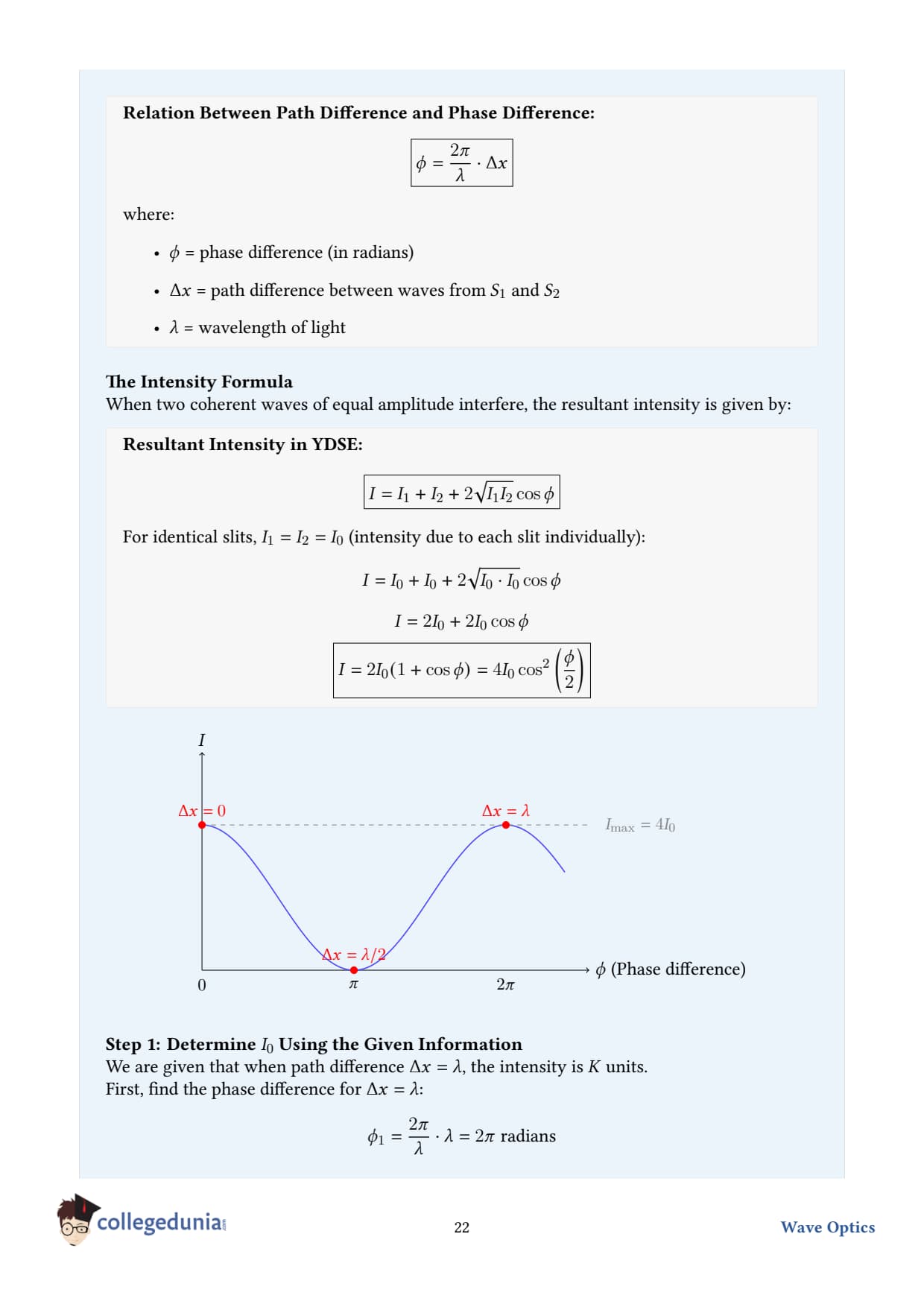
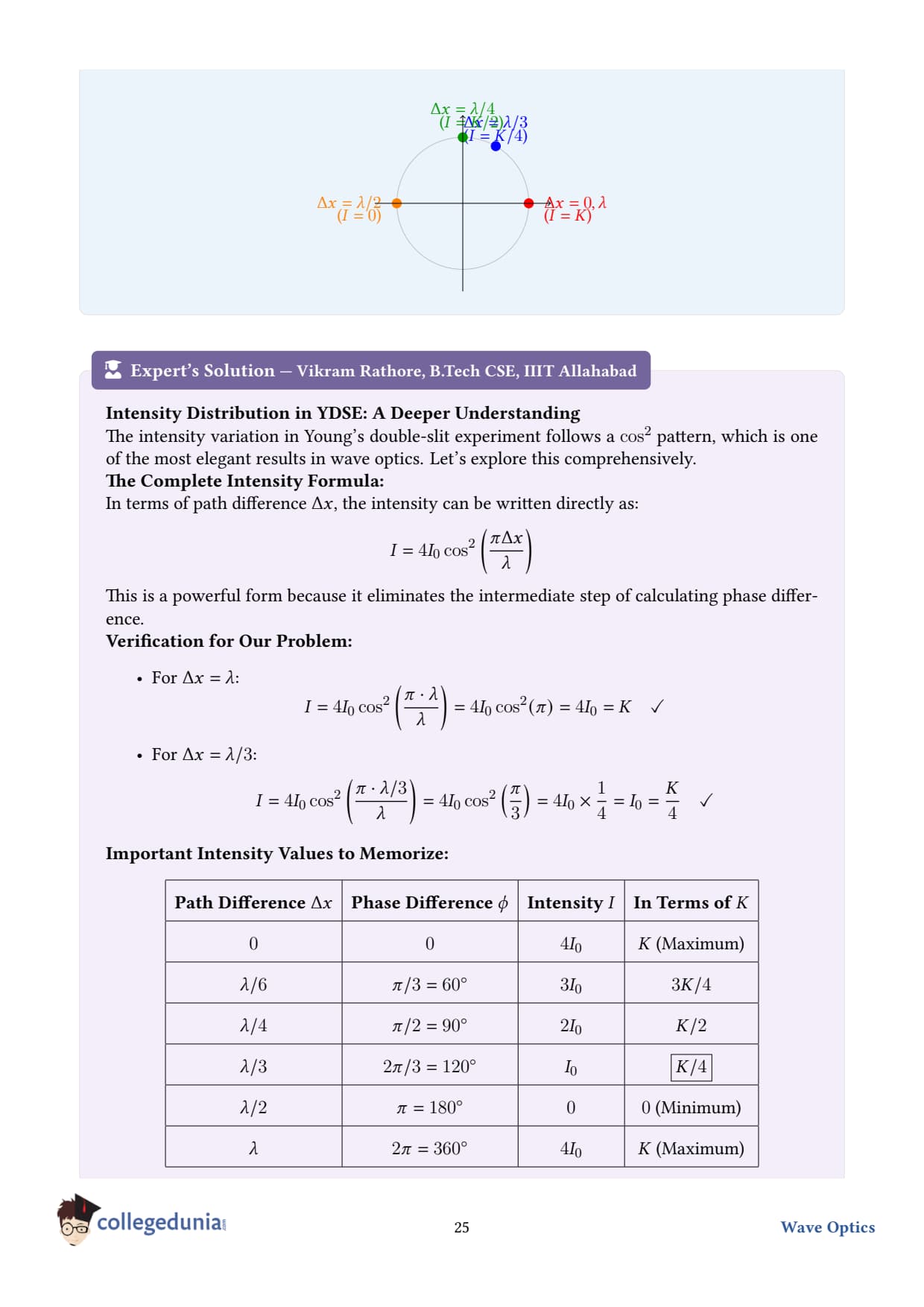
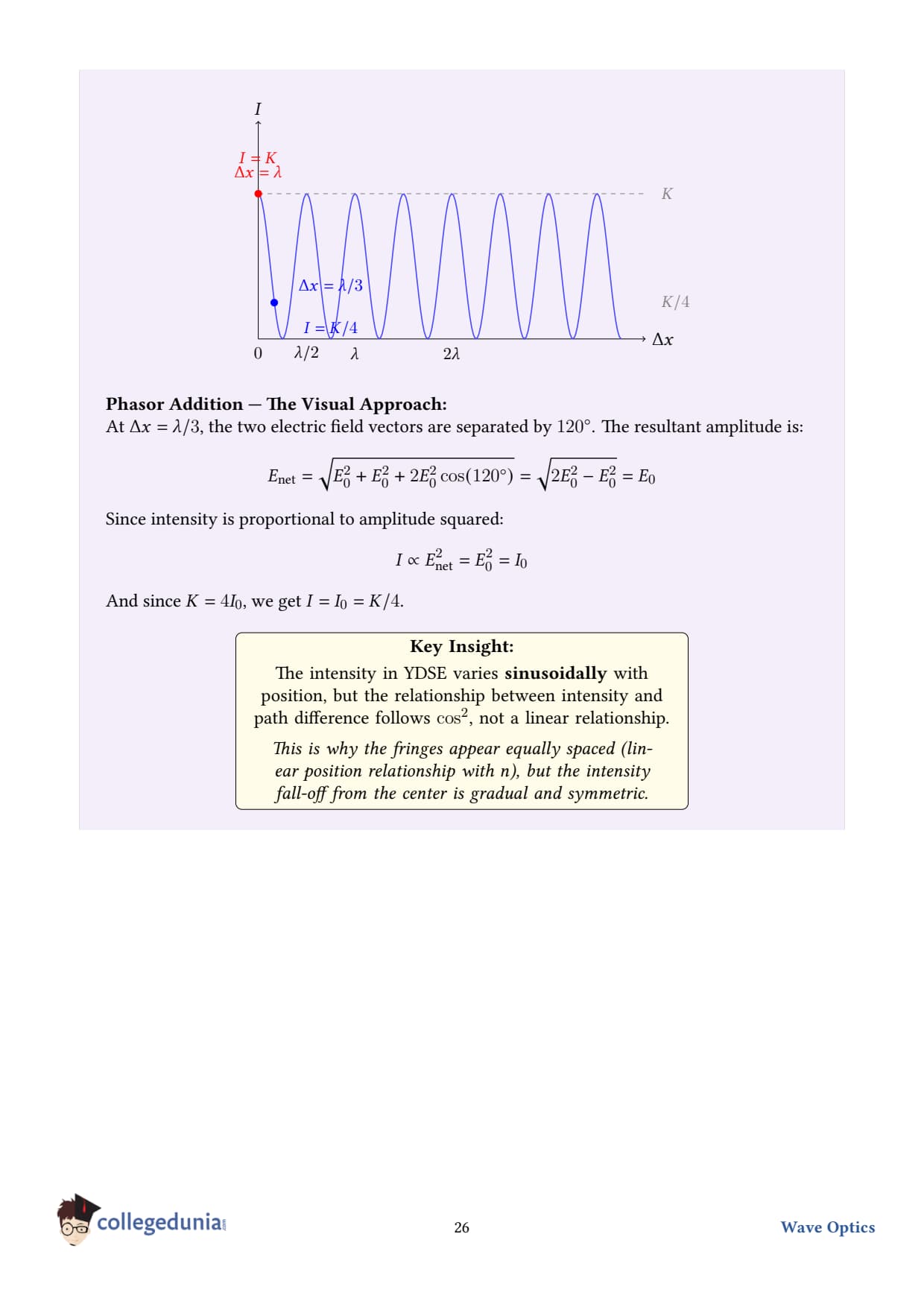
Concept used - intensity formula for two-slit interference. If the two slits emit waves of equal intensity, the resultant intensity at a point with phase difference φ is I = I0 cos2(φ2), where I0 is the maximum (central) intensity. The phase difference relates to the path difference via φ = 2πλ Δ.
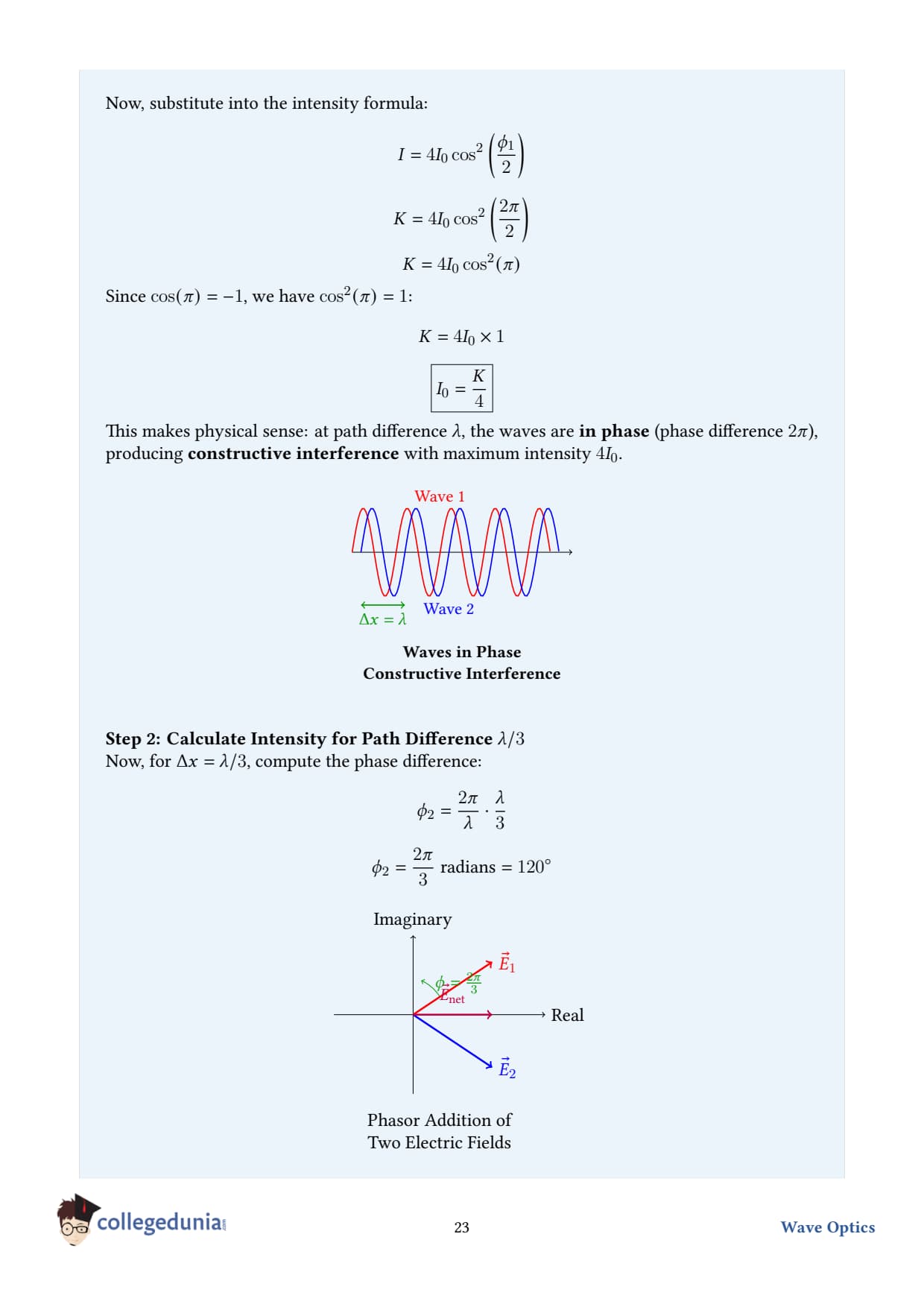
Step 2 - intensity at this point (given). When φ = 2π, cos2(2π2) = cos2(π) = (-1)2 = 1. So I1 = I0· 1 = I0. We are told this equals K: K = I0.
Why this makes sense. A path difference of one full wavelength corresponds to a bright fringe (maximum) - both waves arrive in phase. So K is the maximum intensity.
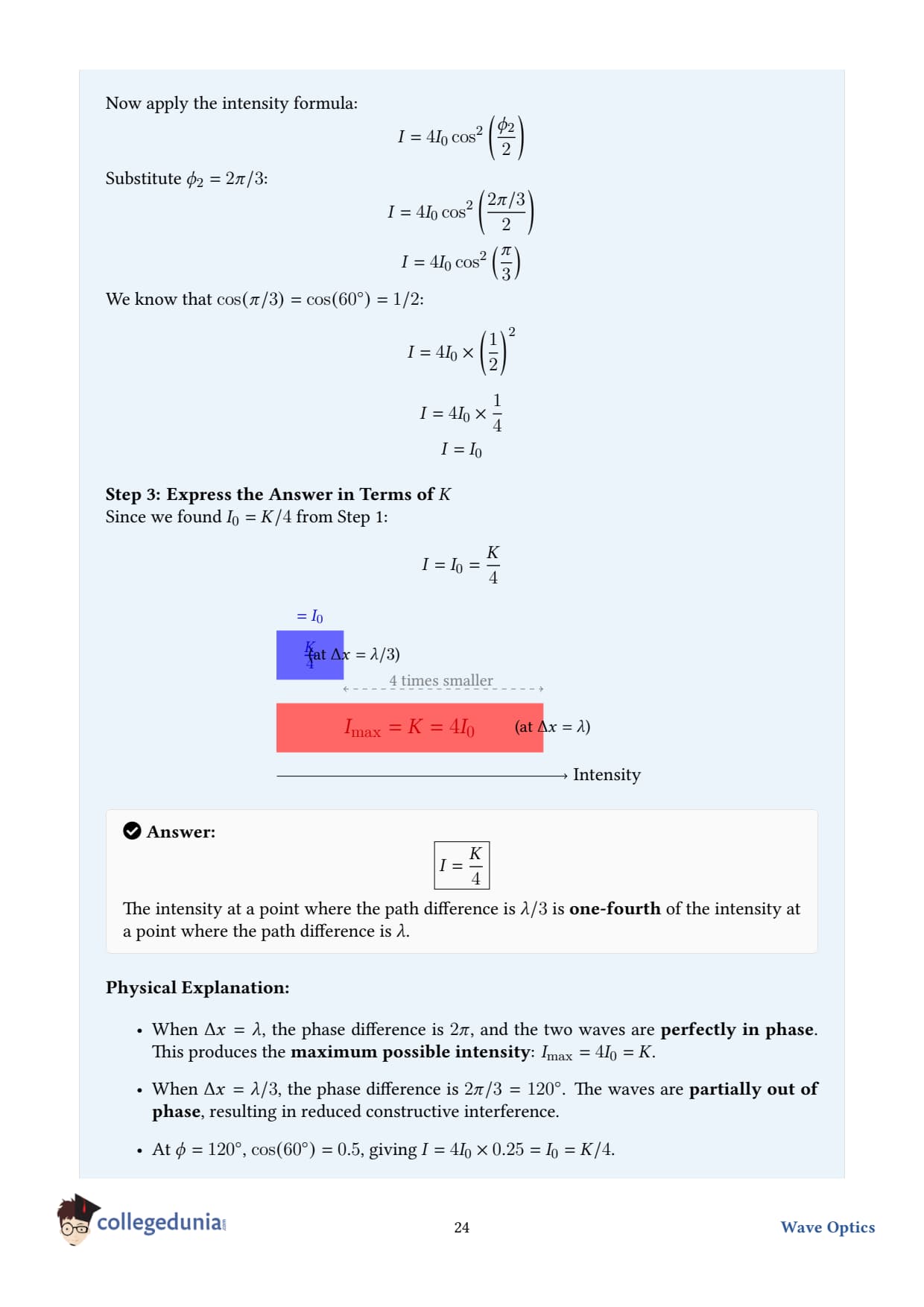
Step 4 - intensity at this point. I2 = I0 cos2(22) = K cos2(π3). Now cosπ/3 = 1/2, so cos2(π/3) = 14.
Step 5 - finish. I2 = K4.
Final answer.I = K4.
DV
Dr. Vikram Joshi
M.Sc Physics, Banaras Hindu University
Verified Expert
Where the cosine-squared formula comes from. Two coherent waves at the screen are y1 = acosω t, y2 = acos(ω t + φ). Their sum is y1 + y2 = 2acos(φ/2) cos(ω t + φ/2). The amplitude of the resultant is A = 2acosφ/2, and intensity I ∝ A2. With I0 = (2a)2 ∝ maximum intensity, we get I = I0cos2φ/2.
Alternative - phasor method. Represent each wave as a phasor (vector) of length a. Two phasors at angle φ apart sum to a resultant of length R = √a2 + a2 + 2a2cosφ = 2a |cos(φ/2)|. Same result.
Common mistake - confusing path difference and phase difference. The factor of 2π/λ is essential. Path difference is measured in metres; phase difference in radians. Many students forget the conversion and use φ = λ/3, which is dimensionally wrong (radians, not metres!).
Pattern of intensities. Worth memorising for quick MCQs:
Δ = 0 or λ: I = K (maximum).
Δ = λ/6: φ = π/3, I = Kcos2π/6 = (3/4)K.
Δ = λ/4: φ = π/2, I = Kcos2π/4 = K/2.
Δ = λ/3: φ = 2π/3, I = Kcos2π/3 = K/4.
Δ = λ/2: φ = π, I = 0 (dark fringe).
Real-world - anti-reflection coatings. A camera lens coated with a thin transparent film of thickness λ/4where λ is the dominant visible wavelength inside the coating produces a path difference of λ/2 for the wave reflected from the front and back surfaces - destructive interference. This reduces reflection from the lens, transmitting more light to the sensor.
Q 10.6
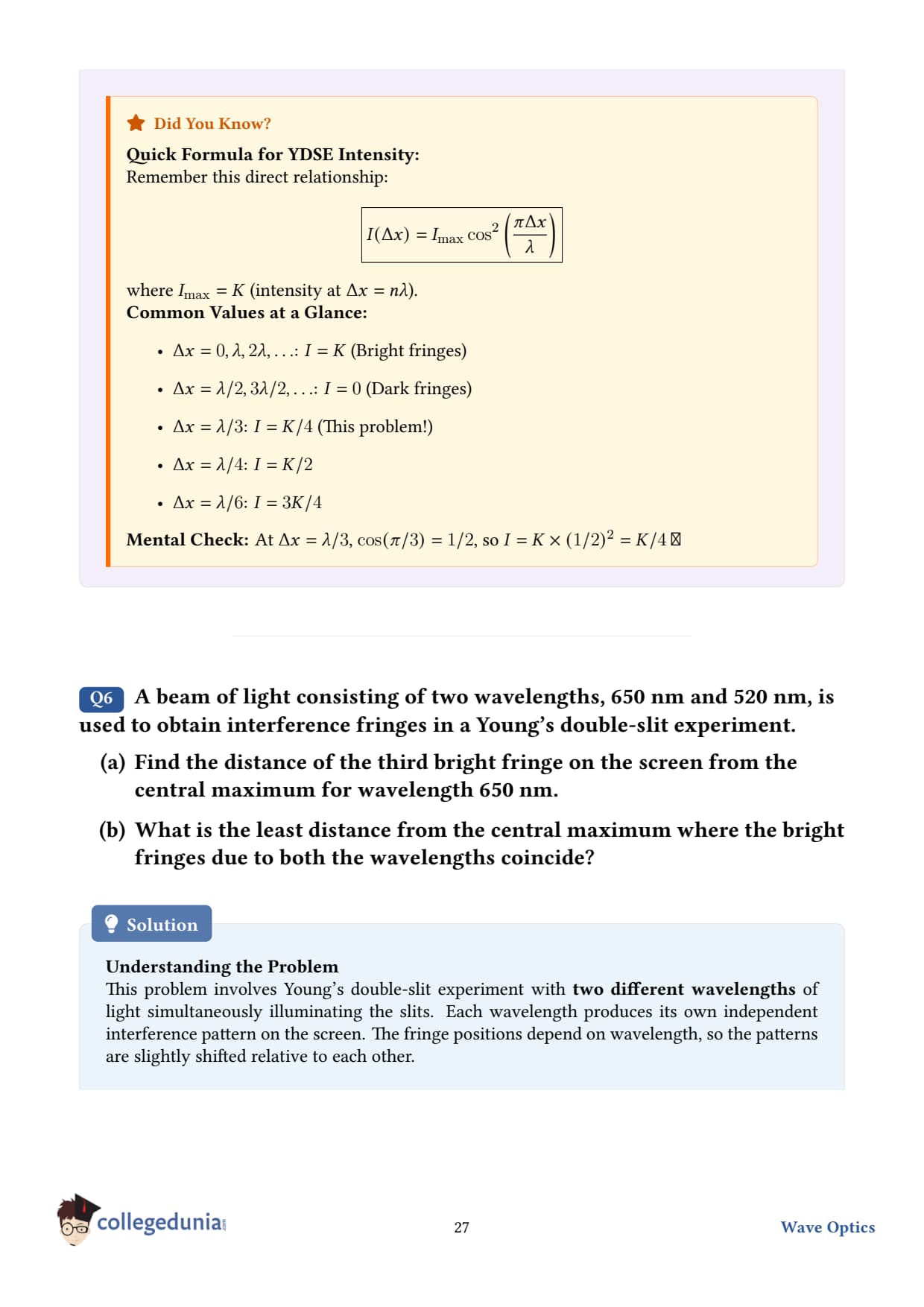
A beam of light consisting of two wavelengths, 650 nm and 520 nm, is used to obtain interference fringes in a Young's double-slit experiment.
(a) Find the distance of the third bright fringe on the screen from the central maximum for wavelength 650 nm.
(b) What is the least distance from the central maximum where the bright fringes due to both the wavelengths coincide?
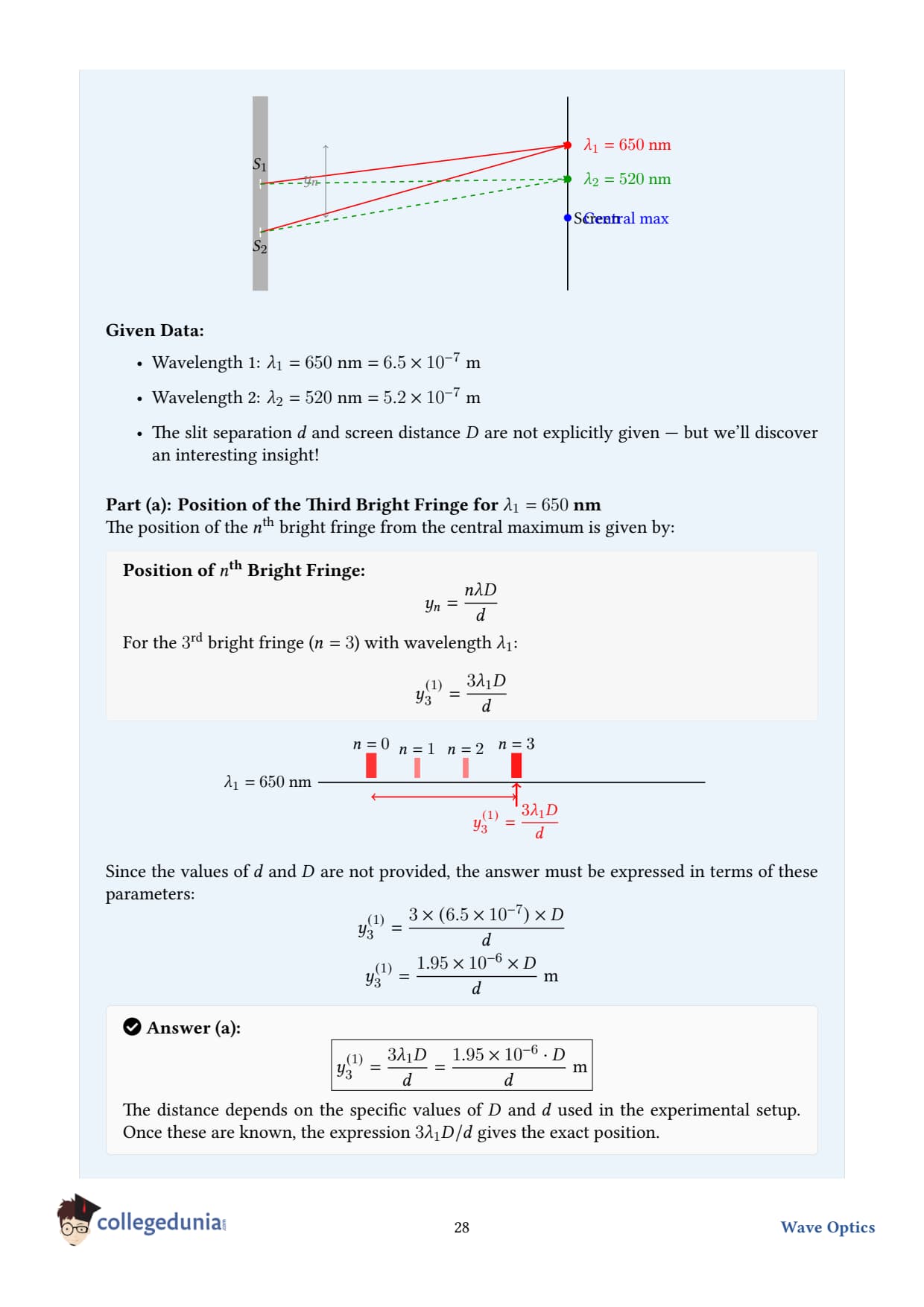
The problem doesn't give numerical values for d and D - we'll express answers in terms of them where needed, or use the NCERT-implicit slit separation d and screen distance D. For part (b), the answer turns out to be independent of d,D only as a ratio.
Note. In the NCERT textbook this question typically is paired with values from Q 10.4: d = 0.28 mm, D = 1.4 m. We use those.
Concept used. Position of n-th bright fringe of wavelength λ: yn = nλ Dd.
(a) Third bright fringe for 1 = 650 nm. Here n = 3.
Step 5 - convert. y3 = 9.7510-3m ≈ 9.75 mm ≈ 0.975 cm.
(b) Least distance where bright fringes of both wavelengths coincide.
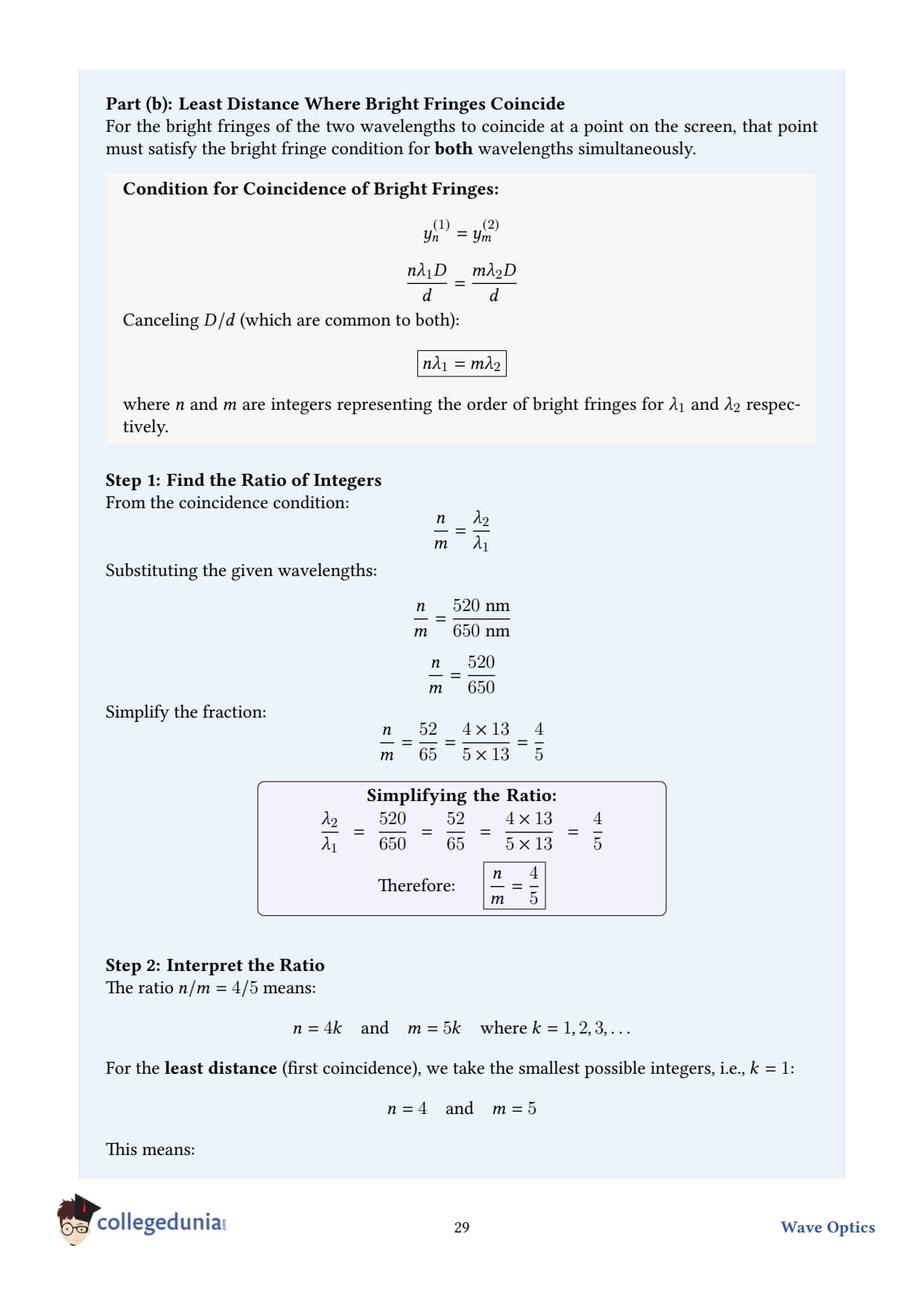
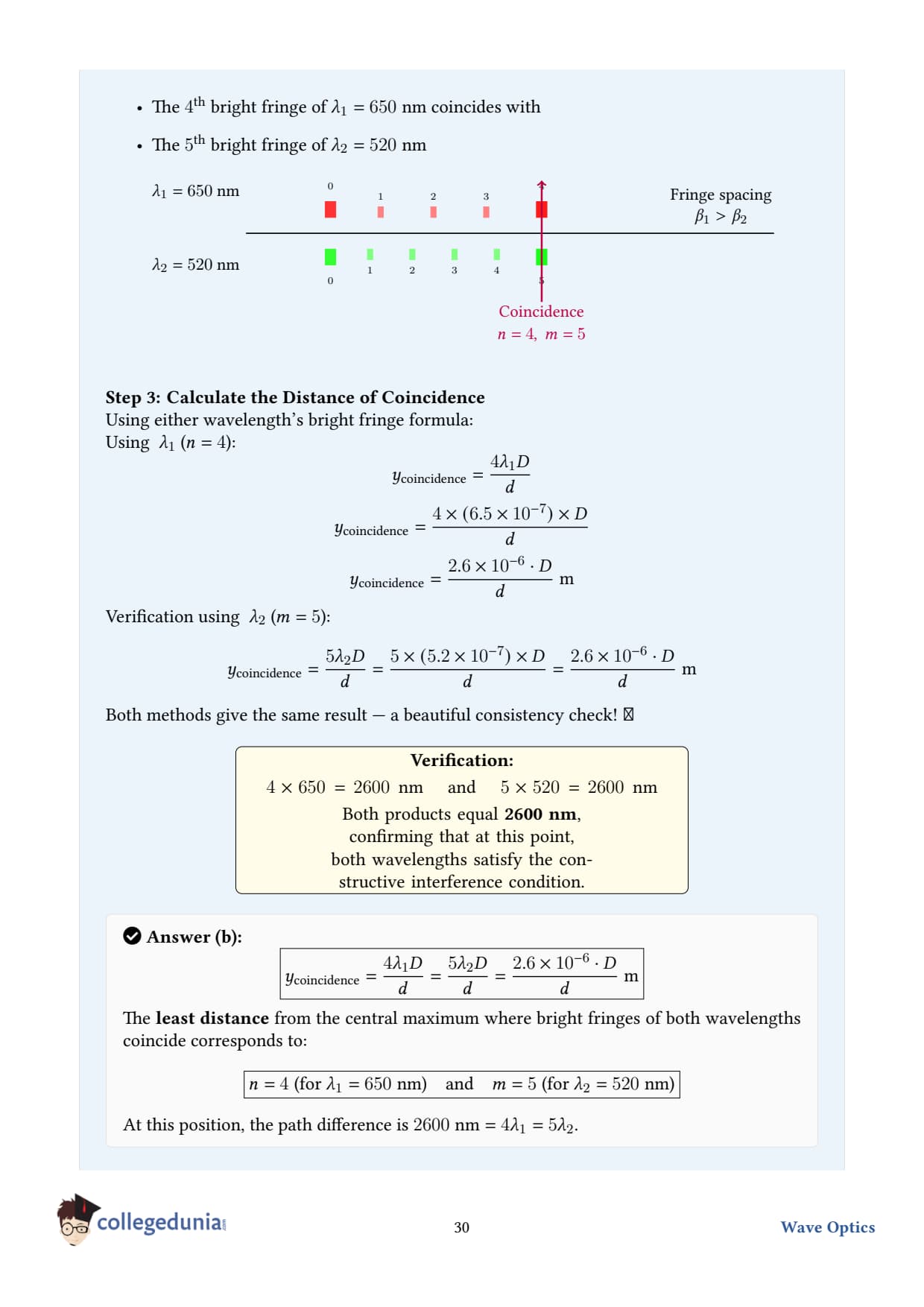
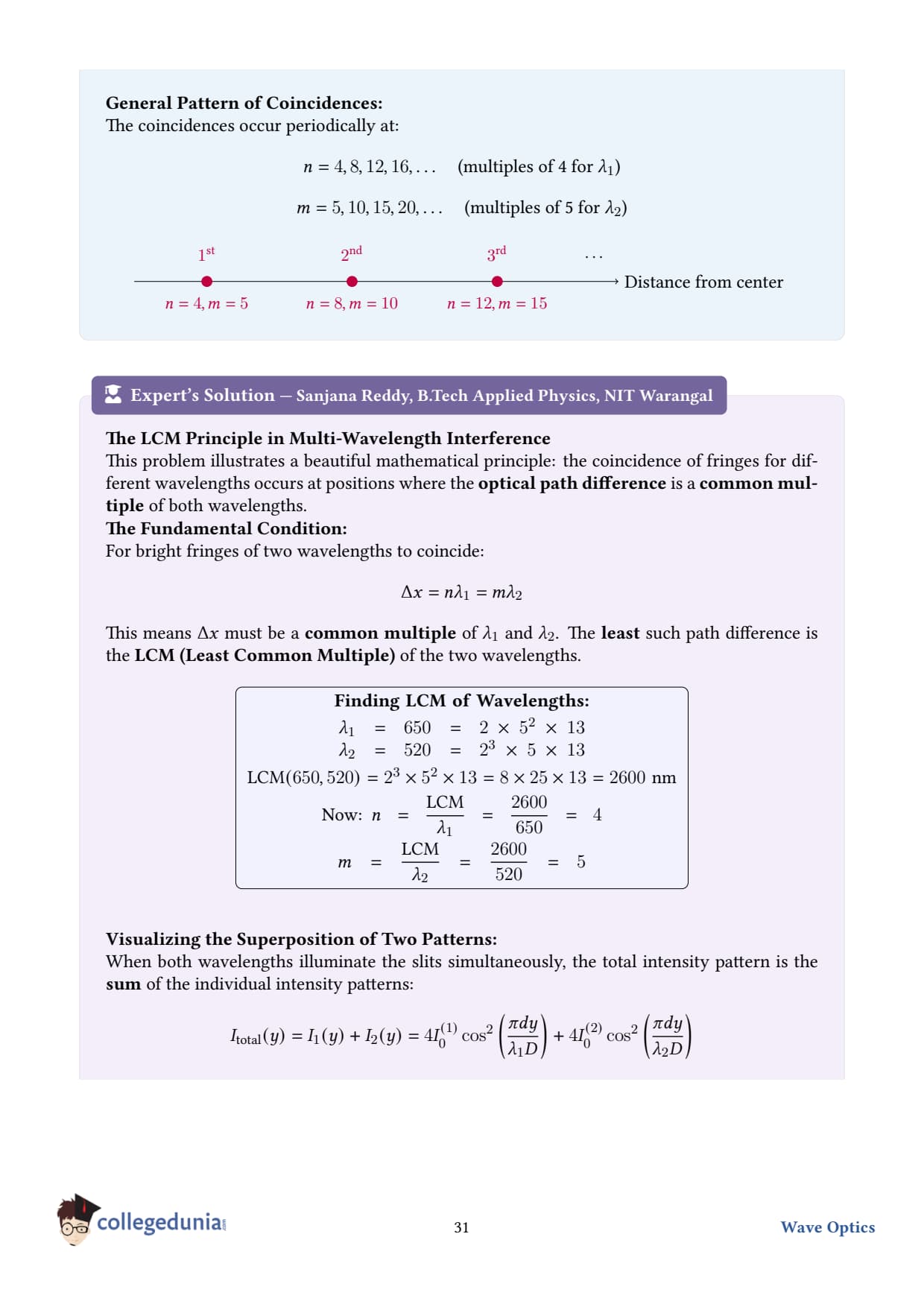
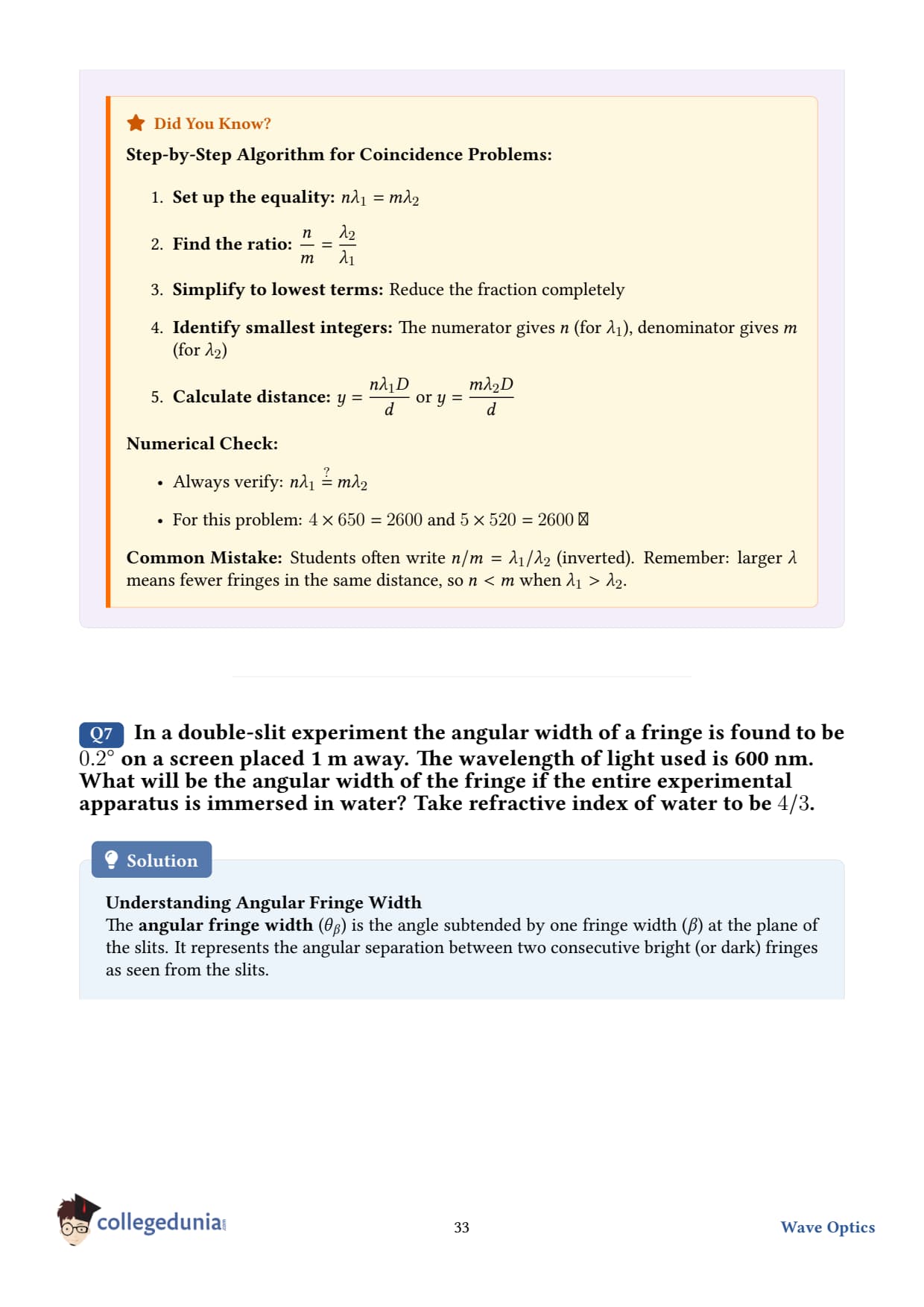
Setup. A bright fringe of order n1 for 1 and a bright fringe of order n2 for 2 coincide if n11Dd = n22Dd, i.e., n11 = n22. We want the SMALLEST positive integers n1, n2 satisfying this.
Step 1 - set up the ratio.n1n2 = 21 = 520650 = 45 (divide both by 130).
Check using the other wavelength.y = 5 2Dd = 5 (52010-9)(1.4)0.2810-3 = 5× 7.2810-72.810-4 = 1.310-2m
Final answer.
(a) y3 ≈ 0.975 cm ≈ 9.75 mm (for 650 nm, third bright fringe).
(b) The bright fringes coincide first at y = 1.3 cm; this is the 4th maximum of 650 nm and the 5th maximum of 520 nm.
DS
Dr. Sneha Iyer
Ph.D. Physics, IISc Bangalore
Verified Expert
The arithmetic of the ratio. Whenever you have two wavelengths in a YDSE problem, the bright fringes coincide when n11 = n22. The smallest solution is found by reducing the wavelength ratio to lowest terms - here 650:520 = 5:4, so n1 = 4, n2 = 5. In general, if 1/2 = p/q in lowest terms, then n1 = q and n2 = p are the smallest orders that coincide.
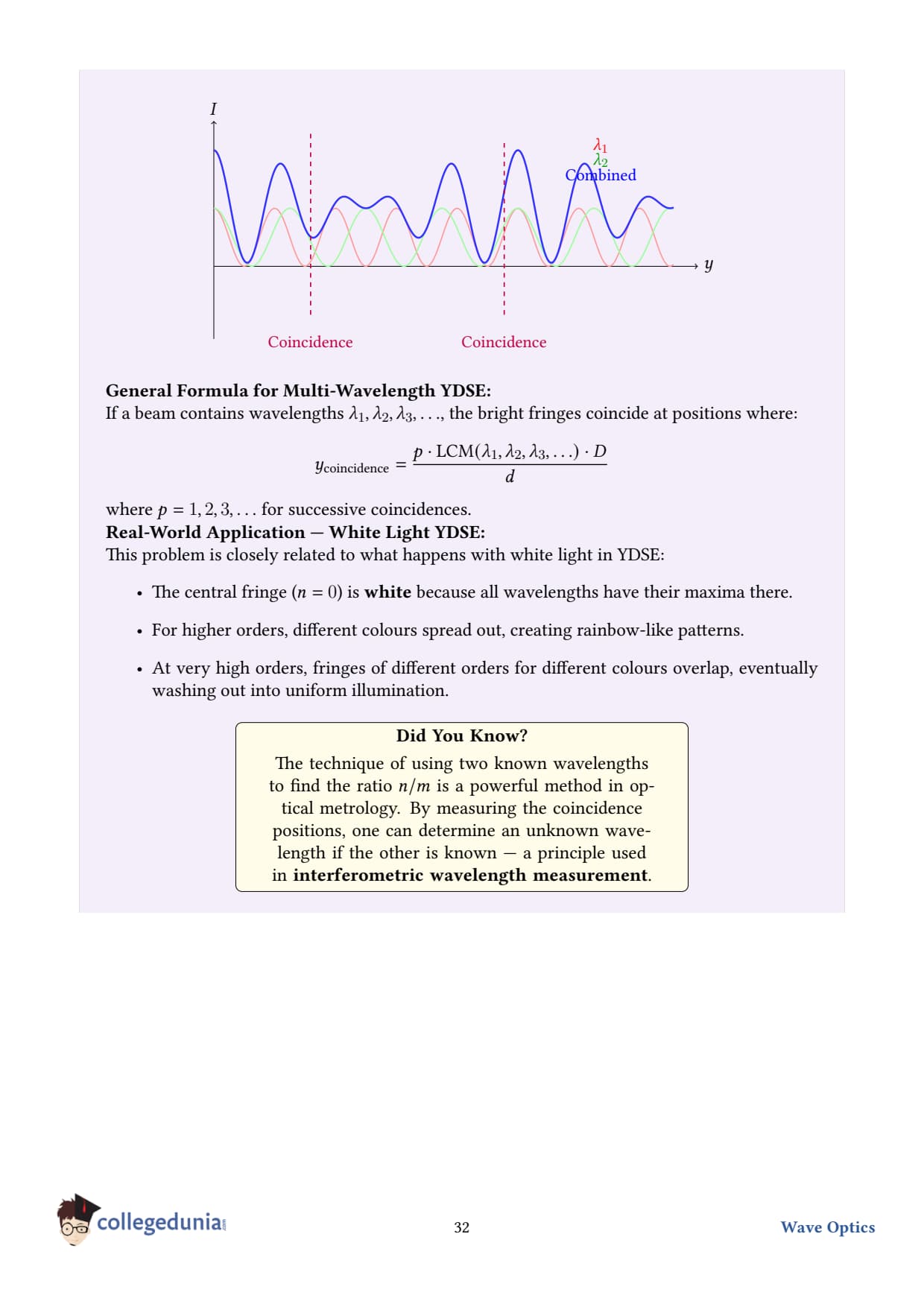
What happens between coincidences. Between the central maximum and the first coincidence, you'd see bright fringes of 1 (red) and 2 (green) at different positions, creating a complicated overlapping pattern. The fringes appear to "beat" - bright regions where they overlap, washed-out regions where they're staggered.
Common mistake - coinciding dark fringes vs bright fringes. For dark fringes, the condition is n1 + 1/21 = n2 + 1/22, which has different solutions. Don't apply the bright-fringe condition to dark fringes.
Real-world - white-light fringes. If the source is white light (a mixture of all visible wavelengths), only the central maximum where Δ = 0 for all wavelengths simultaneously is white. Away from the centre, fringes of different colours fall at different positions, producing rainbow-coloured fringes near the centre that quickly wash out. The "central white fringe" is therefore a signature of zero-path-difference geometry - useful for calibrating interferometers.
Pitfall. Make sure to convert all units consistently. Wavelengths in nm, distances in m - mixing them up by a factor of 109 is a common slip.
Q 10.7
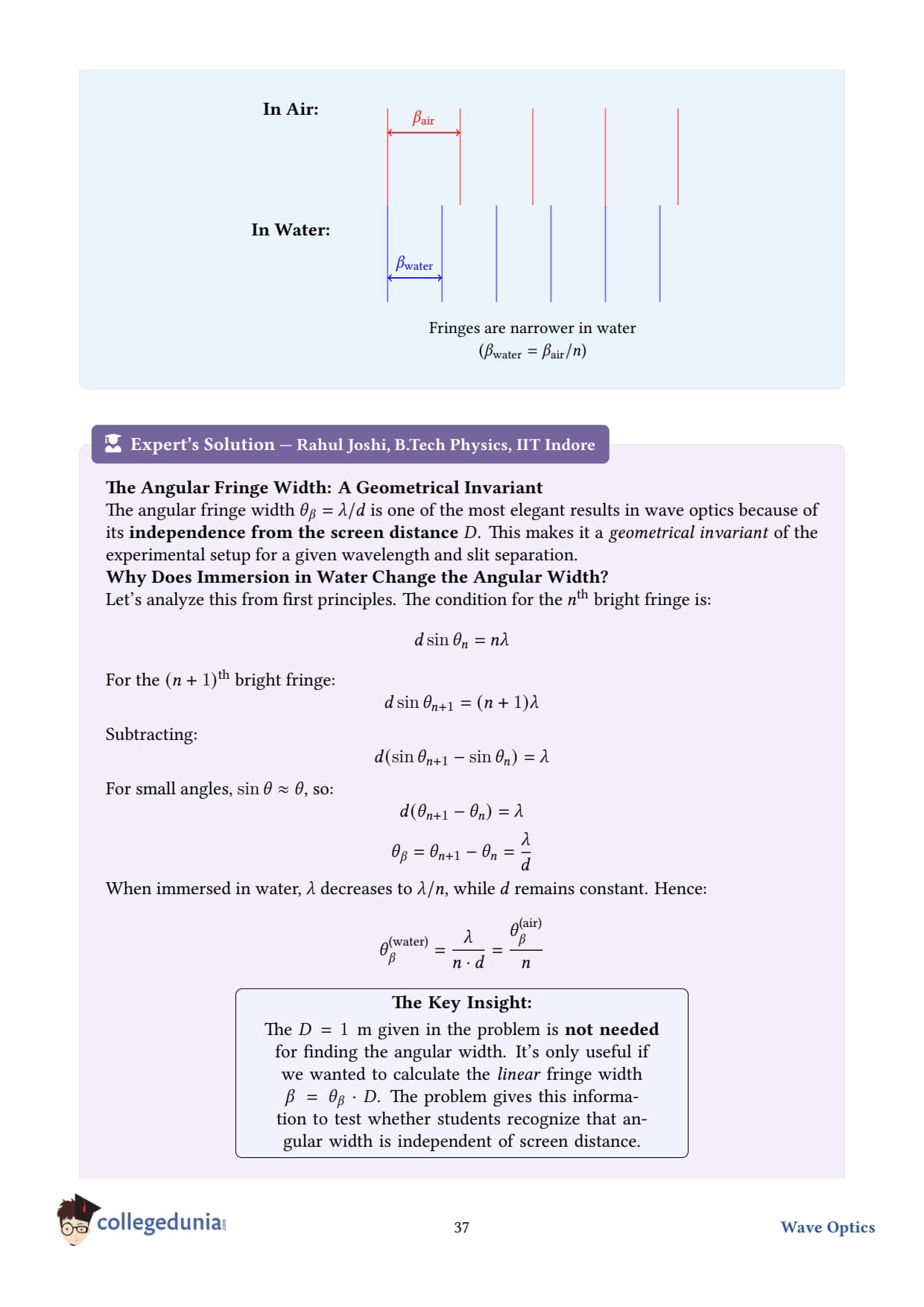
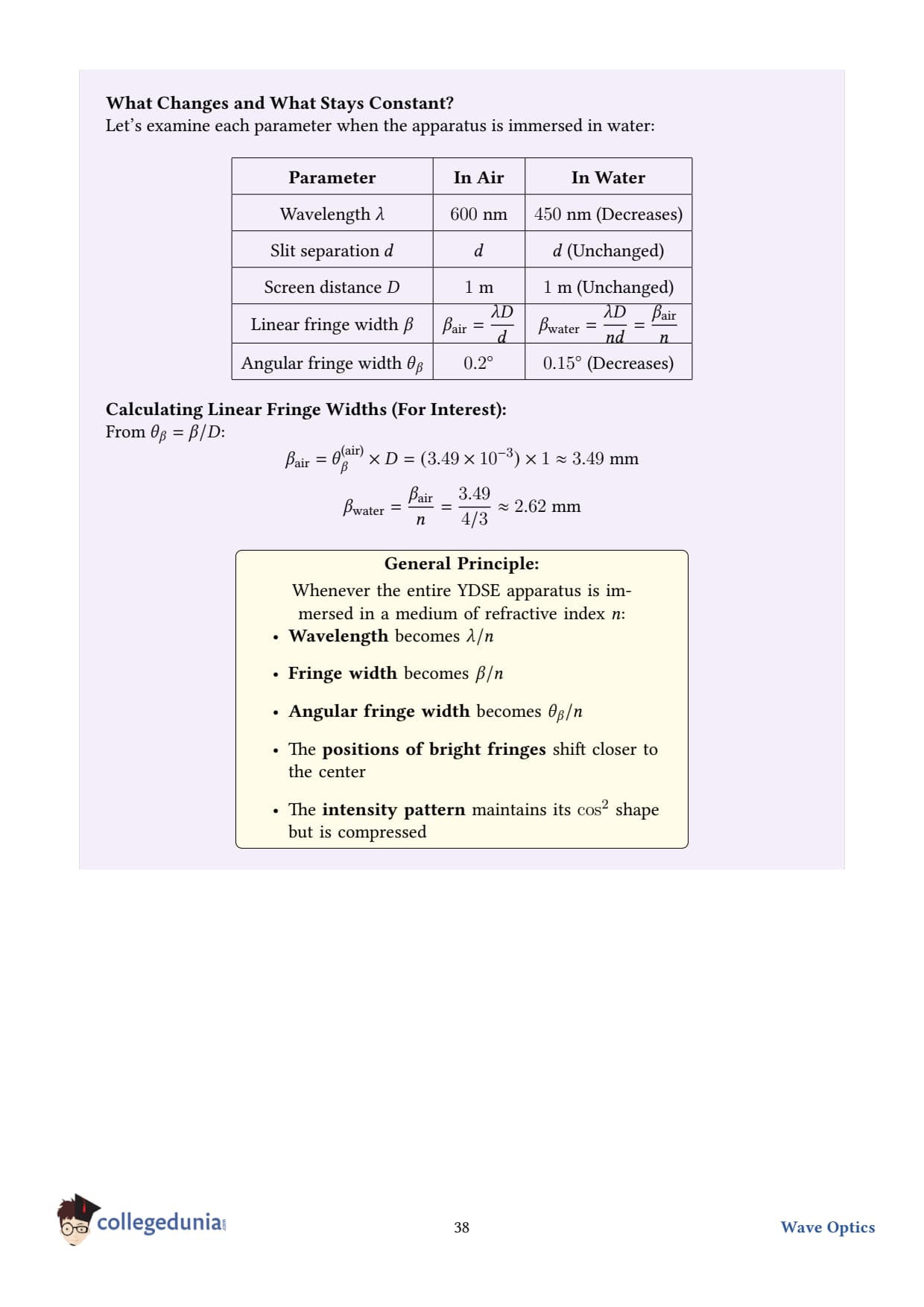
In a double-slit experiment using light of wavelength 600 nm, the angular width of a fringe formed on a distant screen is 0.1∘. What is the spacing between the two slits?
Given.
Wavelength of light, λ = 600 nm = 610-7m
Angular fringe width, θ = 0.1∘
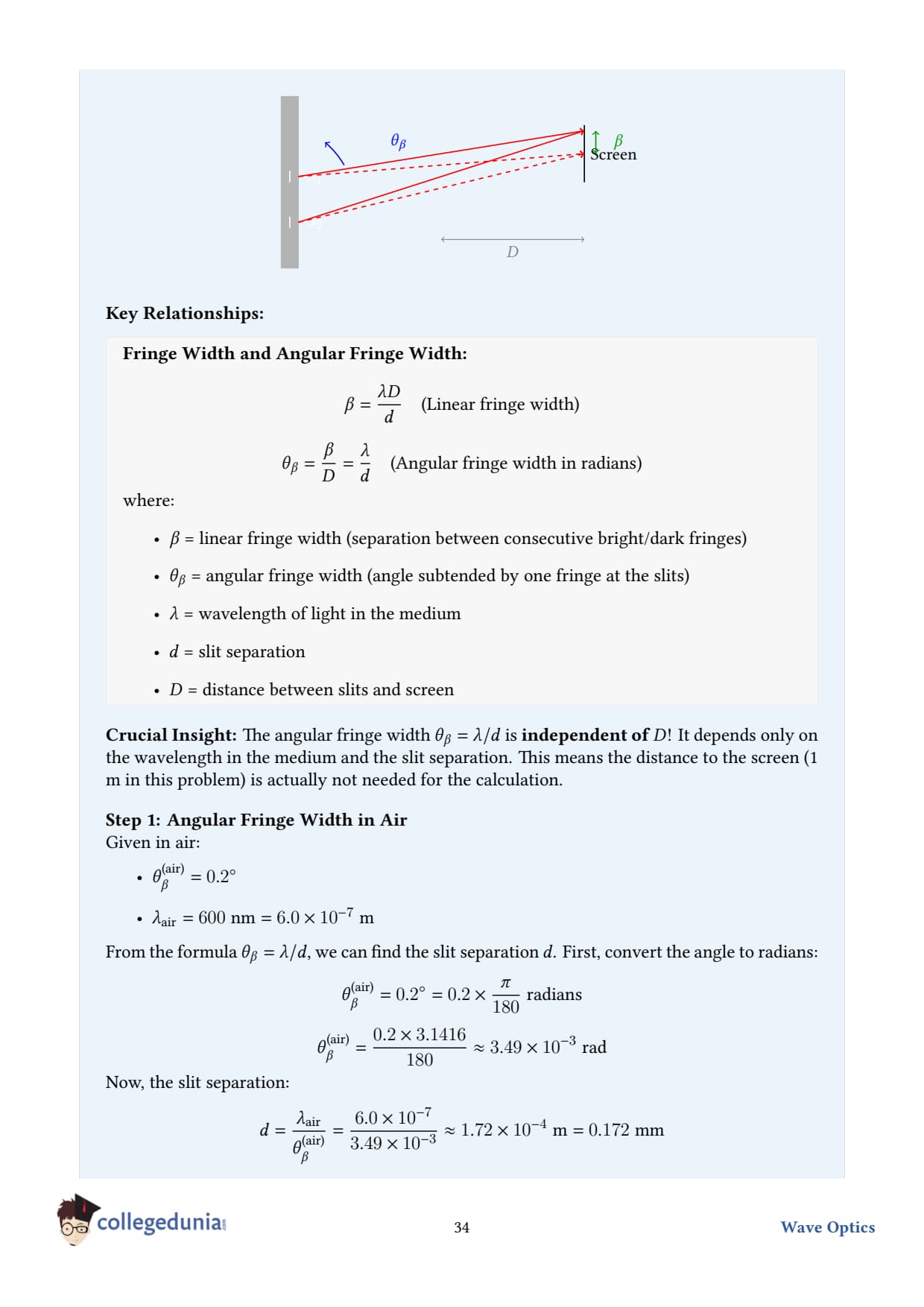
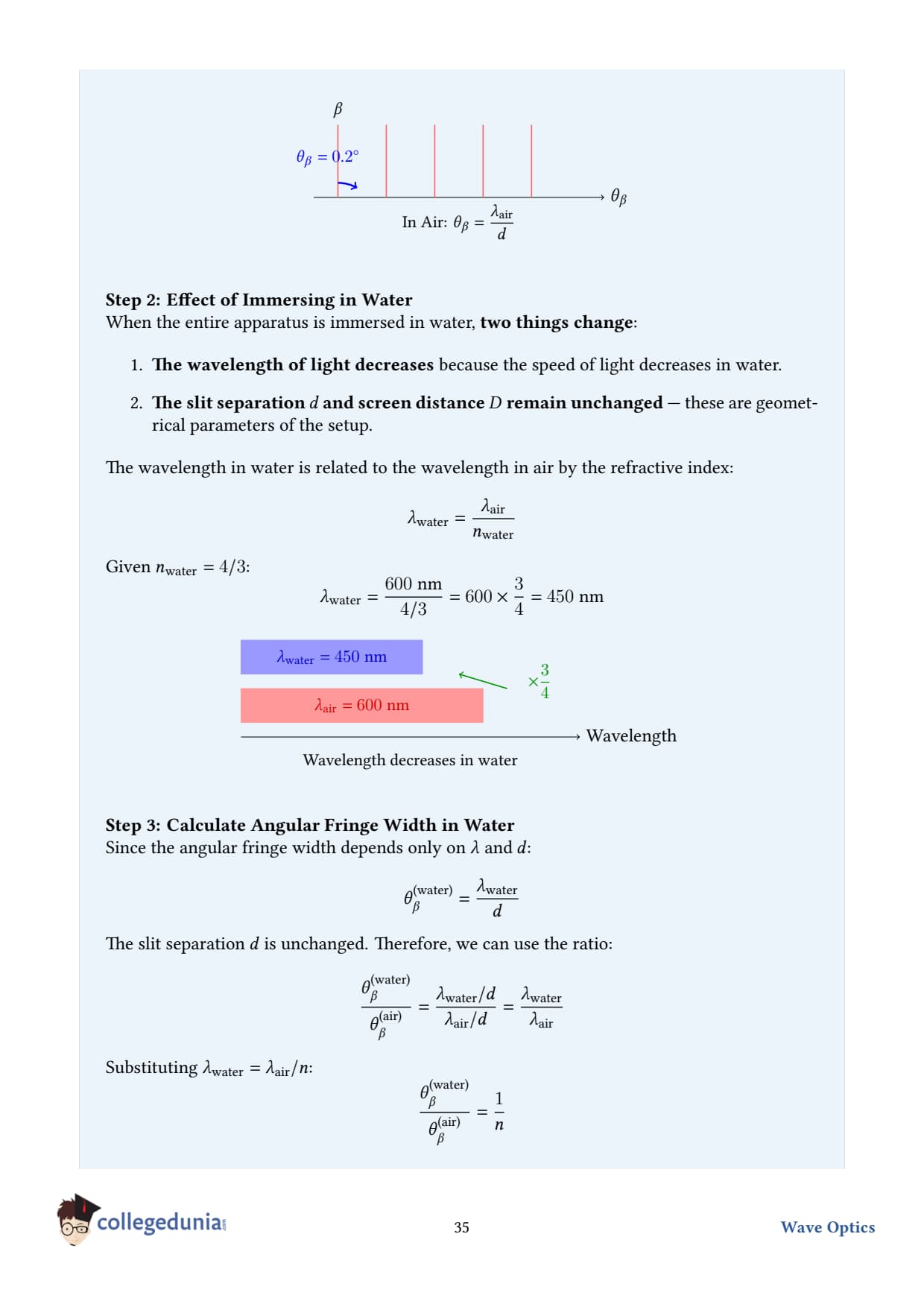
Concept used - angular fringe width. Each bright fringe in YDSE is at angular position sinn = nλ/d. The angular spacing between consecutive fringes (the angular fringe width) is approximately θ = λd (for small angles, in radians). This is the convenient form when D is not specified - it eliminates the screen distance from the formula.
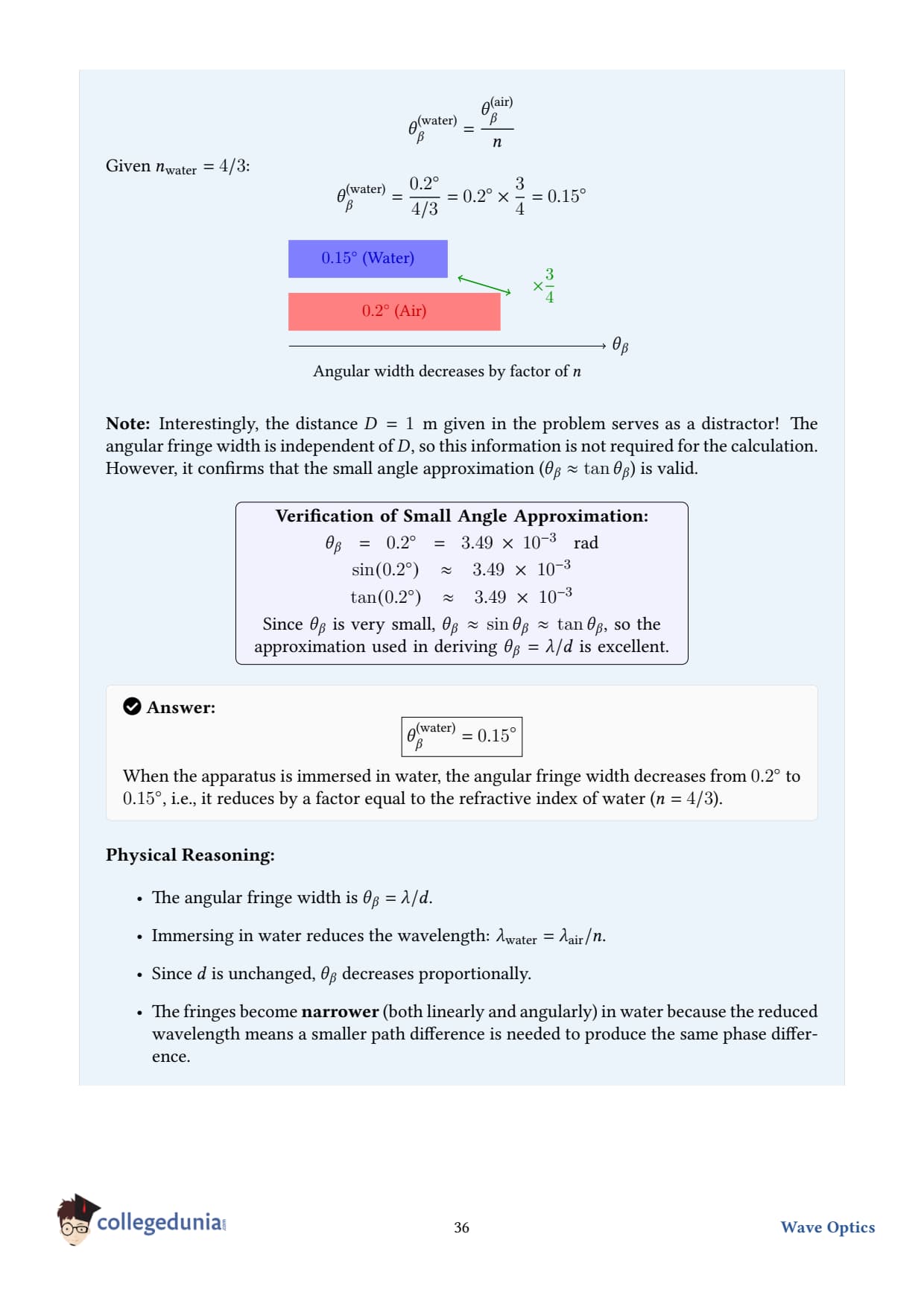
Why angular width is convenient. Linear fringe width β = λ D/d depends on the screen distance D. Angular fringe width θ = β/D = λ/d does not - it's a property only of the slits and the wavelength. So if a problem doesn't mention D, you should immediately suspect angular width.
Alternative - small-angle radians. Always remember the conversion: 1 degree = π/180 rad ≈ 0.01745 rad. Always convert before plugging into formulae that assume radians.
Order of magnitude. Slit separations in YDSE are typically 0.1-1 mm. Our answer (0.34 mm) is well in this range - a sanity check that nothing has gone wrong.
Real-world. Diffraction gratings (used in spectrometers) work by the same principle. The angular position of a bright spectral line is set by sinθ = nλ/d, where d is now the grating period. Knowing d (engraved precisely) and measuring θ, one can determine λ - this is how astronomers identify spectral lines of distant stars.
Q 10.8
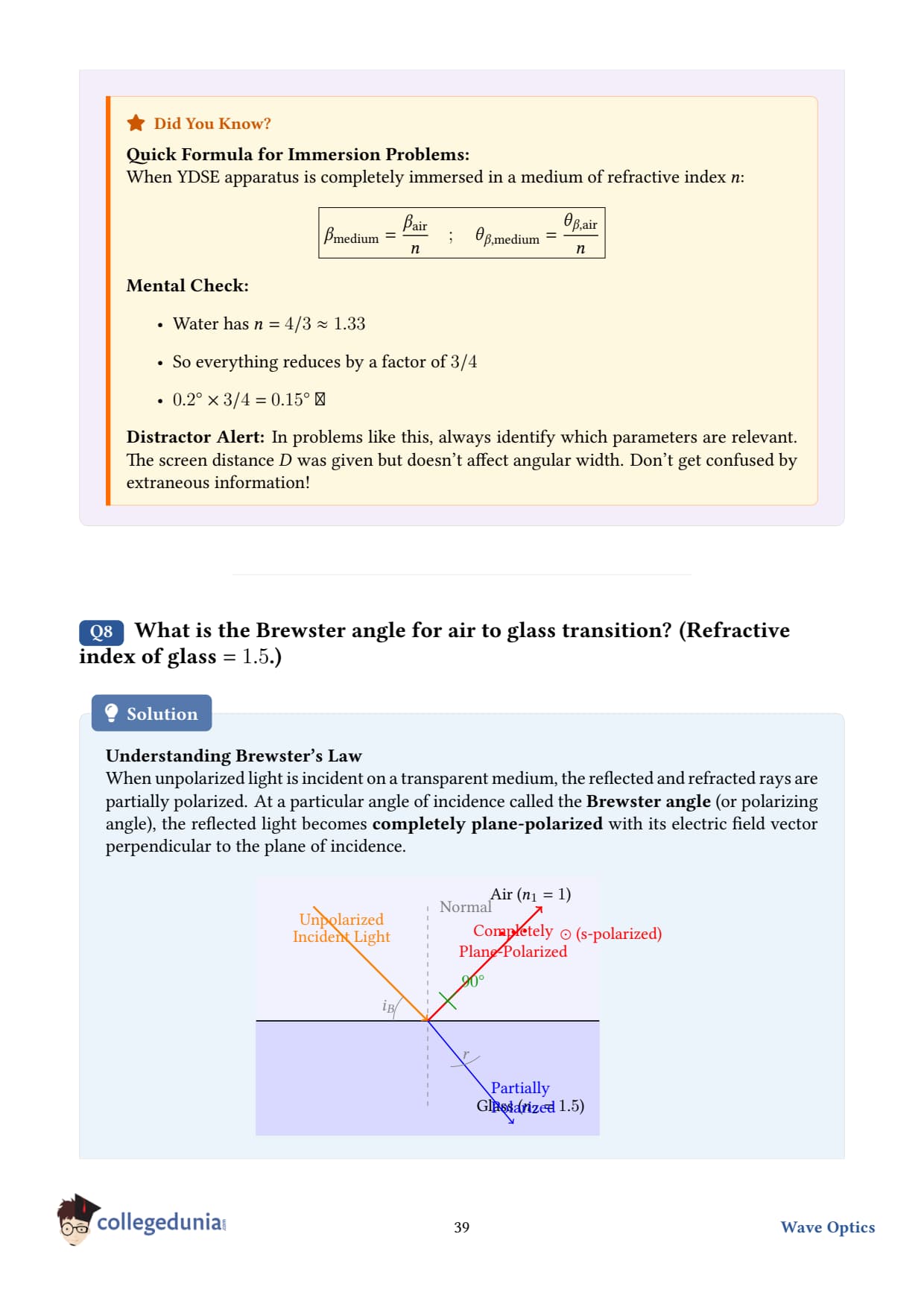
What is the Brewster angle for air to glass transition? Refractive index of glass = 1.5.
Given. Light going from air n1 = 1 into glass n2 = 1.5.
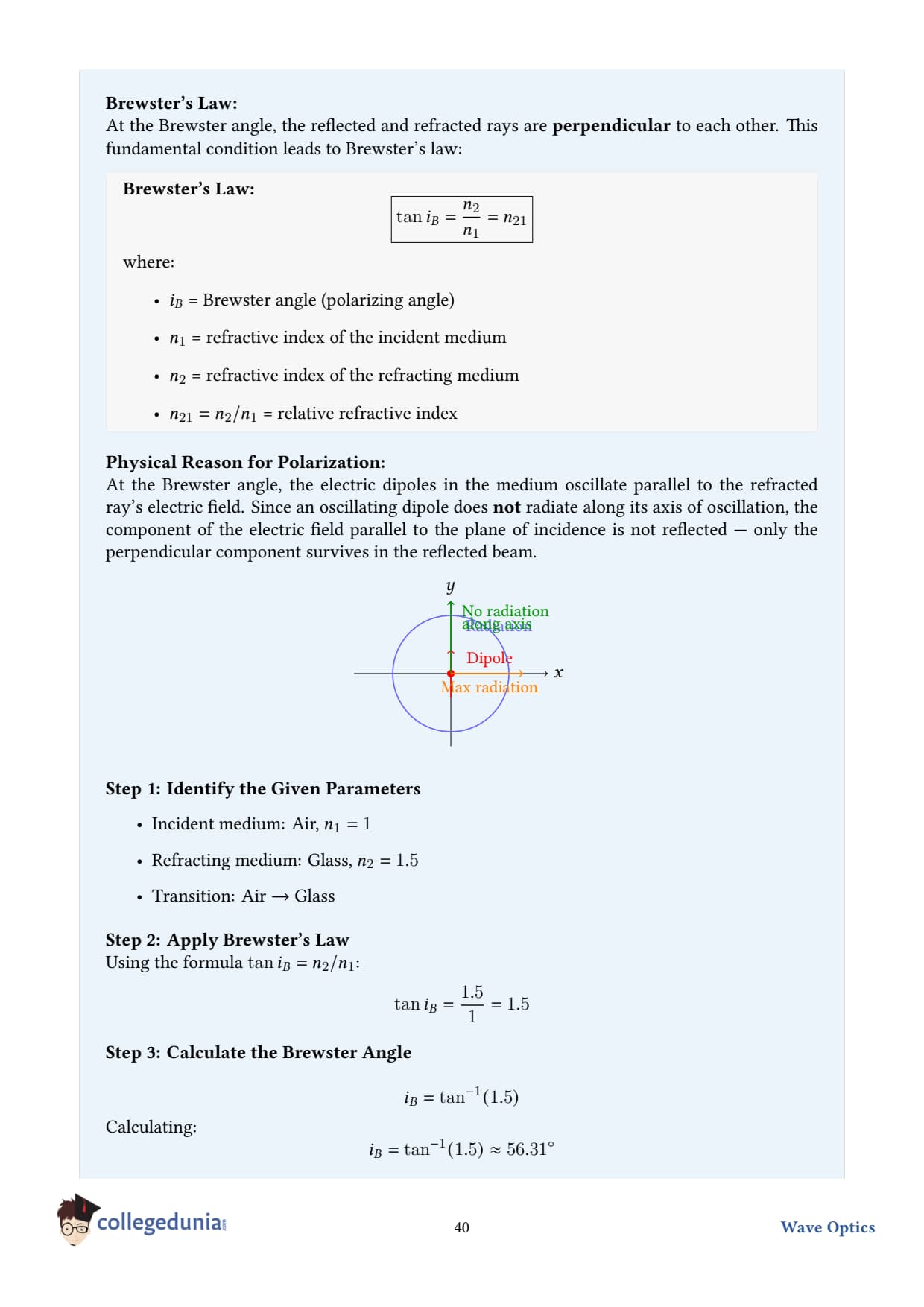
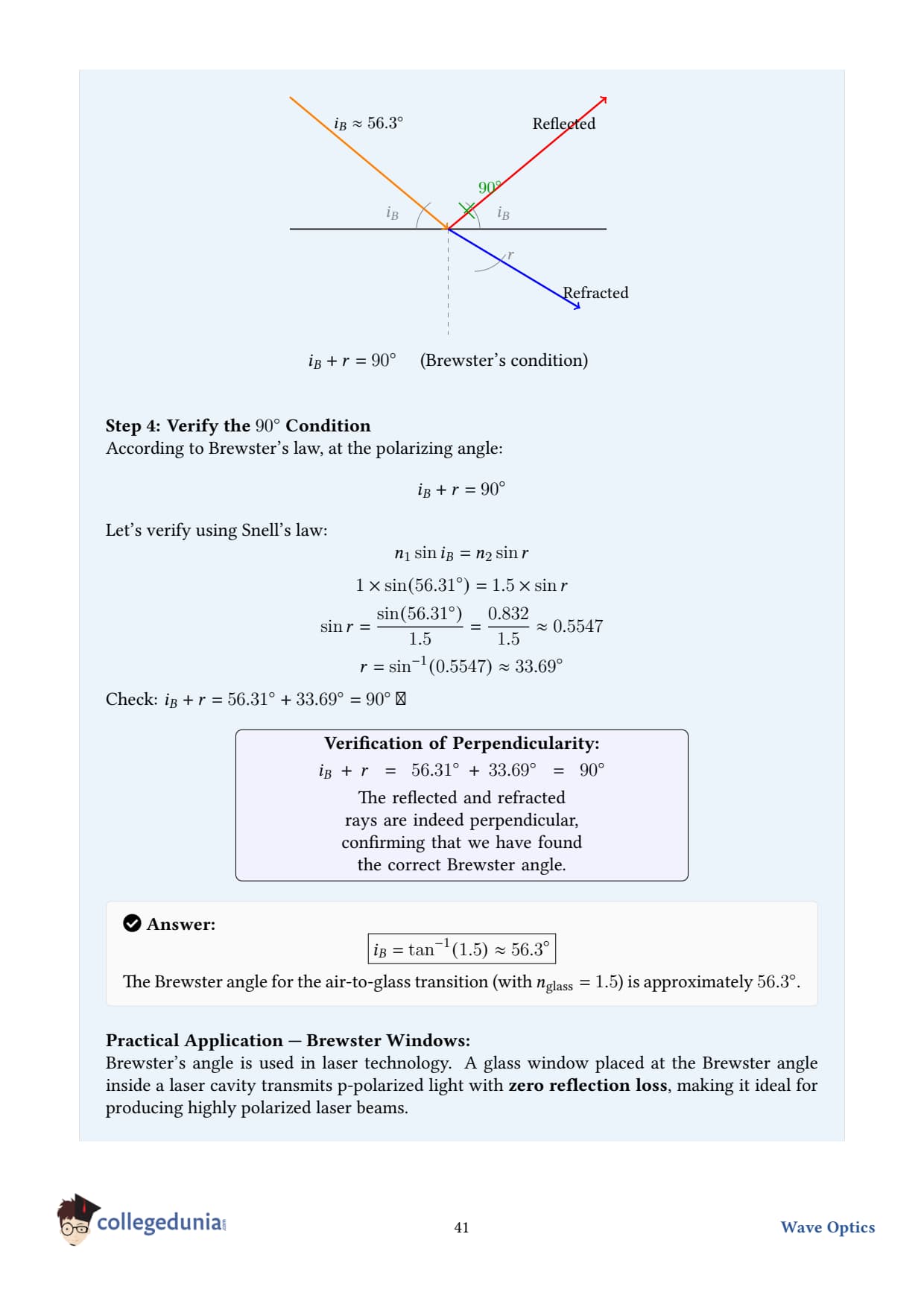
Concept used - Brewster's law. At a particular angle of incidence called the Brewster angleiB (or polarising angle), the reflected and refracted rays are perpendicular to each other, and the reflected light is completely polarised (electric field vector lies in the plane of the interface, perpendicular to the plane of incidence). Brewster's law gives this angle: tan iB = n2n1, where light travels from medium 1 refractive index n1 into medium 2 refractive index n2.
Step 1 - substitute. tan iB = 1.51 = 1.5.
Step 2 - take inverse tangent. iB = tan-1(1.5).
Step 3 - evaluate. Recall tan 56.3∘ ≈ 1.5. So iB ≈ 56.3∘.
Final answer. iB ≈ 56.3∘.
DR
Dr. Rajesh Kumar
Ph.D. Physics, IIT Delhi
Verified Expert
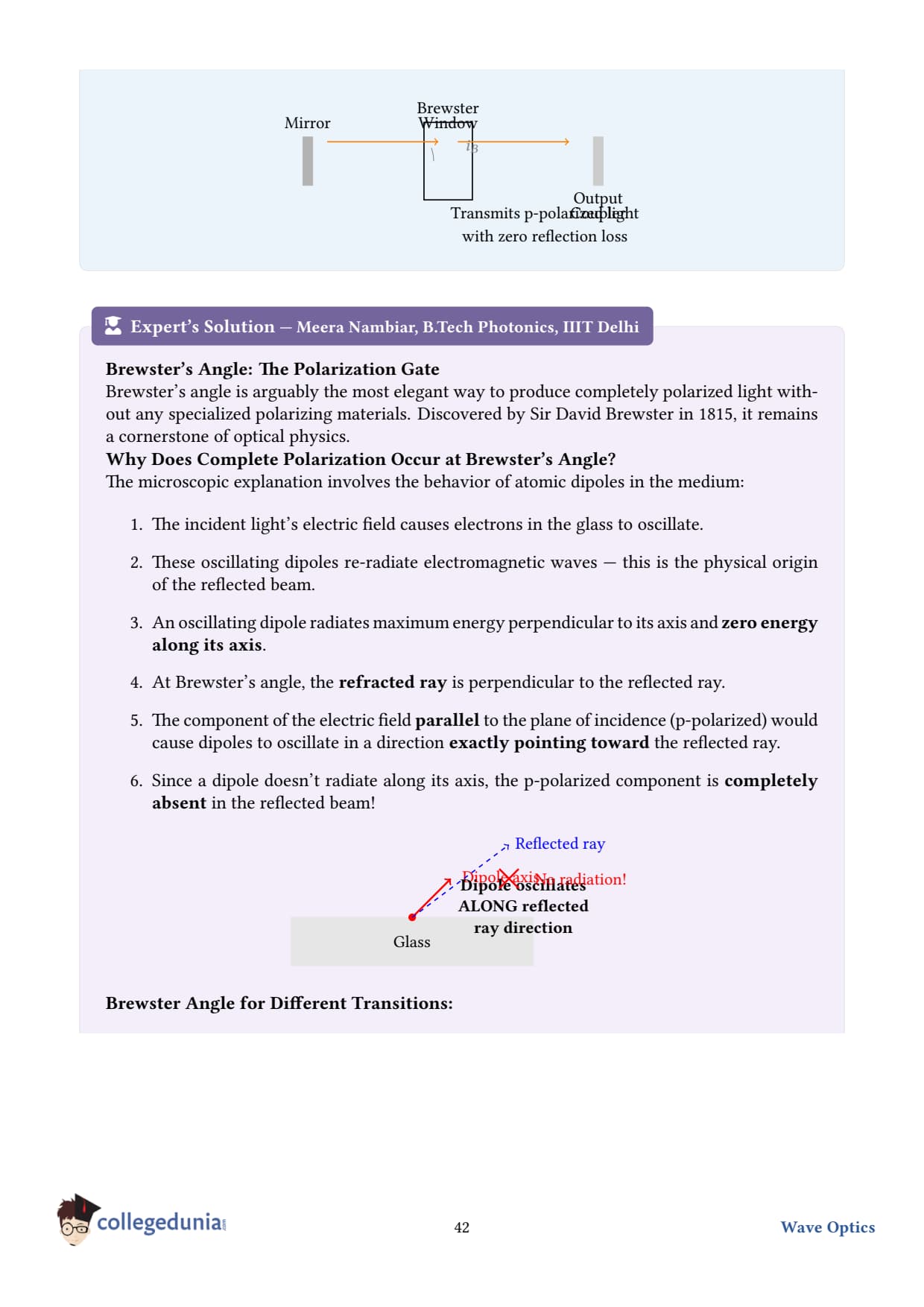
Why Brewster's law works. Light is an electromagnetic wave with electric field vector E. Inside the glass, the field drives electrons to oscillate; oscillating electrons re-radiate, producing the reflected beam. But oscillating dipoles don't radiate along their own oscillation axis. When the angle of incidence is such that the reflected ray would be along the dipole oscillation direction for the parallel-polarised (p) component, that component is suppressed - leaving only the perpendicular-polarised (s) component in the reflection. Geometrically, this occurs when the reflected and refracted rays are 90° apart, leading to tan iB = n2/n1.
Alternative derivation. Use the condition that reflected and refracted rays are perpendicular: iB + r = 90∘, so r = 90∘ - iB. Apply Snell's law: n1sin iB = n2sin r = n2sin(90∘ - iB) = n2cos iB. Divide both sides by cos iB: n1tan iB = n2, giving tan iB = n2/n1.
Real-world - polarising sunglasses. When sunlight reflects off a horizontal surface (road, water, snow) at an angle near 56∘, the reflected glare is strongly horizontally polarised. Polaroid sunglasses with vertically oriented transmission axes block this horizontal glare, dramatically reducing the brightness while preserving most other light. Fishermen and pilots wear them for exactly this reason.
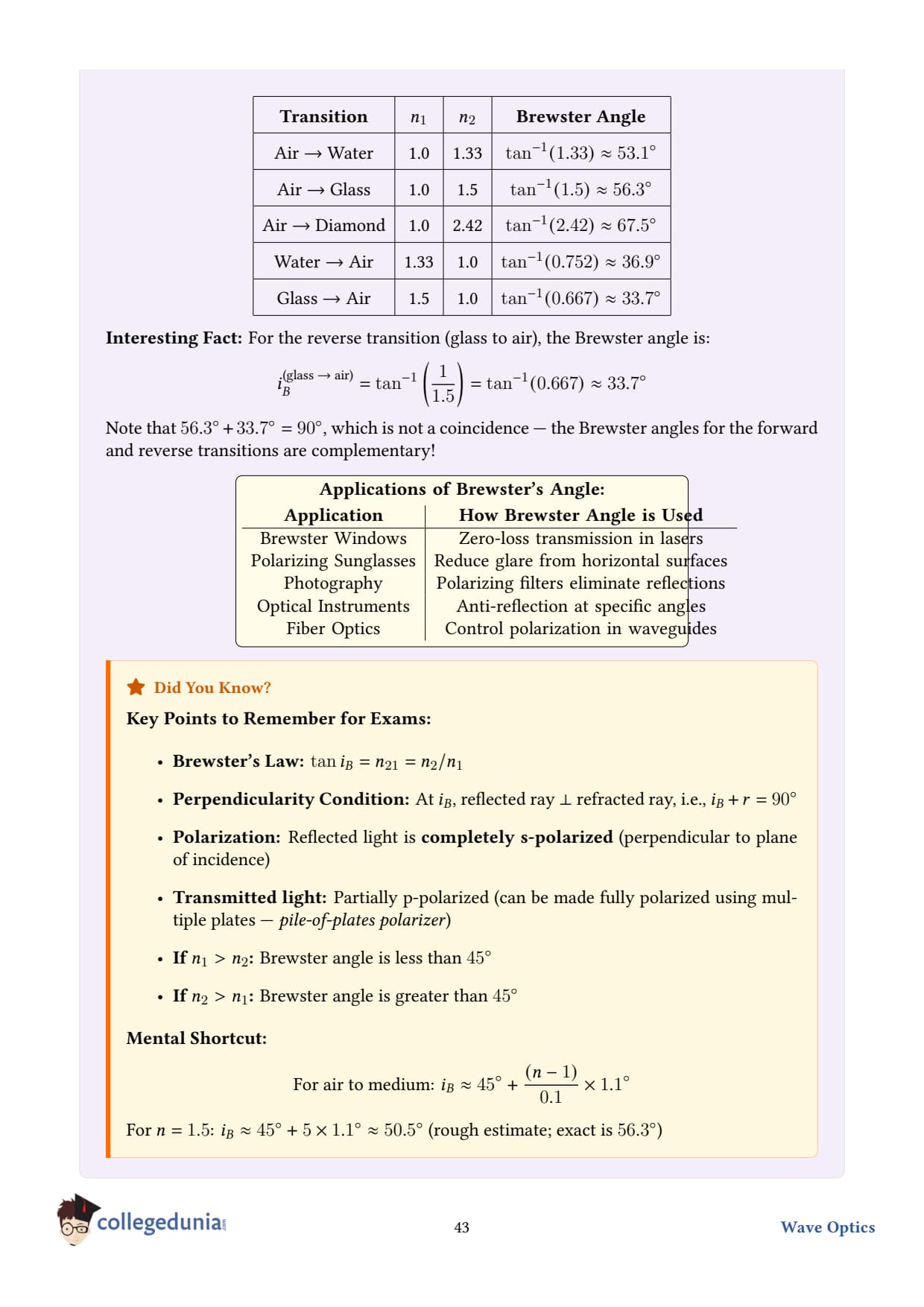
Common mistake - direction of light. The formula tan iB = n2/n1 assumes light goes FROM medium 1 INTO medium 2. If light comes from glass into air n1 = 1.5, n2 = 1, then tan iB = 1/1.5 ≈ 0.667, giving iB ≈ 33.7∘. The two Brewster angles (air-to-glass and glass-to-air) are complementary: 56.3∘ + 33.7∘ = 90∘.
Q 10.9
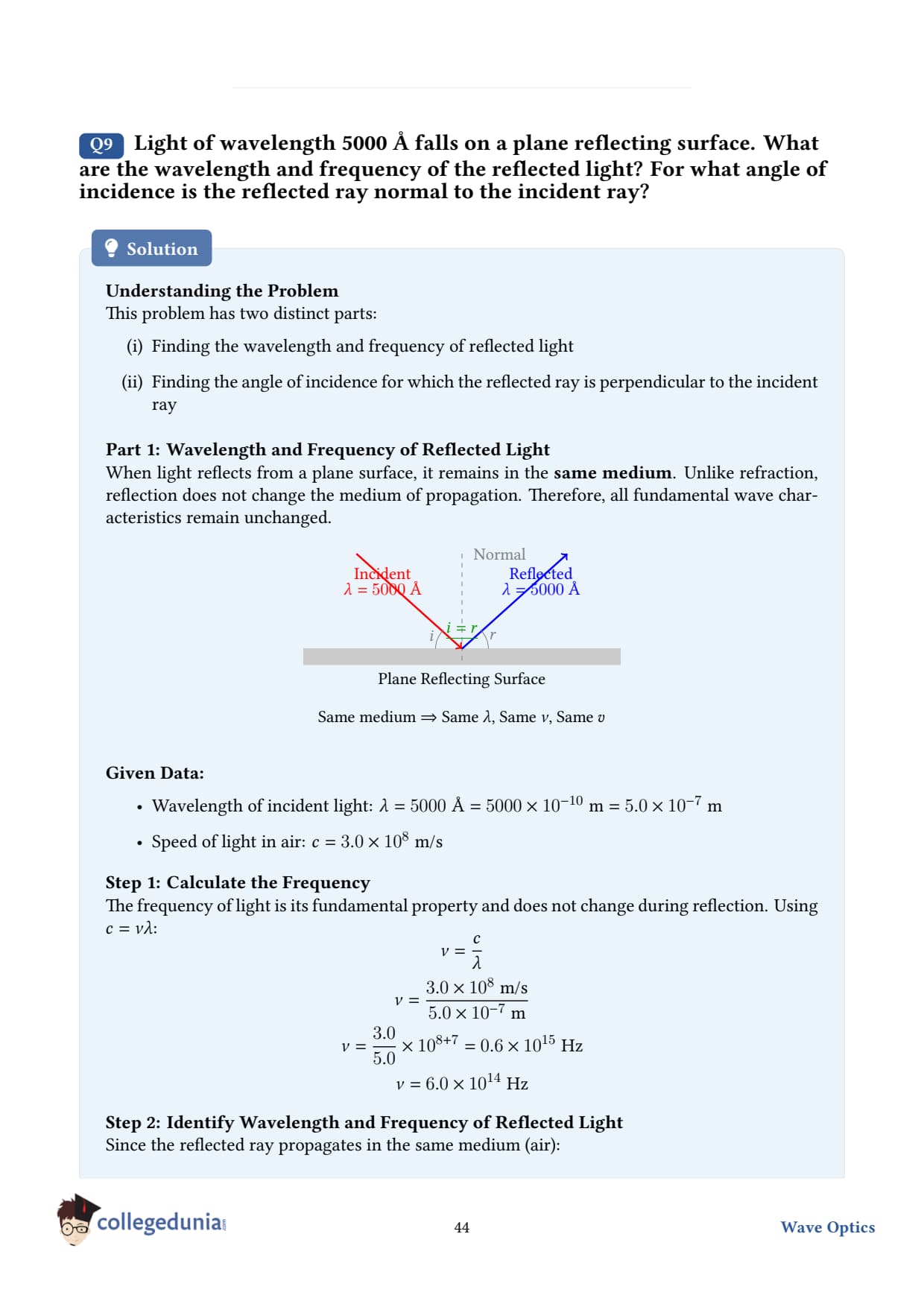
Light of wavelength 5000 falls on a plane reflecting surface. What are the wavelength and frequency of the reflected light? For what angle of incidence is the reflected ray normal to the incident ray?
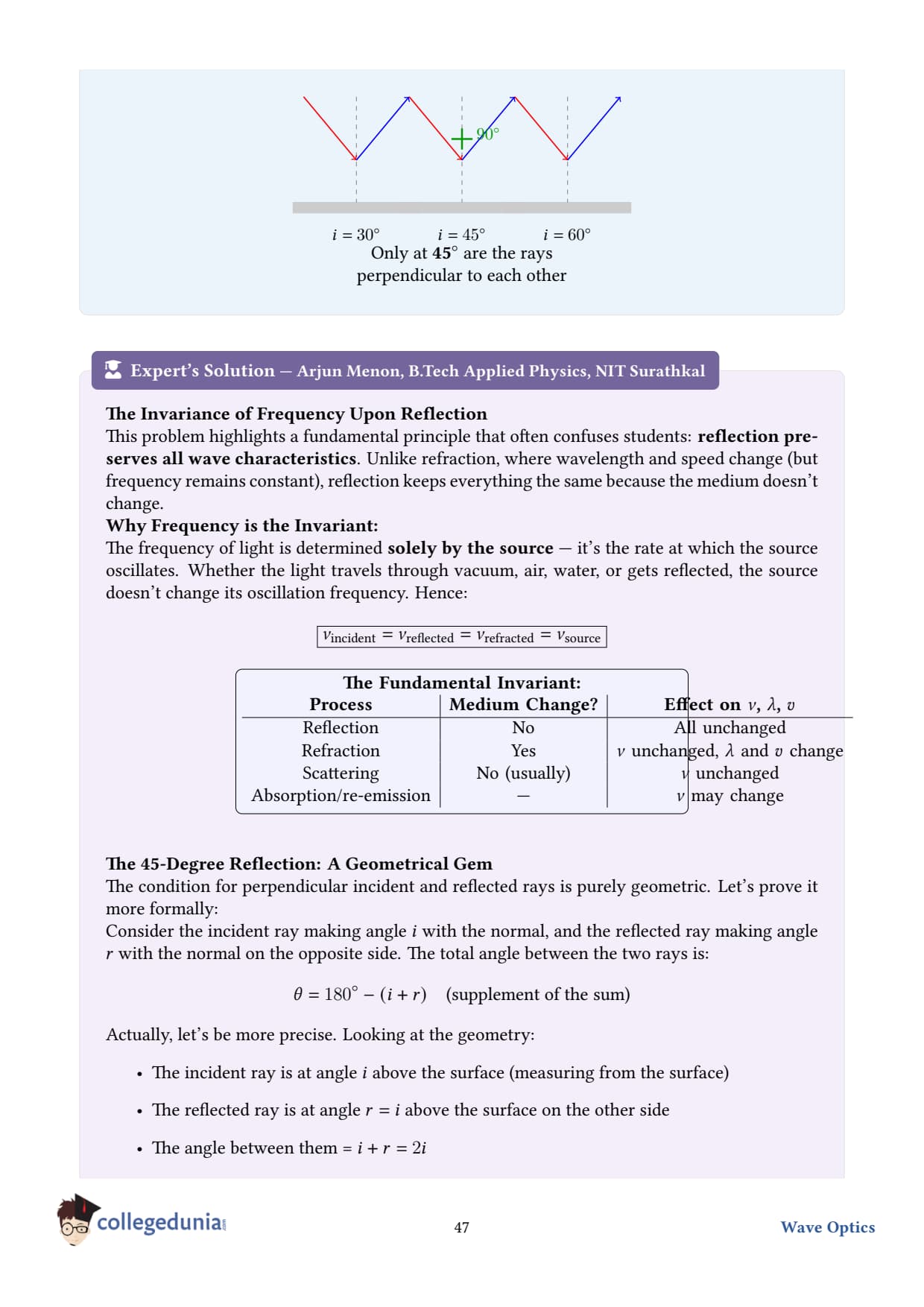
Concept used - reflection doesn't change λ or ν. Reflection is a process within the SAME medium (here, air). The wave merely changes direction; its wavelength, frequency, and speed are unaltered. Frequency is determined by the source, and is conserved across any optical event.
Step 1 - reflected wavelength and frequency.
reflected = 5000 = 510-7m
reflected = cλ = 3108510-7 = 61014 Hz
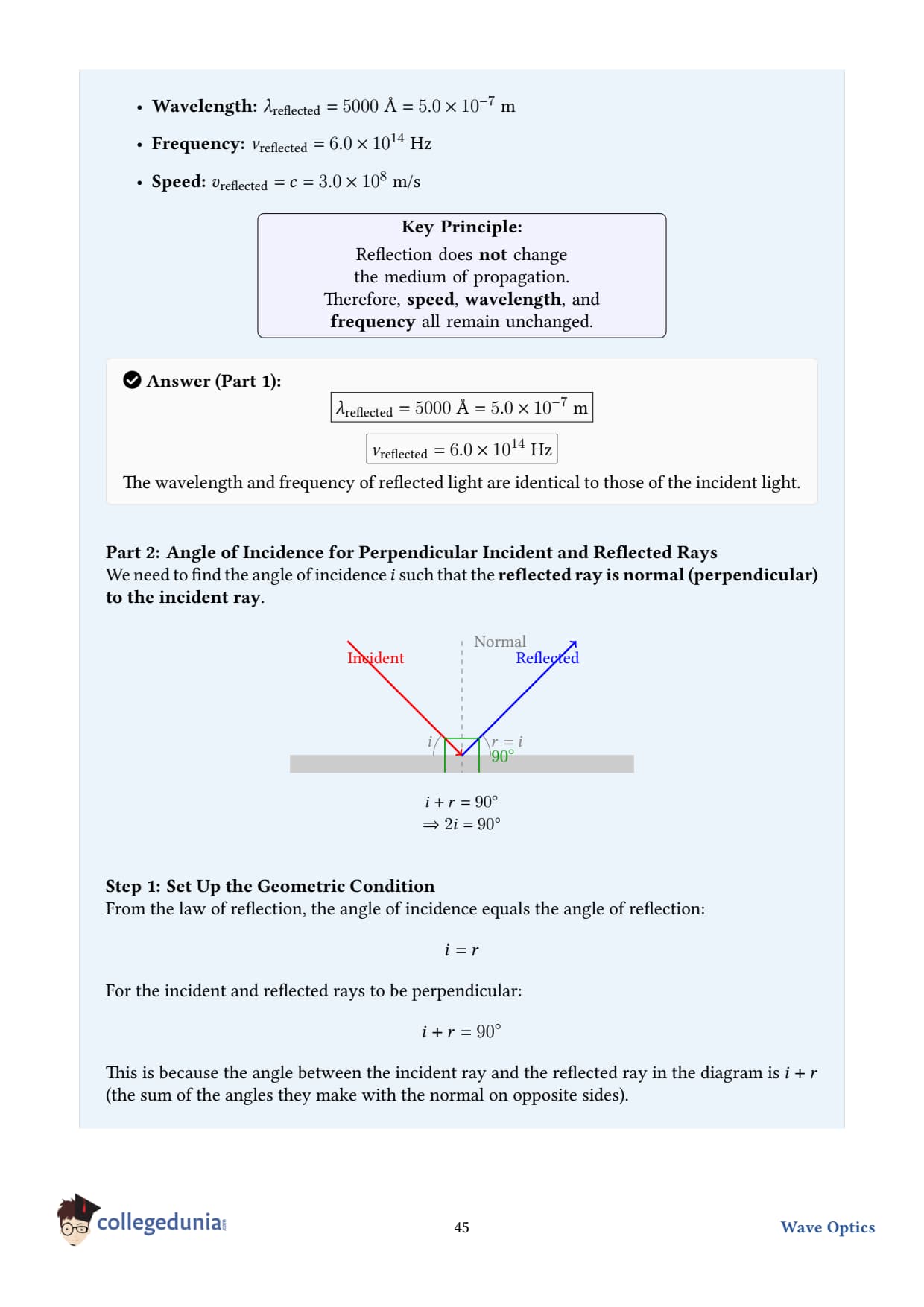
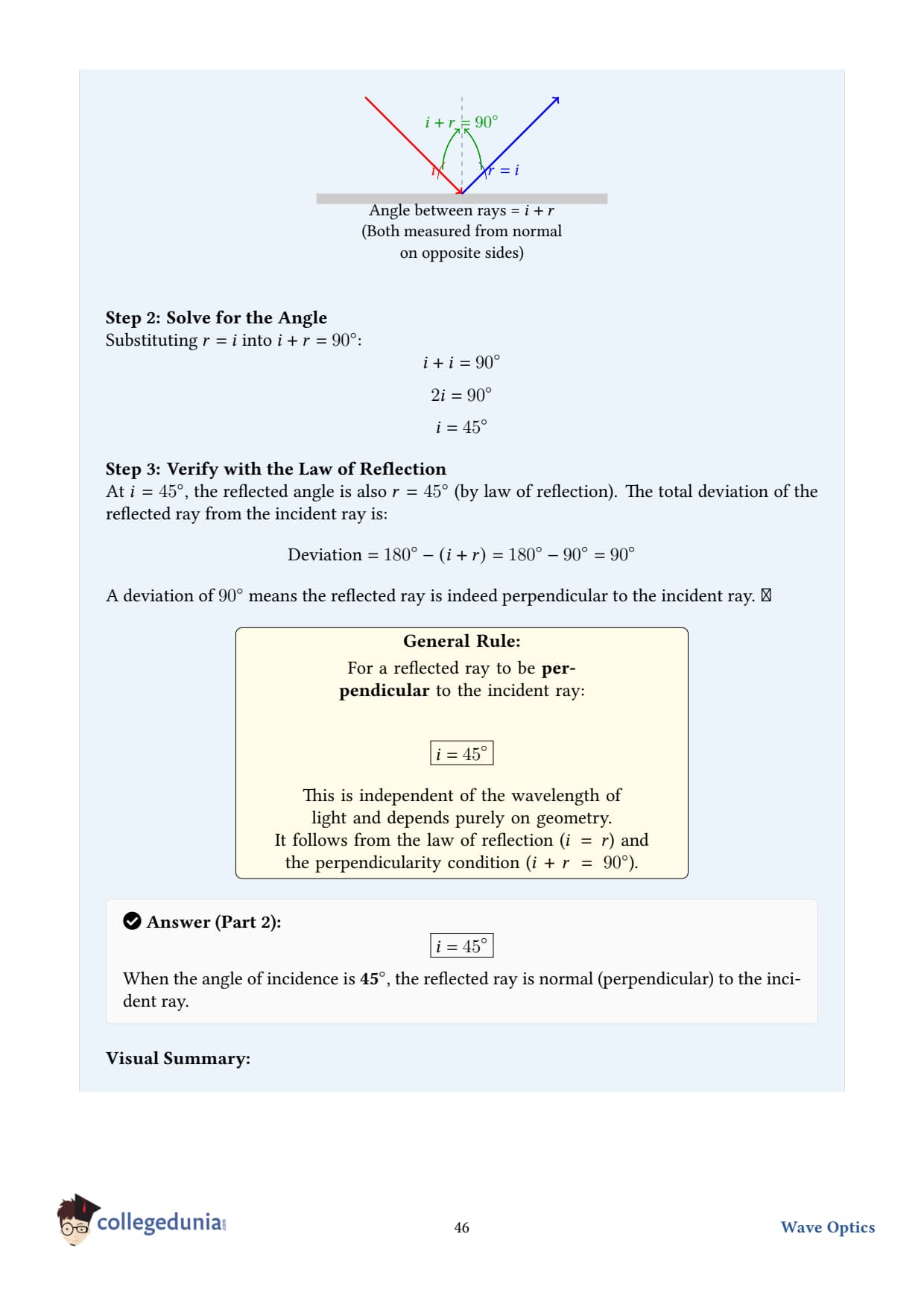
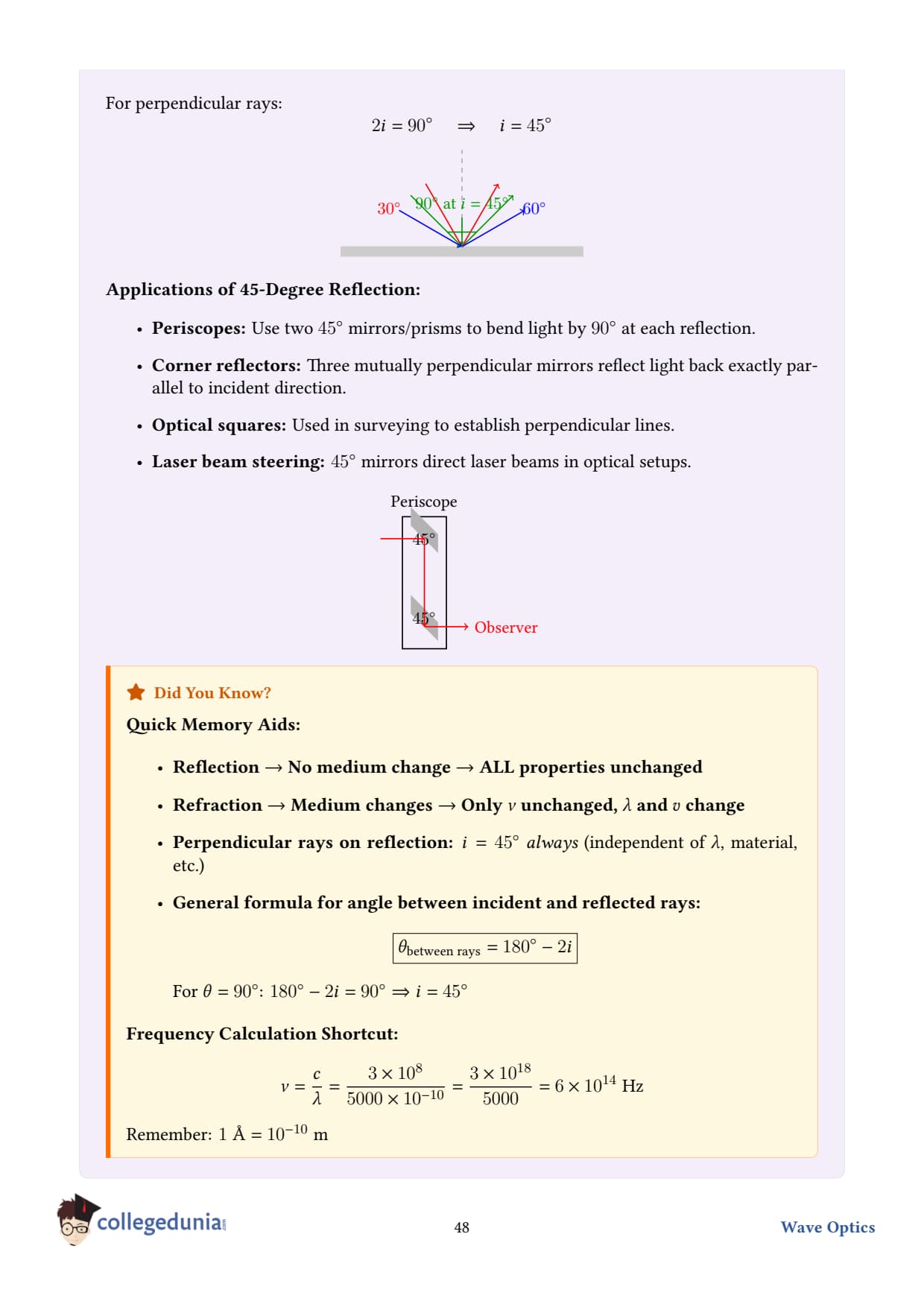
Step 2 - geometry condition: reflected ray normal to incident ray. Let i be the angle of incidence (measured from the normal to the surface). By the law of reflection, the angle of reflection equals i (also measured from the normal, on the other side). The angle between the incident and reflected rays is then 2i. For the reflected ray to be PERPENDICULAR to the incident ray, this total angle must equal 90∘: 2i = 90∘.
Step 3 - solve.i = 45∘.
Final answer.
Reflected wavelength: 5000 . Reflected frequency: 61014 Hz.
Angle of incidence for reflected ray perpendicular to incident ray: i = 45∘.
DS
Dr. Suresh Iyer
Ph.D. Theoretical Physics, TIFR Mumbai
Verified Expert
Geometry check. Draw it: incident ray hits the mirror at 45∘ to the normal; reflected ray leaves at 45∘ on the other side. The two rays make a 90∘ angle at the point of incidence - exactly the condition for perpendicularity. This is the same geometry as a right-angle prism (or any corner reflector): incident and reflected rays at 90∘ means the mirror is at 45∘ to both.
Why ν is conserved on reflection. The electrons in the mirror surface oscillate at the frequency of the incident wave (they're driven by it). These oscillating electrons re-radiate at the SAME frequency (because they're tied to the driving frequency). So the reflected wave's frequency equals the incident wave's frequency exactly.
Real-world - corner-cube reflectors. A corner cube (three mutually perpendicular mirrors) sends any incoming ray back exactly along the direction it came from. The Apollo missions left corner-cube reflectors on the Moon's surface; laser pulses fired from Earth bounce back along the same path, allowing the Earth-Moon distance to be measured to millimetre precision. Same idea: 45∘-style geometry, applied in three dimensions.
Common mistake - measuring angles from the surface vs the normal. The "angle of incidence" i in optics is measured from the NORMAL (perpendicular to the surface), not from the surface itself. A student who measures from the surface would get i + r = 90∘ inside the geometry, leading to confusion. Stick with the normal as your reference.
Q 10.10
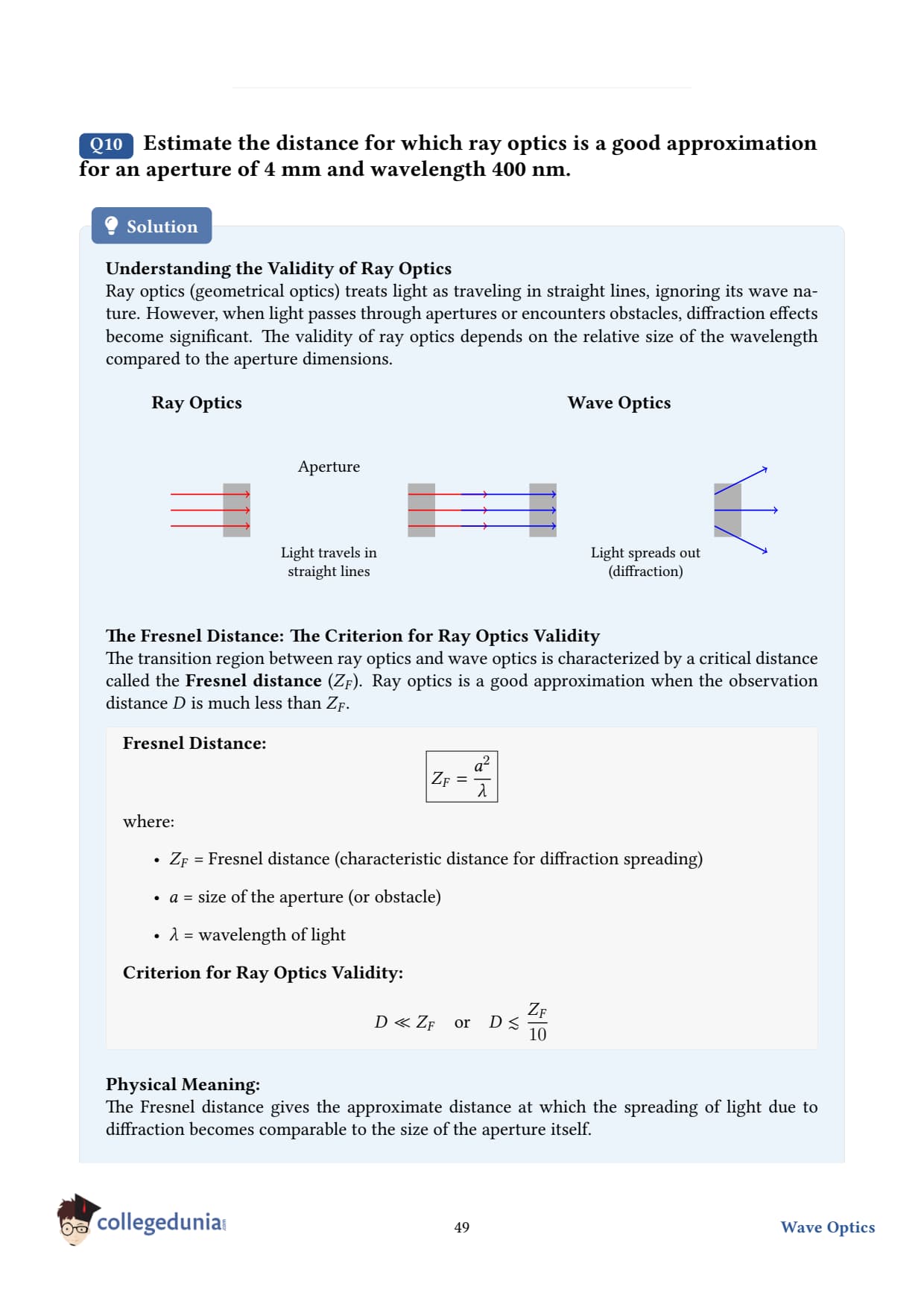
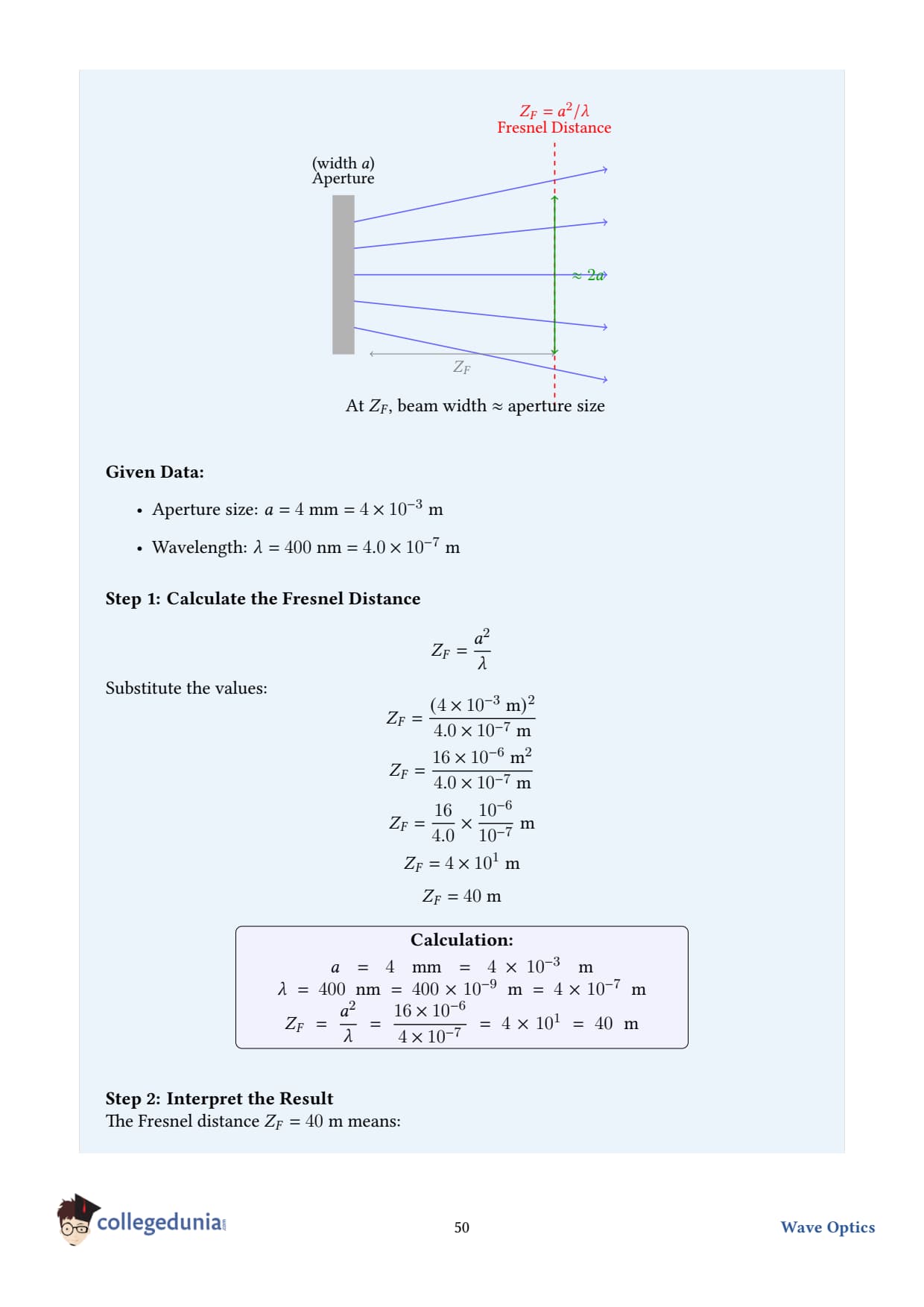
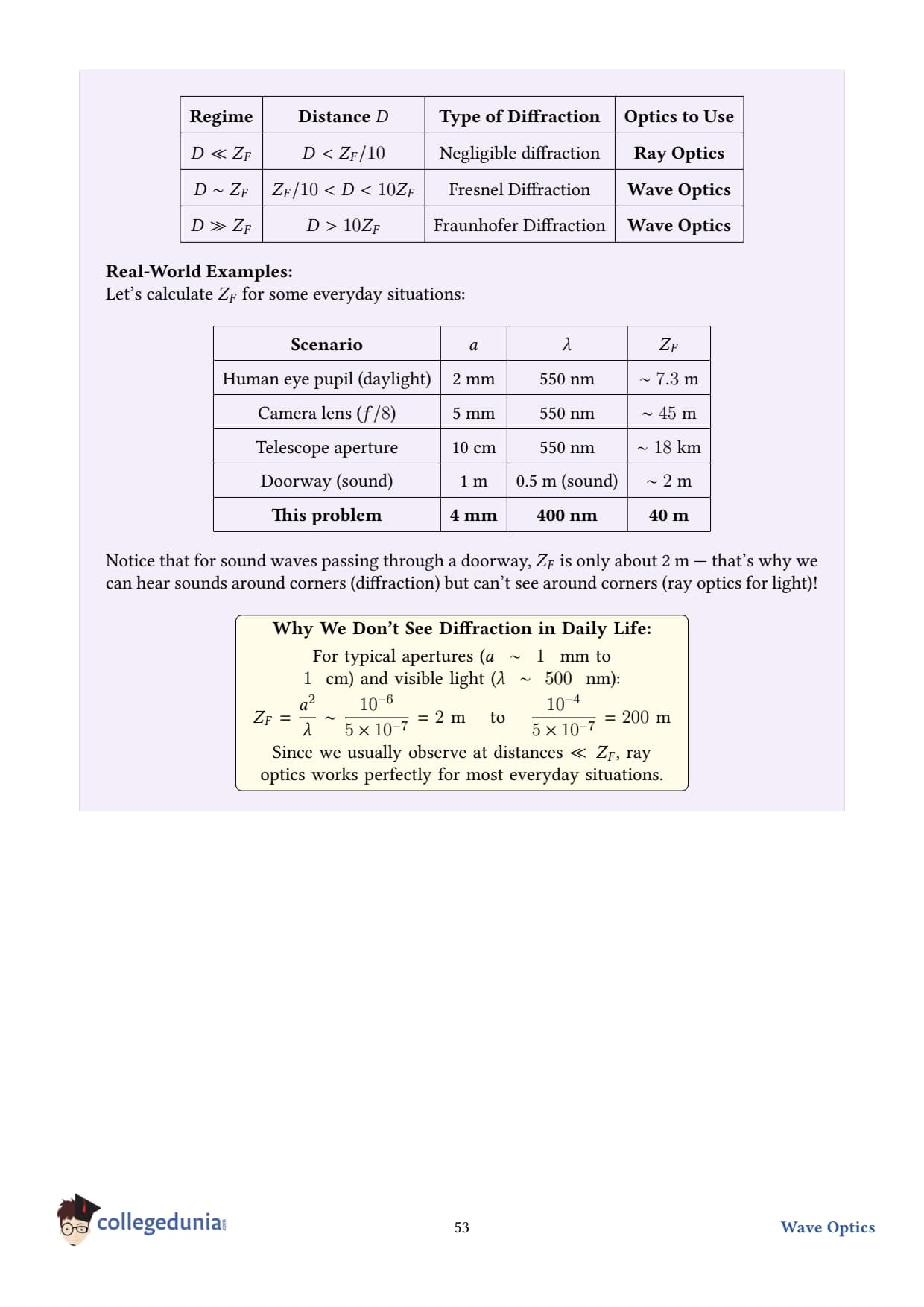
Estimate the distance for which ray optics is good approximation for an aperture of 4 mm and wavelength 400 nm.
What the question is asking. Light passing through an aperture (a small hole or slit) initially behaves "ray-like" (going straight). But after a certain distance, diffraction effects become noticeable and the beam starts to spread. We want the characteristic distance up to which ray optics remains a good approximation.
Given.
Aperture size, a = 4 mm = 410-3m
Wavelength, λ = 400 nm = 410-7m
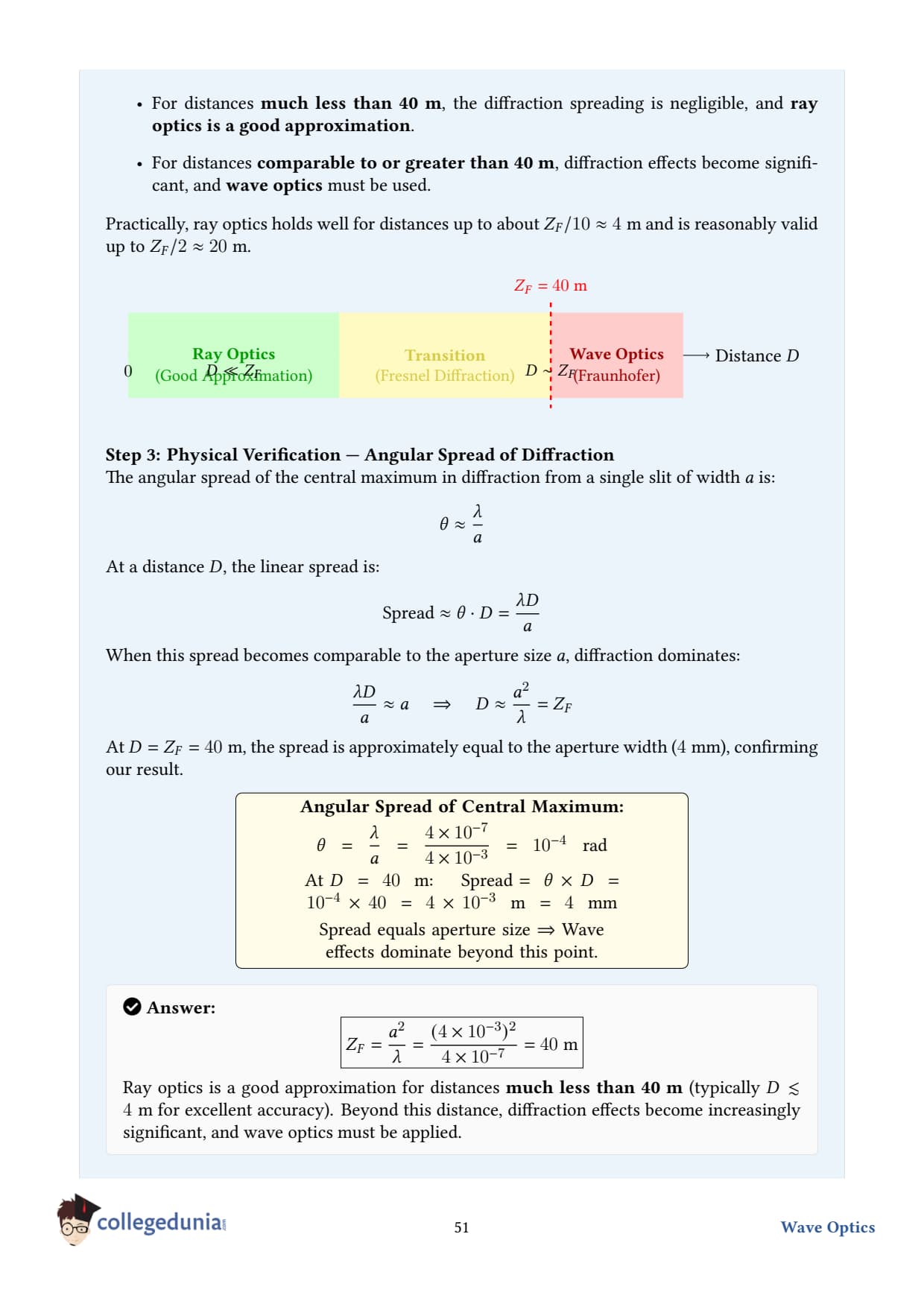
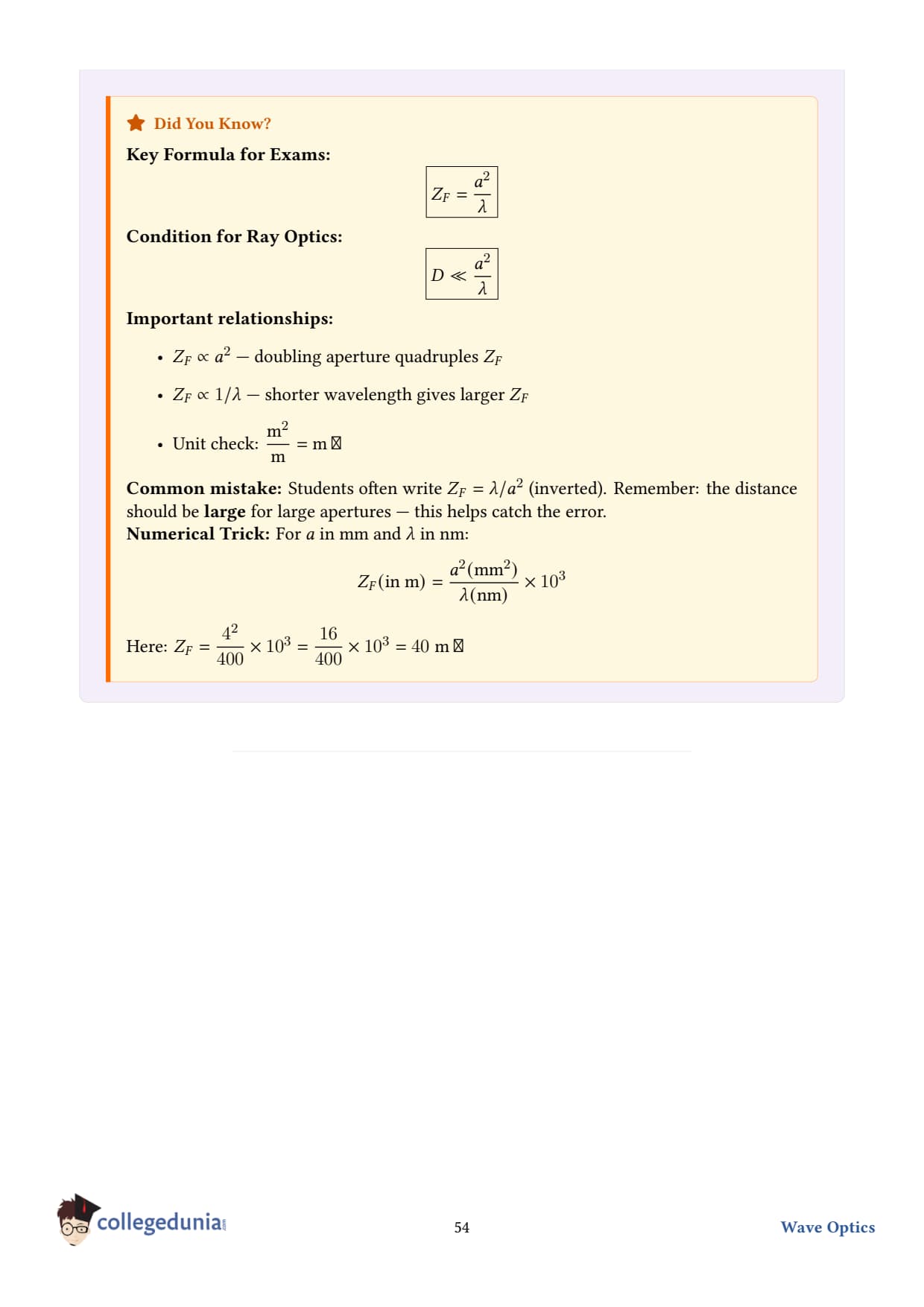
Concept used - Fresnel distance. The Fresnel distance is the distance beyond which diffraction becomes comparable to the aperture size: zF = a2λ. Within distance zF of the aperture, the beam width is roughly a and ray optics is a good approximation. Beyond zF, diffraction spread dominates and wave-optics treatment is required.
Step 5 - interpret. For an aperture of 4 mm illuminated by 400-nm light, ray optics is a good approximation up to about 40 m from the aperture. Beyond that, the beam noticeably broadens because of diffraction.
Final answer. zF = 40 m.
DA
Dr. Anita Sharma
Ph.D. Physics, University of Delhi
Verified Expert
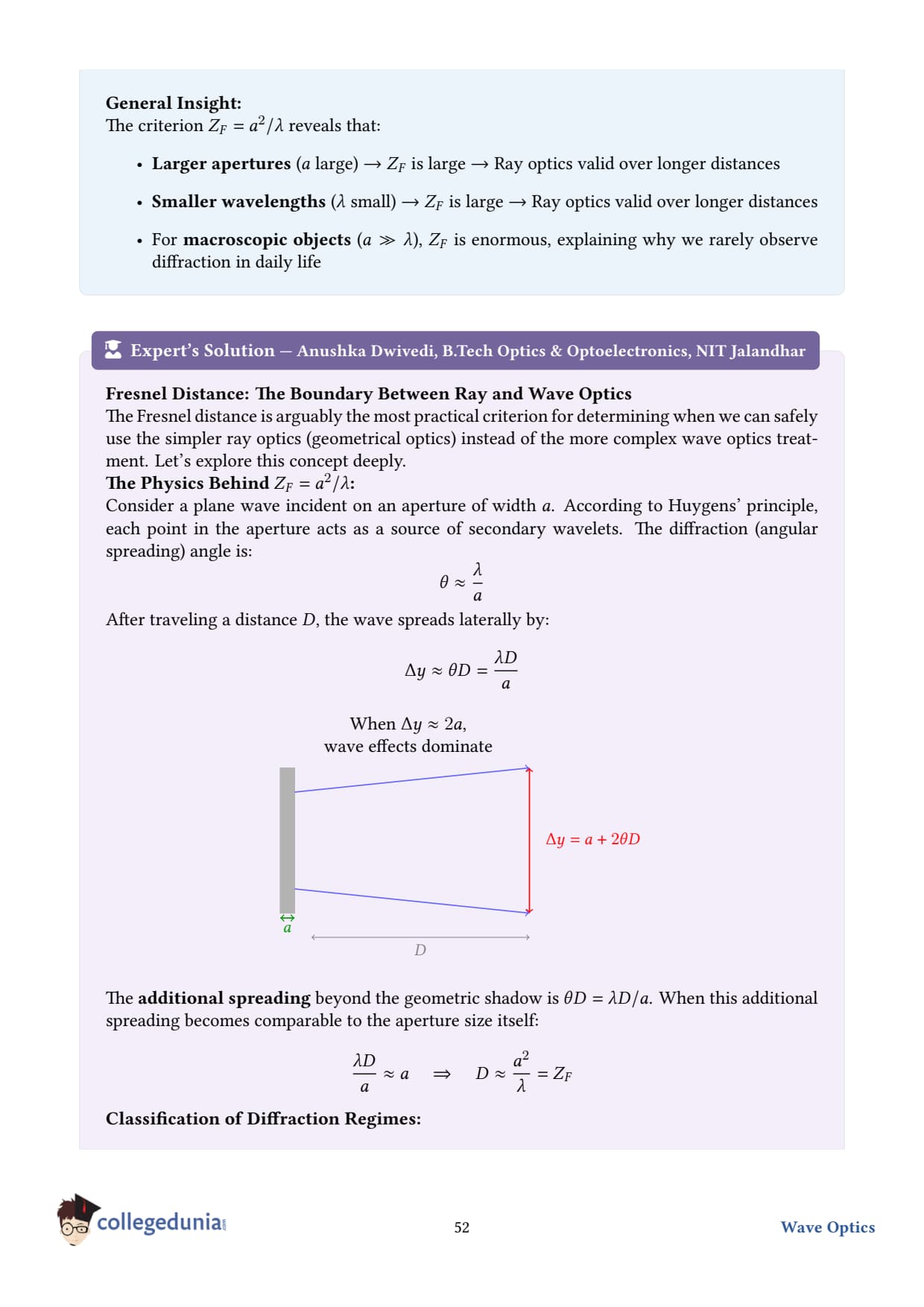
Where the Fresnel distance comes from. Diffraction by a slit of width a produces an angular spread (half-width to first minimum) θ ≈ λa. At distance z from the slit, the linear spread is zθ ≈ zλ/a. Setting this spread equal to the original aperture width a: zλ/a = az = a2λ. This is the distance at which the diffracted spread "catches up" with the aperture size - the rough boundary between ray-optics and wave-optics regimes.
Big aperture, small λ → big zF. Note how strongly zF depends on the aperture (squared). Doubling the aperture quadruples zF. This is why we can use ray optics confidently for everyday objects (windows, lenses, eyes) - apertures of cm-scale and visible light give zF of kilometres.
Real-world - telescope resolution. The Fresnel distance idea connects to the resolving power of telescopes. The diffraction-limited angular resolution of a telescope of aperture D is θ ∼ λ/D. The Hubble Space Telescope D ∼ 2.4 m, λ ∼ 550 nm achieves θ ∼ 0.05 arc-seconds - about ten times better than any ground telescope's view through Earth's turbulent atmosphere.
Common mistake - applying ray optics where it fails. For very small apertures e.g., the pupil of the human eye at low light, ∼ 6 mm, with light of ∼ 550 nm, zF ≈ 65 m - still fine for everyday vision but on the edge for astronomical detail. For wavelengths of microwaves ∼ 1 cm and apertures of cm-scale, zF is only a few cm and diffraction shows up immediately. Always check the regime.
Q 10.11
The 6563 Hα line emitted by hydrogen in a star is found to be red-shifted by 15 . Estimate the speed with which the star is receding from the Earth.
What the question is asking. A hydrogen spectral line is detected from a distant star with a slightly larger wavelength than its laboratory value. This red shift is interpreted as a Doppler effect - the star is moving away from us. We're asked: how fast?
Given.
Rest (laboratory) wavelength of Hα, 0 = 6563
Observed wavelength shift (red-shift), λ = 15
Speed of light, c = 3108m/s
Concept used - Doppler effect for light. When a source recedes from an observer at speed v much smaller than c, the wavelength of the light emitted is observed to be increased (red-shifted) by λ0 = vc. For v approaching c, the relativistic formula is needed, but for v ≪ c, this non-relativistic version is exact enough.
The star is receding from the Earth at about 687 km/s.
PM
Prof. Meera Nair
Ph.D. Experimental Physics, IISc Bangalore
Verified Expert
Red shift vs blue shift. A receding source produces a longer observed wavelength (red shift, λ > 0). An approaching source produces a shorter observed wavelength (blue shift, λ < 0). Same formula, just sign of v.
Why v ≪ c lets us use the non-relativistic formula. The full relativistic Doppler formula for a receding source is obs0 = √1 + v/c1 - v/c. For v/c ≪ 1, expanding to first order gives λ/0 ≈ v/c - exactly what we used. Our answer v ≈ 700 km/s is only 0.23% of c, so the non-relativistic formula is accurate to better than one part in 10,000.
Hubble's law and cosmology. In the 1920s, Edwin Hubble noticed that the red shift of distant galaxies is proportional to their distance from us: v = H0d, where H0 is the Hubble constant. This was the first evidence that the universe is expanding. Every distant galaxy's red shift, combined with its distance, places it on a graph that traces back to a single point - the Big Bang, some 13.8 billion years ago.
Real-world - exoplanet detection. Tiny periodic Doppler shifts of a star's spectral lines reveal the wobble caused by an orbiting planet's gravitational pull. The technique can detect planets of Earth's mass around nearby stars. The shifts involved are minute - wavelength changes of order 1 part in 109 - but modern spectrographs can measure them.
Common mistake - confusing wavelength shift with frequency shift. For a receding source, λ increases AND ν decreases since λ = c. The fractional shift is the same in magnitude: Δν/0 = -λ/0 = -v/c (to first order). Use whichever quantity the problem provides.
Sanity check. 687 km/s sounds enormous, but is typical of stars in distant galaxies. Stars within our own Milky Way usually have line-of-sight velocities of tens of km/s - far smaller. The high value here suggests a distant extragalactic source.
Class 12 Physics Chapter 10 Wave Optics NCERT Solutions FAQs
Ques. How should I write the YDSE numericals in class 12 wave optics ncert solutions?
Ans. Draw the labelled YDSE setup, state the path difference, write beta = lambda D / d, then substitute the values with units (convert lambda from nm to metres first). The wave optics class 12 ncert solutions on this page show this answer-writing flow for every numerical.
Ques. How is fringe width derived in YDSE?
Ans. For two coherent slits separated by d on a screen at distance D, the bright-fringe path difference n lambda gives position x_n = n lambda D / d, so fringe width beta = lambda D / d. The solutions on this page show every step.
Ques. What is the difference between interference and diffraction in wave optics class 12 ncert?
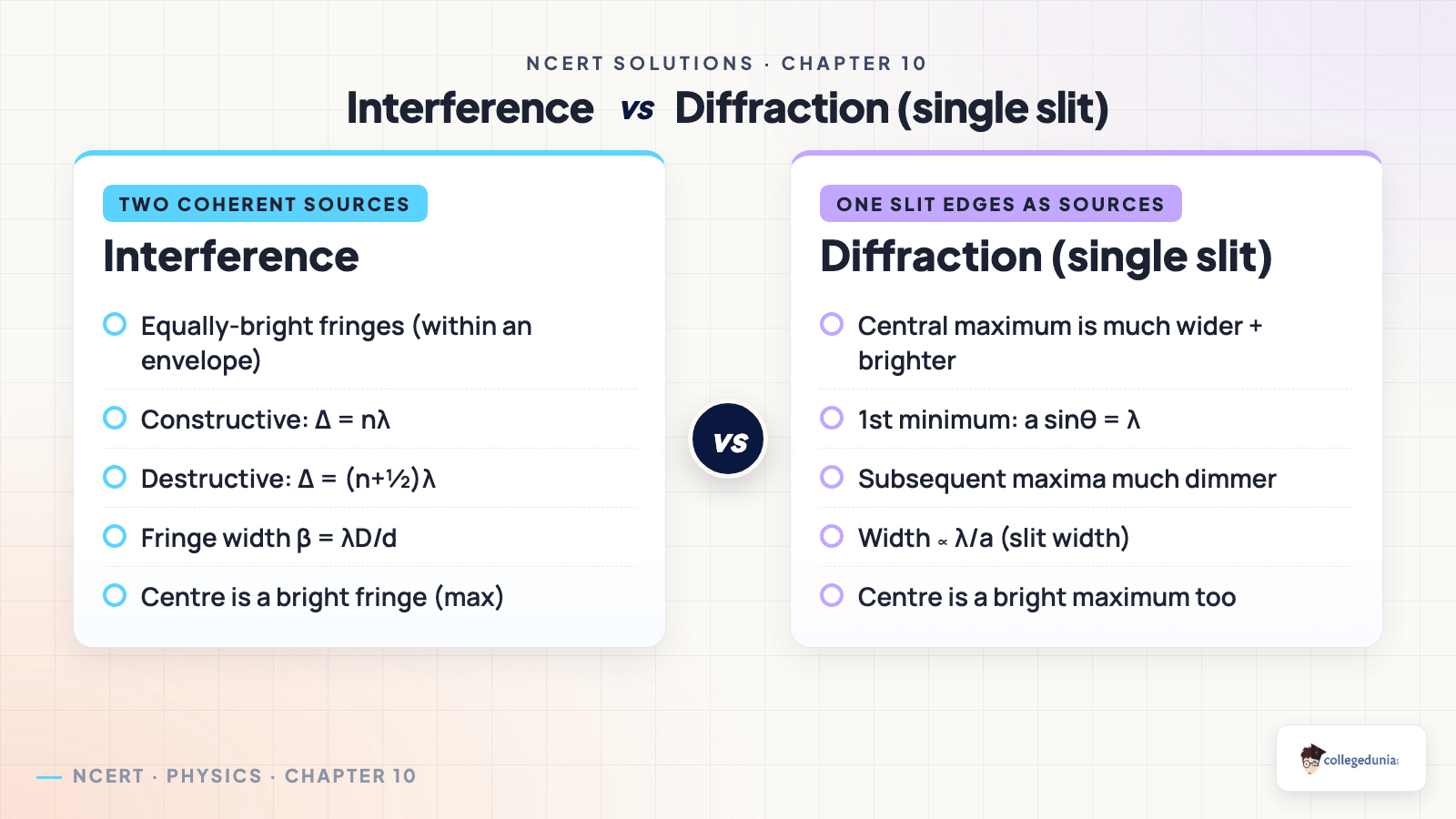
Ans. Interference comes from two coherent sources (YDSE); diffraction comes from a single aperture. Interference fringes are equally spaced; diffraction has a central maximum twice as wide as the secondary maxima.
Ques. What is Malus's law and where is it applied?
Ans. Malus's law: I = I_0 cos squared theta, where theta is the angle between the analyser axis and the plane of polarisation. It is applied in two-Polaroid problems where the second Polaroid analyses the first's output.
Ques. How many exercises are in class 12 physics wave optics ncert solutions?
Ans. The 2026-27 NCERT carries 14 back exercises plus 7 in-text solved examples. The wave optics class 12 exercise solutions on this page cover every back-exercise with step-wise marking annotated.
Ques. What is the weightage of class 12 physics wave optics in CBSE?
Ans. Chapter 10 carries 5 marks on average in the CBSE Class 12 Physics board exam. JEE Main draws 2 to 3 percent and NEET pulls 1 to 2 questions every year. The chapter is mid-weight in the revision plan.
Ques. Where can I download the wave optics class 12 pdf?
Ans. The wave optics class 12 pdf and the wave optics class 12 formulas pdf are available directly on this page via the download card above. Both the Normal and HD versions cover every back-exercise plus the YDSE and diffraction derivations.
Ques. Which wave optics questions carry the most marks in the NCERT exercise?
Ans. In the NCERT back exercise, the Young's double slit numericals (Q 10.4 to 10.6) and the single-slit diffraction question (around Q 10.7 to 10.8) carry the most marks, 3 to 5 each. The step-by-step solutions on this page walk through each one with the marking points shown.
Ques. What is Young's double slit experiment?
Ans. Two narrow slits lit by a coherent source give alternating bright and dark fringes on a screen at distance D. The fringe width beta = lambda D / d is the same for every order and for both bright and dark fringes.
Ques. What is polarisation of light?
Ans. Polarisation restricts the electric field vibrations of light to a single plane, achieved with a Polaroid filter. Malus's law (I = I_0 cos squared theta) gives the intensity through a second Polaroid at angle theta to the first.








Comments