



These NCERT notes cover Class 12 Physics Chapter 5 Magnetism and Matter in a short, exam-ready form. They walk through bar magnets, dipole moment and torque, Earth's magnetism, and magnetic materials. You can download the full notes PDF right here on this page.
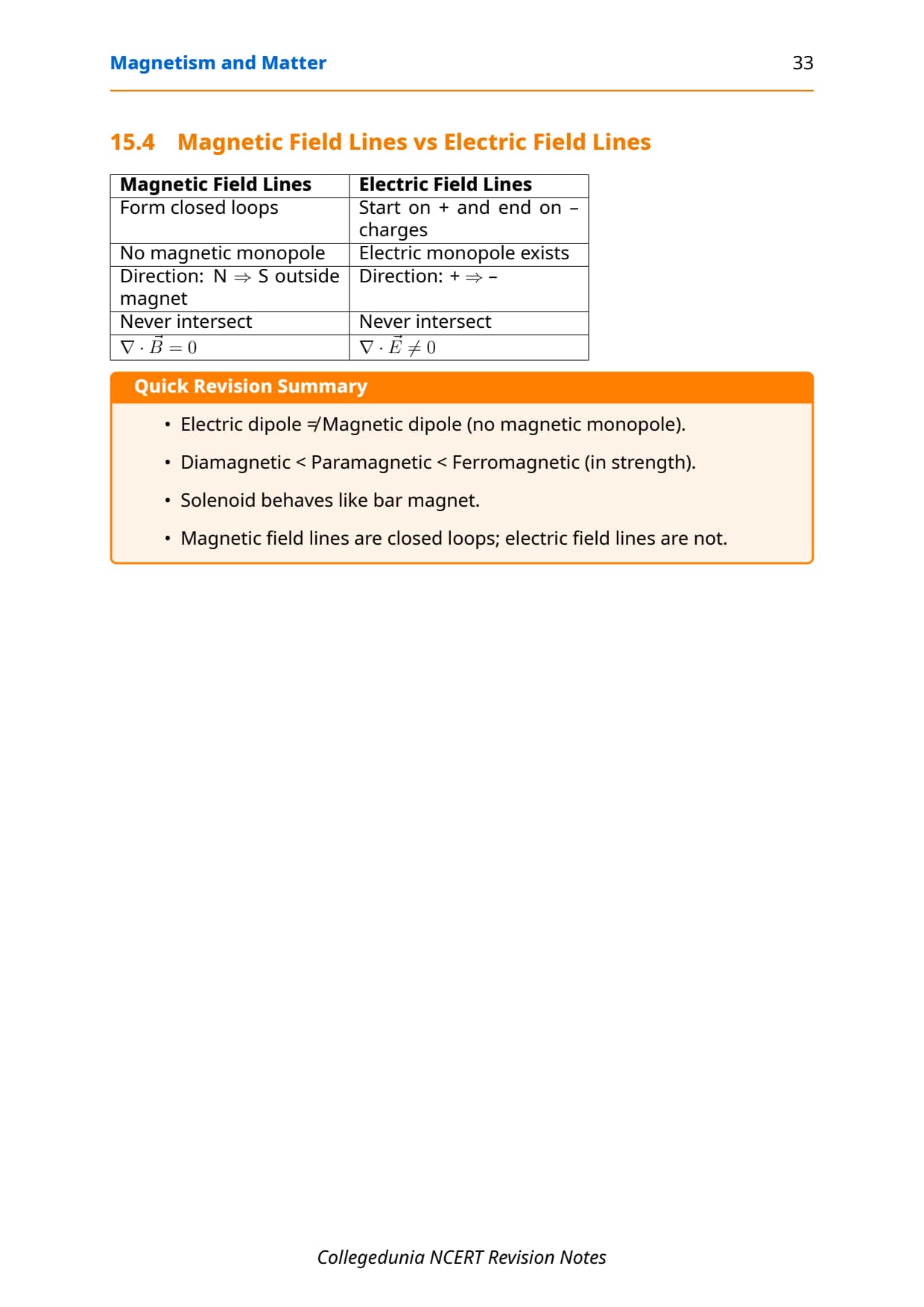
What Magnetism and Matter is worth in your exams:
- CBSE Boards: 3 marks, usually one derivation plus one short-answer concept question.
- JEE Main: 1 to 2 percent, with steady yearly coverage of derivations and numericals.
- NEET: about 1 question every year on chapter concepts.
The data provided in the Magnetism and Matter NCERT notes are cross-verified by Collegedunia Subject Matter Experts and aligned to the 2026-27 NCERT, and refined against the last five years of CBSE Board, JEE Main, and NEET papers.
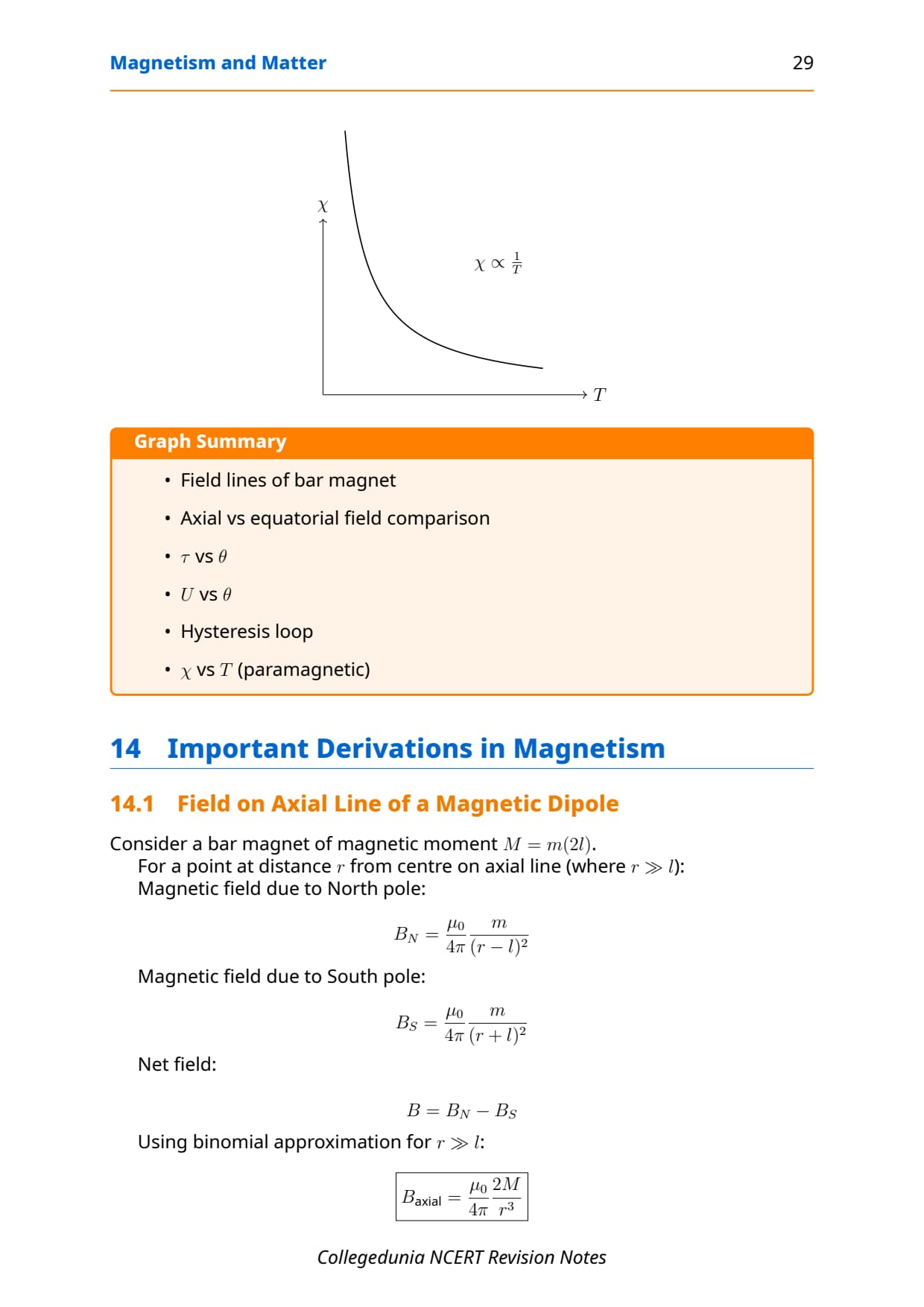
You can find the complete magnetism and matter class 12 notes PDF, including bar magnet and magnetic field lines, magnetic dipole moment and torque, Earth's magnetism, and diamagnetic, paramagnetic, ferromagnetic, in the article below. The Ch 5 Physics Class 12 notes also cover the JEE Main extensions for this topic.
Also Check:
Topic-by-Topic Concept Summary for Class 12 Physics Chapter 5
The chapter splits into 5 sub-topic blocks. The walkthrough below maps each block to its CBSE marking pattern.
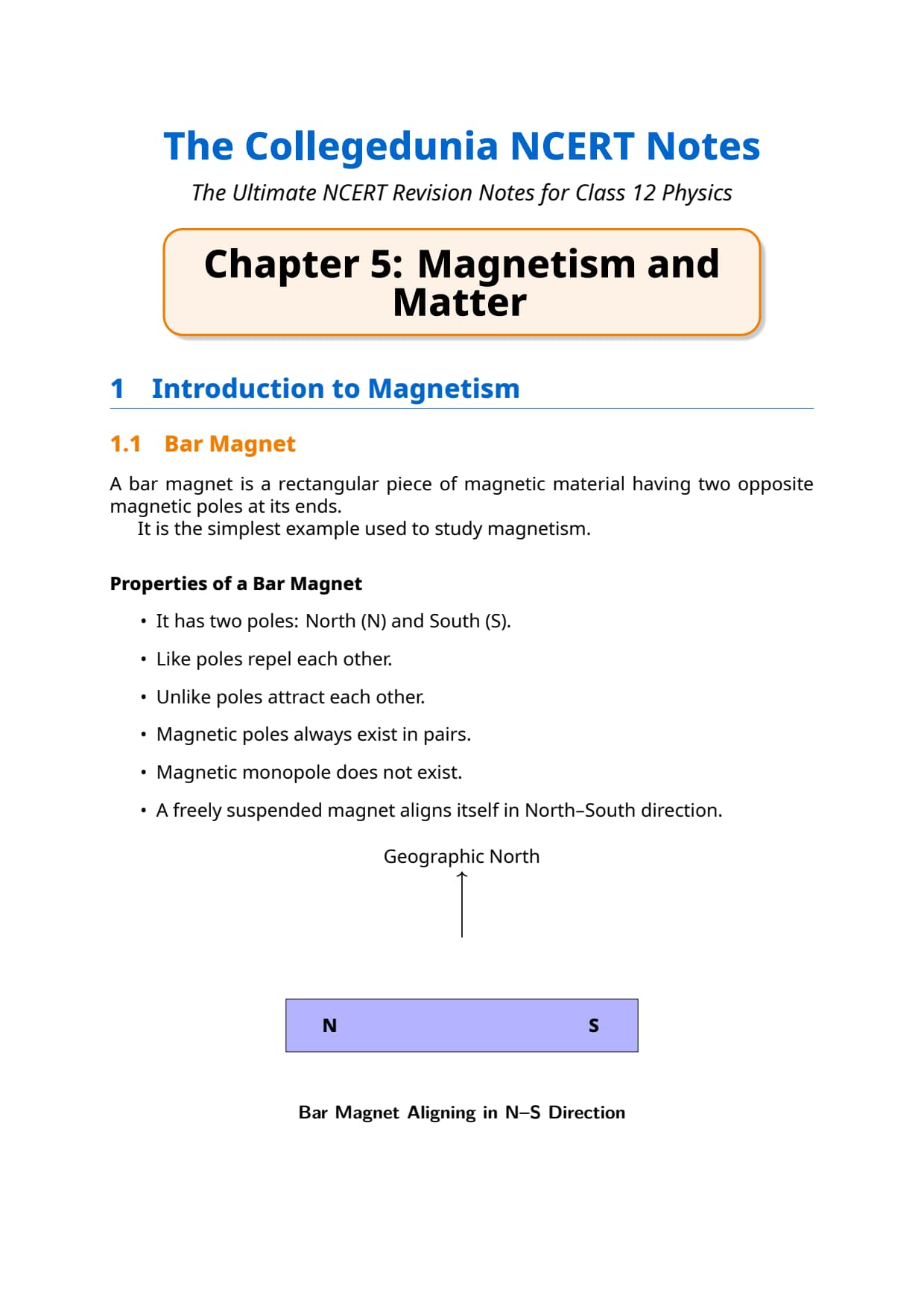
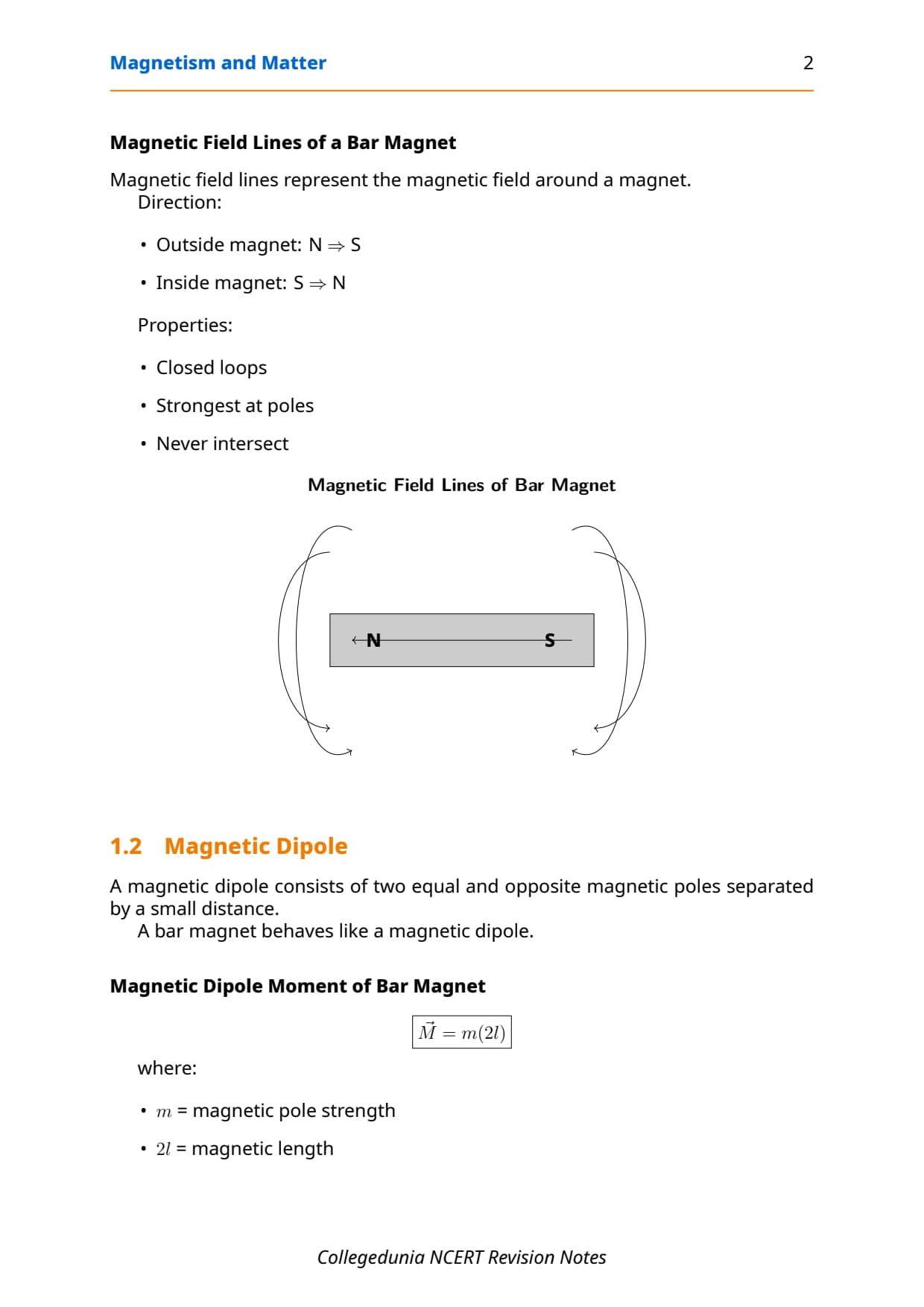
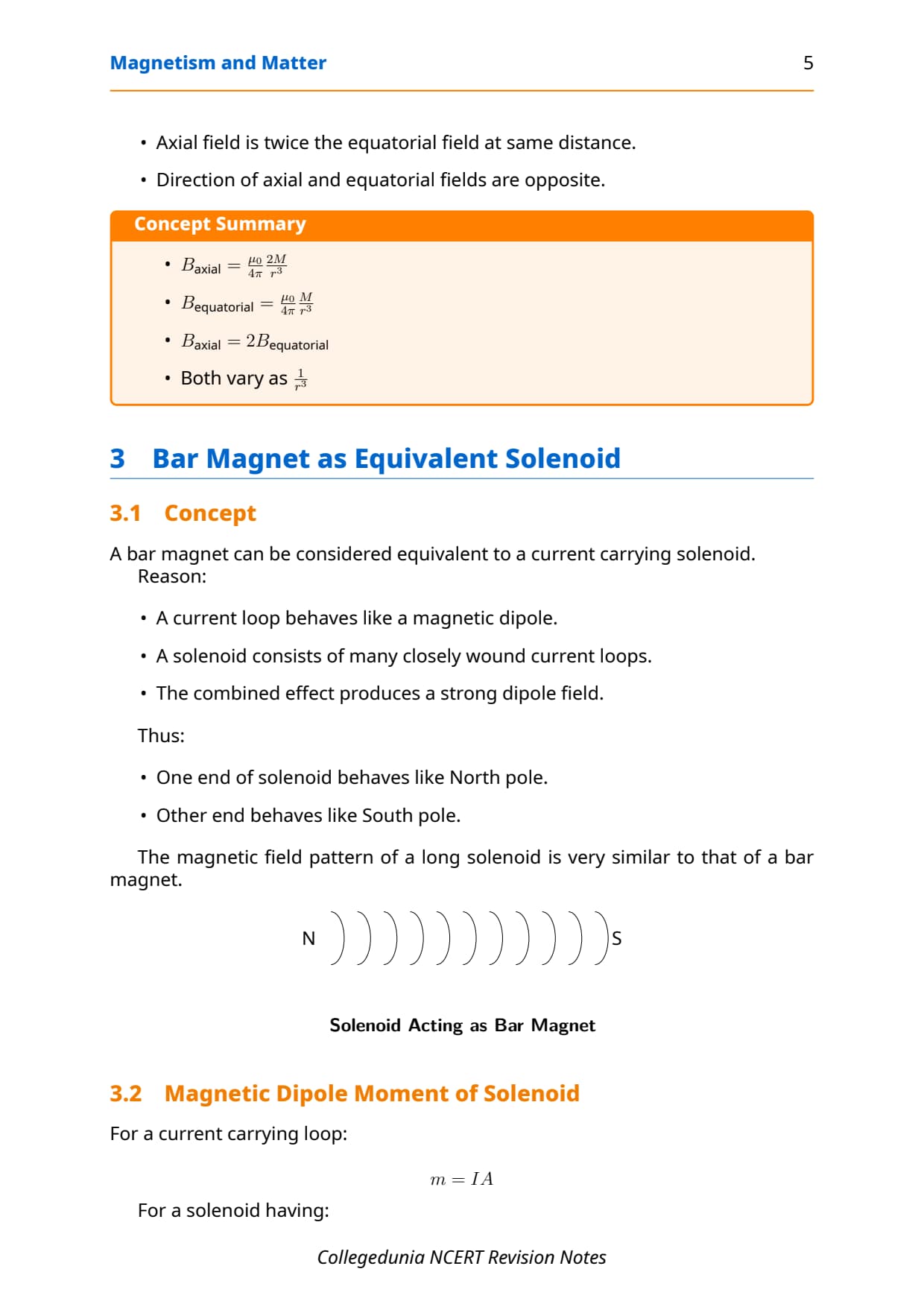
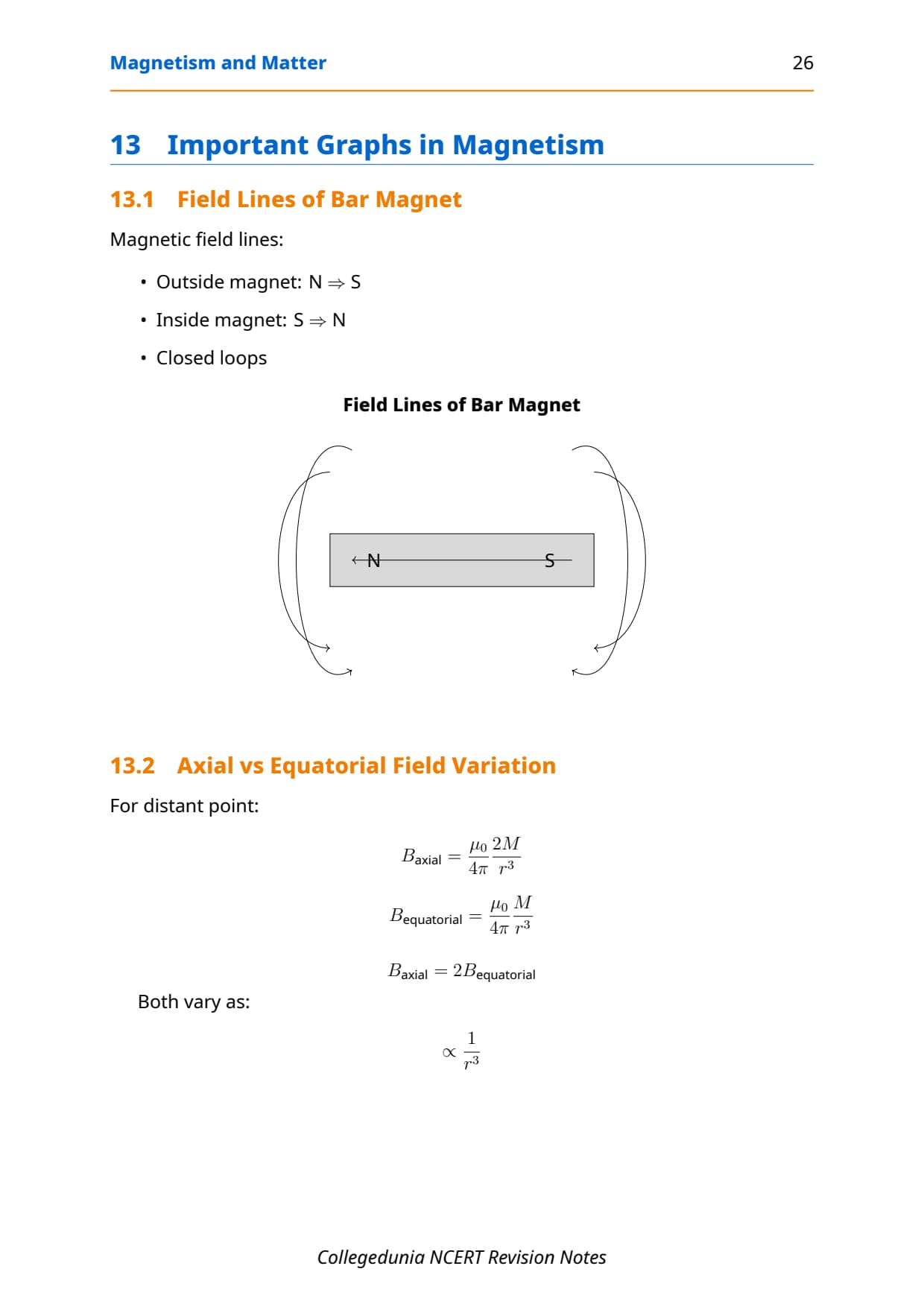
- Bar magnet and magnetic field lines: 1-mark on properties
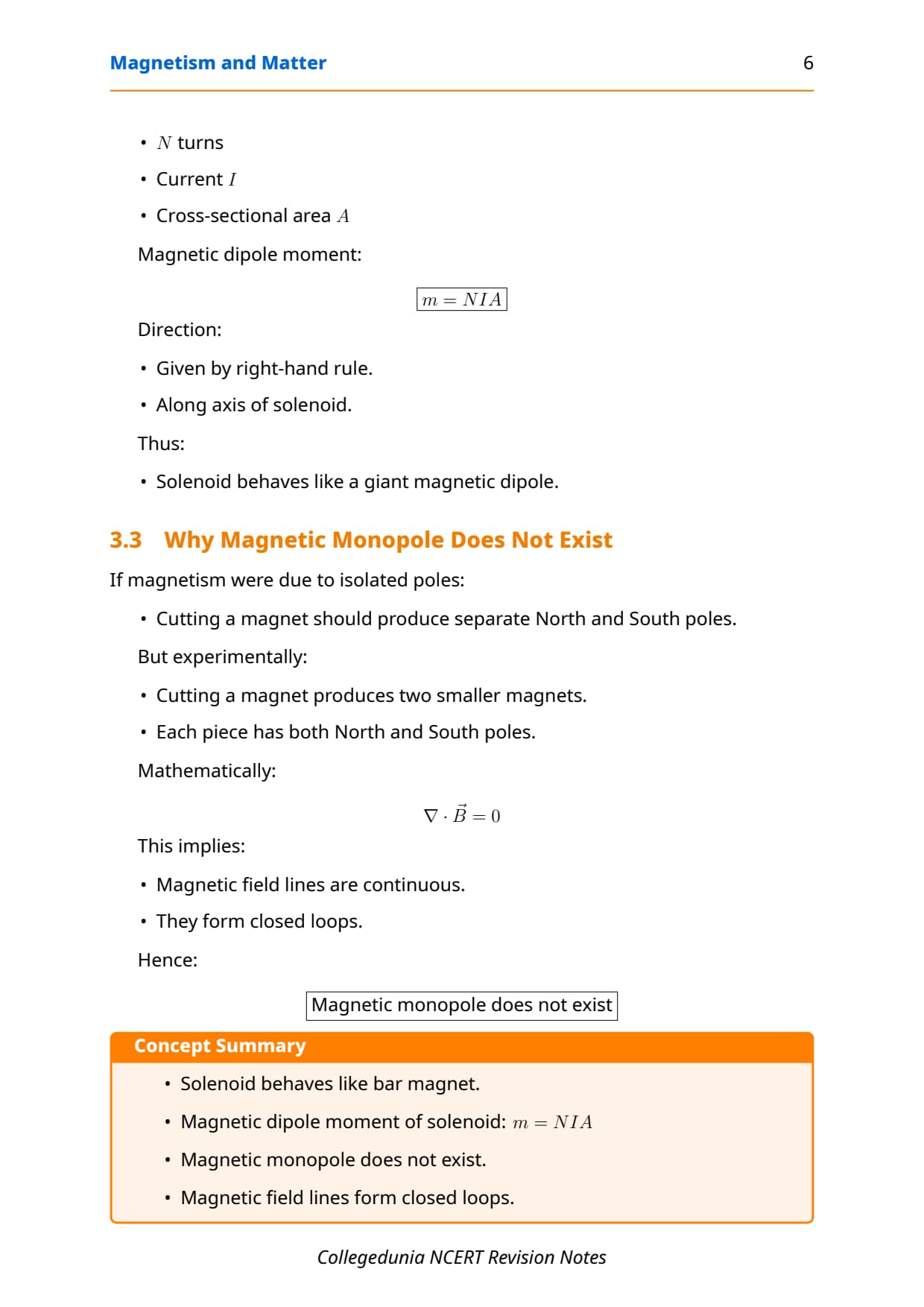
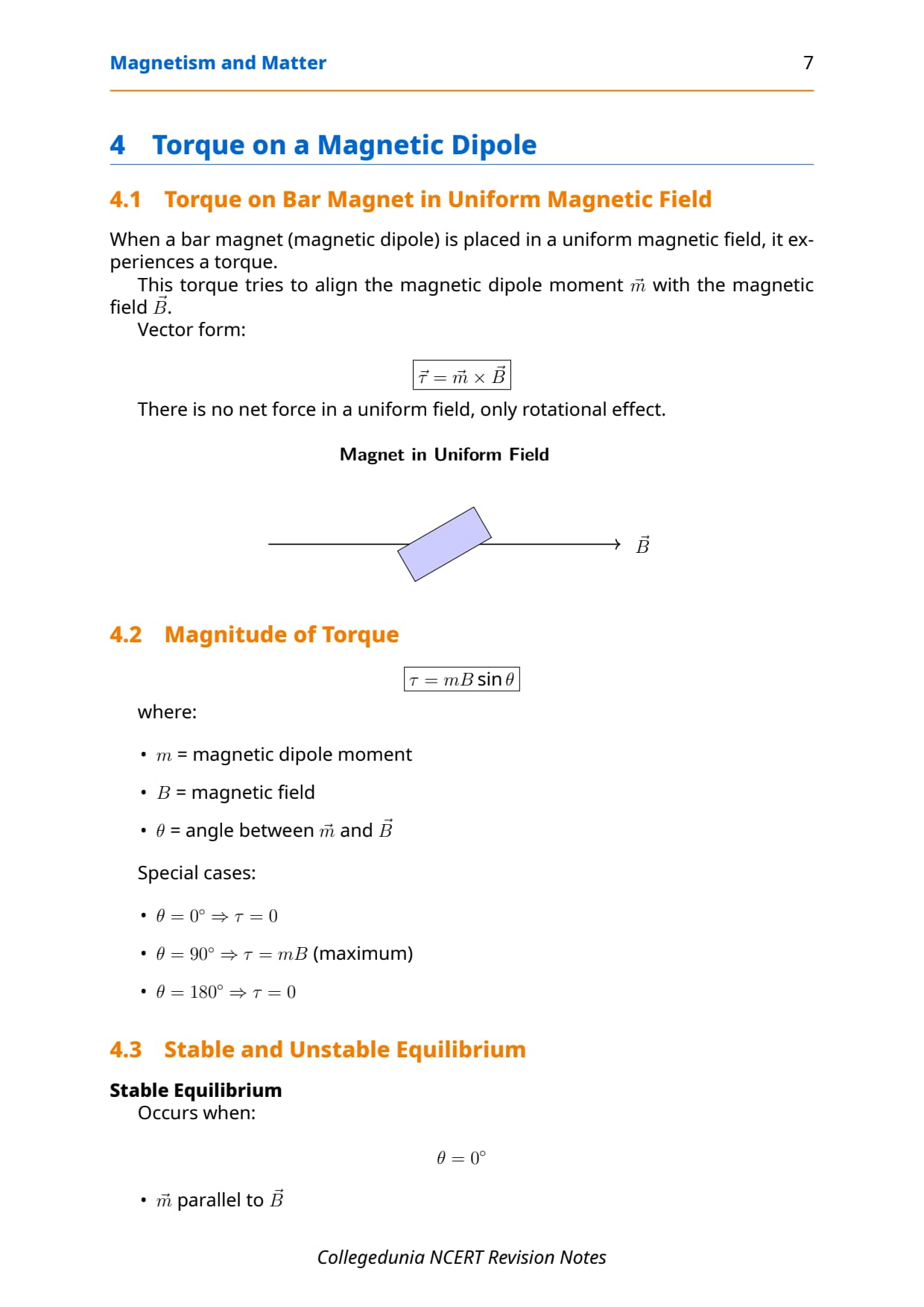
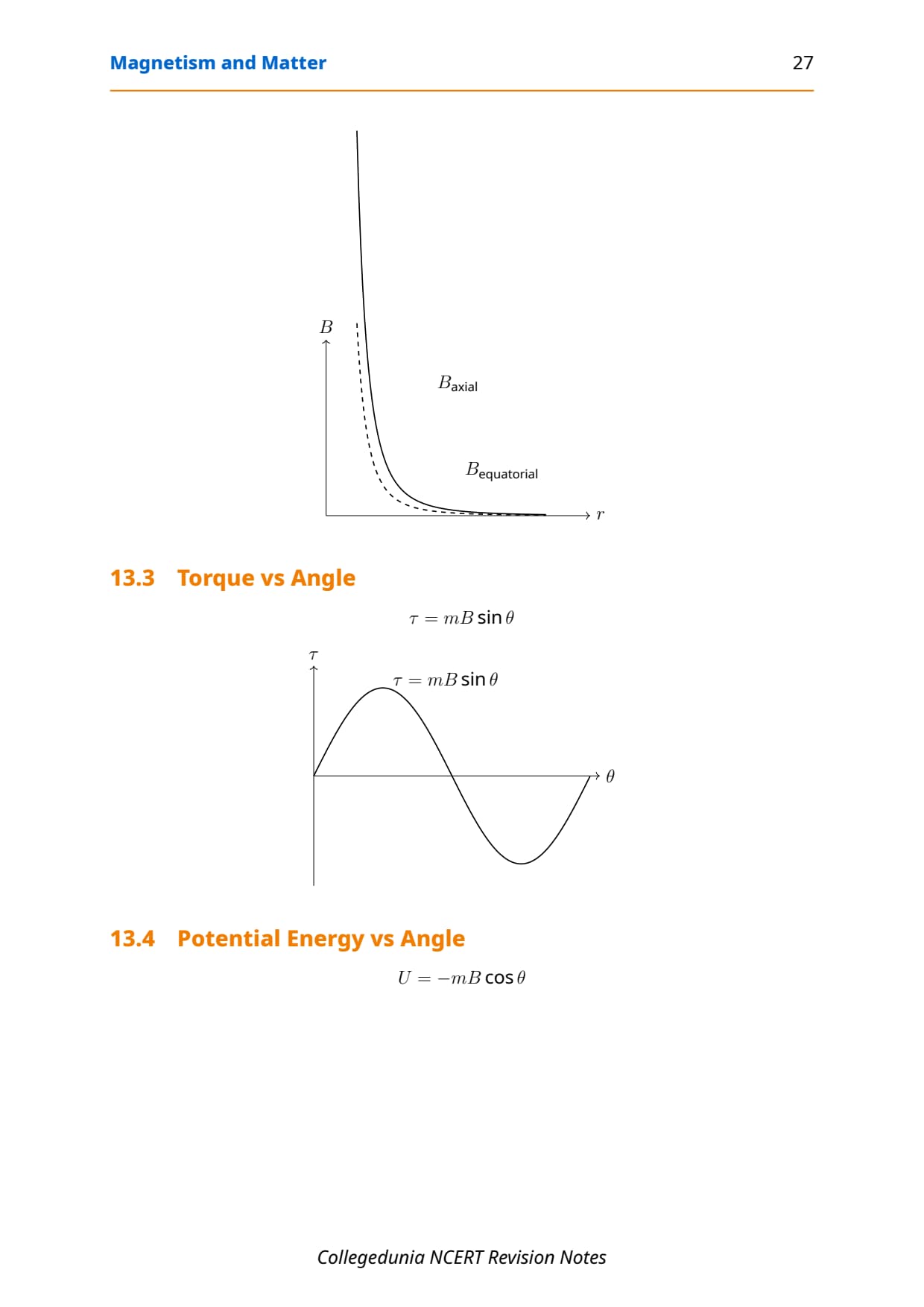
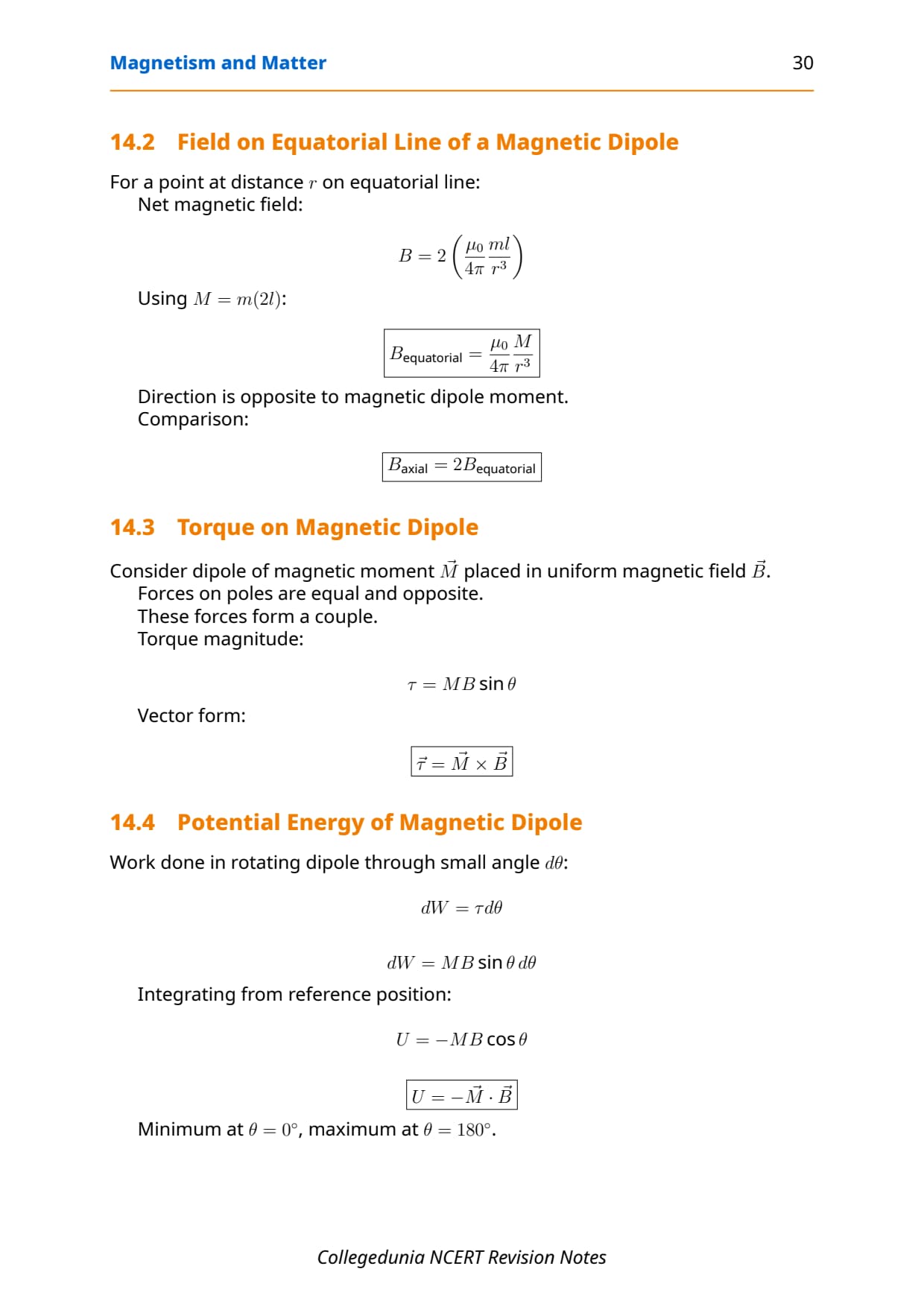
- Magnetic dipole moment and torque: 2-mark on m = I A, tau = m cross B
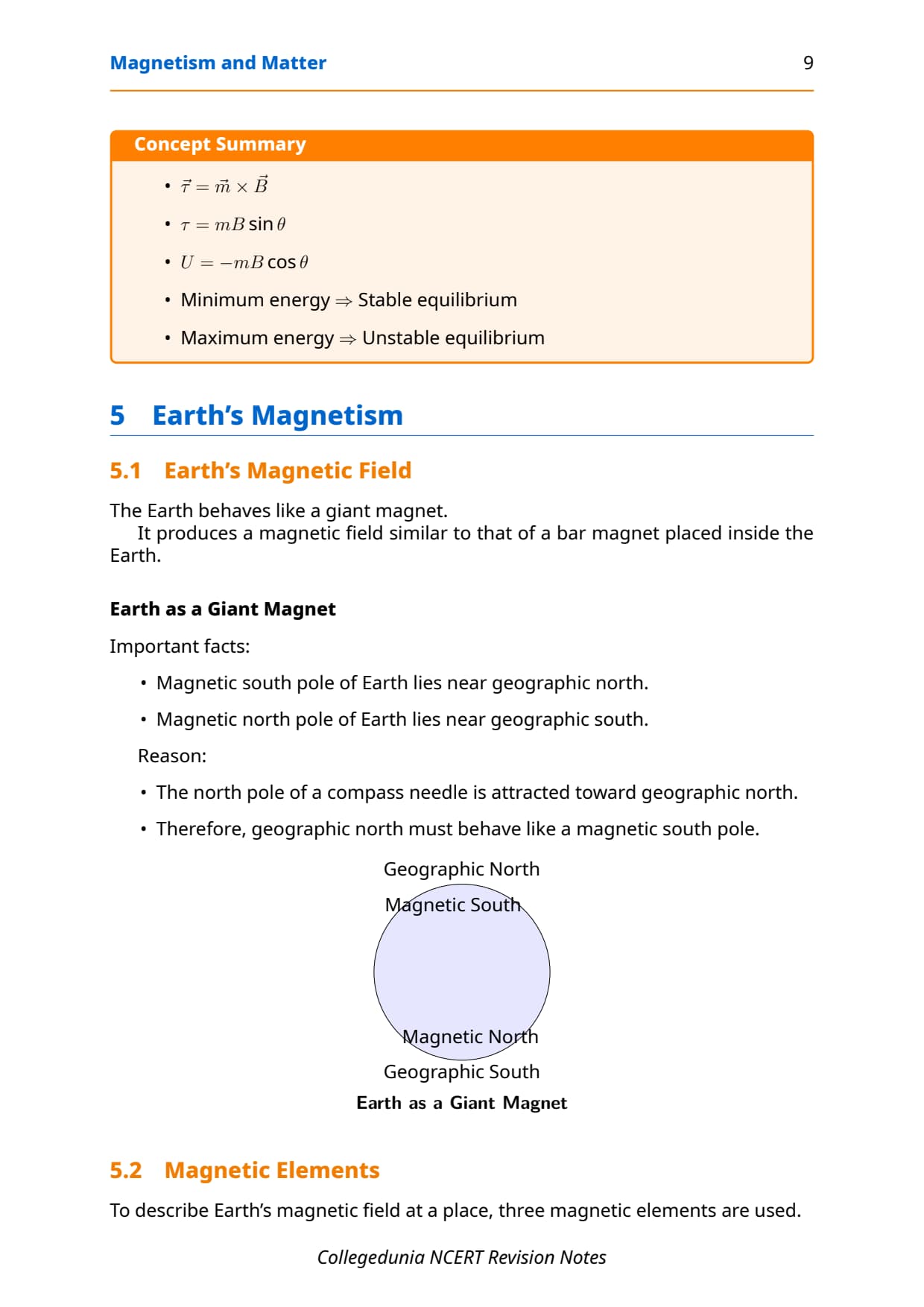
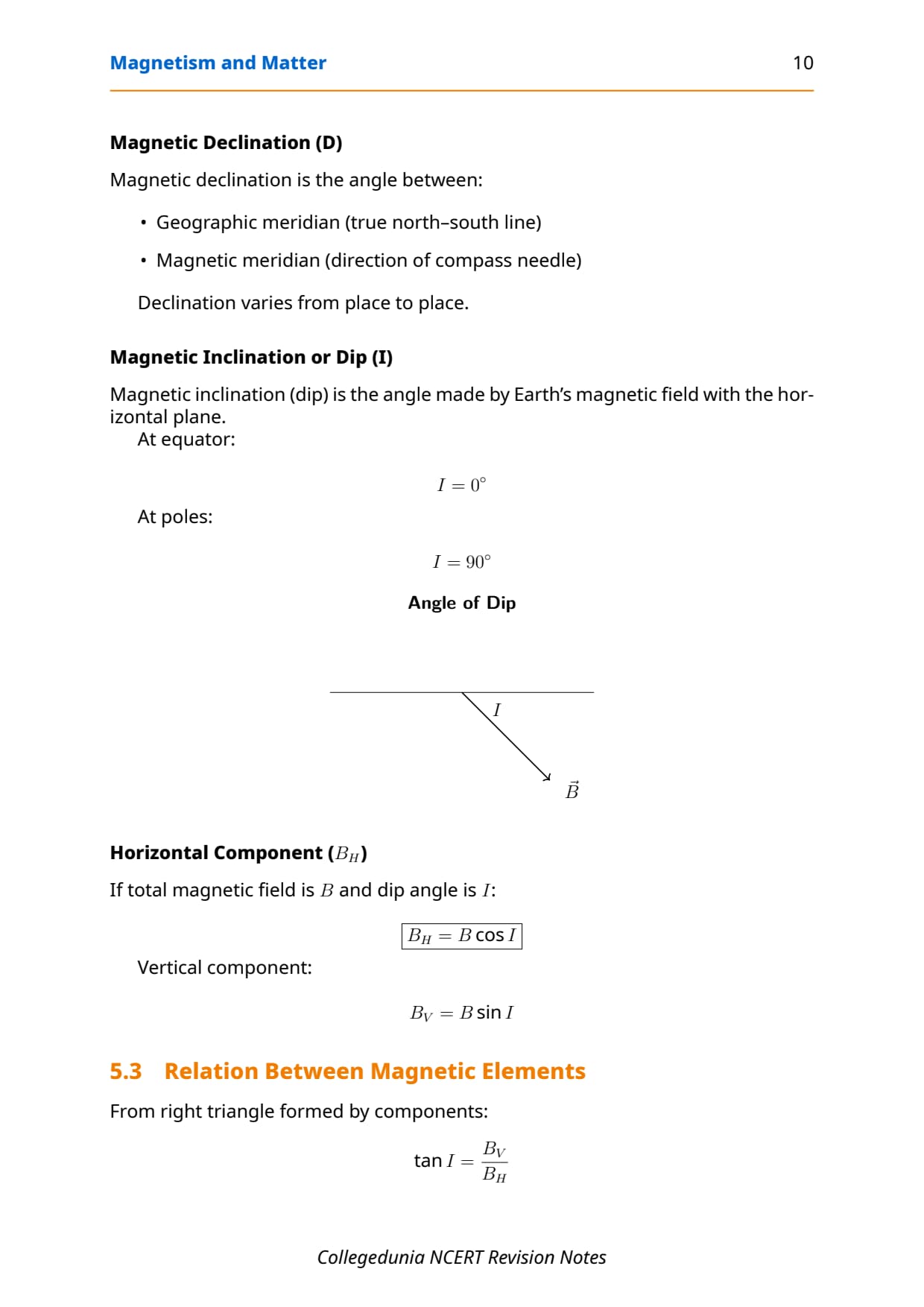
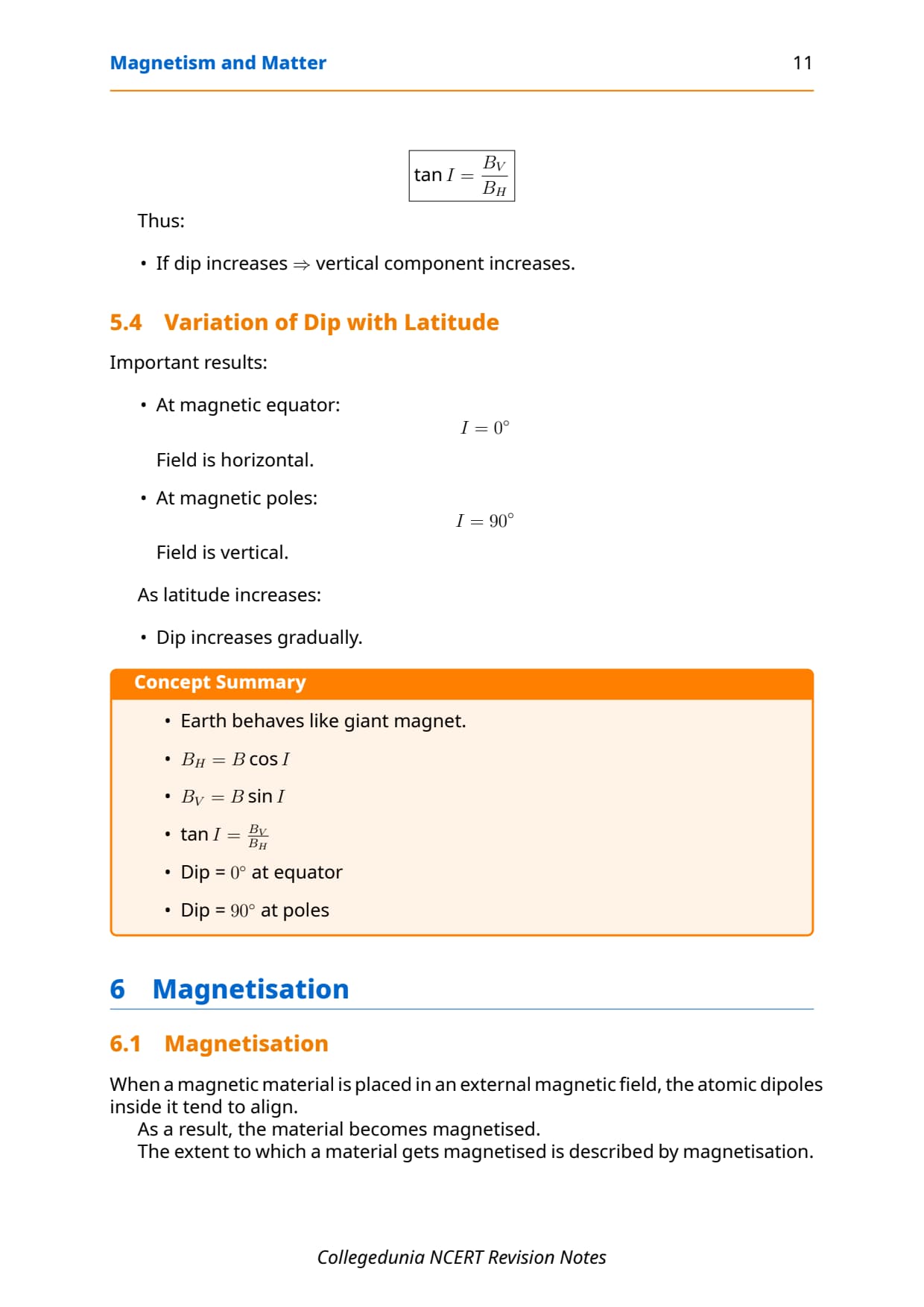
- Earth's magnetism: 3-mark on declination, dip, horizontal component
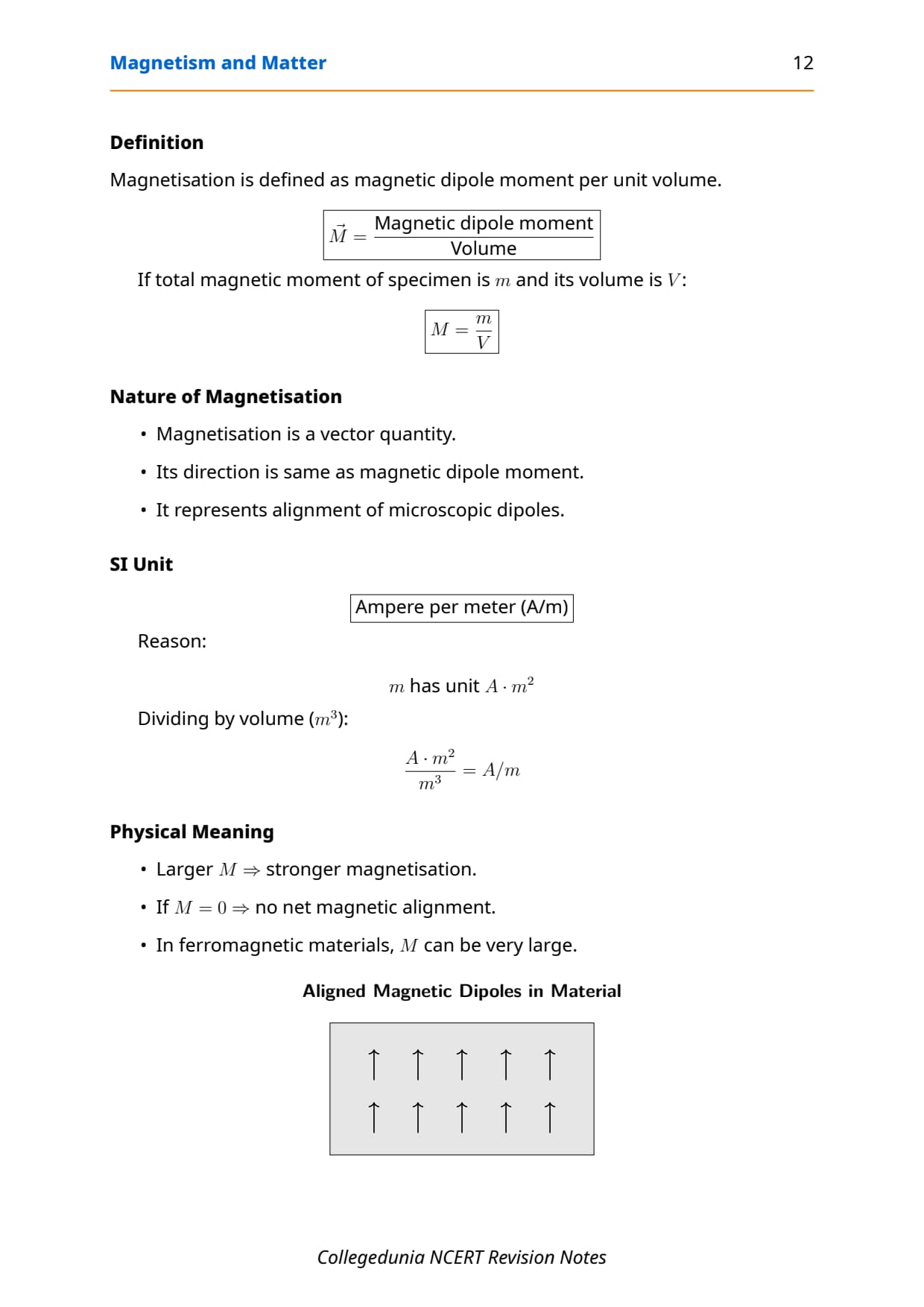
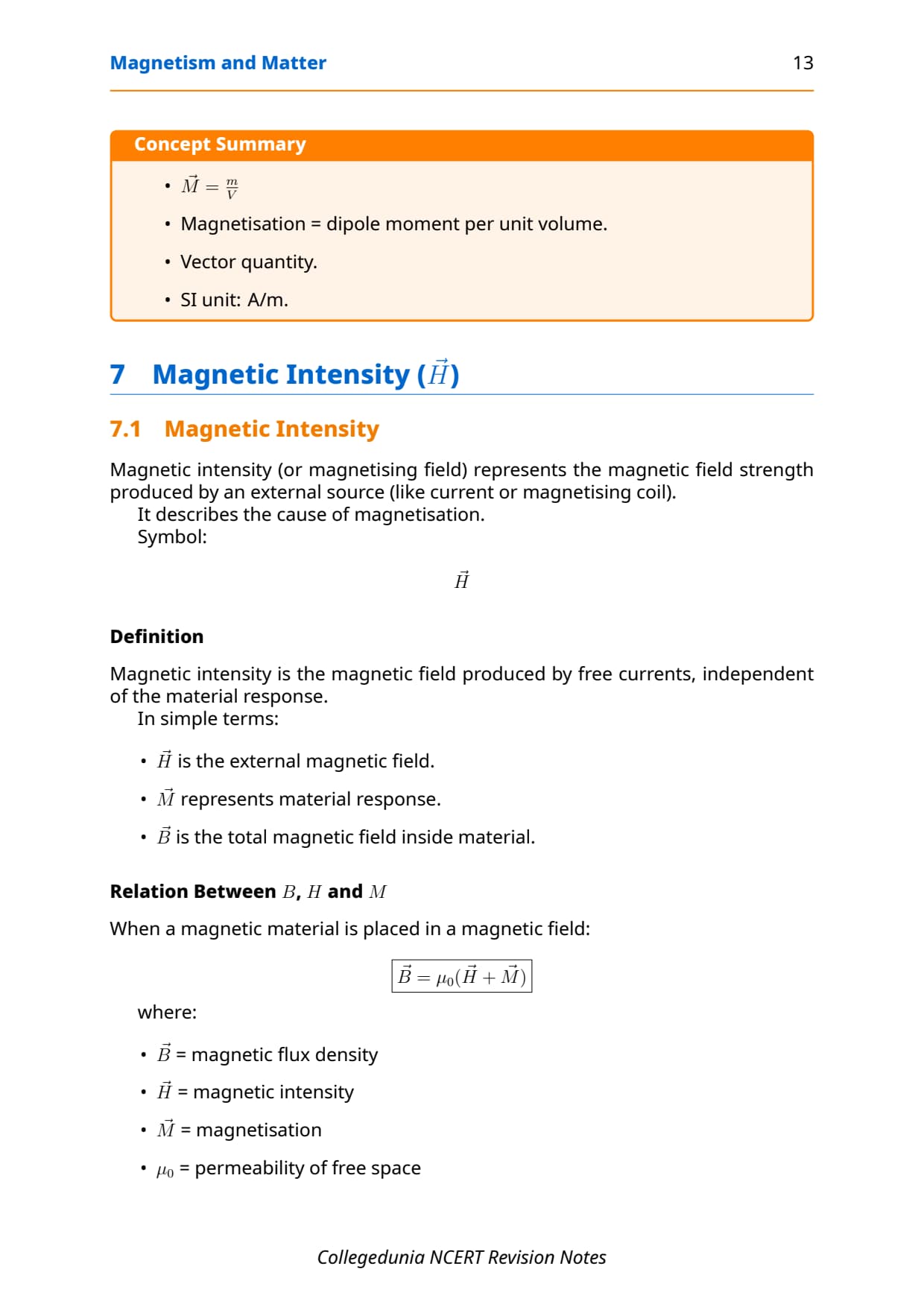
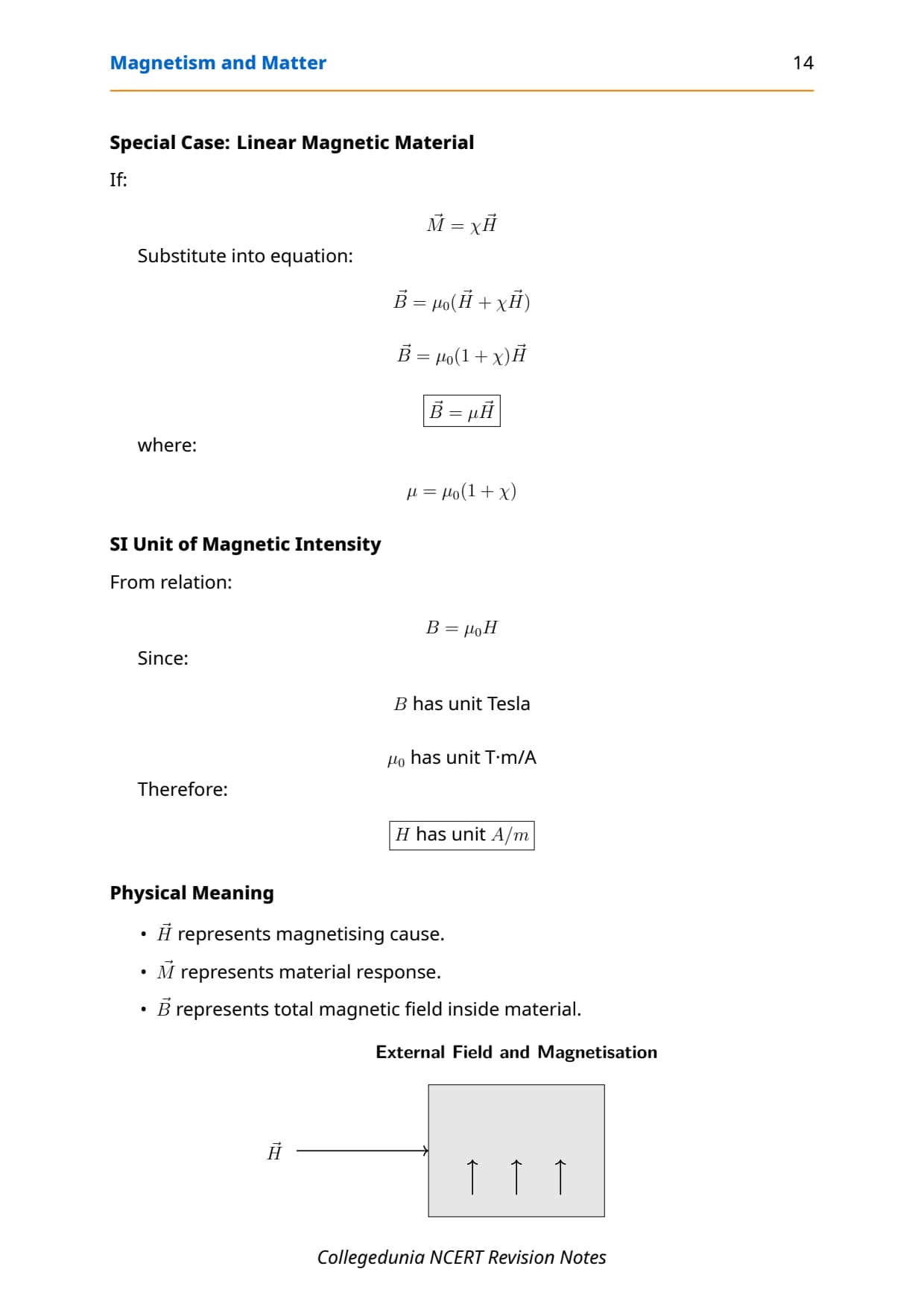
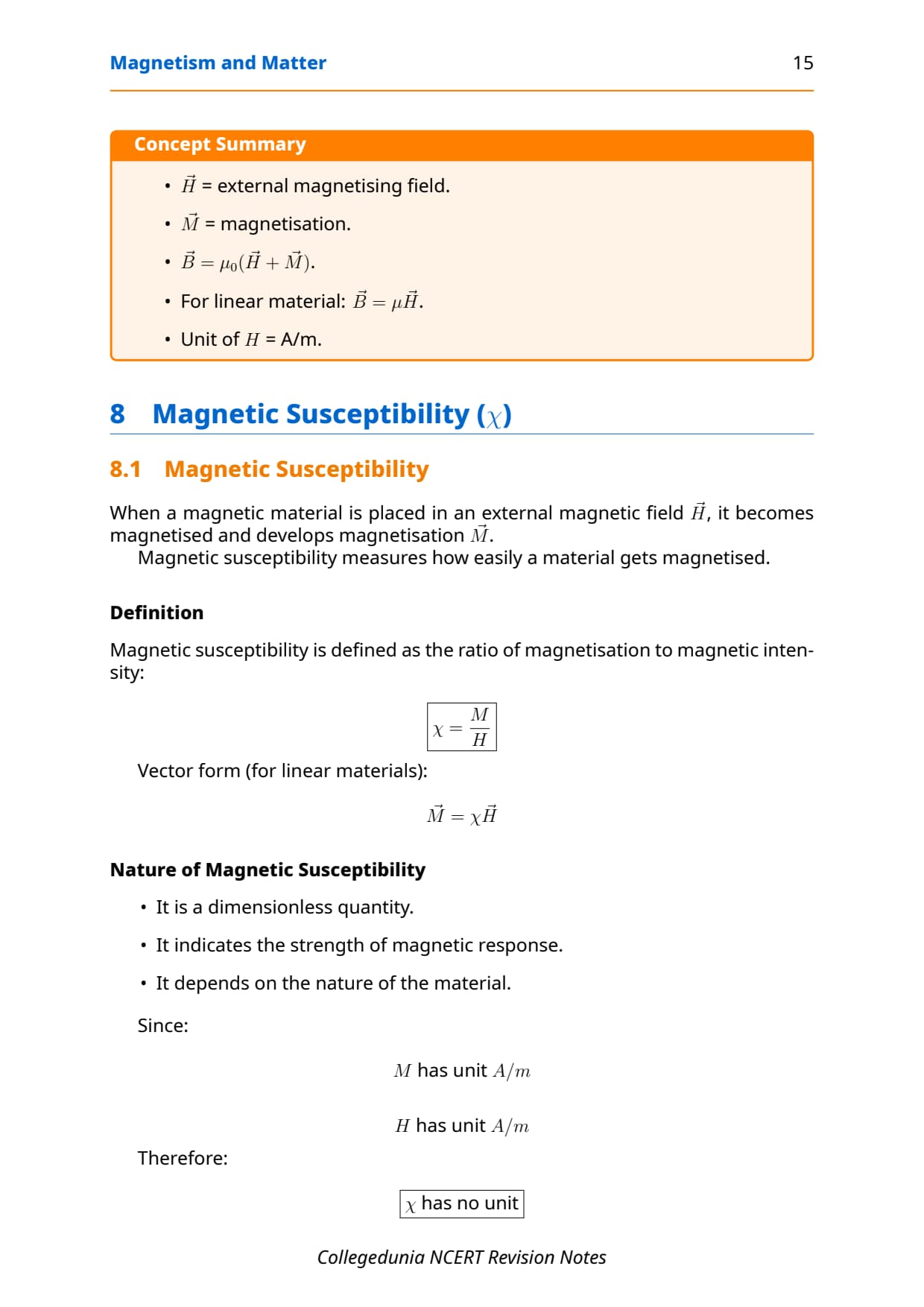
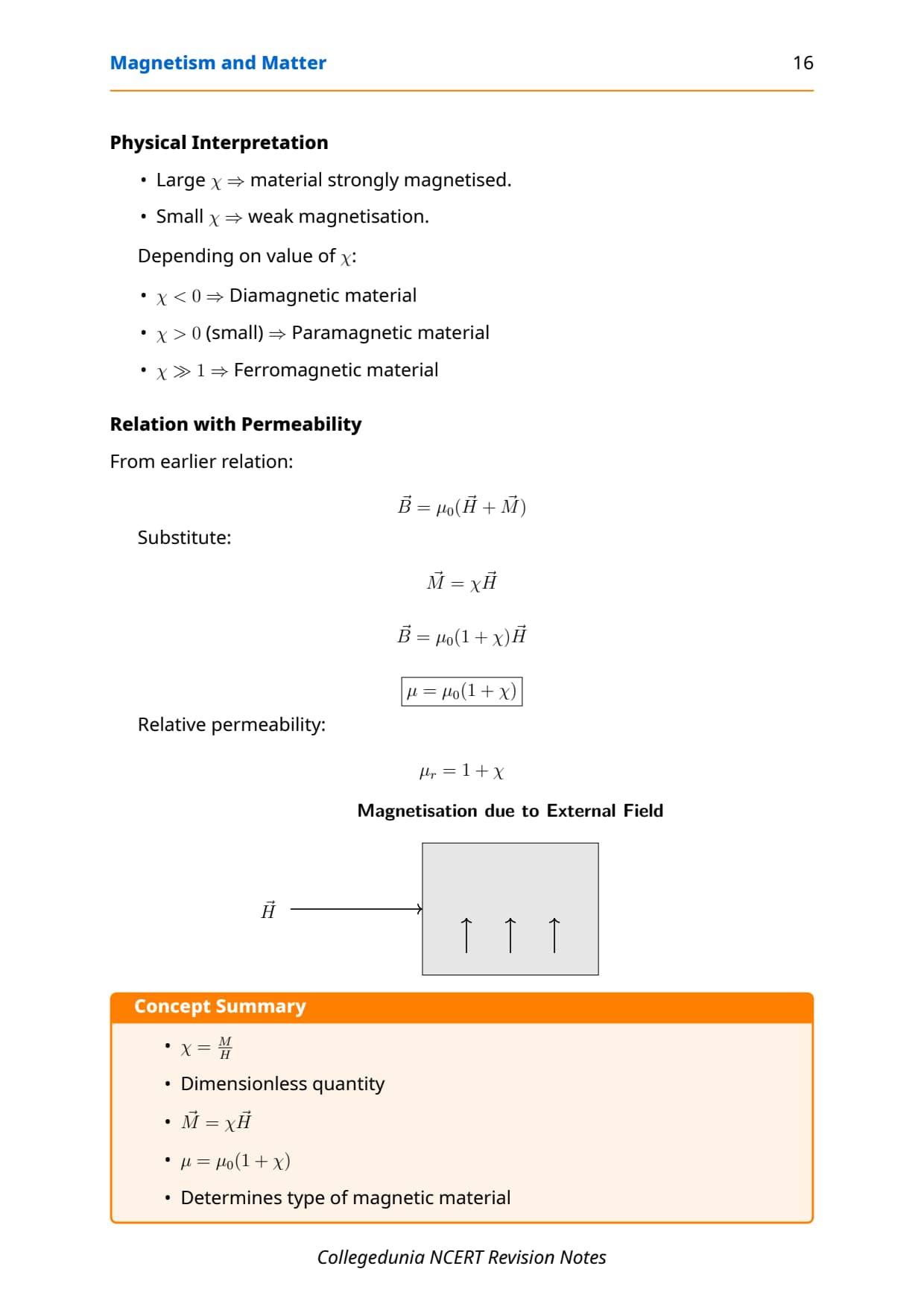
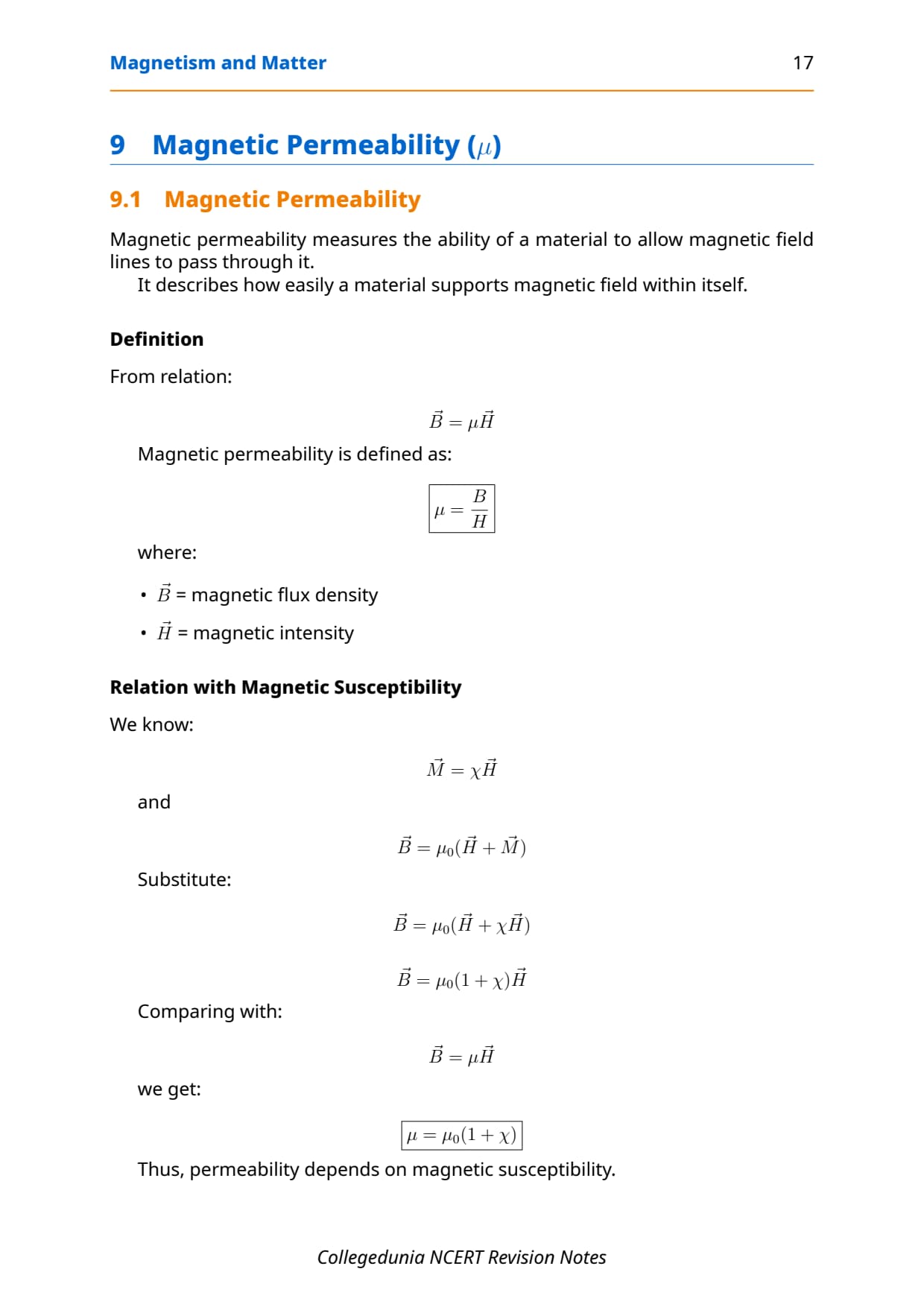
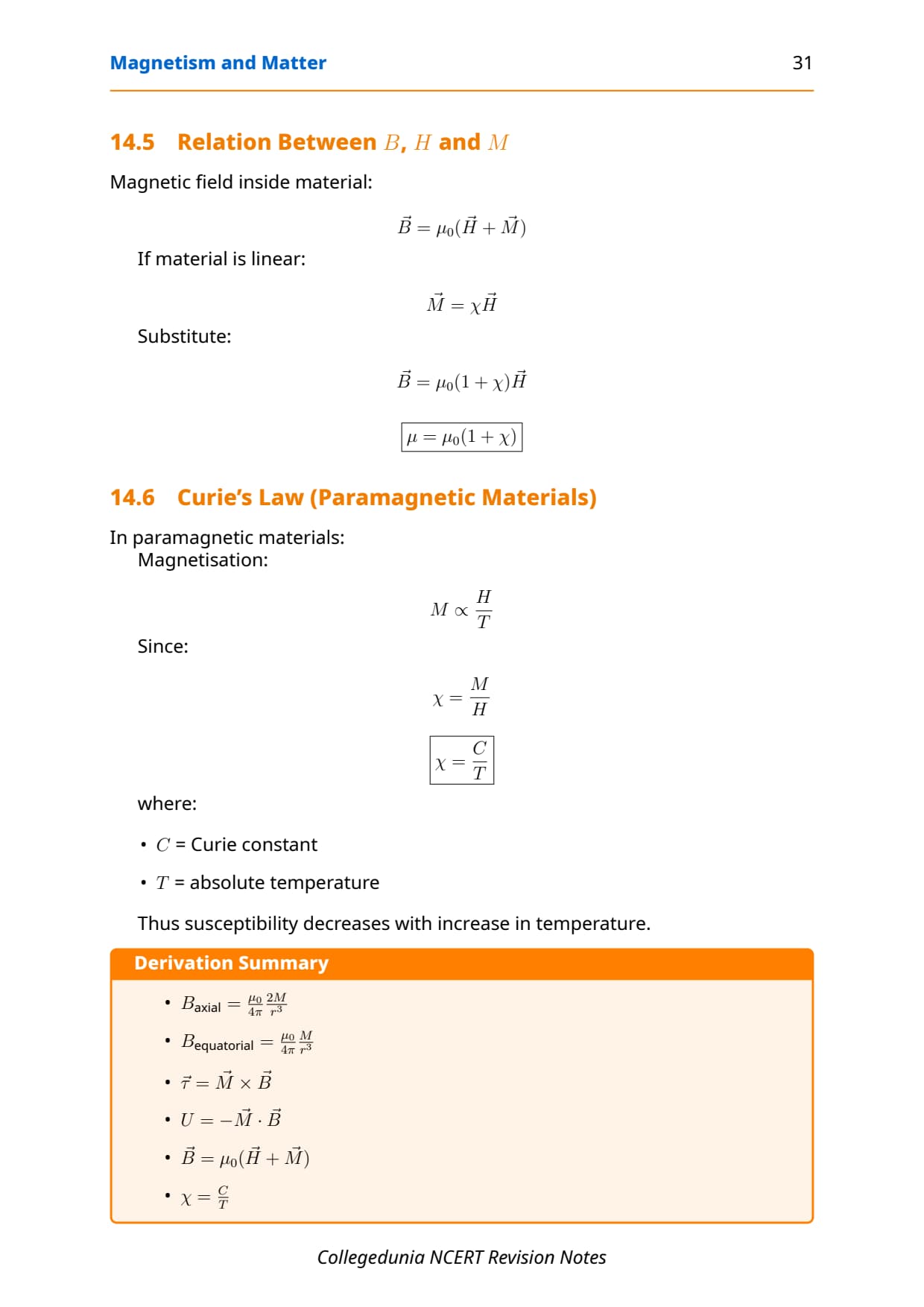
- Magnetisation and magnetic intensity: 3-mark on M = chi H, B = mu_0 (H + M)
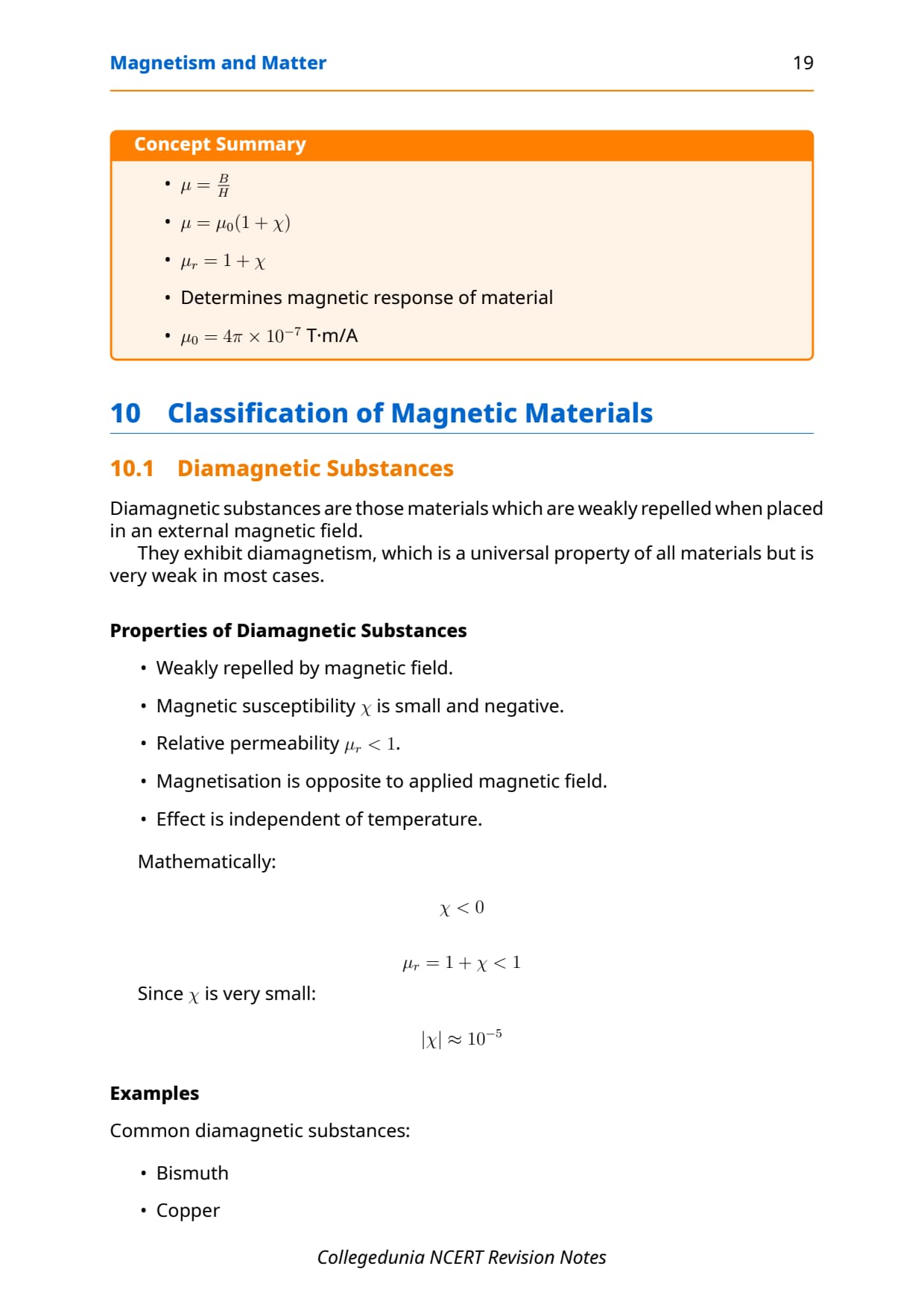
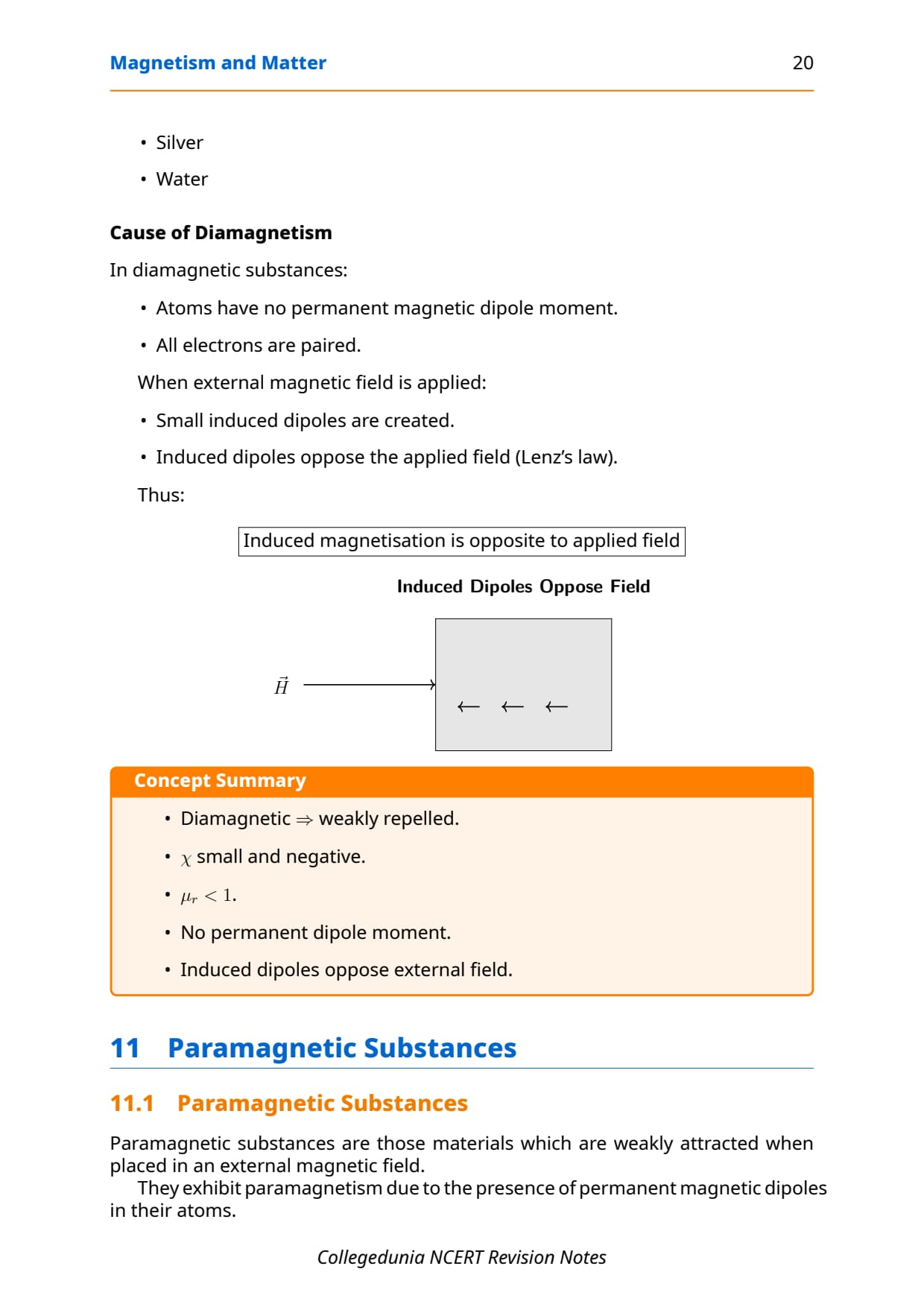
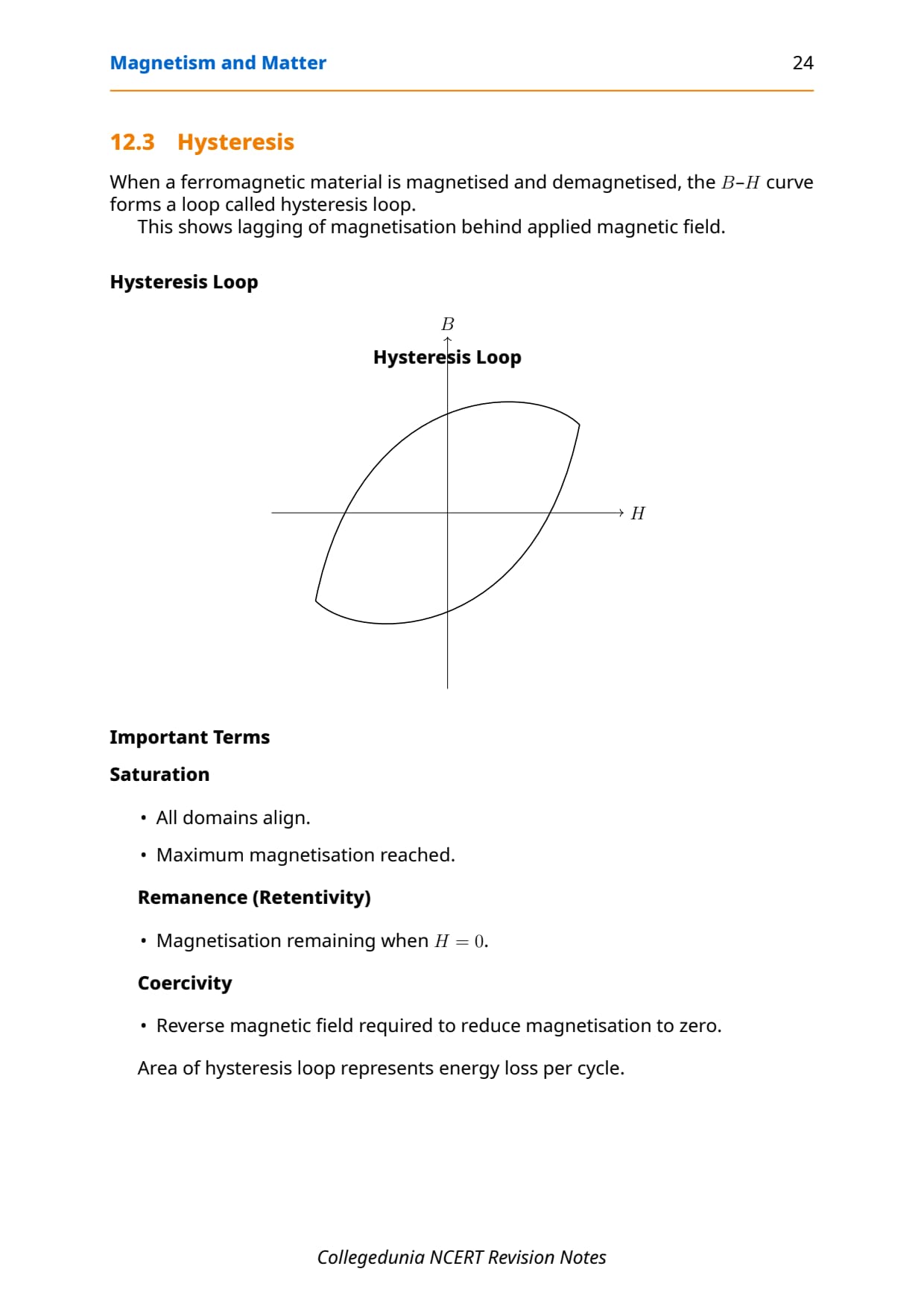
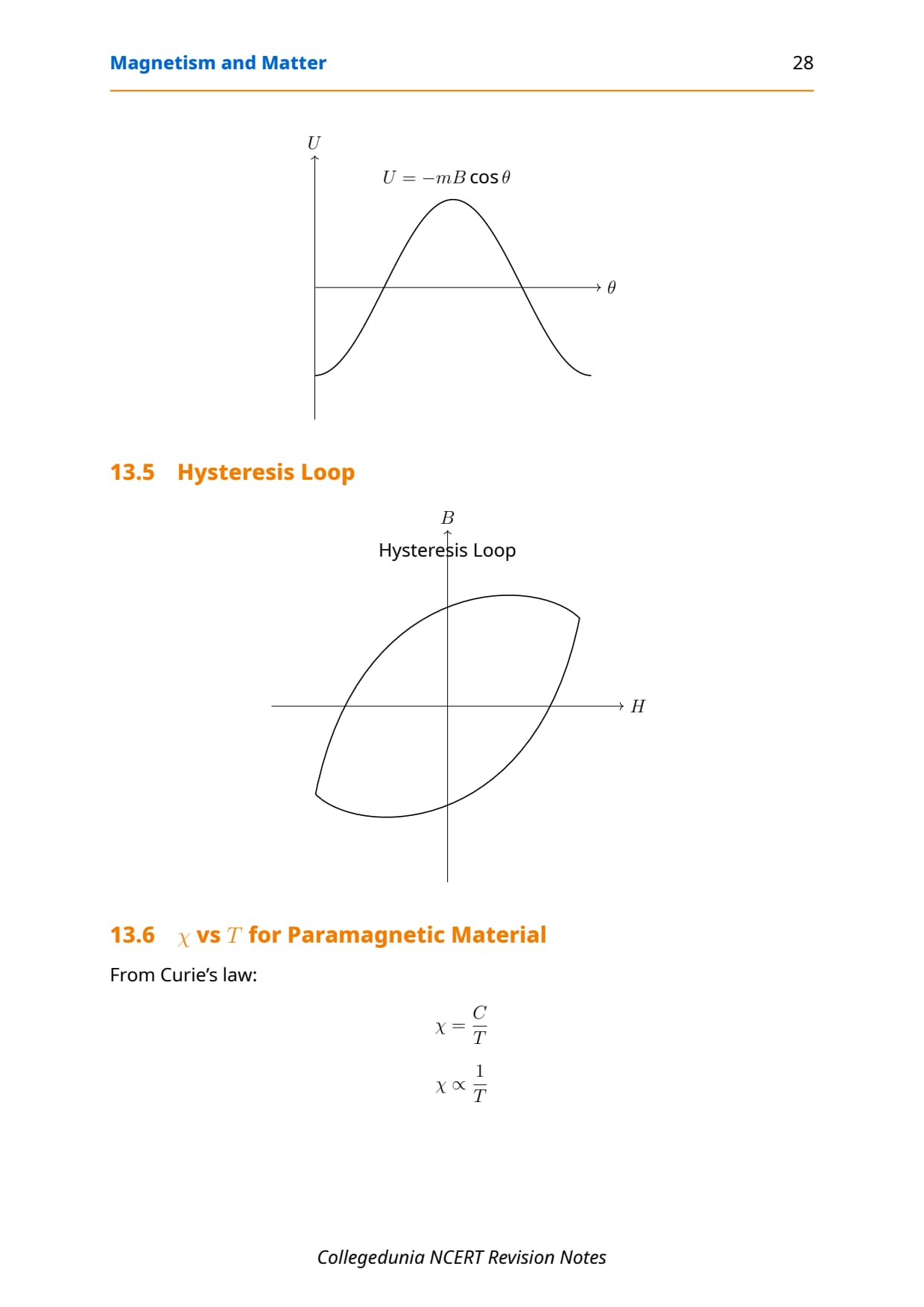
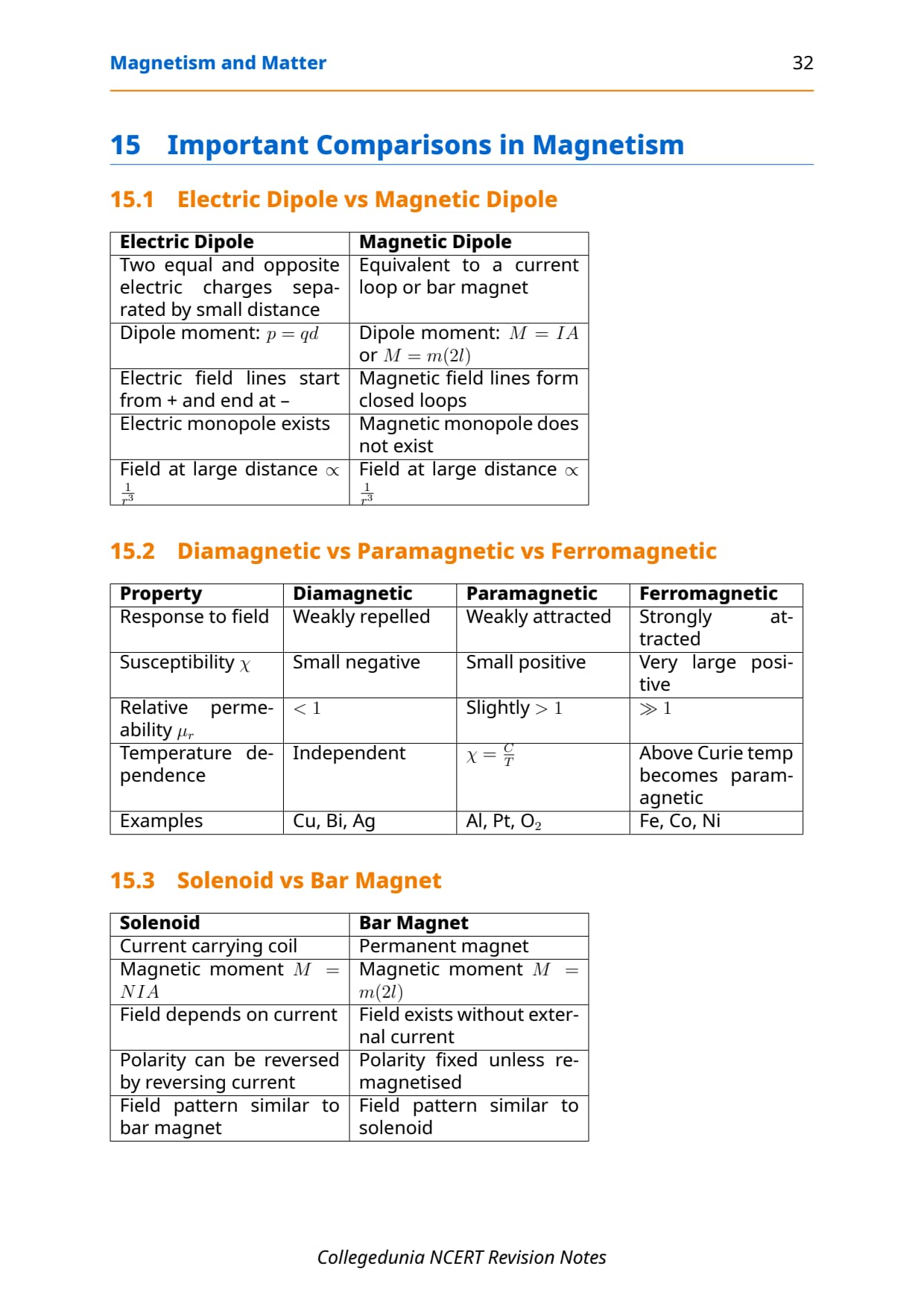
- Diamagnetic, paramagnetic, ferromagnetic: 2-mark on hysteresis loop
Magnetism and Matter Class 12 Physics Video Lecture
Source: Magnet Brains on YouTube
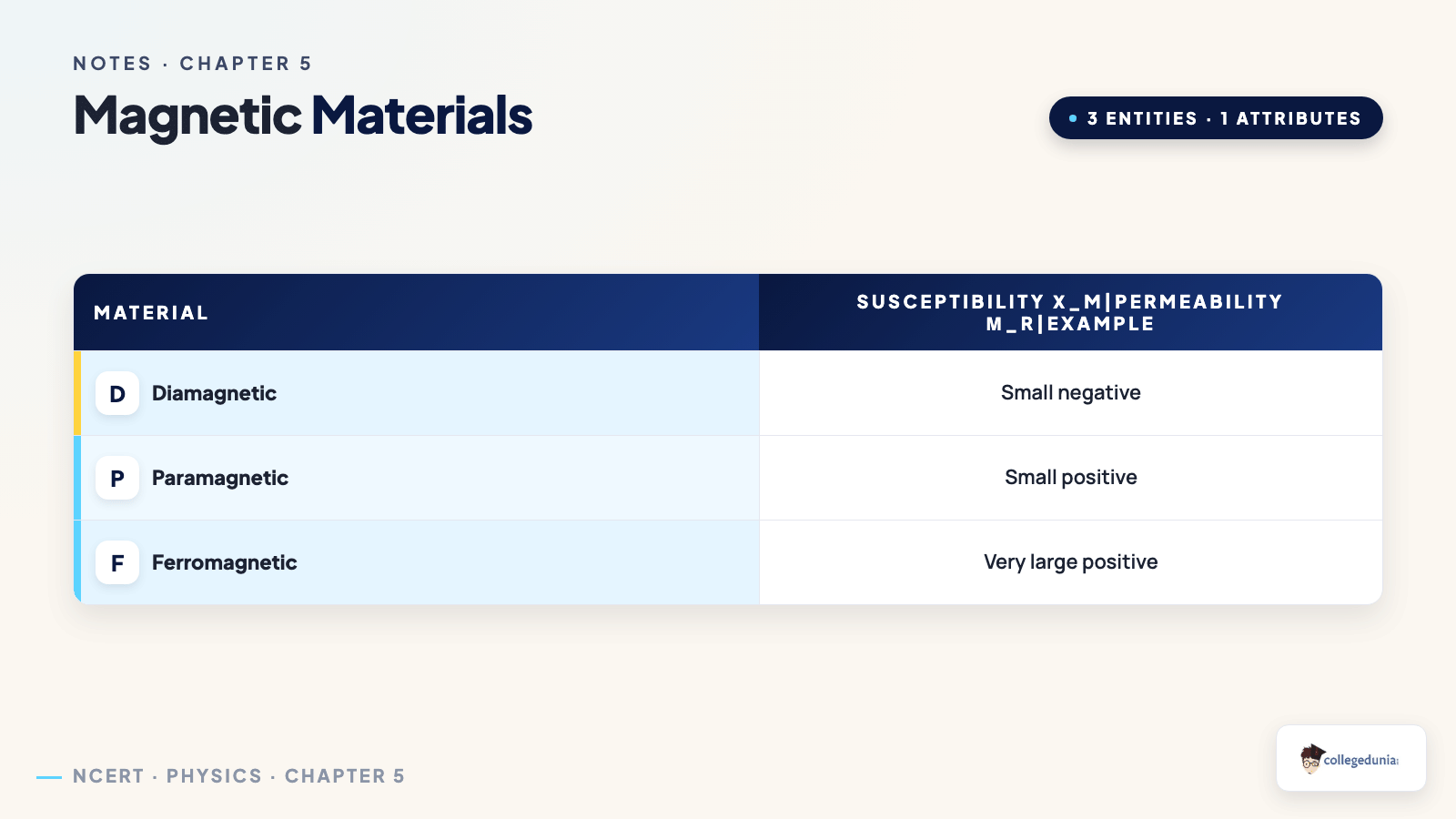
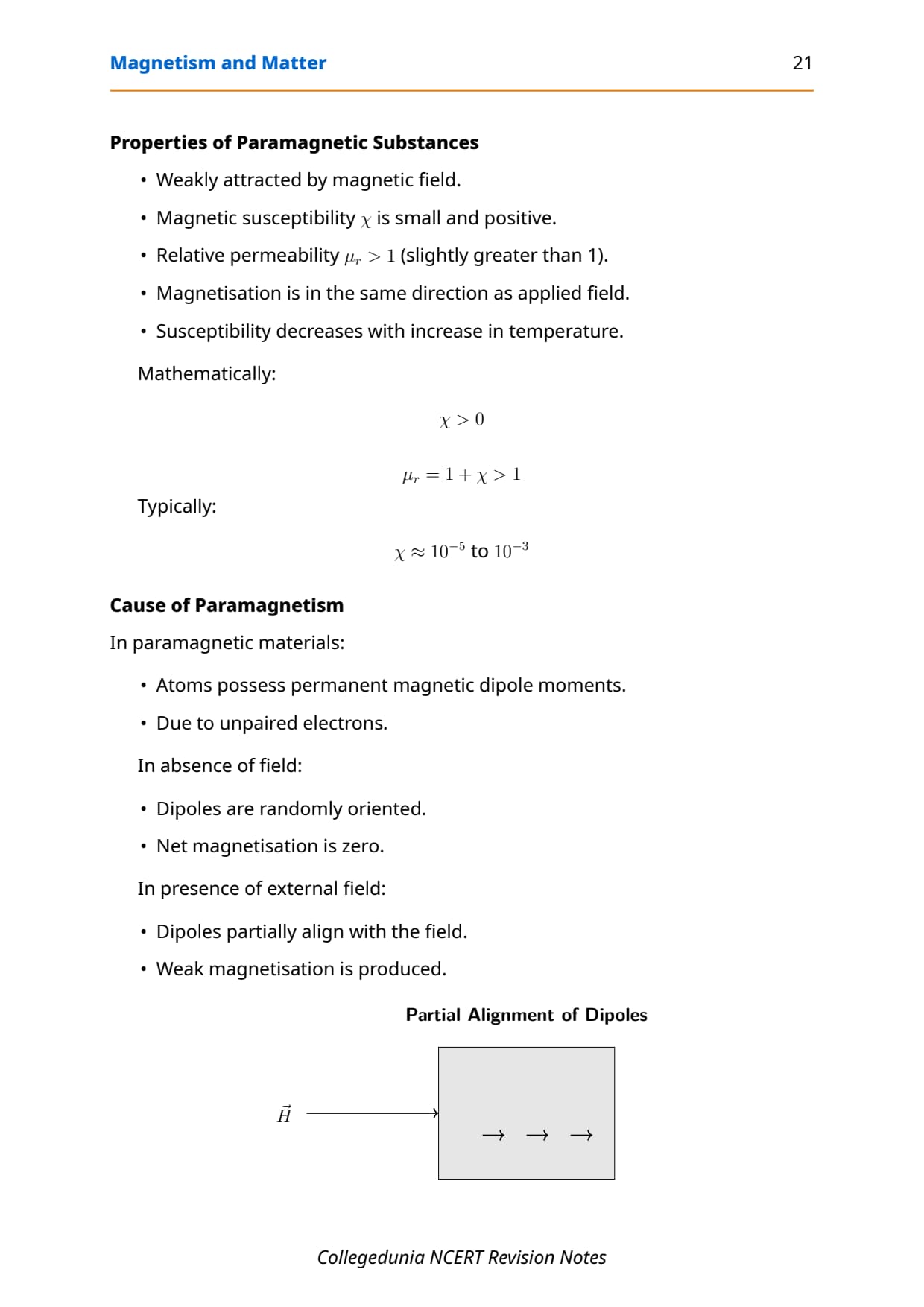
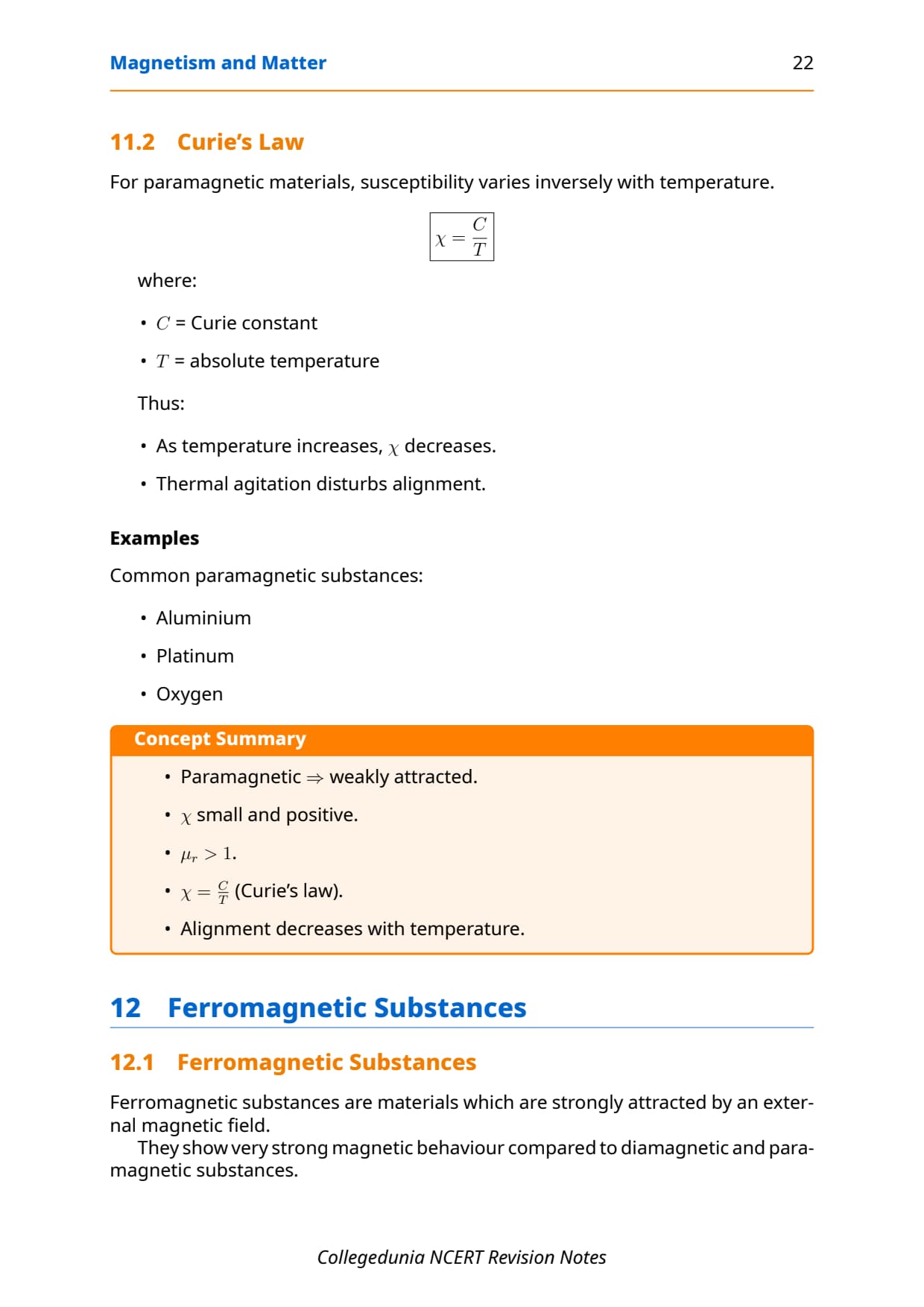
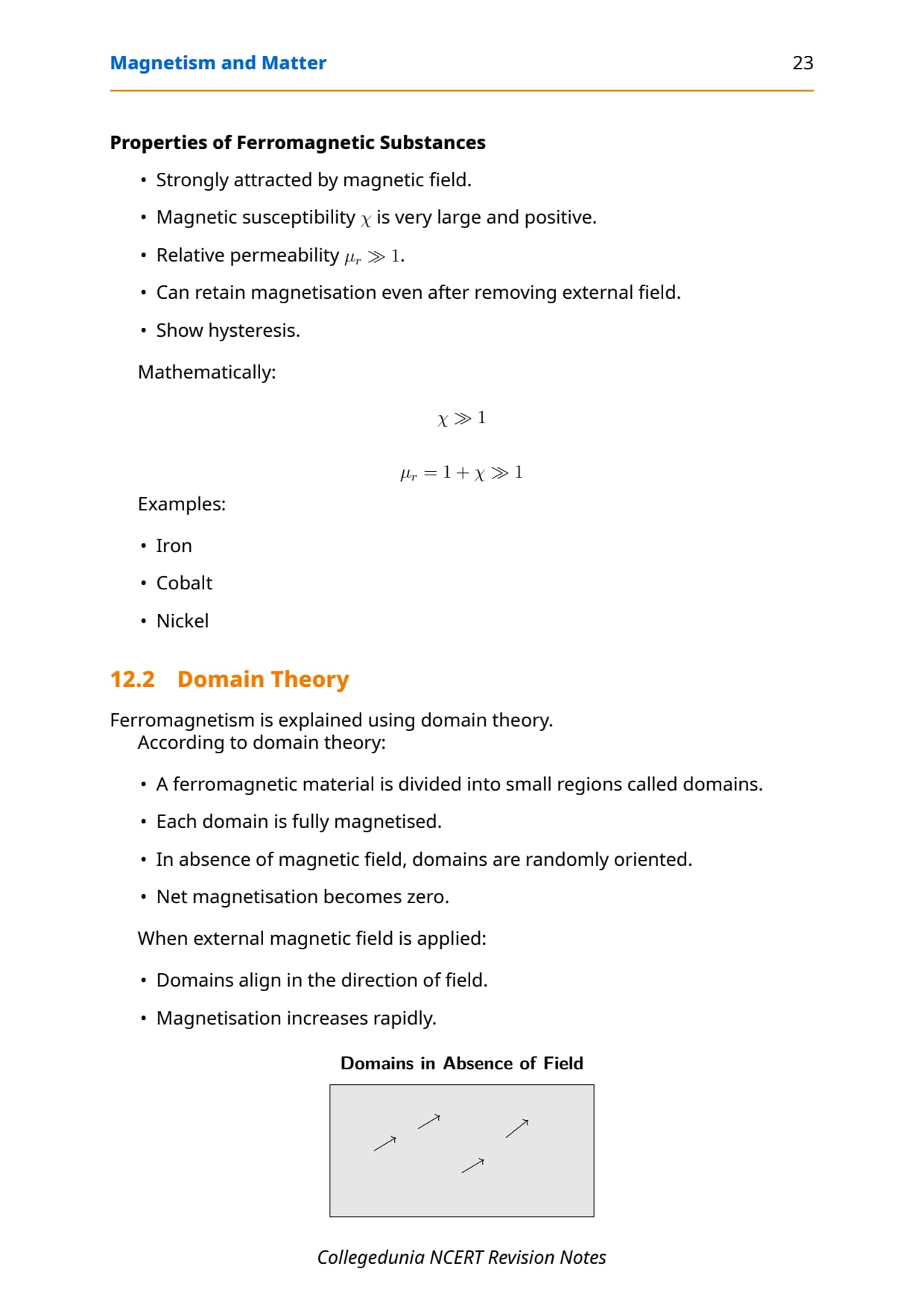
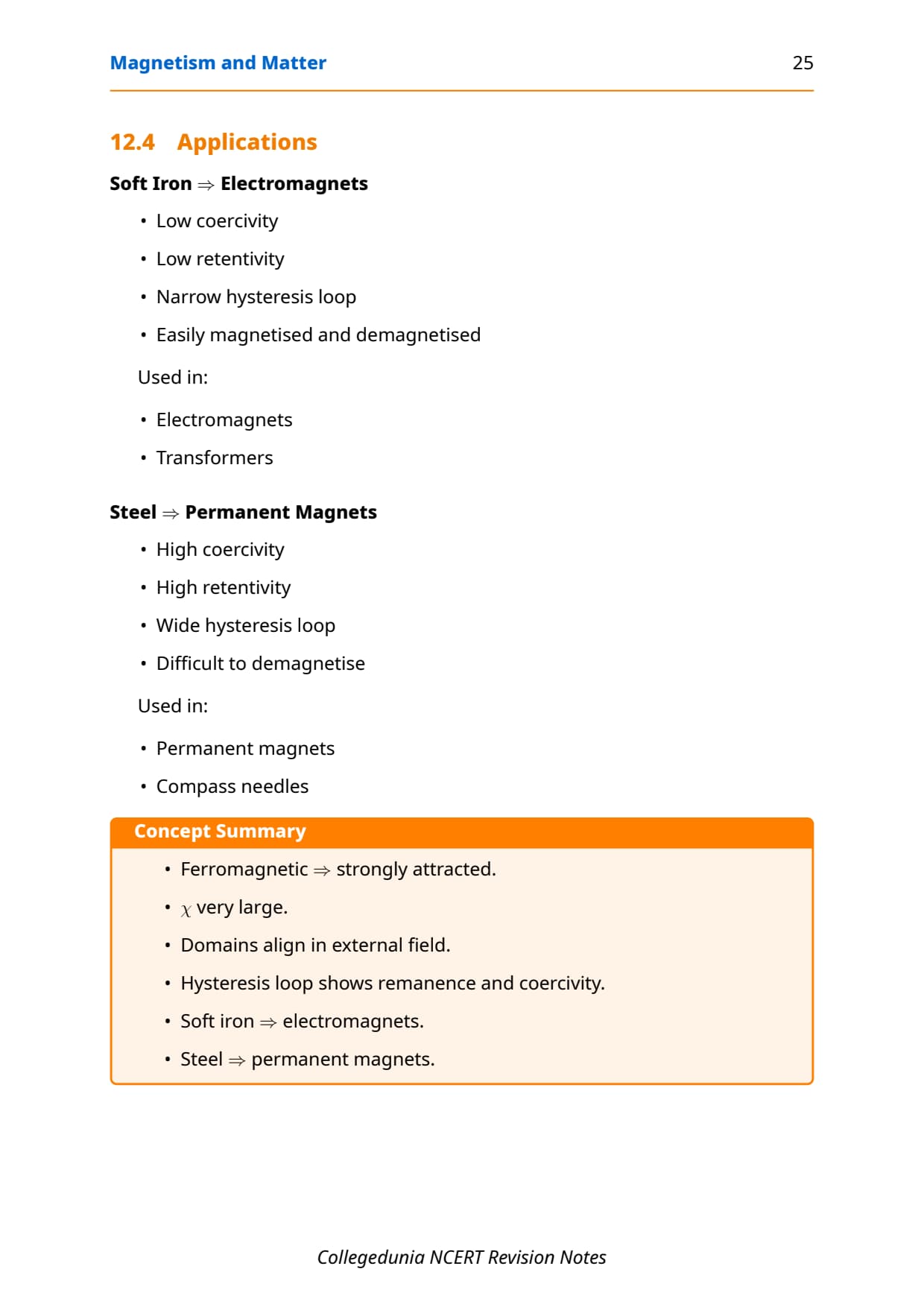
Diamagnetic / Paramagnetic / Ferromagnetic - quick reference.
Class 12 Physics Chapter 5 All Formulas: Quick-Reference Table
The physics chapter 5 class 12 all formulas list below covers every numerical the chapter generates. The same table sits on the back of the physics class 12 chapter 5 pdf for last-minute revision.
| Concept | Formula | SI Unit |
|---|---|---|
| Magnetic dipole moment | m = I A | A m² |
| Torque on dipole | tau = m cross B | N m |
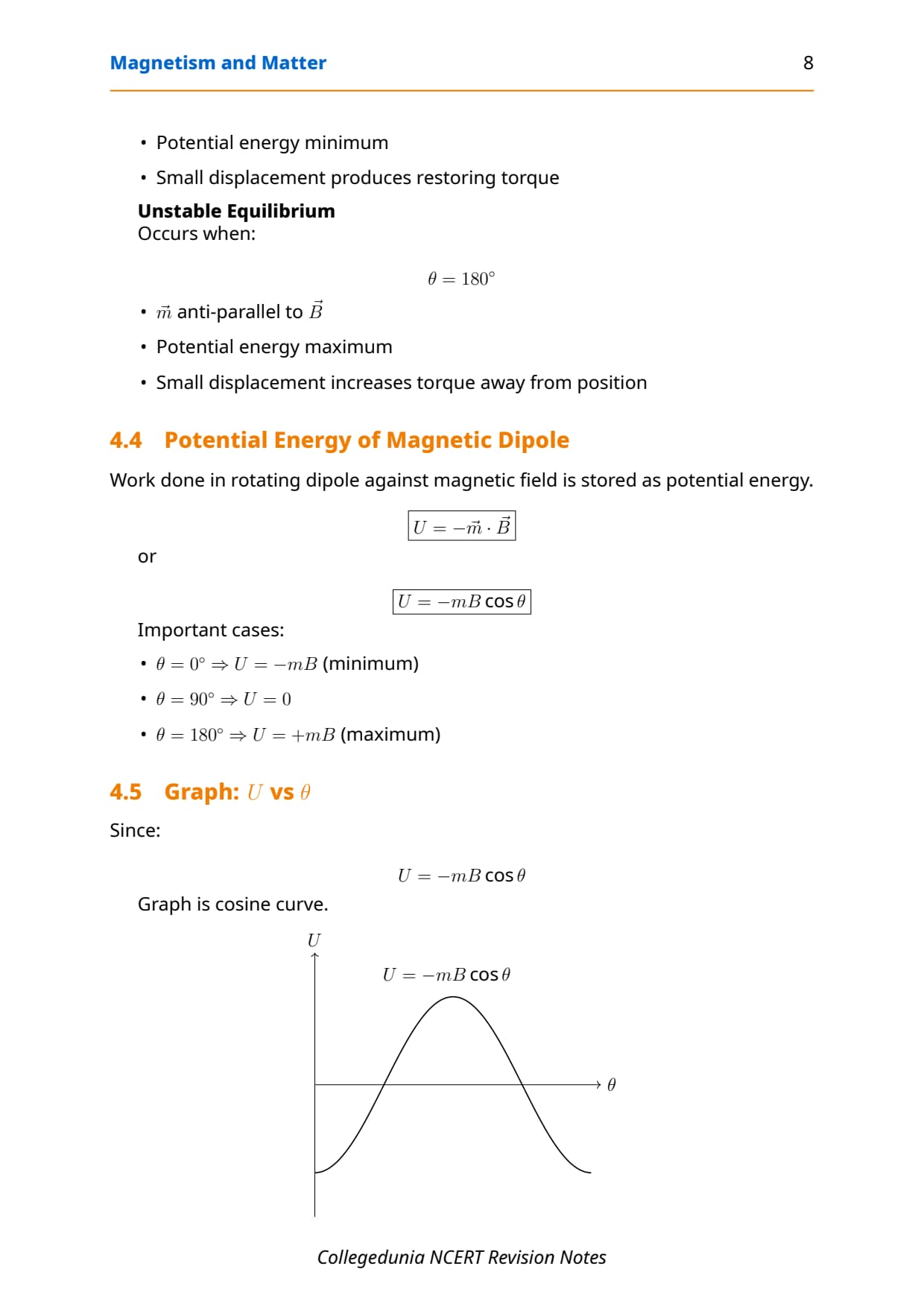
| Potential energy | U = minus m . B | joule |
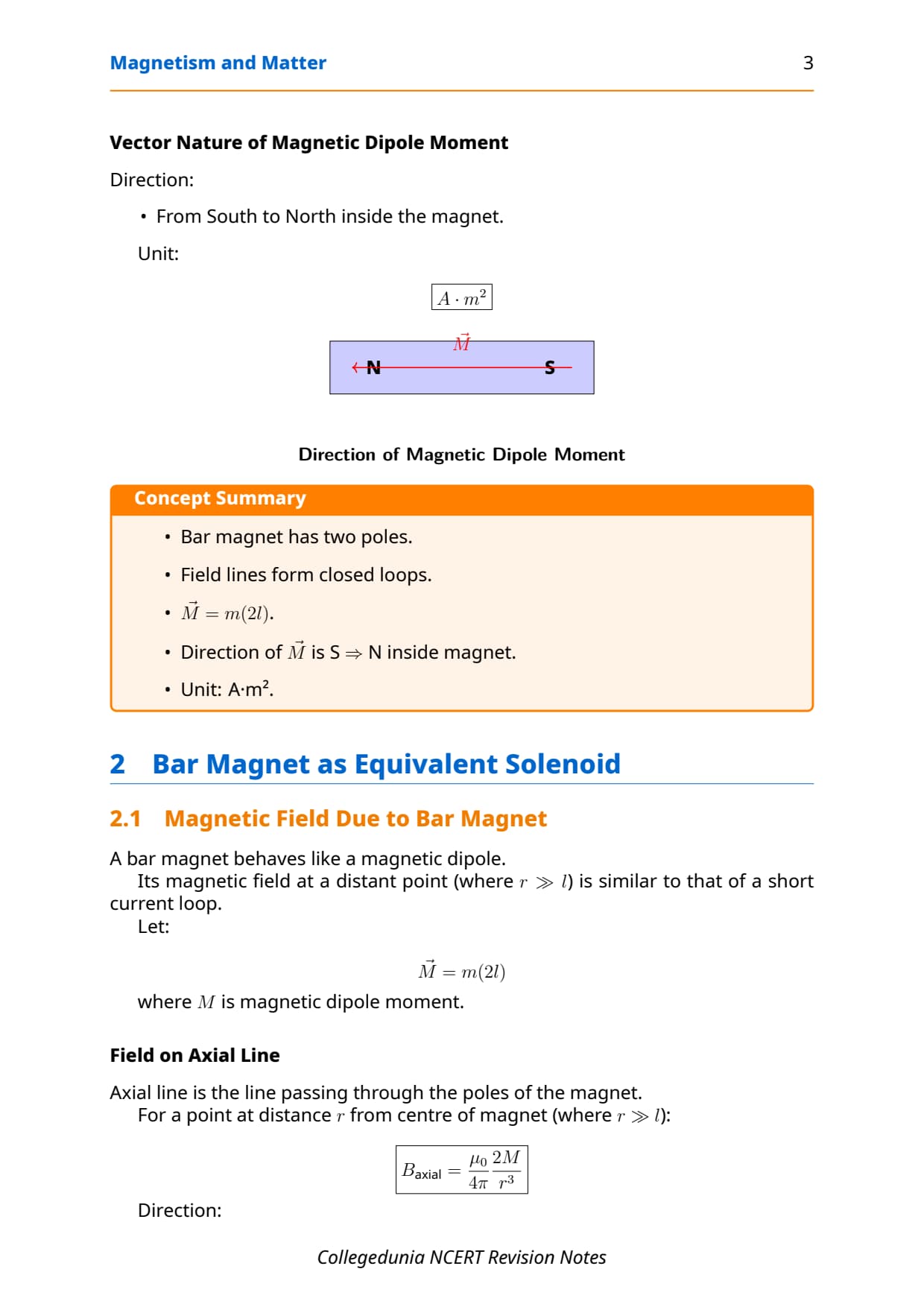
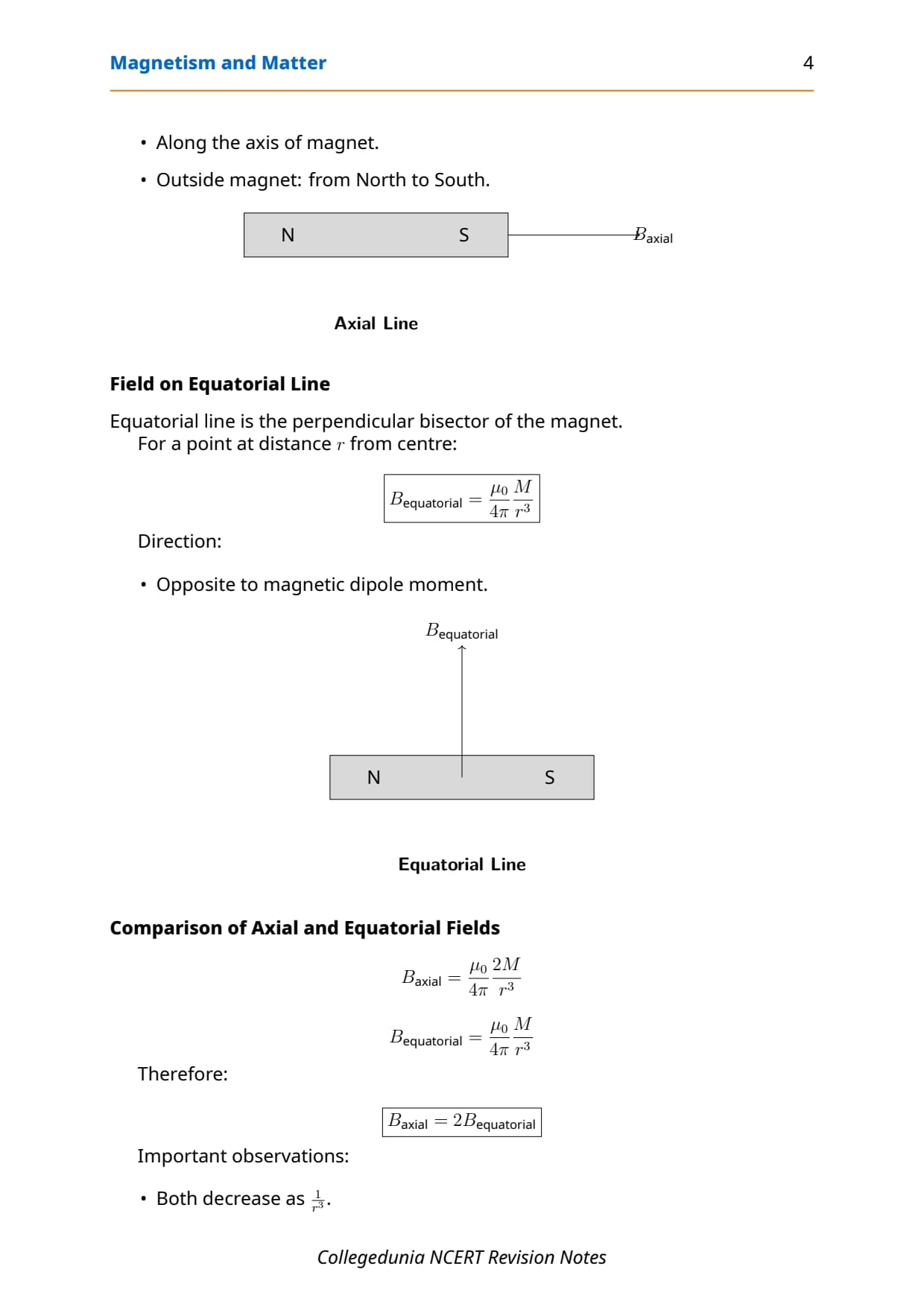
| Magnetic field of bar magnet (axial) | B_axial = mu_0 (2m) / (4 pi r³) | tesla |
| Magnetic field of bar magnet (equatorial) | B_eq = mu_0 m / (4 pi r³) | tesla |
| Earth's horizontal component | B_H = B_total cos(dip) | tesla |
| Magnetic susceptibility | chi = M / H | dimensionless |
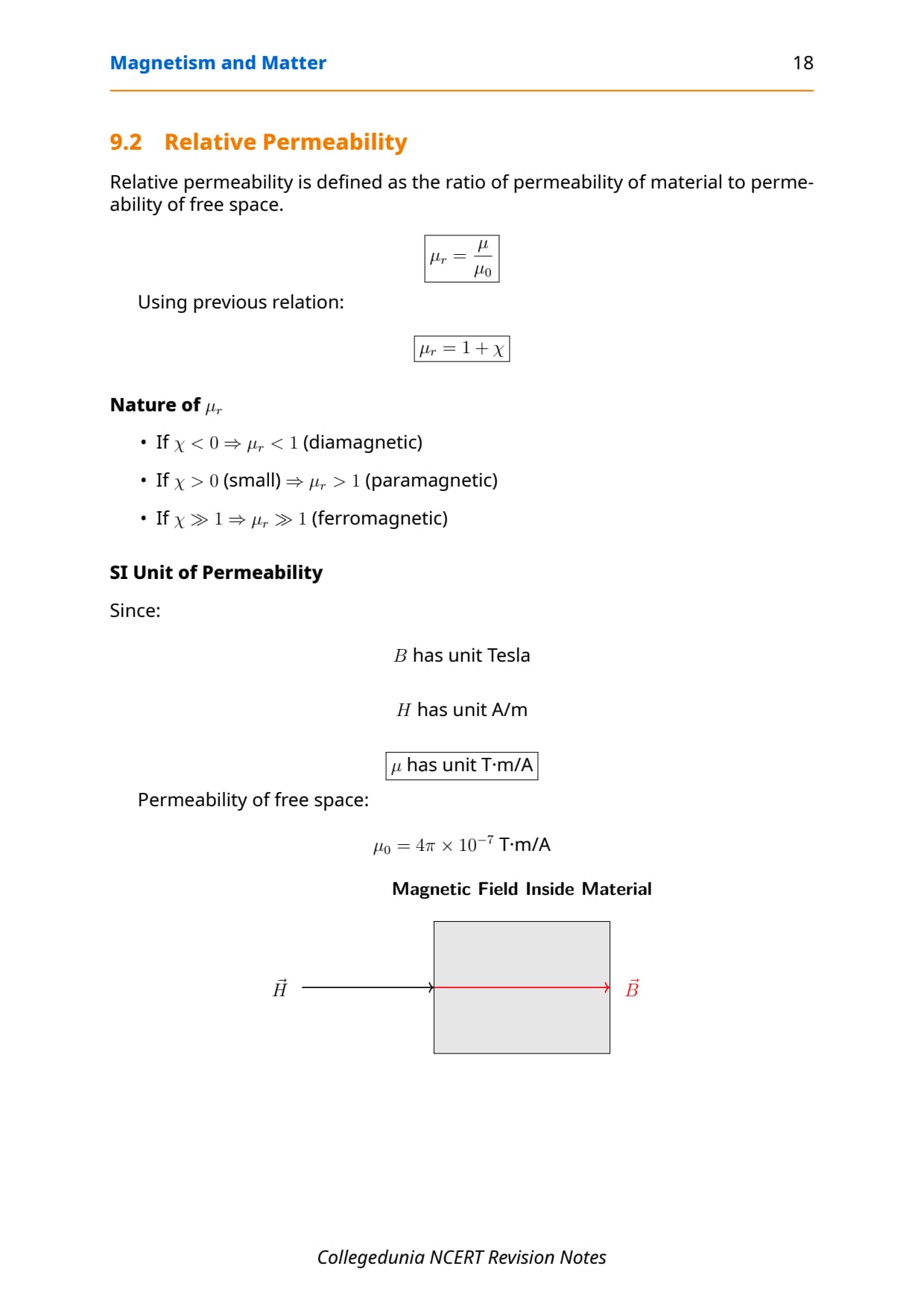
| Relative permeability | mu_r = 1 + chi | dimensionless |
| Curie's law | chi = C / T | 1/K |
Full formula sheet with derivations: Class 12 Physics Chapter 5 Formula Sheet
Class 12 Physics Chapter 5 All Derivations: Index Table
The 4 derivations below carry the bulk of the marks across the class 12 physics chapter 5 all derivations set. Each derivation in the ch 5 physics class 12 notes PDF carries the full geometry sketch, the integral set-up, and the boundary-condition substitution.
| Derivation | Marks (CBSE) |
|---|---|
| Bar magnet axial field | 3 |
| Bar magnet equatorial field | 3 |
| Torque on dipole in uniform field | 2 |
| Curie's law for paramagnets | 2 |
Magnetism and Matter Weightage Compared Across Class 12 Physics Chapters
The table below maps how Class 12 Physics Chapter 5 weightage compares with every other chapter. Marks are CBSE board averages over the last five papers.
| Chapter | Topic | Avg CBSE Marks |
|---|---|---|
| Ch 1 | Electric Charges and Fields | 6 marks |
| Ch 2 | Electrostatic Potential and Capacitance | 7 marks |
| Ch 3 | Current Electricity | 7 marks |
| Ch 4 | Moving Charges and Magnetism | 6 marks |
| Ch 5 | Magnetism and Matter | 3 marks |
| Ch 6 | Electromagnetic Induction | 5 marks |
| Ch 7 | Alternating Current | 6 marks |
| Ch 8 | Electromagnetic Waves | 2 marks |
| Ch 9 | Ray Optics and Optical Instruments | 7 marks |
| Ch 10 | Wave Optics | 5 marks |
| Ch 11 | Dual Nature of Radiation and Matter | 4 marks |
| Ch 12 | Atoms | 3 marks |
| Ch 13 | Nuclei | 3 marks |
| Ch 14 | Semiconductor Electronics | 6 marks |
Magnetism and Matter Previous Year Questions Weightage (2021 to 2026)
The table below maps every CBSE Board, JEE Main, and NEET appearance of Class 12 Physics Chapter 5 topics over the last six sessions.
| Year | CBSE Board | JEE Main | NEET |
|---|---|---|---|
| 2026 | Bar magnet axial field (3 marks) | Earth's horizontal component (4 marks) | Magnetic materials: dia, para and ferromagnetism |
| 2025 | Curie's law derivation (3 marks) | Magnetic susceptibility comparison | Diamagnetic property MCQ |
| 2024 | Magnetic intensity vs magnetisation (3 marks) | Hysteresis loop interpretation | Ferromagnetic material |
| 2023 | Torque on a dipole (2 marks) | Magnetic dipole moment calculation | Earth's magnetism elements |
| 2022 | Bar magnet equatorial field (3 marks) | Pole strength definition | Magnetic flux density |
| 2021 | - | Magnetic flux through a coil | Magnetic field lines property |
Common Mistakes in Class 12 Chapter 5 Physics
Mistake 1: Skipping the unit balance step. CBSE markers award marks for showing dimensional consistency on derivations.
Mistake 2: Confusing scalar and vector quantities in formulas. Add scalars algebraically, vectors as components.
Mistake 3: Forgetting boundary conditions in the earth's magnetism derivation. State assumptions explicitly before doing the algebra.
Mistake 4: Using approximate values when the question demands exact symbolic answers. Boards mark down for premature numerical substitution.
Each one costs 1 to 2 marks.
Student Feedback on the Magnetism and Matter Class 12 Physics Notes
In a Collegedunia poll of 10,760 Class 12 Physics students conducted before the 2026 boards, 69% of students rated the magnetic intensity vs magnetisation distinction as the trickiest sub-topic, ahead of Curie's law derivation.
Student Feedback
What 10,760 students told us about these Class 12 Chapter 5 notes:
- 69% of students surveyed marked the magnetic intensity vs magnetisation distinction as the most-confusing sub-topic.
- 57% reported confusion in the Curie's law derivation block on at least one class test.
- 4 out of 5 students said the Bar magnet axial field was the most-practised derivation the night before boards.
- Average student took 5.0 hours for first-read and 2.4 hours for focused revision.
- Out of 10,760 students, 61% read these ch 5 physics class 12 notes at least twice before their boards.
Source: 2025-26 Class 12 Physics student poll. Sample of 10,760 students from CBSE schools across 16 states.
How to Revise Class 12 Chapter 5 Physics in 2 Hours
- 0 to 30 min: Bar magnet and magnetic field lines + Magnetic dipole moment and torque. Solve 2 numericals.
- 30 to 60 min: Earth's magnetism derivation walkthrough.
- 60 to 90 min: Magnetisation and magnetic intensity block.
- 90 to 120 min: Flush through the 9-formula reference and the 4-derivation index.
Budget 5 to 6 hours for first-read; ch 5 physics class 12 notes are best read after the prerequisite chapter.
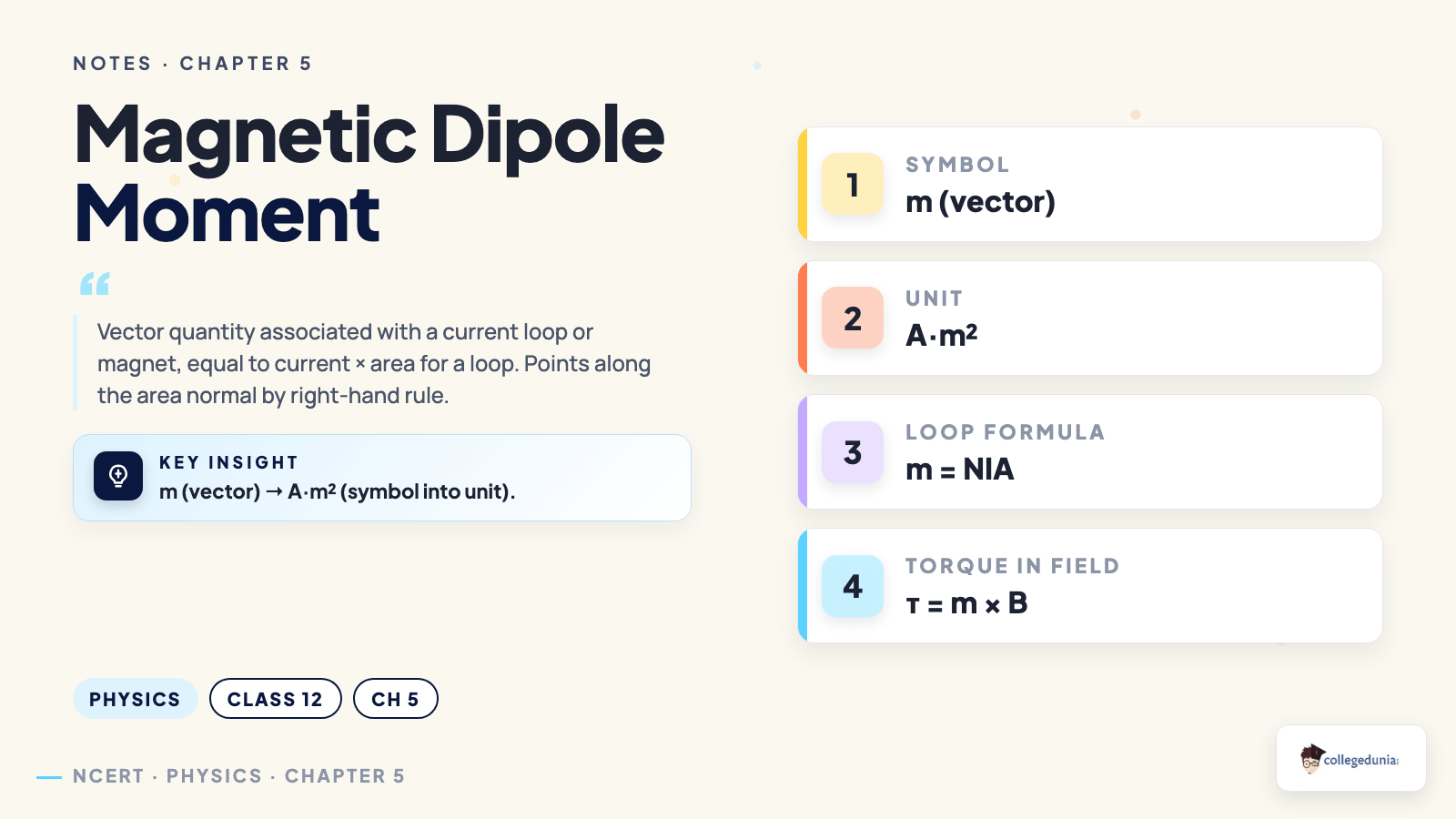
Magnetic dipole moment - definition + torque formula.
Other Resources for Class 12 Physics Chapter 5 Magnetism and Matter
The same Chapter 5 Magnetism and Matter content comes in other formats too. Pick the one that fits how you study.
| Resource | Link |
|---|---|
| Notes (this page) | Magnetism and Matter Notes |
| NCERT Solutions | Magnetism and Matter NCERT Solutions |
| Formula Sheet | Magnetism and Matter Formula Sheet |
| NCERT Book PDF | Magnetism and Matter NCERT Book PDF |
| Exemplar Book PDF | Magnetism and Matter NCERT Exemplar Book PDF |
| Exemplar Solutions | Magnetism and Matter NCERT Exemplar Solutions |
| Handwritten Notes | Magnetism and Matter Handwritten Notes |
NCERT Notes for Class 12 Physics: All Chapters
| Chapter | Resource |
|---|---|
| Chapter 1 | Electric Charges and Fields Notes |
| Chapter 2 | Electrostatic Potential and Capacitance Notes |
| Chapter 3 | Current Electricity Notes |
| Chapter 4 | Moving Charges and Magnetism Notes |
| Chapter 5 | Magnetism and Matter Notes |
| Chapter 6 | Electromagnetic Induction Notes |
| Chapter 7 | Alternating Current Notes |
| Chapter 8 | Electromagnetic Waves Notes |
| Chapter 9 | Ray Optics and Optical Instruments Notes |
| Chapter 10 | Wave Optics Notes |
| Chapter 11 | Dual Nature of Radiation and Matter Notes |
| Chapter 12 | Atoms Notes |
| Chapter 13 | Nuclei Notes |
| Chapter 14 | Semiconductor Electronics Notes |
Class 12 Physics Chapter 5 Magnetism and Matter Notes FAQs
Ques. What are the main topics in ch 5 physics class 12 notes?
Ans. The class 12 ch 5 physics notes cover bar magnet and magnetic field lines, magnetic dipole moment and torque, earth's magnetism, magnetisation and magnetic intensity, and diamagnetic, paramagnetic, ferromagnetic.
Ques. What are the most-asked derivations in this chapter?
Ans. 4 derivations carry the chapter's mark weight: Bar magnet axial field, Bar magnet equatorial field, Torque on dipole in uniform field, and others listed in the Derivations Index above.
Ques. How many formulas are in the ch 5 physics class 12 notes?
Ans. 9 formulas cover every numerical the chapter generates. The Quick-Reference Table above lists them with units. The physics class 12 chapter 5 pdf carries the same list on a single A4 cover sheet.
Ques. What is the weightage of ch 5 physics class 12?
Ans. Chapter 5 carries 3 marks in CBSE Class 12 Physics, 1 to 2 percent in JEE Main, and 1 question per year in NEET.
Ques. Where can I download the physics chapter 5 class 12 notes pdf?
Ans. The physics class 12 chapter 5 notes pdf is available directly on this page via the download card above. Both Normal and HD versions cover all 9 formulas, 4 derivations, and worked numericals.
Ques. Bar magnet and magnetic field lines: what does it cover?
Ans. 1-mark on properties. The ch 5 physics class 12 notes give the formal definition plus typical numericals.
Ques. What is the hardest sub-topic in ch 5 physics class 12?
Ans. In our 2025-26 student poll, the magnetic intensity vs magnetisation distinction was rated as the trickiest. Detailed coverage is in the section above plus 3 solved examples in the PDF.



Comments