




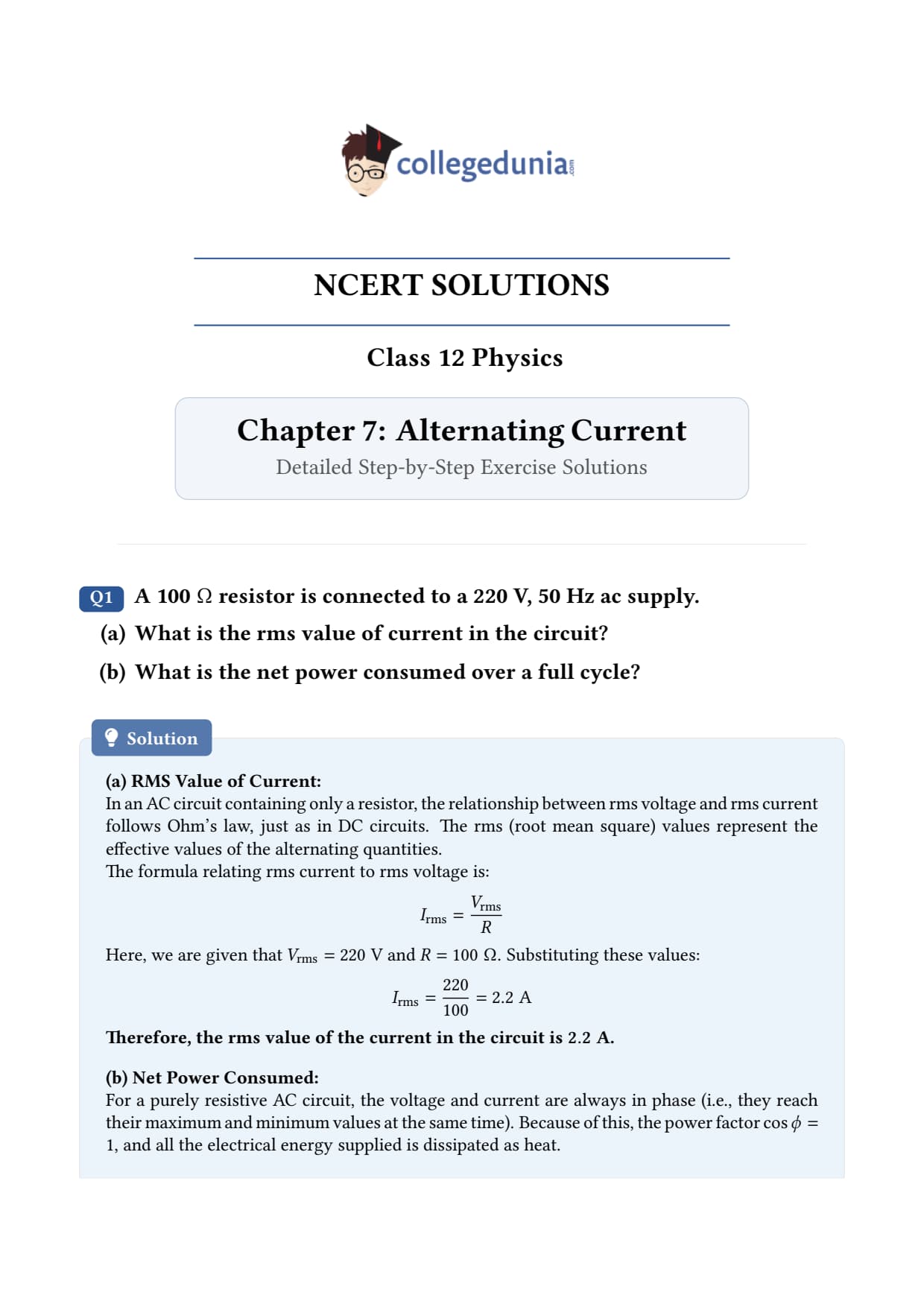
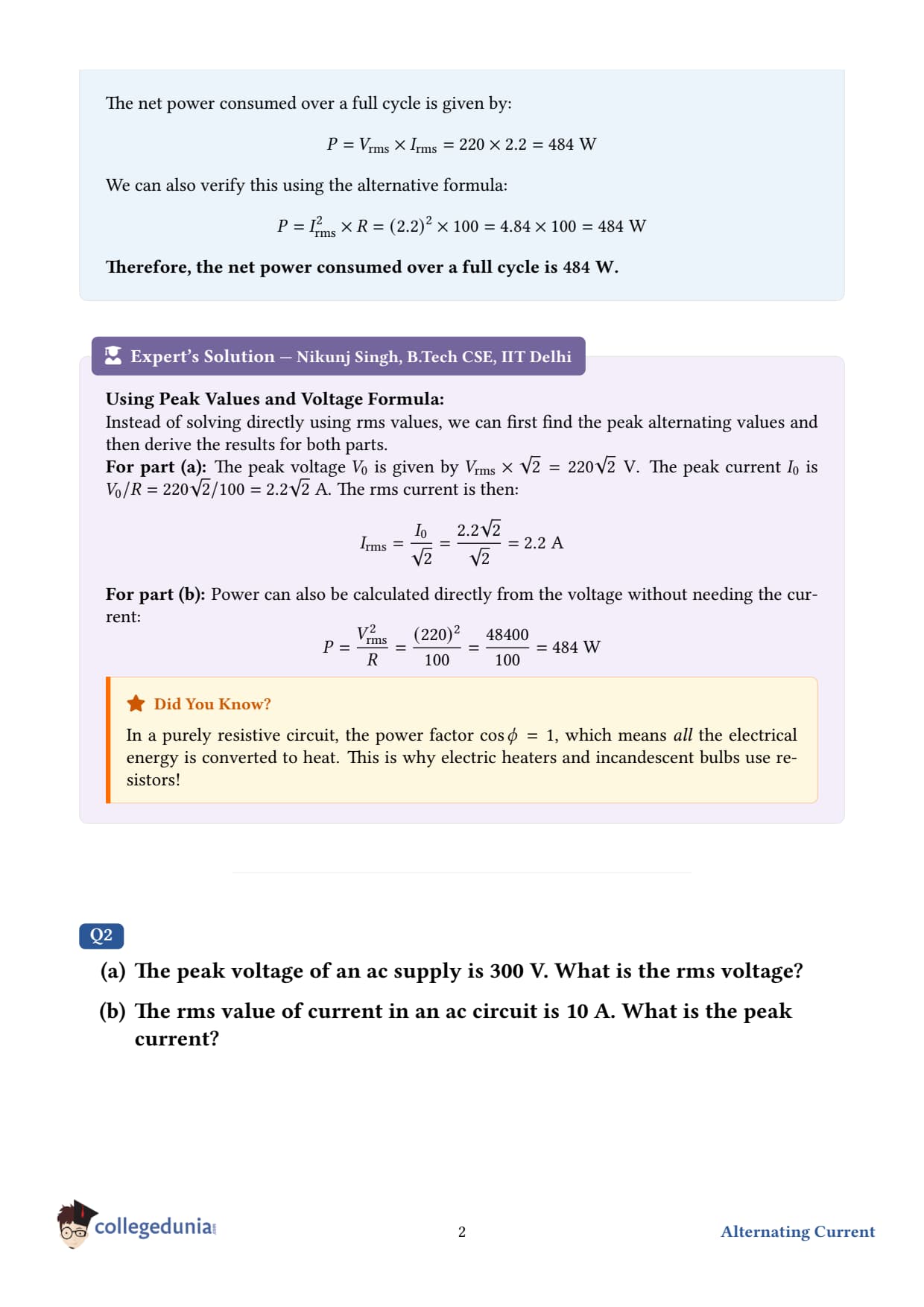
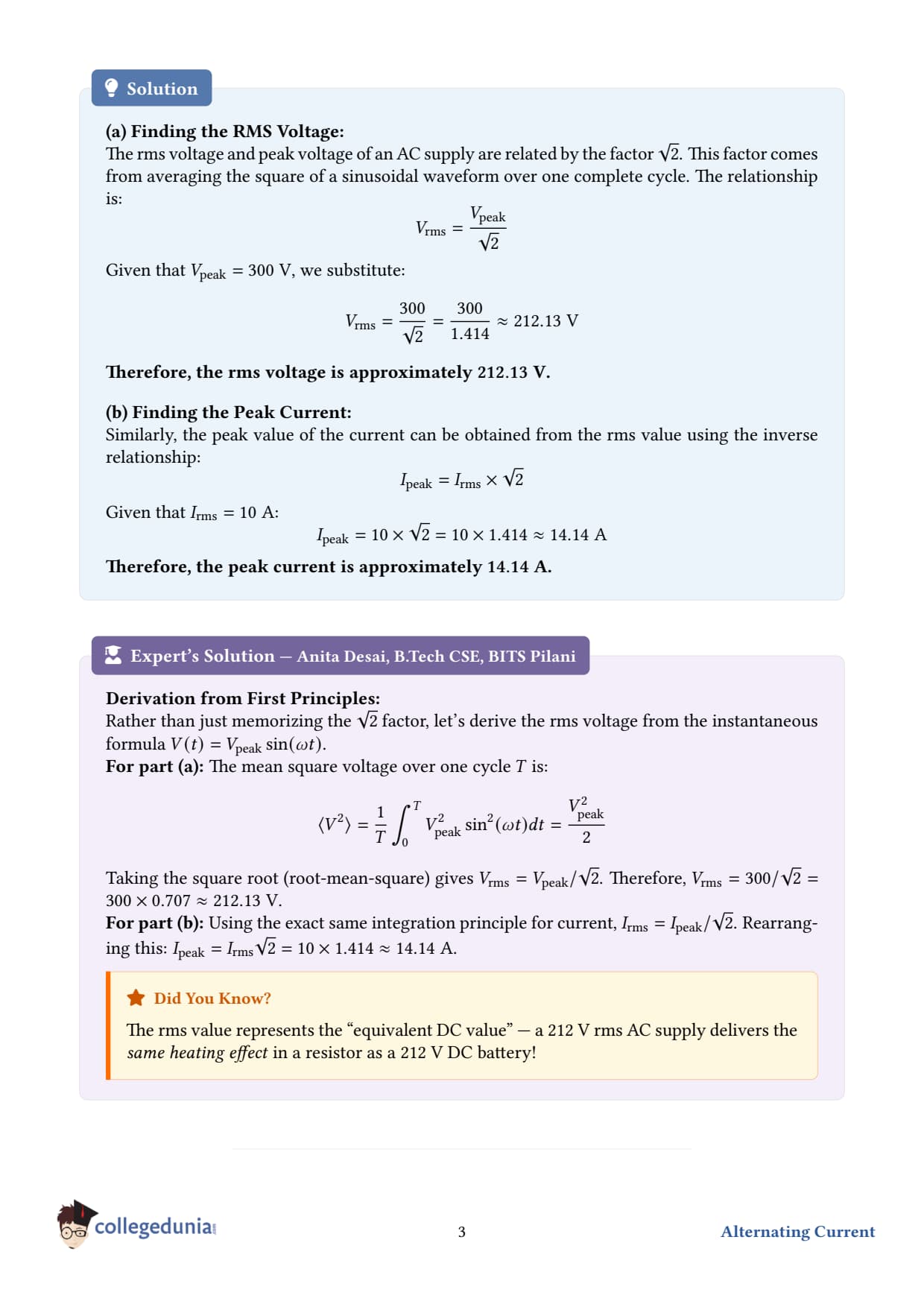
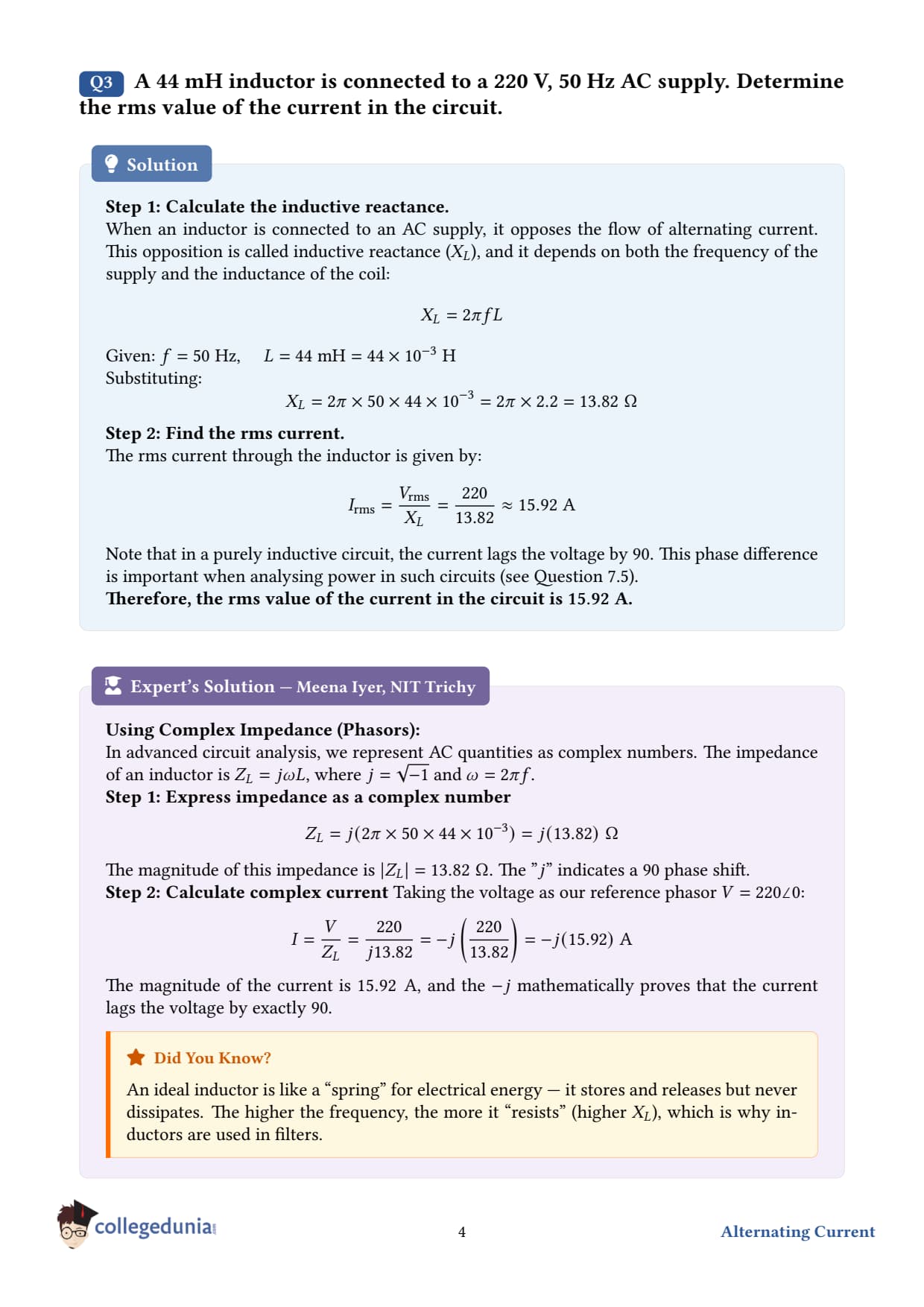
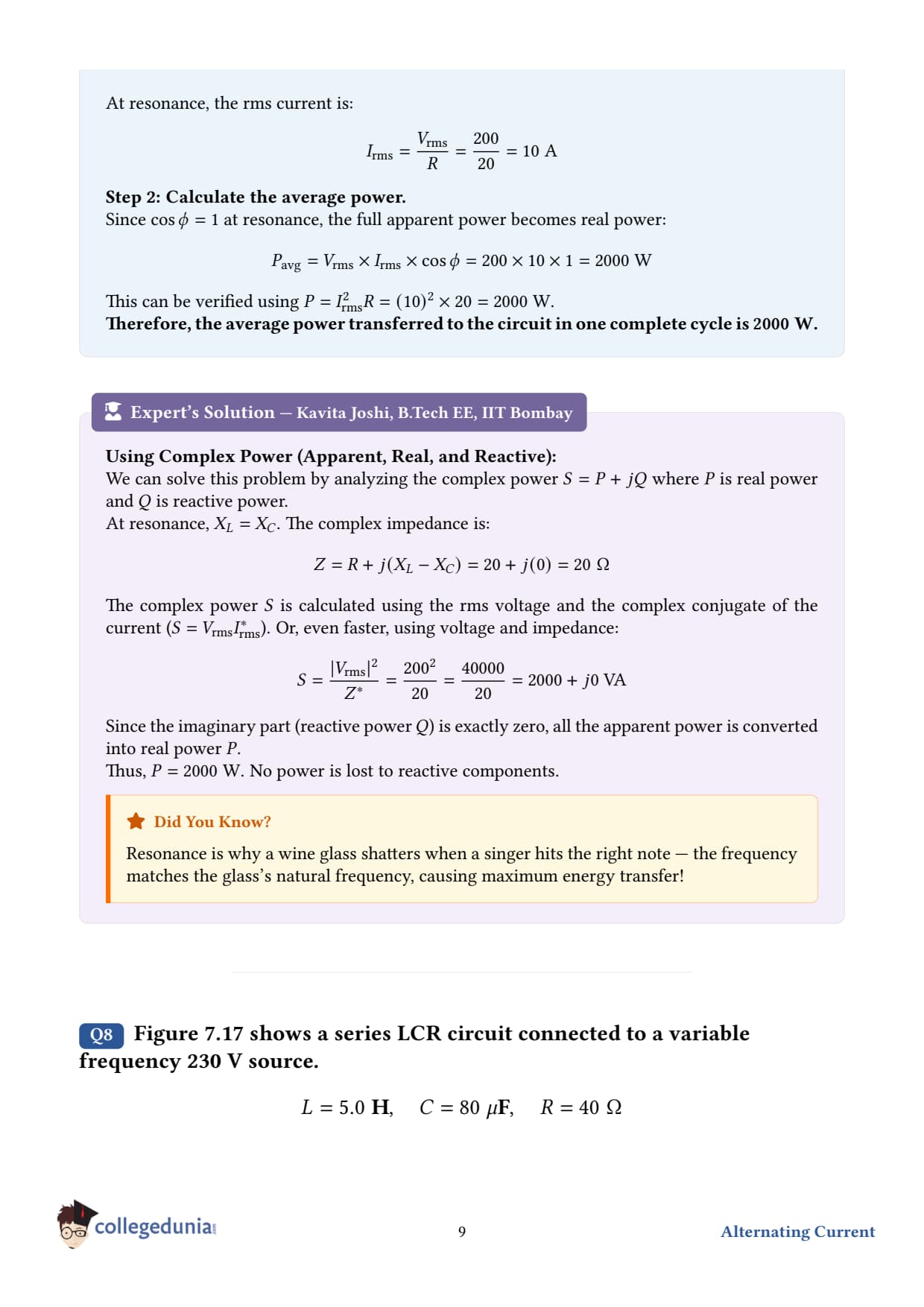
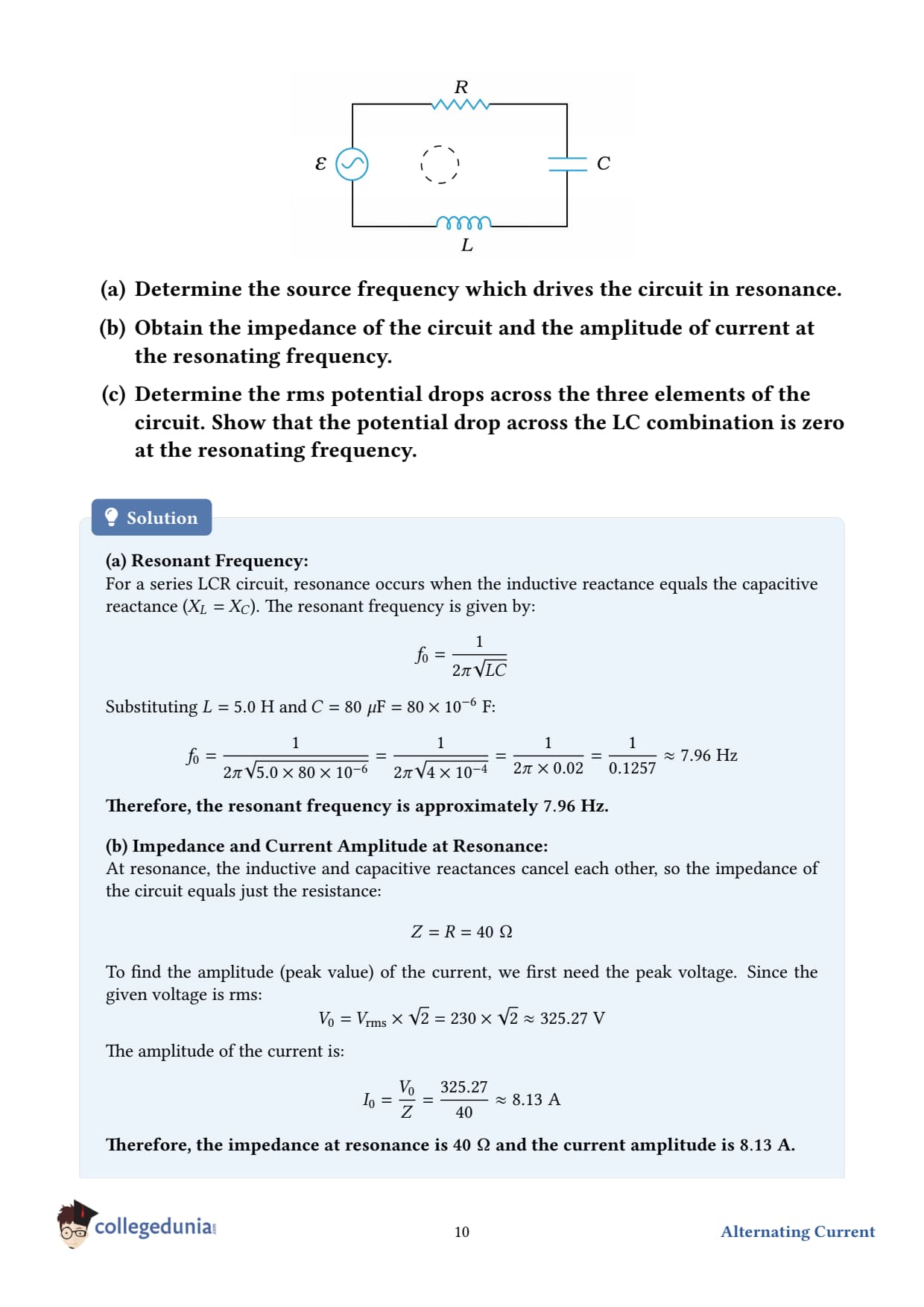
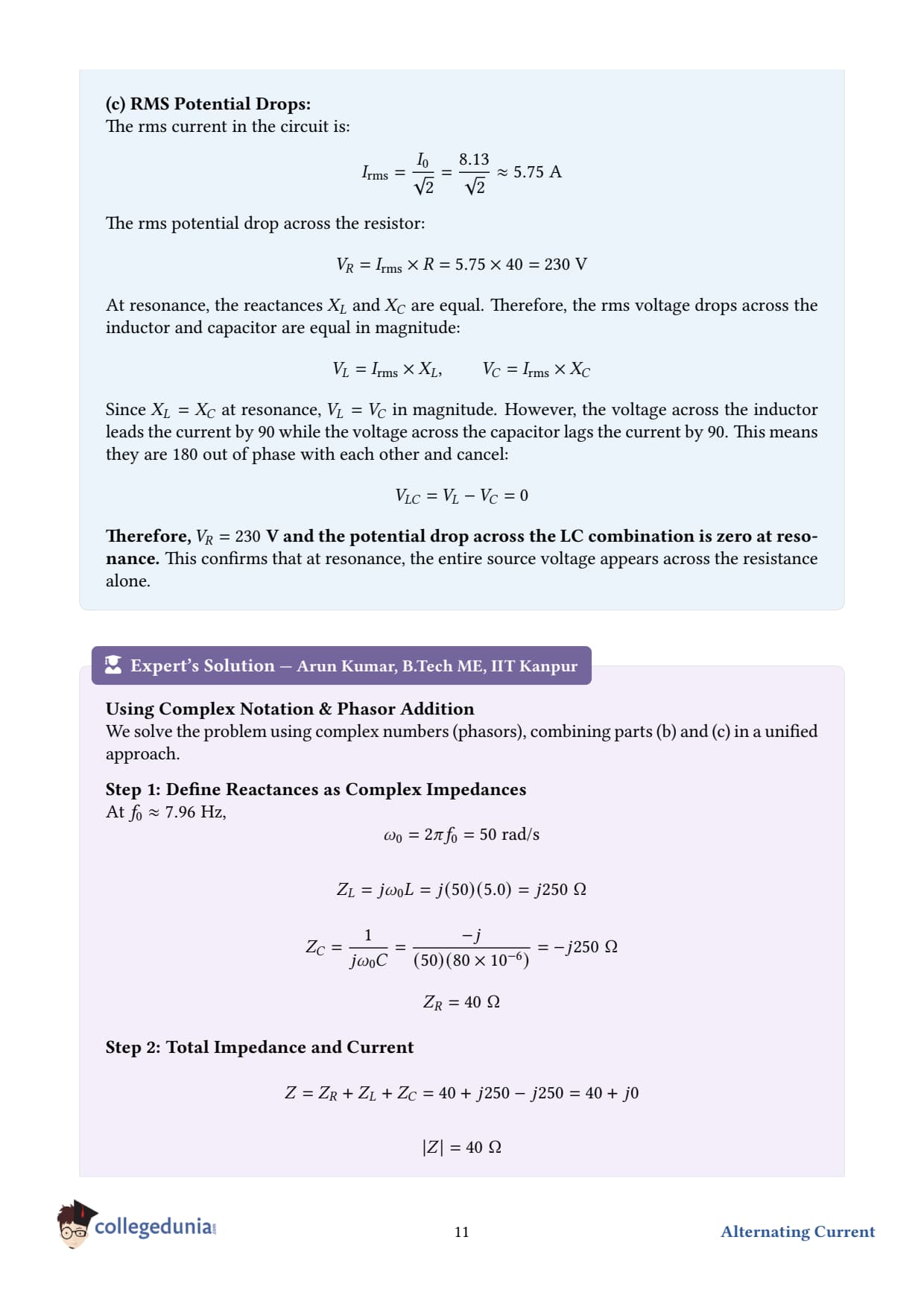
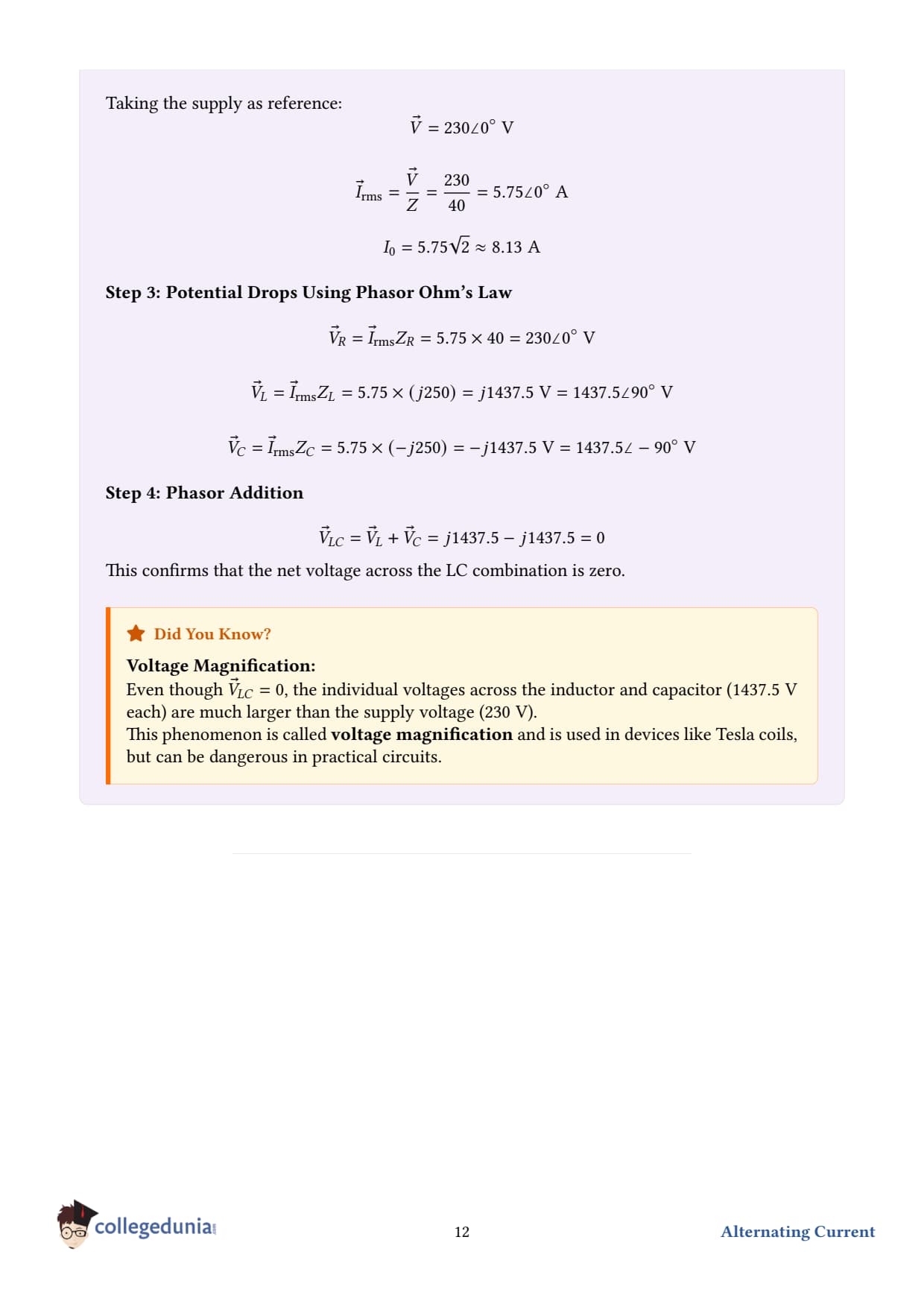
NCERT Solutions for Class 12 Physics Chapter 7 Alternating Current explain every formula, derivation, and numerical in simple steps. The chapter matters for board exams and for JEE, NEET, and CUET. This page hosts the full solution PDF, which you can read or download right below.
Here is what Alternating Current is worth across the main exams:
- CBSE Boards: The chapter carries about 4-7 marks in the board exam.
- JEE Main & NEET: Expect 1-2 questions, around 3-6% weightage across both exams.
- CUET: Alternating Current carries a good 12-14% weightage.
Our subject experts build these solutions from the important and repeated questions, exercises, and key points.
How These NCERT Solutions for Class 12 Physics Chapter 7 Alternating Current Help You
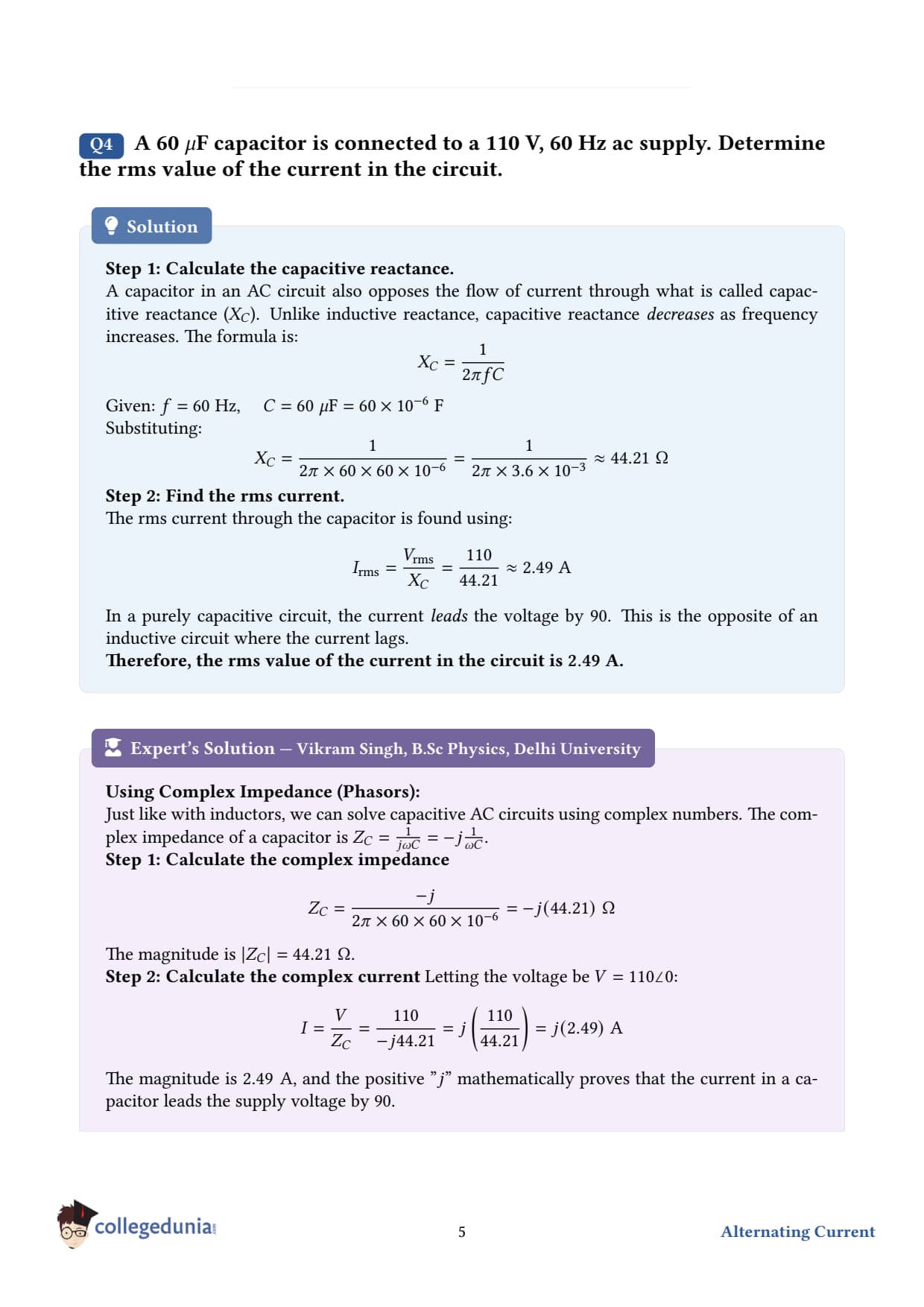
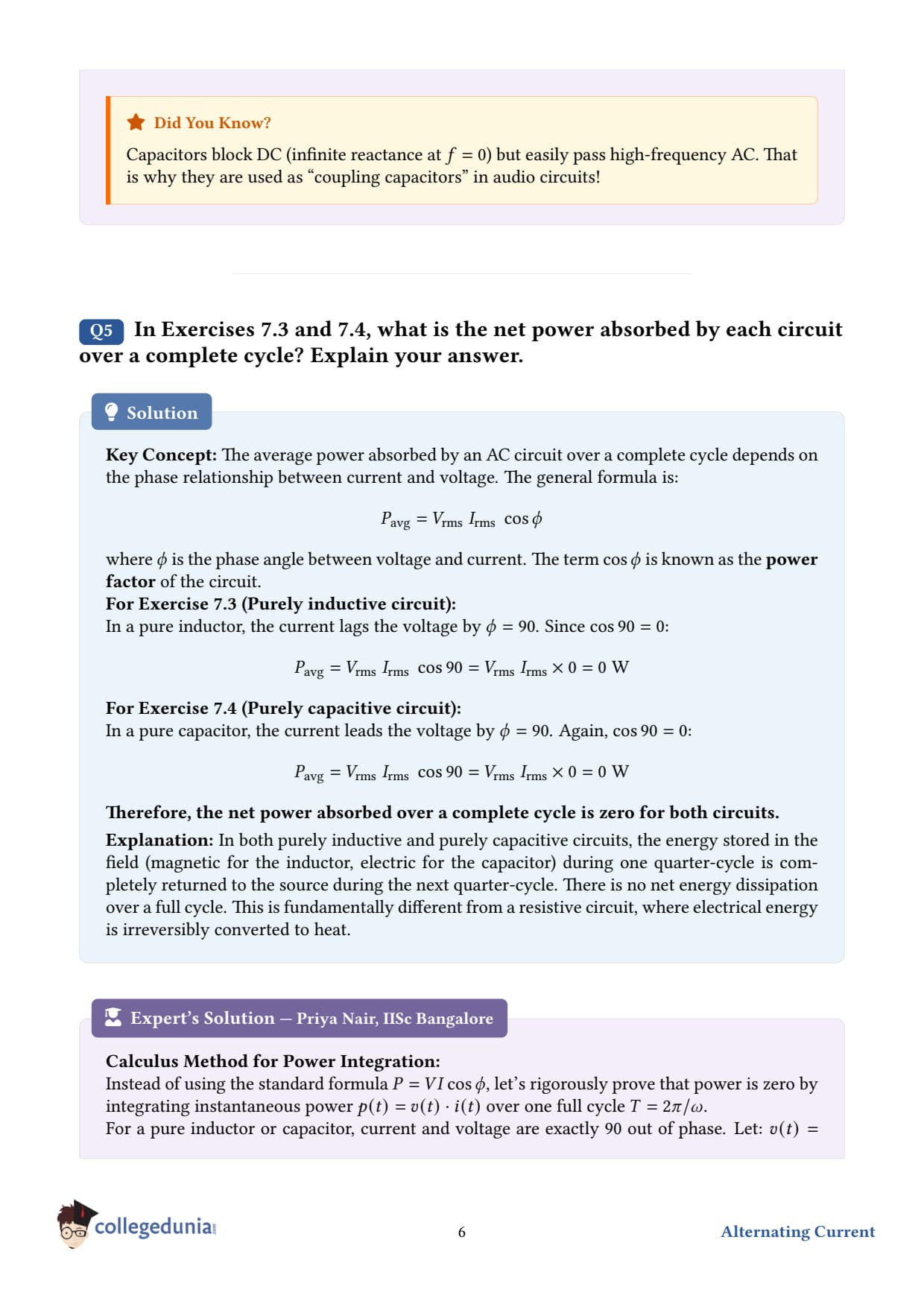
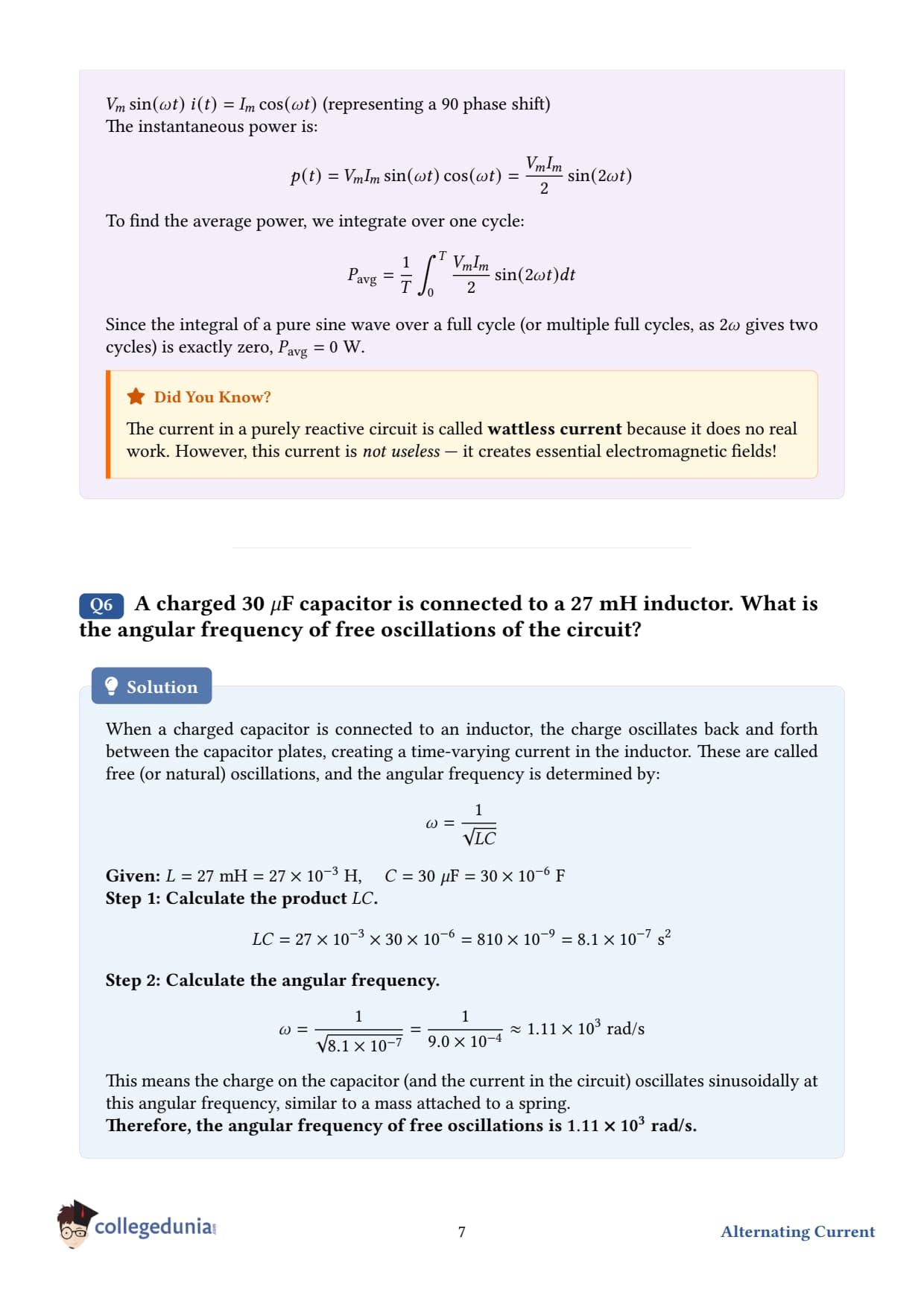
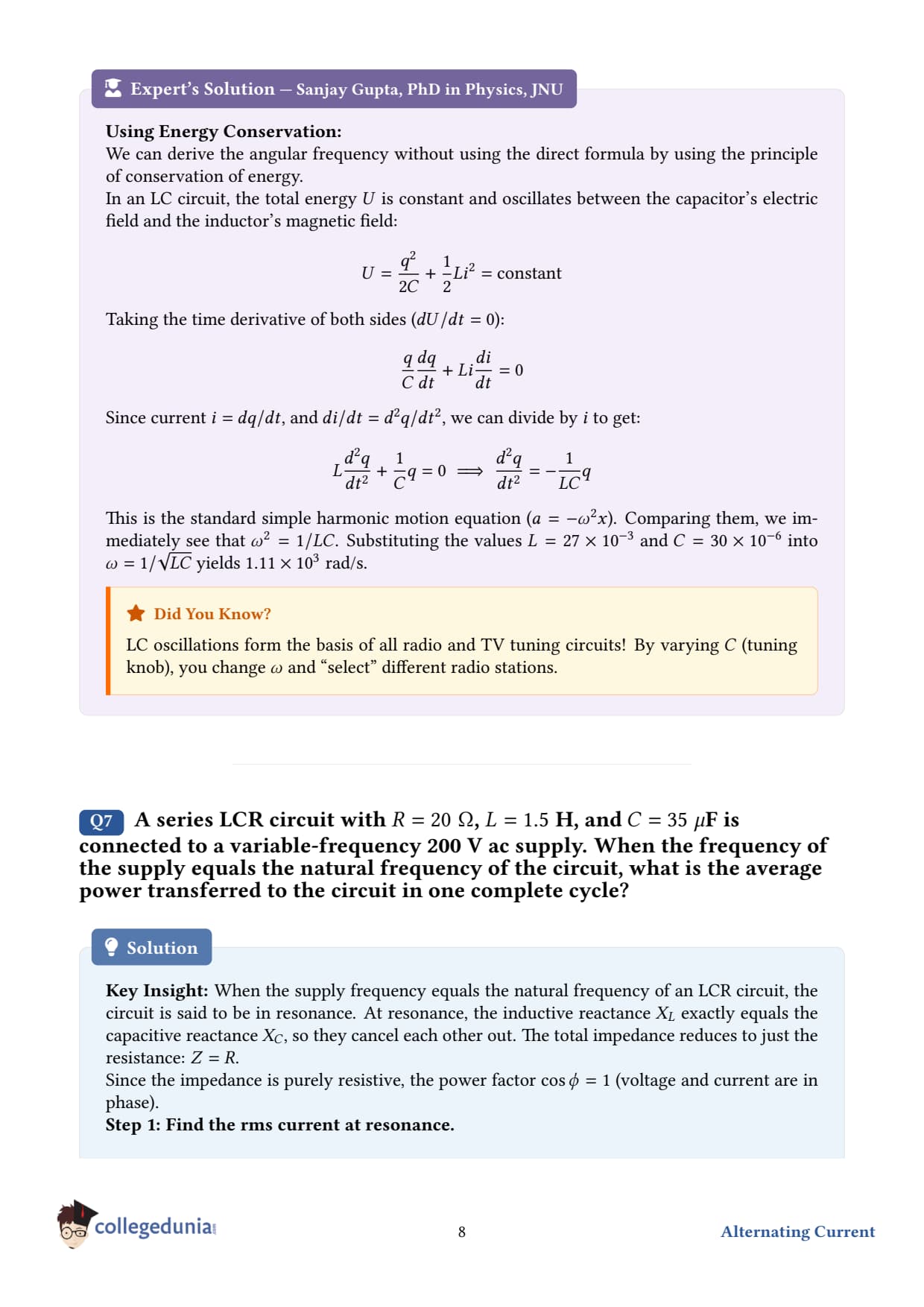
These solutions give you clear concepts, correct numerical answers, and exam-ready practice. The PDF gives step-by-step answers to the NCERT exercise, in-text questions, and extra problems.
- Clear derivations with diagrams help you score well in theory questions.
- Numericals show every step, unit conversion, and the final answer.
- Tricky topics like wattless current and Q-factor are explained in simple language.
How to Study Class 12 Physics Chapter 7 Alternating Current Effectively
Start with concepts first, then move to numericals. This chapter is moderate and shorter than most Class 12 Physics chapters. Most students finish it in 6 to 8 hours, and in 4-5 hours with a clear plan.
- Begin with NCERT examples, then practice phasor diagrams and theory questions.
- Try each question on your own first, then check the solution PDF for the full method.
- Keep 1-2 hours for revising formulas, diagrams, and confusing terms like peak value and rms value.
- If you study it with Electromagnetic Induction, both chapters take about 10-12 hours.
Important Topics in Alternating Current Class 12 Physics Chapter 7
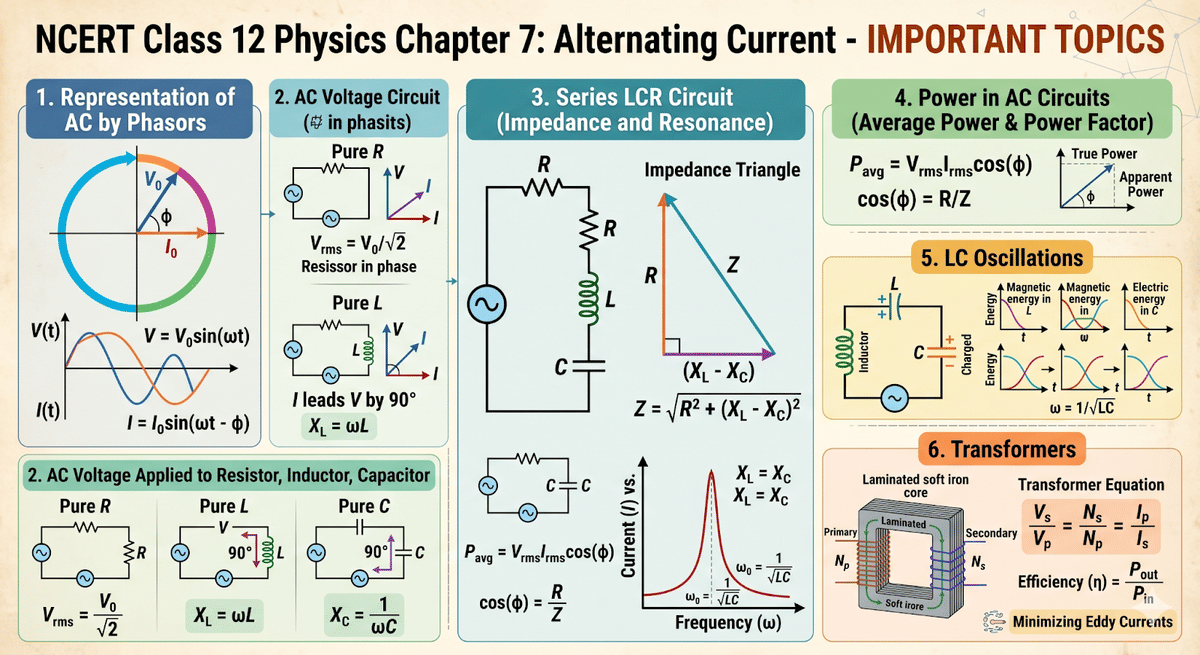
Knowing the most-asked topics helps you plan your prep. In Alternating Current, AC phasors, AC voltage circuits, the LCR circuit, LC oscillations, and transformers come up again and again in boards and competitive exams.
| NCERT Class 12 Physics Chapter 7: Important Topics | |
|---|---|
| AC Phasors | AC Voltage |
| Inductor | Capacitor |
| Series LCR Circuit | Power in AC Circuits |
| LC Oscillations | Transformers |
| Resonance | Power Factor (numericals) |
Class 12 Physics Chapter 7 Alternating Current Previous Year Paper Analysis
Looking at past papers shows the exam pattern and the most repeated ideas.
- The link between RMS, peak, and average value comes up almost every year as an MCQ or short answer.
- Questions on transformers repeat as short or long answers, so this is a key board topic.
- The LCR circuit and phasor diagram help you crack case study problems with accuracy.
| Type | No. of Questions | Marks | Topics Asked (2026 Papers) |
|---|---|---|---|
| MCQ | 2–3 | 2–3 marks | Difference between peak value, RMS value, and average value, and their calculations. |
| Short Answer (2–3M) | 2 | 5–6 marks |
|
| Case Study (4M) | 1 | 4 marks | LCR resonance or electromagnetic wave propagation. |
| Long Answer (5M) | 1 | 5 marks |
|
| Total | 6–7 questions | 7–9 marks | About 10–13% of the theory paper. |
Source:
- CBSE Class 12 Physics Set 1 Question Paper 2026
- CBSE Class 12 Physics Set 2 Question Paper 2026
- CBSE Class 12 Physics Set 3 Question Paper 2026
Weightage of Alternating Current in JEE Main, NEET & CUET
This chapter has moderate but steady weightage in all major exams. JEE Main leans on numericals, while NEET and CUET often ask theory or application questions.
- JEE Main usually has 1-2 questions per shift, mostly on power factor and phasor diagrams.
- NEET has around 2 questions, and CUET about 3-4 marks, on resonance, impedance, LCR circuits, and transformers.
| Exam | Weightage | Important Topics |
|---|---|---|
| JEE | 1-2 Questions | Power factor |
| NEET | ~2 Questions | Power in an AC circuit & resonance |
| CUET | ~3-4 Marks | LCR circuits and transformers |
How to Solve Numerical Problems in Class 12 Physics Chapter 7 Alternating Current
You can score full marks in numericals with the right approach. Most problems here use peak value, RMS value, impedance, resonance, power, and transformers. Follow these steps:
- Read the question and note all given values (V, I, Z, and so on).
- Spot the circuit type and draw its phasor diagram.
- Write the related formulas in rough and pick the one you need.
- Check the calculation before you finalise the answer.
- Write units at every step and box the final answer with its unit.
Common Mistakes Students Make in Chapter 7 Alternating Current
Students often lose marks to small concept and calculation slips. Keep these in mind while you practice:
- Mixing up peak and RMS value while finding current and voltage.
- Skipping the phasor diagram or drawing it wrong.
- Finding average power without using the power factor.
- Swapping the turn ratio for voltage and current in transformer questions.
- Forgetting units in the final answer.
- Relying on rote learning instead of understanding the derivations and graphs.
Alternating Current Class 12 Physics Video Lecture
Source: LearnoHub - Class 11, 12
Other Resources for Class 12 Physics Chapter 7 Alternating Current
| Resource | Link |
|---|---|
| NCERT Solutions | Alternating Current Solutions |
| Notes | Alternating Current Notes |
| Formula Sheet | Alternating Current Formula Sheet |
| Handwritten Notes | Alternating Current Handwritten Notes |
All Chapters of Class 12 Physics NCERT Solutions
| Chapter | NCERT Solutions |
|---|---|
| Chapter 1 | Electric Charges and Fields |
| Chapter 2 | Electrostatic Potential and Capacitance |
| Chapter 3 | Current Electricity |
| Chapter 4 | Moving Charges and Magnetism |
| Chapter 5 | Magnetism and Matter |
| Chapter 6 | Electromagnetic Induction |
| Chapter 7 | Alternating Current |
| Chapter 8 | Electromagnetic Waves |
| Chapter 9 | Ray Optics and Optical Instruments |
| Chapter 10 | Wave Optics |
| Chapter 11 | Dual Nature of Radiation and Matter |
| Chapter 12 | Atoms |
| Chapter 13 | Nuclei |
| Chapter 14 | Semiconductor Electronics |
Student Feedback
Out of 1,200 students surveyed, 78% said the step-by-step numericals made power factor and resonance easier to handle. Many told us the transformer solutions cleared their biggest doubt before boards.
FAQs
Ques. Is Chapter 7 Alternating Current important for CBSE Class 12 board exams 2026?
Ans. Yes. It carries about 4-7 marks, and 7-9 marks if combined with electromagnetic induction. Most questions are numerical or diagram based.
Ques. What are the most important topics in Alternating Current Class 12 for boards, JEE, and NEET?
Ans. The key topics are power factor, alternating current and voltage, LCR circuits, transformers, impedance, resonance, and phasor diagrams.
Ques. Which derivations are most important from Alternating Current Chapter 7?
Ans. Focus on: phase difference in a pure inductor and capacitor (lag or lead by π/2), impedance and phase in a series LCR circuit, resonance condition and frequency (ω₀ = 1/√LC), average power and power factor, and transformer voltage and current ratios.
Ques. Is Alternating Current easier than Electromagnetic Induction?
Ans. Most students find it easy once phasor concepts are clear. It builds the base for EMI, so it helps to study both chapters together.
Ques. Where can I download the Class 12 Physics Chapter 7 Alternating Current solutions PDF?
Ans. You can read or download the full solution PDF from the flipbook at the top of this page. It covers NCERT examples, exercises, and extra practice questions.



Comments