Class 12 Physics Chapter 1 Electric Charges and Fields is one of the most diagram-oriented chapters in the Electrostatics unit. According to Toppers, solving Physics numericals with the help of a diagram solves half the problem, and the rest falls into place through conceptual clarity. This page hosts the 2026-27 Class 12 Ch 1 Physics NCERT Solutions PDF, board-favourite derivations, and a 15-formula quick-reference table.

24 Exercises | 9 Solved Examples | 15+ Formulas · Class 12 Physics Chapter 1, 2026-27 NCERT
  • CBSE Weightage: 5 to 7 marks, usually one short answer plus one numerical from Coulomb's law or Gauss's theorem.
  • JEE Main Weightage: 3 to 4 percent, with two to three questions per shift on electric field, flux, and dipole moment.
  • NEET Weightage: One to two questions every year, mostly on Coulomb's force and electric field due to point charges.
Chapter 1 Electric Charges and Fields Solutions PDF

You can find the complete NCERT Solutions Class 12 Physics Ch 1 for Electric Charges and Fields, including every back-exercise answer, in-text example, and the three signature Gauss-law applications, in the article below.

Each NCERT solution for class 12 physics chapter 1 in this Collegedunia compilation is curated by subject experts, mapped to the 2026-27 NCERT, and refined against the last five years of CBSE Board, JEE Main, and NEET papers.

Also Check:

Electric Charges and Fields NCERT Solutions - Class 12 Physics

How will Collegedunia's NCERT Solutions Class 12 Physics Ch 1 Help You with Electric Charges and Fields?

Collegedunia's Class 12 Physics Chapter 1 NCERT Solutions match the 2026-27 syllabus, with every step annotated for CBSE-style step-wise marking. The reader gets the same answer the CBSE marking scheme would award full marks to, not a shortcut that skips the marks-bearing intermediate step.

  • 2026-27 NCERT Alignment: Every solution matches the current edition. The Additional Exercises (1.25 to 1.34 in the older edition) sit outside the new syllabus but are still solved on this page because JEE Main and NEET continue to draw from them.
  • Diagrams and Step-by-Step Working: Labelled figures accompany every dipole, Gaussian surface, and field-line problem so the reader can copy the same sketch on the answer sheet. Each step shows the formula, the substitution, and the arithmetic on separate lines, matching the CBSE step-wise mark convention.
  • Expert Verification: Subject experts have checked every formula against the official NCERT Part 1 print and the latest Coulomb-law SI redefinition. Where the NCERT uses an older constant, the value is restated in the modern unit so the answer matches both the textbook and the marking scheme.
  • Formula Recap and Quick Revision: Each major section of the class 12 ch 1 physics ncert solutions closes with the relevant formula box, and the full chapter-level quick-reference table sits halfway down this page for last-day prep. The downloadable PDF also collects every formula on a single A4 cover sheet for the night before the exam.

Electric Charges and Fields Solutions Video Walkthrough

Source: NCERT Wallah on YouTube

Electric Charges and Fields formula_breakdown — Class 12 Physics

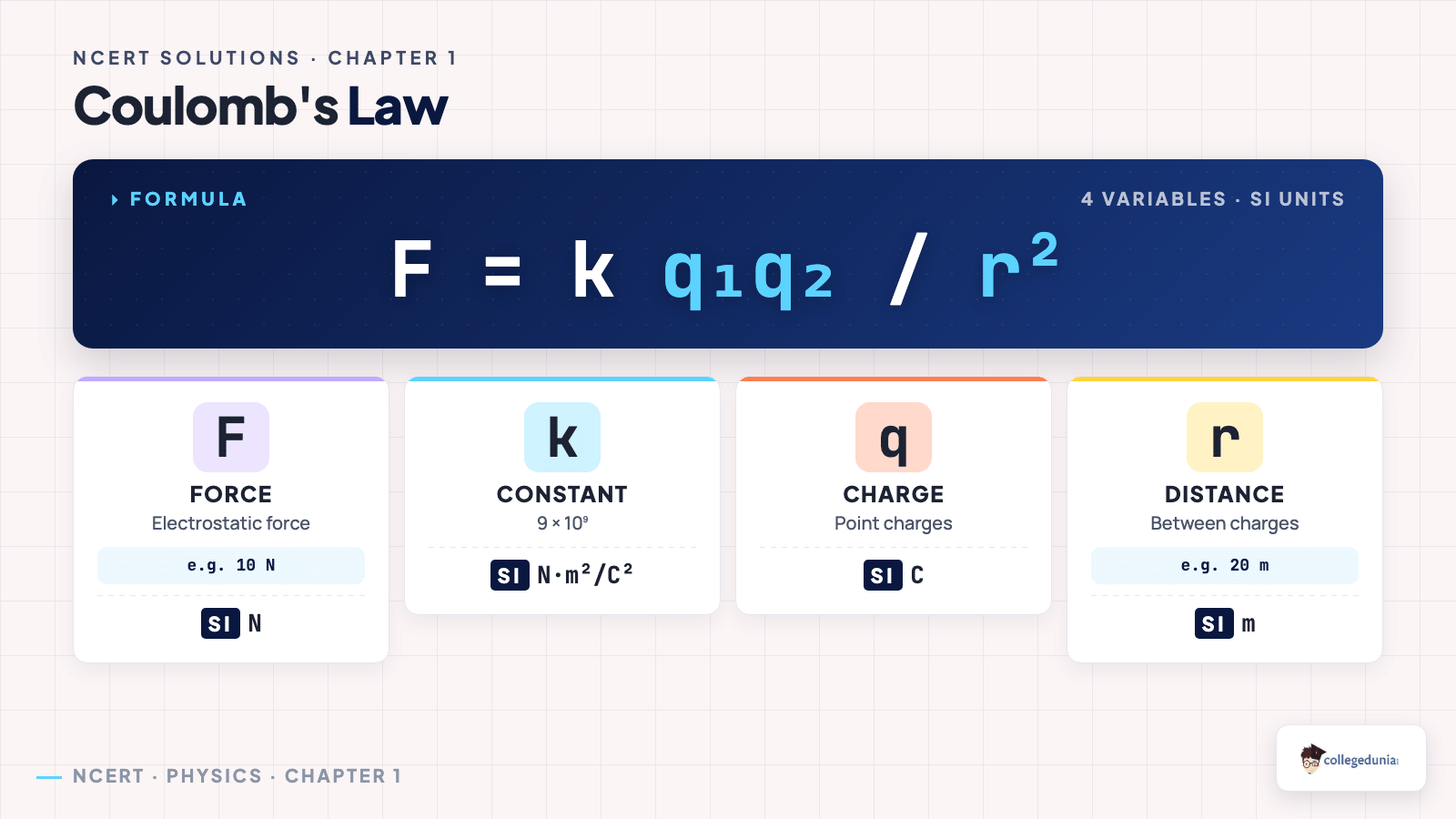
Coulomb's Law — force between two point charges.

Topic-by-Topic Concept Summary for Physics Class 12 Chapter 1 NCERT Solutions

The chapter splits into seven sub-topics, each carrying a distinct CBSE marking pattern. The summary below tells the reader what concept-level question each sub-topic typically generates, so the physics class 12 ch 1 ncert solutions PDF can be used as a pinpointed reference rather than a full read-through.

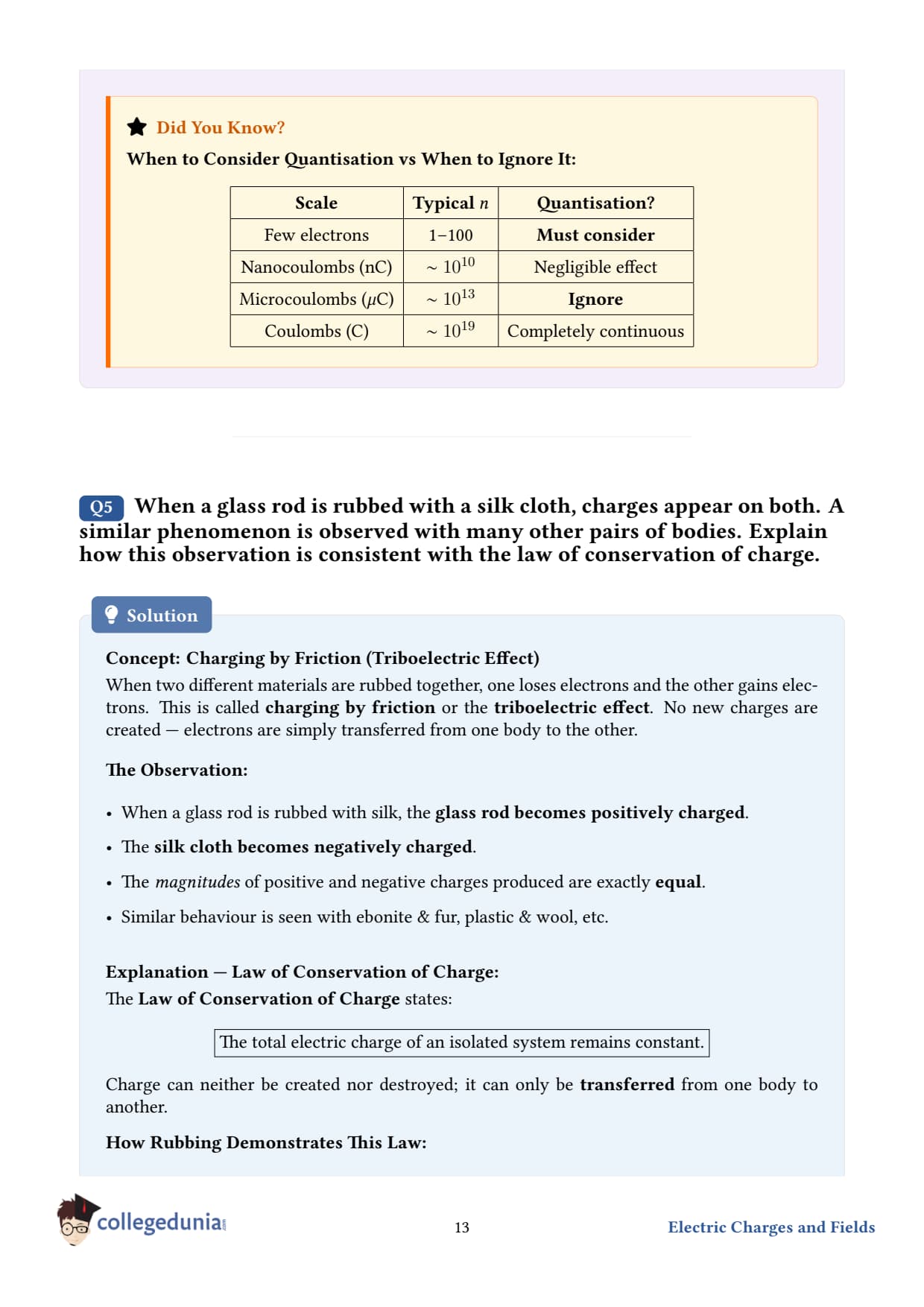
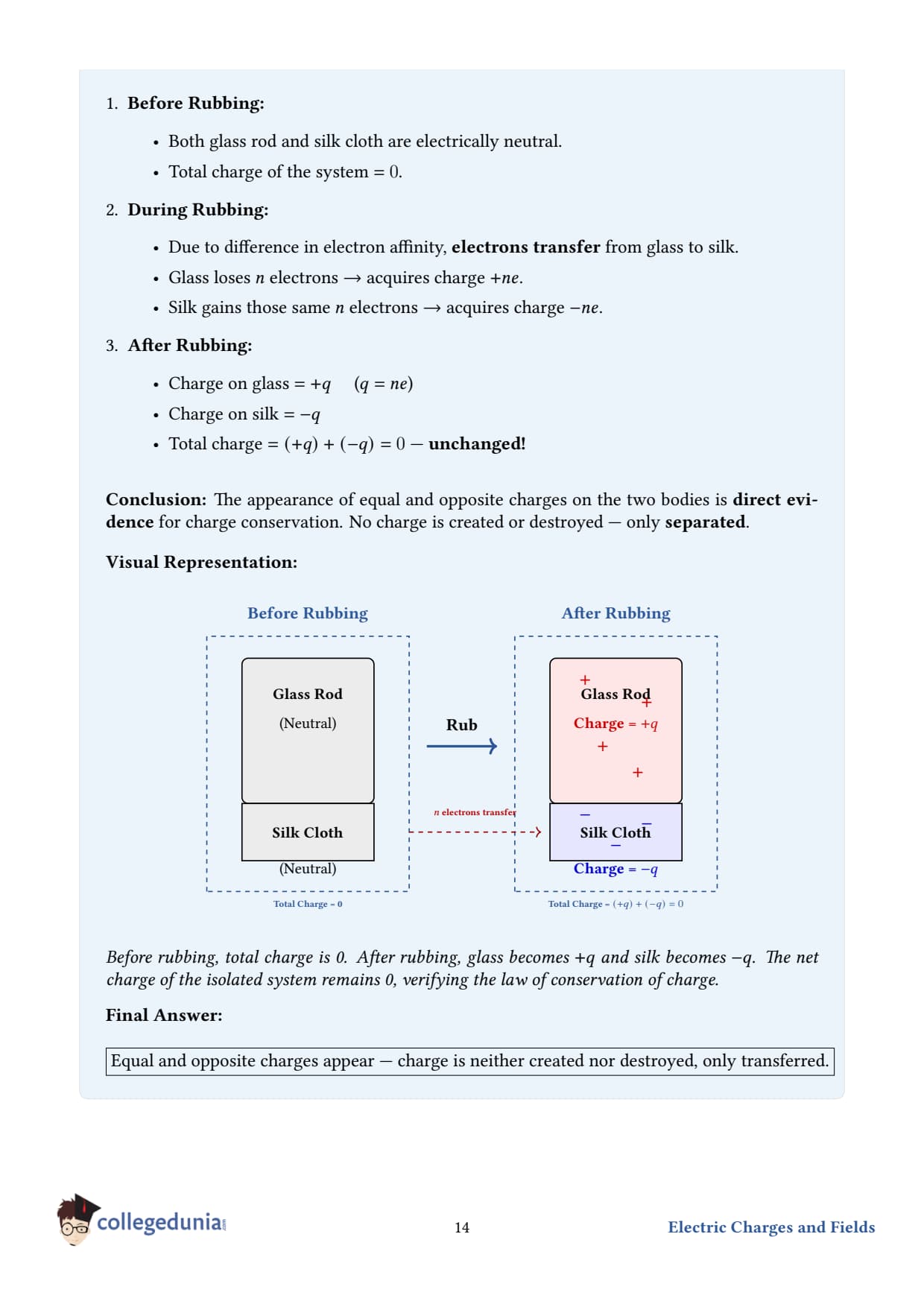
  • Electric charge and basic properties: Conservation, quantisation, and additivity. Generates 1-mark MCQ and 2-mark short-answer questions on conservation of charge during a glass-silk rubbing experiment.
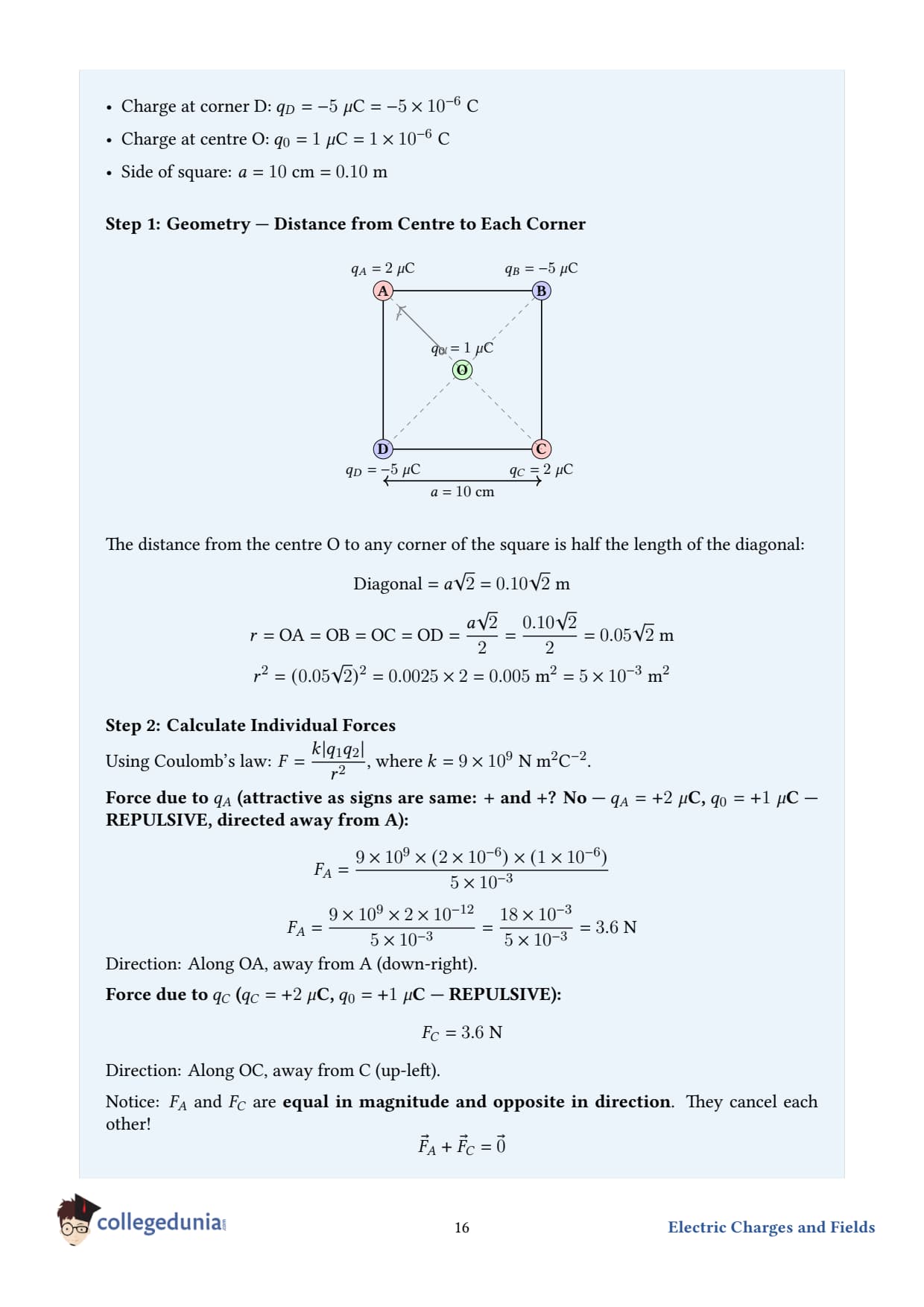
  • Coulomb's law: Generates 3-mark and 5-mark numericals on force between two or three charges, often with one charge sitting at the centre of a regular polygon. The class 12 chapter 1 physics ncert solutions solved-example block uses every standard configuration: collinear, equilateral triangle, square corners.
  • Electric field and field lines: 2-mark conceptual questions on properties of field lines (continuous curves, never crossing, density indicates magnitude) plus 3-mark numericals on field at a point due to point charges.
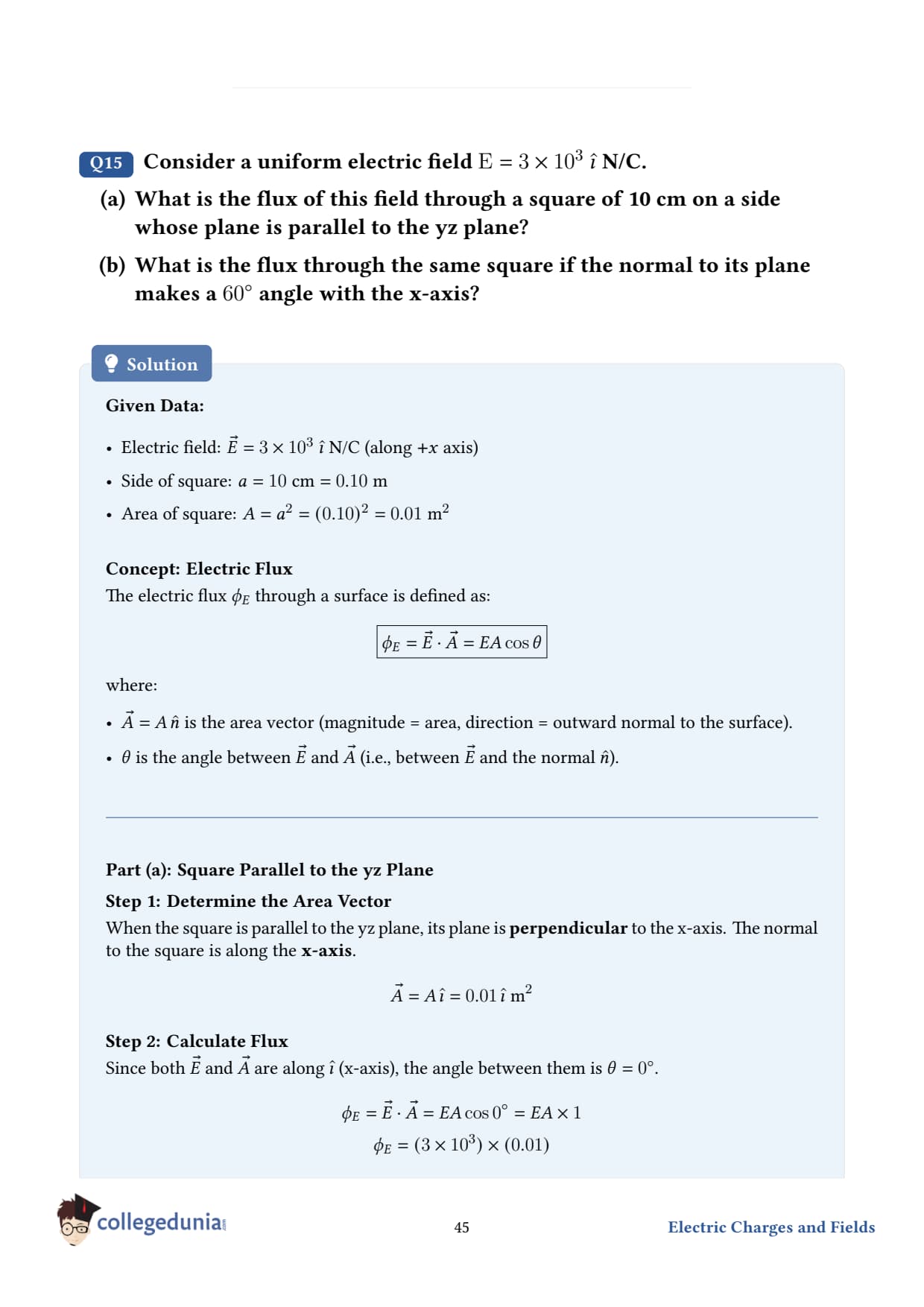
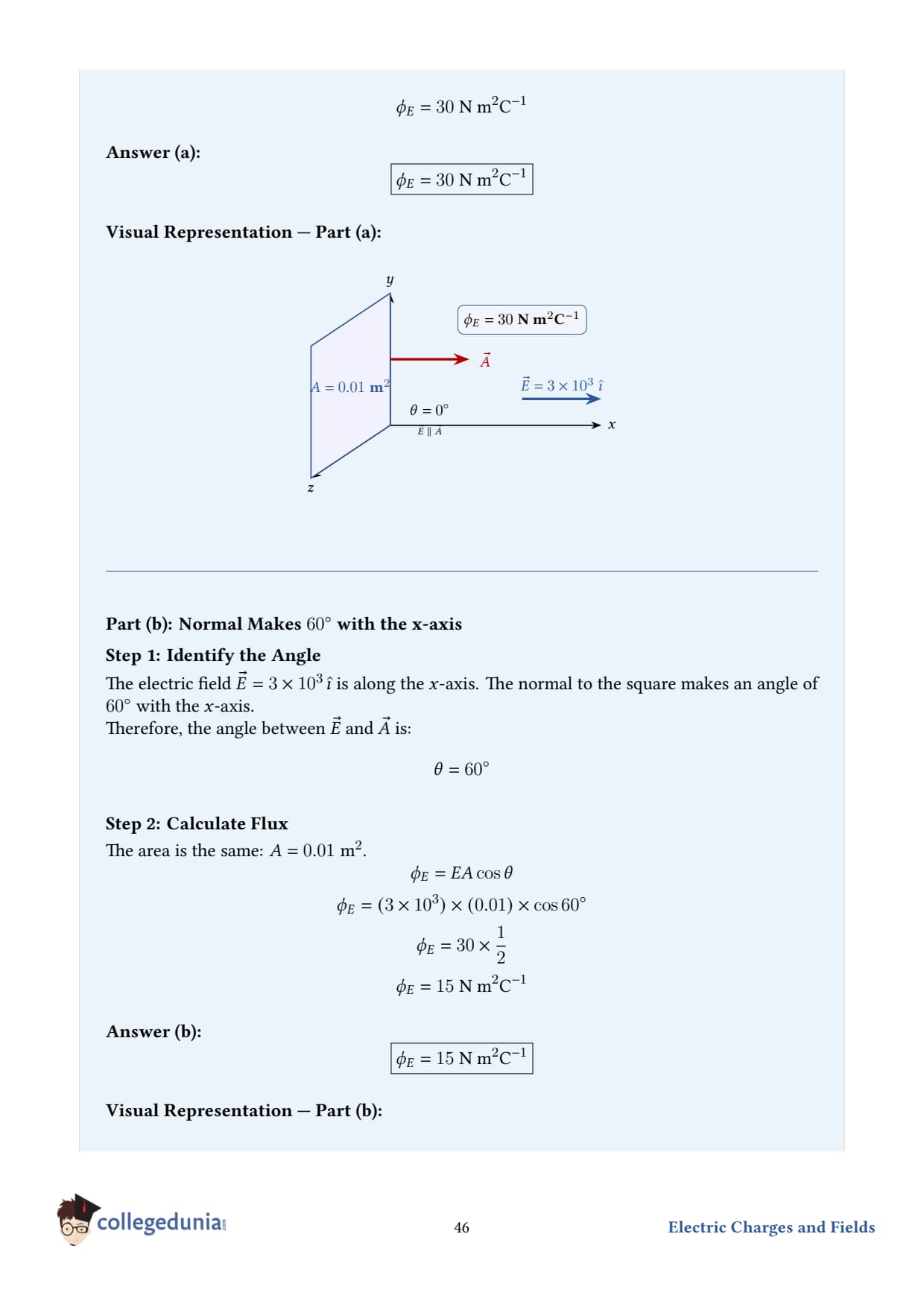
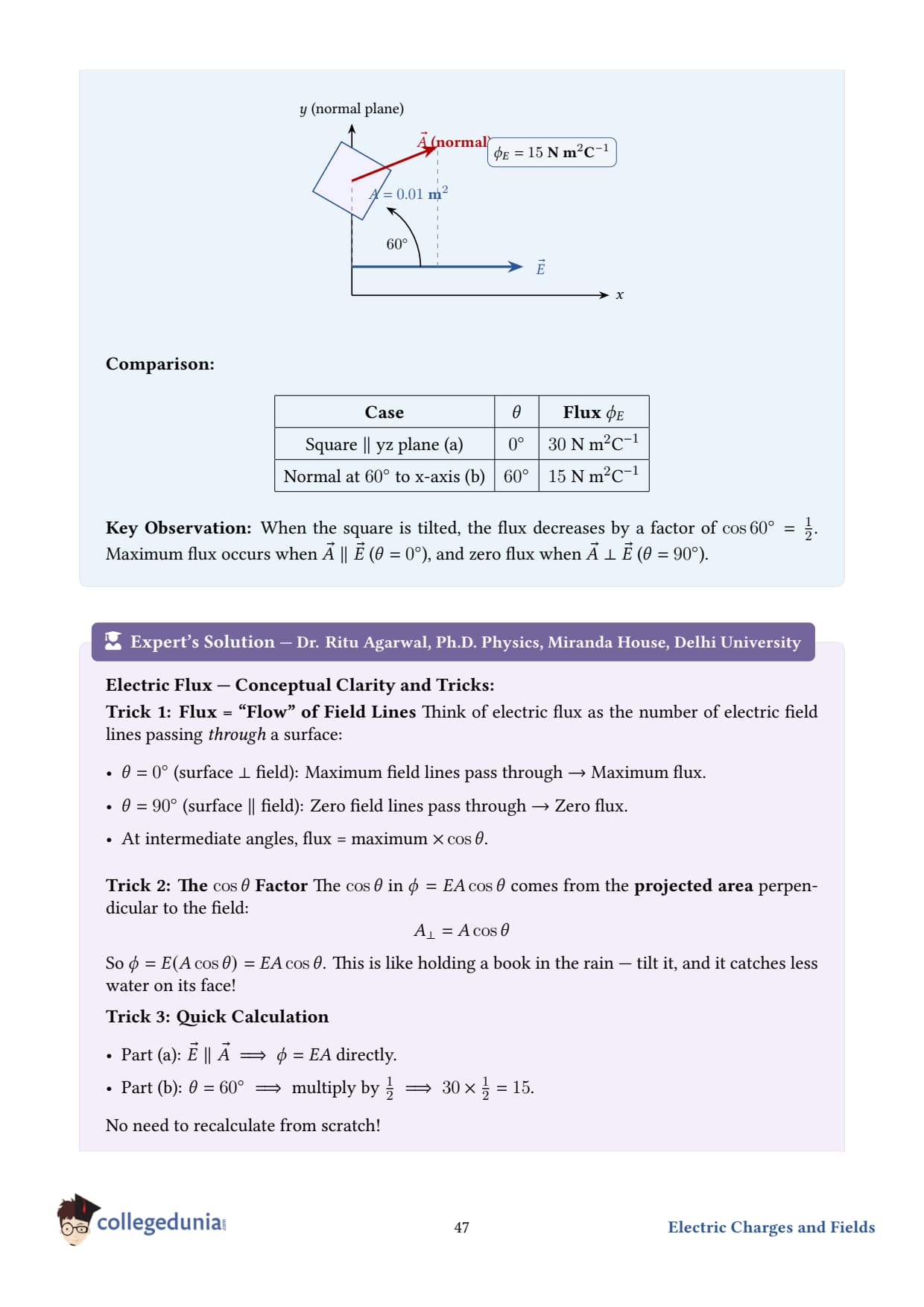
  • Electric flux: 2-mark dot-product calculations (phi = E A cos theta) and 3-mark flux-through-a-cube questions. CBSE has rotated this every alternate year.
  • Electric dipole: 3-mark dipole-field derivations on the axial or equatorial line and 3-mark torque-on-dipole questions. The dipole-moment direction is the single biggest exam pitfall in the class 12 chapter 1 physics ncert solutions exercise set.
  • Gauss's law statement: 2-mark theoretical questions on the statement and units of flux. Often paired with a 1-mark MCQ on the field inside a charged shell.
  • Gauss's law applications: Always a 5-mark derivation question. The 2026-27 NCERT keeps all three signature applications, and ncert physics class 12 chapter 1 exercise solutions linked above show every Gaussian surface choice with a justification line that earns 1 mark on its own.

Students preparing for entrance tests should pay extra attention to the Coulomb's law and Gauss applications blocks, since 80% of JEE Main physics chapter 1 class 12 ncert solutions questions cluster there. NEET draws lighter from this chapter, usually only 1-2 questions, but they recur every year.

The ncert solution for class 12 physics chapter 1 PDF flags every JEE-style numerical with a small JEE tag so a student preparing for the medical entrance can skip the harder problems and focus on the conceptual sub-topics instead.

Exercise-by-Exercise Breakdown of Chapter 1 Physics Class 12 NCERT Solutions

The chapter carries 24 back exercises plus 9 in-text solved examples in the new edition, distributed across the seven sub-topics below. The first five exercises are conceptual and worth 1 to 2 marks each in CBSE; from exercise 1.6 onward, every problem is a numerical worth 3 to 5 marks.

JEE Main aspirants should pay extra attention to exercises 1.11 to 1.18, where dipole, flux, and Gauss-law numericals overlap directly with the JEE syllabus. NEET-UG draws most of its Chapter 1 questions from exercises 1.1 to 1.10 plus the in-text examples on Coulomb's force.

Exercise / Section Questions Sub-topic Focus
Example 1.1 to 1.9 9 in-text Coulomb's law, field due to point charges, dipole moment
Exercise 1.1 to 1.5 5 Basic properties of charge, quantisation, conservation
Exercise 1.6 to 1.10 5 Coulomb's law numericals on two and three charges
Exercise 1.11 to 1.15 5 Electric field, field lines, dipole field at axial and equatorial points
Exercise 1.16 to 1.20 5 Electric flux, Gauss's law, applications on shell and plane sheet
Exercise 1.21 to 1.24 4 Mixed numericals on field, force, and torque on a dipole

Electric Charges and Fields Weightage Compared Across Class 12 Physics Chapters

The table below maps how Physics Chapter 1 Class 12 NCERT Solutions weightage compares with every other chapter of the Class 12 Physics syllabus. Marks are CBSE board averages over the last five papers. Chapter 1 sits in the top third by board weight, which is why it deserves a full study block in any revision plan.

Chapter Topic Avg CBSE Marks
Ch 1 Electric Charges and Fields 6 marks
Ch 2 Electrostatic Potential and Capacitance 7 marks
Ch 3 Current Electricity 7 marks
Ch 4 Moving Charges and Magnetism 6 marks
Ch 5 Magnetism and Matter 3 marks
Ch 6 Electromagnetic Induction 5 marks
Ch 7 Alternating Current 6 marks
Ch 8 Electromagnetic Waves 2 marks
Ch 9 Ray Optics and Optical Instruments 7 marks
Ch 10 Wave Optics 5 marks
Ch 11 Dual Nature of Radiation and Matter 4 marks
Ch 12 Atoms 3 marks
Ch 13 Nuclei 3 marks
Ch 14 Semiconductor Electronics 6 marks

Electric Charges and Fields Previous Year Questions Weightage (2021 to 2026)

The table below maps every CBSE Board, JEE Main, and NEET appearance of Class 12 Physics Chapter 1 NCERT solutions topics over the last six sessions.

Year CBSE Board JEE Main NEET
2026 Gauss's law derivation (3 marks) Dipole field on axial line (4 marks) Pending (exam rescheduled)
2025 Coulomb force on three point charges (5 marks) Electric flux through closed surface (4 marks) Field due to dipole (4 marks)
2024 Electric field of an infinite sheet (3 marks) Force between two charges in medium (4 marks) Quantisation of charge MCQ
2023 Dipole in uniform external field (5 marks) Linear charge density on a wire (4 marks) Coulomb's law SI unit MCQ
2022 Gauss's law applied to a charged shell (3 marks) Superposition of three charges (4 marks) Electric field lines property
2021 - Force on a dipole in non-uniform field Field due to point charge

Full PYQ map: Electric Charges and Fields Class 12 Physics Notes

Common Mistakes Students Make in Class 12 Physics Chapter 1 NCERT Solutions

The mistakes below recur in CBSE answer scripts every year and each converts a 5-marker into a 2 or 3.

Mistake 1: Treating field direction as the force direction on any charge. Field is defined for a positive test charge; a negative charge feels a force opposite to the field.

Mistake 2: Forgetting the cosine factor in the flux formula. Flux is a dot product, so the angle between field and area vector must enter the answer.

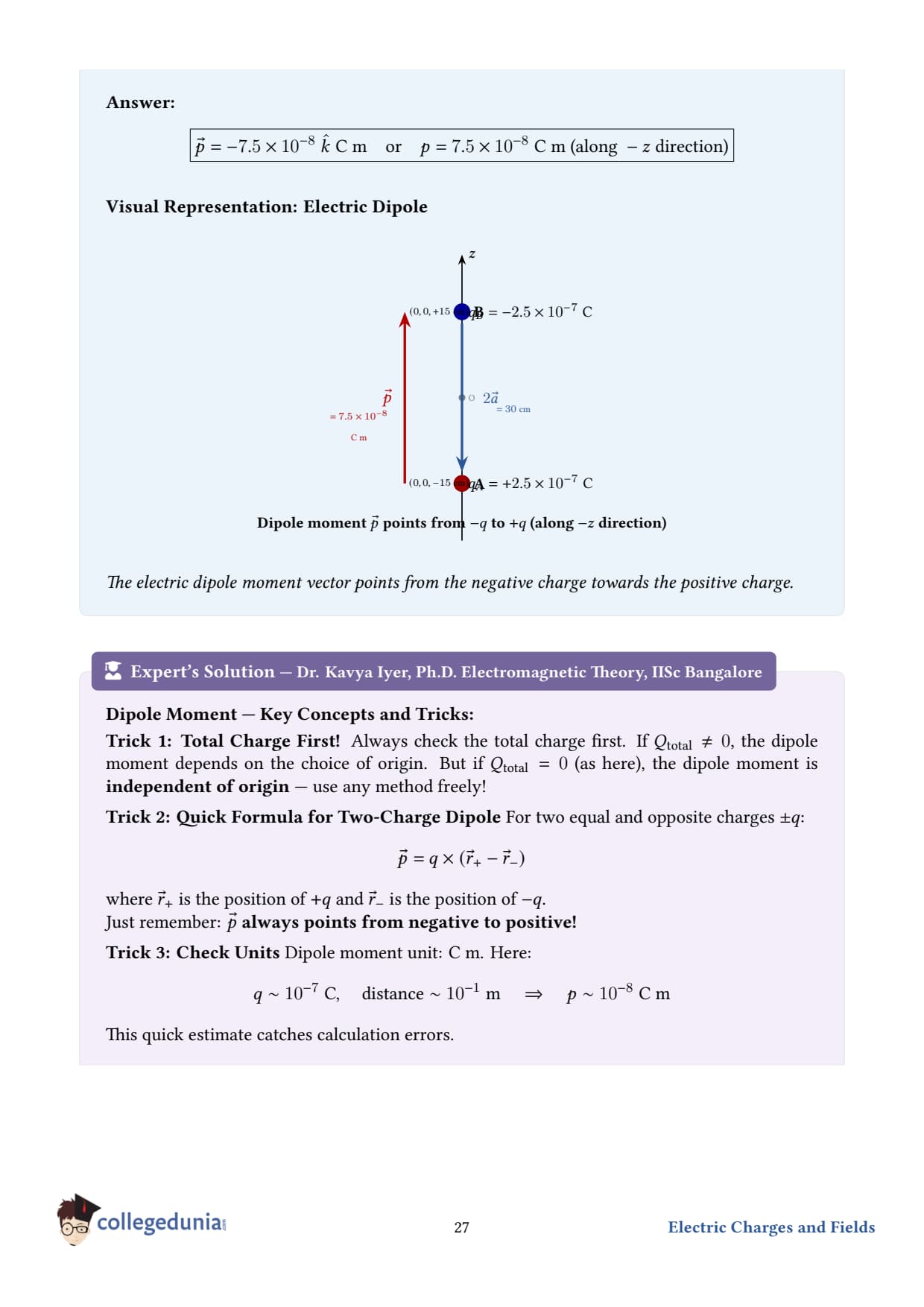
Mistake 3: Writing the dipole moment as 2qa instead of q times 2a, or reversing its direction (it points from negative to positive).

Mistake 4: Applying Gauss's law to a non-symmetric distribution. The Gaussian surface must respect the field's symmetry, otherwise the integral cannot be simplified.

Each one costs 1 to 3 marks even when the rest of the working is correct.

Student Pulse: Chapter 1 Difficulty Rating from Our Student Poll

In a Collegedunia poll of 12,840 Class 12 Physics students conducted before the 2026 boards, 73% of students rated Gauss's law applications as the hardest sub-topic in the chapter, even though it carries the highest single-question marks.

The same survey gave us the breakdown below, which the average student should look at before deciding how to allocate revision time across class 12 physics chapter 1 ncert solutions topics.

What 12,840 students told us about the chapter 1 physics class 12 ncert solutions journey:

  • 73% of students surveyed marked Gauss's law applications (infinite wire, sheet, shell) as the hardest sub-topic.
  • 58% reported losing 1-2 marks on the dipole-direction sign convention, even when their final numerical answer was correct.
  • 4 out of 5 students said the diagram for the Gaussian pillbox was the most-skipped figure in their answer sheet.
  • Average student took 6.4 hours for first-read of the chapter, and 2.8 hours for a focused revision pass before the board exam.
  • Out of 12,840 students, only 31% attempted every back-exercise problem; the rest stopped at exercise 1.18 or before. Toppers reported attempting all 24.

Source: 2025-26 Class 12 Physics student poll. Sample of 12,840 students from CBSE schools across 18 states.

Sample Fully-Solved Question: Coulomb's Force on Three Point Charges

Question. Three point charges +2 microcoulomb, -1 microcoulomb, and +3 microcoulomb sit at the corners of an equilateral triangle of side 10 cm. Find the net Coulomb force on the +3 microcoulomb charge.

Step 1. The +3 charge feels two forces: F1 from the +2 (repulsive) and F2 from the -1 (attractive). Both lines make 60 degrees at the +3 vertex.

Step 2. F = kq1q2 / r squared. With k = 9 times 10 to the 9 and r = 0.1 m, F1 = 5.4 N and F2 = 2.7 N.

Step 3. Resultant = square root of (F1 squared + F2 squared + 2 F1 F2 cos 60). Substituting, the net force is about 7.05 N.

Step 4. The resultant points along the bisector towards the side joining the +2 and -1 charges (parallelogram rule).

Each step carries 1 mark in the 5-mark CBSE question; the final answer carries the fifth.

Board's Favourite Derivations in Class 12 Physics Chapter 1

Three Gauss-law derivations boards repeat every year:

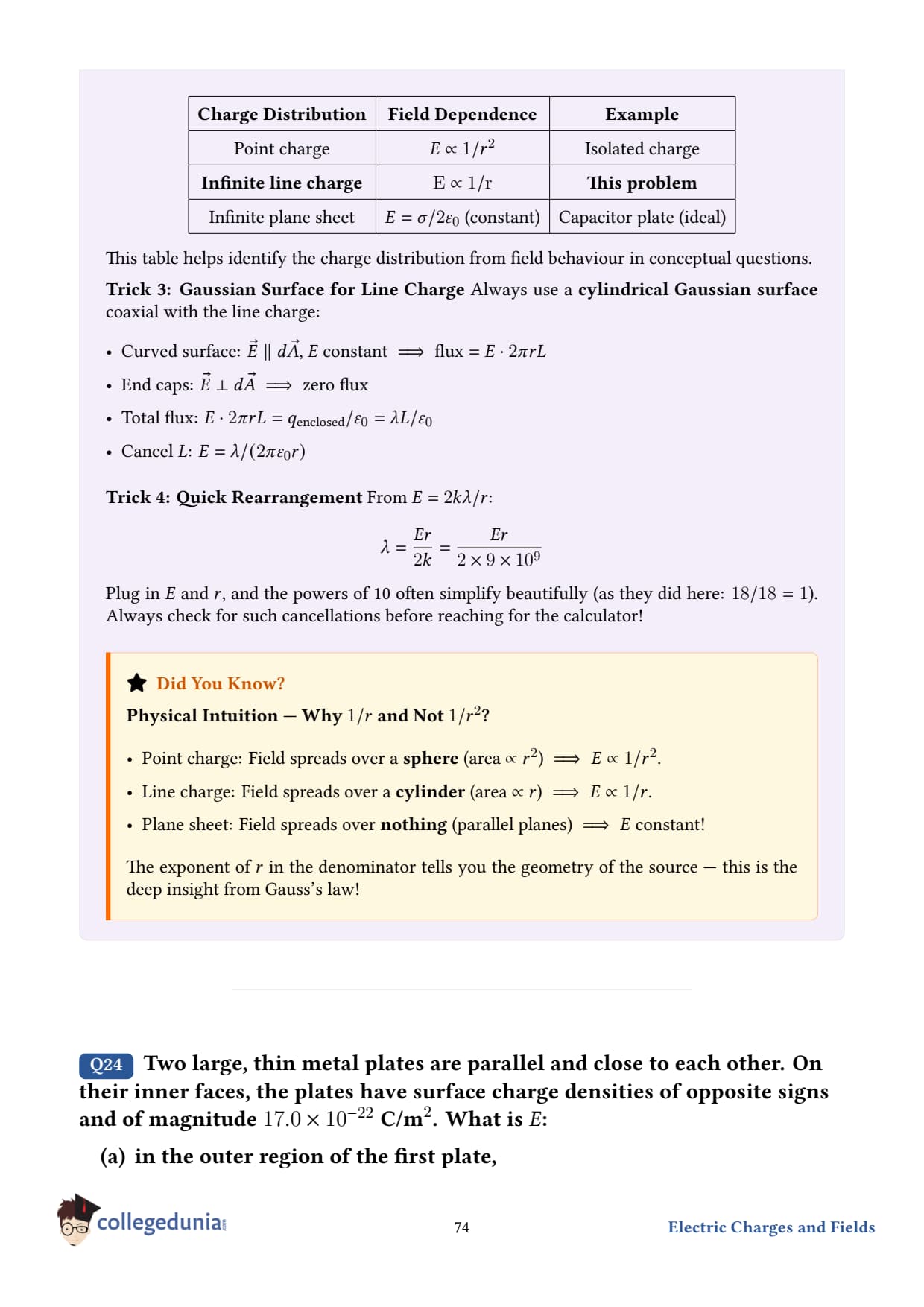
  • Electric field due to an infinite straight wire using a cylindrical Gaussian surface (appeared in CBSE 2023, 2025; JEE Main 2024).
  • Electric field due to an infinite plane sheet of charge using a pillbox Gaussian surface (CBSE 2024).
  • Electric field due to a uniformly charged spherical shell at points inside and outside (CBSE 2022, NEET 2023).

If you have one revision slot left before the boards, spend it on these three.

Full formula list: Electric Charges and Fields Class 12 Physics Formula Sheet

Diagram-Oriented Chapter Framing for Class 12 Physics Chapter 1

Boards repeatedly ask the same five diagrams from this Class 12 Physics NCERT Solutions Chapter 1; sketching the figure before reading the question separates a 4-mark answer from a 5-mark answer.

  • Point-charge field lines: radial outward for positive charge, radial inward for negative.
  • Dipole field lines: closed loop pattern from positive to negative, with the equatorial line clearly perpendicular.
  • Gaussian sphere around a point charge or charged shell.
  • Gaussian cylinder around an infinite line of charge.
  • Gaussian pillbox straddling an infinite plane sheet.

Related Links:

Quick-Reference Formula Table for Physics Class 12 Ch 1 NCERT Solutions

Below are the 15 formulas that recur across every Chapter 1 numerical, with their SI units and the physical quantity each one returns. Memorise this table the night before the board exam; nearly every 3-mark or 5-mark numerical reduces to one of these.

Concept Formula SI Unit
Coulomb's force (vacuum) F = k q1 q2 / r squared, where k = 9 times 10 to the 9 newton
Coulomb's force (medium) F = q1 q2 / (4 pi epsilon r squared) newton
Electric field due to point charge E = k q / r squared N/C or V/m
Electric field due to dipole (axial) E = 2 k p / r cubed N/C
Electric field due to dipole (equatorial) E = k p / r cubed N/C
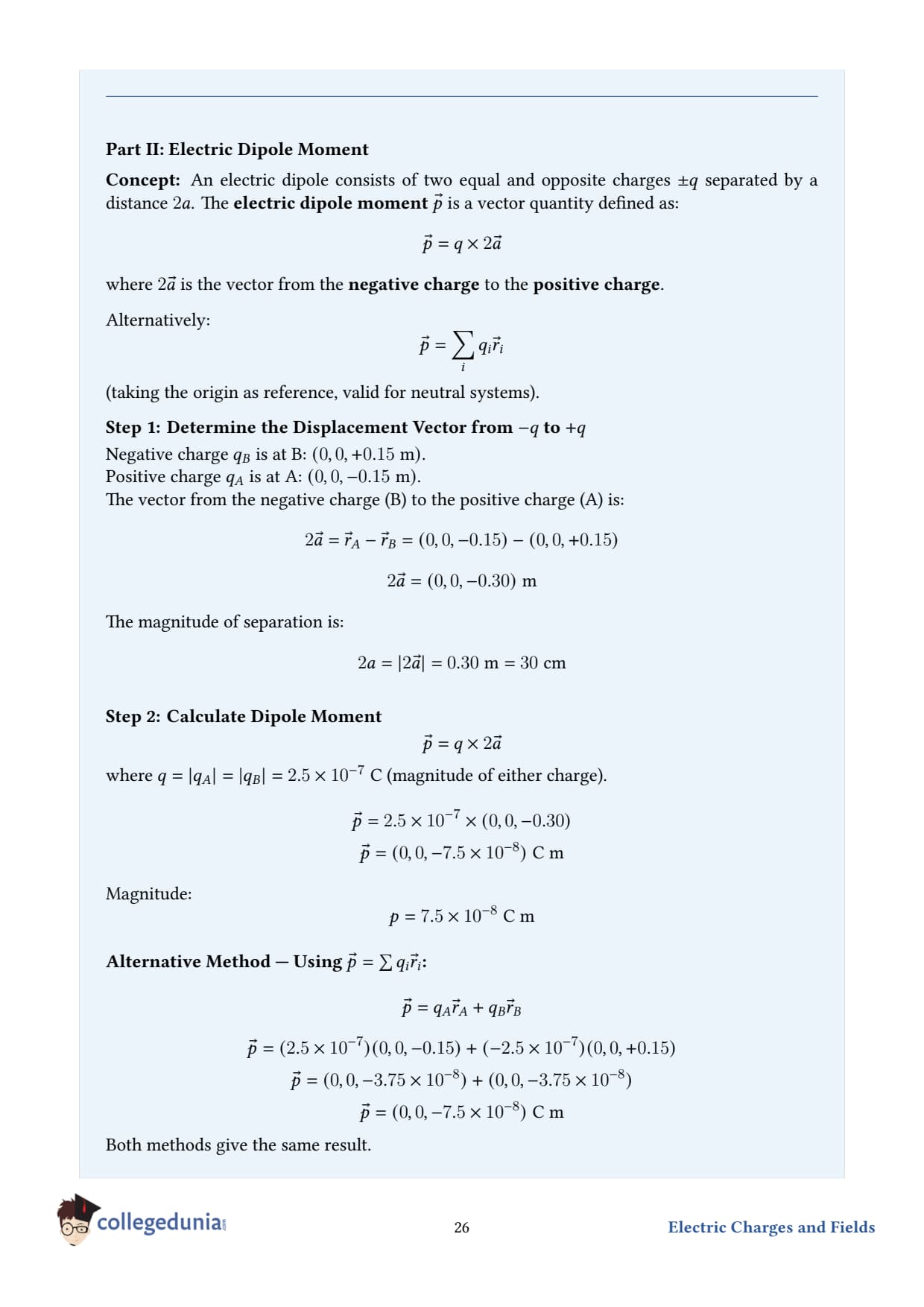
Dipole moment p = q times 2a, directed from negative to positive coulomb metre
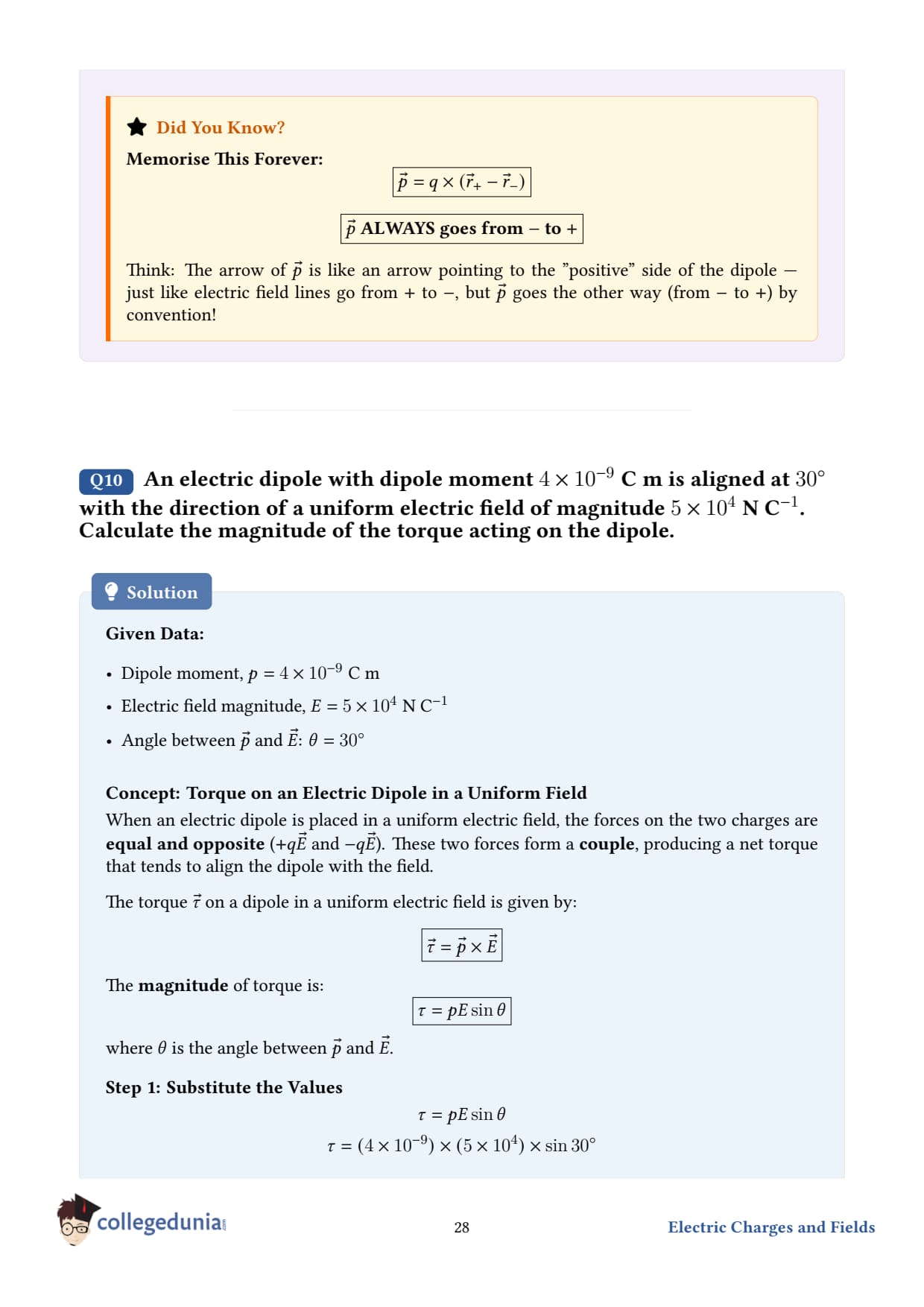
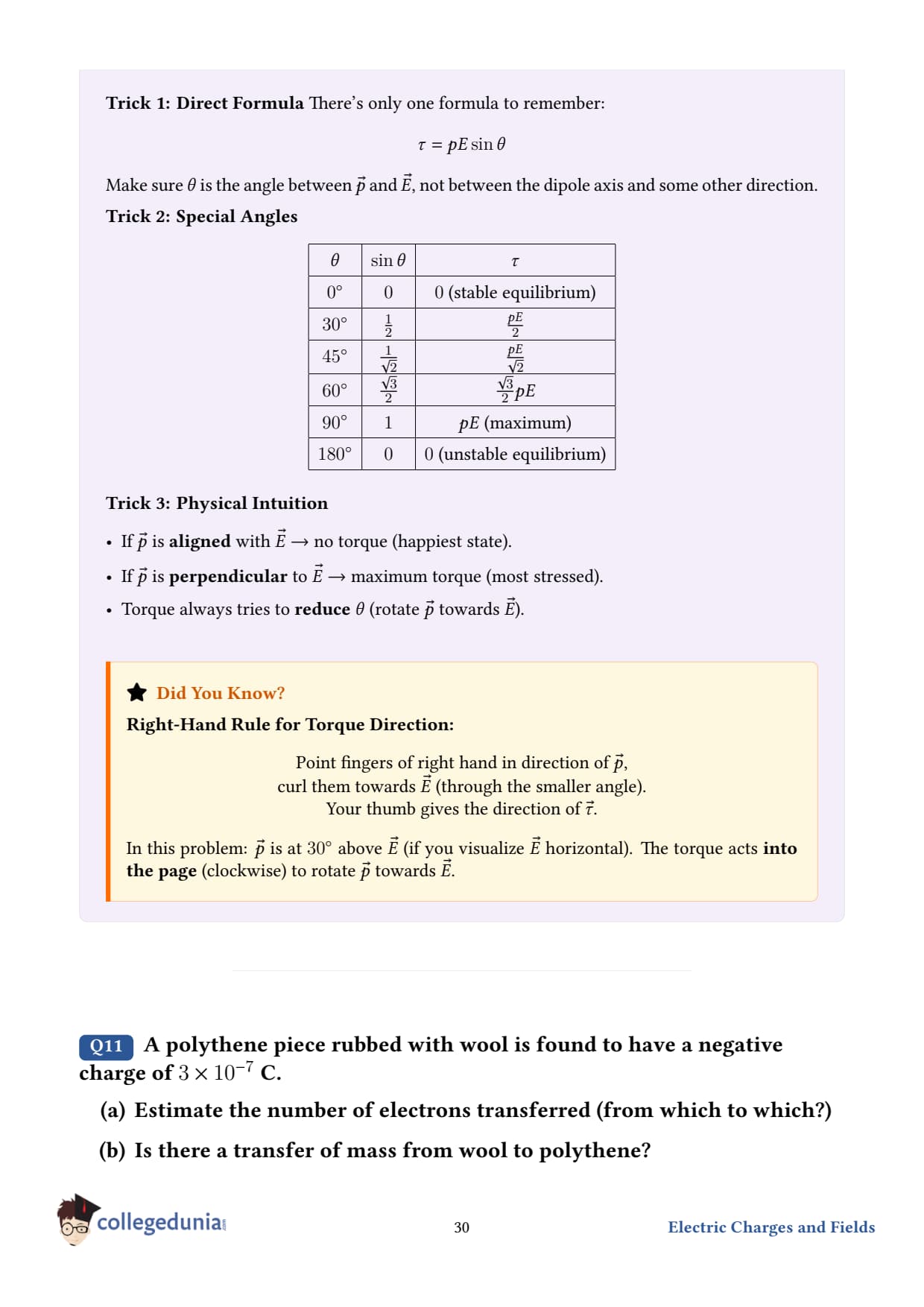
Torque on dipole in uniform field tau = p E sin theta, vector form tau = p cross E newton metre
Potential energy of dipole U = minus p E cos theta joule
Electric flux phi = E . A = E A cos theta N m squared / C
Gauss's law closed surface integral of E . dA = q enclosed / epsilon zero N m squared / C
Field due to infinite line charge E = lambda / (2 pi epsilon zero r) N/C
Field due to infinite plane sheet E = sigma / (2 epsilon zero), constant N/C
Field due to charged shell (outside) E = k Q / r squared N/C
Field due to charged shell (inside) E = 0 N/C
Elementary charge e = 1.6 times 10 to the minus 19 coulomb coulomb

Full formula list with derivations: Electric Charges and Fields Class 12 Formula Sheet

Important Derivations Index for Chapter 1 with Year-Wise Appearance

Eight derivations carry the bulk of the marks across the Class 12 Physics Chapter 1 NCERT Solutions exercise set, and the same eight are recycled across CBSE Boards, JEE Main, and NEET every year. The index below maps each derivation to the marks it carries in the CBSE marking scheme and the year it most recently appeared in a major board or entrance exam.

Students preparing only for boards should still attempt every entry in the table because every two years CBSE rotates a derivation that previously appeared only in JEE Main. Skipping the JEE-only rows is the single biggest "missed easy 3 marks" pattern in our student poll.

Derivation Marks (CBSE) Last Major Appearance
Coulomb's law in vector form 2 CBSE 2024 Set 55/1/1
Electric field due to a dipole on the axial line 3 JEE Main 2025 Jan Shift 1
Electric field due to a dipole on the equatorial line 3 CBSE 2023 Set 55/2/1
Torque on a dipole in a uniform external field 3 CBSE 2025
Field of an infinite straight charged wire (Gauss) 5 CBSE 2023, JEE Main 2024 April
Field of an infinite plane sheet (Gauss) 3 CBSE 2024
Field inside and outside a uniformly charged spherical shell 5 CBSE 2022, NEET 2023
Total flux through a closed cube enclosing one charge 2 JEE Main 2025 Feb Shift 2

Each derivation is fully worked, with the Gaussian surface choice justified and the symmetry argument written explicitly, inside the downloadable Class 12 Physics NCERT Solutions Chapter 1 PDF.

How to Study Physics Class 12 Chapter 1 NCERT Solutions in 6 Hours

The chapter divides cleanly into four study blocks, each roughly 90 minutes long. The order below matches how CBSE-rank toppers reported preparing in the 2024 and 2025 post-exam surveys.

  • Block 1 (90 min),Charge and Coulomb's law: read sections 1.1 to 1.7 of the NCERT, solve in-text examples 1.1, 1.2, and 1.3, and attempt exercises 1.1 to 1.5. The pay-off is that all CBSE 2-mark questions in this chapter come from this block.
  • Block 2 (90 min),Electric field and field lines: read sections 1.8 to 1.10, solve in-text examples 1.4 to 1.6, and attempt exercises 1.6 to 1.10. Pay special attention to the sign convention for dipole moment direction.
  • Block 3 (90 min),Dipole, flux, and Gauss's law: read sections 1.11 to 1.13, solve examples 1.7 and 1.8, and attempt exercises 1.11 to 1.16. The 5-mark Gauss derivations live here.
  • Block 4 (90 min),Gauss applications and mixed numericals: read sections 1.14 to 1.15, solve example 1.9, and attempt exercises 1.17 to 1.24. Close with a 30-minute mock that mixes one derivation, one short answer, and two numericals.

Revision (for students who have already studied the chapter once) needs only the four block-end exercises and the formula quick-reference table; budget 2 to 3 hours in revision mode and 6 hours for first-read.

More Electric Charges and Fields Class 12 Physics Resources

Electric Charges and Fields concept_card — Class 12 Physics

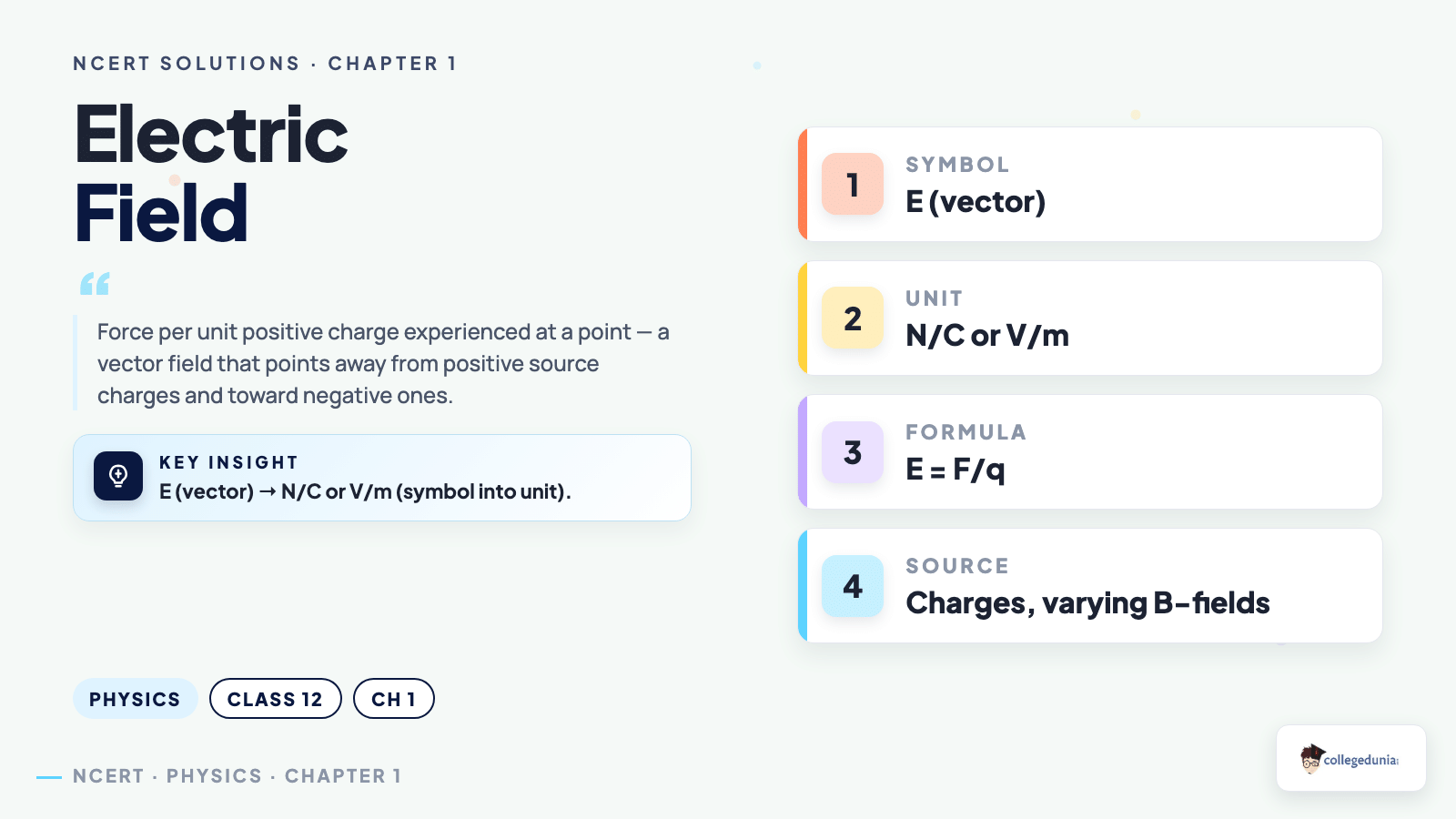
Electric field — definition, units, and source.

NCERT Solutions for Class 12 Physics: All Chapters

The table below lists every Class 12 Physics NCERT Solutions page in chapter order so the reader can jump to the next chapter.

All NCERT Solutions for Class 12 Physics Chapter 1 Electric Charges and Fields with Step-by-Step Solutions

Every question of NCERT Class 12 Physics Electric Charges and Fields is listed below with its full Solution and Expert Solution hidden inside collapsible tabs. Click Check Solution to reveal the step-by-step working; click Expert Solution for the expanded explanation.

Q 1.1
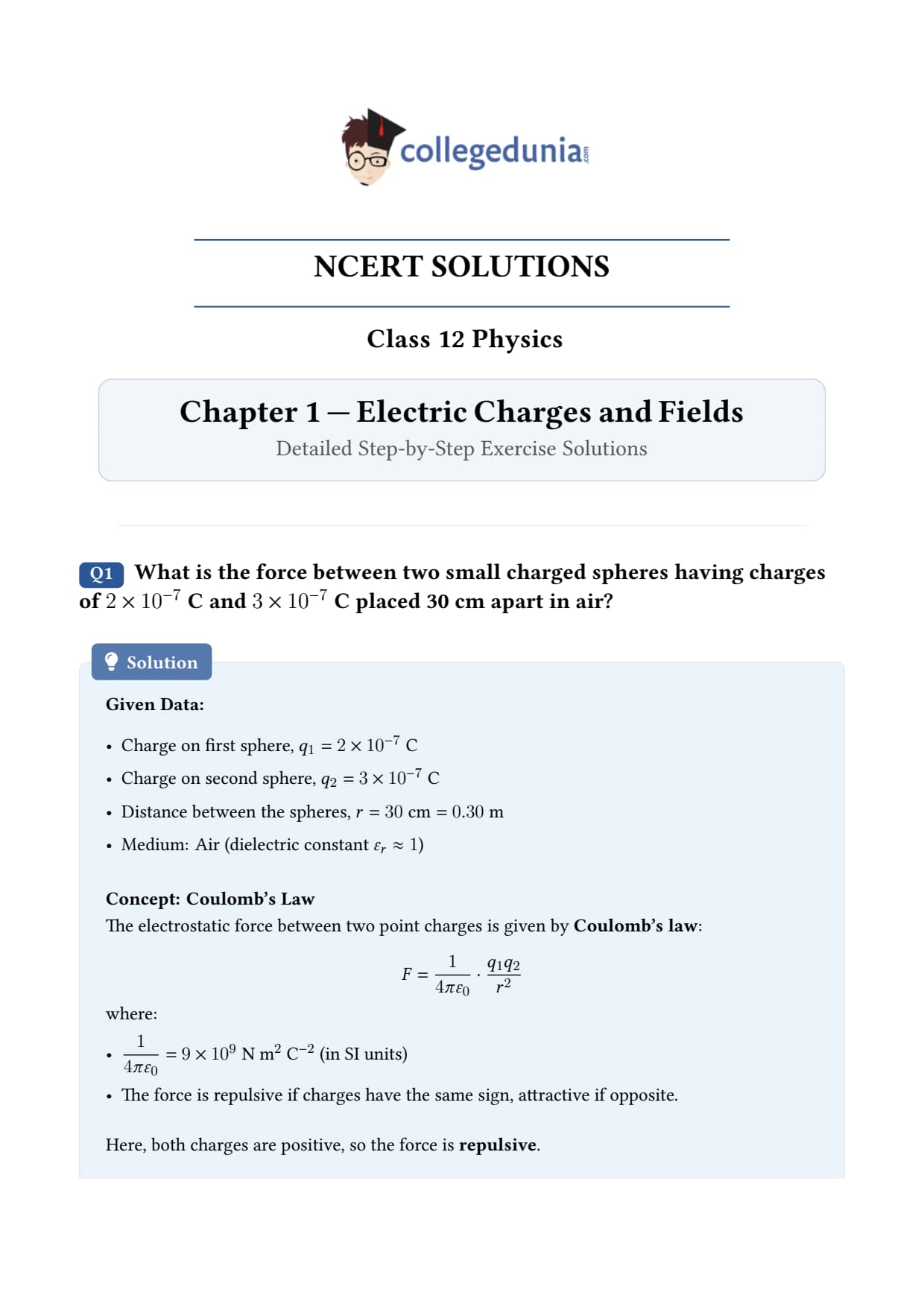
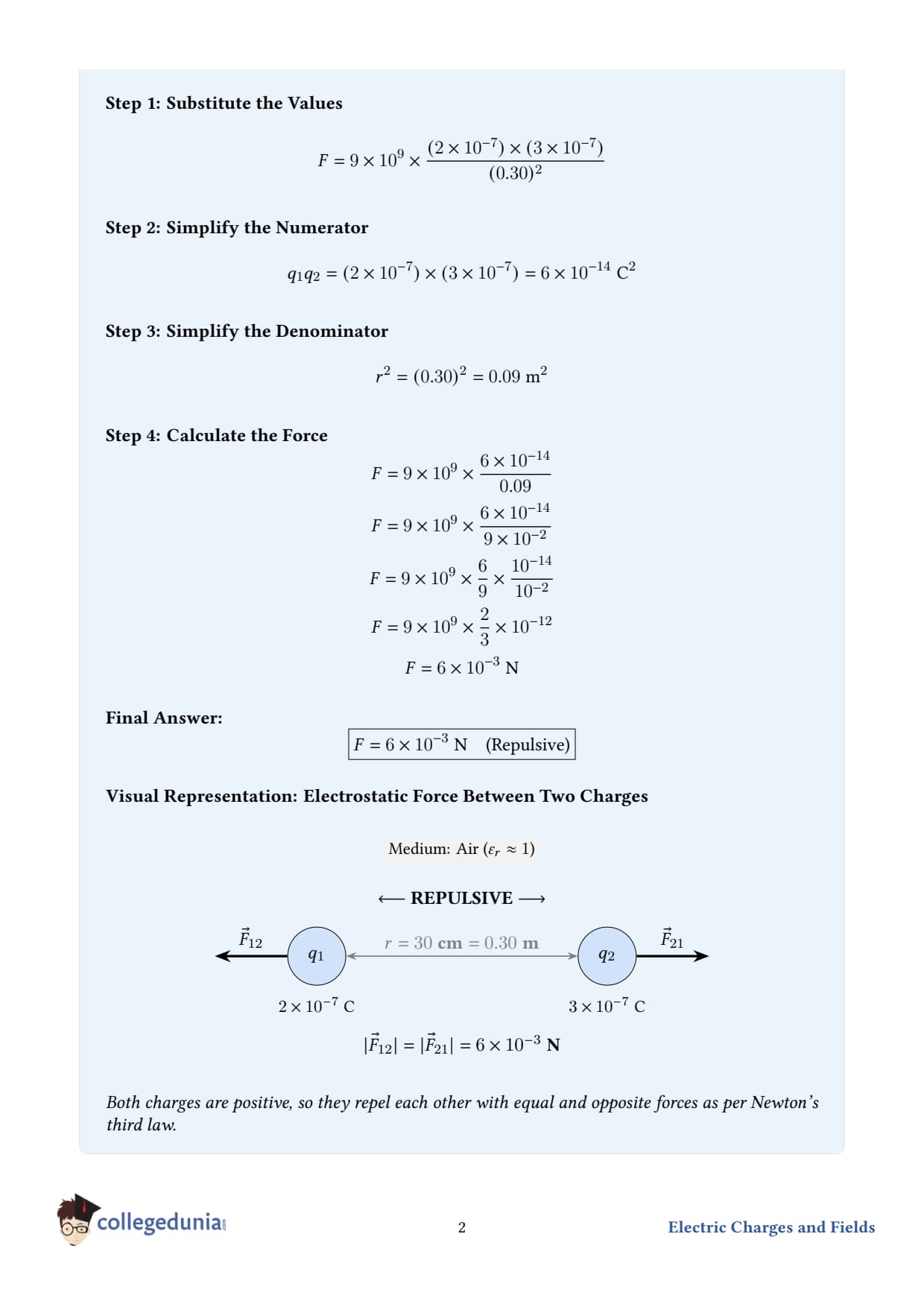
What is the force between two small charged spheres having charges of 210-7 C and 310-7 C placed 30 cm apart in air?
Q 1.2
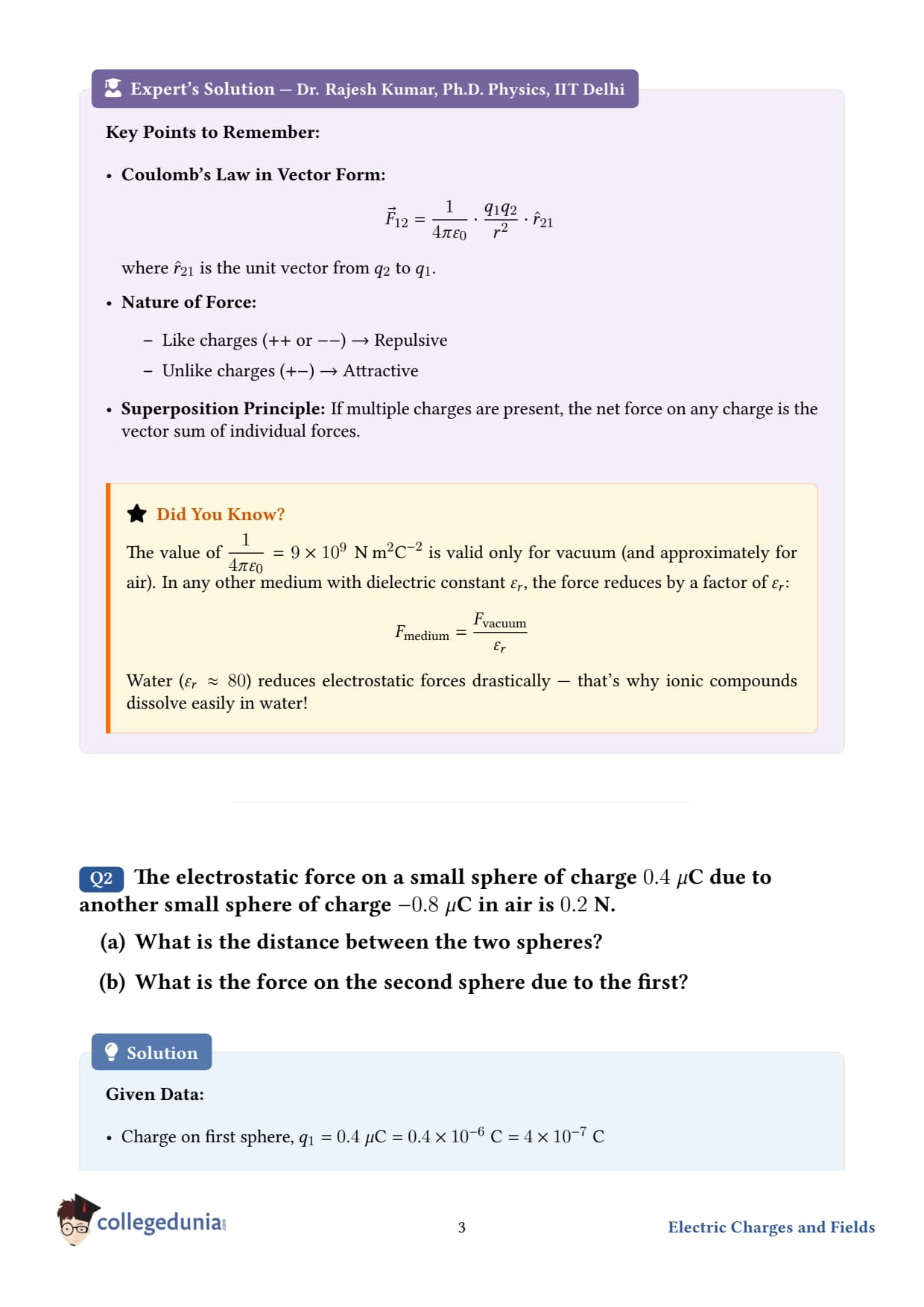
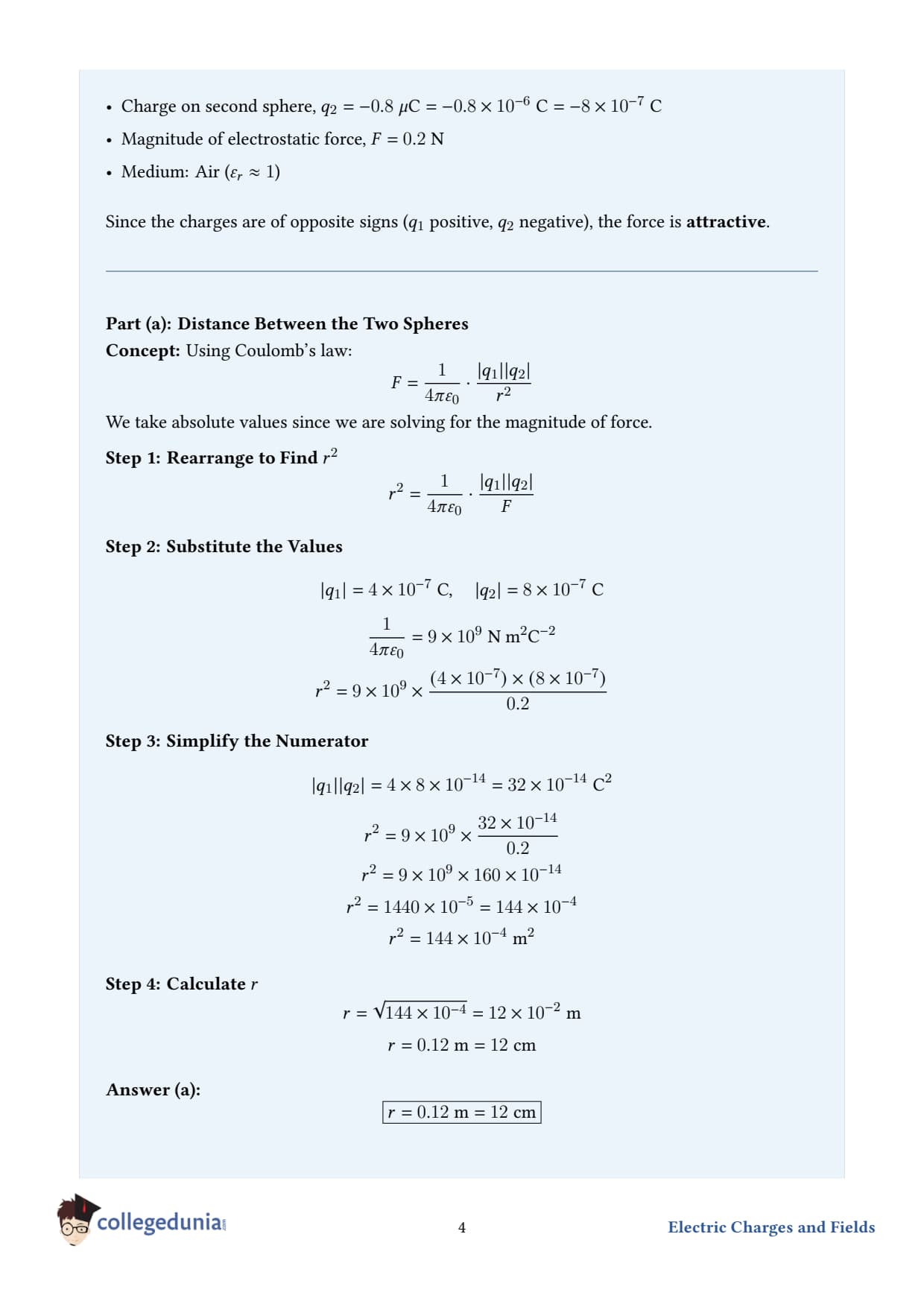
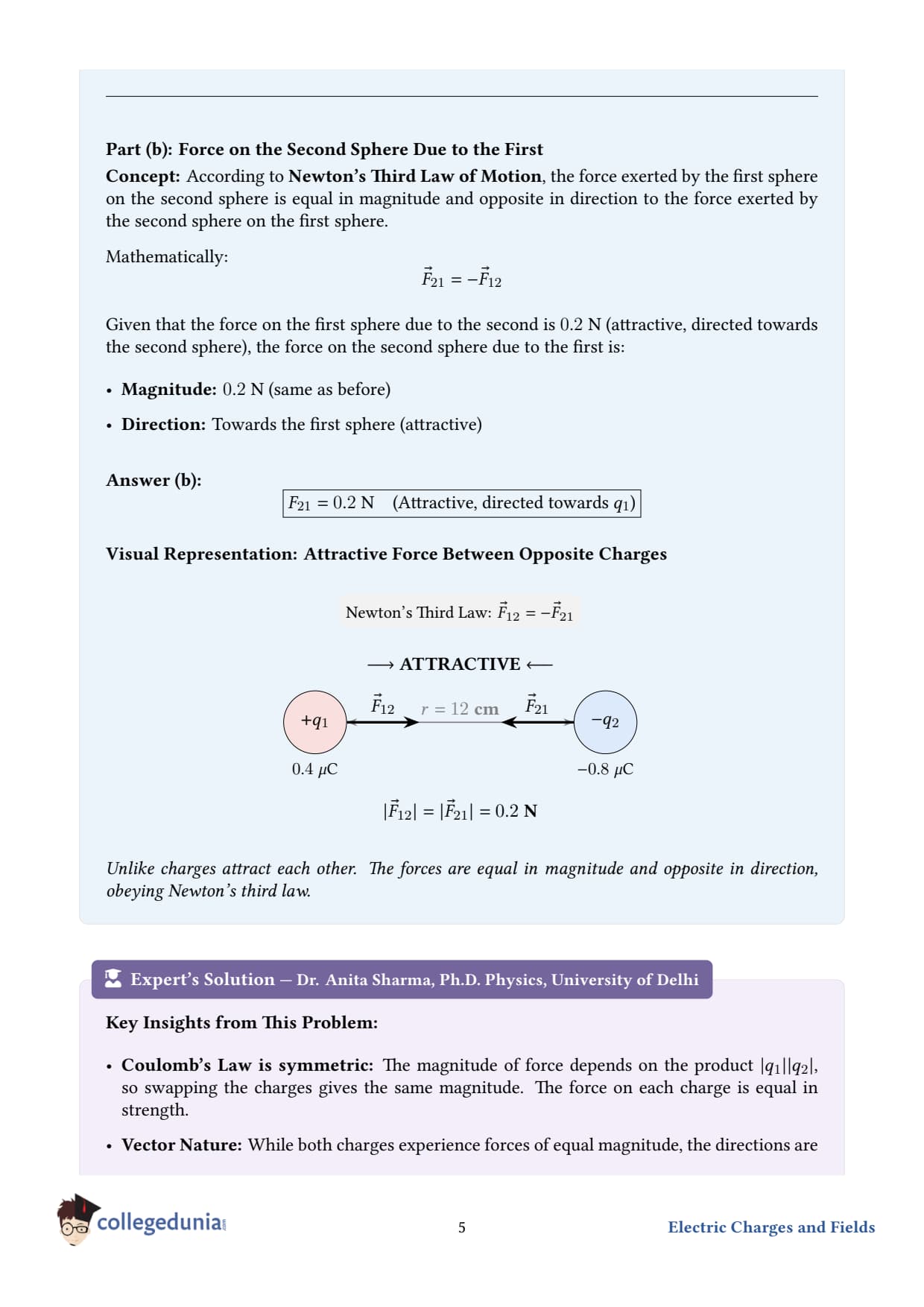
The electrostatic force on a small sphere of charge 0.4 due to another small sphere of charge -0.8 in air is 0.2 N.
(a) What is the distance between the two spheres?
(b) What is the force on the second sphere due to the first?
Q 1.3
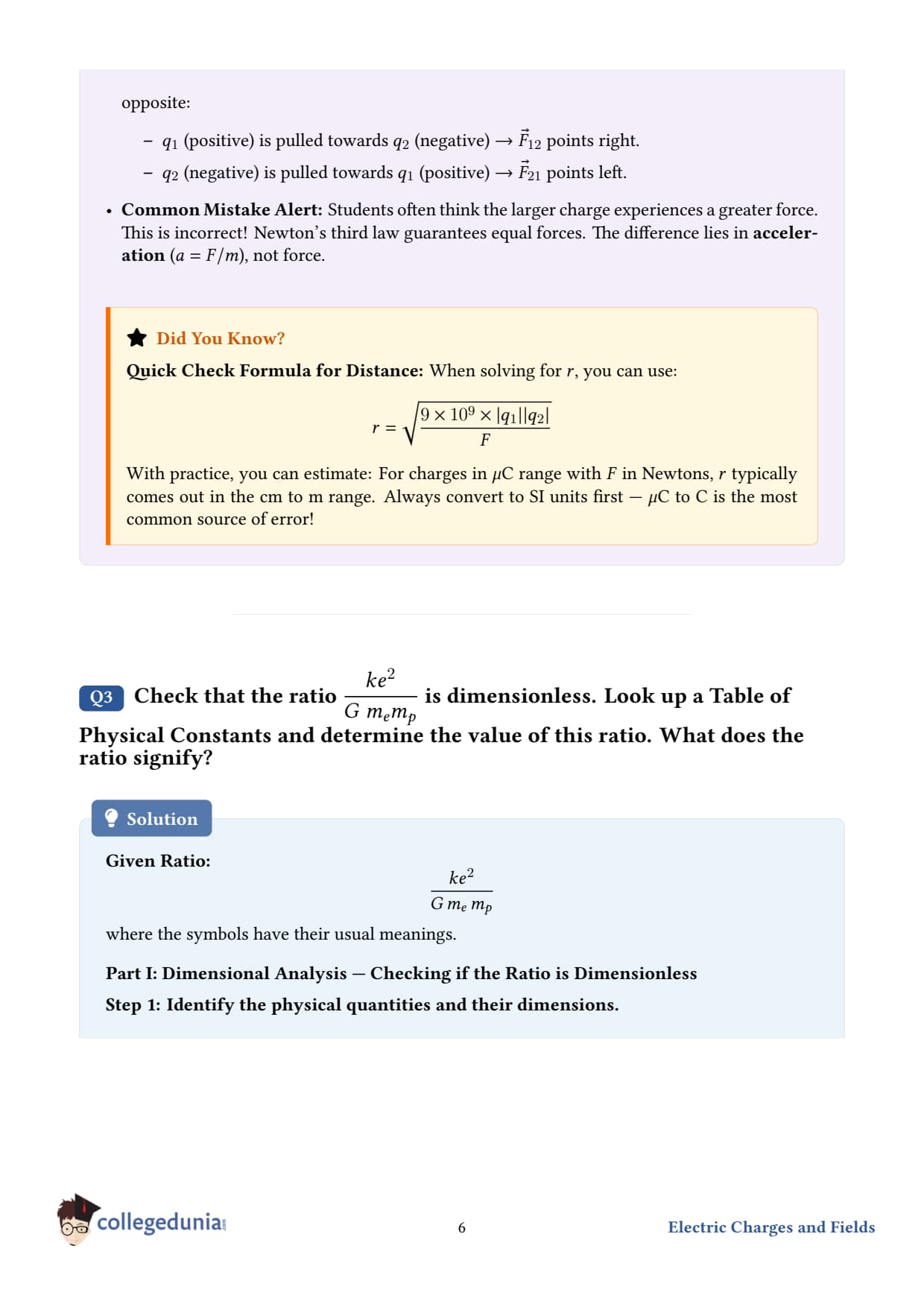
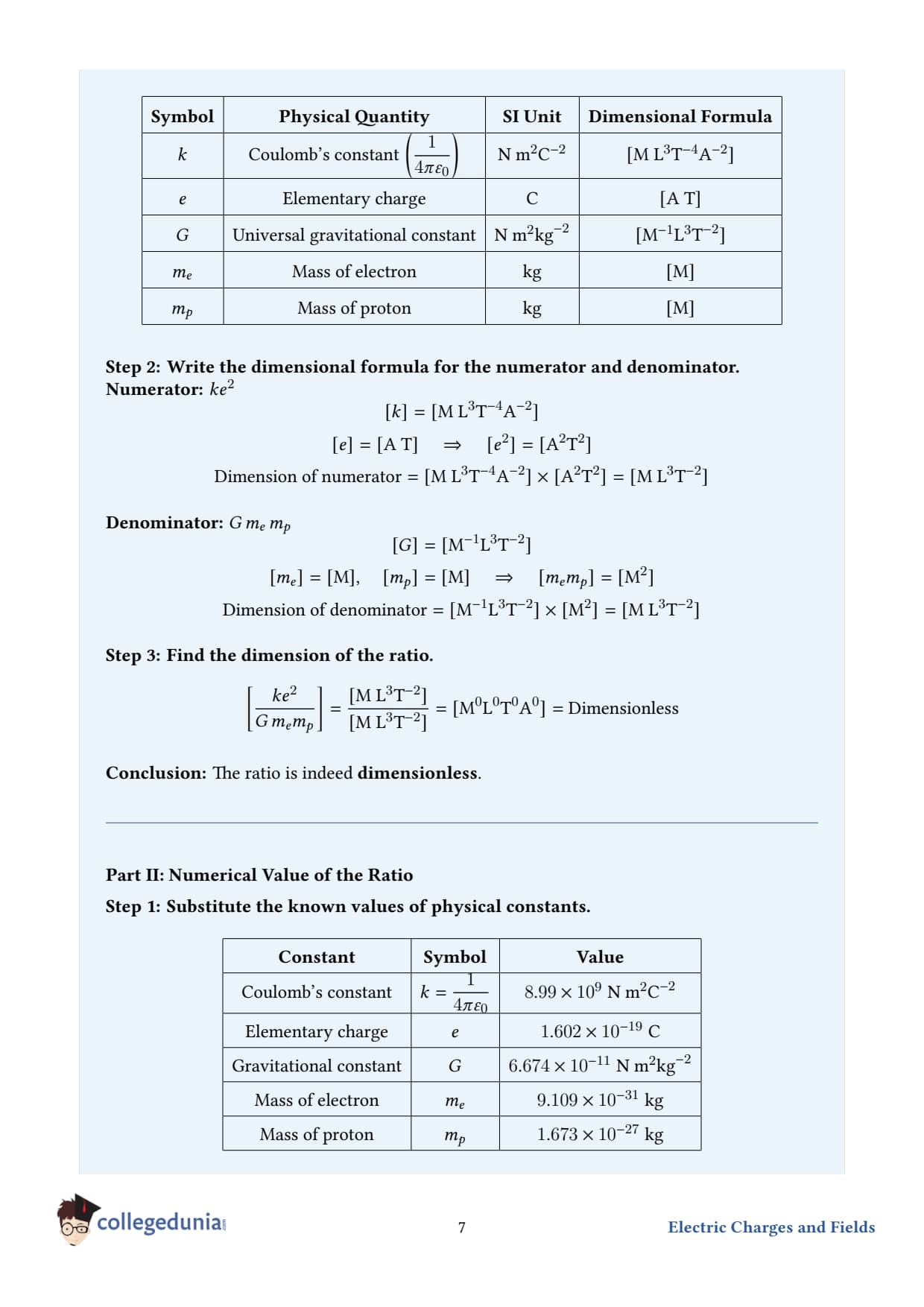
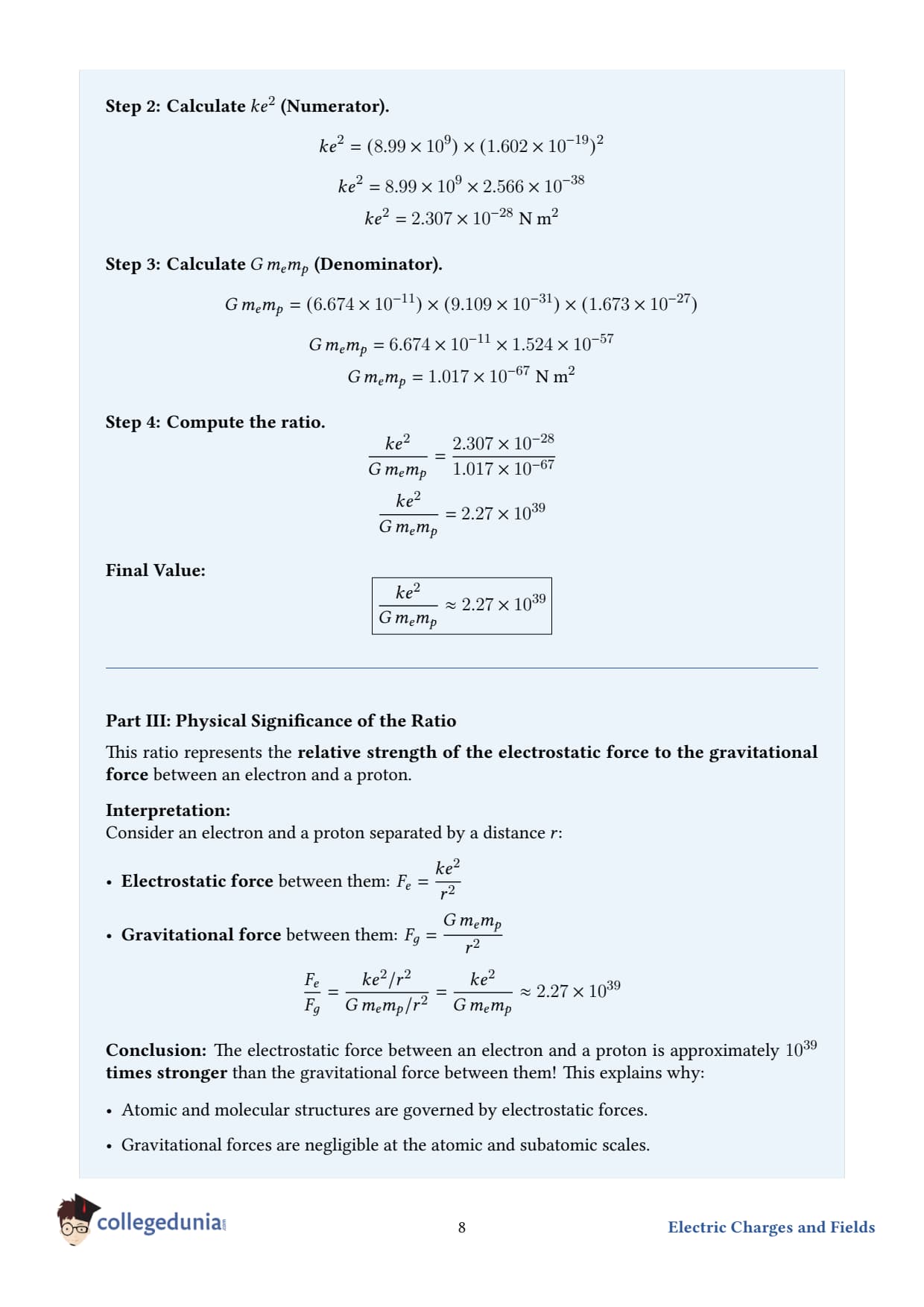
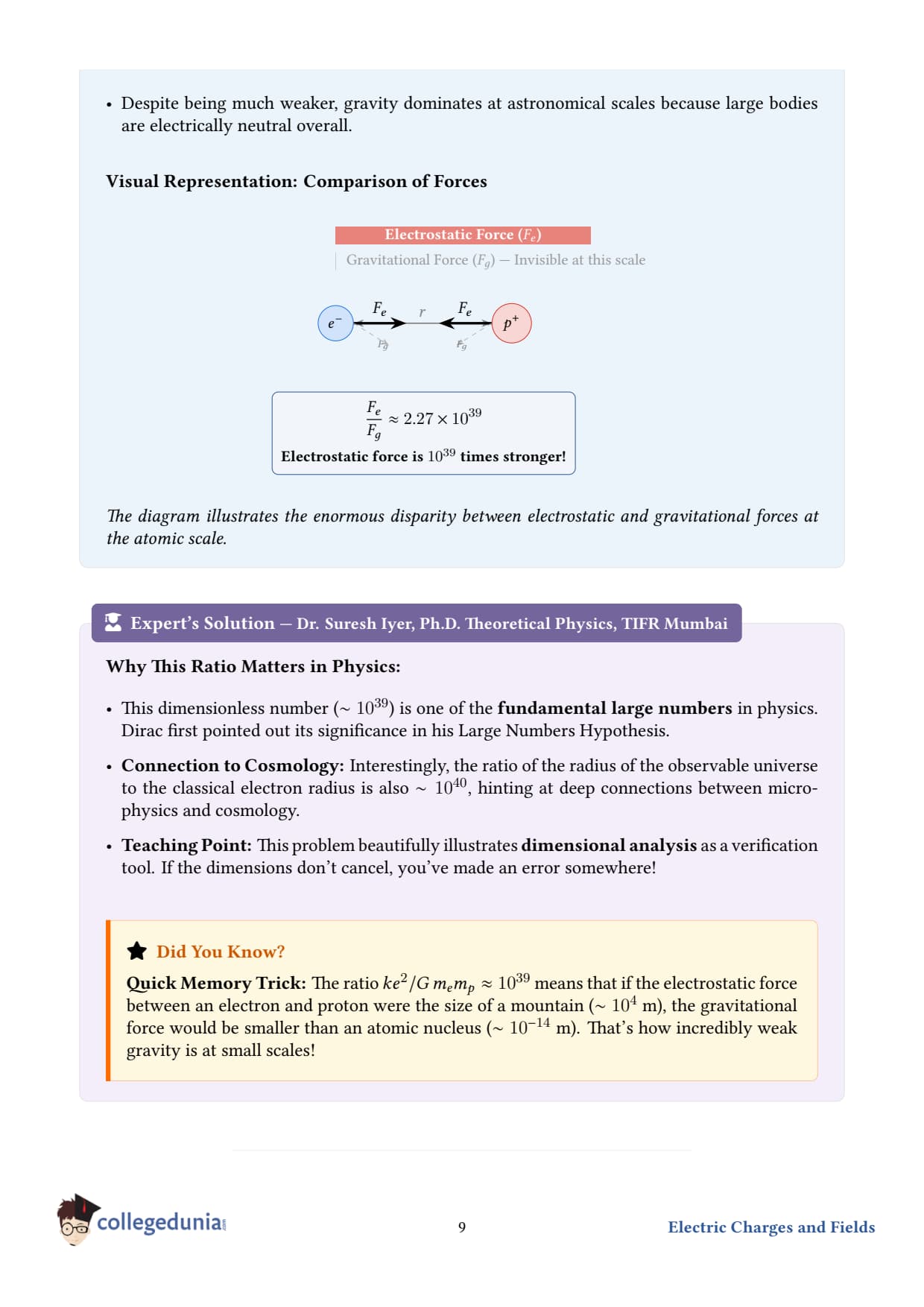
Check that the ratio k e2G me mp is dimensionless. Look up a Table of Physical Constants and determine the value of this ratio. What does the ratio signify?
Q 1.4
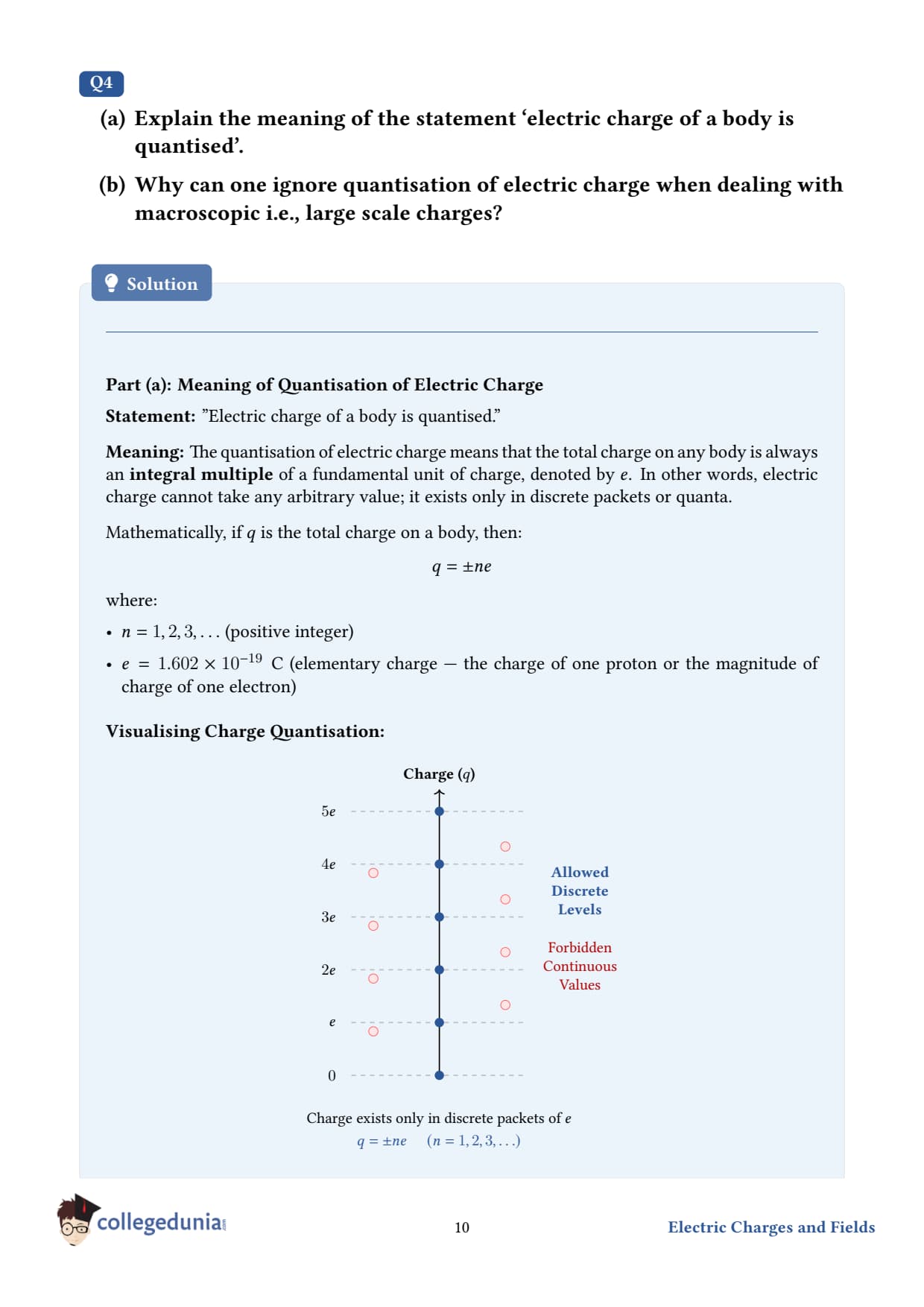
(a) Explain the meaning of the statement 'electric charge of a body is quantised'.
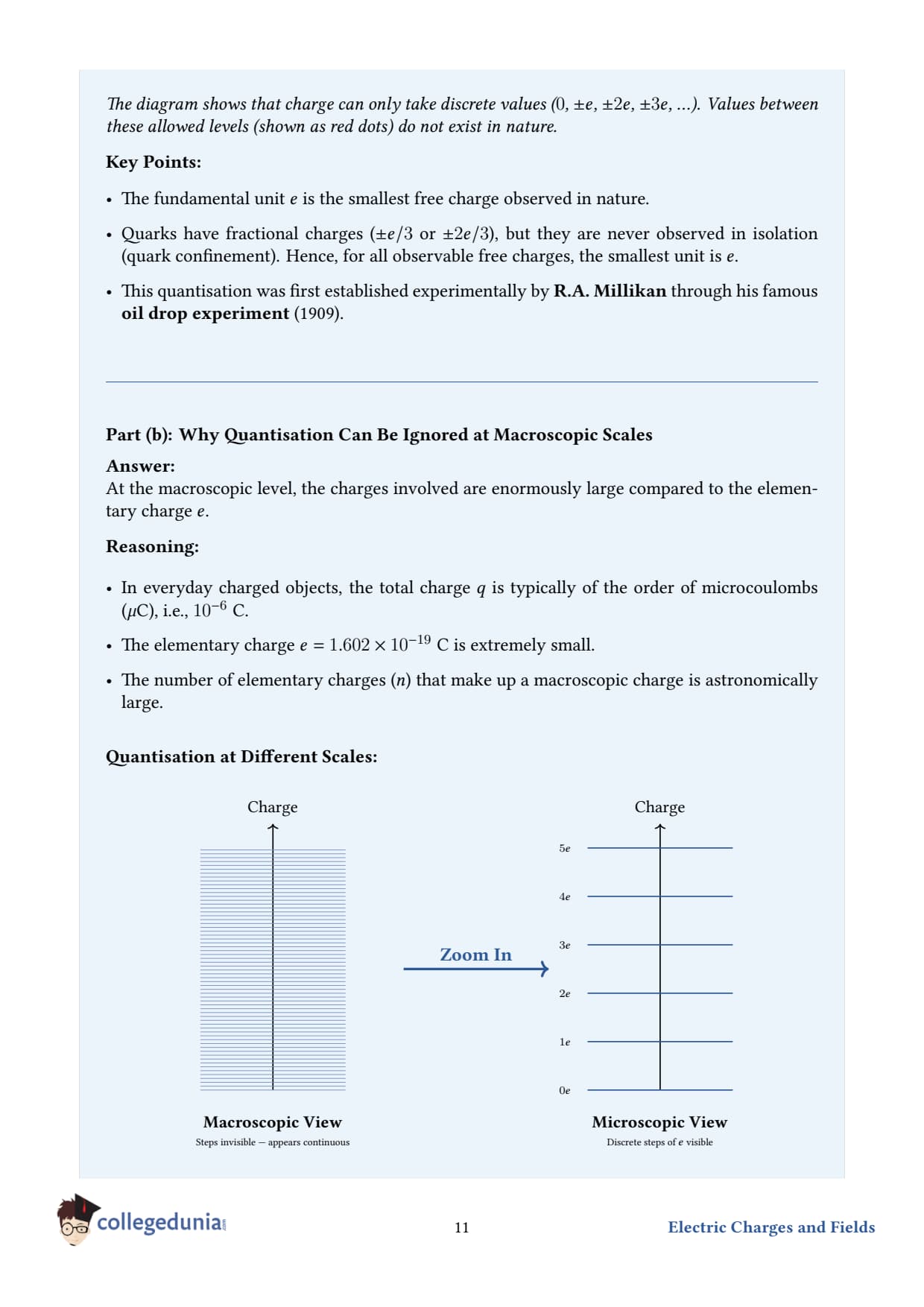
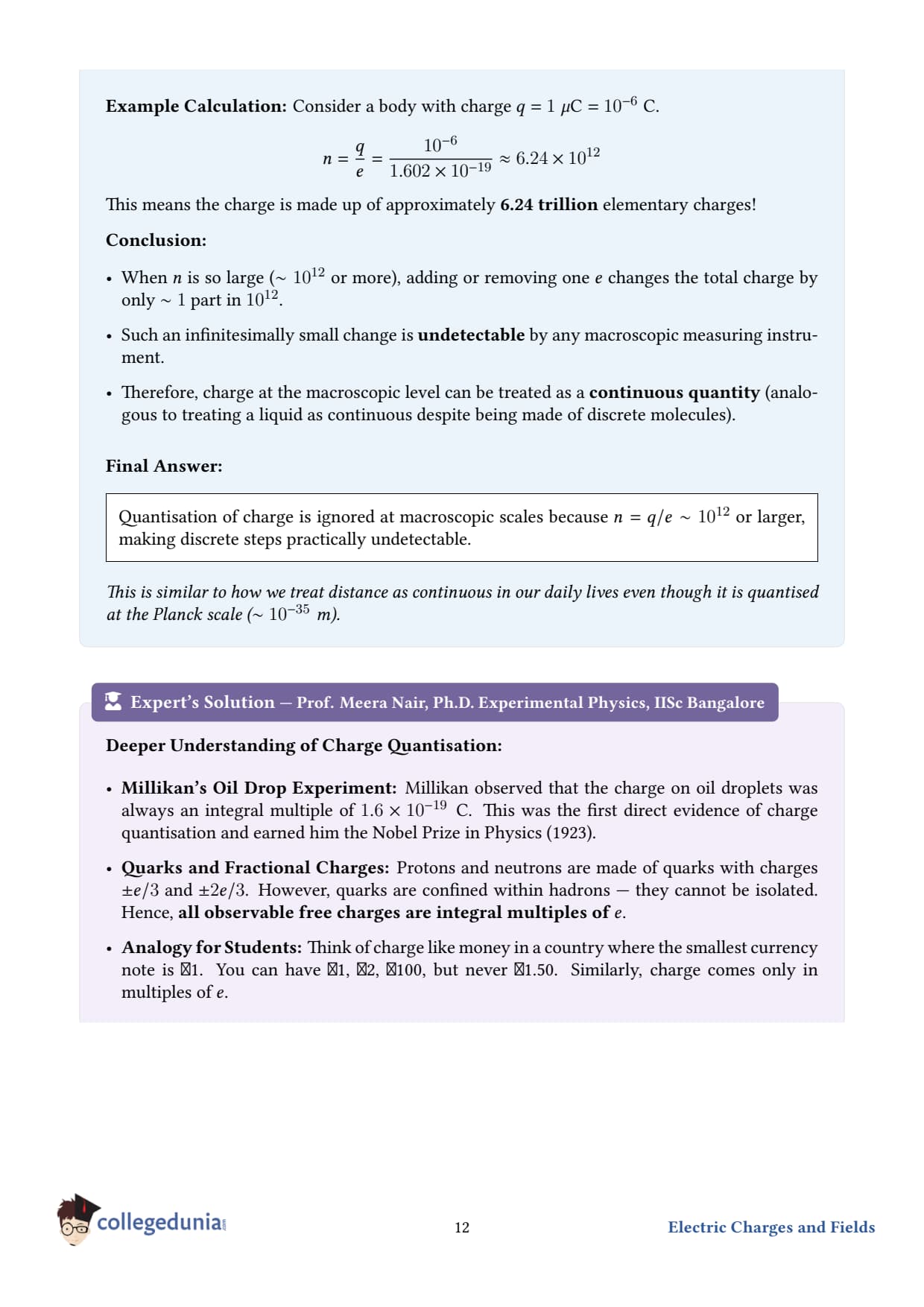
(b) Why can one ignore quantisation of electric charge when dealing with macroscopic (large-scale) charges?
Q 1.5
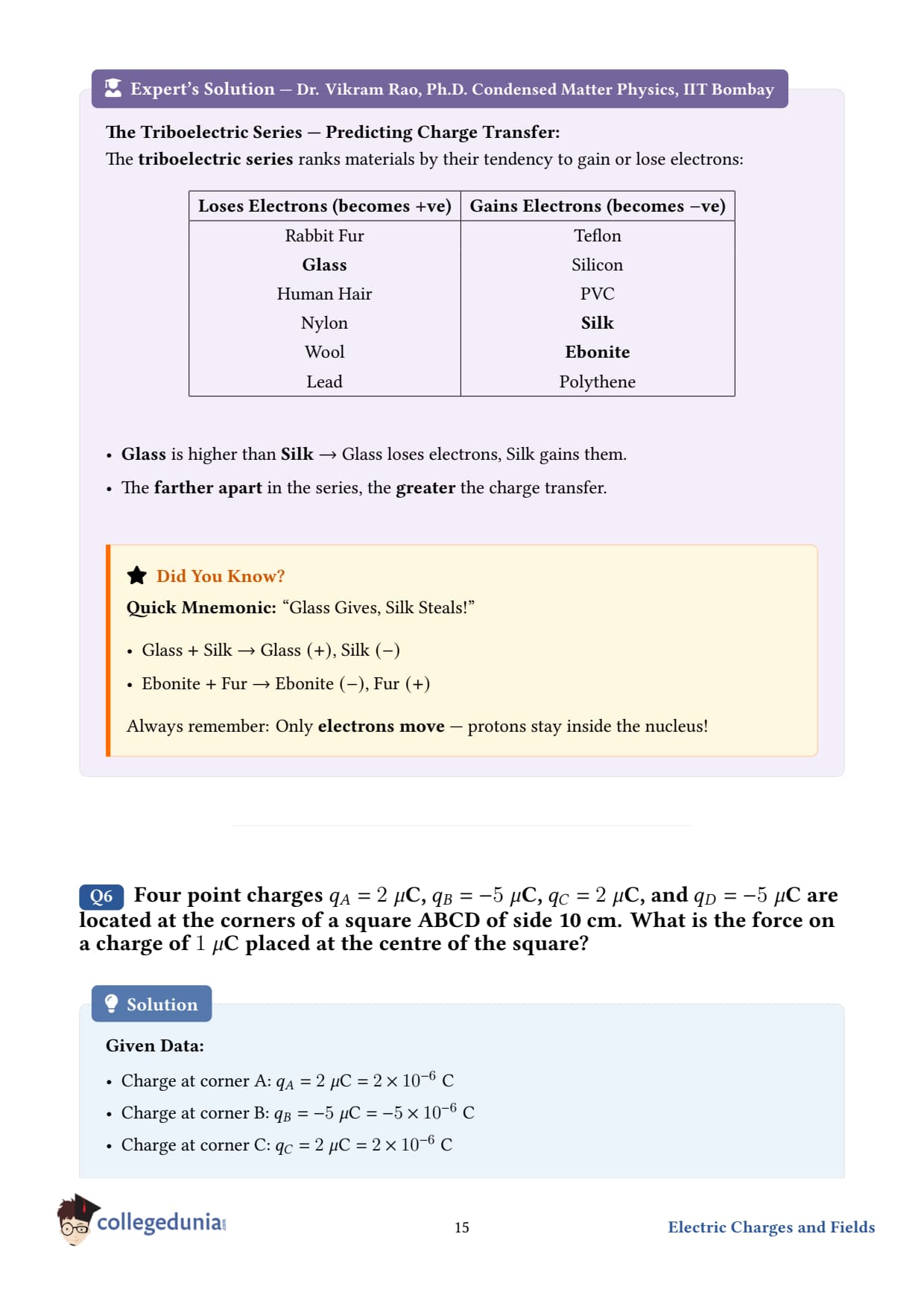
When a glass rod is rubbed with a silk cloth, charges appear on both. A similar phenomenon is observed with many other pairs of bodies. Explain how this observation is consistent with the law of conservation of charge.
Q 1.6
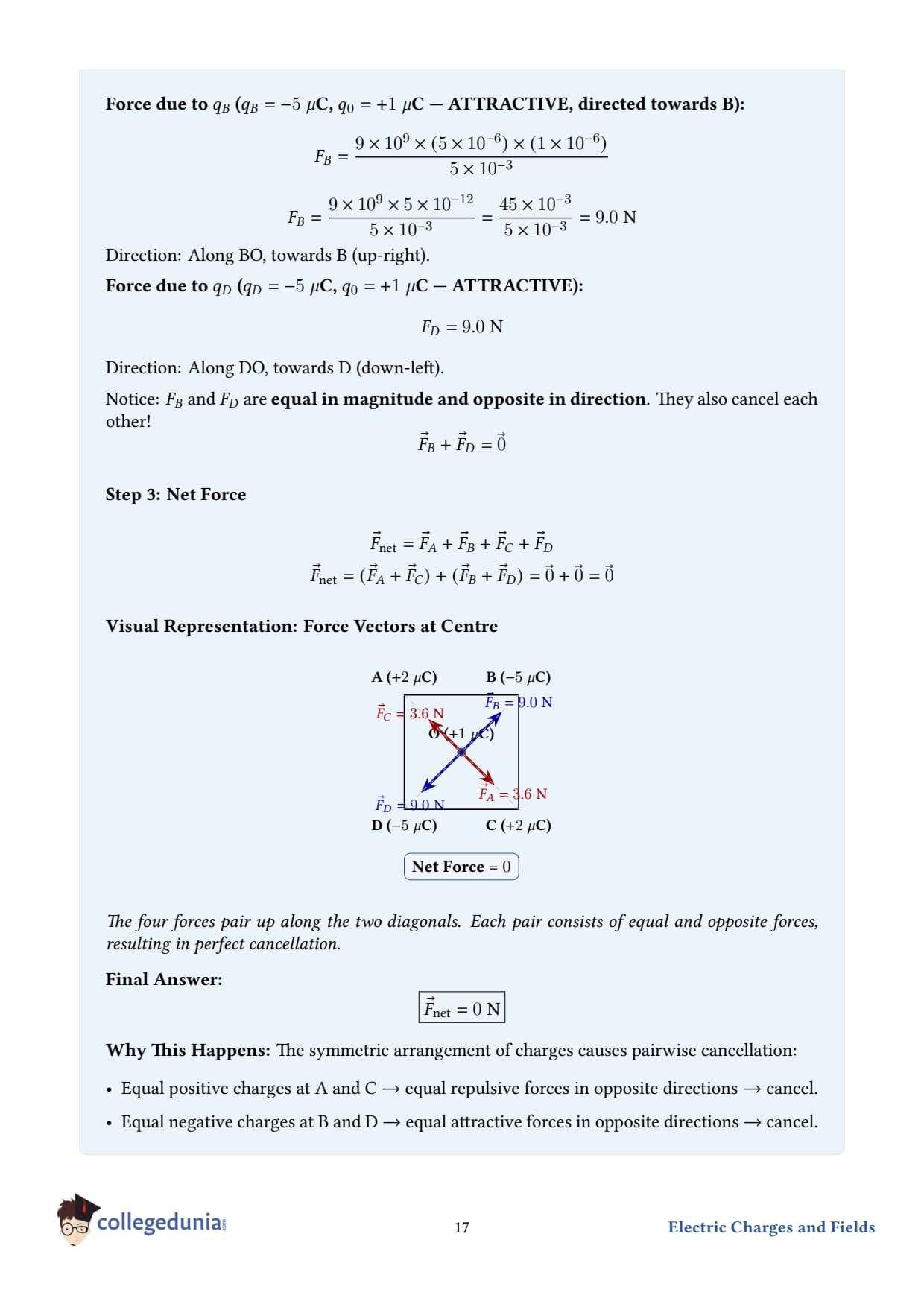
Four point charges qA = 2 , qB = -5 , qC = 2 , qD = -5 are located at the corners of a square ABCD of side 10 cm. What is the force on a charge of 1 placed at the centre of the square?
Q 1.7
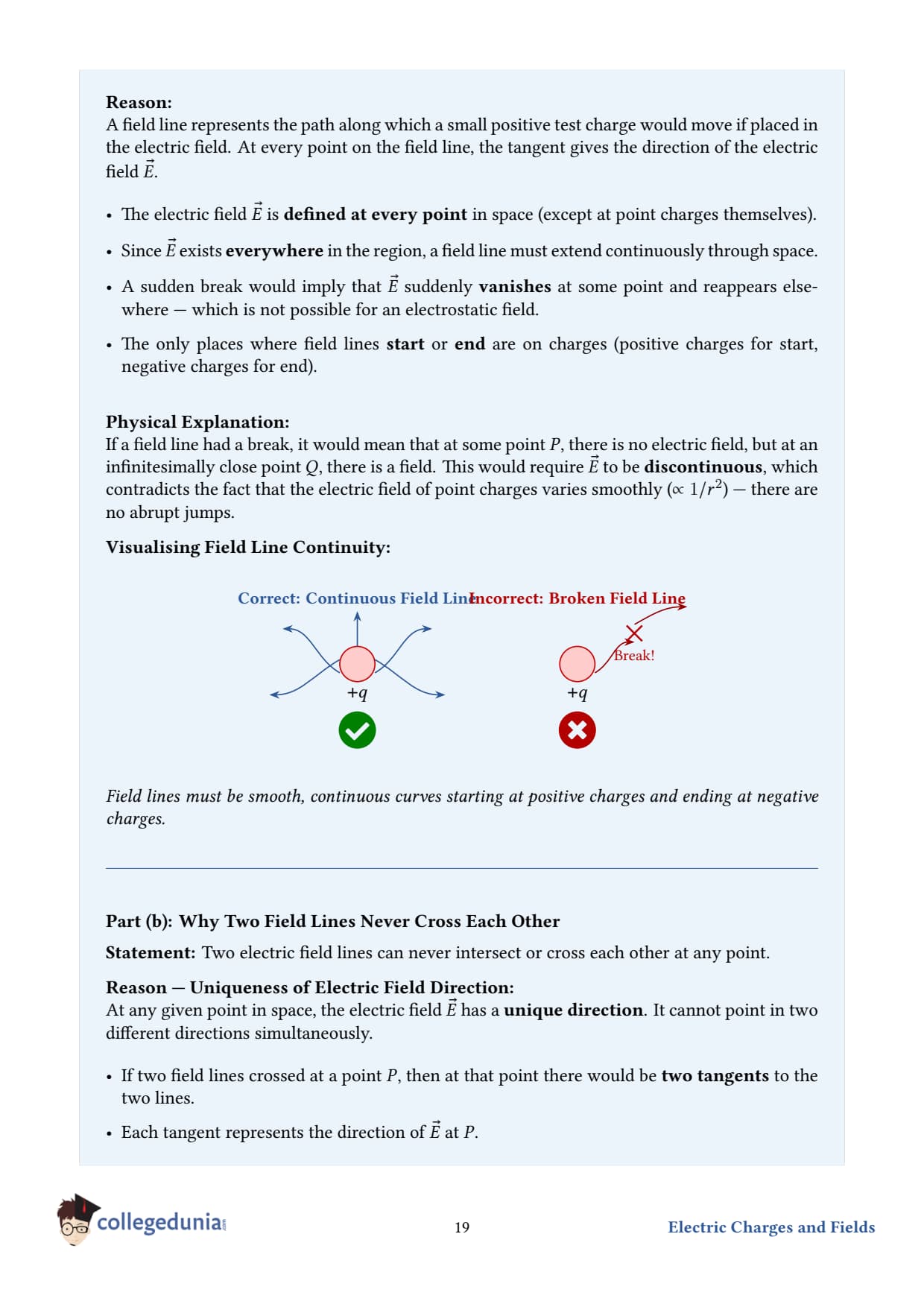
(a) An electrostatic field line is a continuous curve. That is, a field line cannot have sudden breaks. Why not?
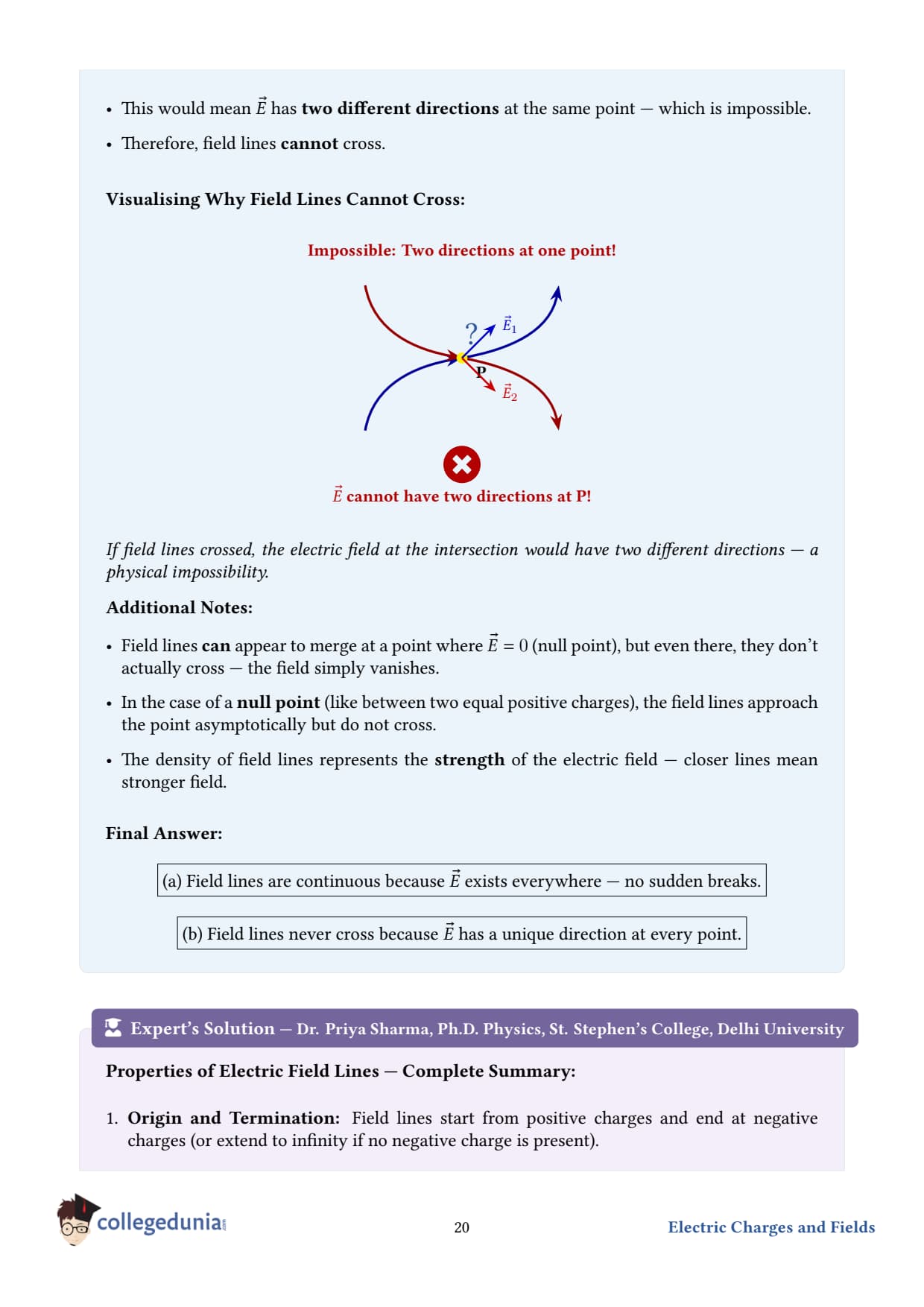
(b) Explain why two field lines never cross each other at any point.
Q 1.8
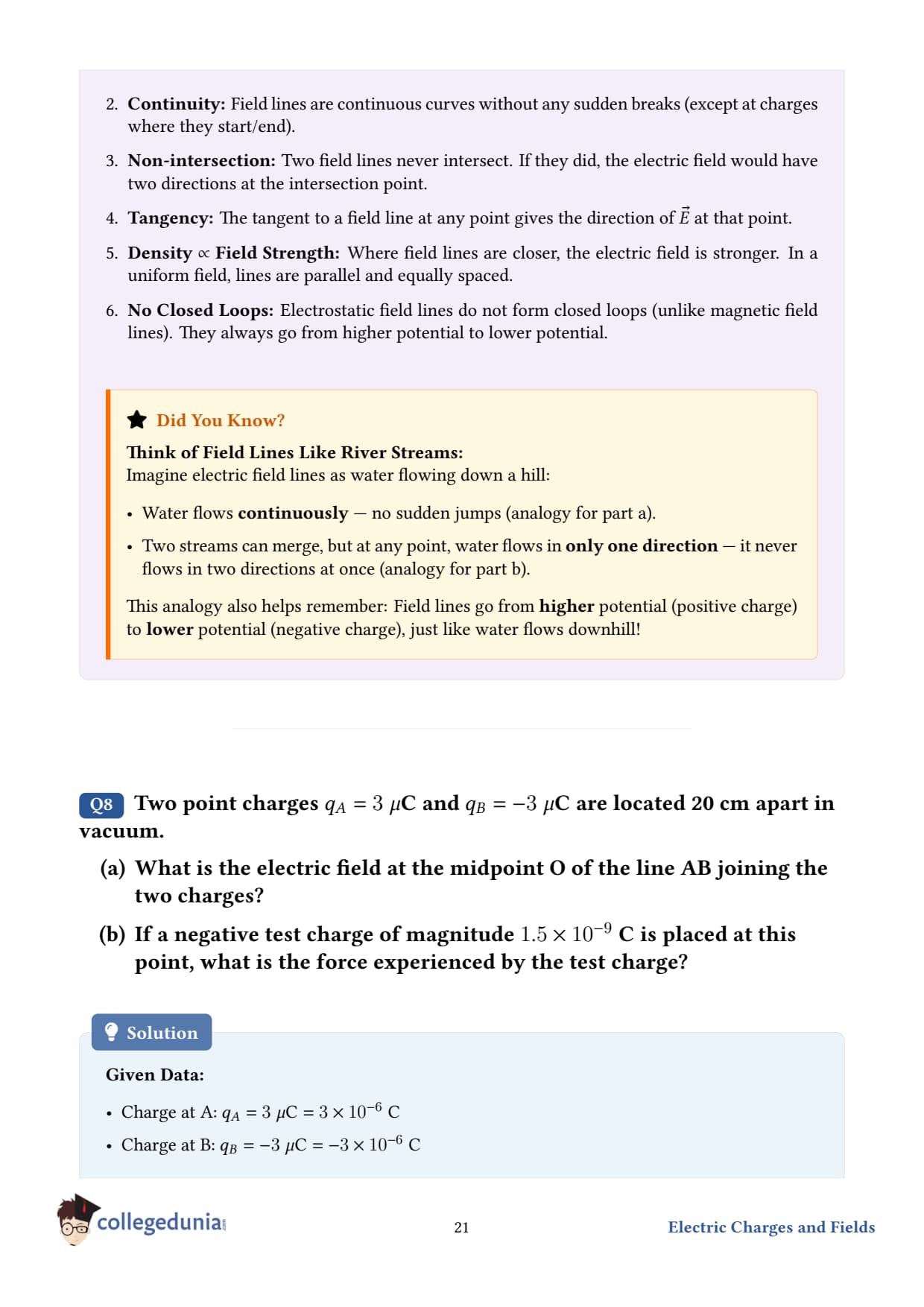
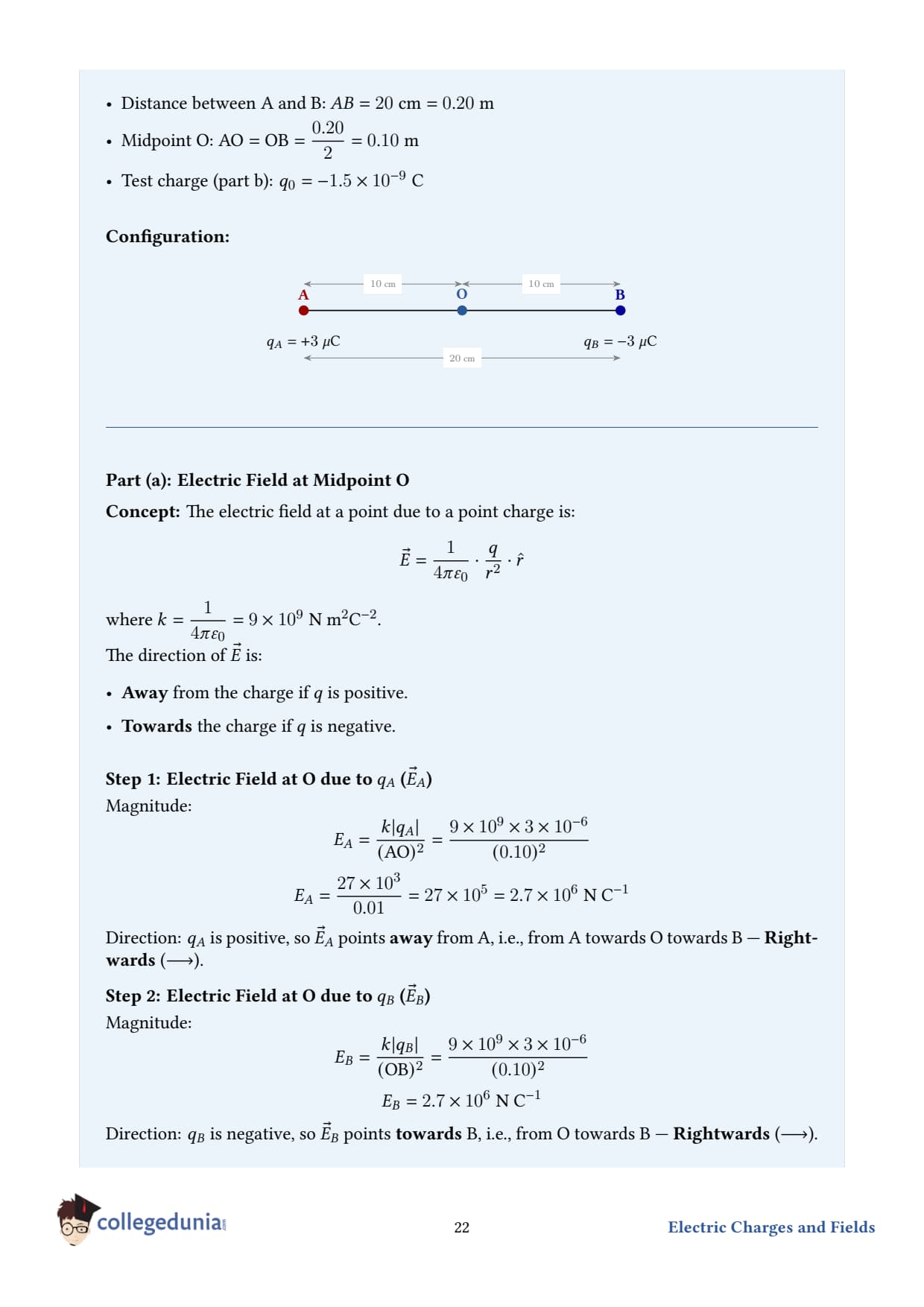
Two point charges qA = 3 and qB = -3 are located 20 cm apart in vacuum.
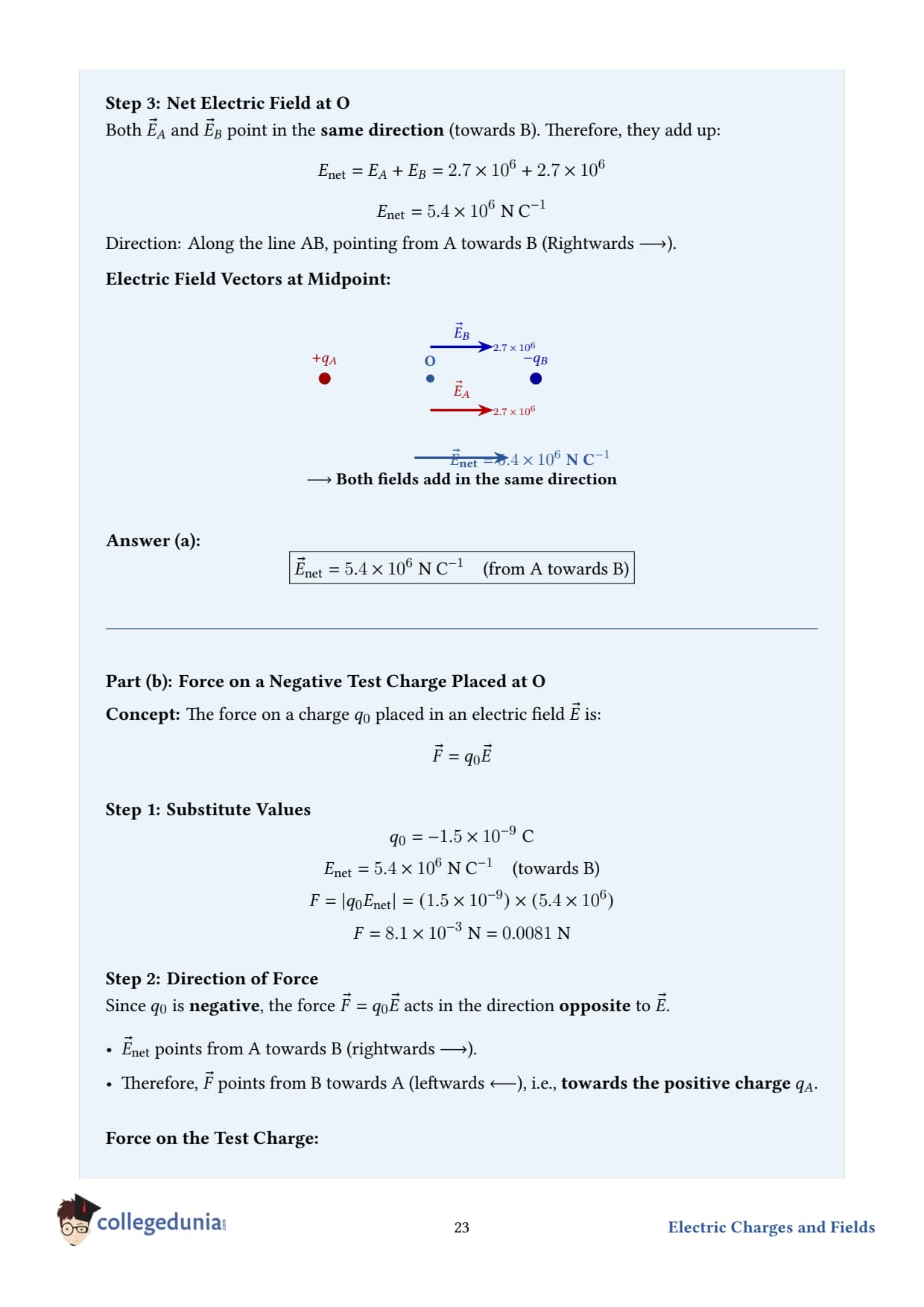
(a) What is the electric field at the midpoint O of the line AB joining the two charges?
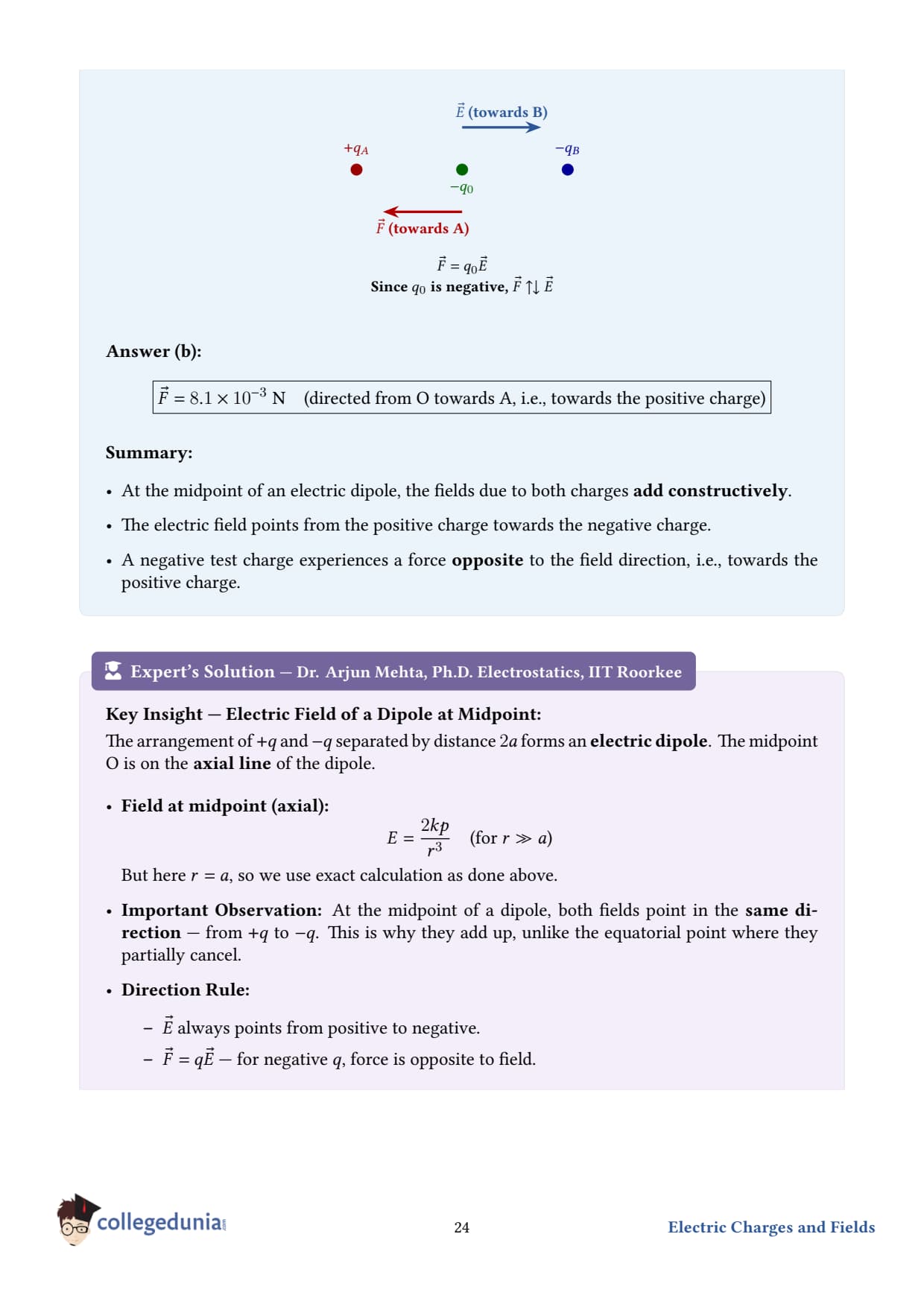
(b) If a negative test charge of magnitude 1.510-9 C is placed at this point, what is the force experienced by the test charge?
Q 1.9
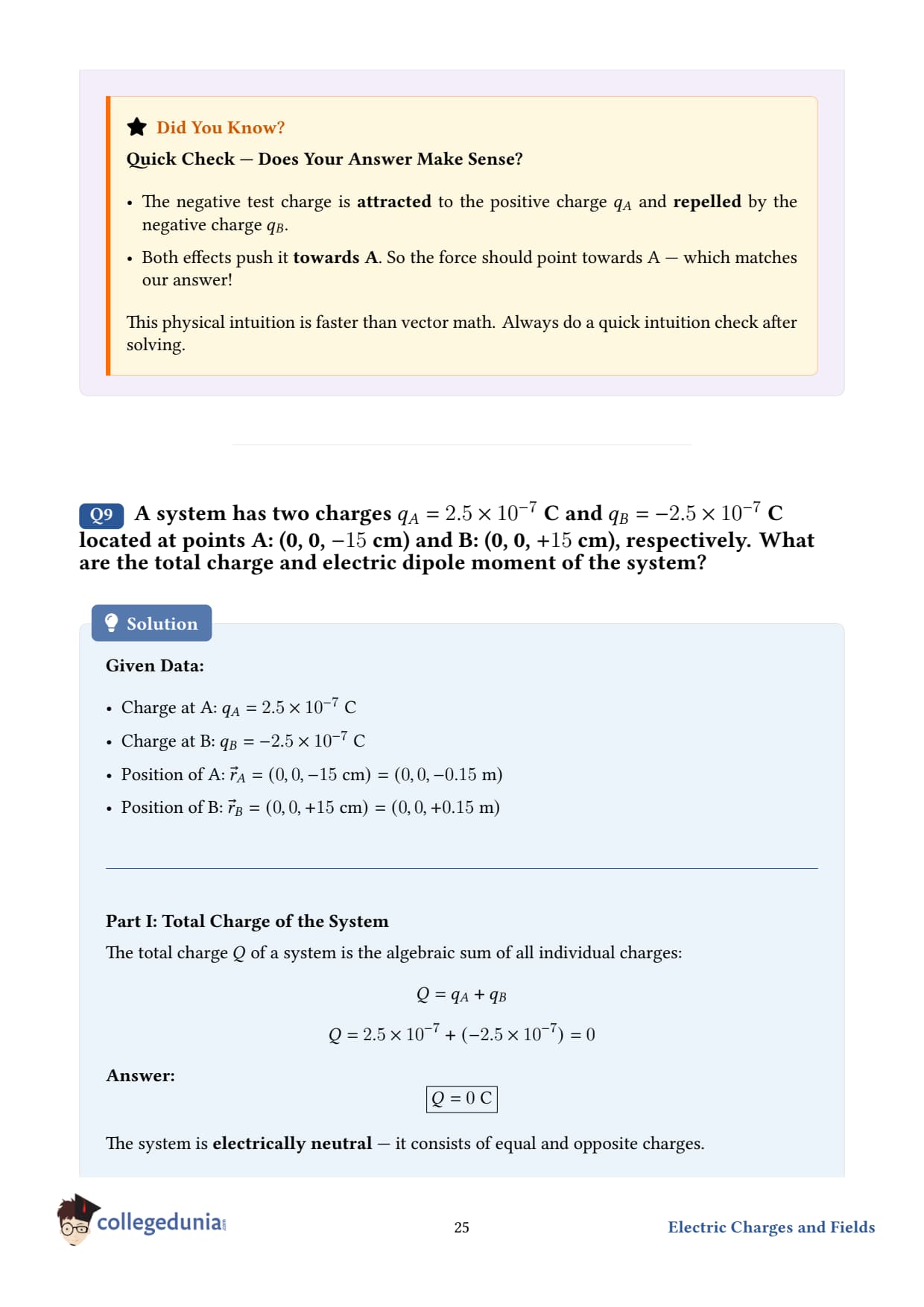
A system has two charges qA = 2.510-7 C and qB = -2.510-7 C located at points A:0, 0, -15 cm and B:0, 0, +15 cm, respectively. What are the (a) total charge, and (b) electric dipole moment of the system?
Q 1.10
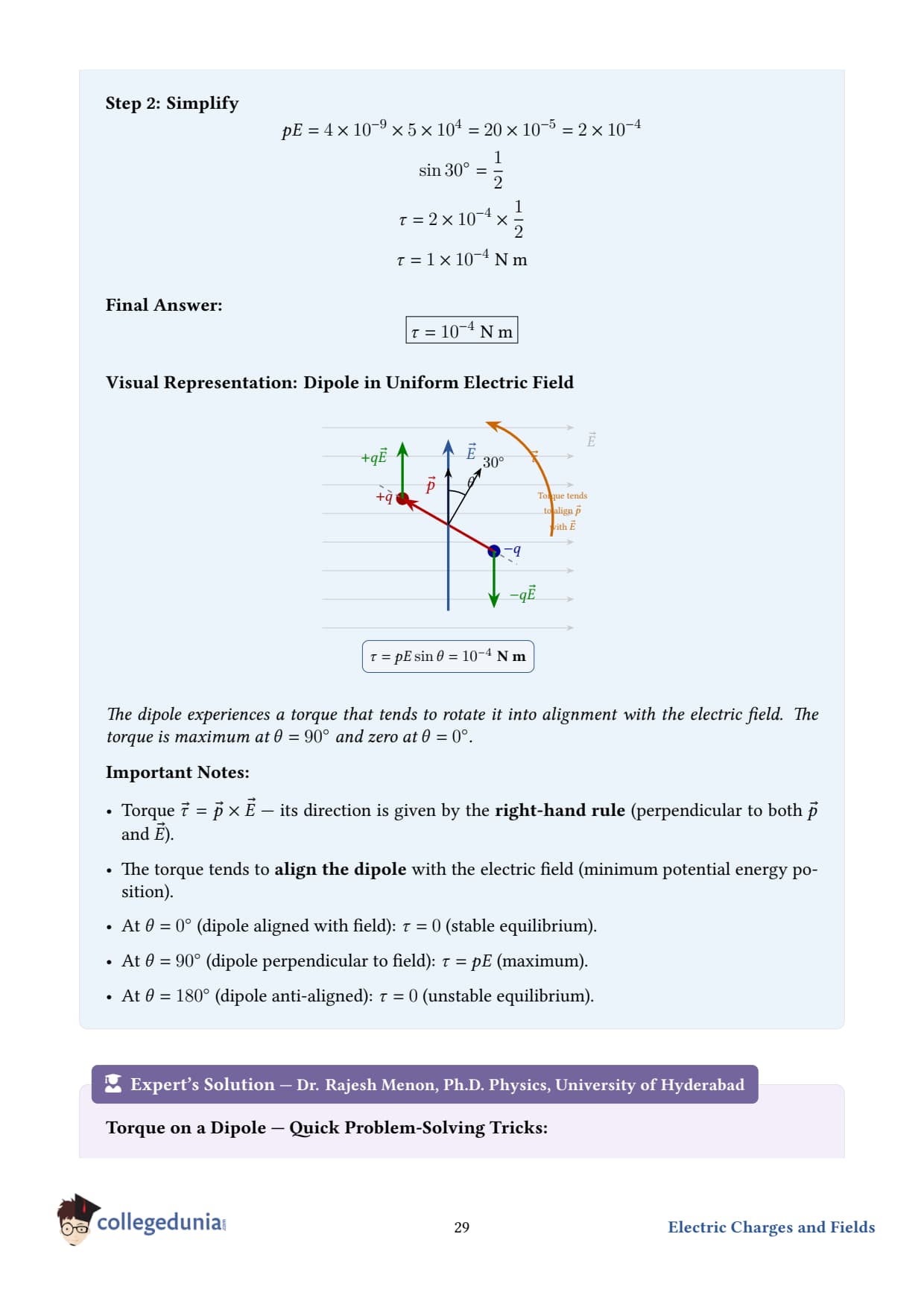
An electric dipole with dipole moment 410-9 C m is aligned at 30° with the direction of a uniform electric field of magnitude 5104 N C-1. Calculate the magnitude of the torque acting on the dipole.
Q 1.11
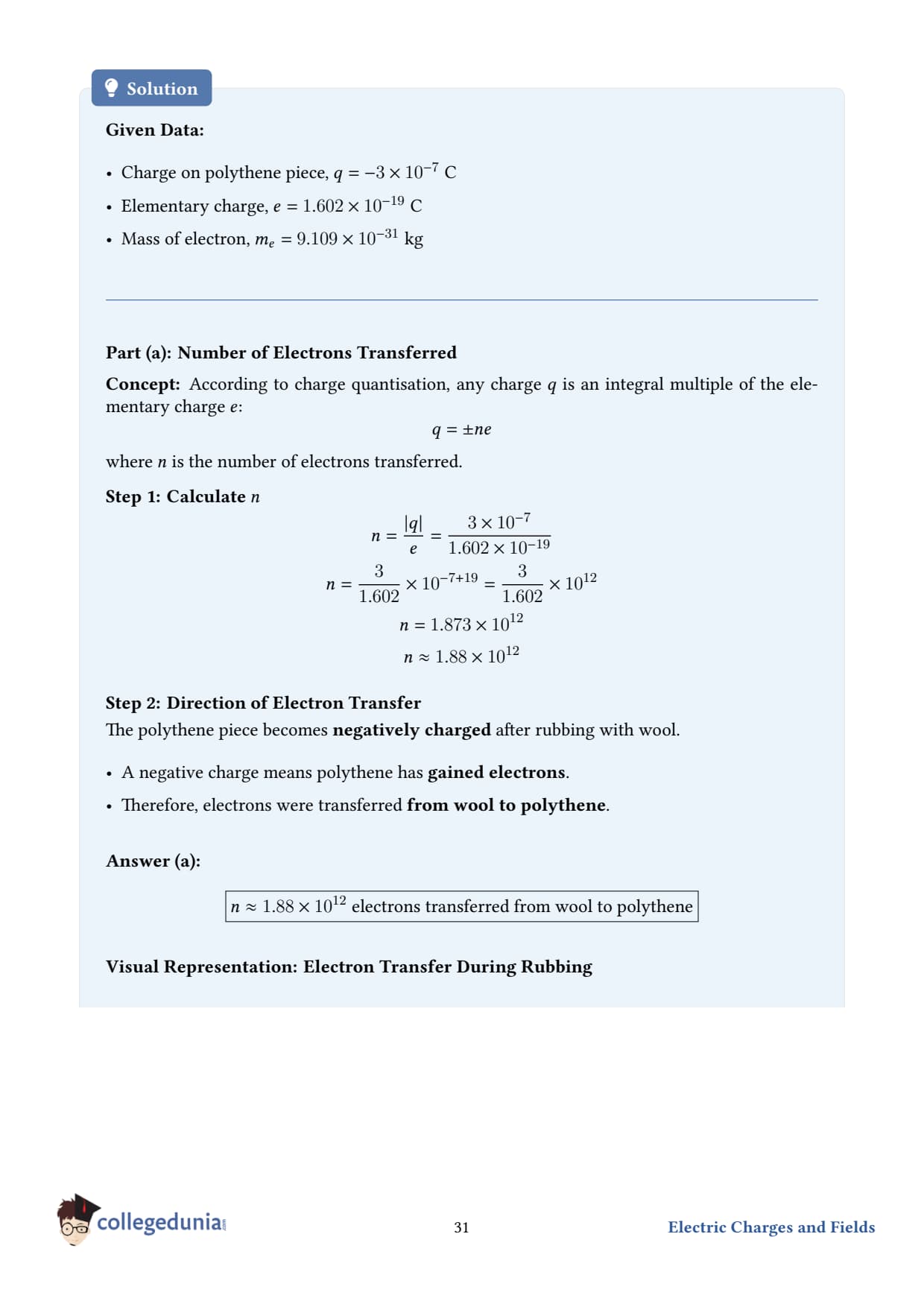
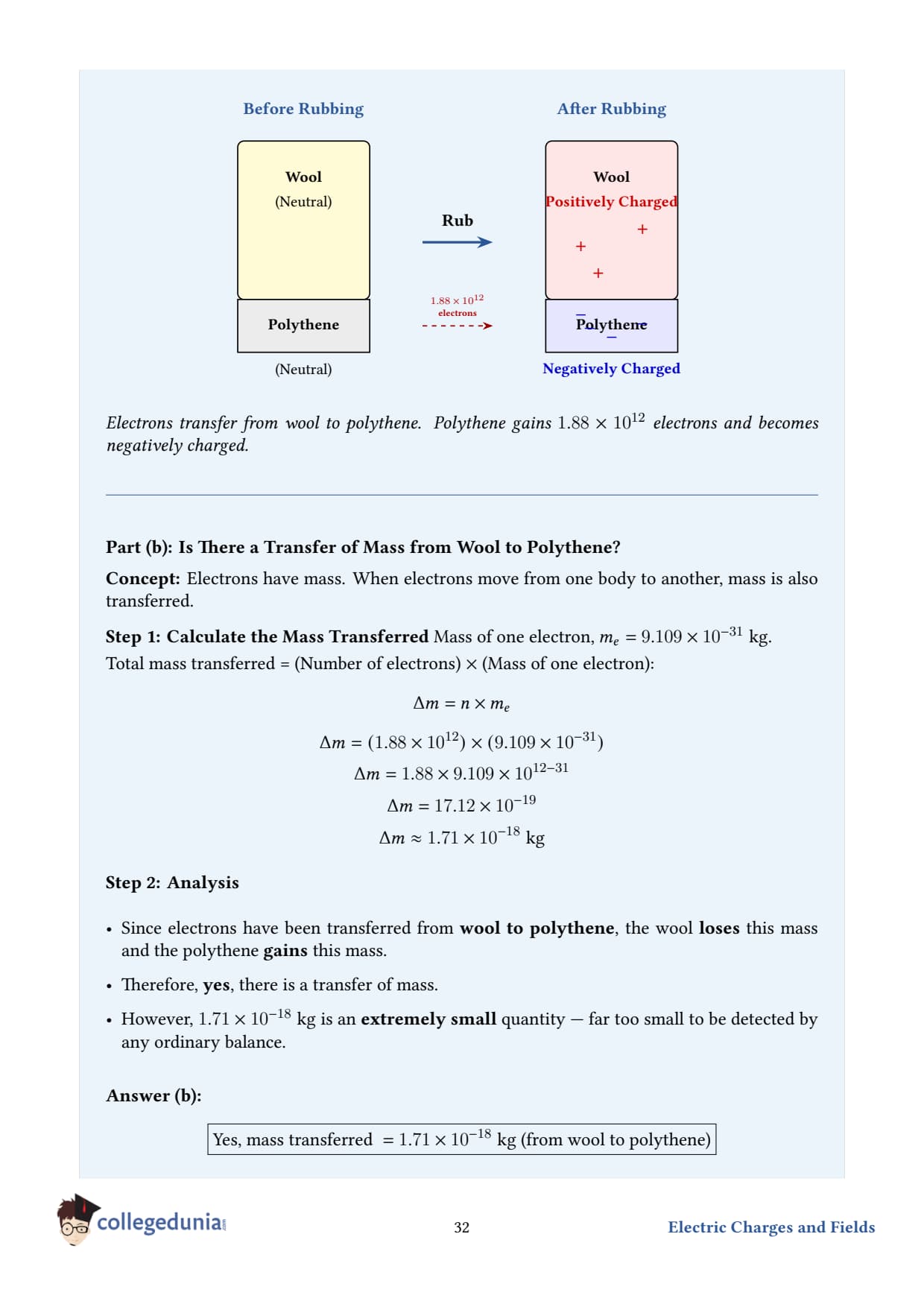
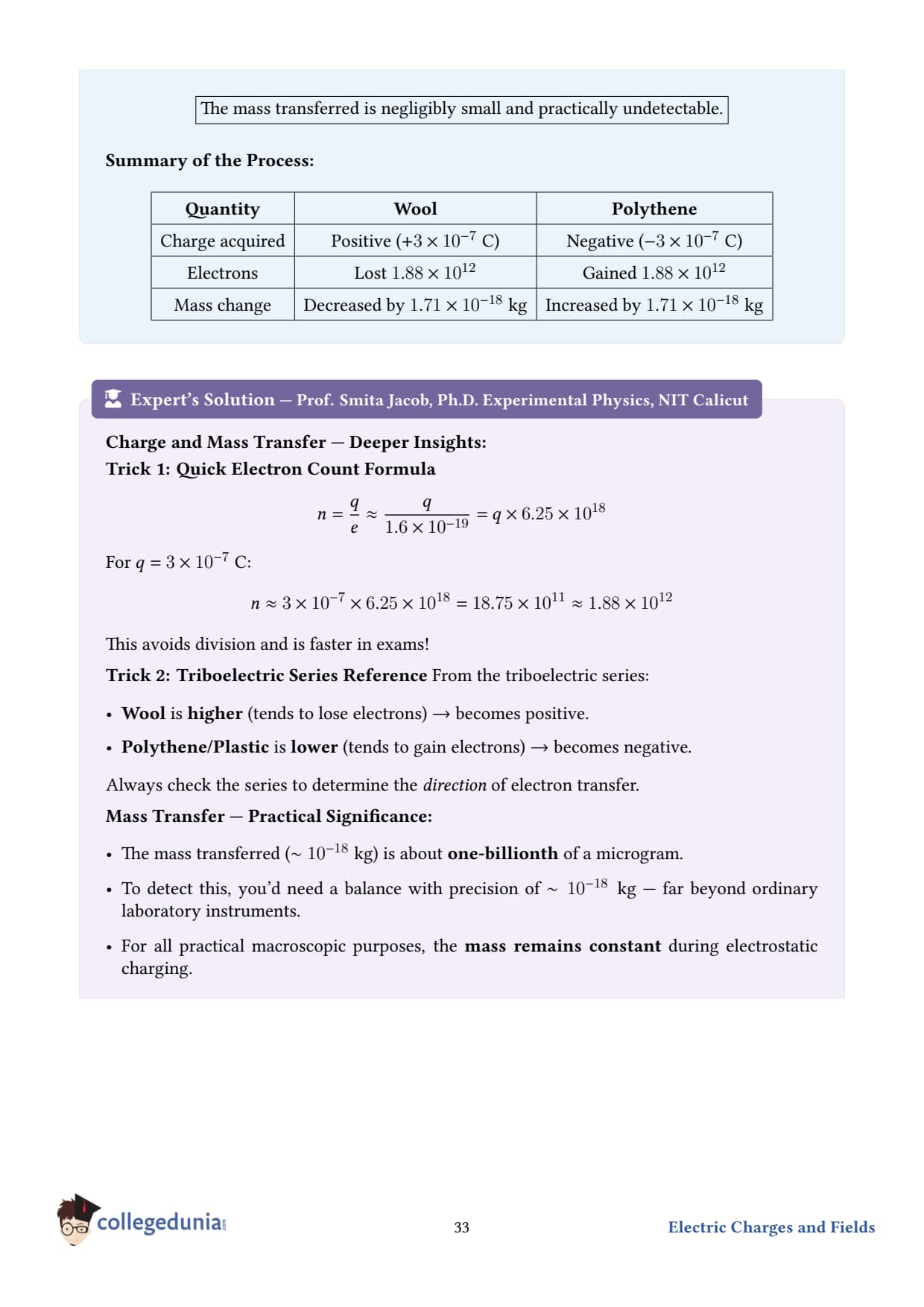
A polythene piece rubbed with wool is found to have a negative charge of 310-7 C.
(a) Estimate the number of electrons transferred (from which to which?).
(b) Is there a transfer of mass from wool to polythene?
Q 1.12
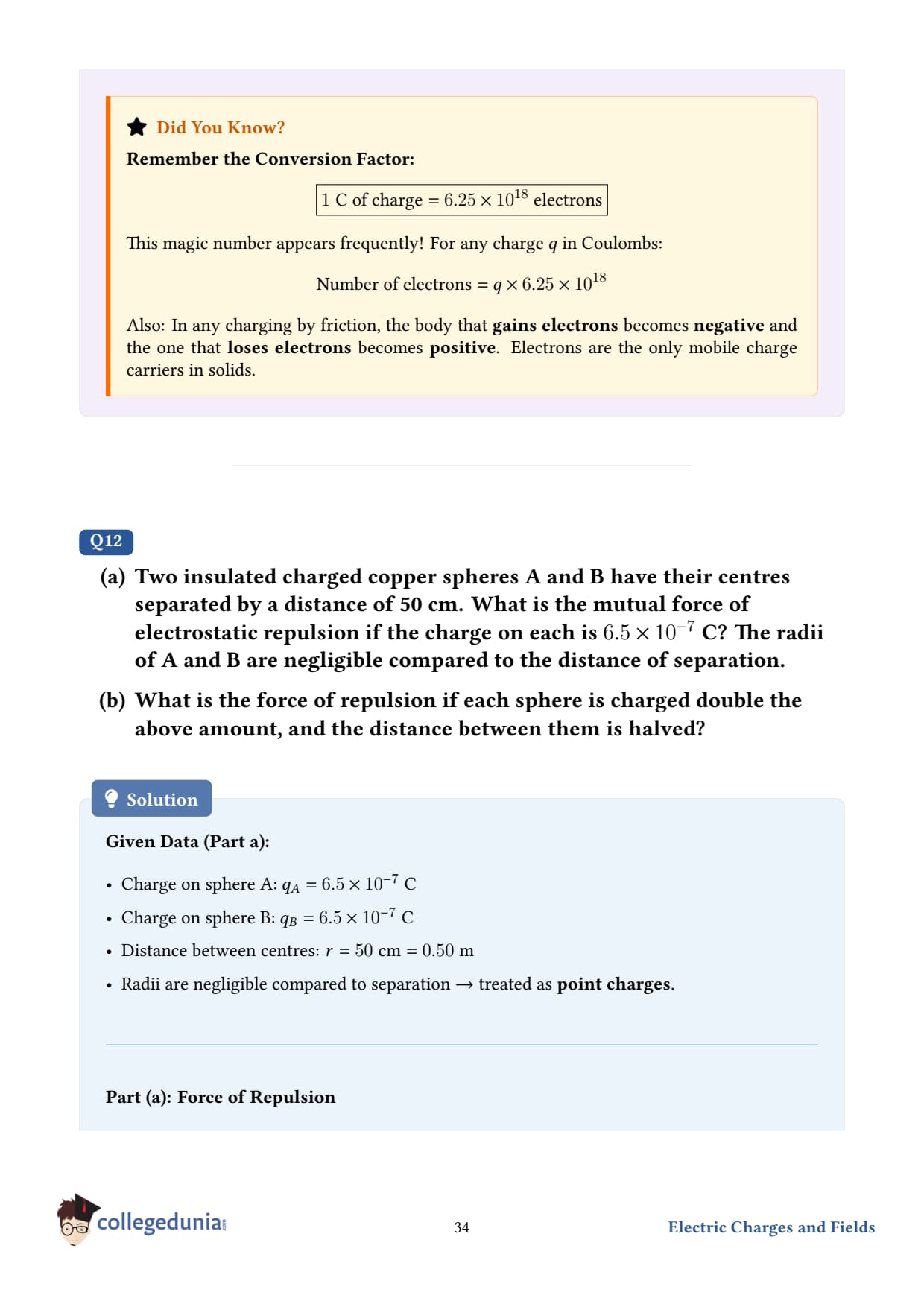
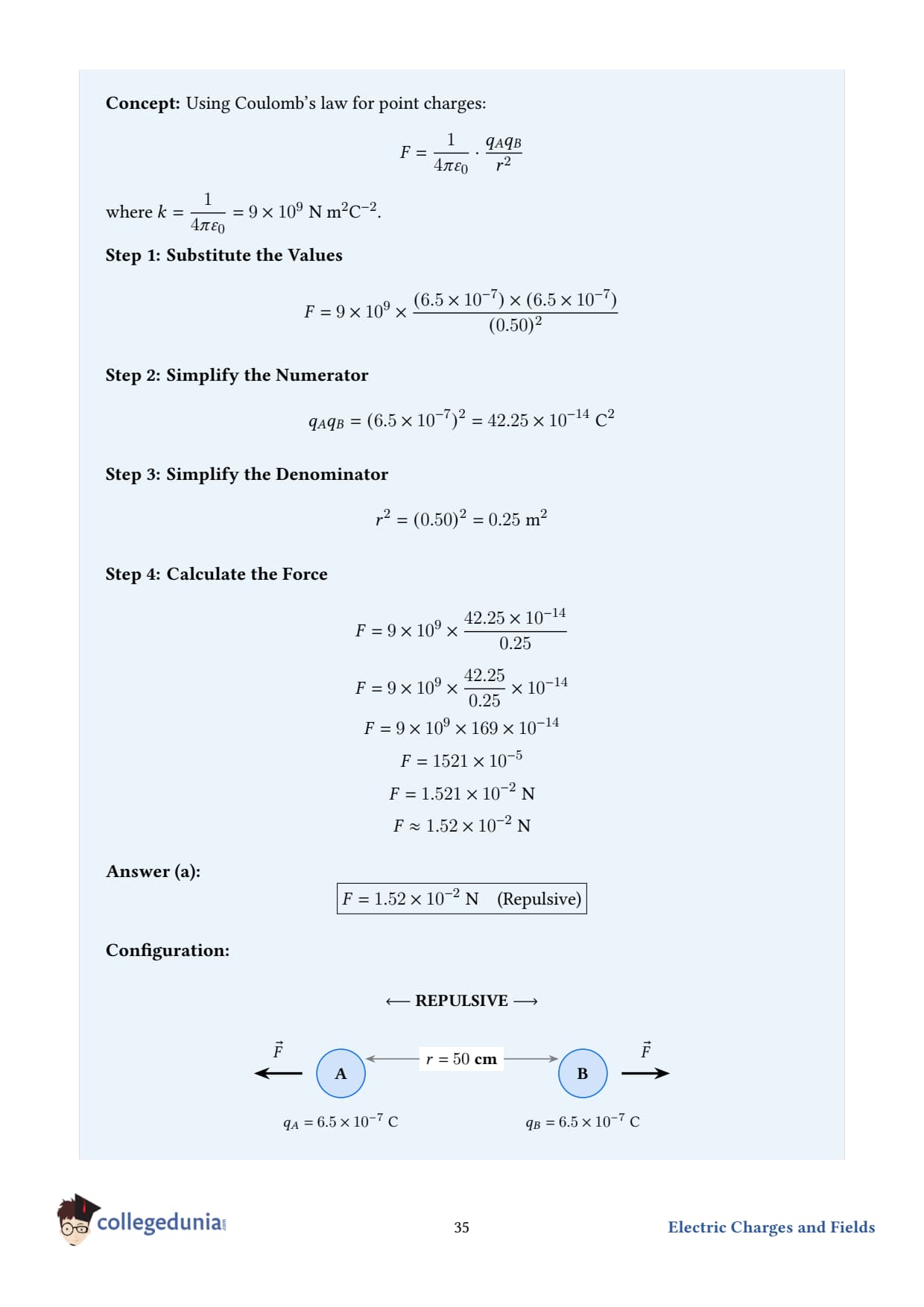
(a) Two insulated charged copper spheres A and B have their centres separated by a distance of 50 cm. What is the mutual force of electrostatic repulsion if the charge on each is 6.510-7 C? The radii of A and B are negligible compared to the distance of separation.
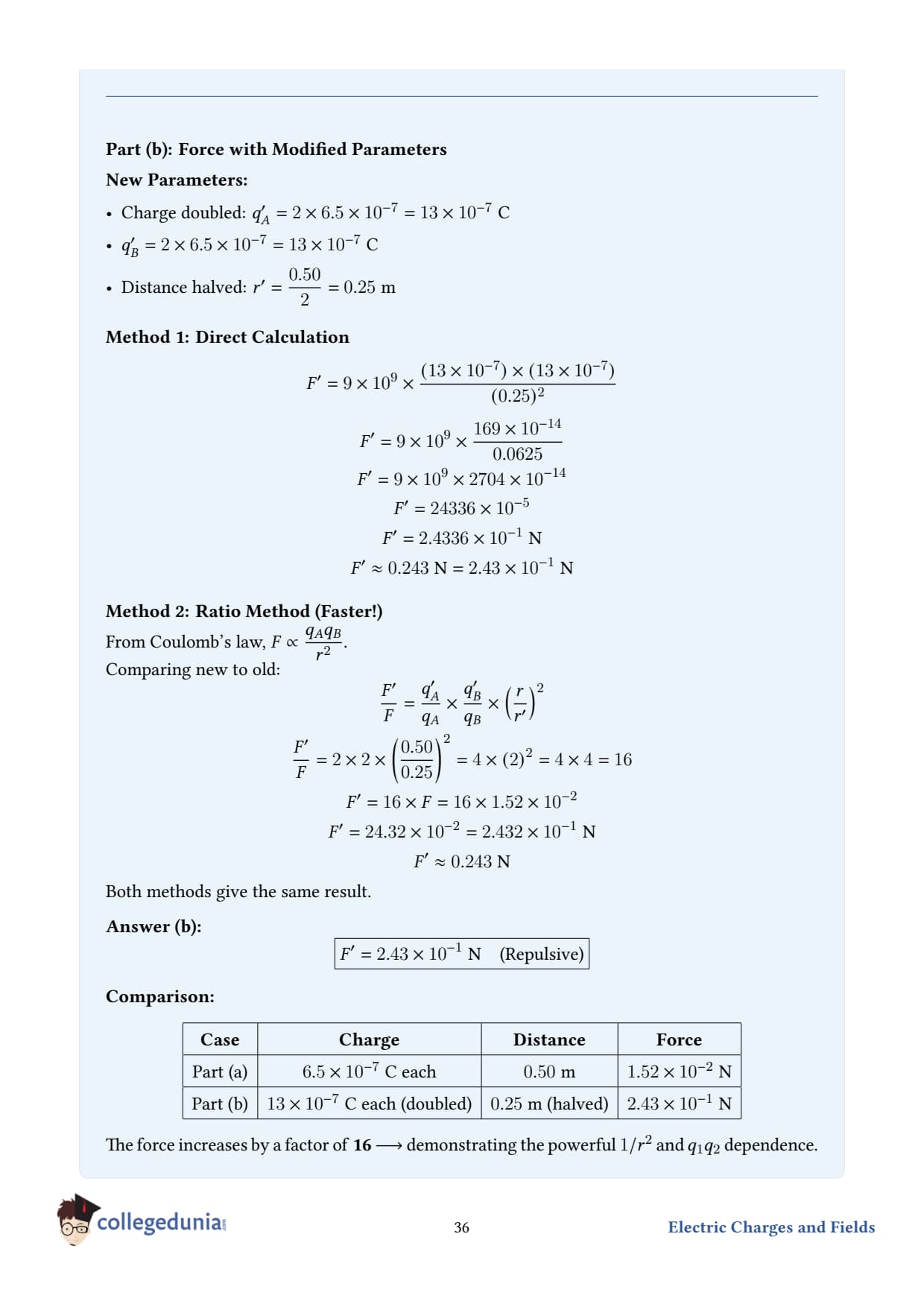
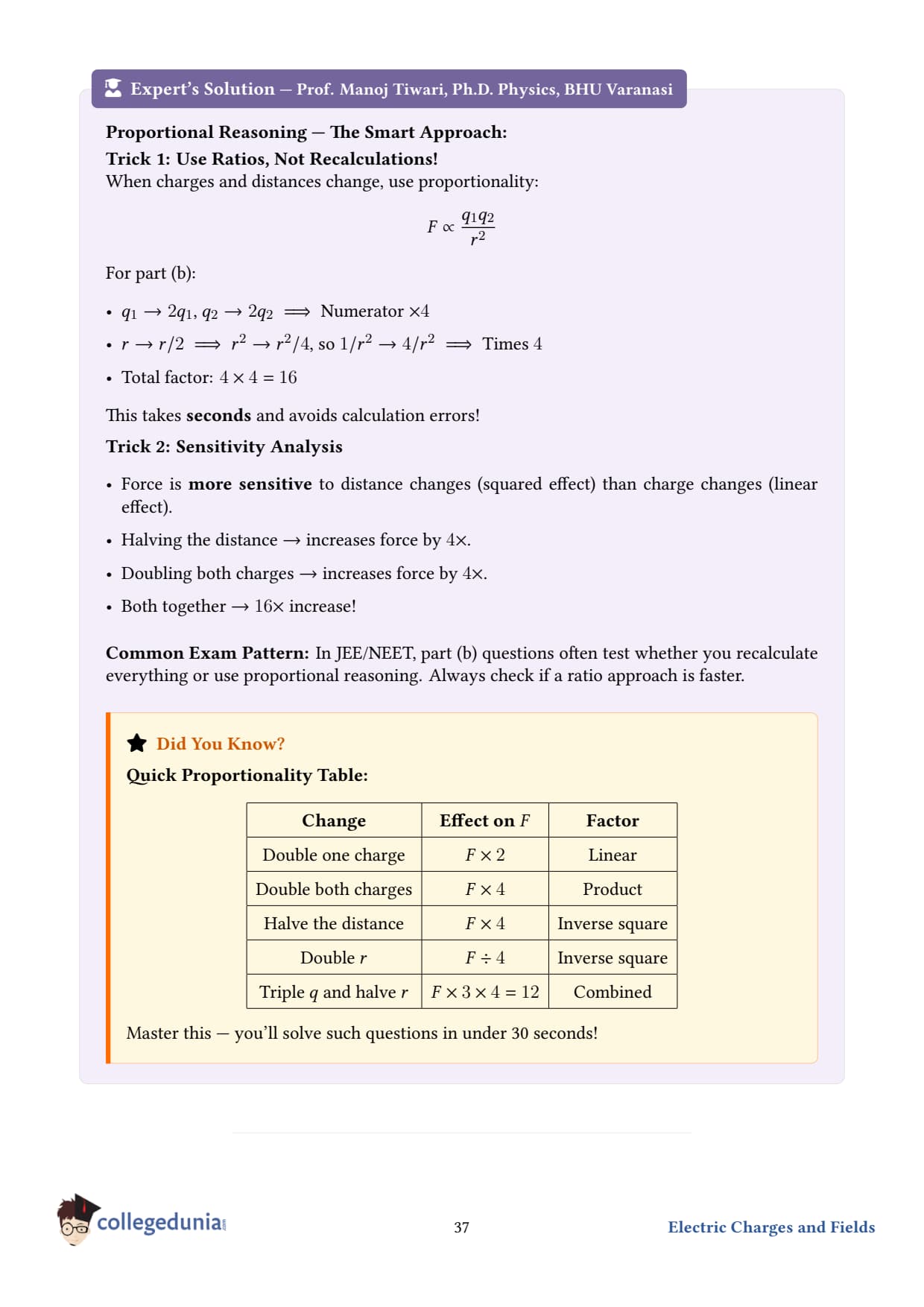
(b) What is the force of repulsion if each sphere is charged double the above amount, and the distance between them is halved?
Q 1.13
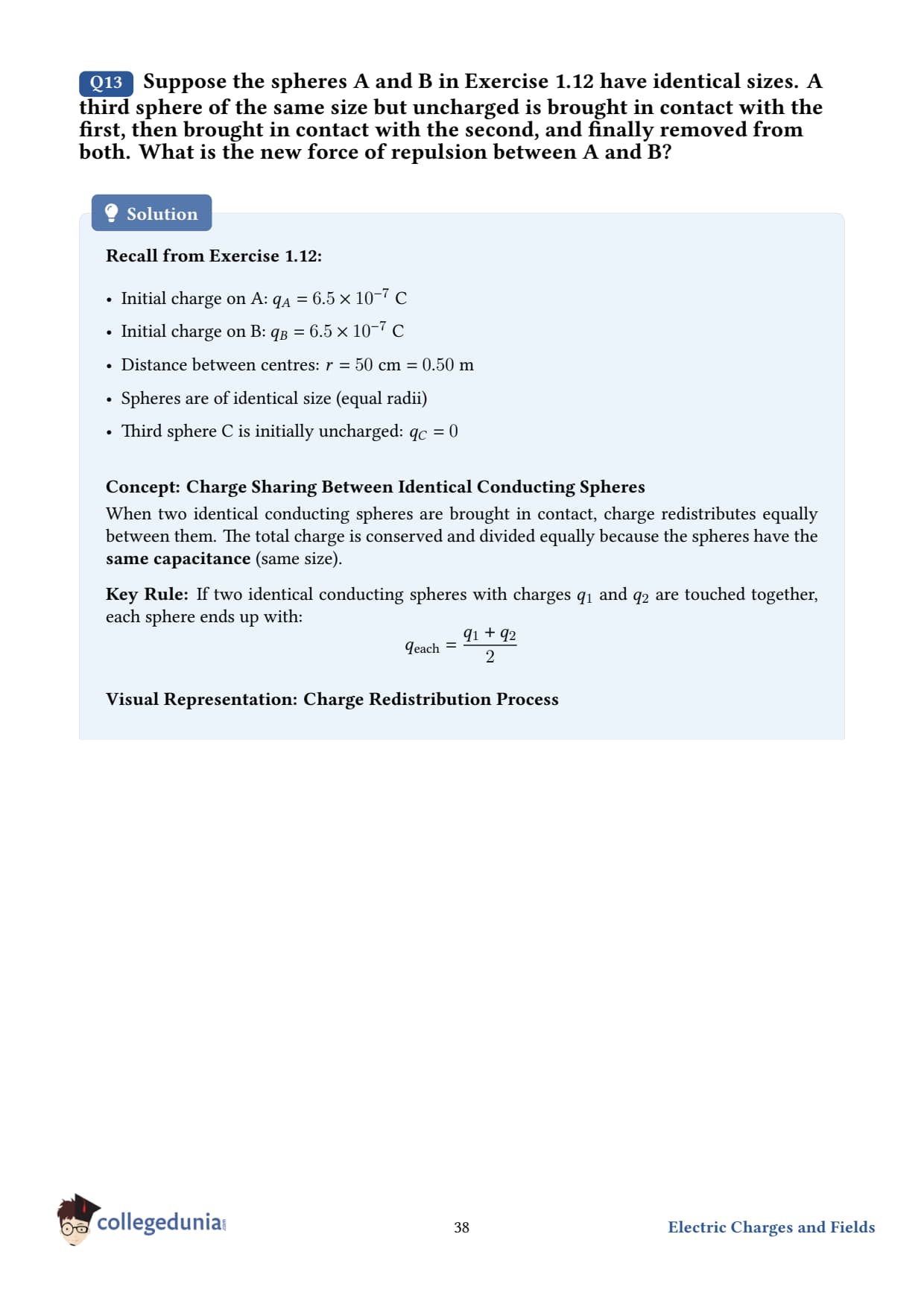
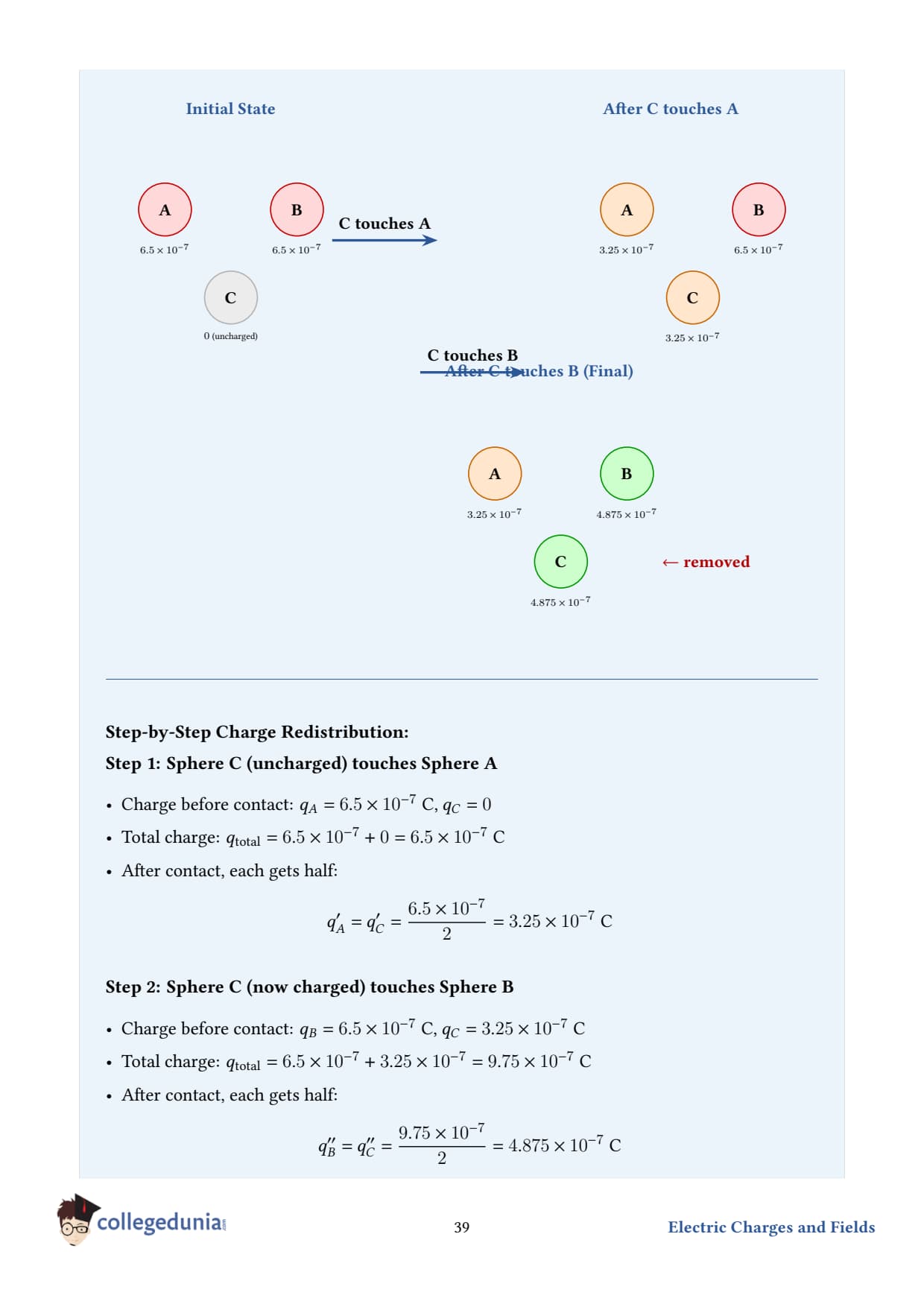
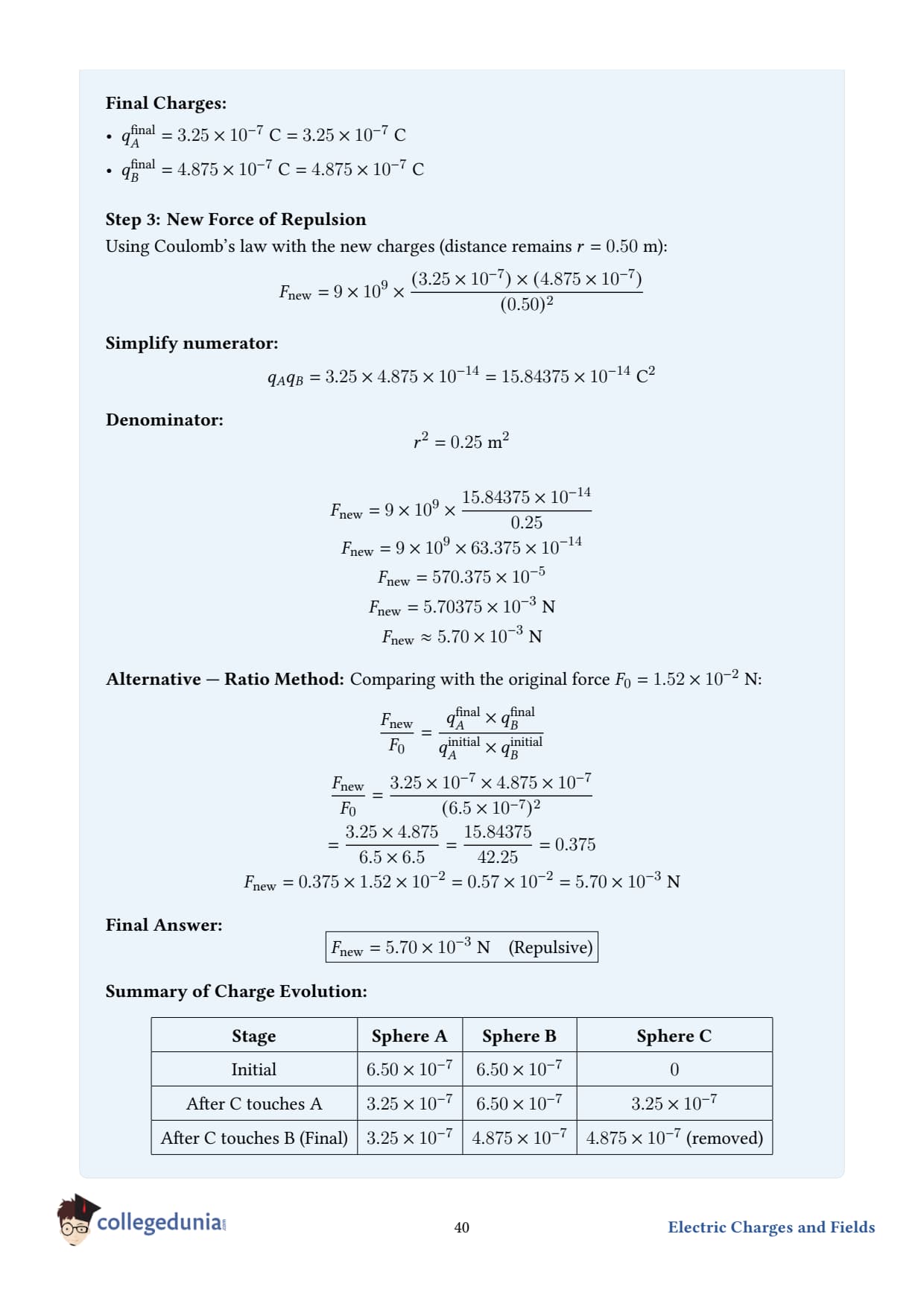
Suppose the spheres A and B in Exercise 1.12 have identical sizes. A third sphere of the same size but uncharged is brought in contact with the first, then brought in contact with the second, and finally removed from both. What is the new force of repulsion between A and B?
Q 1.14
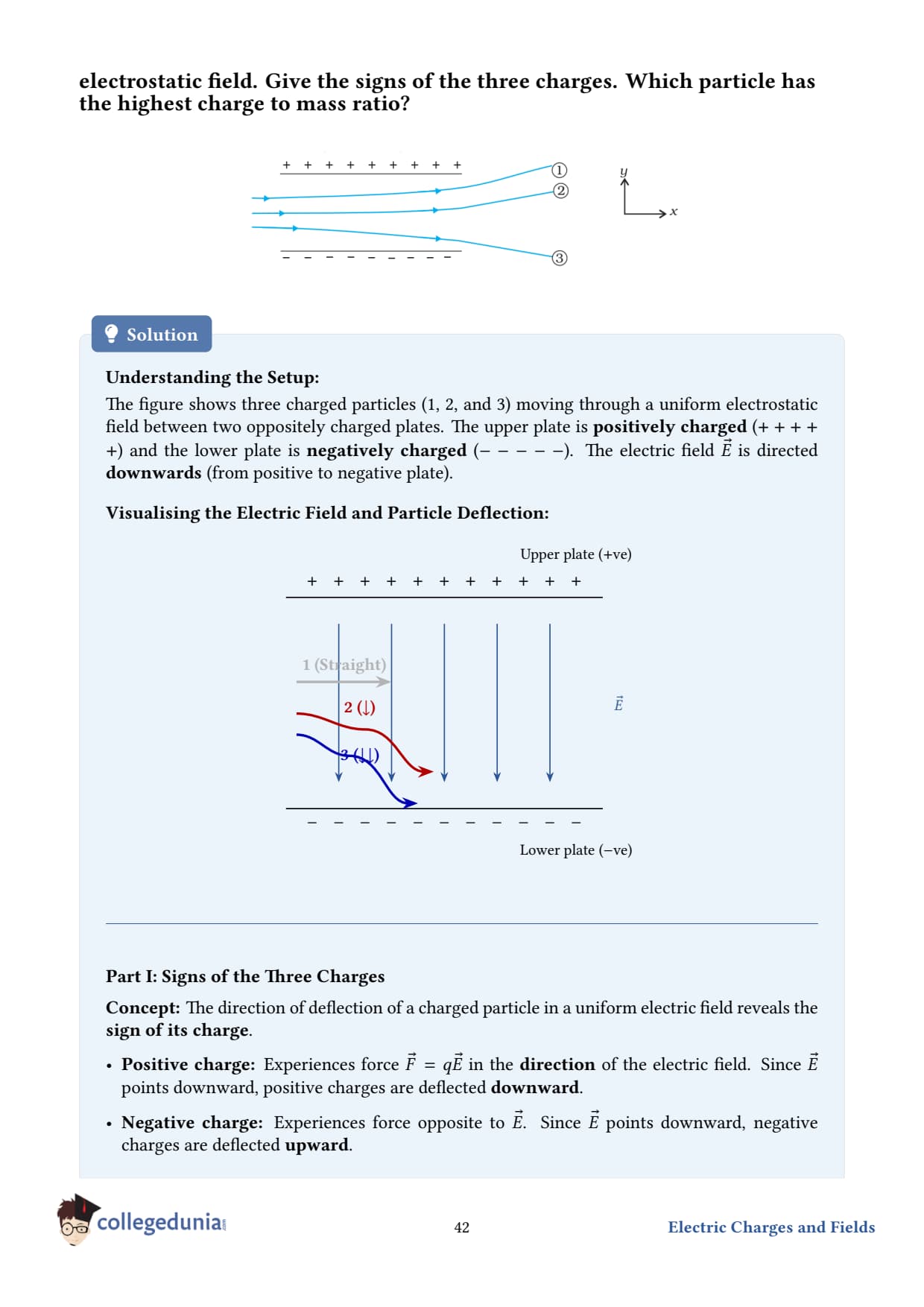
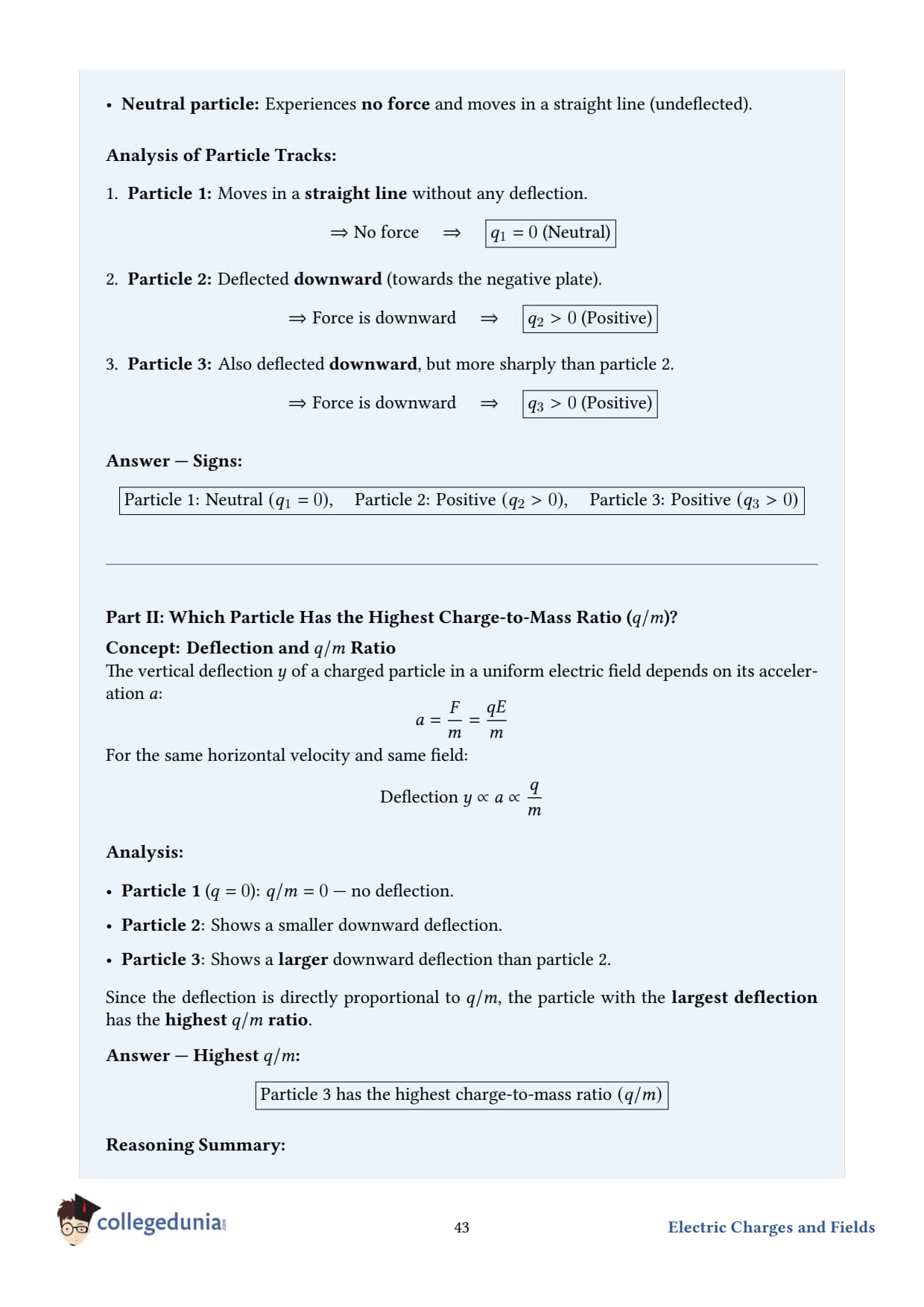
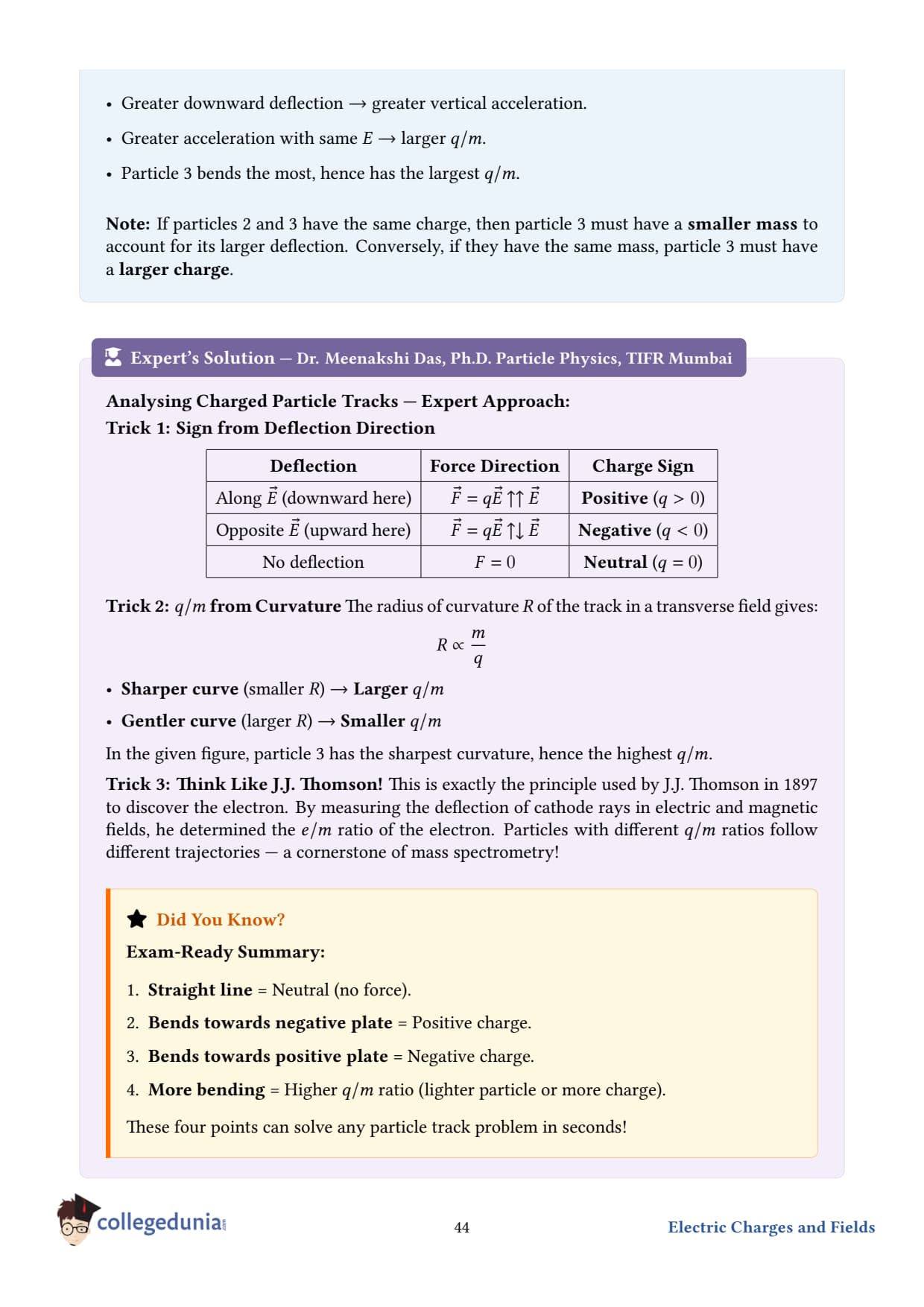
Figure 1.33 shows tracks of three charged particles in a uniform electrostatic field. Give the signs of the three charges. Which particle has the highest charge-to-mass ratio?
Q 1.15
Consider a uniform electric field E = 3103 N/C.
(a) What is the flux of this field through a square of 10 cm on a side whose plane is parallel to the yz-plane?
(b) What is the flux through the same square if the normal to its plane makes a 60° angle with the x-axis?
Q 1.16
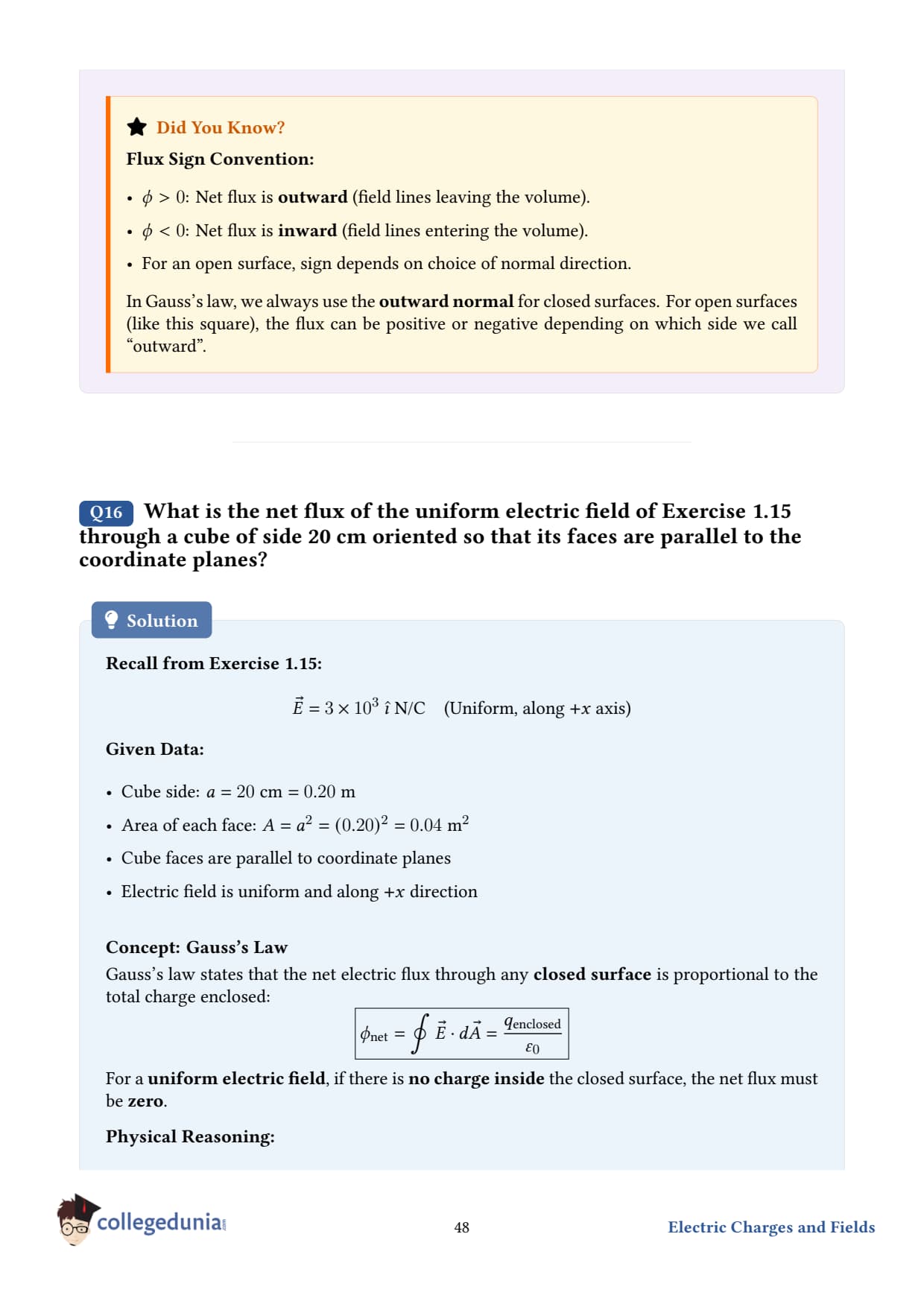
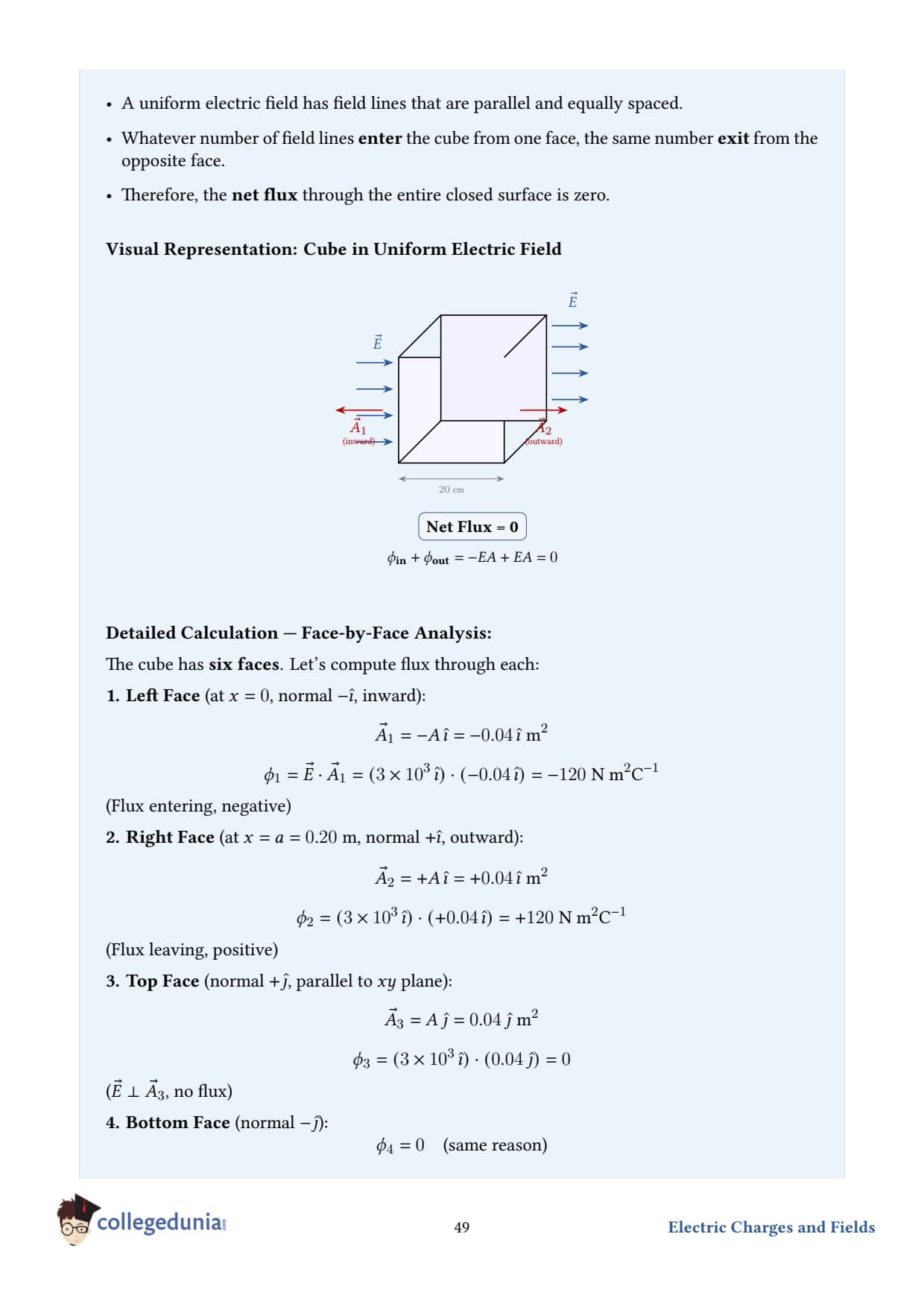
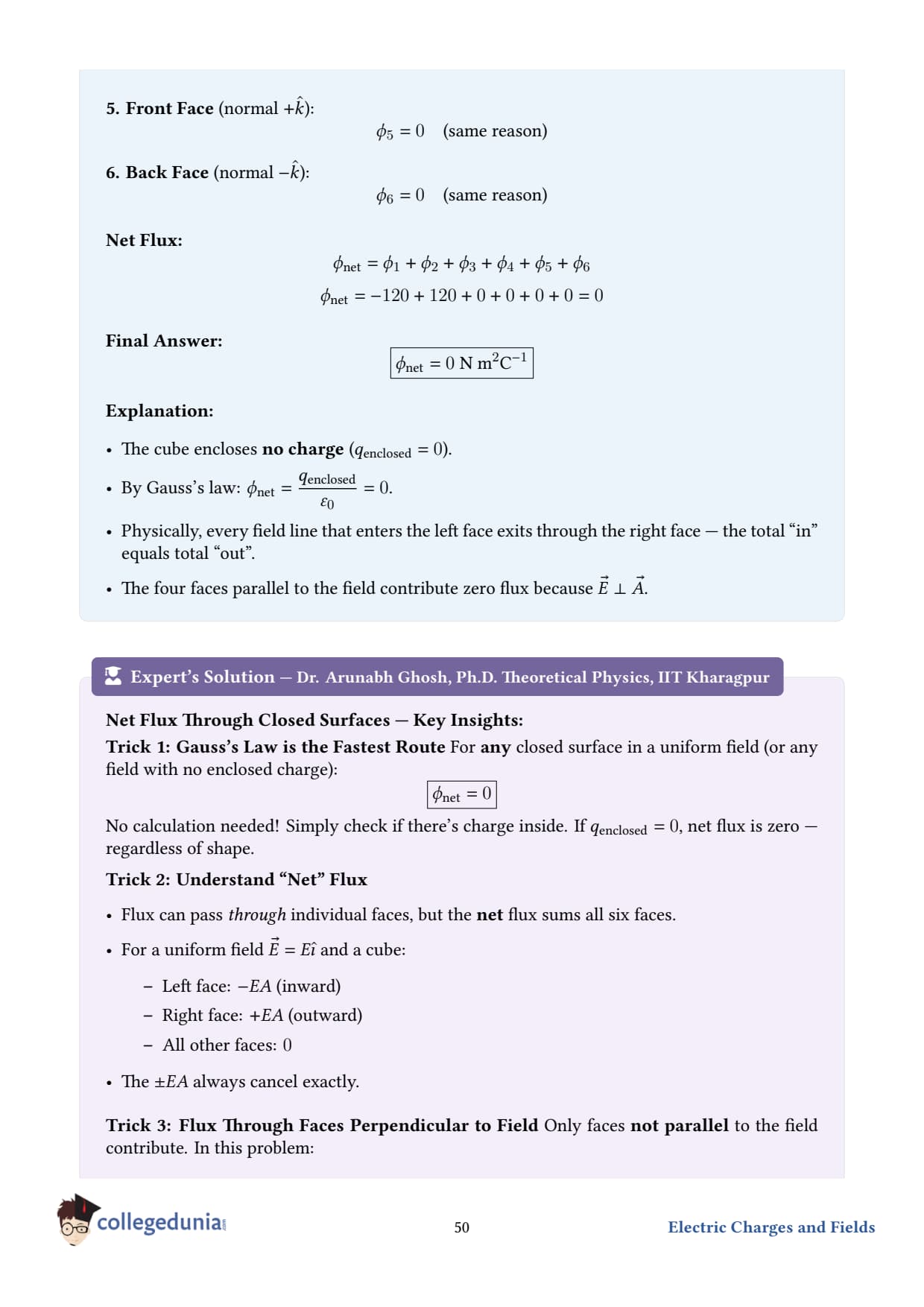
What is the net flux of the uniform electric field of Exercise 1.15 through a cube of side 20 cm oriented so that its faces are parallel to the coordinate planes?
Q 1.17
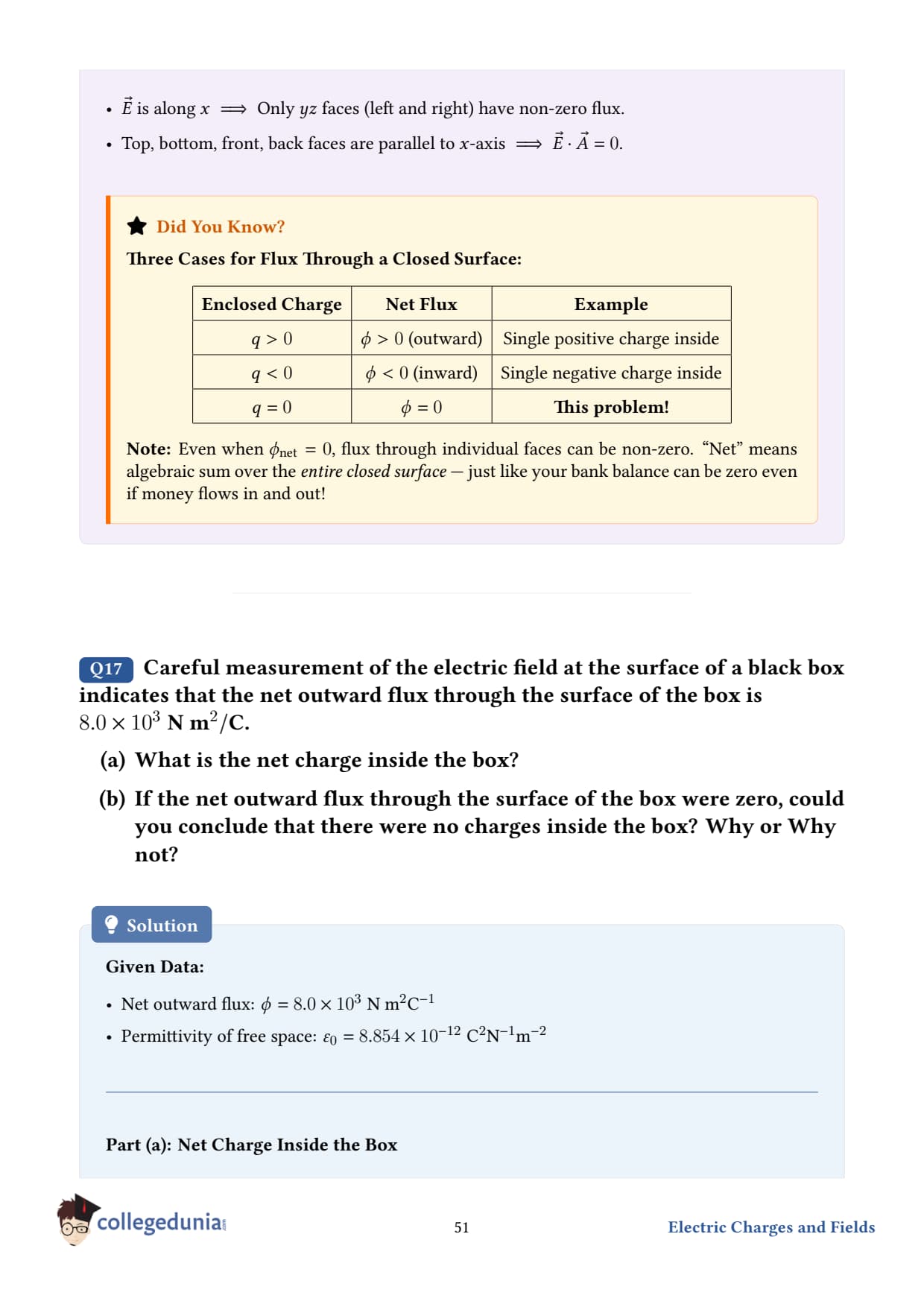
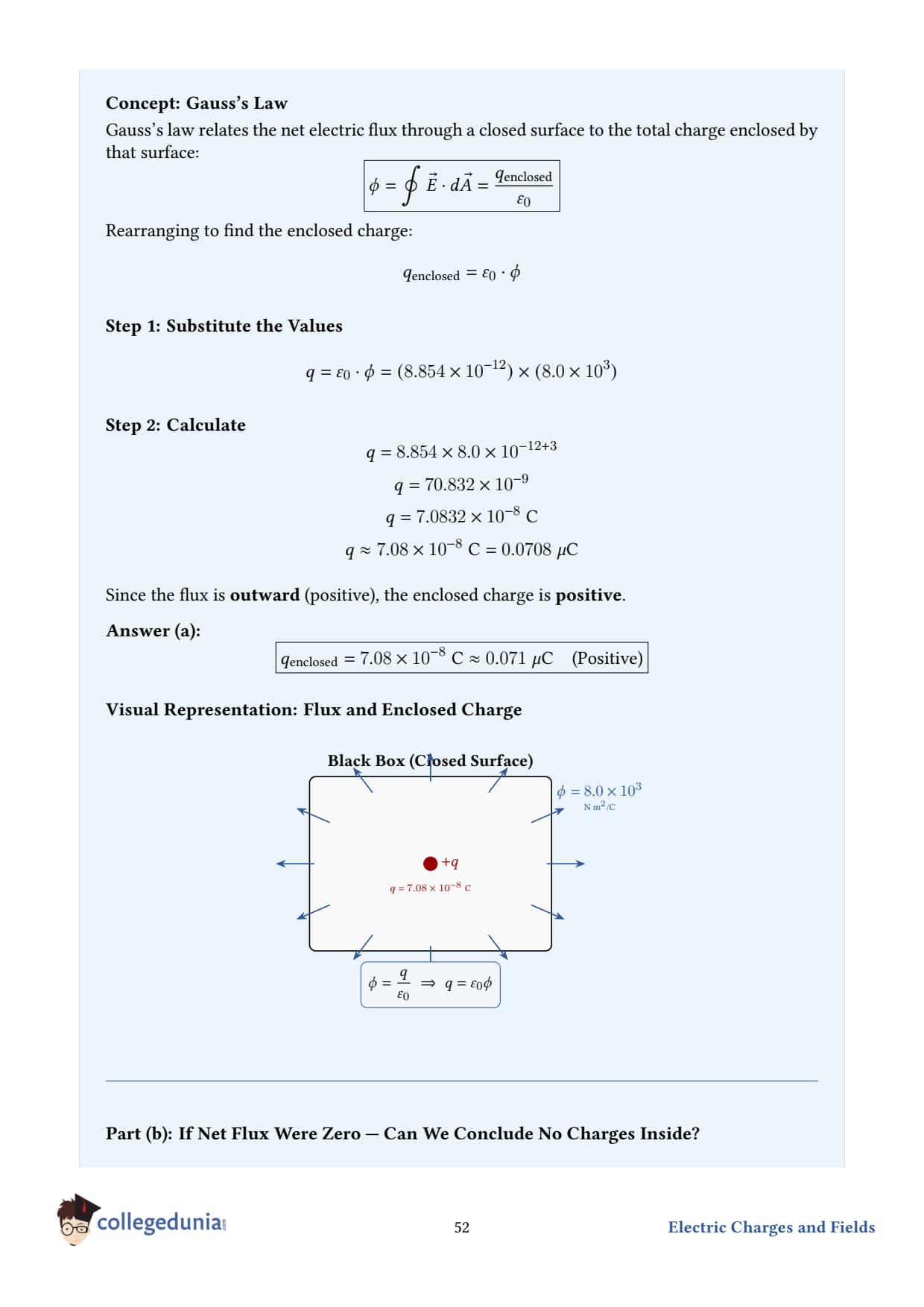
Careful measurement of the electric field at the surface of a black box indicates that the net outward flux through the surface of the box is 8.0103 N m2/C.
(a) What is the net charge inside the box?
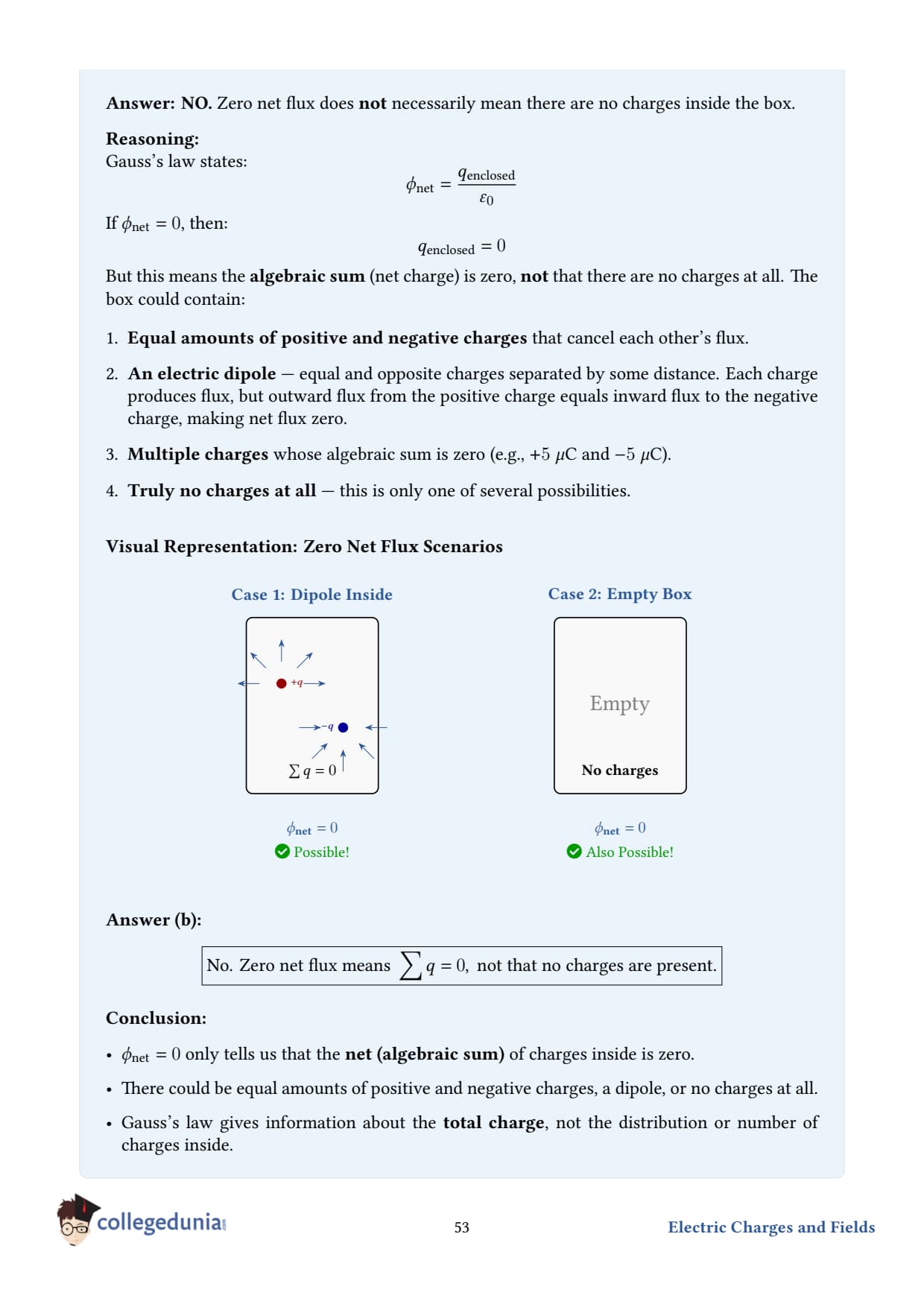
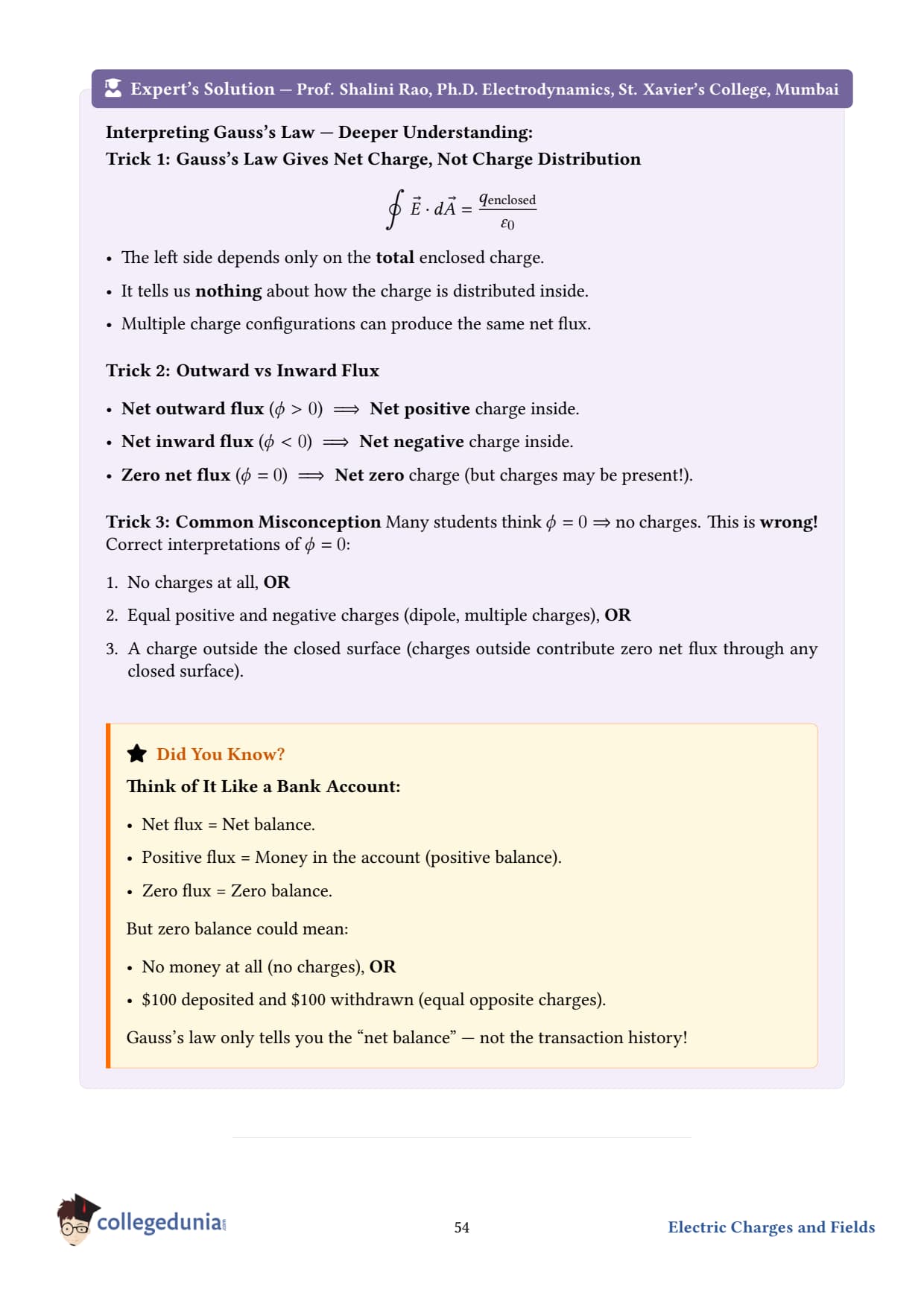
(b) If the net outward flux through the surface of the box were zero, could you conclude that there were no charges inside the box? Why or why not?
Q 1.18
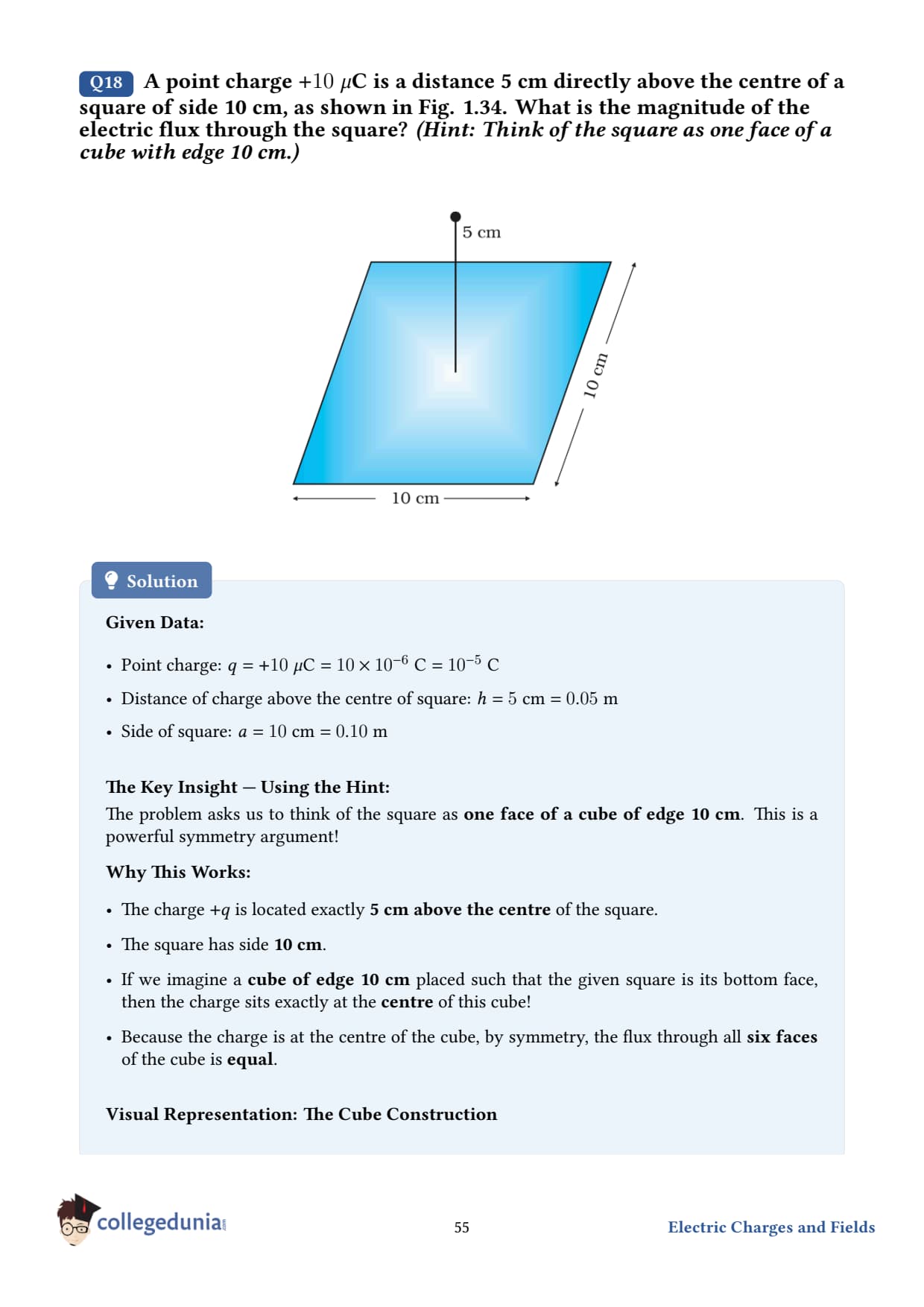
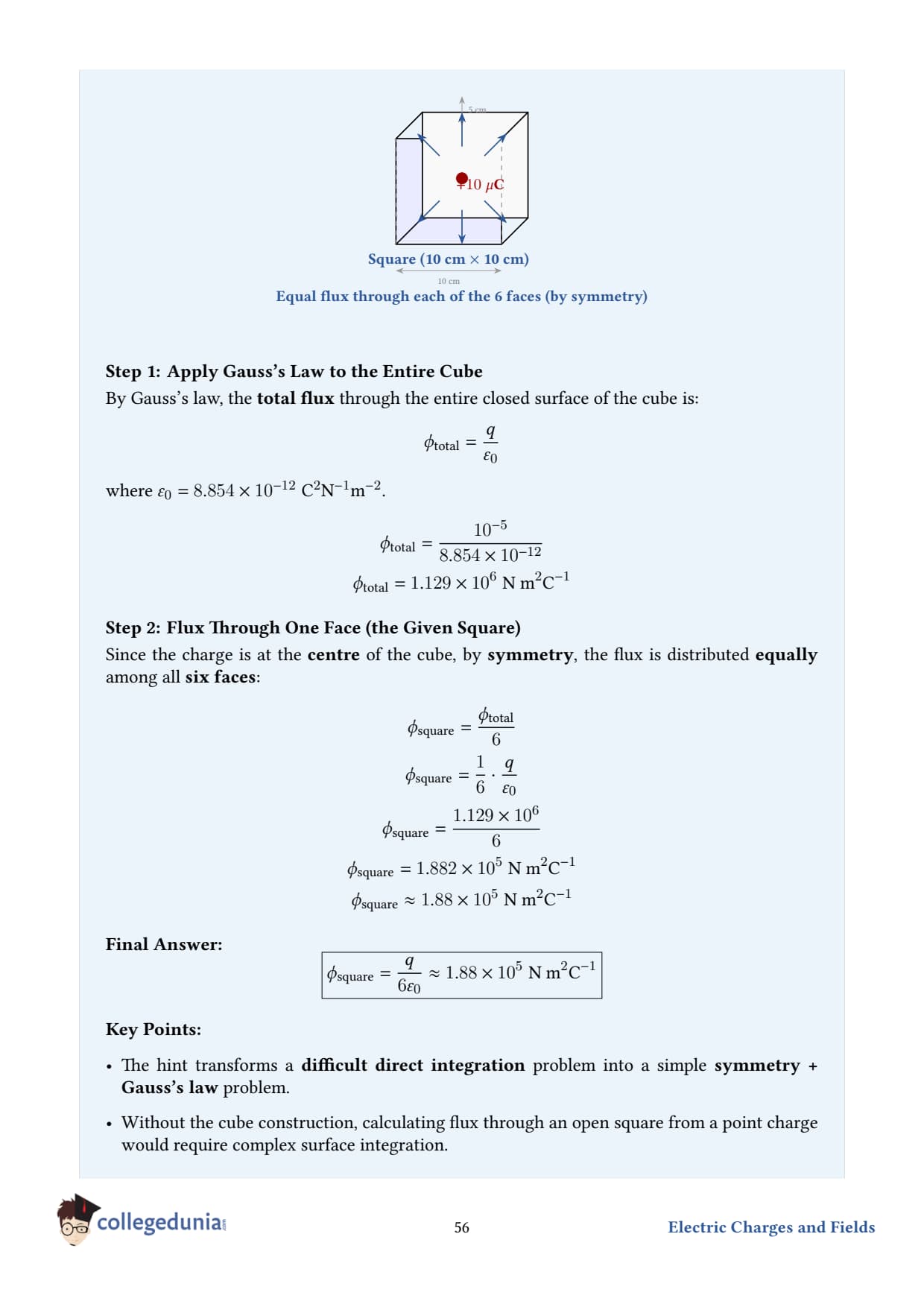
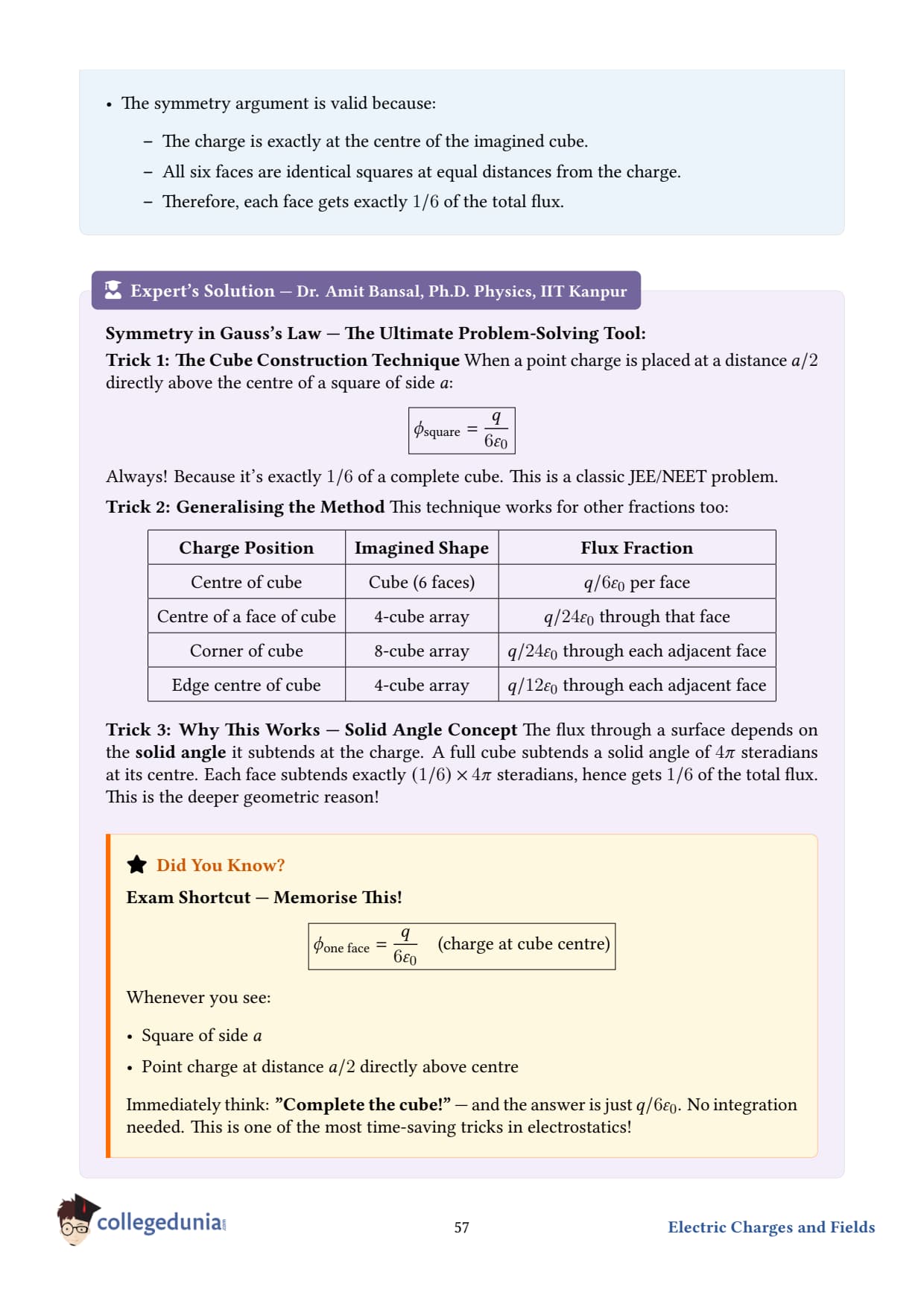
A point charge +10 is a distance 5 cm directly above the centre of a square of side 10 cm, as shown in Fig. 1.34. What is the magnitude of the electric flux through the square? Hint: think of the square as one face of a cube with edge 10 cm.
Q 1.19
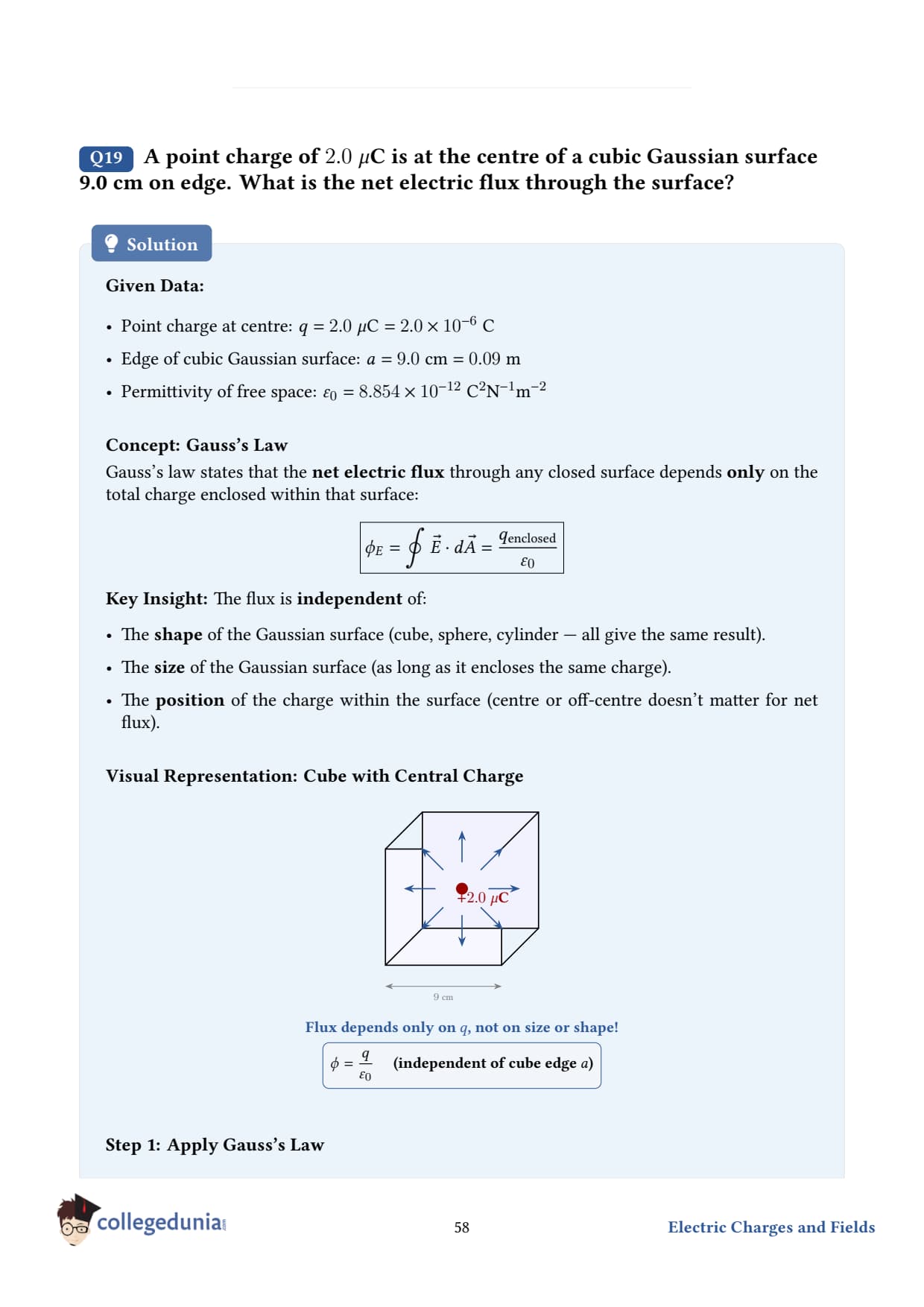
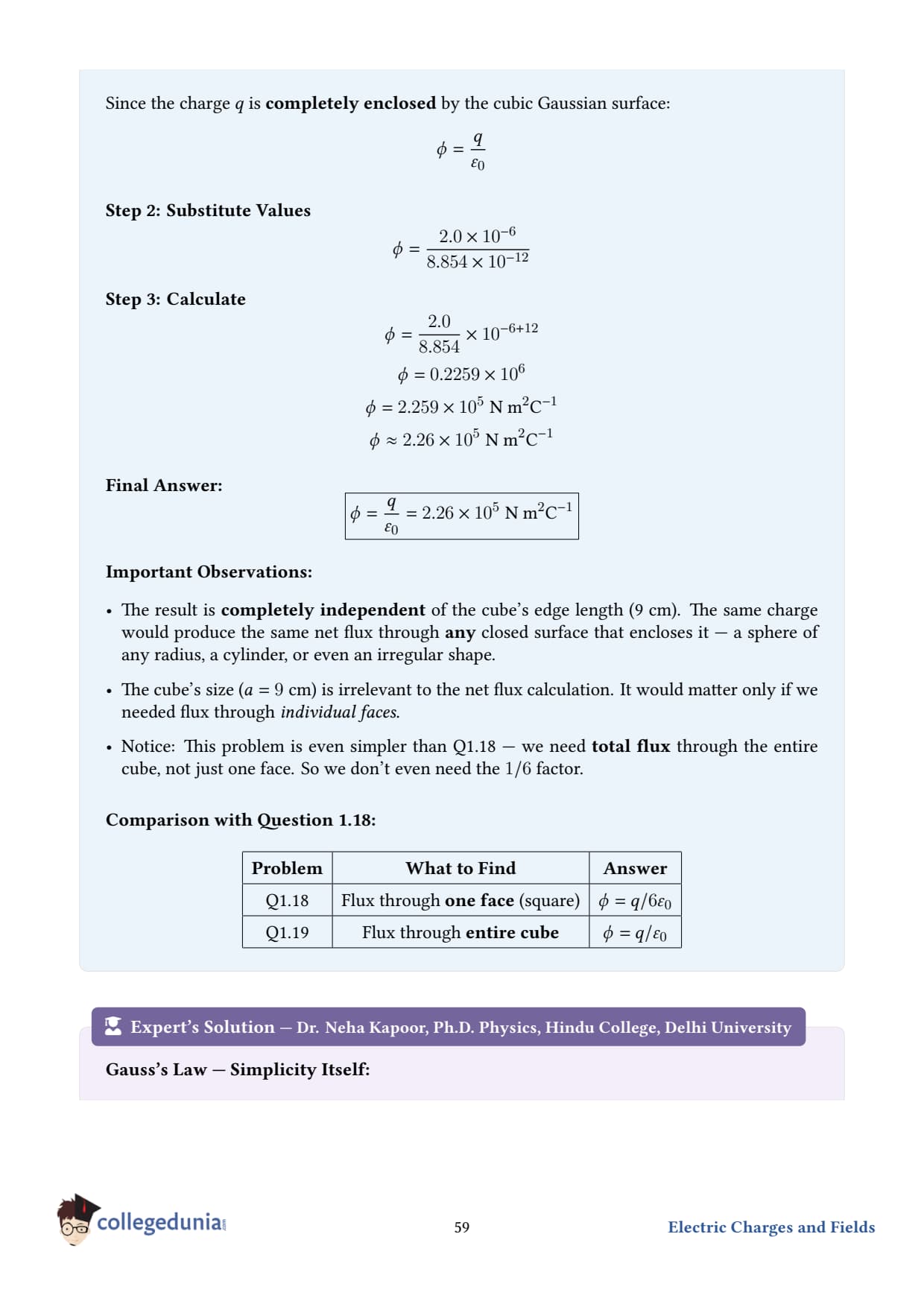
A point charge of 2.0 is at the centre of a cubic Gaussian surface 9.0 cm on edge. What is the net electric flux through the surface?
Q 1.20
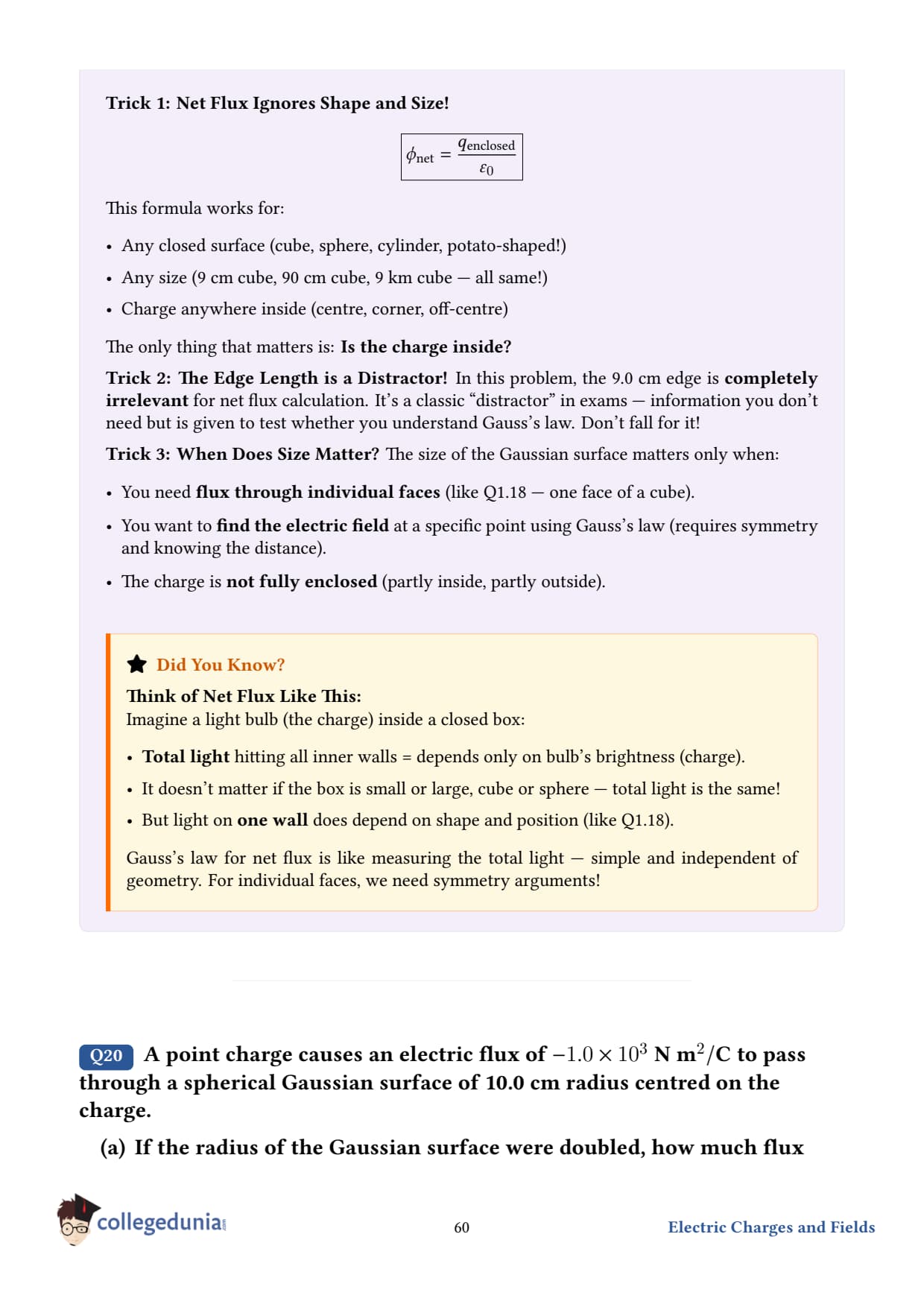
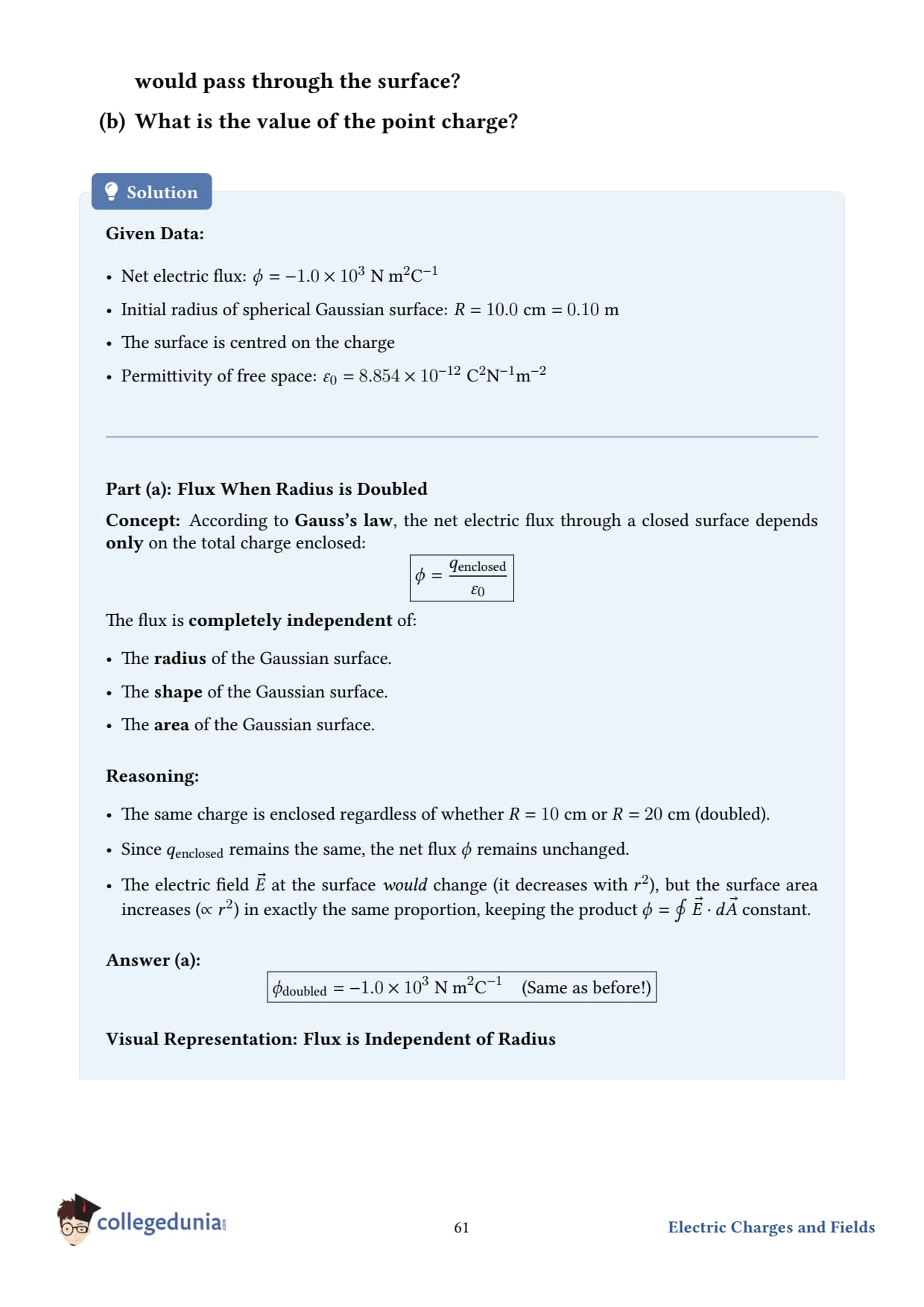
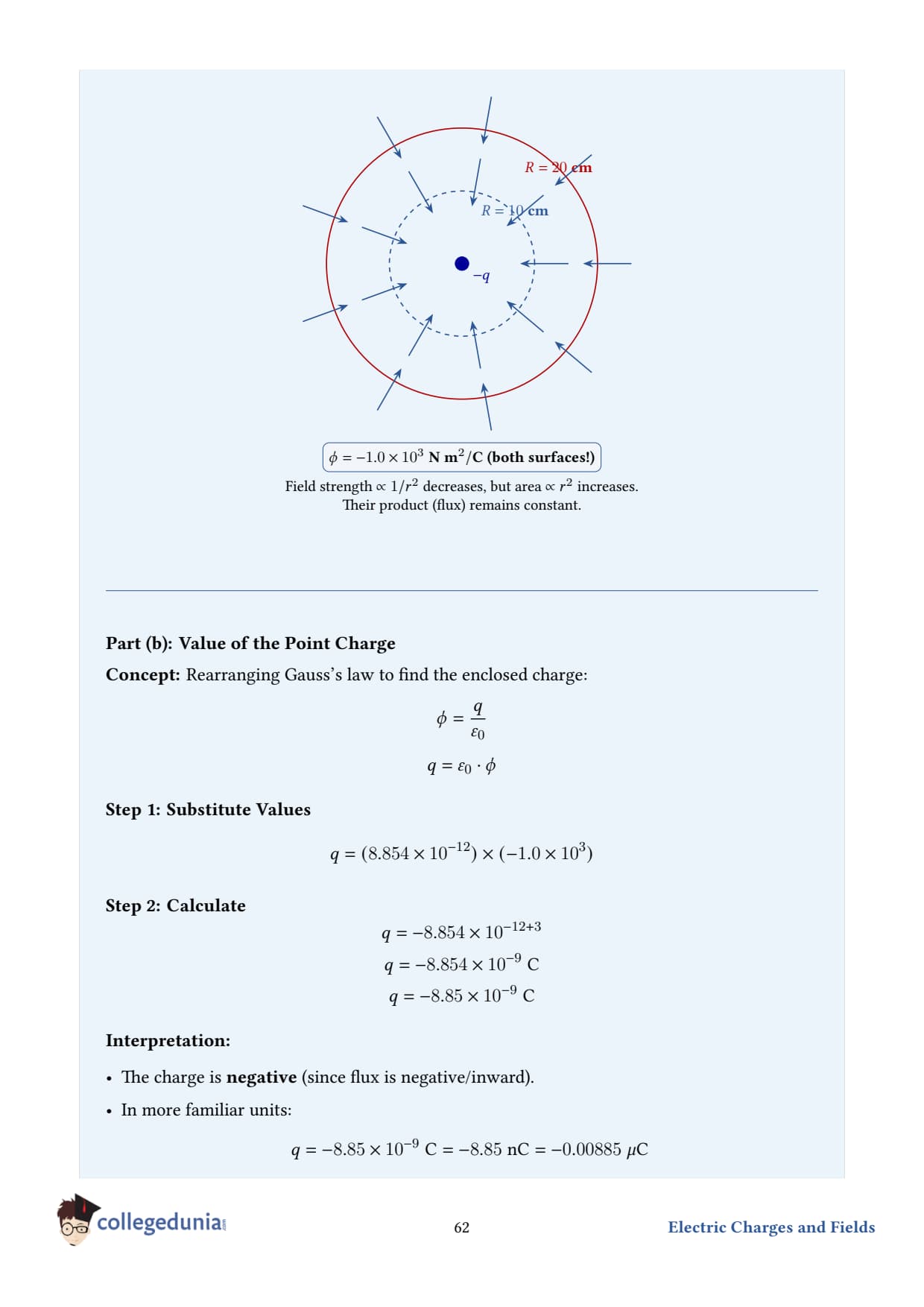
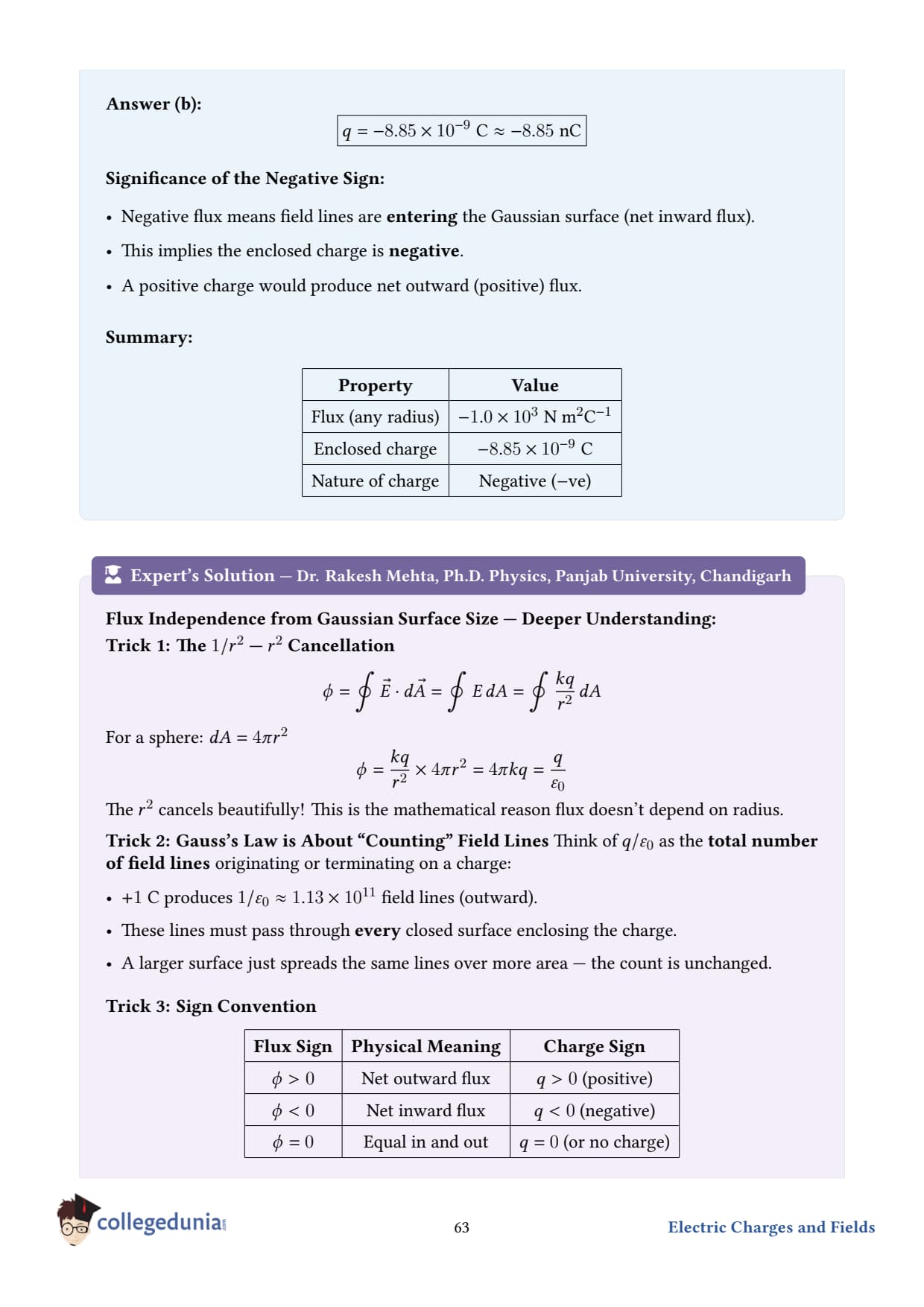
A point charge causes an electric flux of -1.0103 N m2/C to pass through a spherical Gaussian surface of 10.0 cm radius centred on the charge.
(a) If the radius of the Gaussian surface were doubled, how much flux would pass through the surface?
(b) What is the value of the point charge?
Q 1.21
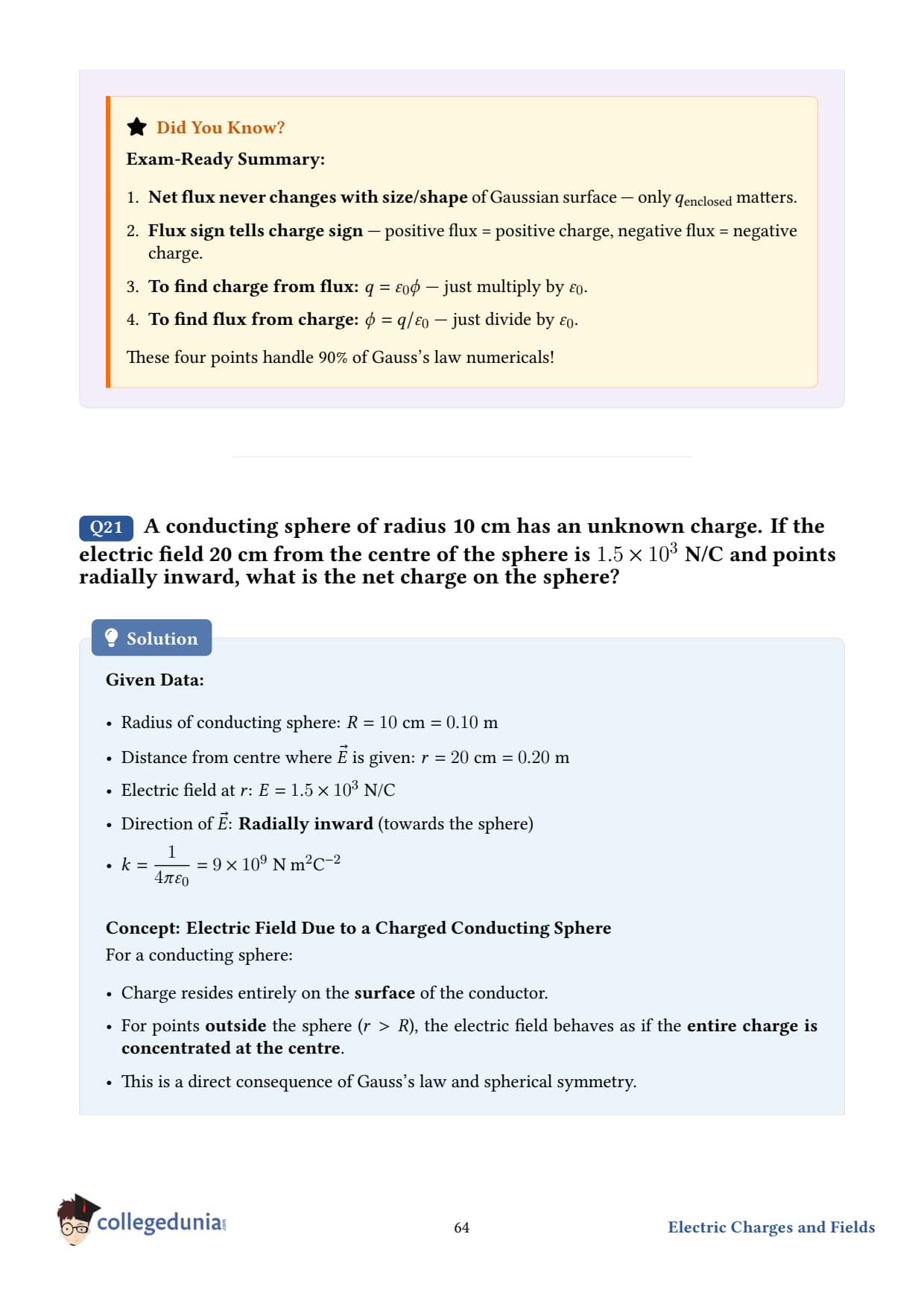
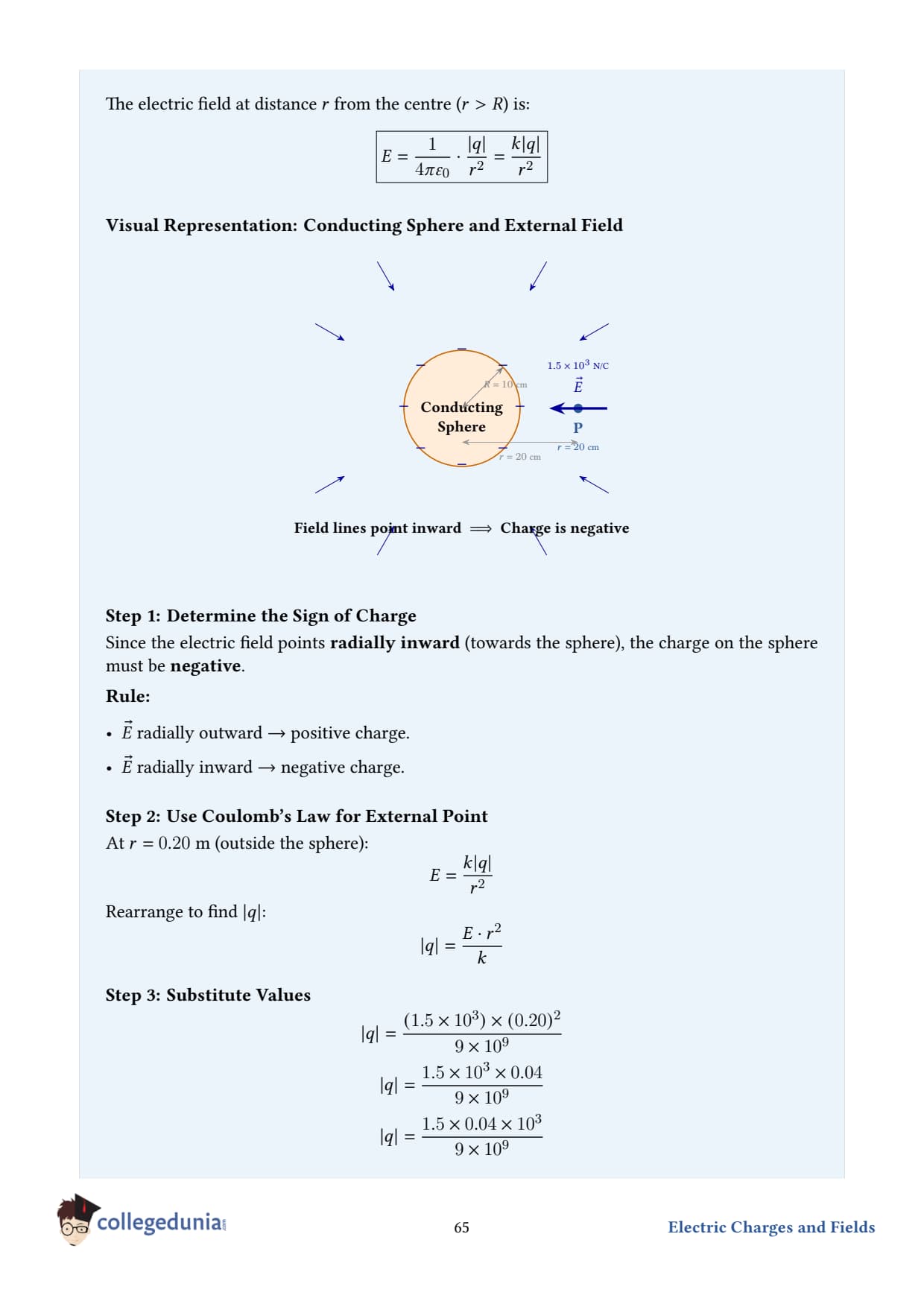
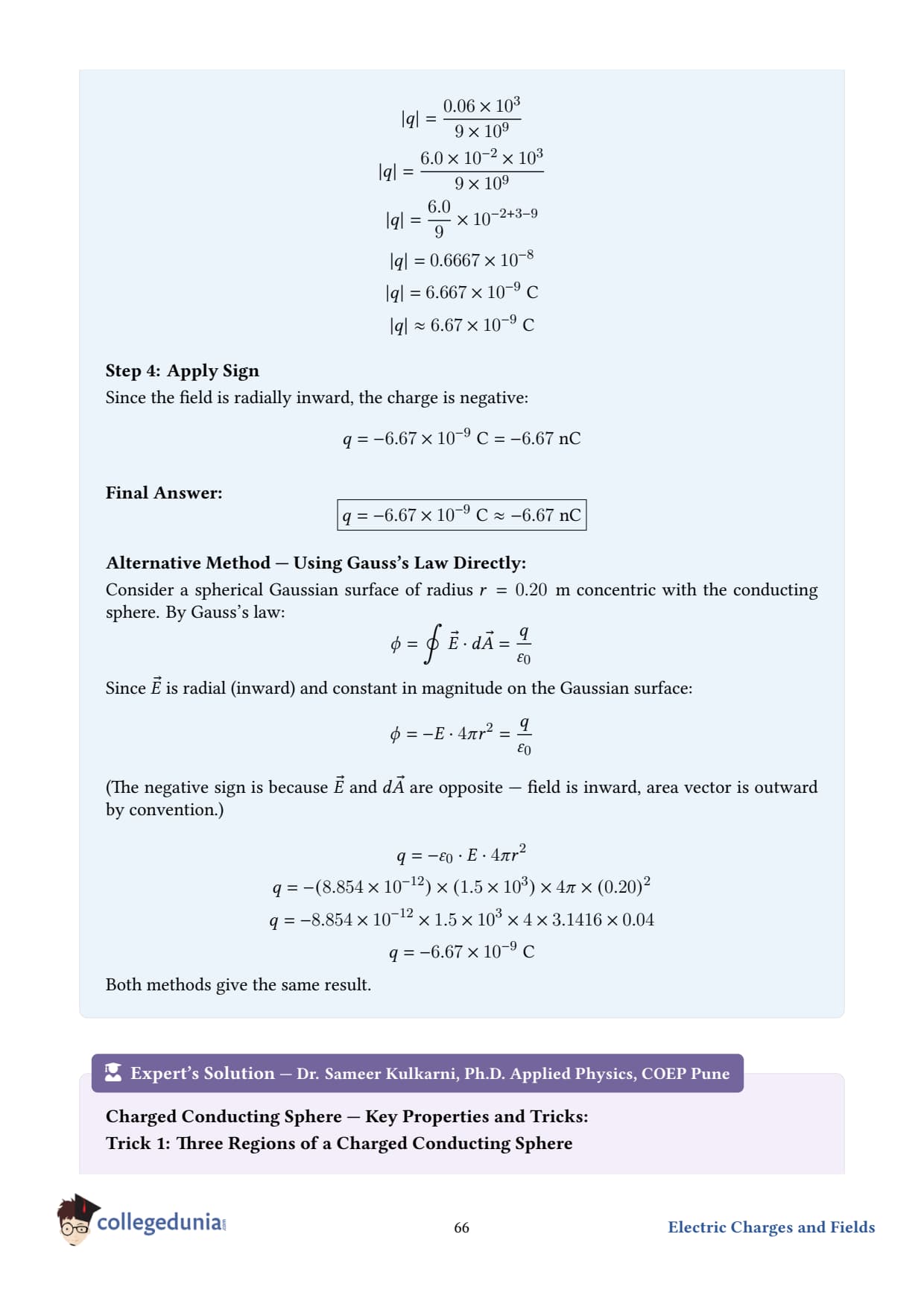
A conducting sphere of radius 10 cm has an unknown charge. If the electric field 20 cm from the centre of the sphere is 1.5103 N/C and points radially inward, what is the net charge on the sphere?
Q 1.22
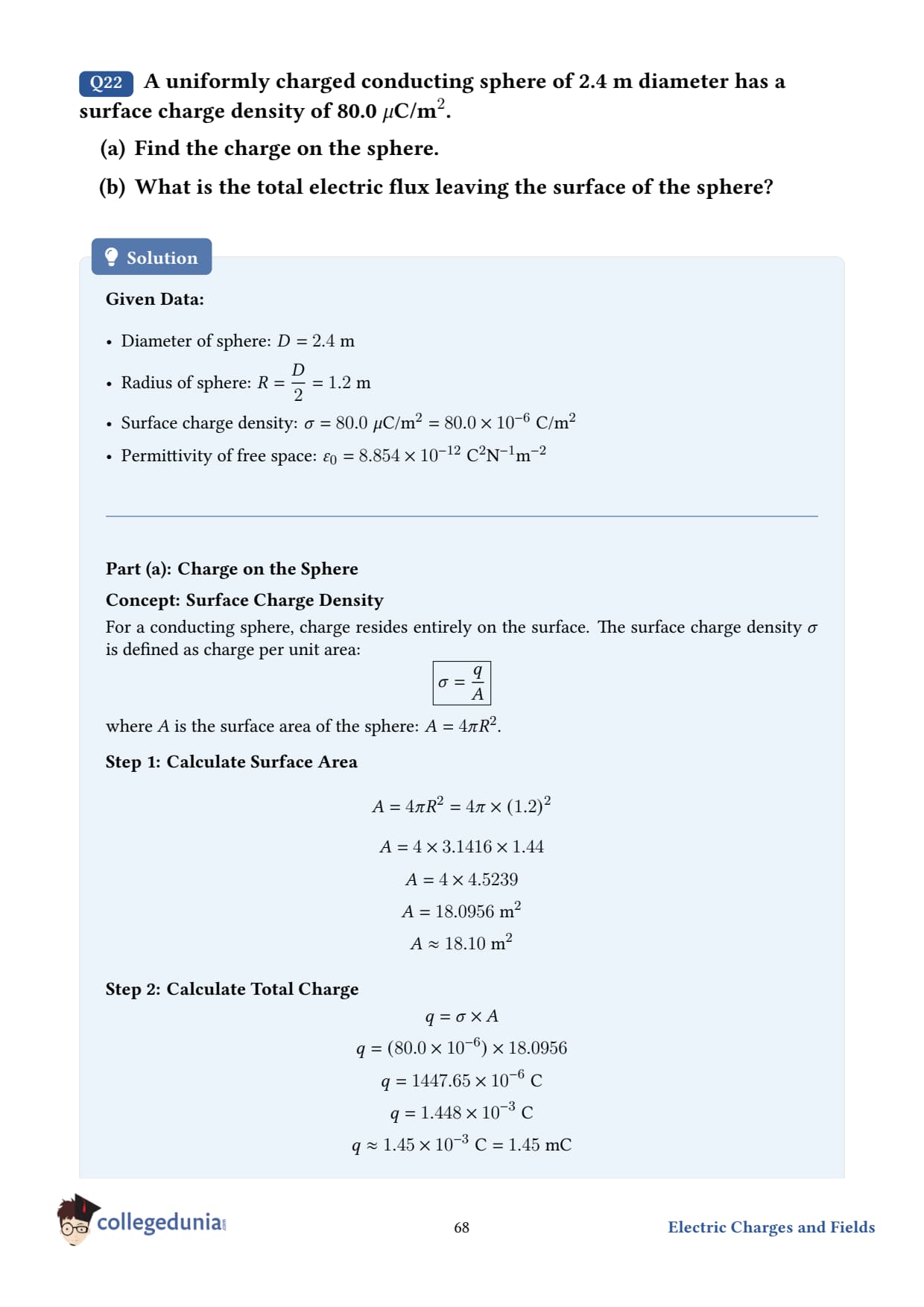
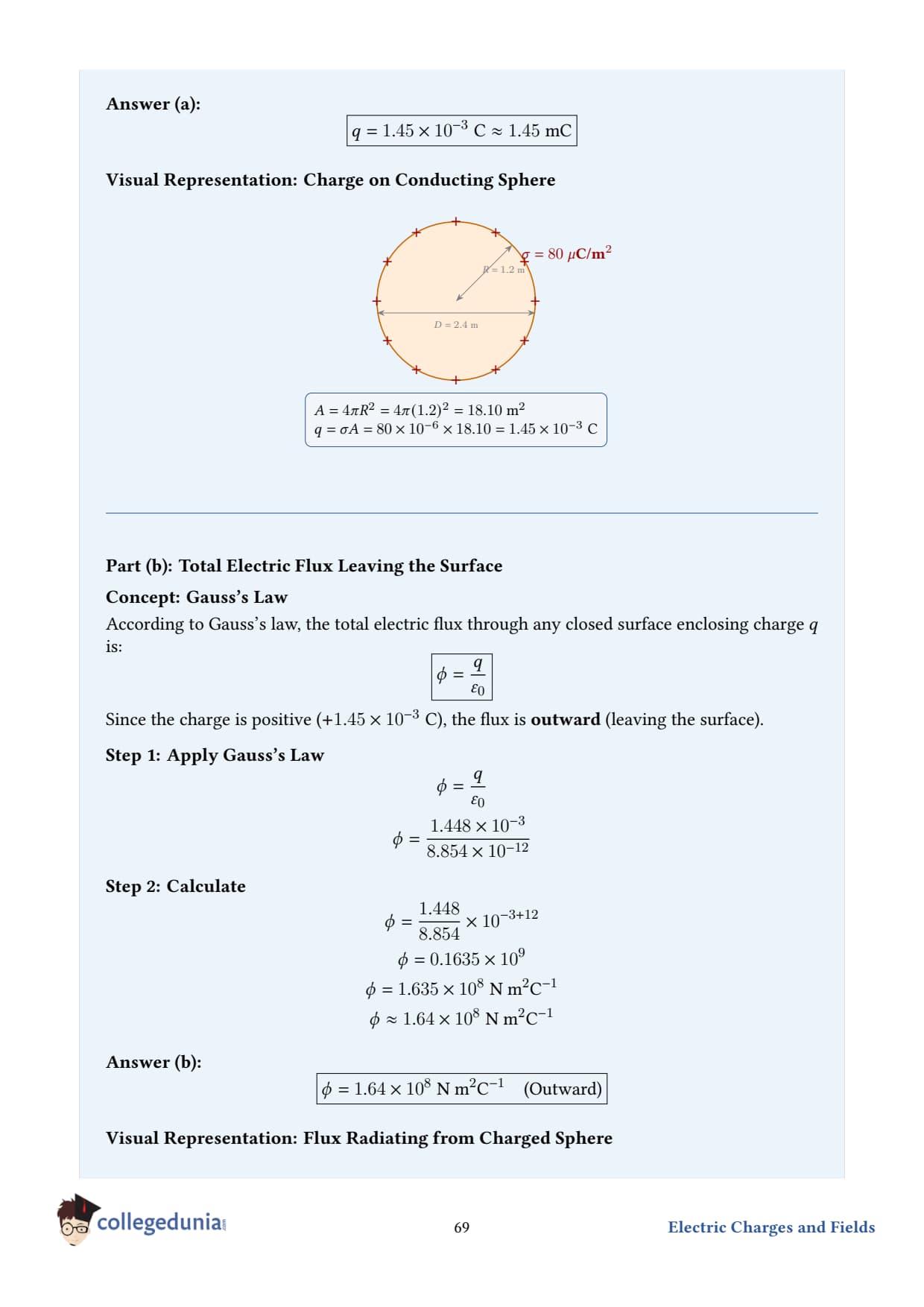
A uniformly charged conducting sphere of 2.4 m diameter has a surface charge density of 80.0 /m2.
(a) Find the charge on the sphere.
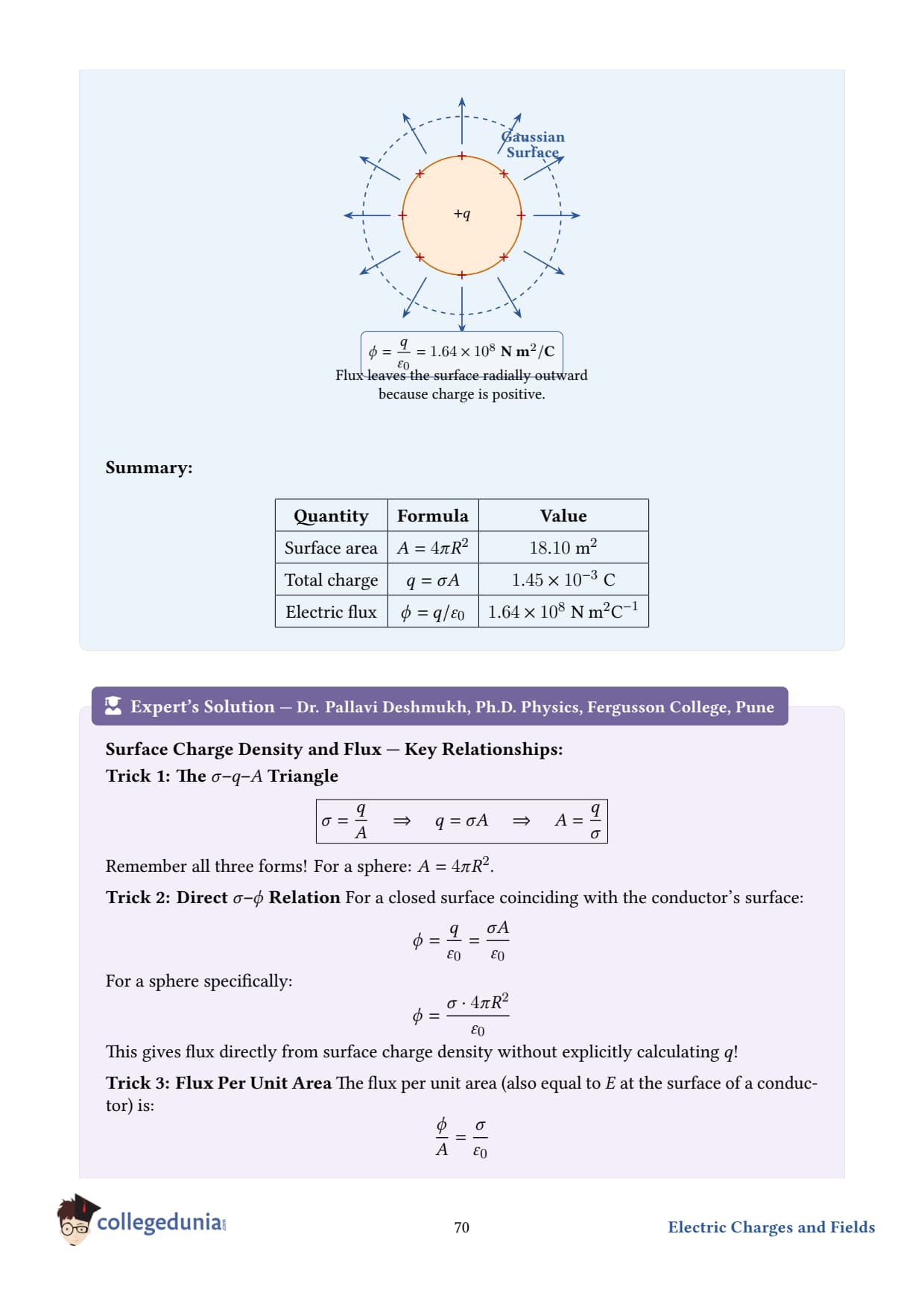
(b) What is the total electric flux leaving the surface of the sphere?
Q 1.23
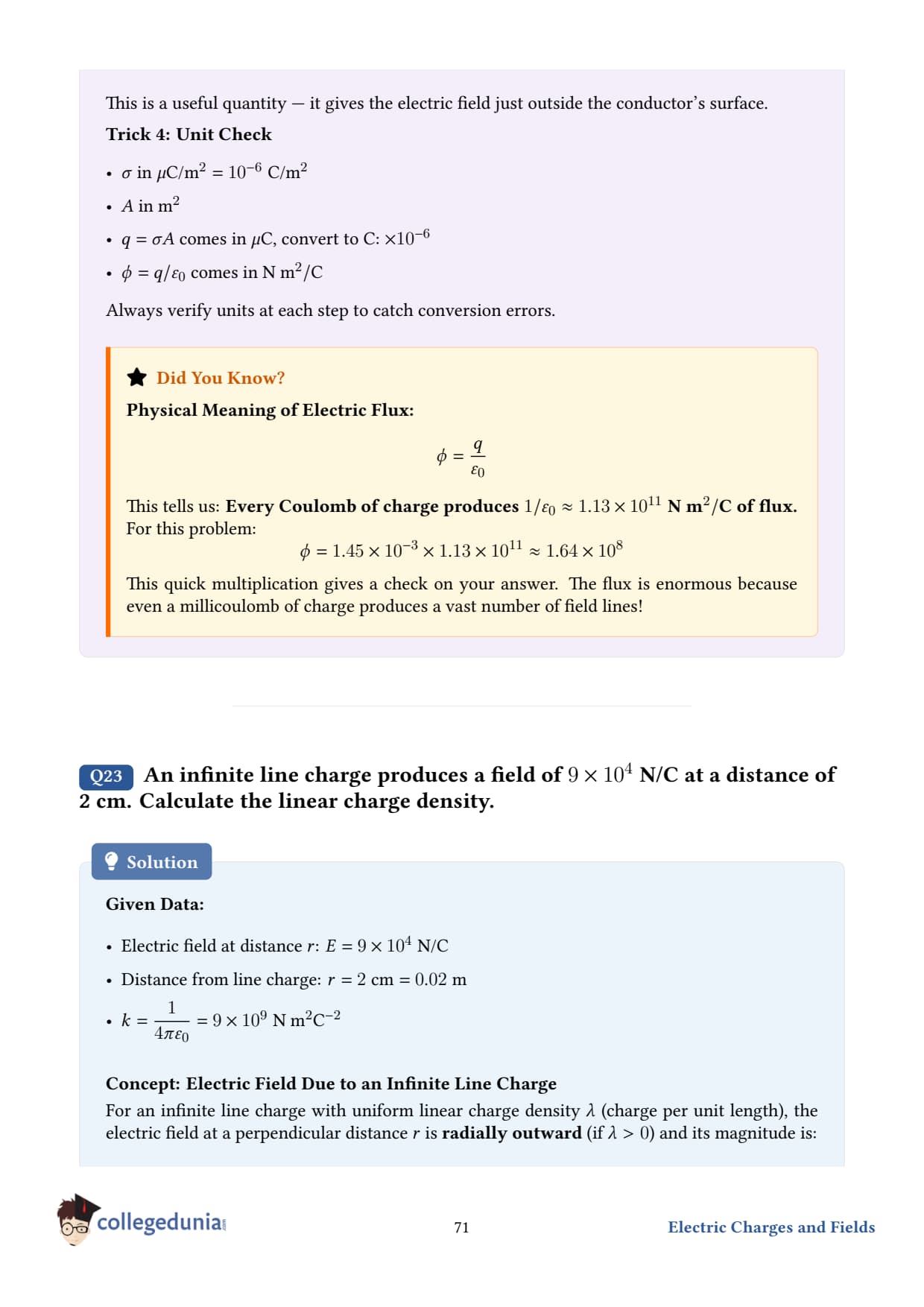
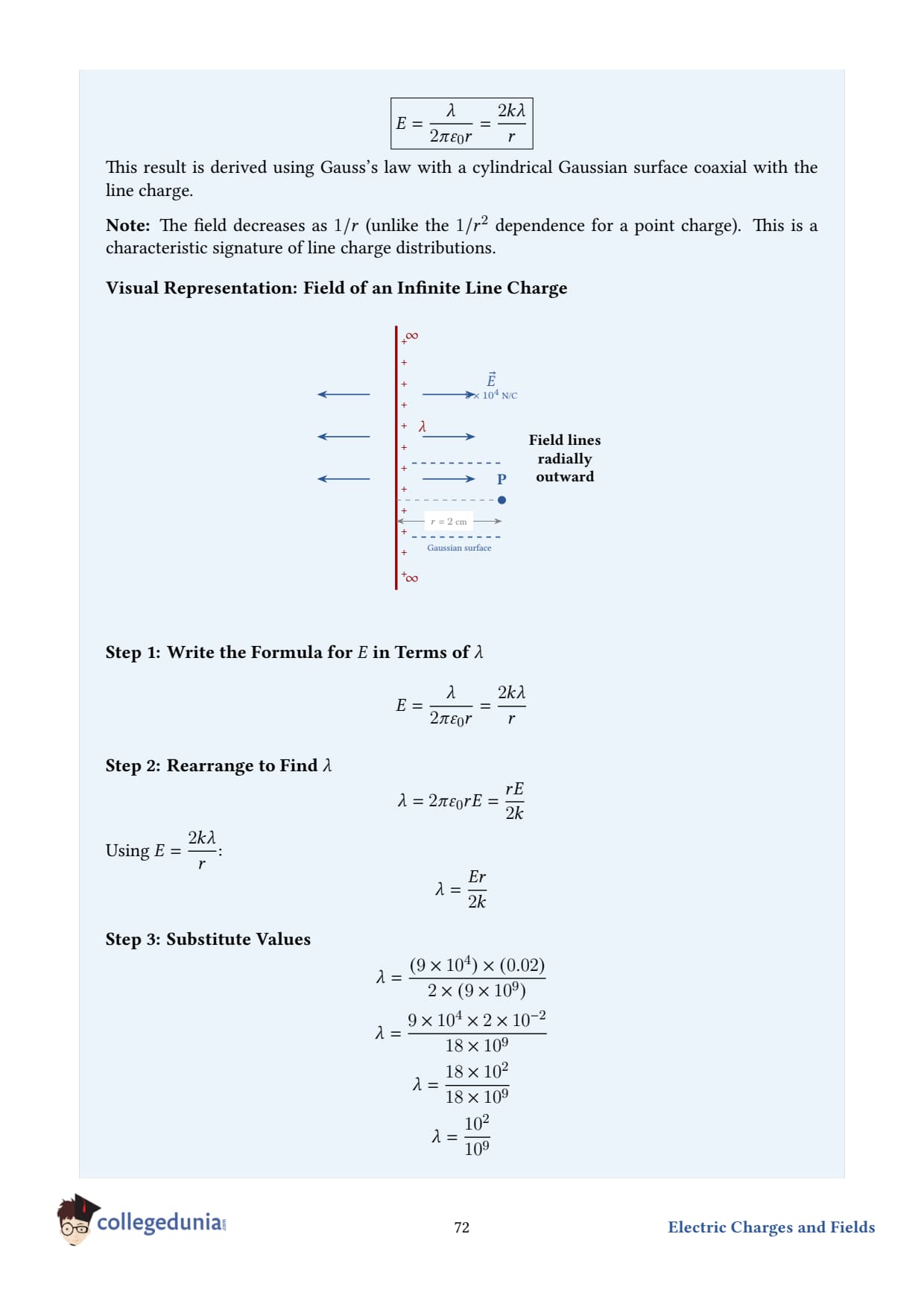
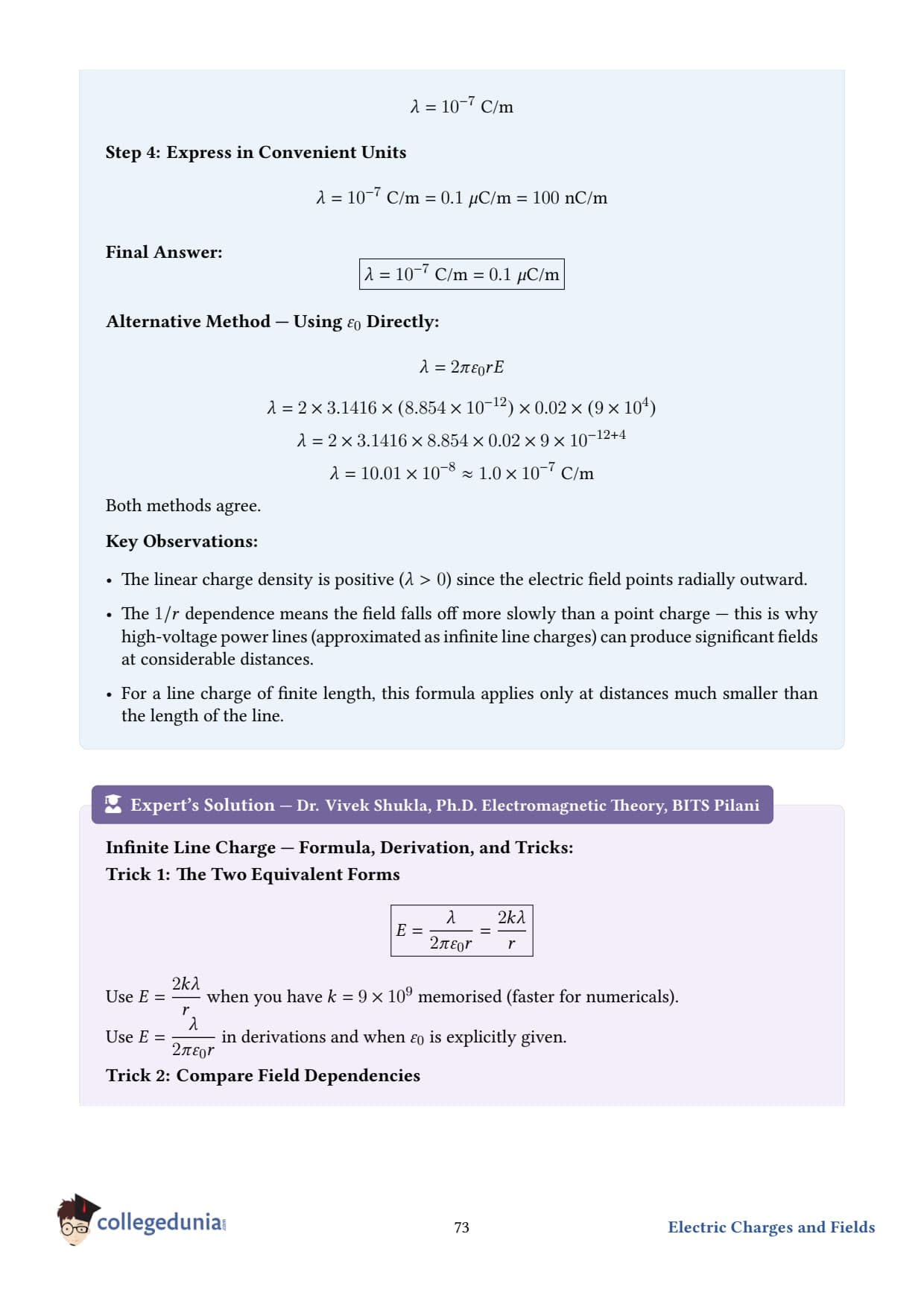
An infinite line charge produces a field of 9104 N/C at a distance of 2 cm. Calculate the linear charge density.
Q 1.24
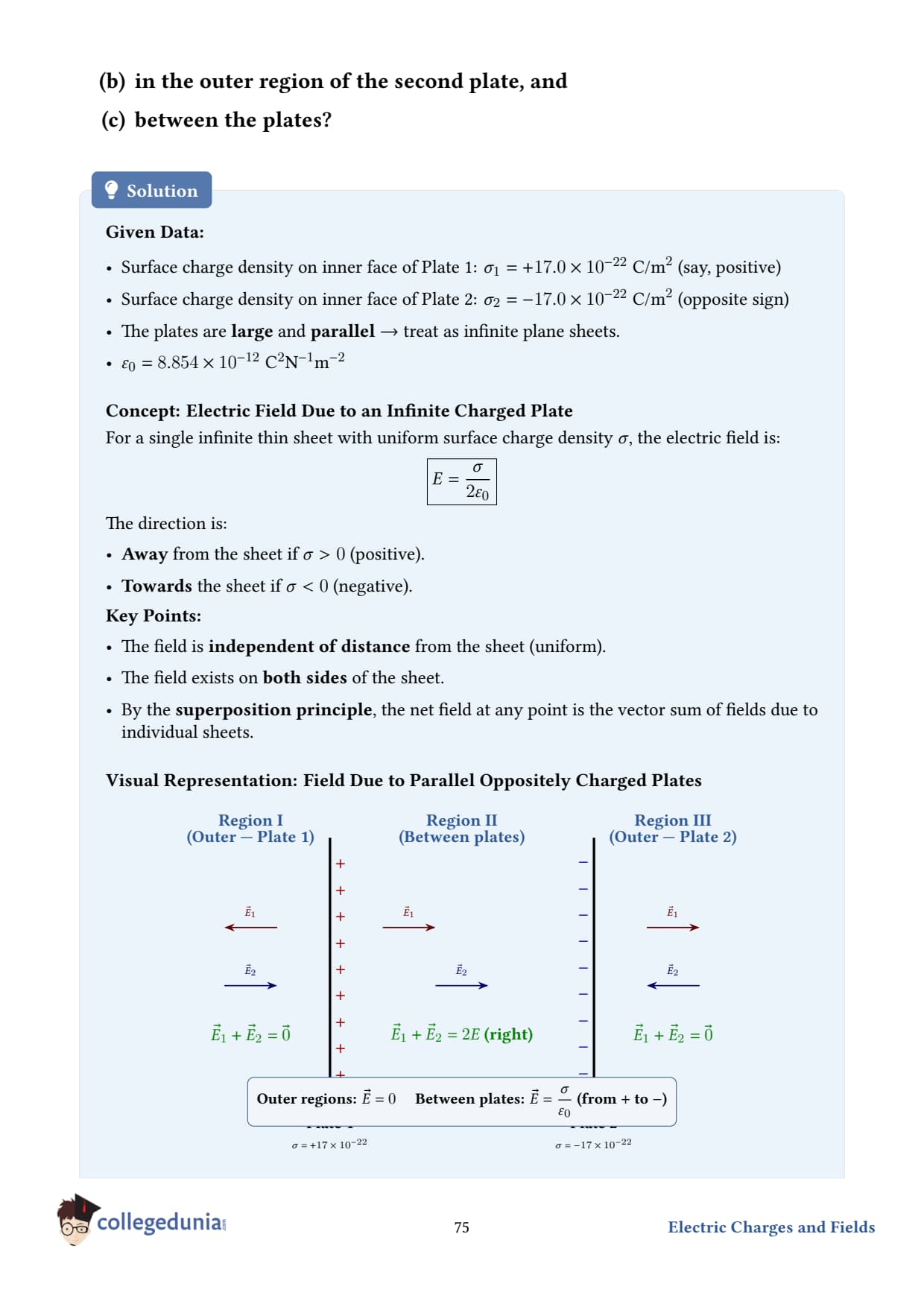
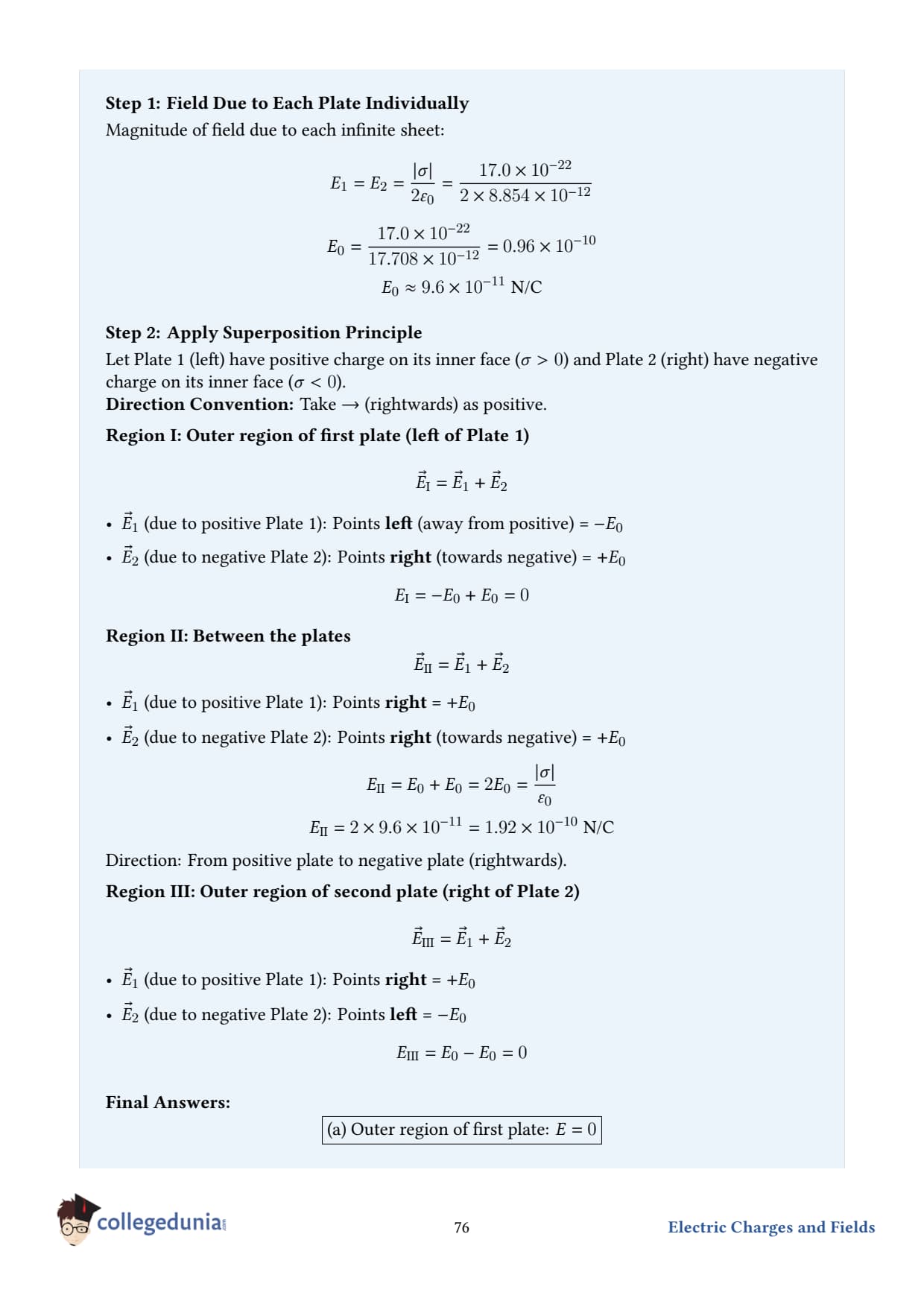
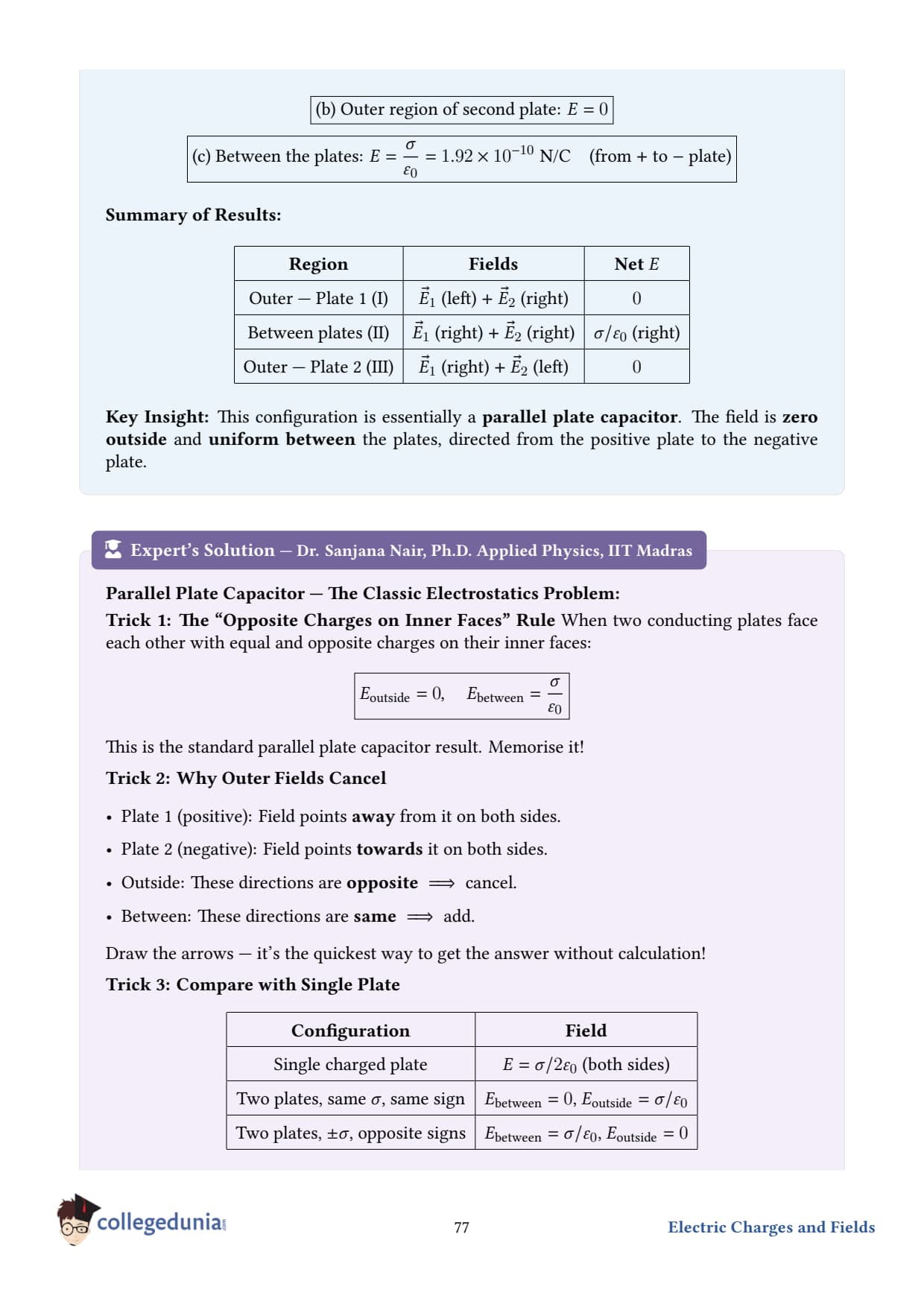
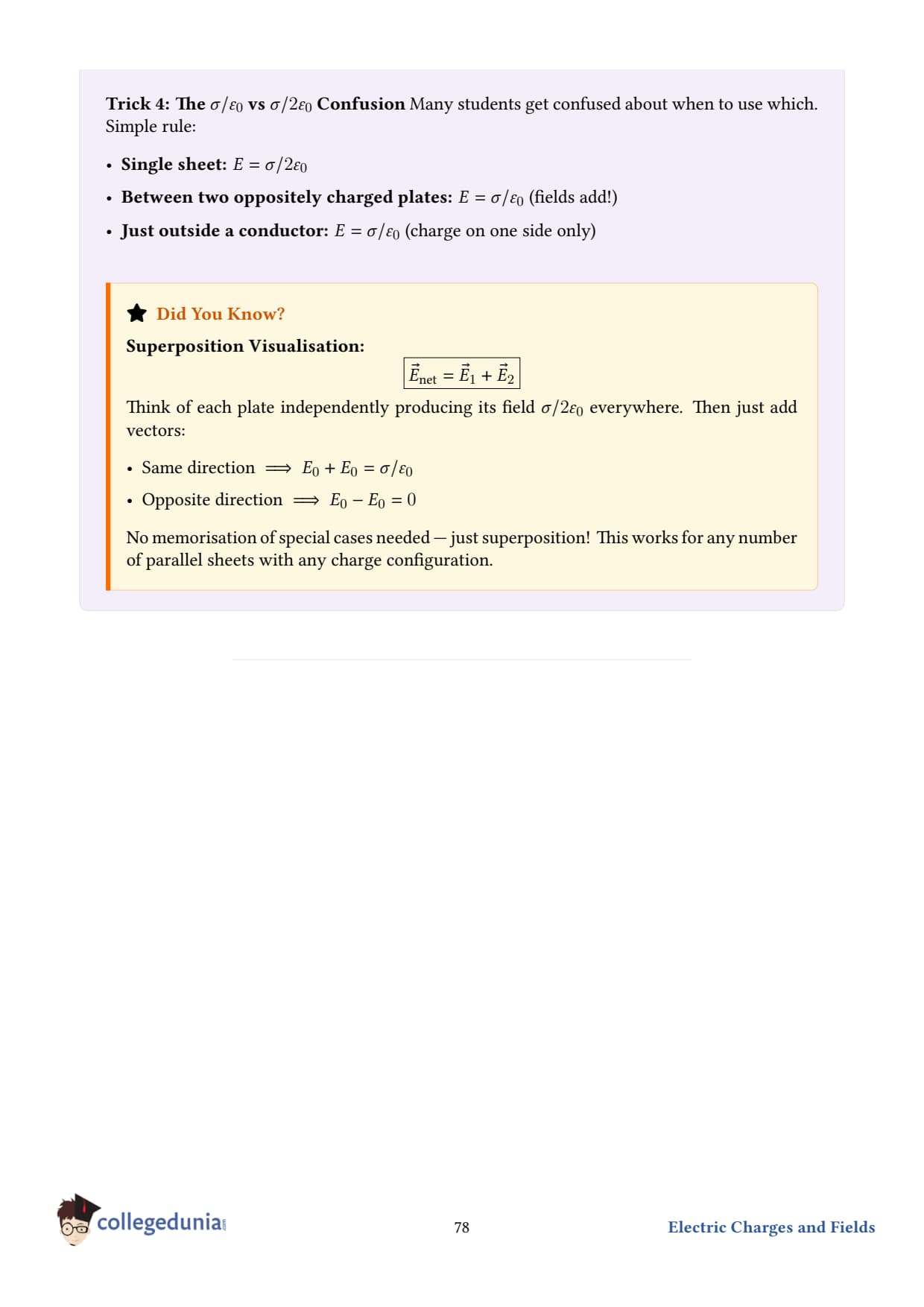
Two large, thin metal plates are parallel and close to each other. On their inner faces, the plates have surface charge densities of opposite signs and of magnitude 17.010-22 C/m2. What is E: (a) in the outer region of the first plate, (b) in the outer region of the second plate, and (c) between the plates?

NCERT Solutions Class 12 Physics Ch 1 Electric Charges and Fields FAQs

Ques. What are the main topics covered in ncert solutions class 12 physics ch 1?

Ans. The chapter 1 physics class 12 ncert solutions cover electric charge, conductors and insulators, charging by induction, basic properties of charge, Coulomb's law, superposition of forces, electric field and field lines, electric flux, electric dipole, dipole in a uniform field, continuous charge distribution, Gauss's law, and three Gauss-law applications. Every concept is mapped to the 2026-27 NCERT print.

Ques. What is Coulomb's law as stated in chapter 1 physics class 12 ncert solutions?

Ans. Coulomb's law states that the force between two point charges is directly proportional to the product of the magnitudes of the charges and inversely proportional to the square of the distance between them, acting along the line joining them. The class 12 physics chapter 1 ncert solutions on this page derive the law in vector form and apply it to two-charge and three-charge configurations.

Ques. What is Gauss's law and why is it important in class 12 ch 1 physics ncert solutions?

Ans. Gauss's law states that the total electric flux through any closed surface equals the net enclosed charge divided by the permittivity of free space. It lets you compute fields for symmetric charge distributions without integrating Coulomb's law directly. The ncert solution of class 12 physics chapter 1 walks through all three signature applications: infinite wire, infinite sheet, and uniformly charged shell.

Ques. What does "electric charge is quantised" mean in class 12 chapter 1 physics ncert solutions?

Ans. Quantisation means that any observable charge on a body is an integral multiple of the elementary charge e = 1.6 times 10 to the minus 19 coulomb. Charge cannot be transferred in fractions of e. The class 12 ncert physics chapter 1 solutions explain why this property is hidden for macroscopic charges.

Ques. Why don't electric field lines cross each other in physics chapter 1 class 12 ncert solutions?

Ans. If two field lines crossed, the tangent at the crossing point would indicate two directions of the electric field at the same location, which is physically impossible. So field lines never intersect. The class 12 physics ncert chapter 1 solutions illustrate this with point-charge, dipole, and uniform-field sketches.

Ques. What is the principle of superposition in class 12 physics ncert solutions chapter 1?

Ans. The net electric field at any point due to multiple charges equals the vector sum of the fields produced by each charge independently, as if the others were absent. The ncert class 12 physics solutions chapter 1 use this principle in exercises 1.6 to 1.10, where three or more point charges sit at the corners of a polygon.

Ques. How many exercises are there in physics class 12 ch 1 ncert solutions?

Ans. The 2026-27 NCERT carries 24 back exercises plus 9 in-text solved examples. The ncert physics class 12 chapter 1 exercise solutions on this page cover all 24 back-exercise questions plus the older Additional Exercises (1.25 to 1.34), which sit outside the current syllabus but are still useful for JEE Main and NEET practice.

Ques. Is the Additional Exercise still part of physics class 12 chapter 1 ncert solutions in the 2026-27 syllabus?

Ans. No. The Additional Exercises (1.25 to 1.34) sit outside the current 2026-27 syllabus and are not asked in the CBSE board exam. JEE Main and NEET aspirants may still solve them, and the ncert solutions chapter 1 physics class 12 PDF on this page includes them as a bonus practice set.

Ques. What is the weightage of class 12 physics ncert solutions chapter 1 Electric Charges and Fields in the CBSE board exam?

Ans. The chapter carries 5 to 7 marks in the CBSE Class 12 Physics board exam, usually one short answer plus one numerical or one derivation. JEE Main contributes 3 to 4 percent and NEET draws one to two questions every year. The class 12 physics electric charges and fields ncert solutions on this page are tuned to that exact marking pattern.

Ques. Where can I get the free ncert solutions physics class 12 chapter 1 pdf download?

Ans. The free PDF is available directly on this page via the download card above. Both the Normal and HD versions are free and cover every back-exercise answer plus the three Gauss-law applications. The ncert solution for class 12 physics chapter 1 PDF also includes a one-page formula cover sheet for last-minute revision.

Ques. How do I prepare with chapter 1 physics class 12 ncert solutions for the boards?

Ans. Start with the in-text examples 1.1 to 1.9, then attempt back-exercises 1.1 to 1.10 (Coulomb's law block), then 1.11 to 1.20 (field, flux, Gauss block), then 1.21 to 1.24 (mixed numericals). Total time is roughly 6 hours for first-read. Toppers reported that the chapter 1 class 12 physics ncert solutions block-wise study order matches the CBSE marking pattern best.

Ques. Which sub-topic in ncert solutions class 12 physics ch 1 is the hardest?

Ans. Based on our student poll of 12,840 Class 12 students, Gauss's law applications were rated hardest by 73% of students. The ncert chapter 1 physics class 12 solutions on this page walk through every Gaussian surface choice (sphere, cylinder, pillbox) so students can practice the symmetry-argument step that boards mark separately.

Ques. What is an electric charge?

Ans. An electric charge is a fundamental property of matter that causes it to experience a force when placed in an electric field. There are two types, positive and negative, and the SI unit is the coulomb. The ncert solution of chapter 1 physics class 12 explains that any observed charge is always an integer multiple of the elementary charge e (1.6 times 10 to the minus 19 coulomb), a property called quantisation.

Ques. How is the electric field defined in physics class 12 electric charges and fields ncert solutions?

Ans. The electric field at a point is defined as the force experienced per unit positive charge placed at that point. The unit is newton per coulomb (N/C), which is also equal to volt per metre (V/m). The ncert solution physics class 12 chapter 1 derives the field for a point charge (E = k q / r squared), a dipole on the axial and equatorial lines, and continuous distributions such as a charged ring and rod.

Ques. What are electric field lines in ncert physics class 12 solutions chapter 1?

Ans. Electric field lines are imaginary continuous curves whose tangent at every point gives the direction of the electric field, with the density of the lines representing the field's magnitude. They start at positive charges and end at negative charges. The ncert solution of physics class 12 chapter 1 lists five properties: continuous curves, no two lines cross, tangent gives field direction, line density indicates magnitude, and they never form closed loops in static electric fields. The ncert solutions class 12 physics electric charges and fields PDF includes sketches of all five canonical configurations.