


The Dual Nature of Radiation and Matter NCERT PDF on this page packs the full Class 12 Physics Chapter 11 Dual Nature of Radiation and Matter textbook across 22 pages, including 5 solved examples and the complete exercise set. Download the Dual Nature of Radiation and Matter NCERT PDF below as a single file for offline use. Every derivation tested in CBSE, JEE Main and NEET sits inside the Dual Nature of Radiation and Matter NCERT PDF.
- CBSE Weightage: 3-5 marks
- JEE Main Weightage: 2-3% (1-2 questions per paper)
- NEET Weightage: 2-3 questions per year (high MCQ frequency)
Both downloads of the Dual Nature of Radiation and Matter NCERT PDF on this page are free and updated for the 2026-27 NCERT syllabus.
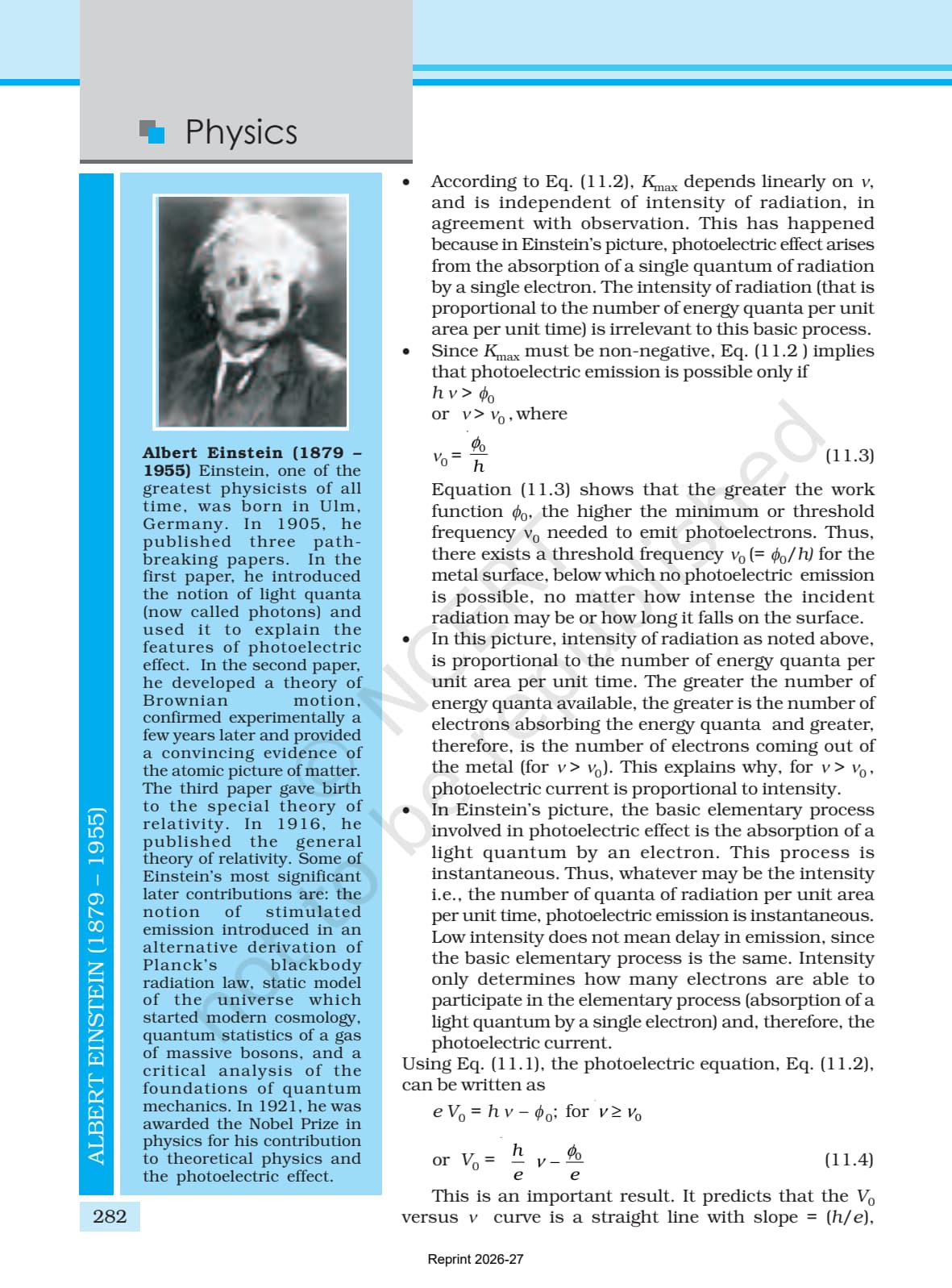
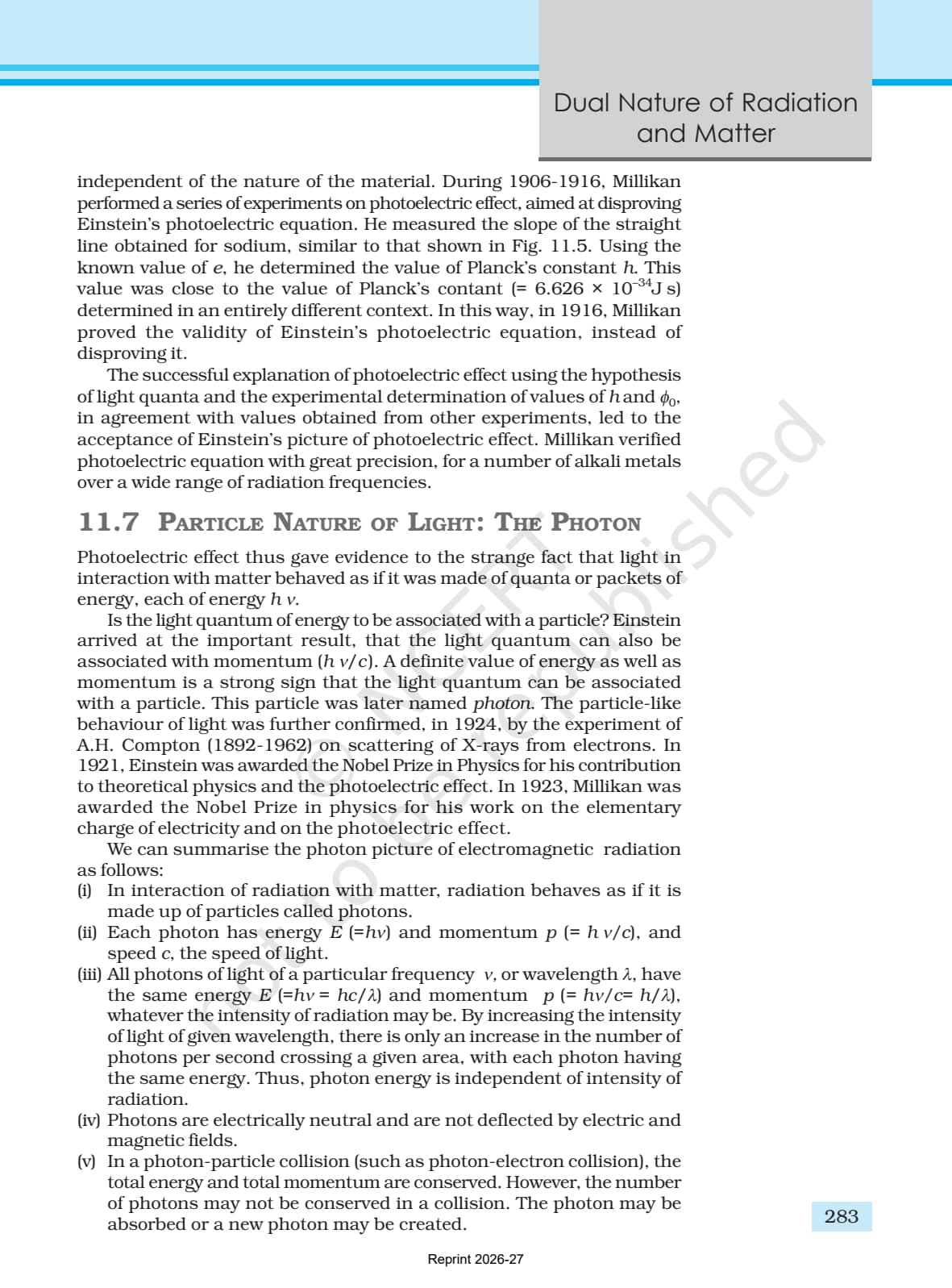
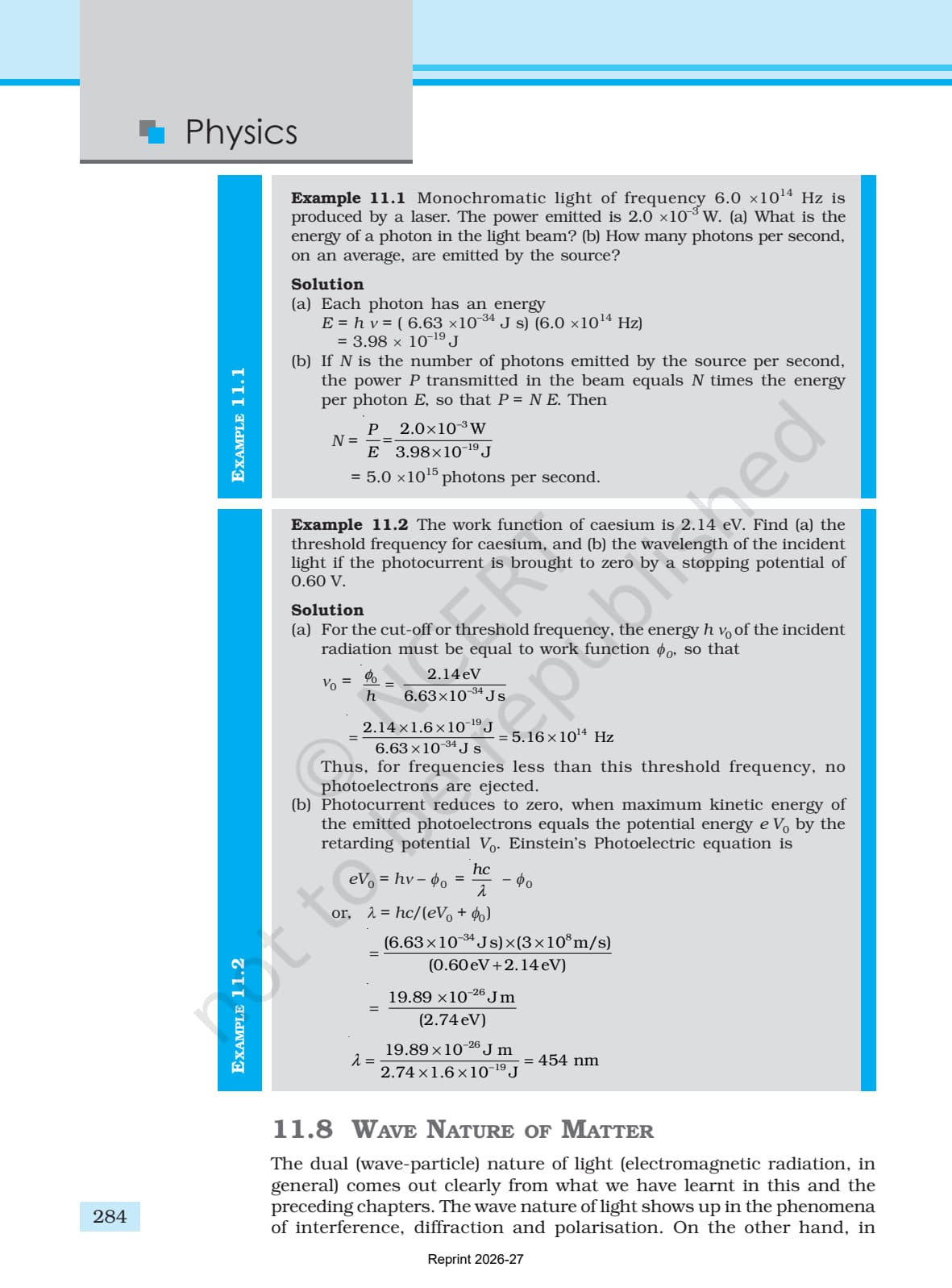
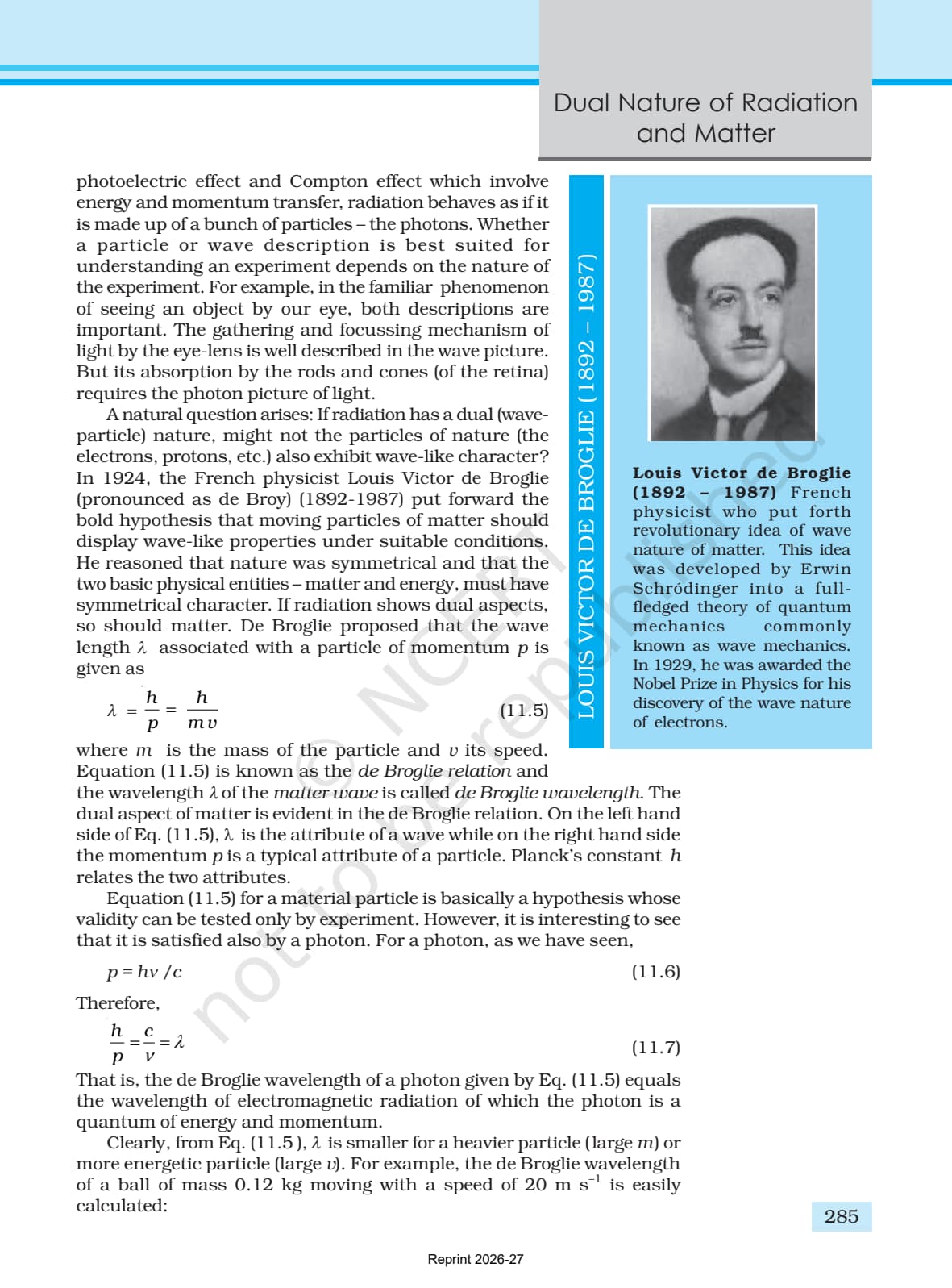
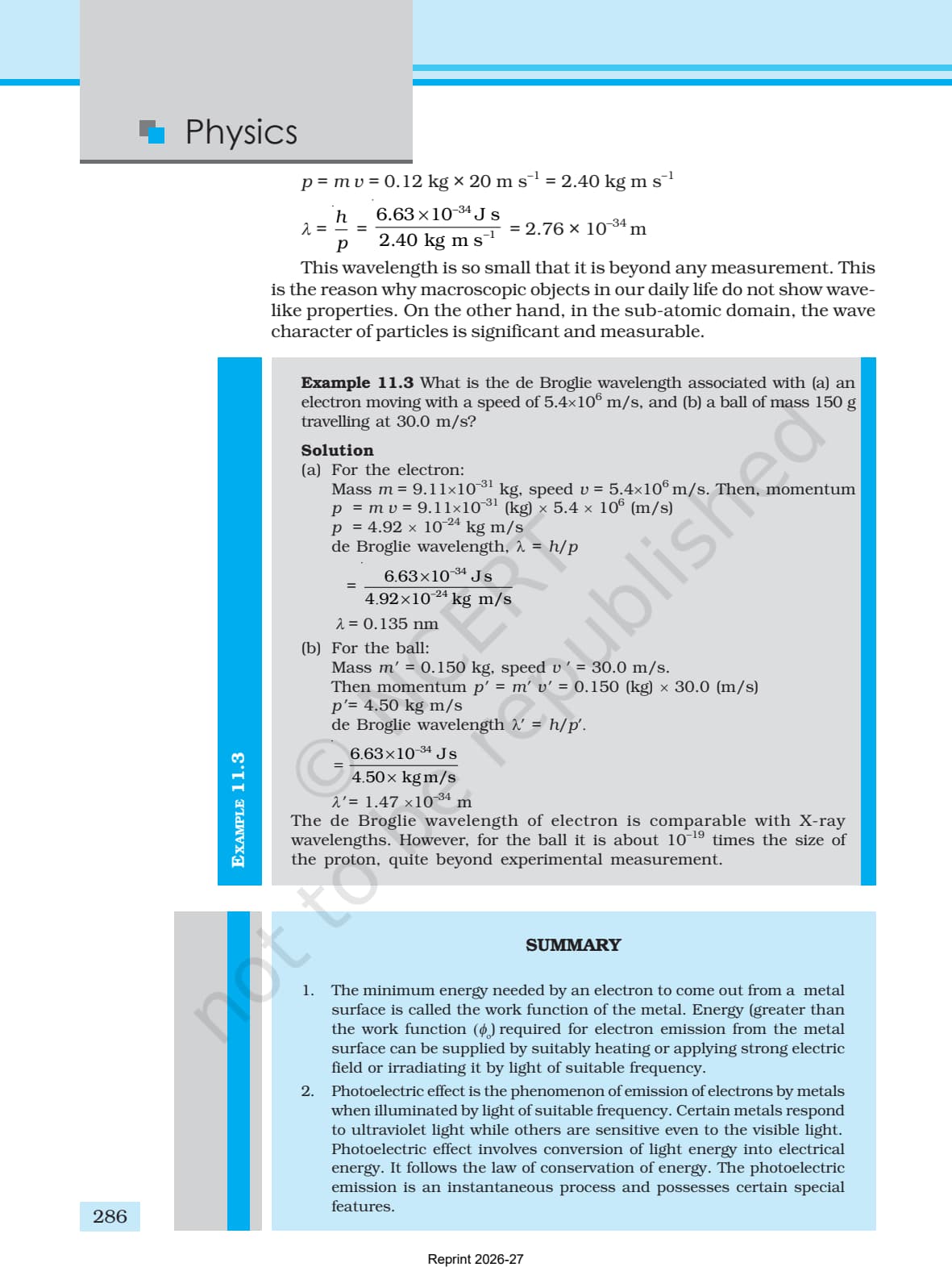
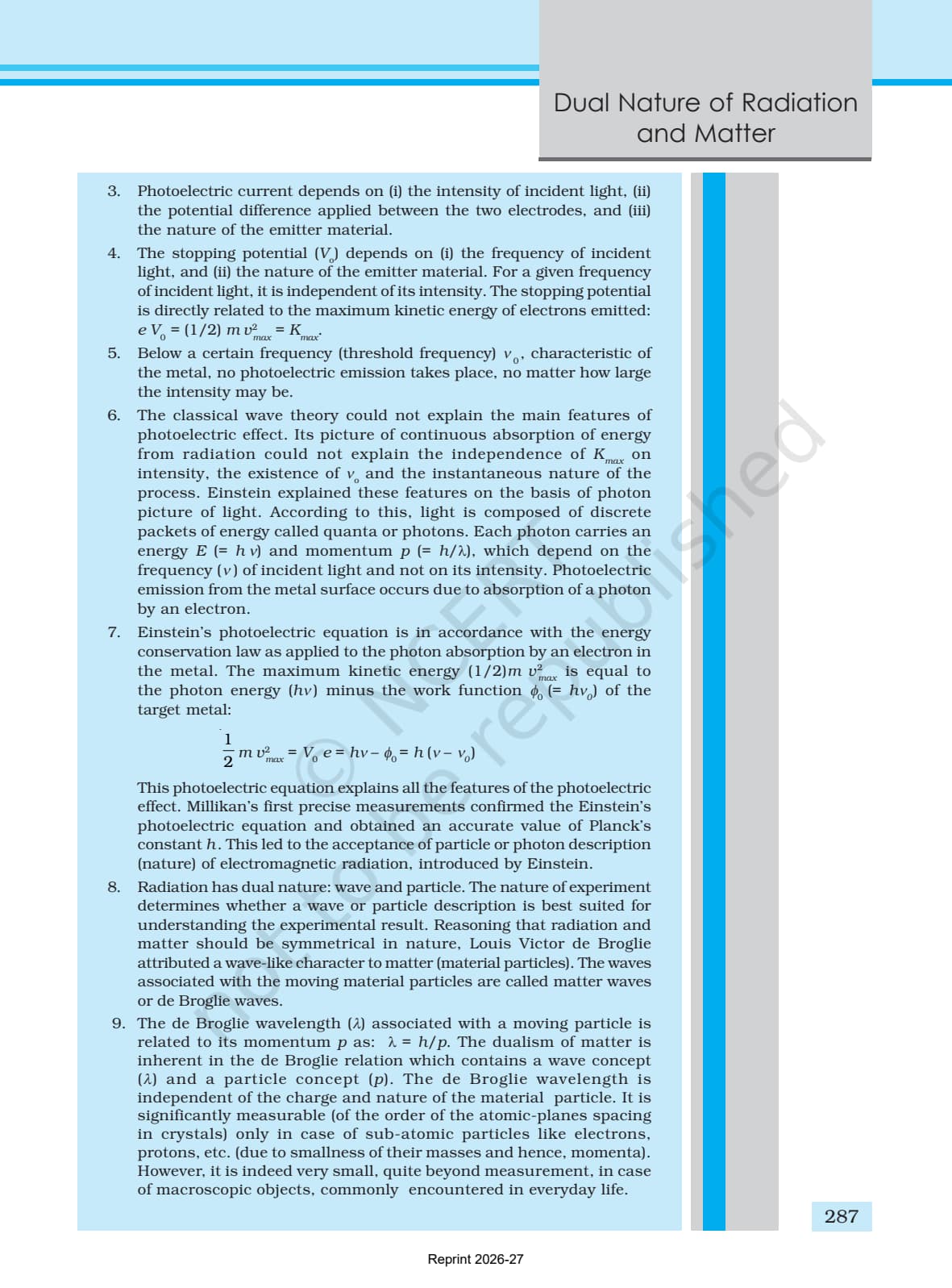
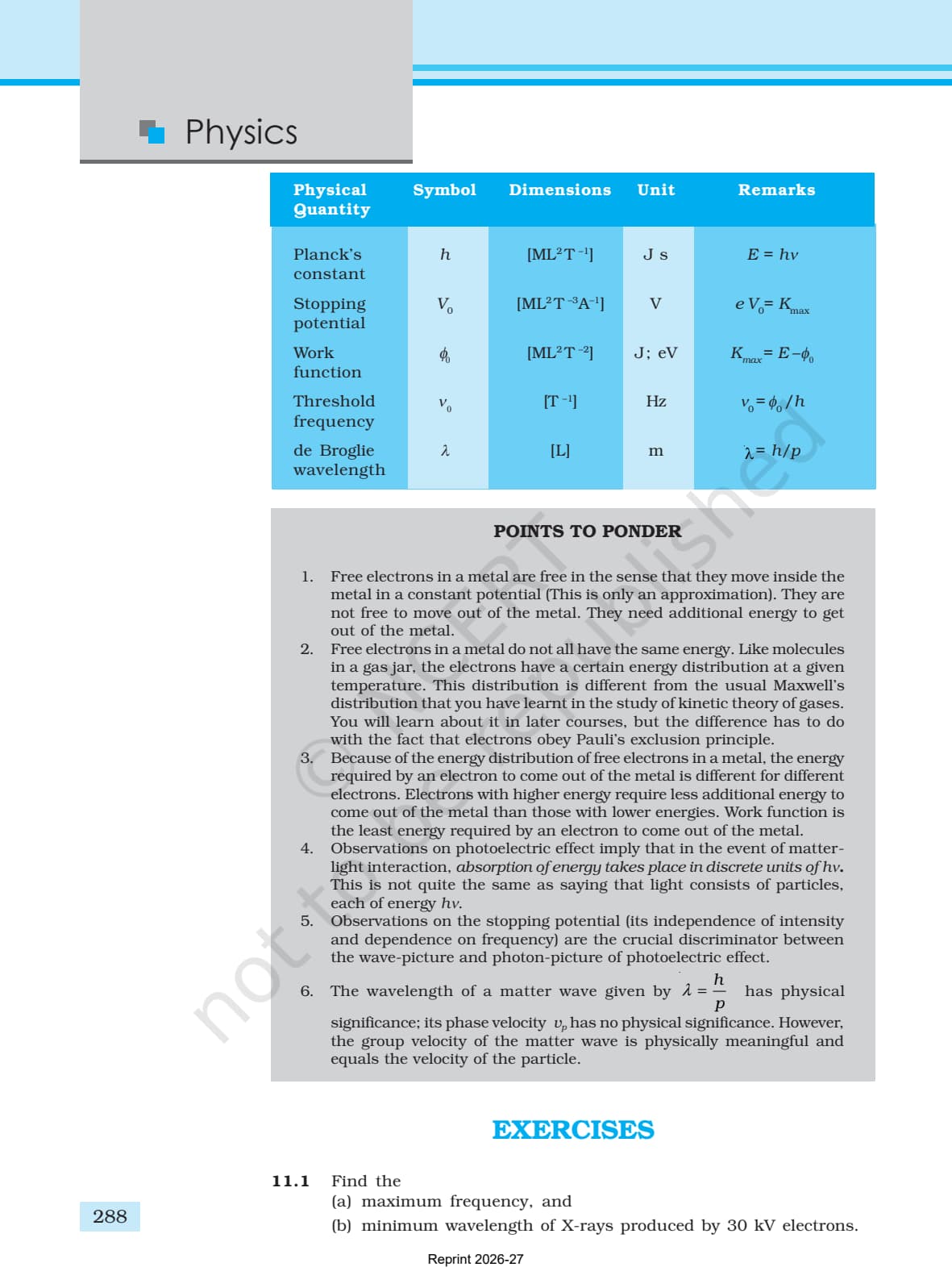
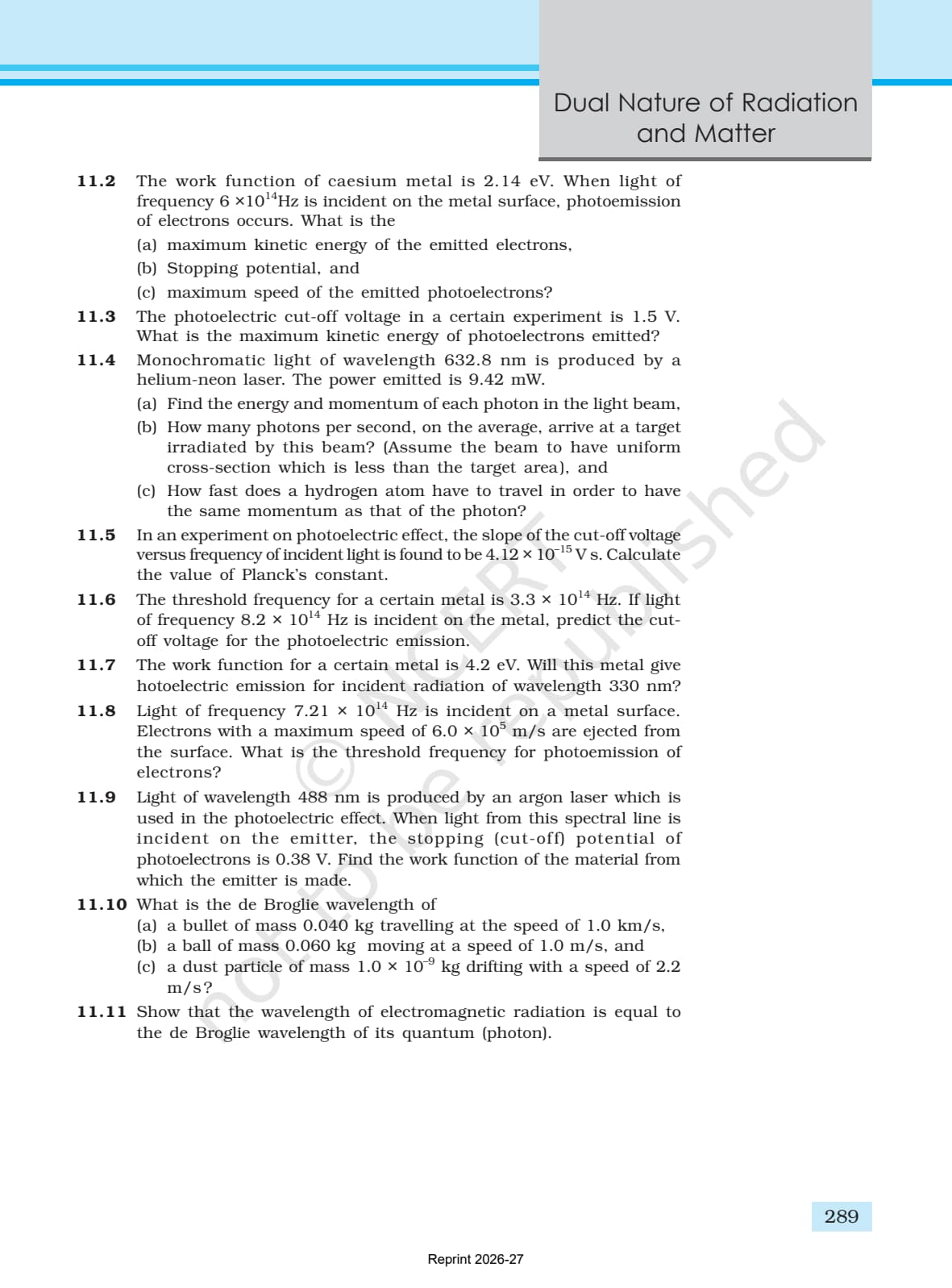
This NCERT Book PDF is curated by subject experts, mapped to the 2026-27 rationalised NCERT, and refined against the last five years of CBSE Board, JEE Main, and NEET papers.
Dual Nature of Radiation and Matter Class 12 Physics NCERT Section-by-Section Breakdown
The 2026-27 NCERT chapter spans roughly 24 pages and runs across nine sections. The breakdown below gives you the approximate page range and the core idea of each section so you can plan a reading pass against the new edition.
| Section | Title | Pages | Core Idea |
|---|---|---|---|
| 11.1 | Introduction | 1 | Wave-particle duality framing for radiation and matter |
| 11.2 | Electron Emission | 2 | Thermionic, field, photoelectric, secondary emission; work function 0 |
| 11.3 | Photoelectric Effect | 2 | Hertz, Hallwachs, Lenard observations on UV-induced electron emission |
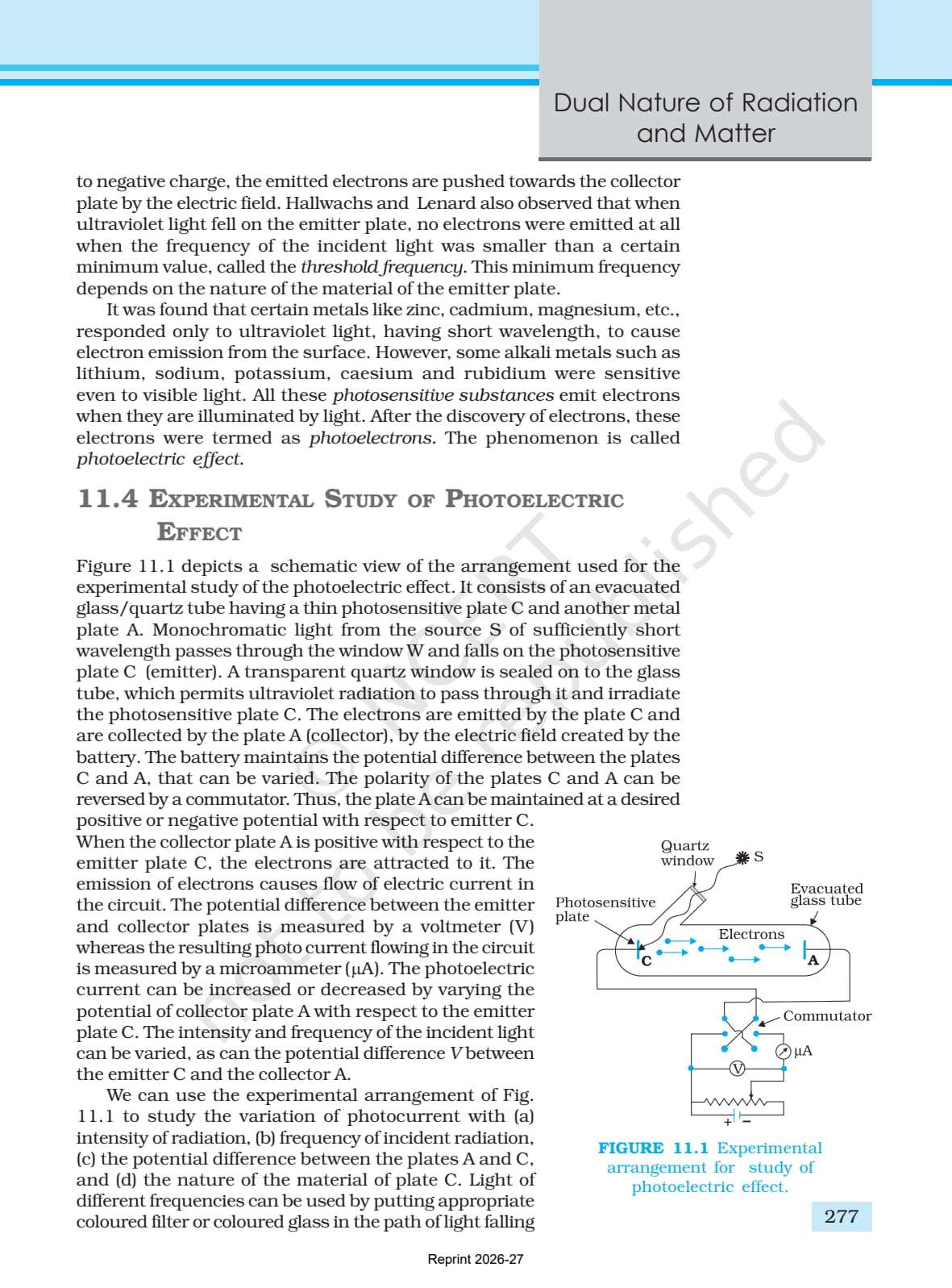
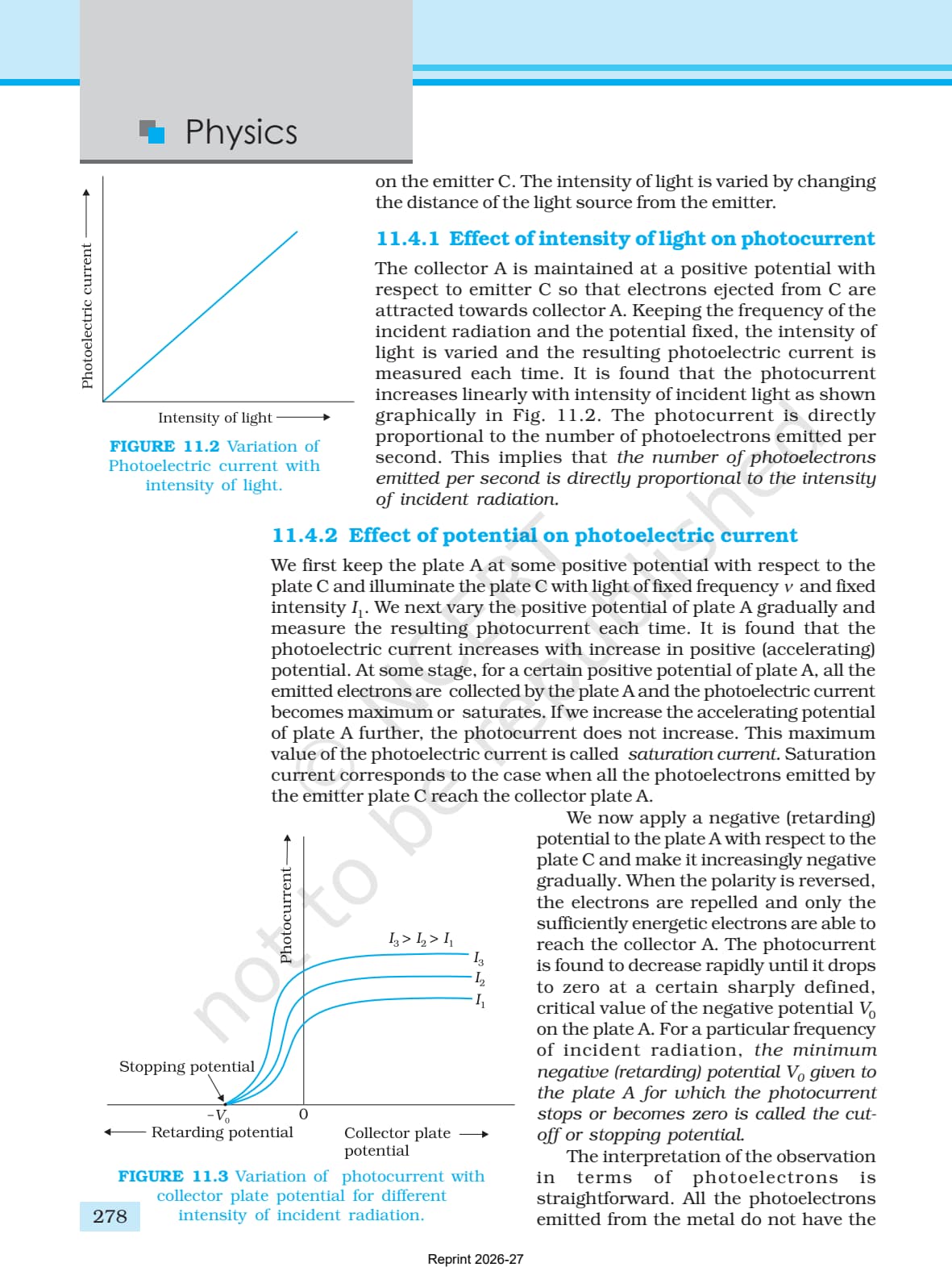
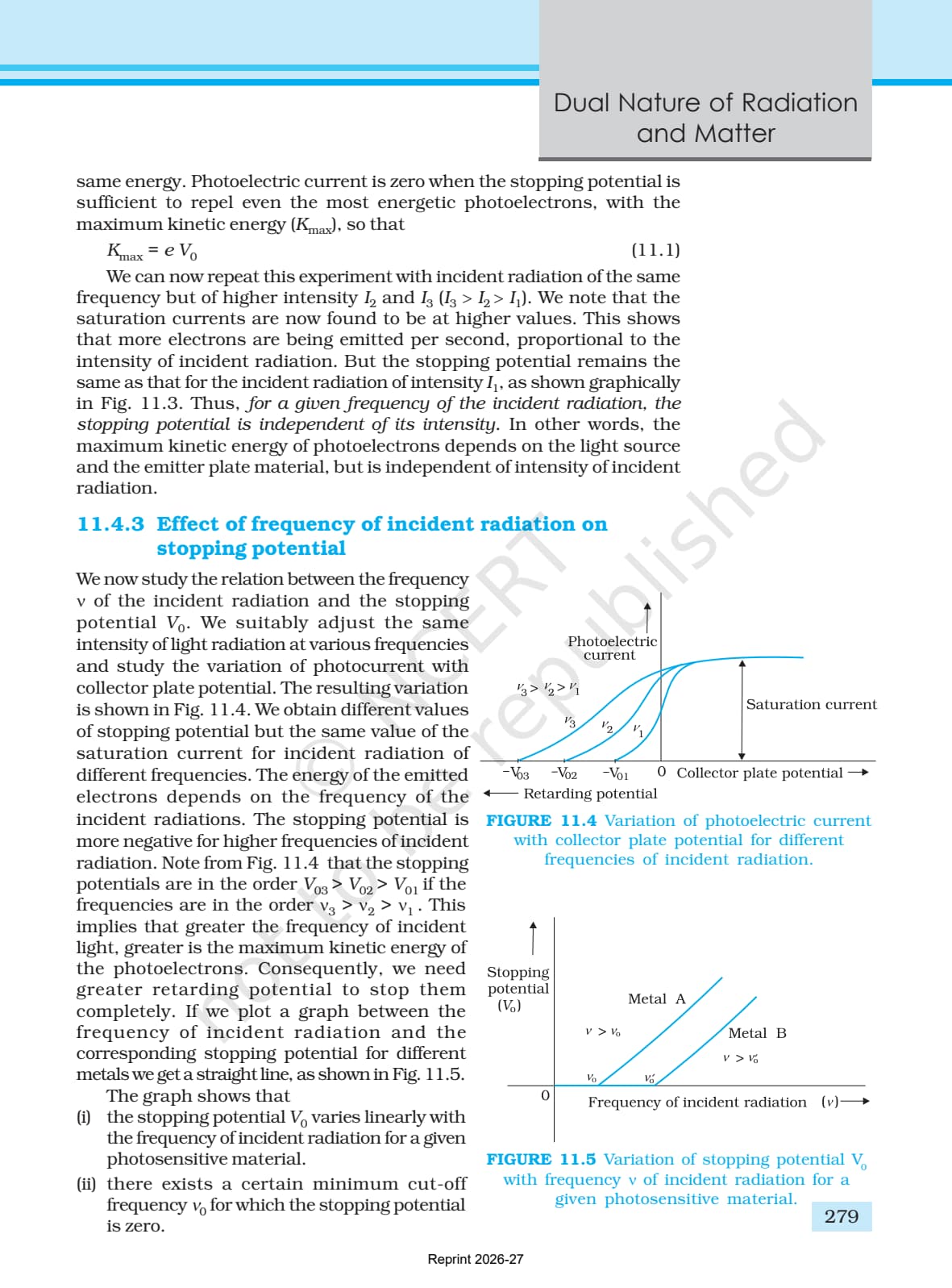
| 11.4 | Experimental Study of Photoelectric Effect | 4 | Three classical graphs: I vs intensity, I vs V, Vs vs ν |
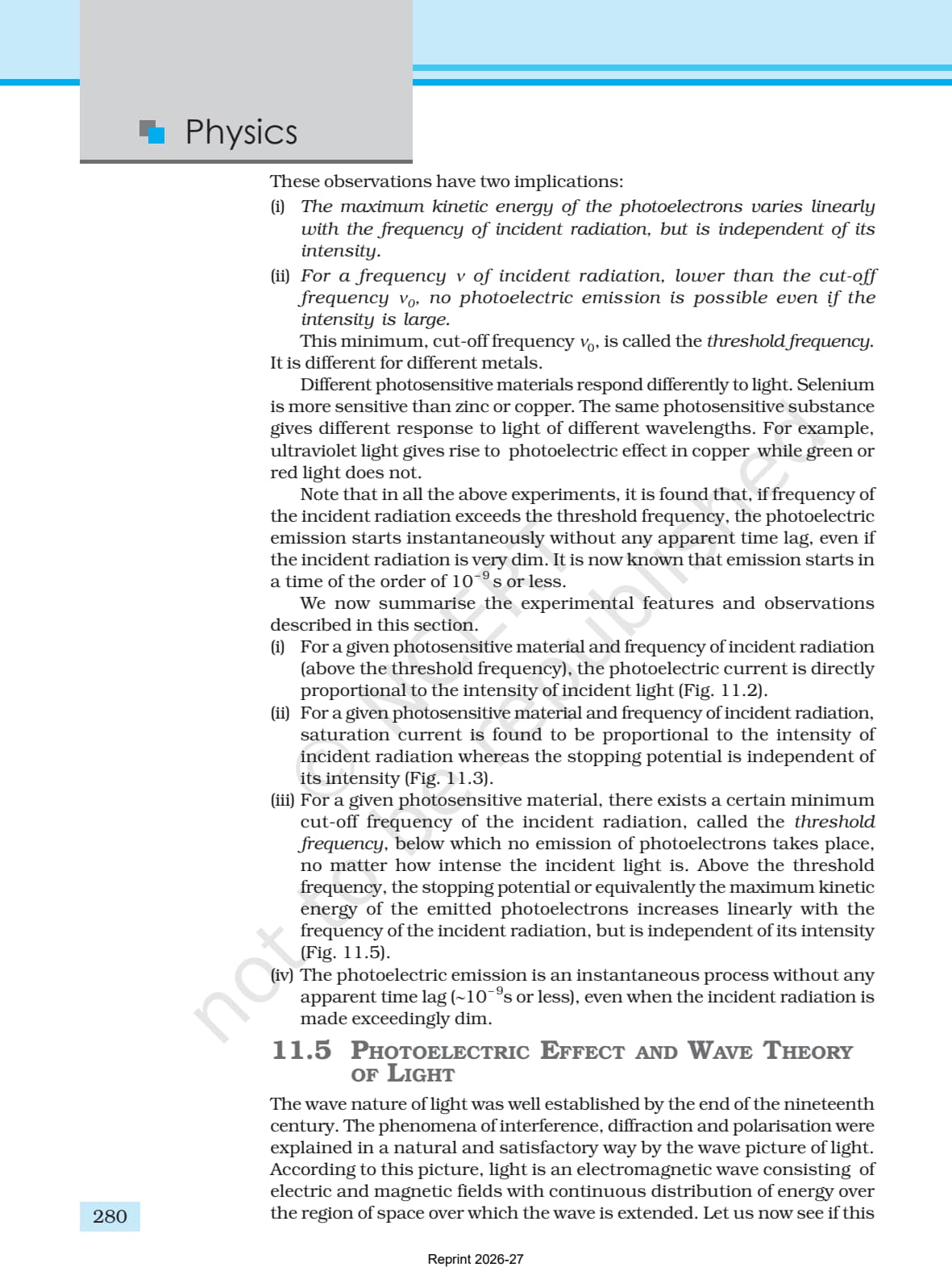
| 11.5 | Photoelectric Effect and Wave Theory of Light | 2 | Three failures of classical wave theory |
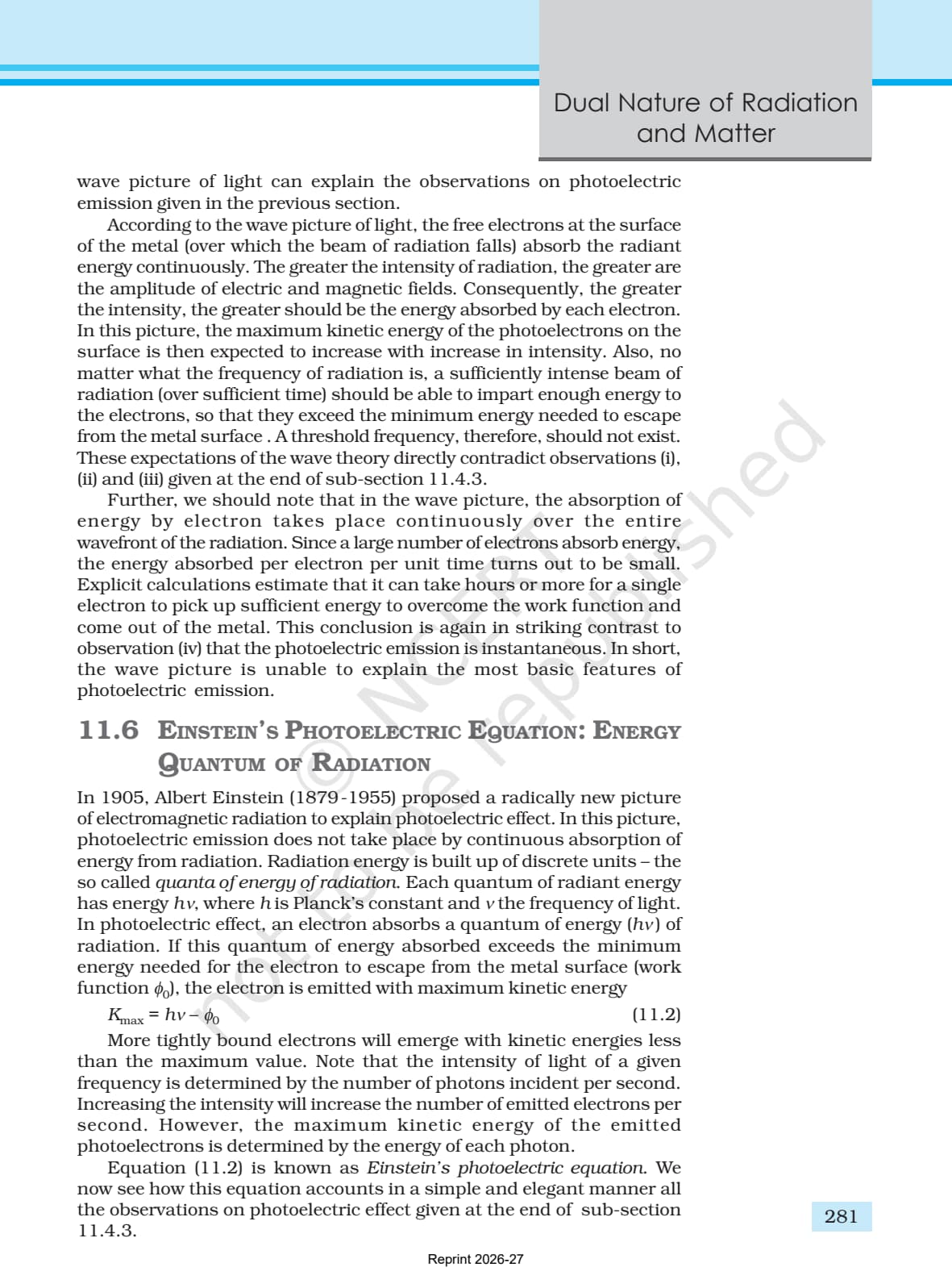
| 11.6 | Einstein's Photoelectric Equation | 3 | KEmax = hν - 0 , photon quantum hypothesis |
| 11.7 | Particle Nature of Light: The Photon | 2 | Photon energy, momentum, zero rest mass |
| 11.8 | Wave Nature of Matter | 3 | de Broglie hypothesis λ = h/p |
| 11.9 | Davisson and Germer Experiment | 2 | First experimental verification of matter waves |
| End | Summary, Points to Ponder, Exercises | 3 | ~32 end-of-chapter Exercises |
Dual Nature of Radiation and Matter Video Chapter Walkthrough
Source: NCERT Wallah on YouTube
Intext Example Inventory in Class 12 Physics Chapter 11 NCERT Book
The 2026-27 chapter carries six intext Examples that demonstrate the exact numerical patterns CBSE, JEE Main, and NEET repeat year after year. The skill column flags what each one trains.
| Example | Sub-topic | What it Covers |
|---|---|---|
| 11.1 | Photon energy of monochromatic light | Apply E = hc/λ for a 632.8 nm laser |
| 11.2 | Photon flux from a sodium lamp | Convert power into photons per second |
| 11.3 | Work function and threshold frequency | Use 0 = h0 with caesium data |
| 11.4 | Stopping potential numerical | Apply eVs = hν - 0 |
| 11.5 | de Broglie wavelength of accelerated electron | Use λ = 1.227/√V nm |
| 11.6 | de Broglie wavelength of a moving ball | Show why matter waves are negligible at macro scale |

How to Read the Dual Nature of Radiation and Matter NCERT PDF (Pass-Sequence Plan)
The recommended reading sequence treats the chapter as three concept blocks. Allocate roughly four study hours across two sittings, then a third revision pass before any test.
- Pass 1 (60 minutes, skim): Read the section headings, all figures, and the chapter Summary. Note the three graphs in Section 11.4 and the λ vs V plot in 11.8.
- Pass 2 (120 minutes, detailed): Work through Sections 11.4, 11.6 and 11.8 line by line. Re-derive Einstein's equation and the de Broglie wavelength on rough paper.
- Pass 3 (60 minutes, examples): Solve Examples 11.1-11.6 without looking at the solved answers first, then check.
- Pass 4 (90 minutes, exercises): Attempt all 32 Exercises; mark the ones based on stopping-potential graphs and de Broglie wavelength for re-revision.
What Changed in the 2026-27 New NCERT Edition for Chapter 11
The current 2026-27 NCERT print retains the full conceptual flow of Dual Nature of Radiation and Matter. No major topic was dropped from this chapter in the rationalised edition. The chapter sits as Chapter 11 with the same nine sections and the same intext Examples as the older Part II edition.
- Kept in full: All four electron emission mechanisms, the three photoelectric laws, Einstein's equation derivation, the photon properties block, de Broglie hypothesis, and Davisson-Germer.
- Light trim: A few historical paragraphs around early photoelectric tubes were tightened.
- Page count: Reduced from roughly 27 to about 24 pages through layout compression, not content removal.
The detailed deletion log is hosted on the Notes page linked below for this chapter.
Related Links:
- Dual Nature of Radiation and Matter Class 12 Physics Notes
- Dual Nature of Radiation and Matter Class 12 Physics NCERT Solutions
Class 12 Physics Chapter Weightage Bar Chart Across the NCERT Book
The visual below maps the typical CBSE Class 12 Physics marks distribution across all 14 chapters of the NCERT book, averaged over the last five board papers.
NCERT Class 12 Physics Chapter 11 Author, Edition and Publisher Info
The chapter is part of the official NCERT Class 12 Physics textbook (Part II) published by the National Council of Educational Research and Training. The table below lists the publishing metadata students often need for project citations and bibliography pages.
| Field | Detail |
|---|---|
| Book Title | Physics Part II - Textbook for Class XII |
| Chapter | Chapter 11 - Dual Nature of Radiation and Matter |
| Publisher | National Council of Educational Research and Training (NCERT) |
| First Published | February 2007 |
| Latest Reprint / Rationalised Edition | 2024 reprint, used unchanged for 2026-27 session |
| Reviewed By | Textbook Development Committee chaired by Prof. J.V. Narlikar; physics review by Prof. A.W. Joshi and members of NCERT's Department of Education in Science and Mathematics |
| Medium | English (Hindi and Urdu editions also published) |
| ISBN | 81-7450-716-9 (Part II) |
| Price | Rs. 180 (printed Part II); free PDF on this page |
The metadata above is taken from the front matter of the official NCERT Physics Part II textbook. The chapter has been reviewed multiple times since first publication, with the most recent content update being the 2023 rationalisation exercise.
Top 3 PYQ Trends for Chapter 11 Dual Nature of Radiation and Matter
Three question patterns reappear almost every year across CBSE, JEE Main, and NEET. The mini-list below captures them; the full year-wise PYQ map sits on the NCERT Solutions page.
- Photoelectric stopping-potential vs frequency graph - appeared in CBSE 2025 (5 marks) and NEET 2024 (4 marks). Tests slope = h/e and x-intercept = threshold frequency.
- de Broglie wavelength of electron / proton - asked in JEE Main 2025 and NEET 2024 as a direct application of λ = h/√2mKE or λ = 1.227/√V nm.
- Einstein's photoelectric equation numerical - CBSE 2024 (3 marks) and JEE Main 2024 both asked KE_max or stopping potential with given work function.
Full year-wise map: Dual Nature of Radiation and Matter NCERT Solutions
How Will Collegedunia's NCERT Book PDF Help You with Chapter 11?
Collegedunia's NCERT Book PDF page is designed as a one-stop launchpad for the chapter, not a static download link.
- 2026-27 NCERT Alignment: The hosted PDF is the latest NCERT print, matching what CBSE schools are using this session.
- Section-mapped Page Numbers: Every section in the breakdown table lists the page span so you can jump straight to a topic.
- Cross-linked to All Six Sibling Resources: Notes, Solutions, Formula Sheet, Handwritten Notes, Exemplar Book and Exemplar Solutions for the same chapter are one click away.
- Expert Verification: Subject experts have verified the section-by-section breakdown and PYQ trends against the official NCERT print.
More Dual Nature of Radiation and Matter Physics Class 12 Resources
NCERT Book PDF for Class 12 Physics: All Chapters
Other Class 12 Physics NCERT Book PDFs you can grab as free downloads:
| Chapter | Resource |
|---|---|
| Chapter 1 | Electric Charges and Fields NCERT PDF |
| Chapter 2 | Electrostatic Potential and Capacitance NCERT PDF |
| Chapter 3 | Current Electricity NCERT PDF |
| Chapter 4 | Moving Charges and Magnetism NCERT PDF |
| Chapter 5 | Magnetism and Matter NCERT PDF |
| Chapter 6 | Electromagnetic Induction NCERT PDF |
| Chapter 7 | Alternating Current NCERT PDF |
| Chapter 8 | Electromagnetic Waves NCERT PDF |
| Chapter 9 | Ray Optics and Optical Instruments NCERT PDF |
| Chapter 10 | Wave Optics NCERT PDF |
| Chapter 12 | Atoms NCERT PDF |
| Chapter 13 | Nuclei NCERT PDF |
| Chapter 14 | Semiconductor Electronics NCERT PDF |
Dual Nature of Radiation and Matter NCERT PDF: available above as a free PDF download, fully aligned to the 2026-27 NCERT release.
Dual Nature of Radiation and Matter NCERT PDF - Frequently Asked Questions
Ques. Where can I download the Dual Nature of Radiation and Matter NCERT PDF for free?
Ans. You can download the Dual Nature of Radiation and Matter Ncert Pdf directly from this page. Both the Normal and HD versions are available, and both are free.
Ques. Is this Dual Nature of Radiation and Matter NCERT PDF aligned with the 2026-27 CBSE syllabus?
Ans. Yes. This page hosts the current 2026-27 syllabus print of Class 12 Physics Chapter 11. No major topic was dropped in the new NCERT edition; only minor historical paragraphs were tightened and the chapter now runs roughly 24 pages.
Ques. How many pages is the Class 12th Physics Dual Nature of Radiation and Matter NCERT Book PDF?
Ans. The NCERT Book PDF runs approximately 24 pages and covers electron emission, the photoelectric effect, Einstein's photoelectric equation, the photon, the de Broglie hypothesis, and the Davisson-Germer experiment, along with six intext Examples and around 32 end-of-chapter Exercises.
Ques. How many intext Examples and Exercises does Chapter 11 contain?
Ans. The chapter contains six intext Examples (numbered 11.1 to 11.6) solved inside the text, plus approximately 32 Exercise questions at the end. The intext Examples cover photon energy, work function, stopping potential, and de Broglie wavelength.
Ques. Who is the publisher and reviewer of the Class 12 Physics NCERT textbook?
Ans. The book is published by the National Council of Educational Research and Training (NCERT). The Textbook Development Committee was chaired by Prof. J.V. Narlikar, with subject review by Prof. A.W. Joshi and members of the NCERT Department of Education in Science and Mathematics. First published in February 2007, the latest reprint is used for the 2026-27 session.
Ques. Which sections of Class 12 Physics Chapter 11 are most important for CBSE Boards, JEE Main and NEET?
Ans. Sections 11.4 (Experimental Study with the three classical graphs), 11.6 (Einstein's photoelectric equation), and 11.8 (de Broglie hypothesis) carry the highest weightage. Section 11.9 Davisson-Germer is a regular 1-mark question. Together these account for nearly all the exam marks from Chapter 11.
Ques. What is Einstein's photoelectric equation as given in the Class 12th NCERT chapter?
Ans. The NCERT chapter states Einstein's photoelectric equation as KEmax = hν - 0 , where h is Planck's constant, ν is the frequency of incident light, and 0 is the work function of the metal. The stopping potential relation eVs = KEmax is used to measure KEmax in the lab.



Comments