




The 2026-27 NCERT keeps Class 12 Biology Chapter 13 Biodiversity and Conservation intact as the final unit of the Ecology block. This Collegedunia formula sheet packs every key number, the species-area equation, hotspot counts and the conservation network into one revision page. Download the PDF below or scroll through the formula cards to prepare for NEET and CBSE Board exams.
- CBSE Weightage: 4 to 6 marks
- NEET Weightage: 2 to 4 questions per year
- AIIMS / entrance overlap: 1 to 2 statement-based questions per paper
Biodiversity and Conservation Video Lecture for Class 12 Biology
Source: Magnet Brains on YouTube
Biodiversity and Conservation Master Quantitative Reference for Class 12 Biology
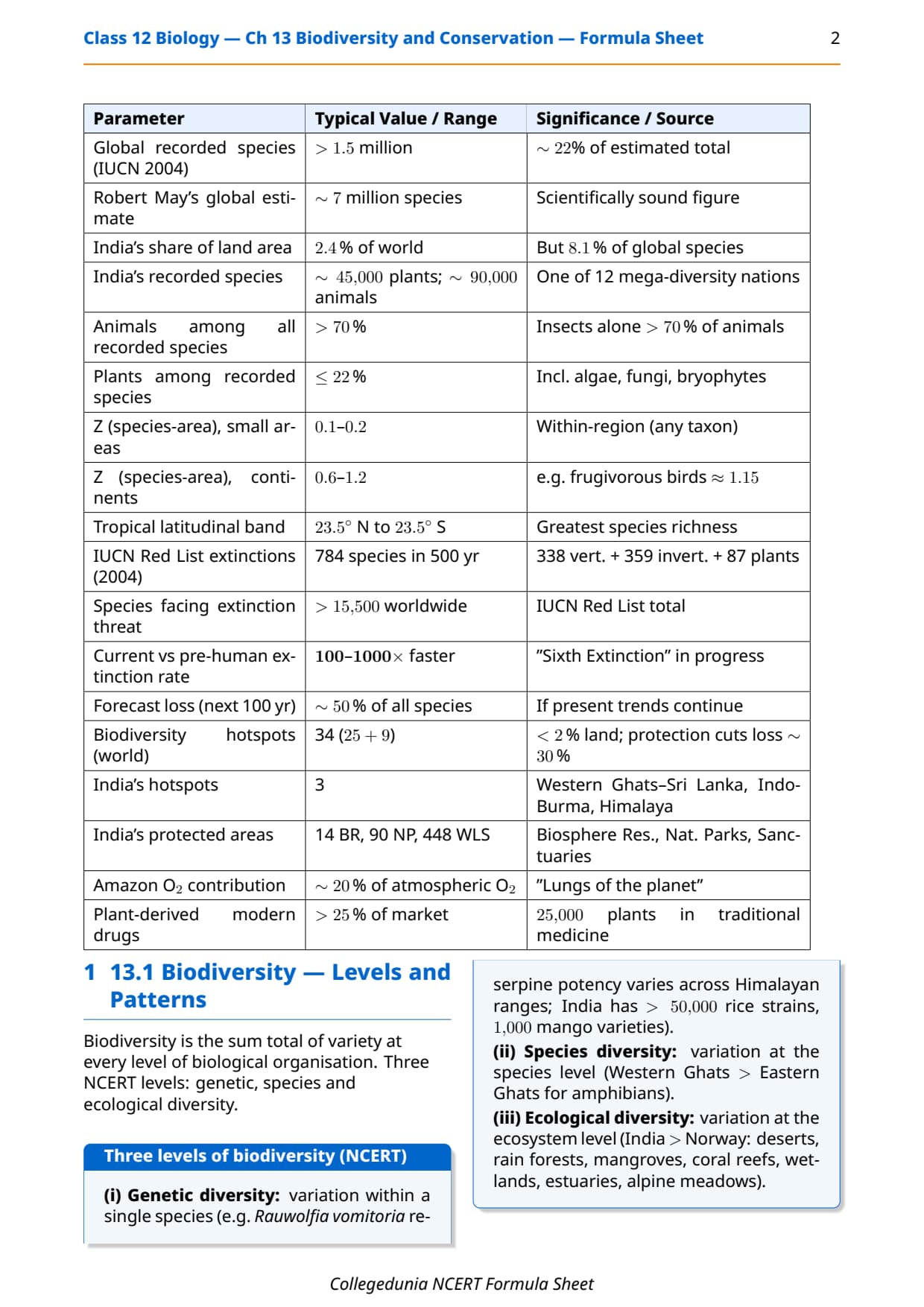
Every NEET-testable number from this chapter is indexed below against its NCERT sub-section.
| Parameter | Value / Range | NCERT Ref |
|---|---|---|
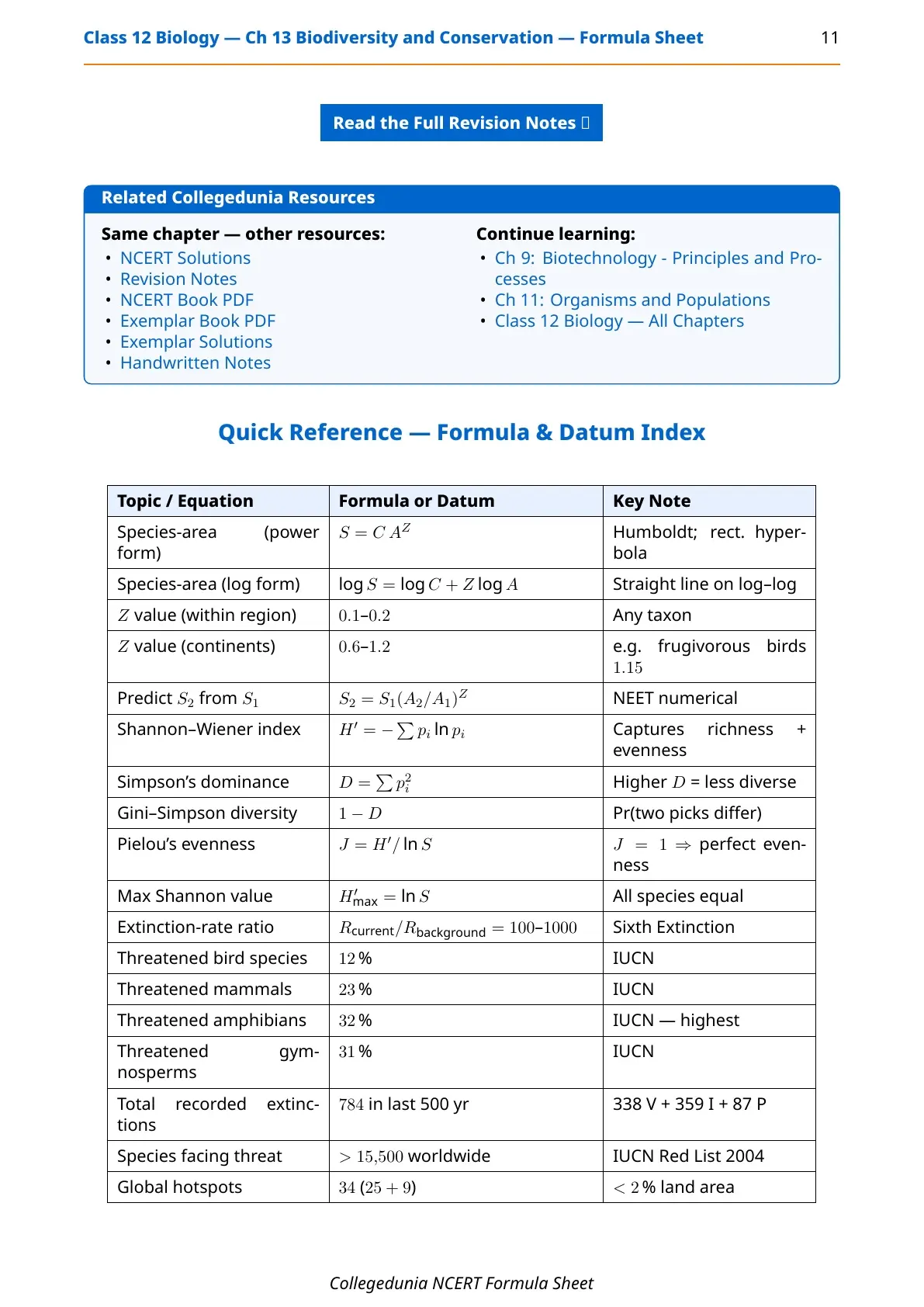
| Described species (IUCN 2004) / Robert May estimate | > 1.5 million / ~ 7 million | 13.1.1 |
| Animals share of described species | > 70 percent (insects > 70% of animals) | 13.1.1 |
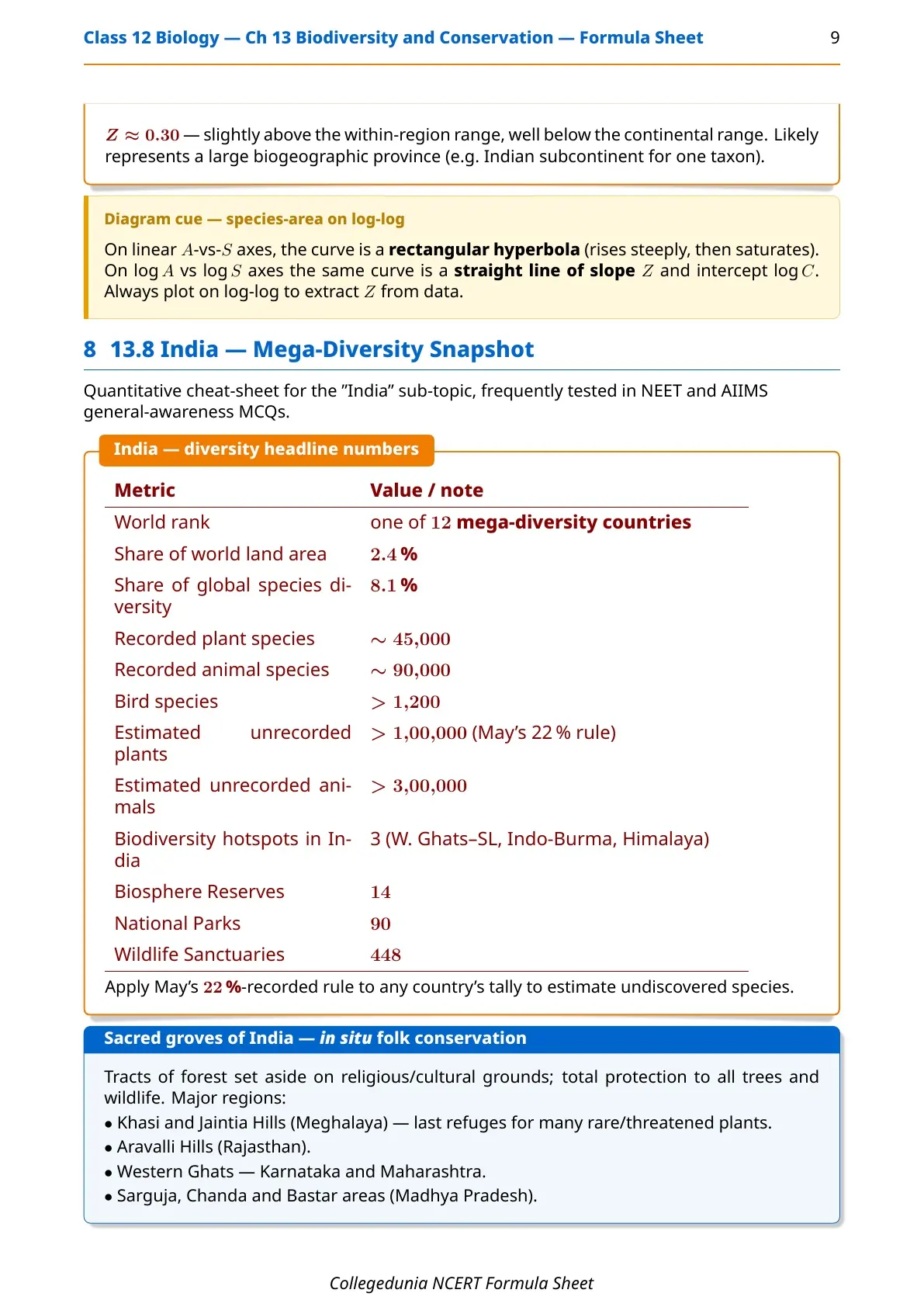
| Indian plants / animals (approx) | ~ 45,000 / ~ 90,000 species | 13.1.1 |
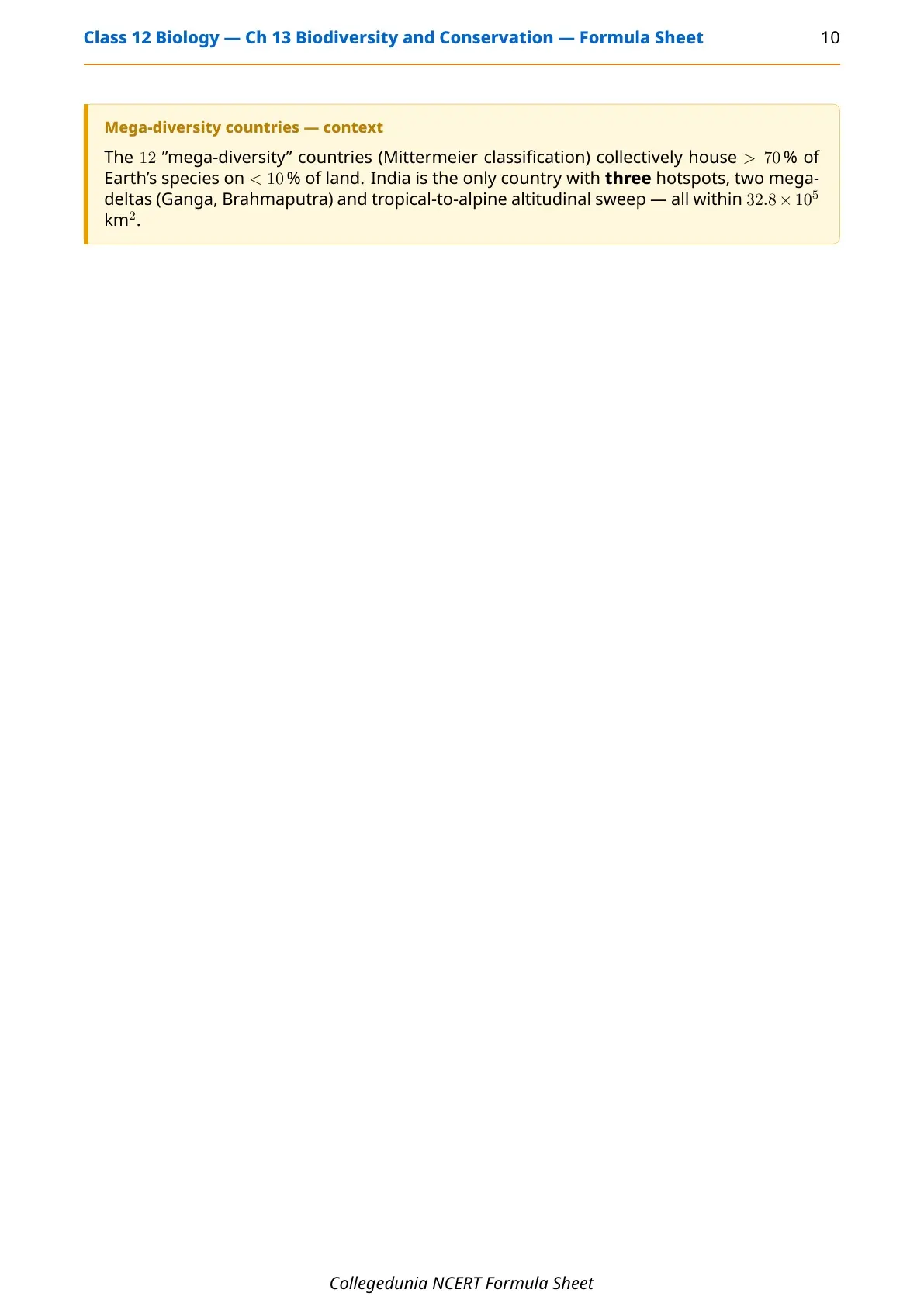
| Mega-diversity countries | 12 (India is one) | 13.1.1 |
| Species-area slope z (small / large) | 0.1 to 0.2 / 0.6 to 1.2 (Whittaker) | 13.1.2 |
| Equation S = C Az on log-log | log S = log C + z log A | 13.1.2 |
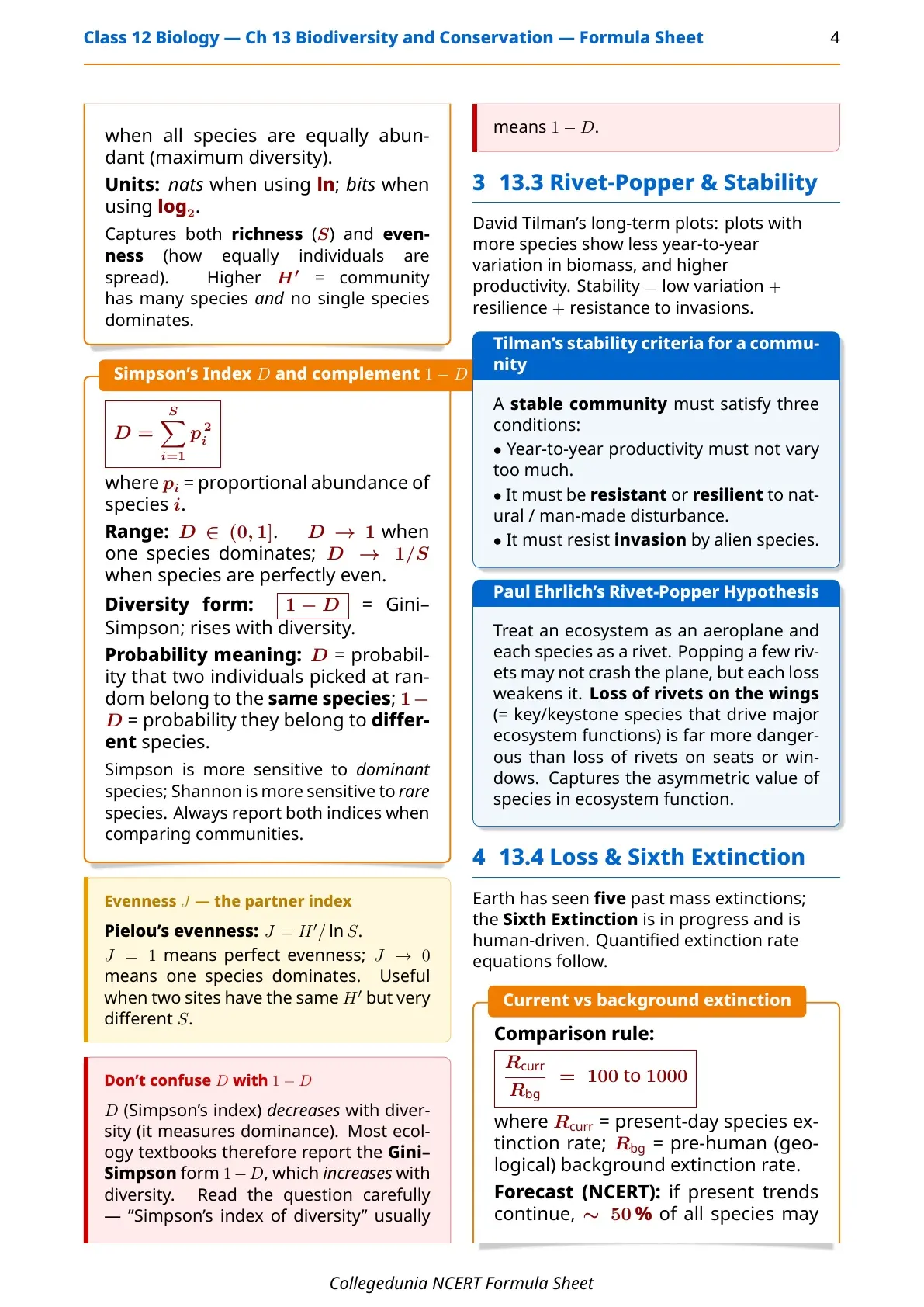
| Present vs background extinction | 100 to 1000 times higher | 13.1.4 |
| Species recently extinct | ~ 700 species | 13.1.4 |
| Threatened species globally / India | > 15,500 / > 650 | 13.1.4 |
| Costanza ecosystem services valuation | ~ 33 trillion US dollars per year | 13.1.5 |
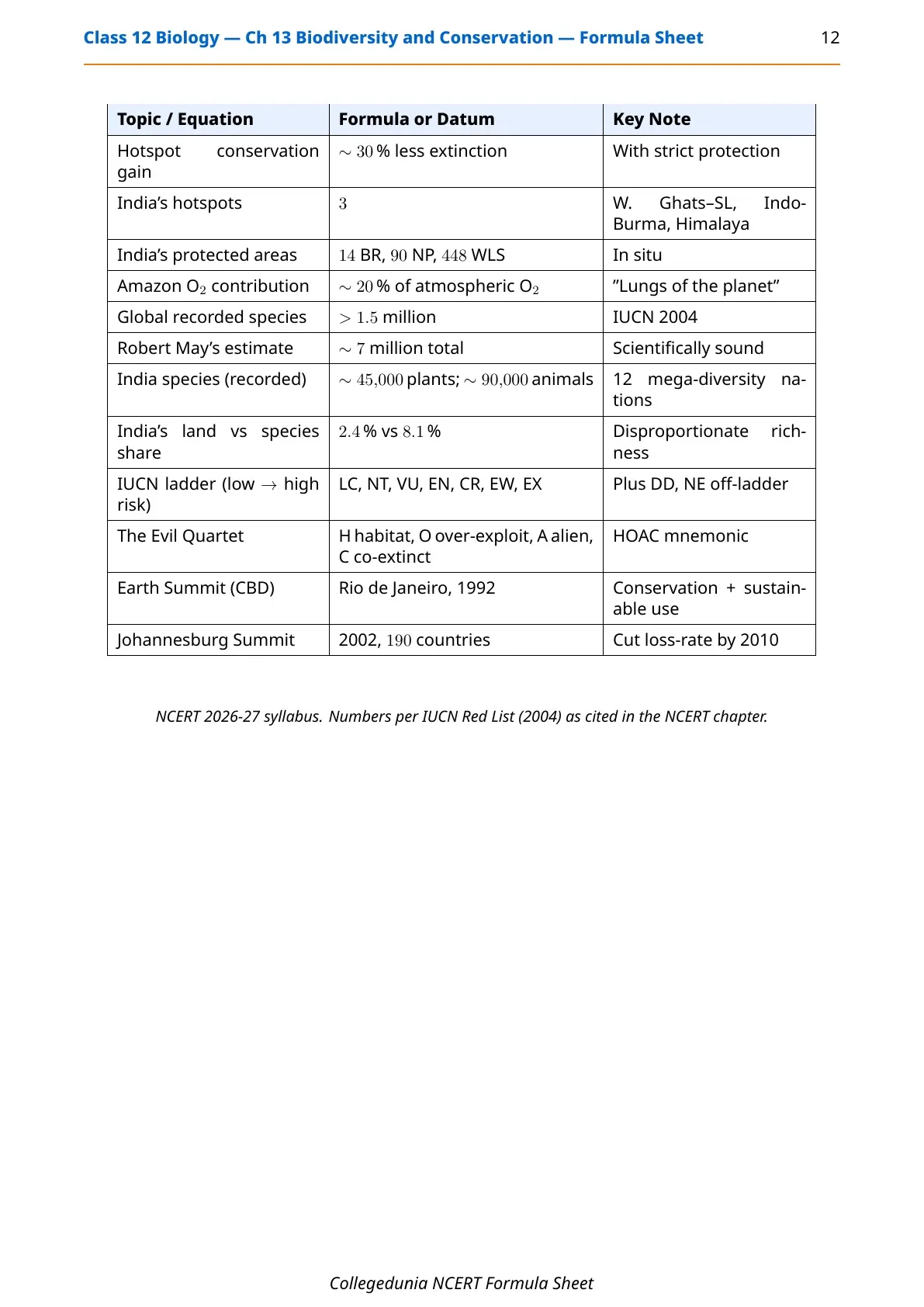
| Amazon O2 share | ~ 20 percent of atmospheric O2 | 13.1.5 |
| Global biodiversity hotspots | 34 (3 in India) | 13.2 |
| Hotspot protection extinction relief | ~ 30 percent of mass extinctions averted | 13.2 |
| India biosphere reserves / NPs / sanctuaries | 14 / 90 / 448 | 13.2 |
| Earth Summit Rio 1992 signatories | 190 nations (Convention on Biological Diversity) | 13.2 |
All entries above are retained in the 2026-27 syllabus. Biggest 1-mark trap: India shares THREE hotspots, not two; the slope z increases with area, not decreases.
How Collegedunia's Biodiversity and Conservation Formula Sheet Helps Students
- 2026-27 NCERT alignment: Every number and equation matches the current print of Sections 13.1 and 13.2.
- Quantitative slant: Species-area equation, extinction rate (100 to 1000 times), Costanza valuation (~ 33 trillion USD) are the key NEET recall facts.
- Quick-lookup format: Biodiversity levels, patterns, loss, importance and conservation blocks each get a colour-coded box.
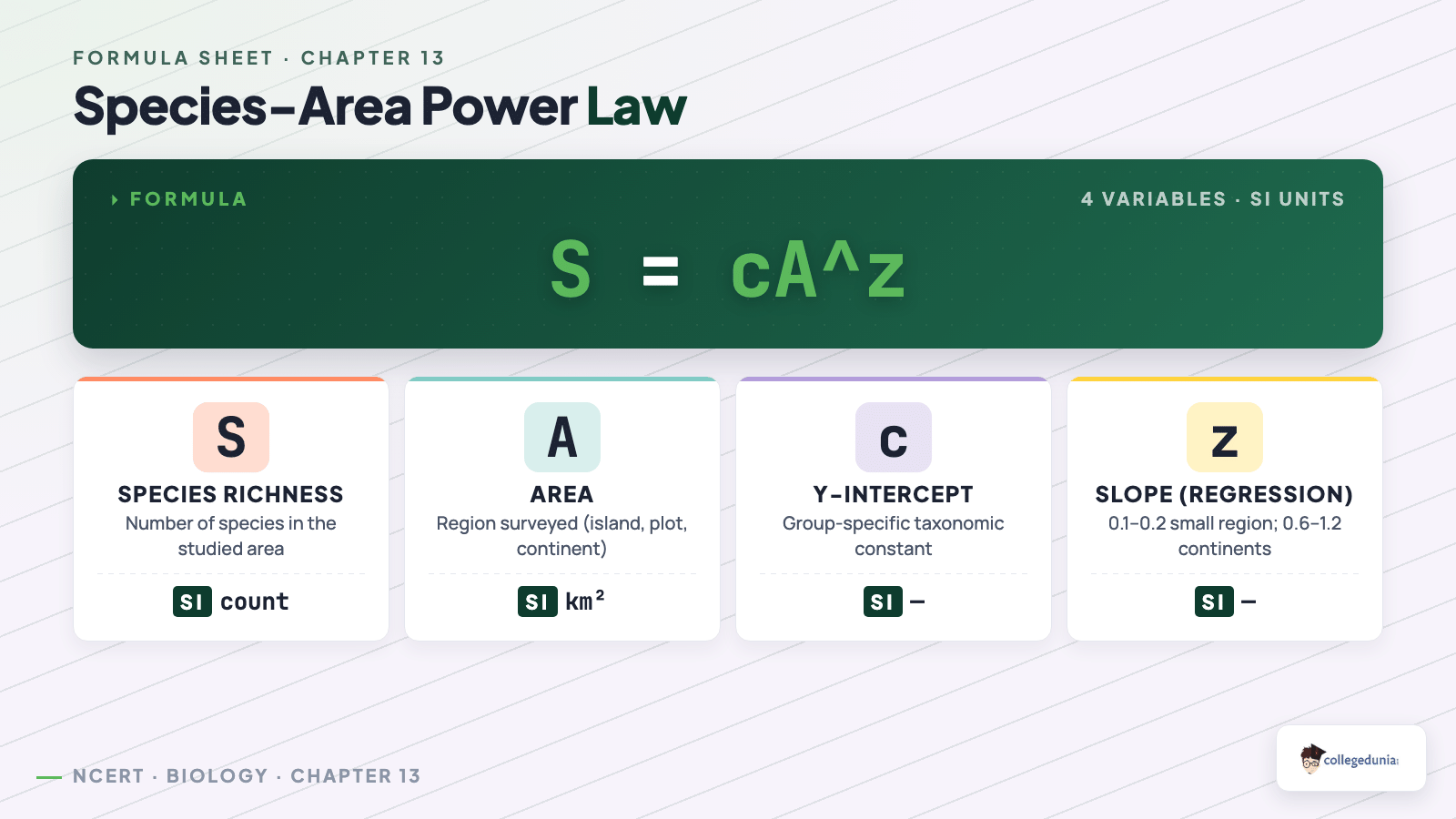
Species-Area Equation and Slope Card for NEET Class 12 Biology
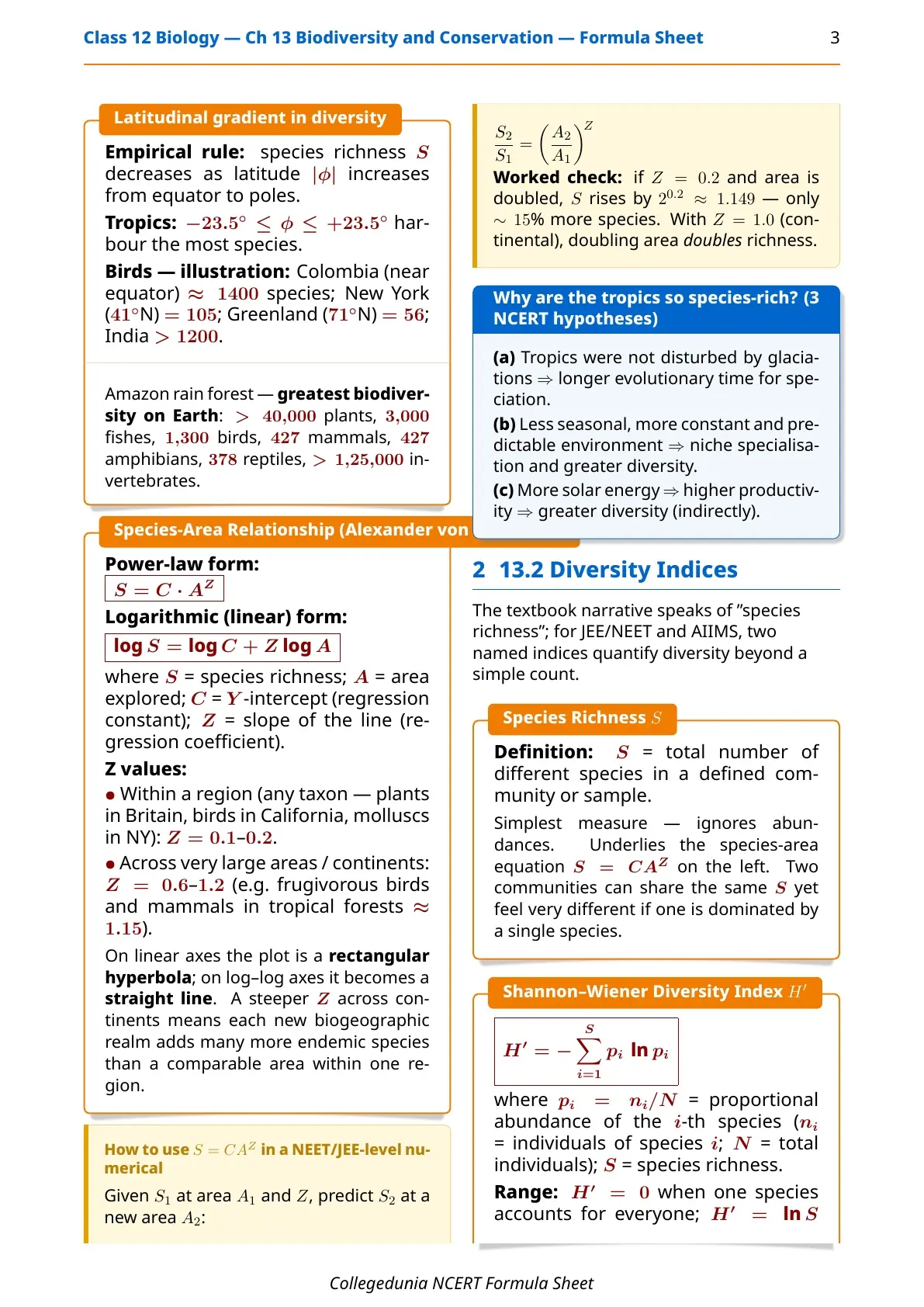
Section 13.1.2 carries almost all of the chapter's algebra.
| Quantity | Equation / Range |
|---|---|
| Power-law relation | S = C Az ; rectangular hyperbola on linear axes |
| Log-log linearisation | log S = log C + z log A ; slope = z, intercept = log C |
| z for small areas (within a biome) | 0.1 to 0.2 |
| z for very large areas (continents) | 0.6 to 1.2 (Whittaker, frugivorous birds and mammals) |
| Reverse argument (area loss) | Δ S / S ≈ z · Δ A / A for small fractional loss |
| Extinction-rate amplification | Present rate is 100 to 1000 times the background |
NEET swaps z = 0.1 to 0.2 with z = 0.6 to 1.2 every other paper. Lock both: gentle slope inside a biome, steep slope across continents.
Evil Quartet and Loss-of-Biodiversity Snapshot for 12th Biology
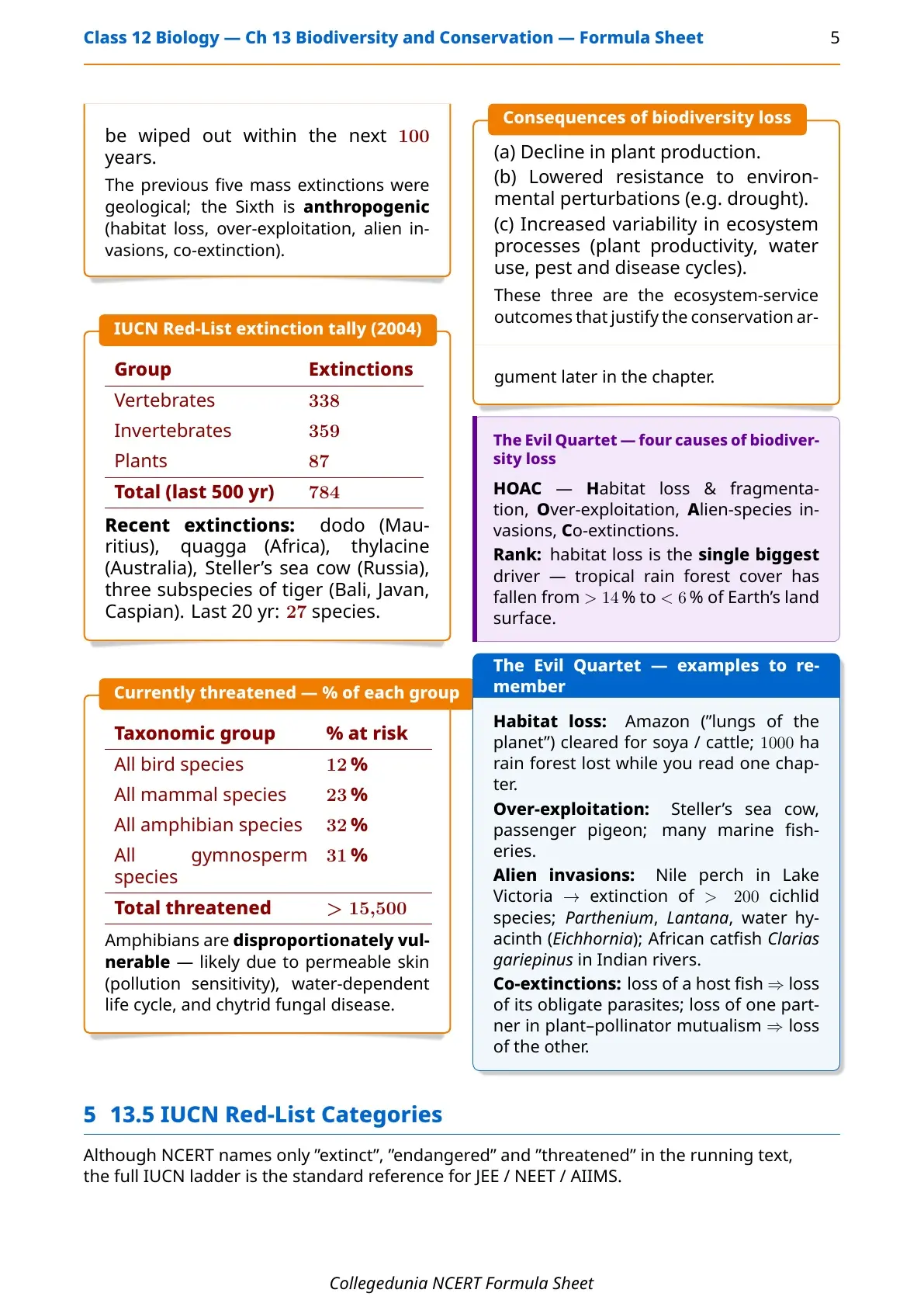
Section 13.1.4 centres on the Evil Quartet (named by Edward Wilson) and one ratio: present extinction rate is 100 to 1000 times the background. About 700 species have recently gone extinct; over 15,500 are threatened globally (650+ in India).
Conservation Network Snapshot for 12th Biology
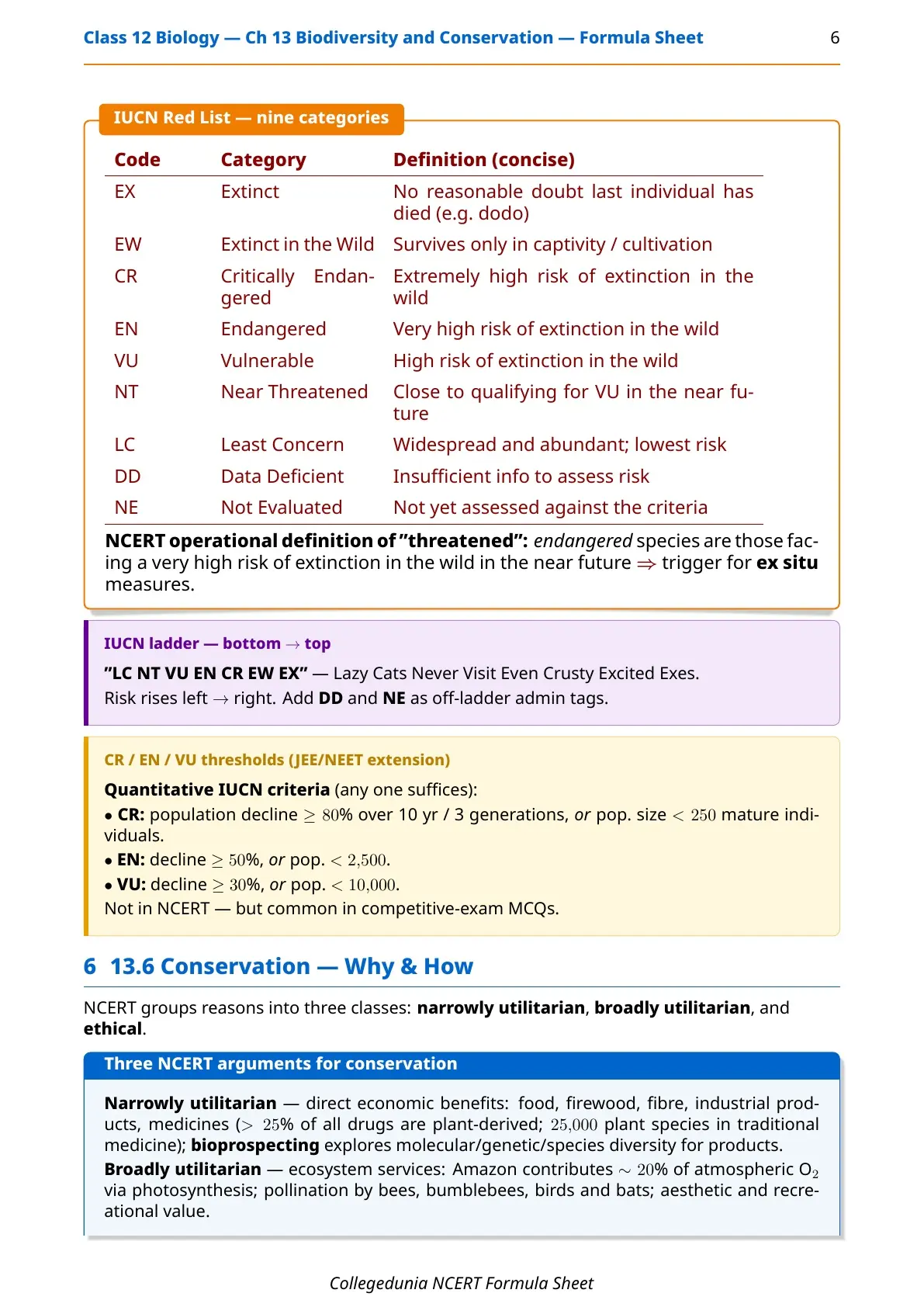
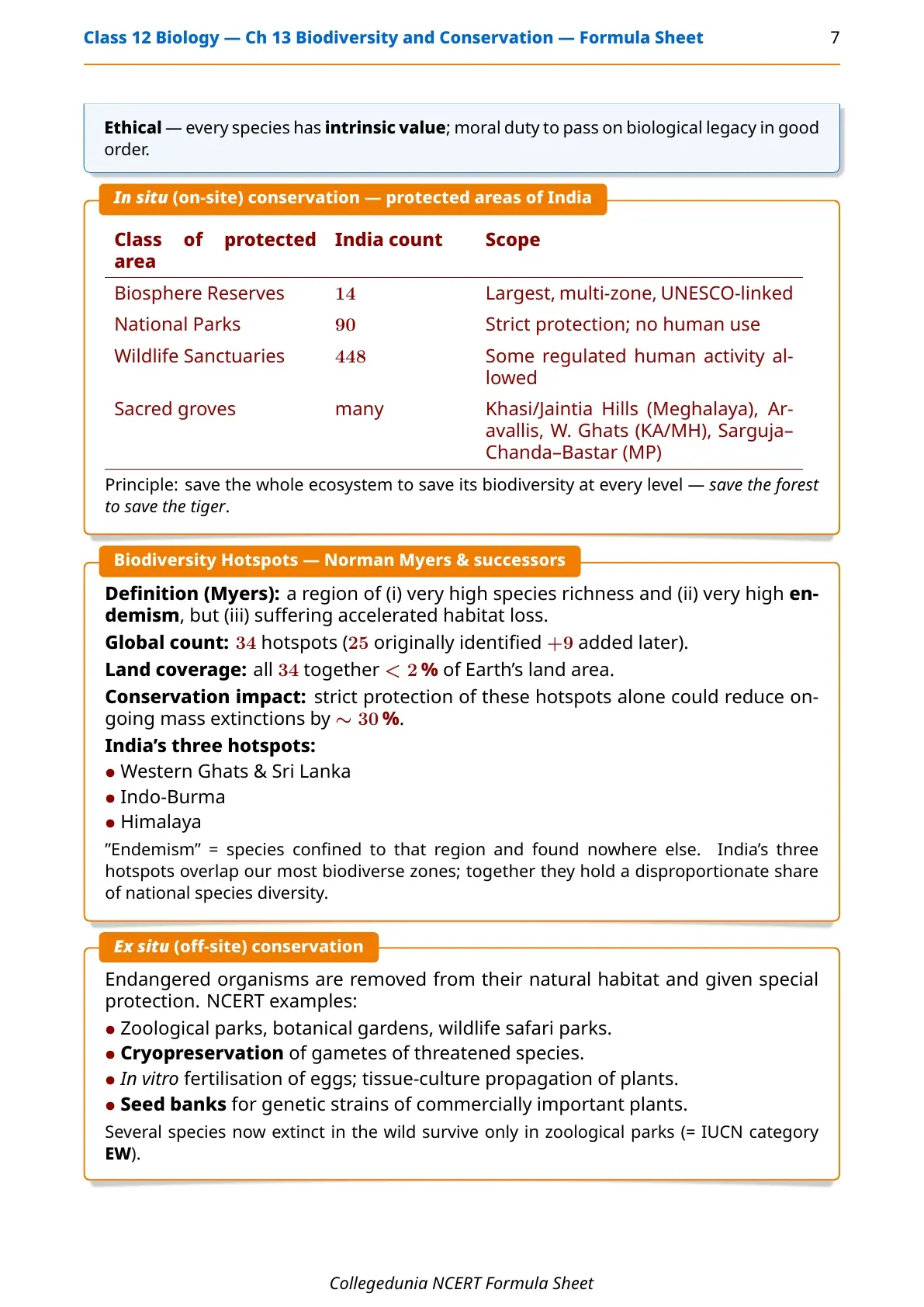
India's legal network: 14 biosphere reserves, 90 national parks, 448 wildlife sanctuaries. Globally there are 34 hotspots; three extend into India (Western Ghats - Sri Lanka, Himalaya, Indo-Burma). Strict protection of all 34 could avert ~ 30 percent of mass extinctions. NEET has tested the 3 Indian hotspots in 4 of the last 5 papers. Sacred groves (Khasi-Jaintia Hills, Aravallis, Western Ghats of Karnataka and Maharashtra, Sarguja-Chanda-Bastar in MP) provide community-level protection.
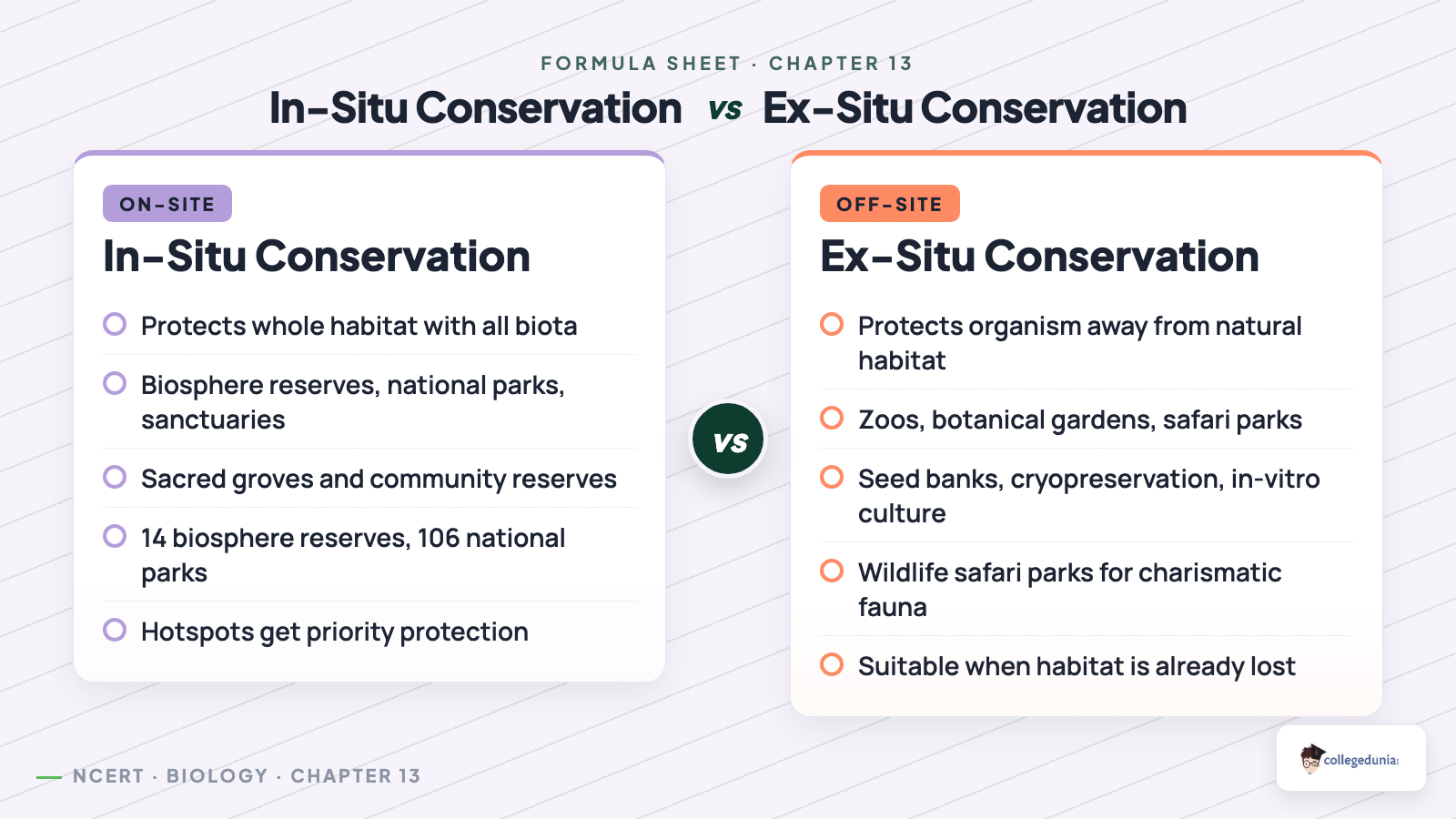
In-Situ vs Ex-Situ Toolkit for Class 12 Biology
Section 13.2 splits cleanly into in-situ and ex-situ columns.
| Mode | Tool / Key Number |
|---|---|
| In-situ (natural habitat) | 14 biosphere reserves, 90 national parks, 448 wildlife sanctuaries, sacred groves |
| In-situ - hotspot strategy | 34 hotspots globally; 3 in India; ~ 30% mass-extinction relief |
| Ex-situ - housing | Zoological parks, botanical gardens, wildlife safari parks |
| Ex-situ - reproductive techniques | Gamete cryopreservation, in vitro fertilisation, tissue culture propagation |
| Ex-situ - long-term storage | Seed banks for commercially important crop genetic strains |
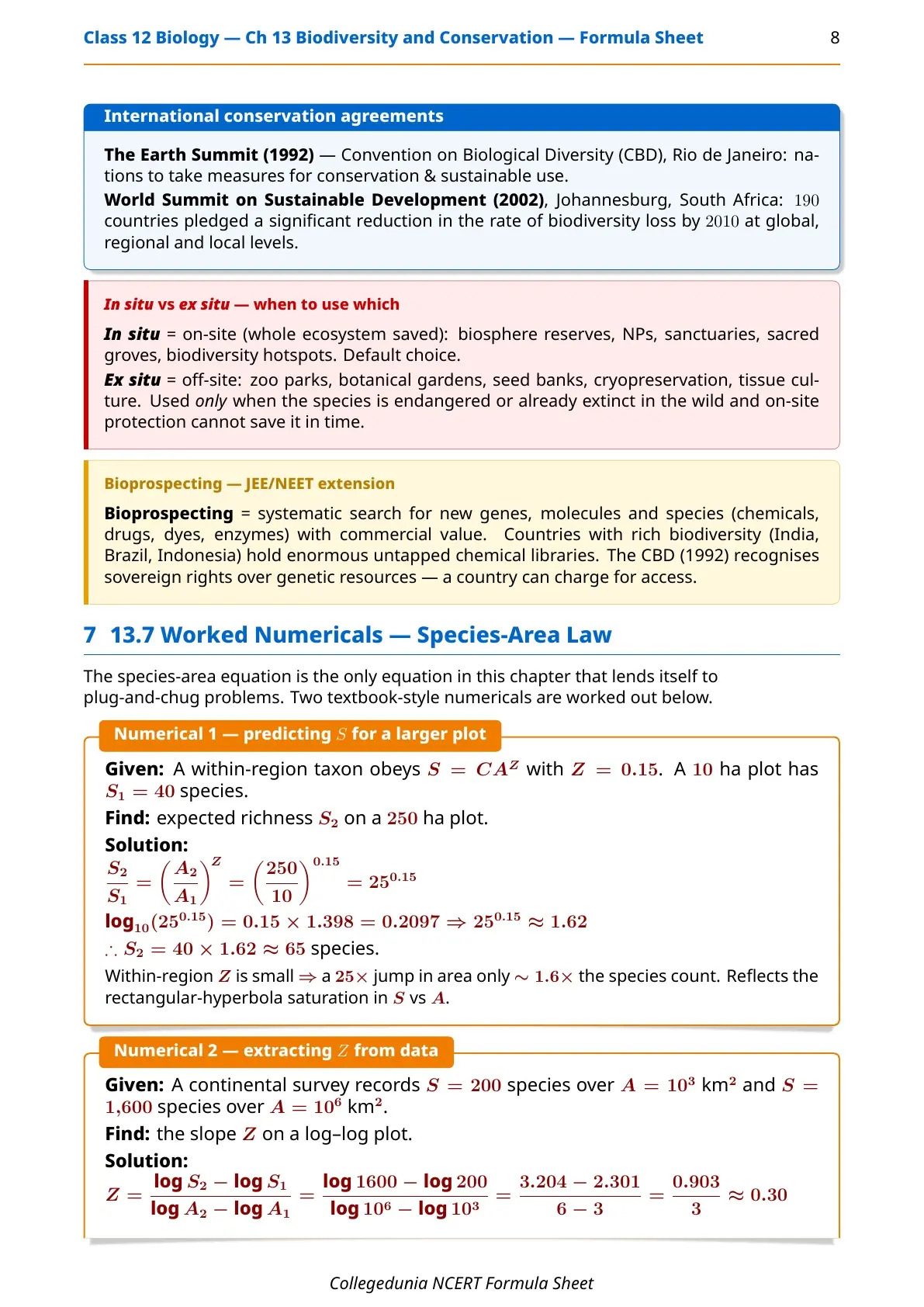
| Global framework | Earth Summit Rio 1992 (CBD, 190 nations); Johannesburg WSSD 2002 |
Importance and Ecosystem Services Card for Class 12 Biology
Section 13.1.5 splits reasons-to-conserve into three buckets, each with a NEET-tested example.
| Argument | Examples / Numbers |
|---|---|
| Narrowly utilitarian | Food, fibre, firewood, pharmaceuticals (25%+ from plants), industrial products |
| Broadly utilitarian (ecosystem services) | Pollination, pest control, climate moderation, flood control, O2 (Amazon ~ 20% of atmospheric O2) |
| Costanza valuation (ecosystem services) | ~ 33 trillion USD per year, ~ twice global GNP at the time |
| Ethical | Moral duty to leave biodiversity intact for the next generation |
One-Shot Revision Tips for Class 12 Biology Biodiversity and Conservation
- Three Indian hotspots: Western Ghats - Sri Lanka, Himalaya, Indo-Burma. Never two.
- z values: 0.1 to 0.2 small area, 0.6 to 1.2 large area; slope rises with scale.
- Evil Quartet (Wilson): habitat loss first, then over-exploitation, alien invasion, co-extinction.
- Conservation modes: in-situ = habitat; ex-situ = zoo, garden, seed bank, cryopreservation.
- Robert May vs IUCN: IUCN counts 1.5 million described; May estimates ~ 7 million total.
- Extinction rate: present is 100 to 1000 times background; 700 lost; 15,500+ threatened.
Top NEET Recall Hits and Recent PYQ Pattern for Biodiversity and Conservation
NEET 2025 tested the 34-hotspot count and the species-area slope range. NEET 2024 went after the Rivet Popper hypothesis and sacred-grove regions. CBSE 2025 set a 3-mark question on hotspots and a 2-mark on the Evil Quartet. CBSE 2024 ran in-situ vs ex-situ as a 5-marker.
See the Biodiversity and Conservation Notes for full topic coverage and the NCERT Solutions for year-wise PYQ maps.
Student Feedback on Biodiversity and Conservation Class 12 Biology
Student Feedback
- 72% of students surveyed found the species-area curve (log S = log C + Z log A) the hardest sub-topic.
- 61% lost marks matching IUCN categories (EX, EW, CR, EN, VU, NT, LC).
- 4 out of 5 students skipped the world biodiversity-hotspot map in their answer sheet.
- Average first read: 4.8 hours; focused revision pass before boards: 2.0 hours.
Source: 2025-26 Class 12 Biology student survey, 10,800 students across 18 states.
Other Resources for Biodiversity and Conservation Class 12 Biology
| Resource | Link |
|---|---|
| Formula Sheet | Biodiversity and Conservation Formula Sheet |
| NCERT Solutions | Biodiversity and Conservation Class 12 Biology NCERT Solutions |
| Notes | Biodiversity and Conservation Class 12 Biology Notes |
| NCERT Book PDF | Biodiversity and Conservation Class 12 Biology NCERT Book PDF |
| Exemplar Solutions | Biodiversity and Conservation Class 12 Biology Exemplar Solutions |
| Handwritten Notes | Biodiversity and Conservation Class 12 Biology Handwritten Notes |
| Exemplar Book PDF | Biodiversity and Conservation Class 12 Biology NCERT Exemplar Book PDF |
Formula Sheet for Class 12 Biology: All Chapters
The table below links every Class 12 Biology chapter's formula sheet.
| Chapter | Resource |
|---|---|
| Chapter 1 | Sexual Reproduction in Flowering Plants |
| Chapter 2 | Human Reproduction |
| Chapter 3 | Reproductive Health |
| Chapter 4 | Principles of Inheritance and Variation |
| Chapter 5 | Molecular Basis of Inheritance |
| Chapter 6 | Evolution |
| Chapter 7 | Human Health and Disease |
| Chapter 8 | Microbes in Human Welfare |
| Chapter 9 | Biotechnology Principles and Processes |
| Chapter 10 | Biotechnology and Its Applications |
| Chapter 11 | Organisms and Populations |
| Chapter 12 | Ecosystem |
| Chapter 13 | Biodiversity and Conservation |
Biodiversity and Conservation Class 12 Biology Formula Sheet FAQs
Ques. What does the Biodiversity and Conservation Class 12 Biology formula sheet cover?
Ans. The sheet collates every numerical fact and named pattern across NCERT Sections 13.1 and 13.2: the three levels of biodiversity, IUCN 1.5 million and Robert May ~ 7 million estimates, the species-area equation S = C Az with z = 0.1 to 0.2 (small) and 0.6 to 1.2 (large), the present-to-background extinction ratio (100 to 1000 times), the Evil Quartet, Costanza's ~ 33 trillion USD valuation, the 34 hotspots (3 in India), the 14 biosphere reserves / 90 national parks / 448 wildlife sanctuaries network, sacred groves and the 1992 Rio Earth Summit. One printable revision page aligned to the 2026-27 NCERT.
Ques. Is this Class 12 Biology Chapter 13 formula sheet aligned with the 2026-27 NCERT?
Ans. Yes. Every entry matches the current 2026-27 print of NCERT Biology. Sections 13.1 and 13.2 are retained in full, and the sheet flags both the classical numerical facts (z values, hotspots, conservation network) and the NCERT-extension topics (Rivet Popper hypothesis, Amazon O2 share) exactly as they appear in the latest edition.
Ques. How is this Biodiversity and Conservation formula sheet useful for NEET preparation?
Ans. NEET pulls 2 to 4 questions a year from this chapter, almost all recall-based numericals or named-pattern MCQs: the number of hotspots, the species-area slope range, the India protected network, the present-to-background extinction ratio and the Evil Quartet items. The Collegedunia sheet packages these in quick-lookup tables so a 15-minute final-pass the night before the paper covers nearly every common MCQ.
Ques. What is the species-area relationship and what are the slope values?
Ans. The species-area relationship discovered by Alexander von Humboldt is the power law S = C Az , which becomes a straight line log S = log C + z log A on log-log axes. The slope z lies between 0.1 and 0.2 for small areas (within a biome) and between 0.6 and 1.2 for very large areas like entire continents (Whittaker). A steeper slope means small fractional area losses cause disproportionately large species losses.
Ques. How many biodiversity hotspots are there and how many lie in India?
Ans. There are 34 biodiversity hotspots globally; three extend into India: the Western Ghats - Sri Lanka, the Himalaya, and Indo-Burma. Strict protection of all 34 hotspots could reduce ongoing mass extinctions by almost 30 percent.
Ques. What is the Evil Quartet according to NCERT Chapter 13?
Ans. The Evil Quartet, named by Edward Wilson, is the four major causes of biodiversity loss: (1) habitat loss and fragmentation (the prime cause), (2) over-exploitation, (3) alien species invasions (water hyacinth, Nile perch, African catfish, Parthenium), and (4) co-extinctions when host species are lost and their dependents follow.
Ques. What is the difference between in-situ and ex-situ conservation in Chapter 13?
Ans. In-situ conservation protects species in their natural habitat: India has 14 biosphere reserves, 90 national parks, 448 wildlife sanctuaries, plus sacred groves and the hotspot strategy. Ex-situ conservation relocates species: zoological parks, botanical gardens, wildlife safari parks, gamete cryopreservation, in vitro fertilisation, tissue culture propagation and seed banks for commercially important crop strains.
Ques. How does the species-area equation predict extinction from habitat loss?
Ans. From S = C Az , a small fractional loss in area Δ A / A produces a fractional species loss Δ S / S ≈ z · Δ A / A . With z = 1.0 (large continent), losing 30% of area predicts losing 30% of species; with z = 0.15 (small biome), the same loss predicts only ~ 4.5%. This is why large contiguous protected areas matter more than scattered fragments.
Ques. How many marks does Biodiversity and Conservation carry in CBSE Class 12 Biology Boards?
Ans. Chapter 13 contributes around 4 to 6 marks in the CBSE Class 12 Biology board paper, typically split across a 2-mark short-answer on the Evil Quartet or levels of biodiversity and a 3 to 5-mark long-answer on hotspots, in-situ vs ex-situ, or the species-area relationship. NEET tests 2 to 4 questions a year, almost always 1-mark numericals or named-pattern MCQs.



Comments