




The NCERT Notes for Class 12 Physics Chapter 7 Alternating Current provide a detailed overview of all important topics covered in the chapter. According to the latest syllabus for CBSE 2026-27, the Alternating Current Chapter contributes to 6-8 marks in the Board exam.
First, here is a quick exam-weightage snapshot for Alternating Current:
- CBSE Weightage: Theory-based 2-3 questions, including formula-based numericals and definitions contributing to 8-12 marks in the CBSE Board exams.
-
JEE Main Weightage: 1-2 questions per session can be seen from the Alternating Current Chapter in the JEE Main. Questions are usually fast-calculation-based.
-
JEE Advanced Weightage: In the JEE Advanced, AC questions are usually paired with numericals and graphs, contributing to around 8-12 marks (2-3 questions) in the exam.
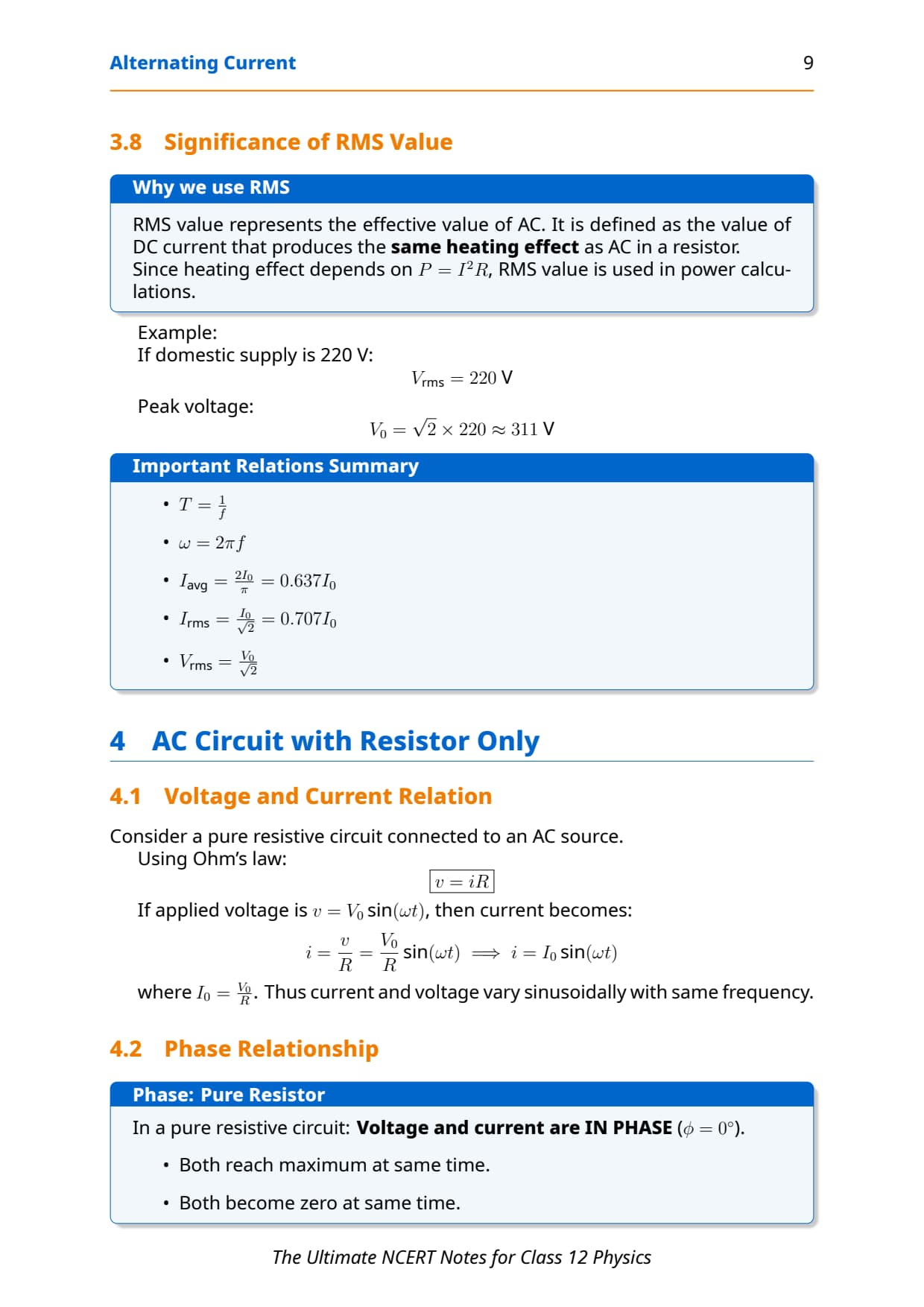
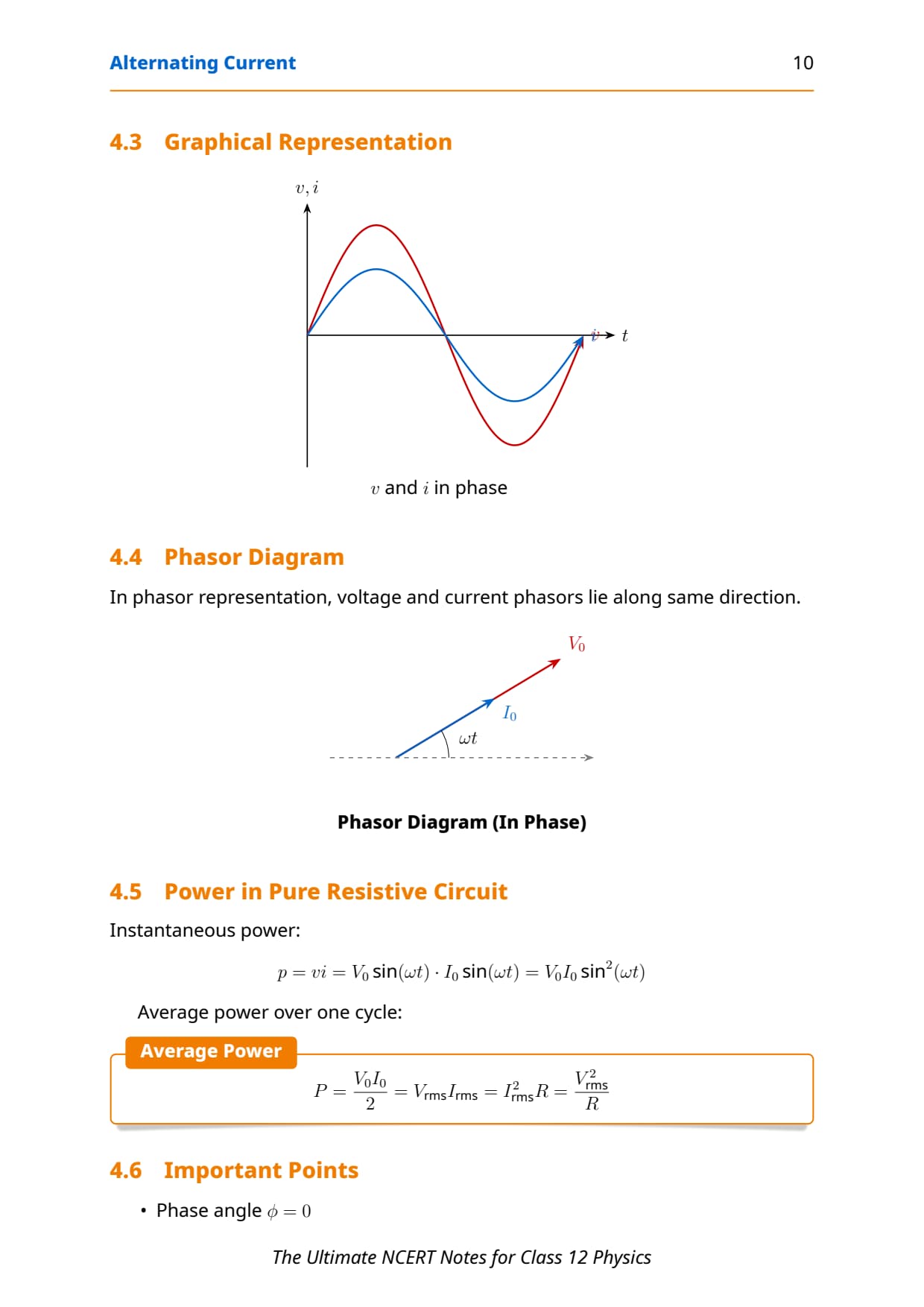
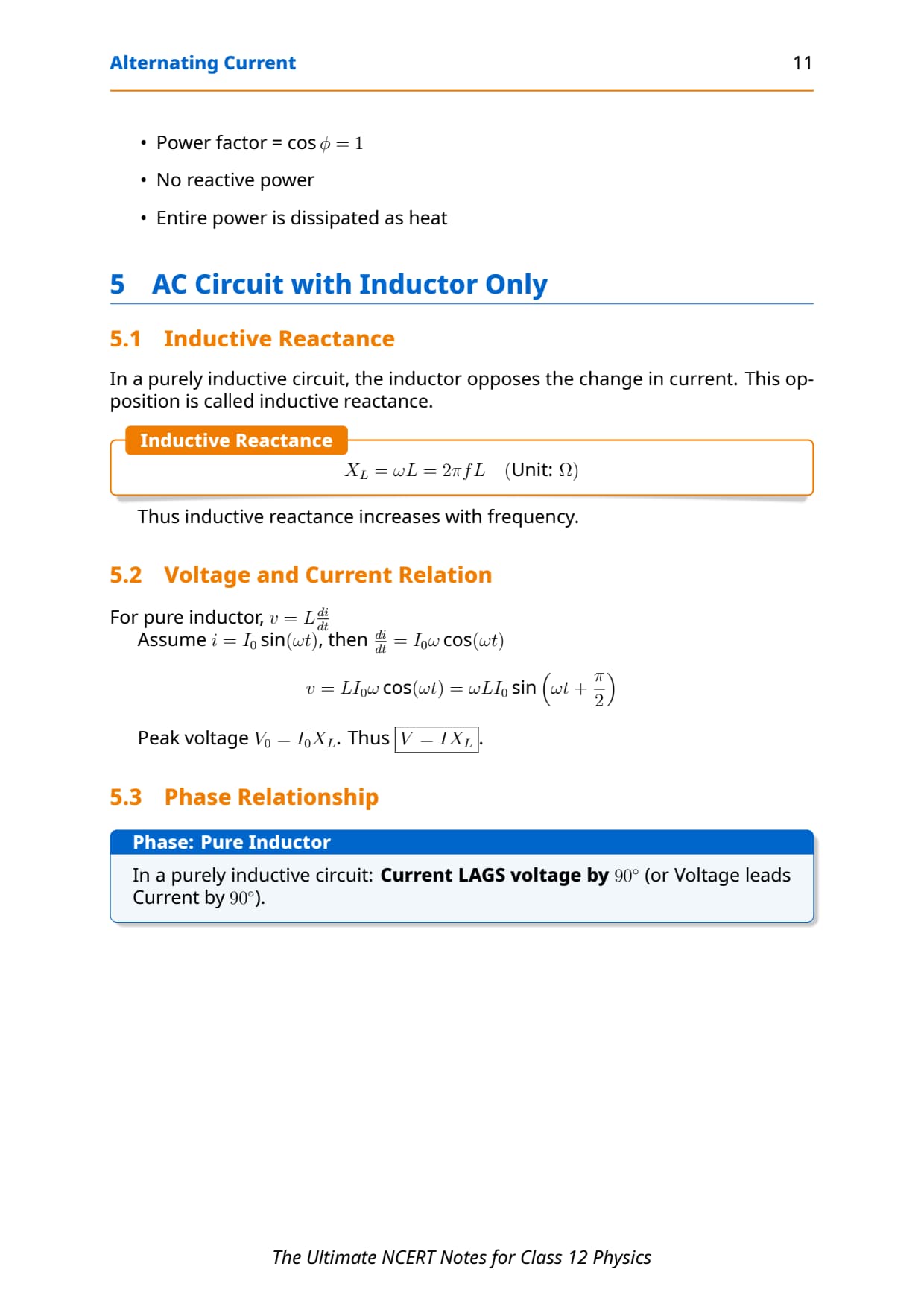
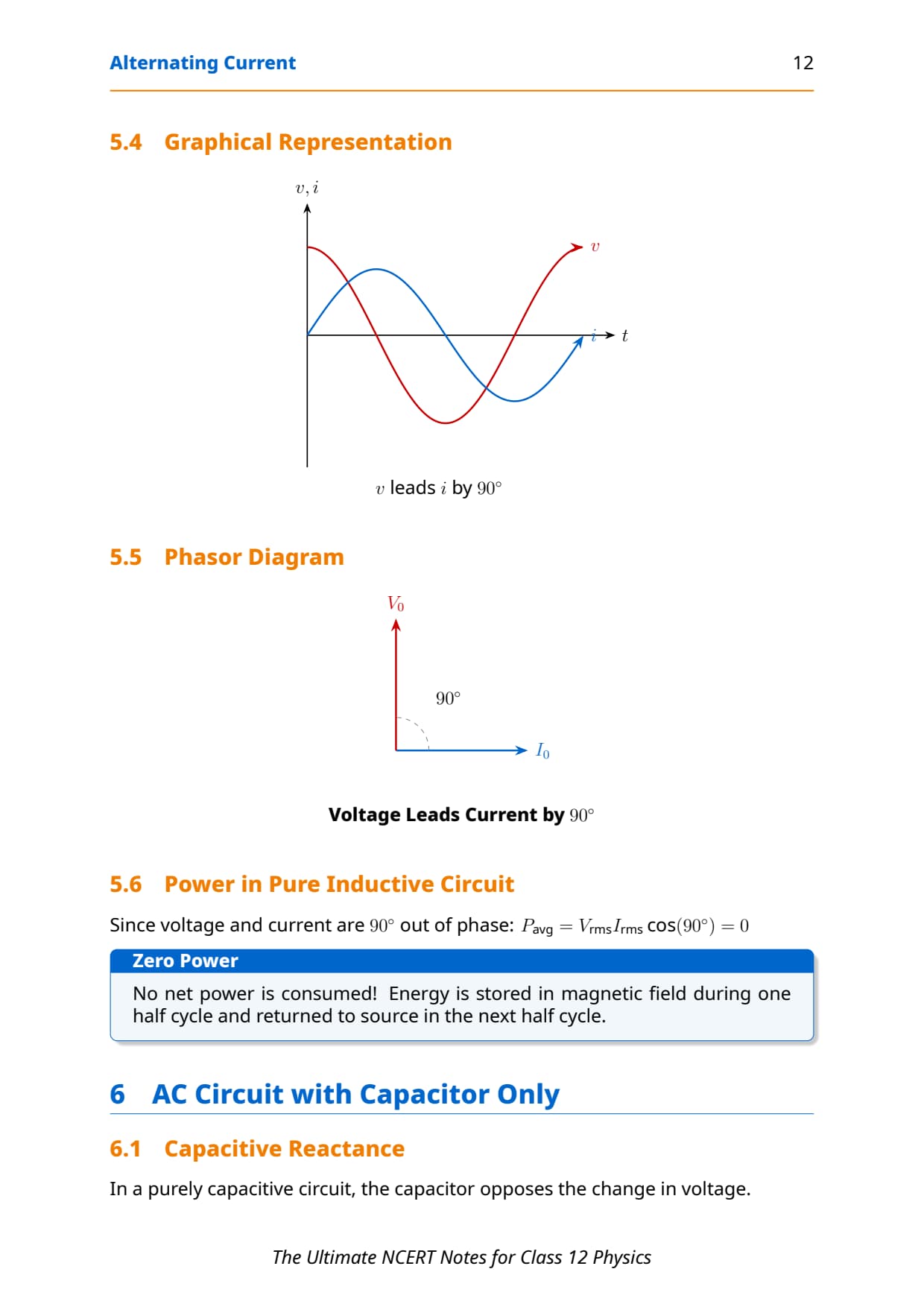
You can find complete revision notes on alternating current class 12 NCERT chapter 7, including all formulas and numerical tips as noted for CBSE boards in the article below.
Collegedunia’s Alternating Current notes are based on NCERT, Reference books like S.L Arora, and previous years’ questions, which will help you not only in Boards but in Competitive exams as well.
Here is how much this chapter matters for Boards and JEE, and how long to study it.
- CBSE Board Weightage (2026): Usually, this chapter carries 2 marks alone, or up to 6 marks with EMI (Unit IV), with 1 easy question or simple numerical from LCR, power, or transformers.
- JEE Main Weightage (2026 trends): 2-3 questions around 6.6% weightage in Physics. More numerical and conceptual MCQs compared to boards.
- High-Yield Topics (Common): Series LCR circuit (resonance, impedance, power factor), phasor diagrams, transformer working & efficiency, RMS/average values.
- Previous Year Trend: Boards - straightforward 2-5 marks; JEE Main - resonance, power, and transformer-based questions appear consistently.
For preparation, spend 4-6 hours for CBSE Boards (theory + diagrams) and 8-12 hours for JEE (numericals + concepts + practice).
1. Basics of Alternating Current
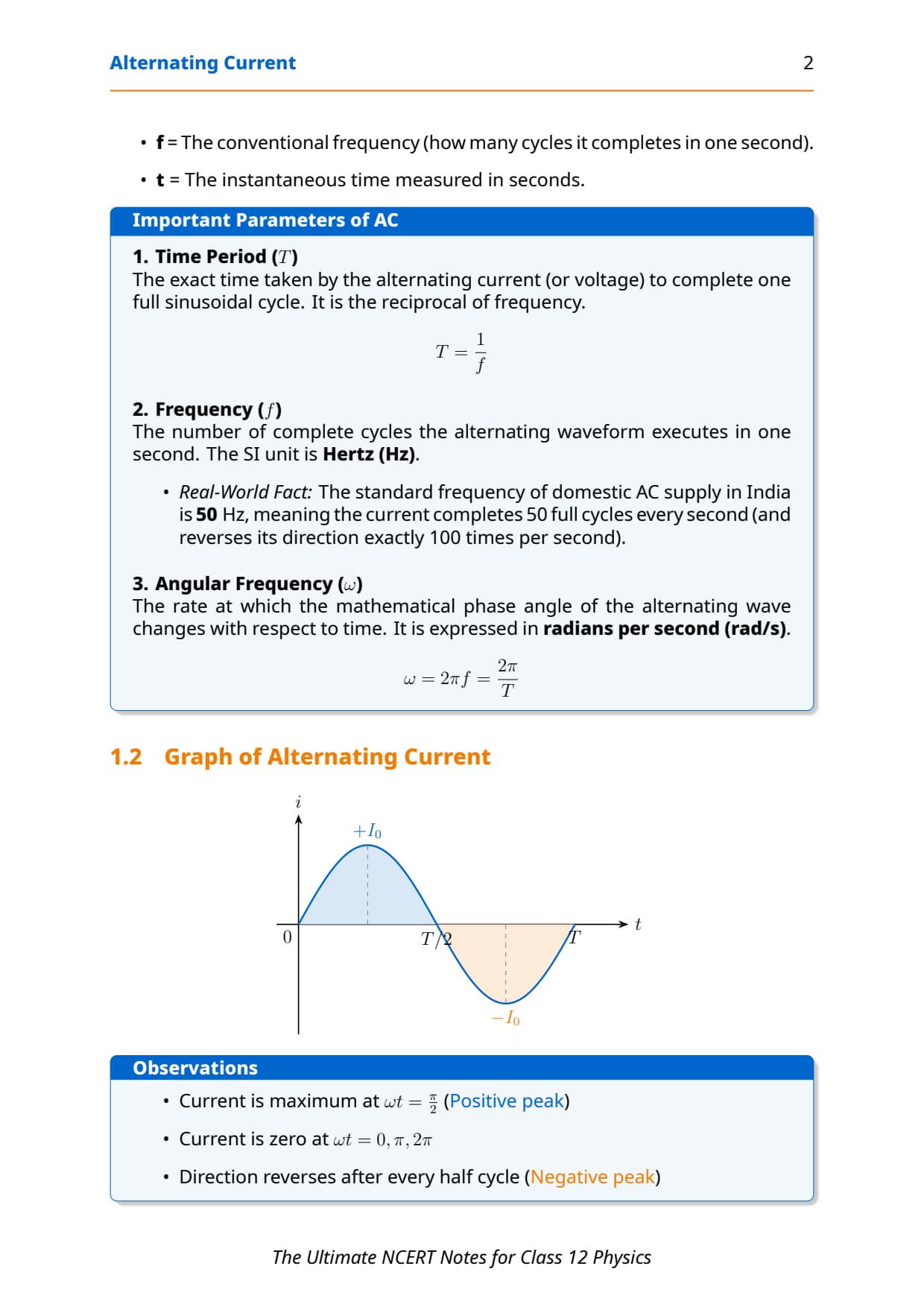
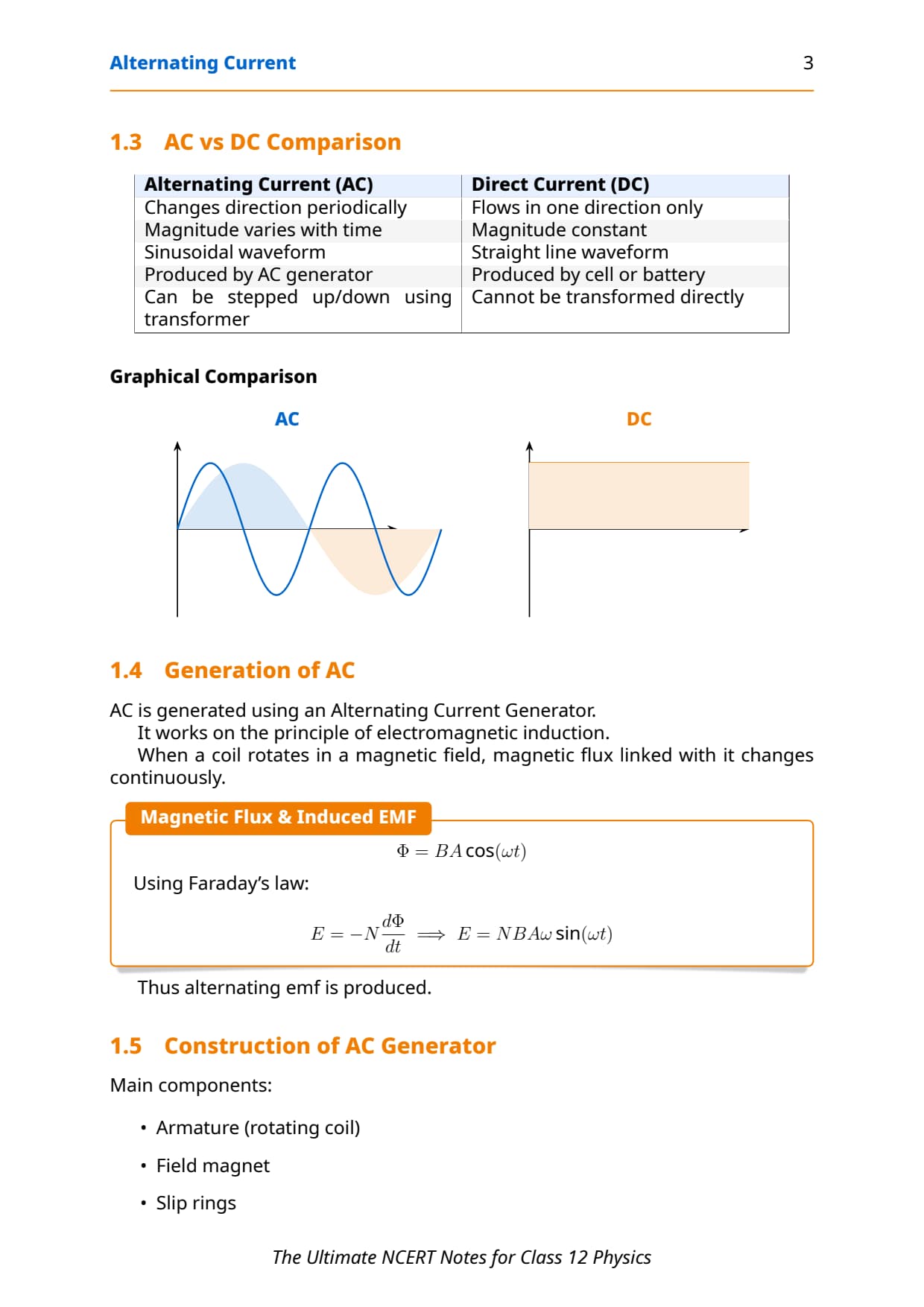
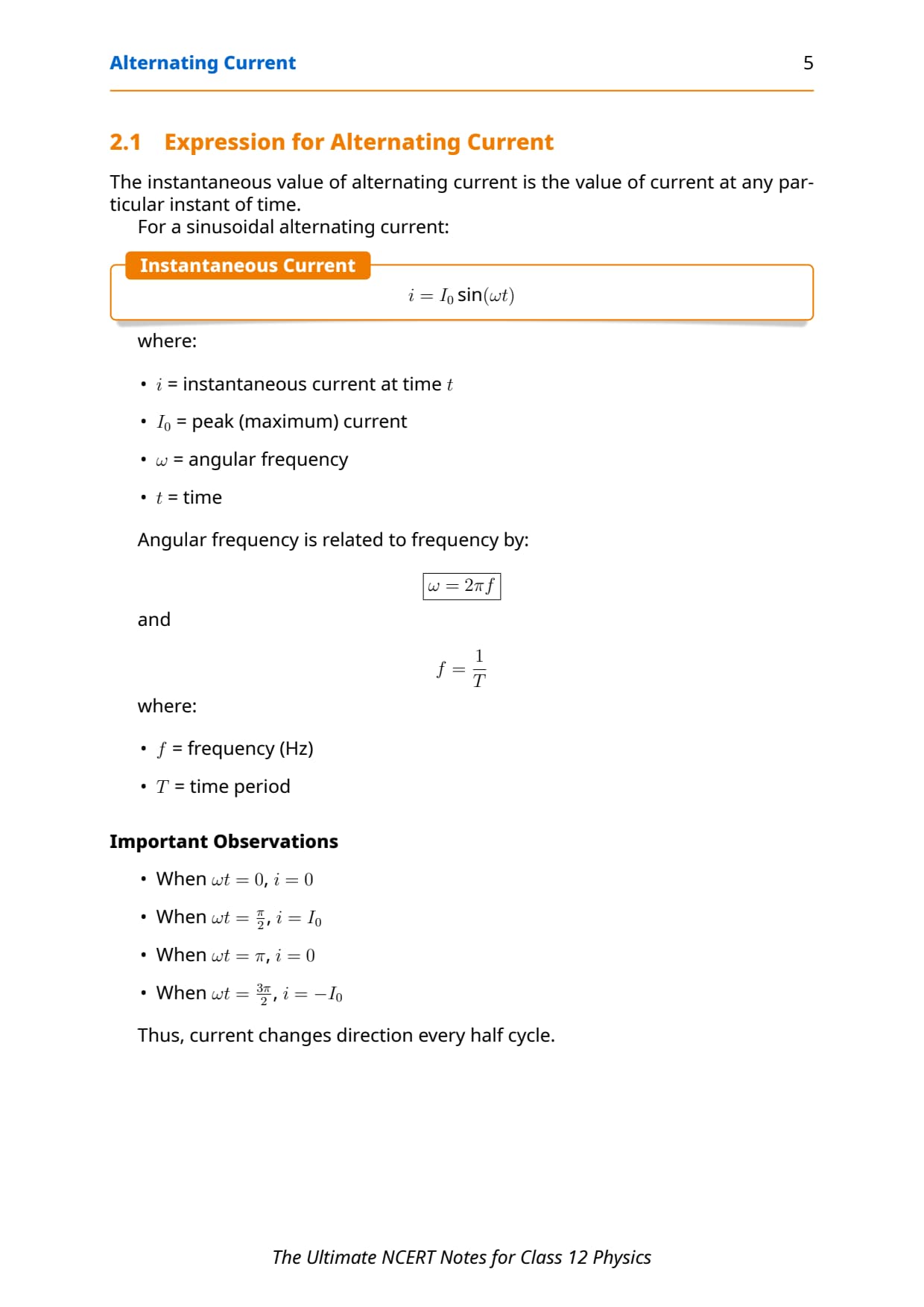
Alternating Current (AC) is a type of electric current that continuously changes both its magnitude and direction with time. Unlike direct current (DC), which flows only in one direction, AC reverses its direction periodically, making it ideal for transmission over long distances.
Mathematical Representation (Instantaneous Value)
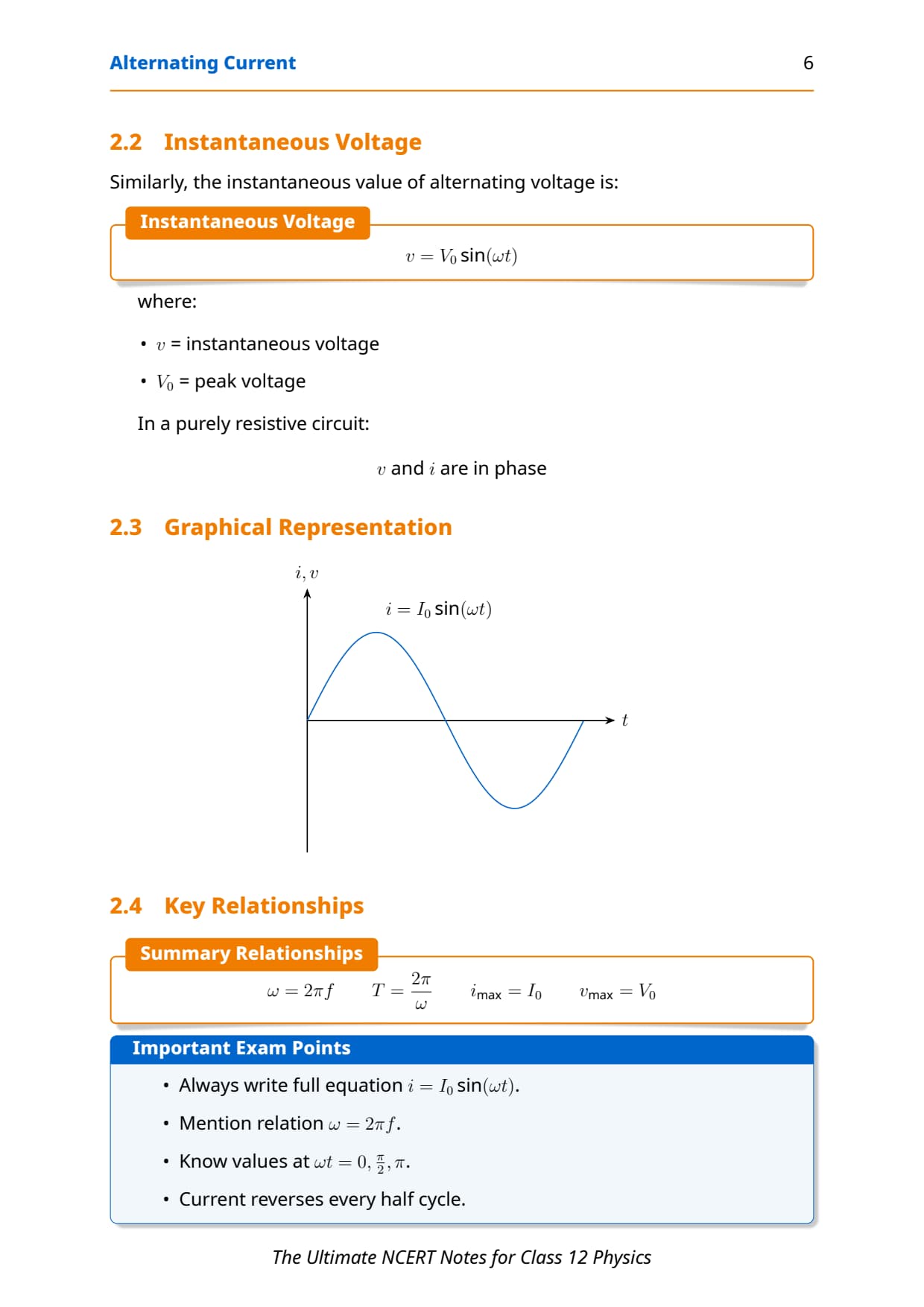
i = I0 sin(ω t) or i = I0 cos(ω t)
Where:
- I0 = Peak current
- ω = 2π f = 2πT = Angular frequency
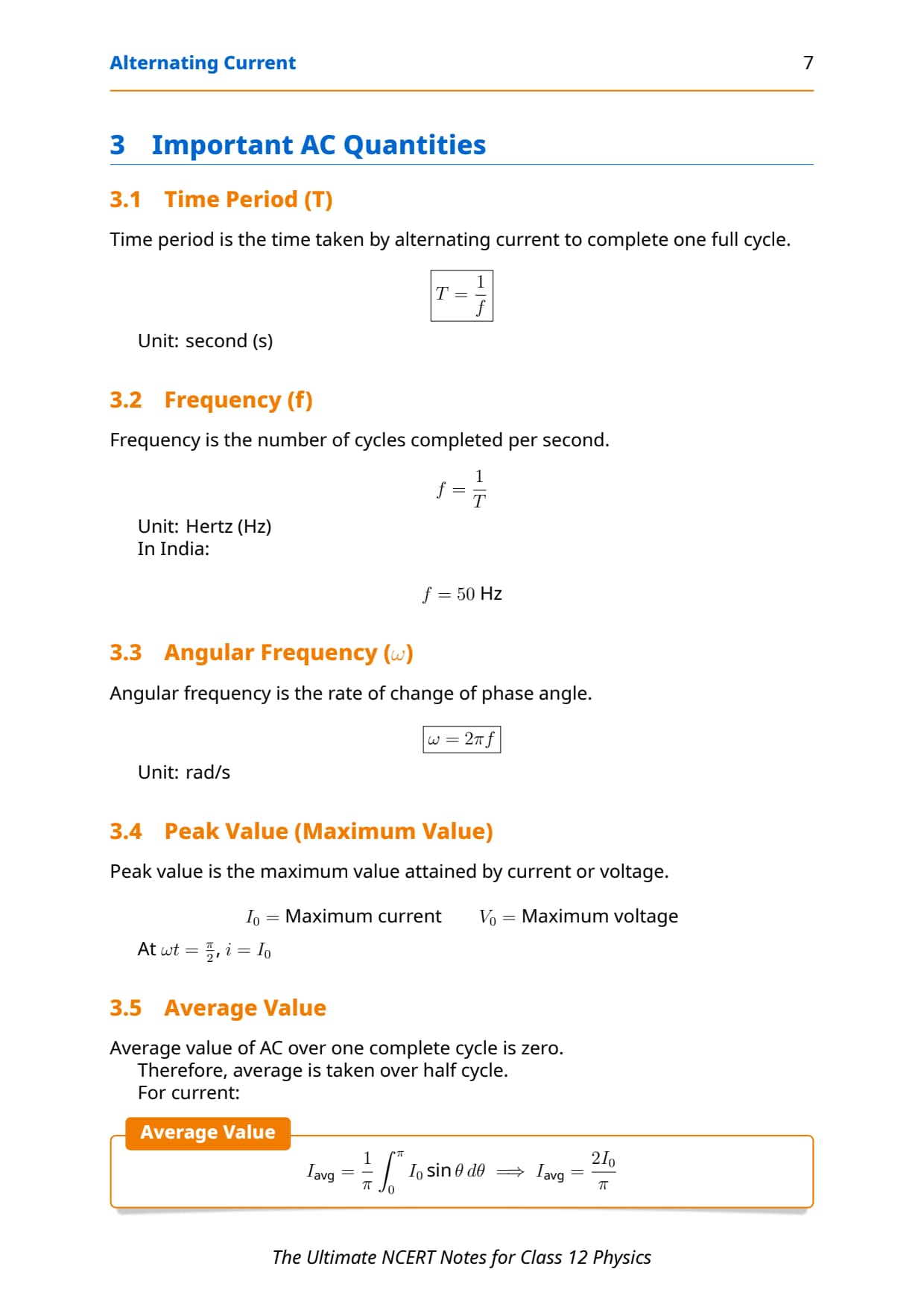
Average (Mean) Value (Over Half Cycle)
Iavg = 2I0π ≈ 0.637 I0
Result:
- Iavg = 0.637 I0 (63.7% of peak value)
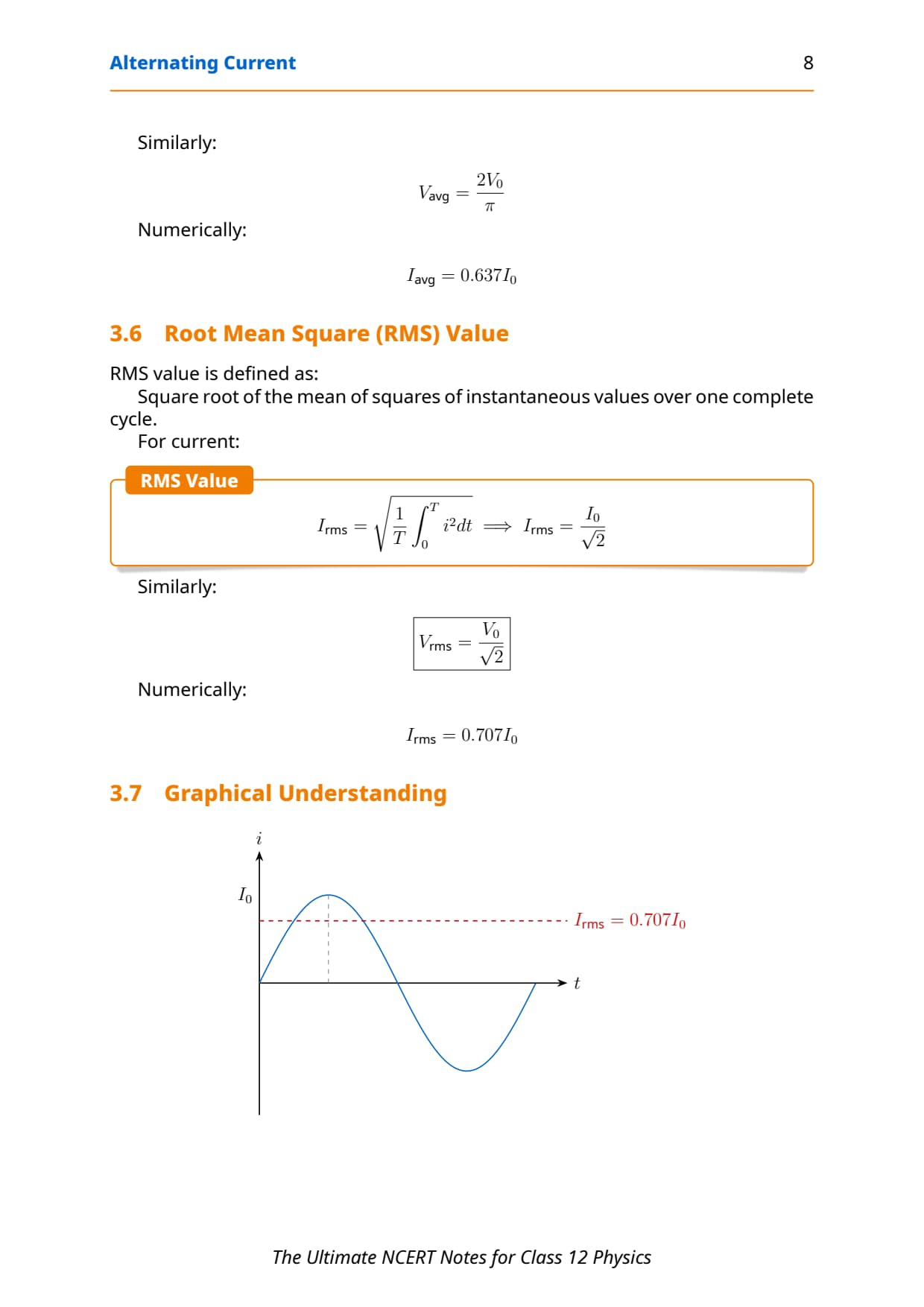
RMS (Root Mean Square) Value (Effective Value)
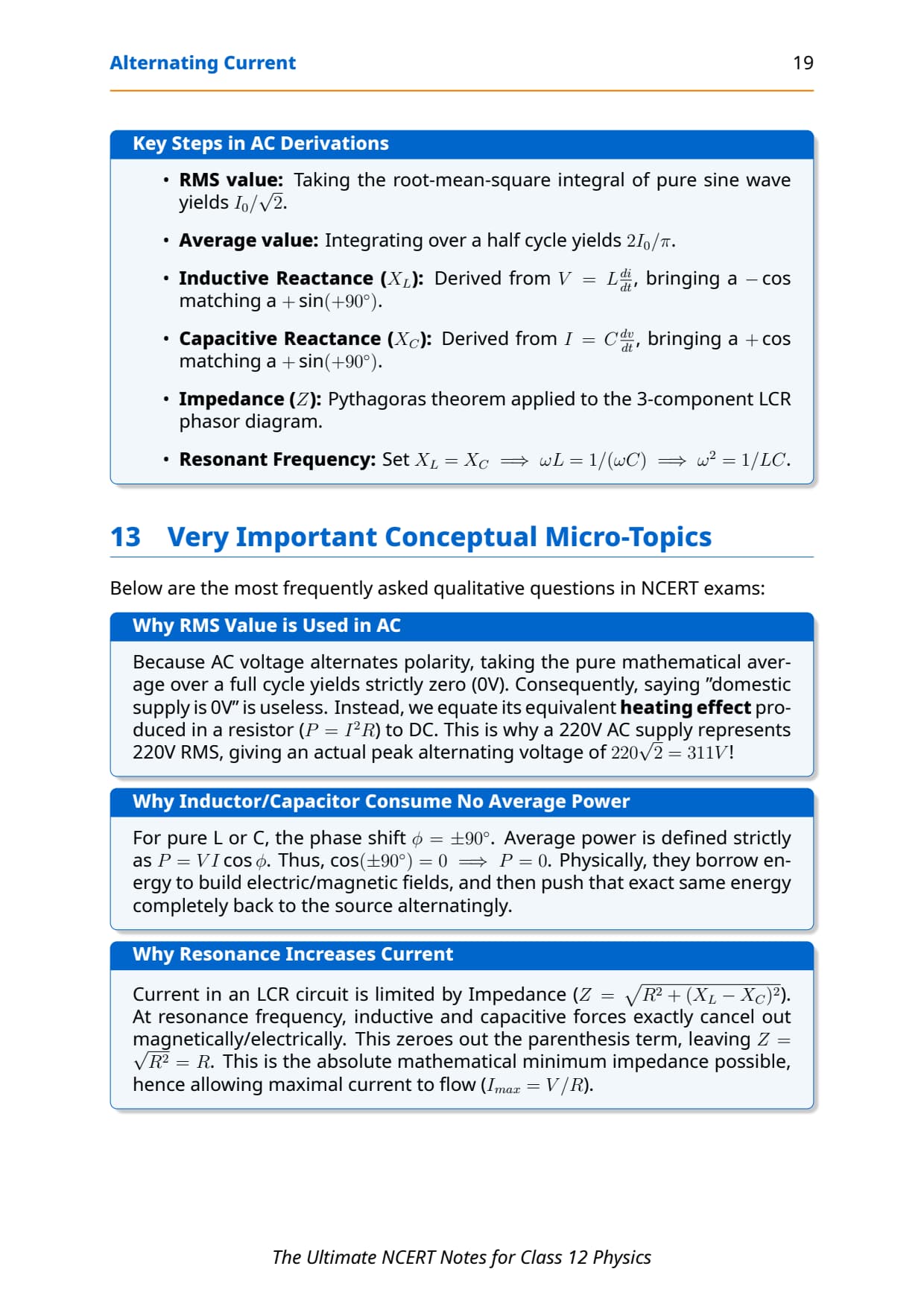
Irms = I0√2, Vrms = V0√2
Result:
- Irms = 0.707 I0
- Vrms = 0.707 V0
2. AC Circuit with Pure Resistance (R only)
When AC is applied to a resistor, current and voltage vary together without any phase difference. The circuit behaves exactly like a DC circuit.
Equations
E = E0 sin(ω t), I = I0 sin(ω t)
Where:
I0 = E0R
Key Points
- Voltage and current are in phase ( φ = 0∘ )
- Power is continuously consumed
- Phasor diagram: Same direction
3. AC Circuit with Pure Inductance (L only)
An inductor resists a change in current due to self-induction. Hence, the current lags behind the voltage.
Current Equation (Phase Lag)
I = I0 sin(ω t - π2)
Inductive Reactance
XL = ω L
I0 = E0XL
Key Points
- Current lags voltage by 90°
- XL = 0 for DC
- No average power consumed
4. AC Circuit with Pure Capacitance (C only)
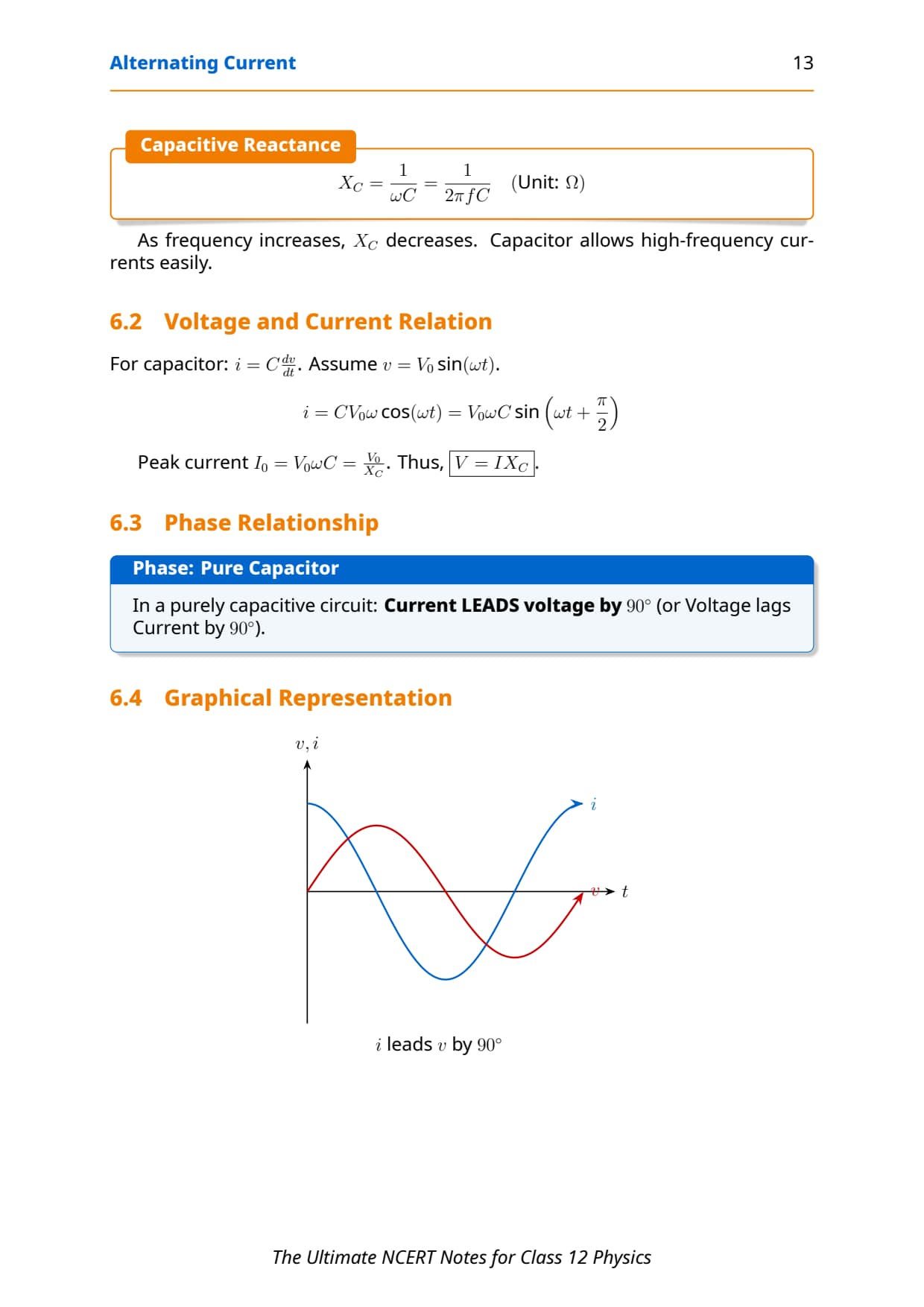
Current leads voltage by 90∘ (or voltage lags current by 90∘ ).
A capacitor allows current to change easily, so current leads voltage.
Current Equation (Phase Lead)
I = I0 sin(ω t + π2)
Capacitive Reactance
XC = 1ω C
I0 = E0XC
Key Points
- Current leads voltage by 90°
- No power consumption
- Phasor: Current ahead
5. Series LCR Circuit (Most Important Section)
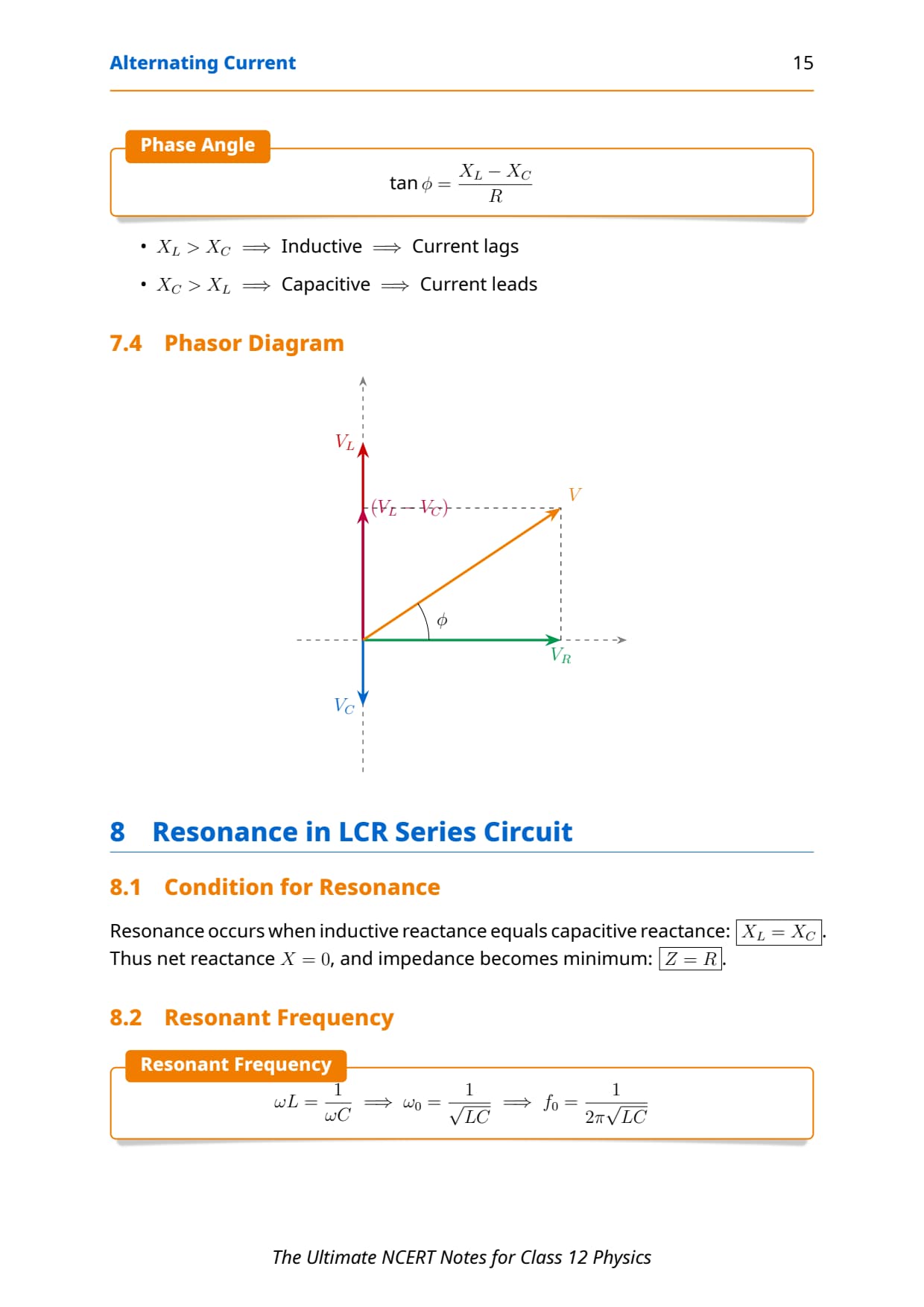
In an LCR circuit, resistance, inductance, and capacitance are connected in series, and the same current flows through all.
R, L, and C in series → same current through all.
Voltage Relations
- VR = I0 R (in phase)
- VL = I0 XL (leads by 90°)
- VC = I0 XC (lags by 90°)
Impedance
Z = √R2 + (XL - XC)2
I0 = E0Z
Phase Angle
tan φ = XL - XCR
Resonance Condition
r = 1√LC, fr = 12π√LC
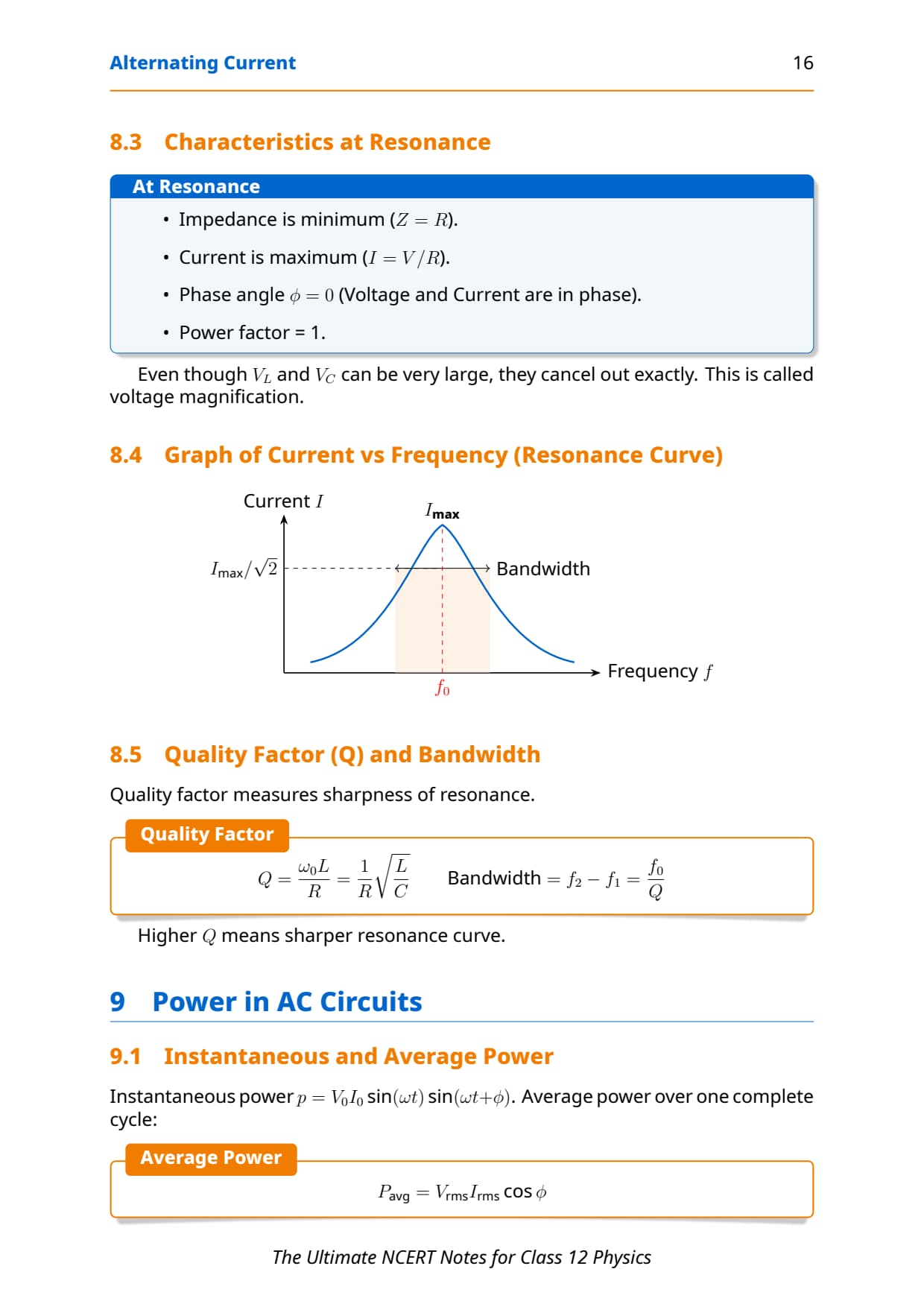
At Resonance
- XL = XC
- Z = R (minimum)
- Current = maximum
- φ = 0 , power factor = 1
Quality Factor (Q)
Q = r LR = 1R√LC
6. Power in AC Circuit
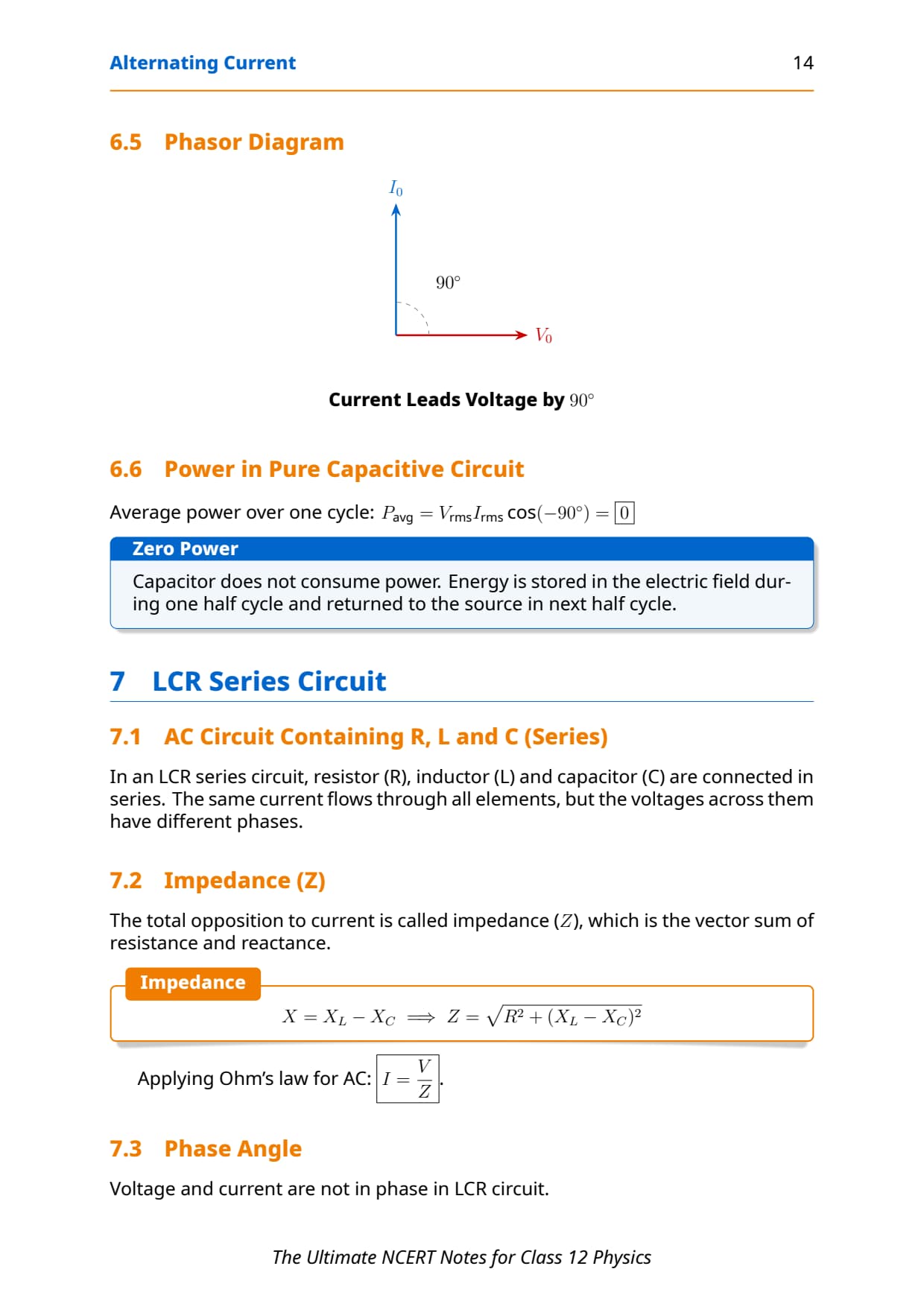
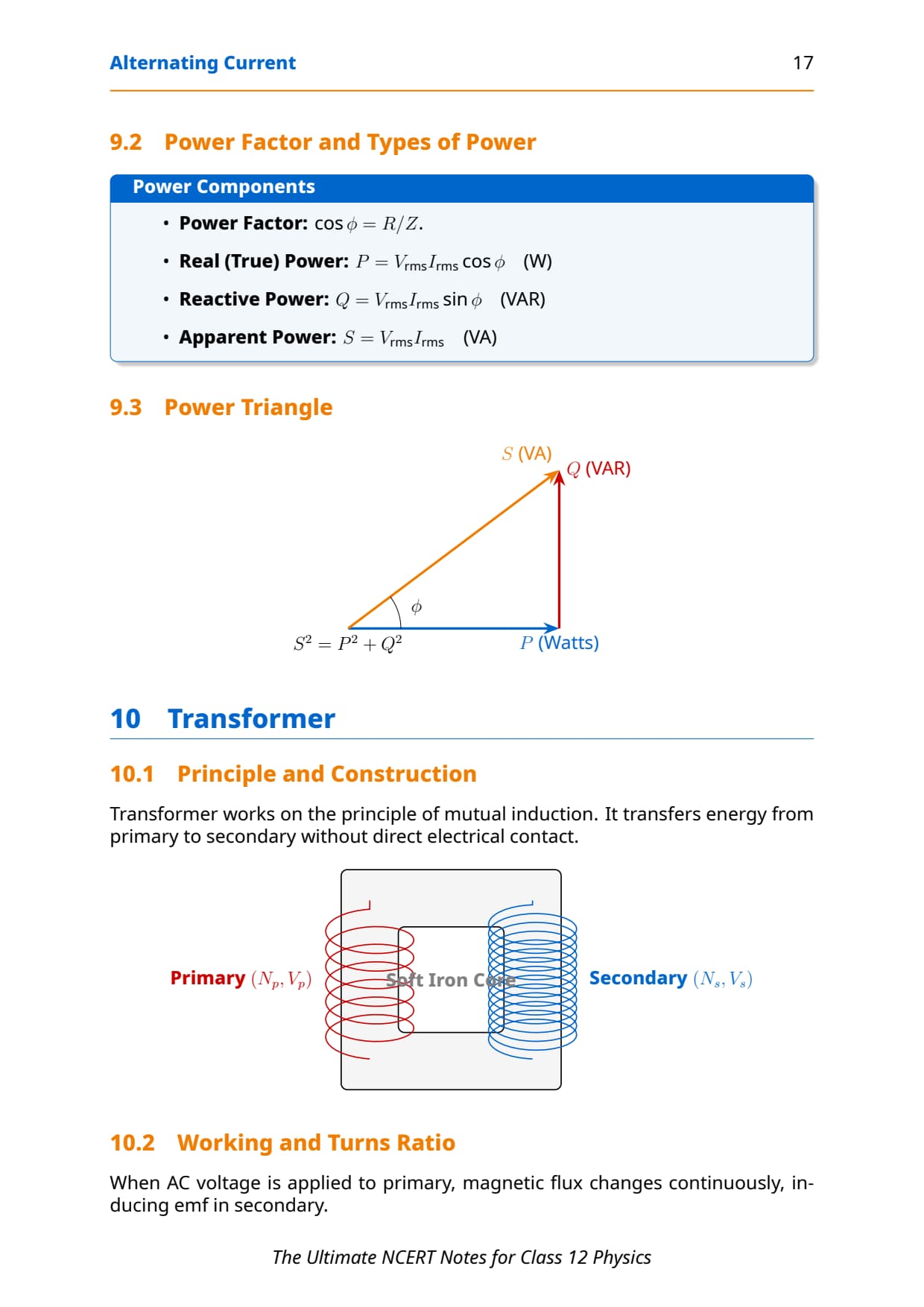
Power in AC depends on phase difference between voltage and current.
Instantaneous Power
P = EI
Average Power
Pavg = Vrms Irms cos φ = E0 I02 cos φ
Power Factor
cos φ = RZ
Key Points
- Pure L/C → cosφ = 0 (wattless current)
- Max power when φ = 0
7. Transformers (Very High Weightage)
Construction: Soft iron laminated core + primary (P) and secondary (S) coils.
Principle: Mutual induction.
A transformer changes AC voltage using mutual induction.
Turns Ratio
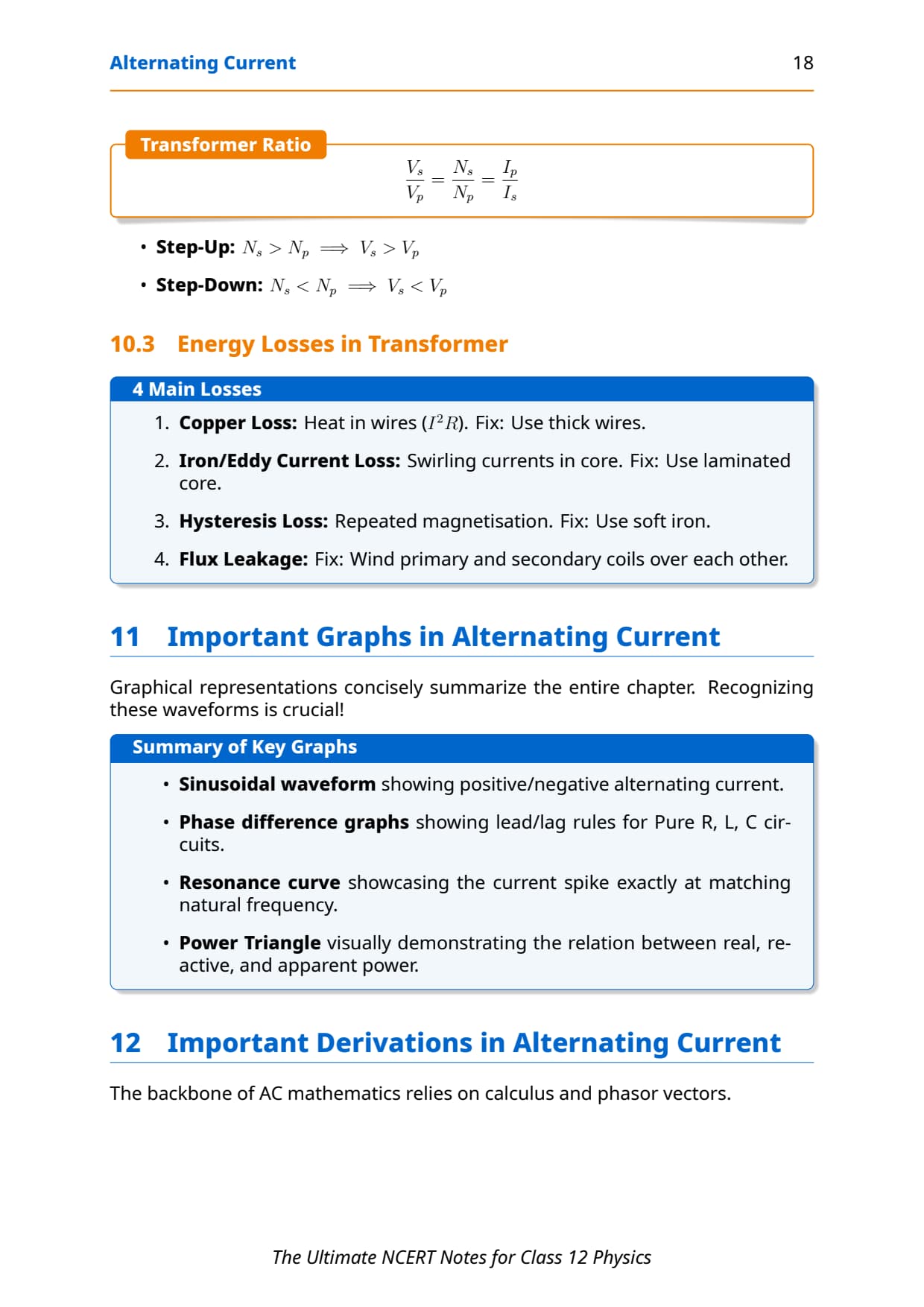
EsEp = NsNp
Power Relation
Ep Ip = Es Is
Efficiency
η = Es IsEp Ip × 100%
Key Points
- Step-up: Ns > Np
- Step-down: Ns < Np
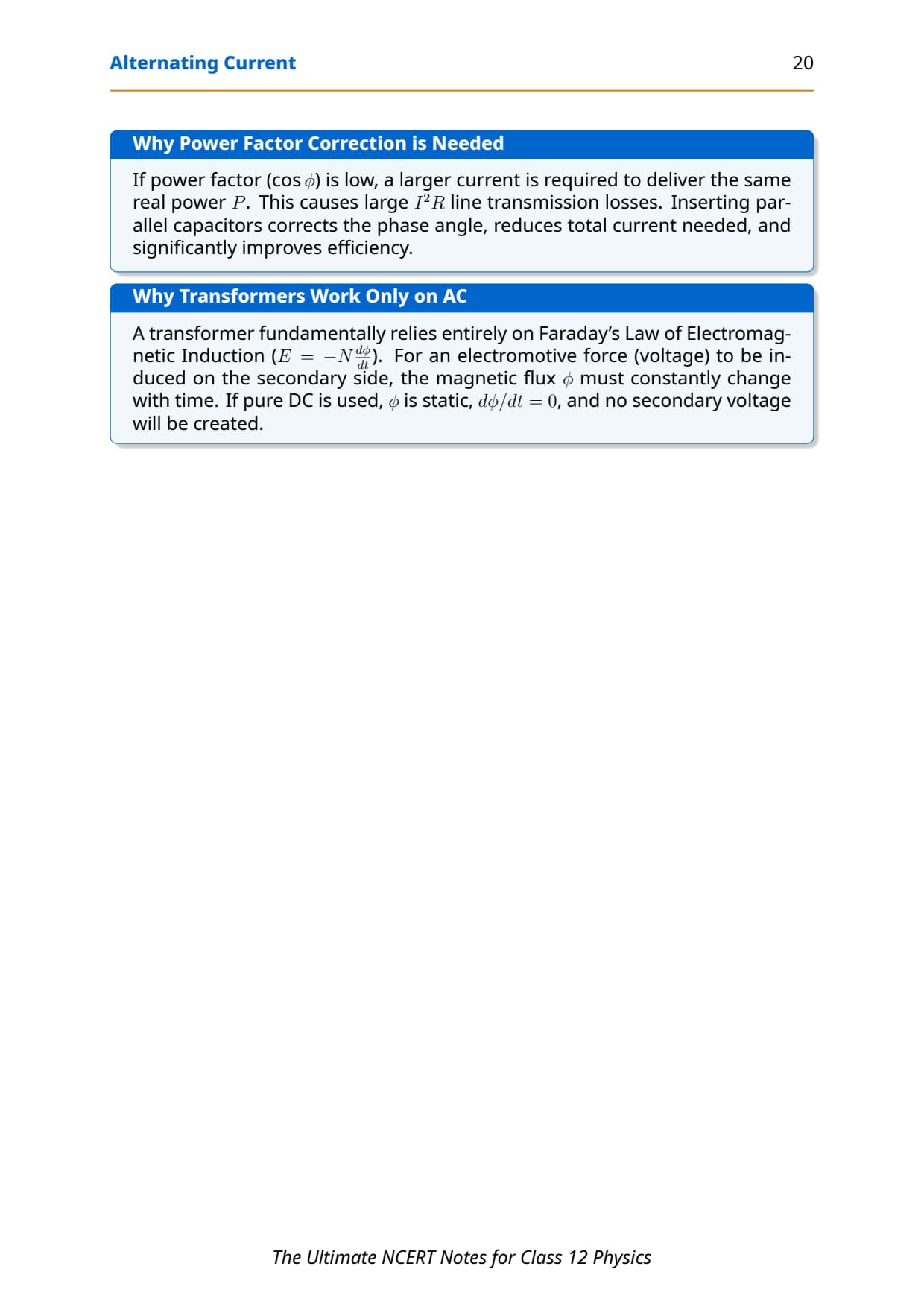
- Losses: Copper, eddy current, hysteresis
Quick Formula Sheet (Memorise These!)
- XL = ω L , XC = 1ω C
- Z = √R2 + (XL - XC)2
- Resonance: fr = 12π √LC , Zmin = R
- Pavg = Vrms Irms cos φ
- Transformer: EsEp = NsNp = IpIs
How Many Marks Is Alternating Current in Class 12?
Ans. In CBSE Class 12 Physics, Alternating Current (AC) is part of Unit IV: Electromagnetic Induction and Alternating Currents, which carries 8 marks in total.
Expect 2-3 marks directly, but with EMI, this unit can contribute up to 6-8 marks, making it an important scoring chapter.
Marks Breakdown (Based on Trends)
- AC alone: Usually 2-3 marks
- Combined with EMI: Can go up to 5-6 marks
- Overall Unit IV weightage: ~11-12% of the Physics paper (8/70 marks)
Question Pattern Insights
- 1 short question (1-2 marks) → theory (e.g., why AC is preferred over DC)
- OR 1 simple numerical (2-3 marks) → LCR circuit, power, or transformer
- Occasionally part of a case-based or diagram question
Alternating Current Key Formulas
| Topic | Key Formula |
|---|---|
| RMS | I = I0√2 |
| Inductive Reactance | XL = ω L |
| Capacitive Reactance | XC = 1ω C |
| Impedance | Z = √R2 + (XL - XC)2 |
| Power | P = VIcosφ |
| Resonance | ω = 1√LC |
Alternating Current Questions - CBSE 2026 (All Sets)
The Alternating Current (AC) chapter in CBSE 2026 carried 18-22% weightage, contributing 12-15 marks through 6-8 questions.
- Around 50-60% of questions came from LCR circuits and resonance, while short answers alone contributed around 40-45% of marks.
- The paper was 60% numerical and 40% conceptual, with case-based questions forming a high-weight segment.
- This shows that focusing on just 4-5 core topics can help students secure up to 80% of AC marks, making it a highly scoring and strategic chapter.
| Type | No. of Questions | Marks | Topics Asked (2026 Papers) |
|---|---|---|---|
| MCQ | 2-3 | 2-3 marks |
|
| Short Answer (2-3M) | 2-3 | 5-7 marks |
|
| Case-based | 1 | 4-5 marks |
|
| Long Answer (3-5M) | 1 | 3-5 marks |
|
| Total | 6-8 questions | 12-15 marks | Covers 6-7 core AC topics |
Source -
- CBSE Class 12 Physics Question Paper 2026 Set 1
- CBSE Class 12 Physics Question Paper 2026 Set 2
- CBSE Class 12 Physics Question Paper 2026 Set 3
Alternating Current Toppers' Strategy
CBSE focuses on theory, derivations and direct questions, while JEE Main emphasizes numericals and concept application. Focusing on 5 to 6 core topics covers 70 to 80% of AC questions. The topic-wise plan below shows where to spend time for each exam.
| Topic | CBSE Strategy | JEE Main Strategy | Data Insight |
|---|---|---|---|
| AC Basics | Learn definition + waveform diagram | Use equation in phase-based MCQs | Easy 1 mark (CBSE), rarely direct in JEE |
| RMS & Average | Learn derivation + formula writing | Direct substitution in numericals | 1-2 questions guaranteed (CBSE) |
| Phase Relationship | Learn lag/lead statements + phasor diagram | Solve tricky MCQs (identify phase instantly) | High mistake area in JEE |
| Reactance ( XL, XC ) | Basic formula-based numericals | Frequency variation + conceptual questions | ~15% weight in JEE AC |
| RLC Circuit | Solve NCERT numericals stepwise | Multi-step numericals + concept mix | Most asked numerical type |
| Resonance | Learn condition + formula | Highest priority → graphs + logic | 2-3 questions (JEE PYQ trend) |
| Quality Factor | Learn the formula only | Use in resonance sharpness questions | Direct formula-based |
| Power & Power Factor | Learn derivation + meaning | Mixed questions with RMS + phase | Moderate weightage |
| Transformer | Theory + diagram + working | Ratio-based numericals only | Easy scoring in CBSE |
| Graphs | Basic understanding | Very important (frequent in JEE) | High conceptual weight |
Topper-Level Insights for Alternating Current Preparation
- RLC + Resonance = 40-50% of AC numericals: Focus here first.
- RMS + Power formulas are directly asked: Easy marks.
- Phase concept = conceptual trap area: Avoid silly mistakes.
- Transformer = low effort, high return: Must not skip.
- Formula revision daily (5 mins): Improves speed drastically.
All the best for your boards! Revise these notes 2-3 times and solve NCERT + previous year questions
Other Resources for Class 12 Physics Chapter 7
Pair these notes with the Solutions, Handwritten Notes, Formula Sheet and official NCERT chapter linked below.
| Resource | What it covers | Open |
|---|---|---|
| Notes | Concept-wise revision notes for Alternating Current. | You are here |
| NCERT Solutions | Step-by-step answers to every exercise question. | Chapter 7 NCERT Solutions |
| Handwritten Notes | Scanned notebook pages for last-mile revision. | Chapter 7 Handwritten Notes |
| Formula Sheet | All AC formulas on one page. | Chapter 7 Formula Sheet |
| NCERT Book PDF | Official NCERT textbook chapter. | Chapter 7 NCERT Book PDF |
All Chapters Notes for Class 12 Physics
| Chapter | Notes link |
|---|---|
| Chapter 1 | Electric Charges and Fields |
| Chapter 2 | Electrostatic Potential and Capacitance |
| Chapter 3 | Current Electricity |
| Chapter 4 | Moving Charges and Magnetism |
| Chapter 5 | Magnetism and Matter |
| Chapter 6 | Electromagnetic Induction |
| Chapter 7 | Alternating Current (you are here) |
| Chapter 8 | Electromagnetic Waves |
| Chapter 9 | Ray Optics and Optical Instruments |
| Chapter 10 | Wave Optics |
| Chapter 11 | Dual Nature of Radiation and Matter |
| Chapter 12 | Atoms |
| Chapter 13 | Nuclei |
| Chapter 14 | Semiconductor Electronics |
Alternating Current Class 12 Notes FAQs
Ques. What is alternating current in Class 12 Physics?
Ans. Alternating current is a current that changes its magnitude and direction periodically with time, written as i = I₀ sin(ωt). Unlike direct current, it reverses direction every half cycle, which makes it ideal for transmission over long distances.
Ques. What is the resonance condition in a series LCR circuit?
Ans. Resonance occurs when the inductive reactance equals the capacitive reactance, so X₃ = Xᶜ. At resonance the impedance is minimum and equals R, the current is maximum, the power factor is 1, and the resonant frequency is f₀ = 1 / (2π√(LC)).
Ques. Why is RMS value used for alternating current?
Ans. The RMS (root mean square) value is the effective value of AC, equal to the DC that produces the same heating effect. For a sinusoidal current, Iᵣᵐᵣ = I₀ / √2 = 0.707 I₀, which is why household supply is rated by its RMS voltage.
Ques. What is the weightage of Alternating Current in CBSE Class 12?
Ans. Alternating Current is in Unit IV with Electromagnetic Induction. The chapter alone carries about 2 to 3 marks, and the full unit contributes 7 to 8 marks, with most questions on the series LCR circuit, power factor and transformers.
Ques. What is a transformer and on what principle does it work?
Ans. A transformer changes AC voltage using mutual induction between two coils on a soft iron core. The turns ratio gives Eₛ/Eₚ = Nₛ/Nₚ. A step-up transformer has more turns in the secondary, while a step-down transformer has fewer.



Comments