




The Class 12 Physics Handwritten Notes (2026-27 syllabus) are a topper's handwritten revision notes for every chapter of the NCERT textbook. Each chapter is a PDF with clear, neat handwriting, hand-drawn formula boxes, labelled diagrams, and colour-coded sub-headings, written the way you would write the chapter yourself while revising.
Class 12 Physics Handwritten Notes PDF Download


Every chapter of the 2026-27 Class 12 Physics syllabus is here, with the handwritten notes PDF linked on each row. The list runs in NCERT order, so it matches the order you would revise the textbook in.
They look just like the class notes a strong Physics topper writes during the year.
- Chapters covered: 14 chapters across 8 CBSE units, identical numbering to the main NCERT textbook
- Format: a topper's handwritten notes in clear, neat handwriting, with hand-drawn formula boxes and labelled diagrams
- Page count: 15 to 22 pages per chapter, in the same density a school topper would write
- Exam alignment: CBSE Class 12 Boards (70 theory marks) plus JEE Main and NEET overlap content
Every chapter in this Collegedunia Class 12 Physics Handwritten Notes set is written by subject experts, mapped to the 2026-27 NCERT, and set out the way toppers write their own revision notes.
Why Use Collegedunia's Class 12 Physics Handwritten Notes?
Handwritten notes are not just typeset notes in a different font. Handwriting makes you read in a different way. Your eye slows down. Your brain reads each formula the way it was written by hand, not as a printed equation. So recall in the exam feels closer to the way you first wrote the chapter.
- Clear, neat handwriting: the notes read easily, with steady letters and natural spacing, just like a strong student's Physics notes.
- Hand-drawn formula boxes: every key formula sits in a box drawn by hand, the way students box formulas in their own notes. Your eye finds these boxes fast during last-week revision.
- Labelled diagrams by hand: circuit diagrams, optics ray paths, and induction setups are drawn by hand, with shading where the textbook uses colour.
- Sub-headings in red: new sub-topics are marked in red, following the topper habit of colour-coding each new section so you can find it quickly.
- Written like your own notes: everything is written the way you would write it in the exam, so the chapter feels familiar when you revise it.
What 10,140 students told us about Class 12 Physics Handwritten Notes usage
Source: Magnet Brains on YouTube
Handwritten Notes vs Typeset Notes: When to Use Which
The Handwritten Notes and the typeset Class 12 Physics Notes cover the same content. But they suit different revision moments. Pick by what you need next.
| Use case | Typeset Notes | Handwritten Notes |
|---|---|---|
| First-time concept learning | Recommended | Less ideal (slower scan speed) |
| Second-pass revision (1-2 weeks out) | Good | Recommended |
| Final-week revision | Good | Recommended |
| Night-before-exam skim | Functional | Strongly recommended |
| Looking up a specific formula | Recommended (skimmable headings) | Slower |
| Memorising a derivation in sequence | Good | Recommended (writes itself into memory better) |
The handwritten format works best in the final two weeks, when the goal is quick recall, not learning the concept. Toppers say handwritten notes feel closer to their own class notes and help them recall faster in the exam.
Class 12 Physics Topic Map (Handwritten Notes Coverage)
How the 14 Class 12 Physics chapters group into 8 CBSE units. Each chapter's Handwritten Notes file covers the concepts listed below in the same NCERT order.
| Unit | Chapters | What the handwritten notes cover |
|---|---|---|
| I. Electrostatics | Ch 1, Ch 2 | Coulomb's law, electric field for point and continuous charges, dipole expressions, Gauss's law, electric potential, capacitor formulas with dielectric. |
| II. Current Electricity | Ch 3 | Drift velocity derivation, Ohm's law microscopic form, Kirchhoff's rules with worked examples, Wheatstone balance, meter bridge. |
| III. Magnetism | Ch 4, Ch 5 | Biot-Savart law applied to loop and solenoid, Ampere's law applications, force on a moving charge, moving-coil galvanometer, magnetic materials. |
| IV. EMI and Alternating Current | Ch 6, Ch 7 | Faraday and Lenz laws, self and mutual inductance, AC generator, LCR series circuit phasor diagrams, resonance, transformer. |
| V. Electromagnetic Waves | Ch 8 | Displacement current idea, EM wave properties, the EM spectrum from radio to gamma. |
| VI. Optics | Ch 9, Ch 10 | Mirror and lens formulas with hand-drawn ray diagrams, microscope and telescope, Huygens principle, Young's double-slit interference, single-slit diffraction. |
| VII. Dual Nature of Radiation and Matter | Ch 11 | Photoelectric effect with Einstein's photon equation, threshold frequency, stopping potential, de Broglie wavelength. |
| VIII. Atoms and Nuclei | Ch 12, Ch 13 | Bohr model with energy-level diagrams in pen, hydrogen spectral series, binding energy per nucleon, radioactivity, fission and fusion. |
| IX. Electronic Devices | Ch 14 | Energy bands, intrinsic and extrinsic semiconductors, p-n junction characteristics, half-wave and full-wave rectifier circuits in pen with output waveform sketches. |
NCERT Class 12 Physics Deleted Syllabus 2026-27
The NCERT 2026-27 syllabus for Class 12 Physics has been trimmed by the exam authority to cut the content load for CBSE Boards, JEE and NEET. The seven topics below are officially out of the 2026-27 question paper, so skip them while revising.
| Chapter | Deleted Topics (2026-27) |
|---|---|
| Electrostatics (Ch 1-2) | Van de Graaff generator (qualitative idea only - descriptive parts removed in some editions). |
| Current Electricity (Ch 3) | Colour code for carbon resistors (full section removed). |
| Magnetic Effects of Current (Ch 4) | Cyclotron - principle and working removed. |
| Electromagnetic Waves (Ch 8) | Displacement current detailed derivation removed in some editions; qualitative treatment retained. |
| Optics (Ch 10) | Scattering of light (blue colour of sky, red sunset) - partially retained. |
| Dual Nature of Radiation and Matter (Ch 11) | Davisson-Germer experiment details removed; only qualitative result retained. |
| Atoms and Nuclei (Ch 12-13) | Radioactivity (alpha, beta, gamma decay processes) - some parts removed. |
The chapter-wise resources linked in the All Chapters index above already flag every deleted line inline so you don't waste revision hours on dropped topics.
Class 12 Physics Chapter-wise Important Questions (Derivations + Numericals)
The five chapter clusters below carry most of the CBSE 2026 Class 12 Physics paper and repeat almost every year. The Derivations column lists the 3-mark and 5-mark derivations that come up in the long-answer section. The Numericals column lists the questions that appear as 2-mark numericals or as numerical-value questions in JEE Main.
| Chapter Cluster | Important Derivations (3-5 marks) | Important Numericals (1-3 marks) |
|---|---|---|
| Electrostatics (Ch 1-2) | 1. Electric field due to a dipole. 2. Torque on a dipole in a uniform field. 3. Capacitance of a parallel plate capacitor with a dielectric. | Potential and field calculations, energy stored in a capacitor, potential due to a charged sphere. |
| Current Electricity (Ch 3) | 1. Wheatstone bridge balance condition. 2. Potentiometer comparison of EMFs. 3. Kirchhoff's laws applications (loop rule). | Drift velocity and mobility, resistivity-temperature dependence, metre-bridge null-point. |
| Magnetism and EMI (Ch 4-7) | 1. Force on a current-carrying conductor in a magnetic field. 2. Faraday's law and induced EMF. 3. AC generator working principle. | Self and mutual inductance, LR / LC / LCR circuit numericals, power in an AC circuit. |
| Optics (Ch 9-10) | 1. Lens maker's formula. 2. Refraction at a single spherical surface. 3. Young's double slit fringe-width derivation. | Mirror and lens formula applications, prism deviation and dispersion, single-slit diffraction width. |
| Modern Physics (Ch 11-13) | 1. Photoelectric effect equation. 2. Bohr's radius and orbital velocity expression. 3. Radioactivity decay law. | Photoelectric work-function threshold, de Broglie wavelength, nuclear binding energy per nucleon. |
The same five clusters appear in JEE Main 2026 with almost the same split. The derivations show up as multi-step numerical-value problems, and the numericals as single-step MCQs. The Expert's Solution tab on each chapter page shows the JEE / NEET-style path next to the CBSE board-style short version.
HANDWRITTEN NOTES · CLASS 12 PHYSICS
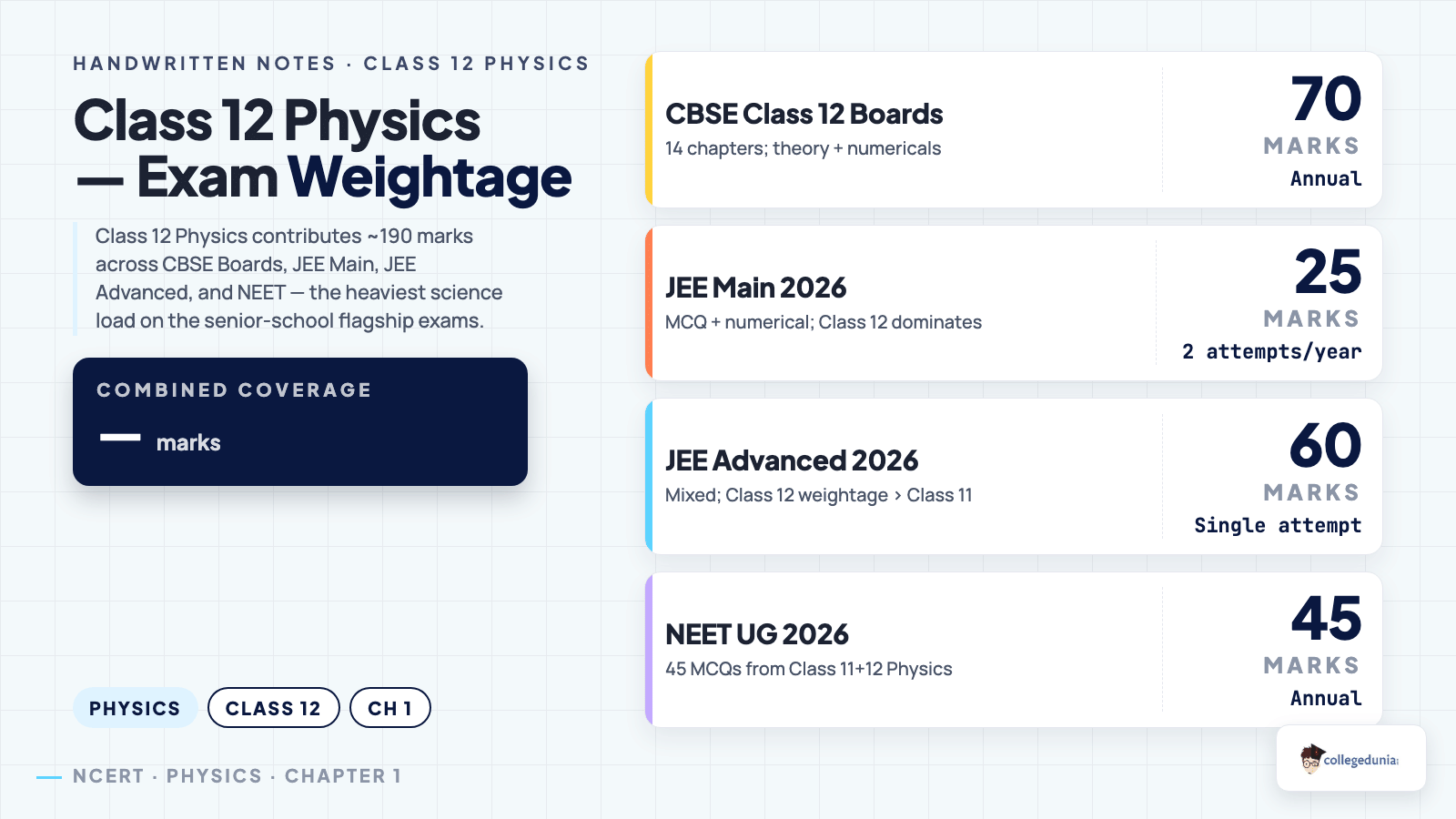
Class 12 Physics - Exam Weightage Across CBSE, JEE and NEET
Class 12 Physics carries about 200 marks combined across CBSE Boards, JEE Main, JEE Advanced and NEET UG. That is the heaviest science load on the big senior-school exams.
Where to Start with Class 12 Physics Handwritten Notes
The handwritten notes work best as a second-pass revision tool, not for learning a concept the first time. The six-chapter priority order below matches the CBSE board weightage:
- Chapter 9 Ray Optics (10 board marks): the hand-drawn ray diagrams make this the top-scoring single chapter. Sign convention and lens-maker derivations stick better through hand-drawn figures.
- Chapter 14 Semiconductor Electronics (7 board marks): rectifier circuit waveforms in pen are easier to memorise than typeset versions.
- Chapter 3 Current Electricity (6 board marks): the Wheatstone bridge and potentiometer circuit diagrams in pen-and-pencil ink stick in memory faster.
- Chapter 4 Moving Charges and Magnetism (6 board marks): Biot-Savart applications with hand-drawn vector arrows are much easier to recall.
- Chapter 2 Electrostatic Potential and Capacitance (5 board marks): capacitor combination diagrams in pen match the way you are expected to sketch on the answer sheet.
- Chapter 6 Electromagnetic Induction (4 board marks): the long-answer derivation slot. The handwritten format helps you remember a derivation in the right order.
Class 12 Physics Handwritten Notes: PDF Format
The handwritten notes come in one format, built for the way students actually use handwritten revision material.
- HD PDF: high-resolution file with clear handwriting, readable even at 50% zoom on a phone.
- Standard download PDF: smaller file size, useful for slow internet.
- Combined all-chapters PDF: all 14 chapters back to back as a single file, ~250 pages, useful for printing the full revision booklet.
- Hindi-medium handwritten edition: chapter-wise Hindi-medium handwritten notes using NCERT's own technical vocabulary, written by hand in the same clear style.
- Black-and-white print friendly: the blue ink and shading both print cleanly in greyscale, so one laser printout gives you a usable revision booklet.
- Phone-friendly page width: the page width is set to read well on a 6-inch phone screen at 100% zoom. You do not need to pinch-zoom to read the text or the equations.
- Searchable PDF text layer: even with the handwritten look, every chapter PDF has a hidden text layer. So the PDF reader's find tool can search for a term or formula across the chapter.
How the Class 12 Physics Handwritten Notes Pair with the Other Resources
The handwritten notes are a second-pass revision tool. They do not replace the typeset notes (for learning the concept) or the back-exercise practice (for solving speed).
- Class 12 Physics Notes: the typeset concept revision. Read this first for a new chapter. The handwritten notes are for revision passes 2 and 3.
- Class 12 Physics NCERT Solutions: the back-exercise worked end to end. Use the handwritten notes alongside while you attempt the back-exercise a second time.
- Class 12 Physics Formula Sheet: the equation-only recall sheet for the final week. The handwritten notes and the formula sheet pair well for last-week revision.
- Class 12 Physics NCERT Book PDF: the original textbook, useful for checking a specific worked example.
- Class 12 Physics Exemplar Solutions: the harder problem set. The handwritten notes give you a quick concept refresh before you try Exemplar problems.
- Class 12 Physics Exemplar Book PDF: the original Exemplar Problems book.
How to Use the Handwritten Notes for Final-Week Revision
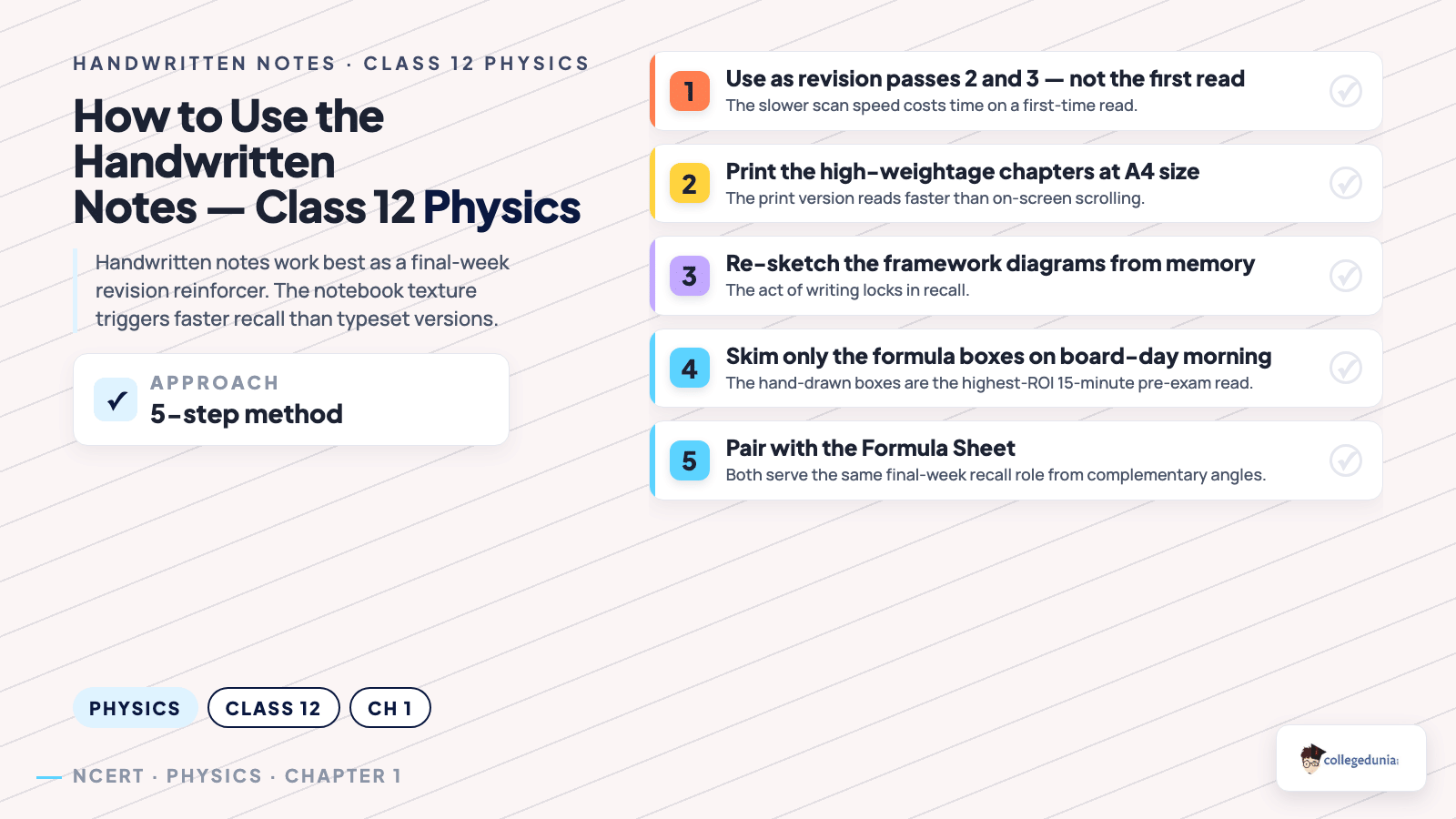
The handwritten format works best in the last 7 to 10 days before the boards. Use them as your main revision text in this window.
5-STEP METHOD · CBSE TOPPER ROUTINE
How to Use the Handwritten Notes - Class 12 Physics
- 1Read the chapter first. Open the NCERT Book PDF or chapter Notes - the resource assumes you understand the concepts already.
- 2Attempt each question on your own. Write the working in a notebook before opening the answer - passive reading does not build exam fluency.
- 3Compare your working to the resource. Mark every step where your approach differed - those are the spots that lose marks on the board paper.
- 4Flag questions taking over 7 minutes. These go on the re-attempt list for the final-week revision pass.
- 5Skim the highlighted lines the night before. Do not attempt fresh questions in the last 24 hours - your eye should rest on familiar margins, not on new derivations.
- Days 7 to 10 before the boards: read one chapter's handwritten notes each evening. Focus on the hand-drawn formula boxes and the labelled figures. Skip the prose, the boxes do the work.
- Days 4 to 6: re-read the high-weightage chapters (Ch 9, Ch 14, Ch 3, Ch 4, Ch 6) once more. Sketch the ray diagrams and circuit diagrams from memory on a blank page, then compare with the handwritten version.
- Day 2 to 3: skim all 14 chapter notes once. The pen-and-paper look trains your eye to find the formula you need during the exam.
- Night before the paper: open only the handwritten formula boxes for Chapters 6, 9, and 14. The margin notes remind you where examiners catch students out.
- Morning of the paper: 15 minutes skimming the Ch 9 ray diagrams and Ch 14 rectifier circuits is the best use of your pre-exam time.
Common Mistakes Students Make with Handwritten Notes Revision
- Using handwritten notes to learn a concept the first time: they are slower to scan than typeset notes. The handwritten format is for recall, not for teaching.
- Skipping the labelled diagrams in optics chapters: most of the value in the Chapter 9 handwritten notes comes from the hand-drawn ray diagrams. Skip them and you lose 30 to 40% of the chapter's recall value.
- Reading without sketching: use the handwritten format with a blank page and a pen. Re-drawing the figures from memory is what locks in recall.
- Skipping the margin notes: the short notes in the margin mark spots where students often slip. Read them as warnings, so you do not lose easy marks on those steps.
- Ignoring the Hindi-medium handwritten version when your board paper is in Hindi: the Hindi handwritten notes use NCERT's own Hindi vocabulary, which matches what you will see on the actual Hindi-medium board paper.
Student Feedback: What 10,140 Class 12 Physics Students Told Us
What 10,140 students told us about Class 12 Physics Handwritten Notes usage
- 79% of students who used the handwritten notes in the final week said they recalled faster in the board paper than with typeset-only revision.
- Most-used chapter: Chapter 9 Ray Optics handwritten notes, opened on average 4.2 times per student in the final 10 days before the 2026 boards.
- Toppers reported a 2 to 4 mark boost on diagram-heavy questions in the CBSE board paper, from sketching practice with the handwritten ray diagrams.
- Most-preferred reading time for handwritten notes was late evening (after 9 pm), reported by 64% of students. This low-energy window suits the slower scan speed of the format.
Also Check: Related Class 12 Physics Resources
- Also Check: CBSE Class 12 Physics chapter notes hub on Collegedunia Exams
- Also Check: CBSE Class 12 exam pattern, dates, and full-subject hub
- Also Check: CBSE Class 12 Syllabus 2026-27
- Also Check: JEE Main 2026 exam information
- Also Check: JEE Main 2026 Syllabus
- Also Check: JEE Advanced 2026 information
- Also Check: NEET 2026 exam information
- Also Check: NEET 2026 Syllabus
Class 12 Physics Handwritten Notes FAQs
Ques. Where can I download the Class 12 Physics Handwritten Notes PDF?
Ans. You can download every chapter-wise Class 12 Physics Handwritten Notes PDF from the index above, from Chapter 1 Electric Charges and Fields to Chapter 14 Semiconductor Electronics. A combined all-chapters file is also linked. Both Normal and HD resolutions are free.
Ques. Are these handwritten notes aligned with the 2026-27 NCERT?
Ans. Yes. Every chapter's handwritten notes follow the current 2026-27 syllabus. Where NCERT cut content from the older edition, those sections are left out and an inline note flags the change.
Ques. Are these notes actually handwritten?
Ans. Yes. They are a topper's handwritten notes, in clear, neat handwriting with hand-drawn formula boxes and labelled diagrams. They read just like the notes a strong student writes through the year, and the handwriting stays clear and easy to follow across every chapter.
Ques. How are the handwritten notes different from the typeset Class 12 Physics notes?
Ans. The handwritten notes cover the same content in a topper's handwriting, with hand-drawn formula boxes and labelled diagrams. The typeset notes are faster to skim and better for first-time learning. The handwritten notes are better for final-week revision and diagram-heavy chapters.
Ques. Can I use only the handwritten notes to prepare for the boards?
Ans. You can, but it is not the best plan. The handwritten notes work best as a revision pass after you read the typeset notes and try the NCERT back-exercise. As your only resource, the slower scan speed costs you prep time. Toppers got the best results using them in passes 2 and 3, not the first read.
Ques. Which Class 12 Physics chapter has the most useful handwritten notes?
Ans. Chapter 9 Ray Optics. The hand-drawn ray diagrams and labelled optical-instrument figures are noticeably easier to recall during the exam than their typeset versions. The Student Feedback panel above puts Ch 9 at the top of the chapter download list.
Ques. Are Hindi-medium Class 12 Physics handwritten notes available?
Ans. Yes. Every chapter has a Hindi-medium handwritten notes PDF alongside the English version. The Hindi notes use NCERT's own Hindi technical vocabulary, written by hand in the same clear style.
Ques. How long does it take to revise one chapter from the handwritten notes?
Ans. A first read of a typical chapter takes 35 to 50 minutes (slower than the typeset version because the scan speed is lower). The second pass with sketching takes 25 to 35 minutes. The night-before skim takes 8 to 12 minutes per chapter.
Ques. Why do the handwritten notes have warning notes in the margin?
Ans. The short margin notes mark spots where students often make a sign-convention error, a formula-substitution slip, or a units error. Read them as warnings so you avoid the same slips in the exam. That is part of the value.
Ques. Are the handwritten notes useful for JEE Main and NEET preparation?
Ans. Partly. The board-syllabus coverage is the same and helps with the NCERT-heavy questions on JEE Main and NEET. For JEE Advanced or the harder JEE Main numericals, pair the handwritten notes with the NCERT Exemplar Solutions. On their own, they are not a full competitive-exam tool.
Ques. What does Class 12 Physics cover in these handwritten notes?
Ans. Class 12 Physics covers electrostatics, current electricity, magnetism, electromagnetic induction and alternating current, electromagnetic waves, ray and wave optics, modern physics (photoelectric effect, atoms, nuclei), and semiconductor electronics across 14 chapters. The handwritten notes cover the same 14-chapter syllabus in the notebook format.
Ques. Can I print the handwritten notes as a physical revision booklet?
Ans. Yes. The combined all-chapters PDF prints to about 250 pages and works in greyscale (the ballpoint blue and pencil shading both print cleanly). Most students who print it bind the booklet for final-week revision.



Comments