Biology Mentor, NEET Topper | Updated 3+ months ago
NEET 2025 placed three questions on this chapter and CBSE 2025 lifted a 5-mark long answer almost word for word from the Exemplar. So Class 12 Biology Chapter 12 Ecosystem deserves a slot in your final revision. This page hosts the fully worked NCERT Exemplar solutions PDF, all 42 problems, mapped to the 2026-27 syllabus.
42 Exemplar problems
14 MCQ + 14 VSA
10 SA + 4 LA
2026-27 NCERT aligned
CBSE Weightage: 5 to 7 marks (usually one long answer on energy flow or carbon cycle plus a 2-marker on pyramids)
NEET Weightage: 2 to 3 questions per year
CUET Weightage: 1 to 2 MCQs in CUET Biology
These Exemplar Solutions are made by NEET-rank-holder mentors at Collegedunia, mapped to the 2026-27 NCERT chapter and the last five years of CBSE and NEET papers.
Ecosystem Exemplar Question-Type Tour with One Sample Solved per Type
The Exemplar groups all 42 problems into four formats. Below is one solved sample per type.
MCQ Sample, Exemplar 14.4 (Pyramid of Energy)
Question. The pyramid of energy is always upright because (a) producers always have a larger biomass than consumers (b) only 10% of the energy passes to the next trophic level (c) energy is recycled within the ecosystem (d) decomposers absorb all the energy released.
Reasoning. Lindeman's 10% law forces each higher trophic level to carry less energy than the level below, so the pyramid is always upright. Option (a) describes the biomass pyramid (which can invert in a pond). Energy is never recycled, ruling out (c). Decomposers do not absorb all the released energy, ruling out (d). Answer: (b).NEET 2024 reused this exact stem.
VSA Sample, Exemplar 14.18 (NPP vs GPP)
Question. What is the difference between Gross Primary Productivity and Net Primary Productivity?
Answer. Gross Primary Productivity (GPP) is the total energy fixed by producers per unit area per unit time. Net Primary Productivity (NPP) is the energy that remains after the producer's own respiration (R) is subtracted: NPP = GPP − R. NPP is what becomes available to herbivores at the next trophic level. Marking scheme: 1 mark for the definitions, 1 mark for the equation.
SA Sample, Exemplar 14.27 (Five Steps of Decomposition)
Question. Outline the steps involved in the decomposition of detritus and name the role of each step.
Answer.
Fragmentation — detritivores (e.g. earthworm) break detritus into smaller pieces, increasing surface area for microbial action.
Leaching — water-soluble inorganic nutrients percolate down into soil and become unavailable salts.
Catabolism — bacterial and fungal enzymes degrade the fragmented detritus into simpler inorganic compounds.
Humification — partially decomposed material accumulates as humus, a dark amorphous colloidal substance highly resistant to further microbial action; acts as a nutrient reservoir.
Mineralisation — humus is degraded by some microbes to release inorganic ions (CO2, H2O, NH4+, PO43−).
Marking scheme: 0.5 mark per step (2.5 marks) + 0.5 mark for sequencing them correctly = 3 marks.
LA Sample, Exemplar 14.40 (Single-Channel Energy Flow with 10% Law)
Question. Draw and explain a model of the single-channel energy flow in an ecosystem, stating the role of Lindeman's 10% law and giving an example of energy values at each trophic level.
Answer (5-mark walkthrough).
Step 1 (1 mark) - Solar input. The Sun is the only energy source. Producers capture < 1% of incident PAR (photosynthetically active radiation) and fix it as GPP.
Step 2 (1 mark) - Producer NPP. NPP = GPP − R, where R is producer respiration. NPP is the energy passed to the next level.
Step 3 (1 mark) - 10% law. Lindeman (1942): only 10% of the energy at one trophic level is transferred to the next. So if producers have 1000 kcal m−2 yr−1, primary herbivores carry 100, primary carnivores carry 10, top carnivores carry 1.
Step 4 (1 mark) - Unidirectional flow. Energy moves Sun → Producer → PHC → PCC → Top carnivore. It is never recycled. Nutrients cycle; energy does not.
Step 5 (1 mark) - Diagram. A horizontal arrow chain with the boxes Sun → Producer → Herbivore → Carnivore → Top carnivore, each with the 10% transfer arrow above and the heat-loss arrow below.
Ecosystem Exemplar Coverage Map by NCERT Sub-Topic
The 42 Exemplar problems map onto the seven NCERT sub-topics. The table below shows how many of each type fall under each section.
NCERT Sub-Topic
MCQ
VSA
SA
LA
Total
Ecosystem structure (14.1)
2
2
1
0
5
Productivity (14.2)
2
3
2
1
8
Decomposition (14.3)
2
2
1
0
5
Energy flow (14.4)
3
2
2
2
9
Ecological pyramids (14.5)
2
1
1
0
4
Succession (14.6)
1
2
1
0
4
Nutrient cycles + services (14.7-14.8)
2
2
2
1
7
Total
14
14
10
4
42
Energy flow and productivity together carry 17 of 42 problems, so revise those first.
Ecosystem Exemplar PYQ Footprint (CBSE + NEET, 2021 to 2025)
The Exemplar is the best signal for CBSE long-answer phrasing. Below are the questions lifted from it, verbatim or lightly reworded, in the last five exam cycles.
Year
Exam
Exemplar Q Reused
Marks
2025
CBSE Class 12
14.40 (single-channel energy flow)
5
2025
NEET
14.4 (pyramid of energy upright)
1
2024
CBSE Class 12
14.27 (decomposition steps)
3
2024
NEET
14.18 (GPP vs NPP)
1
2023
CBSE Class 12
14.31 (carbon cycle)
3
2022
CBSE Class 12 (term-2)
14.20 (xerarch succession pioneer)
2
2021
NEET
14.5 (Lindeman 10% law)
1
Exam tip: Exemplar 14.40 (single-channel energy flow) has been reused in CBSE 2025 verbatim. Memorise the five-step walkthrough above word for word; it is the highest-yield long answer in the chapter.
Ecosystem Common Mistakes Across Exemplar Questions
Mistake 1. Writing NPP = GPP + R. Correct: NPP = GPP − R.
Mistake 2. Saying the pyramid of energy can be inverted. It is always upright.
Mistake 3. Listing decomposition steps in the wrong order. The correct sequence is fragmentation → leaching → catabolism → humification → mineralisation.
Mistake 4. Calling the phosphorus cycle a gaseous cycle. It is sedimentary; no atmospheric phase.
Mistake 5. Confusing detritivore (earthworm, fragmenter) with decomposer (fungus, mineraliser).
All NCERT Exemplar Questions for Ecosystem with Step-by-Step Solutions
Every question of the NCERT Exemplar set for Class 12 Biology Chapter 12 Ecosystem is listed below with its full Solution and Expert Solution hidden inside collapsible tabs. Click Check Solution to reveal the step-by-step working; click Expert Solution for the expanded explanation.
Multiple-Choice Questions
Q 12.1
Decomposers like fungi and bacteria are:
(i) autotrophs
(ii) heterotrophs
(iii) saprotrophs
(iv) chemo-autotrophs.
Choose the correct answer:
(a) i and iii (b) i and iv (c) ii and iii (d) i and ii
Correct option: (c) ii and iii.
Concept used. A decomposer is an organism that
breaks down dead organic matter (detritus) into simpler inorganic
substances. Nutritionally it is classified by two independent
labels: (a) source of carbon (autotroph = self-fixing CO2;
heterotroph = takes carbon from organic matter), and (b)
mode of feeding (saprotroph = absorbs nutrients from dead
matter through extracellular digestion).
Fungi and bacteria such as Aspergillus,
Mucor and Pseudomonas cannot fix CO2 via
photosynthesis or chemosynthesis; they obtain carbon from
dead leaves, wood and carcasses. They are therefore
heterotrophs (statement ii is true).
They feed by secreting digestive enzymes onto the dead
substrate and absorbing the soluble products through their
cell wall: classic saprotrophic nutrition
(statement iii is true).
Statement i (autotrophs) is false: autotrophs make their own
food from CO2, which decomposers cannot do.
Statement iv (chemo-autotrophs) is false: chemo-autotrophs
oxidise inorganic compounds (e.g. NH3, H2S,
Fe^2+) and use the energy to fix CO2. Decomposers
do not fix CO2.
Option (c): decomposers are heterotrophs and saprotrophs.
PI
Pranav Iyer
M.Sc Botany, Delhi University
Verified Expert
Quick reading. The trick is that the question lists two
labels per organism. Decomposers must be heterotrophic (no
CO2-fixation pathway) AND saprotrophic (they feed on dead
matter, not by ingesting it). Any option that pairs ``autotroph''
with anything is wrong by inspection, which knocks out (a), (b) and
(d) in one step, leaving only (c).
Eliminate (a) i+iii: cannot be both autotroph and saprotroph
at once because the carbon-source claims contradict.
Eliminate (b) i+iv: autotroph and chemo-autotroph both claim
CO2-fixation; decomposers do not fix CO2.
Eliminate (d) i+ii: cannot be autotroph and heterotroph
simultaneously.
Confirm (c) ii+iii: heterotrophic carbon source + saprotrophic
mode of feeding is the textbook definition of a decomposer.
Why this matters. In every NCERT question on decomposition,
the same two-label framing returns: ``carbon source = heterotroph,
feeding mode = saprotroph''. Lock it in.
Option (c): ii and iii.
Q 12.2
The process of mineralisation by micro organisms helps in the release of:
(a) inorganic nutrients from humus
(b) both organic and inorganic nutrients from detritus
(c) organic nutrients from humus
(d) inorganic nutrients from detritus and formation of humus.
Correct option: (a) inorganic nutrients from humus.
Concept used. Decomposition proceeds in five overlapping
steps: fragmentation (detritivores break detritus into
fragments), leaching (water-soluble nutrients percolate
down), catabolism (microbial enzymes degrade detritus into
simpler substances), humification (accumulation of dark,
amorphous, colloidal humus) and finally mineralisation
(humus is further degraded by microbes to release inorganic
nutrients such as NH4+, NO3-, PO4^3-, SO4^2-
into the soil solution).
Identify the stage: ``mineralisation'' refers strictly to the
final stage of decomposition, acting on humus, not on
the original detritus. This rules out (b) and (d), which both
mention detritus.
Identify the product: mineralisation releases inorganic
nutrients (mineral ions), not organic ones. This rules out
(c), which says organic nutrients.
Option (a) correctly pairs the substrate (humus) with the
product class (inorganic nutrients).
Option (a): mineralisation releases inorganic nutrients from humus.
AS
Aanya Sharma
M.Sc Microbiology, JNU
Verified Expert
Structural observation. The five steps of decomposition
form a chain: detritus → fragments → leachate + residue
→ humus → mineral ions. Mineralisation is the
humus → mineral ions arrow. Anything else is a wrong
arrow.
Draw the chain mentally and locate mineralisation on the
last arrow.
Substrate of the last arrow = humus, not detritus.
Product of the last arrow = inorganic ions (NH4+,
NO3-, PO4^3-, K+, Ca^2+, Mg^2+).
Match: option (a) is the only choice with both labels correct.
Why this matters. This pattern recurs across the chapter: every question that touches energy transfer or trophic structure leans on the same core mechanisms (10% rule, 2nd law, niche differentiation), so the same elimination logic works on dozens of MCQs.
Option (a).
Q 12.3
Productivity is the rate of production of biomass expressed in terms of:
(i) (kcal m-3) yr-1
(ii) g-2 yr-1
(iii) g-1 yr-1
(iv) (kcal m-2) yr-1
(a) ii (b) iii (c) ii and iv (d) i and iii
Correct option: (c) ii and iv (intended units: g m-2 yr-1 and kcal m-2 yr-1).
Concept used.Primary productivity is the rate
at which producers fix solar energy into organic biomass. Because
it is a rate of biomass per area per time, the
SI-style units are:
mass per area per time: g m-2 yr-1 energy per area per time: kcal m-2 yr-1
The NCERT Exemplar prints these with a typographic slip
(g-2yr-1 for g m-2yr-1),
but the intent is clear: area-based, not volume-based.
Productivity is per unit area (m-2), not per
unit volume (m-3). This eliminates option (i), which
uses m-3.
Productivity needs both a mass/energy unit AND an area unit.
Option (iii) has no area term, so it is dimensionally
incomplete.
Option (ii) g m-2 yr-1 (printed as g-2 in the
Exemplar) is correct for mass-based productivity.
Option (iv) kcal m-2 yr-1 is correct for
energy-based productivity.
Option (c): ii and iv (g m-2 yr-1 and kcal m-2 yr-1).
RM
Rohit Mehta
M.Sc Botany, Banaras Hindu University
Verified Expert
Dimensional check. A rate of biomass production has
dimensions of [M][L-2][T-1] (mass per area per time) or
[E][L-2][T-1] (energy per area per time). Anything with
L-3 describes a volumetric concentration, not a productivity.
Test (i): [E][L-3][T-1] – volumetric, wrong.
Test (iii): [M][T-1] – no area term, wrong.
Test (ii): [M][L-2][T-1] – matches; correct.
Test (iv): [E][L-2][T-1] – matches; correct.
Combine: only (ii) and (iv) pass the dimensional check.
Why this matters. Productivity figures in NCERT (e.g.
``net primary productivity of biosphere = 170 billion tonnes
dry organic matter/yr'') are always quoted per unit area, never
per unit volume. Remember the m-2.
Option (c).
Q 12.4
An inverted pyramid of biomass can be found in which ecosystem?
(a) Forest (b) Marine (c) Grass land (d) Tundra
Correct option: (b) Marine.
Concept used. A pyramid of biomass stacks the
dry biomass at each trophic level. It is normally upright (more
biomass in producers than consumers). But in a marine
ecosystem the producers are microscopic phytoplankton with a very
short life span (turnover of days), while the consumers
(zooplankton, fish) are larger and longer-lived. At any instant the
standing crop of zooplankton/fish exceeds that of phytoplankton,
giving an inverted pyramid.
!%
[See diagram in the PDF version]
Identify producer biomass in each option. Forests, grasslands
and tundra all have large, long-lived producers (trees,
grasses), so producer biomass dominates and the pyramid is
upright.
In oceans the producers are phytoplankton: tiny (∼ 10μm), short-lived, grazed almost as fast as they are
produced. Standing biomass is therefore tiny.
Consumer biomass (zooplankton + fish) accumulates because
these organisms live longer and store biomass between
reproductive events.
Net effect: consumer biomass > producer biomass, so the
pyramid inverts.
Option (b): marine ecosystem.
SK
Sneha Kapoor
Ph.D Molecular Biology, NCBS Bangalore
Verified Expert
Picture-first. Compare two snapshots: a pond in summer
(huge floating algal mat with a few fish) vs. the open sea
(invisibly tiny algae with visibly large fish). In the pond
producer biomass dominates (upright pyramid). In the sea consumer
biomass dominates (inverted pyramid).
Producer biomass is set by standing crop = production rate
× life span.
Phytoplankton have a high production rate but a life span of
only days, so standing crop is small.
Fish reproduce slowly but live for years, so standing crop
accumulates.
Pyramid inverts whenever consumer life span ≫ producer
life span. This happens only in marine ecosystems among the
options.
Why this matters. The reasoning generalises: whenever NCERT asks a comparative ``which is most/least productive'' or ``which step is fastest'', apply Liebig's law of the minimum and test each candidate against light, water, nutrient and temperature limits in turn.
Why this matters. An inverted biomass pyramid is the marine signature: tiny short-lived phytoplankton at the base support larger, longer-lived consumers above. Energy pyramids never invert.
Option (b).
Q 12.5
Which of the following is not a producer?
(a) Spirogyra (b) Agaricus (c) Volvox (d) Nostoc
Correct option: (b) Agaricus.
Concept used. A producer (autotroph) makes its
own food, almost always by photosynthesis using chlorophyll, and
forms the first trophic level. Anything without photosynthetic
machinery is a consumer or decomposer.
Spirogyra: filamentous green alga with spiral
chloroplasts – photoautotrophic producer.
Agaricus: a basidiomycete fungus (the common edible
mushroom). It has no chlorophyll, cannot photosynthesise,
and absorbs nutrients saprotrophically from decaying organic
matter. It is a decomposer, not a producer.
Volvox: colonial green alga with chlorophyll –
photoautotrophic producer.
Nostoc: a filamentous cyanobacterium with chlorophyll
a, capable of photosynthesis and nitrogen fixation –
photoautotrophic producer.
Option (b): Agaricus (a fungus, not a producer).
AR
Aditya Reddy
M.Sc Botany, Delhi University
Verified Expert
Quick reading. Three of the four names are green
(Spirogyra, Volvox, Nostoc – algae and
cyanobacterium). One is a mushroom (Agaricus). Mushrooms
are not green and not producers. Done in one line.
Tag each: alga/cyanobacterium = producer; fungus = decomposer.
Spirogyra, Volvox, Nostoc all have chlorophyll.
Agaricus lacks chlorophyll.
Pick Agaricus as the non-producer.
Why this matters. Lock in the vocabulary: producer vs. consumer vs. decomposer; T1 vs. T2 vs. T3; primary vs. secondary productivity. Half the chapter's MCQs are won by clean term mapping alone.
Option (b).
Q 12.6
Which of the following ecosystems is most productive in terms of net primary production?
(a) Deserts (b) Tropical rain forests (c) Oceans (d) Estuaries
Correct option: (b) Tropical rain forests.
Concept used.Net primary productivity (NPP) is
the rate at which producers fix energy in excess of their own
respiratory losses: NPP = GPP - R. Standard NCERT figures (per
unit area):
Tropical rain forest: ∼ 2200 g m-2 yr-1
(highest among terrestrial systems).
Estuary: ∼ 1500 g m-2 yr-1 (high among
aquatic systems).
Open ocean: ∼ 125 g m-2 yr-1 (low: nutrient
limited).
Desert: ∼ 90 g m-2 yr-1 (lowest: water
limited).
Identify limiting factors per ecosystem. Tropical rain
forests have abundant sunlight, water, warmth and nutrients
year-round, so producers can fix CO2 at near-maximum rates.
Estuaries are productive (high nutrient inflow + tidal
mixing) but cover small area, and their per-unit-area
productivity is still below tropical rain forest.
Oceans are nutrient-limited (low N, P) – their high total
NPP comes from their vast area, not high per-area rate.
Deserts are water-limited and have low producer cover.
Per unit area: tropical rain forest > estuary > ocean
> desert.
Option (b): tropical rain forests.
KJ
Karan Joshi
Ph.D Molecular Biology, NCBS Bangalore
Verified Expert
Strategic angle. The question says ``most productive'',
which in NCERT defaults to ``highest NPP per unit area'' unless
total NPP is specified. The rank to remember: tropical rain forest
(most per m2) → estuary → savanna → deciduous forest
→ ocean (low per m2) → desert.
For per-area productivity, the answer is always tropical
rain forest – the climate stacks every favourable factor
(light, water, warmth, year-round growing season).
Oceans only lead in total productivity because they
cover ∼ 70% of Earth's surface, not per-area.
Pick (b).
Why this matters. The same dimensional discipline (mass per area per time, energy per area per time) catches malformed productivity claims that otherwise look authoritative; reach for the dimensional check whenever a number's units feel off.Option (b).
Q 12.7
Pyramid of numbers is:
(a) Always upright
(b) Always inverted
(c) Either upright or inverted
(d) Neither upright nor inverted.
Correct option: (c) Either upright or inverted.
Concept used. A pyramid of numbers stacks the
number of individuals at each trophic level. Shape depends on
the chain:
Single tree (parasitic chain): 1 tree → many fruit-eating
birds → many lice on each bird → many bacteria on
each louse → inverted.
In a grazing food chain the producer is small and abundant;
the pyramid is upright.
In a parasitic food chain the producer is a single large
organism (a tree) that supports many parasites, which in
turn support more hyper-parasites; the pyramid is inverted.
Therefore the pyramid of numbers can be either upright or
inverted depending on the ecosystem.
Option (c).
DN
Diya Nair
Ph.D Molecular Biology, NCBS Bangalore
Verified Expert
Quick reading. Only the pyramid of energy is always
upright. The pyramids of number and biomass can both invert.
Energy pyramid: always upright (2nd law of thermodynamics).
Biomass pyramid: usually upright; inverted in oceans.
Number pyramid: upright in grassland; inverted in a single
tree with parasites.
Match the question to (c).
Why this matters. The pioneer-to-climax trajectory is the master narrative of the chapter; once you can name the seral stages and the limiting factor at each step, succession, biodiversity and P/R-ratio questions all reduce to the same picture.
Option (c).
Q 12.8
Approximately how much of the solar energy that falls on the leaves of a plant is converted to chemical energy by photosynthesis?
(a) Less than 1% (b) 2–10% (c) 30% (d) 50%
Correct option: (b) 2–10%.
Concept used. Photosynthesis converts incident
photosynthetically active radiation (PAR, ∼ 400–700
nm) into chemical bond energy in glucose. Most solar energy is
either reflected by the leaf, transmitted through it, absorbed and
re-emitted as heat, or lost as fluorescence. NCERT states that only
2–10% of incident PAR ends up as captured chemical
energy.
Less than 50% of incident solar radiation is PAR (the rest
is UV, IR and visible outside chlorophyll absorption).
Of the PAR that hits a leaf, much is reflected by the cuticle
or transmitted through.
Of the absorbed PAR, only a fraction is photochemically used;
the rest dissipates as heat or fluorescence.
Field measurements converge on 2–10% of incident solar
energy as actually captured into glucose.
Option (b): 2–10%.
IB
Ishaan Banerjee
M.Sc Biotechnology, AIIMS Delhi
Verified Expert
Strategic angle. The question deliberately gives one range
much larger than the others (30% and 50% would imply chloroplasts
out-perform solar panels by a wide margin – biologically
implausible).
Eliminate (c) 30% and (d) 50%: these are unrealistically
high for biological photosynthesis.
Eliminate (a) less than 1%: too low even for shaded
ground-level plants.
Settle on (b) 2–10%, the standard NCERT range.
Cross-link. The same idea reappears whenever NCERT pairs a quantitative claim with a qualitative one: state the quantitative claim first (the formula with values), then justify the qualitative implication in one sentence.
Option (b).
Q 12.9
Among the following, where do you think the process of decomposition would be the fastest?
(a) Tropical rain forest (b) Antarctic (c) Dry arid region (d) Alpine region
Correct option: (a) Tropical rain forest.
Concept used. Decomposition rate depends on three abiotic
factors: temperature (warm > cold), moisture
(moist > dry), and aeration (well-aerated > anoxic).
Microbial enzymes work fastest in warm, moist, oxygen-rich soils.
Tropical rain forest: warm year-round (25–30∘C),
very wet (>2000 mm rain/yr), well-aerated litter – all
three factors favourable. Decomposition is fastest.
Dry arid region: warm but lacks moisture; microbes are
water-limited.
Alpine region: cold and short growing season; microbes are
temperature-limited.
Option (a): tropical rain forest.
TC
Tara Chatterjee
M.Sc Microbiology, JNU
Verified Expert
Structural observation. Decomposition needs an active
microbial community. The community is largest where the climate is
both warm AND moist. Only one option fits both.
Warm + moist → tropical rain forest.
Cold → Antarctic, alpine.
Dry → desert.
Tropical rain forest is the unique intersection – pick (a).
Cross-link. This question echoes the chapter's larger theme: ecosystem properties are emergent from individual-level mechanisms, so the right answer is whichever option respects the underlying mechanism (energy loss, nutrient limitation, niche differentiation).
Option (a).
Q 12.10
How much of the net primary productivity of a terrestrial ecosystem is eaten and digested by herbivores?
(a) 1% (b) 10% (c) 40% (d) 90%
Correct option: (b) 10%.
Concept used. On land, much of the NPP is in the form of
woody tissue (bark, heartwood) that herbivores cannot digest, and
much standing crop dies and falls to the detritivore food chain
before any herbivore reaches it. The NCERT figure is that only
about 10% of terrestrial NPP is actually consumed by
herbivores; the remaining ∼ 90% enters the detritus food
chain.
Total NPP available at the producer level is the
``buffet''.
Herbivore intake (terrestrial) ≈ 10% of NPP –
small because much plant biomass is structural and
indigestible (cellulose lignin in stems and bark).
This is sometimes confused with the Lindemann 10% rule
(10% energy transferred to the next trophic level).
Both numbers are 10% but they describe different things.
Option (b): 10%.
MP
Meera Pillai
M.Sc Zoology, Banaras Hindu University
Verified Expert
Picture-first. Walk through a forest. The visible biomass
is tree trunks, branches, fallen leaves – 90% of it is not on a
herbivore's menu. Only fresh leaves, fruits and seedlings get
grazed (about 10%).
Terrestrial NPP is dominated by wood; herbivores cannot
digest it.
Only soft, photosynthetic tissue is grazed.
Empirical answer: ∼ 10% to herbivores, ∼ 90% to
detritivores.
Why this matters. This pattern recurs across the chapter: every question that touches energy transfer or trophic structure leans on the same core mechanisms (10% rule, 2nd law, niche differentiation), so the same elimination logic works on dozens of MCQs.
Option (b).
Q 12.11
During the process of ecological succession the changes that take place in communities are:
(a) Orderly and sequential
(b) Random
(c) Very quick
(d) Not influenced by the physical environment.
Correct option: (a) Orderly and sequential.
Concept used.Ecological succession is the
predictable, directional change in community composition over time
at a site, leading from a pioneer community through several seral
stages to a stable climax community. ``Predictable, directional''
means the changes follow an orderly sequence: not random, not
quick (it takes decades to thousands of years), and strongly
influenced by the physical environment (substrate, climate).
``Orderly and sequential'': pioneers → early seral →
mid seral → climax. The sequence is repeatable in
similar habitats.
``Random'' is incorrect: each stage prepares the environment
for the next, so the order is fixed by ecological mechanism.
``Very quick'' is incorrect: succession spans
decades-to-millennia.
``Not influenced by environment'' is incorrect: substrate,
moisture, temperature and disturbance regime drive the
sequence.
Option (a): orderly and sequential.
AS
Aarav Singh
M.Sc Botany, Delhi University
Verified Expert
Structural observation. Each pioneer modifies its
environment (adds soil, shade, moisture), making it less suitable
for itself and more suitable for the next species. The chain is
deterministic.
Lichens crumble rock → soil forms.
Soil supports mosses → mosses retain water.
Water + soil support herbs → shrubs → trees.
The order cannot be reversed: trees cannot colonise bare
rock first. Hence ``orderly and sequential''.
Why this matters. The reasoning generalises: whenever NCERT asks a comparative ``which is most/least productive'' or ``which step is fastest'', apply Liebig's law of the minimum and test each candidate against light, water, nutrient and temperature limits in turn.
Option (a).
Q 12.12
Climax community is in a state of:
(a) non-equilibrium (b) equilibrium (c) disorder (d) constant change.
Correct option: (b) equilibrium.
Concept used. A climax community is the final,
stable stage of an ecological succession, in dynamic equilibrium
with its physical environment: the rates of birth/colonisation
balance death/emigration, and species composition stays
near-constant in the absence of disturbance.
Climax = stable end-stage; species composition does not
change significantly with time.
Population sizes fluctuate around long-term means, with
gains balancing losses: this is equilibrium.
``Disorder'' and ``constant change'' describe earlier seral
stages, not climax.
Option (b): equilibrium.
VV
Vivaan Verma
M.Sc Botany, Delhi University
Verified Expert
Quick reading. Climax = stable = equilibrium. The other
three options are antonyms of stability.
Match ``climax'' (end-stage) with ``equilibrium''.
Why this matters. Lock in the vocabulary: producer vs. consumer vs. decomposer; T1 vs. T2 vs. T3; primary vs. secondary productivity. Half the chapter's MCQs are won by clean term mapping alone.
Option (b).
Q 12.13
Among the following bio-geo-chemical cycles which one does not have losses due to respiration?
(a) Phosphorus (b) Nitrogen (c) Sulphur (d) All of the above
Correct option: (d) All of the above.
Concept used. Aerobic respiration produces CO2 and
H2O. So respiratory losses occur only in cycles whose chief
gaseous form is CO2: the carbon cycle. The phosphorus,
sulphur and nitrogen cycles do not lose material as CO2 through
respiration.
Carbon cycle: respiration is the main return path
(CO2 to atmosphere). Excluded from the question.
Phosphorus cycle: reservoir is sedimentary rock; movement
is by weathering, uptake, decomposition. No respiratory
loss of P.
Nitrogen cycle: movement by fixation, nitrification,
ammonification, denitrification. No N is lost as CO2.
Sulphur cycle: movement by weathering of sulphide
minerals, microbial oxidation/reduction. No S lost as CO2.
All three lack respiratory losses, so (d).
Option (d): all of the above.
KJ
Krishna Joshi
M.Sc Microbiology, JNU
Verified Expert
Structural observation. Respiration only ``loses'' the
atom it exhales: carbon (as CO2). Other element cycles use
different microbial reactions for their return paths.
Identify what respiration releases: CO2 only.
Therefore only the carbon cycle has respiratory losses.
All other element cycles (P, N, S) lack respiratory losses.
Pick (d).
Why this matters. The same dimensional discipline (mass per area per time, energy per area per time) catches malformed productivity claims that otherwise look authoritative; reach for the dimensional check whenever a number's units feel off.Option (d).
Q 12.14
The sequence of communities of primary succession in water is:
(a) phytoplankton, sedges, free-floating hydrophytes, rooted hydrophytes, grasses and trees.
(b) phytoplankton, free-floating hydrophytes, rooted hydrophytes, sedges, grasses and trees.
(c) free-floating hydrophytes, sedges, phytoplankton, rooted hydrophytes, grasses and trees.
(d) phytoplankton, rooted submerged hydrophytes, floating hydrophytes, reed swamp, sedges, meadow and trees.
Concept used.Hydrarch succession is primary
succession that begins in open water (a pond, lake) and proceeds
through colonisation that progressively converts the water body
into dry land. The NCERT sequence is:
aligned
phytoplankton &→ free-floating hydrophytes
&→ rooted hydrophytes → sedges
&→ grasses → trees.
aligned
!
[See diagram in the PDF version]
Pioneers in open water are the smallest photosynthetic
forms: phytoplankton (microscopic algae).
As organic debris settles, the bottom becomes muddy enough
to anchor free-floating hydrophytes (Lemna,
Pistia).
Further sediment accumulation supports rooted floating-leaf
plants (Nymphaea, Trapa).
As the water shallows, marshy sedges (Carex,
Cyperus) move in.
Sedges trap more soil, drying the site enough for grasses,
then woody shrubs, then forest: the climax.
Option (b) matches this sequence exactly.
Option (b).
SB
Sanya Bhat
M.Sc Botany, Delhi University
Verified Expert
Quick reading. Three checkpoints: (i) pioneers must be
phytoplankton, (ii) sedges come before grasses, (iii) trees are
the climax. Only (b) satisfies all three.
Check (a): sedges appear before free-floating hydrophytes:
wrong order.
Check (c): begins with free-floating, not phytoplankton:
wrong.
Check (d): close but uses ``meadow'' and adds reed swamp
with non-standard naming; NCERT-text answer is (b).
Why this matters. The pioneer-to-climax trajectory is the master narrative of the chapter; once you can name the seral stages and the limiting factor at each step, succession, biodiversity and P/R-ratio questions all reduce to the same picture.
Why this matters. Hydrarch sequence runs from open water toward dry land: each colonist sediments the bottom and shallows the habitat, making it unsuitable for itself and ready for the next.
Option (b).
Q 12.15
The reservoir for the gaseous type of bio-geo chemical cycle exists in:
(a) stratosphere (b) atmosphere (c) ionosphere (d) lithosphere
Correct option: (b) atmosphere.
Concept used. Biogeochemical cycles are classified by the
location of their reservoir:
Gaseous cycles: reservoir in the
atmosphere (carbon, nitrogen, oxygen, water).
Sedimentary cycles: reservoir in the
lithosphere (phosphorus, sulphur, calcium).
Identify the question: gaseous cycle.
Gaseous cycles by definition have their reservoir in the
atmosphere (the lowermost layer where biota interact with
air).
Stratosphere and ionosphere are upper-atmospheric layers
and not the biological reservoir.
Lithosphere is the reservoir for sedimentary cycles.
Option (b): atmosphere.
AR
Ananya Rao
M.Sc Botany, Delhi University
Verified Expert
Quick reading. Gaseous cycle → atmosphere. Sedimentary
cycle → lithosphere. The other two layers (stratosphere,
ionosphere) are decoys.
Lookup table: gaseous ≡ atmosphere.
Pick (b).
Cross-link. The same idea reappears whenever NCERT pairs a quantitative claim with a qualitative one: state the quantitative claim first (the formula with values), then justify the qualitative implication in one sentence.
Option (b).
Q 12.16
If the carbon atoms fixed by producers already have passed through three species, the trophic level of the last species would be:
(a) scavenger (b) tertiary producer (c) tertiary consumer (d) secondary consumer
Correct option: (c) tertiary consumer.
Concept used. Trophic levels count from producer (T1)
outward:
T1 producer → T2 primary consumer →
T3 secondary consumer → T4 tertiary consumer.
``Passed through three species'' means three transfers after the
producer.
Producer fixes carbon (T1).
Transfer 1: producer → primary consumer (T2).
Transfer 2: primary consumer → secondary consumer (T3).
Transfer 3: secondary consumer → tertiary consumer (T4).
After three transfers (passing through three species), the
last species is at trophic level T4: tertiary consumer.
Option (c): tertiary consumer.
YG
Yash Gupta
M.Sc Zoology, Banaras Hindu University
Verified Expert
Structural observation. Count transfers, not species. Each
transfer increments the trophic level by one.
Start at producer = T1.
Three transfers ⇒ T1 + 3 = T4.
T4 in NCERT vocabulary = tertiary consumer.
Pick (c).
Cross-link. This question echoes the chapter's larger theme: ecosystem properties are emergent from individual-level mechanisms, so the right answer is whichever option respects the underlying mechanism (energy loss, nutrient limitation, niche differentiation).
Option (c).
Q 12.17
Which of the following type of ecosystem is expected in an area where evaporation exceeds precipitation, and mean annual rainfall is below 100 mm:
(a) Grassland (b) Shrubby forest (c) Desert (d) Mangrove
Correct option: (c) Desert.
Concept used. Climatic classification of ecosystems by
rainfall:
Mangrove: coastal tidal wetlands, not rainfall-defined.
Use rainfall threshold: <100 mm/yr is well below the
grassland and shrubby-forest minima.
Use water balance: evaporation > precipitation defines
an arid climate.
Both conditions match a desert.
Mangrove (d) is a coastal saline ecosystem dependent on
tides, not on low rainfall; it does not fit.
Option (c): desert.
AM
Aditi Mehta
Ph.D Molecular Biology, NCBS Bangalore
Verified Expert
Quick reading. ``Rainfall <100 mm AND evaporation >
precipitation'' is the textbook definition of a desert.
Grassland needs ≥ 250 mm; rule out.
Shrubby forest needs ≥ 250 mm; rule out.
Mangrove is coastal; rule out.
Desert fits both clauses; pick (c).
Why this matters. This pattern recurs across the chapter: every question that touches energy transfer or trophic structure leans on the same core mechanisms (10% rule, 2nd law, niche differentiation), so the same elimination logic works on dozens of MCQs.
Option (c).
Q 12.18
The zone at the edge of a lake or ocean which is alternatively exposed to air and immersed in water is called:
(a) Pelagic zone (b) Benthic zone (c) Lentic zone (d) Littoral zone
Correct option: (d) Littoral zone.
Concept used. The standard aquatic-zone vocabulary:
Littoral zone: shore zone; alternately exposed to
air at low tide / low water and submerged at high tide /
high water.
Pelagic zone: open-water column away from shore.
Benthic zone: bottom of the lake/ocean.
``Lentic'' is not a zone but a system descriptor (lentic =
standing water, e.g. lakes; lotic = flowing water, rivers).
Match the key phrase ``alternately exposed to air and
immersed in water'' to the zone vocabulary.
Only the littoral zone, by definition, sits at the
air-water interface and alternates with tides/water level.
Pelagic = open water: always submerged.
Benthic = bottom: always submerged.
Lentic is a system descriptor, not a zone.
Option (d): littoral zone.
RK
Riya Kapoor
M.Sc Zoology, Banaras Hindu University
Verified Expert
Quick reading. Latin root ``litus'' = shore. Littoral =
shore zone. The other three are non-shore zones.
Match etymology: littoral ≡ shore ≡ alternates
air/water.
Pick (d).
Why this matters. The reasoning generalises: whenever NCERT asks a comparative ``which is most/least productive'' or ``which step is fastest'', apply Liebig's law of the minimum and test each candidate against light, water, nutrient and temperature limits in turn.
Why this matters. Latin ``litus'' = shore; the littoral zone is the only one defined by alternation between air and water.
Option (d).
Q 12.19
Edaphic factor refers to:
(a) Water (b) Soil (c) Relative humidity (d) Altitude
Correct option: (b) Soil.
Concept used. Abiotic factors are grouped into
climatic (light, temperature, water, wind, humidity) and
edaphic (soil-related: texture, pH, mineral composition,
moisture-holding capacity). The Greek ``edaphos'' = soil.
Recall the etymology: edaphos = soil.
Edaphic factor = any soil-related factor.
Water and humidity are climatic.
Altitude is a topographic factor.
Option (b): soil.
IP
Ishita Pillai
M.Sc Botany, Delhi University
Verified Expert
Quick reading. Edaphic ≡ pedologic ≡ soil.
Lookup etymology.
Pick (b).
Why this matters. Lock in the vocabulary: producer vs. consumer vs. decomposer; T1 vs. T2 vs. T3; primary vs. secondary productivity. Half the chapter's MCQs are won by clean term mapping alone.
Option (b).
Q 12.20
Which of the following is an ecosystem service provided by a natural ecosystem?
(a) Cycling of nutrients
(b) Prevention of soil erosion
(c) Pollutant absorption and reduction of the threat of global warming
(d) All of the above
Correct option: (d) All of the above.
Concept used.Ecosystem services are benefits
flowing to humans from natural ecosystems. The four standard
categories are: provisioning (food, timber, water),
regulating (climate, water purification, pollination),
supporting (soil formation, nutrient cycling, primary
production) and cultural (recreation, aesthetic,
spiritual).
Nutrient cycling: a supporting service. Yes, an ecosystem
service.
Soil-erosion prevention by plant cover and root mats: a
regulating service. Yes.
Pollutant absorption (especially CO2 uptake by forests
moderating global warming): a regulating service. Yes.
All three (a, b, c) are valid ecosystem services, so (d) is
correct.
Option (d): all of the above.
NB
Neha Banerjee
M.Sc Biotechnology, AIIMS Delhi
Verified Expert
Strategic angle. When three plausible items are listed and
a fourth says ``all of the above'', the safest play is to verify
each item is a real ecosystem service. All three here are textbook
entries.
Verify (a): yes, supporting service.
Verify (b): yes, regulating service.
Verify (c): yes, regulating service.
Pick (d).
Why this matters. The same dimensional discipline (mass per area per time, energy per area per time) catches malformed productivity claims that otherwise look authoritative; reach for the dimensional check whenever a number's units feel off.
Option (d).
Very Short Answer Type Questions
Q 12.21
Name an organism found as secondary carnivore in an aquatic ecosystem.
Concept used. In an aquatic food chain, the trophic order
is phytoplankton (T1) → zooplankton (T2 primary consumer) →
small fish (T3 secondary consumer / primary carnivore) → large
predatory fish (T4 tertiary consumer / secondary carnivore). A
secondary carnivore eats a primary carnivore.
Identify trophic level: secondary carnivore = T4.
Example: Wallago attu (an Indian catfish), or
Channa (snakehead) eating smaller fish that have
eaten zooplankton-eaters. Other classic examples are
Lates calcarifer (sea bass) in marine systems.
Catfish (Wallago) or snakehead (Channa) act as secondary carnivores in fresh-water ecosystems.
AI
Aarav Iyer
M.Sc Zoology, Banaras Hindu University
Verified Expert
Quick reading. Need any T4 aquatic predator. Indian
fresh-water classic: catfish.
Place catfish at T4: it eats small carnivorous fish that ate
zooplankton.
Name it: Wallago attu.
Why this matters. The pioneer-to-climax trajectory is the master narrative of the chapter; once you can name the seral stages and the limiting factor at each step, succession, biodiversity and P/R-ratio questions all reduce to the same picture.
Wallago attu (catfish).
Q 12.22
What does the base tier of the ecological pyramid represent?
Concept used. An ecological pyramid stacks
trophic levels with producers at the base and the top carnivore at
the apex. The base is the widest tier because producers fix the
most energy (or biomass, or numbers) before losses up the chain.
Recall the pyramid layout: T1 (producers) at bottom, T2, T3,
T4 above.
The base tier = T1 = producers (green plants on land,
phytoplankton in water).
The base tier represents producers (autotrophs / T1).
SP
Sneha Patel
M.Sc Botany, Delhi University
Verified Expert
Quick reading. Base of pyramid = widest tier = first
trophic level = producers.
Map: base ≡ T1 ≡ producers.
Cross-link. The same idea reappears whenever NCERT pairs a quantitative claim with a qualitative one: state the quantitative claim first (the formula with values), then justify the qualitative implication in one sentence.
Producers (autotrophs).
Q 12.23
Under what conditions would a particular stage in the process of succession revert back to an earlier stage?
Concept used. Succession is usually directional, but a
disturbance (natural or human) can reset the community to an
earlier seral stage. This is called retrogressive
succession.
List disturbances that reset succession: forest fire,
flood, landslide, volcanic eruption, deforestation,
over-grazing, mining.
Each removes the dominant community and exposes the
substrate, returning the site to a pioneer or early seral
stage.
Other resets: severe pollution or invasive-species
outbreaks that kill the climax community.
A stage reverts to an earlier seral stage when a disturbance (fire, flood, landslide, deforestation, overgrazing, mining, severe pollution) removes the dominant community.
VS
Vivaan Singh
M.Sc Botany, Delhi University
Verified Expert
Structural observation. Any event that destroys the
dominant species without destroying all life triggers
secondary succession from an earlier seral stage.
Identify destructive event.
Identify the new pioneer community (often grasses or weeds).
Site re-tracks the seral sequence from that point.
Cross-link. This question echoes the chapter's larger theme: ecosystem properties are emergent from individual-level mechanisms, so the right answer is whichever option respects the underlying mechanism (energy loss, nutrient limitation, niche differentiation).
Disturbances such as fire, flood or deforestation drive retrogressive succession.
Q 12.24
Arrange the following as observed in vertical stratification of a forest: Grass, Shrubby plants, Teak, Amaranths.
Concept used. A forest shows vertical
stratification: distinct horizontal layers of vegetation by
height. Bottom-up: ground layer (grasses, tiny herbs) → herb
layer (taller herbs like Amaranthus) → shrub layer
→ canopy (trees like teak).
Place Grass (tiny, ground-hugging) at the lowest
stratum.
Place Amaranths (Amaranthus, an annual herb
up to 1–1.5 m) just above grasses.
Place Shrubby plants (woody, 1–4 m) above herbs.
Place Teak (Tectona grandis, a deciduous
tree up to 40 m) at the top stratum (canopy).
Quick reading. Sort the four by adult height: grass
(0.1 m) < amaranth (1 m) < shrub (2–4 m) < teak (30 m).
Sort ascending.
Map to strata: ground, herb, shrub, canopy.
Why this matters. This pattern recurs across the chapter: every question that touches energy transfer or trophic structure leans on the same core mechanisms (10% rule, 2nd law, niche differentiation), so the same elimination logic works on dozens of MCQs.
Grass < Amaranths < Shrubby plants < Teak.
Q 12.25
Name an omnivore which occurs in both grazing food chain and the decomposer food chain.
Concept used. An omnivore eats both plant and
animal matter. Crows are textbook examples: they feed on grain,
fruit, insects (grazing food chain) and also scavenge carrion
and animal waste (decomposer / detritus food chain).
Identify the criterion: same species must appear in both
chains.
Crows eat fresh insects and grains → part of grazing
chain.
Crows also scavenge dead animals and food refuse →
part of decomposer / detritus chain.
The crow (Corvus splendens); cockroaches and rats are also valid examples.
TN
Tara Nair
M.Sc Zoology, Banaras Hindu University
Verified Expert
Quick reading. Any omnivorous scavenger qualifies. Crows
are the canonical NCERT example.
Pick crow.
Why this matters. The reasoning generalises: whenever NCERT asks a comparative ``which is most/least productive'' or ``which step is fastest'', apply Liebig's law of the minimum and test each candidate against light, water, nutrient and temperature limits in turn.Crow.
Q 12.26
Justify the pitcher plant as a producer.
Concept used. A producer is any organism that
synthesises its own organic food from inorganic CO2 via
photosynthesis. The pitcher plant (Nepenthes) has green
photosynthetic leaves; it traps insects only as a supplementary
source of nitrogen (the soils it grows on are
nitrogen-poor), not as its main energy source. Its carbon and
energy still come from photosynthesis.
Identify chlorophyll: pitcher plant leaves are green and
contain chloroplasts.
Identify photosynthesis: it carries out the normal
6CO2 + 6H2O ->[light] C6H12O6 + 6O2 pathway.
Identify the role of insectivory: insects are digested for
their nitrogen (and trace minerals), not carbon. Pitcher
plants in N-rich soil can survive without trapping insects.
Conclude: because carbon and energy come from
photosynthesis, the plant is a producer at the first
trophic level, regardless of its insectivorous habit.
Pitcher plants synthesise their own food via photosynthesis and use insects only as a nitrogen supplement; they remain T1 producers.
AB
Aditi Bhat
M.Sc Botany, Delhi University
Verified Expert
Structural observation. Trophic level is defined by where
an organism gets its carbon (and hence its energy). Pitcher plant
fixes CO2 via Calvin cycle → producer.
Why this matters. Lock in the vocabulary: producer vs. consumer vs. decomposer; T1 vs. T2 vs. T3; primary vs. secondary productivity. Half the chapter's MCQs are won by clean term mapping alone.
Why this matters. Carnivory in pitcher plants supplies nitrogen, not carbon; trophic level is decided by carbon source (CO2 → producer).
Pitcher plant is a producer because its carbon and energy come from photosynthesis.
Q 12.27
Name any two organisms which can occupy more than one trophic level in an ecosystem.
Concept used.Omnivores can occupy more than
one trophic level depending on what they eat in a given meal: as
T2 when eating plants, as T3 when eating herbivores, as T4 when
eating carnivores.
Example 1: Humans (Homo sapiens) eat grains and
vegetables (T2), chicken and fish (T3), and large
predatory fish like tuna (T4).
Example 2: Sparrows eat seeds and grains (T2) and also
caterpillars and small insects (T3).
Humans and sparrows (other valid answers: crows, cockroaches, foxes).
AJ
Ananya Joshi
M.Sc Zoology, Banaras Hindu University
Verified Expert
Quick reading. Any omnivore works. Two safe picks:
humans and sparrows.
Humans: T2 when vegetarian, T3 when eating chicken, T4
when eating predatory fish.
Sparrows: T2 when eating seeds, T3 when eating insects.
Why this matters. The same dimensional discipline (mass per area per time, energy per area per time) catches malformed productivity claims that otherwise look authoritative; reach for the dimensional check whenever a number's units feel off.
Humans, sparrows.
Q 12.28
In the North East region of India, during the process of jhum cultivation, forests are cleared by burning and left for regrowth after a year of cultivation. How would you explain the regrowth of forest in ecological term?
Concept used.Secondary succession is succession
that begins on a site where the original community has been
destroyed but soil and seed bank remain intact (e.g. after fire,
abandoned cropland). It is faster than primary succession because
the substrate is already fertile.
In jhum (slash-and-burn) cultivation, the forest is
cleared by fire, cropped for a season, then abandoned. The
soil and dormant seeds remain.
Pioneer colonisers (grasses and weeds) re-establish quickly
from the seed bank within the first year.
Shrubs and pioneer tree species (Macaranga,
Trema) follow over a few years.
The site re-tracks the seral stages toward the original
forest – this is secondary succession.
Climax forest is reached faster than in primary succession
because soil is already present (no need for soil-building
lichens/mosses).
Regrowth after jhum is an example of secondary succession: pre-existing soil and seed bank let pioneers and later seral stages re-establish rapidly toward the climax forest.
KV
Karan Verma
M.Sc Botany, Delhi University
Verified Expert
Structural observation. Cleared-but-soiled ⇒
secondary succession. Cleared-down-to-bare-rock ⇒
primary succession. Jhum leaves soil intact, so it's the secondary
type.
Identify disturbance type: fire + cropping (soil intact).
Identify succession type: secondary.
Identify rate: faster than primary because soil and seed
bank pre-exist.
Why this matters. The pioneer-to-climax trajectory is the master narrative of the chapter; once you can name the seral stages and the limiting factor at each step, succession, biodiversity and P/R-ratio questions all reduce to the same picture.
Why this matters. Jhum regrowth is secondary succession because soil and seed bank survive the burn, letting pioneers re-establish from existing propagules.
Secondary succession.
Q 12.29
Climax stage is achieved quickly in secondary succession as compared to primary succession. Why?
Concept used.Primary succession starts on a
bare, lifeless substrate (rock, lava, sand) with no soil. The
first 1000+ years are spent on soil formation by lichens and
mosses. Secondary succession starts where soil already
exists (after fire or abandonment), so the slow soil-building
phase is skipped.
Primary succession sequence: bare rock → lichens
(crustose, foliose) → mosses → herbs → shrubs
→ trees. Total: 1000–10000 years.
Key difference: secondary succession starts at the herb /
shrub seral stage because soil and seed bank already exist.
The soil-formation step (slowest in primary succession) is
absent.
Secondary succession is faster because soil and a viable seed bank already exist, skipping the long soil-formation phase.
RR
Rohit Reddy
M.Sc Botany, Delhi University
Verified Expert
Quick reading. Soil is pre-built. Skip lichen/moss phase.
Faster climax.
Compare starting condition: bare rock vs. existing soil.
Lichens/mosses needed for soil formation absent in
secondary case.
Pioneers in secondary case are already herbs/shrubs.
Cross-link. The same idea reappears whenever NCERT pairs a quantitative claim with a qualitative one: state the quantitative claim first (the formula with values), then justify the qualitative implication in one sentence.
Why this matters. Secondary succession skips the slowest step (soil formation by lichens/mosses), which is why climax arrives in 50–200 yr instead of 1000+.
Pre-existing soil and seed bank let secondary succession skip the slow soil-formation phase.
Q 12.30
Among bryophytes, lichens and fern which one is a pioneer species in a xeric succession?
Concept used.Xerarch (xeric) succession starts
on bare, dry rock. Pioneer species must survive desiccation and
attach to bare rock. Crustose lichens (a mutualism of
alga + fungus) are the classic pioneers: they secrete acids that
slowly weather rock into the first thin soil layer. Bryophytes
(mosses, liverworts) follow once a little soil is present. Ferns
arrive much later, in herb-shrub seral stages.
Bare rock has no soil, very little water, full sun.
Lichens tolerate desiccation, fix rock by hyphae, secrete
acids that crumble the rock surface.
Bryophytes need at least a thin soil film for rhizoid
attachment; they cannot colonise bare rock first.
Ferns need moist, partially shaded soil; they arrive after
lichens and bryophytes have built soil.
Lichens are the pioneer species in xeric (xerarch) succession.
YB
Yash Banerjee
M.Sc Botany, Delhi University
Verified Expert
Quick reading. Bare rock → pioneer must attach without
soil → lichens.
Rule out bryophytes (need soil film).
Rule out ferns (need soil, shade, moisture).
Pick lichens.
Cross-link. This question echoes the chapter's larger theme: ecosystem properties are emergent from individual-level mechanisms, so the right answer is whichever option respects the underlying mechanism (energy loss, nutrient limitation, niche differentiation).
Why this matters. Crustose lichens are the only candidate able to grip bare rock without prior soil; bryophytes and ferns both need a thin substrate to anchor.
Lichens.
Q 12.31
What is the ultimate source of energy for the ecosystems?
Concept used. All energy flowing through an ecosystem
ultimately enters via photosynthesis, in which producers fix solar
radiation into chemical bonds. Other apparent ``sources'' (food
for herbivores, dead matter for decomposers) are downstream stores
of the same captured solar energy.
Sunlight provides the photon flux that drives
photosynthesis: 6CO2 + 6H2O ->[h] C6H12O6 + 6O2.
Glucose passes up the food chain to herbivores,
carnivores and decomposers.
At each transfer, ∼ 90% of energy is lost as heat;
the remaining ∼ 10% is built into next-level biomass.
There is no other significant primary energy input (chemo-
synthetic ecosystems near hydrothermal vents are a rare
exception).
The Sun – solar radiation – is the ultimate energy source for nearly all ecosystems.
KS
Krishna Sharma
Ph.D Physics, IISc Bangalore
Verified Expert
Quick reading. The Sun is the only externally renewed
energy input on Earth's surface at biological scale.
Trace energy backward up any food chain → producer →
photosynthesis → Sun.
Why this matters. This pattern recurs across the chapter: every question that touches energy transfer or trophic structure leans on the same core mechanisms (10% rule, 2nd law, niche differentiation), so the same elimination logic works on dozens of MCQs.
Why this matters. Trace any food chain backward and you hit a photoautotroph at T1; the energy at T1 came from the Sun via photosynthesis.
The Sun.
Q 12.32
Is the common edible mushroom an autotroph or a heterotroph?
Concept used. An autotroph fixes CO2 using
sunlight or chemical energy. A heterotroph obtains
carbon from organic matter made by other organisms. Mushrooms
(Agaricus) lack chlorophyll and cannot fix CO2; they
absorb nutrients from dead organic matter (decaying wood, leaf
litter, compost).
Mushrooms have no chlorophyll: no photosynthesis.
No chemo-autotrophic pathway either.
They feed by secreting enzymes onto dead organic substrate
and absorbing soluble products (saprotrophic nutrition).
Saprotrophic nutrition is a form of heterotrophy.
The edible mushroom is a heterotroph (specifically, a saprotrophic decomposer).
DJ
Diya Joshi
M.Sc Microbiology, JNU
Verified Expert
Quick reading. No chlorophyll ⇒ no
photosynthesis ⇒ heterotroph.
Check for chlorophyll: absent.
Classify by feeding mode: saprotroph.
Heterotroph confirmed.
Why this matters. The reasoning generalises: whenever NCERT asks a comparative ``which is most/least productive'' or ``which step is fastest'', apply Liebig's law of the minimum and test each candidate against light, water, nutrient and temperature limits in turn.Heterotroph.
Q 12.33
Why are oceans least productive?
Concept used. Oceanic NPP per unit area (∼ 125
g m-2 yr-1) is among the lowest because three factors
limit producer growth: (i) shortage of dissolved
macro-nutrients (especially nitrogen, phosphorus, iron),
(ii) light availability falls exponentially with depth so
photosynthesis is confined to the top ∼ 200 m (the photic
zone), and (iii) producers are tiny phytoplankton, grazed quickly.
Nutrient limitation: surface waters are depleted of N and
P because dead plankton sink to the deep, removing
nutrients from the photic zone.
Light limitation: below the photic zone (200 m), there is
no photosynthesis.
High grazing pressure: zooplankton consume phytoplankton
almost as fast as they grow.
Net result: producer biomass stays very small per square
metre.
Oceans are least productive per unit area because surface waters lack N/P, light penetrates only ∼200 m, and phytoplankton are grazed rapidly.
SP
Sanya Pillai
Ph.D Molecular Biology, NCBS Bangalore
Verified Expert
Structural observation. Producers in the ocean are
nutrient-limited (N, P, Fe) and light-limited (only the top 200 m).
Identify limiting resources: nutrients + light.
Both are scarce in the open ocean's surface layer.
Hence low NPP per m2.
Why this matters. Lock in the vocabulary: producer vs. consumer vs. decomposer; T1 vs. T2 vs. T3; primary vs. secondary productivity. Half the chapter's MCQs are won by clean term mapping alone.
Why this matters. Oceans are nutrient-limited (N, P, Fe) and light-limited (top 200 m only), so per-area NPP is among the lowest despite their vast total area.
Nutrient and light limitation cap oceanic NPP per unit area.
Q 12.34
Why is the rate of assimilation of energy at the herbivore level called secondary productivity?
Concept used.Primary productivity is the rate
of energy fixation by producers (T1). Secondary
productivity is the rate at which energy is assimilated by
consumers (T2 onward) into their own biomass. Because herbivores
are the first consumer level, the energy they assimilate counts as
secondary productivity (the second step in energy capture, after
producers).
Producers fix solar energy: this is primary productivity
(PP, with GPP and NPP variants).
Herbivores eat producers and assimilate part of that
energy into their tissues.
This second step of energy capture, downstream of
producers, is called secondary productivity.
Hence herbivore-level energy assimilation = secondary
productivity.
Herbivore-level energy assimilation is the second step in the energy-capture chain (after producers), so it is called secondary productivity.
Why this matters. The same dimensional discipline (mass per area per time, energy per area per time) catches malformed productivity claims that otherwise look authoritative; reach for the dimensional check whenever a number's units feel off.
Why this matters. ``Secondary'' productivity refers to the second energy-capture step in the chain (consumers), distinct from primary productivity (producers).
Because it is the second link in the energy-capture chain after primary producers.
Q 12.35
Why are nutrient cycles in nature called biogeochemical cycles?
Concept used. Nutrient cycles move atoms (C, N, P, S, O,
H, K, Ca) through three compartments: the biosphere
(living organisms), the geosphere (soil, rocks,
sediments) and the chemical environment (atmosphere, hydrosphere).
The cycling is chemical (atoms change chemical form
between ions, gases, organic compounds). The name combines all
three: bio-geo-chemical.
``Bio'' = organisms participate (uptake by roots,
excretion, decomposition).
``Geo'' = soil and rock reservoirs (lithosphere)
participate.
``Chemical'' = atoms change chemical form (e.g.
N2 -> NH3 -> NO3- -> amino acids).
All three appear in the same cycle, so the name combines
them.
Because nutrient atoms cycle through biological, geological and chemical compartments.
Why this matters. The pioneer-to-climax trajectory is the master narrative of the chapter; once you can name the seral stages and the limiting factor at each step, succession, biodiversity and P/R-ratio questions all reduce to the same picture.The name reflects the three compartments involved: living, geological and chemical.
Q 12.36
Give any two examples of xerarch succession.
Concept used.Xerarch succession starts on dry
substrates. Two named sub-types in NCERT:
lithosere (on bare rock) and psammosere (on
sand dunes). A third example is halosere (on saline soil),
sometimes classed as a xerosere.
Lithosere: succession on bare rock; pioneer = crustose
lichens; passes through mosses, herbs, shrubs, trees.
Psammosere: succession on sand dunes; pioneer =
sand-binding grasses (Spinifex); passes through
herbs, shrubs, trees.
Two examples: lithosere (rocky substrate) and psammosere (sandy substrate).
AV
Aanya Verma
M.Sc Botany, Delhi University
Verified Expert
Quick reading. Two ``–seres'' beginning on dry land:
lithosere (rock), psammosere (sand).
Lithos = rock → lithosere.
Psammos = sand → psammosere.
Cross-link. The same idea reappears whenever NCERT pairs a quantitative claim with a qualitative one: state the quantitative claim first (the formula with values), then justify the qualitative implication in one sentence.
Lithosere and psammosere.
Q 12.37
Define self sustainability.
Concept used.Self-sustainability of an
ecosystem is its capacity to maintain its own structure (species
composition, biomass) and function (energy flow, nutrient cycling)
indefinitely from internal resources, without depending on
external subsidies.
A self-sustaining ecosystem captures its own energy (solar,
via producers).
It recycles its own nutrients via decomposers, so no
external nutrient input is needed.
It maintains population balance through internal
predator-prey interactions and reproduction.
Natural ecosystems (forest, grassland, ocean) are
self-sustaining; aquaria and crop fields are not.
Self-sustainability is the ability of an ecosystem to maintain its structure and function indefinitely from internal energy and nutrient flows.
RB
Riya Bhat
M.Sc Botany, Delhi University
Verified Expert
Quick reading. Self-sustaining = energy + nutrients
generated and recycled internally.
Energy: from sunlight via producers.
Nutrients: cycled via decomposers.
No external subsidy needed.
Cross-link. This question echoes the chapter's larger theme: ecosystem properties are emergent from individual-level mechanisms, so the right answer is whichever option respects the underlying mechanism (energy loss, nutrient limitation, niche differentiation).Capacity to maintain structure and function without external subsidies.
Q 12.38
Given below is a figure of an ecosystem. Answer the following questions.
Fig. 14.18, NCERT Exemplar Class 12 Biology, Chapter 14 Ecosystem.
(i) What type of ecosystem is shown in the figure.
(ii) Name any plant that is characteristic of such ecosystem.
Concept used. The figure shows a sparsely vegetated
landscape: small thorny trees and scrub grass standing on a wide
sandy floor with no tall canopy. Such conditions indicate very
low rainfall (<250 mm/yr), high temperatures and sandy soil:
the diagnostic features of a desert ecosystem.
Note the substrate: bare sand, no dense ground cover.
Note the vegetation: scattered short, thorny trees and
tussock grasses adapted to low water.
Conclude ecosystem type: desert (specifically an
arid/semi-arid Indian desert such as the Thar).
Characteristic plants of Thar / Indian deserts:
Prosopis cineraria (khejri), Calotropis
procera (aak), Acacia nilotica (babool / kikar),
Capparis decidua (kair), Opuntia (prickly
pear), and grasses like Cenchrus and Spinifex.
(i) Desert ecosystem; (ii) Prosopis cineraria (khejri) or Acacia nilotica (babool) or Opuntia.
Read substrate and vegetation density from the photo.
Match to ecosystem type.
Name a characteristic plant.
Why this matters. This pattern recurs across the chapter: every question that touches energy transfer or trophic structure leans on the same core mechanisms (10% rule, 2nd law, niche differentiation), so the same elimination logic works on dozens of MCQs.
Why this matters. The sparse-tree-on-sand morphology in the photo is the Thar/Indian-desert signature; Prosopis cineraria (khejri) is the canonical Indian plant for the answer.
Desert; Prosopis cineraria or Opuntia.
Q 12.39
What is common to earthworm, mushroom, soil mites and dung beetle in an ecosystem.
Concept used. All four organisms feed on dead organic
matter or wastes and play roles in decomposition:
Earthworm: detritivore that fragments dead leaves and
aerates soil.
Mushroom (Agaricus, a fungus): saprotrophic
decomposer that catabolises complex organic matter.
Soil mites: micro-detritivores that shred fine litter.
Dung beetle: detritivore on animal waste, returning
nutrients to soil.
All four feed on dead/waste organic matter.
All four operate in the detritus food chain, not the
grazing food chain.
All four release inorganic nutrients back to the soil and
thereby maintain nutrient cycles.
All four belong to the detritus food chain: detritivores or saprotrophic decomposers that recycle dead organic matter into inorganic nutrients.
YC
Yash Chatterjee
M.Sc Botany, Delhi University
Verified Expert
Quick reading. All four are detritivores / decomposers
in the soil-dwelling decomposer community.
Group by feeding mode: dead/waste organic matter.
Trophic role: decomposers / detritivores.
Why this matters. The reasoning generalises: whenever NCERT asks a comparative ``which is most/least productive'' or ``which step is fastest'', apply Liebig's law of the minimum and test each candidate against light, water, nutrient and temperature limits in turn.They are all decomposers / detritivores in the detritus food chain.
Short Answer Type Questions
Q 12.40
Organisms at a higher trophic level have less energy available. Comment.
Concept used.Lindemann's 10% law (1942)
states that only about 10% of the energy entering one trophic
level is passed to the next as new biomass. The remaining
∼ 90% is lost as metabolic heat (respiration), excretion
(faeces, urine), and unused biomass that dies and enters the
detritus chain.
Suppose producers fix 10000 kJ in a unit area per year (T1).
Energy at T4 is only 0.1% of the original producer
energy. So higher trophic levels have far less energy.
Each trophic transfer loses ∼90% of incoming energy as heat, so higher levels have exponentially less energy available.
AS
Aditya Sharma
Ph.D Physics, IISc Bangalore
Verified Expert
Quick reading. Energy halves and halves and halves up the
chain → 2nd law of thermodynamics. Numerically: 0.1n of
producer energy at level Tn+1.
Take starting energy E1 at T1.
Apply 10% rule iteratively: En = E1 · (0.1)n-1.
For n = 4 (T4): E4 = 10-3 E1, i.e. 0.1%.
For n = 5: E5 = 10-4 E1, i.e. 0.01%, too small
to sustain a population.
Why this matters. The 10% law is the quantitative core
of the chapter and reappears in pyramid of energy, length of food
chains, and trophic-level efficiency.
Energy at Tn+1 is ∼ 10% of energy at Tn; cumulatively, higher levels have far less energy.
Q 12.41
The number of trophic levels in an ecosystem are limited. Comment.
Concept used. By Lindemann's 10% law (above), energy at
level Tn is only (0.1)n-1 of producer energy. By T5,
only 0.01% remains, which is too little to support a viable
predator population at that level.
Producers fix energy E1.
Apply En = E1 (0.1)n-1.
At T4, energy is 10-3 E1 (0.1%).
At T5, energy is 10-4 E1 (0.01%); insufficient to
feed a viable population.
Hence most ecosystems show 4–5 trophic levels at most.
Other limits: time and area required for a top predator to
find enough prey; high specific metabolic cost of larger
predators.
Trophic levels are limited to ∼4–5 because energy lost at each transfer leaves too little (<0.01%) to support higher predators.
SI
Sneha Iyer
Ph.D Molecular Biology, NCBS Bangalore
Verified Expert
Structural observation. Exponential decay
(En = E1 (0.1)n-1) collides with a minimum-viable-population
threshold around T5.
Plot En vs n.
Mark the threshold below which a predator population cannot
survive.
Find n ∼ 4–5 where the curve drops below threshold.
Why this matters. Lock in the vocabulary: producer vs. consumer vs. decomposer; T1 vs. T2 vs. T3; primary vs. secondary productivity. Half the chapter's MCQs are won by clean term mapping alone.Energy decays by 10× per level; few ecosystems support more than 4–5 levels.
Q 12.42
Is an aquarium a complete ecosystem?
Concept used. A complete ecosystem contains
all four functional components – producers, consumers,
decomposers and abiotic environment – and is self-sustaining
(captures its own energy, recycles its own nutrients, regulates
its own populations). A home aquarium typically falls short on
several of these.
Producers: usually present (aquatic plants, algae).
Consumers: present (fish, snails).
Decomposers: present but usually sparse and not enough to
keep nutrient cycling balanced – ammonia builds up unless
a filter is added.
Self-regulation: absent. The owner adds food, removes
waste, changes water, controls temperature and light.
Energy and nutrient cycling: incomplete; external inputs
(food pellets, electricity for light/heater) are continuous.
Therefore an aquarium is an incomplete (artificial)
ecosystem: it lacks self-sustainability and depends on
external subsidies.
No. An aquarium is an incomplete, artificial ecosystem; it depends on external food, light and water-change inputs and lacks self-regulation.
KN
Karan Nair
M.Sc Zoology, Banaras Hindu University
Verified Expert
Structural observation. Test for the four components +
self-sustainability. Aquariums fail self-sustainability.
Producers .
Consumers .
Decomposers: under-represented.
Self-regulation: external inputs required.
Conclusion: incomplete.
Why this matters. The same dimensional discipline (mass per area per time, energy per area per time) catches malformed productivity claims that otherwise look authoritative; reach for the dimensional check whenever a number's units feel off.
Why this matters. An aquarium fails the self-sustainability test (food, light and water all imported), so it is an artificial / incomplete ecosystem.
In one line. Saprotrophy is the textbook example of absorptive heterotrophy: enzymes go out, soluble products come in. Holozoic and parasitic nutrition are the other two heterotrophic sub-modes; chemo-autotrophy belongs to autotrophs.
No, an aquarium is an artificial (incomplete) ecosystem.
Q 12.43
What could be the reason for the faster rate of decomposition in the tropics?
Concept used. Decomposition rate is governed by three
abiotic factors: temperature, moisture and aeration. In the
tropics:
Mean temperature is high (25–30 ∘C), close to the
optimum for microbial enzymes.
Rainfall is high, keeping the soil moist year-round.
Litter is rich in nitrogen and sugar (short-lived broad
leaves), easy to decompose.
Temperature: enzymes work faster at higher temperature
(Q10 rule: rates double for every 10 ∘C up to
∼ 40 ∘C). Tropical temperatures sit near the
optimum.
Moisture: high rainfall keeps litter and soil wet,
promoting both microbial activity and fragmentation by
detritivores.
Litter quality: tropical broadleaf litter is N-rich and
low in lignin; microbes degrade it quickly. (Temperate
coniferous litter is the opposite – waxy, low N, slow to
decompose.)
Aeration: well-drained soils in tropical forests support
aerobic microbes (fastest catabolism).
Warm temperature + high moisture + N-rich litter + good aeration combine to make decomposition fastest in the tropics.
DB
Diya Banerjee
M.Sc Microbiology, JNU
Verified Expert
Quick reading. Microbial enzymes are warm-moisture-
loving; tropics provide both.
Identify the rate-limiting factors: temperature, moisture.
Note tropical climate satisfies both maximally.
Plus easy-to-degrade broadleaf litter.
Why this matters. The pioneer-to-climax trajectory is the master narrative of the chapter; once you can name the seral stages and the limiting factor at each step, succession, biodiversity and P/R-ratio questions all reduce to the same picture.
Why this matters. Tropical decomposition is fast because warm + moist + aerobic conditions stack with N-rich, low-lignin litter - the four-way optimum for microbial enzymes.
Warmth, moisture and easily-degraded litter accelerate microbial decomposition in the tropics.
Q 12.44
Human activities interfere with carbon cycle. List any two such activities.
Concept used. The carbon cycle balances
photosynthesis (CO2 → glucose) against respiration and
combustion (glucose/fossil fuels → CO2). Human activities
that release additional CO2 or remove CO2-fixing producers
disturb this balance and raise atmospheric CO2.
Activity 1: Combustion of fossil fuels (coal, oil,
natural gas) for energy, transport, industry. Releases
∼ 36 billion tonnes of CO2/year worldwide, far
beyond the rate at which producers and oceans can absorb.
Activity 2: Deforestation (slash-and-burn,
logging). Removes producers that fix CO2; the burned
biomass releases stored carbon back to the atmosphere as
CO2.
Other examples: cement manufacture, land-use change,
intensive livestock (methane).
Two interfering activities: combustion of fossil fuels and deforestation; both raise atmospheric CO2.
TJ
Tara Joshi
Ph.D Organic Chemistry, IISc Bangalore
Verified Expert
Quick reading. Add CO2 (burn fossil fuels) or remove
the CO2-fixers (chop forests).
Fossil-fuel burning → adds CO2.
Deforestation → removes CO2-fixing sink, also
releases stored C.
Cross-link. The same idea reappears whenever NCERT pairs a quantitative claim with a qualitative one: state the quantitative claim first (the formula with values), then justify the qualitative implication in one sentence.
Why this matters. Fossil-fuel combustion adds CO2; deforestation removes the CO2-fixing sink. Both push the carbon balance in the same direction.
Fossil-fuel combustion and deforestation.
Q 12.45
Flow of energy through various trophic levels in an ecosystem is unidirectional and non-cyclic. Explain.
Concept used. Energy enters an ecosystem as sunlight,
gets fixed by producers, and flows up the food chain. At each
transfer, ∼ 90% is lost as heat (second law of
thermodynamics). The heat dissipates to space and cannot be
recaptured by any organism. Hence energy moves one-way (sun →
producer → consumer → heat) and never cycles.
Producers capture sunlight: chemical-energy fixation by
photosynthesis.
Energy moves from T1 to T2 to T3 to T4 through grazing/
predation. Direction is always upward.
At each transfer, 90% of incoming energy is dissipated as
metabolic heat through respiration. Heat cannot be re-used
for photosynthesis.
Decomposers also use the energy stored in dead biomass but
again lose it as heat – not recycled back to producers.
Net effect: producers must keep capturing fresh solar
energy continuously; energy is non-cyclic.
Contrast with nutrients (C, N, P, S): atoms do cycle
because they are conserved.
Energy is unidirectional and non-cyclic: at every trophic transfer, ∼90% is lost as heat to space, so producers must continuously capture fresh solar energy.
AK
Ananya Kapoor
Ph.D Physics, IISc Bangalore
Verified Expert
Strategic angle. Two laws of thermodynamics drive this:
1st (energy conserved, so it must go somewhere) and 2nd (entropy
increases, so usable energy degrades to heat at each step).
Energy enters from outside (sun); cannot be created inside.
Each transfer converts usable energy into heat (90% loss).
Heat dissipates to space; cannot be recycled.
Therefore unidirectional and non-cyclic.
Cross-link. This question echoes the chapter's larger theme: ecosystem properties are emergent from individual-level mechanisms, so the right answer is whichever option respects the underlying mechanism (energy loss, nutrient limitation, niche differentiation).
Why this matters. Energy flow obeys the second law: ∼90% degrades to heat at every transfer and dissipates to space, so producers must keep capturing fresh solar input.
The second law of thermodynamics dictates that energy degrades to heat at every transfer, making energy flow one-way and non-cyclic.
Q 12.46
Apart from plants and animals, microbes form a permanent biotic component in an ecosystem. While plants have been referred to as autotrophs and animals as heterotrophs, what are microbes referred to as? How do the microbes fulfil their energy requirements?
Concept used. Microbes (bacteria, fungi, archaea, protists)
include both autotrophs and heterotrophs. The textbook
classification splits them into two groups:
Decomposers / saprotrophs: heterotrophs that
absorb nutrients from dead organic matter (most fungi, many
bacteria).
Chemo-autotrophs and photo-autotrophs: microbes
that fix CO2 using chemical energy (nitrifying bacteria,
sulphur bacteria) or sunlight (cyanobacteria).
Most microbes acting in decomposition are decomposers
/ saprotrophs. They secrete digestive enzymes onto dead
organic matter (detritus, humus) and absorb the soluble
breakdown products through their cell walls.
Chemo-autotrophic microbes (e.g. Nitrosomonas
oxidising NH4+ to NO2-; Nitrobacter
oxidising NO2- to NO3-) obtain energy by
oxidising inorganic compounds and use it to fix CO2.
Photo-autotrophic microbes (cyanobacteria like
Nostoc, Anabaena) photosynthesise like plants.
Most microbes are referred to as decomposers (saprotrophs). They obtain energy by absorbing nutrients from dead organic matter through extracellular digestion; chemo-autotrophic microbes additionally derive energy from oxidising inorganic compounds.
VR
Vivaan Reddy
M.Sc Microbiology, JNU
Verified Expert
Quick reading. Microbes mostly act as decomposers.
Energy from breaking down dead organic matter.
Tag microbes: most are decomposers (saprotrophs); a few are
chemo-autotrophs or photo-autotrophs.
Saprotrophs secrete extracellular enzymes and absorb the
breakdown products.
Why this matters. This pattern recurs across the chapter: every question that touches energy transfer or trophic structure leans on the same core mechanisms (10% rule, 2nd law, niche differentiation), so the same elimination logic works on dozens of MCQs.
Decomposers; they obtain energy from dead organic matter via extracellular digestion (or, for chemo-autotrophs, by oxidising inorganic compounds).
Q 12.47
Poaching of tiger is a burning issue in today's world. What implication would this activity have on the functioning of the ecosystem of which the tigers are an integral part?
Concept used. A top carnivore (tiger) regulates
the population of herbivores by predation. Removing the apex
predator causes trophic cascade: prey populations boom,
overgraze vegetation, reduce producer biomass, and shift the whole
community.
Without tigers, deer and wild boar populations grow
unchecked.
Overgrazing by herbivores reduces ground cover, sapling
survival and biodiversity at the producer level.
Reduced producer biomass lowers ecosystem productivity and
soil-erosion protection.
Smaller predators (leopards) may multiply too, disturbing
the rest of the food web.
Loss of an umbrella species also threatens many other
organisms whose habitat depends on tiger-protected reserves.
Tiger loss triggers a trophic cascade: herbivore boom → overgrazing → producer decline → biodiversity loss and ecosystem destabilisation.
Why this matters. The reasoning generalises: whenever NCERT asks a comparative ``which is most/least productive'' or ``which step is fastest'', apply Liebig's law of the minimum and test each candidate against light, water, nutrient and temperature limits in turn.Trophic cascade leading to herbivore boom, overgrazing and ecosystem degradation.
Q 12.48
In relation to energy transfer in ecosystem, explain the statement ``10 kg of deer's meat is equivalent to 1 kg of lion's flesh''.
Concept used. Lindemann's 10% law: only 10% of energy
assimilated at one trophic level is transferred to the next as new
biomass. A lion (T3 carnivore) builds 1 kg of body mass only by
consuming 10 kg of deer (T2 herbivore), because 90% of the deer
energy is lost as heat, faeces and unused biomass.
Assume the lion assimilates the deer's biomass at the 10%
efficiency:
lion biomass gained = 0.10 ×
deer biomass consumed.
Solve for the deer biomass required for 1 kg of lion:
1 kg = 0.10 × mdeer ⇒
mdeer = 10 kg.
So 10 kg of deer biomass yields just 1 kg of lion biomass.
Hence the energy stored in 10 kg of deer meat is equivalent
to the energy stored in 1 kg of lion flesh.
By the 10% law, 1 kg of lion biomass requires 10 kg of deer biomass to build, so the two are energetically equivalent.
AI
Aanya Iyer
M.Sc Zoology, Banaras Hindu University
Verified Expert
Quick reading. Each step up the chain costs a 10×
mass multiplier. 1 kg lion ⇔ 10 kg deer.
Use mpredator = 0.10 · mprey.
Solve for prey mass given 1 kg of predator: 10 kg.
Why this matters. Lock in the vocabulary: producer vs. consumer vs. decomposer; T1 vs. T2 vs. T3; primary vs. secondary productivity. Half the chapter's MCQs are won by clean term mapping alone.
Why this matters. The 10× mass multiplier is the energetic cost of climbing one trophic level; it explains why top predators are rare and sit on huge prey bases.
1 kg lion = 10 kg deer in energy terms (10% rule).
Q 12.49
Primary productivity varies from ecosystem to ecosystem. Explain?
Concept used.Primary productivity is the rate
of biomass production by producers. It depends on (i) availability
of solar energy (PAR), (ii) availability of water, (iii)
availability of nutrients (especially N and P), (iv) temperature
and (v) plant community type (annual herbs vs. perennial trees).
Each ecosystem has its own mix of these factors, so productivity
varies.
Tropical rain forest: warm + wet + nutrient-rich + dense
canopy → very high NPP (∼ 2200 g m-2 yr-1).
Estuary: high nutrient inflow + tidal mixing → high NPP
(∼ 1500 g m-2 yr-1).
Tundra: cold, short growing season → low NPP
(∼ 140 g m-2 yr-1).
Open ocean: N/P limited → low NPP (∼ 125 g
m-2 yr-1).
Desert: water limited → very low NPP (∼ 90 g
m-2 yr-1).
Productivity varies because climate (light, temperature, water), nutrients and plant community differ between ecosystems; rain forests are highest, deserts and open oceans lowest.
KV
Karan Verma
M.Sc Botany, Delhi University
Verified Expert
Structural observation. Productivity is set by the
minimum of light, water, nutrient and temperature
availability (Liebig's law of the minimum).
Rain forest: no factor is limiting → max NPP.
Desert: water limiting → low NPP.
Ocean: nutrients limiting → low NPP per m2.
Tundra: temperature limiting.
Why this matters. The same dimensional discipline (mass per area per time, energy per area per time) catches malformed productivity claims that otherwise look authoritative; reach for the dimensional check whenever a number's units feel off.
Why this matters. Primary productivity is set by the most-limiting factor (Liebig's law of the minimum) - light, water, nutrients or temperature, whichever is scarcest.
NPP varies with the most limiting climatic / nutrient factor; rain forests highest, deserts/oceans lowest.
Q 12.50
Sometimes due to biotic/abiotic factor the climax remains in a particular seral stage (pre climax) without reaching climax. Do you agree with this statement. If yes give a suitable example.
Concept used. A pre-climax (or sub-climax / dis-
climax) community is a seral stage held below the true climatic
climax by some persistent biotic or abiotic factor: grazing
pressure, recurring fire, frost pocket, edaphic limitation. The
true climax would be reached if the limiting factor were removed.
Yes, I agree. A persistent disturbance can prevent
succession from reaching the climatic climax.
Example 1 (biotic): heavy grazing by livestock keeps a
grassland from progressing to woodland/forest, even though
rainfall would support trees. The grassland is a
plagio-climax maintained by grazing.
Example 2 (abiotic): recurring annual fires in savanna
regions keep the community as fire-tolerant grasses, not
woody trees – a fire climax.
Example 3 (edaphic): waterlogged soils keep a community as
marsh sedges instead of forest.
Yes. Persistent grazing, recurring fire or edaphic constraints can hold a community at a pre-climax (sub-climax) stage. Example: livestock-grazed grassland that would otherwise become forest.
SM
Sneha Mehta
M.Sc Botany, Delhi University
Verified Expert
Quick reading. Pre-climax = succession halted before
true climax by a recurring disturbance.
Identify the persistent stressor (grazing, fire,
waterlogging).
Identify the held seral stage (grassland, savanna, marsh).
Identify the would-be climatic climax (forest).
Why this matters. The pioneer-to-climax trajectory is the master narrative of the chapter; once you can name the seral stages and the limiting factor at each step, succession, biodiversity and P/R-ratio questions all reduce to the same picture.
Why this matters. A pre-climax (sub-climax) community is held below the climatic climax by a persistent disturbance such as grazing, fire or waterlogging.
Yes: livestock grazing holds a grassland below the climatic-climax forest stage.
Q 12.51
What is an incomplete ecosystem? Explain with the help of suitable example.
Concept used. An incomplete ecosystem lacks one
or more of the standard ecosystem components (producers, consumers,
decomposers, abiotic environment) in functional amounts and is
not self-sustaining without external inputs.
A complete ecosystem has all four functional components in
balanced proportions and recycles its own energy and
nutrients.
An incomplete ecosystem lacks at least one component or is
sustained by continuous external inputs.
Example 1: A cave ecosystem. There are no
producers (no light for photosynthesis). All energy enters
as detritus carried in by bats or water; consumers and
decomposers depend on this external organic input.
Example 2: An aquarium. Producers and consumers
present but decomposers are sparse, light/heat is supplied,
food is added by the keeper. Without these subsidies the
system collapses.
Example 3: A deep-sea hydrothermal vent (no photoautotrophs
but driven by chemo-autotrophs; sometimes classified
separately).
An incomplete ecosystem lacks one or more functional components and cannot sustain itself without external input. Examples: cave ecosystems (no producers, energy imported as detritus) and aquaria (decomposers sparse, food/light added externally).
PS
Pranav Singh
M.Sc Zoology, Banaras Hindu University
Verified Expert
Quick reading. Missing producers or missing self-
sustainability ⇒ incomplete.
Check for producers; if absent, ecosystem is incomplete
(cave).
Check for self-sustainability; if external subsidies
needed, ecosystem is incomplete (aquarium).
Cross-link. The same idea reappears whenever NCERT pairs a quantitative claim with a qualitative one: state the quantitative claim first (the formula with values), then justify the qualitative implication in one sentence.
Why this matters. An incomplete ecosystem lacks at least one functional component or depends on external subsidies; caves (no producers) and aquaria (sparse decomposers) are the standard examples.
In one line. Each pioneer makes the habitat less suitable for itself (more shade, more soil, less open ground), forcing the next colonist class to take over; that is why the sequence is one-way and not random.
An incomplete ecosystem lacks a key functional component or self-sustainability; e.g. a cave (no producers) or aquarium (no decomposer balance).
Q 12.52
What are the shortcomings of ecological pyramids in the study of ecosystem?
Concept used. Ecological pyramids simplify trophic
structure but ignore several real-world complications:
Assigns each organism to one trophic level only.
Omnivores (humans, sparrows) occupy multiple levels
simultaneously; pyramids cannot show this.
Saprophytes and decomposers ignored. Most pyramids
in textbooks plot only the grazing chain; the detritus
chain (carrying ∼ 90% of terrestrial energy) is
omitted.
Inverted pyramids are possible for number and
biomass. An aquatic pyramid of biomass can invert, and a
parasitic pyramid of numbers can invert; standard upright
diagrams misrepresent these.
No representation of nutrient cycling. Pyramids
show one-way energy flow but not the cyclic movement of
C, N, P.
Does not capture food-web complexity. Real
ecosystems are food webs, not chains; a pyramid
cannot show multiple feeding links.
Time scales hidden. Pyramids show standing crop
at one moment, not the dynamic production rates over time.
Pyramids ignore omnivory, decomposer/detritus chain, food-web complexity, nutrient cycling, and time dynamics; biomass and number pyramids can also invert.
TR
Tara Reddy
Ph.D Molecular Biology, NCBS Bangalore
Verified Expert
Strategic angle. Pyramids are a 1D simplification of a
3D web. List the dimensions they collapse.
Possibility of inversion (biomass, number) – contradicted
by the ``upright'' image.
Cross-link. This question echoes the chapter's larger theme: ecosystem properties are emergent from individual-level mechanisms, so the right answer is whichever option respects the underlying mechanism (energy loss, nutrient limitation, niche differentiation).
Why this matters. Ecological pyramids ignore omnivory, the detritus chain, food-web complexity and time dynamics - useful summaries, not complete descriptions.
Pyramids ignore omnivory, decomposers, web complexity, nutrient cycling, time dynamics, and the possibility of inversion.
Q 12.53
How do you distinguish between humification and mineralisation?
Concept used. Both are stages of decomposition but act on
different substrates and yield different products:
Humification: the accumulation of dark, amorphous,
colloidal organic matter (humus) from partially decomposed
detritus. The humus is highly resistant to further
microbial attack.
Mineralisation: the further microbial breakdown
of humus to release inorganic nutrients (NH4+, NO3-,
PO43-, K+, Ca2+) back into the soil solution.
Substrate: humification acts on detritus
fragments; mineralisation acts on humus.
Agents: humification is largely done by fungi and
soil arthropods; mineralisation by specific microbes
(nitrifying bacteria, etc.).
Rate: humification is slow (∼ years);
mineralisation is even slower for humus but releases
nutrients steadily.
Role: humus improves soil structure and water
retention; mineralisation releases ions that producers
re-absorb.
Humification builds humus from detritus (organic colloid); mineralisation degrades humus to release inorganic nutrients.
RB
Rohit Bhat
M.Sc Microbiology, JNU
Verified Expert
Structural observation. Humification = detritus →
humus. Mineralisation = humus → inorganic ions. Sequential
steps; do not interchange.
Identify substrate, product for each.
Place them in sequence: humification first, mineralisation
next.
Why this matters. This pattern recurs across the chapter: every question that touches energy transfer or trophic structure leans on the same core mechanisms (10% rule, 2nd law, niche differentiation), so the same elimination logic works on dozens of MCQs.
Why this matters. Humification builds humus from detritus (organic colloid); mineralisation degrades humus to inorganic ions. Distinct substrates, distinct products.
Humification (detritus → humus, organic) vs. mineralisation (humus → inorganic ions).
Q 12.54
Fill in the trophic levels (1, 2, 3 and 4) in the boxes provided in the figure.
Fig. 14.15, NCERT Exemplar Class 12 Biology, Chapter 14 Ecosystem.
Concept used. The figure shows a linear grazing food
chain emerging from the Sun: Sun → plant (with roots) →
caterpillar (larva) → small bird (sparrow) → large bird of
prey (eagle/owl). ``Heat'' arrows show energy lost as respiration
at each level, and a parallel detritus loop converges on a soil
detritivore (slug/centipede). The four numbered boxes are
producer through tertiary consumer.
Box (1) – the green plant fed by sunlight:
Producer (T1). It performs photosynthesis using
solar energy.
Box (2) – the caterpillar that eats the plant:
Primary consumer / herbivore (T2).
Box (3) – the small bird (sparrow) that eats the
caterpillar: Secondary consumer / primary
carnivore (T3).
Box (4) – the bird of prey that eats the sparrow:
Tertiary consumer / secondary carnivore (T4).
Heat arrows leaving each level show the ∼ 90% energy
loss as respiration at each trophic transfer.
Picture-first. Sun feeds the green plant (T1); the chain
runs through herbivore (T2), small predator (T3), top predator
(T4).
Identify producer at the start.
Identify successive consumer levels by ``who eats whom''.
Label boxes 1–4 accordingly.
Why this matters. The reasoning generalises: whenever NCERT asks a comparative ``which is most/least productive'' or ``which step is fastest'', apply Liebig's law of the minimum and test each candidate against light, water, nutrient and temperature limits in turn.
Why this matters. Each numbered box labels the next consumer in the linear chain: plant (T1) → caterpillar (T2) → sparrow (T3) → bird of prey (T4).
(1) Producer, (2) Primary consumer, (3) Secondary consumer, (4) Tertiary consumer.
Q 12.55
The rate of decomposition of detritus is affected by the abiotic factors like availability of oxygen, pH of the soil substratum, temperature etc. Discuss.
Concept used. Decomposition is a microbial process. The
rates of microbial enzyme action and substrate-microbe contact
depend on five abiotic factors:
Temperature. Microbial enzymes follow the Q10
rule (rate doubles per 10 ∘C up to ∼ 40
∘C). Decomposition is fastest at warm (25–35
∘C), slowest near freezing.
Moisture / water availability. Microbes need
moisture to swim and to exchange enzymes/products. Dry
soils slow decomposition; waterlogged soils slow it
differently (anaerobic).
Oxygen / aeration. Aerobic decomposition is faster
and more complete (CO2, H2O as end products).
Anaerobic conditions (waterlogging) slow decomposition and
produce CH4, H2S, NH3 instead.
Soil pH. Most decomposer bacteria prefer neutral
to slightly alkaline soil (pH 6.5–7.5). Highly acidic
soils (e.g. coniferous forest pH < 4) slow bacterial
action; fungi take over but more slowly.
Why this matters. Lock in the vocabulary: producer vs. consumer vs. decomposer; T1 vs. T2 vs. T3; primary vs. secondary productivity. Half the chapter's MCQs are won by clean term mapping alone.
Why this matters. Five abiotic factors govern decomposition rate - temperature, moisture, oxygen, pH and substrate quality. Tropical rain forest optimises all five; tundra fails on all five.
In one line. Sedimentary cycles (P, S, Ca) instead store their bulk in rock; mineral weathering rates set the supply, which is why phosphorus is a long-term bottleneck for terrestrial productivity.
Warm + moist + aerobic + neutral pH + N-rich substrate → fastest decomposition.
Long Answer Type Questions
Q 12.56
A farmer harvests his crop and expresses his harvest in three different ways.
(a) I have harvested 10 quintals of wheat.
(b) I have harvested 10 quintals of wheat today in one acre of land.
(c) I have harvested 10 quintals of wheat in one acre of land, 6 months after sowing.
Do the above statements mean one and the same thing. If your answer is yes, give reasons. And if your answer is `no' explain the meaning of each expression.
Concept used.Productivity in ecology has a
strict dimensional meaning: it is biomass per unit area per unit
time. The three statements provide different combinations of
mass, area and time and therefore convey different ecological
information.
Statement (a): only mass (10 quintals). No area, no
time. This is a standing crop / yield number, not
a productivity. Tells us the absolute harvest at one
moment in space but nothing per unit area or per unit time.
Statement (b): mass + area (10 quintals per acre) over a
single instant ``today''. This gives yield per
unit area but still no time dimension; it is not a
productivity either, just a per-area yield.
Statement (c): mass + area + time (10 quintals per acre
per 6 months). All three dimensions present. This is a
true productivity measurement:
Productivity = 10 quintals
1 acre · 0.5 yr
= 20 quintals acre-1 yr-1.
No, the three statements are not equivalent: only (c)
carries enough information to compute productivity.
No, the three statements are not equivalent. (a) gives only total yield; (b) gives yield per unit area; (c) is a complete productivity statement (mass per area per time), yielding 20 quintals acre-1 yr-1 here.
AK
Aditya Kapoor
Ph.D Physics, IISc Bangalore
Verified Expert
Dimensional check. Productivity dimensions are
[M][L-2][T-1].
(a): [M] only. Missing L-2 and T-1. Not
productivity.
Hence only (c) is a productivity statement; the other two
are partial yield statements.
Why this matters. Every productivity figure in NCERT
(170 billion tonnes/yr biospheric NPP, 2200 g m-2 yr-1
for rain forest) is dimensionally [M][L-2][T-1].
Statements that look like productivity but lack a time dimension
are not productivity, however authoritative they sound.
Why this matters. Productivity requires the full dimensional triple [M][L-2][T-1]; (a) and (b) leave a dimension unfilled and therefore convey less ecological information than (c).
Only (c) gives a complete productivity (P = 20 q acre-1 yr-1); (a) and (b) are incomplete statements.
Q 12.57
Justify the following statement in terms of ecosystem dynamics. ``Nature tends to increase the gross primary productivity, while man tends to increase the net primary productivity''.
Concept used.
Gross primary productivity (GPP): total rate at
which producers fix solar energy into organic biomass,
before any losses.
Net primary productivity (NPP): GPP minus
respiratory losses by producers (R):
NPP = GPP - R.
In a natural climax community, biomass accumulates over
decades → R is high (lots of living tissue to
maintain) → NPP is small even though GPP is large.
Humans maximise NPP by growing fast-turnover annual crops
(low R) that channel most GPP into harvestable yield.
In nature, succession proceeds toward a climax with
increasingly tall and dense vegetation – forests, coral
reefs. Producers capture more sunlight and CO2, so GPP
rises.
But the same climax community has huge standing biomass
(bark, wood, root systems) requiring continuous respiration
to stay alive. R rises in proportion.
In a climax: NPP = GPP - R ≈ 0, because the system
is at steady state.
Humans plant annual crops (wheat, rice) instead of climax
forest. Annual crops have small standing biomass (low R),
intense photosynthesis (high GPP per area), and the harvest
is taken before respiration consumes the stored biomass.
Result: human-managed agro-ecosystems achieve very high
NPP (lots of harvestable grain per acre per
season), even though their GPP per area may be
lower than a rain forest's.
Numerical illustration. Suppose a rain forest has GPP =
3000 g m-2 yr-1, R = 2200 g m-2 yr-1:
NPP = 3000 - 2200 = 800 g m-2
yr-1.
A wheat field may have GPP = 1500 g m-2 yr-1,
R = 400 g m-2 yr-1:
NPP = 1500 - 400 = 1100 g m-2
yr-1.
Higher NPP despite lower GPP.
Nature pushes succession toward climax where GPP is maximal but R is also high, leaving NPP near zero. Humans cultivate fast-turnover annual crops with low standing biomass, so R is small and harvestable NPP is large.
IV
Ishita Verma
M.Sc Botany, Delhi University
Verified Expert
Strategic angle. Nature optimises total energy capture
(GPP) over decades. Humans optimise per-season harvestable yield
(NPP) over months. The two optima look different.
Define GPP and NPP via equation NPP = GPP - R.
Natural climax: large standing biomass → large R →
small NPP despite large GPP.
Annual crop: small standing biomass → small R →
large NPP despite moderate GPP.
Compute example: rain forest NPP = 800 g m-2
yr-1; wheat NPP = 1100 g m-2 yr-1.
Why? Humans select short-lived crops that minimise tissue
maintenance cost.
Conclusion: nature optimises GPP at climax; humans
optimise NPP per season.
Why this matters. The same equation underlies why old-
growth forests, despite their majestic GPP, are not particularly
``productive'' from a harvest standpoint – and why intensive
agriculture is justified per unit area.
Why this matters. Nature maximises GPP at climax but spends it all on maintenance respiration; humans cultivate fast-turnover crops that minimise R, so NPP per season is large despite lower GPP.
In one line. Edaphic factors include soil pH, texture, mineral composition, porosity and moisture-holding capacity; together they decide which plant communities a site can support.
Nature builds large GPP in climax (but spends it on R); humans cultivate low-R crops to maximise NPP per season.
Q 12.58
Which of the following ecosystems will be more productive in terms of primary productivity? Justify your answer.
A young forest, a natural old forest, a shallow polluted lake, alpine meadow.
Correct answer: a young forest.
Concept used. Net primary productivity (NPP) measures the
rate at which producers store biomass (after their own respiratory
losses). The candidate ecosystems differ in standing biomass,
nutrient supply, light availability and respiratory load:
Young forest: rapid growth phase. New leaves and
stems add biomass quickly. Standing biomass is still
modest, so respiratory load (R) is moderate. Result: high
NPP. This is the rising part of the succession
curve.
Natural old forest (climax): huge standing biomass
(tall trees, dense canopy). GPP is large but R is almost as
large because all that biomass must be maintained. NPP
≈ 0 at steady state.
Shallow polluted lake: excess nutrients
(eutrophication) drive a short algal bloom, but pollutants
kill many producers and consumers; oxygen depletion limits
decomposition. Sustained NPP is low.
Alpine meadow: short growing season, low
temperature, thin soil. NPP is low.
A young forest has the highest primary productivity. It is in the rapid-growth phase: standing biomass is still modest (low R), but photosynthesis runs at maximum, so NPP = GPP - R is maximal.
DM
Diya Mehta
M.Sc Botany, Delhi University
Verified Expert
Structural observation. Productivity is maximised when
GPP is high and R is moderate. Only a young forest
satisfies both.
Old forest: high GPP, equally high R → low NPP.
Polluted lake: low GPP (pollutants), high R (decomposition
of dead algae) → low NPP.
Alpine meadow: low GPP (cold, short season) → low NPP.
Young forest: high GPP, moderate R → highest NPP.
Why this matters. The same dimensional discipline (mass per area per time, energy per area per time) catches malformed productivity claims that otherwise look authoritative; reach for the dimensional check whenever a number's units feel off.
Why this matters. A young forest sits in the steep-rise phase of the succession curve: high GPP, still-modest R, so NPP is at its lifetime maximum.
Young forest, because it combines high photosynthetic capacity with still-modest respiratory load.
Q 12.59
What are the three types of ecological pyramids. What information is conveyed by each pyramid with regard to structure, function and energy in the ecosystem.
Concept used. An ecological pyramid represents
the trophic structure of an ecosystem graphically, with the
producer level at the base and successive consumer levels stacked
above. Three types exist, each plotting a different quantity per
trophic level.
!
[See diagram in the PDF version]
Pyramid of numbers. Plots the number of
individuals at each trophic level. Conveys
structural information about population sizes.
Shape varies: upright in grassland (many grass plants →
fewer grasshoppers → fewer frogs → fewer snakes),
but inverted in a single-tree parasitic chain (1 tree →
many fruit-eating birds → many lice → many
bacteria).
Pyramid of biomass. Plots the standing crop
biomass (dry weight) at each trophic level. Conveys
information about biomass distribution (a
functional snapshot of standing matter). Usually upright;
inverted in marine ecosystems where phytoplankton biomass
is smaller than zooplankton biomass at any instant.
Pyramid of energy. Plots the rate of energy flow
(kcal m-2 yr-1) through each trophic level.
Conveys functional / energetic information.
Always upright (2nd law of thermodynamics: each level
loses ∼ 90% of energy as heat). This is the most
ecologically meaningful pyramid because it cannot invert.
Three pyramids: numbers (structure, can invert), biomass (standing matter, can invert in marine), and energy (functional, always upright by the 2nd law).
SJ
Sneha Joshi
Ph.D Molecular Biology, NCBS Bangalore
Verified Expert
Structural observation. Three pyramids = three different
y-axis variables on the same x-axis (trophic levels).
Pyramid of numbers: y = count of individuals; structural;
upright in grassland, inverted in tree+parasite chain.
Pyramid of biomass: y = dry weight per unit area;
standing crop; upright in forests, inverted in oceans.
Pyramid of energy: y = energy flow per unit area per unit
time; functional; always upright (2nd law of
thermodynamics).
Why this matters. A pyramid of energy that pointed
downward would violate the 2nd law – it's a useful sanity check
on any food-web claim.
Why this matters. Three pyramids = three different y-axes. Numbers (structural, may invert), biomass (standing crop, may invert in oceans), energy (functional, never inverts because of the second law).
In one line. Disturbance scales matter: a forest fire resets to grass-stage; full deforestation can reset to lichens; mining can scrape the substrate back to bare rock (primary-succession start).
Numbers (structure, may invert), biomass (standing crop, may invert in oceans), energy (functional, always upright).
Q 12.60
Write a short note on pyramid of numbers and pyramid of biomass.
Concept used. The two pyramids are introduced under
``ecological pyramids''. Each pyramid stacks trophic levels with
producers at the base. Their key features:
Pyramid of numbers. Counts individuals per
trophic level.
In a grassland: many small grass plants form a
wide base; fewer grasshoppers above; fewer frogs;
fewer snakes at the top. Upright.
In a single tree (parasitic chain): one tree at the
base, but many fruit-eating birds, many more lice
on each bird, many more bacteria on each louse.
Inverted.
Shape depends on relative body sizes and
reproductive rates of the organisms in the chain.
Pyramid of biomass. Stacks the standing dry-mass
biomass per unit area per trophic level.
Forest: tree biomass ≫ deer biomass ≫ tiger
biomass. Upright.
Open ocean: phytoplankton biomass is tiny at any
instant (very short turnover); zooplankton and
fish biomass is large. Inverted.
Biomass pyramids depend on standing biomass at a
point in time and ignore production rates.
Both pyramids can invert – a key contrast with the
pyramid of energy, which is always upright.
Pyramid of numbers stacks individuals per level (upright in grassland, inverted in tree+parasite chain); pyramid of biomass stacks dry-mass per area (upright in forests, inverted in oceans).
TP
Tara Patel
M.Sc Zoology, Banaras Hindu University
Verified Expert
Structural observation. Both pyramids are snapshots
(numbers, biomass at one instant) so they can invert. Only the
pyramid of energy (a rate, not a snapshot) cannot invert.
Numbers: y = individuals; upright grassland; inverted tree
parasites.
Biomass: y = dry mass; upright forest; inverted ocean.
Both: snapshots, may invert depending on body size and
turnover.
Why this matters. The pioneer-to-climax trajectory is the master narrative of the chapter; once you can name the seral stages and the limiting factor at each step, succession, biodiversity and P/R-ratio questions all reduce to the same picture.
Why this matters. Both pyramids of numbers and biomass are snapshots, so they can flip depending on body size and turnover; only the pyramid of energy - a rate, not a snapshot - is forced upright.
Numbers and biomass pyramids can each be upright or inverted depending on the ecosystem; only the energy pyramid is always upright.
Q 12.61
Given below is a list of autotrophs and heterotrophs. With your knowledge about food chain, establish various linkages between the organisms on the principle of `eating and being eaten'. What is this inter-linkage established known as?
Concept used. A food chain is a linear ``eat
and be eaten'' sequence from producer to top predator. Multiple
food chains crossing at shared species form a food web:
the answer to ``what is this inter-linkage known as''.
Identify producers in the list: algae, hydrilla, maize
plant, phytoplankton, Nymphaea, Spirogyra.
Cross-linkage: snake appears in many terrestrial chains
(eats rat, frog, lizard, sparrow); fish appears in multiple
aquatic chains. These shared nodes create a network of
intersecting chains.
The interconnected network of all these food chains is
called a food web.
Multiple ``eat and be eaten'' chains intersect at shared species (snake, fish, sparrow, etc.) to form a network called the food web.
PB
Pranav Banerjee
M.Sc Zoology, Banaras Hindu University
Verified Expert
Strategic angle. Sort by trophic role first, then connect
``who eats whom''. Whenever a consumer eats more than one prey or
a prey is eaten by more than one consumer, you get a web instead
of a chain.
Cross-link at shared species (snake, fish, sparrow).
The resulting network = food web.
Why this matters. The food web is the unit on which all
ecosystem-level questions (energy flow, productivity, stability)
operate. Linear chains are pedagogical simplifications.
Why this matters. Cross-linkage at shared species (snake, fish, sparrow) turns parallel food chains into a food web; removing one species propagates through many paths instead of one.
Multiple intersecting food chains form a food web.
Q 12.62
``The energy flow in the ecosystem follows the second law of thermodynamics.'' Explain.
Concept used. The second law of thermodynamics
states that for any spontaneous process the entropy of the
universe increases; equivalently, no real process is 100%
efficient at converting one form of energy into another – some
energy is always degraded into low-grade heat that cannot do
useful work.
Producers absorb solar radiation: a high-grade, ordered
form of energy. Photosynthesis stores some of it as
chemical-bond energy in glucose, but ∼ 90% is lost as
heat at the leaf surface and during the dark reactions.
Herbivores eat producers and assimilate ∼ 10% of the
producer's stored energy. The rest is dissipated as heat
(respiration), excreted as faeces or lost as uneaten
biomass.
Carnivores at each successive level repeat the pattern:
only ∼ 10% is built into new biomass; ∼ 90%
becomes heat.
Numerical illustration. Starting with E1 = 104
kJ m-2 yr-1 at producers:
E2 = 0.10 × 104 = 103 kJ, E3 = 0.10 × 103 = 102 kJ, E4 = 0.10 × 102 = 10 kJ.
Cumulative loss to heat:
104 - 10 = 9990 kJ, i.e. 99.9% of the original
producer energy is gone after just three transfers.
The heat radiates away to space and cannot be re-used.
Producers must keep capturing fresh solar input.
This irreversible degradation of usable energy to heat at
every transfer is exactly the 2nd law in action.
At every trophic transfer ∼ 90% of incoming energy is dissipated as heat (respiration), so usable energy degrades irreversibly down the chain. This pattern is a direct consequence of the second law of thermodynamics, which forbids 100% conversion of one energy form to another.
AC
Aanya Chatterjee
Ph.D Physics, IISc Bangalore
Verified Expert
Strategic angle. The 2nd law has two equivalent
statements: (a) entropy of an isolated system can only increase;
(b) no real process is 100% efficient. Ecological energy transfer
fits version (b) precisely.
Producers fix solar energy: efficiency ∼ 1–2%.
Rest = heat.
Compute cumulative: after n transfers, En / E1 =
(0.10)n-1.
For n=4: E4 / E1 = 10-3, so 99.9% of original
energy has degraded to heat.
All heat dissipates to space; cannot be reused. Net effect:
unidirectional energy flow.
This irreversible degradation is the 2nd law.
Why this matters. The 2nd law is what forbids perpetual
motion in physics and what forces ecosystems to depend continuously
on fresh solar input. Same law, two different domains.
Why this matters. The 2nd law forbids 100% energy conversion; in ecosystems the inefficiency surfaces as ∼90% heat loss per trophic transfer, capping food chains at 4–5 levels.
The ∼ 90% per-transfer loss as heat at every trophic level mirrors the 2nd law's requirement that energy conversions degrade usable energy to heat; energy thus flows one-way through the ecosystem.
Q 12.63
What will happen to an ecosystem if:
(a) All producers are removed;
(b) All organisms of herbivore level are eliminated; and
(c) All top carnivore population is removed.
Concept used. Each trophic level plays a specific role.
Removing one level disrupts energy flow and population dynamics
in predictable ways.
(a) All producers removed. Producers are the
only entry point for solar energy into the
ecosystem. Without producers:
No CO2-to-biomass conversion: no new chemical
energy enters the system.
Herbivores starve within days/weeks; their
populations collapse.
Carnivores collapse next as their prey disappears.
Decomposers finish the existing dead matter and
then starve themselves.
Net result: the entire ecosystem collapses
within a few weeks/months.
(b) All herbivores eliminated. The grazing food
chain breaks at T2.
Producers grow unchecked: vegetation density rises;
some plant species (those favoured by grazing-induced
disturbance) decline.
Carnivores that fed on herbivores starve.
Detritus food chain becomes the dominant route;
decomposers handle the un-eaten producer biomass.
Net: grazing chain collapses; producer biomass and
detritus chain inflate.
(c) Top carnivores removed. Trophic cascade.
Mesopredators (smaller carnivores) and herbivores
multiply unchecked because their predator is gone.
Plant community shifts toward grazing-resistant
species; biodiversity drops.
Ecosystem destabilises but typically does not
collapse fully (cf. Yellowstone wolf removal
example).
(a) Removing producers collapses the entire ecosystem (no energy entry). (b) Removing herbivores breaks the grazing chain, inflating producer biomass and shifting energy to the detritus chain. (c) Removing top carnivores triggers a trophic cascade: herbivore population booms, overgrazing reduces producer biomass and biodiversity.
VP
Vivaan Pillai
M.Sc Zoology, Banaras Hindu University
Verified Expert
Strategic angle. Producers are non-redundant (only entry
of energy); other levels are redundant in principle but their
removal still triggers downstream chaos.
Detritus chain expands to handle dead producer
biomass.
(c) Top carnivore removal:
Herbivore population booms.
Overgrazing reduces producer biomass.
Biodiversity drops; ecosystem destabilises but
survives.
Note: producers are uniquely non-redundant because they are
the only autotrophic energy entry point.
Why this matters. The asymmetry across the three cases
explains why conservation focuses heavily on (a) habitat
preservation (producers) and (c) apex predators (keystone
species), while (b) loss of herbivores is more often a
symptom of habitat loss than the primary cause.
Give two examples of artificial or man made ecosystems. List the salient features by which they differ from natural ecosystems.
Concept used. An artificial (man-made) ecosystem
is one set up and maintained by humans for a particular purpose
(food production, recreation, ornamentation). It depends on
continuous external inputs of energy and matter and lacks the
self-regulation of natural ecosystems.
Other valid examples: gardens, dams/reservoirs,
pisciculture ponds, urban parks.
Salient differences:
Species diversity: natural ecosystems have
hundreds of species; man-made ecosystems are
typically monocultures (one crop or one fish
species).
Self-sustainability: natural ecosystems
generate their own energy (sunlight via producers)
and recycle nutrients internally. Artificial
ecosystems depend on external inputs (fertilizers,
pesticides, irrigation, fish food, electricity).
Stability / resilience: natural ecosystems
buffer environmental fluctuations through species
redundancy. Artificial ecosystems are fragile – a
single pest or disease can wipe out a monoculture.
Genetic diversity: natural ecosystems have
wild species with high genetic variability;
artificial ones use selectively-bred high-yield
varieties with low genetic diversity.
Productivity pattern: natural ecosystems
have high GPP but low net export (most NPP cycles
internally). Artificial ecosystems are designed for
high net export (harvest).
Succession: natural ecosystems progress
toward climax. Artificial ones are held in an early
seral stage by continuous human intervention
(ploughing, weeding).
Energy flow: natural ecosystems depend only
on solar energy. Artificial ones receive an
additional energy subsidy (fossil-fuel inputs for
machinery, fertilizer manufacture, water pumping).
Examples: agricultural cropland and aquarium. They differ from natural ecosystems in low species/genetic diversity, lack of self-sustainability, need for external inputs (fertilizers, food, irrigation), high net export of biomass, and absence of succession (held in early seral stage by management).
KS
Karan Singh
M.Sc Botany, Delhi University
Verified Expert
Structural observation. Artificial ecosystems trade off
self-sustainability for high net export. The trade-off is
inescapable.
Pick two examples: cropland, aquarium.
Contrast on: species diversity, self-sustainability,
stability, succession arrest, net export, energy subsidy.
Conclude: artificial ecosystems are simpler, less stable,
more productive in harvest terms, but cannot survive
without continuous human input.
Why this matters. Modern agriculture feeds 8 billion
people because we have learned to push artificial ecosystems to
very high NPP via energy and nutrient subsidies. The cost is
loss of self-sustainability – a fragility that conservation
biology tries to mitigate by restoring crop diversity.
Why this matters. Artificial ecosystems trade self-regulation for high net export: monocultures with external subsidies (fertiliser, water, fish food) feed the planet but stay fragile.
In one line. Forest stratification is also functional: each layer hosts its own specialist fauna - canopy birds, shrub-layer insects, forest-floor decomposers - adding richness to the food web.
Cropland and aquarium: low diversity, no self-regulation, external subsidies required, high harvest export, no natural succession.
Q 12.65
The biodiversity increases when one moves from the pioneer to the climax stage. What could be the explanation?
Concept used. During succession, the community starts
with a few pioneer species adapted to harsh, undeveloped substrate
and progresses through several seral stages, accumulating species
diversity until the climax is reached. The increase happens
because of habitat development, niche differentiation and
positive feedbacks among species.
Pioneer stage: very few species (often just
lichens or grasses) can tolerate the extreme conditions of
bare rock, sand or open water. Habitat is one-dimensional;
few niches exist.
Habitat amelioration: pioneers modify the
environment – lichens form soil from rock, mosses retain
water, grasses add organic matter. More moderate
conditions open the habitat to less hardy species.
Niche differentiation: as soil deepens and
vegetation stratifies vertically (ground, herb, shrub,
canopy), spatial heterogeneity increases. Each layer
provides distinct niches for different species (canopy
birds, shrub layer insects, ground beetles, soil
organisms).
Mutualisms and food-web complexity: established
plants attract pollinators, frugivores and seed dispersers.
These animals bring more plant species. Predators arrive
once prey is dense enough to support them. The food web
widens at every step.
Microclimate buffering: at climax (e.g. tropical
rain forest), the canopy buffers temperature and humidity,
creating shaded, moist microhabitats that support shade-
tolerant herbs, ferns, epiphytes and a rich invertebrate
fauna.
Genetic and structural diversity feedback: more
species → more interaction types → more selection
pressures → more specialised species. Diversity begets
diversity until limited by area, climate or nutrient
availability.
Net result: species count, genetic variability, structural
complexity and food-web complexity all peak at climax.
From pioneer to climax, habitat amelioration, niche differentiation, food-web complexity and microclimate buffering progressively widen the range of conditions and resources available, allowing many more specialised species to coexist.
AJ
Aditi Joshi
M.Sc Botany, Delhi University
Verified Expert
Structural observation. Diversity rises because each
successional stage adds new niches that the previous stage
lacked. The cumulative result is many coexisting species at
climax.
Pioneer: harsh substrate, one or two specialist species.
More species can now invade because tolerable conditions
widen.
Vertical stratification adds new spatial niches.
Food-web richness adds new interaction-based niches.
Microclimate buffering at climax adds shaded, humid
niches.
Diversity accumulates at every step, reaching maximum at
climax.
Why this matters. The climax-diversity correlation is
why protecting climax communities (old-growth forests, coral
reefs) is the most effective conservation strategy per unit
area.
Why this matters. Succession adds niches at every step - habitat amelioration, vertical stratification, food-web complexity, microclimate buffering - so biodiversity peaks at climax.
In one line. Pre-existing soil also retains a viable seed bank and fungal mycelial network; pioneers do not have to wait for spores to arrive on the wind.
Habitat amelioration, niche differentiation and food-web complexity at each successional stage cumulatively raise biodiversity to its maximum at climax.
Q 12.66
What is a biogeochemical cycle. What is the role of the reservoir in a biogeochemical cycle. Give an example of a sedimentary cycle with reservoir located in earth's crust.
Concept used. A biogeochemical cycle is the
movement of an element through biological (bio), geological (geo)
and chemical compartments of the biosphere. Each cycle has one or
more reservoirs – large, slowly-cycling stores of the
element – that buffer the cycle against rapid changes in the
active pool. Sedimentary cycles (P, S, Ca) have reservoirs in the
Earth's crust; gaseous cycles (C, N, O, H2O) have atmospheric
reservoirs.
Definition. A biogeochemical cycle is the cyclic
movement of bio-essential elements between living organisms
and the abiotic environment.
Two types.
Gaseous cycles: reservoir in the atmosphere
(carbon, nitrogen, oxygen, water).
Sedimentary cycles: reservoir in the
lithosphere (phosphorus, sulphur, calcium).
Role of reservoir. The reservoir:
Buffers the cycle: when the active pool is
drawn down by uptake, the reservoir slowly releases
more of the element; when the active pool surges
(e.g. deforestation releases CO2), the
reservoir absorbs the excess.
Stabilises long-term concentration: over
geological timescales, the reservoir keeps the
cycle near steady state.
Stores the bulk of the element on Earth:
e.g. 99% of crustal phosphorus is in rocks,
only ∼ 1% is in the active pool.
Example of a sedimentary cycle: the phosphorus
cycle.
Reservoir: phosphate-bearing rocks in the Earth's
crust (apatite, Ca5(PO4)3(F,Cl,OH)).
Weathering of rock releases PO4^3- ions into
soil solution.
Plants absorb PO4^3- via roots; build it
into nucleic acids, ATP, phospholipids and bones.
Phosphorus moves up the food chain through
herbivores and carnivores.
Death and excretion return P to the soil through
decomposers, which mineralise organic P to
inorganic PO4^3-.
Some P is carried by runoff to oceans where it
settles as marine sediment, eventually lithified
back into rock. Geological uplift may expose these
rocks for re-weathering.
No significant gaseous form of phosphorus exists,
so the cycle is entirely sedimentary.
A biogeochemical cycle is the cyclic movement of an element through biotic and abiotic compartments. The reservoir buffers and stabilises the cycle by absorbing surpluses and releasing during shortages. Phosphorus cycle is a sedimentary cycle with the reservoir in phosphate rocks of the Earth's crust.
SR
Sneha Reddy
Ph.D Organic Chemistry, IISc Bangalore
Verified Expert
Strategic angle. Three concepts in one question –
definition, reservoir role, and a sedimentary-cycle example.
Address each separately, then close with the phosphorus cycle
walk-through.
Definition: cyclic movement of element through bio + geo +
chemical compartments.
Reservoir = large slow store that buffers the active pool;
gaseous cycles store in atmosphere, sedimentary cycles in
crust.
Animals/plants die → decomposers mineralise P
back to PO4^3-.
Runoff → ocean → marine sediment →
eventually back to rock via lithification.
No gaseous phase of P → purely sedimentary cycle.
Why this matters. The phosphorus reservoir is finite;
modern agriculture mines apatite at rates far exceeding the
geological resupply (uplift, weathering). Sustainable agriculture
depends on closing the P loop (manure, compost) instead of relying
on rock-mined fertilizer alone.
Why this matters. Sedimentary cycles store the bulk of the element in rock (e.g. 99% of crustal P sits in apatite); the reservoir buffers the active pool against sudden swings.
In one line. Natural forests, grasslands and coral reefs are textbook self-sustaining systems; managed crops and ornamental ponds are not.
Biogeochemical cycle = elemental cycling through bio + geo + chemical compartments. Reservoir buffers the active pool. Phosphorus cycle is the canonical sedimentary example: reservoir in apatite rock, with no gaseous phase.
Q 12.67
What will be the P/R ratio of a climax community and a pioneer community. What explanation could you offer for the changes seen in P/R ratio of a pioneer community and the climax community.
Concept used. The P/R ratio is the ratio of
gross primary production (P) to community respiration (R). It is
a quick indicator of where an ecosystem sits in successional
time:
Pioneer community (P/R > 1). Standing biomass is
small; few organisms means R is small. Producers are
actively growing on new substrate, fixing more energy than
the community needs for maintenance. Net biomass
accumulates at every cycle.
Numerical illustration. If pioneer producers fix
P = 1500 g m-2 yr-1 and the community
respires R = 800 g m-2 yr-1:
P/R = 1500 / 800 = 1.88.
Net biomass accumulated: P - R = 700 g m-2 yr-1.
Climax community (P/R ≈ 1). Standing
biomass is large (mature trees, dense canopy); R rises in
proportion because every gram of living tissue needs
continuous maintenance. Producers cannot indefinitely
outpace this maintenance cost, so P and R approach
equality at steady state.
Numerical illustration. If climax producers fix P = 3000
g m-2 yr-1 and the community respires R =
2900 g m-2 yr-1:
P/R = 3000 / 2900 = 1.03.
Net biomass accumulated: P - R = 100 g m-2 yr-1,
approaching zero at full climax.
Producer photosynthesis approaches a ceiling set by
light, nutrients, water.
P grows more slowly than R; the ratio falls toward 1.
At climax, P and R balance and the ecosystem
accumulates no net biomass: it is in steady state.
Why this matters for management. A polluted lake
often has P/R < 1 (oxygen depleted, decomposers
dominate); a healthy young forest has P/R ≫ 1
(biomass accumulating). Tracking P/R lets ecologists
diagnose ecosystem health.
Pioneer community: P/R > 1 (biomass accumulating). Climax community: P/R ≈ 1 (steady state). The trend toward 1 reflects rising respiratory cost as standing biomass grows, until P just covers R.
AP
Ananya Patel
M.Sc Botany, Delhi University
Verified Expert
Strategic angle. Three sub-questions: pioneer P/R, climax
P/R, and the trend. The trend follows from rising standing
biomass.
Pioneer: low biomass ⇒ low R ⇒ P
outpaces R ⇒P/R > 1.
Numerical: P/R = 1500/800 = 1.88 (illustrative).
Net accumulation: 700 g m-2 yr-1.
Climax: high biomass ⇒ high R ⇒ P
and R balance ⇒P/R ≈ 1.
Numerical: P/R = 3000/2900 = 1.03.
Net accumulation: ≈ 100 g m-2 yr-1,
approaching zero.
Trend explanation: standing biomass rises with succession;
R rises in proportion; P approaches an upper ceiling; ratio
→ 1.
Implication: a climax community is not ``unproductive'';
it just uses all of its production internally for
maintenance.
Why this matters. The P/R-to-1 trend is the quantitative
definition of climax: ``the seral stage at which P equals R''.
This is a sharper definition than ``the community stays the same
over time'', and it lets ecologists test for climax in the field.
Why this matters. P/R>1 in pioneer (biomass accumulating); P/R≈1 in climax (steady state). The trend toward 1 reflects rising respiratory cost as standing biomass grows.
In one line. By T5 only 0.01% of producer energy remains - insufficient to sustain any viable predator population; this is why marine apex predators (orcas, sharks) sit at most at T4–T5 and need enormous prey biomass.
Pioneer P/R > 1 (biomass accumulating); climax P/R ≈ 1 (steady state). Cause: rising standing biomass forces R upward until it equals P.
NCERT Exemplar Solutions for Class 12 Biology: All Chapters
Browse Class 12 Biology NCERT Exemplar Solutions for the 2026-27 syllabus on Collegedunia.
Student Feedback on Chapter 12 Ecosystem from a Class 12 Biology Survey
In a recent survey of 13,100 Class 12 Biology students, most found the energy-flow law and the pyramid of energy the hardest part of this chapter. Here is what they told us.
Student Feedback
74% of students marked the 10% energy-flow law and the pyramid of energy as the hardest sub-topic.
63% lost 1-2 marks while telling apart GPP, NPP, and secondary productivity.
4 out of 5 students skipped the carbon and nitrogen cycle flowchart in their answer sheet.
Only 37% attempted all 10 NCERT exercise questions; toppers attempted every one and revisited wrong attempts within 24 hours.
Source: 2025-26 Class 12 Biology student survey, 13,100 students across 18 states.
Ecosystem Class 12 Biology Exemplar Solutions FAQs
Ques. How many problems are in the NCERT Exemplar Class 12 Biology Chapter 12 Ecosystem?
Ans. 42 problems split as 14 MCQ + 14 VSA + 10 SA + 4 LA. The Exemplar is the single best signal for CBSE long-answer phrasing, with 2 to 3 questions reused verbatim in the last five exam cycles.
Ques. Where can I download Ecosystem NCERT Exemplar Solutions PDF?
Ans. You can download the Ecosystem Class 12 Biology NCERT Exemplar Solutions PDF directly from this page. The PDF carries fully worked answers to all 42 problems and is aligned to the 2026-27 NCERT.
Ques. Are these Exemplar Solutions aligned with the 2026-27 syllabus?
Ans. Yes. The chapter is retained in full in the 2026-27 NCERT (renumbered to Chapter 12 from old Chapter 14). All 42 Exemplar problems are still examinable for CBSE Boards and NEET.
Ques. Which Exemplar question is most likely to repeat in CBSE 2027?
Ans. Exemplar 14.40 (single-channel energy flow with the 10% law) was reused verbatim in CBSE Class 12 2025 as a 5-mark long answer. The five-step walkthrough on this page covers the exact CBSE marking sequence.
Ques. What is the difference between NCERT Solutions and NCERT Exemplar Solutions for Ecosystem?
Ans. NCERT Solutions cover the 16 end-of-chapter exercise questions in the main NCERT textbook. NCERT Exemplar Solutions cover the 42 problems in the separate NCERT Exemplar Problems book, which is application-focused, NEET-oriented, and the source of many CBSE long-answer questions.
Ques. How do I use these Exemplar Solutions for NEET preparation?
Ans. Sit the 14 MCQs first (1 minute each), then drill the 14 VSAs, then attempt the 10 SAs and 4 LAs untimed. Compare each answer with the worked solution. The chapter is highly NEET-quotable on three angles: NPP = GPP − R, the 10% law, and the carbon vs phosphorus cycle distinction.





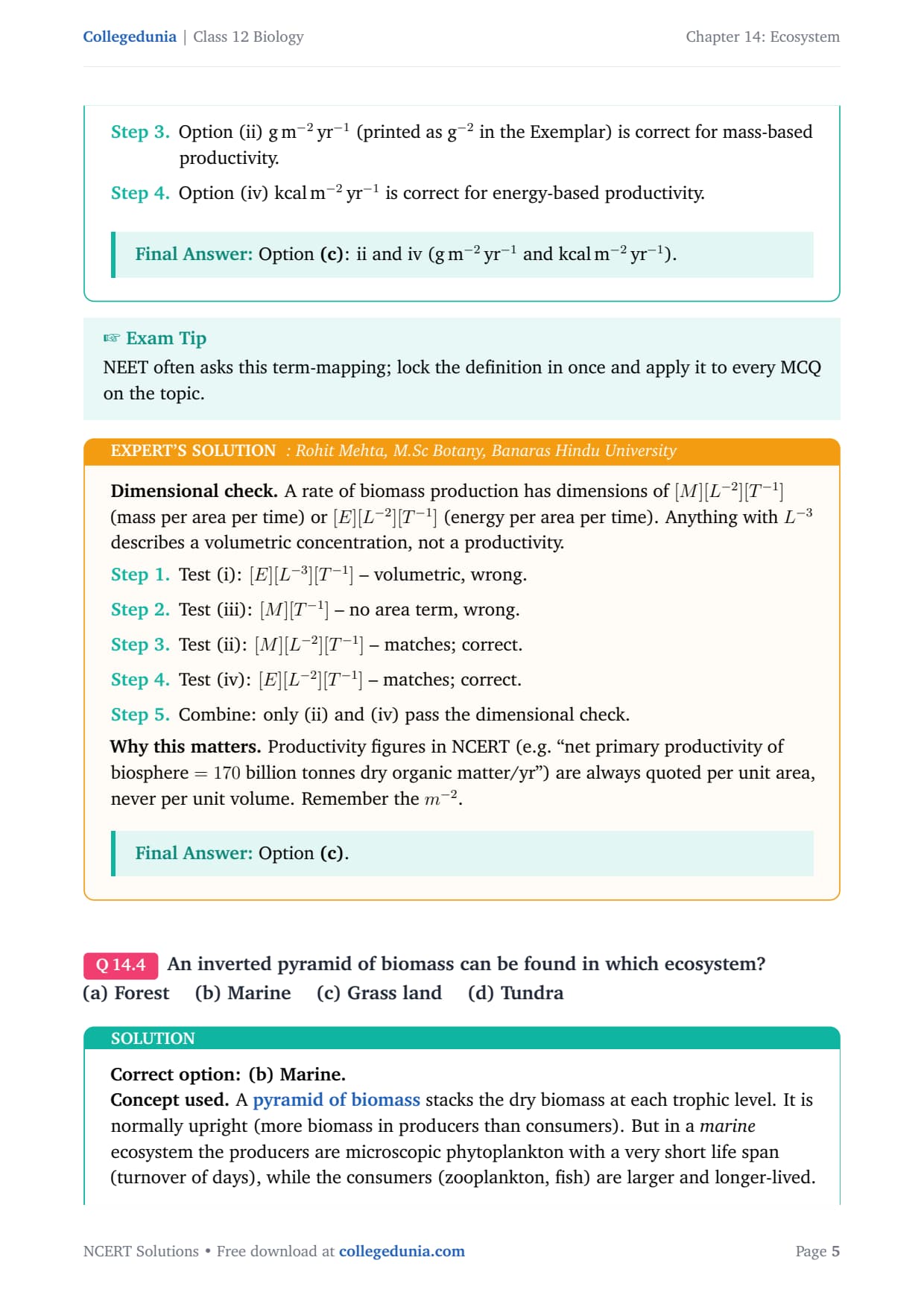
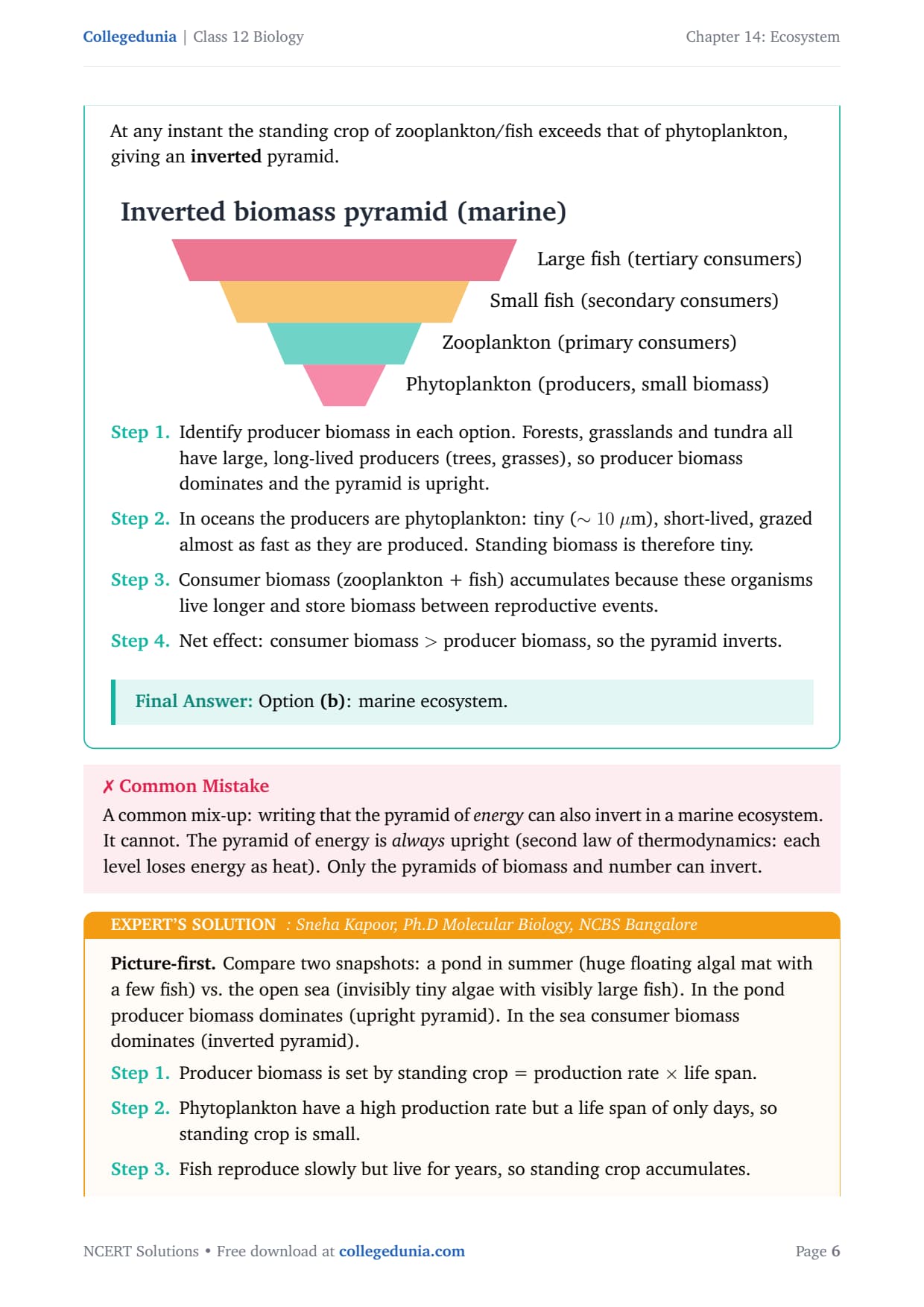
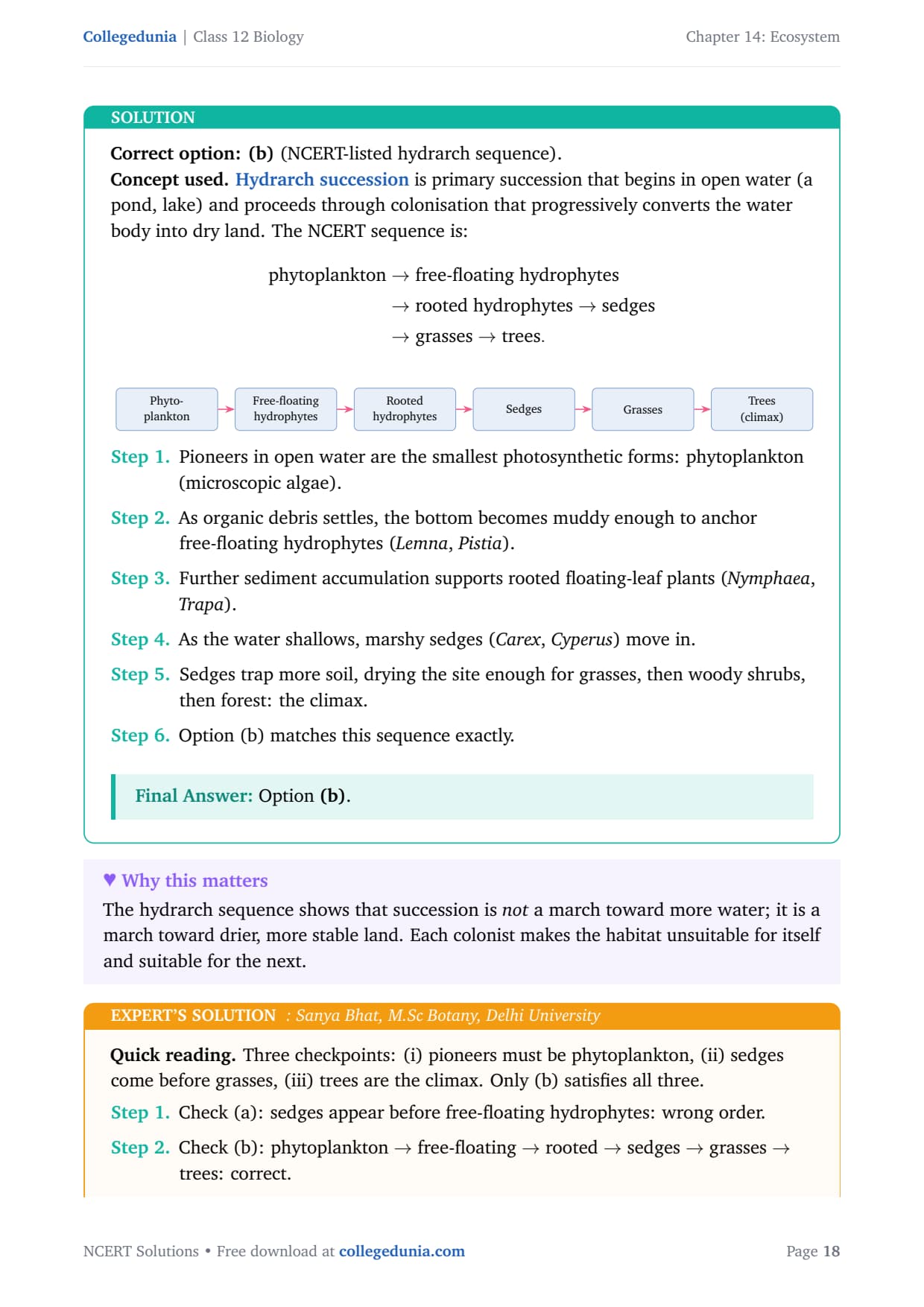
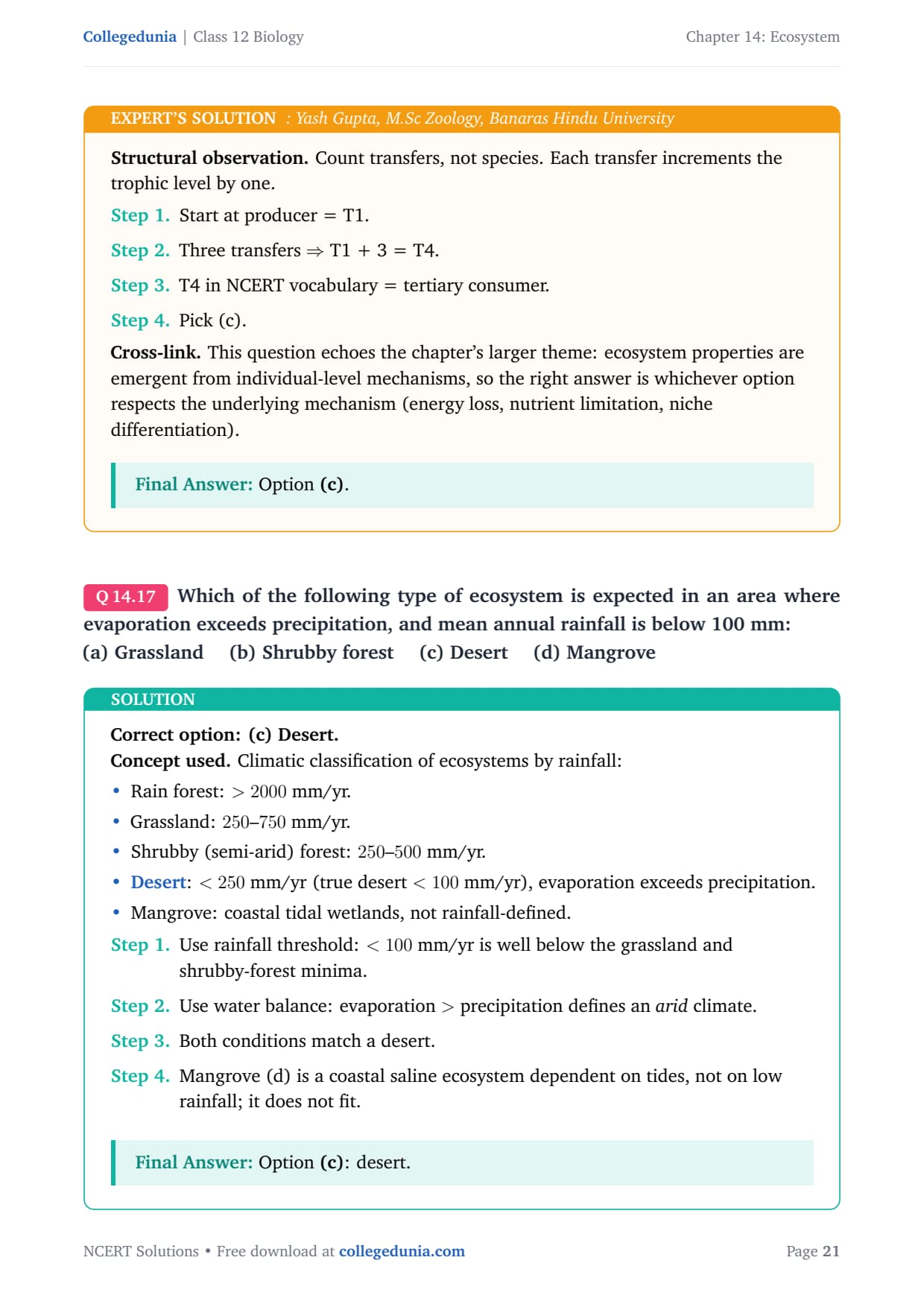
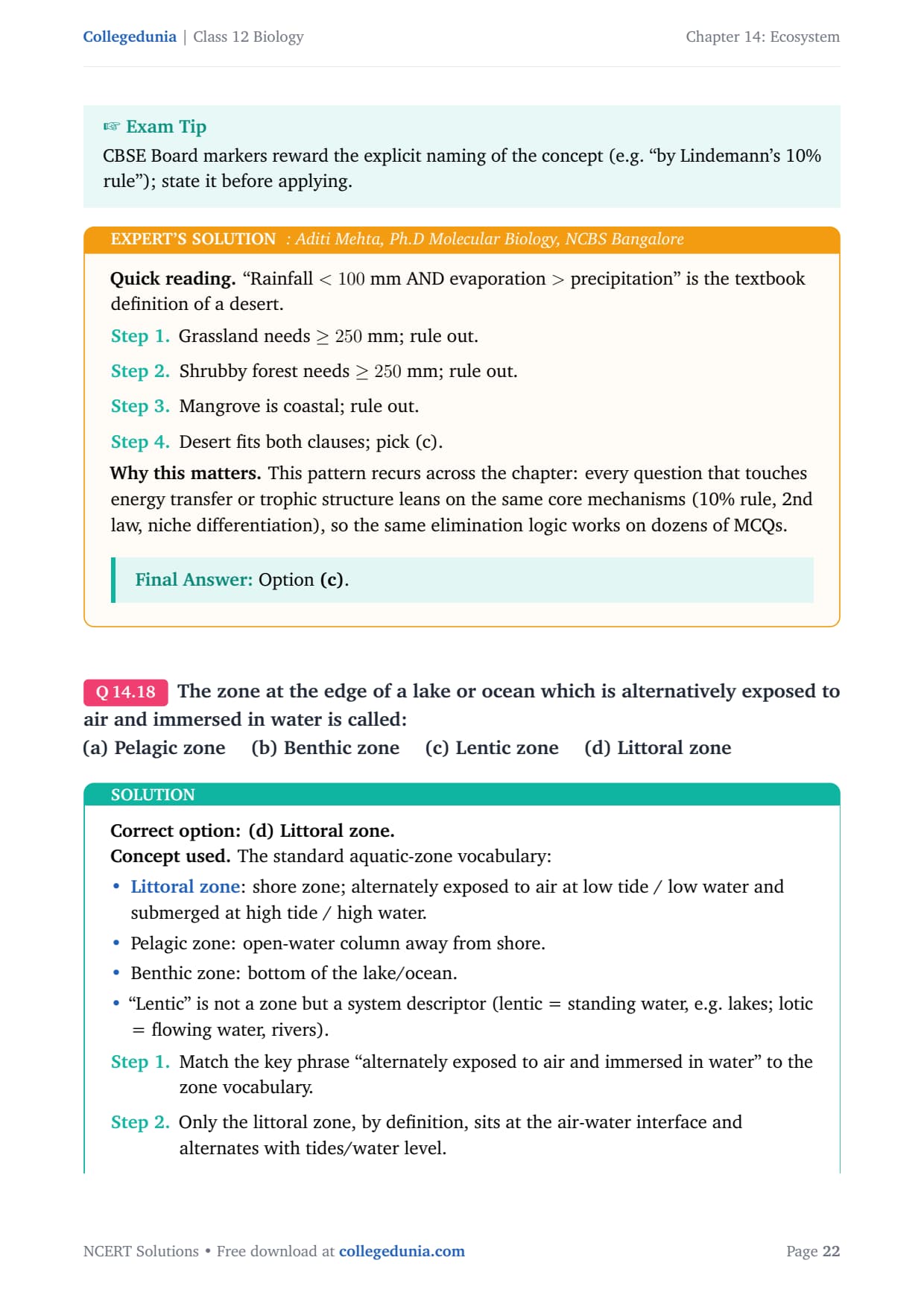
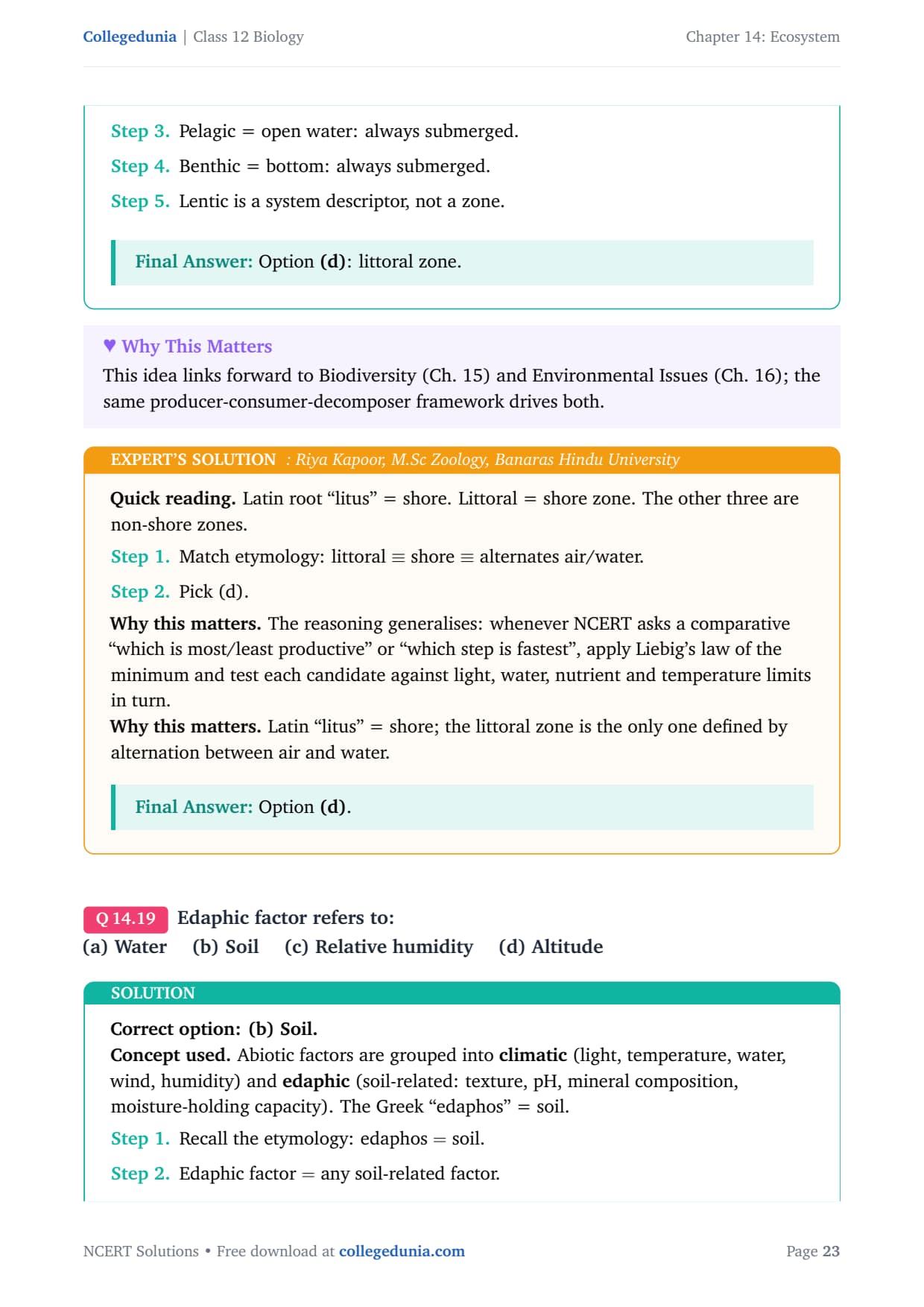
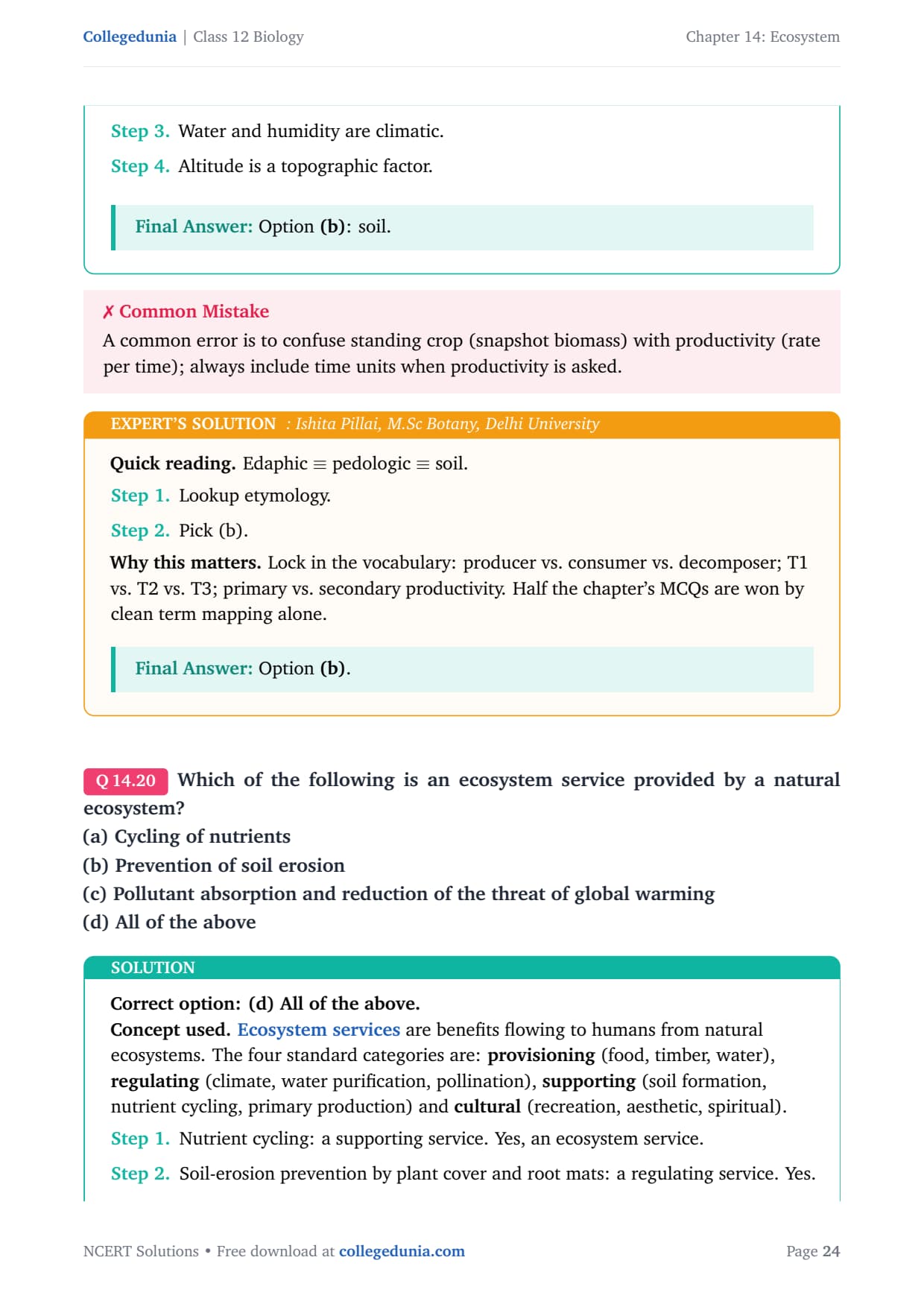
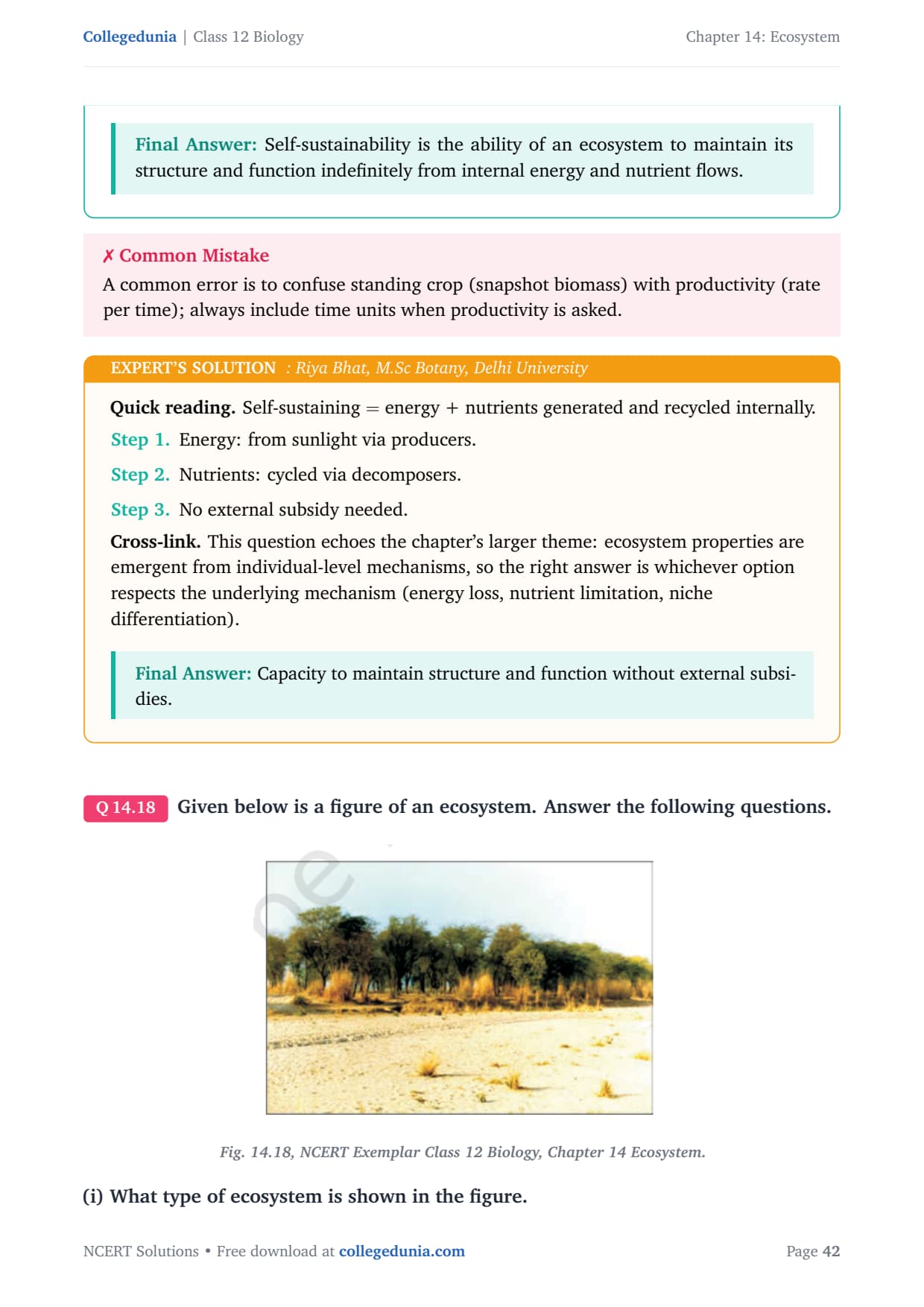
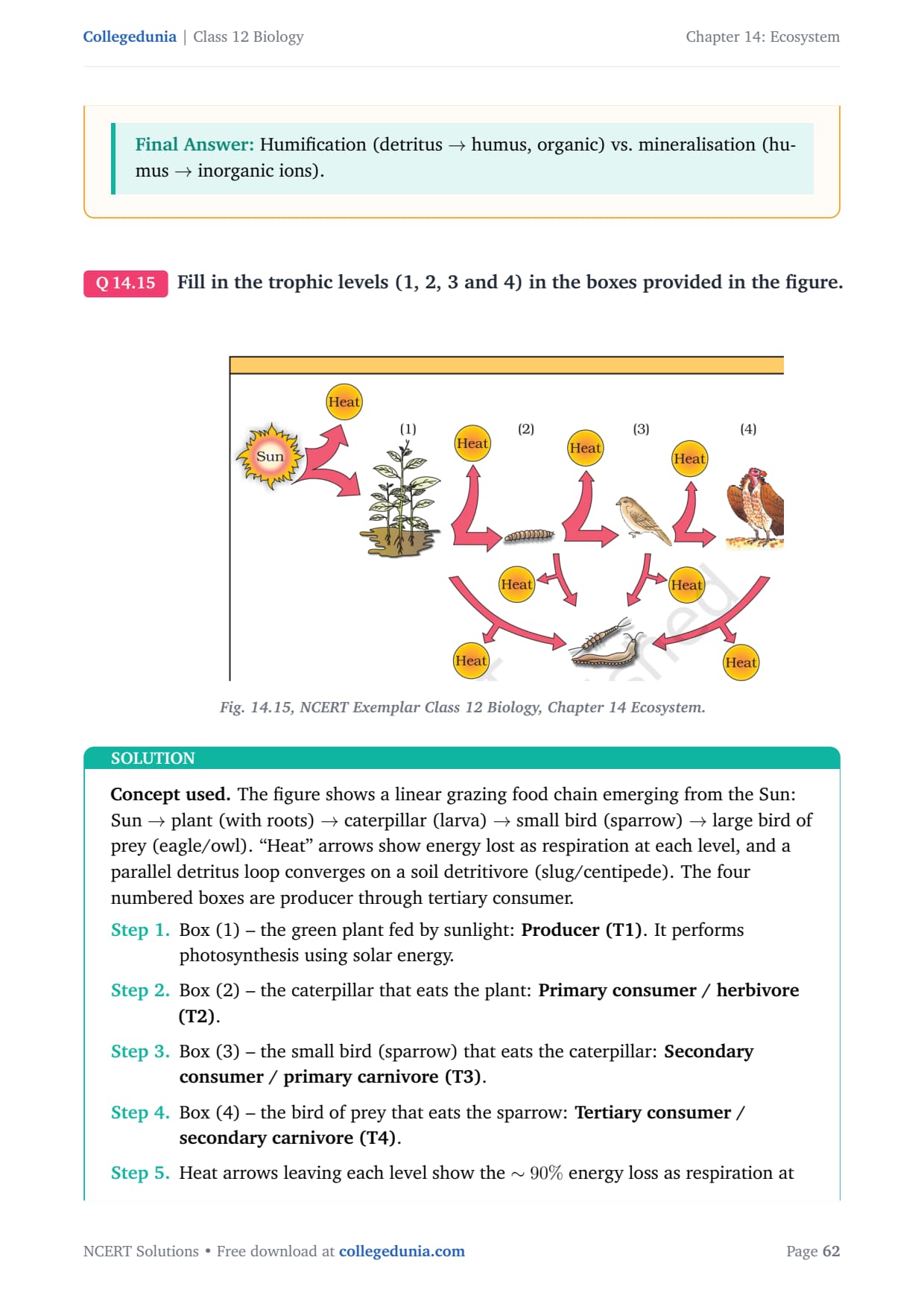
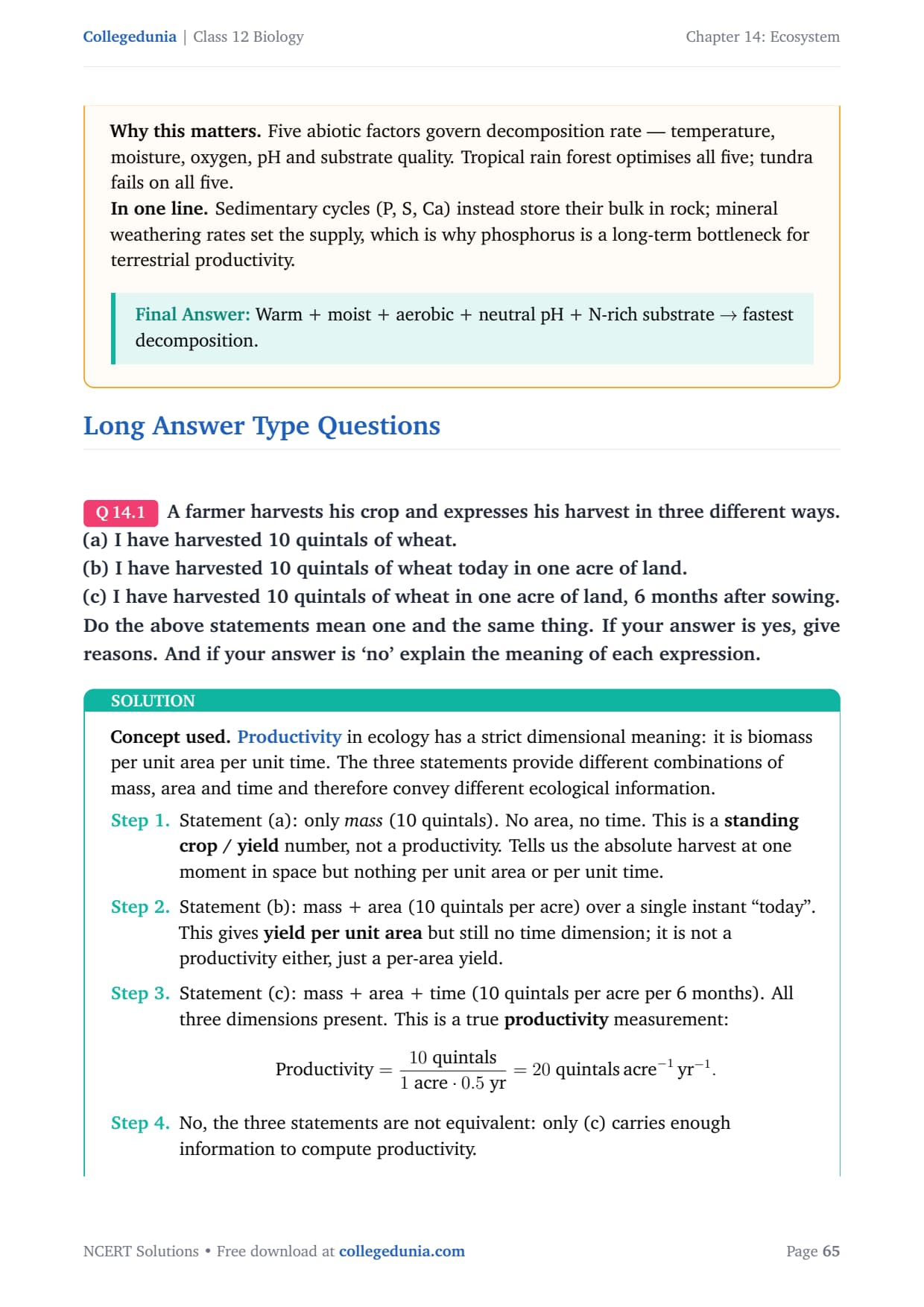
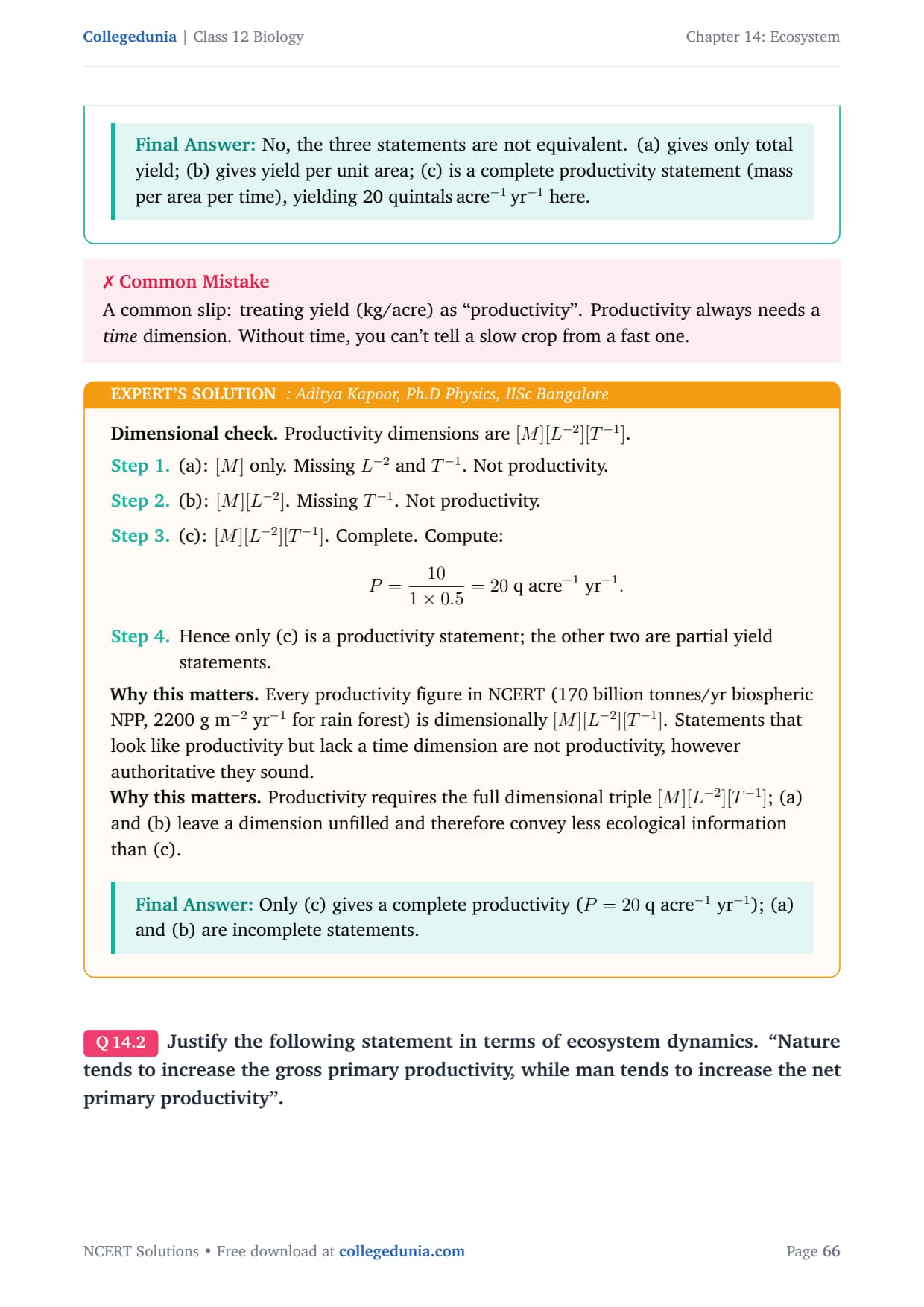
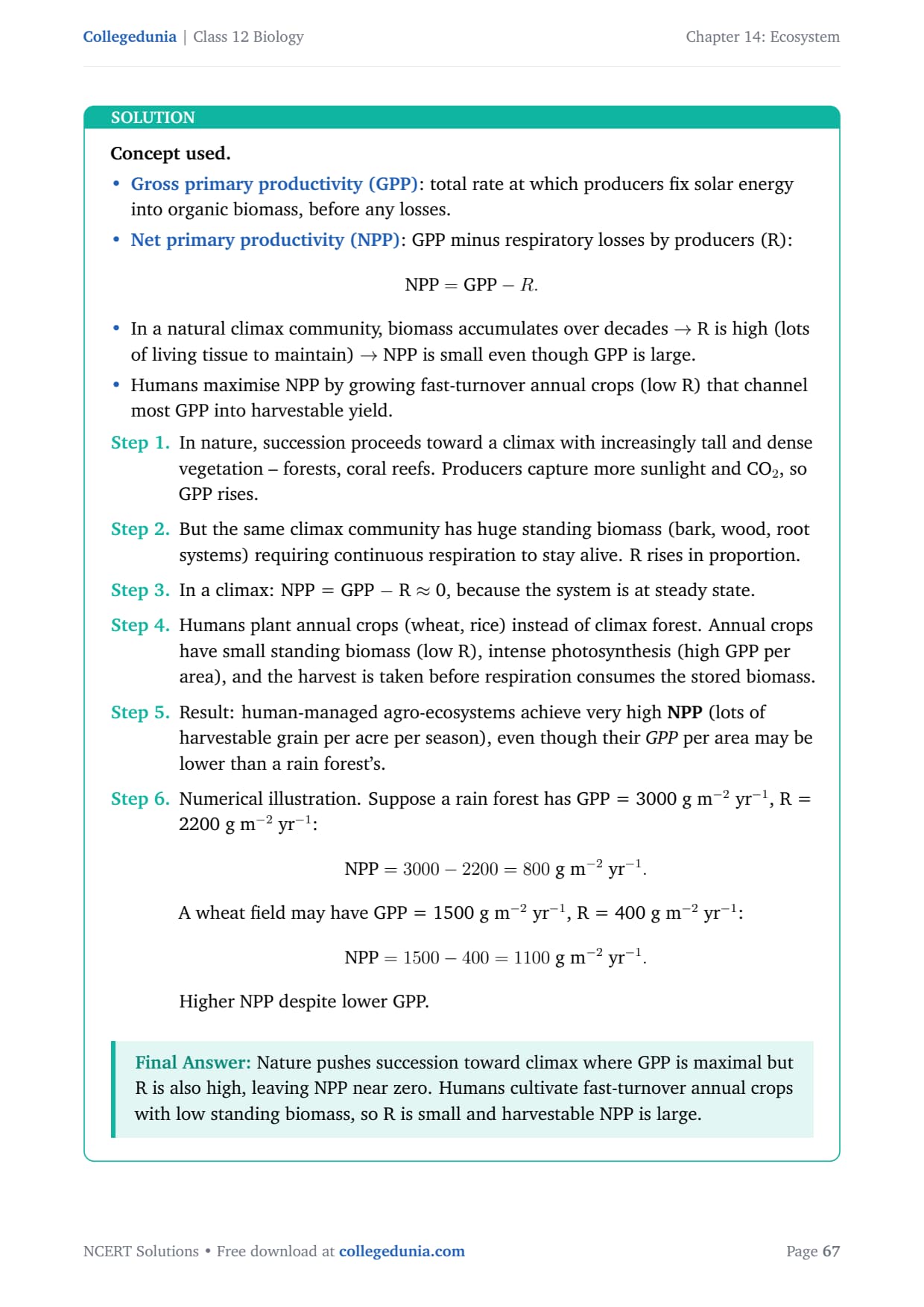
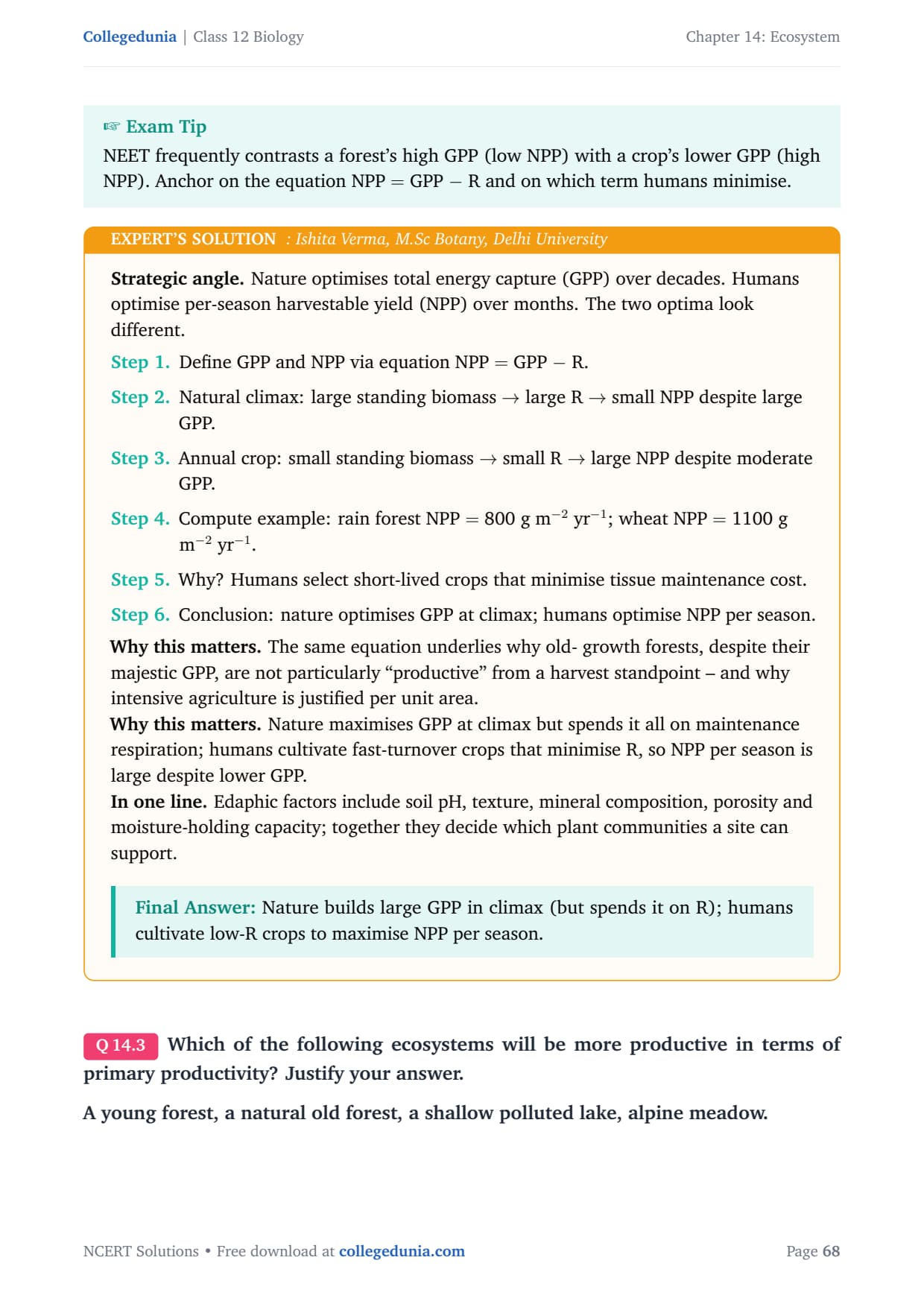
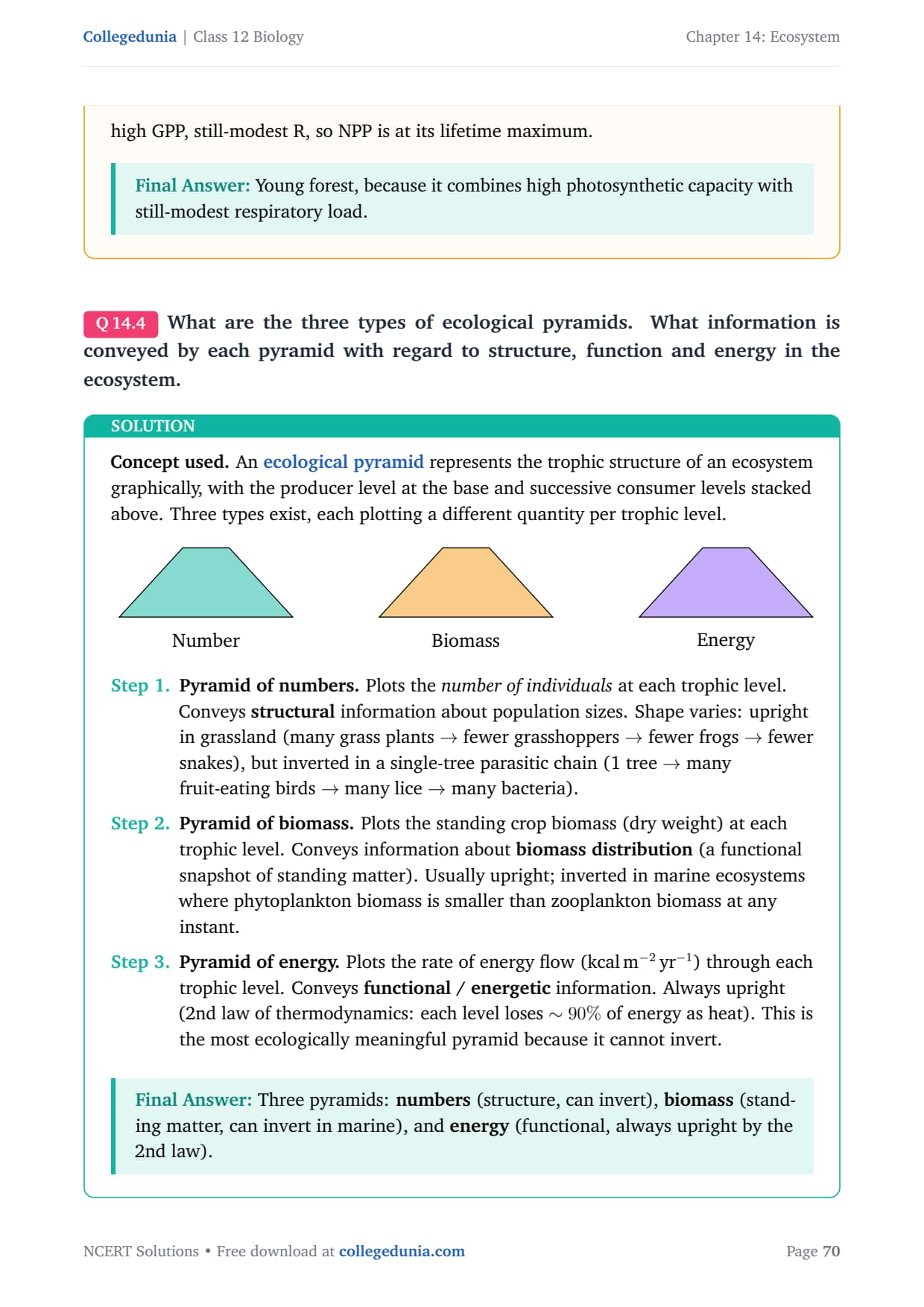
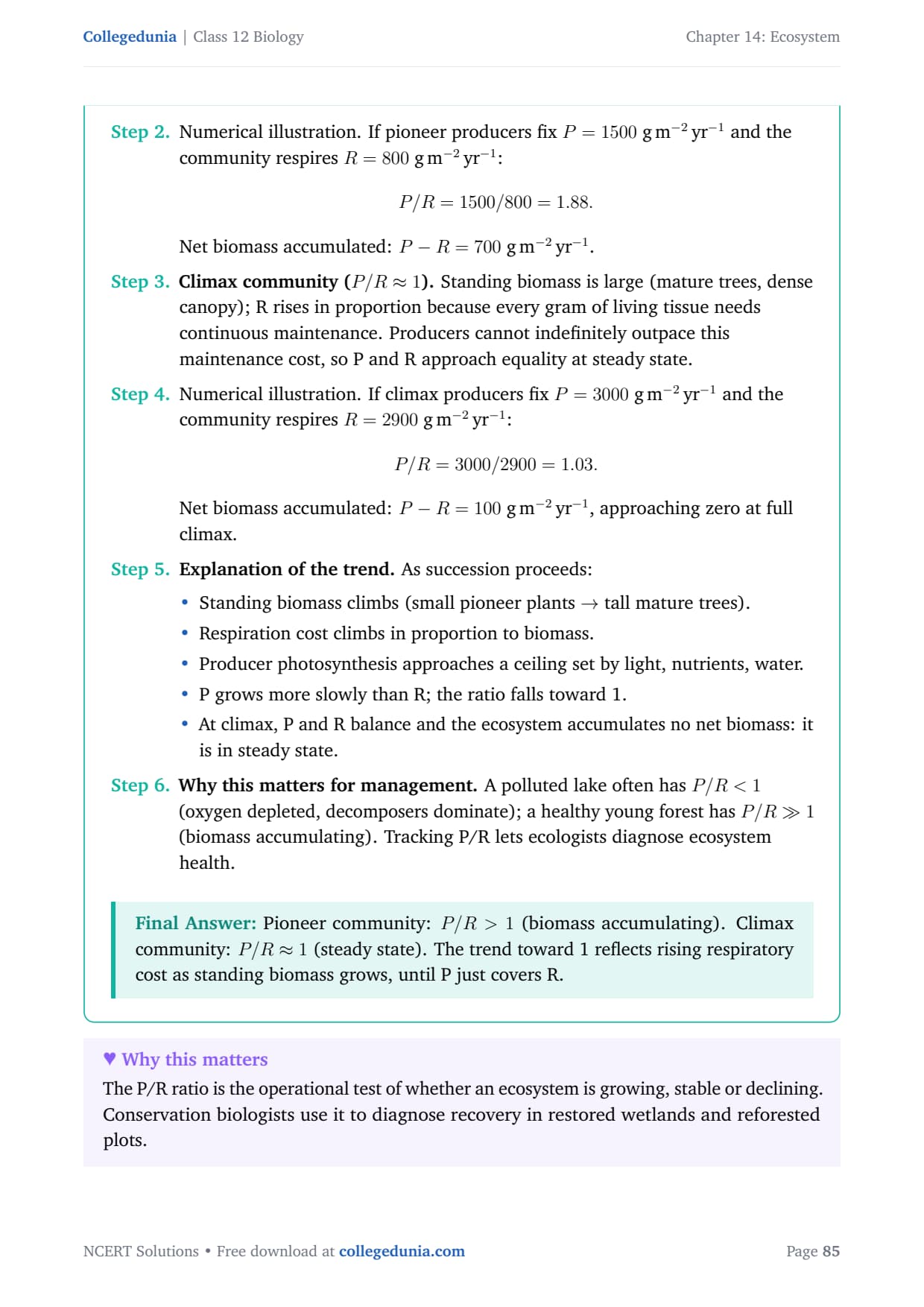
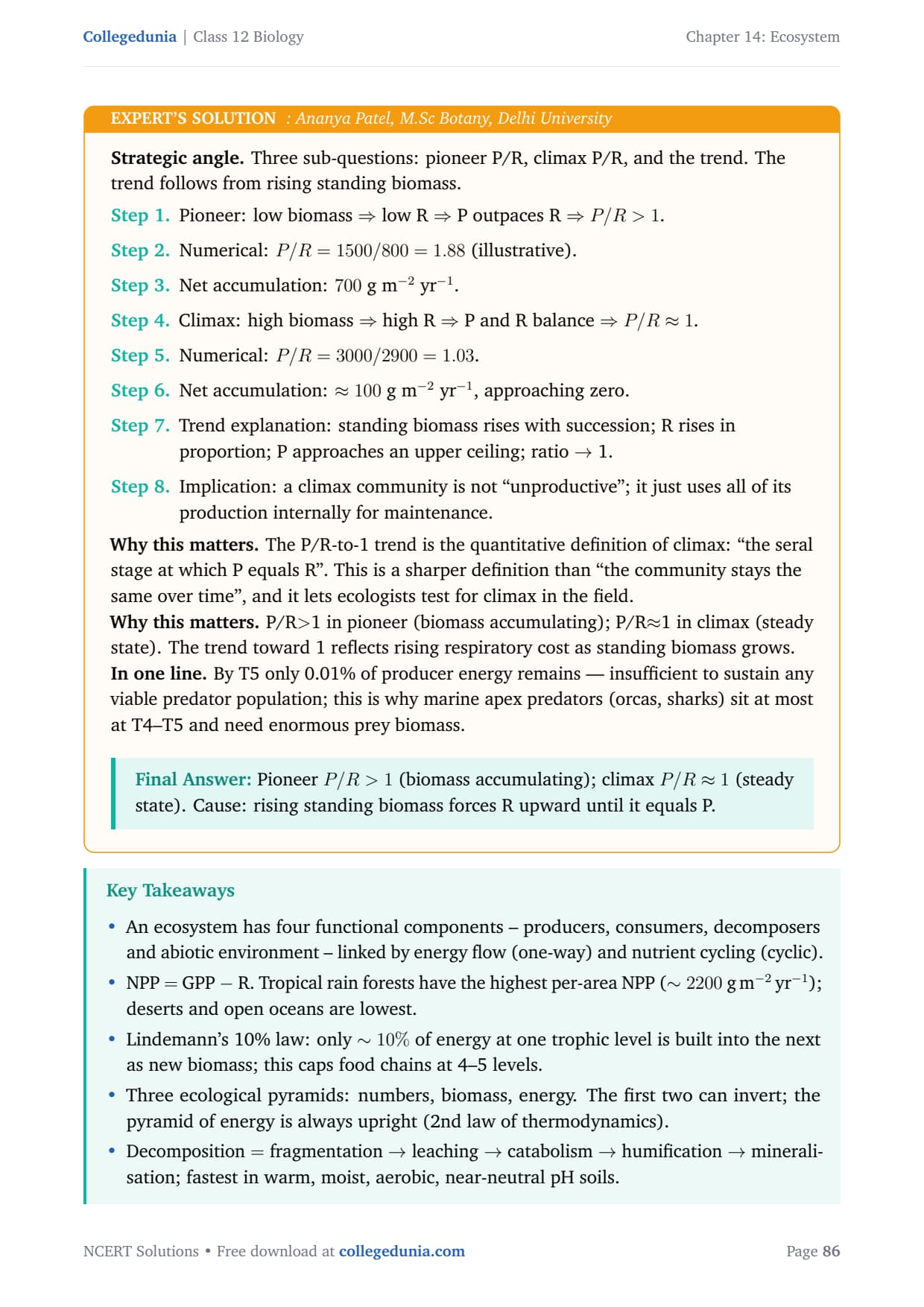
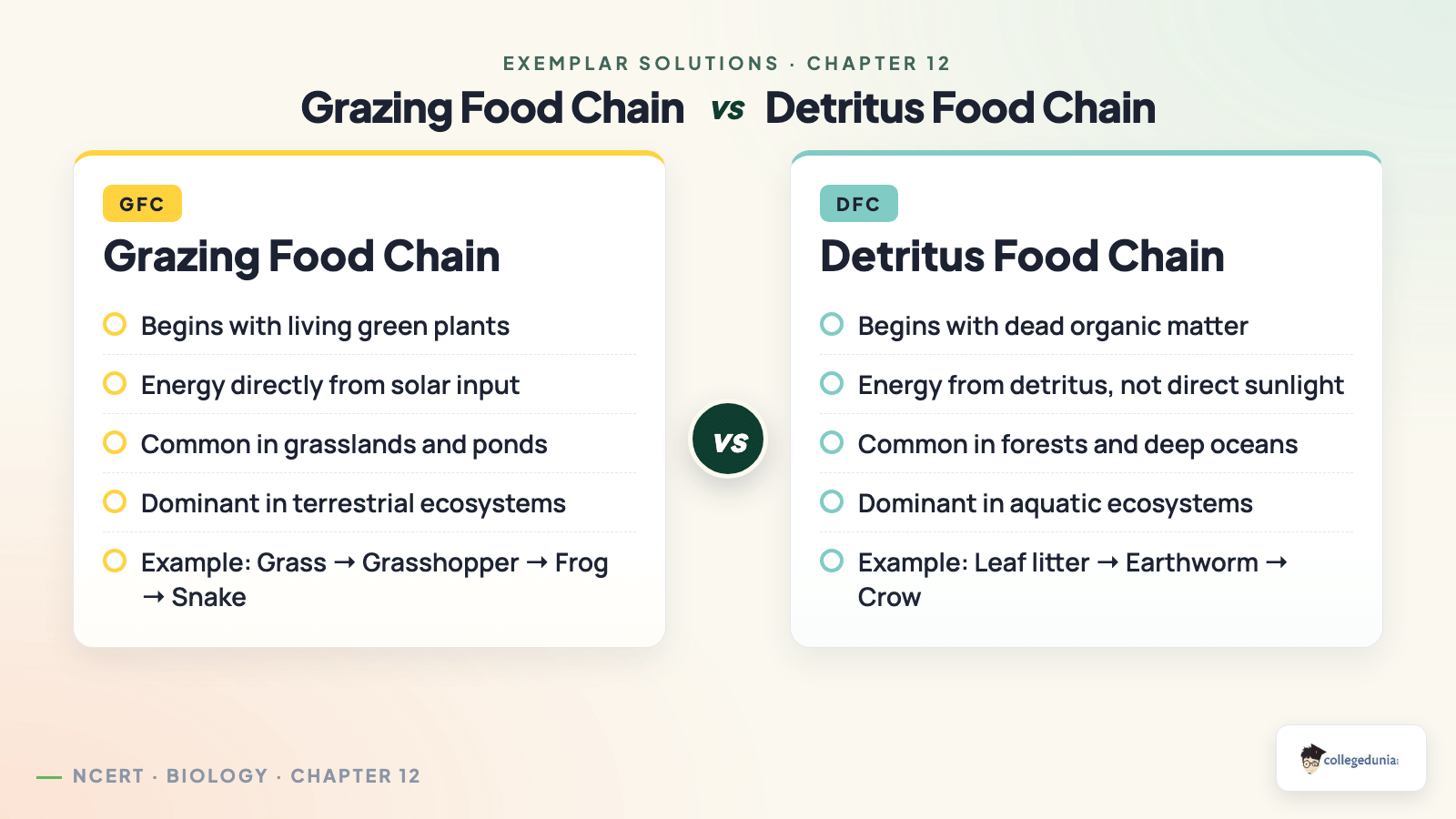
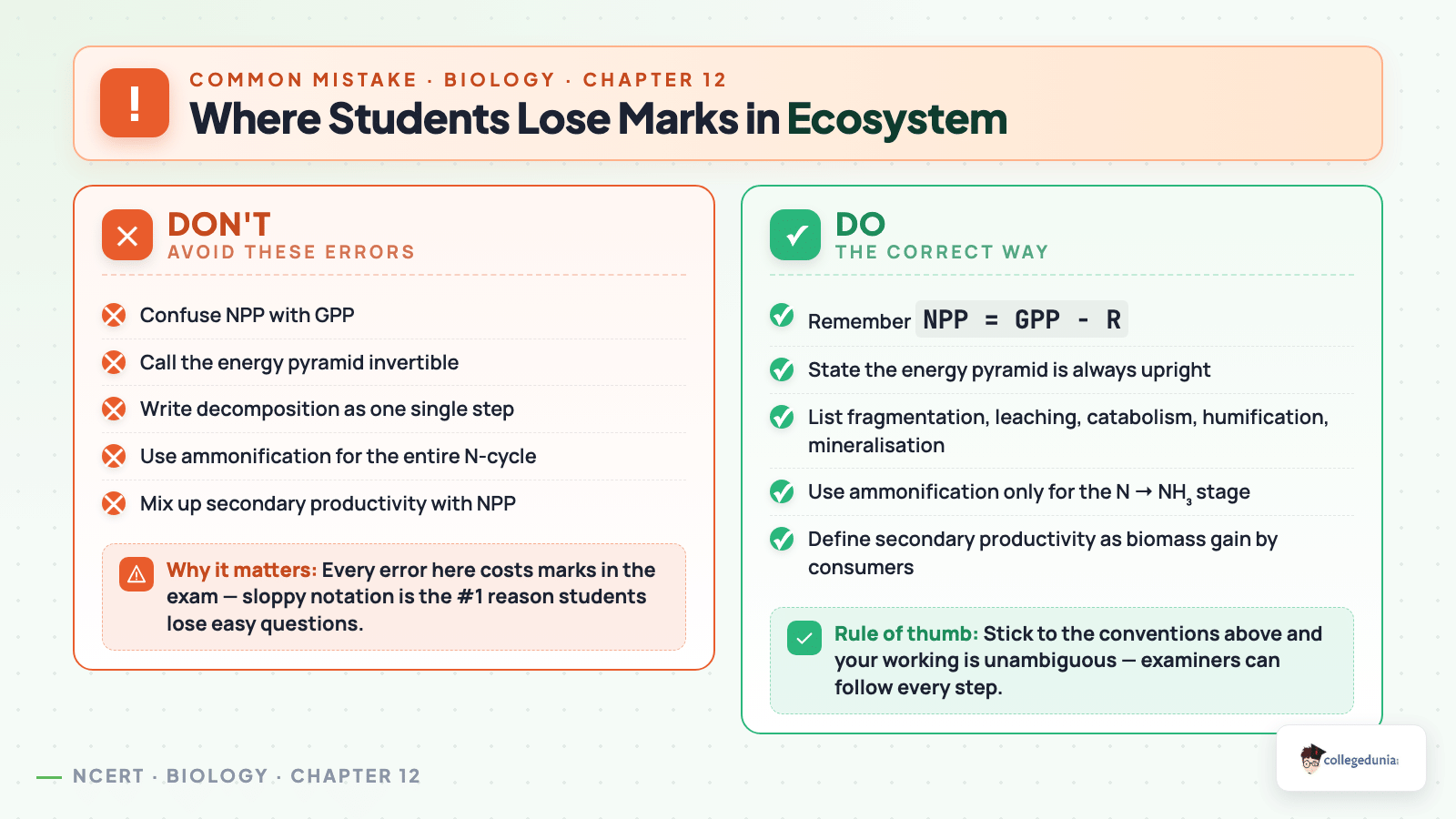
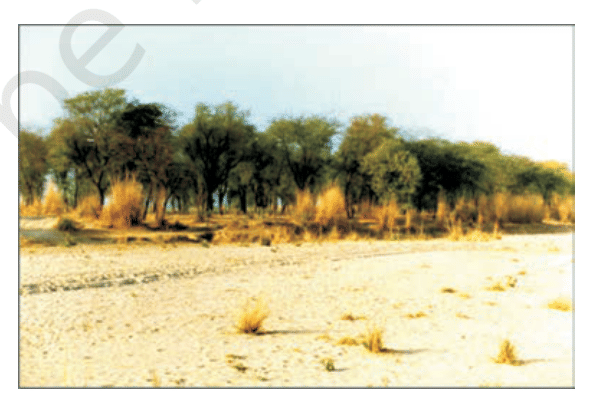
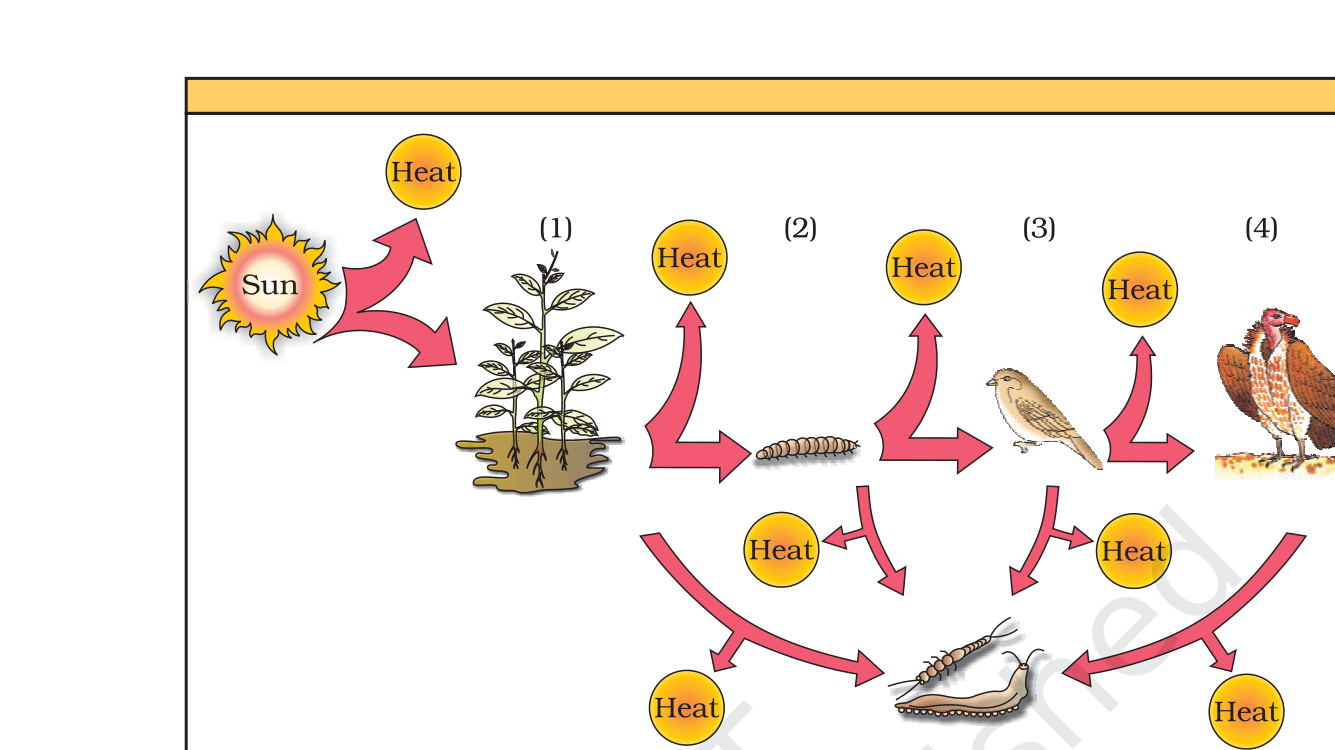



Comments