




Class 12 Physics Chapter 4 - Moving Charges and Magnetism covers Lorentz force, Biot-Savart law, Ampere's circuital law, solenoid fields, and the moving coil galvanometer. The chapter runs 42 pages with 10 sections, 12 intext Examples, and 28 Exercise problems. Download the free NCERT Book PDF for Moving Charges and Magnetism on this page.
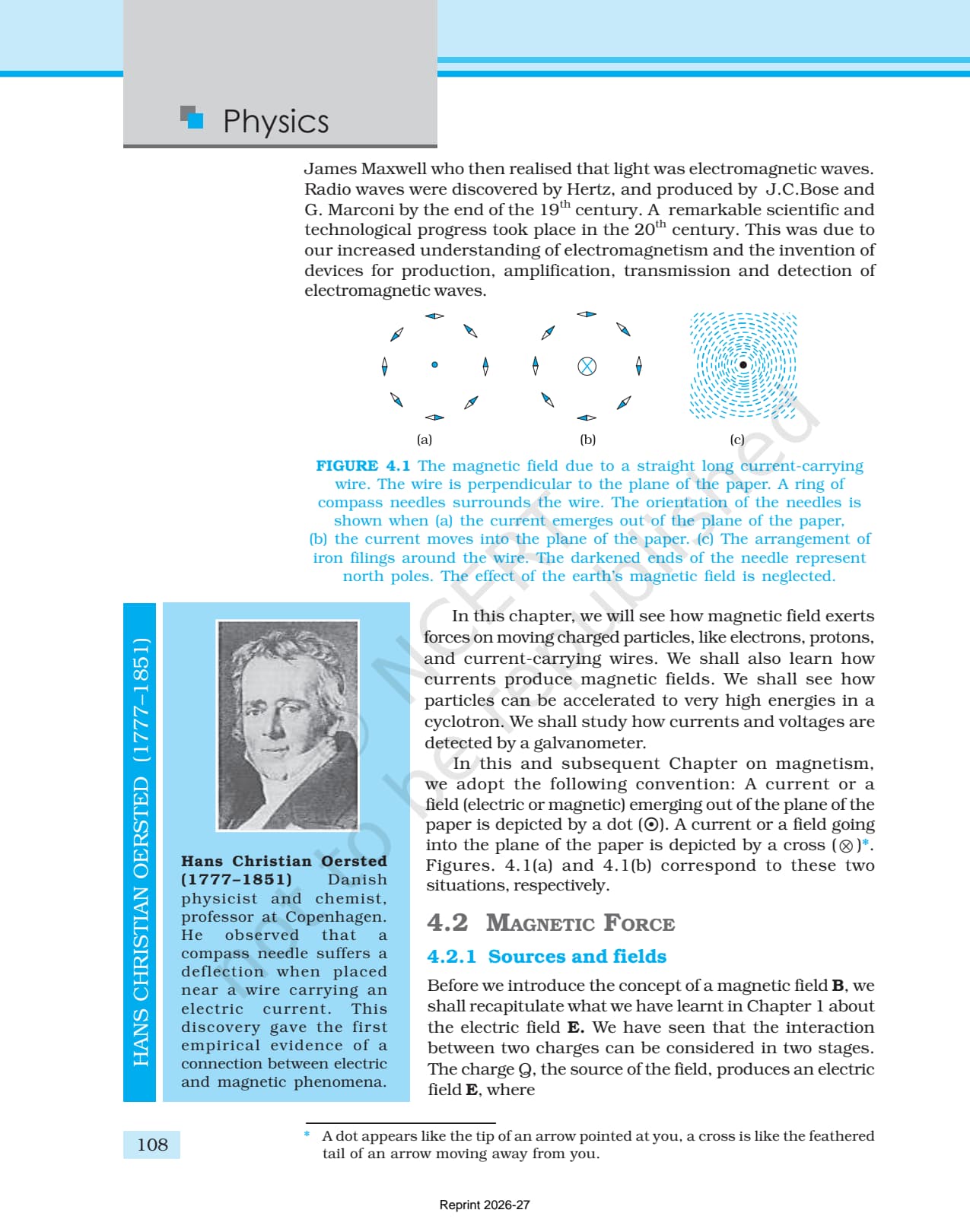
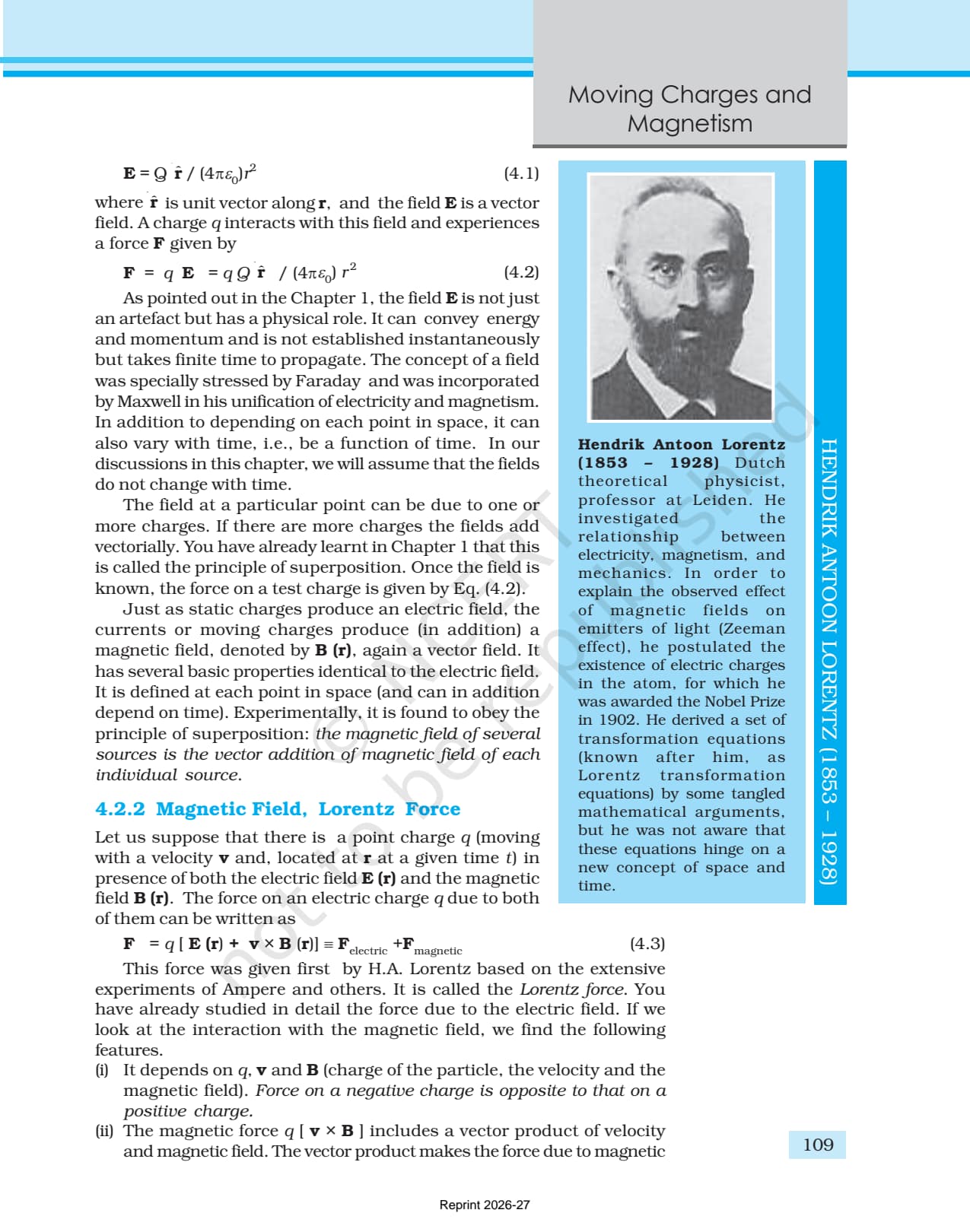
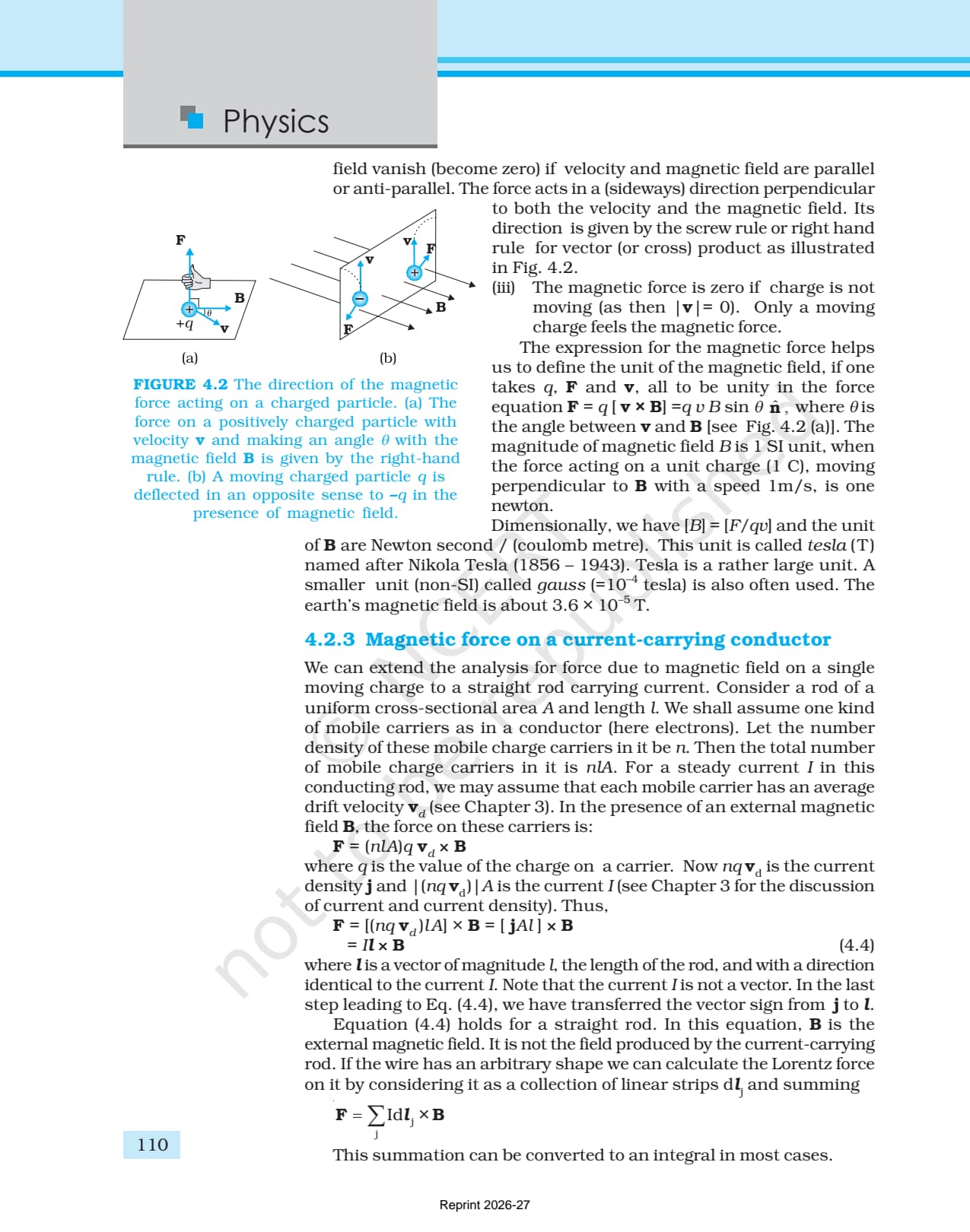

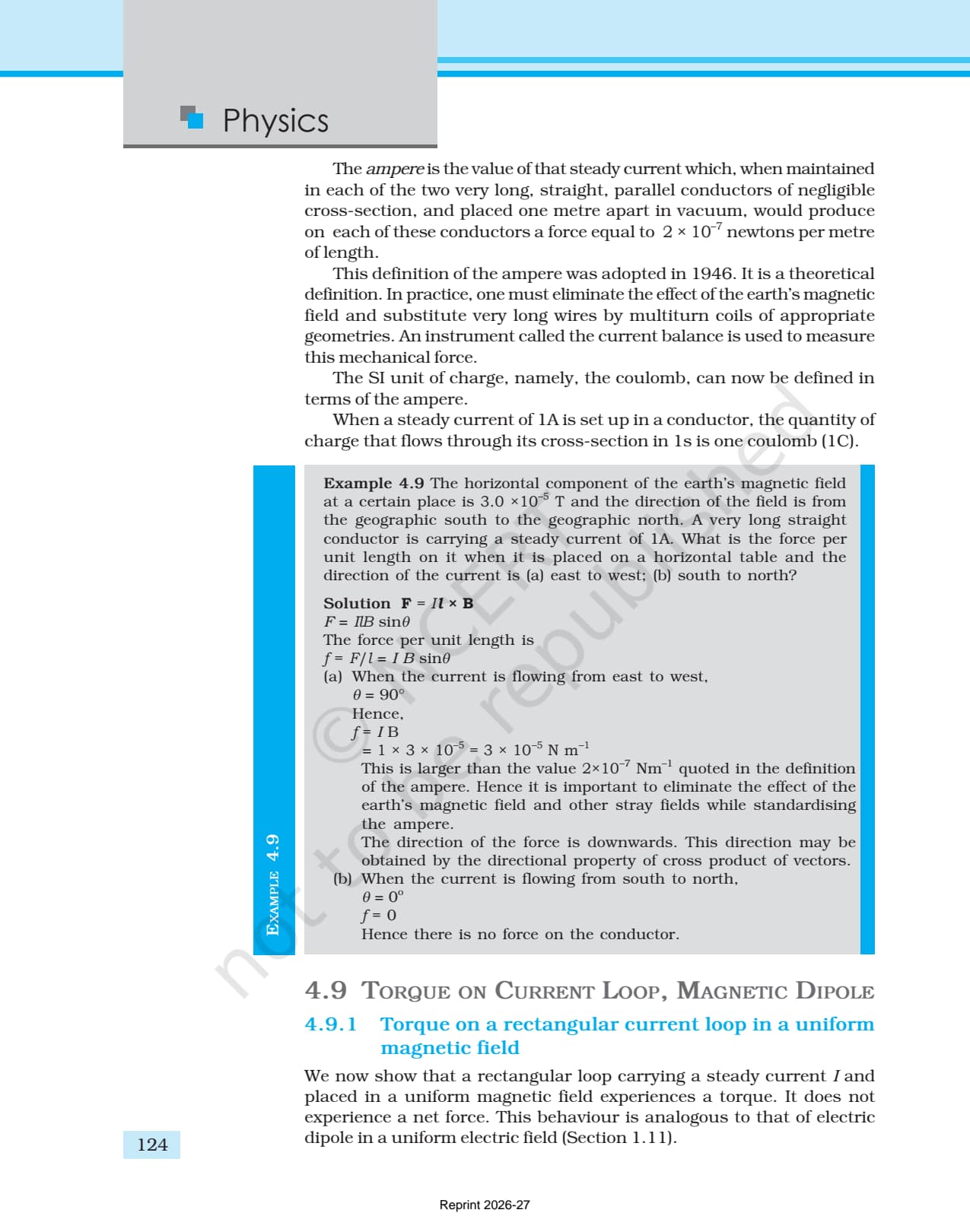

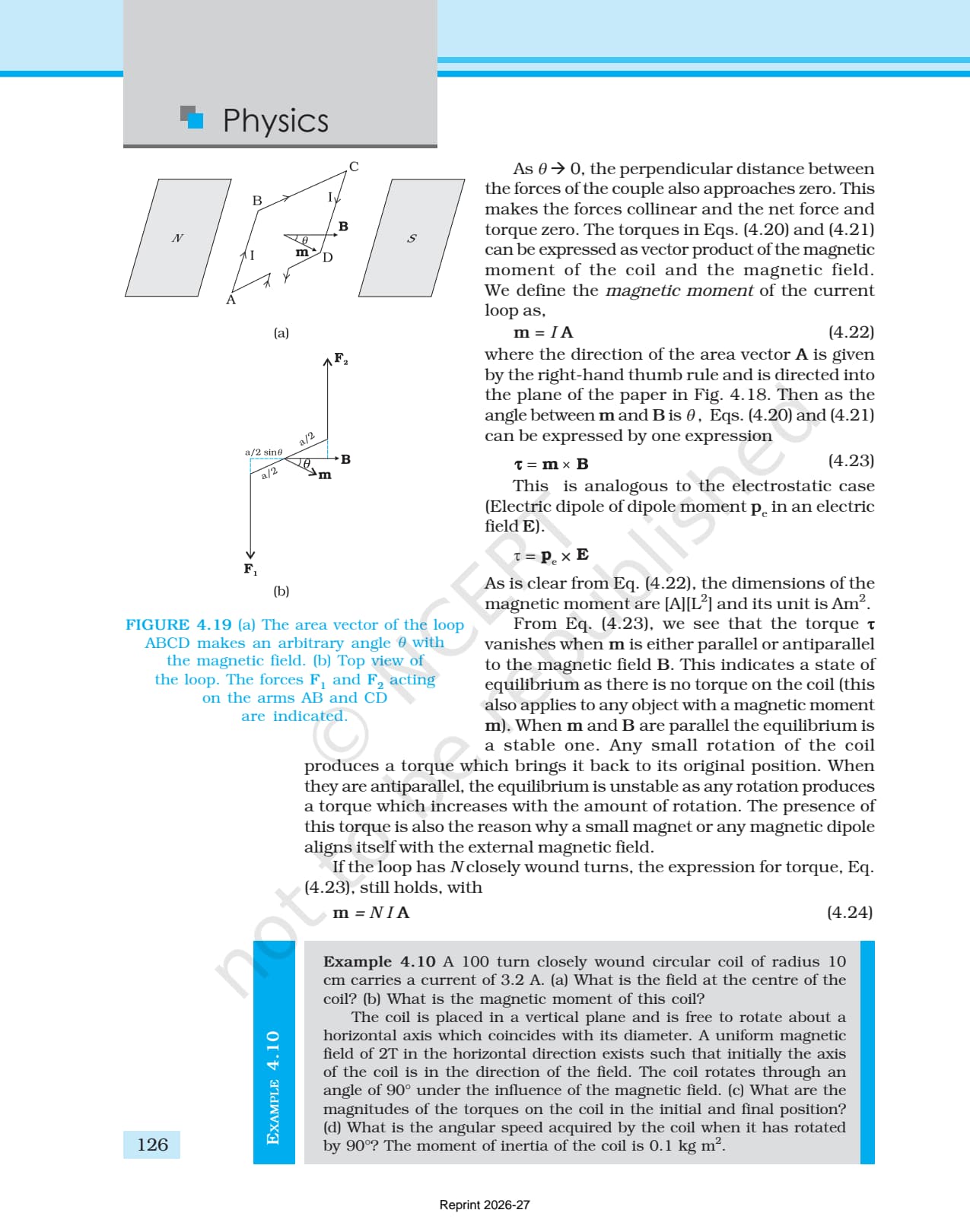

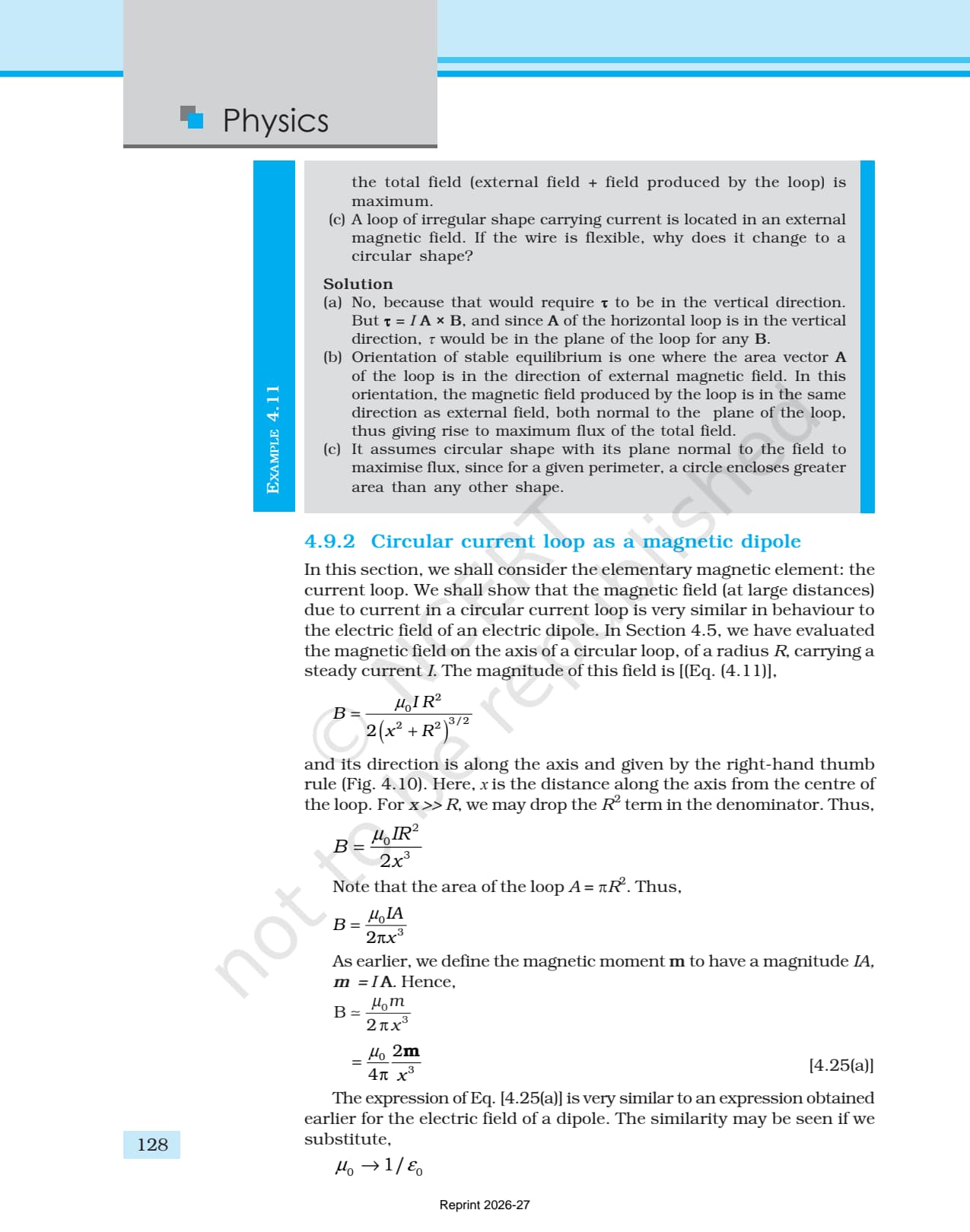


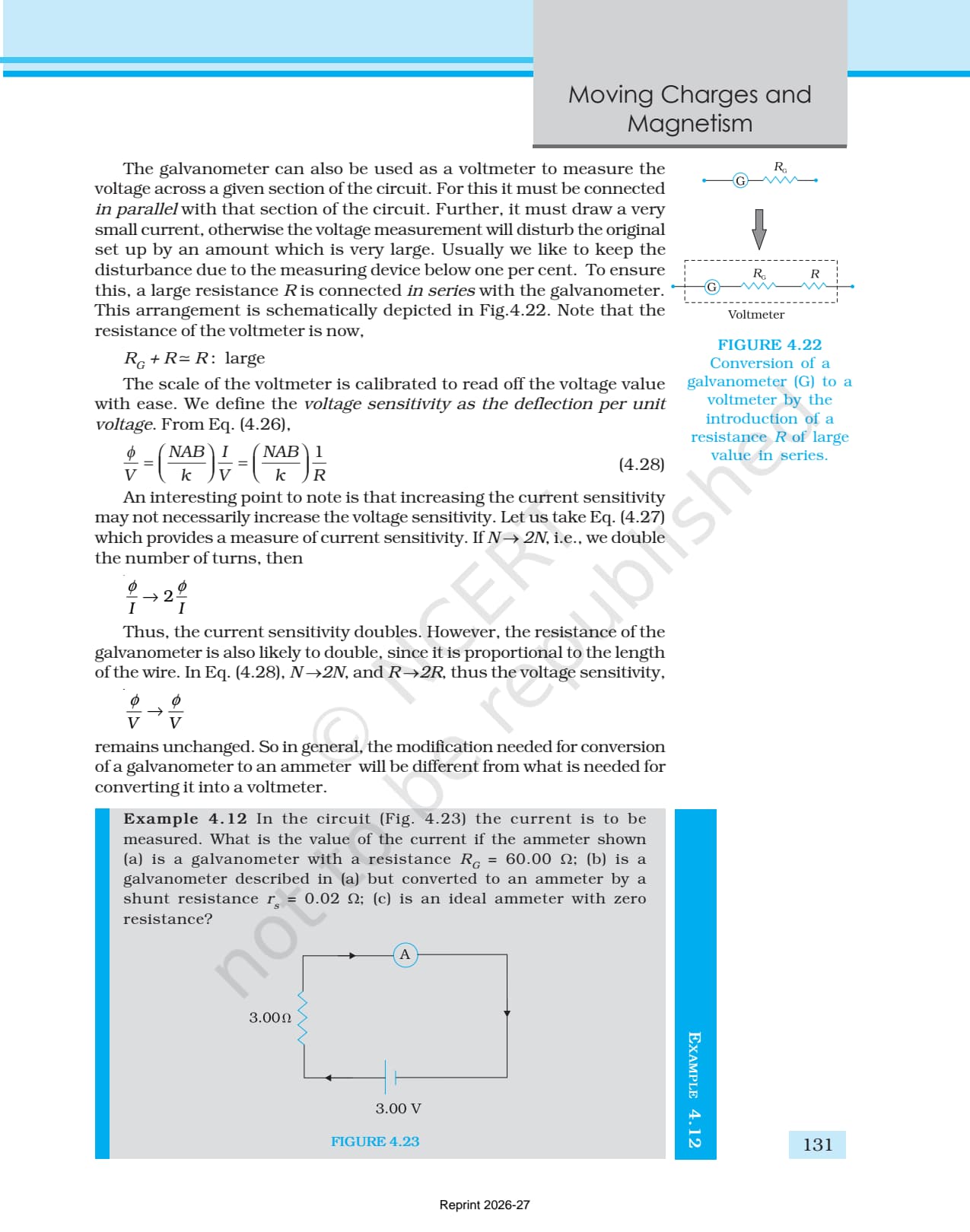
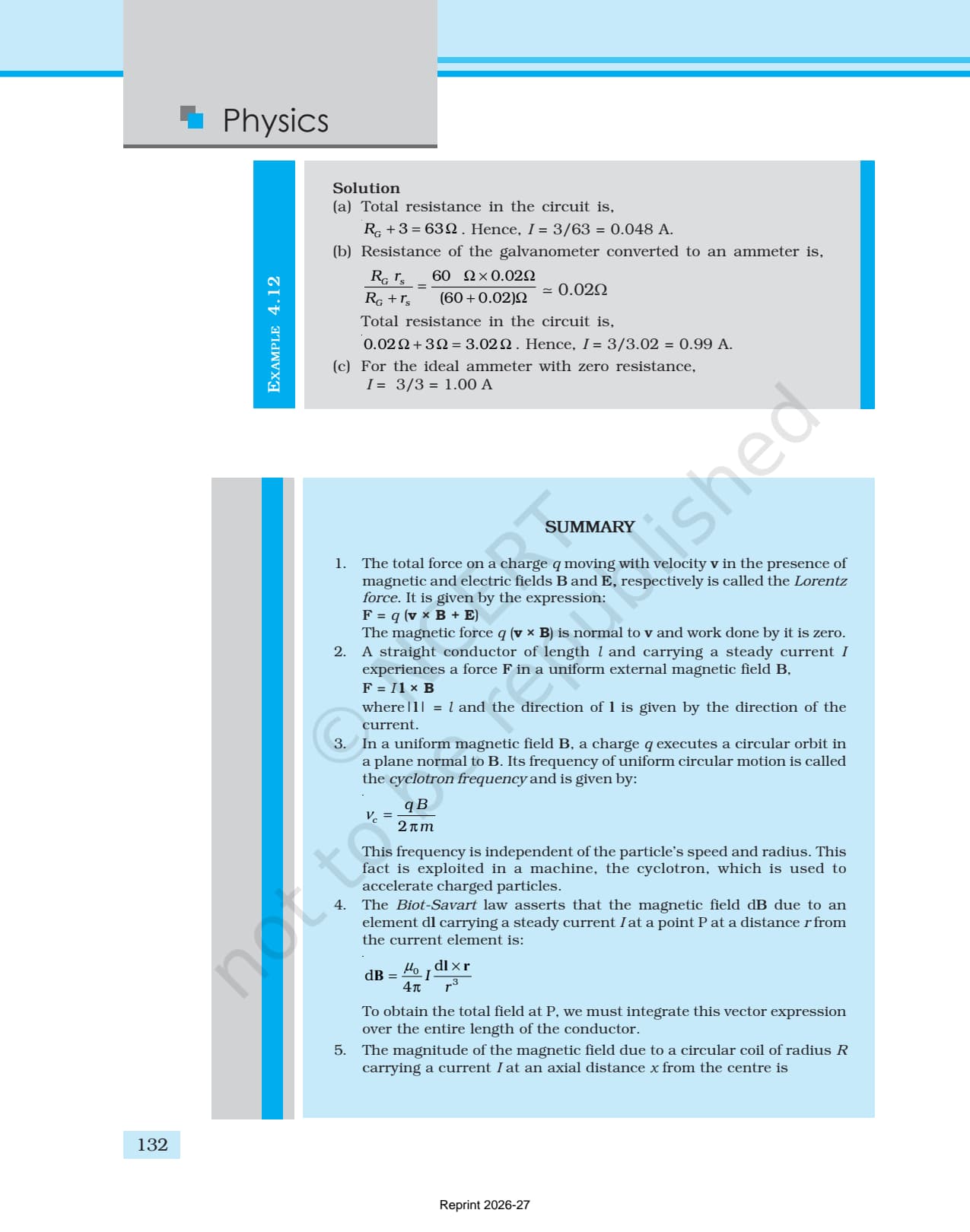
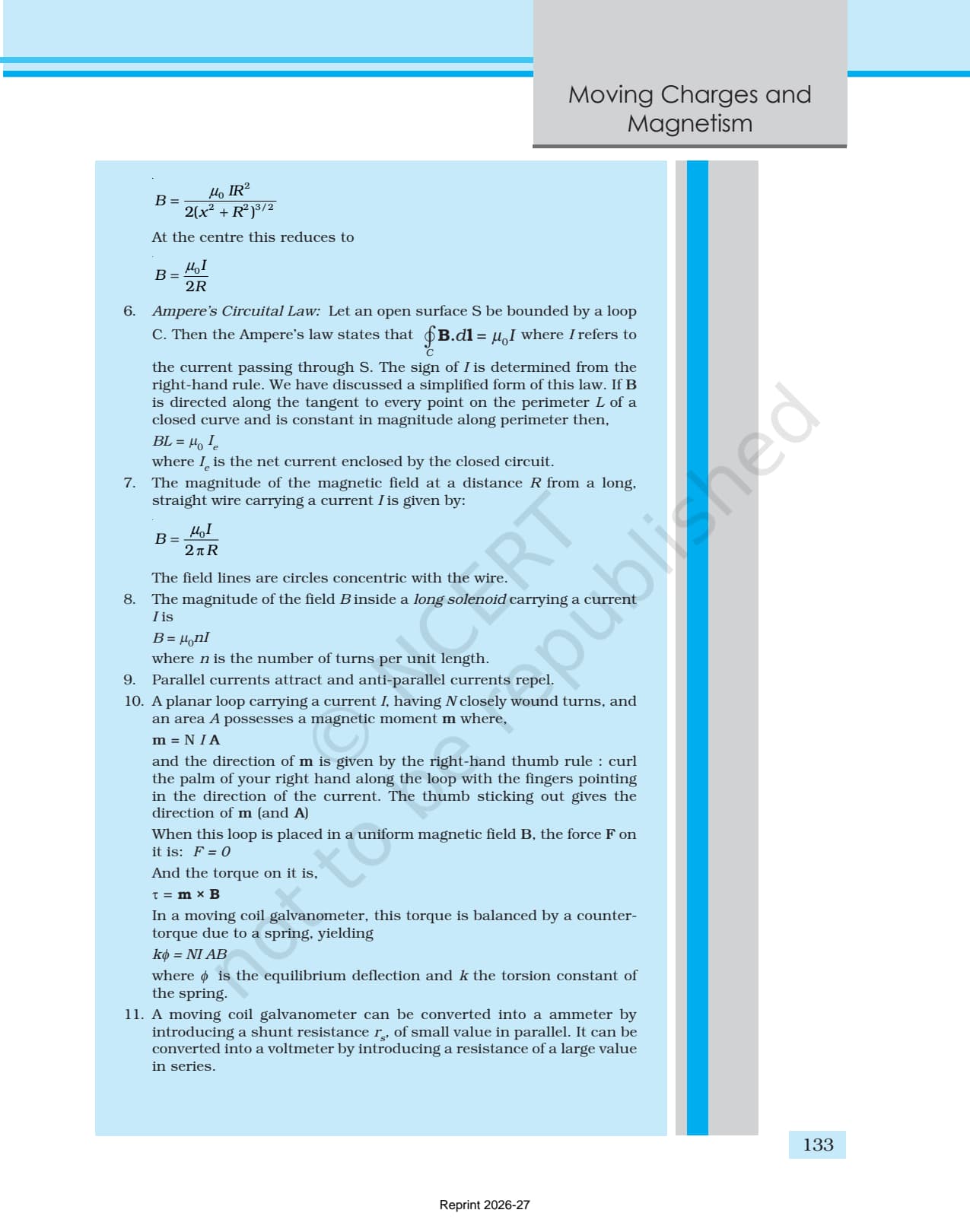
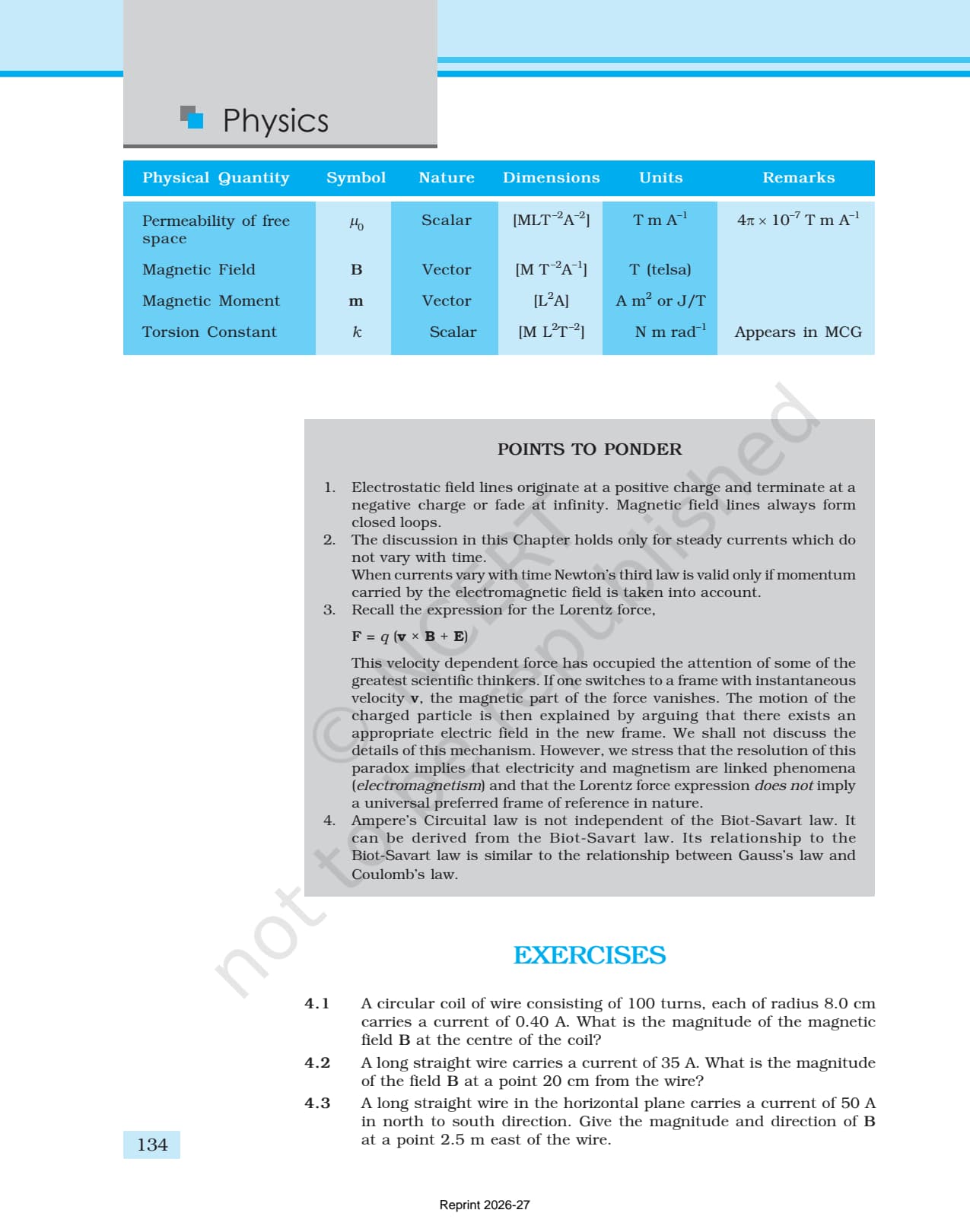
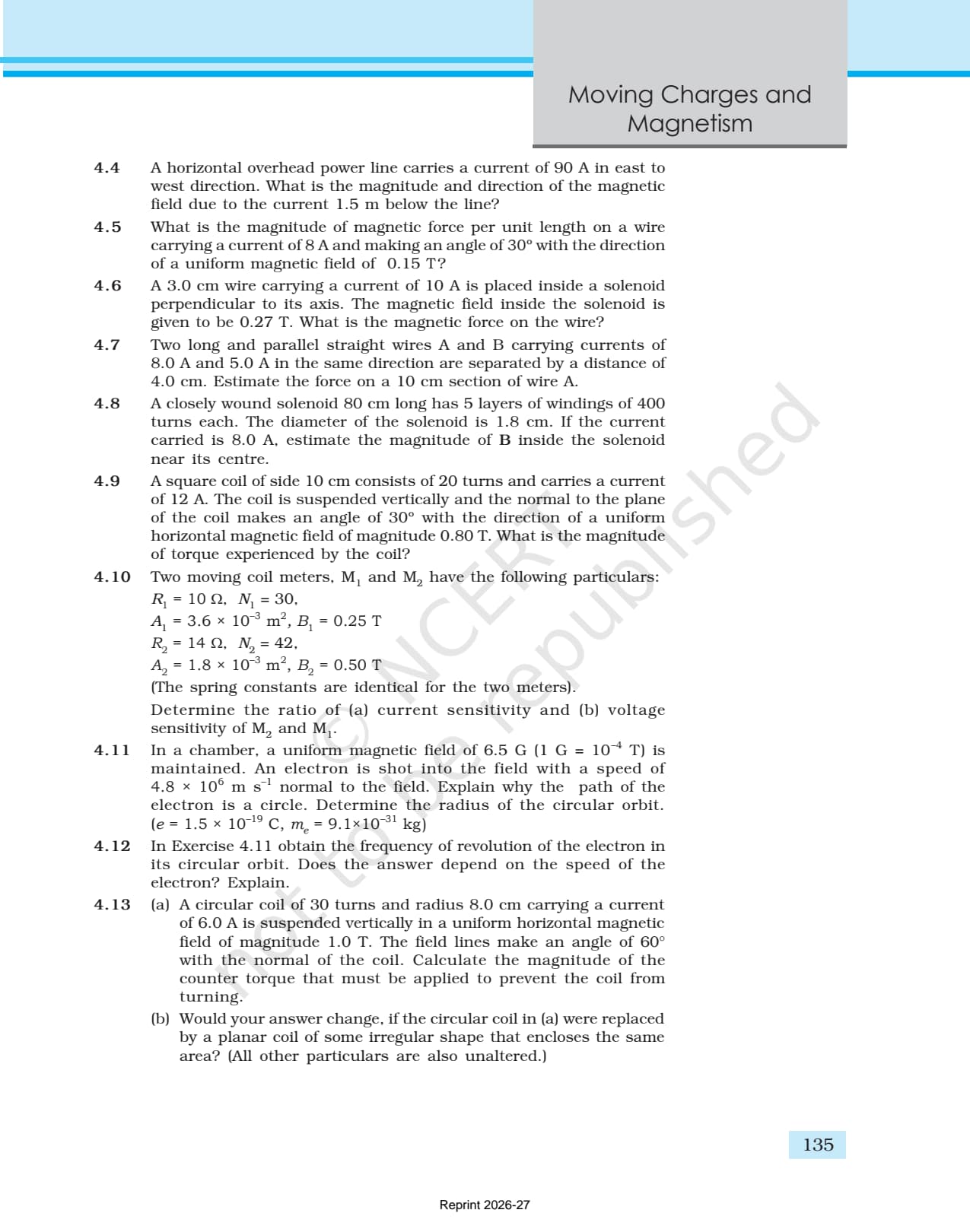
- CBSE Weightage: Expect 5-7 marks from Chapter 4 in CBSE Board exams.
- JEE Main Weightage: 2-3 questions (3-4% of paper) come from this chapter every year.
- NEET Weightage: 2-3 conceptual or formula-based questions appear from this chapter in NEET.
How the Moving Charges and Magnetism NCERT PDF Helps Class 12 Students
- Verified 2026-27 Source: Every page matches the latest NCERT print, with no off-syllabus inserts.
- Section Navigation: A page-range map lets you jump straight to Biot-Savart, Ampere's law, or the galvanometer.
- Reading-Order Guidance: A staged plan tells you which pages to study on day one, day two, and day three.
- Cross-Chapter Bridge: This guide connects Chapter 4 to Chapter 5 and Chapter 6 so students don't relearn the same concepts twice.
Moving Charges and Magnetism Video Lecture (Class 12 Physics Chapter 4)
Source: NCERT Wallah on YouTube
What's Inside the Moving Charges and Magnetism NCERT PDF (42 Pages)
The chapter follows a derivation-first sequence: Lorentz force, then Biot-Savart, then Ampere's law. Each derivation has worked examples, and the Exercise set mixes conceptual and numerical questions.

Moving Charges and Magnetism NCERT Section-by-Section Breakdown
Use the table below as a navigation index into the PDF.
| Section | Title | Pages | Core Concept |
|---|---|---|---|
| 4.1 | Introduction | 132 to 133 | Oersted's experiment, magnetic field as a vector field |
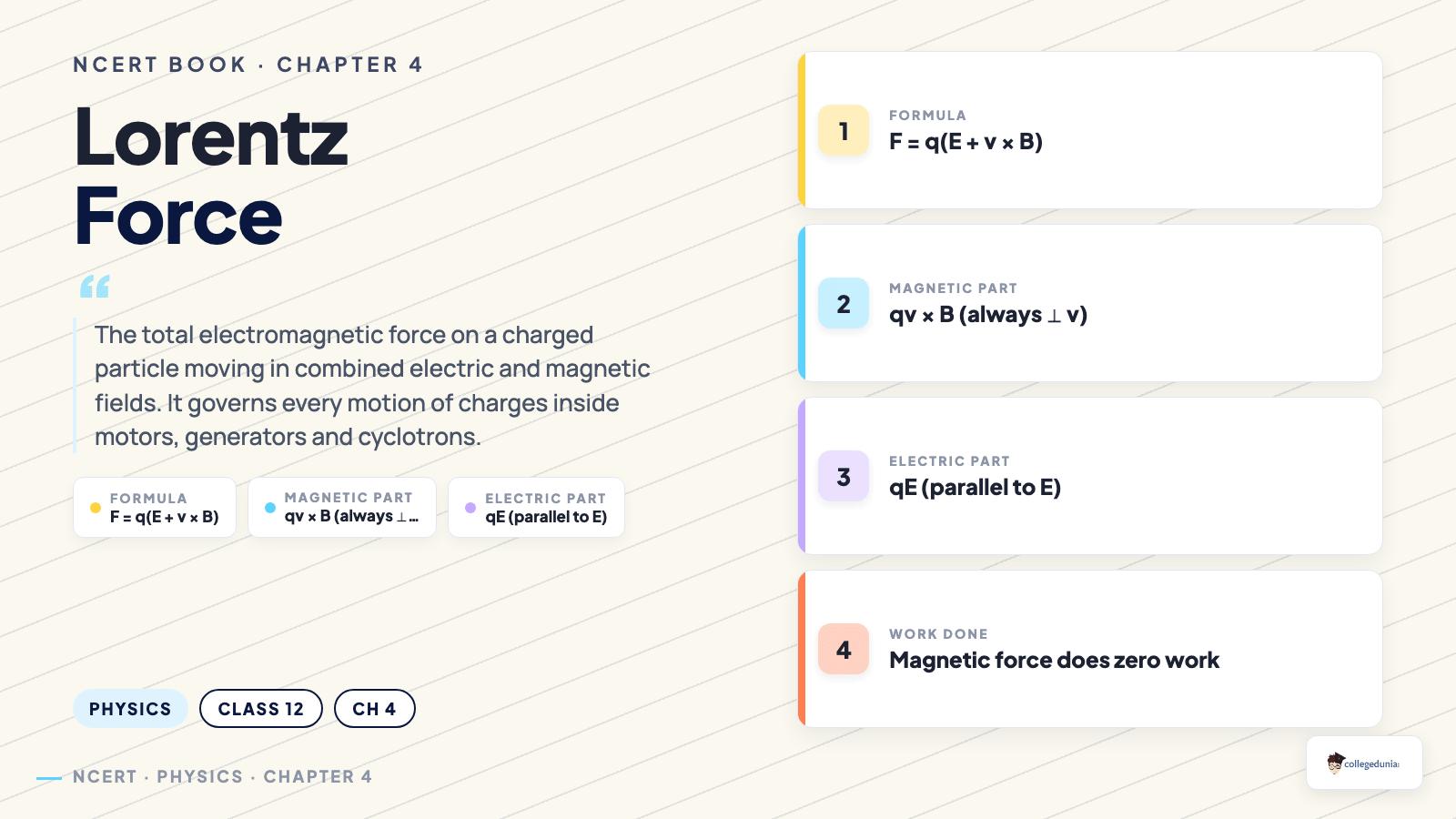
| 4.2 | Magnetic Force | 133 to 137 | Lorentz force F = qE + v × B , force on a current element F = IL × B |
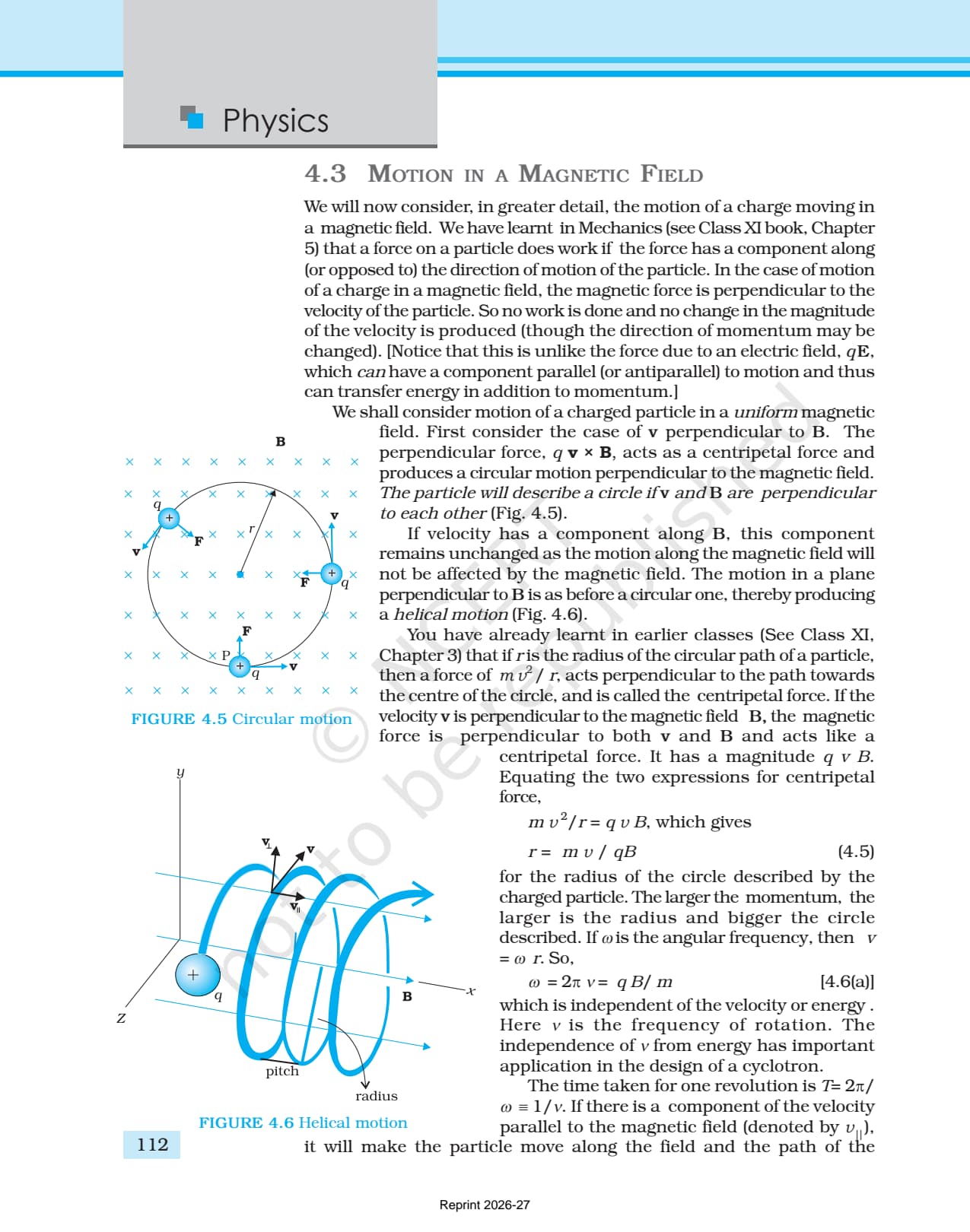
| 4.3 | Motion in a Magnetic Field | 137 to 141 | Circular and helical motion, cyclotron principle |
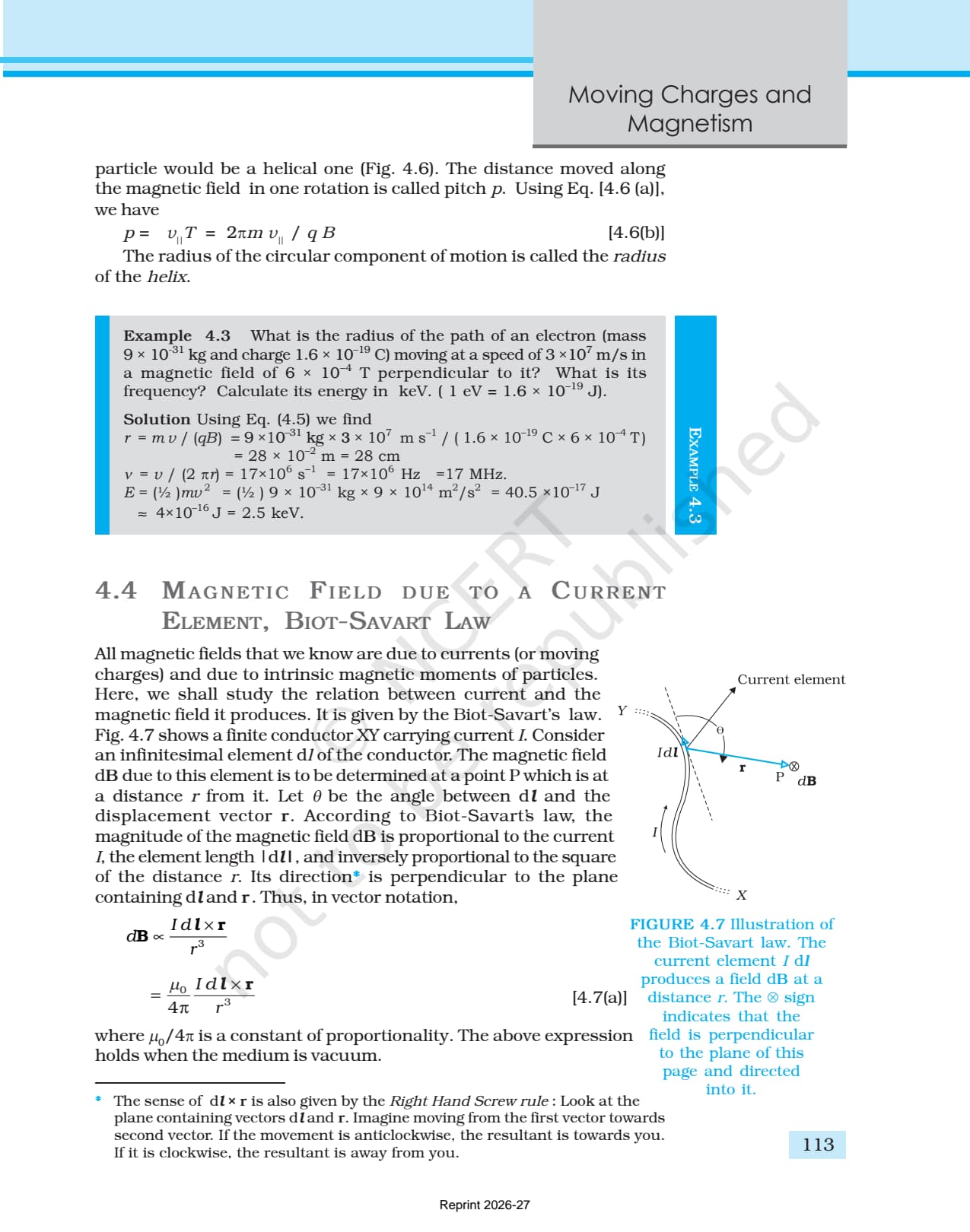
| 4.4 | Magnetic Field due to a Current Element, Biot-Savart Law | 141 to 145 | dB = 0/4π · I dL × r̂ / r2 , straight-wire field |
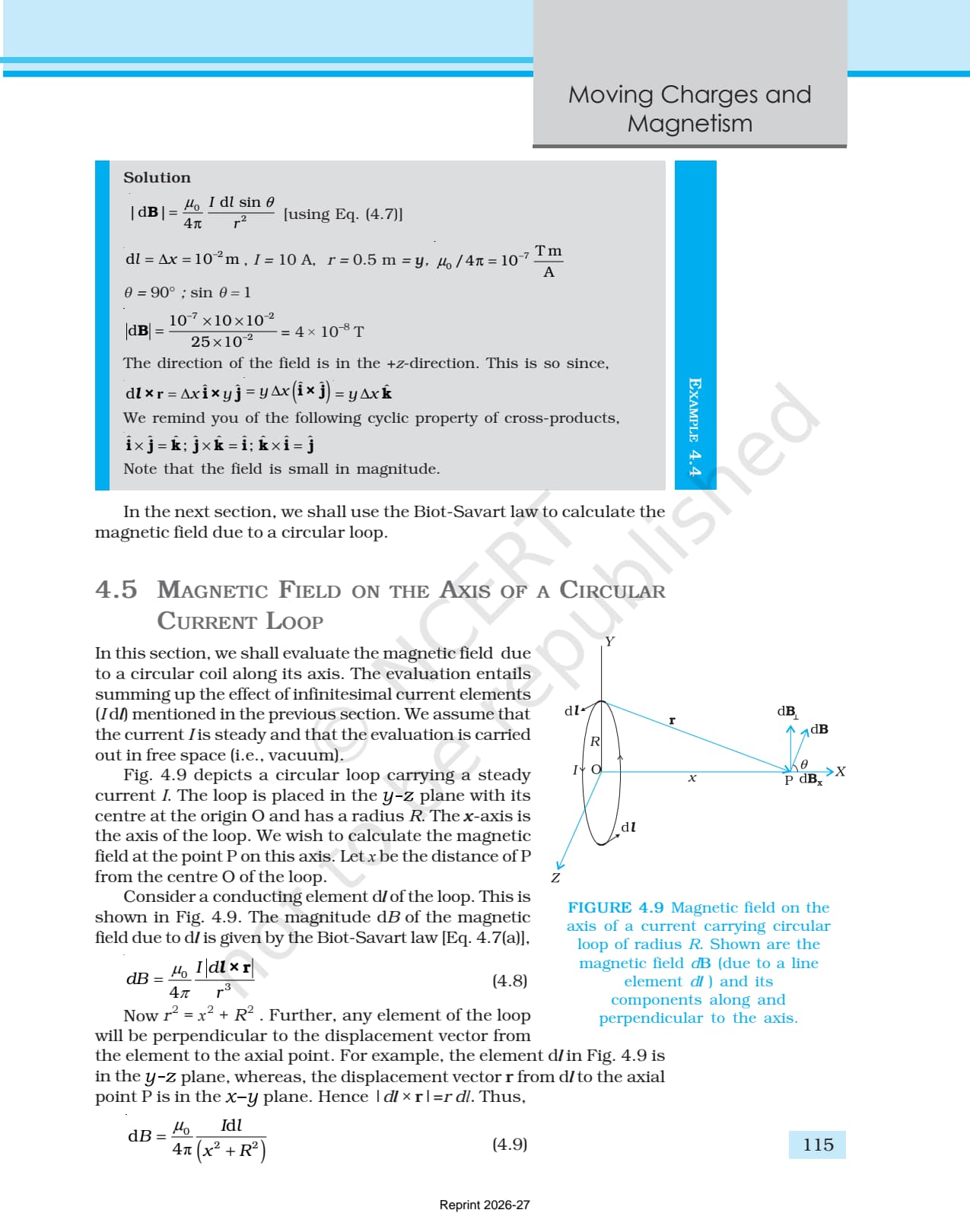
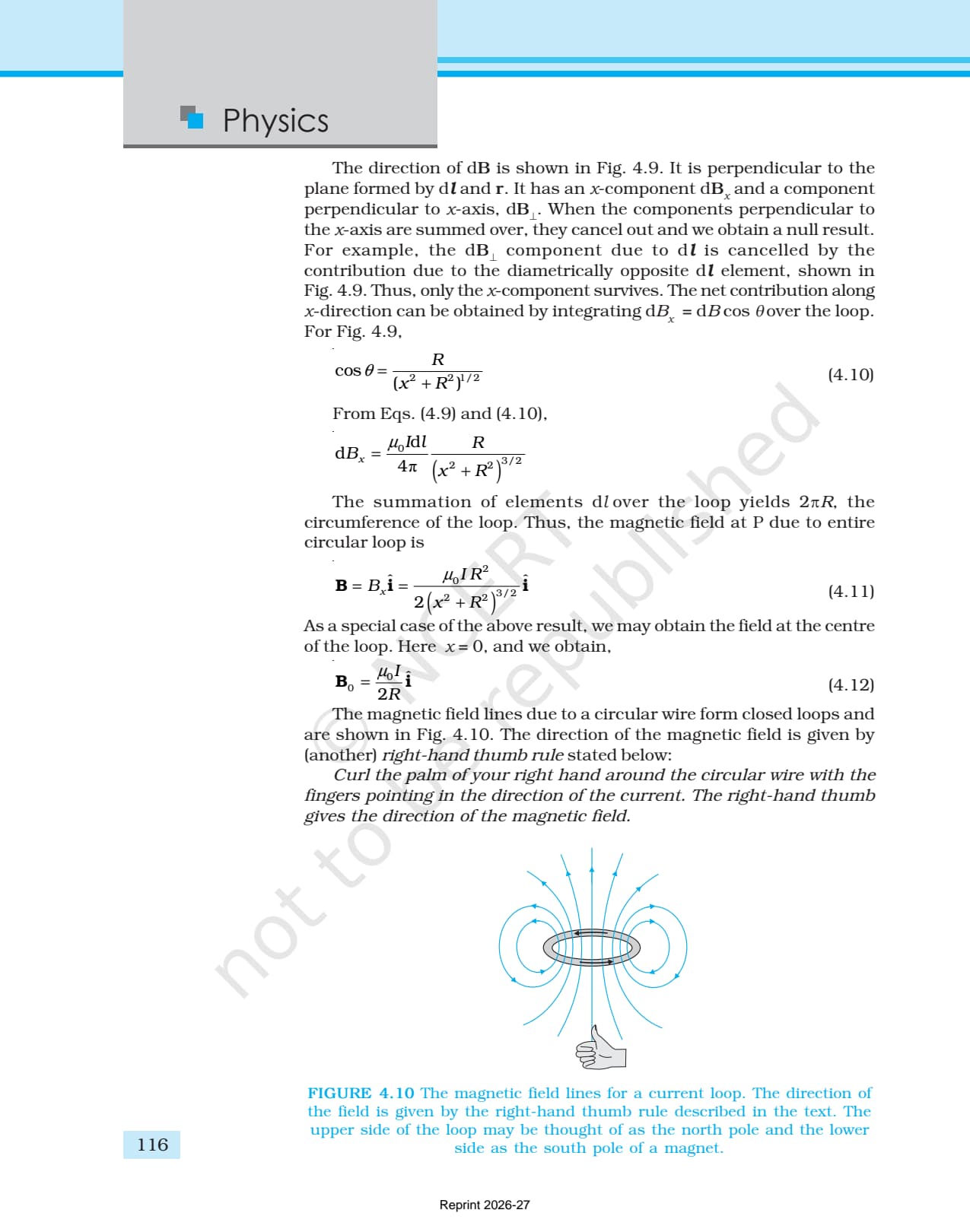
| 4.5 | Magnetic Field on the Axis of a Circular Current Loop | 145 to 148 | B = 0 I R2 / 2(R2 + x2)3/2 ; at centre B = 0 I / 2R |
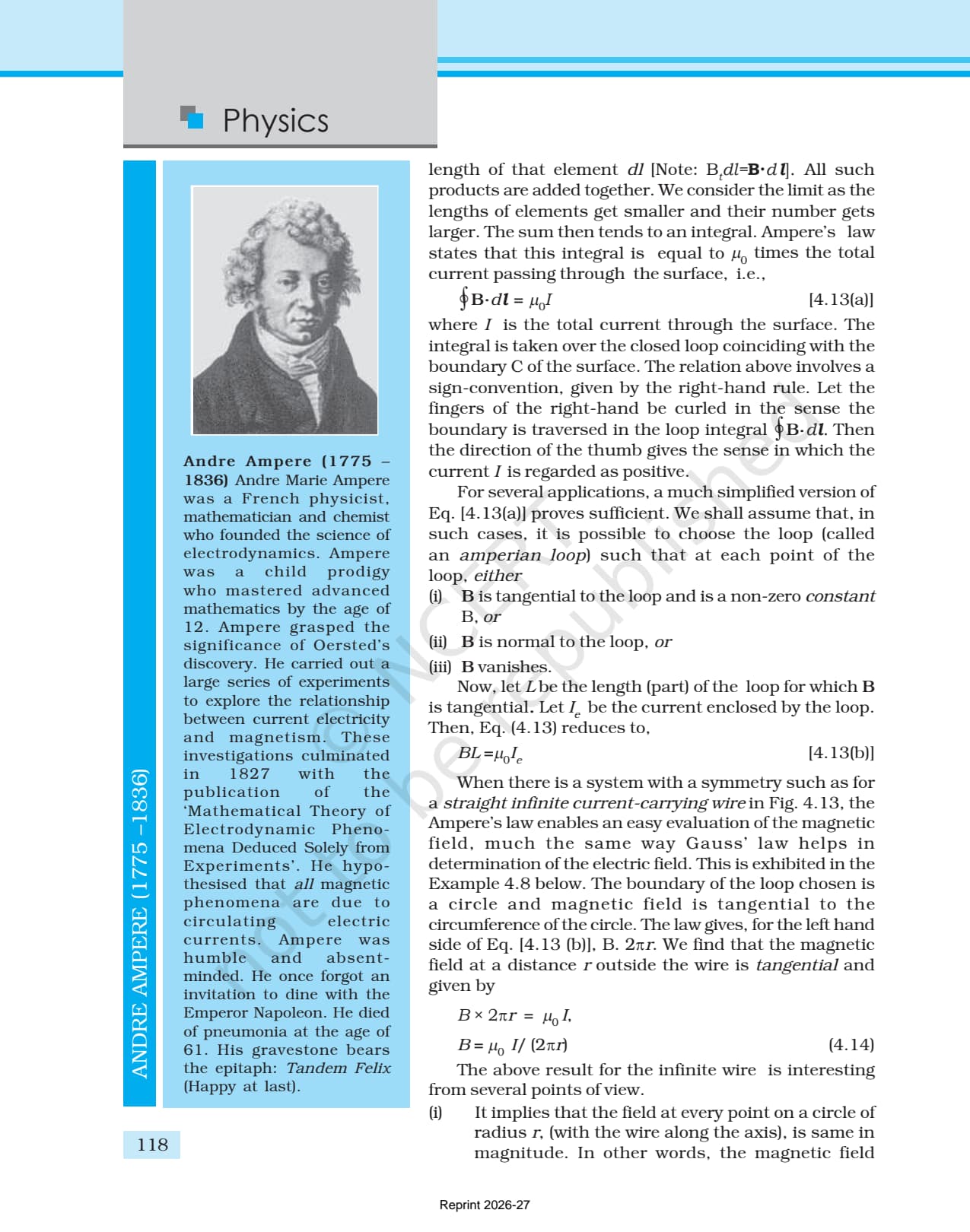
| 4.6 | Ampere's Circuital Law | 148 to 152 | ∮ B · dL = 0 Ienc , application to straight wire |
| 4.7 | The Solenoid | 152 to 155 | Ideal solenoid field B = 0 n I , toroid as bent solenoid |
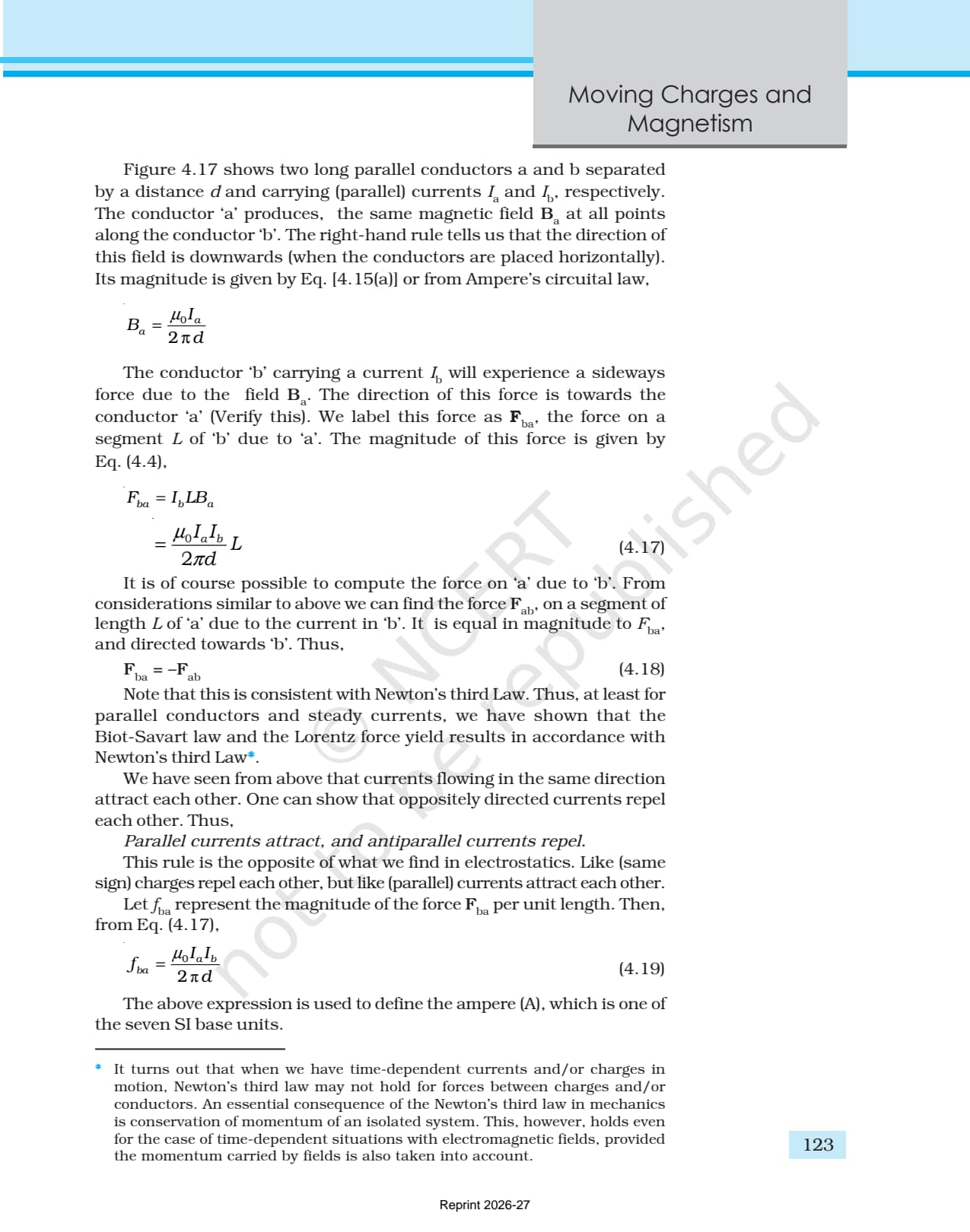
| 4.8 | Force Between Two Parallel Currents, the Ampere | 155 to 158 | F/L = 0 I1 I2 / 2π d , SI definition of the ampere |
| 4.9 | Torque on Current Loop, Magnetic Dipole | 158 to 162 | τ = m × B , m = NIA , potential energy U = -m · B |
| 4.10 | The Moving Coil Galvanometer | 162 to 166 | φ = NABI/k , current and voltage sensitivity, ammeter or voltmeter conversion |
Sections 4.4, 4.6, and 4.9 appear in almost every CBSE 5-marker. Sections 4.3 and 4.10 typically show up as 3-mark numericals.
Moving Charges and Magnetism Intext Example Inventory
Solve these 12 examples before the Exercise set. They match recurring CBSE question patterns closely.
| Example | Sub-topic | What it Covers |
|---|---|---|
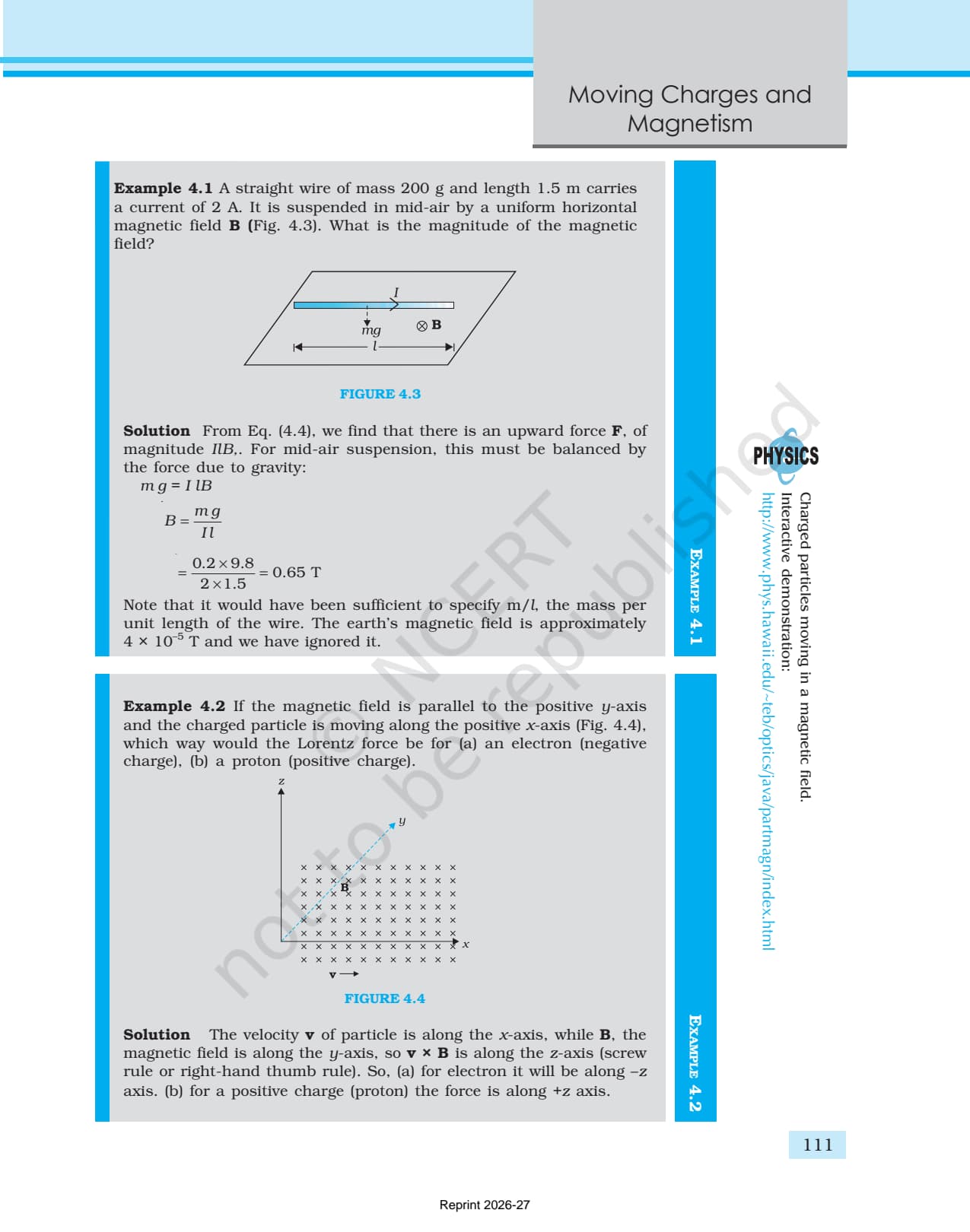
| 4.1 | Lorentz force direction | Vector cross product, right-hand rule |
| 4.2 | Cyclotron radius and frequency | Substitution in r = mv/qB , f = qB/2π m |
| 4.3 | Helical motion pitch | Velocity decomposition parallel and perpendicular to B |
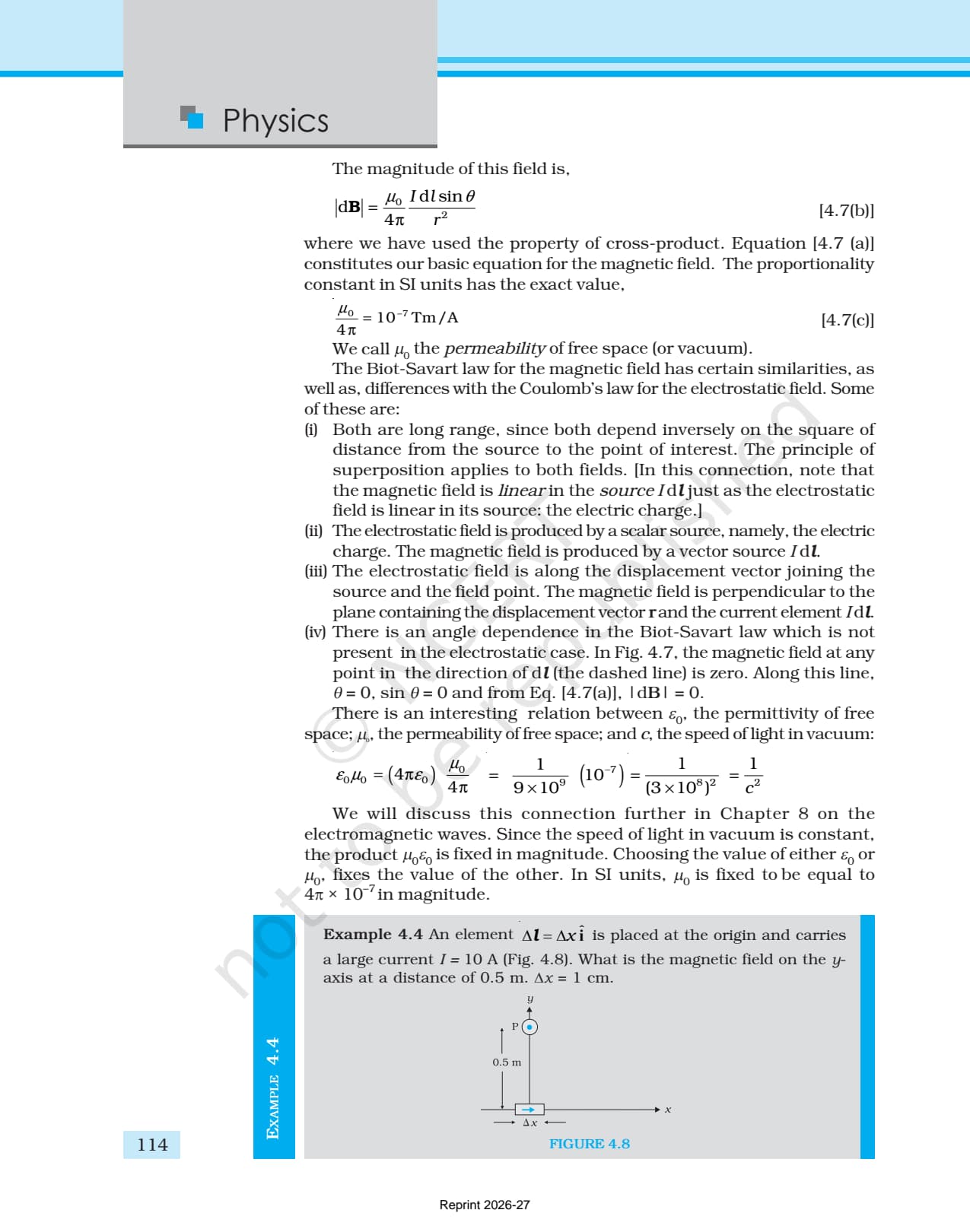
| 4.4 | Biot-Savart for a finite straight wire | Integration with angular limits |
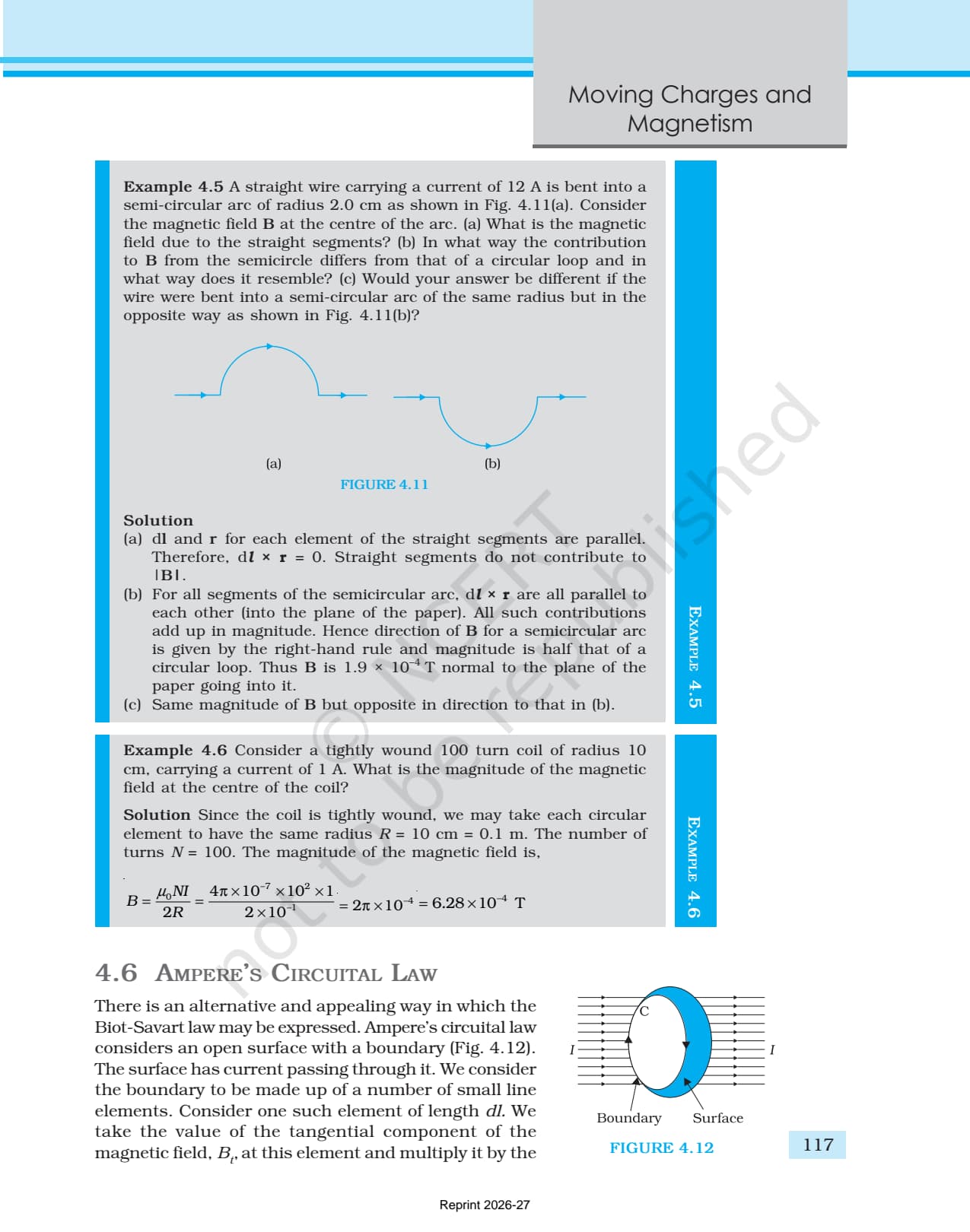
| 4.5 | Field at centre of a circular loop | Direct application of B = 0 I / 2R |
| 4.6 | Field on the axis of a loop | Substitution at given x along the axis |
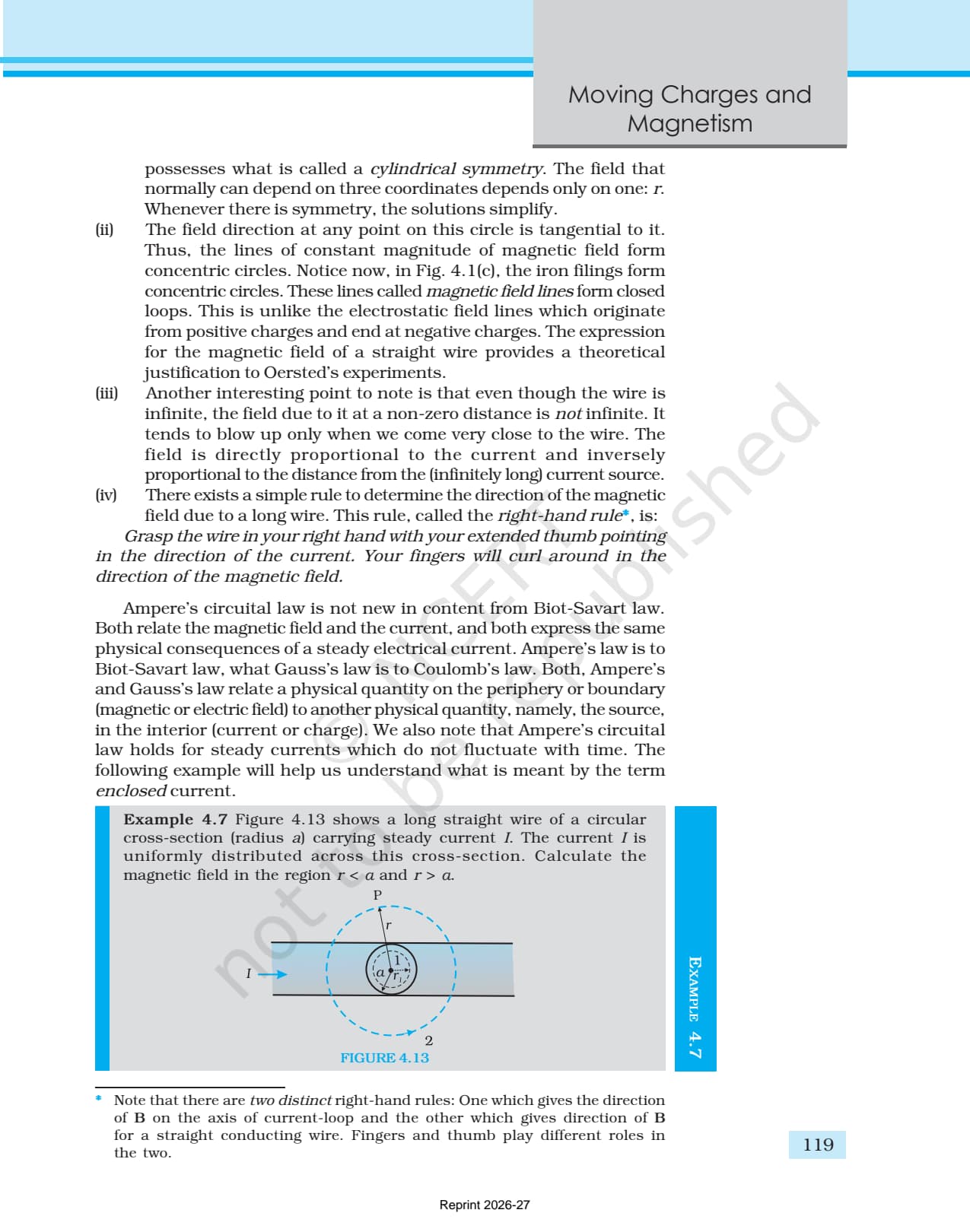
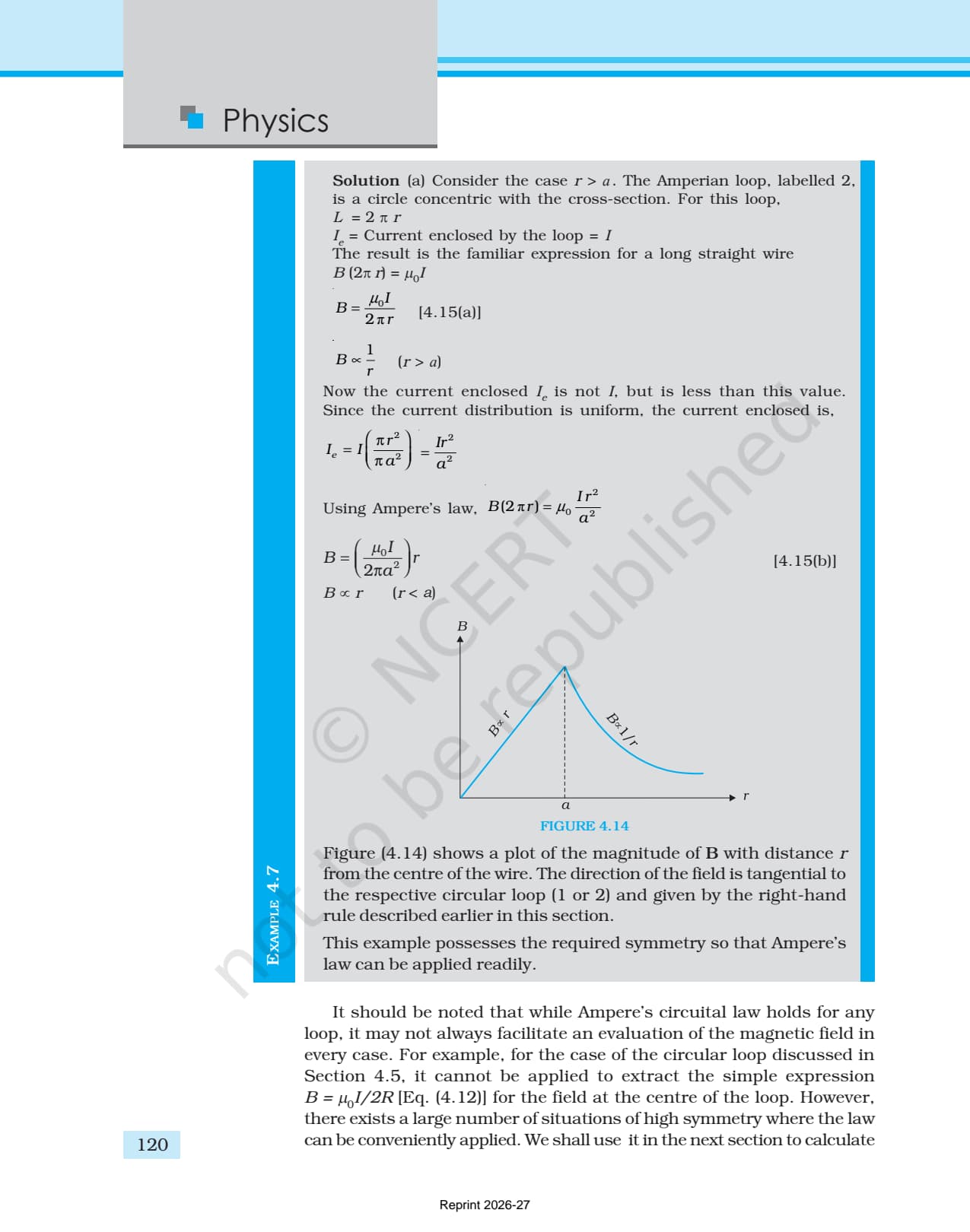
| 4.7 | Ampere's law for a long straight wire | Choice of Amperian loop, symmetry argument |
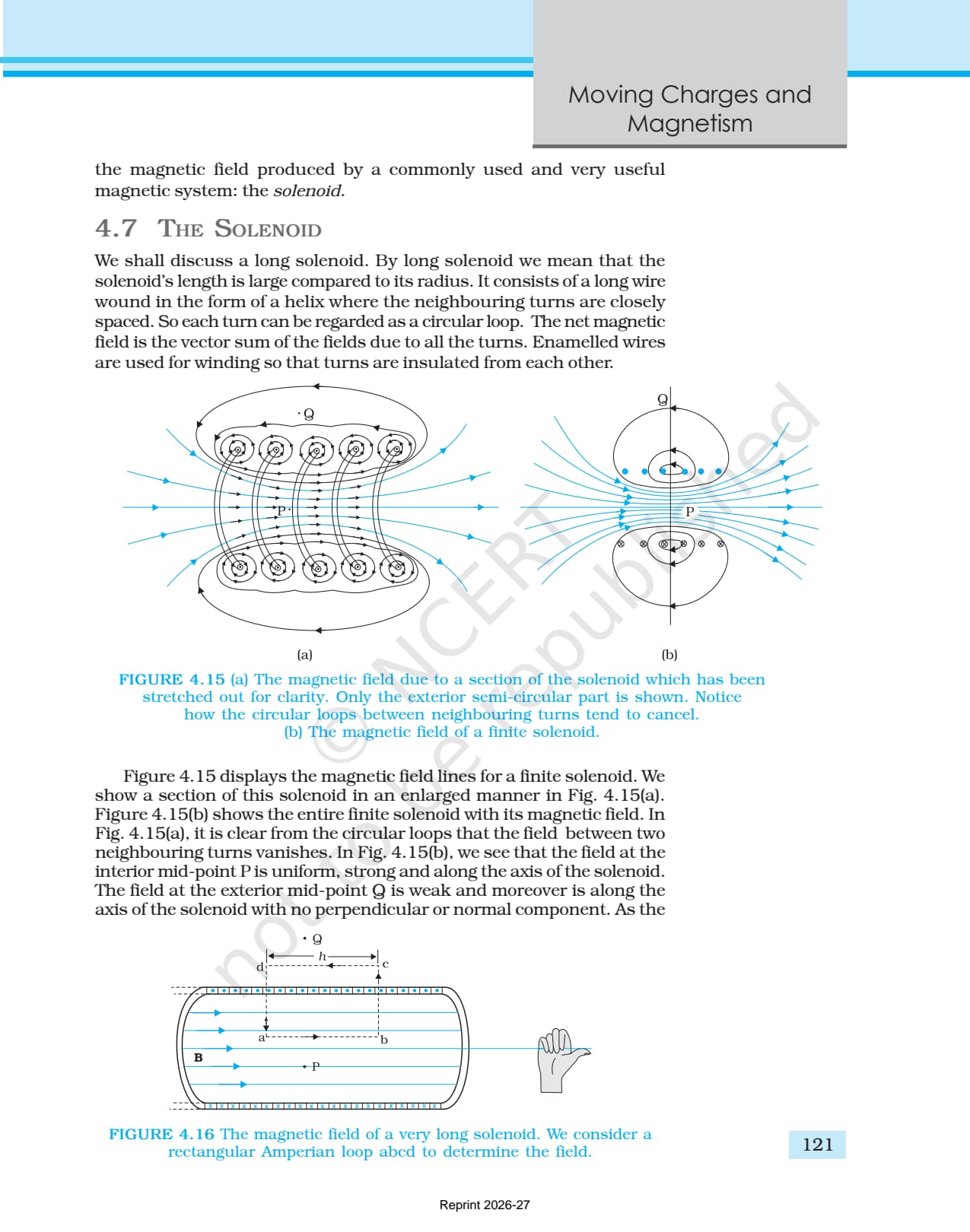
| 4.8 | Field inside a solenoid | Counting turns enclosed by the Amperian rectangle |
| 4.9 | Force between parallel currents | Sign of force, attraction versus repulsion |
| 4.10 | Torque on a rectangular loop | τ = NIAB sinθ with the correct angle |
| 4.11 | Galvanometer to ammeter conversion | Shunt resistance calculation |
| 4.12 | Galvanometer to voltmeter conversion | Series resistance calculation |
How to Study the Moving Charges and Magnetism NCERT PDF
The 42-page chapter rewards a three-pass reading rather than a single linear read.
- Pass 1 - Skim (30 min): Read headings, boxed definitions, and figure captions only. Build a mental map.
- Pass 2 - Derivations (90 min): Redo sections 4.4, 4.5, 4.6, and 4.9 with pen and paper.
- Pass 3 - Examples (60 min): Solve all 12 intext Examples without looking at solutions, then verify.
- Pass 4 - Exercises (2-3 hours): Attempt all 28 Exercise problems in two sittings. The last six are JEE-style.
A focused three-pass reading takes 4-5 hours - enough to score 6 of the 7 CBSE marks.
Multi-Day Study Plan for Moving Charges and Magnetism Chapter 4
If you have three study days, use this split.
| Day | NCERT Sections | Outcome | Time |
|---|---|---|---|
| Day 1 | 4.1, 4.2, 4.3 plus Examples 4.1 to 4.3 | Lorentz force, cyclotron, helical motion locked in | 2.5 hours |
| Day 2 | 4.4, 4.5, 4.6, 4.7 plus Examples 4.4 to 4.8 | Biot-Savart, loop field, Ampere's law and solenoid derived | 3 hours |
| Day 3 | 4.8, 4.9, 4.10 plus Examples 4.9 to 4.12 and Exercise 4.1 to 4.28 | Force between wires, torque, galvanometer, full exercise set | 3 hours |
Student Feedback
Many students find section 4.10 (moving coil galvanometer) hardest in numericals. Keep the shunt and series resistance formulas handy during practice. Working through all 12 intext Examples before the Exercise set makes a clear difference in scores.
Cross-Chapter Links: Chapter 4, 5 and 6 as a Cluster
Chapters 4, 5, and 6 form a tight magnetism cluster. Reading them in order cuts revision time because the dipole moment and field concepts carry across all three chapters.
| Concept from Ch 4 | Used in Ch 5 Magnetism and Matter | Used in Ch 6 Electromagnetic Induction |
|---|---|---|
| Field B from a current (Biot-Savart, Ampere) | Compared with bar-magnet field to define equivalent dipole moment | The B linking a coil sets the flux Φ = ∫ B · dA |
| Magnetic dipole moment m = NIA | Extended to atomic moments and the Bohr magneton | Rotating loop in B produces induced emf (generator) |
| Solenoid field B = 0 n I | Solenoid treated as equivalent bar magnet, defines magnetisation M | Self-inductance L = 0 n2 A l |
| Torque τ = m × B on a loop | Torque on a bar magnet, energy U = -m · B | Same torque opposes motion in a generator (Lenz's law) |
| Force F = qv × B on a moving charge | Microscopic origin of diamagnetism and paramagnetism | Motional emf ε = Blv derived from this force |
Most Recurring PYQ Topics from Moving Charges and Magnetism Chapter 4
Three question types repeat almost every year across CBSE, JEE Main, and NEET.
- Biot-Savart or Ampere's law derivation for a solenoid: CBSE 2025 5-marker, JEE Main 2025 numerical, CBSE 2022 3-marker.
- Cyclotron principle, frequency and radius: JEE Main 2024, NEET 2024, CBSE 2023 3-marker.
- Torque on a current loop and dipole moment: CBSE 2023, CBSE 2022, NEET 2023.
Full year-wise PYQ map: Moving Charges and Magnetism NCERT Solutions
Other Resources for Moving Charges and Magnetism Class 12 Physics
| Resource | Chapter 4 Moving Charges and Magnetism |
|---|---|
| NCERT Book PDF | Moving Charges and Magnetism NCERT Book PDF |
| NCERT Solutions | Moving Charges and Magnetism Solutions |
| NCERT Notes | Moving Charges and Magnetism Notes |
| Formula Sheet | Moving Charges and Magnetism Formula Sheet |
NCERT Book PDF for Class 12 Physics: All Chapters
Other Class 12 Physics NCERT Book PDFs you can get as free downloads:
| Chapter | Resource |
|---|---|
| Chapter 1 | Electric Charges and Fields NCERT PDF |
| Chapter 2 | Electrostatic Potential and Capacitance NCERT PDF |
| Chapter 3 | Current Electricity NCERT PDF |
| Chapter 4 | Moving Charges and Magnetism NCERT PDF |
| Chapter 5 | Magnetism and Matter NCERT PDF |
| Chapter 6 | Electromagnetic Induction NCERT PDF |
| Chapter 7 | Alternating Current NCERT PDF |
| Chapter 8 | Electromagnetic Waves NCERT PDF |
| Chapter 9 | Ray Optics and Optical Instruments NCERT PDF |
| Chapter 10 | Wave Optics NCERT PDF |
| Chapter 11 | Dual Nature of Radiation and Matter NCERT PDF |
| Chapter 12 | Atoms NCERT PDF |
| Chapter 13 | Nuclei NCERT PDF |
| Chapter 14 | Semiconductor Electronics NCERT PDF |
Moving Charges and Magnetism NCERT PDF - Frequently Asked Questions
Ques. Where can I download the Moving Charges and Magnetism NCERT PDF for free?
Ans. You can download the Moving Charges and Magnetism NCERT PDF directly from this page. The PDF is free and updated for the 2026-27 syllabus.
Ques. Is this Moving Charges and Magnetism NCERT PDF aligned with the 2026-27 CBSE syllabus?
Ans. Yes. This page reflects the current 2026-27 syllabus for Class 12 Physics. Sections 4.1 through 4.10 are retained in full, with the Biot-Savart, Ampere's law, solenoid, parallel-wire force, torque on a loop, and moving coil galvanometer derivations all intact.
Ques. How many pages is the Class 12 Physics Moving Charges and Magnetism NCERT Book PDF?
Ans. The chapter PDF runs approximately 42 pages and covers Lorentz force, motion in a magnetic field, Biot-Savart law, Ampere's circuital law, solenoid, torque on a current loop, and the moving coil galvanometer, with 12 intext Examples and 28 Exercise problems.
Ques. How should students read Chapter 4 for CBSE Class 12 boards?
Ans. Use a three-pass strategy: skim headings and figures first, redo the four major derivations (Biot-Savart, loop field, Ampere's law, torque) with pen and paper second, and solve the 12 intext Examples plus the 28 Exercise problems last. The full chapter takes 4-5 hours of focused work.
Ques. Which sections of Chapter 4 are most important for JEE Main and NEET?
Ans. Sections 4.3 (cyclotron), 4.4 (Biot-Savart), 4.6 (Ampere's law), and 4.9 (torque on a current loop) carry the heaviest weight. Together they account for the majority of JEE Main and NEET questions set on this chapter in the last five years.



Comments