




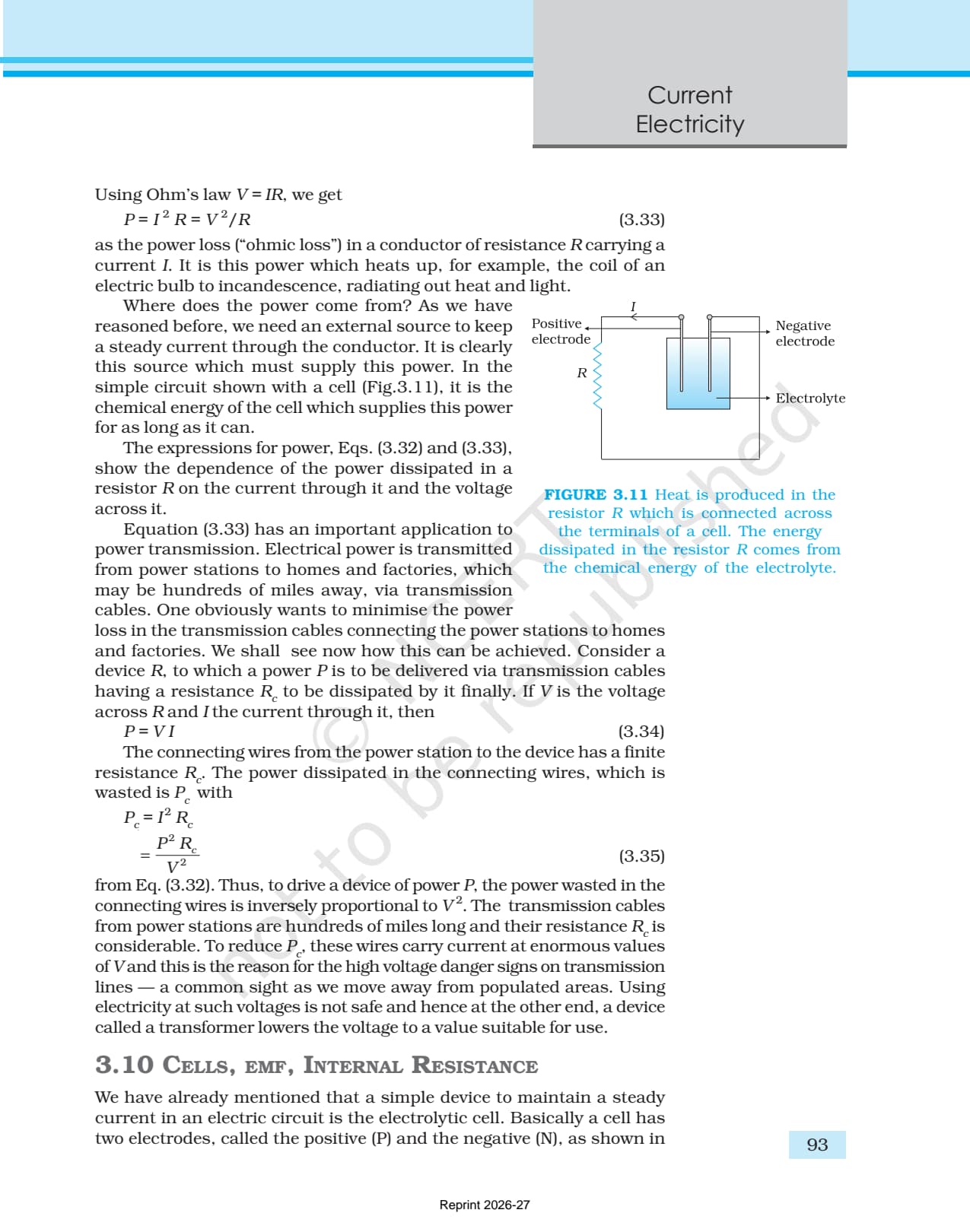
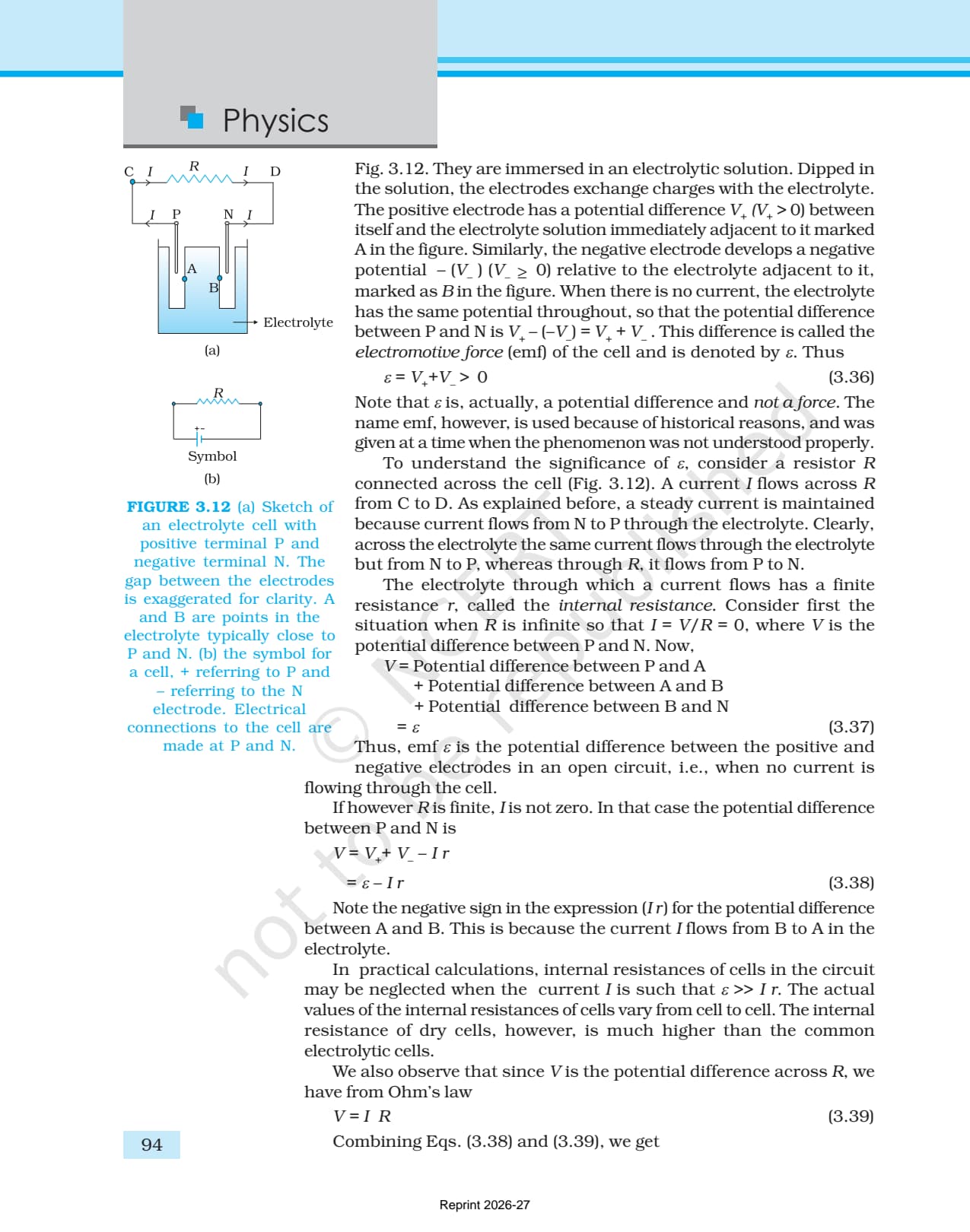
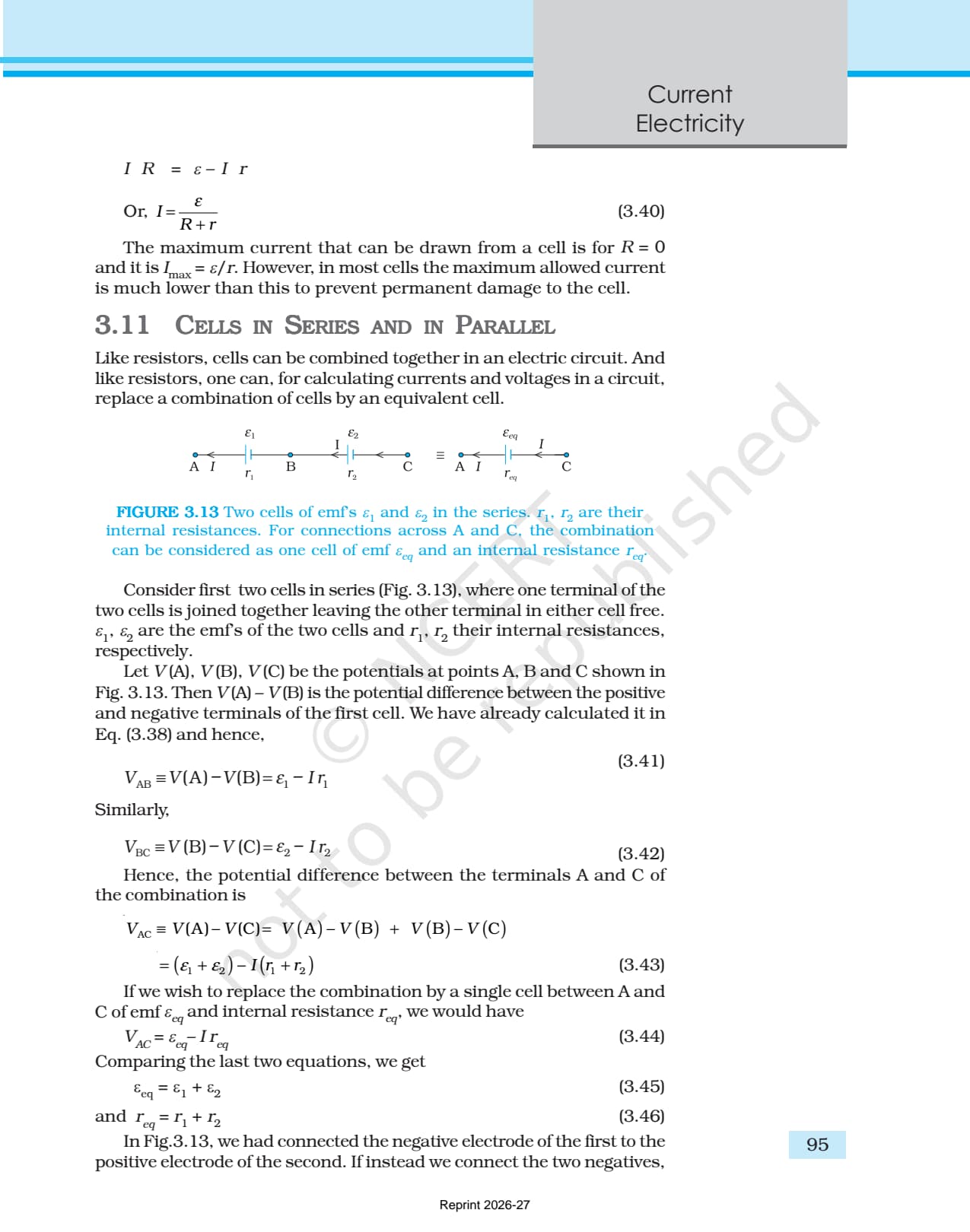
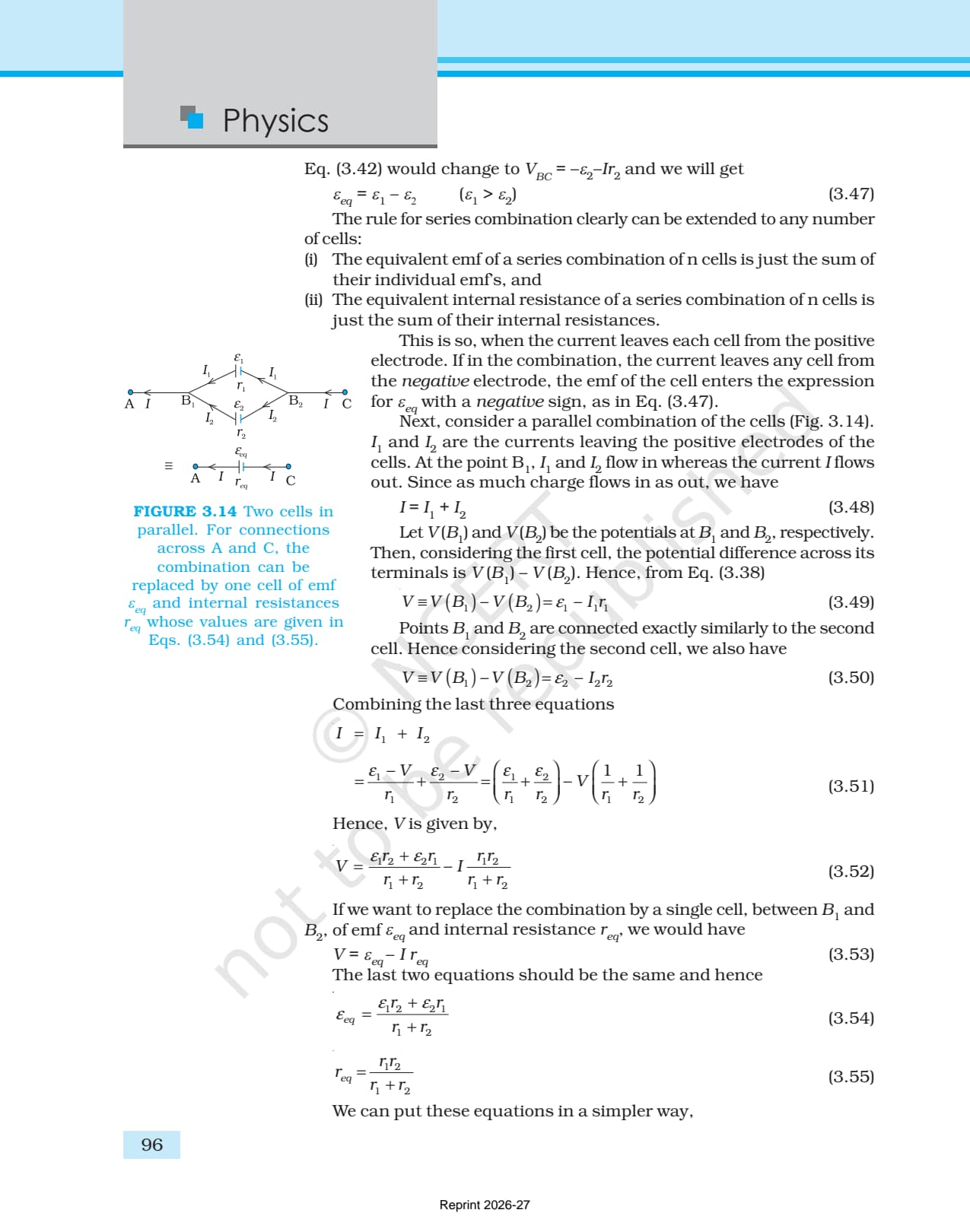
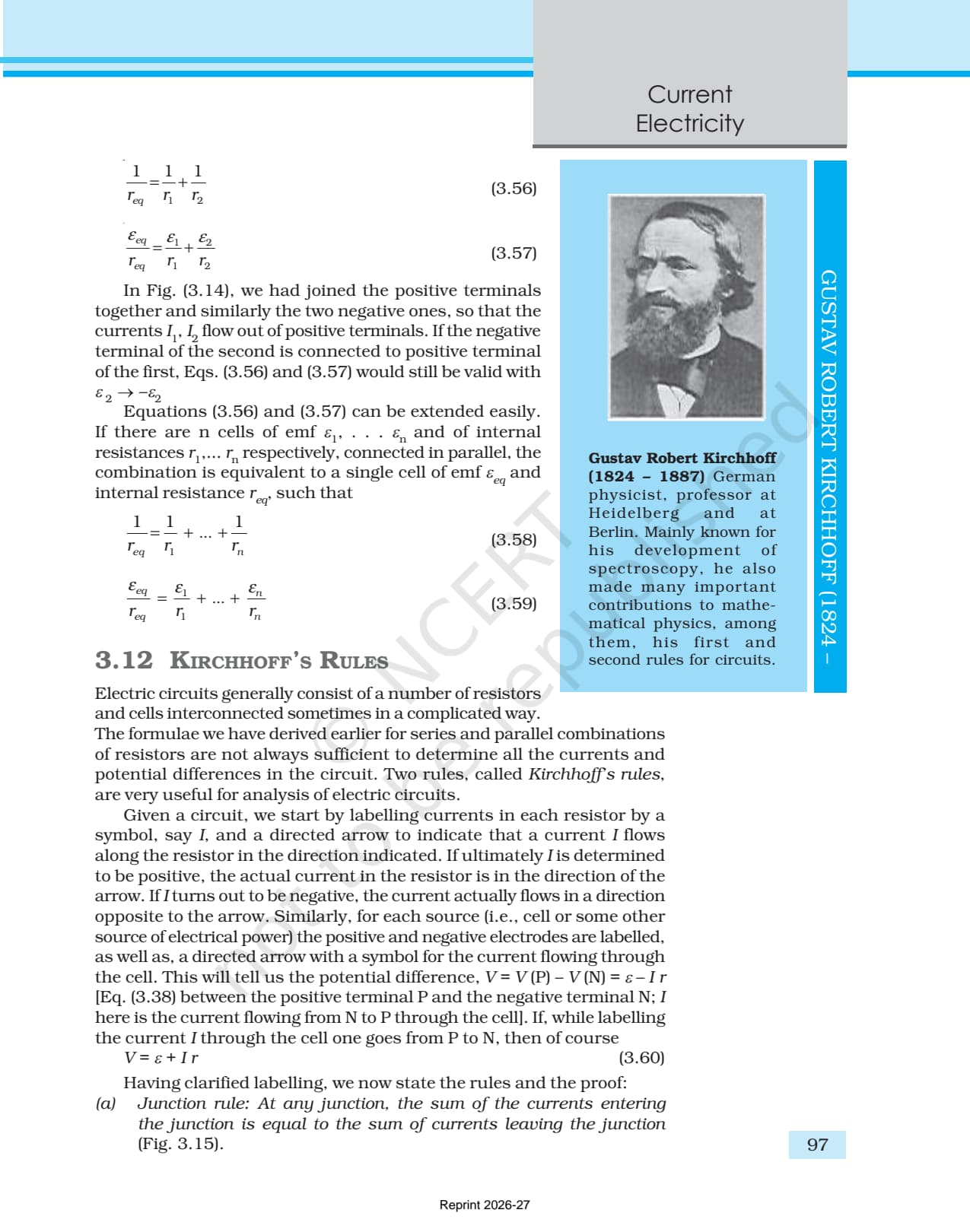
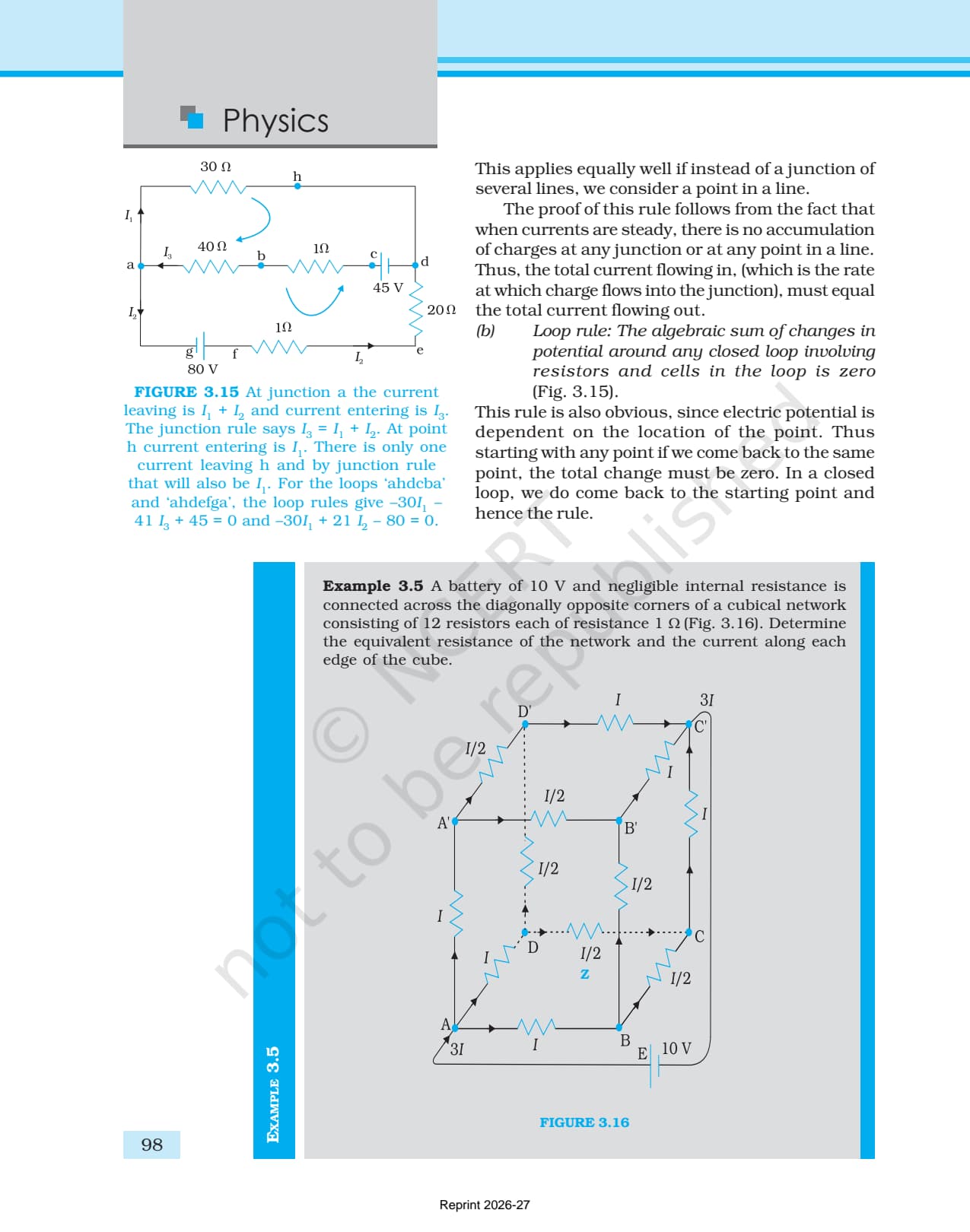
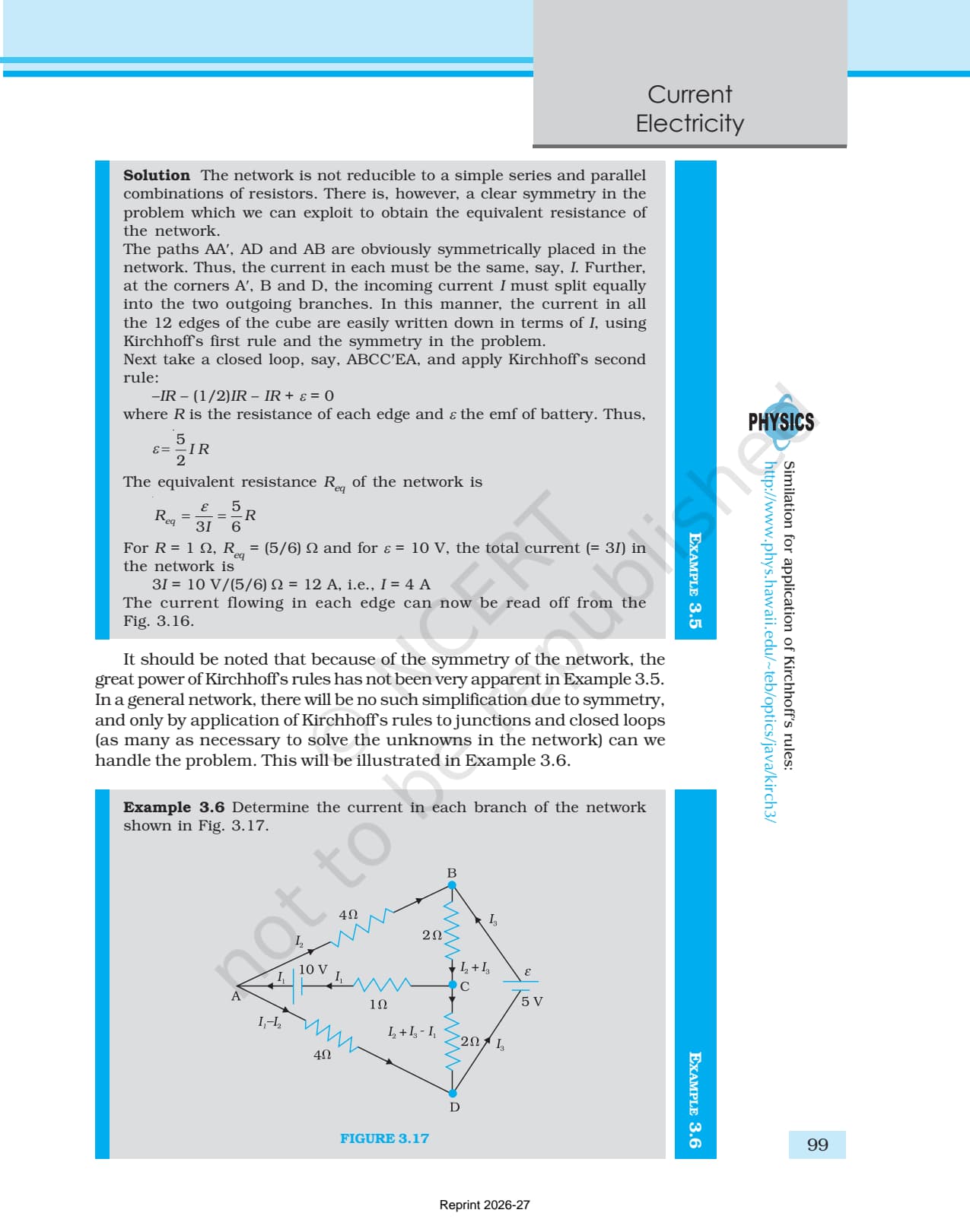
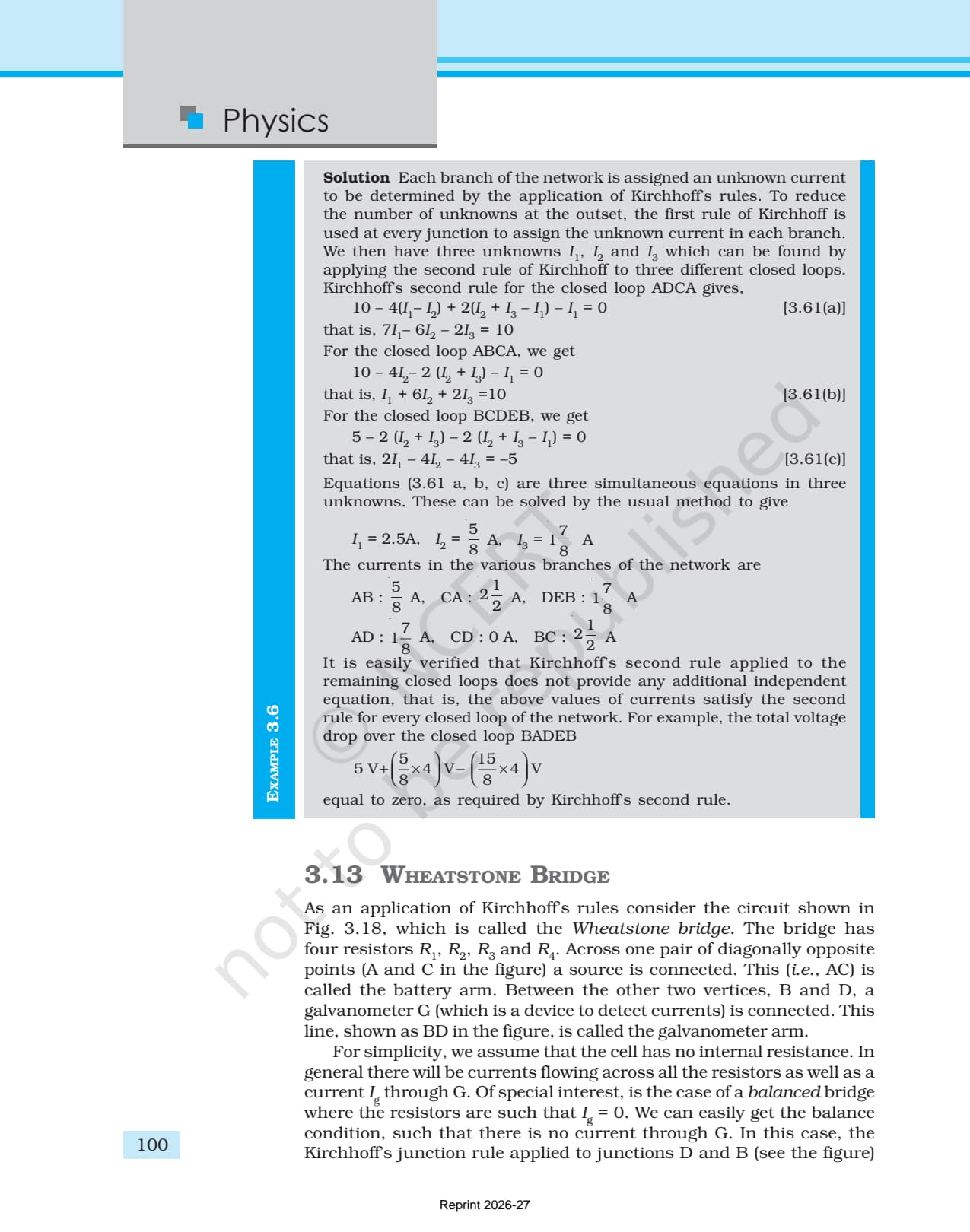
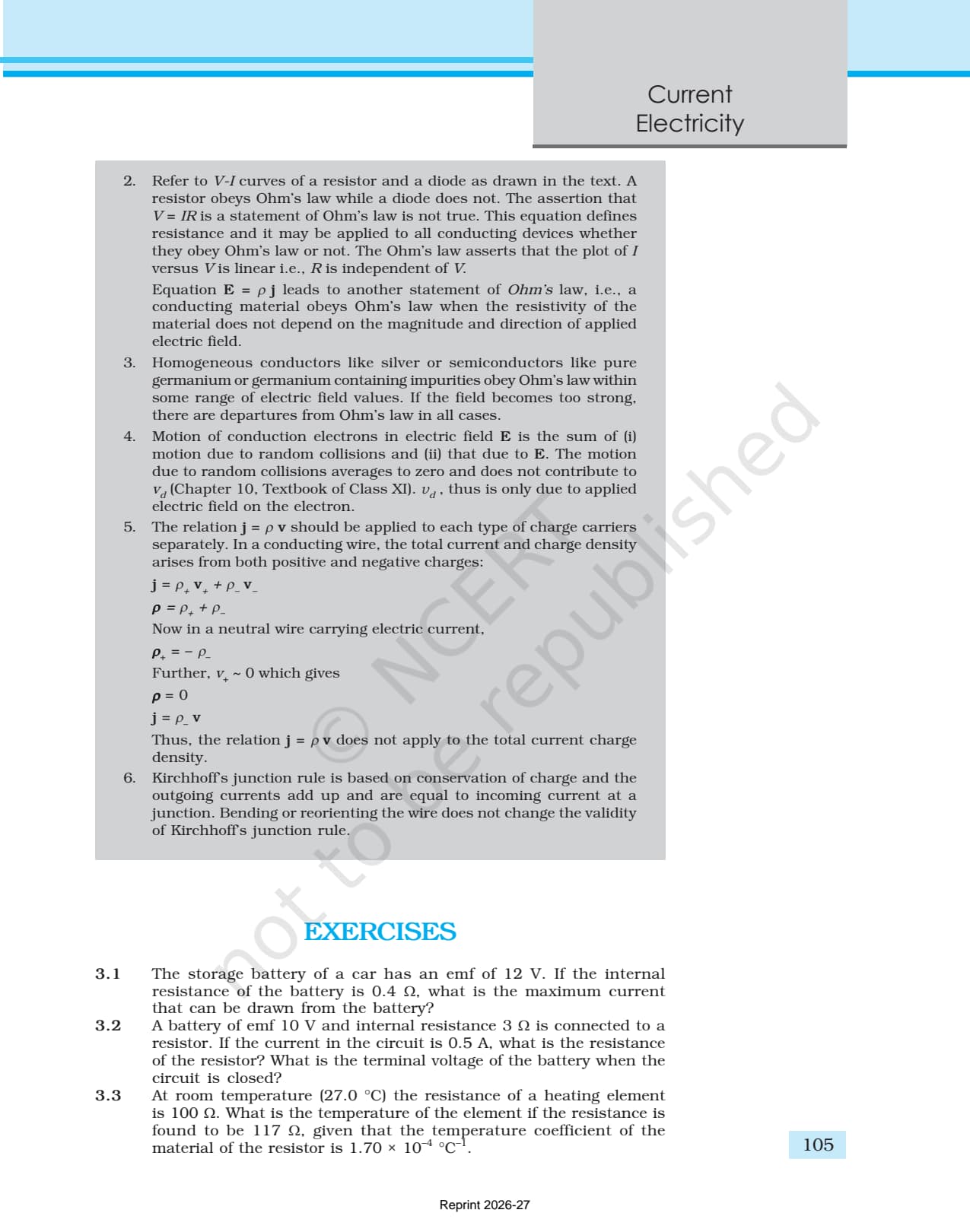
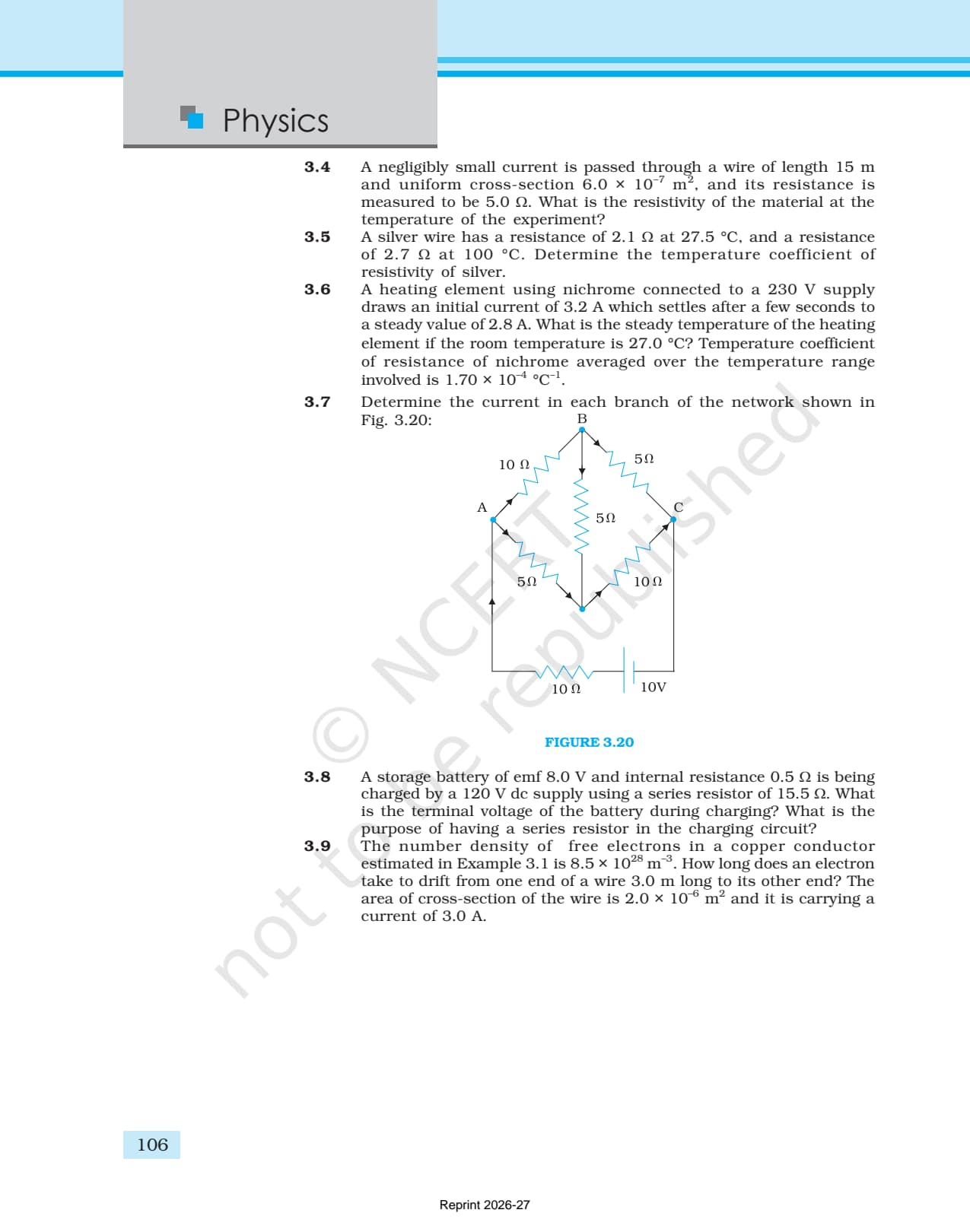
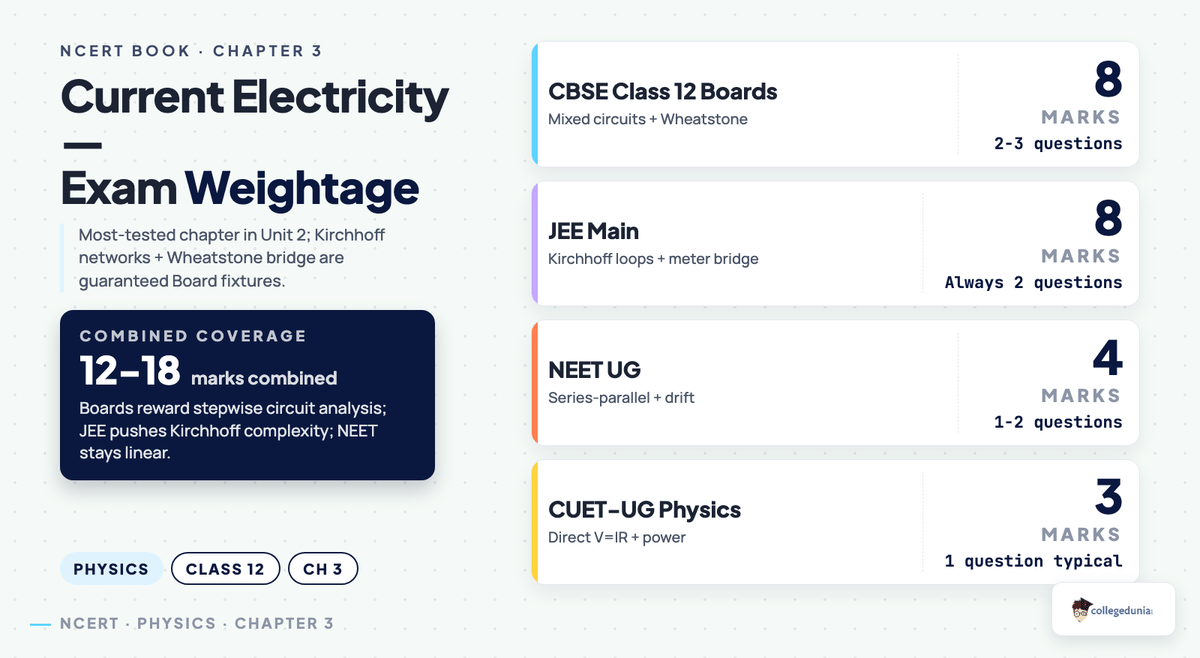
Class 12 Physics Chapter 3 Current Electricity covers Ohm's law, Kirchhoff's rules, Wheatstone bridge, and potentiometer across 38 pages with 7 solved examples and 23 exercises. The chapter carries 5 to 7 marks in CBSE Board and 2 to 3 questions in JEE Main and NEET every year. Download the full Current Electricity Class 12 NCERT PDF free from this page.
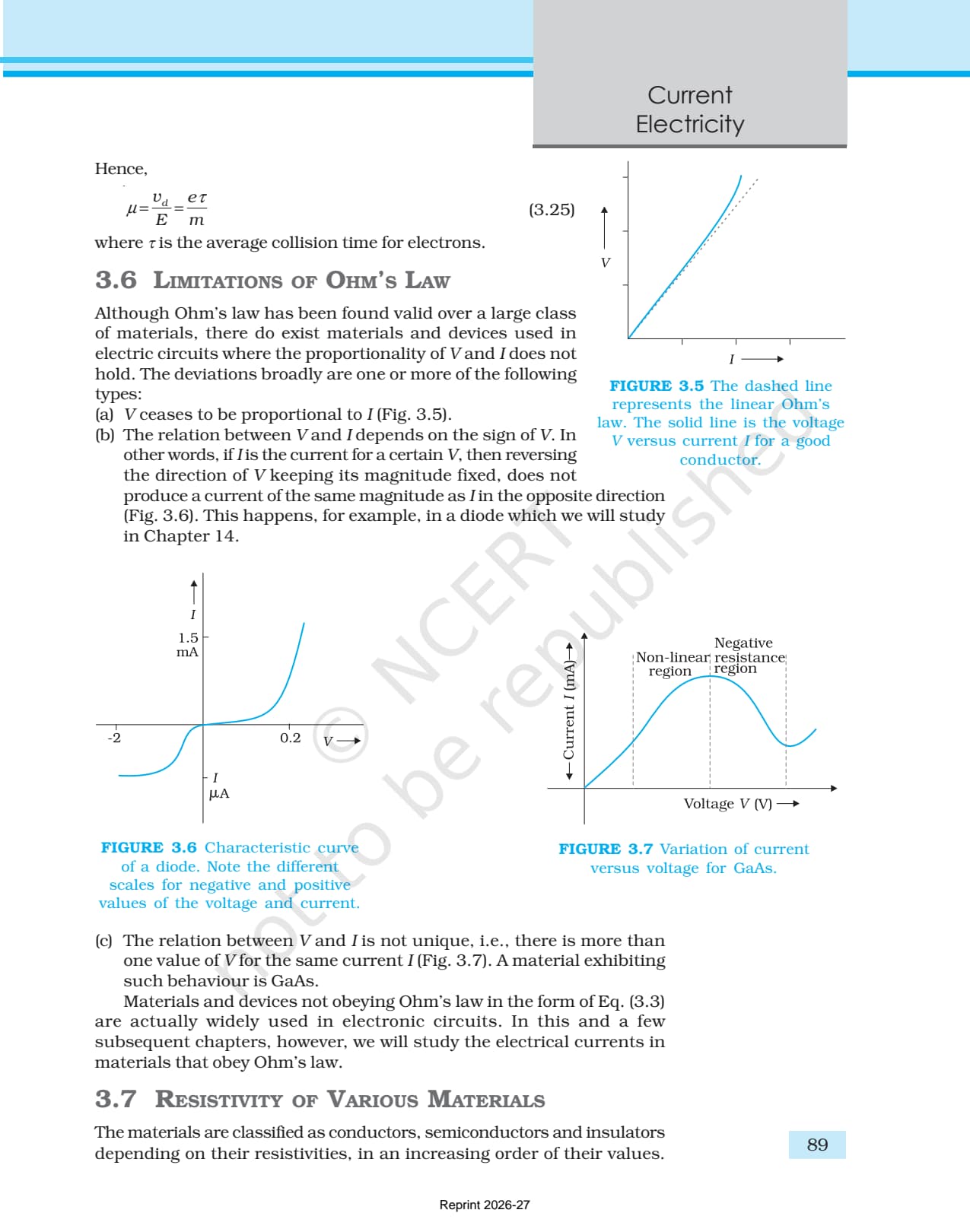
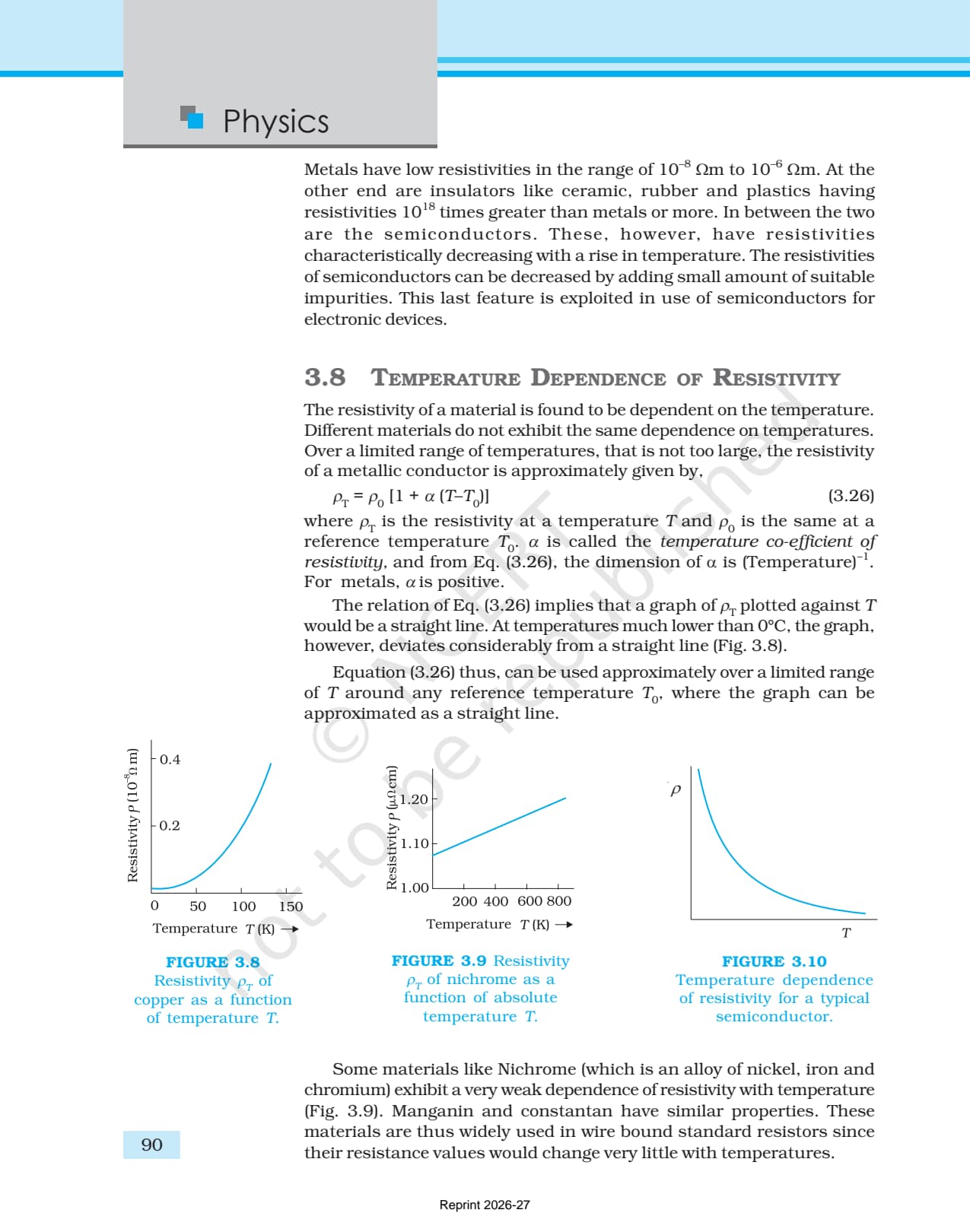
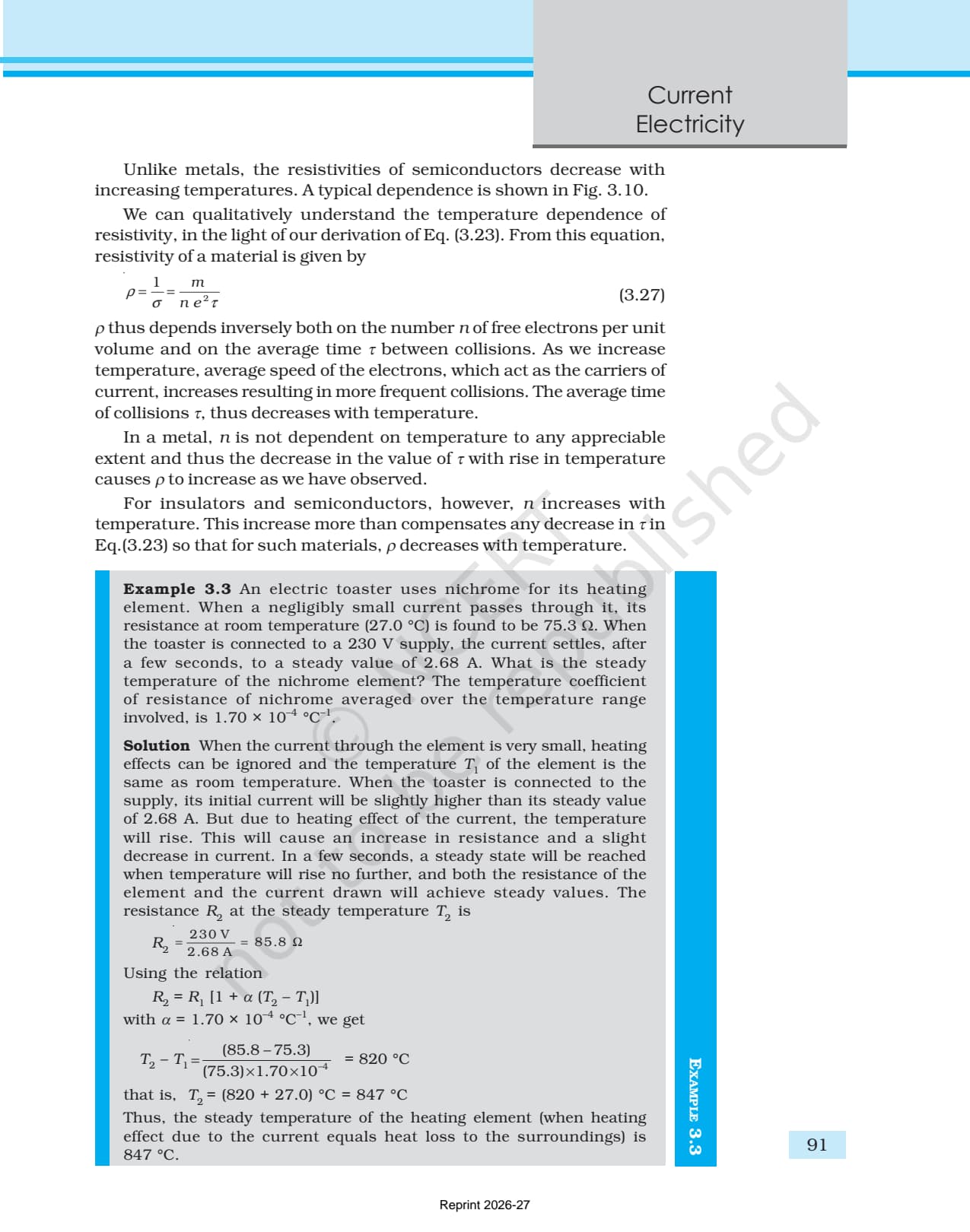
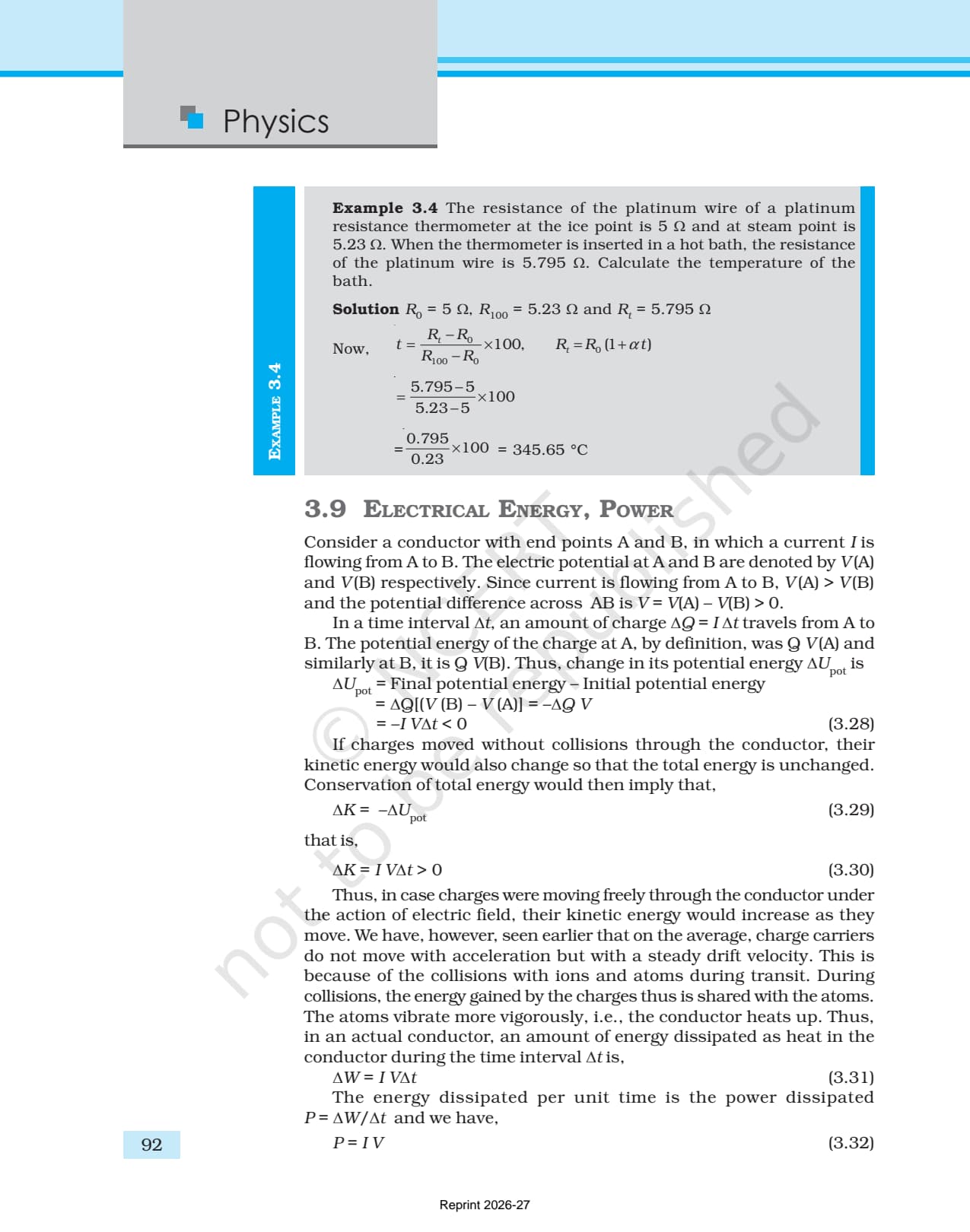
- CBSE Weightage: 5 to 7 marks (one short answer + one 5-mark numerical typical)
- JEE Main Weightage: 3 to 5% (2 to 3 questions per paper)
- NEET Weightage: 2 to 3 questions per year
How the Current Electricity Class 12 NCERT PDF on This Page Helps You
- 2026-27 NCERT Alignment: Every section and example number on this page matches the current print of NCERT Class 12 Physics Part I.
- Section-by-Section Page Map: Page ranges for every sub-topic so you can skim, deep-read, or skip-print exactly what you need.
- Reading Order Recommendation: A three-pass reading plan, not the front-to-back order printed in the book.
- What Changed in the New Edition: A clear note on what NCERT kept, trimmed, or moved compared to the older edition.
Current Electricity Video Lecture - Class 12 Physics Chapter 3
Source: NCERT Wallah on YouTube
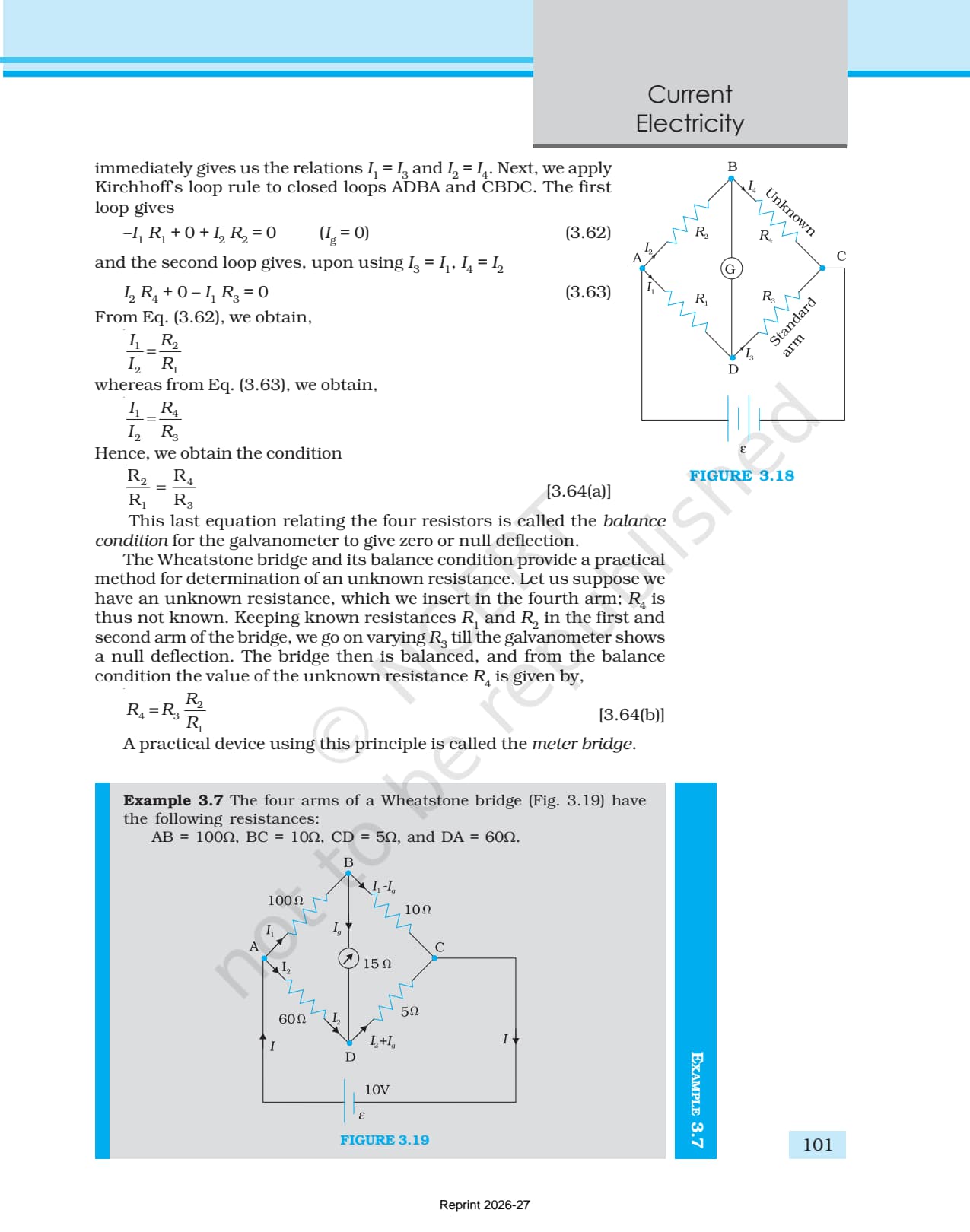
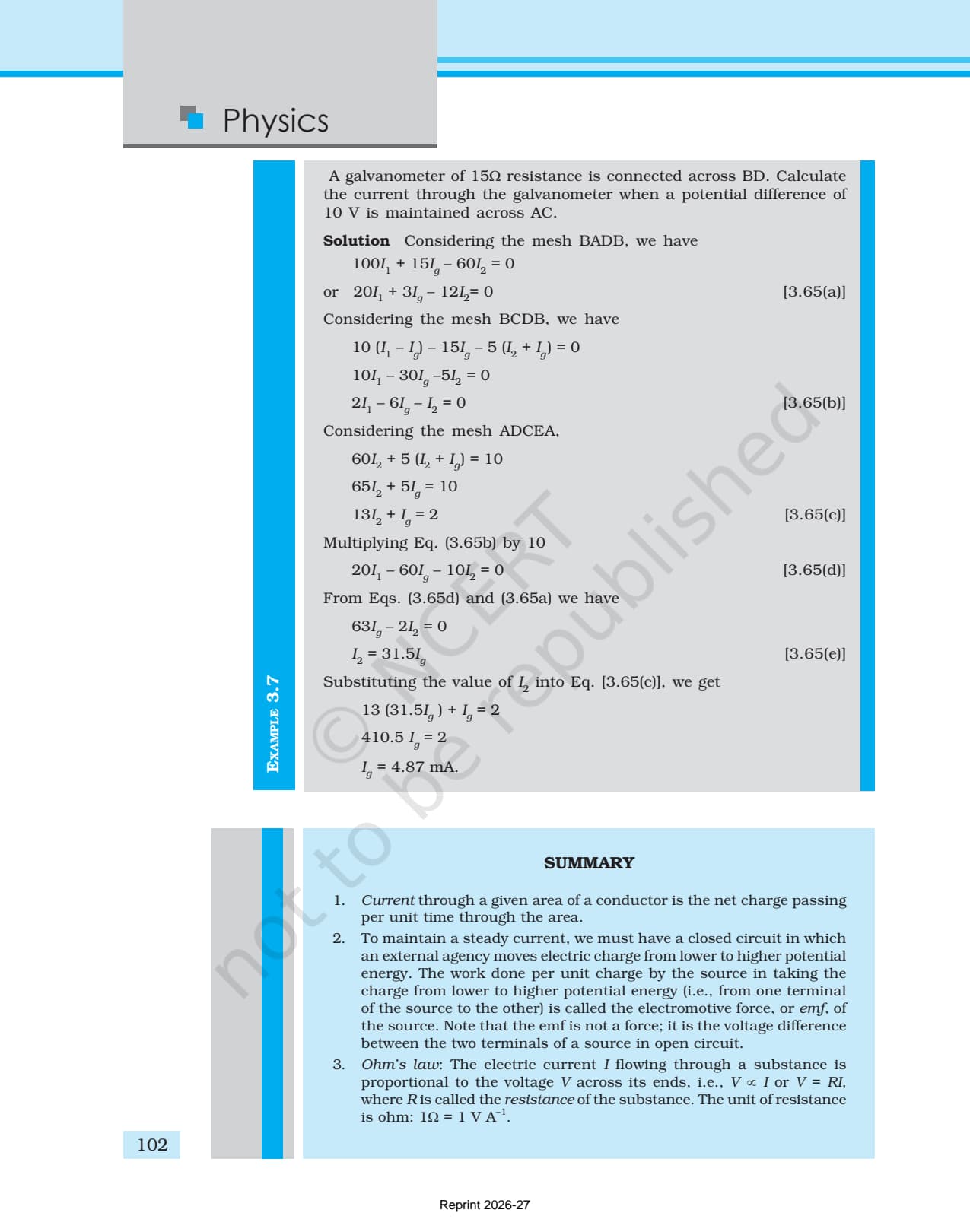
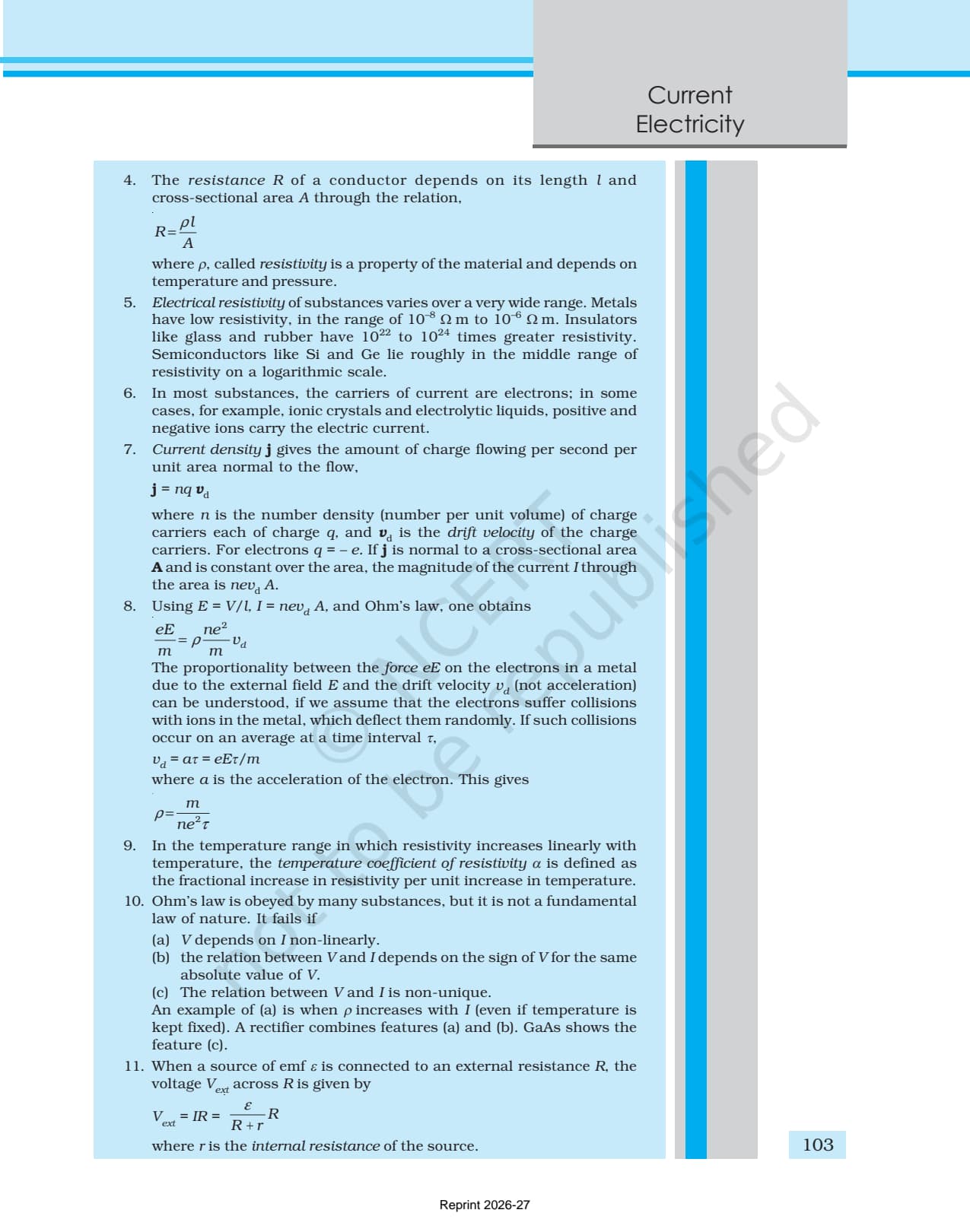
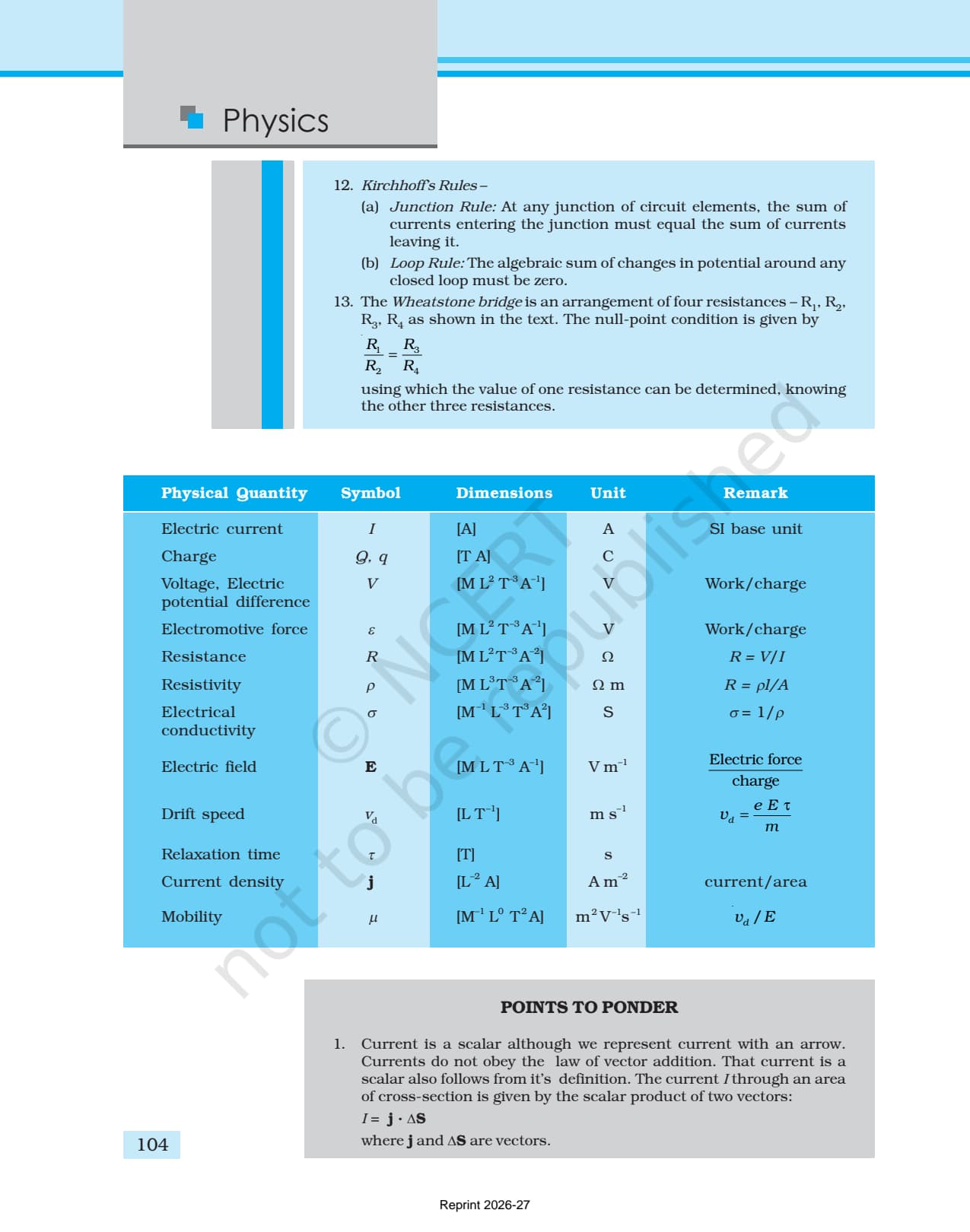
Current Electricity NCERT Section-by-Section Breakdown
The table below lists all 16 numbered sections of Chapter 3 with approximate page ranges. Sub-topics in the lower half of the chapter carry the most marks in CBSE Board and JEE Main.
| Section | Heading | Pages | What It Covers |
|---|---|---|---|
| 3.1 | Introduction | 1 | Historical context, scope of electric current |
| 3.2 | Electric Current | 1 | Definition I = dq/dt, units, sign |
| 3.3 | Electric Currents in Conductors | 2 | Free electron model, steady state |
| 3.4 | Ohm's Law | 2 | V = IR, ohmic vs non-ohmic conductors |
| 3.5 | Drift of Electrons and Origin of Resistivity | 3 | Drift velocity, relaxation time, I = nAv_de |
| 3.6 | Limitations of Ohm's Law | 1 | Diode, gas discharge, GaAs |
| 3.7 | Resistivity of Various Materials | 2 | Conductors, semiconductors, insulators |
| 3.8 | Temperature Dependence of Resistivity | 2 | rho = rho_01 + alpha(T - T0) |
| 3.9 | Electrical Energy and Power | 2 | P = VI, Joule heating, max power transfer |
| 3.10 | Combination of Resistors: Series and Parallel | 3 | R_series, R_parallel, hybrid networks |
| 3.11 | Cells, EMF, Internal Resistance | 3 | EMF, terminal voltage V = epsilon - Ir |
| 3.12 | Cells in Series and in Parallel | 3 | Equivalent EMF, equivalent internal r |
| 3.13 | Kirchhoff's Rules | 3 | KCL, KVL, sign convention |
| 3.14 | Wheatstone Bridge | 3 | Balance condition P/Q = R/S, derivation |
| 3.15 | Meter Bridge | 3 | S = R(100 - l)/l, practical setup |
| 3.16 | Potentiometer | 4 | EMF comparison, internal r measurement |
Sections 3.10 to 3.16 account for nearly 60% of the marks from this chapter across CBSE, JEE Main, and NEET. If you have only one day to revise, start with 3.13 Kirchhoff onwards.
Current Electricity Intext Example Inventory
The 7 in-text Examples are placed next to the section they illustrate. Use this table to find which Examples to attempt first based on exam priority.
| Example | Sub-topic | What it Covers |
|---|---|---|
| Example 3.1 | Drift velocity | Plug-and-chug numerical on I = nAv_de |
| Example 3.2 | Resistance and resistivity | Two-step calculation using R = rho L/A |
| Example 3.3 | Temperature dependence | Platinum thermometer style reading |
| Example 3.4 | Combination of resistors | Network reduction by series-parallel |
| Example 3.5 | Wheatstone bridge | Balance condition derivation |
| Example 3.6 | Meter bridge | Locating balance point on 1 m wire |
| Example 3.7 | Potentiometer | Comparing EMF using balancing lengths |
Examples 3.1, 3.5, 3.6, and 3.7 closely mirror questions from JEE Main 2025, NEET 2021, CBSE 2023, and CBSE 2025. Working through these four Examples covers roughly half the chapter's PYQ pool.
2026-27 Rationalisation Note for Current Electricity
The 2026-27 syllabus retains all 16 sections of Chapter 3 unchanged. Here is what NCERT kept and what got trimmed in earlier rounds.
The full rationalisation analysis with diff against the older edition is on the Current Electricity Class 12 Physics Notes page.
How to Read the Current Electricity Class 12 NCERT PDF
The chapter is 38 pages. A three-pass approach works best. First, skim all section headings and formula boxes in about 45 minutes. Next, read sections 3.5, 3.10, 3.11, 3.13, 3.14, and 3.16 line by line - these are the high-yield sections. Finally, attempt Examples 3.1, 3.5, 3.6, and 3.7 with the book closed, then check against the printed solution. Do at least Exercises 3.9, 3.18, 3.20, 3.22, and 3.23 on paper to cover the hardest CBSE 5-markers.
Current Electricity Chapter Weightage in Class 12 Physics
The visual below maps the typical CBSE Class 12 Physics marks distribution across all 14 chapters, averaged over the last five board papers.
Top 5 Formulae from Current Electricity Class 12 Chapter 3
These five formulae appear across multiple sections of the NCERT chapter and drive most exam questions. The full list with dimensional analysis is on the Current Electricity Formula Sheet page.
| Concept | Formula | NCERT Section |
|---|---|---|
| Current via drift velocity | I = nAv_de | 3.5 |
| Resistance of conductor | R = rho L/A | 3.5 |
| Temperature dependence | rho = rho_01 + alpha(T - T0) | 3.8 |
| Terminal voltage | V = epsilon - Ir | 3.11 |
| Wheatstone balance | P/Q = R/S | 3.14 |
Top 3 PYQ Trends from CBSE, JEE, and NEET for Current Electricity
These three patterns account for most of the questions asked from Chapter 3 in the last three years.
- Kirchhoff and Wheatstone derivation: CBSE 2025 and 2024 both asked for the Wheatstone balance condition derivation followed by a numerical. Practice with Example 3.5 and Exercise 3.20.
- Drift velocity and resistivity numericals: JEE Main 2025 used a direct lift of Example 3.1 with only the current value changed. NEET 2022 used the same template for copper vs aluminium.
- Potentiometer comparison of EMFs: CBSE 2023 and NEET 2024 both used the balancing-length ratio from Example 3.7. Expect a similar question in any session that does not test Wheatstone heavily.
Full year-by-year question map (2021 to 2026): Current Electricity Class 12 Physics NCERT Solutions.
Student Feedback
"The section breakdown table helped me know which pages to print and annotate. Sections 3.13 and 3.14 took the most time but were worth it - Kirchhoff problems came from this chapter in my boards." - Priya, Class 12, Delhi
"I used the three-pass reading plan and finished Chapter 3 in one weekend. The example inventory table helped me decide which solved problems to attempt first." - Arjun, Class 12, Pune
Other Resources for Current Electricity Class 12 Physics Chapter 3
| Resource | Link |
|---|---|
| NCERT Book PDF | Current Electricity Class 12 NCERT Book PDF |
| NCERT Solutions | Current Electricity Class 12 Physics NCERT Solutions |
| Notes | Current Electricity Class 12 Physics Notes |
| Formula Sheet | Current Electricity Class 12 Physics Formula Sheet |
NCERT Book PDF for Class 12 Physics: All Chapters
Download NCERT Book PDFs for all Class 12 Physics chapters:
| Chapter | Resource |
|---|---|
| Chapter 1 | Electric Charges and Fields NCERT PDF |
| Chapter 2 | Electrostatic Potential and Capacitance NCERT PDF |
| Chapter 3 | Current Electricity NCERT PDF |
| Chapter 4 | Moving Charges and Magnetism NCERT PDF |
| Chapter 5 | Magnetism and Matter NCERT PDF |
| Chapter 6 | Electromagnetic Induction NCERT PDF |
| Chapter 7 | Alternating Current NCERT PDF |
| Chapter 8 | Electromagnetic Waves NCERT PDF |
| Chapter 9 | Ray Optics and Optical Instruments NCERT PDF |
| Chapter 10 | Wave Optics NCERT PDF |
| Chapter 11 | Dual Nature of Radiation and Matter NCERT PDF |
| Chapter 12 | Atoms NCERT PDF |
| Chapter 13 | Nuclei NCERT PDF |
| Chapter 14 | Semiconductor Electronics NCERT PDF |
Current Electricity Class 12 NCERT PDF: available above as a free PDF download, fully aligned to the 2026-27 NCERT release.
Current Electricity Class 12 NCERT PDF - Frequently Asked Questions
Ques. Where can I download the Current Electricity Class 12 NCERT PDF for free?
Ans. You can download the Current Electricity Class 12 NCERT PDF directly from this page. The file matches the official 2026-27 NCERT print of Chapter 3 and is free to download.
Ques. Is this Current Electricity Class 12 NCERT PDF aligned with the 2026-27 CBSE syllabus?
Ans. Yes. This page reflects the current 2026-27 syllabus for Class 12 Physics. All 16 sections of Chapter 3, all 7 Examples, and all 23 Exercises are retained in the new edition without any deletions.
Ques. How many pages is the Class 12 Physics Current Electricity NCERT Book PDF?
Ans. The NCERT Book PDF runs approximately 38 pages and covers all 16 sections from Introduction through Potentiometer, plus the chapter summary, 7 in-text Examples, and 23 end-of-chapter Exercises.
Ques. What is the weightage of Current Electricity in CBSE Class 12 Boards?
Ans. Current Electricity carries roughly 5 to 7 marks in CBSE Class 12 Physics, typically as one short answer question plus one long-answer numerical based on Wheatstone bridge, meter bridge, or potentiometer.
Ques. Which are the most important sections of Chapter 3 for JEE Main and NEET?
Ans. Sections 3.10 (combinations), 3.11 to 3.12 (cells and internal resistance), 3.13 (Kirchhoff), 3.14 (Wheatstone), and 3.16 (potentiometer) together account for roughly 60% of all questions from this chapter in JEE Main and NEET.



Comments