




The class 11 physics formula sheet chapter 1 units and measurements gathers every error, dimensional and unit formula tested in the Boards, JEE Main, JEE Advanced, NEET, CUET and NDA exams. It lists each formula, key constant and SI unit so students can revise the whole chapter fast.

Units and Measurements is the foundation chapter, so its error and dimension rules return in every numerical chapter that follows.
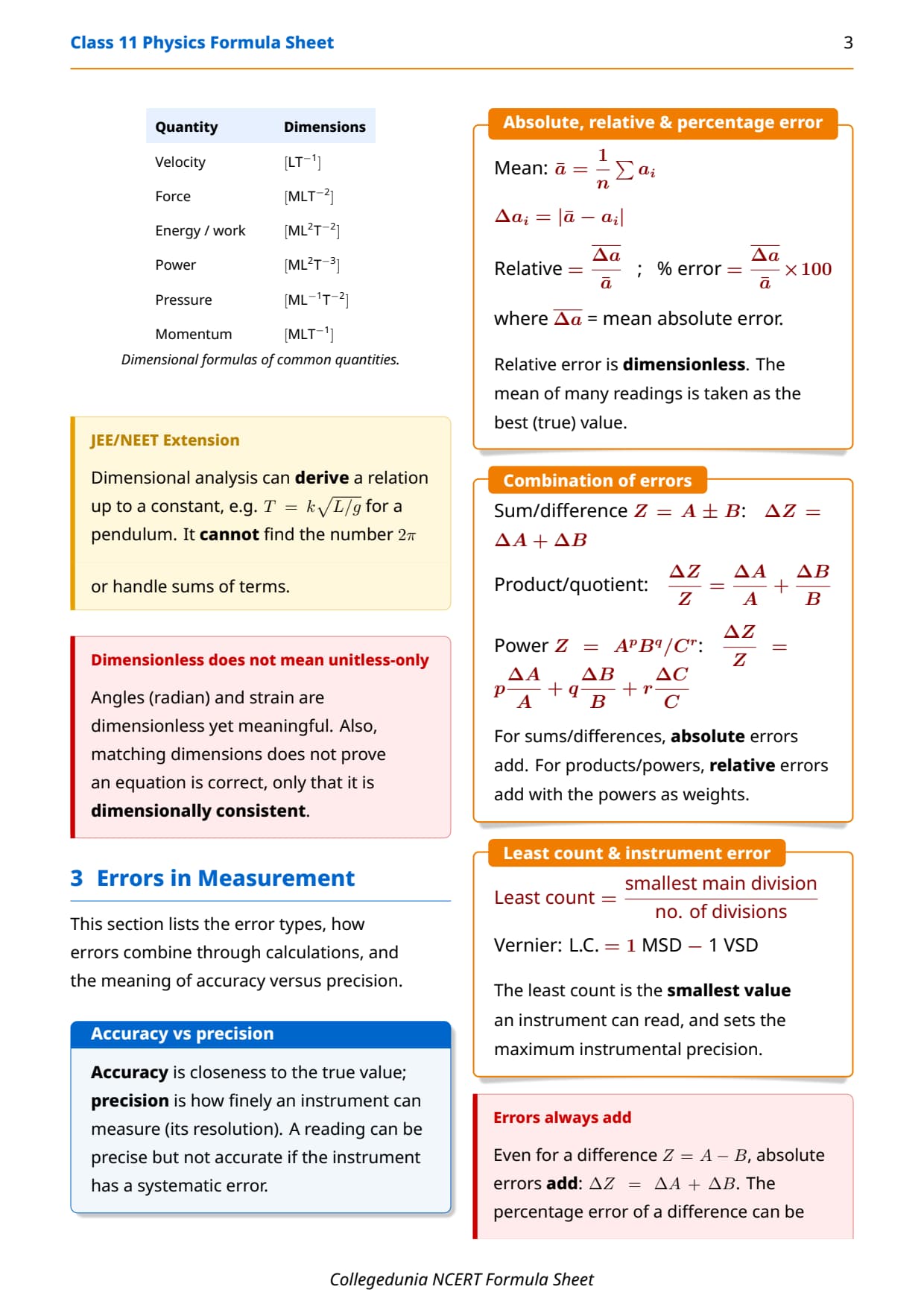
- Covers absolute, relative and percentage error, plus the rules for combining errors.
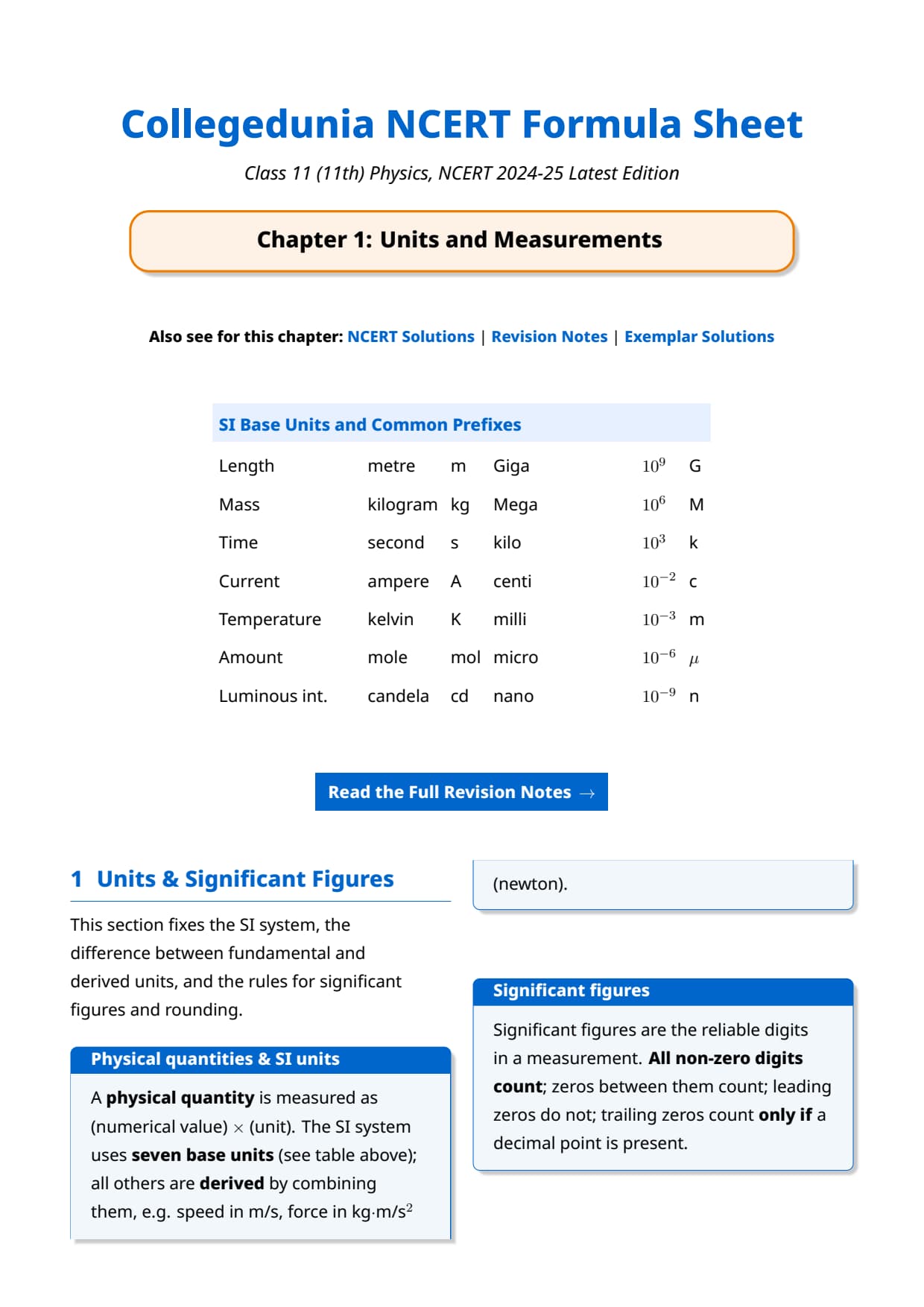
- Lists the dimensional formulae of common quantities and all seven SI base units.
- Helps students check any physics formula using the principle of homogeneity.
This class 11 physics formula sheet chapter 1 units and measurements is curated by subject experts and checked against the 2026-27 NCERT and recent CBSE and JEE papers.
All Units and Measurements Formulas at a Glance
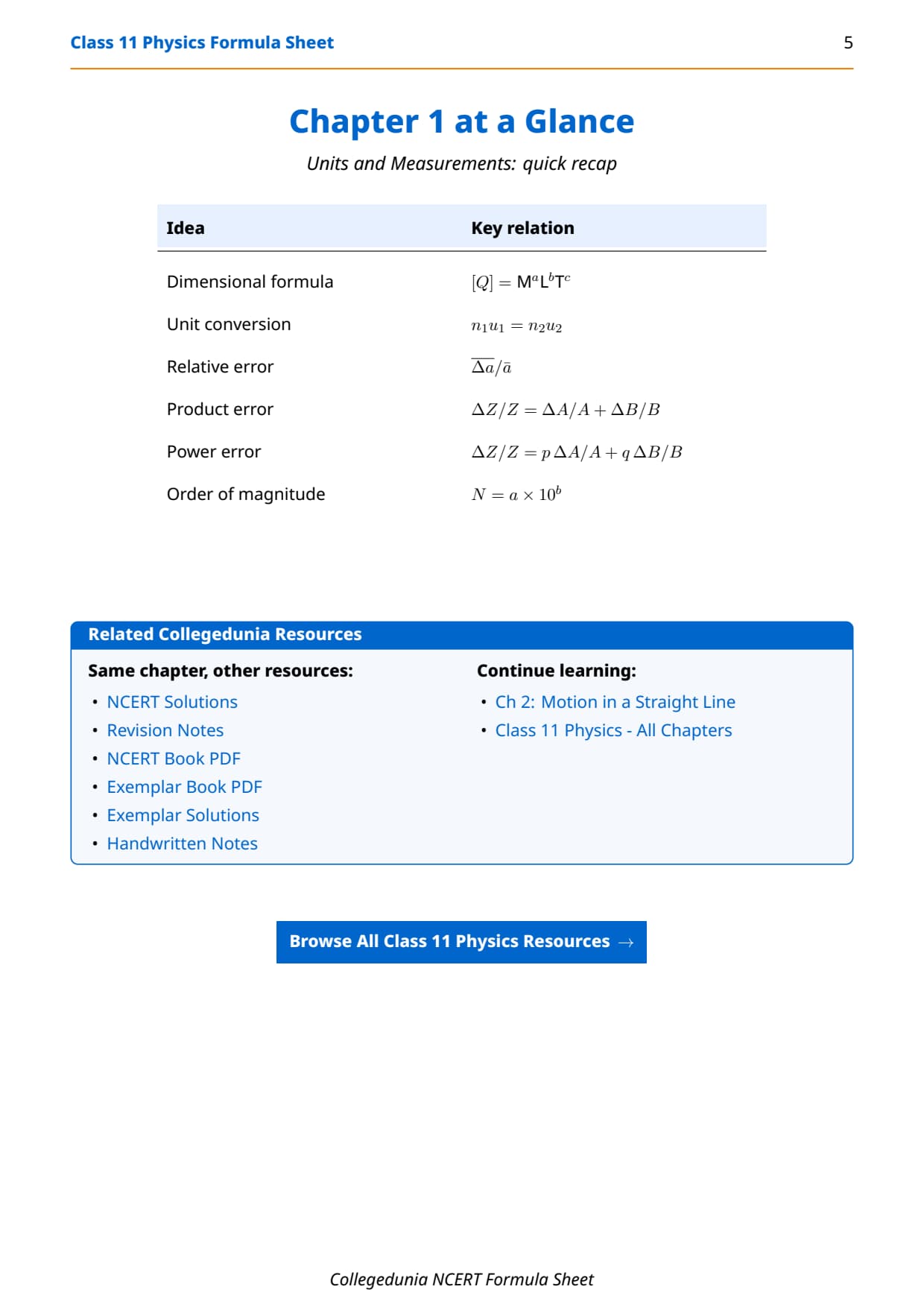
Every error formula sits in one table below, with its meaning and SI unit. Learn the combination-of-errors rows first, since almost every numerical uses them.
| Formula | What it means | SI unit |
|---|---|---|
| Δai = |amean − ai| | Absolute error in a single reading | Same unit as the quantity |
| Δamean = (Σ|Δai|)/n | Mean absolute error of all readings | Same unit as the quantity |
| δa = Δamean/amean | Relative error, the error as a fraction | Dimensionless |
| % error = (Δamean/amean) × 100 | Percentage error | Percent (%) |
| Z = A ± B → ΔZ = ΔA + ΔB | In a sum or difference, absolute errors add | Same unit as Z |
| Z = AB or A/B → ΔZ/Z = ΔA/A + ΔB/B | In a product or quotient, relative errors add | Dimensionless |
| Z = ApBq/Cr → ΔZ/Z = pΔA/A + qΔB/B + rΔC/C | For powers, multiply each relative error by its power | Dimensionless |
Absolute errors add in a sum or difference, but relative errors add in a product, quotient or power.
Dimensional Formulae of Key Physical Quantities
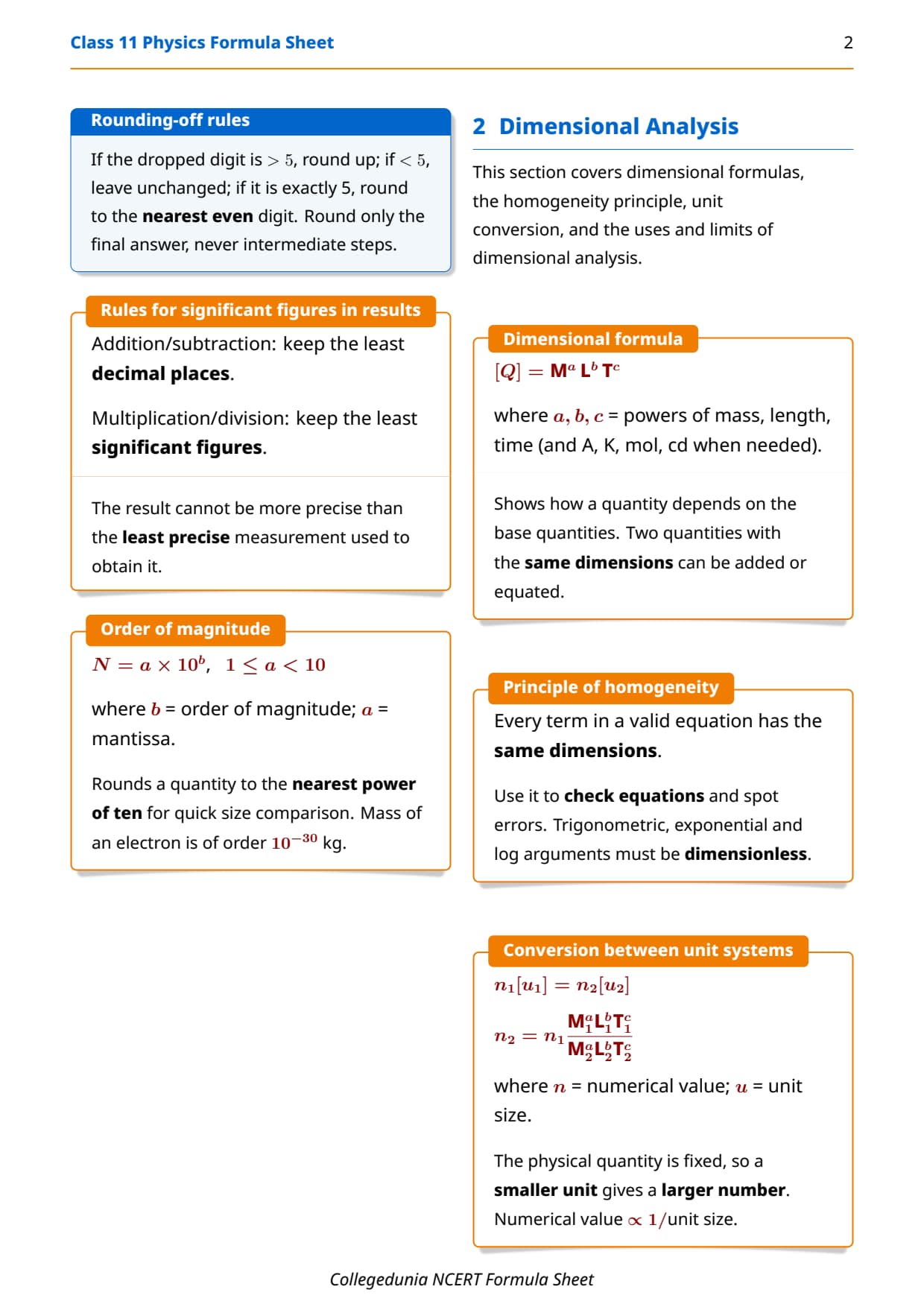
You must also write the dimensional formula of a quantity as [Ma Lb Tc]. These check equations and convert units.
| Quantity | Dimensional formula | SI unit |
|---|---|---|
| Velocity | [M0 L1 T-1] | m s-1 |
| Acceleration | [M0 L1 T-2] | m s-2 |
| Force | [M1 L1 T-2] | newton (N) |
| Work or energy | [M1 L2 T-2] | joule (J) |
| Power | [M1 L2 T-3] | watt (W) |
| Pressure | [M1 L-1 T-2] | pascal (Pa) |
| Gravitational constant G | [M-1 L3 T-2] | N m2 kg-2 |
| Planck's constant h | [M1 L2 T-1] | J s |
By the principle of homogeneity, every term in a formula must have the same dimensions. If they do not match, the equation is wrong.
Key Constants and SI Base Units for Units and Measurements
Boards and entrance papers often ask for a constant or unit definition. The list below has the key values and the seven SI base units.
- SI base units: metre (length), kilogram (mass), second (time), ampere (current), kelvin (temperature), mole (amount of substance), candela (luminous intensity).
- Speed of light: c = 3 × 10⁸ m s-1.
- 1 light year = 9.46 × 10¹⁵ m; 1 astronomical unit = 1.496 × 10¹¹ m.
- 1 parsec = 3.08 × 10¹⁶ m; 1 angstrom = 10-10 m.
- 1 atomic mass unit (u) = 1.66 × 10⁻²⁷ kg.
How to Revise Units and Measurements Formulas Before the Exam
Use this class 11 physics formula sheet chapter 1 units and measurements for a fast recap the night before a test, in about 20 minutes.
- First 7 minutes: write the four error formulas and three combination rules from memory.
- Next 7 minutes: write the dimensional formula of force, energy, power and pressure.
- Last 6 minutes: recall the seven SI base units and check one formula by homogeneity.
Finish by solving one combination-of-errors numerical using the power rule.
Student Feedback on the Units and Measurements Formula Sheet
What 12,840 students told us about their Units and Measurements revision:
- 68% of students rated the combination-of-errors rules as the hardest part.
- Most-skipped step: multiplying each relative error by its power.
- Students who learned the dimensional formulae first found unit conversions easier.
Source: 2026-27 Class 11 Physics student poll. Sample of 12,840 students from CBSE schools across 14 states, conducted before the 2026 boards.
Other Units and Measurements Class 11 Physics Resources
Pair this formula sheet with the solved answers, notes and textbook PDF.
| Resource | Link |
|---|---|
| NCERT Solutions | Units and Measurements Class 11 NCERT Solutions |
| Revision Notes | Units and Measurements Class 11 Notes |
| Handwritten Notes | Units and Measurements Class 11 Handwritten Notes |
| NCERT Book PDF | Units and Measurements Class 11 Book PDF |
NCERT Formula Sheet for Class 11 Physics: All Chapters
Jump to any other Class 11 Physics formula sheet below.
| Chapter | Formula Sheet |
|---|---|
| Chapter 1 | Units and Measurements |
| Chapter 2 | Motion in a Straight Line |
| Chapter 3 | Motion in a Plane |
| Chapter 4 | Laws of Motion |
| Chapter 5 | Work, Energy and Power |
| Chapter 6 | System of Particles and Rotational Motion |
| Chapter 7 | Gravitation |
| Chapter 8 | Mechanical Properties of Solids |
| Chapter 9 | Mechanical Properties of Fluids |
| Chapter 10 | Thermal Properties of Matter |
| Chapter 11 | Thermodynamics |
| Chapter 12 | Kinetic Theory |
| Chapter 13 | Oscillations |
| Chapter 14 | Waves |
FAQs on Units and Measurements Class 11 Physics Formula Sheet
Units and Measurements Formula Sheet - Frequently Asked Questions
Ques. What formulas does the class 11 physics formula sheet chapter 1 units and measurements cover?
Ans. This class 11 physics formula sheet chapter 1 units and measurements covers absolute, mean absolute, relative and percentage error. It also lists the rules for combining errors in sums, products and powers, the dimensional formulae of common quantities, and the seven SI base units.
Ques. How do errors combine in a product or quotient?
Ans. For a product or quotient, the relative errors add: ΔZ/Z = ΔA/A + ΔB/B. For a power Z = Ap, multiply the relative error by the power p. In a sum or difference, the absolute errors add.
Ques. What is the dimensional formula of force?
Ans. Force equals mass times acceleration, so its dimensional formula is [M1 L1 T-2] and its SI unit is the newton.
Ques. What are the seven SI base units?
Ans. The seven SI base units are the metre (length), kilogram (mass), second (time), ampere (current), kelvin (temperature), mole (amount of substance) and candela (luminous intensity). Every other physical unit is derived from these seven.



Comments