



Dr Jitendra Singh (Union Minister of State, Independent Charge, Ministry of Science and Technology, Ministry of Earth Sciences, plus PMO, Atomic Energy, Space, Personnel) inaugurated Lakshya 2047 (15 labs, 2 floors) and Pragya cadaveric extension at Parul University Vadodara. Apple Lab, AR/VR Lab, ABB Robotics, Drone Lab, NVIDIA Lab, VLSI Lab, Sensor Lab (30+ patents, 50+ sensor types). Pragya: 16,000 sq ft, 11 simulation units, ATLAS/i-Simulate. Dr Iype Cherian: 2 cm neurosurgery demo. Student eye-health app: Apple India top 350. 90 Udhampur-constituency students met the minister.
The Day: Two Inaugurations, One National Vision
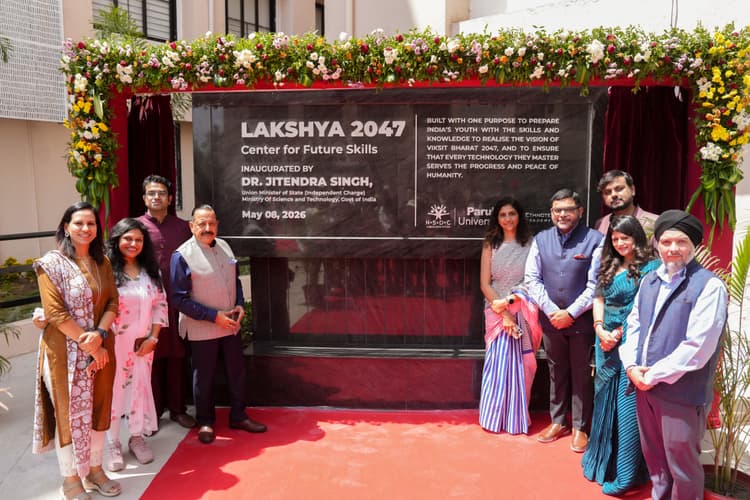
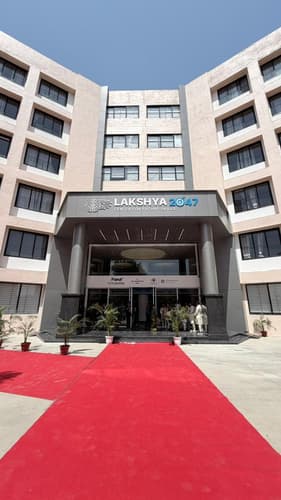
On 8 May 2026, Parul University in Vadodara hosted what was its most significant institutional event of the year. Union Minister of State (Independent Charge) Dr Jitendra Singh, who currently holds six ministerial portfolios spanning Science and Technology, Earth Sciences, the Prime Minister's Office, Personnel and Public Grievances, Atomic Energy, and Space, inaugurated two facilities on the same day. The first was Lakshya 2047, a newly commissioned two-floor building purpose-built to house fifteen specialised laboratories as Parul University's Centre for Future Skills. The second was a cadaveric centre extending Pragya, the existing Advanced Skills and Simulation Centre at the Parul Institute of Medical Sciences and Research.
The university leadership receiving the minister was led by Dr Parul Patel (Founding Figure and Vice President for Student Affairs), Dr Devanshu Patel (President of Parul University), and Dr Geetika Madan Patel (Vice President and Medical Director of Parul Sevashram Hospital). The name Lakshya, meaning goal or target, is tied to 2047: the hundredth anniversary of India's independence and the target year for Viksit Bharat 2047, the national vision for developed-nation status. The Amrit Kaal, the working window from 2022 to 2047, frames what universities like Parul are building toward.
The disciplines housed inside Lakshya 2047 map directly onto the high-growth areas the national vision identifies: robotics, drone technology, sensor research and nanomaterials, cloud computing, augmented and virtual reality, iOS development, industrial automation, chip design, networking and cybersecurity, and precision and digital fabrication. As Dr Jitendra Singh noted during his address:
"The skills that were learned yesterday for today have already become obsolete today. The pace of evolution is so fast."

Inside Lakshya 2047: 15 Labs Across Two Floors
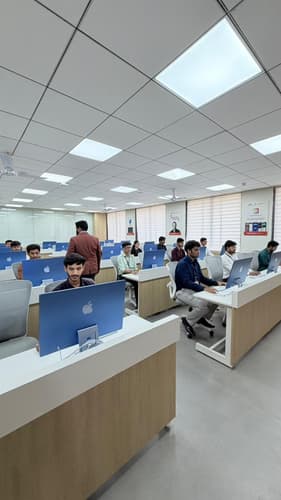
Lakshya 2047 is structured as an operational facility rather than a display centre. Each lab is functional, fitted with professional-grade equipment, and supervised by faculty with domain expertise. The ground floor houses five labs:
- Apple Lab: iOS application development using Swift and SwiftUI, with development for watchOS, tvOS, macOS, and visionOS (Apple Vision Pro spatial computing)
- AR/VR Lab: Apple Vision Pro and Meta Quest headsets with direct hand and finger tracking for immersive technology development
- ABB Industrial Automation Lab: operational ABB robotic systems including an articulated robotic arm running adaptive task replication
- PLC and SCADA Lab: twelve working industrial process models for programmable logic controller and supervisory control training
- Home Automation Lab: Internet of Things deployment and connected environment design
The first floor houses ten labs covering the technology domains that Dr Jitendra Singh identified as defining the next generation of careers:
- Drone Lab: RPTO (Remote Pilot Training Operations) curriculum, drone components, flight training, lithium polymer and lithium-ion battery technology, applications in agriculture, infrastructure inspection, mapping, and logistics
- Centre of Excellence in Sensor Technology: 50+ sensor types on display, 30+ disclosed patent applications, Autolab PGSTAT204N potentiostat, Metrohm Dropsens 220BT portable electrochemical analyser, hydrothermal autoclave rated to 100 bar and 300°C, UV laser writing at 405 nm, DC plasma system
- IDEA Lab: fabrication hub with industrial 3D printers (Bambu Lab H2S, Prusa XL, Elegoo Saturn 4 Ultra 16K resin), CNC equipment (SIL 1325 Router, CO2 laser cutter), Proxxon lathe and milling attachment
- Cisco Lab: networking and cybersecurity certifications
- NVIDIA Lab: GPU-accelerated workstations for AI and machine learning training
- AWS Lab: cloud computing infrastructure and deployment
- VLSI Lab: integrated circuit design aligned with the India Semiconductor Mission for domestic chip design and fabrication capability
- Autodesk Lab: professional-grade computer-aided design
- Cambridge Lab: structured communication and professional writing training
Dr Jitendra Singh paid particular attention to the patent display at the Centre of Excellence in Sensor Technology during the walkthrough. The Sensor Lab operates in scope-adjacency to the Micro-Nano Research and Development Center (MNRDC), where SEM, XRD, and AFM characterisation services are housed. Together, the Sensor Lab and MNRDC create a research pipeline from material synthesis through device fabrication to electrochemical characterisation that few private universities in India can match.
The Student Who Built an App That Apple Noticed
The most commercially indicative moment of the walkthrough was not a piece of equipment. It was a student. Inside the Apple Lab, a Computer Science student presented a mobile application he had developed independently. The application had been recognised among the top 350 apps by Apple India in a national competition: a notable distinction in a country with several million developers competing for visibility on the App Store.
The app is an eye-movement game addressing digital eye strain syndrome: dry eyes, blurry vision, headaches, and persistent fatigue from prolonged screen exposure. The user is guided through targeted eye exercises delivered as game mechanics, with real-time visual feedback on eye-health restoration progress. The student noticed the problem in his own life, had the technical training to address it, had the institutional environment to support the work, and shipped a finished product that Apple's editorial reviewers independently validated. Apple's review standards assess design quality, performance, accessibility, privacy compliance, and user experience consistency. For a single student developer working without a corporate engineering team, clearing that filter and earning a top 350 placement is structurally significant.
Pragya: 16,000 Square Feet Where Medical Students Train Before Patients
The second inauguration extended Pragya, the Advanced Skills and Simulation Centre on the third floor of the Parul Institute of Medical Sciences and Research, with a new cadaveric centre. Pragya covers 16,000 square feet and houses eleven simulation and training units, each fitted with high-fidelity manikins and task trainers. The ATLAS and i-Simulate platforms allow instructors to run dynamic clinical scenarios that respond to learner interventions, replicating real physiological responses rather than scripted outcomes. Training protocols are aligned to ATLS (Advanced Trauma Life Support) and ACLS (Advanced Cardiac Life Support) standards.
The eleven units:
- Emergency Critical Care Simulation Unit
- Trauma Simulation Unit (TrueMan Trauma simulator, paediatric intraosseous training)
- Advanced Obstetric and Neonatal Simulation Unit (full-body birthing simulators, neonatal manikins with cyanosis and preterm fidelity)
- Advanced Airway and Cardiac Unit
- Cardiac Diagnostic Unit
- Minimal Access Surgery Simulation Unit
- Operation Theatre Simulation Unit
- Triage and Emergency Unit
- ICU Intensive Care Simulation Unit (mechanical ventilation, multipara monitoring, invasive pressure, central venous line practice)
- Radiography Unit
- Optometry Unit
The new cadaveric centre adds anatomical and surgical training capability, completing the progression from manikin-based simulation through cadaveric dissection to supervised patient care. Dr Geetika Madan Patel noted during the walkthrough that the simulation hardware is imported because comparable equipment is not currently manufactured in India. Dr Jitendra Singh responded: bohet jald shruyat hogi yaha bhi (it will start here very soon).
The Neurosurgery Demonstration: 2 cm Cranial Channel
The most technically striking moment of the day happened inside Pragya. Dr Iype Cherian, Director of Neurosciences at Parul University, demonstrated a minimally invasive neurosurgical technique using a 2-centimetre cranial channel. Through that channel, a robotic exoscope (the Sanma Yoko Exoscope, developed by Dr Cherian himself) navigates the operative field, eliminating line-of-sight constraints that conventional neurosurgical access imposes. Dr Singh, himself an MBBS from Stanley Medical College Chennai and an MD from AIIMS New Delhi, asked precisely the right question: how wide is the channel. The answer, 2 centimetres, opened a clinical exchange on suture work. The STMC Bypass Set, also developed by Dr Cherian, uses suture tips approximately six times finer than conventional suture material, enabling anastomosis of microvessels inaccessible with standard techniques.
Dr Cherian is the developer of Cisternostomy (opening cerebrospinal fluid cisterns to reduce intracranial pressure in head injury cases) and the Brain Cooling Theory (explaining CSF shift in postoperative recovery). His Neurosurgery Coach framework trains neurosurgeons from low and middle-income countries in microsurgical techniques. The MCh Neurosurgery pathway at Parul University runs MBBS → MS General Surgery → MCh Neurosurgery under his direction.
90 Students from the Minister's Constituency
Dr Jitendra Singh spent a dedicated half-hour with ninety students from his Udhampur Lok Sabha constituency in Jammu and Kashmir who are currently studying at Parul University. The interaction was not part of the official programme but was facilitated by the university leadership. The minister asked students about their experiences, their programmes, and their plans. For students from Udhampur studying in Vadodara, the meeting with their elected representative inside the university where they are being trained carried a significance that transcended the formal agenda.
Parul University Programmes and Admissions
Parul University: From History to Milestones
Parul University at a Glance
NAAC A++ (CGPA 3.55). Category 1 University with Grant of Graded Autonomy. Centre of Excellence notified by the Government of Gujarat. QS World University Rankings 1001-1100 band (Asia 2026). NIRF Top 50 Innovations. ASSOCHAM Best University in Placements for 3 consecutive years. 70,500+ students across 4 campuses (Vadodara, Ahmedabad, Rajkot, Goa). 6,000+ international students. 3,500+ faculty including 200+ from IITs, NITs, IISc, NIDs, NIFTs. 7 NABH-accredited hospitals. 25 disciplines from Diploma through Doctoral level. Research: Rs 58.31 crore government-funded, 315 funded projects, 545 patent filings (2021-2025). PIERC: 254 startups incubated, Rs 20 crore+ funding, Rs 40 crore+ revenue. Research infrastructure: DSIR-approved R&D Centre, AICTE-supported Drone Lab, Micro-Nano Research and Development Center (MNRDC), state-sponsored Supercomputer Lab, NABL-accredited Environmental Lab, and the newly inaugurated Lakshya 2047 Centre for Future Skills.
Frequently Asked Questions
Ques. What is Lakshya 2047 at Parul University?
Ans. Lakshya 2047 is the Centre for Future Skills at Parul University, Vadodara. A two-floor building housing 15 specialised operational laboratories: Apple Lab, AR/VR Lab, ABB Industrial Automation Lab, PLC and SCADA Lab, Home Automation Lab, Drone Lab, Centre of Excellence in Sensor Technology (30+ patents, 50+ sensor types), IDEA fabrication hub, Cisco Lab, NVIDIA AI Lab, AWS Lab, VLSI Lab (India Semiconductor Mission aligned), Autodesk Lab, and Cambridge Lab. Inaugurated 8 May 2026 by Union Minister Dr Jitendra Singh.
Ques. What is Pragya at Parul University?
Ans. Pragya is the Advanced Skills and Simulation Centre at the Parul Institute of Medical Sciences and Research. 16,000 square feet. 11 simulation units with high-fidelity manikins and ATLAS/i-Simulate platforms. Training aligned to ATLS and ACLS standards. Units cover emergency critical care, trauma, obstetrics, cardiac, minimal access surgery, operation theatre, triage, ICU, radiography, and optometry. A new cadaveric centre was inaugurated on 8 May 2026, completing the progression from manikin simulation through cadaveric dissection to supervised patient care.
Ques. Who inaugurated Lakshya 2047?
Ans. Dr Jitendra Singh, Union Minister of State (Independent Charge) for the Ministry of Science and Technology and the Ministry of Earth Sciences, who also holds portfolios for the Prime Minister's Office, Personnel and Public Grievances, Atomic Energy, and Space. MBBS from Stanley Medical College Chennai, MD from AIIMS New Delhi. He toured all 15 labs, witnessed a neurosurgical demonstration by Dr Iype Cherian, inaugurated the Pragya cadaveric extension, and met 90 students from his Udhampur constituency.


.png?h=132&w=263&mode=stretch)



Comments