



Education Journalist | Study Abroad Lead | Updated On - Mar 17, 2026
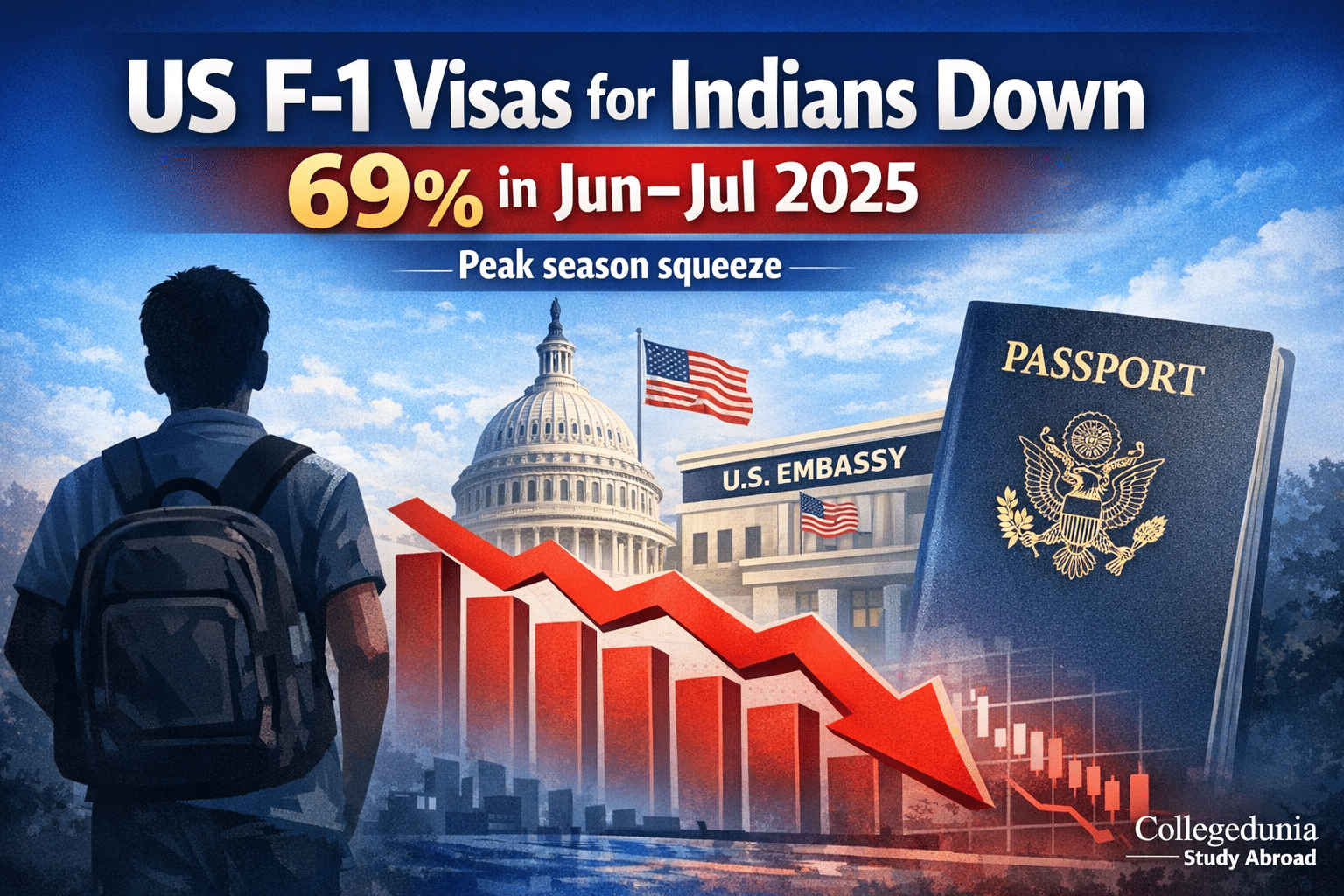
The number of F-1 student visas issued to Indian students collapsed by 69 per cent in June and July 2025, the two most critical months before the US Fall semester, compared to the same period in 2024, according to newly released data from the US Department of State. For Indian students who make up the single largest international student cohort in the United States, the figures mark the sharpest peacetime decline on record and raise urgent questions about the viability of the US as a study destination for Fall 2026.
Check Other Latest Study Abroad News:
- Top Study Abroad Scholarships Closing March 2026
- Indians Largest Group for UK Study Visas in 2025, Home Office Data Shows
- Australia Doubles Graduate Visa Fee From 1 March 2026
- NCI Launches 75 Lakh Scholarship Fund for Indian Postgrads in Ireland
F-1 Visa Numbers: The Steepest Fall Since COVID
In June and July 2025, only 12,776 F-1 visas were issued to Indian students, less than one-third of the 41,336 issued in the same months of 2024. The monthly breakdown tells an even starker story:
| Month | 2025 | 2024 | 2023 |
| June | 10,695 | 26,731 | 40,224 |
| July | 2,081 | 14,605 | 31,803 |
| August | 2,389 | 5,529 | — |
(Source: US Department of State)
To put this in historical context: F-1 visa issuances to Indian students had surged in the post-COVID years, reaching a combined peak of 72,027 in June–July 2023. The 2025 figure of 12,776 represents a fall of 82% from that peak in just two years.
China also saw a significant drop (around 56%) but received more F-1 visas than India in June–July 2025 (17,025 vs 12,776). This is the first time since 2021 that Chinese students have received more F-1 visas than Indian students in these peak months.
Why Did F-1 Visas Drop? Trump Administration's New Rules
The sharp decline in June–July 2025 directly followed a series of policy changes introduced by the Trump administration:
1. Interview pause (late May to 18 June 2025): Secretary of State Marco Rubio announced a pause on student visa interviews in preparation for expanded social media screening. No new interview slots were added during this period, creating a backlog that compressed the entire peak visa season.
2. Mandatory social media disclosure (23 June 2025): The US Embassy in India required all F, M, and J visa applicants to set their social media accounts to "public" and list every social media username or handle used over the past five years on their application form.
3. SEVIS record terminations (April 2025): Hundreds of international students — some involved in pro-Palestine campus protests or with minor law enforcement interactions — had their Student and Exchange Visitor Information System (SEVIS) records abruptly terminated. Though many were later reinstated after legal challenges, the episode created widespread anxiety among students already in the US and those planning to apply.
4. Research grant freezes: Federal research grants were frozen at several leading universities, including Harvard and Stanford, further dampening confidence in the US as a safe and stable study environment.
Indian Students in the US: Scale of the Disruption
The scale of the impact on Indian students is significant. India is the largest international student-sending country to the US, with 3.63 lakh (363,000) Indian students enrolled in 2024–25, accounting for approximately 31 per cent of all international students in the US, according to Open Doors data. Indian students surpassed Chinese students to become the largest cohort for the first time in 2023–24.
By August 2025, US universities reported a 45 per cent drop in students from India, according to the Graduate Management Admission Council (GMAC). Overall new international enrolments at US universities fell 19 per cent in Fall 2025.
The GMAC's 2026 White Paper, "The Great Re-Routing of Global Business Talent," found that nearly 90 per cent of US programmes reported India as the top country from which students paid admission deposits but did not ultimately enrol, primarily due to visa delays, denials, or students holding multiple offers while waiting for clarity.
Is Canada or the UK a Safe Alternative?
Many Indian students who could not secure US F-1 visas looked to Canada and the UK as alternatives, but both destinations have also tightened their policies significantly.
- Canada: Study permit approval rates fell to approximately 30–34% in 2025, down sharply from 50–60% in previous years. Canada's 2024 cap on international study permits caused sharp drops in both applications and approvals.
- United Kingdom: Restrictions on student dependents and a shorter post-study work period led to a 12% drop in processed student visas in 2024. The UK is not the straightforward backup it once was.
- Europe and Asia-Pacific: These regions are emerging as genuine alternatives. Western Europe (Germany, Ireland, France) saw a 6 percentage point rise in preference among Indian students in just one year, driven by English-taught programmes, lower costs, and clearer post-study work rules. Asia-Pacific programmes reported 54% higher international enrolment in Fall 2025 compared to the year before.
- India itself: Applications to graduate management programmes in India rose 25 per cent, as students weighed comparable quality, lower costs, and proximity to family against an increasingly uncertain global visa environment.
What the Data Means for Fall 2026 Applicants?
The preference shift is structural, not temporary. In 2019, 57% of non-US candidates preferred to study in the US. By 2025, that figure had dropped to 42%, according to GMAC's Prospective Students Survey.
For Indian students planning for Fall 2026, the situation remains uncertain. The Trump administration's social media vetting requirements remain in place. Interview wait times at the US Embassy in India have not normalised. And the SEVIS termination episode has left a lasting impression on students and families weighing the risk of investing lakhs of rupees in a US education only to face visa disruption mid-course.
What Indian Students Should Do Now
If you are an Indian student planning to apply for a US F-1 visa for Fall 2026, here are your immediate action steps:
- Apply early, do not wait until May or June. The 2025 interview pause compressed the entire peak season. Book your visa interview as soon as you receive your I-20 from your US university. Aim for March–April 2026 at the latest.
- Set all social media accounts to public before your interview. The US Embassy requires this for F, M, and J visa applicants. Compile a complete list of all usernames and handles across every platform used in the past five years.
- Prepare a strong Statement of Purpose and financial documentation. Enhanced vetting means consular officers are scrutinising intent more carefully. Be clear about your academic goals, funding source, and plans to return to India after your studies.
- Check your SEVIS status regularly if you are already in the US on a student visa. Use the SEVP portal and keep your university's international student office informed of any changes in your enrolment or address.
- Have a backup plan. Given ongoing uncertainty, shortlist at least one alternative destination, Germany, Singapore, or a top Indian institution, alongside your US applications. This is not pessimism; it is prudent planning.
- Monitor policy updates. Check the US Embassy India website and the SEVP/ICE website for the latest F-1 visa requirements and any new executive orders affecting student visas.










Comments