


Education Journalist | Study Abroad Strategy Lead | Updated On - Mar 24, 2026
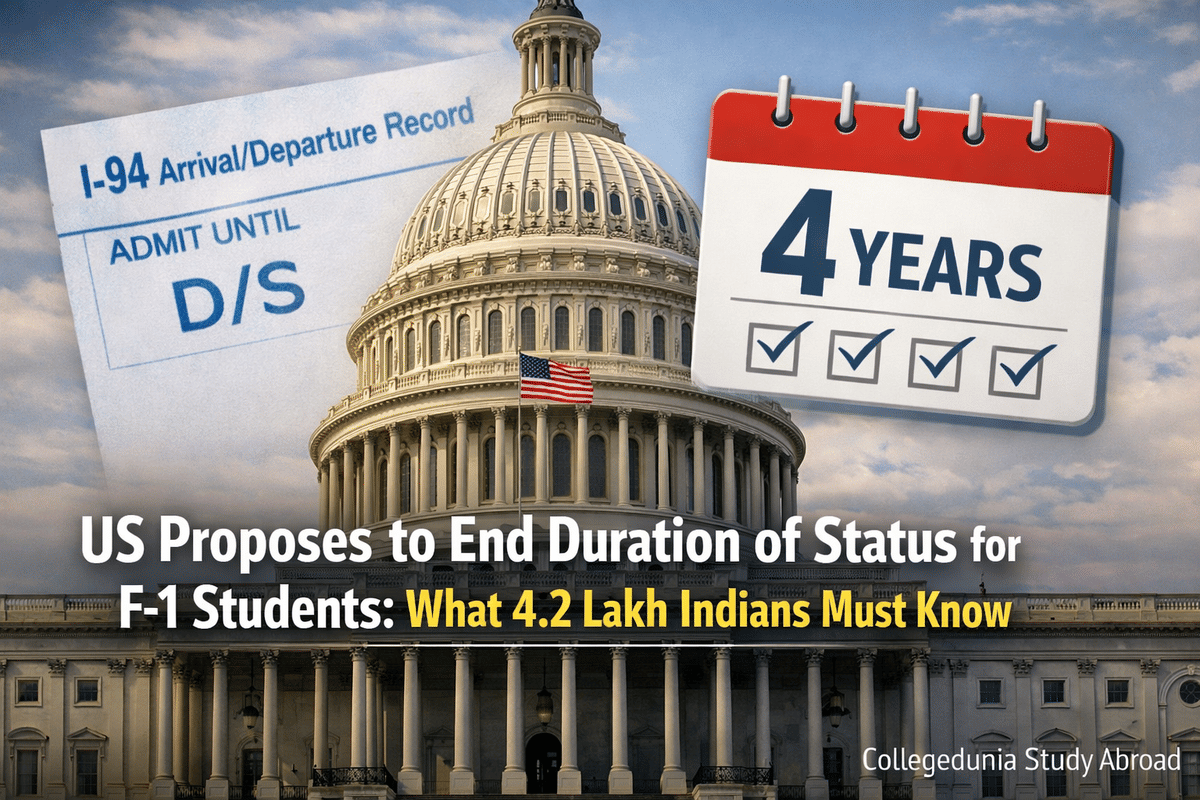
The US Department of Homeland Security (DHS) has proposed a sweeping change to how international students are admitted into the United States — one that could fundamentally alter the F-1 student visa experience for over 4.2 lakh Indian students currently enrolled in American universities. The proposed rule, published in the Federal Register on August 28, 2025, would eliminate "Duration of Status" (D/S) — a decades-old framework that has allowed F-1 students to remain in the US for as long as their academic programme continues — and replace it with a fixed 4-year stay limit.
The rule remains under review and has not yet been finalised. However, universities, immigration lawyers, and student advisors across the US are already treating it as a near-certainty — and Indian students, who make up 27% of all international students in the US, have the most at stake.
Check Top US Universities for Indian Students in 2026
What Is the Duration of Status — and Why Does It Matter?
Since 1978, F-1 students have been admitted to the US for "Duration of Status" — meaning their I-94 arrival record simply reads "D/S" rather than a specific end date. This allows students to remain lawfully in the US for the entire length of their academic programme, including any authorised practical training (OPT or STEM OPT), without needing to file a separate extension application with the government.
Under D/S, a student pursuing a 5-year PhD, a student who switches from a master's to a doctoral programme, or a student who takes an approved medical leave — all remain in valid status automatically, as long as their Designated School Official (DSO) updates their SEVIS record.
If the proposed rule is finalised, that flexibility disappears entirely.
What the Proposed Rule Would Change?
DHS has proposed seven significant changes to the F-1 framework. Here is what each means in plain terms:
- Fixed 4-year stay limit replaces D/S
Your I-94 will show a specific end date — your programme completion date or 4 years from entry, whichever comes first. If your programme runs longer (common for PhD students), you must file a formal extension.
- Formal USCIS Extension of Stay (EOS) required
Currently, your DSO extends your status by updating SEVIS — no government application needed. Under the new rule, you must file Form I-539 with USCIS and pay a fee of USD 1,965 (approximately ₹ 1.84 lakh at USD 1 = ₹93.80) to extend your stay. Premium processing costs $2,075 (~₹1.95 lakh).
- Grace period cut from 60 days to 30 days
After completing your programme or OPT, you currently have 60 days to depart, transfer, or change status. Under the proposal, this drops to 30 days — halving the window to secure a job offer, file for OPT, or make alternative plans.
- English language training capped at 24 months
Students in English language or foundation programmes will be limited to a cumulative 24 months of such study in F-1 status.
- Undergraduate students cannot change their major or transfer in Year 1
F-1 undergraduates will be barred from changing their educational objective (major/field) or transferring to another US university during their first academic year.
- Graduate students cannot change their major or transfer at any point
This is the most restrictive provision. F-1 graduate students — including Indian MS and PhD students — would be permanently barred from changing their field of study or transferring to another institution at any stage of their programme.
- No pursuing the same or a lower-level degree
Students who have already completed a degree in F-1 status in the US cannot return to pursue another degree at the same or lower level (e.g., a second master's degree).
Why This Matters for Indian Students
Indian students are the single largest group of international students in the US — 4.2 lakh as of 2024 SEVIS data, up 11.8% from 2023. The proposed changes hit several patterns that are common among Indian applicants, specifically:
| Scenario | Current Rule | Under Proposed Rule |
|---|---|---|
| 5-year PhD programme | Stay valid automatically throughout | Must file I-539 + pay ₹1.84 lakh fee after Year 4 |
| Switching from MS to PhD | DSO updates SEVIS, no fee | Barred — graduate students cannot change educational objective |
| Transferring universities mid-programme | Allowed with DSO approval | Barred for all graduate students |
| Post-OPT grace period | 60 days to find job/file H-1B | Reduced to 30 days |
| Second master's degree | Permitted | Barred if first master's completed in F-1 status in US |
For Indian students pursuing 5-year integrated programmes, dual degrees, or PhD tracks — all common pathways — the administrative and financial burden increases significantly. A PhD student who needs to extend beyond 4 years would need to budget an additional ₹1.84 lakh in USCIS fees, on top of tuition and living costs.
The 30-day grace period cut is particularly consequential for Indian students targeting OPT and STEM OPT. Currently, the 60-day window after graduation gives students time to receive their OPT EAD card and begin work. Cutting this to 30 days — while USCIS processing times often run 3–5 months — creates a serious compliance risk.
Who Is Most Affected?
Highest risk:
- Indian PhD students in STEM fields whose programmes exceed 4 years
- Indian MS students considering switching specialisation or transferring universities
- Students on STEM OPT extension who need to track their 30-day post-completion window carefully
- Students who completed one US master's and planned to pursue a second
Less immediately affected:
- Indian students in 2-year master's programmes completing within the 4-year window
- New F-1 applicants for Fall 2026 — the rule is not yet final; no effective date confirmed
- Students whose programmes and OPT fall entirely within the 4-year window
This is critical: the rule has not been enacted. DHS is still reviewing public comments received by September 29, 2025. The final rule must be submitted to the Office of Management and Budget (OMB) for review before DHS publishes it in the Federal Register. The effective date is expected to be 60 days after final publication.
Universities including Cornell, UCLA, UW-Madison, and Columbia have issued formal guidance to students, urging them to monitor updates and plan for the possibility of implementation.
What Indian Students Should Do Now?
- Do not panic — but do plan. The rule is proposed, not final. However, given the current US immigration policy direction, most university advisors recommend preparing as if it will be implemented.
- Check your programme length. If your degree programme (including OPT) is likely to exceed 4 years from your entry date, speak to your DSO now about what an extension application would involve.
- Do not switch majors or transfer universities without advice. If the rule is finalised, graduate students who change their educational objective or transfer could fall out of status. Consult your international student office before making any programme changes.
- Track your OPT application timeline carefully. With a potential 30-day grace period, you cannot afford USCIS processing delays. File your OPT application as early as 90 days before your programme end date.
- Monitor NAFSA and your university's international student office. The final rule will be published in the Federal Register. NAFSA (nafsa.org) is tracking this in real time. Sign up for alerts from your university's DSO.
- Consult an immigration attorney if your situation is complex. Students in dual-degree programmes, those considering a second US master's, or those mid-transfer should get individual legal advice before the rule is finalised.









Comments