


Education Journalist | Study Abroad Strategy Lead | Updated On - Apr 24, 2026
Indian students applying for a US F-1 visa in 2025 faced a 61% rejection rate — the highest in a decade, and up sharply from 53% in 2024 and just 23% in 2015. A new report by Shorelight, Beyond the Interview: A Decade of Student Visa Denials and What Comes Next, draws on ten years of official data from the US Department of State and confirms the trend is structural, not temporary. For the 3.52 lakh Indian students currently enrolled in the US — and every Fall 2026 applicant still waiting on a decision — the numbers demand a rethink.
India is the single largest source of international students in the US, making up 30% of all foreign enrolments. Yet Indian applicants are now refused at nearly seven times the rate of European applicants, who face just a 9% denial rate. The same degree, the same ambition — a 52-percentage-point gap in access.
Also Read: US F-1 Visas for Indian Students Dropped 69% in Peak Months Before Fall 2026

How the F-1 Rejection Rate for Indians Has Changed Over 10 Years
The Shorelight report is based on annual F-1 visa data obtained directly from the US Department of State via a public information request — the most comprehensive analysis of its kind. The overall F-1 denial rate hit 35% in 2025, the highest level of the decade. India's trajectory has been steeper than the global average at every point.
| Year | Overall F-1 Denial Rate | India F-1 Denial Rate |
|---|---|---|
| 2015 | 23% | ~23% |
| 2023 | ~29% | 36% |
| 2024 | 31% | 53% |
| 2025 | 35% | 61% |
For every 100 Indian students who applied for an F-1 visa in 2025, 61 were turned away. The report describes this as "structurally concentrated" — not a temporary spike, but an entrenched disparity rooted in how the US visa system treats applicants from South Asia versus those from Europe and North America.
What This Means for Indian STEM and MBA Applicants
The consequences extend well beyond the visa counter. Indians represent 70% of enrolments in US master's and PhD-level STEM programmes and nearly half of all STEM-OPT participants. The enrolment data is already reflecting the pressure: Indian student enrolment in the US fell 6.9% to 3.52 lakh in February 2026 — the sharpest year-on-year drop in a decade, confirmed by India's Ministry of External Affairs in a Rajya Sabha reply on April 2, 2026. Indian graduate enrolments specifically fell 9.5% in 2024/25, reversing 18.5% growth the year before.
At current exchange rates of ₹94.17 per US dollar (Wise, April 24, 2026), a mid-tier US master's programme costs approximately ₹47–65 lakh in tuition alone. A family investing that sum now faces a 61% chance of the visa being refused before a single rupee of that investment is recovered.
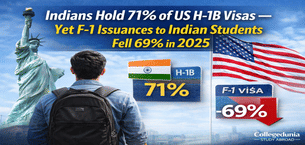
The Shorelight report notes that if Indian demand declines further, the consequences for US universities, research labs, and the tech sector will be measurable within a decade. Close to 75% of all H-1B work visas are awarded to Indians. The current CEOs of Google, Microsoft, and IBM are Indian-born.
What Fall 2026 Applicants Must Do Right Now
A 61% rejection rate does not mean the US is closed. It means the margin for error in an F-1 application has shrunk to near zero. Every element now carries more weight than it did two years ago.
1. Apply early and build a 12-week buffer. Administrative processing holds for Indian F-1 applicants have increased significantly. Book your visa interview as soon as you receive your I-20. The 2025 interview pause compressed the entire peak season — do not wait until May or June.
2. Prepare a financial trail, not just a balance. Six months of consistent bank statements showing gradual accumulation are stronger than a single large deposit made shortly before the application. If funds were recently consolidated, include a clear explanation letter.
3. Social media is now part of the visa file. The US Embassy requires all F, M, and J visa applicants to set social media accounts to public and list every username used in the past five years. Audit every account before submitting your DS-160.
4. Write a specific, verifiable Statement of Purpose. Generic programme descriptions are flags. Your SOP must answer five questions with concrete detail: why this programme, why this university, why the US, what is your career plan, and why will you return to India.
5. Have a parallel application ready. A 61% refusal rate makes shortlisting only US universities a high-risk strategy. Germany (90–95% approval, 6-day processing, zero tuition at public universities) and Ireland (95–97% approval, 24-month post-study work) are not fallbacks — they are primary options for many profiles in 2026.
A Decade of Data, and No Reform in Sight for Fall 2026
The Shorelight report calls for specific reforms: greater transparency in denial reasons, standardised financial guidance for high-refusal consulates, dual-intent provisions for F-1 visas, and codifying OPT into statute. None of these are in place for the current application cycle.
The US State Department's response, as quoted in Inside Higher Ed, was that "all visa applications are reviewed on a case-by-case basis." The data does not support that framing. A case-by-case system would not produce a 52-percentage-point gap between European and Indian applicants that has widened consistently over ten years.
For Indian families making this decision in April 2026, the structural bias in the F-1 system is not a policy debate — it is a planning variable. The 61% rejection rate is the highest in ten years of data. It rose 8 percentage points in a single year. Apply with that reality fully priced in.
Also Check: Indian Student Visa Approval Rates 2026: US, Canada, UK, Australia, Germany Compared






Comments