



Education Journalist | Study Abroad Lead
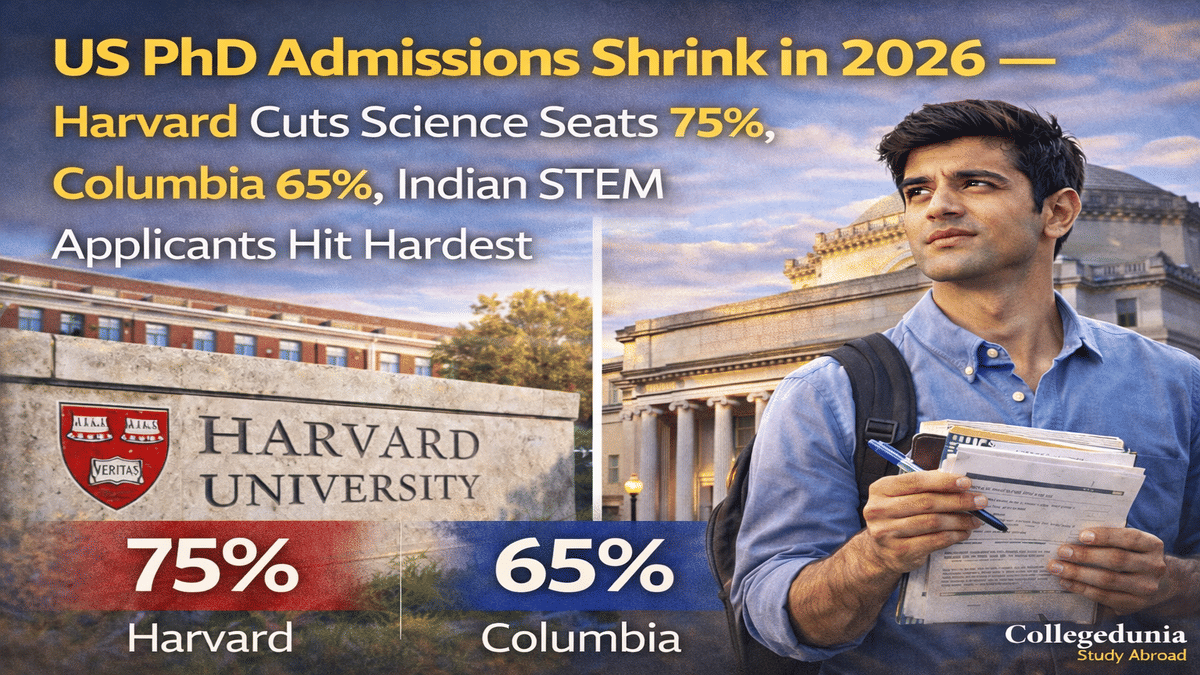
Indian students applying for fully-funded STEM PhD programmes at top US universities in Fall 2026 are facing the sharpest contraction in available seats in over two decades. Harvard has cut its science PhD intake by more than 75%, Columbia has proposed reducing its incoming doctoral cohort by up to 65%, and the University of California San Diego's Biology programme has cut admissions by more than 30% — all directly linked to the Trump administration's freeze and proposed cuts to NIH and NSF research funding.
Indian nationals make up the largest share of international STEM PhD students in the US. With new international graduate enrolment already down 19% in 2025 (Global Enrolment Benchmark Survey) and Indian undergraduate applications to US colleges falling 14% (Common App, November 2025), the PhD funding crisis adds a structural layer to what was already a deteriorating admissions environment.
Why US PhD Seats Are Disappearing in 2026
The cuts are not arbitrary. They are the direct consequence of a federal funding environment that has made it financially impossible for many universities to guarantee stipends and research support for incoming doctoral students.
In the US, a funded PhD is not a scholarship — it is an employment arrangement. PhD students in STEM fields are paid a stipend (typically $25,000–$40,000 per year) and receive full tuition waivers in exchange for research and teaching work. That stipend is almost always paid from a faculty member's federal research grant — awarded by NIH (for biomedical sciences) or NSF (for physical sciences, engineering, and computing).
When the Trump administration froze NIH grant reviews in January 2025, proposed a 15% cap on NIH indirect funding, and began cutting NSF's budget — ultimately by 55% in the first year — universities faced an immediate problem: they could not guarantee that the grants funding their PhD students would be renewed. The safest response was to admit fewer students.
The scale of the response has been significant:
- Harvard Faculty of Arts and Sciences: Science division PhD seats cut by more than 75%; Arts & Humanities by 60%. Molecular and Cellular Biology was reduced to 4 new students. Chemistry and Chemical Biology: 4 new students. (Harvard Crimson, October 2025)
- Columbia University GSAS: Proposed to cut the incoming PhD cohort by up to 65%. NIH subsequently froze all research grants to Columbia — over $400 million — compounding the crisis. (Columbia Spectator, February 2025; Inside Higher Ed, April 2025)
- UC San Diego Biology: Cut admissions by more than 30% — from a target of 25 new students to 17 — due to uncertainty over a 35-year-old NIGMS institutional training grant expiring in summer 2026. (The Scientist, February 2025)
- George Washington University: 7% cut in doctoral student support; admissions paused entirely in 5 programmes, including mathematics and clinical psychology. (GW Hatchet, January 2026)
- Stanford: Reduced independent funding for bioscience graduate students from four years to two years; staff hiring frozen. (Stanford News, February 2025)
- Yale, Brown, USC, Boston University, Penn, Wisconsin, Michigan State, and Washington: All scaled back, paused, or froze new PhD admissions across multiple programmes. (Forbes, January 2026)
Which STEM Fields Are Cutting the Most — and Why It Hits Indian Applicants Hardest
The cuts are not uniform across disciplines. They follow the funding source. Fields that depend most heavily on NIH and NSF grants have been hit hardest.
| STEM Field | Primary Funding Source | Severity of Cuts | Indian Student Impact |
|---|---|---|---|
| Molecular & Cell Biology | NIH | Severe — Harvard: 4 seats total | Very high — largest Indian PhD cohort in biomedical sciences |
| Chemistry / Chemical Biology | NIH + NSF | Severe — Harvard: 4 seats; Columbia: deep cuts | High — strong Indian applicant pool in organic and computational chemistry |
| Biomedical Engineering | NIH + NSF | High — widespread freezes at R1 universities | Very high — top destination for Indian BTech/MTech graduates |
| Neuroscience | NIH | High — training grants under threat | Moderate — growing Indian applicant base |
| Computer Science (research-track) | NSF + DARPA | Moderate — NSF cut 55%; some programmes paused | Very high — CS is the single largest PhD field for Indian students in the US |
| Physics | NSF + DOE | Moderate — selective cuts | Moderate |
| Mathematics | NSF | Moderate-High — GWU paused entirely | Moderate |
| Environmental Science / Climate | NSF + EPA + NOAA | Severe — EPA and NOAA grants cancelled | Low-Moderate |
Critical note for Indian applicants: Computer Science PhD programmes funded primarily through industry partnerships (Google, Microsoft, Meta research grants) or university endowments have been less affected than NIH-dependent biomedical fields. Indian CS PhD applicants at well-endowed private universities (MIT, Carnegie Mellon, Stanford, Cornell) face a different — and less severe — funding picture than those applying to biology or chemistry programmes at the same institutions.
The Numbers Behind the Contraction
The scale of the PhD admissions pullback is the largest since the 2008 financial crisis — and in some fields, the largest ever recorded.
| Metric | Before (2023–24) | Now (2025–26) | Change |
|---|---|---|---|
| New international graduate enrolment in US | Baseline | −19% | Sharpest drop in a decade |
| Indian UG applications to US (Common App) | Baseline | −14% | First decline since 2020 |
| Harvard Science PhD seats | ~25/programme | 4 (Mol. Cell Bio.) | −75%+ |
| Columbia GSAS PhD cohort | Baseline | Proposed −65% | −65% |
| STEM PhDs lost from federal agencies (2025) | Baseline | Net −4,224 | 11:1 departures vs new hires |
| NSF budget cut | Baseline | −55% (Year 1) | Largest in NSF history |
What This Means for Indian PhD Applicants Right Now
For Indian students currently in the Fall 2026 PhD application cycle — or planning for Fall 2027 — the implications are direct and require immediate recalibration.
1. Verify funding status before applying
Before submitting a PhD application to any US programme, email the department's graduate coordinator and ask directly: "Is the programme admitting a full cohort for Fall 2026, and is stipend funding guaranteed for admitted students?" Many programmes have quietly reduced cohorts without public announcements. A non-response or vague answer is itself informative.
2. Prioritise programmes with endowment-backed or industry-backed funding
PhD programmes at universities with large endowments (MIT, Caltech, Princeton, Carnegie Mellon) or strong industry research partnerships (CS programmes at Stanford, CMU, Cornell) are more insulated from federal funding cuts than NIH-dependent biomedical programmes at the same institutions. For Indian students in CS, AI, and electrical engineering, the funding picture is materially better than for those in biology or chemistry.
3. Broaden the geography of your PhD search
Canada has launched an aggressive counter-strategy. In December 2025, the Canadian government announced CAD $133.6 million to attract up to 600 doctoral students and 400 postdoctoral researchers — many expected to come from the US pipeline. Universities of Toronto, Waterloo, UBC, and McGill are actively expanding PhD cohorts in STEM fields with guaranteed multi-year funding packages.
Germany's fully-funded PhD positions (paid research contracts, not scholarships) in engineering, physics, and computer science at institutions like TU Munich, RWTH Aachen, and KIT remain open and are not subject to any federal funding freeze. The application process is direct — applicants contact professors, not admissions offices.
4. Do not assume a waitlist offer will convert
In a normal year, 20–30% of waitlisted PhD applicants receive offers as admitted students decline. In 2026, with smaller cohorts and fewer declines (admitted students are holding offers more tightly given the uncertain environment), waitlist conversion rates are lower. Do not defer other plans on the basis of a waitlist position.
5. For those already in US PhD programmes
If your advisor's NIH or NSF grant is up for renewal in 2026, have a direct conversation about funding continuity. The SEVIS termination risk (covered separately) and the funding uncertainty are separate but compounding pressures. Know your funding source, its renewal date, and your fallback options before the situation becomes urgent.
Where the US PhD Pipeline Goes From Here
The PhD admissions contraction of 2025–26 is not a one-year anomaly. It is the leading edge of a structural shift in how the US funds graduate education — and Indian students, who have historically been the largest beneficiaries of that system, are disproportionately exposed to its unravelling.
The US built its STEM PhD dominance on a simple model: federal grants fund faculty research, faculty fund PhD students, PhD students produce research, research produces economic value. The Trump administration's cuts to NIH and NSF have disrupted the first link in that chain. Every subsequent link — including the 50,000+ Indian students currently in US STEM PhD programmes — is now less stable than it was two years ago.
For Indian students with the academic profile to compete for a fully-funded US PhD, the question in 2026 is no longer just "which programme?" It is "which programme still has the funding to support me for five years?" That is a harder question — and one that requires more due diligence than a US PhD application has ever demanded before.



Comments