



Education Journalist | Study Abroad Lead | Updated On - Apr 17, 2026
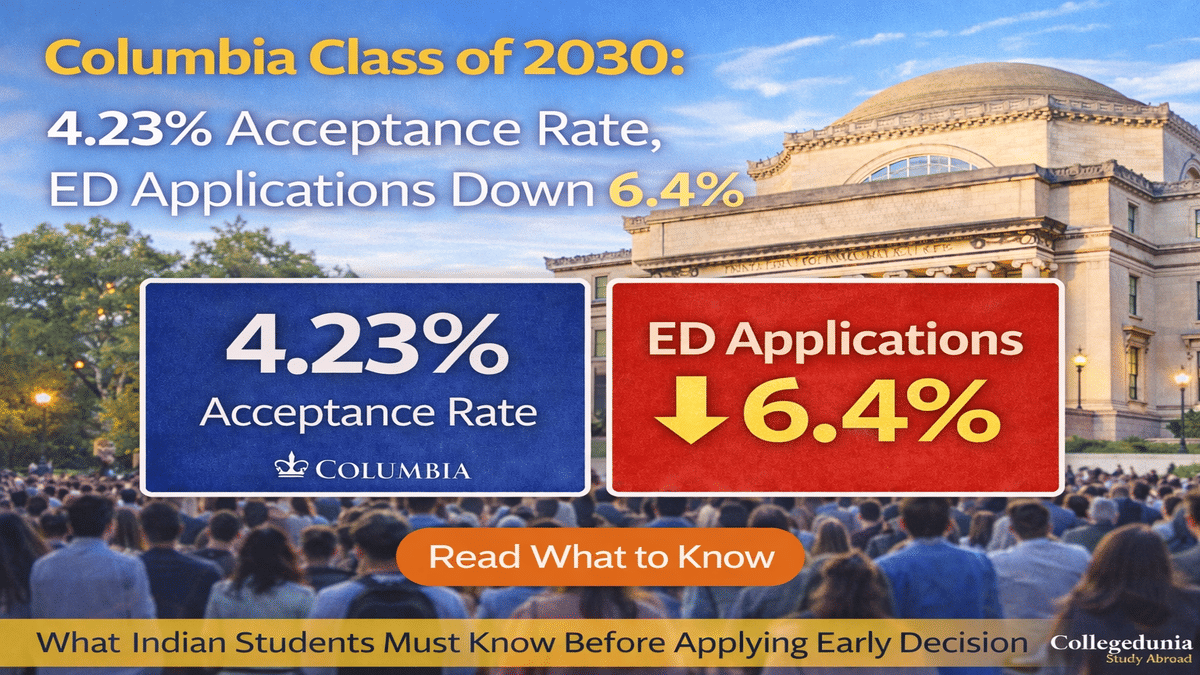
Indian students targeting Columbia University for undergraduate admission now have a data point that changes the strategic calculus: Early Decision applications fell 6.4% for the Class of 2030 — from 5,872 to 5,497 — making it the only Ivy League school to report a decline in ED volume this cycle. At the same time, Columbia's overall acceptance rate tightened to 4.23%, down from 4.9% for the Class of 2029, across a record 61,031 total applications.
For Indian applicants planning their Class of 2031 strategy — with ED deadlines arriving in October–November 2026 — the combination of a smaller ED pool and Columbia's full need-based financial aid commitment creates a window that did not exist two years ago.
Check: Columbia University — Courses, Fees, Admission & Scholarships for Indian Students
What the Class of 2030 Numbers Actually Show
Columbia released its Class of 2030 admissions decisions on March 26, 2026 — Ivy Day — admitting 2,581 students from the largest applicant pool in university history.
| Metric | Class of 2029 | Class of 2030 | Change |
|---|---|---|---|
| Total applications | ~57,000 (est.) | 61,031 | +7.1% |
| Students admitted | ~2,800 (est.) | 2,581 | Smaller cohort |
| Overall acceptance rate | 4.9% | 4.23% | −0.67 pp |
| ED applications received | 5,872 | 5,497 | −6.4% |
| Financial aid offered | ~50% | ~50% of the admitted class | Maintained |
| Countries represented | — | 111 | — |
The headline number — 4.23% — makes Columbia the most selective Ivy League school by acceptance rate this cycle, ahead of Harvard (3.6%), Princeton (3.9%), and Yale (3.7%). But the more strategically significant number for Indian applicants is the 6.4% drop in ED applications — a figure no other Ivy reported this cycle.
Brown's ED pool grew 12%. Penn's ED applications rose. Yale and Harvard saw stable or growing early pools. Columbia was the outlier — and the reason is not hard to identify.
Why Columbia's ED Pool Shrank — and What Drove It
Columbia has faced sustained reputational pressure since 2022. Its US News ranking fell to No. 15 — the lowest among Ivy League schools — after a data inflation controversy that saw it drop from a tie for No. 2. Campus protests in 2024 and 2025 generated significant negative media coverage. In March 2025, the Trump administration cut $400 million in federal funding to Columbia; a July 2025 settlement restored most of it, but the episode drew criticism from students, faculty, and prospective applicants alike.
The result: some domestic applicants who might have committed to Columbia ED chose to apply elsewhere or wait for Regular Decision. Columbia Spectator interviews with Class of 2030 ED admits confirm that several students' friends actively discouraged them from applying, citing the settlement with the Trump administration.
For Indian applicants, this context matters — but not in the way it might for domestic students. The reputational concerns driving the ED decline are largely US-specific. Columbia's academic standing, Core Curriculum, New York City location, and alumni network remain unchanged. Its financial aid commitment — 100% of demonstrated need, no loans — is one of the most generous in the Ivy League.
Key point: A smaller ED pool at a school that has not reduced its admitted class size means each ED application carries marginally more weight. That is the strategic opening.
The ED Advantage at Columbia — What the Historical Data Shows
Columbia does not publicly release its ED acceptance rate. But the structural advantage of applying ED at highly selective universities is well-documented. At schools like Columbia, Penn, Duke, and Brown, ED admit rates are typically two to three times higher than Regular Decision rates, according to admissions data compiled by Oriel Admissions and Top Tier Admissions.
The reason is straightforward: ED applicants signal demonstrated first-choice commitment, which matters to universities managing yield rates. Columbia's Class of 2029 saw a record 1,806 students enrol — the largest incoming class in university history — suggesting the university values yield management highly.
For Indian students, the ED advantage is real but comes with a critical constraint: ED is binding. If admitted, you must enrol and withdraw all other applications. This makes financial aid clarity essential before committing.
| Factor | ED Applicant | RD Applicant |
|---|---|---|
| Acceptance rate advantage | 2–3x higher (est.) | Baseline (4.23% overall) |
| Pool size (Class of 2030) | 5,497 (down 6.4%) | ~55,534 (up ~7%) |
| Financial aid comparison | Cannot compare offers | Can compare multiple offers |
| Binding commitment | Yes — must enrol if admitted | No |
| Aid withdrawal option | Yes — if aid is insufficient | N/A |
Financial Aid at Columbia — What Indian Students Need to Know
Columbia meets 100% of demonstrated financial need for all admitted students, including international students. Approximately half of the Class of 2030 has been offered financial aid. The university does not include loans in its financial aid packages — aid is grants only.
For Indian families, this is significant. Columbia's annual tuition for international students is approximately $68,000 — roughly ₹63.3 lakh at ₹93.06/USD. With room, board, and living costs, the total annual cost of attendance exceeds $90,000 (≈ ₹83.8 lakh). A full need-based aid package can reduce this to zero out-of-pocket cost for families with limited income.
The binding nature of ED does not prevent withdrawal if the financial aid package is inadequate. Columbia's admissions office has confirmed that students who cannot afford the offered package may be released from the ED commitment — a provision that Class of 2030 ED admits cited as making the early commitment feel less financially risky.
Should Indian Students Apply ED to Columbia for Class of 2031?
The honest answer is: it depends on three things — and all three must be true before ED makes strategic sense.
1. Columbia must be your genuine first choice
ED is not a tactical tool for undecided students. The binding commitment is real. If you are weighing Columbia against MIT, Stanford, or a UK university like UCL or Imperial, apply Regular Decision and compare offers. ED only makes sense if Columbia is unambiguously your first choice.
2. You must be financially prepared for the binding commitment
Before applying ED, use Columbia's Net Price Calculator for international students to estimate your aid package. If the estimated out-of-pocket cost is manageable for your family, ED is viable. If it is not, apply RD and compare financial aid offers from multiple universities.
3. Your application must be complete and competitive by the ED deadline
Columbia's ED deadline for the Class of 2031 is expected in early November 2026. That means SAT/ACT scores, essays, recommendations, and extracurricular documentation must all be finalised by October. Students who need more time to strengthen their application — retake standardised tests, complete a research project, or improve grades — are better served by RD.
If all three conditions are met, the Class of 2030 data makes a clear case: a smaller ED pool, a maintained financial aid commitment, and a university whose academic standing has not materially changed despite its reputational turbulence. For a well-prepared Indian applicant for whom Columbia is a genuine first choice, this is as favourable an ED environment as Columbia has offered in several years.
Columbia vs Other Ivies: Where Does the ED Opportunity Compare?
| University | Class of 2030 Overall Rate | ED App Trend | Meets 100% Need (Intl)? |
|---|---|---|---|
| Columbia | 4.23% | −6.4% (only Ivy to decline) | Yes |
| Harvard | 3.6% | Stable/growing | Yes |
| Yale | 3.7% | Stable | Yes |
| Brown | ~5.1% | +12% ED growth | Yes |
| Penn | ~5.7% | Growing | Yes |
Among the Ivies, Columbia is the only school where the ED pool shrank while the overall application volume grew. That combination — more total competition, less early competition — is unusual and unlikely to persist. If Columbia's reputational environment stabilises under incoming President Jennifer Mnookin (taking office July 1, 2026), ED volumes are likely to recover for the Class of 2031. The current window may not repeat.
For Indian students who have spent years building a profile for an Ivy League education, the Class of 2030 data is not a reason to lower standards or change targets. It is a reason to make a more informed, more strategic decision about when to apply — and to do so with full clarity on the financial commitment involved.



Comments