



Education Journalist | Study Abroad Lead | KdTvCV - May 20, 2026
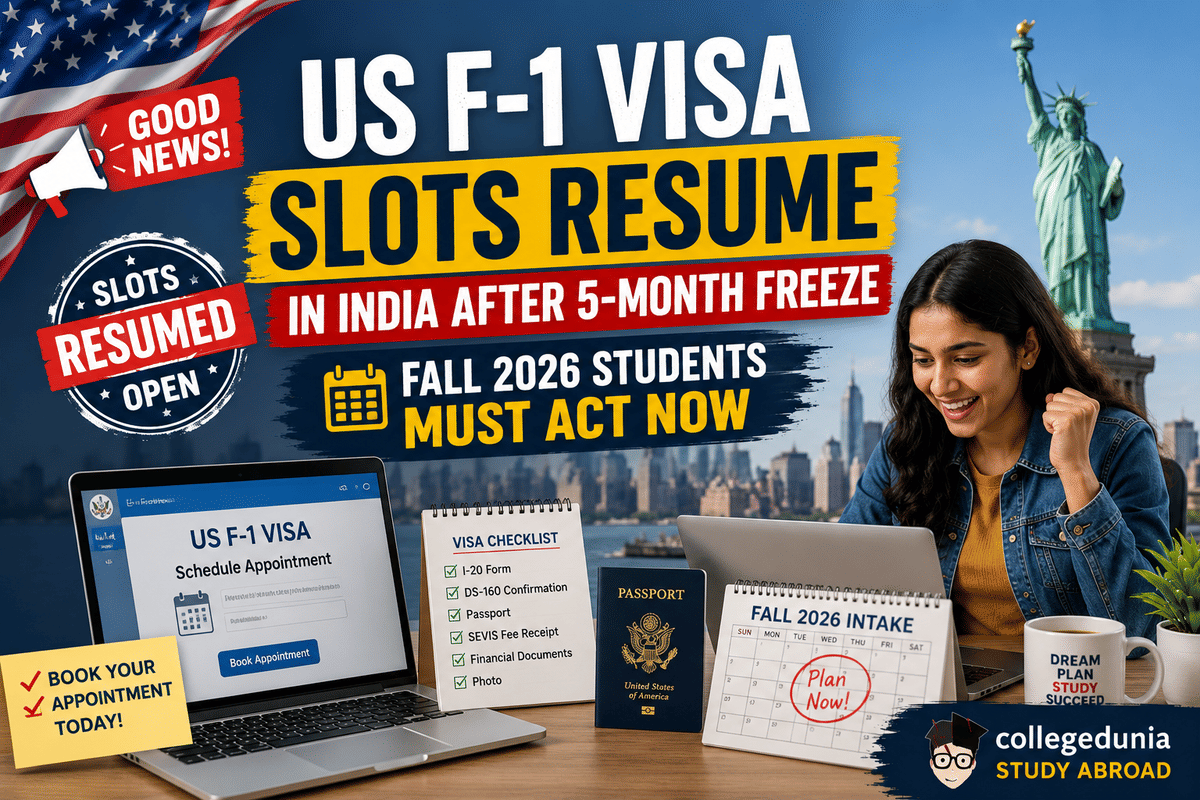
F-1 visa interview slots at all five US consulates in India have resumed after a five-month freeze, with batches of appointment dates appearing on the scheduling portal since mid-April 2026. The backlog was triggered by stricter social media vetting rules introduced on 15 December 2025, which slashed daily interview capacity across New Delhi, Mumbai, Chennai, Hyderabad, and Kolkata.
According to the Murthy Law Firm, "significant improvement" was confirmed across all Indian posts as of 23 April 2026, but demand still far outstrips supply, and the peak Fall 2026 rush is already underway. With over 1 lakh Indian students estimated to be waiting for slots, the window to secure a safe interview date before August is narrowing fast.
- Slots resumed in mid-April 2026 at all five Indian consulates — Delhi, Mumbai, Chennai, Hyderabad, Kolkata
- The freeze lasted approximately five months, caused by enhanced social media screening rules effective 15 December 2025
- Slots are released in small, irregular batches and fill within minutes — availability is not guaranteed
- Students with prior F-1 refusals may face restricted access to newly released dates
- Third-country stamping remains permanently banned since September 2025 — all Indian applicants must interview in India only
- Full normalisation is not expected until late 2026; STEM applicants face additional administrative processing risk
Update — May 20, 2026: The slot crisis has deepened. Consultants now estimate over 3 lakh Indian applicants are competing for approximately 90,000 interview slots across all five consulates — a supply gap that explains why batches released on May 15 for June–July dates filled within minutes. Two new warnings every applicant must know:
- Do not refresh the portal repeatedly or switch between consulates. The US scheduling system now triggers a 24–72 hour access lockout if it detects excessive activity on your account. One session, one consulate, move deliberately.
- Ignore WhatsApp agents offering "guaranteed" slots. Fake agents are charging up to ₹50,000 for slots they cannot deliver. The only legitimate booking portal is ustraveldocs.com. No third party can access or hold slots on your behalf.
Also Check:
- US Student Visa Queues in India Now Run Up to 3.5 Months — Fall 2026 Applicants Must Book in May
- US F-1 Visa Drop 69%: What Indian Students Must Know for 2026
- F1 Visa Slot Booking: How to Book Your F1 Visa Interview Slot
What Changed — and Why Slots Disappeared for Five Months
The freeze was not a policy ban on student visas. It was a capacity collapse. On 15 December 2025, the US State Department expanded its social media vetting requirements to cover all F, M, and J visa applicants — requiring every student to set all social media accounts to public and list every username or handle used over the past five years on their DS-160 form. The additional screening time per applicant cut the number of interviews each consulate could process daily, and appointment availability effectively dried up across India.
- Before the freeze, Indian students who faced long queues had a practical workaround: book a slot at a US consulate in Mexico, Canada, or Germany, where appointments were often available within days.
- That option was permanently closed on 6 September 2025, when the State Department directed all non-immigrant visa applicants to interview only in their country of nationality.
- Every Indian student now competes for the same five posts — and the combined pressure of the third-country ban and the December vetting rules pushed wait times at some consulates to dates as far out as 2027.
The mid-April resumption marks the first meaningful easing since that collapse. Financial Express first reported the batch releases; the Murthy Law Firm independently confirmed improvement across all Indian posts as of 23 April 2026. The US Embassy in India's official scheduling portal — ustraveldocs.com — is the only authorised channel to check and book appointments.
Check: Is Your GitHub Flagging Your F-1 Visa? The New Social Media Audit Every STEM Applicant Needs
Current Slot Availability by Consulate — May 2026
Availability is inconsistent and changes daily. Based on the latest data from the US State Department's Global Visa Wait Times portal and tracker data as of early May 2026, the picture across Indian consulates is as follows:
| Consulate | F/M/J Slot Status (May 2026) | Fall 2026 Risk Level |
|---|---|---|
| New Delhi | Limited slots available; dates in mid-May | Lower risk — book immediately |
| Chennai | Batches releasing; ~1 month wait | Manageable — act this week |
| Mumbai | ~2.5 months; irregular batch releases | Borderline — STEM applicants at risk |
| Hyderabad | ~2.5 months; improving slowly | Borderline — STEM applicants at risk |
| Kolkata | ~3–3.5 months; most constrained post | High risk — consider Delhi/Chennai |
Source: US State Department Global Visa Wait Times portal; visagrader.com tracker data, May 2026. Wait times are estimates and change frequently.
One critical fact: Indian students are not required to interview at the consulate nearest their home city. A student based in Kolkata or Bengaluru can legally book at New Delhi or Chennai. Given that a one-semester deferral at most US universities costs between $500 and $2,000 (approximately ₹48,000–₹1.92 lakh at the current consular exchange rate of ₹96 per dollar), the cost of travelling to Delhi for an earlier slot is almost always lower than the cost of missing Fall 2026 entirely.
The STEM Timing Problem
Securing an interview date is not the same as securing a visa. For Indian students in Computer Science, Artificial Intelligence, Aerospace, or Biotechnology, a significant share of applications trigger administrative processing — a post-interview security review under Section 221(g) of the US Immigration and Nationality Act. This adds 60 days to 6 months on top of the interview wait, with no guaranteed timeline.
For a Kolkata applicant booking today, the realistic worst-case scenario: interview in late July, administrative processing triggered, visa in hand by October or later — Fall 2026 missed entirely. For a New Delhi applicant booking this week, the same scenario still lands safely: interview in late May, processing complete by late July, August arrival intact.
The consulate choice is not a matter of convenience. For STEM applicants, it determines whether they make their intake at all. This is the same structural risk that caused F-1 visa issuances to Indian students to fall 69% in June–July 2025 — the sharpest peacetime decline on record.
What Indian Fall 2026 Applicants Must Do Right Now?
May is the last safe booking month for a Fall 2026 start. The action sequence, in order:
- Complete your DS-160 today at ceac.state.gov. Every day of delay pushes your interview date further into summer.
- Pay the SEVIS I-901 fee ($350 / approximately ₹33,600) at fmjfee.com. This must be done before booking.
- Pay the MRV visa application fee ($185 / approximately ₹17,760 at the consular rate of ₹96 per dollar). Payment activates your appointment calendar access.
- Book at New Delhi or Chennai if your local consulate wait exceeds six weeks. You are legally permitted to do this regardless of where you live in India. Book at ustraveldocs.com.
- Request an expedited appointment immediately after booking your regular slot — citing your programme start date. Expedited slots are limited but available for genuine academic urgency.
- Set all social media accounts to public before your interview. The US Embassy requires this for all F, M, and J applicants. List every username and handle used in the past five years on your DS-160.
- Do not book non-refundable flights until your visa stamp is physically in your passport — especially if you are in a STEM field where administrative processing is common.
- Check for cancellation slots daily. New dates appear without notice. Applicants who check the portal at off-peak hours — early morning or late night — consistently find earlier openings.
The resumption of F-1 slots is genuine relief — but it is not a return to normal. Over 4.2 lakh Indian students are currently enrolled in US universities, making India the single largest source of international students in the country. The demand for Fall 2026 slots is enormous, and the system that serves it remains under strain. Third-country stamping is permanently gone. Social media vetting is now standard for every applicant. The US rejected 61% of Indian F-1 applications in 2025 — the highest rate in a decade.
None of these conditions have changed with the April slot releases. What has changed is that the door is open again — narrowly, and for now. Indian students who move this week, choose their consulate strategically, and build a realistic buffer for processing time are in a materially better position than those who wait for the system to fully stabilise. That stabilisation, according to immigration consultants tracking the situation, is not expected before late 2026 at the earliest.



Comments