




Study Abroad Content Writer | Updated On - May 21, 2026
The Spring intake in the USA starts in January and is the second major admission cycle at US universities. Spring 2026 has already passed. The next target for Indian students is Spring 2027 (January 2027 start), with application windows opening between July and October 2026 for most programs.
- Spring intake covers only 60–70% of programs available in Fall; highly competitive CS, MBA, and STEM programs are often Fall-only.
- CPT (Curricular Practical Training) is not available in your first US summer if you start in January, a critical career disadvantage for tech and finance roles.
- Scholarships are significantly limited in Spring; most TA and RA positions are allocated at the start of the Fall academic year.
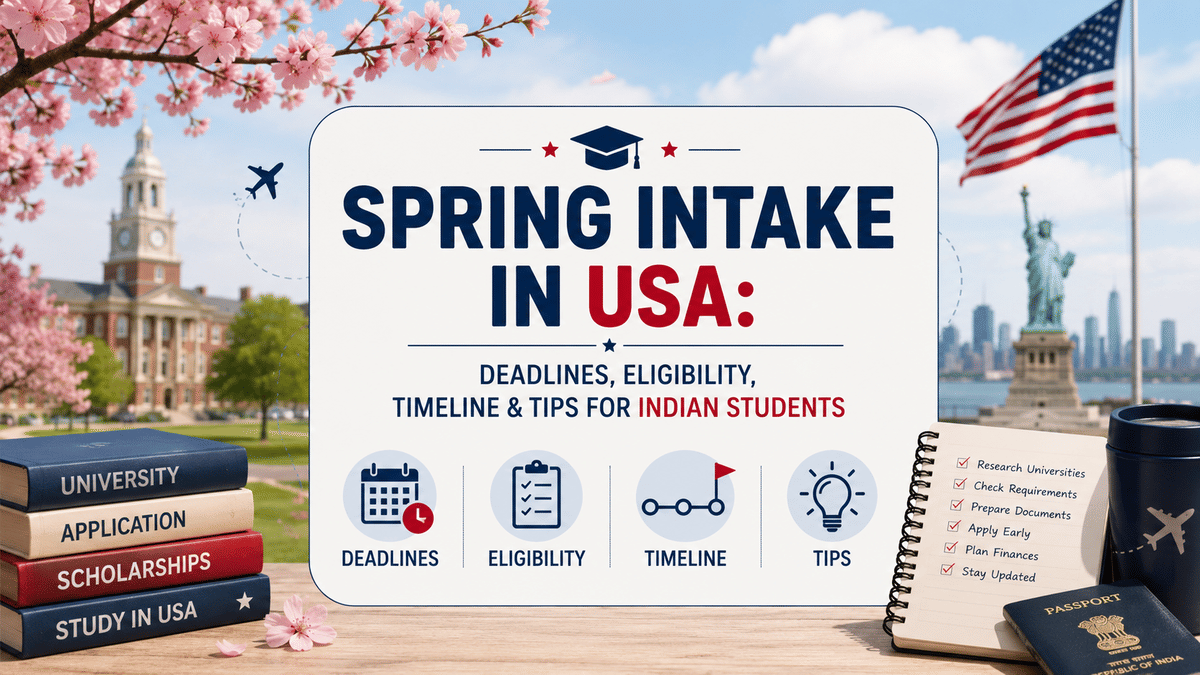
What is Spring Intake in the USA?
The Spring intake is also called the January intake. It is the second admission cycle at US universities. Classes begin in January and run through April or May.
It is a legitimate entry point, especially for students who:
- Missed the Fall 2026 application deadline
- Need more time to improve GRE, TOEFL, or IELTS scores
- Were waitlisted or deferred from a Fall admit
- Prefer a smaller cohort and more direct faculty access
Not all universities offer Spring admission. Roughly 60–70% of US programs are available in Spring, compared to nearly all programs in Fall. Highly competitive programs in CS, MBA, and certain STEM fields are often Fall-only.
A common misconception among Indian students on Reddit and Quora: "Spring intake means lower quality." That is not accurate. The admission standards are identical – what changes is the applicant pool size and program availability.
Learn more: Intakes in USA: Fall, Spring and Summer | Fall vs Spring Intake in USA
Spring 2027 Application Deadlines: University-Wise
For Spring 2027 (January 2027 start), most universities open applications between July and August 2026. Priority deadlines typically fall between September and October 2026, with final deadlines in November 2026. Some programs close as early as August 1.
The table below shows Spring 2027 application deadlines based on published university admissions data. Always verify on the official program page – deadlines vary by department.
| QS Rank 2026 | University | Spring 2027 Deadline | Admission Type |
|---|---|---|---|
| #1 | MIT | January 2027 (Regular Action) | Select programs only |
| #5 | Harvard University | November 2026 | Select graduate programs |
| #21 | Yale University | November 2026 | Select programs |
| #70 | University of Illinois (UIUC) | October 15, 2026 (Spring priority) | Program-specific rolling |
| #146 | University of Southern California (USC) | October–November 2026 | Program-specific |
| #190 | Ohio State University | October 15, 2026 | Priority deadline |
| #212 | University of Florida | August 1, 2026 (international) | Regular Decision |
| #299 | University of Colorado Boulder | October 2026 | Rolling |
| #423 | Washington State University | November 15, 2026 (Priority) | Priority Date |
| #534 | University of Connecticut | December 15, 2026 | Rolling |
| #540 | University of Utah | November 2026 | Regular |
| #701–710 | University of Central Florida (UCF) | September–October 2026 | Rolling |
| #761–770 | New Jersey Institute of Technology (NJIT) | November 15, 2026 | Rolling Admission |
| - | University of New Haven | November 15, 2026 | Spring Priority |
| - | University of Cincinnati | November 1, 2026 | Regular |
Important Note: Deadlines listed are based on historical patterns and published admissions data for Spring 2027. Always verify on the official university admissions page for your specific program. Department-level deadlines can be 2–3 weeks earlier than the university-wide deadline — a common oversight among Indian applicants. Never rely solely on the main university website; check the department page separately.
Top Universities Accepting Spring Intake in the USA
Not all US universities offer Spring admission. The ones that typically accept students for select graduate programs. Below is a list of universities known to accept Spring intake students, with popular programs and approximate annual tuition.
| University | QS Rank 2026 | Popular Spring Programs | Approx. Annual Tuition |
|---|---|---|---|
| MIT | #1 | Select MS and PhD programs | ~$60,000 (₹57.9 lakh) |
| University of Illinois (UIUC) | #70 | CS, ECE, MCS, Bioinformatics | ~$32,000 (₹30.9 lakh) |
| University of Southern California (USC) | #146 | CS, Electrical Engineering, Data Analytics | ~$35,000 (₹33.8 lakh) |
| Ohio State University | #190 | Engineering, Business, Public Health | ~$30,000 (₹29.0 lakh) |
| University of Florida | #212 | Engineering, Computer Science, Business | ~$28,000 (₹27.0 lakh) |
| University of Colorado Boulder | #299 | Engineering, Data Science, Business | ~$30,000 (₹29.0 lakh) |
| Washington State University | #423 | CS, Engineering, Business Analytics | ~$26,000 (₹25.1 lakh) |
| NJIT | #761–770 | CS, Data Science, Engineering Management | ~$24,000 (₹23.2 lakh) |
| University of Central Florida (UCF) | #701–710 | CS, Engineering, Business | ~$22,000 (₹21.2 lakh) |
| University of New Haven | - | MS Accounting, Cybersecurity, Engineering | ~$21,000 (₹20.3 lakh) |
| University of Cincinnati | - | Engineering, Business, Health Sciences | ~$22,000 (₹21.2 lakh) |
Important Note: Tuition figures are approximate annual estimates based on published university data. Actual costs vary by program and credit load. Always check the official university fee page. INR conversions are based on 1 USD = ₹96.57 (as of May 21, 2026).
Explore: Cost of MS in USA for Indian Students | STEM Courses in USA
Eligibility and Score Requirements for Spring Intake
Eligibility for Spring intake is identical to Fall intake at most universities. Admission standards do not drop for Spring – what changes is the applicant pool size, which is smaller. The table below covers standard requirements for Indian students applying to the Spring intake at US universities.
| Requirement | For UG Programs | For MS / Graduate Programs |
|---|---|---|
| Academic Qualification | Class 12 (10+2) from a recognised board | Bachelor's degree in a relevant field |
| Minimum GPA / Percentage | 75–85% in Class 12 (varies by university) | 3.0/4.0 GPA or 7.0+ CGPA on a 10-point scale |
| GRE | Not required for UG | 310+ overall (Quant 160+ for STEM programs) |
| GMAT | Not required | 650+ for MBA programs |
| TOEFL iBT | 80–100 (varies by university) | 90–105 (varies by program) |
| IELTS Academic | 6.0–6.5 minimum | 6.5–7.5 (varies by program) |
| PTE Academic | Accepted at select universities | 58–65 (varies by program) |
| Work Experience | Not required | Required for MBA (2–5 years); optional for MS |
Important Note: Many US universities have moved to test-optional GRE/GMAT policies post-2020. However, submitting strong scores still strengthens your application – especially for Indian students competing in high-volume programs like CS and Data Science. A GRE score of 305 may be competitive at NJIT or UCF but not at UIUC or USC. Always research program-specific averages, not just university-wide cutoffs. Verify the current test policy on the official program page before applying.
Documents Required for Spring Intake in the USA
The document checklist for Spring intake is the same as Fall intake. The key difference is the compressed timeline – you have less preparation time, so starting document collection early is critical.
| Document | Details |
|---|---|
| Academic Transcripts | Official mark sheets from Class 10 through the final year of undergraduate study. Some universities require a WES evaluation (takes 4–6 weeks – initiate early) |
| Degree / Provisional Certificate | If in the final year, a provisional certificate or enrollment letter is accepted at the application stage |
| GRE / GMAT Scores | Sent directly from ETS/GMAC to each university. Order score reports 10–14 days before the deadline. Valid for 5 years |
| TOEFL / IELTS / PTE Scores | Valid for 2 years from test date. Scores are sent directly to universities by the testing body |
| Statement of Purpose (SOP) | 750–1,000 words. Must reference specific faculty, labs, or courses at each target university. Generic SOPs are a leading rejection reason for Indian applicants |
| Letters of Recommendation (LORs) | 2–3 letters submitted directly by recommenders. At least one academic LOR is required for MS programs. Give recommenders 4–6 weeks' notice minimum |
| Resume / CV | US format: no photograph, no date of birth, no marital status. 1–2 pages maximum. Quantify achievements wherever possible |
| Valid Passport | Must be valid for at least 6 months beyond your program start date (January 2027). Renew early if needed |
| Financial Documents | Bank statements (6 months), education loan sanction letter, or sponsor affidavit showing funds to cover at least one year of tuition and living expenses |
Important Note: If you need a WES (World Education Services) credential evaluation, initiate it at least 6 weeks before your application deadline. This is a step many Indian students overlook until the last minute, causing delays.
Read more: How to Write a Strong SOP | Fall vs Spring Intake in USA: Which is Right for You?
Practical Tips for Indian Students Applying to Spring Intake
- Start shortlisting now (May–June 2026). Spring 2027 deadlines open in August. Use this window to research programs, not scramble for documents later.
- Check department pages, not just the main university site. Many departments have internal deadlines 2–3 weeks earlier than the university-wide deadline. This is one of the most common mistakes Indian applicants make.
- Do not apply to Spring just to avoid a gap year. If your profile needs strengthening, a well-prepared Fall 2027 application will outperform a rushed Spring 2027 application at a lower-ranked school.
- Scholarships are limited in the spring. Most TA and RA positions are filled at the start of the academic year in the fall. If funding is a priority, factor this into your decision. Explore available options: Scholarships for Indian Students in the USA
- Apply to 8–12 universities. Include a mix of reach, target, and safety schools. Spring has fewer seats per program, so a wider list improves your chances significantly.
- Book your F-1 visa slot early. After receiving your I-20 in November or December, visa slots fill quickly. Do not delay booking your interview appointment.
- Arrange housing before arrival. January arrivals often find fewer on-campus housing options than Fall students. Start searching in November.
- Budget for living costs. Annual living expenses in the USA range from $10,000–$25,000 (₹9.7 lakh–₹24.1 lakh) depending on the city. Tier 1 cities like New York or LA cost significantly more than smaller cities.
Also explore:
Spring intake in the USA is a viable path for Indian students – roughly 60–70% of programs are available, competition is lower, and class sizes are smaller. However, the CPT restriction in the first summer is a real career cost for students targeting tech or finance roles. As of May 2026, Spring 2027 applications open in July–August 2026, with most deadlines falling between October and November 2026. Students who begin shortlisting and test preparation now will be in the strongest position when applications open. A well-prepared Spring 2027 application beats a rushed one every time.
FAQs
Ques. What is the Spring intake in USA?
Ans. The Spring intake in the USA is the second major admission cycle at US universities. Classes begin in January and run through April or May. It is also called the January intake. It is a legitimate entry point for students who missed the Fall intake, need more time to improve test scores, or prefer a smaller cohort. Spring 2026 has already passed — the next target is Spring 2027 (January 2027 start).
Ques. When do Spring 2027 applications open for Indian students?
Ans. Spring 2027 applications at most US universities open between July and August 2026. Priority deadlines typically fall between September and October 2026, with final deadlines in November 2026. Some programs — like the University of Florida for international students — close as early as August 1, 2026. Starting your preparation in May–June 2026 is strongly recommended.
Ques. Which universities in the USA accept Spring intake?
Ans. Several universities accept Spring intake applications, including MIT, Harvard, Yale, University of Illinois (UIUC), University of Southern California (USC), Ohio State University, University of Florida, University of Colorado Boulder, Washington State University, NJIT, University of Central Florida, University of New Haven, and University of Cincinnati, among others. Spring admission is available for select programs only — not all departments at these universities offer Spring entry. Always verify on the official program page.
Ques. Is Spring intake harder to get into than Fall intake?
Ans. No. Admission standards remain the same across both intakes. Spring typically has a smaller applicant pool, which can make it slightly less competitive for some programs. However, the number of available seats is also smaller in Spring, so the overall difficulty is broadly similar. The quality of education and degree awarded is identical regardless of intake.
Ques. Can Spring intake students do internships in the USA?
Ans. Not in their first US summer. CPT (Curricular Practical Training) — the work authorization that allows F-1 students to intern off-campus — requires one full academic year of enrollment, approximately 9 months. A Spring 2027 student completes only one semester by May 2027 and is not eligible for CPT that summer. They become eligible after completing the Fall 2027 semester. This is the single most consequential career disadvantage of Spring intake for students targeting tech, finance, or consulting roles.
Ques. What is the eligibility for Spring intake in USA for Indian students?
Ans. For MS programs: a bachelor's degree in a relevant field, minimum 3.0/4.0 GPA or 7.0+ CGPA, GRE 310+ (Quant 160+ for STEM), and TOEFL 90–105 or IELTS 6.5–7.5. For UG programs: Class 12 completion with 75–85%+ and TOEFL/IELTS scores. Requirements vary by university and program — always check the official program page before applying.
Ques. Are scholarships available for Spring intake in USA?
Ans. Scholarships are more limited in Spring compared to Fall. Most university-funded Teaching Assistantships (TAs) and Research Assistantships (RAs) are allocated at the start of the academic year in Fall. External scholarships like the Fulbright-Nehru Fellowship are also primarily aligned with Fall intake. Some merit-based and need-based university scholarships are available for Spring admits — check with each university's financial aid office directly.
Ques. What documents are needed for Spring intake in USA?
Ans. Documents required include: academic transcripts (Class 10 through final year), degree or provisional certificate, GRE/GMAT scores (if required), TOEFL/IELTS/PTE scores, Statement of Purpose (SOP), 2–3 Letters of Recommendation (LORs), resume/CV in US format, valid passport, and financial documents (bank statements, education loan letter, or sponsor affidavit). For the F-1 visa, you additionally need Form I-20, SEVIS fee receipt ($350, approx. ₹33,800), and DS-160 confirmation.
Ques. Should I apply for Spring 2027 or wait for Fall 2027?
Ans. Apply for Spring 2027 if you have missed Fall 2026 deadlines and your test scores and documents are ready. Wait for Fall 2027 if your GRE or IELTS scores need improvement, if your target program is Fall-only, or if internship eligibility in your first US summer is important to your career plan. A well-prepared Fall 2027 application will generally produce better outcomes than a rushed Spring 2027 application at a lower-ranked school.
Ques. How do I apply for an F-1 visa for Spring intake?
Ans. After receiving your Form I-20 from the university (typically in November–December 2026), pay the SEVIS I-901 fee of $350 (approx. ₹33,800) at fmjfee.com, complete the DS-160 online visa application, pay the MRV visa fee of $185 (approx. ₹17,865), and book your interview slot at one of the five US consulates in India (New Delhi, Mumbai, Chennai, Hyderabad, Kolkata). Book your slot as soon as your I-20 arrives — slots fill quickly in December.


1691135330.png%3Ftr%3Dw-305%2Ch-145%2Cc-force&w=750&q=75)



Comments