


Education Journalist | Study Abroad Strategy Lead
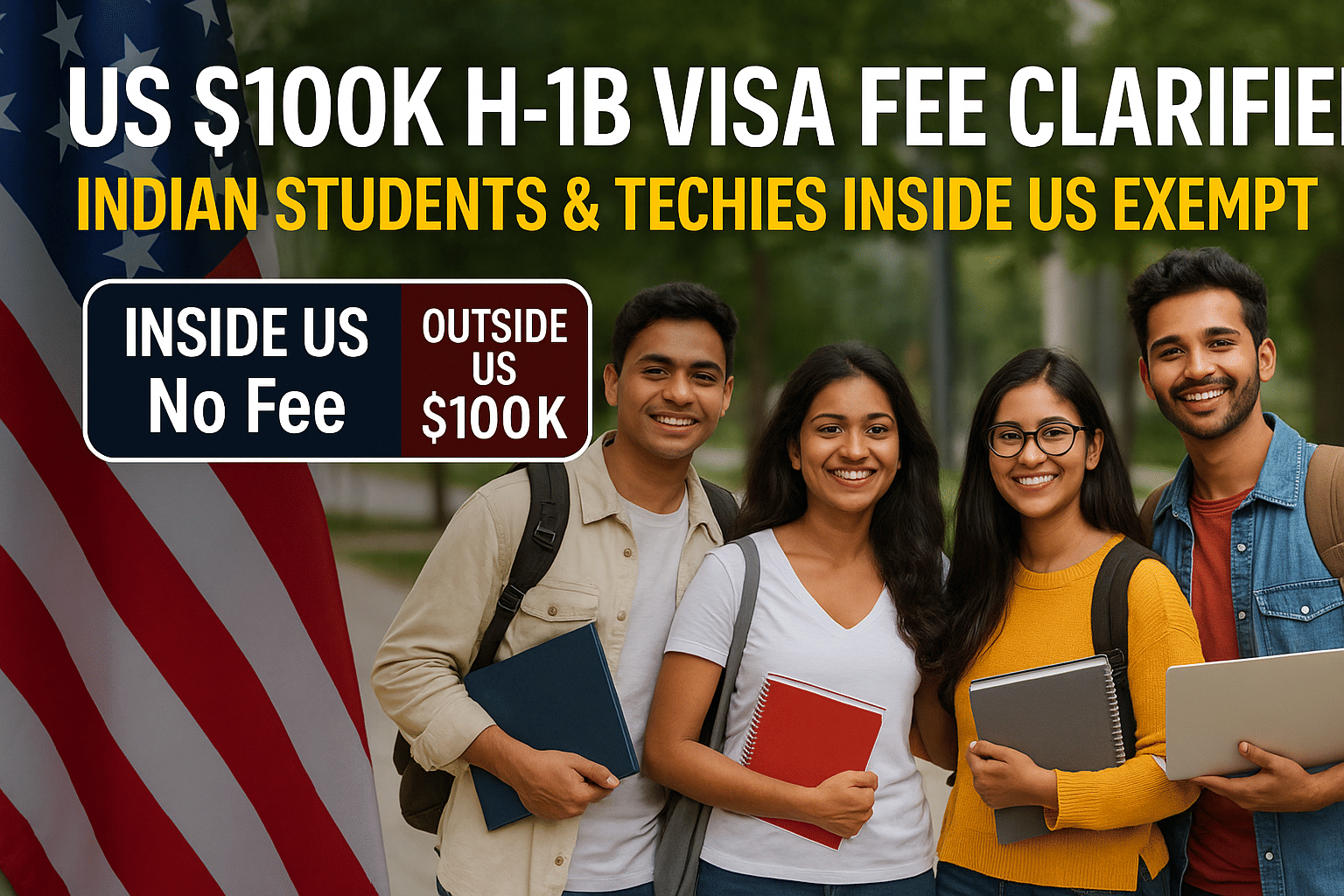
The United States has clarified new rules on the $100,000 H-1B visa fee, bringing relief to thousands of Indian students, skilled workers, and tech professionals. According to the latest US Citizenship and Immigration Services (USCIS) guidance, students and professionals already inside the US will not have to pay the new $100,000 fee when they apply to extend or change their visa status.
Also Read
- Indian Students Face Stricter US Visa Rules Amid Policy Overhaul
- H-1B Visa Fee Raised to $100,000: Trump’s New Order Could Impact Indian Tech Workers
- Trump’s H1B Lottery Reform 2026: High-Salary, High-Skilled Applicants to Get Priority
- US Sees 19% Drop in International Student Arrivals in August 2025 Amid Stricter Visa Rules
Who Has to Pay the $100,000 Fee?
The $100,000 surcharge — introduced under President Trump’s 19 September proclamation — applies only to:
- New H-1B visa petitions filed on or after 21 September 2025
- Applicants outside the US without a valid visa
If you’re already in the US on a valid F-1 student visa, L-1 work visa, or an existing H-1B, you’re exempt when applying for:
- A change of status (for example, from F-1 → H-1B)
- An extension or renewal of your current visa
That means most students completing their studies and moving to jobs through OPT or STEM-OPT will not have to pay the new charge.
Why This Matters for Indian Students?
India is the largest source of international students in the US, with over 4.2 lakh Indians currently studying there. Nearly 1 lakh graduates each year use OPT (Optional Practical Training) as a bridge to H-1B employment.
Without this exemption, many students faced the risk of losing job offers or paying huge extra costs. The new rule ensures:
- Smooth transition from F-1 to H-1B for those already in the US
- No additional burden for visa extensions or transfers
- More certainty for students planning to work in the US after graduation
What About Indian Tech Professionals?
For software engineers and other skilled professionals already in the US, the clarification is a major relief.
They can:
- Change employers or extend their H-1B without the $100k fee
- Continue working under existing grace periods after layoffs
- Avoid disruptions to projects and job transfers
However, for professionals still in India or other countries, the fee still applies. Companies hiring talent from abroad may now prefer candidates already in the US, making it harder for new applicants overseas.
The Bigger Picture
Visa applications are down 19 percent this year, as tighter rules and slower processing times continue.
Analysts warn that the $100k surcharge could discourage new hires and push students to other destinations like Canada, Germany, and the UK.
Experts say the clarification helps “protect the existing talent pipeline” — especially for sectors like AI, software, and healthcare, where skilled professionals are in short supply.
Also Read
What Students Should Do Next?
If you’re already studying or working in the US:
- Stay put — apply for H-1B change of status from inside the country.
- Check with your university’s international office or employer to ensure filings are handled correctly.
If you’re applying from India:
- Discuss petition type (in-country vs. consular) with your employer.
- Be aware that consular filings may still trigger the $100,000 levy.
- Keep backup options ready — the UK, Canada, Germany, and Ireland now offer simpler post-study work routes.
Key Takeaways
| Situation | $100,000 Fee Applies? | Notes |
|---|---|---|
| F-1 → H-1B (inside US) | No | Change of status exempt |
| H-1B extension/renewal | No | Existing visa holders safe |
| New petition (outside US) | Yes | Fee applies from 21 Sept 2025 |
| Employer transfer (within US) | No | No extra cost for job switch |
| Medical / research staff | Pending | Exemption under review |
The latest USCIS guidance offers welcome clarity for Indian students and professionals already in the US — but uncertainty remains for those applying from abroad.
For now, the study-then-work route (F-1 → OPT → H-1B) remains open and affordable. But experts advise students to stay informed, keep multiple options in mind, and be ready for further policy shifts as the US 2026 visa reforms unfold.








Comments