



Education Journalist | Study Abroad Strategy Lead | Updated On - Apr 16, 2026
In Fall 2025, Harvard's Indian student enrollment fell from 788 to 545 — a 31% drop in a single year. MIT cut its graduate student intake by 8%, directly reducing seats for Indian applicants who make up the overwhelming majority of its graduate cohort. Stanford's international student share fell from 14% to 12.7% in the Class of 2029. And across all three campuses, the same question is being asked in every Indian student group: which of these universities is actually safe to attend in 2026?
The answer depends entirely on what "safe" means to you. Safe from visa rejection? Safe from funding cuts? Safe from losing your OPT work rights after graduation? Safe from the Trump administration's escalating conflict with elite universities? Each of these is a different risk — and Harvard, MIT and Stanford score very differently on each one.
This article maps all four risk dimensions so you can make a decision based on facts rather than fear.
- Federal funding freeze: Harvard's USD 2.2 billion frozen April 2025; court restored it September 2025; appeal ongoing
- Endowment tax: One Big Beautiful Bill Act (signed July 4, 2025) imposes 8% tax on endowment income at Harvard, MIT and Stanford — reducing scholarship and research funding. Full breakdown here
- Visa environment: F-1 visa issuances to Indian students down 44% in H1 2025; DHS reviewing STEM OPT since February 2026
- What Has Actually Happened at Each University in 2025-2026
- Indian Student Enrollment: Harvard vs MIT vs Stanford
- F-1 Visa and OPT Risk: What Is Actually Changing
- Institutional Posture: Which University Is Fighting Hardest for Students
- Cost and Financial Aid: What Indian Students Actually Pay
- Safety Scorecard: Harvard vs MIT vs Stanford
- The Honest Verdict by Field and Goal
- FAQs
What Has Actually Happened at Each University in 2025-2026
All three universities are under pressure — but the nature of each conflict is different, and the outcomes so far are very different.
A funding freeze that gets overturned in court is a different risk from a DOJ investigation that is still open. Understanding the specific nature of each conflict is the starting point for any honest assessment.
| University | Trump Administration Action | Current Status (April 2026) | Direct Impact on Indian Students |
|---|---|---|---|
| Harvard | USD 2.2 billion federal funding frozen (April 2025); tax-exempt status threatened; demands for admissions and hiring changes rejected by Harvard | Court ruled in Harvard's favor; Trump administration appealed December 2025; appeal ongoing as of April 2026 | Indian enrollment fell 31% (788 to 545) in Fall 2025; uncertainty driving students to other destinations |
| MIT | NSF and DOE indirect cost caps; Trump compact rejected publicly (October 10, 2025 — first US university to do so); joined lawsuit against NSF/DOE cuts | No direct funding freeze equivalent to Harvard's; research budget under strain from indirect cost caps; MIT joined multiple lawsuits | Graduate student intake cut 8% (~100 fewer students) in 2025 due to funding pressure; 242 of 286 Indian students are at graduate level |
| Stanford | Hiring freeze (early 2025); Trump DOJ investigation into medical school admissions opened March 2026; USD 575 million in NIH grants at risk | DOJ investigation ongoing as of April 2026; Stanford has not publicly rejected the Trump compact; more cautious institutional posture than Harvard or MIT | International student share fell from 14% to 12.7% in Class of 2029; DOJ investigation creates uncertainty for medical and life sciences students specifically |
The pattern across all three: Harvard has faced the most dramatic confrontation but has also mounted the most aggressive legal defence and won the first round. MIT has been the most principled in its public resistance. Stanford has been the most cautious, which may protect it from confrontation in the short term but also means less visible institutional cover for students if the environment worsens.
Indian Student Enrollment: Harvard vs MIT vs Stanford
Indian student numbers have fallen sharply at Harvard, been constrained at MIT by graduate intake cuts and declined modestly at Stanford — but the direction is the same at all three.
These are the verified enrollment numbers for Fall 2025. They matter because enrollment trends are the most direct signal of how Indian students themselves are assessing the risk at each institution.
| University | Indian Students (Fall 2025) | Previous Year | Change | Breakdown | Source |
|---|---|---|---|---|---|
| Harvard | 545 | 788 (2024-25) | Down 31% | Not published by level | Business Standard, January 2026 |
| MIT | 286 | Not separately published | Grad intake cut ~8% in 2025 | 16 UG + 242 Graduate + 3 Special + 25 Exchange/Visiting | MIT ISO official statistics, October 2025 |
| Stanford | ~500 (estimated) | ~500 (historical average) | International % fell from 14% to 12.7% (Class of 2029) | No official country breakdown published for Fall 2025 | Stanford Daily, November 2025; Yocket |
The Harvard number demands attention. A 31% drop in Indian enrollment in a single year is not a statistical fluctuation — it is a signal. It reflects a combination of the funding freeze generating uncertainty, the Trump administration's hostile posture toward the institution and Indian students and families actively choosing other destinations. Germany, UK and Australia absorbed significant portions of this redirected demand in 2025.
At MIT, the 8% cut in graduate student intake is directly attributable to federal funding pressure on research budgets. With 242 of MIT's 286 Indian students at the graduate level, any further cuts to graduate admissions will disproportionately affect Indian applicants. The 16 undergraduate Indian students at MIT reflect the historically low undergraduate admission rate for international students — this number has always been small.
Stanford's situation is the hardest to read precisely because Stanford does not publish country-level enrollment breakdowns. The decline in international student share from 14% to 12.7% in the Class of 2029 is a directional signal, not a precise Indian student count. The ~500 figure is a historical average that has not been officially updated for Fall 2025.
Read More: Explore all US university options for Indian students
F-1 Visa and OPT Risk: What Is Actually Changing
The visa and OPT situation is the most urgent concern for Indian students in 2026 — and it affects Harvard, MIT and Stanford identically. This is a federal policy issue, not a university-specific one.
F-1 visa issuances to Indian students dropped 44% in the first half of 2025. This decline affects every Indian student applying to any American university — not just the three elite institutions. Choosing between Harvard, MIT and Stanford on the basis of visa safety is a false distinction. The risk is the same at all three.
| Visa or Work Issue | Current Status (April 2026) | Impact on Indian Students | Difference Between Harvard, MIT and Stanford |
|---|---|---|---|
| F-1 visa issuance rate | Down 44% for Indian students in H1 2025 (ApplyBoard via ICEF Monitor) | Fewer students getting visas approved even with confirmed admits in hand | None — federal policy applies equally to all three |
| STEM OPT (3-year work authorization) | DHS review ongoing since February 2026; outcome pending as of April 2026 | Indian students = 48% of all STEM OPT participants in the US (79,331 students — ICE SEVP data 2024) | None — DHS review affects all US universities equally |
| Standard OPT (1-year) | No changes announced as of April 2026 | Students graduating in 2026 very unlikely to be affected — Yuno Learning analysis, March 2026 | None |
| SEVIS record termination | Expanded SEVIS termination rules announced April 2026 — affects students with minor violations | 363,000 Indian students in the US potentially exposed to expanded termination criteria | None — all three universities have strong ISO legal support for affected students |
| University ISO support quality | All three have strong international student offices with dedicated legal support | Harvard ISO active since April 2025; MIT ISO published detailed guidance October 2025; Stanford Bechtel Center maintaining regular student communication | Marginal — all three are strong; Harvard ISO has been most publicly active in 2025-2026 |
One important nuance on OPT: the DHS review announced in February 2026 is specifically targeting STEM OPT — the 3-year extension that allows STEM graduates to work in the US for up to 3 years after graduation. Indian students represent 48% of all STEM OPT participants. If STEM OPT is curtailed or eliminated, the impact on Indian CS, engineering and life sciences graduates from Harvard, MIT and Stanford would be severe and equal across all three institutions. The review outcome is not yet known.
Read More: US OPT under threat — what the new bipartisan bill means for Indian students
Institutional Posture: Which University Is Fighting Hardest for Students
When the political environment turns hostile, the university's willingness to fight back matters. On this dimension, Harvard and MIT are clearly ahead of Stanford as of April 2026.
Institutional posture is not just symbolic. A university that publicly resists federal overreach is more likely to provide active legal support, maintain its admissions commitments and protect enrolled students from administrative pressure. A university that stays quiet may avoid confrontation — but it also signals less institutional cover if things escalate.
| Action | Harvard | MIT | Stanford |
|---|---|---|---|
| Rejected Trump administration demands | Yes — refused all demands for admissions and hiring changes; refused to comply with federal compact | Yes — first US university to publicly reject Trump's Compact for Academic Excellence (October 10, 2025) | No public rejection of compact as of April 2026 |
| Legal action against administration | Yes — sued administration over USD 2.2 billion funding freeze; won first round September 2025 | Yes — joined lawsuit against NSF and DOE indirect cost caps | No public legal action announced as of April 2026 |
| Court victories | Yes — Judge Allison Burroughs ruled in Harvard's favor September 3, 2025; funding restored pending appeal | Lawsuit ongoing | No court action |
| Active DOJ investigation | No active DOJ investigation into Harvard admissions as of April 2026 | No active DOJ investigation into MIT admissions as of April 2026 | Yes — Trump DOJ opened investigation into Stanford Medical School admissions, March 2026; ongoing |
| Hiring freeze | No university-wide hiring freeze announced | No university-wide hiring freeze; graduate intake cut 8% due to funding pressure | Yes — hiring freeze announced early 2025 |
| Public statements supporting international students | Strong — Harvard president and provost have made multiple public statements defending international students | Strong — MIT ISO published detailed guidance for international students October 2025 | Moderate — Bechtel Center communications maintained but less public advocacy |
The Stanford DOJ investigation deserves specific attention for Indian students in medicine and life sciences. The investigation targets medical school admissions practices — which means it creates direct uncertainty for Indian students applying to or enrolled in Stanford's medical programs. The investigation is new (March 2026), and its scope and outcome are unknown. This is the most unresolved institutional variable across all three universities as of April 2026.
Cost and Financial Aid: What Indian Students Actually Pay
All three universities are expensive at sticker price — but all three also offer need-blind admissions for international students and meet 100% of demonstrated financial need. The actual cost for many Indian families is significantly lower than the headline numbers suggest.
Note: The One Big Beautiful Bill Act (signed July 4, 2025) imposes an 8% tax on endowment investment income at Harvard, MIT and Stanford — reducing the pool from which financial aid is funded. This does not eliminate need-blind aid commitments, but it does reduce the resources available to fund them. For a full breakdown of the endowment tax and its impact on Indian student financial aid, see the analysis here.
All INR conversions use 1 USD = INR 93.38
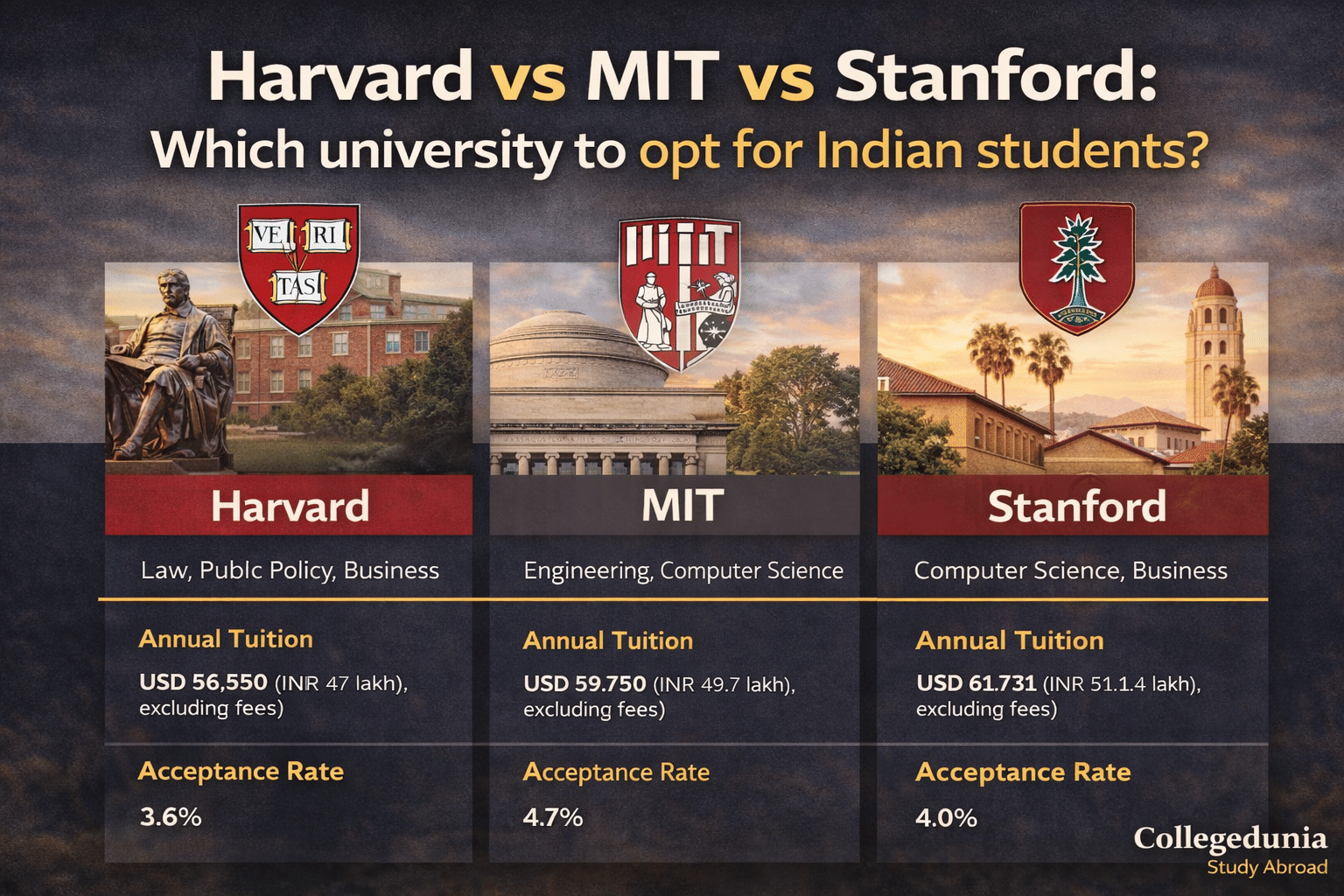
| Cost Component | Harvard (2025-26) | MIT (2025-26) | Stanford (2025-26) |
|---|---|---|---|
| Annual tuition (USD) | USD 59,320 | USD 59,750 | USD 62,484 to 83,766 (varies by program) |
| Annual tuition (INR approx.) | INR 55.4 lakh | INR 55.8 lakh | INR 58.3 lakh to 78.2 lakh |
| Room and board (USD) | USD 21,000 approx. | USD 22,000 approx. | USD 23,000 approx. |
| Total annual cost of attendance (USD) | USD 80,000 to 85,000 | USD 82,000 to 87,000 | USD 85,000 to 90,000 |
| Total annual cost of attendance (INR) | INR 74.7 lakh to 79.4 lakh | INR 76.6 lakh to 81.2 lakh | INR 79.4 lakh to 84.0 lakh |
| Need-blind admissions for international students | Yes — meets 100% of demonstrated need | Yes — meets 100% of demonstrated need | Yes — meets 100% of demonstrated need |
| Average financial aid for international students | USD 53,000 per year (Harvard Financial Aid Office, 2025) | USD 57,000 per year (MIT SFS, 2025) | USD 56,000 per year (Stanford Financial Aid, 2025) |
| Endowment tax impact on aid pool (2026) | USD 266 million annual tax cost — reduces aid pool | ~10% of annual central budget — reduces research fellowships and PhD funding | Significant NIH grant exposure — DOJ investigation adds further uncertainty |
The practical implication for Indian students: an Indian family earning below approximately USD 75,000 per year (INR 70 lakh) may qualify for substantial grant aid at all three institutions — potentially reducing the actual annual cost to USD 20,000 to 30,000 (INR 18.7 lakh to 28 lakh). This is lower than many private engineering colleges in India. The key is applying for financial aid at the time of application and submitting all required documentation accurately. Given the endowment tax reducing available aid pools in 2026, verify your specific package directly with the financial aid office before accepting any offer.
Read More: Scholarships for Indian students at top global universities
Safety Scorecard: Harvard vs MIT vs Stanford
Here is the honest, dimension-by-dimension risk map — not a ranking, but a structured comparison of what each university offers and where each falls short in 2026.
| Safety Dimension | Harvard | MIT | Stanford | Assessment |
|---|---|---|---|---|
| Financial resilience (endowment buffer) | USD 56.9 billion — largest in the world | USD 27.4 billion — strong but smallest of the three | USD 40.8 billion — second largest | Harvard strongest; all three have substantial buffers |
| Legal resistance to Trump administration | Suing administration; won first court round September 2025; appeal ongoing | First US university to reject Trump compact; joined multiple lawsuits | No public legal action; DOJ investigation unresolved; has not rejected compact | Harvard and MIT clearly ahead; Stanford most uncertain |
| Indian student enrollment trend | Down 31% (788 to 545) in one year — sharpest decline | Grad intake cut 8%; 286 Indian students Fall 2025 | Stable at ~500; international % fell modestly | Stanford most stable; Harvard most alarming |
| F-1 visa risk | Equal — systemic federal policy issue | Equal — systemic federal policy issue | Equal — systemic federal policy issue | Tie — no university can protect against federal visa policy |
| STEM OPT risk | Equal — DHS review affects all US universities | Equal — DHS review affects all US universities | Equal — DHS review affects all US universities | Tie — outcome of DHS review unknown; affects all equally |
| Active government investigation | No active DOJ investigation into admissions | No active DOJ investigation into admissions | Yes — DOJ investigation into medical school admissions, March 2026; ongoing | Stanford only university with active DOJ investigation as of April 2026 |
| Graduate admissions availability for Indians | Enrollment down 31%; fewer seats in practice | Grad intake cut 8%; 242 Indian grad students Fall 2025 | Stable but international % declining | Stanford most stable for graduate access; Harvard most constrained |
| Institutional support for international students | Strong ISO; active legal support; high-profile public advocacy | Strong ISO; detailed guidance published October 2025; principled public stance | Strong Bechtel Center; regular communication; less public advocacy | All three strong; Harvard and MIT more publicly active |
| Post-graduation employment by field | Strongest for finance, consulting, law, policy | Strongest for engineering, AI, computer science, research | Strongest for tech, entrepreneurship, venture capital, Silicon Valley roles | Field-dependent — no single winner |
No single university wins across all dimensions. Harvard has the largest financial cushion and the most aggressive legal defense but the sharpest enrollment decline. MIT has the most principled public stance and the strongest STEM employer network but the smallest endowment of the three. Stanford has the most stable enrollment trend but the most unresolved institutional uncertainty — specifically the active DOJ investigation — as of April 2026.
The Honest Verdict by Field and Goal
If you have admits to more than one of these three universities, here is how to think about the decision in 2026 — by field, by risk tolerance and by what "safe" actually means to you.
If Your Goal Is STEM Research or a PhD
MIT is the strongest choice for engineering, AI, computer science and life sciences research. Its employer relationships in STEM are unmatched and 242 of its 286 Indian students are at the graduate level — meaning the peer network is dense and career-focused. The 8% graduate intake cut is a concern, but MIT's research culture and STEM OPT utilisation rate remain the highest of the three. Note that MIT's 10% annual budget impact from the endowment tax creates pressure on research fellowships and PhD funding — confirm your funding package in writing before accepting.
If Your Goal Is Tech, Entrepreneurship or Silicon Valley
Stanford's location advantage is irreplaceable for tech, product management and venture capital roles. The Stanford alumni network in Silicon Valley is the densest of any university in the world for these fields. The DOJ investigation is into medical school admissions specifically — it does not directly affect CS, engineering or business students. If you are not in medicine or life sciences, Stanford's institutional uncertainty is less directly relevant to your program.
If Your Goal Is Finance, Consulting, Law or Policy
Harvard carries the strongest brand weight with US employers in finance, consulting, law and policy. Despite the 31% enrollment decline, Harvard's institutional prestige and alumni network in these fields remain unmatched. The court victory in September 2025 provides meaningful near-term financial stability. For students in these fields, Harvard's political visibility is a risk — but its legal resilience and financial cushion are the strongest of the three.
If Your Primary Concern Is Visa and Immigration Risk
All three universities are equally exposed to F-1 visa and OPT policy changes. No university can protect you from a visa denial or an OPT policy change. What all three can do — and do well — is provide legal support, guidance and advocacy if your individual situation becomes complicated. On this dimension, choose based on academic fit, not visa anxiety. The visa risk is identical at all three.
If You Are Still Deciding Whether to Apply to the US at All
That is a legitimate question in 2026. Germany and the UK are the strongest alternatives. Indian students in Germany doubled from 28,905 to 59,420 between 2020 and 2024 (DAAD, 2025). UK visa grants to Indian students surged 44% in Q2 2025 (UK Home Office via ICEF Monitor). If your goal is a strong research university with post-study work rights and lower visa uncertainty, TU Munich, ETH Zurich, Imperial College London and University of Edinburgh are worth serious consideration alongside Harvard, MIT and Stanford.
FAQs: Harvard vs MIT vs Stanford for Indian Students in 2026
Ques. Is Harvard safe for Indian students in 2026?
Ans. Harvard is financially the most resilient of the three — with a USD 56.9 billion endowment and a court victory in September 2025 that restored USD 2.2 billion in frozen federal funding. Indian student enrollment fell 31% in Fall 2025 (from 788 to 545), reflecting uncertainty rather than any direct threat to enrolled students. Harvard has been the most aggressive in legally defending its independence from the Trump administration. For enrolled
Ans. Harvard is financially the most resilient of the three — with a USD 56.9 billion endowment and a court victory in September 2025 that restored USD 2.2 billion in frozen federal funding. Indian student enrollment fell 31% in Fall 2025 (from 788 to 545), reflecting uncertainty rather than any direct threat to enrolled students. Harvard has been the most aggressive in legally defending its independence from the Trump administration. For enrolled students, Harvard remains a strong and well-resourced institution. The primary risk is at the application stage — fewer Indian students are applying and being admitted due to the political environment.
Ques. How many Indian students are at MIT in 2025-2026?
Ans. MIT enrolled 286 Indian students in Fall 2025 — 16 undergraduate, 242 graduate, 3 special students and 25 exchange or visiting students. This is according to MIT's International Students Office official statistics published in October 2025. MIT cut its graduate student intake by approximately 8% (around 100 fewer students) in 2025 due to federal funding pressure from indirect cost caps imposed by the Trump administration on NSF and DOE research grants.
Ques. Did Trump freeze funding to MIT and Stanford as well?
Ans. Not in the same direct way as Harvard. Harvard faced a specific USD 2.2 billion funding freeze in April 2025 — which a court overturned in September 2025. MIT and Stanford face broader federal research funding pressure through NSF and NIH indirect cost caps that affect their research budgets but are not university-specific freezes. Additionally, the One Big Beautiful Bill Act (signed July 4, 2025) imposes an 8% endowment tax on all three universities — costing Harvard approximately USD 266 million annually and MIT approximately 10% of its annual central budget. Stanford received USD 575 million in NIH grants in 2025 and faces a separate DOJ investigation into its medical school admissions opened in March 2026.
Ques. Which is better for Indian students — MIT or Stanford?
Ans. It depends on your field and career goal. MIT is stronger for engineering, computer science, AI, physics and research-focused careers — 242 of its 286 Indian students are at the graduate level, reflecting this concentration. Stanford is stronger for entrepreneurship, product management, venture capital and Silicon Valley tech roles. In terms of 2026 political risk, MIT has taken a more publicly principled stance — it was the first US university to reject the Trump compact and has joined multiple lawsuits. Stanford's active DOJ investigation into its medical school admissions is an unresolved variable as of April 2026 that specifically affects medicine and life sciences students.
Ques. Is OPT at risk for Indian students graduating from Harvard, MIT or Stanford?
Ans. OPT and STEM OPT are under DHS review as of February 2026 — but this affects all US universities equally, not just Harvard, MIT or Stanford. Indian students represent 48% of all STEM OPT participants in the US (79,331 students as of ICE SEVP data 2024). Students graduating in 2026 are considered very unlikely to be affected by any OPT policy change, according to Yuno Learning analysis (March 2026). The review is ongoing and its outcome is not yet known. For the latest OPT developments, see the CollegeDunia OPT guide here.
Ques. What is the total cost of Harvard, MIT and Stanford for Indian students in 2026?
Ans. The total annual cost of attendance (tuition plus room and board) is approximately USD 80,000 to 85,000 at Harvard (INR 74.7 lakh to 79.4 lakh), USD 82,000 to 87,000 at MIT (INR 76.6 lakh to 81.2 lakh) and USD 85,000 to 90,000 at Stanford (INR 79.4 lakh to 84.0 lakh). All three universities offer need-blind admissions for international students and meet 100% of demonstrated financial need. Average financial aid for international students is USD 53,000 at Harvard, USD 57,000 at MIT and USD 56,000 at Stanford per year. Note that the 8% endowment tax introduced in 2025 is reducing the pool from which this aid is funded — verify your specific package directly with the financial aid office. Exchange rate: 1 USD = INR 93.38 (Twelve Data, April 16, 2026).
Ques. Should Indian students avoid US universities in 2026 because of Trump?
Ans. Not necessarily — but the risk calculus has changed. F-1 visa issuances to Indian students dropped 44% in the first half of 2025. The number of Indian students enrolled in universities abroad fell 5.7% in 2025 — the first decline in three years (MEA via ICEF Monitor, December 2025). Germany, UK and Ireland are absorbing significant demand from Indian students diversifying away from the US and Canada. If you have a strong admit to Harvard, MIT or Stanford, the academic and career value still justifies the application. If you are choosing between a mid-tier US university and a strong European alternative, the risk-reward calculation in 2026 favors Europe more than it did in 2023.
Ques. Which US university is safest for Indian students in 2026?
Ans. There is no single answer — it depends on which dimension of safety matters most to you. On financial resilience: Harvard (USD 56.9 billion endowment; court victory September 2025). On institutional independence and legal resistance: MIT (first university to reject Trump compact; joined multiple lawsuits). On enrollment stability: Stanford (most stable Indian student numbers at approximately 500 per year). On visa and OPT risk: all three are equal — this is a federal policy issue, not a university-specific one. On active government investigation risk: Harvard and MIT are cleaner — Stanford has an ongoing DOJ investigation into its medical school admissions as of April 2026.
Ques. What alternatives should Indian students consider if not the US in 2026?
Ans. Germany and the UK are the strongest alternatives in 2026. Indian students in Germany doubled from 28,905 to 59,420 between 2020 and 2024 (DAAD, 2025) — driven by zero tuition at public universities and a clear post-study work pathway. UK visa grants to Indian students surged 44% in Q2 2025 (UK Home Office via ICEF Monitor). Top alternatives include TU Munich, ETH Zurich, Imperial College London and University of Edinburgh. For research-focused students, Germany's DAAD scholarships are often fully funded and cover travel, accommodation and a monthly stipend.
Ques. Why did Harvard's Indian student enrollment fall so sharply in 2025?
Ans. Harvard's Indian student enrollment fell 31% — from 788 to 545 — between 2024-25 and Fall 2025. Three factors drove this. First, the Trump administration's April 2025 funding freeze created significant uncertainty about Harvard's financial stability, even though a court restored the funding in September 2025. Second, the broader F-1 visa environment deteriorated sharply — issuances to Indian students fell 44% in H1 2025. Third, Indian students and families actively diversified to other destinations — Germany, UK and Australia all saw increased Indian student intake in 2025. The decline reflects the environment, not a change in Harvard's quality or commitment to international students.





Comments