



Education Journalist | Study Abroad Lead | Updated On - Jun 1, 2026
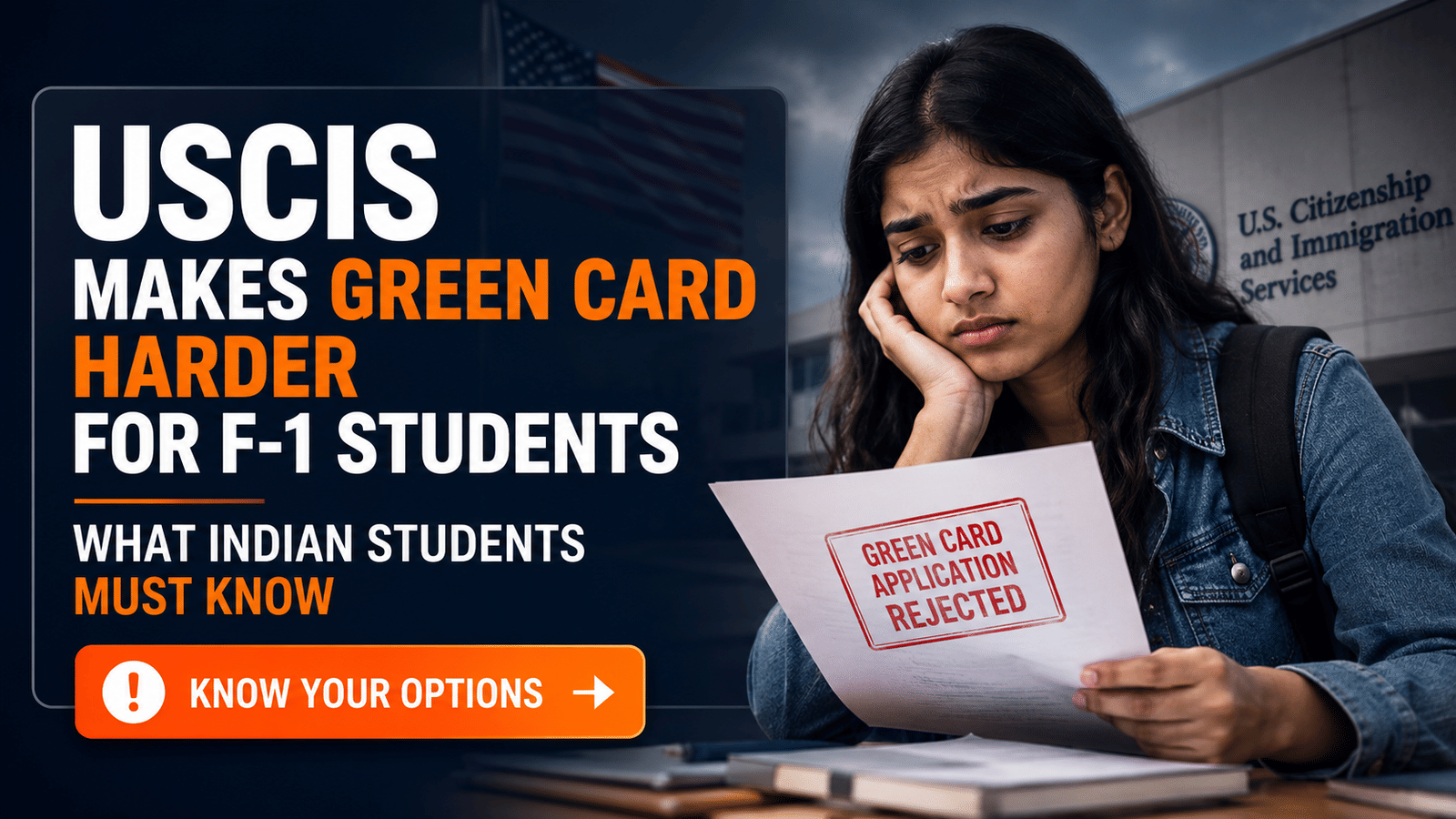
Indian students on F-1 visas who plan to apply for a US Green Card after graduation now face a significantly harder path. A policy memorandum issued by US Citizenship and Immigration Services (USCIS) on May 21, 2026 instructs immigration officers to treat Adjustment of Status — the process that allows visa holders to apply for permanent residency from inside the United States — as an "extraordinary form of relief" to be granted only in exceptional cases, not as a routine step in the immigration process.
The change directly affects the more than 3.52 lakh Indian students currently enrolled at US universities, many of whom plan to transition from F-1 to OPT, then to H-1B, and eventually to a Green Card — all without leaving the country. That pathway has just become considerably more uncertain.
What Is Adjustment of Status — and What Just Changed
To understand the impact, it helps to know what Adjustment of Status (AOS) actually is. Normally, a foreign national who wants a US Green Card must leave the United States, go to a US consulate in their home country, and apply for an immigrant visa from abroad. This is called consular processing.
Adjustment of Status is the alternative — it allows eligible visa holders already inside the US to apply for a Green Card without leaving. For decades, this has been the standard route for Indian students who complete their degrees, secure H-1B sponsorship, and begin the long wait for an employment-based Green Card while continuing to live and work in the US.
The new USCIS memo does not eliminate AOS. But it fundamentally changes how officers must evaluate applications. Under Policy Memorandum PM-602-0199, officers are now directed to treat AOS as an act of "discretion and administrative grace" — meaning even applicants who meet every legal requirement can be denied if an officer decides the case does not warrant this "extraordinary" exception to the normal consular process.
The memo explicitly lists factors officers must weigh against applicants, including:
- Any violation of immigration status conditions
- Failure to depart the US as originally expected — described as "highly relevant"
- Conduct inconsistent with the original purpose of the visa
- Any prior fraud or false testimony with any government agency
Crucially, the memo states that simply maintaining lawful status — even in a dual-intent category like H-1B — is "not sufficient, on its own, to warrant a favourable exercise of discretion."
Why F-1 Students Are Specifically at Risk
The memo singles out F-1 as a non-dual intent visa. When Indian students apply for an F-1 visa at the US consulate in India, they are required to demonstrate non-immigrant intent — that is, they must show they plan to return home after completing their studies. Consular officers routinely ask about post-graduation plans, and students typically confirm they intend to return to India.
Under the new guidance, that declaration can now be used against them if they later file for a Green Card from inside the US. As immigration law firm Manifest Law explained in its breakdown of the memo: "Officers can now ask when they actually decided to stay and weigh that in their Green Card application."
This creates a direct conflict for the typical Indian student pathway:
| Stage | Visa Status | What the New Memo Changes |
|---|---|---|
| During studies | F-1 | No change — student visa unaffected |
| After graduation | F-1 OPT / STEM OPT | OPT itself unaffected — but AOS filing now carries higher scrutiny |
| Employer sponsorship | H-1B | H-1B is dual intent — but memo says this alone is insufficient |
| Green Card filing | I-485 (AOS) | ⚠️ Officers must now weigh original F-1 non-immigrant declaration against AOS application |
Source: USCIS Policy Memorandum PM-602-0199, May 21, 2026. Official USCIS press release.
Also Read: OPT Program 2026: Rules, Risks and Alternatives for Indian Students
Scale of Impact on Indian Applicants
India already faces the longest Green Card backlog of any nationality in the US system. Indian nationals in the EB-2 employment category face estimated wait times of up to 128 years; EB-3 applicants face decades-long queues. Approximately 2,34,000 employment-based I-485 applications are currently pending inside the US — the overwhelming majority filed by Indian nationals who have been waiting years, sometimes over a decade, for their priority dates to become current.
For these applicants, the new memo adds a layer of discretionary risk on top of an already punishing wait. A case that would previously have moved through adjudication as a procedural matter now requires affirmative documentation of why the applicant deserves to adjust status from inside the US rather than returning to India to apply through consular processing.
For Indian students currently on F-1 or OPT who are earlier in the pipeline, the practical implication is stark: the assumption that completing a US degree, securing OPT, winning an H-1B, and filing an I-485 constitutes a reliable path to permanent residency is no longer safe to make.
Also Read: US Ends F-1 Duration of Status — 4-Year Cap Hits Fall 2026 Arrivals
What Indian Students and OPT Holders Should Do Now
- Do not treat AOS as automatic. If you are on OPT or H-1B and planning to file an I-485, speak to a qualified US immigration attorney before filing. Cases that previously required minimal documentation now need a stronger affirmative argument.
- Document your US ties proactively. The memo instructs officers to weigh family ties, employment history, tax compliance, and moral character. Build and maintain a clear record of your lawful presence and contributions.
- Understand the consular processing alternative. If AOS becomes untenable, consular processing — applying from India — remains available. It involves leaving the US, which carries its own risks, but may become the more viable route for some applicants.
- Watch for court challenges. The memo carries no effective date and provides no implementation timeline. Multiple immigration law firms have flagged it as likely to face legal challenges. Monitor USCIS updates and NAFSA guidance closely over the coming weeks.
- Factor this into your study abroad decision. For students currently deciding whether to pursue a US degree, this memo is the latest in a series of signals — following the F-1 slot crisis, the Duration of Status proposal, and OPT uncertainty — that the US post-study pathway to permanent residency is becoming structurally less reliable.
The USCIS memo does not close the door on Green Cards for Indian students. But it moves the goalposts in a way that demands far more preparation, documentation, and legal support than the process previously required. For a community that has long treated the F-1-to-H-1B-to-Green Card pipeline as a known quantity, the message from Washington is increasingly clear: nothing about that pipeline should be taken for granted anymore.



Comments