



Education Journalist | Study Abroad Lead | Updated On - Apr 25, 2026
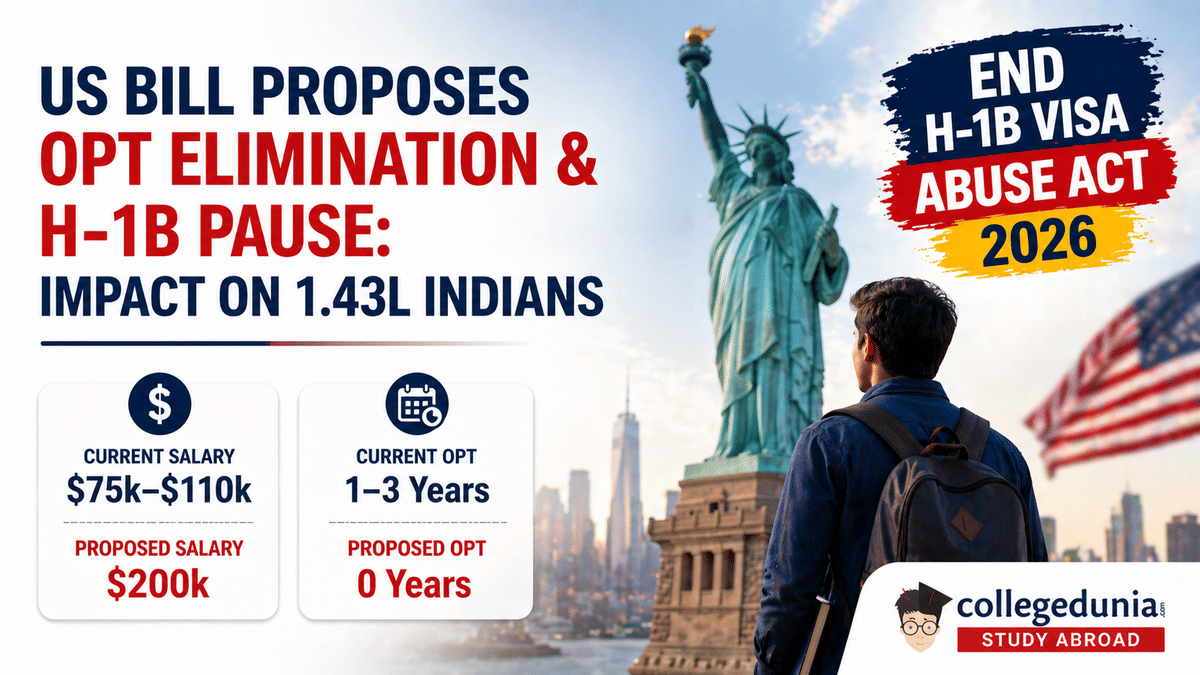
Indian students planning to study in the US and stay to work just had the ground shift under them — again. A bill introduced in the US House of Representatives on April 22, 2026 proposes a three-year pause on all new H-1B visas, the complete elimination of OPT, a $200,000 minimum salary floor, and a ban on H-1B holders bringing dependents to the US. If passed, it would dismantle the F-1, OPT, H-1B pipeline that 1.43 lakh Indian students currently depend on to convert a US degree into a US career — across every field, from computer science and engineering to MBA, data science, life sciences, and healthcare.
The bill — the End H-1B Visa Abuse Act of 2026, introduced by Rep. Eli Crane (R-AZ) with seven Republican co-sponsors — is not law. It has not passed committee, has no Senate companion bill, and faces significant opposition from the US tech industry. But it is the most sweeping anti-H-1B legislation ever introduced in Congress, and it arrives when the H-1B system is already under more pressure than at any point in the past decade.
Also Read: The $100,000 H-1B Barrier — Why FY2027 Lottery Selection No Longer Guarantees a US Visa
What the Crane Bill Proposes — The Full Picture
The End H-1B Visa Abuse Act of 2026 is the most comprehensive H-1B elimination bill ever introduced in Congress. Its provisions go well beyond previous reform attempts and target every stage of the pathway Indian students use to build US careers.
| Provision | Current Rule | Proposed Change |
|---|---|---|
| H-1B issuance | 85,000 visas/year (65K regular + 20K master's) | 3-year pause, then cap cut to 25,000 |
| Minimum salary | Prevailing wage (typically $60K–$110K) | $200,000/year (~₹1.92 crore at ₹96/USD) |
| OPT programme | 12 months standard + 24 months STEM extension | Eliminated entirely |
| H-4 dependent visa | Spouses and children permitted | Banned |
| Green Card adjustment | H-1B holders can apply for PR from within US | Prohibited — must leave US first |
| Third-party staffing | Permitted | Banned |
| Multiple jobs | Permitted with employer approval | Banned |
The $200,000 salary floor is the provision with the most immediate practical impact. The median starting salary for roles that Indian graduates typically enter — software engineer, data analyst, financial analyst, biomedical researcher, management consultant — ranges from $75,000 to $130,000.
A $200,000 floor would disqualify the vast majority of first-job roles across every field, not just tech. It would effectively restrict H-1B access to senior hires at large corporations — eliminating the programme as a post-study work pathway for recent graduates entirely.
Who Is Most Exposed — Field by Field
The bill's impact is not uniform. The exposure varies sharply by field of study — and in some cases, non-STEM graduates face a steeper cliff than STEM graduates.
| Field | Current OPT Duration | If OPT Eliminated | Exposure Level |
|---|---|---|---|
| CS / Software Engineering | 36 months (STEM) | No post-study work bridge | High |
| Data Science / AI / ML | 36 months (STEM) | No post-study work bridge | High |
| Electrical / Mechanical Engineering | 36 months (STEM) | No post-study work bridge | High |
| Life Sciences / Biotech / Pharma | 36 months (STEM) | No post-study work bridge | High |
| MBA / Business / Finance | 12 months only (non-STEM) | No post-study work bridge | Highest |
| Public Policy / Social Sciences | 12 months only (non-STEM) | No post-study work bridge | Highest |
| Healthcare / Public Health | 12–36 months (varies) | No post-study work bridge | High |
MBA and non-STEM graduates are actually the most exposed cohort. They currently have only 12 months of OPT — no STEM extension buffer. If OPT is eliminated, they have no post-graduation work authorisation at all. A student who spends ₹60–80 lakh on a US MBA would graduate with no legal pathway to work in the US while waiting for H-1B sponsorship. The H-1B lottery window opens only once a year, in March, for an October start — meaning even a student with a job offer in hand could face a 6–12 month gap with no work authorisation.
Why This Hits Indian Students Harder Than Any Other Nationality?
Indians hold 71% of all H-1B approvals in the US — 283,397 out of 399,395 approvals in FY2024, according to USCIS data. Of the approximately 294,000 students currently on OPT, 48% are Indian nationals (79,331 on STEM OPT alone, per ICE SEVP data). No other nationality is as structurally dependent on the H-1B pathway as Indian students — across every field.
H-1B approvals for Indians have already dropped 37% in FY2026 compared to FY2024, reflecting the combined effect of the wage-weighted lottery (effective February 27, 2026) and the $100,000 employer fee introduced in September 2025. The Crane bill, if passed, would not be a continuation of that trend — it would be a structural end to the programme as Indian students across all disciplines have known it.
The H-4 ban compounds the impact further. Tens of thousands of Indian spouses currently in the US on H-4 visas — many of them women with their own professional qualifications — would lose their legal status and work authorisation entirely. For Indian families who have built dual-income lives in the US, this is not a visa technicality. It is a forced choice between a US career and a family.
How Likely Is This Bill to Become Law?
Unlikely in its current form — but not irrelevant, and not dismissible.
The bill has eight House co-sponsors, all Republicans. It has no Senate companion bill. It faces opposition from major US tech employers and the US Chamber of Commerce. The Trump administration has itself sent mixed signals: it has tightened H-1B enforcement and raised fees, but has also signalled support for retaining high-skilled talent, particularly from India.
Previous H-1B pause bills — the PAUSE Act, the EXILE Act — never advanced past committee. The Crane bill is more sweeping than any of them. What makes it consequential, even if it fails, is the pattern it represents. The wage-weighted lottery that took effect in February 2026 appeared in earlier reform proposals. The $100,000 employer fee was an executive action that bypassed Congress entirely. Each successive measure has been more restrictive than the last. The Crane bill is the outer boundary of where that direction could go — and outer boundaries have a way of becoming the new centre over time.
For Indian students currently deciding on Fall 2026 or Fall 2027 US applications, the relevant question is not whether this specific bill passes. It is whether the F-1→OPT→H-1B pathway will be intact when they graduate in 2028 or 2029. That question has no certain answer today.
What Every Indian Student Planning US Study Must Do Now
The uncertainty is real. The response should be practical, not panicked.
- Do not assume OPT will exist when you graduate. If you are starting a 2-year programme in Fall 2026, you graduate in 2028. Build a contingency plan before you accept your offer — not after you arrive. This applies equally to MS, MBA, MFA, MPH, and every other programme.
- For STEM students: prioritise programmes with direct-hire pipelines at large employers. If OPT survives but the $200K salary floor passes, your best protection is a role at a large tech or pharma employer that pays above the threshold and has the legal infrastructure to sponsor H-1B petitions without staffing intermediaries.
- For MBA and non-STEM students: the risk calculus has changed materially. A US MBA has historically justified its ₹60–80 lakh cost partly through the OPT→H-1B pathway. If OPT is eliminated, the post-study work bridge disappears entirely for non-STEM graduates. Evaluate whether the degree's value holds without that pathway — and whether a UK, European, or Canadian MBA offers a more predictable post-study work route.
- Track the bill's progress as a live signal. Monitor crane.house.gov and USCIS.gov for committee votes or Senate action. A bill that advances to a Senate vote before your application deadline is a materially different risk signal than one that dies in committee.
- Seriously evaluate alternative destinations. Germany's EU Blue Card requires no employer sponsorship lottery and offers PR in 21–33 months. Canada's PGWP provides up to 3 years of open work authorisation with no annual cap. Ireland's Stay and Thrive pathway offers 2 years post-study work. These are not consolation prizes — for Indian students across all fields, they are increasingly competitive alternatives to a US pathway that is structurally narrowing.
Check: OPT Programme 2026 — Rules, Risks and Alternatives for Indian Students
The US Career Pathway for Indians Is Narrowing — Across Every Field
The Crane bill is the loudest signal yet — but it is not the first. Since September 2025, the H-1B system has already absorbed a $100,000 employer fee, a wage-weighted lottery that halved entry-level selection odds, a 37% drop in approvals for Indian nationals, and a 61% F-1 visa rejection rate for Indians in 2025. The pipeline that once reliably converted an Indian degree in any field into a US career is now narrower, more expensive, and less predictable at every stage.
Indians hold 71% of H-1B visas because they built the most efficient pipeline in the world for converting international education into US employment. That pipeline is being systematically compressed — not by one bill, but by a sustained policy direction consistent across executive actions, regulatory changes, and now legislative proposals. The Crane bill may not pass. But the direction it represents is not going away. Indian students planning US study in 2026 and 2027 — in every field, at every programme level — need to plan for a US career pathway that is harder, more selective, and less certain than the one their seniors navigated, and have a credible alternative ready if it narrows further.



Comments