



Education Journalist | Study Abroad Strategy Lead | Updated On - Apr 17, 2026
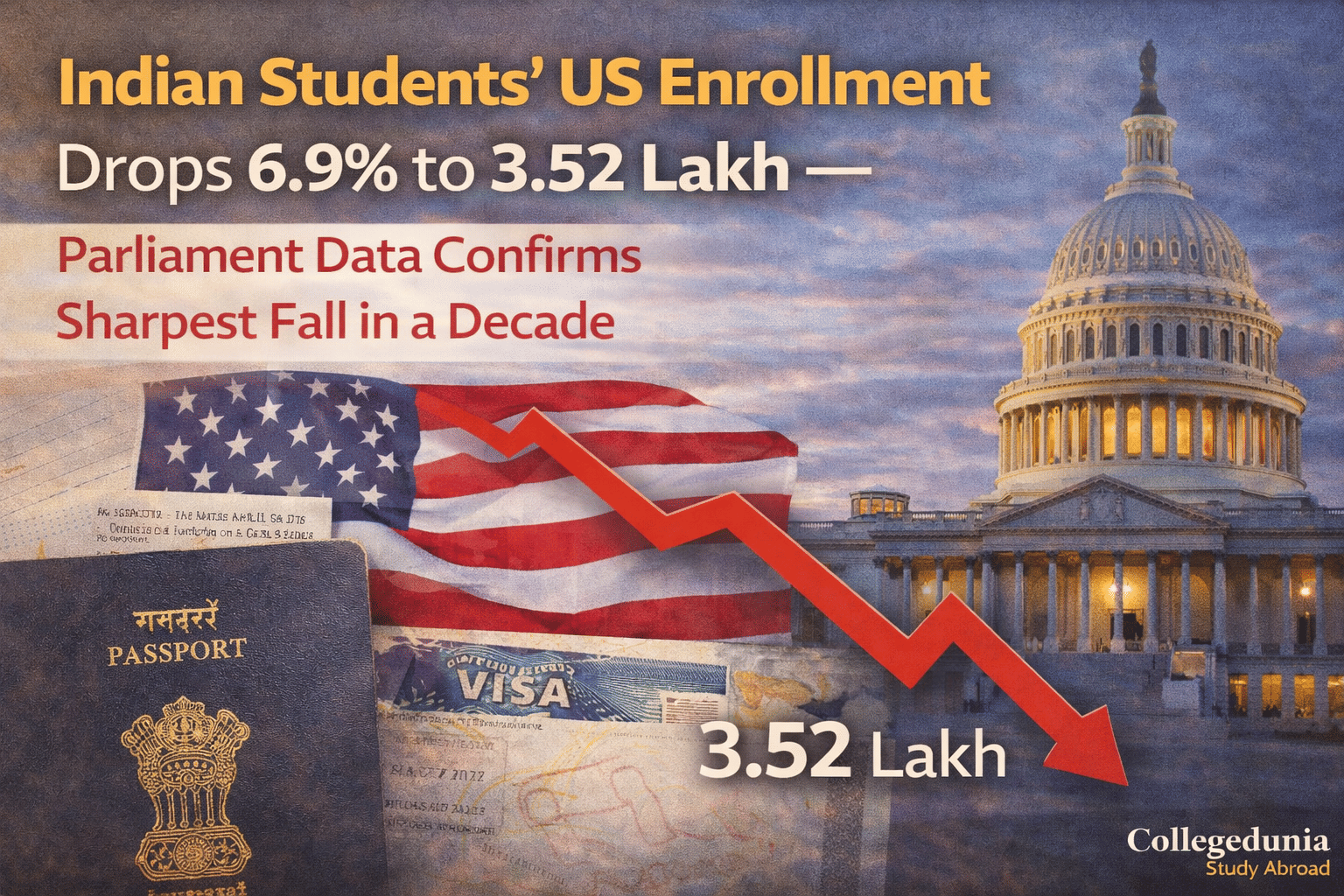
The number of Indian students enrolled in US institutions has fallen by 6.9% in a single year — from 3,78,787 in February 2025 to 3,52,644 in February 2026. The decline, confirmed by India's Ministry of External Affairs in a written reply to the Rajya Sabha on April 2, 2026, marks the sharpest year-on-year drop in Indian student enrolment in the United States in over a decade.
The fall is not concentrated in one programme level. MEA data drawn from the US Department of Homeland Security's SEVIS Mapping Tool shows the decline is broad-based — spanning school-level, vocational, undergraduate, and postgraduate enrolments. India remains the largest source country of international students in the US, but the gap with second-ranked China has narrowed for the first time since 2019.
Check: Study in USA — Universities, Costs, Visa & Scholarships for Indian Students 2026
What the Parliament Data Shows?
Minister of State for External Affairs Kirti Vardhan Singh tabled the figures in response to parliamentary questions on whether declining enrolments were linked to scarce visa slots, high rejection rates, and increased scrutiny by US authorities.
The answer, in effect, was yes.
Singh cited a June 18, 2025 announcement by the US Department of State — titled Announcement of Expanded Screening and Vetting for Visa Applicants — as the policy backdrop for the decline. Under the revised framework, all applicants in F (student), M (vocational), and J (exchange visitor) visa categories are subject to enhanced scrutiny, including a mandatory review of their online presence and social media profiles.
“The US would conduct a comprehensive vetting, including online presence of all student and exchange visitor applicants.” — Minister of State Kirti Vardhan Singh, Rajya Sabha, April 2, 2026
The MEA also noted the current US administration's position that "a US visa is a privilege, not a right" — a framing that signals a structural, not temporary, tightening of the student visa pipeline.
Indian Student Numbers in the US: The Before and After
The 2026 figure of 3,52,644 represents a reversal of a multi-year growth trend. Indian student enrolment in the US had grown consistently from 2021 to 2024, peaking at over 3,31,000 new student visas issued in the 2023–24 academic year alone, according to US State Department data.
| Year | Indian Students in US (SEVIS) | Year-on-Year Change |
|---|---|---|
| February 2024 | ~3,60,000 (est.) | +8.7% |
| February 2025 | 3,78,787 | +5.2% |
| February 2026 | 3,52,644 | −6.9% |
The 26,143-student drop in a single year is the largest absolute decline since the COVID-19 disruption of 2020–21 — and unlike that period, this decline is policy-driven, not pandemic-driven.
The F-1 visa rejection rate for Indian applicants reached 41% in 2025 — the highest in a decade, according to US State Department consular data. For every 100 Indian students who applied for an F-1 visa in 2025, 41 were turned away.
Three Reasons Behind the Decline
1. Enhanced vetting and social media screening
The June 2025 US State Department directive requires all F, M, and J visa applicants to make their social media profiles publicly accessible before their visa interview. Consular officers are instructed to review applicants' online activity as part of the national security assessment. Any content flagged by automated screening tools can result in refusal or administrative processing delays of months.
For Indian students, this has introduced a new layer of unpredictability. A student with a strong academic profile, adequate funds, and a credible study plan can still face delays or refusals based on social media content that was never previously considered relevant to a student visa application.
2. SEVIS terminations and status uncertainty
The Trump administration's expanded use of SEVIS record terminations — which effectively cancels a student's legal status in the US — has created a chilling effect on new applications. Over 4,700 SEVIS records were terminated in early 2026, with Indian students estimated to account for approximately 50% of those affected. Even students who were not directly terminated have become more cautious about applying, given the visible enforcement environment.
3. Cost and currency pressure
At ₹93.06 per US dollar (April 17, 2026), the cost of a US education has risen sharply in rupee terms. A mid-tier US university charging $35,000 per year in tuition now costs approximately ₹32.6 lakh annually — before accommodation, living costs, or health insurance. Total annual costs at a US university now routinely exceed ₹50–60 lakh for Indian students.
| Cost Element | 2023 (₹83/USD) | 2026 (₹93.06/USD) | Change |
|---|---|---|---|
| Mid-tier US tuition ($35,000/yr) | ₹29.1 lakh | ₹32.6 lakh | +₹3.5 lakh/yr |
| On-campus accommodation ($15,000/yr) | ₹12.5 lakh | ₹14 lakh | +₹1.5 lakh/yr |
| Total annual cost ($50,000) | ₹41.5 lakh | ₹46.5 lakh | +₹5 lakh/yr |
| 4-year UG degree total | ₹1.66 crore | ₹1.86 crore | +₹20 lakh |
Exchange rate: $1 = ₹93.06 as of April 17, 2026
Which Indian Students Are Most Affected
The decline is not uniform across student cohorts. Based on the MEA data and SEVIS trends, the sharpest drops are concentrated in:
- Undergraduate applicants — The most visa-sensitive cohort. UG students have fewer institutional ties and lower financial proof thresholds, making them more vulnerable to refusal under enhanced scrutiny.
- Students from Tier 2 and Tier 3 cities — Consular data consistently shows higher refusal rates for applicants from cities outside the major metros, where documentation quality and interview preparation vary more widely.
- Students targeting community colleges and pathway programmes — These institutions have faced heightened scrutiny under the Trump administration's focus on visa abuse in lower-ranked institutions.
- OPT and STEM OPT holders already in the US — The SEVIS termination wave disproportionately affected students on Optional Practical Training, particularly those whose social media activity or minor compliance gaps triggered automated flags.
What Fall 2026 Applicants Must Do Now
The MEA data covers enrolments through February 2026 — meaning it does not yet capture the full impact of the SEVIS termination wave (which peaked in March–April 2026) or the Duration of Status proposed rule change (which would cap F-1 stays at a fixed period). The actual 2026 full-year figure is likely to show a steeper decline.
For Indian students currently planning Fall 2026 US applications, the practical implications are significant:
- Social media hygiene is now a visa requirement, not a suggestion. Before submitting a US visa application, audit every public-facing social media account. Remove or archive content that could be misread as political, controversial, or inconsistent with your stated academic purpose. This is part of the formal vetting process.
- Apply early and expect delays. Administrative processing (AP) has increased significantly for Indian F-1 applicants in 2025–26. Build a minimum 12-week buffer between your visa application and your intended travel date.
- Have a documented financial trail. Bank statements showing a consistent savings history over 6–12 months are stronger than a single large deposit made shortly before the application.
- Consider the full cost in rupees. At ₹93.06/USD, a four-year US undergraduate degree at a mid-ranked university costs ₹1.5–2 crore all-in. A master's degree costs ₹60–90 lakh.
- Evaluate alternatives seriously. Germany (free tuition, 6-day visa processing), Canada, and the UK remain active alternatives for students who cannot absorb the current US visa risk.
Important: The F-1 visa rejection rate for Indian applicants stood at 41% in 2025. Apply with complete documentation, a clear financial trail, and a well-prepared Statement of Purpose. Do not leave any section of the DS-160 incomplete.
The MEA's Rajya Sabha data is the first official Indian government confirmation of what the study abroad sector has been observing for months: the US is no longer the default, low-friction destination it was for Indian students between 2015 and 2023.
The structural shift is not about one policy or one administration. It is the convergence of enhanced vetting, SEVIS enforcement, cost escalation, and a visa system that now treats every student application as a national security decision. The MEA's framing — quoting the US position that "a visa is a privilege, not a right" — signals that the Indian government is not expecting a near-term reversal.
For the 3.52 lakh Indian students currently in the US, the immediate priority is compliance: maintaining valid status, keeping social media clean, and staying ahead of any SEVIS flags. For the next cohort of applicants, the question is no longer just "which US university?" — it is "is the US the right bet at all?"
The 6.9% drop is a data point. The policy environment that produced it is not going away.





Comments