



Education Journalist | Study Abroad Strategy Lead | Updated On - Apr 15, 2026
Hampshire College, a private liberal arts college in Amherst, Massachusetts, will permanently shut down at the end of December 2026. The Board of Trustees announced the closure on April 14, 2026, after the college missed enrollment targets, failed to refinance debt, and exhausted seven years of emergency fundraising efforts. For Indian students currently enrolled on F-1 visas, a decision deadline of April 30 is now active. For Indian students who had Hampshire on their Fall 2026 shortlist, all deposits will be refunded, and the admissions process is effectively over. Both groups need to act this week.
Hampshire College has approximately 745 undergraduate students. It raised more than $55 million in unrestricted operating support since 2019 in an attempt to stay independent — and still could not survive. The closure follows a pattern of small US liberal arts college failures driven by falling domestic enrollment, rising costs, and insufficient endowment. For Indian families evaluating similar institutions, the warning signs were visible and are worth understanding before the next application cycle.
Check other top US universities for Indian Students
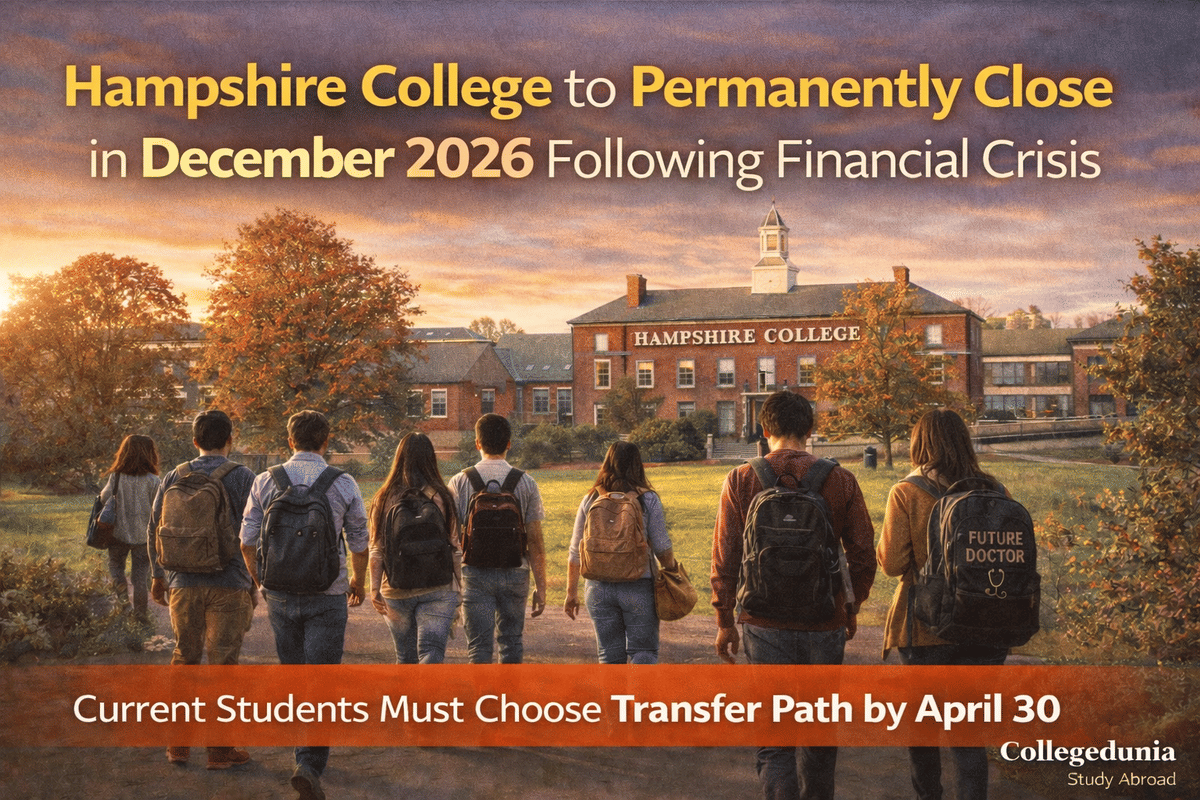
If You Are Currently Enrolled at Hampshire — Act Before April 30
The college has confirmed two formal pathways for current students. You must indicate your choice by April 30, 2026.
Pathway 1 — Complete Your Degree at Hampshire
Available to Division III students — those in the final independent project stage of Hampshire's degree structure. Under this pathway:
- You complete your Division III project during Summer and Fall 2026
- You graduate in December 2026 with a Bachelor of Arts from Hampshire College
- The degree will be from a fully accredited institution — Hampshire remains accredited through NECHE and the Massachusetts Department of Higher Education throughout the teach-out
- Campus housing and student support services remain available for Fall 2026
- Commencement: May 16, 2026 for spring graduates; December 2026 for teach-out completers
- Transcripts held at Hampshire through December 31, 2026; transferred to UMass Amherst after that
Pathway 2 — Transfer to a Partner Institution
Available to Division I and Division II students, and to Division III students who prefer not to complete at Hampshire. Eight institutions have signed transfer agreements:
| Partner Institution | Type |
|---|---|
| Amherst College | Private liberal arts, Five Colleges Consortium |
| Bennington College | Private liberal arts, Vermont |
| Massachusetts College of Art & Design | Public art and design |
| Massachusetts College of Liberal Arts (MCLA) | Public liberal arts |
| Mount Holyoke College | Private liberal arts, Five Colleges Consortium |
| Prescott College | Private liberal arts, Arizona |
| Smith College | Private liberal arts, Five Colleges Consortium |
| University of Massachusetts, Amherst | Large public research university |
Hampshire's Centre for Academic Support and Advising (CASA) will assist with credit mapping, documentation, and institution selection. A transfer resource fair will be held on campus before the end of the spring semester.
The F-1 Visa Question — What Hampshire Has Not Yet Answered
This is the most urgent issue for Indian students and it is not addressed in the official closure announcement.
Under US immigration rules, F-1 students must maintain full-time enrollment at a SEVP-certified institution. Hampshire College's SEVP certification status during the teach-out period — and whether it will remain active through December 2026 — has not been confirmed publicly.
Every Indian student currently enrolled at Hampshire must do the following immediately:
Step 1 — Contact Hampshire's international student office today.
Confirm whether SEVP certification will remain active through December 2026 and whether your F-1 status can be maintained during the teach-out semester. Contact: advising@hampshire.edu / 413.559.5498
Step 2 — If transferring, initiate your SEVIS transfer as soon as your new institution is confirmed.
Under SEVIS rules, your record must be transferred before the release date — typically the start of the next semester at the new institution. Do not wait until summer.
Step 3 — Get a new I-20 from your transfer institution before your current one expires.
All eight partner institutions are SEVP-certified and will issue a new I-20. Ensure your financial documentation meets the new institution's F-1 sponsorship requirements — these vary by institution.
Step 4 — Do not allow a gap in your SEVIS record.
A lapse between Hampshire's teach-out and enrollment at a transfer institution could trigger SEVIS termination. Coordinate with both institutions' Designated School Officials (DSOs) to ensure continuity.
If You Were Planning to Apply to Hampshire — What to Do Now
If Hampshire was on your Fall 2026 shortlist, your path forward is straightforward:
Deposits will be fully refunded.
If you paid an enrollment deposit, email admissions@hampshire.edu to initiate the refund. Hampshire's admissions team has confirmed it will support admitted students in exploring alternatives.
Your application materials are still useful.
Essays, recommendations, and transcripts prepared for Hampshire can be redirected to comparable US liberal arts colleges. Several have rolling admissions or late-round deadlines in April and May 2026.
Comparable alternatives to consider for Fall 2026:
| College | Profile | Location |
|---|---|---|
| Bennington College | Progressive liberal arts, project-based learning | Vermont |
| Bard College | Arts and humanities focus, similar ethos | New York |
| Evergreen State College | Interdisciplinary, no traditional grades | Washington |
| Marlboro College (merged with Emerson) | Small, self-designed curriculum | Now part of Emerson, Boston |
| Sarah Lawrence College | Writing and arts intensive, no traditional majors | New York |
| Prescott College | Environmental and social justice focus | Arizona |
All of these institutions share Hampshire's progressive, self-directed academic philosophy. Most have acceptance rates above 60% and rolling or late admissions windows.
For Indian students who had not yet applied: Do not use Hampshire College for application planning.
Why Hampshire Is Closing — and What It Signals
Hampshire College's closure is the result of three compounding failures that played out over seven years:
Enrollment shortfall.
The college missed its Fall 2025 enrollment target by a margin that made continued operations financially unviable. With only 745 students paying tuition, the revenue base was too small to service existing debt.
Debt tied to land assets.
Hampshire attempted to generate revenue by selling portions of its campus land. Even a favorable sale would not have changed the long-term financial trajectory given current enrollment levels — the debt was structural, not solvable by asset sales alone.
Insufficient endowment.
Hampshire's endowment was not large enough to absorb operating losses. By contrast, the Five Colleges Consortium partners — Amherst, Smith, Mount Holyoke, and UMass — have endowments ranging from $400 million to over $3 billion, giving them the financial cushion Hampshire lacked.
How to Spot Financial Risk at Small US Colleges — Before You Apply?
Hampshire's closure follows Antioch College, Marlboro College, and more than 80 other US institutions that have closed or merged since 2016. For Indian students evaluating small US colleges, these are the indicators to check:
- Three or more consecutive years of enrollment decline — Hampshire missed enrollment targets repeatedly from 2022 onwards.
- Active accreditor monitoring — Check the NECHE, HLC, or relevant regional accreditor website for any show-cause notices or monitoring status. Hampshire was under active engagement with NECHE before the closure announcement.
- US News financial health indicators — The US News college rankings include financial health scores. Scores below 3 out of 5 warrant scrutiny.
- Small endowment + high tuition dependence — Colleges where more than 80% of revenue comes from tuition are structurally vulnerable to enrollment drops.
Hampshire College charged $63,900 per year in tuition and fees — comparable to elite liberal arts colleges with far larger endowments. The price point was not the problem. The enrollment base was.





Comments