



| Updated On - May 16, 2026
IELTS scores for Germany are mandatory for the admission process and the visa application. The IELTS test is mandatory for university admission. Students must aim to score at least 6.6-7.0 overall IELTS score band for top-tier universities.
The IELTS test score requirements can vary depending on visa types. For a professional visa, such as for nurses or for a German opportunity card (1-year permit for non-EU professionals), a minimum of 6.0 overall score band is required to satisfy the B2 level English criteria.
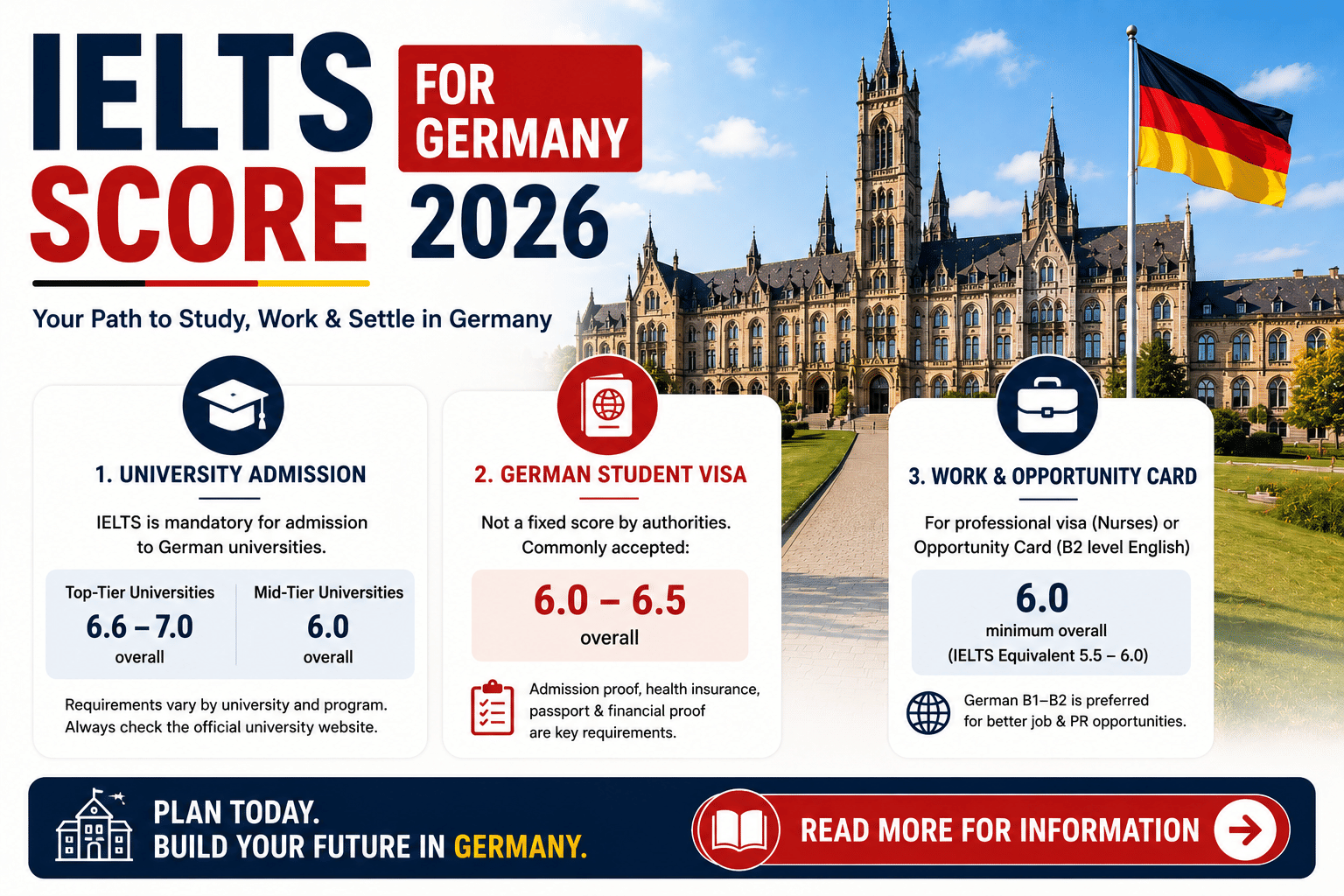
- IELTS Score requirements for German Universities in 2026.
- IELTS Score Required for Mid-tier Universities in 2026
- IELTS Score for German Student visa in 2026
3.1 Types of German Student Visa
- IELTS Score for German Nurses in 2026
- IELTS Score for German Opportunity Card in 2026
- IELTS Score for German Work Visa and PR in 2026
- Tips for Indian Students Applying for a German Visa in 2026
- FAQs
IELTS Score requirements for German Universities in 2026.
IELTS scores for some of the top German universities in 2026 are given in the table below:
| University | QS World University Ranking 2026 | IELTS Score for Undergraduate. | IELTS Score for Postgraduate. |
|---|---|---|---|
| Technical University of Munich (TUM) | #=22 | 6.0-6.5 overall with no band below 6.0 | 6.5 overall |
| Ludwig Maximilian University of Munich | #=58 | 6.0-6.5 overall | 6.5 overall |
| Heidelberg University | #=80 | 6.0-6.5 overall | 6.5 overall |
| Free University of Berlin | #=88 | 6.0-6.5 overall | 6.5 overall |
| Karlsruhe Institute of Technology (KIT) | #=98 | 6.0-6.5 overall | 6.5 overall with no band below 5.5 |
| RWTH Aachen University | #=105 | 6.0-6.5 overall | 6.5-7.0 overall |
| Humboldt University of Berlin | #=130 | 6.0-6.5 overall | 6.5 overall |
| Technical University Berlin | #=145 | 6.0-6.5 overall | 6.0-6.5 overall |
| University of Hamburg | #=193 | 6.0 overall | 6.0-6.5 overall |
| University of Freiburg | #=201 | 6.0 overall | 6.5-7.0 overall |
Note: The score requirements for some specific programs can differ from the usual overall requirements. Students should check this on the respective website of the university.
Also Read
IELTS Score Required for Mid-tier Universities in 2026
IELTS score requirements for mid-tier German universities can differ from the high score requirements of the top-ranking universities. These options are best for those students looking for admission in 2026 with an average IELTS score band of 6.0 overall.
| University | QS Global Ranking 2026 | IELTS Score for Undergraduate | IELTS Score for Postgraduate |
|---|---|---|---|
| Technical University Dresden | #=218 | 6.0 overall | 6.5 overall |
| University of Cologne | #=272 | 6.0 overall | 6.0-6.5 overall |
| Goethe University Frankfurt | #=316 | 6.0 overall | 6.5 overall |
| Ruhr University Bochum (RUB) | #=395 | 6.0 overall | 6.0 overall |
| Leibniz University of Hannover | #=433 | 6.0 overall | 6.0-6.5 overall |
| University of Duisburg-Essen | #=801-850 | 6.0 overall | 6.0 overall |
Also read: Best Public Universities of Germany for Indian Students in 2026
IELTS Score for German Student visa in 2026
The IELTS score for a German student visa is not fixed for a German Type D student visa by the German authorities. The National Type D Visa is Germany's long-term national visa for stays longer than 90 days. The requirement depends on the university`s admission criteria. The commonly accepted IELTS score band is 6.0-6.5 overall.
Types of German Student Visa
There are mainly 3 types of German student visa, which are:
- Student Visa (Visum zu Studienzwecken): This is a visa offered to those students who have been admitted to a full-time degree program or preparatory course. This permits the student to stay for a year, which can be renewed.
- Prospective Student Visa (Visum zur Studienbewerbung): Also known as Student Applicant Visa, valid for 9 months. It is for those students who are willing to apply for admission to any German university. Once admission is done, the student can convert it to a full Student Visa inside Germany.
- Language Course Visa: Valid for 1 year, for intensive German language courses. Cannot be extended or converted into a student visa in most cases (exceptions are rare).
The major requirements for a German student visa are:
- University admission proof.
- Health insurance.
- Passport.
- Financial proofs.
The German student visa mandates proof of acceptance to a recognized higher education institution and sufficient language proficiency in the language of instruction. The IELTS score is required only for the admission process. If the student gets admission in any English-taught program, the admission letter itself can ensure the language proficiency. It can waive additional language proof based on prior educational history.
Note: Typical requirement is at least B2 level (5.5 - 6.5 IELTS score) of the Common European Framework of Reference for Languages (CEFR). CEFR is a global standard that categorizes language proficiency into six levels from A1 (beginner) to C2 (mastery).
IELTS Score for German Nurses in 2026
An IELTS score is generally not mandatory for a professional permit, like working as a nurse in Germany. An English proficiency test, such as IELTS, is only relevant if applying to an English-taught nursing study program or if a specific agency requests it during recruitment.
German B1-B2 is the core requirement for practice and integration into the healthcare system. German B1-B2 levels represent intermediate proficiency on the CEFR scale.
- German B1 Level: Intermediate level, where you can handle everyday situations and describe experiences in simple connected text. The IELTS Equivalent for B1 is 4.0-5.0 overall score.
- German B2 Level: Upper-intermediate level, allowing you to understand complex texts, interact fluently, and produce detailed writing on various topics. IELTS Equivalent for B2 is 5.5-6.5 overall score.
The German authorities focus on German language proficiency at the B2 level, plus a specialist nursing German exam, such as telc Deutsch B1–B2 Pflege, in many states. These exams are profession-specific language tests that assess nurses’ ability to communicate.
IELTS Score for German Opportunity Card in 2026
The German Opportunity Card is a points-based visa that allows skilled non-EU workers (including Indians) to enter Germany for up to one year to search for a job while meeting specific criteria like qualifications, experience, age, and language skills.
The German authorities have not specified any English proficiency test requirement for the German Opportunity card. Instead, the authorities have mandated the German A1 level or English B2 level CEFR.
To satisfy the English B2 requirement, the applicants can sit for IELTS. The score band for the English B2 level is 5.5-6.0 overall. The B2 level English certificate must be recent as per the official Chancenkarte (Opportunity card) portal.
Note: The Chancenkarte portal mainly prefers one-year-old certificates.
IELTS Score for German Work Visa and PR in 2026
The German authorities have not specified any fixed IELTS score requirements. Language focus is primarily on German proficiency, usually B1 or B2. IELTS or English proof is only needed if the job is in an English-speaking environment, like IT, research, or multinational companies. Employers may ask for an IELTS 6.0-7.0 overall score in such a case, but this is not a visa rule.
For PR in Germany, there is no direct IELTS score requirement. Applicants need a German B1 with an IELTS 4.0-5.0 overall score band instead for a faster PR permit. Germany prioritizes the German language for work visas and PR purposes.
Tips for Indian Students Applying for a German Visa in 2026
Students who are planning to study in Germany in 2026 should keep in mind that the whole admission process and other requirements take time. They should plan accordingly and proceed with the IELTS test. Here are some tips for the students:
- Financial proof: Applicants must open a blocked account and show proof of funds.
- DAAD Scholarships: A strong motivation letter, a clear return plan to the home country, and relevant experience boost chances.
- Health insurance: Get German-compliant coverage from day one.
- Learn basic German: Even for English programs, A1-B1 German helps with daily life, part-time jobs, and integration.
- Backup plans: Apply to 6-8 universities, mixing top and mid-tier for safety options.
- Avoid last-minute rush: Start 12-18 months in advance.
- Document clarity: Ensure the same name spelling across all documents.
Also Read
In 2026, Germany continues to rely on university-based IELTS requirements rather than a fixed government mandate. 6.0-6.5 overall band is sufficient for most English-taught programs. Highly ranked universities such as TUM and LMU maintain 6.5 as the benchmark.
While mid-tier options accept 6.0 overall, offering wider accessibility for Indian students. Since the visa process prioritizes admission proof, CEFR-level proficiency, and financial documentation, timely planning and early test preparation remain essential for a strong application
Also read: What is a Good Score to Study Abroad
FAQs
Ques. Is getting a B1 B2 visa difficult?
Ans. B1 or B2 refers to language proficiency levels (CEFR), not a specific visa type. For visas like student, work, or Opportunity Card, a B1 German visa is often required for long-term residence or naturalization, while a B2 is standard for many skilled worker visas and nursing recognition. It is moderately difficult if you prepare well, consistent study (3-6 months intensive) with certified courses (Goethe, telc) usually leads to success. Many Indian applicants achieve it successfully
Ques. Is it easy to get a German student visa?
Ans. Yes, the German student visa is considered one of the easiest for genuine students, with 90-95% approval rates for complete applications from Indian students. Success depends on strong admission to a recognized university, proper blocked account (₹13 lakhs), a clear study plan, and complete documents. Rejections usually occur due to missing finances, weak motivation, or incomplete files. Processing can take 6 days to 8 weeks.
Ques. Can I move to Germany without a job offer?
Ans. Yes, through the German Opportunity Card (Chancenkarte). It allows skilled professionals to enter Germany for up to 1 year (extendable) to search for a qualified job without a prior offer. You need a recognized qualification/degree along with at least 6 points in the points system (language, experience, age, etc.) plus proof of funds. You can work part-time (up to 20 hours/week) while searching.
Ques. Which skill is in high demand in Germany?
Ans. The highest demand in 2026 is in:
- IT & Tech (Software developers, Data Scientists, AI/ML, Cybersecurity, Cloud)
- Engineering (Mechanical, Electrical, Automotive, Renewable Energy)
- Healthcare/Nursing (Nurses, Elderly Care, Doctors)
- Skilled trades (Electricians, Welders, Construction), German language (B1 or B2), along with recognized qualifications, significantly boost your chances in these fields.
Ques. When should I start my application process for the Winter 2026 intake?
Ans. Start immediately (ideally 12-15 months in advance). Take IELTS/German tests by June-July 2026, prepare APS certificate (for Indian students), and apply by mid-July 2026 deadline for most programs. Early applications improve chances for scholarships and popular courses



Comments