



| Updated On - Aug 3, 2026
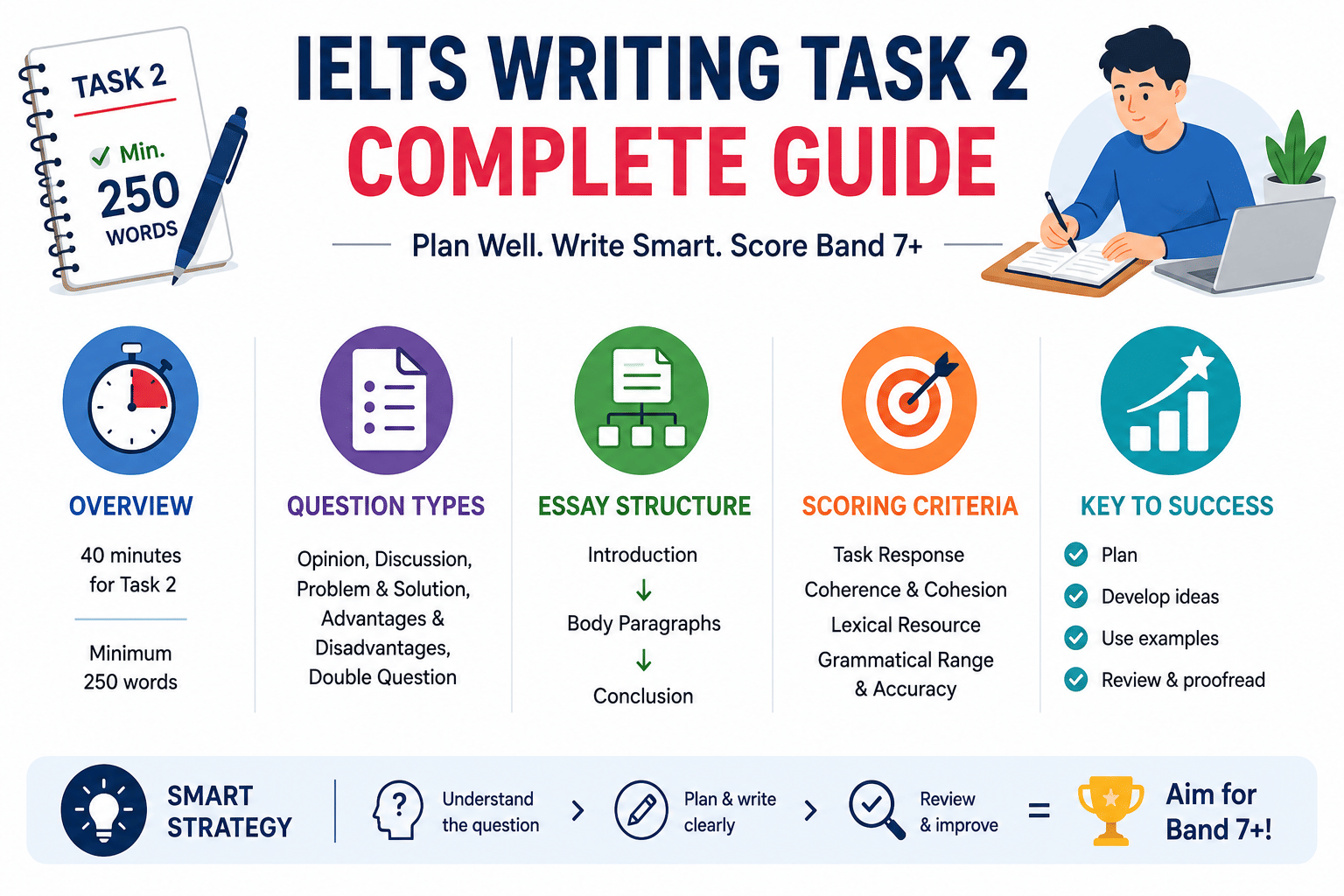
IELTS Writing Task is divided into 2 parts, Task 1 is a graph descriptive task. Task 2 is an essay writing task. Applicants need to write on the given topic in 250 words in approx 40 minutes. Task 2 holds twice the score than task 1 of the Writing section.
IELTS Writing Task 2 topics depend on the question type. IELTS can give topics based on opinion, discussion, advantages & disadvantages, or problem & solution. The task is scored based on vocabulary, grammar, cohesion & coherence, accuracy, and structure of the essay.
IELTS Writing Task 2 Format Overview
- Total Writing Test Duration: 60 minutes
- Recommended Time for Task 2: 40 minutes
- Essay Length: Minimum 250 words
- Question Type: 1 essay
- Contribution to Writing Score: 66% (Task 2 carries twice the weight of Task 1)
- What is IELTS Writing Task 2?
- IELTS Writing Task 2 Format 2026
- IELTS Writing Task 2 Question Types
- Latest IELTS Writing Task 2 Topics 2026
- IELTS Writing Task 2 Essay Structure with Example
5.1 How to Write an Introduction
5.2 How to Develop Body Paragraphs
5.3 How to Write a Strong Conclusion
5.4 IELTS Writing Task 2 Band 9 Sample Essays
- IELTS Writing Task 2 Topic-wise Vocabulary
- IELTS Writing Task 2 Linking Words
- IELTS Writing Task 2 Grammar Tips 2026
- IELTS Writing Task 2 Time Management Strategy 2026
- IELTS Writing Task 2 Common Mistakes 2026
- IELTS Writing Task 2 Band 7+ and Band 8+ Tips
- FAQs
What is IELTS Writing Task 2?
IELTS Writing Task 2 is the 2nd task of the IELTS Writing section, where candidates are required to write an essay in response to a point of view, argument, or problem. Test takers must present a clear position, organize ideas logically, and support their arguments with relevant explanations and examples.
The Writing Task 2 is included in both the IELTS Academic and IELTS General Training tests. Unlike Task 1, this part of the test is the same for both test types. Unlike Task 1, Writing Task 2 contributes twice as much to the overall Writing IELTS band score, making it the most important part of the Writing test.
Tip: Candidates must write in complete sentences and should avoid using bullet points or note form. A well-developed essay with clear organization and relevant examples is essential for achieving a high band score.
IELTS Writing Task 2 Format 2026
The IELTS Writing Task 2 format remains unchanged in 2026. Candidates are required to write one essay within the 60-minute Writing test, allocating approximately 40 minutes to Task 2 and 20 minutes to IELTS Writing Task 1.
| Feature | Details |
|---|---|
| Task Type | Essay Writing |
| Test Availability | IELTS Academic & IELTS General Training |
| Time Recommended | 40 minutes |
| Minimum Word Count | 250 words |
| Writing Style | Academic or semi-formal |
| Question Format | Opinion, argument, or problem-based |
| Weightage | Twice the marks of Writing Task 1 |
| Assessment Criteria |
|
During the test, candidates receive a question asking them to discuss an issue, present an opinion, evaluate ideas, compare viewpoints, explain causes, or propose solutions. They should carefully address every part of the question and support their arguments with relevant examples or evidence.
Tip: Candidates should spend a few minutes planning their response before writing and reserve the final few minutes to review grammar, vocabulary, and coherence.
IELTS Writing Task 2 Question Types
In IELTS Writing Task 2, candidates write an essay based on a point of view, argument, or problem. IELTS emphasizes understanding the question rather than memorizing fixed categories. Most IELTS preparation resources group Task 2 questions into five common essay types. These classifications help candidates identify what the examiner expects and structure their responses effectively.
| Question Type | What You Need to Do | Common Instruction Words |
|---|---|---|
| Opinion Essay | Present your opinion and support it with reasons and examples. | Do you agree or disagree? To what extent do you agree? |
| Discussion Essay | Discuss two opposing views and provide your own opinion. | Discuss both views and give your opinion. |
| Problem and Solution Essay | Explain the causes of a problem and suggest practical solutions. | What are the causes? What solutions can you suggest? |
| Advantages and Disadvantages Essay | Evaluate both benefits and drawbacks before giving a balanced conclusion. | Do the advantages outweigh the disadvantages? |
| Double Question (Direct Question) Essay | Answer two separate questions related to the same topic. | Why is this happening? Is this a positive or negative development? |
Opinion Essay
In an Opinion Essay, candidates are asked to express their viewpoint on a given statement and justify it with logical arguments and examples. The position should remain clear throughout the essay.
Common question prompts include:
- Do you agree or disagree?
- To what extent do you agree or disagree?
- What is your opinion?
Discussion Essay
A Discussion Essay requires candidates to examine two contrasting opinions on a topic before presenting their own viewpoint. Both perspectives should be discussed fairly, followed by a clear personal opinion in the conclusion or final body paragraph.
Common question prompt:
- Discuss both views and give your opinion.
Problem and Solution Essay
In this essay type, candidates identify the causes of a particular issue and recommend practical solutions. Strong responses explain the problem clearly and ensure that each proposed solution directly addresses an identified cause.
Common question prompts include:
- What are the causes of this problem?
- What solutions can you suggest?
- How can this problem be solved?
Advantages and Disadvantages Essay
Candidates evaluate both the positive and negative aspects of a situation before deciding whether the advantages outweigh the disadvantages. A balanced discussion supported by relevant examples is expected.
Common question prompts include:
- Do the advantages outweigh the disadvantages?
- What are the advantages and disadvantages?
Double Question (Direct Question) Essay
A Double Question Essay presents two separate questions related to the same topic. Candidates must answer both questions fully with equal attention and support each response with explanations and examples.
Common question prompts include:
- Why is this happening?
- Is this a positive or negative development?
- What problems does this cause, and how can they be solved?
Also read: Check IELTS Writing Sample Question 2026
Latest IELTS Writing Task 2 Topics 2026
| Question Type | IELTS Writing Task 2 Question |
|---|---|
| Opinion Essay | 1. Some people believe that artificial intelligence will improve people's lives, while others think it will create more problems than benefits. To what extent do you agree or disagree? |
| 2. Many universities now offer online degree programmes instead of traditional classroom teaching. Do you think the advantages of this development outweigh the disadvantages? | |
| Discussion Essay | 1. Some people think governments should invest more in public transportation, while others believe building more roads is a better solution. Discuss both views and give your own opinion. |
| 2. Some people believe children should spend more time learning practical skills, whereas others think schools should focus on academic subjects. Discuss both views and give your opinion. | |
| Problem and Solution Essay | 1. Traffic congestion has become a major problem in many large cities around the world. What are the main causes of this problem, and what measures can be taken to solve it? |
| 2. Many countries are facing increasing levels of obesity among children. What are the causes of this problem, and what solutions can be implemented? | |
| Advantages and Disadvantages Essay | 1. More companies are allowing employees to work from home instead of the office. What are the advantages and disadvantages of this trend? |
| 2. Many countries are replacing printed books with digital learning materials in schools. Do the advantages of this development outweigh the disadvantages? | |
| Double Question Essay | 1. In many countries, people are choosing to have children later in life. Why is this happening? Do you think this is a positive or negative development? |
| 2. More people are using social media to get news instead of traditional newspapers and television. Why has this change occurred? Is it a positive or negative development? |
IELTS Writing Task 2 Essay Structure with Example
A well-organized essay helps examiners follow your ideas easily and improves your Coherence and Cohesion score. Most high-scoring IELTS essays follow a simple four-paragraph structure, where the introduction is in the 1st paragraph, the arguments are in the 2nd and 3rd paragraphs, and the conclusion is in the 3rd paragraph.
Essay question: Some people believe that artificial intelligence will improve people's lives, while others think it will create more problems than benefits. To what extent do you agree or disagree?
How to Write an Introduction
Tips to Write an Effective Introduction
- Paraphrase the question instead of copying it directly. Replace key words with suitable synonyms while keeping the original meaning.
- Provide brief context by introducing the topic in one sentence before expressing your opinion.
- State your opinion clearly if the question asks whether you agree or disagree. Your position should remain consistent throughout the essay.
- Keep it concise. An effective introduction is usually 2–3 sentences and should not include examples or detailed arguments.
Here’s an example:
Artificial intelligence (AI) has become an integral part of modern society, transforming industries such as healthcare, education, and transportation. While some individuals argue that AI may lead to unemployment and ethical concerns, I strongly believe that its advantages outweigh the potential drawbacks, provided it is developed and regulated responsibly.
How to Develop Body Paragraphs
Tips for Writing Strong Body Paragraphs
- Begin with a clear topic sentence that introduces the main idea of the paragraph.
- Explain your argument by describing why your point is important or relevant to the question.
- Support your ideas with examples, such as real-life situations, general observations, or logical reasoning, instead of making unsupported statements.
- Use linking words naturally, such as Furthermore, However, As a result, and For example, to connect ideas smoothly.
- Focus on one main idea per paragraph to maintain clarity and logical progression.
Here’s an example of how you need to write body paragraphs:
One significant benefit of artificial intelligence is its ability to improve efficiency and productivity. AI-powered systems can automate repetitive tasks, allowing employees to focus on more creative and strategic work. In healthcare, for example, AI assists doctors in diagnosing diseases more accurately and quickly, leading to better patient outcomes. Similarly, educational platforms use AI to provide personalized learning experiences that cater to students' individual needs.
However, critics argue that widespread adoption of AI could replace human jobs and increase dependence on technology. Although these concerns are valid, history has shown that technological advancements often create new employment opportunities while eliminating outdated roles. Governments and organizations can address this challenge by investing in reskilling programmes and establishing regulations that ensure AI is used ethically and transparently.
How to Write a Strong Conclusion
Tips for Writing a Strong Conclusion
- Restate your opinion using different words instead of repeating the thesis statement exactly.
- Summarize your main arguments without introducing any new information.
- Keep the conclusion concise, usually 2–3 sentences, while maintaining a formal academic tone.
- Finish confidently by reinforcing your overall viewpoint rather than ending with an uncertain or neutral statement.
Here’s an example of a conclusion:
In conclusion, artificial intelligence offers numerous benefits that can significantly improve people's quality of life, from enhancing healthcare services to increasing workplace productivity. While certain risks exist, they can be minimized through responsible implementation and continuous human oversight. Therefore, I believe AI will ultimately have a positive impact on society.
IELTS Writing Task 2 Band 9 Sample Essays
Artificial intelligence (AI) has transformed many aspects of modern life, from healthcare and education to transportation and business. While some people believe that AI may create serious challenges, such as unemployment and ethical concerns, I strongly agree that its benefits outweigh the potential disadvantages when it is used responsibly.
One of the greatest advantages of AI is its ability to improve efficiency and accuracy. In the healthcare sector, AI-powered systems assist doctors in detecting diseases earlier, leading to faster diagnosis and better treatment. Similarly, educational platforms use AI to provide personalized learning experiences, enabling students to study at their own pace. These innovations not only save time but also improve the quality of essential services.
Opponents argue that AI could replace human workers and increase dependence on technology. Although this concern is understandable, technological progress has always changed the nature of employment rather than eliminating it. As automation replaces repetitive tasks, new careers in software development, data analysis, and AI management continue to emerge. Governments and employers can further reduce unemployment by offering training programmes that help workers acquire new skills.
In conclusion, artificial intelligence presents certain risks, particularly in employment and data privacy. Nevertheless, its ability to improve healthcare, education, productivity, and innovation makes it a valuable tool for society. With appropriate regulations and responsible implementation, AI has the potential to enhance people's quality of life and contribute significantly to economic and social development.
IELTS Writing Task 2 Topic-wise Vocabulary
Using precise and topic-specific vocabulary can improve your Lexical Resource score in IELTS Writing Task 2. Use words naturally and accurately rather than forcing advanced vocabulary into every sentence. The table below includes commonly used academic words across popular IELTS essay topics:
| Vocabulary | Meaning |
|---|---|
| Enhance | To improve or increase the quality of something |
| Sustainable | Able to continue for a long time without harming the environment |
| Significant | Important or considerable |
| Implement | To put a plan or policy into action |
| Allocate | To distribute resources for a specific purpose |
| Consequence | The result or effect of an action |
| Perspective | A particular way of viewing an issue |
| Inequality | Lack of equal opportunities or treatment |
| Innovation | Introduction of new ideas, methods, or technologies |
| Infrastructure | Basic systems such as roads, transport, and communication facilities |
| Renewable | Able to be naturally replaced, such as solar or wind energy |
| Urbanization | Growth and expansion of cities |
| Awareness | Knowledge or understanding of a particular issue |
| Productivity | The ability to produce goods or services efficiently |
| Consumption | The use of goods, services, or resources |
| Mitigate | To reduce the seriousness of a problem |
| Preserve | To protect something from damage or loss |
| Diverse | Showing a variety of different types or ideas |
| Welfare | Health, happiness, and general well-being of people |
| Viable | Practical and capable of succeeding |
| Subsidy | Financial assistance provided by the government |
| Regulate | To control through laws or rules |
| Efficient | Achieving good results with minimal waste of time or resources |
| Collaborate | To work together toward a common goal |
| Prioritize | To deal with the most important task first |
Also read: IELTS Vocabulary and Grammar 2026
IELTS Writing Task 2 Linking Words
Coherence and cohesion are 2 of the four marking criteria. Linking words should be used naturally to connect ideas rather than being inserted into every sentence. Overusing connectors can reduce the natural flow of an essay. Here are some common connectors which can be used naturally in your writing:
| Purpose | Linking Words |
|---|---|
| Addition | Furthermore, Moreover, In addition, Besides, Additionally |
| Contrast | However, Nevertheless, On the other hand, In contrast, Whereas |
| Cause | Because, Since, Due to, Owing to |
| Result | Therefore, Consequently, As a result, Hence |
| Example | For example, For instance, Such as |
| Opinion | In my opinion, I believe, From my perspective |
| Sequence | Firstly, Secondly, Finally |
| Conclusion | To conclude, In conclusion, Overall |
IELTS Writing Task 2 Grammar Tips 2026
Grammar accounts for 25% of the IELTS Writing score under the Grammatical Range and Accuracy criterion. Examiners assess not only grammatical correctness but also your ability to use a variety of sentence structures naturally throughout the essay. Follow these tips to enhance your grammar and present it without any errors:
- Use a variety of sentence structures: Avoid writing only short, simple sentences. Combine simple, compound, and complex sentences to demonstrate grammatical range while ensuring each sentence remains clear and easy to understand.
- Maintain correct subject-verb agreement: Ensure that singular subjects take singular verbs and plural subjects take plural verbs. Subject-verb agreement errors are common and can lower your grammar score even when your ideas are strong.
- Keep verb tenses consistent: Choose the correct tense according to the context and avoid switching between tenses without a reason. Most IELTS essays use the present simple, while future or past tenses should be used only when discussing predictions or past events.
- Use articles correctly: Pay attention to the correct use of a, an, and the. Missing or incorrect articles are among the most frequent grammar mistakes made by IELTS candidates.
- Include relative and conditional clauses: Use structures such as who, which, that, if, and unless to add detail and show grammatical flexibility. However, avoid making sentences unnecessarily long or difficult to follow.
- Avoid run-on sentences and sentence fragments: Every sentence should express a complete idea with proper punctuation. Joining multiple ideas without conjunctions or punctuation can reduce clarity and negatively affect your grammar score.
- Use the passive voice only when appropriate: It is useful when the action is more important than the person performing it, especially in formal writing. Overusing passive constructions, however, can make your essay sound unnatural.
- Proofread for common grammar errors: Reserve the final few minutes to check spelling, punctuation, prepositions, verb forms, and sentence structure. Correcting small grammatical mistakes before submission can improve the overall accuracy of your writing.
Also read: IELTS Writing Tips to Score 8+ Band Score
IELTS Writing Task 2 Time Management Strategy 2026
Candidates have 40 minutes to complete Task 2, which carries twice the weight of Task 1 in the overall Writing score. Effective time management helps ensure all parts of the question are addressed. The table below divides the precious 40 minutes into effective strategies:
| Activity | Recommended Time |
|---|---|
| Read and understand the question | 2-3 minutes |
| Brainstorm ideas | 3-4 minutes |
| Create an outline | 2-3 minutes |
| Write the essay | 27-30 minutes |
| Proofread | 3-5 minutes |
Suggested 40-Minute Plan
- 0-5 minutes: Analyze the question and decide your position.
- 5-10 minutes: Plan paragraph structure and supporting ideas.
- 10-35 minutes: Write the introduction, body paragraphs, and conclusion.
- 35-40 minutes: Review grammar, spelling, and word count.
Also read: IELTS Exam Preparation Time Strategy 2026
IELTS Writing Task 2 Common Mistakes 2026
Many candidates lose marks because they do not fully meet the assessment criteria. Understanding these common mistakes and knowing how to avoid them can significantly improve your Writing Task 2 score. The following are some of the common mistakes and their solutions:
| Common Mistake | Solution |
|---|---|
| Writing fewer than 250 words | Write at least 250 words and monitor your word count while practicing to avoid losing marks for underdeveloped responses. |
| Not answering every part of the question | Read the prompt carefully and underline the key instructions before planning your essay to ensure all parts are addressed. |
| Going off-topic | Stay focused on the question throughout the essay and avoid adding unrelated ideas or memorized content. |
| Poor paragraph organization | Divide your essay into a clear introduction, two or three body paragraphs, and a conclusion, with one main idea per paragraph. |
| Using the same vocabulary repeatedly | Use synonyms and topic-specific vocabulary naturally to improve lexical variety without changing the meaning. |
| Overusing linking words | Use connectors only where they improve the flow of ideas. Excessive use of words like Moreover or Furthermore can make the essay sound mechanical. |
| Making frequent grammar mistakes | Practice sentence structure, subject-verb agreement, articles, and verb tenses, then proofread your essay before finishing the test. |
| Giving weak or no supporting examples | Support every main idea with a relevant explanation or example to strengthen your argument and improve Task Response. |
| Writing memorized essays | Write an original response that directly answers the question instead of relying on pre-learned essays, which may not fit the prompt. |
| Not proofreading the essay | Reserve the last 3-5 minutes to check grammar, spelling, punctuation, and incomplete sentences before submitting your response. |
IELTS Writing Task 2 Band 7+ and Band 8+ Tips
The difference between Band 7 and Band 8 lies in the quality of idea development, vocabulary precision, cohesion, and grammatical control. Examiners assess all four criteria equally, but the presentation of ideas is a main factor in the difference between the 2 IELTS scores:
Tips to Score Band 7+
- Address every part of the question.
- Present a clear opinion throughout the essay.
- Develop each main idea with explanations and relevant examples.
- Organize ideas into logical paragraphs.
- Use a range of vocabulary accurately instead of forcing advanced words.
- Combine simple and complex sentence structures.
- Limit grammar and spelling errors.
Tips to Score Band 8+
- Present fully developed arguments supported with relevant evidence.
- Use cohesive devices naturally without making them obvious.
- Demonstrate flexibility in vocabulary with precise word choice and appropriate collocations.
- Write varied, accurate sentence structures with only occasional minor errors.
- Maintain a consistent position from introduction to conclusion.
- Ensure each paragraph has a clear central idea and transitions smoothly to the next.
- Reserve the final few minutes to proofread for grammar, punctuation, and word choice.
Also read: How to Get a 9 Band Score in IELTS Speaking Task 2026
IELTS Writing Task 2 carries twice the weight of Task 1 in the overall Writing score, making it one of the most important sections of the IELTS exam. Understanding the essay format, practicing all five question types, and meeting the official assessment criteria can help candidates write well-structured essays and improve their chances of achieving a higher band score.
FAQs
Ques. What is the minimum word limit for IELTS Writing Task 2?
Ans. Candidates must write at least 250 words in IELTS Writing Task 2. Writing fewer than the required word count may affect the Task Response score. Although there is no official maximum word limit, candidates are advised to complete the essay within the recommended 40 minutes.
Ques. Can I use first-person pronouns like "I" and "my" in IELTS Writing Task 2?
Ans. Yes. Candidates can use first-person pronouns when the question asks for a personal opinion. However, the essay should maintain a formal tone and support opinions with clear explanations and relevant examples.
Ques. How many paragraphs should an IELTS Writing Task 2 essay have?
Ans. IELTS does not specify a fixed number of paragraphs. However, most high-scoring essays follow a clear structure with one introduction, two body paragraphs, and one conclusion, making it easier to present ideas logically.
Ques. Which IELTS Writing Task 2 essay type appears most frequently?
Ans. IELTS does not publish data on how often each essay type appears. Candidates should prepare for all common question types, including Opinion, Discussion, Problem and Solution, Advantages and Disadvantages, and Double Question essays.
Ques. Can I use bullet points in IELTS Writing Task 2?
Ans. No. IELTS Writing Task 2 requires candidates to write a continuous essay using complete sentences and paragraphs. Bullet points or note-form answers are not suitable for this task.
Ques. Does IELTS accept both British and American English in Writing Task 2?
Ans. Yes. Both British English and American English spellings are accepted. However, candidates should use one style consistently throughout the essay.
Ques. How can I improve my IELTS Writing Task 2 band score?
Ans. To improve your IELTS Writing Task 2 score, answer every part of the question, organize your ideas logically, use a range of vocabulary and sentence structures accurately, and leave a few minutes to proofread your essay. These skills align with the four official IELTS Writing assessment criteria.


1787567517.png?tr=w-305,h-145,c-force?h=175&w=350&mode=stretch)



Comments