



| Updated On - Aug 3, 2026
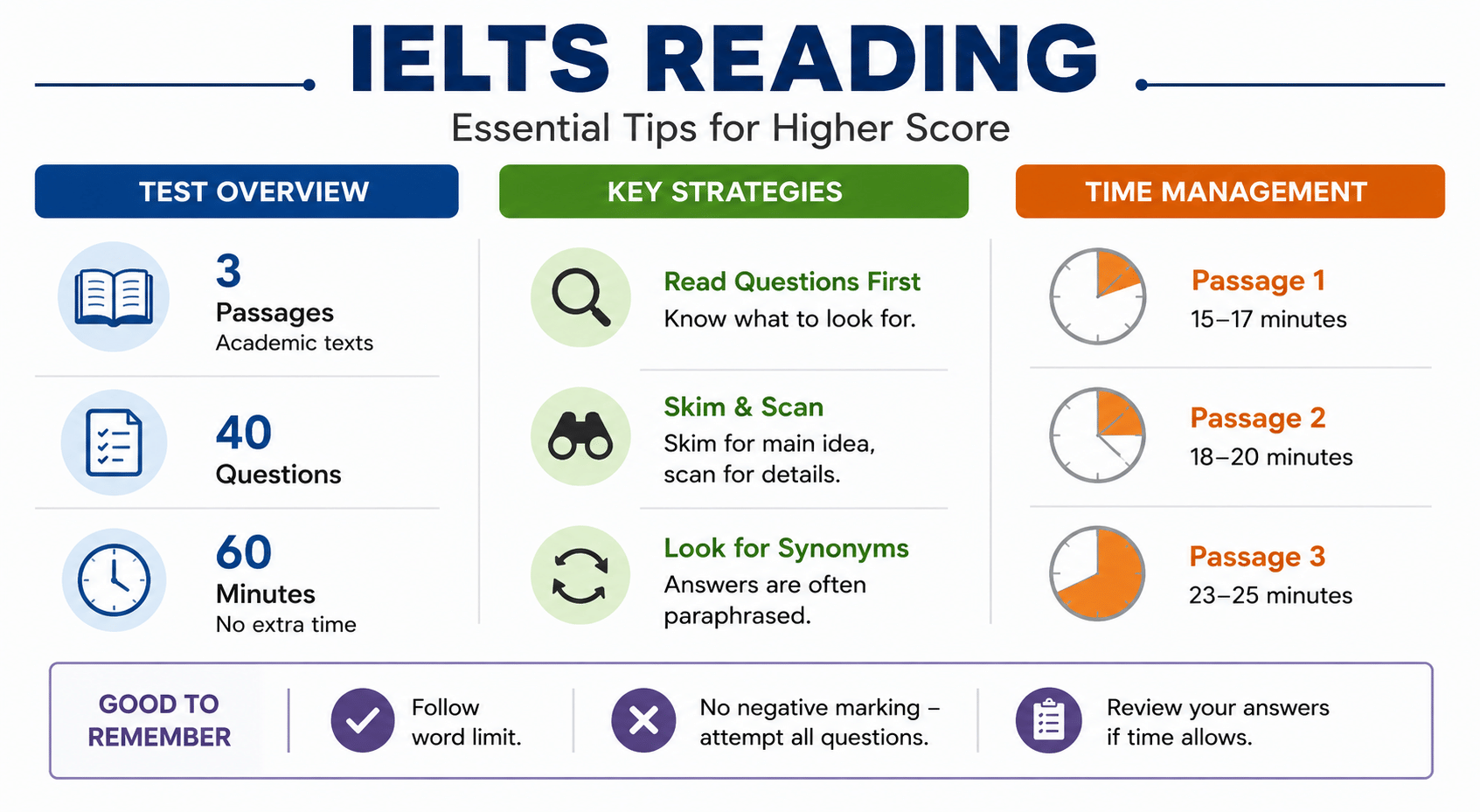
The IELTS Reading test includes 40 questions to be completed in 60 minutes, with 3 passages that assess your ability to identify key information, understand ideas, and interpret opinions. Since there is no extra time to transfer answers, effective time management and the right reading strategies are essential for achieving a high band score.
Mastering techniques like skimming, scanning, and identifying synonyms can significantly improve your accuracy, speed, and overall IELTS scores. The Reading skill tests a candidate's ability to understand factual information, identify the writer's views, and locate specific details using effective reading strategies.
- What is the IELTS Reading Test?
- IELTS Reading Test Format
- IELTS Reading Tips to Improve Your Score
- IELTS Reading Time Management Tips 2026
- Question-wise IELTS Reading Tips 2026
- IELTS Reading Skimming and Scanning Techniques
- IELTS Reading Common Mistakes & Solutions 2026
- IELTS Reading Tips for Beginners
- IELTS Reading Tips for Band 7, 8 & 9
- 7-Day IELTS Reading Practice Plan
- 30-Day IELTS Reading Practice Plan
- FAQs
What is the IELTS Reading Test?
The IELTS Reading test assesses your ability to understand, interpret, and analyze written English in different contexts. It evaluates essential reading skills such as identifying the main idea, locating specific information, understanding logical arguments, recognizing opinions, and interpreting the writer's purpose.
Unlike the Listening test, candidates do not receive additional time to transfer answers in the Reading section. Answers must be written directly on the answer sheet (paper-based) or entered into the system (computer-delivered).
IELTS Reading Test Format
The Reading section is available in both IELTS Academic and IELTS General Training. While the test format remains the same, 60 minutes and 40 questions, the reading passages differ according to the test type.
- IELTS Academic Reading includes three long texts sourced from books, journals, magazines, and newspapers, designed for university-level candidates.
- IELTS General Training Reading contains texts taken from everyday materials such as advertisements, company handbooks, notices, newspapers, and workplace documents.
| Feature | Details |
|---|---|
| Test Duration | 60 minutes |
| Number of Questions | 40 |
| Number of Passages | 3 |
| Transfer Time | No extra transfer time in computer-based or paper-based Reading test |
| Marks per Question | 1 mark |
| Negative Marking | None |
IELTS Reading Tips to Improve Your Score
Applicants who are aiming for high IELTS scores must follow these tips to score better in the Reading test. The following are the tips to improve your score in the Reading section:
- Read the questions first: Review the questions before reading the passage to identify keywords such as names, dates, and places. This gives you a clear purpose while reading.
- Look for synonyms, not exact words: IELTS usually paraphrases information instead of repeating the same words. Build your vocabulary to recognize synonyms and similar expressions.
- Use skimming and scanning: Skim the passage to understand the main idea and scan for specific details like numbers, names, or dates instead of reading every word.
- Don't spend too long on one question: If you can't find an answer within a minute or two, move on and return later. This helps you complete all 40 questions within 60 minutes.
- Follow the word limit: Always follow instructions such as "ONE WORD ONLY" or "NO MORE THAN TWO WORDS." Extra words make the answer incorrect even if the information is right.
- Practice every question type: Each question type follows a different strategy. Familiarity with all question formats improves both speed and accuracy.
- Improve your reading speed: Read English newspapers, magazines, and academic articles daily to increase reading speed and comprehension without translating every sentence.
- Review your mistakes regularly: After every mock test, analyze incorrect answers to identify recurring mistakes, weak vocabulary, and question types that need more practice.
Also read: Check IELTS Reading Practice Papers 2026
IELTS Reading Time Management Tips 2026
The IELTS Reading test gives candidates 60 minutes to answer 40 questions, with no extra time to transfer answers. Managing your time effectively is essential to complete all three passages. Applicants need to manage their time carefully so that they can focus on each passage equally and answer effectively.
Here’s a recommended time distribution for the IELTS Reading task:
| Passage | Suggested Time |
|---|---|
| Passage 1 | 15-17 minutes |
| Passage 2 | 18-20 minutes |
| Passage 3 | 23-25 minutes |
| Final Review | 2-3 minutes |
The following are some tips for time management during the Reading test:
- Start with the questions: Read the questions before the passage to know exactly what information you need to find, reducing unnecessary reading.
- Skim before reading in detail: Spend the first minute skimming the passage to understand its structure before searching for answers.
- Keep an eye on the clock: Aim to finish Passage 1 in 15-17 minutes, Passage 2 in 40 minutes, and leave the remaining time for Passage 3 and review.
- Don't get stuck: If an answer takes too long to find, move to the next question and return later if time permits.
- Answer directly on the answer sheet: Since there is no transfer time in the Reading test, write your answers directly on the answer sheet or computer screen.
- Leave time for review: Reserve the final 2-3 minutes to check spelling, word limits, and ensure every question has been attempted.
- Attempt every question: IELTS Reading has no negative marking, so never leave a question unanswered. Make an educated guess if necessary.
Also read: IELTS Reading Fatal Attraction Passage 2026
Question-wise IELTS Reading Tips 2026
IELTS Reading test has multiple question types such as multiple choice, matching the information, and summary completion. The table below lists all the question types and tips on how they can be answered:
| Question Type | Best Tip |
|---|---|
| Matching headings | Focus on the main idea of each paragraph rather than matching individual keywords. |
| True/false/not given | Base your answer only on the passage. If the information isn't mentioned, choose Not Given instead of making assumptions. |
| Yes/no/not given | Identify the writer's opinion, not factual information, before selecting your answer. |
| Multiple choice | Eliminate incorrect options first and choose the answer supported directly by the passage. |
| Matching information | Scan for synonyms and paraphrased ideas, as the exact words from the question rarely appear in the text. |
| Matching features | Identify all names or categories first, then match each statement with the correct person, place, or feature. |
| Sentence completion | Predict the missing word type (noun, verb, adjective, or number) before locating the answer in the passage. |
| Summary completion | Read the summary first, then locate the corresponding section in the passage using keywords and paraphrases. |
| Note completion | Follow the order of information in the passage, as answers usually appear sequentially. |
| Flow-chart completion | Pay attention to sequence words such as first, next, after, and finally to identify the correct answer. |
| Diagram label completion | Study the diagram carefully and locate the descriptive section in the passage before selecting labels. |
| Short answer questions | Follow the specified word limit exactly and copy the answer accurately from the passage, checking spelling before submitting. |
Also read: Types of Topics and Questions in IELTS Reading Test
IELTS Reading Skimming and Scanning Techniques
Skimming and scanning are two essential reading techniques that help candidates complete the IELTS Reading test within the 60-minute time limit. While skimming helps you understand the overall meaning of a passage, scanning is used to locate specific information quickly.
Using both techniques together can improve reading speed and accuracy. Follow the table below to know when and how to use these techniques effectively:
| Technique | Purpose | When to Use |
|---|---|---|
| Skimming | Understand the main idea of a passage or paragraph | Before answering questions, Matching Headings, identifying paragraph themes |
| Scanning | Locate specific information quickly | Finding names, dates, numbers, keywords, and factual details |
IELTS Reading Common Mistakes & Solutions 2026
Many candidates lose marks in the IELTS Reading test because of avoidable mistakes rather than lack of English proficiency. Understanding these common errors and applying the right strategies can improve both speed and accuracy. Follow the table below to know these common mistakes and their solutions:
| Common Mistake | Solution |
|---|---|
| Reading every word of the passage | Skim the passage first to understand the main idea and scan for specific information while answering questions. |
| Ignoring the word limit | Always follow instructions such as "ONE WORD ONLY" or "NO MORE THAN TWO WORDS." Writing extra words results in an incorrect answer. |
| Looking for exact keywords | IELTS uses synonyms and paraphrasing. Focus on meaning rather than identical words. |
| Spending too much time on one question | If an answer is taking too long, move on and return later if time allows. |
| Confusing 'False' with 'Not Given' | Choose False when the passage contradicts the statement and Not Given when the information is not mentioned at all. |
| Making assumptions | Base every answer only on the information provided in the passage, not on your personal knowledge or opinions. |
| Poor time management | Allocate around 15-17 minutes for Passage 1, 18-20 minutes for Passage 2, and 23-25 minutes for Passage 3. |
| Spelling mistakes | Copy answers carefully from the passage and review your spelling before submitting. Incorrect spelling is marked wrong. |
| Leaving questions unanswered | There is no negative marking in IELTS Reading, so attempt every question even if you need to make an educated guess. |
| Not practicing different question types | Familiarize yourself with all IELTS Reading question formats to develop the right strategy for each one. |
IELTS Reading Tips for Beginners
If you're new to IELTS Reading, focus on building reading habits and understanding the test format before attempting full-length mock tests. Consistent practice and the right techniques can help you improve your score over time.
- Understand the test format: Learn about the number of passages, question types, and the 60-minute time limit before starting your preparation. Knowing the format reduces exam-day anxiety.
- Build a daily reading habit: Read English newspapers, magazines, blogs, or academic articles for at least 20-30 minutes daily. This improves vocabulary, comprehension, and reading speed.
- Learn skimming and scanning: Instead of reading every word, practice skimming to understand the main idea and scanning to locate specific information quickly.
- Improve your vocabulary: Maintain a notebook of unfamiliar words, their meanings, and synonyms. Review them regularly to recognize paraphrased information in the Reading test.
- Practice one question type at a time: Start by mastering one question type, such as True/False/Not Given or Matching Headings, before attempting complete Reading tests.
- Read the instructions carefully: Always check the word limit and answer format before writing your response. Even a correct answer can lose marks if it exceeds the specified word limit.
- Solve timed practice tests: Once you're comfortable with the format, practice full Reading tests under exam conditions. This helps improve time management and builds confidence.
- Review every mistake: After each practice test, identify why you answered a question incorrectly. Understanding your mistakes is one of the fastest ways to improve your IELTS Reading score.
- Don't worry about unknown words: It's normal to encounter unfamiliar vocabulary. Focus on understanding the surrounding context instead of stopping to translate every word.
- Be consistent: Practice IELTS Reading regularly rather than studying for long hours occasionally. Even 30-45 minutes of focused practice each day can lead to steady improvement over time.
IELTS Reading Tips for Band 7, 8 & 9
Your IELTS Reading band score depends on both accuracy and time management. While Band 7 requires a solid understanding of the passage, Bands 8 and 9 demand faster reading, better vocabulary, and the ability to recognize paraphrased information with minimal errors.
The following are tips based on target IELTS score band:
| Target Band | Tips to Achieve It |
|---|---|
| Band 7 | Focus on mastering all question types, practice skimming and scanning, improve vocabulary, and complete at least 2-3 full Reading tests every week. Aim to avoid simple mistakes such as spelling errors and exceeding word limits. |
| Band 8 | Develop the ability to identify synonyms and paraphrases quickly. Improve reading speed, solve full-length mock tests under timed conditions, and spend more time analyzing mistakes than simply taking tests. |
| Band 9 | Read complex academic texts daily, answer questions with high accuracy under 60 minutes, recognize subtle differences between similar answer choices, and avoid relying solely on keywords. Focus on understanding meaning and the writer's purpose. |
Additional Tips to Improve Your Band Score
- Build a strong vocabulary by reading newspapers, journals, and academic articles.
- Practice under real exam conditions to improve speed and accuracy.
- Review incorrect answers to identify recurring mistakes.
- Learn strategies for every IELTS Reading question type.
- Never leave a question unanswered, as there is no negative marking.
7-Day IELTS Reading Practice Plan
Applicants who are well acquainted with the IELTS Reading format can follow this 7-day study plan. This will help them revise the main areas of reading skills.
| Day | Practice Plan |
|---|---|
| Day 1 | Understand the IELTS Reading format, question types, and scoring system. Practice skimming and scanning techniques using one Reading passage. |
| Day 2 | Practice Matching Headings, Matching Information, and Matching Features questions. Review your mistakes and note unfamiliar vocabulary. |
| Day 3 | Practice True/False/Not Given and Yes/No/Not Given questions. Focus on distinguishing between contradictory and missing information. |
| Day 4 | Solve Sentence Completion, Summary Completion, Note Completion, and Short Answer Questions. Pay close attention to word limits and grammar. |
| Day 5 | Attempt one full IELTS Reading test in 60 minutes. Review every incorrect answer and identify weak areas. |
| Day 6 | Revise difficult question types, practice another Reading passage, and improve vocabulary by learning common IELTS synonyms and paraphrases. |
| Day 7 | Take one final mock test under exam conditions. Analyze your performance, revise common mistakes, and review your error log before the exam. |
7-Day Preparation Tips
- Practice for 60-90 minutes daily.
- Maintain an error notebook to track recurring mistakes.
- Learn at least 10-15 new words and synonyms each day.
- Focus on accuracy first, then gradually improve speed.
30-Day IELTS Reading Practice Plan
Applicants who are sitting for the IELTS exam for the first time need to familiarise themselves with the format of the test. They need to practice regularly to improve their skills and get good IELTS scores. Follow this 4-week study plan to achieve your target score:
| Week | Focus Area |
|---|---|
| Week 1: Build the Basics | Understand the IELTS Reading format, scoring, and question types. Learn skimming and scanning techniques, start reading English newspapers or articles daily, and practice one Reading passage every day. |
| Week 2: Master Question Types | Practice each IELTS Reading question type, including Matching Headings, True/False/Not Given, Multiple Choice, Summary Completion, and Diagram Label Completion. Focus on identifying synonyms, paraphrases, and following word limits. |
| Week 3: Improve Speed & Accuracy | Solve 3-4 full Reading passages under timed conditions. Improve time management, strengthen weak question types, expand your vocabulary, and review mistakes after every practice session. |
| Week 4: Mock Tests & Final Revision | Attempt 3-4 full IELTS Reading mock tests in 60 minutes. Revise skimming, scanning, and paraphrasing strategies, review your error log, and focus on improving accuracy while maintaining speed. |
Also read: IELTS Reading Books for Effective Preparation in 2026
The IELTS Reading test includes 40 questions to be completed in 60 minutes, making both accuracy and time management essential for a high band score. By practicing skimming and scanning techniques, mastering different question types, and taking regular timed mock tests, you can steadily improve your performance and achieve your target IELTS Reading band.
FAQs
Ques. How can I improve my IELTS Reading score quickly?
Ans. To improve your IELTS Reading score, practice under timed conditions, learn skimming and scanning techniques, expand your vocabulary, and review your mistakes after each mock test. Regular practice with different question types can improve both speed and accuracy.
Ques. What is the best strategy for the IELTS Reading test?
Ans. The best strategy is to read the questions first, identify keywords, skim the passage for the main idea, and then scan for specific information. Also, pay attention to synonyms and paraphrased words, as IELTS rarely repeats the exact wording from the questions.
Ques. Is skimming and scanning important for IELTS Reading?
Ans. Yes. Skimming helps you understand the overall meaning of a passage, while scanning allows you to locate specific details such as names, dates, and numbers quickly. Using both techniques can help you complete all 40 questions within the 60-minute time limit.
Ques. What are the most difficult IELTS Reading question types?
Ans. Many candidates find Matching Headings, True/False/Not Given, Yes/No/Not Given, and Matching Information the most challenging because they require understanding the main idea and identifying paraphrased information.
Ques. Is there negative marking in the IELTS Reading test?
Ans. No. There is no negative marking in the IELTS Reading test. You should attempt every question, even if you are unsure of the correct answer.
Ques. Should I read the passage first or the questions first in IELTS Reading?
Ans. Most IELTS experts recommend reading the questions first. This helps you identify important keywords and locate the required information more efficiently while reading the passage.


1787567517.png?tr=w-305,h-145,c-force?h=175&w=350&mode=stretch)



Comments