



| Updated On - Aug 25, 2026
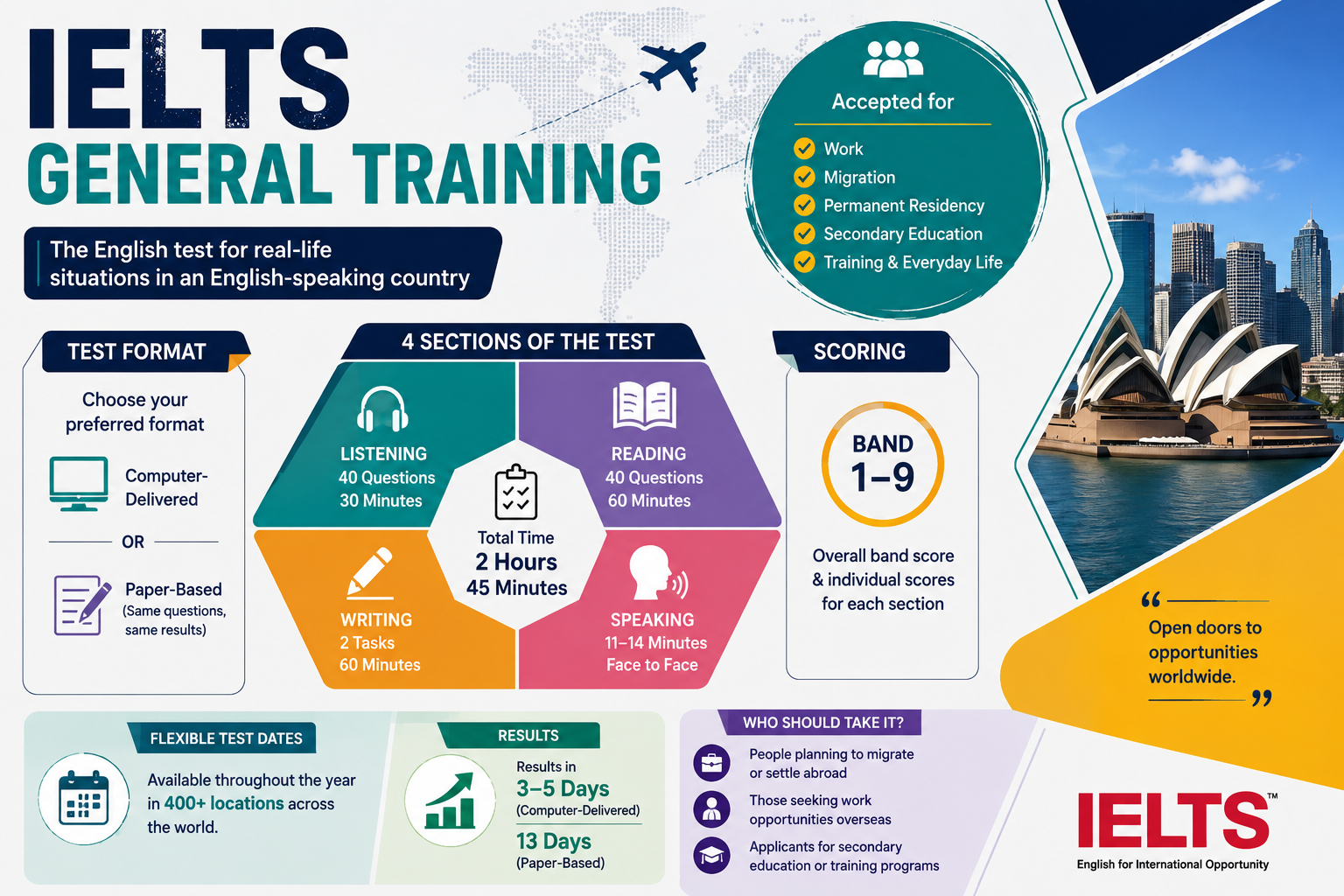
IELTS General Training is taken for job, migration, or visa purposes. Students who need to take admission in below-degree studies also sit for General Training instead of IELTS Academic. The exam fee for General Training is INR 19,000, including GST.
The General Training scores are valid for 2 years from the date of the examination. IELTS will shift to a fully computer-based mode from September 2026. Applicants can no longer appear for the paper-based test mode. Important highlights of the test are:
- General Training focuses on everyday life conversations and requirements of the English language.
- Booking the wrong version wastes the full fee because you can't swap versions later.
- Reading is marked more strictly here, so accuracy matters more than speed.
- Your weakest skill decides your visa outcome, not your overall band.
Note: UK visa applicants need to take IELTS UKVI.
Also read: Difference between IELTS Academic and General Training
- Quick Facts on IELTS General Training
- What is IELTS General Training?
- Who should take IELTS General Training
- IELTS General Training exam pattern 2026
- IELTS General Training Reading and Writing
- IELTS General Training band score chart
- IELTS General Training scores for PR
- IELTS General Training fees in India
- How to book IELTS General Training
- Common IELTS Fee Mistakes
- How to prepare for General Training
- FAQs
Quick Facts on IELTS General Training
| Parameter | Detail |
|---|---|
| Test fee in India (2026) | INR 19,000 |
| Total test time | 2 hours 45 minutes |
| Questions in Listening and Reading | 40 each |
| Writing word minimums | 150 and 250 words |
| Speaking duration | 11 to 14 minutes |
| Band scale | 0 to 9 |
| Score validity | 2 years |
| Result time on computer | 1 to 2 days |
Also read: The End of Paper-Based IELTS Testing
What is IELTS General Training?
IELTS General Training measures everyday English used in social and workplace situations. It is built for people who plan to work, train, or migrate abroad. It is not built for degree admission.
The test has four parts: Listening, Reading, Writing and Speaking. Listening and Speaking are identical to the Academic version. Only Reading and Writing have changes in format and question content. Both versions sit on the same 0 to 9 band scale, so a 7.0 means the same thing either way.
The texts you face are practical, not academic. Think notices, timetables, job descriptions and staff handbooks. The Writing test asks for a letter instead of a chart description.
What IELTS General Training gives you:
- Proof of English for skilled migration to Canada, Australia, the USA, and New Zealand.
- Proof of English for many work visa and professional routes.
- Entry to training courses and schooling below degree level.
Tip: A Band 7 in General Training Reading usually needs about 35 correct answers out of 40. Academic Reading needs about 30 for the same band. That single difference decides whether many applicants clear their PR language threshold on the first attempt.
Who should take IELTS General Training?
Take IELTS General Training if your goal is a work visa, permanent residence, or a non-degree course. Everyone applying to a university abroad should book the Academic version instead.
Canada is the clearest case. Immigration, Refugees and Citizenship Canada converts only General Training scores into Canadian Language Benchmark levels. An Academic score cannot be used for an Express Entry profile at all. Australia is more relaxed and accepts both versions for skilled migration.
If you plan to study first and settle later, you will likely need both versions at different stages. That means budgeting for two separate test fees across two or three years. Students in that position should start with the IELTS Academic and take General Training when applying for PR.
| Your goal | Version to book |
|---|---|
| Bachelor's or master's abroad | Academic |
| Canada PR through Express Entry | General Training |
| Australia skilled migration | General Training or Academic |
| UK work or family visa | General Training for UKVI |
| Diploma or vocational training | General Training |
| Nursing or medical registration | Academic, in most cases |
Note: Professional bodies sit outside the visa system and set their own bar. A nursing council may ask for 7.0 while the visa itself asks for far less. Always confirm both thresholds before booking anything.
Read More: Who can appear for the IELTS test and what documents are needed
IELTS General Training exam pattern 2026
The IELTS General Training exam pattern runs 2 hours 45 minutes across four sections. Listening, Reading, and Writing are taken in one sitting. Speaking may fall on the same day or within a week either side.
| Section | Time | Task load |
|---|---|---|
| Listening | About 30 minutes | 4 recordings, 40 questions |
| Reading | 60 minutes | 3 sections, 40 questions |
| Writing | 60 minutes | 1 letter, 1 essay |
| Speaking | 11 to 14 minutes | 3 parts, face-to-face |
Listening covers four recorded conversations and monologues of rising difficulty. Speaking is a live interview with a certified examiner in every format, including on a computer. Source: ielts.org test format guidance.
IELTS General Training Reading and Writing
Reading and Writing are the only two sections where General Training differs from Academic. Both use everyday material rather than journal articles. In Academic, applicants need to describe a graph in 150 words as IELTS Writing Task 1. Whereas, in General Training, applicants need to write a letter of 150 words as Writing Task 1.
Reading structure
Reading has three sections of rising difficulty and a total text length of 2,150 to 2,750 words. Section 1 uses short survival texts such as notices and advertisements. Section 2 covers work topics like contracts and training material. Section 3 is one long text of general interest.
Question types are the same eleven used in the Academic Reading test. True, False, Not Given still trips up most Indian test takers. Spelling and grammar errors cost you the mark even when the meaning is right.
Writing structure
Task 1 asks for a letter of at least 150 words in about 20 minutes. Task 2 asks for an essay of at least 250 words in about 40 minutes. Task 2 carries twice the weight of Task 1 in the final Writing band.
- Letters can be formal, semi-formal, or informal, and the tone must stay consistent.
- Every letter prompt carries three bullet points that all need a response.
- Writing under the minimum word count triggers a direct penalty on task achievement.
- Notes and bullet points in your answer are penalised, so write connected prose.
The letter is where most General Training candidates lose half a band. It looks easier than an Academic chart task, so it gets less practice time. Working through recent Writing Task 1 letter prompts is the fastest fix.
Key Insight: If your Writing target is 7.0, then Task 2 deserves two thirds of your practice time. That means roughly two essays for every letter you write.
IELTS General Training band score chart
General Training Reading needs about five more correct answers than Academic for the same band. This is the most misread fact about the test.
Listening and Reading are marked out of 40 with one mark per correct answer. There is no negative marking, so every blank should be filled. Writing and Speaking are marked by certified examiners against four criteria each.
| Band score | Listening marks | General Training Reading marks | Academic Reading marks |
|---|---|---|---|
| Band 4 | NA | 15 | NA |
| Band 5 | 16 | 23 | 15 |
| Band 6 | 23 | 30 | 23 |
| Band 7 | 30 | 35 | 30 |
| Band 8 | 35 | NA | 35 |
These are average marks published by the test partners. The exact number shifts slightly between test versions. Source: ielts.org scoring guidance. Read the General Training column carefully. Thirty correct answers is a Band 6 here and a Band 7 in Academic. Anyone practising with Academic answer keys is reading a flattering score.
Your overall IELTS score band is the average of the four section scores, rounded to the nearest half band. An average ending in .25 rounds up to the next half band. An average ending in .75 rounds up to the next whole band.
IELTS General Training scores for PR
Most General Training candidates need 6.0 to 8.0 in every skill, depending on the country and route. Overall band alone is never enough, because every system reads your four skills separately.
Canada
Canada converts General Training bands into Canadian Language Benchmark levels. CLB 7 is 6.0 in each skill and is the Federal Skilled Worker floor. CLB 9 is Listening 8.0 with 7.0 in Reading, Writing and Speaking. Recent draw cut-offs have sat far above the minimum, so CLB 7 gets you into the pool and rarely out of it. Source: IRCC language equivalency charts.
Also read: IELTS Score Requirements for Canada.
Australia
Australia runs a three-tier system on the skilled migration points test. Competent English is 6.0 in each skill and earns zero bonus points. Proficient English is 7.0 in each skill and earns 10 points. Superior English is 8.0 in each skill and earns 20 points, the maximum available for language. Source: Department of Home Affairs points tables.
Also read: IELTS score requirements for Australia
United Kingdom
The UK does not accept a standard General Training result for visa purposes. You need IELTS for UKVI, taken at an approved secure test centre. Visa routes at CEFR level B1 need 4.0 in each skill. Routes at B2 need 5.5 in each skill, and this applies to first-time applicants on certain work routes from 8 January 2026.
| Route | Band needed in every skill | What it unlocks |
|---|---|---|
| Canada Express Entry minimum | 6.0 (CLB 7) | Eligibility to enter the pool |
| Canada competitive profile | 8.0 Listening, 7.0 rest (CLB 9) | Top language points band |
| Australia Competent English | 6.0 | Meets the threshold, no points |
| Australia Proficient English | 7.0 | 10 points on the points test |
| Australia Superior English | 8.0 | 20 points on the points test |
| UK routes at CEFR B1 | 4.0 | Skilled Worker English requirement |
| UK routes at CEFR B2 | 5.5 | Higher work routes from January 2026 |
The pattern is consistent. One weak skill pulls your whole tier down, even with a strong overall band. A profile of 8.0, 8.0, 8.0 and 7.5 counts as Proficient in Australia, not Superior. UK applicants have an extra step. Their route is defined by a CEFR level rather than a band, so map it through the CEFR level and IELTS comparison first.
IELTS General Training fees in India
IELTS General Training costs INR 19,000 in India, the same as the Academic version. The IELTS exam fee covers the test, five free electronic score reports, and official practice material. It does not cover rescheduling, cancellation charges, or a remark request.
The UKVI version costs slightly more because of the extra security checks.
| Test type | Fee in India (2026) |
|---|---|
| IELTS General Training | INR 19,000 |
| IELTS Academic | INR 19,000 |
| IELTS for UKVI | INR 19,250 |
| IELTS Life Skills | INR 18,000 |
| One Skill Retake | Around INR 12,650 |
One Skill Retake is the most useful cost lever in the system. If you miss your target in one skill only, you retake that skill instead of the full test. The saving is roughly a third of a fresh booking.
How to book IELTS General Training
Booking takes about ten minutes and requires a valid passport. The passport number you enter must match the document you carry on test day.
- Create an account on the official IELTS booking portal.
- Select IELTS General Training and your delivery format.
- Pick a test city, date, and Speaking slot preference.
- Check the availability of the IELTS test dates and book your exam slot.
- Upload a clear copy of your passport.
- Pay INR 19,000 by card, net banking, or UPI.
- Save the confirmation email and payment receipt.
Slots open around three months ahead and fill fastest between June and August. That window overlaps with visa filing season, so book early if your deadline is fixed. Computer-delivered results arrive in one to two days. That speed matters when a PR profile or visa file has a closing date.
Common IELTS Fee Mistakes
Four booking errors account for most wasted IELTS fees among Indian candidates. Each one costs a full retest, not a correction.
- Booking Academic for PR. Canada will not convert an Academic score into a CLB level.
- Booking standard IELTS for a UK visa. Only the UKVI version is accepted, whatever your score.
- Practising with Academic Reading keys. Your real General Training band will land lower.
- Letting the score expire. Two years pass quickly during a long PR queue.
Test versions cannot be switched after payment. Changing from Academic to General Training means cancelling and rebooking, and cancellation deductions apply. If your route is still undecided, then wait a week and confirm the requirement in writing first.
Key Insight: Confirm the exact test name your authority accepts, in writing, before you pay. General Training, General Training for UKVI and Life Skills are three different products.
How to prepare for General Training
IELTS preparation should start from a timed diagnostic test, not from a book. The gap between your current band and your target band sets the study load.
Take one full practice test under real conditions. Mark Listening and Reading against the General Training key. Then work only on the skill sitting furthest below your target.
- Practise on screen, since every Indian sitting is now computer-delivered.
- Type essays with a live word count instead of handwriting them.
- Drill True, False, Not Given until the Not Given logic feels automatic.
- Write letters in all three registers, because the prompt decides the tone.
- Read workplace English daily: notices, policy emails, staff handbooks.
Book the real test only after two consecutive timed attempts hit your target band. Booking on a single good practice score is how most retakes begin. If one skill stays stubbornly half a band short after four weeks, then plan for One Skill Retake from the start. That means booking your first attempt early enough to keep the 60-day retake window open.
Check Out Free Full-Length IELTS Mock Tests With Answer Keys
Also Check:
| Best IELTS Books | IELTS Speaking Topics | IELTS Reading Tips |
| IELTS Writing Tips | IELTS Score Validity | IELTS Preparation Time |
IELTS General Training remains the default English test for migration from India. The content is practical, but the marking is not soft, and Reading in particular rewards precision over pace. Two decisions carry the most weight: choosing the right test version for your route, and setting a per-skill target instead of an overall one. From September 2026, every sitting in India is computer-delivered, so preparation should move to a screen now. Confirm your required score with the authority you are applying to, then work backwards from that number.
FAQs
Ques. Is IELTS General Training easier than IELTS Academic?
Ans. The texts are easier, but the marking is stricter. General Training Reading usually needs about 35 correct answers out of 40 for Band 7. Academic Reading needs about 30 for the same band. Listening and Speaking are identical in both versions.
Ques. Can I use IELTS General Training for university admission abroad?
Ans. No. Almost every overseas university asks for IELTS Academic for degree-level courses. General Training is accepted only for training programmes and schooling below degree level. Check the exact wording on the admission requirement before booking.
Ques. What is the IELTS General Training fee in India in 2026?
Ans. INR 19,000, including taxes. The fee rose from INR 18,000 on 1 April 2026. It is the same across all Indian cities and the same as the Academic version. The UKVI version costs slightly more.
Ques. What IELTS General Training band do I need for Canada PR?
Ans. 6.0 in each skill is the Federal Skilled Worker minimum, which equals CLB 7. Competitive profiles usually target CLB 9, which is 8.0 in Listening and 7.0 in the other three. Only General Training scores convert to CLB levels.
Ques. Is IELTS General Training still available on paper in India?
Ans. No. The last paper sitting in India was held on 22 August 2026. From September 2026, candidates can choose IELTS on Computer or a hybrid option where only the Writing section is handwritten. Speaking stays a face-to-face interview.
Ques. How long is an IELTS General Training score valid?
Ans. Two years from the test date. Australia allows skilled migration results up to three years old. Some organisations set their own limits, so confirm the rule with the authority you are applying to.
Ques. How many marks are needed for Band 6 in General Training Reading?
Ans. About 30 correct answers out of 40. Band 5 needs about 23, and Band 7 needs about 35. The exact figure varies slightly between test versions. There is no negative marking, so answer every question.
Ques. Can I retake only one section of IELTS General Training?
Ans. Yes, through One Skill Retake. You may retake one skill within 60 days of your original computer-delivered test, once per test. Results arrive in three to five days, and you receive a new score report.
Ques. Does the UK accept IELTS General Training for a work visa?
Ans. Only the UKVI version. A standard General Training result is rejected for visa purposes regardless of the score. Routes at CEFR B1 need 4.0 in each skill, and routes at B2 need 5.5 in each skill.
Ques. What IELTS General Training score does Australia need for PR?
Ans. 6.0 in each skill meets the Competent English threshold with no bonus points. Proficient English is 7.0 in each skill and adds 10 points. Superior English is 8.0 in each skill and adds 20 points.
Ques. How long does it take to prepare for IELTS General Training?
Ans. It depends on the gap between your current band and your target. Take one timed practice test first, then work on your weakest skill. Book the real test only after two timed attempts hit your target band.
Ques. How many times can I take IELTS General Training?
Ans. There is no limit on attempts. You pay the full INR 19,000 each time unless you qualify for One Skill Retake. Results arrive in one to two days on the computer, so a quick second attempt is possible.


1787567517.png?tr=w-305,h-145,c-force?h=175&w=350&mode=stretch)
1786708144.png?tr=w-305,h-145,c-force?h=175&w=350&mode=stretch)



Comments