



Study Abroad Content Specialist | Updated On - Sep 3, 2026
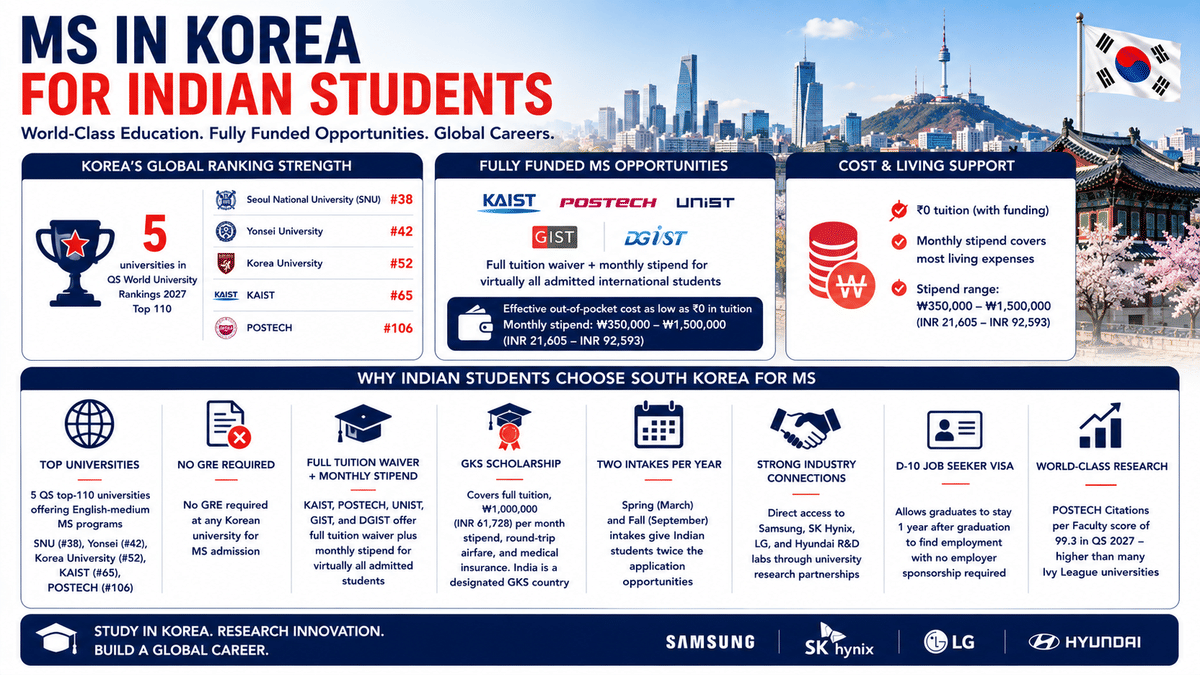
South Korea has 5 universities in the QS World University Rankings 2027 top 110, led by Seoul National University (SNU) at #38 and KAIST at #65. MS programs at KAIST, POSTECH, UNIST, GIST, and DGIST offer full tuition waivers plus monthly stipends to virtually all admitted international students. The effective out-of-pocket cost for a funded Indian MS student in Korea can be as low as ₹0 in tuition with a monthly stipend of ₩350,000 to ₩1,500,000 (INR 21,605 to INR 92,593) covering most living expenses.
Here is why Indian students choose South Korea for MS:
- 5 QS top-110 universities offering English-medium MS programs: SNU (#38), Yonsei (#42), Korea University (#52), KAIST (#65), POSTECH (#106)
- No GRE required at any Korean university for MS admission
- Full tuition waiver plus monthly stipend for virtually all admitted students at KAIST, POSTECH, UNIST, GIST, and DGIST
- GKS (Global Korea Scholarship) covers full tuition, ₩1,000,000 (INR 61,728) per month stipend, round-trip airfare, and medical insurance — India is a designated GKS country
- Two intakes per year — Spring (March) and Fall (September) — giving Indian students twice the application opportunities
- Direct access to Samsung, SK Hynix, LG, and Hyundai R&D labs through university research partnerships
- D-10 Job Seeker Visa allows graduates to stay 1 year after graduation to find employment with no employer sponsorship required
- POSTECH Citations per Faculty score of 99.3 in QS 2027 — higher than many Ivy League universities
Latest Updates — September 2026
- Spring 2027 deadlines are closing now. POSTECH closes September 11, 2026. UNIST, GIST, and DGIST close in September to October 2026. Yonsei, Korea University, SKKU, and Hanyang close between October 1 and October 31, 2026.
- KAIST's Spring 2027 window (August 18 to September 1) has closed. Indian students who missed it should target Fall 2027 (application opens December 2026) or apply to POSTECH, UNIST, GIST, or DGIST immediately.
- SNU Spring 2027 application window (July 6 to 9, 2026) has closed. SNU Fall 2027 applications open in early 2027 — plan accordingly.
- D-10 Job Seeker Visa upgraded in 2026. Maximum stay extended to 3 years with 1-year renewable extensions. Korean university graduates with TOPIK Level 4+ are exempt from the points-based evaluation.
- GKS Graduate Scholarship 2027 (Embassy Track) opens February to March 2027 — begin preparing documents now and contact the Korean Embassy in New Delhi to confirm India's quota.
- Faculty contact is urgent. Indian students applying to KAIST, POSTECH, UNIST, GIST, or DGIST must secure a faculty advisor's agreement before submitting — contact professors this week.
All currency conversions use 1 INR = 16.20 KRW and 1 USD = INR 95.23 (September 2026)
- Top Universities for MS in Korea
- Specialisations in MS in Korea
- Requirements for MS in Korea for Indian Students
- MS in Korea Fees for Indian Students
- Cost of Living in Korea for MS Students
- Scholarships for MS in Korea for Indian Students
- Jobs After MS in Korea for Indian Students
- Korea vs Other Countries for MS
- FAQs
Top Universities for MS in Korea
South Korea has 10 universities offering English-medium MS programs suitable for Indian students. KAIST, POSTECH, UNIST, GIST, and DGIST offer 100% English instruction and full funding to all admitted international students. SNU, Yonsei, Korea University, SKKU, and Hanyang are the top research universities in Seoul with strong industry connections.
| University | Location | QS Rank 2027 |
|---|---|---|
| Seoul National University (SNU) | Seoul | #38 |
| Yonsei University | Seoul | #42 |
| Korea University | Seoul | #52 |
| KAIST | Daejeon | #65 |
| POSTECH | Pohang | #106 |
| Sungkyunkwan University (SKKU) | Seoul | #108 |
| Hanyang University | Seoul | #155 |
| UNIST | Ulsan | #299 |
| GIST | Gwangju | #379 |
| DGIST | Daegu | #385 |
Specialisations in MS in Korea
Korean universities offer specialisations aligned with the country's strongest technology and research sectors. Semiconductor Engineering and AI/Machine Learning are the most in-demand and highest-paying for Indian graduates.
- Semiconductor Engineering and Materials Science (Best at KAIST, POSTECH, SKKU, SNU): Korea produces ~40% of global DRAM through Samsung and SK Hynix. SKKU's Department of Semiconductor and Display Engineering is co-funded by Samsung. Post-MS, direct recruitment into Samsung's Device Solutions division or SK Hynix's R&D is realistic for top graduates.
- Artificial Intelligence and Machine Learning (Best at KAIST, SNU, SKKU): The Korean government's AI National Strategy targets ₩2 trillion in AI investment by 2030. KAIST's AI Graduate School and SNU's AI Institute are among Asia's best. Naver and Kakao actively recruit AI MS graduates.
- Computer Science and Software Engineering (Best at KAIST, SNU, Yonsei, Korea University): Korean tech giants (Naver, Kakao, Krafton, Coupang) and global firms (Google Korea, Microsoft Korea, Amazon Korea) recruit CS MS graduates. KAIST and SNU CS departments are ranked among Asia's top 20.
- Electrical and Electronic Engineering (Best at KAIST, POSTECH, SNU): Research areas include power electronics, VLSI design, photonics, and wireless communications. Post-MS roles at Samsung's System LSI division, LG Electronics R&D, or Hyundai's electrification division are realistic targets.
- Chemical Engineering and Energy Science (Best at POSTECH, KAIST): POSTECH has direct ties to POSCO, the world's 4th largest steel company. Research areas include battery technology, hydrogen energy, and advanced polymers — all high-growth sectors in Korea's EV push.
- Biomedical Engineering and Life Sciences (Best at SNU, Yonsei, Korea University): Korea's biotech sector includes Samsung Biologics, Celltrion, and Yuhan Corporation. Korea's aging population is driving massive government investment in healthcare technology and pharmaceuticals.
- Interdisciplinary Science and Technology (Best at DGIST, GIST, UNIST): All three institutions offer full tuition waivers plus stipends to all admitted students. GIST focuses on photonics and energy, UNIST on battery technology and materials, and DGIST on robotics and brain science.
Requirements for MS in Korea for Indian Students
No Korean university requires GRE or GMAT for MS admission. Indian students with a B.Tech, B.E., or B.Sc. (4-year) with 60%+ aggregate or 7.0+ CGPA from a UGC/AICTE-approved university are generally eligible. IIT, NIT, and BITS graduates are particularly competitive. English proficiency is often waived for graduates of English-medium Indian universities.
Key notes for Indian applicants:
- B.Tech/B.E./B.Sc. (4-year) with 60%+ or 7.0+ CGPA meets minimum eligibility at all 10 universities
- No GRE or GMAT required anywhere in Korea
- English proficiency waived at KAIST, POSTECH, UNIST, GIST, and DGIST for English-medium Indian graduates — confirm with each university
- Faculty contact is strongly recommended before applying at KAIST, POSTECH, UNIST, GIST, and DGIST — most admissions are research-based and require a faculty advisor's agreement
- All universities require a research plan/SOP, 2 recommendation letters, and official transcripts
| University | Academic Eligibility | English (TOEFL/IELTS) | Other Requirements |
|---|---|---|---|
| SNU | Bachelor's degree; min. 3.0/4.5 GPA recommended | TOEFL iBT 80 / IELTS 6.5 (waived for English-medium graduates) | Research plan; faculty contact recommended |
| Yonsei University | Bachelor's degree; strong academic record | TOEFL iBT 80 / IELTS 6.0 | SOP; 2 recommendation letters |
| Korea University | Bachelor's degree; min. GPA 3.0/4.5 | TOEFL iBT 80 / IELTS 6.0 | Bank statement USD 20,000 (INR 19.05 lakh) for visa; research plan |
| KAIST | Bachelor's in relevant field; strong academic record | TOEFL iBT 83 / IELTS 6.5 (waived for English-medium graduates) | Research proposal; faculty advisor contact strongly recommended |
| POSTECH | Bachelor's; strong STEM background | TOEFL iBT 79 / IELTS 6.0 / TOEIC 750 | Research plan; 2 recommendation letters |
| SKKU | Bachelor's from accredited institution | TOEFL iBT 80 / IELTS 6.0 | SOP; 2 recommendation letters; faculty contact |
| Hanyang University | Bachelor's; min. GPA 2.5/4.5 | TOEFL iBT 75 / IELTS 6.0 | SOP; 2 recommendation letters |
| UNIST | Bachelor's in STEM; strong academic record | TOEFL iBT 80 / IELTS 6.0 (waived for English-medium graduates) | Research plan; faculty contact required |
| GIST | Bachelor's in STEM; strong academic record | TOEFL iBT 80 / IELTS 6.0 (waived for English-medium graduates) | Research plan; faculty contact required |
| DGIST | Bachelor's; interdisciplinary STEM background | TOEFL iBT 80 / IELTS 6.0 (waived for English-medium graduates) | Research plan; faculty contact required |
Also Read: Top 5 Countries to Study MS Abroad for Indian Students
MS in Korea Fees for Indian Students
Nominal tuition fees range from ₩3,000,000 (INR 1.85 lakh) per semester at SNU to ₩10,603,000 (INR 6.54 lakh) per semester at SKKU. However, the effective tuition cost is ₩0 (INR 0) for most funded students at KAIST, POSTECH, UNIST, GIST, and DGIST, where full tuition waivers are provided to virtually all admitted international students through Research Assistantships.
| University | Duration | Tuition Fee (KRW/semester) | Per Semester (INR) | Effective Cost (Funded) |
|---|---|---|---|---|
| SNU | 2 years (4 semesters) | ₩3,000,000 to ₩6,500,000 | INR 1.85 lakh to INR 4.01 lakh | Partial to full waiver via GKS/GSFS |
| Yonsei University | 2 years (4 semesters) | ₩4,854,000 to ₩7,479,000 | INR 2.99 lakh to INR 4.62 lakh | Partial to full waiver via GKS |
| Korea University | 2 years (4 semesters) | ₩5,237,000 to ₩8,571,500 | INR 3.23 lakh to INR 5.29 lakh | Partial to full waiver via GKS |
| KAIST | 2 years (4 semesters) | ₩9,559,000 (nominal) | INR 5.90 lakh (nominal) | ₩0 effective (full waiver for all funded students) |
| POSTECH | 2 years (4 semesters) | ~₩5,000,000 (nominal) | ~INR 3.09 lakh (nominal) | ₩0 effective (full waiver for all admitted international students) |
| SKKU | 2 years (4 semesters) | ₩6,741,000 to ₩10,603,000 | INR 4.16 lakh to INR 6.54 lakh | Partial to full waiver via Samsung scholarship |
| Hanyang University | 2 years (4 semesters) | ₩4,000,000 to ₩8,000,000 | INR 2.47 lakh to INR 4.94 lakh | Partial waiver available |
| UNIST | 2 years (4 semesters) | Nominal (varies) | Nominal | ₩0 effective (full waiver for all admitted students) |
| GIST | 2 years (4 semesters) | ₩3,607,000 (nominal) | INR 2.23 lakh (nominal) | ₩0 effective (full waiver for funded students) |
| DGIST | 2 years (4 semesters) | Nominal (varies) | Nominal | ₩0 effective (full waiver for all admitted students) |
Also Read: Affordable Countries to Study Abroad for Indian Students
Cost of Living in Korea for MS Students
Monthly living costs range from ₩700,000 (INR 43,211) in Pohang, Ulsan, Gwangju, and Daegu to ₩1,800,000 (INR 1.11 lakh) in Seoul. On-campus dormitory accommodation costs ₩200,000 to ₩500,000 (INR 12,346 to INR 30,864) per month — far below market rates. Monthly stipends from Research Assistantships often cover most or all living costs at non-Seoul universities.
| University | City | Monthly Cost (KRW) | Monthly Cost (INR) |
|---|---|---|---|
| SNU, Yonsei, Korea University, Hanyang | Seoul | ₩1,200,000 to ₩1,800,000 | INR 74,074 to INR 1.11 lakh |
| SKKU | Seoul/Suwon | ₩1,000,000 to ₩1,600,000 | INR 61,728 to INR 98,765 |
| KAIST | Daejeon | ₩800,000 to ₩1,200,000 | INR 49,383 to INR 74,074 |
| POSTECH | Pohang | ₩700,000 to ₩1,100,000 | INR 43,210 to INR 67,901 |
| UNIST | Ulsan | ₩700,000 to ₩1,100,000 | INR 43,210 to INR 67,901 |
| GIST | Gwangju | ₩700,000 to ₩1,000,000 | INR 43,210 to INR 61,728 |
| DGIST | Daegu | ₩700,000 to ₩1,000,000 | INR 43,210 to INR 61,728 |
Also Read: Cost of Living in South Korea for Indian Students
Scholarships for MS in Korea for Indian Students
The GKS (Global Korea Scholarship) is the most important scholarship for Indian MS students in Korea. India is a designated GKS country. The scholarship covers full tuition, ₩1,000,000 (INR 61,728) per month living allowance, round-trip economy airfare, 1-year Korean language training, and medical insurance. Applications are submitted through the Korean Embassy in India (Embassy Track) or directly to universities (University Track) — typically in February to March each year.
| Scholarship | University | Award (KRW/month) | Award (INR/month) | Eligibility |
|---|---|---|---|---|
| GKS (Global Korea Scholarship) | All 10 universities | Full tuition + ₩1,000,000/month + airfare + insurance | Full tuition + INR 61,728/month | Indian students; merit-based; India is designated GKS country |
| KAIST International Student Scholarship (RA/TA) | KAIST | Full tuition + ₩350,000 to ₩1,500,000/month | Full tuition + INR 21,605 to INR 92,593/month | Virtually all admitted international MS students |
| POSTECH International Student Full Scholarship | POSTECH | Full tuition + living allowance + settlement grant | Full tuition + allowances | All admitted international students |
| SNU GSFS (Graduate Scholarship for Excellent Foreign Students) | SNU | Full tuition + min. ₩500,000/month | Full tuition + INR 30,864/month | Open to Indian students; merit-based |
| SNU President Fellowship (SPF) | SNU | Full tuition + ₩1,500,000 to ₩2,000,000/month + airfare | Full tuition + INR 92,593 to INR 1.23 lakh/month | Faculty of developing country universities; PhD-focused |
| Korea University Graduate Scholarship (Type A) | Korea University | Full tuition + ₩900,000/month | Full tuition + INR 55,556/month | Indian students; merit-based |
| SKKU Global Leader Scholarship (Samsung-funded) | SKKU | Full tuition + ₩500,000 to ₩1,000,000/month | Full tuition + INR 30,864 to INR 61,728/month | STEM-focused; Samsung Electronics-backed |
| GIST Institutional Scholarship | GIST | Full tuition + RA stipend ₩4,785,384/month | Full tuition + INR 2.95 lakh/month | All admitted MS students |
| DGIST Full Scholarship | DGIST | Full tuition + monthly living support | Full tuition + allowances | All admitted students |
| UNIST Research Assistantship | UNIST | Full tuition + ₩500,000 to ₩1,000,000/month | Full tuition + INR 30,864 to INR 61,728/month | Most admitted MS students |
| Seoul Tech Scholarship 2026 | Seoul Metropolitan Government | Full tuition + ₩1,350,000/month | Full tuition + INR 83,333/month | STEM MS students at Seoul universities |
Also Read: Fully Funded Scholarships for Indian Students to Study Abroad
Jobs After MS in Korea for Indian Students
South Korea is home to Samsung Electronics, LG Electronics, SK Hynix, Hyundai, POSCO, Kakao, Naver, and Krafton — all of which actively recruit MS graduates from top Korean universities. The D-10 Job Seeker Visa allows international graduates to stay in Korea for up to 1 year after graduation to seek employment with no employer sponsorship required. The E-7 Skilled Worker Visa enables long-term employment once a job offer is secured.
| Job Role | Annual Salary (KRW) | Annual Salary (INR) |
|---|---|---|
| Software Engineer (entry-level, MS) | ₩40,000,000 to ₩60,000,000 | INR 24.69 lakh to INR 37.04 lakh |
| Research Engineer / R&D (Samsung, LG, SK) | ₩50,000,000 to ₩80,000,000 | INR 30.86 lakh to INR 49.38 lakh |
| Data Scientist / AI Engineer | ₩50,000,000 to ₩85,000,000 | INR 30.86 lakh to INR 52.47 lakh |
| Semiconductor / Hardware Engineer | ₩55,000,000 to ₩90,000,000 | INR 33.95 lakh to INR 55.56 lakh |
| University / Government Researcher (PostDoc) | ₩30,000,000 to ₩50,000,000 | INR 18.52 lakh to INR 30.86 lakh |
| Average MS Graduate (all fields) | ₩44,000,000 avg. | INR 27.16 lakh avg. |
Top employers include Samsung Electronics, SK Hynix, LG Electronics, Hyundai, POSCO, Naver, Kakao, Krafton, Coupang, Google Korea, Microsoft Korea, and Amazon Korea.
Note: Indian students should note that Korean language proficiency (TOPIK Level 3 to 4) significantly improves employability in Korea, as most corporate environments operate in Korean. Many Indian MS graduates use Korea as a 2 to 3-year stepping stone before moving to the US, Europe, or returning to India in senior technical roles at Korean MNC subsidiaries like Samsung India, LG India, and Hyundai India.
Korea vs Other Countries for MS
Korea has 5 QS top-110 universities offering fully funded MS programs. KAIST (#65) and POSTECH (#106) offer research quality comparable to top US programs at ₩0 effective tuition for funded students. The D-10 Job Seeker Visa is more accessible than the US H-1B lottery, which has a selection rate of only 15% annually.
| Factor | Korea | USA | Australia | Germany |
|---|---|---|---|---|
| Top MS University (QS 2027) | SNU #38, KAIST #65 | MIT #1 | Melbourne #33 | TU Munich #37 |
| MS Duration | 2 years | 2 years | 1.5 to 2 years | 2 years |
| Tuition (Funded) | ₩0 effective (KAIST, POSTECH, UNIST, GIST, DGIST) | USD 20,000 to USD 50,000/year (limited funding) | AUD 30,000 to AUD 50,000/year | €0 to €1,500/year |
| Monthly Stipend | ₩350,000 to ₩1,500,000 (INR 21,605 to INR 92,593) | USD 1,500 to USD 2,500 (RA, competitive) | Rare for MS | €800 to €1,200 (HiWi/RA, competitive) |
| GRE Required | No | Yes (most programs) | No | No |
| Post-Study Work | D-10 (1 year) then E-7 Work Visa | OPT 1 to 3 years then H-1B lottery (15%) | 2 to 4 years PSW | 18-month job seeker visa |
| Industry Access | Samsung, SK Hynix, LG, Hyundai (direct) | Google, Meta, Amazon (competitive) | Mining, Finance, Healthcare | BMW, Siemens, Bosch (competitive) |
| Intakes per Year | 2 (Spring and Fall) | 1 (Fall mostly) | 2 | 1 (Winter semester mostly) |
| Application Complexity | Low (no GRE, no application fee) | High (GRE + USD 75 to USD 150 per application) | Medium | Medium |
| PR Pathway | F-2 then F-5 after 3 to 5 years | Green Card (10 to 20-year wait for Indians) | PR after 2 to 4 years | PR after 5 years |
Also Read: Top 10 Countries for Masters for Indian Students
For Indian students targeting world-class MS research with full funding and no GRE requirement, South Korea offers an unmatched combination of QS-ranked universities, full tuition waivers, monthly stipends, and direct access to Samsung, SK Hynix, LG, and Hyundai R&D labs. Students targeting semiconductor engineering and AI should prioritise KAIST, POSTECH, or SKKU. Students targeting the best value with full funding should apply to UNIST, GIST, or DGIST. Apply for the GKS scholarship through the Korean Embassy in India between February and March. Contact faculty advisors at KAIST, POSTECH, UNIST, GIST, and DGIST before applying — most admissions are research-based and require a faculty advisor's agreement.
FAQs
Ques: Is MS in Korea good for Indian students?
Ans: Yes. South Korea has 5 QS top-110 universities offering English-medium MS programs. KAIST (#65), POSTECH (#106), UNIST, GIST, and DGIST offer full tuition waivers plus monthly stipends to virtually all admitted international students. The GKS scholarship covers full tuition, ₩1,000,000 (INR 61,728) per month, round-trip airfare, and medical insurance for Indian students.
Ques: What are the top universities for MS in Korea for Indian students?
Ans: The top universities for MS in Korea by QS World University Rankings 2027 are SNU (#38), Yonsei (#42), Korea University (#52), KAIST (#65), and POSTECH (#106). For fully funded MS programs, KAIST, POSTECH, UNIST, GIST, and DGIST offer full tuition waivers plus monthly stipends to all admitted international students.
Ques: What are the fees for MS in Korea for Indian students?
Ans: Nominal tuition fees range from ₩3,000,000 (INR 1.85 lakh) per semester at SNU to ₩10,603,000 (INR 6.54 lakh) per semester at SKKU. However, the effective tuition cost is ₩0 (INR 0) for most funded students at KAIST, POSTECH, UNIST, GIST, and DGIST. The GKS scholarship covers full tuition at all 10 listed universities.
Ques: What are the requirements for MS in Korea for Indian students?
Ans: Indian students need a B.Tech, B.E., or B.Sc. (4-year) with 60%+ aggregate or 7.0+ CGPA from a UGC/AICTE-approved university. No GRE or GMAT is required at any Korean university. English proficiency (TOEFL iBT 75 to 83 or IELTS 6.0 to 6.5) is often waived for graduates of English-medium Indian universities.
Ques: What is the GKS scholarship for MS in Korea?
Ans: The GKS (Global Korea Scholarship) covers full tuition, ₩1,000,000 (INR 61,728) per month living allowance, round-trip economy airfare, 1-year Korean language training, and medical insurance. India is a designated GKS country. Applications are submitted through the Korean Embassy in India (Embassy Track) or directly to universities (University Track) — typically in February to March each year.
Ques: What jobs can I get after MS in Korea?
Ans: Entry-level Software Engineers earn ₩40,000,000 to ₩60,000,000 (INR 24.69 lakh to INR 37.04 lakh) per year. Semiconductor and Hardware Engineers earn ₩55,000,000 to ₩90,000,000 (INR 33.95 lakh to INR 55.56 lakh) per year. Top employers include Samsung Electronics, SK Hynix, LG Electronics, Hyundai, Naver, and Kakao.
Ques: What is the post-study work visa for MS graduates in Korea?
Ans: MS graduates receive a D-10 Job Seeker Visa allowing them to stay in Korea for up to 1 year after graduation to seek employment with no employer sponsorship required. Upon securing a job offer, graduates can apply for the E-7 Skilled Worker Visa for long-term employment. After 3 to 5 years of continuous employment, graduates can apply for the F-5 Permanent Residency Visa.
Ques: Is Korean language required for MS in Korea?
Ans: Korean language is not required for admission or coursework at KAIST, POSTECH, UNIST, GIST, DGIST, or most English-medium MS programs. However, Korean language proficiency (TOPIK Level 3 to 4) significantly improves employability in Korea's corporate sector. Most Korean universities offer free Korean language classes to international students, and the GKS scholarship includes 1 year of paid Korean language training.



Comments