



| Updated On - Sep 3, 2026
Most Indian students preparing for IELTS focus on grammar and structure. But vocabulary is one of the 4 equally weighted criteria in IELTS Writing, and it is assessed in Speaking too.
The official IELTS Writing Key Assessment Criteria call this Lexical Resource. It looks at:
- The range of vocabulary you use.
- How accurate and appropriate your word choices are.
- Your use of less common items, collocations, and sophisticated phrasing.
- The density and effect of spelling errors.
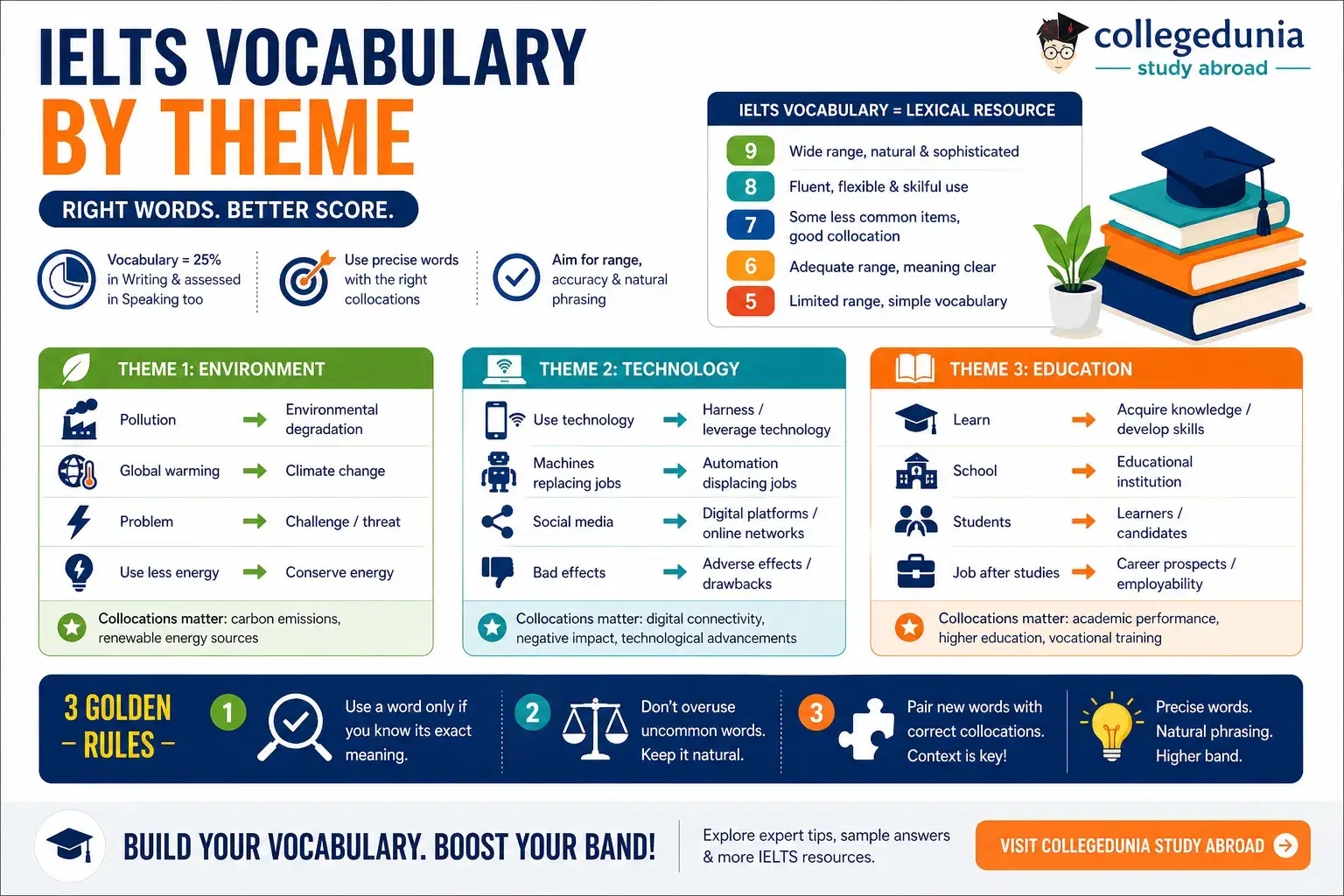
To score Band 7 or above, examiners look for "some ability to use less common and/or idiomatic items" and "an awareness of style and collocation." At Band 8 and above, vocabulary must be used "fluently and flexibly to convey precise meanings."
This article breaks down what that looks like, by theme.
Also Check: Full Updated IELTS Syllabus 2026
What is "High-Band" Vocabulary in IELTS?
High-band vocabulary in the IELTS does not mean using long or difficult words. It means using the right word, in the right context, with precision.
According to the official IELTS Writing Band Descriptors:
| Band | What Examiners Look For |
|---|---|
| 9 | Wide range; very natural and sophisticated control; minor errors extremely rare. |
| 8 | Fluent and flexible use; skilful use of uncommon/idiomatic items. |
| 7 | Some less common items, awareness of style and collocation, and only a few errors. |
| 6 | Generally adequate, meaning clear despite restricted range or lack of precision. |
| 5 | Simple vocabulary is used accurately, but the range is too limited for variation. |
The jump from Band 6 to Band 7 depends heavily on synonyms, collocations, and precise word choice, not just grammar.
Learn more about IELTS band scores 2026
Theme 1: Environment
Environment is one of the most common IELTS Writing Task 2 topics. Official sample tasks from ielts.org include topics like tourism's impact on the environment.
Some of the common words Indian students use and their higher-band alternatives are given in the table below:
| Basic Word | High-Band Alternative |
|---|---|
| Pollution | Environmental degradation or contamination |
| Damage | Deterioration, destruction |
| Problem | Challenge, concern, threat |
| Help the environment | Mitigate environmental impact |
| Bad for nature | Detrimental to ecosystems |
| Use less energy | Conserve energy, reduce energy consumption |
| Global warming | Climate change, rising global temperatures |
Collocation tip: IELTS examiners specifically look for collocations, words that naturally go together. For example:
- Environmental degradation (not "environmental damage").
- Carbon emissions (not "carbon pollution").
- Renewable energy sources (not "clean energy things").
Theme 2: Technology
Technology appears in IELTS tasks about gadgets, the internet, automation, and social media.
Some of the common words Indian students use and their higher-band alternatives are given in the table below:
| Basic Word | High-Band Alternative |
|---|---|
| Use technology | Harness or leverage technology |
| New gadgets | Technological advancements or innovations |
| Bad effects | Adverse effects or drawbacks |
| Helps people | Facilitates, enhances |
| Spread of internet | Proliferation of digital connectivity |
| Machines replacing jobs | Automation is displacing the workforce |
| Social media | Digital platforms, online networks |
From official examiner comments on a Band 7.5 essay: Examiners praised the use of "less common or idiomatic phrases" and noted that the test taker could "convey precise meanings." Words like "gadgets" and "devices" were used, but paired with precise collocations like "negative impact on health" rather than vague phrases.
Theme 3: Education
Education topics appear in both Task 1 (charts on enrolment and literacy) and Task 2 (essays on learning methods and university vs. vocational training).
Some of the common words Indian students use and their higher-band alternatives are given in the table below:
| Basic Word | High-Band Alternative |
|---|---|
| Learn | Acquire knowledge, develop skills |
| School | Educational institution, academic setting |
| Students | Learners, candidates, pupils |
| Good education | Quality education, academic excellence |
| Teach | Impart knowledge, instruct |
| Drop out | Discontinue studies, disengage from education |
| Job after studies | Career prospects, employability |
Collocation tip:
- Academic performance (not "study results").
- Higher education (not "university studies").
- Vocational training (not "job courses").
Theme 4: Environment
Environmental topics are most common for IELTS Writing Task 2 where applicants need to write a 250-word essay. Here are some high-band words:
| Basic Word/Phrase | Higher-Band Alternative |
|---|---|
| Pollution | Environmental contamination |
| Air pollution | Air contamination |
| Global warming | Global temperature rise |
| Climate change | Climate variability/climate change |
| Greenhouse gases | Greenhouse gas emissions |
| Carbon emissions | Carbon dioxide emissions |
| Protect the environment | Preserve the environment |
| Harm the environment | Cause environmental degradation |
| Reduce pollution | Curb pollution |
| Reduce emissions | Cut carbon emissions |
Theme 5: Technology
If applicants are relocation themseleves for job purposes then these words can help in describing your job profile.
| Basic Word/Phrase | Higher-Band Alternative |
|---|---|
| Technology | Technological advancement |
| New technology | Emerging technology |
| Modern technology | Advanced technology |
| Internet | Digital network |
| Computers | Computing devices |
| Smartphone | Mobile device |
| Social media | Social networking platforms |
| Use technology | Utilise technology |
| Technology changes | Technological transformation |
| Develop technology | Advance technological capabilities |
| Make communication easier | Facilitate communication |
Theme 6: Travel and Tourism
IELTS vocabulary for Travel and Tourism helps candidates describe destinations, travel experiences, accommodation, and the impact of tourism with greater precision. Learning topic-specific words and natural collocations can improve vocabulary range in both IELTS Speaking and Writing.
| Basic Word/Phrase | Higher-Band Alternative |
|---|---|
| Travel | Travel/journey |
| Tourist | Traveller/visitor |
| Tourism | Tourism industry |
| Popular place | Popular destination |
| Tourist place | Tourist attraction |
| Foreign country | Overseas destination |
| Holiday | Vacation/holiday |
| Trip | Journey |
| Hotel | Accommodation |
| Cheap accommodation | Affordable accommodation |
| Expensive hotel | Luxury accommodation |
How to Use These Words Without Losing Marks
Using high-band vocabulary incorrectly can lower your score. The official IELTS Writing Key Assessment Criteria warns against "inappropriacies", words that are not suitable for the context.
3 rules to follow:
- Use a word only if you know its exact meaning. Guessing can lead to wrong collocations.
- Do not overuse uncommon words. Examiners notice when vocabulary feels forced or unnatural.
- Pair new words with correct collocations. "Environmental degradation" works. "Environmental deterioration of the air" is awkward.
From official examiner comments on a Band 8.5 essay: "The writer uses a wide and very natural range of vocabulary with full flexibility. There are many examples of appropriate modification, collocation, and precise vocabulary choice."
In IELTS Writing, vocabulary is evaluated through range, accuracy, and appropriate collocation, not just difficulty level. Moving from Band 6 to 7 depends largely on using precise, theme-relevant words and natural phrasing. Topics like environment, technology, and education require familiarity with common collocations and controlled use of less common items. Consistent, accurate usage matters more than memorising or forcing advanced vocabulary.
Must Read: Common Spelling Mistakes Indian Students Make on the IELTS Exam – UK vs US Spelling
Source: ielts.org. IELTS Writing Key Assessment Criteria, IELTS Writing Band Descriptors, IELTS Academic Writing Sample Tasks 2023, Sample Candidate Writing Responses and Examiner Comments
Grammar for IELTS for Indian Students 2026
As IELTS is an English proficiency test, applicants appearing for it should be well-versed and fluent with English grammar rules. The main grammar topics, such as tenses, active and passive voice, articles, and affixes, are main topics for IELTS.
The important IELTS grammar topics that can help you to get scores above 6.5, especially in IELTS Speaking and Writing, are:
| Topic | Areas To Be Covered |
|---|---|
| Tenses |
|
| Complex sentence structures |
|
| Passive voice | Critical for Task 1, like process diagrams, formal description and academic-sounding Task 2 essays. Applicants can begin their essay with words such as "It is believed that...", "Steps are taken to..." |
| Comparatives and superlatives | Essential for Task 1 data comparison. You can use words such as “higher than”, “the highest”, “significantly more than”. |
| Modal verbs | For expressing degrees of certainty, obligation, and suggestion. Applicants should be well aware of the use of modals such as ‘should, must, might, could, may '. It is important in Task 2 for giving opinions and recommendations. |
| Articles (a, an, the) | Applicants should know when to use “a, an, and the”. Mistakes in articles are easily noticeable. |
| Prepositions | Applicants must know when and where to use the correct prepositions. For example, with “interested in, responsible for, " and " contribute to, mistakes in prepositions can impact the scores in both Speaking and Writing. |
Also read: Mistakes to Avoid in IELTS Test 2026
Tips for IELTS Grammar Syllabus 2026
The applicants must be well-practiced in English grammar rules. The grammar rules impact the IELTS Speaking and Writing scores significantly. Grammar for IELTS is one of the major tests in IELTS. Follow these tips to improve your grammar for IELTS 2026:
- Keep the writing in parallel structure to list and compare grammatically consistently. Use phrases such as "not only... but also," "both... and".
- Use cohesive devices to link grammar, not vocabulary. For example, correct grammatical use of "despite" is with any noun or gerund, and "although" with any clause.
- Speak or write in simple sentences: Try to speak or write error-free simple sentences and some accurate complex ones, rather than complex sentences with many mistakes.
- Practice tenses: Use the past tense for describing specific data or years shown. Use present simple only for general or timeless descriptions.
- Learn your personal error patterns: Everyone repeats the same 3-4 mistakes, such as missing articles and wrong prepositions. Track yours from practice tests and drill just those.
- Read articles and journals: To get a good hold og grammar in writing, reading articles or journals can be the best option. This will also help you improve your vocabulary.
FAQs
Ques. Does using difficult words always help my IELTS Writing score?
Ans. No. The official IELTS criteria assess whether vocabulary is used accurately and appropriately, not just whether it is complex. Using a difficult word in the wrong context can actually lower your Lexical Resource score.
Ques. What is a "collocation" and why does IELTS care about it?
Ans. A collocation is two or more words that naturally go together — like "carbon emissions" or "academic performance." IELTS examiners specifically look for correct collocations as a sign of high-band vocabulary control. Incorrect collocations are flagged as "inappropriacies" in the official marking criteria.
Ques. Do I need to use theme-specific vocabulary in the Speaking test too?
Ans. Yes. Speaking is also assessed on Lexical Resource, which includes the range and precision of vocabulary. Using topic-specific words in Speaking shows the examiner that you can discuss ideas with accuracy, not just fluency.
Ques. How many uncommon words should I use in one essay?
Ans. There is no fixed number. The official band descriptors describe Band 7 as showing "some ability" to use less common items, not constant use. A natural mix of common and precise vocabulary is better than forcing uncommon words throughout.
Ques. Can I memorise a list of high-band words and use them in any essay?
Ans. This approach is risky. IELTS examiners are trained to spot memorised or formulaic language. The official criteria specifically penalise responses that rely on "memorised phrases"; this can limit your score to Band 4 or below.
Ques. Are the same vocabulary themes repeated across IELTS tests?
Ans. IELTS Writing Task 2 topics are drawn from areas of general interest, including environment, technology, education, health, and society. The official IELTS Academic Writing sample tasks on ielts.org include topics like tourism's environmental impact and children's upbringing, showing these broad themes recur.
Ques. Does vocabulary range matter more in Task 1 or Task 2?
Ans. Both tasks are assessed on Lexical Resource. However, Task 2 carries twice the weight of Task 1 in your final Writing band score. So vocabulary precision in Task 2 has a bigger impact on your overall Writing band.
Ques. What is the difference between "range" and "precision" in vocabulary?
Ans. Range means how many different words you use, avoiding repetition. Precision means choosing the exact right word for the context. The official IELTS Writing Key Assessment Criteria assesses both separately under Lexical Resource. You need both to score Band 7 or above.



Comments