



| Updated On - Aug 2, 2026
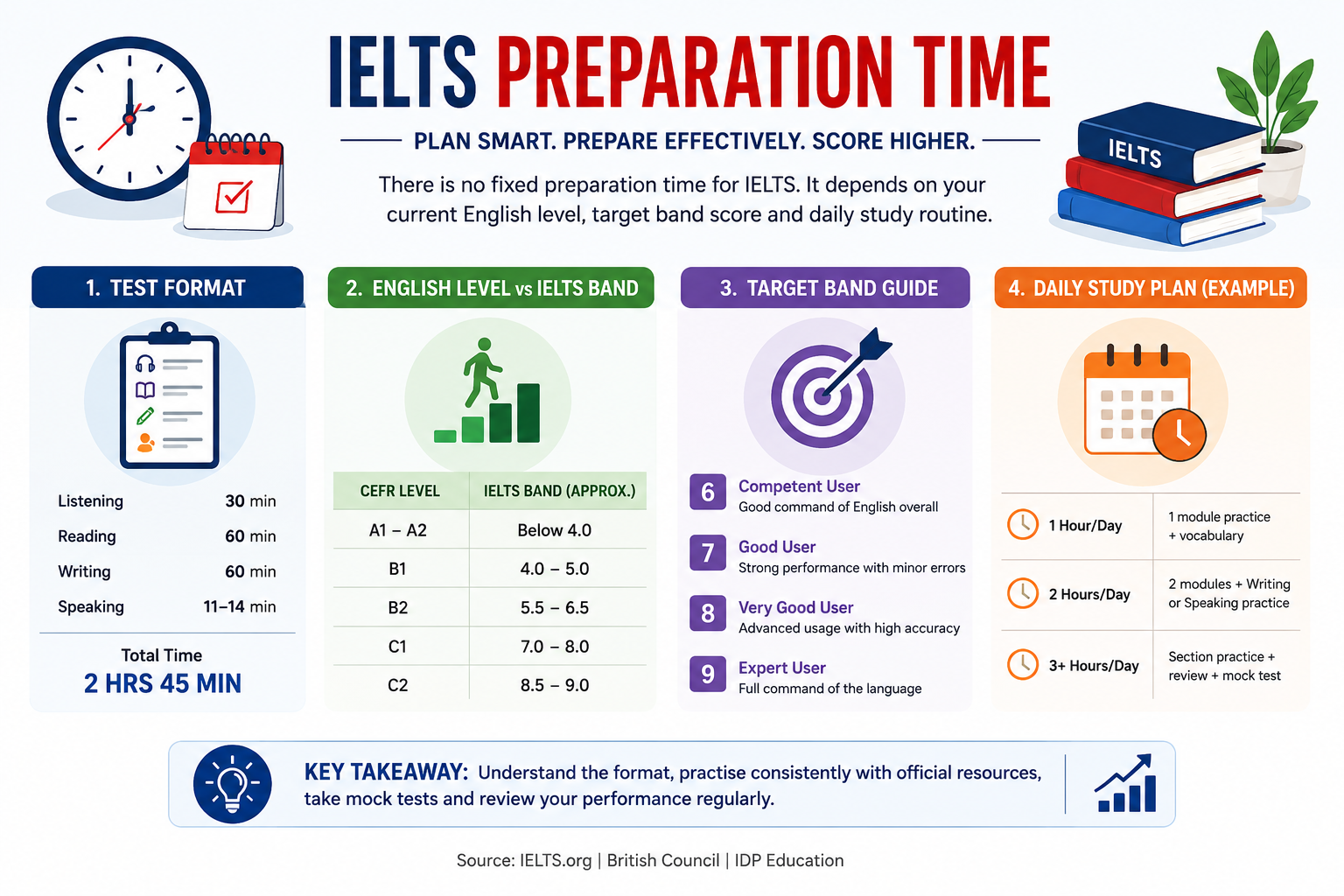
The IELTS preparation duration depends on your current English proficiency, target band score, familiarity with the test format, and consistency of practice. Before creating a study plan, candidates should understand the exam pattern and assess their current level using IELTS practice materials.
Factors that determine your IELTS Preparation time are as follows:
| Factor | Why It Matters |
|---|---|
| Current English proficiency | Candidates with stronger language skills generally spend more time understanding test strategies than learning English fundamentals. |
| Target IELTS Band | A higher target band requires greater accuracy in grammar, vocabulary, coherence, and fluency. |
| Test Type | Academic and General Training have different Reading and Writing modules. |
| Daily Study Hours | Consistent daily preparation is more effective than irregular long study sessions. |
| Familiarity with IELTS Format | Understanding question types and assessment criteria reduces avoidable mistakes. |
IELTS Preparation Recommendations
The British Council recommends that candidates should:
- Understand the IELTS test format before beginning preparation.
- Identify weaker skills through diagnostic practice.
Also read:
- IELTS Score Requirements for Top Study Abroad Destinations 2026
- IELTS Score Requirements for MBA Abroad 2026
- IELTS Preparation Time Based on Your Current English Level
- IELTS Preparation Time for Different Target Band Scores
- IELTS Preparation Time for Academic vs General Training
- Can You Prepare for IELTS in 1 Month?
- Can You Prepare for IELTS in 2 Months?
- Daily IELTS Study Plan 2026
- Section-wise IELTS Preparation Time 2026
- Factors Affecting IELTS Preparation Time in 2026
- How to Reduce Your IELTS Preparation Time in 2026
- IELTS Preparation Common Mistakes 2026
- IELTS Preparation Timeline for Study Abroad Destinations
- FAQs
IELTS Preparation Time Based on Your Current English Level
Your preparation timeline depends more on your existing English proficiency than on the IELTS exam itself. IELTS aligns its band scores with the Common European Framework of Reference for Languages (CEFR), allowing candidates to estimate the level of English required before aiming for a specific band score.
The table below discusses the CEFR equivalent to IELTS band scores:
| CEFR Level | IELTS Band | English Proficiency |
|---|---|---|
| A1 | Below 4.0 | Beginner |
| A2 | 3.5-4.0 | Elementary |
| B1 | 4.0-5.0 | Intermediate |
| B2 | 5.5-6.5 | Upper Intermediate |
| C1 | 7.0-8.0 | Advanced |
| C2 | 8.5-9.0 | Proficient |
What This Means for Preparation
| Current Level | Preparation Focus |
|---|---|
| A1-A2 | Build grammar, vocabulary, and all four language skills before intensive IELTS practice. |
| B1 | Improve accuracy and become familiar with IELTS question types. |
| B2 | Focus on timed practice tests, Writing, and Speaking performance. |
| C1-C2 | Concentrate on exam strategy, time management, and consistency across all four sections. |
IELTS Preparation Time for Different Target Band Scores
IELTS assesses English proficiency on a 9-band scale, where each band reflects a defined level of language ability. Rather than preparing for a fixed duration, candidates should understand the skills expected at their target band and practise accordingly.
IELTS Band Descriptors
| Band Score | Official User Level |
|---|---|
| 5 | Modest User |
| 6 | Competent User |
| 7 | Good User |
| 8 | Very Good User |
| 9 | Expert User |
Preparation Focus by Target Band
| Target Band | Areas to Prioritise |
|---|---|
| Band 6 | Understand test format, improve grammar accuracy, and develop basic academic vocabulary. |
| Band 6.5 | Increase fluency, improve paragraph organisation, and reduce language errors. |
| Band 7 | Meet all Writing and Speaking assessment criteria consistently while maintaining accuracy in Reading and Listening. |
| Band 7.5-8 | Demonstrate advanced vocabulary, grammatical flexibility, coherence, and natural pronunciation. |
IELTS Assessment Criteria
Writing is assessed on:
- Task Achievement / Task Response
- Coherence and Cohesion
- Lexical Resource
- Grammatical Range and Accuracy
Speaking is assessed on:
- Fluency and Coherence
- Lexical Resource
- Grammatical Range and Accuracy
- Pronunciation
IELTS Preparation Time for Academic vs General Training
IELTS offers two main test types: Academic and General Training. The Listening and Speaking sections are identical in both tests, while Reading and Writing differ according to the purpose of the exam. Understanding these differences helps candidates plan their preparation efficiently.
Here’s a comparison between IELTS Academic and General Training:
| Feature | IELTS Academic | IELTS General Training |
|---|---|---|
| Purpose | Higher education and professional registration | Migration, employment and secondary education |
| Listening | Same | Same |
| Speaking | Same | Same |
| Reading | Academic passages | Everyday and workplace texts |
| Writing Task 1 | Describe visual information (graph, chart, map, diagram) | Write a letter |
| Writing Task 2 | Essay | Essay |
Both test formats use the same 9-band scoring scale and assess Listening, Reading, Writing, and Speaking skills. Still, candidates should prepare specifically for the Reading and Writing tasks relevant to their chosen test type.
Also read: Check IELTS Academic vs General Training Difference 2026
Can You Prepare for IELTS in 1 Month?
Preparing for IELTS in one month is possible if you already have a good command of English and want to become familiar with the test format. IELTS partners recommend using official practice tests, mock exams, webinars, and preparation materials to identify weak areas before the exam.
Who Can Prepare in One Month?
| Candidate Proficiency | Recommended Focus |
|---|---|
| B2-C1 English proficiency | Full-length mock tests and time management |
| Previous IELTS test takers | Improve weaker modules and band score |
| Students requiring Band 6-6.5 | Practice Writing and Speaking using official band descriptors |
| Candidates familiar with exam format | Revision and error analysis |
Also read: Check Free IELTS Full-Length Mock Test 2026
Can You Prepare for IELTS in 2 Months?
A two-month preparation period allows candidates to improve their language skills and become familiar with IELTS question types. Official IELTS partners recommend combining skill-based practice with regular mock tests and progress tracking rather than focusing only on memorising answers.
Suggested 8-Week Preparation Plan
| Week | Preparation Goal |
|---|---|
| 1 | Understand IELTS format and assessment criteria |
| 2 | Listening and Reading practice |
| 3 | Writing Task 1 & Task 2 practice |
| 4 | Speaking practice with sample questions |
| 5 | Timed section-wise practice tests |
| 6 | Full-length mock tests |
| 7 | Review mistakes and improve weak skills |
| 8 | Final revision and test-day preparation |
IELTS Recommendation
Candidates should:
- Understand question types before practising.
- Review model answers.
- Monitor progress using official preparation tools.
Daily IELTS Study Plan 2026
There is no fixed number of hours candidates should study each day. Candidates should encourage regular practice across all 4 skills using mock tests and progress tracking instead of irregular intensive study sessions.
If any applicant wants to prepare for the IELTS daily, here’s a recommended daily study plan:
| Available Time | Skills to Focus |
|---|---|
| 1 Hour | One Reading or Listening exercise, and vocabulary revision. |
| 2 Hours | Practice one complete module and the Writing or Speaking section. |
| 3 Hours | Two modules along with review of mistakes and vocabulary revision. |
| 4 Hours | Full-length section practice with the Speaking and Writing sections. |
Also read:
Section-wise IELTS Preparation Time 2026
The IELTS exam assesses 4 language skills: Listening, Reading, Writing, and Speaking. While IELTS does not recommend a fixed preparation duration for each section, understanding the official test format helps candidates allocate their preparation effectively.
The table below projects the IELTS preparation focus by section for applicants willing to take the exam:
| Section | Focus Area |
|---|---|
| Listening | Understanding different English accents and identifying key information |
| Reading | Skimming, scanning and time management |
| Writing | Task response, coherence, grammar and vocabulary |
| Speaking | Fluency, pronunciation and lexical resource |
Factors Affecting IELTS Preparation Time in 2026
Although IELTS does not prescribe a standard preparation duration, several factors influence how quickly candidates become test-ready. These factors relate to English proficiency, familiarity with the exam format, and performance across the four assessed skills.
The key factors affecting IELTS preparation time are:
| Factor | Impact on Preparation |
|---|---|
| Current English Level | Determines whether candidates need language improvement or only exam practice. |
| Target Band Score | Higher scores require greater accuracy and consistency. |
| Familiarity with IELTS | Understanding question types reduces avoidable mistakes. |
| Writing Skills | Requires regular practice based on official assessment criteria. |
| Speaking Confidence | Fluency improves through consistent speaking practice. |
| Mock Test Performance | Highlights strengths and weaknesses before the actual exam. |
How IELTS Partners Recommend Preparing
- Take IELTS practice tests.
- Review band descriptors before Writing and Speaking practice.
- Track progress regularly.
- Focus on weaker skills identified during mock tests.
- Practise under timed conditions.
How to Reduce Your IELTS Preparation Time in 2026
There is no shortcut to achieving a high IELTS band score, but using preparation resources and following a structured study plan can make your preparation more efficient. IELTS partners recommend familiarising yourself with the test format, practising under timed conditions, and reviewing your performance regularly.
Tips to prepare more efficiently for IELTS are:
| Strategy | How It Helps |
|---|---|
| Understand the IELTS format first | Reduces confusion on test day and improves time management. |
| Take an official diagnostic test | Identifies your strengths and areas for improvement before beginning preparation. |
| Practice under timed conditions | Builds confidence and improves speed in Reading and Writing. |
| Review band descriptors | Helps understand how Writing and Speaking are officially assessed. |
| Analyse mistakes after every mock test | Prevents repeating common errors and tracks progress effectively. |
| Use official preparation materials | Ensures practice questions match the actual IELTS exam format. |
IELTS Preparation Common Mistakes 2026
Many candidates spend months preparing without improving their band score because they focus only on solving practice questions. IELTS assessment is based on specific scoring criteria, making it equally important to understand how each module is evaluated.
Common mistakes to avoid and their impact are discussed below:
| Mistake | Impact |
|---|---|
| Starting preparation without understanding the exam format | Leads to confusion and poor time management during the test. |
| Ignoring official band descriptors | Makes it difficult to understand examiner expectations in Writing and Speaking. |
| Practising only favourite sections | Creates an imbalance in overall performance across the four skills. |
| Not attempting full-length mock tests | Reduces familiarity with the actual exam duration and pressure. |
| Memorising essays or speaking answers | Examiners assess natural language ability and task response rather than memorised content. |
| Skipping answer review | Prevents candidates from identifying recurring mistakes and improving accuracy. |
IELTS Preparation Timeline for Study Abroad Destinations
The IELTS score required for admission depends on the university, programme, and country. While institutions set their own entry requirements, most universities publish minimum overall and section-wise IELTS scores on their official admissions pages. Your target score should determine the depth and duration of your preparation.
Typical IELTS score requirements for top study abroad destinations are:
| Study Destination | Common Overall IELTS Requirement |
|---|---|
| Canada | 6.5-7.0 |
| United Kingdom | 6.0-7.5 |
| Australia | 6.5-7.0 |
| Ireland | 6.0-6.5 |
| New Zealand | 6.0-6.5 |
Top universities and their IELTS score requirements:
| University | Country | Minimum IELTS Requirement |
|---|---|---|
| University of Toronto | Canada | Overall 6.5 |
| University of British Columbia | Canada | Overall 6.5 |
| University of Oxford | UK | 7.0-7.5 depending on course |
| University of Melbourne | Australia | Overall 6.5 |
| Trinity College Dublin | Ireland | Overall 6.5 |
| University of Auckland | New Zealand | Overall 6.0-6.5 |
Note: Check the official programme page, as requirements differ by course.
Also read:
- IELTS Score Requirements for USA in 2026
- IELTS Score Requirements for UK in 2026
- IELTS Score Requirements for Germany in 2026
There is no fixed preparation time for IELTS, as it depends on your current English proficiency, target band score, and familiarity with the exam format. The IELTS partners recommend using official preparation materials, taking timed practice tests, and understanding the assessment criteria to improve performance. A structured study plan based on your target university and destination can help you prepare more effectively and maximise your chances of achieving the required IELTS score.
FAQs
Ques. How long should I prepare for IELTS?
Ans. IELTS does not prescribe a fixed preparation period. The time required depends on your English proficiency, target band score, and familiarity with the test format. Candidates are advised to assess their current level using official practice tests before planning their preparation.
Ques. Does IELTS recommend a daily study schedule?
Ans. No. IELTS partners do not recommend a fixed number of study hours. Instead, they encourage regular practice using official preparation resources, sample tests, and progress tracking tools.
Ques. Can I prepare for IELTS without coaching?
Ans. Yes. IELTS provides official preparation resources, including sample questions, practice tests, study materials, and webinars, allowing candidates to prepare independently.
Ques. What is the best way to prepare for the IELTS Writing test?
Ans. Candidates should practise Task 1 and Task 2 regularly while referring to the official Writing assessment criteria, including Task Achievement, Coherence and Cohesion, Lexical Resource, and Grammatical Range and Accuracy.
Ques. Does IELTS provide official mock tests?
Ans. Yes. Official practice tests and preparation materials are available through IELTS partners, including IELTS.org, the British Council, and IDP Education.


1787567517.png?tr=w-305,h-145,c-force?h=175&w=350&mode=stretch)



Comments