



Study Abroad Content Writer | KdTvCV - Oct 20, 2026
To prepare for the IELTS exam, Indian students need 8 to 12 weeks and a daily plan across four sections. Start with a diagnostic test, fix your weakest skill first, and build Speaking last. Format matters more than fancy vocabulary at every band below 8.0.
- Treat the IELTS exam as a skill test, not a vocabulary dump.
- Open with a diagnostic, then route hours to your weakest section.
- A clear weekly plan beats long hours of random practice.
- Speaking marks rise faster from recording yourself than reading more tips.
Check the full IELTS preparation roadmap for 2026
IELTS examiners discourage memorised answers because they may not reflect a candidate’s natural communication skills. In India, Speaking tests may be conducted face-to-face or by video call at selected centres, so candidates should practise spontaneous, natural responses. A Band 7 overall is now the baseline for most popular courses in the US, UK, Canada and Australia, which means your plan has to earn it.
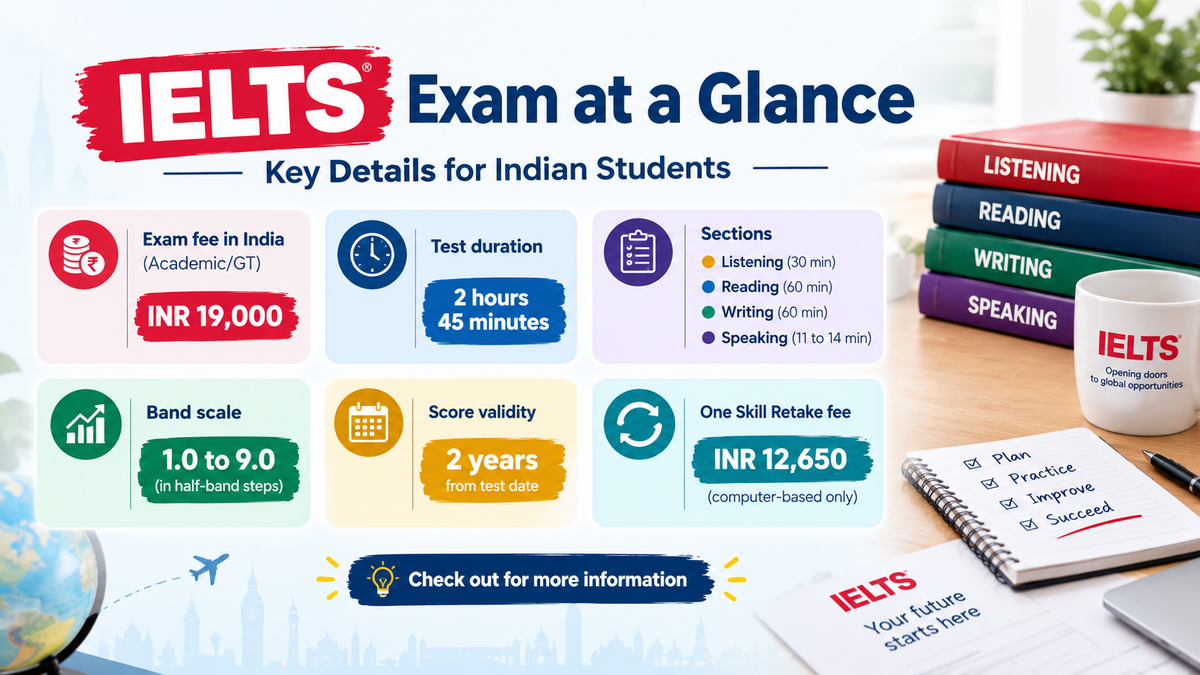
Highlights on IELTS exam prep
IELTS is a four-section English test accepted by over 13,500 organisations in 140+ countries. The numbers below are the ones you will keep returning to during prep.
| Parameter | Detail |
|---|---|
| Exam fee in India (Academic/GT) | INR 19,000 |
| Test duration | 2 hours 45 minutes |
| Sections | Listening (30 min), Reading (60 min), Writing (60 min), Speaking (11 to 14 min) |
| Band scale | 1.0 to 9.0 in half-band steps |
| Score validity | 2 years from test date |
| One Skill Retake fee | INR 12,650 (computer-based only) |
| Paper IELTS in India | Ends 22 August 2026; computer-only after |
| Conducting body | IDP IELTS India |
Source: IDP IELTS India and Collegedunia IELTS exam fee tracker, October 2026.
Must read:
- IELTS Test Centres for Indian Students
- Latest IELTS Syllabus for Indian Students
- IELTS Coaching in India
How to prepare for IELTS from scratch
Start by taking one full mock test before you buy a single book. That one score tells you where you really stand and which section bleeds the most marks.
Most Indian students write the IELTS Academic test for university admission. The General Training version is for work visas and PR routes to Canada, Australia, and the UK. Confirm the version your target universities need before you plan hours.
Once you have a diagnostic score, split your 8 to 12 weeks into three phases:
- Phase 1 (Weeks 1 to 3): Learn the format, scoring rules, and question types for all four sections.
- Phase 2 (Weeks 4 to 8): Section-wise drills, daily. Fix one skill at a time instead of mixing all four.
- Phase 3 (Final 2 to 3 weeks): Full-length mock tests under exam timing. Review errors, not just scores.
Read the official IELTS exam pattern and scoring breakdown before you touch any practice set. It saves weeks of guessing.
Key Insight: IELTS does not test what you know. It tests how clearly you listen, read, write and speak in a fixed time. Skills grow with daily reps, not weekend cramming.
If English is already your office language, 6 to 8 weeks is enough. If you studied in a vernacular medium, give yourself 12 to 16 weeks. That means working professionals should book the test only after a diagnostic, not before.
The IELTS syllabus and skills tested have not changed in 2026, but the delivery is now computer-only across most Indian centres.
Smart 60-day IELTS preparation plan
A 60-day plan works for most Indian students who already use English at work or college. It leaves room for errors without turning prep into a six-month project.
- Target two hours a day on weekdays and three to four hours on weekends.
- Stick to one skill per weekday and keep weekends for mixed practice.
| Week | Focus | Outcome |
|---|---|---|
| Weeks 1 to 2 | Format, question types, scoring rules for all four sections | Comfort with test flow |
| Weeks 3 to 4 | Reading and Listening drills, vocabulary by theme | Band 6.5 in both sections |
| Weeks 5 to 6 | Writing Task 1 and Task 2 templates, 3 essays a week | Clean 250+ word essays in 40 minutes |
| Week 7 | Speaking Parts 1, 2 and 3, record and review daily | Fluent 2-minute cue card answers |
| Week 8 | Full mock tests, timed, in exam conditions | Final confidence check |
Important Tip for Indian Students: If you only have 60 days, do not start with full mock tests. That means focus on format and section drills for the first three weeks. Full tests belong in the last fortnight when speed and stamina matter more than new skills.
IELTS Listening and Reading prep tips
Listening and Reading are the two sections where most Indian students pick up quick band gains. Both are marked out of 40 and both reward pattern recognition more than vocabulary.
- Band 7 in Listening needs 30 to 31 correct answers out of 40.
- Band 8 needs 35 to 36.
- Reading band jumps follow a similar curve, so every extra correct answer counts.
Listening prep that works
- Train on four accents: British, American, Australian and Canadian. The test mixes all of them.
- Use the 30 seconds before each section to read the questions and underline keywords.
- Practise with podcasts like BBC 6 Minute English, TED Talks and Al Jazeera reports, 20 minutes a day.
- Spelling matters. A right answer with a wrong spelling scores zero.
Also read:
Reading prep that works
- Spend 20 minutes per passage, no more. The third passage is the hardest and needs the time buffer.
- Learn to skim for main ideas in 2 minutes, then scan for exact answers.
- True/False/Not Given trips most Indian students. Practise 10 of these a day until the logic feels automatic.
- Read The Guardian, The Economist and National Geographic. Those are the voices IELTS pulls passages from.
Dig deeper into the IELTS Reading question types with practice sets.
Key Insight: If your Listening score is already Band 7, do not waste prep hours there. That means route your time to Writing and Speaking, where Band 7 is harder to earn.
IELTS Writing prep: Task 1 and 2
Writing is where most Band 6.5 scores happen and where most Band 7 targets fail. Task 2 carries twice the weight of Task 1, so plan your hours accordingly. Task 1 for Academic candidates means describing a chart, graph, map, or process in 150 words in 20 minutes. Task 2 asks for a 250-word essay in 40 minutes.
Task 1 prep in short
- Learn five chart templates: line, bar, pie, table, and map.
- Write a paraphrased introduction, a one-line overview, and two body paragraphs with real data.
- Skip opinions, bullet points, and copying the question word for word.
Study the IELTS Writing Task 1 scoring criteria with sample answers before writing your first response.
Task 2 prep in short
- Learn the five essay types: opinion, discussion, problem/solution, advantages/disadvantages, double question.
- Spend 3 to 4 minutes planning before writing. Students who skip planning lose structure marks.
- Use one main idea per paragraph. Two main ideas in one paragraph is a Band 6 habit.
- Hit the 250-word minimum. Essays under this cap lose Task Response marks.
Walk through the IELTS Writing Task 2 essay templates and model responses for all five essay types.
Vocabulary helps, but only when it fits. Build theme-based IELTS vocabulary for Band 7+ across environment, education, technology and travel topics.
What strong Task 2 preparation gives you:
- A clear four-paragraph structure you can write in your sleep.
- A bank of 10 to 15 topic phrases you can adapt to any question.
- A sense of when to add a complex sentence and when to keep it simple.
What it does not cover:
- Grammar basics. Fix tenses, articles, and prepositions first.
- Spelling. Weekly spelling drills still matter at Band 7.
IELTS Speaking prep for Indian students
IELTS Speaking is a 3-part interview that lasts 11 to 14 minutes, now mostly conducted over video call in India. It is the section where Indian students worry most about accent, and that worry is misplaced.
Examiners are trained to understand Indian English, regional accents and local phrasing. What they penalise is memorised answers, long pauses, and translating from Hindi to English mid-sentence.
Band 7 in Speaking needs four things:
- Fluency that flows for 1 to 2 minutes without unnatural pauses.
- A range of vocabulary with 2 to 3 natural idioms used in context.
- Grammar variety with a mix of simple and complex sentences.
- Clear pronunciation, not an imitation of a British or American accent.
The best drill is simple. Record yourself answering a Part 2 cue card for 2 minutes, then listen back the same evening. Count your pauses and filler words. Repeat for 30 days and the shift is measurable.
Pull real questions from the latest IELTS cue card topics and sample answers every week.
Key Insight: If you plan to apply for the Fall 2027 intake, book your test by February 2027. That means your scores reach universities well before most March to May admission deadlines.
Idioms earn marks only when they fit the context. One or two natural phrases beat memorised showpieces every time. The topic-wise idioms for IELTS Speaking set is a tight starting point.
Part 3 is the deciding round for Band 7+ scores. It has no prep time and tests how you build and defend an opinion.
Check sample IELTS Speaking Part 3 questions with model answers
If you want a step-by-step Band 9 blueprint, work through the Band 9 IELTS Speaking framework.
IELTS prep mistakes you must avoid
Most Band 6.5 scores come from avoidable mistakes, not weak English. Fix these early, and the band jump often follows without extra hours.
- Starting with mock tests. Mock tests test stamina, not skill. Learn format first.
- Writing a Task 2 essay in 20 minutes. Rushing kills structure. Give it the full 40.
- Memorising cue card answers. Examiners spot this in the first 10 seconds and penalise it.
- Ignoring spelling. One wrong spelling in Listening is one lost mark. Band jumps live in those marks.
- Reading only Indian newspapers. IELTS passages read like The Guardian, not like The Hindu. Diversify your reading.
- Skipping Part 3 of Speaking. This part separates Band 6.5 from Band 7+, and it has no prep time.
- Booking the test before a diagnostic. Many Indian students book, then realise 30 days is not enough.
- Using big words to sound smart. Precise simple words score higher than forced advanced ones.
Band jumps come from reviewing errors, not stacking hours. For every mock test, spend 60 minutes on the score and 90 minutes on why each wrong answer was wrong.
Mock tests, books and final week plan
The final 10 days decide whether your prep converts into a real band jump on test day. Mock tests, timed and reviewed, do the heavy lifting here.
Build your mock test rhythm around three sources:
- Cambridge IELTS 1 to 19 for the most realistic question style.
- The British Council IELTS Ready platform for two full mock tests, free.
- IDP’s free preparation pack for a Cambridge mock test with scoring.
Source: British Council India and IDP IELTS India, October 2026.
Target one full mock every 3 days in Phase 3. Review each one for 90 minutes before taking the next.
Final week IELTS prep plan
In the final seven days, your goal is to protect what you already know, not learn new skills.
- Day 7: Full mock test under exam conditions, same time slot as your real test.
- Day 6: Review mock test errors, build a one-page notes sheet.
- Day 5: Writing Task 1 and Task 2 practice, 90 minutes.
- Day 4: Speaking practice with a partner or recording, 60 minutes.
- Day 3: Half-mock test, Listening and Reading only.
- Day 2: Light review of notes sheet. No new content.
- Day 1: Rest, hydrate, and reach your test centre location on a trial run.
Band score targets for top destinations
Your target band depends on where you are applying. Build your prep plan backwards from this score.
| Destination | Overall Band | Section minimum |
|---|---|---|
| USA (most universities) | 6.5 to 7.5 | No band below 6.0 |
| USA (Ivy League, top STEM) | 7.0 to 7.5 | No band below 6.5 |
| UK (undergrad) | 6.0 to 6.5 | No band below 5.5 |
| UK (postgrad, Russell Group) | 6.5 to 7.0 | No band below 6.0 |
| Canada (most universities) | 6.5 | No band below 6.0 |
| Australia (postgrad) | 6.5 | No band below 6.0 |
| New Zealand | 6.0 to 6.5 | No band below 5.5 |
These bands are indicative, not exhaustive. Always check the exact score your course page lists on the university site.
The One Skill Retake option
If you fall short in just one section, you no longer need to retake the full test. The IELTS One Skill Retake lets you redo a single section within 60 days of your original test.
- Fee in India: INR 12,650.
- Available only for computer-based IELTS.
- One retake per full test, one section at a time.
- New Test Report Form includes updated and original scores.
If three sections are at Band 7 and only Writing is at 6.5, One Skill Retake is cheaper and faster than a full re-sit. That means save your money for a targeted re-sit instead of panic-booking a second full test.
Also Check:
Learning how to prepare for the IELTS exam is less about hours stacked and more about choices made. A diagnostic test, a clear 60- to 90-day plan, and honest weekly reviews outperform cramming every time. Fix the weakest section first and let the strong sections hold their marks. On test day, trust the plan, not the panic. The band score follows the plan, not the hope.
FAQs
Ques. Can I prepare for IELTS at home without coaching?
Ans. Yes. Free and official resources from the British Council and IDP cover the full syllabus. A fixed daily schedule, two mock tests a week and recorded Speaking practice can get you to Band 7 at home.
Ques. What is the IELTS exam fee in India in 2026?
Ans. The IELTS Academic and General Training fee is INR 19,000 from 1 April 2026. UKVI costs INR 19,250, Life Skills costs INR 18,000 and the One Skill Retake costs INR 12,650.
Ques. Which is better: IELTS Academic or General Training?
Ans. Choose Academic for university admission abroad. Choose General Training for work visas or PR routes to Canada, Australia and the UK. The Listening and Speaking sections are identical.
Ques. How many hours a day should I study for IELTS?
Ans. Target 2 hours on weekdays and 3 to 4 hours on weekends. Focus on one skill per day in Phase 2 and move to full mock tests in the final two weeks. Consistency beats long one-off sessions.
Ques. What is a good IELTS score for study abroad?
Ans. Band 6.5 to 7.5 covers most popular destinations. US top universities expect 7.0 and above. UK and Canada accept 6.5 for most postgrad courses, with no band below 6.0.
Ques. Is IELTS harder than TOEFL for Indian students?
Ans. No, both are of similar difficulty. IELTS has a face-to-face or video Speaking test, which many Indian students find more natural. TOEFL is fully computer-based and asks for recorded Speaking responses.
Ques. Can I retake only one IELTS section if I score low?
Ans. Yes. The One Skill Retake lets you redo a single section within 60 days of your original computer-based test. The fee in India is INR 12,650 and you get a new Test Report Form with updated scores.



Comments