



Education Journalist | Study Abroad Lead
Most Indian students know their CGPA number — but the moment they start applying abroad, they hit a wall: "Do I convert this to a 4-point GPA? Is 7.8 good enough for Canada? Why does my university give CGPI instead of CGPA?" That confusion has derailed more study abroad applications than low scores ever have.
In this guide, you will learn exactly:
- What CGPA full form means and how it works in India
- How to calculate your CGPA step-by-step (with examples)
- Whether a low CGPA can still get you admitted abroad
The short answer first: CGPA full form is Cumulative Grade Point Average. It is a single number that represents your overall academic performance across all semesters, typically on a 10-point scale in India.
Check out all top universities to study abroad for Indian Students
CGPA Full Form: What Does CGPA Stand For?
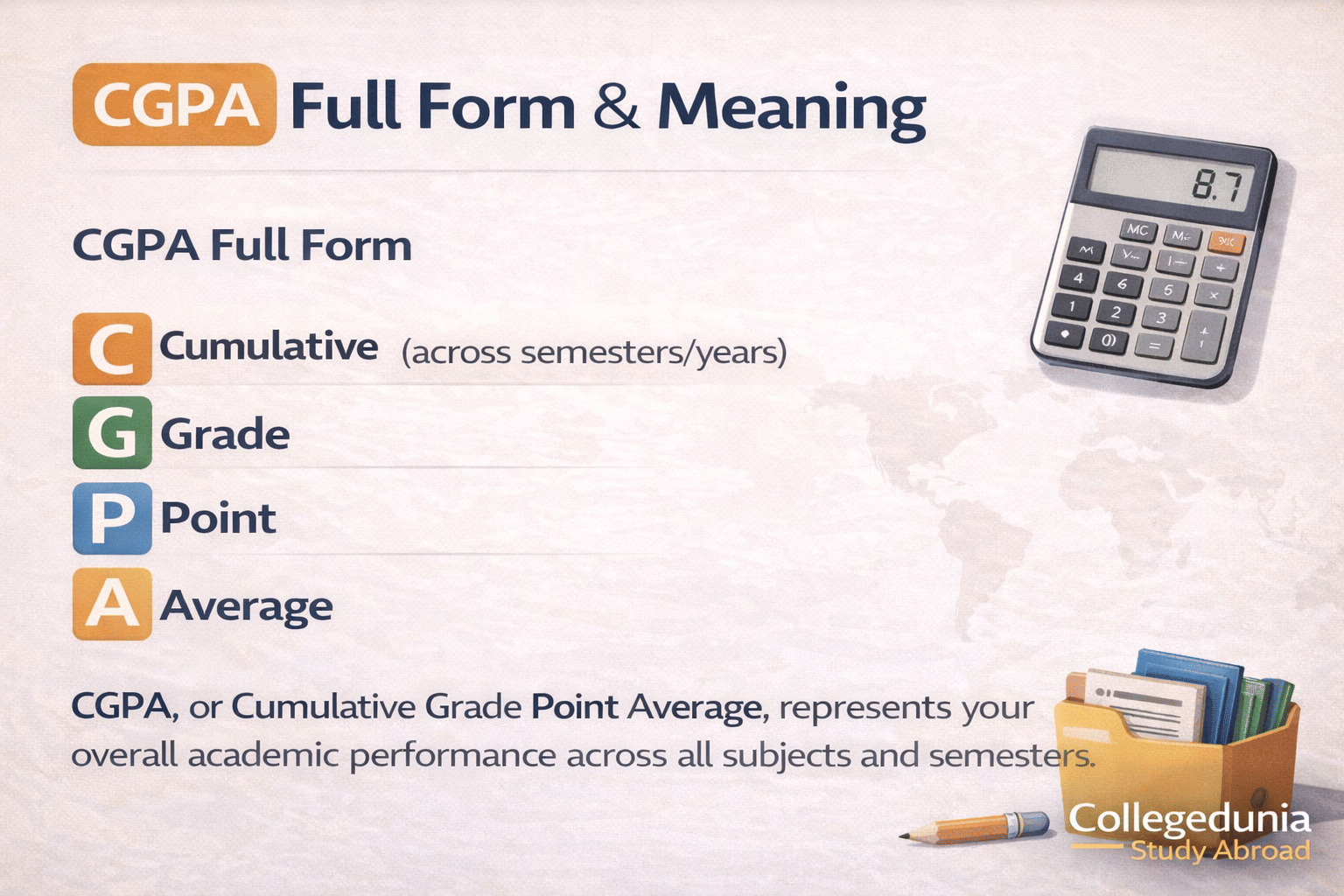
CGPA full form is Cumulative Grade Point Average. It is a standardised academic metric that calculates the average of all grade points earned across every subject and semester throughout your degree or course. Unlike a single-semester score, CGPA reflects your entire academic journey in one number.
In India, CGPA is used by CBSE schools (Classes 9–12), engineering colleges, universities, and most undergraduate and postgraduate institutions. It is typically measured on a 10-point scale, where 10.0 is the highest possible score.
- C = Cumulative (across all semesters/years)
- G = Grade
- P = Point
- A = Average
CGPA Meaning in Simple Terms
Think of CGPA as your academic report card compressed into a single number. If you scored well in most semesters but had one weak semester, your CGPA reflects the overall average — not just the bad semester. This makes it a fairer, more holistic measure of academic performance than a single exam score.
For example, if you completed four semesters with GPAs of 8.5, 9.0, 8.0, and 8.8, your CGPA would be: (8.5 + 9.0 + 8.0 + 8.8) ÷ 4 = 8.58
CGPA Full Form in CBSE (Class 10 & 12)
In CBSE schools, the CGPA for Classes 9 and 10 is calculated by averaging the grade points of the five main subjects (excluding the sixth additional subject). The maximum CGPA in CBSE is 10.0, and the standard formula to convert it to a percentage is:
Percentage = CGPA × 9.5
So a CGPA of 9.2 in CBSE Class 10 equals approximately 87.4%.
Note: As of 2024–25, CBSE has transitioned to a 9-point relative grading scale for Class 10 and 12 board exams. However, the CGPA system remains widely used across Indian colleges and universities on a 10-point scale.
Check out: CGPA to GPA Calculator: How to Convert 10 point CGPA to 4 point GPA?
How to Calculate CGPA?
CGPA is calculated by dividing the total weighted grade points earned across all subjects by the total number of credits attempted. The exact method varies slightly by institution, but the core formula remains consistent across most Indian universities.
Understanding how to calculate your CGPA is essential, not just for tracking your academic progress, but for accurately presenting your scores on international university applications.
Step-by-Step CGPA Calculation Formula
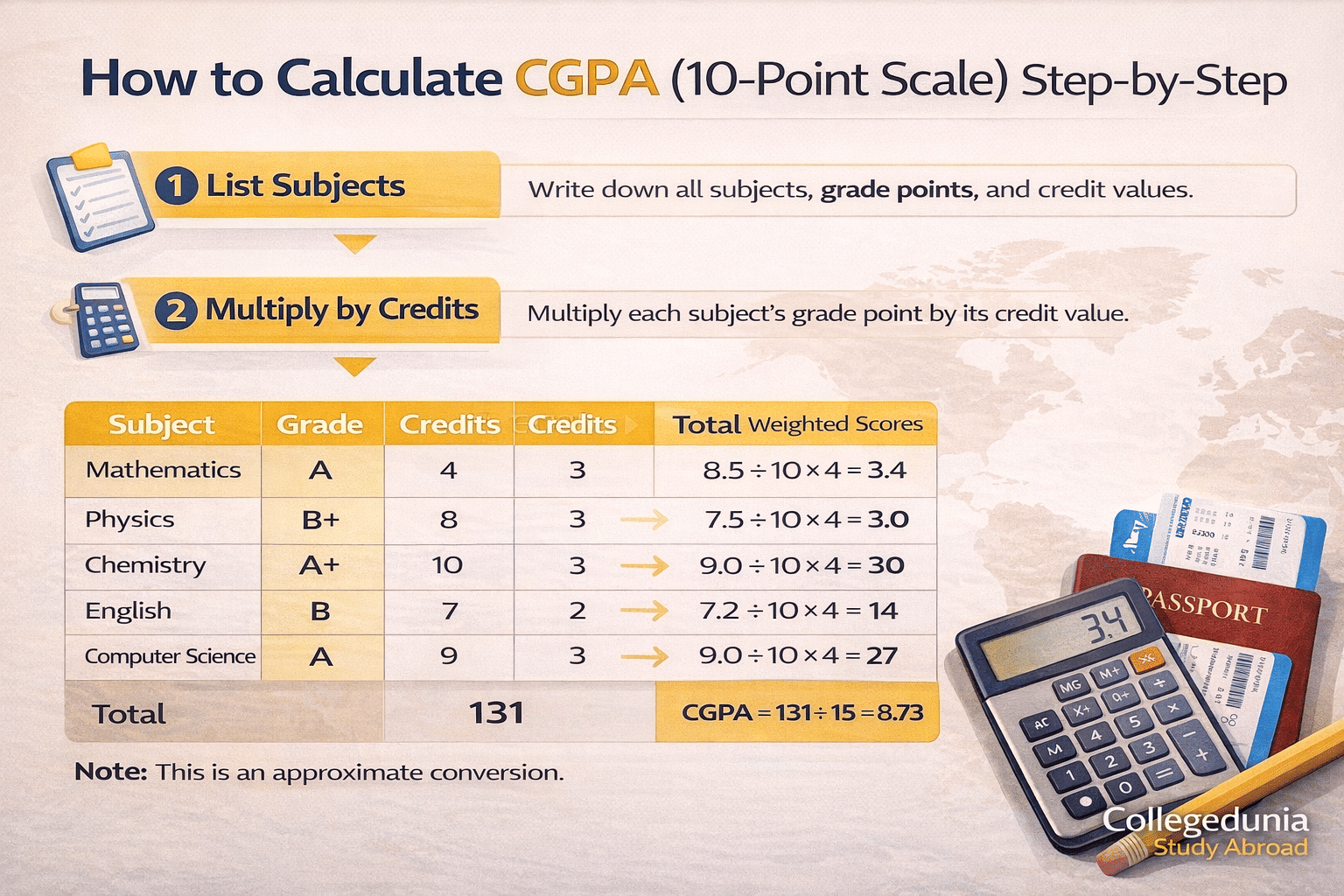
Step 1: List all subjects, their grade points, and credit values.
Step 2: Multiply each subject's grade point by its credit value (weighted score).
Step 3: Add all weighted scores together.
Step 4: Divide the total by the sum of all credits.
Formula: CGPA = Σ (Grade Point × Credit) ÷ Total Credits
CGPA Calculation Example (With Numbers)
Here is a worked example for a single semester with five subjects:
| Subject | Grade | Grade Point | Credits | Weighted Score |
|---|---|---|---|---|
| Mathematics | A | 9 | 4 | 36 |
| Physics | B+ | 8 | 3 | 24 |
| Chemistry | A+ | 10 | 3 | 30 |
| English | B | 7 | 2 | 14 |
| Computer Science | A | 9 | 3 | 27 |
| Total | — | — | 15 | 131 |
Semester GPA = 131 ÷ 15 = 8.73
To calculate your CGPA, repeat this for all semesters and average the semester GPAs:
(Sem 1 GPA + Sem 2 GPA + Sem 3 GPA + Sem 4 GPA) ÷ 4 = CGPA
Important: Only credit-bearing subjects are included in CGPA calculations. Audit courses, pass/fail subjects, and additional electives are typically excluded.
How to Calculate CGPA from SGPA?
If your university provides SGPA (Semester Grade Point Average) for each semester, calculating CGPA is straightforward:
CGPA = Sum of all SGPAs ÷ Number of Semesters
Example: If your SGPAs across 6 semesters are 7.5, 8.0, 8.2, 7.8, 8.5, and 8.6: (7.5 + 8.0 + 8.2 + 7.8 + 8.5 + 8.6) ÷ 6 = 8.1 CGPA
Read More: Difference Between SGPA and CGPA — Full Explanation
CGPA to Percentage Conversion
To convert CGPA to percentage, multiply your CGPA by 9.5. This is the standard formula recommended by CBSE and widely used across Indian institutions. Some colleges use a multiplier of 10 instead — always verify with your institution.
This conversion is critical when applying to Indian jobs, government exams, or universities that require percentage-based eligibility criteria.
CGPA to Percentage Formula (10-Point Scale)
Percentage = CGPA × 9.5 (CBSE/most Indian universities) Percentage = CGPA × 10 (some autonomous colleges)
Examples:
- CGPA 9.0 → 9.0 × 9.5 = 85.5%
- CGPA 8.5 → 8.5 × 9.5 = 80.75%
- CGPA 7.5 → 7.5 × 9.5 = 71.25%
- CGPA 6.5 → 6.5 × 9.5 = 61.75%
CGPA to Percentage Conversion Table (6.0–10.0)
The table below shows the percentage equivalent for every CGPA value from 6.0 to 10.0 on a 10-point scale, using the standard formula (CGPA × 9.5):
| CGPA | Equivalent Percentage (%) |
|---|---|
| 10.0 | 95.0 – 100 |
| 9.5 | 90.25 – 91.2 |
| 9.0 | 85.5 – 86.45 |
| 8.5 | 80.75 – 81.7 |
| 8.0 | 76.0 – 76.95 |
| 7.5 | 71.25 – 72.2 |
| 7.0 | 66.5 – 67.45 |
| 6.5 | 61.75 – 62.7 |
| 6.0 | 57.0 – 57.95 |
Note: These conversions are based on the formula Percentage = CGPA × 9.5, as recommended by CBSE. Actual percentages may vary slightly depending on your institution's grading policy.
Percentage to CGPA Conversion Formula
To reverse the calculation — converting a percentage back to CGPA:
CGPA = Percentage ÷ 9.5
Examples:
- 90% → 90 ÷ 9.5 = 9.47 CGPA
- 75% → 75 ÷ 9.5 = 7.89 CGPA
- 60% → 60 ÷ 9.5 = 6.32 CGPA
Read More: How to Convert Percentage to GPA and CGPA for Study Abroad
CGPA to GPA Conversion for Study Abroad
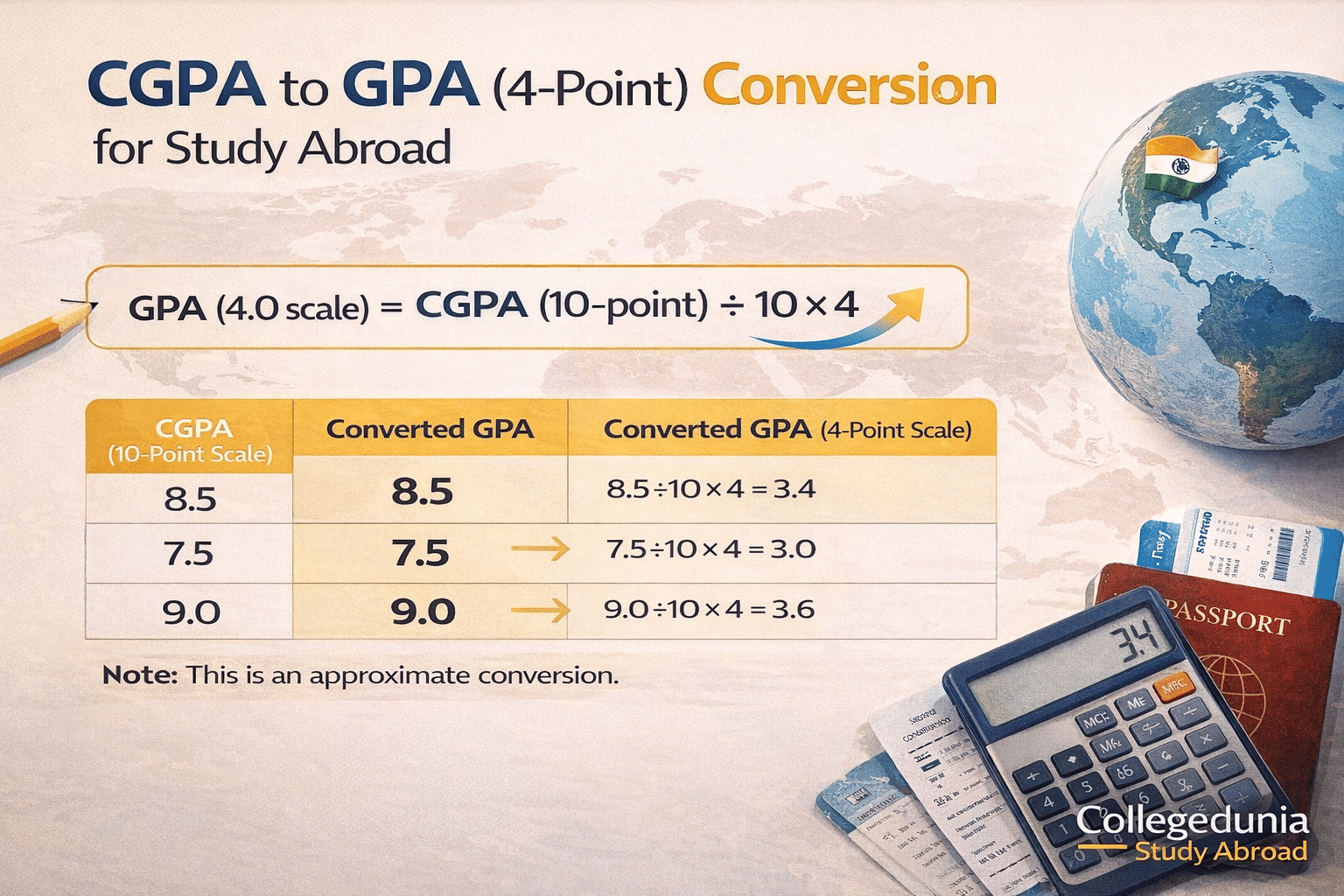
To convert a 10-point CGPA to a 4-point GPA (used in the US, Canada, and many other countries), divide your CGPA by 10 and multiply by 4.
This conversion is one of the most common requirements for Indian students applying to universities abroad — particularly in the United States, where the 4.0 GPA scale is the standard.
How to Convert 10-Point CGPA to 4-Point GPA
GPA (4.0 scale) = (CGPA ÷ 10) × 4
Examples:
- CGPA 8.5 → (8.5 ÷ 10) × 4 = 3.4 GPA
- CGPA 7.5 → (7.5 ÷ 10) × 4 = 3.0 GPA
- CGPA 9.0 → (9.0 ÷ 10) × 4 = 3.6 GPA
- CGPA 6.5 → (6.5 ÷ 10) × 4 = 2.6 GPA
Important caveat: This is an approximate conversion. For official US university applications, credential evaluation services like WES (World Education Services) or ECE (Educational Credential Evaluators) provide the most accurate and universally accepted GPA equivalents. Many top universities require a WES evaluation.
CGPI vs CGPA: What's the Difference?
Many students from Mumbai University and affiliated colleges receive their academic scores as CGPI (Cumulative Grade Point Index) rather than CGPA. This is a common source of confusion when filling out international application forms.
CGPI and CGPA are functionally the same metric — both represent the cumulative average of grade points across all semesters. The difference is purely terminological: Mumbai University uses "CGPI" while most other Indian universities use "CGPA."
For international applications, you can use your CGPI score in place of CGPA. However, it is advisable to:
- Attach a letter from your university confirming the grading scale used
- Use a credential evaluation service (WES/ECE) for official conversion
- Mention "CGPI (equivalent to CGPA)" in your application if the form asks for CGPA
CGPA vs GPA: Key Differences
CGPA and GPA are related but not the same. GPA (Grade Point Average) typically refers to the grade points earned in a single semester or academic year, while CGPA is the cumulative average across all completed semesters. In India, CGPA is the standard; in the US, GPA (on a 4.0 scale) is the norm.
Understanding this distinction is critical for Indian students applying abroad — you will need to present your academic record in the format the university expects.
CGPA vs GPA Comparison Table
| Parameter | CGPA | GPA |
|---|---|---|
| Full Form | Cumulative Grade Point Average | Grade Point Average |
| Scale | 10-point (India) | 4-point (US/Canada) |
| Scope | All semesters/years combined | Single semester or year |
| Purpose | Overall academic standing | Short-term performance |
| Used In | India, UAE, Nepal, some EU countries | USA, Canada, Philippines |
| Calculation | Avg. of all semester GPAs | Avg. of grade points in one semester |
| Conversion | CGPA ÷ 10 × 4 = GPA | GPA × 10 ÷ 4 = CGPA |
CGPA vs SGPA: What's the Difference?
SGPA (Semester Grade Point Average) measures your performance in a single semester only. CGPA is the running average of all your SGPAs from the first semester to the current one.
- SGPA = Performance in one semester
- CGPA = Performance across your entire degree (all semesters combined)
You receive an SGPA at the end of each semester. Your CGPA is updated cumulatively as you complete more semesters. A strong SGPA in later semesters can improve a lower CGPA from earlier years.
Check Out: Full Difference Between CGPA and GPA — Detailed Guide
What CGPA Is Required to Study Abroad?
Most international universities require a minimum CGPA of 6.5–7.0 (on a 10-point scale) for postgraduate admissions, with top programs expecting 8.0 or above. However, requirements vary significantly by country, university, and program. Here is a country-wise breakdown based on general admission patterns.
This is the section most Indian students struggle to find — and where most generic CGPA articles fall short. The truth is, "good CGPA" means different things in different countries.
CGPA Requirements by Country (US, UK, Canada, Australia, Germany)
| Country | Minimum CGPA (10-Point) | Equivalent GPA | Top Universities Expect | Notes |
|---|---|---|---|---|
| USA | 7.0 – 8.0 | 2.8 – 3.2 | 8.5+ (3.4+ GPA) | WES evaluation often required |
| UK | 6.5 – 7.5 | 2.6 – 3.0 | 7.5+ (Upper Second Class) | Equivalent to 2:1 degree |
| Canada | 7.0 – 7.5 | 2.8 – 3.0 | 8.0+ | WES/IQAS evaluation recommended |
| Australia | 6.0 – 7.0 | 2.4 – 2.8 | 7.0+ | Credit average or above |
| Germany | 6.5 – 7.5 | 2.6 – 3.0 | 7.5+ | Converted to German 5-point scale |
| Singapore | 7.0 – 8.0 | 2.8 – 3.2 | 8.0+ | Varies by NUS/NTU program |
As of the 2025–26 admissions cycle, these are general benchmarks. Always verify the specific CGPA cut-off on the official university admissions page before applying.
What CGPA Is Good for Scholarships Abroad?
Scholarship requirements are typically stricter than general admission requirements. Here are general benchmarks:
- Merit-based scholarships (US/UK/Canada): 8.0+ CGPA (3.2+ GPA equivalent)
- Fully funded government scholarships (e.g., Chevening, Commonwealth, DAAD): 8.5+ CGPA
- University-specific scholarships: Varies — typically 7.5–8.5 CGPA
- Research assistantships (US PhD programs): 8.0+ CGPA, strong GRE scores
Note: Scholarship committees evaluate the complete profile — CGPA is one factor among many, including SOP, LOR, research experience, and test scores (GRE/GMAT/IELTS/TOEFL).
Can a Low CGPA Be Compensated?
Yes — a low CGPA does not automatically disqualify you from studying abroad. Many Indian students with 6.5–7.5 CGPA have secured admissions to reputable international universities by strengthening other parts of their profile.
Here is what can compensate for a lower CGPA:
- Strong GRE/GMAT scores: A high GRE score (320+) can offset a 7.0–7.5 CGPA for US MS programs
- Relevant work experience: 2–3 years of industry experience is highly valued, especially for MBA programs
- Research publications or projects: Demonstrates academic capability beyond grades
- Strong SOP (Statement of Purpose): Explains the context of a lower CGPA (health issues, family circumstances, etc.)
- Excellent LORs (Letters of Recommendation): From professors or employers who can vouch for your abilities
- Upward GPA trend: If your CGPA improved significantly in later semesters, highlight this in your SOP
As one Reddit user from r/Indians_StudyAbroad noted: "I had 58% in Class 12, worked hard in undergrad and maintained 8.22 CGPA and built my overall profile too." The trajectory matters as much as the number.
Explore: Study Abroad Options by Country — Find Programs That Match Your Profile
CGPA Grading System in India
India primarily uses a 10-point CGPA grading system across schools and universities. Under this system, marks obtained in each subject are converted into grade points, which are then averaged (weighted by credits) to produce the CGPA. The grading scale below is used by most Indian universities and CBSE-affiliated institutions.
CGPA Grade Scale Table (Marks → Grade → Category)
| Marks Obtained (%) | Numerical Grade (GP) | Letter Grade | Category |
|---|---|---|---|
| 90 – 100 | 10 | O | Outstanding |
| 80 – 89 | 9 | A+ | Excellent |
| 70 – 79 | 8 | A | Very Good |
| 60 – 69 | 7 | B+ | Good |
| 50 – 59 | 6 | B | Above Average |
| 45 – 49 | 5 | C | Average |
| 40 – 44 | 4 | D | Pass |
| Below 40 | 0 | F | Fail |
Note: This grading scale is indicative and based on the standard 10-point system used by most Indian universities. Individual institutions may have slight variations. Always refer to your university's official grading policy.
What Is a Good CGPA in India?
The definition of a "good" CGPA depends on your goals:
- For competitive placements (top IT/consulting firms): 7.5–8.5+ CGPA is typically expected
- For study abroad (master's programs): 7.0–8.0+ CGPA is the general benchmark
- For government jobs/PSU recruitment: Minimum 6.0–6.5 CGPA (varies by role)
- For scholarships: 8.0+ CGPA is generally required for merit-based awards
- For PhD programs abroad: 8.5+ CGPA is strongly preferred
A CGPA of 8.0 or above is widely considered strong across most academic and professional contexts in India.
FAQs on CGPA Full Form
Ques. What is the full form of CGPA?
Ans. The full form of CGPA is Cumulative Grade Point Average. It is a standardised grading metric used in schools and universities to measure a student's overall academic performance across all subjects and semesters, typically on a 10-point scale in India.
Ques. What is the difference between CGPA and GPA?
Ans. CGPA (Cumulative Grade Point Average) is the average of grade points earned across all semesters of a degree, measured on a 10-point scale in India. GPA (Grade Point Average) typically refers to the grade points for a single semester and is measured on a 4-point scale in the US and Canada. To convert Indian CGPA to a 4-point GPA, use the formula: GPA = (CGPA ÷ 10) × 4.
Ques. How is CGPA calculated?
Ans. CGPA is calculated using the formula: CGPA = Σ (Grade Point × Credit) ÷ Total Credits. Assign grade points to each subject based on marks, multiply by the subject's credit value, sum all weighted scores, and divide by total credits. For semester-based courses, average all semester GPAs to get the final CGPA.
Ques. What is a 75% mark in CGPA?
Ans. A score of 75% converts to approximately 7.89 CGPA on a 10-point scale, using the formula: CGPA = 75 ÷ 9.5 = 7.89. This is considered a good academic score and meets the minimum CGPA requirement for many international university programs, particularly in Australia and Canada.
Ques. What is 8 CGPA in percentage?
Ans. A CGPA of 8.0 equals approximately 76% using the standard formula: 8.0 × 9.5 = 76%. On a 4-point GPA scale, 8.0 CGPA converts to approximately 3.2 GPA. This is considered a strong academic score and meets the minimum requirements for most master's programs in the US, UK, Canada, and Australia.
Ques. What CGPA is required for a master's degree abroad?
Ans. Most international universities require a minimum CGPA of 7.0–7.5 (on a 10-point scale) for master's admissions. Top programs at universities like MIT, Stanford, Oxford, and University of Toronto typically expect 8.0–8.5+ CGPA. Requirements vary by country: US (7.0–8.5), UK (6.5–7.5), Canada (7.0–7.5), Australia (6.0–7.0), Germany (6.5–7.5).
Ques. What CGPA is required for scholarships abroad?
Ans. Most merit-based scholarships abroad require a minimum CGPA of 8.0 (on a 10-point scale). Fully funded government scholarships like Chevening (UK), DAAD (Germany), and Commonwealth Scholarships typically expect 8.5+ CGPA. However, scholarship selection is holistic — SOP, LOR, research experience, and test scores also play a significant role.
Ques. Can a low CGPA affect my study abroad application?
Ans. A low CGPA (below 7.0) can reduce your chances at highly competitive programs, but it does not disqualify you entirely. Strong GRE/GMAT scores, relevant work experience, research publications, a compelling SOP, and excellent LORs can compensate for a lower CGPA. Many universities also consider an upward GPA trend — if your scores improved significantly in later semesters, highlight this in your application.



Comments