



Study Abroad Expert | Updated On - Nov 4, 2025
Indian students have long been drawn to the US, Canada, the UK, and Australia for higher education. But in recent years, Europe has quietly emerged as a fresh frontier - with more affordable costs, generous scholarships, and welcoming policies. As traditional destinations face policy changes, many Indian students are exploring newer paths.
Why Europe Is Gaining Momentum with Indian Students?
Before we dive into specific countries, let's look at the broader trends:
- In 2025, over 1.8 million Indian students are pursuing studies abroad—a record high.
- That said, in 2024, the total number of Indians abroad decreased by ~15% compared to 2023 (from ~893,000 to ~759,000).
- Among the so-called "Big Four" destinations (the USA, UK, Canada, and Australia), enrollments declined - Canada saw a ~41% drop, the UK ~27%, the U.S. ~13%, and Australia ~12%.
- In contrast, India's government data shows sharp increases in Indian student numbers in Germany (+68% between 2022 and 2024), Russia (+59%), France (+33%), and Ireland (+49%) over that same period.
- In 2023–24, the number of Indian students going to EU member countries increased from ~56,000 in 2018–19 to over 90,000.
These shifts suggest growing confidence among Indian students and families in Europe as a viable, sometimes superior, choice.
Check Out:
Top Fastest-Growing Destinations in Europe for Indian Students
Here are the European countries where Indian student numbers are growing fastest (or showing significant momentum) in 2025, along with what draws students there:
Germany
- Germany is often cited for affordable education, especially in public universities where tuition is either very low or zero (for many programs).
- In 2024–25, Germany hosted approximately 42,997 Indian students.
- German institutions have seen a 15.1% increase in Indian enrollments, bringing the total to nearly 50,000.
- Over five years, some sources estimate a 100% increase in the number of Indian students in Germany.
- Germany also offers 18-month job-seeking visas after graduation, which appeals strongly to STEM and engineering students.
- Many courses (especially at the undergraduate level) are free or low-cost.
- Strong industry-academic linkages in engineering, automation, and manufacturing.
Check Out:
- Germany Overtakes US as Top Choice for Indian Students in 2025
- India, Germany Announce Free Student Exchange Visas Amid Surge in Indian Enrolments
France
- France is positioning itself aggressively to attract Indian students. It aims to host 30,000 Indian students by 2030, up from roughly 8,000 in 2023–24.
- Between 2022 and 2024, the number of Indian students in France increased by ~33%.
- France continues to award Erasmus+ scholarships to Indian students: in 2025, 101 Indian students received such scholarships for two-year master's programs.
- Availability of English-taught master's programs and dual degree options.
- Scholarships and subsidised tuition for EU and non-EU students.
- Rich culture, good quality of life, and proximity to other European centres.
Check Out: France Sees 17% Rise in Indian Students, Aims for 30,000 by 2030
Ireland
- India's government data show a ~49% increase in Indian student inflow in recent years.
- Ireland offers relatively straightforward visa norms, post-study work opportunities (24 months), and a strong tech and business ecosystem, which appeals to students in IT, analytics, and business.
- Many universities in Ireland are highly ranked globally, and English is the primary language of instruction.
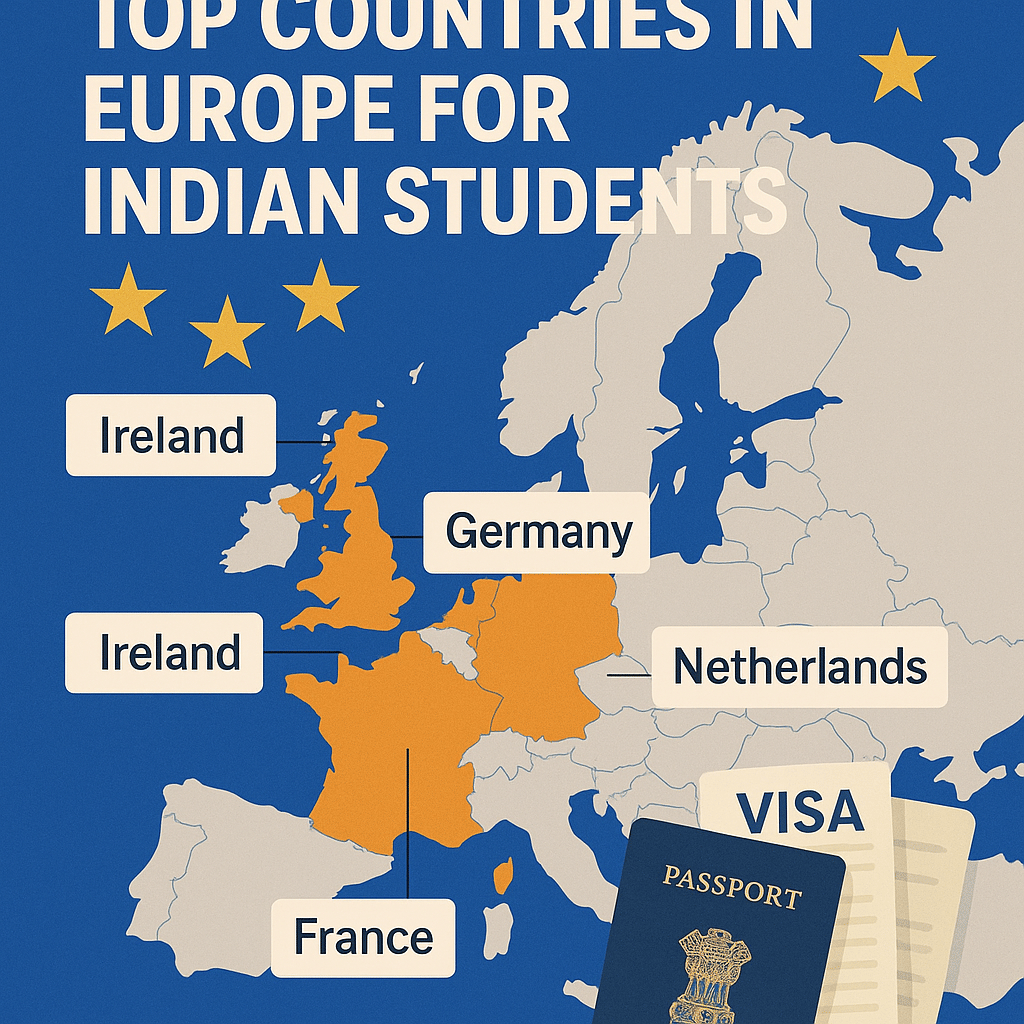
Netherlands & Belgium
- The Netherlands and Belgium have steadily raised their visibility through English-taught programs and good research output.
- The Netherlands, in particular, is known for its strong master's programs in Data Science, Engineering, and Business Analytics.
- The cost of living and tuition in Belgium is moderate compared to those in the UK or the U.S.
Other contenders: Poland, the Czech Republic, and Switzerland
- Poland is emerging as a more affordable alternative in Central Europe, particularly in the fields of engineering, medicine, and technology.
- The Czech Republic (Prague, Brno) attracts students with reasonable tuition and many English-language programs.
- Switzerland may not be experiencing mass growth yet, but niche areas—such as hospitality, business, and research—are seeing a gradual increase in interest.
What Factors Are Driving This Shift?
- Tuition in many European public universities is low or near zero compared to U.S./UK norms. Even in private universities, fees tend to be much lower.
- Countries like Germany (18 months), Ireland (24 months), and France (varies) offer work visas after graduation. That reassurance is a strong pull for Indian students.
- More universities across Europe now offer master's and even some undergraduate programs in English.
- Erasmus+, joint degree programs, and government-sponsored scholarships make Europe more accessible.
- Many European institutions consistently perform well in global rankings, especially in engineering, business, and sciences.
- Stricter visa norms or high costs in the U.S., UK, and Canada have nudged students to explore alternative destinations.
Country-by-Country Snapshot
| Country | Approx Indian Student Numbers/ Trend | Key Advantages | Cautions/ Tips |
|---|---|---|---|
| Germany | ~43,000+ | Low/no tuition, strong STEM, 18-month stay back | German language for many undergrad programs; proof of financial stability needed |
| France | ~8,000+ | Scholarships, English-taught masters, EU mobility | French helps with local life |
| Ireland | Growing at ~49% | English medium, 24-month work visa, strong tech hub | Living cost in Dublin can be steep |
| Netherlands/Belgium | Moderate but rising | English programs, central Europe access | Tuition can be higher than in Germany |
| Poland / Czech Republic | Emerging | Affordable fees, decent infrastructure | May need to check recognition for professional licensing |
Tips for Indian Students Choosing Europe in 2026
- Research language requirements: Even in countries where English is widely spoken, local language proficiency can be beneficial for internships, daily life, and part-time work.
- Check visa/permit rules carefully: Some countries require proof of blocked bank accounts or monthly minimum balances.
- Explore scholarship and funding options early: Erasmus+, university grants, bilateral schemes—these often have earlier deadlines.
- Explore post-study work rights: A country with a strong stay-back visa is more attractive.
- Verify recognition and accreditation: For fields such as medicine, law, or engineering, ensure that degrees are recognized in India or globally.
Europe is no longer the "backup" option—it's fast becoming a first choice for many Indian students. Germany, France, Ireland, the Netherlands, Belgium, and the Central European nations are leading this shift. They combine affordability, strong programs, mobility within Europe, and post-study work options.
While the Big Four (U.S., UK, Canada, Australia) will continue to matter, the trends show that Indian students are diversifying. If you're planning to study abroad in 2026 or beyond, adding Europe strongly to your list makes sense.

1720429164.png?tr=w-305,h-145,c-force?h=40&w=40&mode=stretch)













Comments