



| Updated On - Jun 20, 2026
A bonafide certificate is an official letter from your school, college or employer confirming that you are genuinely enrolled or employed there. Indian students applying abroad use it as proof of student status for visa, scholarship, education loan and accommodation applications. Most institutions issue it within 3 to 7 working days for a fee of INR 50 to INR 500.
- The word "bonafide" comes from Latin and means "in good faith", so the certificate is the institution vouching for your authenticity.
- Two formats exist: a temporary version valid for 6 to 12 months and a permanent version tied to your full enrolment period.
- It is not the same as a transfer certificate, a transcript or a domicile certificate, and embassies treat each one differently.
- Visa officers, banks, and university registrars often want a copy issued within the last 6 months, so the timing of the request matters.
On student forums, the most common panic is a bank or consulate rejecting a year-old certificate days before a deadline. A document this small should never be the reason an application stalls. Getting the format, purpose and validity right the first time keeps your visa file, loan file and university file moving without a second trip to the registrar.
Also check,
- Study Abroad: Colleges, Courses, Exams, and Fees
- Top Universities/Colleges to study abroad
- How can I study abroad for Free?
- Scholarships to Study Abroad: Types, Eligibility, Award Value
- What Is a Bonafide Certificate
- Why a Bonafide Certificate Matters Abroad
- Types of Bonafide Certificate
- Bonafide Certificate Format and Contents
- How to Apply for a Bonafide Certificate
- Documents Needed for a Bonafide Certificate
- Bonafide Certificate Application Letter Sample
- Bonafide Certificate Validity and Reuse
- FAQs
What Is a Bonafide Certificate
A bonafide certificate is a signed, stamped letter on official letterhead that confirms a named person is a genuine student or employee of the issuing institution for a stated period. For students, it records your name, course, enrolment number and the start and expected end date of your programme.
The certificate carries weight because a senior official, usually the registrar, principal or HR head, signs it and applies the institutional seal. That signature is the institution staking its reputation on the fact that your status is real. A copy of your own ID card never carries the same authority, which is why third parties ask for this letter instead.
- It states active enrolment or employment, not past association.
- It is written in formal third person and avoids casual language.
- It usually names the specific purpose, such as a visa or a scholarship.
Note: A bonafide certificate confirms current status. The moment you graduate or leave, your institution can only issue a "studied here" letter, which is a different document with different uses.
Also check, Eligibility to Study Abroad: Language Tests, General Exams & Documents Required
Why a Bonafide Certificate Matters Abroad
For Indian students, a bonafide certificate is requested at several checkpoints in the study abroad journey, not just one. Universities, embassies, banks and landlords each use it to verify that you are a real, currently enrolled student before they commit anything to you.
Immigration officers treat it as supporting proof of your student intent. A clear certificate stating your course and duration strengthens the genuine student case in any visa file, which matters when officers scrutinise ties and intent.
- Student visa: attached as evidence, you hold a real seat at a recognised institution.
- Scholarship applications: committees confirm enrolment before releasing funds.
- Education loans: banks verify your admission before sanctioning money.
- Accommodation and bank accounts: landlords and banks abroad confirm student status for tenancy and concessions.
Before your visa interview, line up the certificate with the rest of your paperwork using the student visa application process walkthrough so nothing is missing on the day.
Also check,
- US Student Visa Requirements: Cost, Application & Process
- UK Student Visa 2026: Requirements, Fees & New Rules
- German Student Visa Procedure for 2026
- Canada Student Visa Guide for Indian Students
Types of Bonafide Certificate
There are two main forms of a bonafide certificate, separated by how long they stay valid and what they are used for. Choosing the right one avoids a rejection when an embassy or bank expects a specific version.
Temporary Bonafide Certificate
This version is valid for roughly 6 to 12 months and then lapses automatically. Students use it for short courses, part-time work permissions, temporary residence proof or unpaid training abroad. It confirms you are enrolled right now for a fixed window.
Permanent Bonafide Certificate
This version covers your full enrolment period and is used for higher-stakes purposes like working visas, residency steps and student exchange programmes. It confirms continuous enrolment rather than a short snapshot.
| Feature | Temporary | Permanent |
|---|---|---|
| Validity | 6 to 12 months | Full course duration |
| Best for | Short courses, part-time work, temporary stay | Work visa, exchange, residency |
| Expiry | Lapses automatically | Tied to enrolment status |
Most undergraduate and postgraduate applicants abroad work with the temporary version because embassies and banks want a recent, current-status letter. Ask your target institution or consulate which one they accept before you request it.
What students actually say on forums: "My consulate did not care which type it was, they only checked the issue date was recent and the course dates matched my offer letter."
Bonafide Certificate Format and Contents
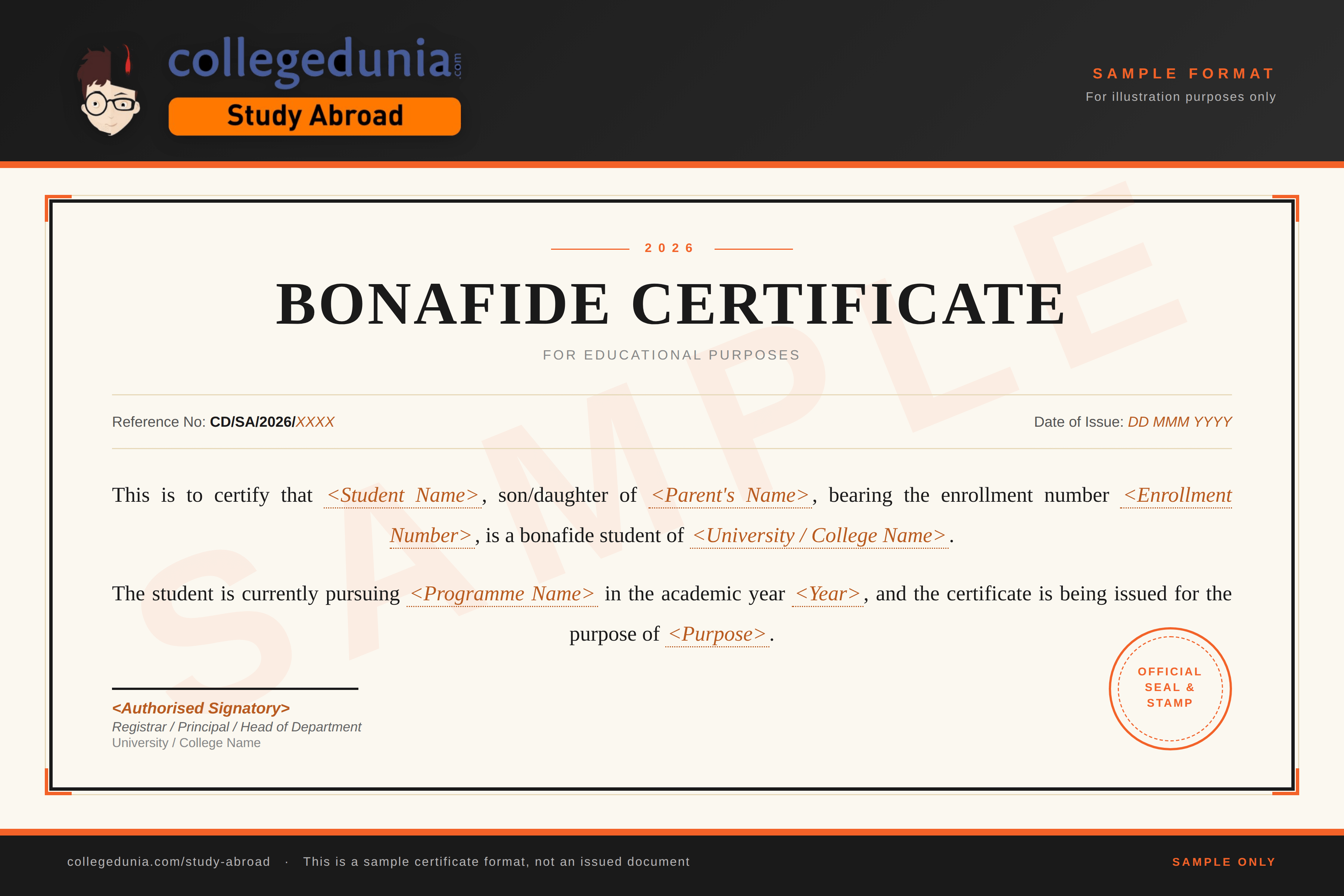
A valid bonafide certificate is printed on institutional letterhead and carries a fixed set of details plus an authorised signature and seal. Wording varies between institutions, but the core elements stay constant so any verifier can read it the same way.
Every certificate should include these items, because a missing field is the most common reason a bank or embassy sends it back.
- Institution name and address on official letterhead.
- Date of issue and a reference or certificate number.
- Student full name, exactly as in the passport, and parent name where used.
- Course name, enrolment or registration number and year of study.
- Start date and expected completion date of the programme.
- The specific purpose, such as visa or scholarship, where relevant.
- Authorised signature, designation and official seal.
A clean sample structure reads as a single certifying statement. For example: "This is to certify that Mr or Ms [Full Name as in Passport], registration number [XXXX], is a bonafide student of the [Programme Name], batch [20XX to 20XX], at [Institution Name]. This certificate is issued on request to support a student visa application."
For more information, check out the Bonafide Certificate sample pdf’s:
Sample 1: For Students
Sample 2: For Employees
Sample 3: For Scholarship
Sample 4: For Internship
How to Apply for a Bonafide Certificate
To get a bonafide certificate, you submit a short written request to your institution's administrative or registrar office along with ID and a fee where charged. The process is simple but moves on the institution's timeline, so apply well before your deadline.
Follow these steps in order to avoid a second visit to the office.
- Write a formal application letter to the principal, head of department or HR, stating the purpose.
- Attach the supporting documents the institution asks for, such as a student ID copy and fee receipt.
- Submit the request at the administrative or registrar office or through the student portal where one exists.
- Pay the processing fee if applicable, usually INR 50 to INR 500.
- Collect the signed and stamped certificate after the 3 to 7 day processing window.
If your institution issues certificates online, download the signed copy and keep both a digital and printed version. When the certificate supports a loan file, request it around the same time you start the education loan application steps so the dates line up for the bank.
Note: Apply at least two weeks before any hard deadline. Registrar offices slow down during admission and exam season, and a 7-day promise can stretch to 10.
Documents Needed for a Bonafide Certificate
Most institutions ask for a written request plus basic identity and enrolment proof before issuing a bonafide certificate. Requirements vary, so confirm the exact list with your office, but the standard set is short.
- A formal application letter stating your details and purpose.
- A copy of your student ID card or admission letter.
- A valid government ID proof, such as Aadhaar or passport.
- Your enrolment or registration number.
- A fee receipt or proof of no pending dues, where the institution requires it.
Some institutions only issue the certificate if you have no outstanding library or fee dues, so clear those first. Keep a passport copy ready, since the certificate often needs your name spelled exactly as the passport shows for abroad use.
The same paperwork supports your wider abroad file, so storing scanned copies of every ID and receipt in one folder saves time across the statement of purpose and visa stages too.
Bonafide Certificate Validity and Reuse
A bonafide certificate does not always carry a printed expiry, but most verifiers abroad accept it only if issued within the last 3 to 6 months. A temporary certificate states its own validity window, while a permanent one stays tied to your enrolment.
If your certificate has lapsed or is older than the window a bank or embassy wants, simply reapply for a fresh one. Reissue is routine and usually carries the same small fee. Do not try to edit an old copy, since any alteration can void the document and trigger serious consequences.
- Temporary certificate: valid for the stated 6 to 12 months.
- Permanent certificate: valid while you stay enrolled.
- For abroad use: aim for a copy issued in the last 90 days.
Key Insight: Request the certificate close to the application it supports, not at the start of the year. A January copy is often too old for an August visa file.
A bonafide certificate is one of the simplest documents in your study abroad file, yet it touches the visa, scholarship, loan and accommodation stages at once. Get the format right, keep the name aligned with your passport and request a fresh copy close to each application so the issue date stays recent. Know which version your verifier wants, never alter the document and store both a digital and printed copy. Treated this way, the certificate quietly clears a checkpoint instead of becoming a last-minute scramble.
FAQs
Ques. What is a bonafide certificate used for in study abroad applications?
Ans. A bonafide certificate proves you are a genuine, currently enrolled student. Indian students use it for student visa, scholarship, education loan and accommodation applications, where universities, embassies and banks need confirmation of your enrolment before they proceed.
Ques. How long does it take to get a bonafide certificate?
Ans. Most institutions issue it within 3 to 7 working days, though some take up to 10 during admission or exam season. Apply at least two weeks before any hard deadline to be safe.
Ques. Is there a fee for a bonafide certificate?
Ans. Often it is free, but many institutions charge a nominal processing fee of INR 50 to INR 500. The amount is not fixed, so confirm it with your administrative or registrar office.
Ques. How long is a bonafide certificate valid?
Ans. A temporary certificate is valid for 6 to 12 months, while a permanent one is tied to your enrolment. Even without a printed expiry, most verifiers abroad want a copy issued within the last 3 to 6 months.
Ques. Is a bonafide certificate the same as a transfer certificate?
Ans. No. A bonafide certificate proves you are currently enrolled, while a transfer certificate is issued when you leave an institution. They serve opposite stages of your academic timeline.
Ques. Who issues a bonafide certificate?
Ans. Your school, college or university registrar issues it for students, and the HR department issues it for employees. It must carry an authorised signature and the official seal to be treated as valid.
Ques. What documents do I need to apply for a bonafide certificate?
Ans. You typically need a formal application letter, a student ID or admission letter, a valid government ID and your enrolment number. Some institutions also ask for a fee receipt or proof of no pending dues.
Ques. Can I reuse an old bonafide certificate for a new application?
Ans. Only if it is still recent, usually within the last 90 days for abroad use. If it has lapsed or the verifier wants a newer copy, reapply for a fresh one rather than editing the old document.
Ques. Does my name on the certificate need to match my passport?
Ans. Yes. For abroad use, the spelling on the certificate should match your passport letter for letter. A mismatch between the certificate, offer letter and passport is a common visa query that slows down your file.
Ques. Is a bonafide certificate mandatory for a student visa?
Ans. It is not always a separate mandatory item, but it is widely requested as supporting proof of enrolment. A clear certificate stating your course and duration strengthens the genuine student case in your visa file.
Ques. What happens if I submit a fake bonafide certificate?
Ans. The consequences are severe. A false certificate can lead to visa denial, deportation, expulsion or legal action, and the institution named on it can pursue the case. Always use a genuine, current document.



Comments