AP EAPCET (AP EAMCET) 2024 Question Paper May 16 Shift 1 : Download BiPC Question Paper with Answer Key PDF

Shivam Yadav's profile photo

Shivam Yadav

Updated 3+ months ago

AP EAPCET 2024 Question Paper May 16 Shift 1 is available for download here. Jawaharlal Nehru Technological University, KAKINADA on behalf of APSCHE conducted AP EAPCET 2024 on May 16 in Shift 1 from 9 AM to 12 PM. AP EAPCET 2024 BiPC Question Paper consists of 160 MCQ-based questions in total, 40 from Botany, 40 from Zoology, 40 from Physics and 40 from chemistry carrying 1 mark each to be attempted in the duration of 3 hours.

Download: AP EAMCET 2025 Question Paper with Solution PDF

AP EAPCET 2024 Question Paper with Answer Key PDF May 16 Shift 1

AP EAPCET 2024 May 16 Shift 1 Question Paper with Answer Key download iconDownload Check Solution

AP EAPCET Previous Year Question Paper with Answer Key PDFs

Question 1:

Choose the incorrect statements regarding definition of Living:

  • (A) Cell division replaces lost cells in certain tissues
  • (B) In living organisms, growth is from outside
  • (C) Metabolism is the sum total of all chemical reactions occurring in the living organism
  • (D) In unicellular organisms, reproduction is not synonymous with the growth
Correct Answer: (4) B, D
View Solution

Question 2:

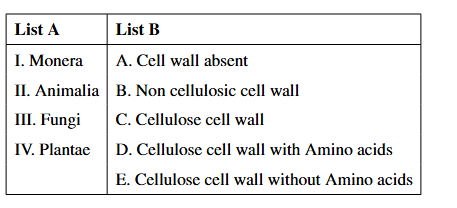
Choose the correct matching:

  • (A) I-A, II-E, III-B, IV-C
  • (B) I-E, II-A, III-B, IV-C
  • (C) I-D, II-E, III-B, IV-C
  • (D) I-D, II-A, III-B, IV-C
Correct Answer: (4) I-D, II-A, III-B, IV-C
View Solution

Question 3:

The correct sequence of plants which help in production of biofertilizers, medicines and protein food is:

Correct Answer: 2. Nostoc, Datura, Chlorella
View Solution

Question 4:

Choose the incorrect statement related to life cycles:

I. Sporophyte generation is represented by a single-celled zygote.
II. Gametophyte is multicellular in Pteridophytes and Gymnosperms.
III. Life cycle is diphlaplontic in Bryophytes.
IV. Life cycle is haplodiplontic in Pteridophytes.

Correct Answer: 3. III, IV
View Solution

Question 5:

These are the roots in a sequence to absorb moisture, support, water minerals from other plants.

  • (1) Nodular roots, Haustorial roots, Stilt roots
  • (2) Velamen roots, Stilt roots, Haustorial roots
  • (3) Stilt roots, Prop roots, Haustorial roots
  • (4) Pneumatophores, Prop roots, Stilt roots
Correct Answer: (2) Velamen roots, Stilt roots, Haustorial roots
View Solution

Question 6:

These are placentation types based on the attachment of ovules within the ovary as given below:
Ridge

Inner wall of the ovary

Base of the ovary

Correct Answer: 1. Marginal, Parietal, Basal
View Solution

Question 7:

In Angiosperms arrange the events of pre-fertilization/post-fertilization in a sequence:

  • (1) Sporogenesis — Spores/Gametogenesis — Gametes
  • (2) Gametes — Syngamy/Embryo — Endosperm
  • (3) Gametogenesis — Gametes transfer/Zygote — Embryo
  • (4) Spores — Gametes/Zygote — Embryo
Correct Answer: (3) Gametogenesis — Gametes transfer/Zygote — Embryo
View Solution

Question 8:

A mother plant having 16 chromosomes produced ovules and underwent megasporogenesis, then the ploidy of the nucleus of A, B, C, D is:


  • (1) A:16, B:16, C:8, D:16
  • (2) A:16, B:16, C:8, D:8
  • (3) A:16, B:32, C:8, D:8
  • (4) A:16, B:8, C:16, D:8
Correct Answer: (4) A:16, B:8, C:16, D:8
View Solution

Question 9:

The author and classification followed in the below mentioned books:
I- Families of flowering plants
II- Genera plantarum
III- Species plantarum

  • (1) I- Hutchinson: Phylogenetic
    II- Bentham \& Hooker: Natural
    III- Linnaeus: Artificial
  • (2) I- Linnaeus: Sexual
    II- Hutchinson: Natural
    III- Bentham \& Hooker: Artificial
  • (3) I- Theophrastus: Sexual
    II- Linnaeus: Natural
    III- Engler and Prantl: Artificial
  • (4) I- decondolle: phylogenetic
    II- Hutchinson: Natural
    III- Linnaeus: Artificial
Correct Answer: (1) I- Hutchinson: Phylogenetic, II- Bentham \& Hooker: Natural, III- Linnaeus: Artificial
View Solution

Question 10:

Identify the cell organelles present in animals and absent in plant cells, present in plant cells and absent in animals, present in only prokaryotes:

  • (1) Centriole, Cytoskeleton, Inclusion bodies
  • (2) Axoneme, Flagellum, Mesosomes
  • (3) Ribosomes, Plasma membrane, Flagellum
  • (4) Fimbriae, Flagellum, Mesosomes
Correct Answer: (1) Centriole, Cytoskeleton, Inclusion bodies
View Solution

Question 11:

Assertion (A): Satellite is a small fragment-like structure found in some chromosomes.
Reason (R): It is a non-staining secondary construction at a constant location.

  • (1) A and R are correct. R is the correct explanation of A
  • (2) A and R are correct. R is not the correct explanation of A
  • (3) A is correct but R is incorrect
  • (4) A is incorrect but R is correct
Correct Answer: (1) A and R are correct. R is the correct explanation of A
View Solution

Question 12:

The number of Guanines and Adenines present in the DNA molecule of pitch at 170° with 130 Hydrogen bonds between base pairs:

  • (1) 20, 10
  • (2) 10, 30
  • (3) 20, 30
  • (4) 30, 20
Correct Answer: (4) 30, 20
View Solution

Question 13:

The total number of meiotic divisions that occurred in a flower of malvaceae, which has 60 stamens with 25 microspore mother cells in each sporangium and 25 ovules in each carpel:

  • (1) 200
  • (2) 3125
  • (3) 3400
  • (4) 265
Correct Answer: (2) 3125
View Solution

Question 14:

Assertion (A): Buds present in the axils of leaves are capable of forming a branch or a flower.
Reason (R): Axillary buds are constituted by the shoot apical meristems.

  • (1) A and R are correct. R is the correct explanation of A
  • (2) A and R are correct. R is not the correct explanation of A
  • (3) A is correct but R is incorrect
  • (4) A is incorrect but R is correct
Correct Answer: (1) A and R are correct. R is the correct explanation of A
View Solution

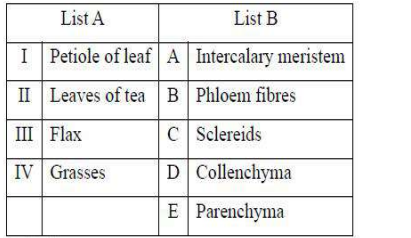
Question 15:

Match the following:

  • (1) I-E, II-B, III-C, IV-A
  • (2) I-E, II-C, III-B, IV-A
  • (3) I-D, II-C, III-B, IV-A
  • (4) I-D, II-B, III-C, IV-E
Correct Answer: (3) I-D, II-C, III-B, IV-A
View Solution

Question 16:

Identify the Anatomical structures based on these following characters given in a series:
Lysigenous cavities in the vascular bundles
Conjoint, open and endarch protoxylem in vascular bundles
More number of stomata in abaxial epidermis

  • (A) Monocot stem, Dicot stem, Dicot Leaf
  • (B) Monocot root, Dicot root, Dicot Leaf
  • (C) Monocot Leaf, Dicot Leaf, Dicot stem
  • (D) Monocot stem, Dicot root, Monocot Leaf
Correct Answer: (1) Monocot stem, Dicot stem, Dicot Leaf
View Solution

Question 17:

Match the following:

  • (1) I-D, II-A, III-B, IV-C
  • (2) I-D, II-E, III-D, IV-C
  • (3) I-D, II-B, III-E, IV-C
  • (4) I-D, II-C, III-B, IV-E
Correct Answer: (1) I-D, II-A, III-B, IV-C
View Solution

Question 18:

Assertion [A]: The species that invade a bare area are pioneer species

Reason [R]: In primary succession, lichens or Phytoplanktons invade rocks and water respectively

  • (A) A and R are correct. R is the correct explanation of A
  • (B) A and R are correct. R is not the correct explanation of A
  • (C) A is correct but R is incorrect
  • (D) A is incorrect but R is correct
Correct Answer: (1) A and R are correct. R is the correct explanation of A
View Solution

Question 19:

Study the comparison of different transport mechanisms to pick out the correct pair in the following format:

  • (1)
  • (2)
  • (3)
  • (4)
Correct Answer: (2)
View Solution

Question 20:

Correct equation of water potential of a cell:

  • (1) \( \Psi_w = \Psi_p + \Psi_{mp} \)
  • (2) \( \Psi_w = \Psi_s - \Psi_p \)
  • (3) \( \Psi_w = \Psi_s + \Psi_p \)
  • (4) \( \Psi_w = \Psi_s + \Psi_{mp} \)
Correct Answer: (3) \( \Psi_w = \Psi_s + \Psi_p \)
View Solution

Question 21:

Essential elements like Nitrogen, Phosphorus, Potassium are supplied to plants growing in soil through:

  • (1) Irrigation
  • (2) Root exudates
  • (3) Fertilizers
  • (4) Atmospheric deposition
Correct Answer: (3) Fertilizers
View Solution

Question 22:

The element which is important in determining solute concentration and oxygen evolution:

  • (1) Zinc
  • (2) Boron
  • (3) Nickel
  • (4) Chlorine
Correct Answer: (4) Chlorine
View Solution

Question 23:

Identify enzyme "X" in the reaction \( CO_2 + H_2O \xrightarrow{X} H_2CO_3 \):

  • (1) Carbonic kinase
  • (2) Carbonic anhydrase
  • (3) Carbonic peroxidase
  • (4) Carbonic catase
Correct Answer: (2) Carbonic anhydrase
View Solution

Question 24:

In the Calvin cycle, the ratio of trioses formed, net gain, and used to regenerate RUBP is:

  • (1) 2 : 3 : 2
  • (2) 10 : 2 : 6
  • (3) 6 : 1 : 5
  • (4) 5 : 1 : 6
Correct Answer: (3) 6 : 1 : 5
View Solution

Question 25:

Identify A, B, and C in the given Hatch and Slack pathway diagram:


  • (1) A – Fixation, B – Regeneration, C – Decarboxylation
  • (2) A – Regeneration, B – Fixation, C – Decarboxylation
  • (3) A – Decarboxylation, B – Regeneration, C – Fixation
  • (4) A – Fixation, B – Decarboxylation, C – Regeneration
Correct Answer: (4) A – Fixation, B – Decarboxylation, C – Regeneration
View Solution

Question 26:

Ratio of ATP:NADH:FADH2 produced in Krebs' cycle per one acetyl Co-A molecule by substrate level phosphorylation is:

  • (1) 2 : 3 : 2
  • (2) 1 : 9 : 2
  • (3) 2 : 9 : 2
  • (4) 2 : 2 : 9
Correct Answer: (2) 1 : 9 : 2
View Solution

Question 27:

In plants, growth rate is expressed in Arithmetic and Geometric growth equations. Which equation is correct?

  • (1) \(L_0 = W_1 e^{rt}\)
  • (2) \(W_1 = W_0 e^{rt}\)
  • (3) \(W_0 = W_1 e^{rt}\)
  • (4) \(W_0 = L_0 + e^{rt}\)
Correct Answer: (2) \(W_1 = W_0 e^{rt}\)
View Solution

Question 28:

Assertion (A): Nitrosomonas is a Chemoautotrophic bacteria.

Reason (R): Chemoautotrophs derive energy from sunlight and carbon from CO\(_2\).

  • (1) A and R are Correct and R is the Correct explanation of A
  • (2) A and R are Correct and R is not the Correct explanation of A
  • (3) A is Correct but R is incorrect
  • (4) A is incorrect but R is correct
Correct Answer: (3) A is Correct but R is incorrect
View Solution

Question 29:

The genetic nature of TMV (Tobacco Mosaic Virus) as RNA was confirmed by:

  • (1) Stanley
  • (2) Beijerinck
  • (3) Frankel Conrot
  • (4) Iwanowski
Correct Answer: (3) Frankel Conrot
View Solution

Question 30:

Choose the correct pair from the following:

  • (1) I, III
  • (2) II, IV
  • (3) I, II
  • (4) III, IV
Correct Answer: (1) I, III
View Solution

Question 31:

The number of recombinants in the 1280 progeny obtained through a dihybrid cross of Mendel in the F\textsubscript{2} generation.

  • (1) 240
  • (2) 360
  • (3) 720
  • (4) 480
Correct Answer: (4) 480.
View Solution

Question 32:

Diagram represents central dogma of molecular biology. Choose the correct labelling of "X" and "Y":

  • (1) Translation and Transcription
  • (2) Translocation and Transcription
  • (3) Transcription and Translation
  • (4) Transcription and Replication
Correct Answer: (4) Transcription and Replication
View Solution

Question 33:

Identify A and B in the diagram given below:

  • (1) Valine and Lysine
  • (2) Serine and Glycine
  • (3) Serine and Tyrosine
  • (4) Proline and Serine
Correct Answer: (3) Serine and Tyrosine
View Solution

Question 34:

Assertion (A): Primers are used in polymerase chain reaction technique. Reason (R): Primers is used for the addition of new DNA nucleotides.

  • (1) A and R are correct. R is the correct explanation of A
  • (2) A and R are correct. R is not the correct explanation of A
  • (3) A is correct but R is incorrect
  • (4) A is incorrect but R is correct
Correct Answer: (3) A is correct but R is incorrect
View Solution

Question 35:

Arrange the following in correct order in polymerase chain reaction cycle:

I Deannealing

II Denaturation

III Extension

IV Annealing

  • (1) II - III - IV
  • (2) I - II - III
  • (3) I - III - IV
  • (4) II - IV - III
Correct Answer: (4) II - IV - III
View Solution

Question 36:

Identify the wrong statement from the following:

  • (1) Bt. Cotton shows resistance to viruses.
  • (2) Transgenic Potato shows resistance to Phytophthora.
  • (3) Transgenic Papaya shows resistance to Ring Spot Virus.
  • (4) Transgenic Tomato shows resistance to Pseudomonas.
Correct Answer: (2) Transgenic Potato shows resistance to \textit{Phytophthora}.
View Solution

Question 37:

Bacteria used to produce human insulin chains is:

  • (1) S. typhimurium
  • (2) E. coli
  • (3) A. tumefaciens
  • (4) B. thuringiensis
Correct Answer: (2) E. coli
View Solution

Question 38:

Identify the correct pair of variety crop developed for resistance to the disease:

  • (1) Pusa Komal - Bacterial blight
  • (2) Pusa Sadabahar - White rust
  • (3) Pusa Swarnim - Tobacco mosaic virus
  • (4) Pusa Subhra - Chilly mosaic virus
Correct Answer: (1) Pusa Komal - Bacterial blight
View Solution

Question 39:

Assertion (A): By mutations genetic variations are created resulting in a new trait not found in the parental type.

Reason (R): Plants having desirable characters will be selected after inducing mutations with chemicals or radiation.

  • (1) A and R are correct. R is the correct explanation of A
  • (2) A and R are correct. R is not the correct explanation of A
  • (3) A is correct but R is incorrect
  • (4) A is incorrect but R is correct
Correct Answer: (1) A and R are correct. R is the correct explanation of A
View Solution

Question 40:

Match the following:

  • (1) I-D, II-A, III-B, IV-C
  • (2) I-C, II-D, III-B, IV-A
  • (3) I-D, II-C, III-B, IV-A
  • (4) I-D, II-C, III-A, IV-B
Correct Answer: (3) I-D, II-C, III-B, IV-A.
View Solution

Question 41:

The term Organic Evolution was coined by:

  • (1) Charles Darwin
  • (2) Lamarck
  • (3) Herbert Spencer
  • (4) Linnaeus
Correct Answer: (3) Herbert Spencer
View Solution

Question 42:

It is the measure of the overall diversity for different ecosystems within an ecological region.

  • (1) Gamma Diversity
  • (2) Beta Diversity
  • (3) Alpha Diversity
  • (4) Delta Diversity
Correct Answer: (1) Gamma Diversity
View Solution

Question 43:

Assertion (A): Circulatory system of arthropods and molluscs is mainly open type. Reason (R): Blood pumped out by the heart is circulated through a series of blood vessels in them.

  • (1) Both A and R are true. R is the correct explanation for A
  • (2) Both A and R are true. But R is not the correct explanation for A
  • (3) A is true. But R is false
  • (4) A is incorrect but R is true
Correct Answer: (3) A is true. But R is false
View Solution

Question 44:

Pick up the correct answer regarding the enterocoelomates.

  • (1) Enterocoelomates are deuterostomes and they show radial and indeterminate cleavages
  • (2) All enterocoelomates are protostomes and they exhibit radial and indeterminate cleavages
  • (3) All enterocoelomates are deuterostomes and they exhibit spiral and indeterminate cleavages
  • (4) All enterocoelomates are deuterostomes and they exhibit spiral and determinate cleavages
Correct Answer: (1) Enterocoelomates are deuterostomes and they show radial and indeterminate cleavages
View Solution

Question 45:

Match the following:

  • (1) A-IV, B-III, C-II, D-I
  • (2) A-V, B-I, C-IV, D-II
  • (3) A-V, B-I, C-III, D-II
  • (4) A-II, B-IV, C-I, D-V
Correct Answer: (2) A-V, B-I, C-IV, D-II.
View Solution

Question 46:

Statement I: Crystalline style present in stomach of pelecypods help in digestion of starches.

Statement II: Larva of sea cucumbers is auricularia.

  • (1) Both statements I and II are correct
  • (2) Both statements I and II are false
  • (3) Statement I is true. But II is false
  • (4) Statement I is false. But II is true
Correct Answer: (1) Both statements I and II are correct
View Solution

Question 47:

Study the following and pick the correct combinations:

  • (1) II, II
  • (2) III, IV
  • (3) I, IV
  • (4) II, III
Correct Answer: (4) II, III.
View Solution

Question 48:

Hatchlings are precocial in:

  • (1) Struthio, Rhea and Dromaeus
  • (2) Psittacula, Columba and Struthio
  • (3) Rhea, Aptenodytes and Corvus
  • (4) Coracias, Dromaeus and Struthio
Correct Answer: (1) Struthio, Rhea and Dromaeus
View Solution

Question 49:

Match the following:

  • (1) A-II, B-IV, C-V, D-III
  • (2) A-II, B-IV, C-I, D-III
  • (3) A-V, B-IV, C-III, D-I
  • (4) A-III, B-I, C-IV, D-II
Correct Answer: (2) A-II, B-IV, C-I, D-III.
View Solution

Question 50:

Study the following and pick up the correct statements:


I. As the binary fission in Paramecium occurs parallel to longitudinal axis of the body, it is called homotheogenic fission.

II. As the daughter Paramecia formed after binary fission are like mirror images, the fission is called symmetrogenic fission.

III. Multiple fission in Amoeba is called sporulation.

IV. Union of pronuclei of the gametes is called amphimixis.

  • (1) I, II
  • (2) II, III
  • (3) III, IV
  • (4) I, III
Correct Answer: (3) III, IV
View Solution

Question 51:

Pseudopodia in Actinophrys are of this type:

  • (1) Lobopodia
  • (2) Filopodia
  • (3) Reticulopodia
  • (4) Helioipodia
Correct Answer: (4) Helioipodia
View Solution

Question 52:

Assertion (A): Nosima is a hyperparasite.

Reason (R): It lives in the body of another parasite.

  • (1) A and R are true. R is correct explanation for A
  • (2) A and R are true. But R is not correct explanation for A
  • (3) A is true. But R is false
  • (4) A is false. But R is true
Correct Answer: (1) A and R are true. R is the correct explanation for A
View Solution

Question 53:

Match the following:

  • (1) A-II, B-IV, C-III, D-V
  • (2) A-II, B-IV, C-I, D-V
  • (3) A-V, B-I, C-IV, D-II
  • (4) A-IV, B-V, C-I, D-III
Correct Answer: (2) A-II, B-IV, C-I, D-V.
View Solution

Question 54:

In these days, some sports people misuse these drugs.

  • (1) Opioids
  • (2) Cannabinoids
  • (3) Coca alkaloids
  • (4) Snack
Correct Answer: (2) Cannabinoids
View Solution

Question 55:

Chemoreceptors in Periplaneta are of this type:

  • (1) Ommatidia
  • (2) Sensillae
  • (3) Scolopidia
  • (4) Tympanal organs
Correct Answer: (2) Sensillae
View Solution

Question 56:

Location of Malpighian tubules in Periplaneta:

  • (1) Foregut - Hindgut
  • (2) Midgut - Foregut
  • (3) Hindgut - Midgut
  • (4) Stomodeum - Proctodeum
Correct Answer: (3) Hindgut - Midgut
View Solution

Question 57:

Wave length of UV-A Rays:

  • (1) 50 nm – 100 nm
  • (2) 100 nm – 280 nm
  • (3) 280 nm – 320 nm
  • (4) 320 nm – 380 nm
Correct Answer: (4) 320 nm – 380 nm
View Solution

Question 58:

Identify the incorrect statement:

  • (1) Both the species are benefitted in mutualism
  • (2) Both species are not benefitted in parasitism
  • (3) Both species get harm in competition
  • (4) One species is benefitted and the other is neither benefitted nor harmed in commensalism
Correct Answer: (2) Both species are not benefitted in parasitism
View Solution

Question 59:

Match the following:

  • (1) A-IV, B-I, C-II, D-II
  • (2) A-I, B-I, C-III, D-II
  • (3) A-II, B-III, C-IV, D-I
  • (4) A-II, B-IV, C-III, D-I
Correct Answer: (1) A-IV, B-I, C-II, D-II.
View Solution

Question 60:

An infant is suffering from indigestion. The enzyme lacking is:

  • (1) Amylase
  • (2) Rennin
  • (3) Trypsin
  • (4) Lipase
Correct Answer: (2) Rennin
View Solution

Question 61:

Inspiratory capacity is:

  • (1) TV + IRV + ERV
  • (2) TV + IRV
  • (3) VC + RV
  • (4) ERV + RV
Correct Answer: (2) TV + IRV
View Solution

Question 62:

Which one of the following is a highly toxic nitrogenous substance?

  • (1) Ammonia
  • (2) Urea
  • (3) Uric acid
  • (4) Hippuric acid
Correct Answer: (1) Ammonia
View Solution

Question 63:

Identify the incorrect statement in relation to coronary artery disease (CAD):

  • (1) Accumulation of calcium, fat, cholesterol in coronary artery
  • (2) Death of myocardial cells
  • (3) Associated with smoking
  • (4) Angina pectoris is a warning signal
Correct Answer: (4) Angina pectoris is a warning signal
View Solution

Question 64:

In skeletal muscle, the central part of the dark band without the thin filaments is called:

  • (1) Z line
  • (2) Sarcomere
  • (3) Hensen’s disc
  • (4) Krause’s membrane
Correct Answer: (3) Hensen’s disc
View Solution

Question 65:

Organ of Corti is located on the:

  • (1) Tectorial membrane
  • (2) Basilar membrane
  • (3) Reissner's membrane
  • (4) Tympanic membrane
Correct Answer: (2) Basilar membrane
View Solution

Question 66:

Match the following:

  • (1) A-III, B-IV, C-II, D-I
  • (2) A-III, B-IV, C-I, D-II
  • (3) A-IV, B-III, C-I, D-II
  • (4) A-I, B-II, C-III, D-IV
Correct Answer: (1) A-III, B-IV, C-II, D-I.
View Solution

Question 67:

Hormone that maintains the normal rhythms of the sleep-wake cycle.

  • (1) Adrenaline
  • (2) Cortisol
  • (3) Melatonin
  • (4) Thyroxine
Correct Answer: (3) Melatonin
View Solution

Question 68:

Hormone that stimulates the reabsorption of calcium ions by renal tubules and increases the absorption of Ca\(^{2+}\) from the gut.

  • (1) Parathormone
  • (2) Renin
  • (3) Angiotensin
  • (4) Vasopressin
Correct Answer: (1) Parathormone
View Solution

Question 69:

These are involved in cell mediated immunity.

  • (1) T-cells
  • (2) B-cells
  • (3) Interferons
  • (4) Interleukins
Correct Answer: (1) T-cells
View Solution

Question 70:

The term 'yellow body' refers to.

  • (1) Corpus luteum
  • (2) Corpus albicans
  • (3) Graffian follicle
  • (4) Trophoblast
Correct Answer: (1) Corpus luteum
View Solution

Question 71:

Human chorionic gonadotropic hormone resembles this hormone in its function:

  • (1) Oxytocin
  • (2) Vasopressin
  • (3) Somatotropin
  • (4) Luteinizing hormone
Correct Answer: (4) Luteinizing hormone
View Solution

Question 72:

Trichomoniasis is caused by:

  • (1) Bacteria
  • (2) Fungus
  • (3) Protozoan
  • (4) Virus
Correct Answer: (3) Protozoan
View Solution

Question 73:

Identify the incorrect statements regarding blood groups:
(1) The mother with Rh\(^{-}\) blood group develops passive immunity on administering IgM antibodies.

(2) Isoagglutinogens are sugar polymers bound to fatty acids on the RBC membrane.

(3) The alleles for Rh factor are located on three different loci on chromosome pair 9.

(4) The expression of ABO blood types in man is by three alleles of a single gene.

  • (2) I, II
  • (3) I, III
  • (4) II, III
Correct Answer: (3) I, III
View Solution

Question 74:

Assertion: The male ants are developed by parthenogenesis from unfertilized eggs.
Reason: The sex of offspring depends on the type of sperm that fertilizes the ovum, which is not relevant since male ants develop through haploid parthenogenesis, which does not involve fertilization.

  • (1) A and R are true. R is correct explanation for A
  • (2) A and R are true. But R is not correct explanation for A
  • (3) A is true. But R is false
  • (4) A is false. But R is true
Correct Answer: (2) A and R are true. But R is not correct explanation for A
View Solution

Question 75:

Identify correct statements regarding the Human Genome Project:
I. The method of DNA sequencing was developed by Jeffreys.

II. Identification of genes that express as RNA is referred to as Expressed Sequence Annotation.

III. About 1.4 million locations where single base DNA differences occur in humans.

IV. Y-chromosome has 231 genes.

  • (1) I, III
  • (2) II, IV
  • (3) III, IV
  • (4) II, III
Correct Answer: (3) III, IV
View Solution

Question 76:


(1) A-IV, B-I, C-II, D-II
(2) A-III, B-I, C-IV, D-II
(3) A-III, B-IV, C-II, D-I
(4) A-I, B-III, C-IV, D-II

Correct Answer: (3) A-III, B-IV, C-II, D-I
View Solution

Question 77:

Consider the following statements about prokaryotic and eukaryotic cells:

Statement I: Some prokaryotes evolved into mitochondria and plastids in the bodies of ancestral eukaryotes.

Statement II: The endomembrane system of eukaryotes might have evolved by infolding of the plasma membrane.

Which of the following is correct?

  • (1) Both the statements I and II are true.
  • (2) Both the statements I and II are false.
  • (3) Statement I is true, but II is false.
  • (4) Statement I is false, but II is true.
Correct Answer: (1) Both the statements I and II are true.
View Solution

Question 78:

  • (1) A-III, B-IV, C-I, D-V
  • (2) A-II, B-IV, C-V, D-I
  • (3) A-III, B-V, C-I, D-II
  • (4) A-III, B-IV, C-I, D-II
    \textbf{Correct Answer:} (3) A-III, B-V, C-I, D-II
Correct Answer: (3) A-III, B-V, C-I, D-II
View Solution

Directional selection (A-III): A type of natural selection where an advantageous trait (e.g., DDT resistance in mosquitoes) becomes more common over time.

Genetic load (B-V): The accumulation of harmful mutations can lead to genetic disorders like sickle cell anaemia.

Bottleneck effect (C-I): A sudden reduction in population size causes genetic drift, leading to traits like polydactyly in dwarfs.

Centrifugal selection (D-II): Occurs when multiple advantageous traits are selected, as seen in Darwin’s finches adapting to different environments. Quick Tip: Natural selection can take different forms—directional selection favors one extreme trait, while genetic drift and bottleneck effects lead to random changes in allele frequencies.


Question 79:

Choose the correct statements among the following:

I. Bird flu is a fungal disease affecting poultry.

II. Propolis is bee glue used to seal the cracks in the honeycomb.

III. The world's livestock population in India and China together is more than 70%, but their contribution to world's farm produce is 25%.

IV. Inactivated whole agent vaccine acts against typhoid.

Which combination of statements is correct?

  • (1) I, III
  • (2) II, IV
  • (3) II, III
  • (4) I, IV
Correct Answer: (3) II, III
View Solution

Question 80:

  • (1) A-III, B-IV, C-II, D-I
  • (2) A-III, B-IV, C-I, D-II
  • (3) A-II, B-IV, C-I, D-III
  • (4) A-III, B-I, C-IV, D-II
    \textbf{Correct Answer:} (4) A-III, B-I, C-IV, D-II
Correct Answer: (4) A-III, B-I, C-IV, D-II
View Solution

Indian Veterinary Research Institute (A-III): Specializes in research related to poultry vaccines and veterinary science.

Breeding centre at Salon (B-I): Known for its top-quality frozen semen storage to improve livestock breeding.

Eli Lilly (C-IV): A pharmaceutical company that played a key role in Humulin production (human insulin).

Central Drug Research Institute (D-II): Contributed to the development of Saheli, a non-steroidal oral contraceptive pill. Quick Tip: Biotechnology has significantly advanced veterinary science, pharmaceutical research, and livestock breeding, contributing to health and agriculture sectors.


Question 81:

If the work done \(W\), length \(L\) and time \(T\) are considered as the fundamental quantities, the dimensional formula for mass is:

  • (1) \([W^1L^{-2}T^{-2}]\)
  • (2) \([W^{-1}L^2T^2]\)
  • (3) \([W^1L^2T^{-2}]\)
  • (4) \([W^{-1} L^{-2} T^{-2}]\)
Correct Answer: (1) \([W^1L^{-2}T^{-2}]\)
View Solution

Question 82:

A body falling freely under gravity from rest from a certain height reaches the ground in \(5\) seconds. The distance travelled by the body in the last two seconds of its motion is:

  • (1) \(98 \, m\)
  • (2) \(44.1 \, m\)
  • (3) \(58.8 \, m\)
  • (4) \(78.4 \, m\)
Correct Answer: (4) \(78.4 \, \text{m}\)
View Solution

Question 83:

A body is thrown with a velocity \( (5\hat{i} + 6\hat{j}) \, m/s \). Its maximum height is (given that acceleration due to gravity = \(10 \, m/s^{-2}\)):

  • (1) \(12.5 \, m\)
  • (2) \(1.8 \, m\)
  • (3) \(1.25 \, m\)
  • (4) \(0.9 \, m\)
Correct Answer: (2) \(1.8 \, \text{m}\)
View Solution

Question 84:

The motion of a particle is given by \(X = a \cos t\), \(Y = a \sin t\) and \(Z = t\). The trajectory traced by the particle as a function of time is:

  • (1) Helix
  • (2) Circular
  • (3) Elliptical
  • (4) Straight line
Correct Answer: (1) Helix
View Solution

Question 85:

A block of mass \(m\) is placed in equilibrium on a moving horizontal plank. The maximum horizontal acceleration of the plank for \(\mu = 0.2\) is (Acceleration due to gravity = \(10 \, ms^{-2}\)).

  • (1) 2 ms\(^{-2}\)
  • (2) 3 ms\(^{-2}\)
  • (3) 4 ms\(^{-2}\)
  • (4) 5 ms\(^{-2}\)
Correct Answer: (1) 2 ms\(^{-2}\)
View Solution

Question 86:

A body of mass \(2 \, kg\) is placed on a smooth horizontal surface. Two forces \(F_1 = 20 \, N\) and \(F_2 = 10\sqrt{3} \, N\) are acting on the body in the directions making angles of \(30^\circ\) and \(60^\circ\) to the surface. The reaction of the surface on the body is:

  • (1) \(20 \, N\)
  • (2) \(25 \, N\)
  • (3) \(5 \, N\)
  • (4) Zero
Correct Answer: Zero
View Solution

Question 87:

A running man has half the kinetic energy of a boy of half his mass. The man speeds up by \(1 \, m/s^{-1}\) to have the same kinetic energy as the boy. The initial speed of the man is:

  • (1) \(\sqrt{2} \, m/s^{-1}\)
  • (2) \((\sqrt{2} - 1) \, m/s^{-1}\)
  • (3) \(\frac{1}{(\sqrt{2} - 1)} \, m/s^{-1}\)
  • (4) \(\frac{1}{\sqrt{2}} \, m/s^{-1}\)
Correct Answer: (3) \(\frac{1}{(\sqrt{2} - 1)} \, \text{m/s}^{-1}\)
View Solution

Question 88:

In a hydroelectric power station, the water is flowing at \(2 \, ms^{-1}\) in the river which is \(100 \, m\) wide and \(5 \, m\) deep. The maximum power output from the river is:

  • (1) \(1.5 \, MW\)
  • (2) \(2 \, MW\)
  • (3) \(2.5 \, MW\)
  • (4) \(3 \, MW\)
Correct Answer: (2) \(2 \, \text{MW}\)
View Solution

Question 89:

Three point masses \(m_1, m_2, m_3\) are located at the vertices of an equilateral triangle of side 'a'. The moment of inertia of the system about an axis along the altitude of the triangle passing through \(m_1\) is:

  • (1) \((m_2 + m_3)a^2\)
  • (2) \((m_1 + m_2 + m_3)a^2\)
  • (3) \((m_2 + m_3)\frac{a^2}{9}\)
  • (4) \((m_2 + m_3)\frac{a^2}{4}\)
Correct Answer: (4) \((m_2 + m_3)\frac{a^2}{4}\)
View Solution

Question 90:

A cockroach of mass \( m \) is moving with a velocity \( v \) in the anticlockwise direction on the rim of a disc of radius \( R \). The moment of inertia of the disc about the axis is \( I \) and it is rotating in a clockwise direction with an angular velocity \( \omega \). If the cockroach stops moving, the angular velocity of the disc will be:

  • (1) \(\frac{I\omega + mR^2}{I + mR^2}\)
  • (2) \(\frac{I\omega + mRv}{I + mR^2}\)
  • (3) \(\frac{I\omega - mRv}{I + mR^2}\)
  • (4) \(\frac{I\omega - mRv}{I}\)
Correct Answer: (3) \(\frac{I\omega - mRv}{I + mR^2}\)
View Solution

Question 91:

The displacement of a particle executing SHM is given by \( X = 0.01 \sin 100\pi (t + 0.05) \). The time period of the particle is:

  • (1) \(0.1 \, s\)
  • (2) \(0.01 \, s\)
  • (3) \(0.2 \, s\)
  • (4) \(0.02 \, s\)
Correct Answer: (4) \(0.02 \, \text{s}\)
View Solution

Question 92:

The vertical extension in a light spring by a weight of 1 kg suspended from the lower end is 9.8 cm. The time period of oscillation of the spring is:

  • (1) \(10\pi \, s\)
  • (2) \(\frac{\pi}{5} \, s\)
  • (3) \(\frac{5\pi}{8} \, s\)
  • (4) \(\frac{\pi}{10} \, s\)
Correct Answer: (2) \(\frac{\pi}{5} \, \text{s}\)
View Solution

Question 93:

An unknown gas in which each molecule has mass \(0.69 \times 10^{-26} \, kg\) escaped from a planet at a temperature \(T\). The radius of the planet is \(18 \times 10^5 \, m\), acceleration due to gravity is \(10 \, ms^{-2}\), and Boltzmann constant is \(1.38 \times 10^{-23} \, J/K^{-1}\). The temperature \(T\) is:

  • (1) \(4.5 \times 10^3 \, K\)
  • (2) \(4.8 \times 10^3 \, K\)
  • (3) \(5.4 \times 10^3 \, K\)
  • (4) \(6 \times 10^3 \, K\)
Correct Answer: (4) \(6 \times 10^3 \, \text{K}\)
View Solution

Question 94:

When a tension of \(F_1\) is applied on a metal wire its length is \(L_1\), if the tension is \(F_2\), length becomes \(L_2\). Then the original length of the wire is:

  • (1) 2\( \frac{F_2 - F_1}{F_1 + F_2}L_2 \)
  • (2) \( \frac{F_2 L_1 - F_1 L_2}{F_2 - F_1} \)
  • (3) \( F_1 L_1 - F_2 L_2 \)
  • (4) \( (F_1 - F_2) L_2 \)
Correct Answer: (2) \( \frac{F_2 L_1 - F_1 L_2}{F_2 - F_1} \)
View Solution

Question 95:

Two soap bubbles of radii \(R_1\) and \(R_2\) are kept in vacuum at constant temperature, the ratio of masses of air inside them are:

  • (1) \( \frac{m_1}{m_2} = \frac{R_1}{R_2} \)
  • (2) \( \frac{m_1}{m_2} = \frac{R_2}{R_1} \)
  • (3) \( \frac{m_1}{m_2} = \frac{R_2^2}{R_1^2} \)
  • (4) \( \frac{m_1}{m_2} = \frac{R_1^2}{R_2^2} \)
Correct Answer: (4) \( \frac{m_1}{m_2} = \frac{R_1^2}{R_2^2} \)
View Solution

Question 96:

The rate of emission of radiation of a black body at 27°C is \(E_1\). If the temperature increased to 327°C the emission is \(E_2\), then \(E_2\) is:

  • (1) \(4 E_1\)
  • (2) \(8 E_1\)
  • (3) \(16 E_1\)
  • (4) \(24 E_1\)
Correct Answer: (3) \(16 E_1\)
View Solution

Question 97:

Two samples of same gas (\(\gamma = \frac{3}{2}\)) have equal volume. If their volumes are doubled by adiabatic and isothermal processes respectively for sample 1 and 2. Their final pressures are now equal. The ratio of initial pressures is:

  • (1) \(\sqrt{2}\)
  • (2) \(\frac{1}{\sqrt{2}}\)
  • (3) \(\frac{3}{\sqrt{2}}\)
  • (4) \(\frac{\sqrt{2}}{3}\)
Correct Answer: (1) \(\sqrt{2}\)
View Solution

Question 98:

A gas is initially at a state of \( (P_0, V_0, T_0) \). If \( W_1 \) is work done in isobaric expansion to volume \( V \) and \( W_2 \) is the work done in isothermal expansion to volume \( V \), then:

  • (1) \( W_1 = W_2 \)
  • (2) \( W_1 < W_2 \)
  • (3) \( W_1 > W_2 \)
  • (4) \( W_1 - W_2 = R \)
Correct Answer: (3) \( W_1 > W_2 \)
View Solution

Question 99:

Heat is supplied at constant pressure to a diatomic gas. The part of this heat that was utilized to increase its internal energy is:

  • (1) \( \frac{4}{5} \)
  • (2) \( \frac{5}{7} \)
  • (3) \( \frac{3}{5} \)
  • (4) \( \frac{5}{6} \)
Correct Answer: (2) \( \frac{5}{7} \)
View Solution

Question 100:

Two ideal gases at absolute temperature \(T_1\) and \(T_2\) are mixed. In this process there is no loss of energy. If the molecular masses are \(m_1\) and \(m_2\), and mole number of the gases are \(n_1\) and \(n_2\), then the final temperature of the mixture is:

  • (1) \( \frac{n_1T_1 + n_2T_2}{n_1 + n_2} \)
  • (2) \( \frac{m_1T_1 + m_2T_2}{n_1 + n_2} \)
  • (3) \( \frac{n_1T_1 + n_2T_2}{m_1 + m_2} \)
  • (4) \( T = \sqrt{T_1 + T_2} \)
Correct Answer: (1) \( \frac{n_1T_1 + n_2T_2}{n_1 + n_2} \)
View Solution

Question 101:

Two vibrating strings of same length, same cross-sectional area and stretched to same tension are made of material with densities \(\rho\) and \(2\rho\). Each string is fixed at both ends. If \(V_1\) and \(V_2\) are speeds of transverse waves in the strings with densities \(\rho\) and \(2\rho\) respectively, then \(\frac{V_1}{V_2}\) is:

  • (1) \(1:2\)
  • (2) \(2:1\)
  • (3) \(\sqrt{2}:1\)
  • (4) \(1:\sqrt{2}\)
Correct Answer: (3) \(\sqrt{2}:1\)
View Solution

Question 102:

If a ray of light takes \(t_1\) and \(t_2\) times in two media of absolute refractive indices \(\mu_1\) and \(\mu_2\) respectively to travel same distance, then the relation between the times and refractive indices is:

  • (1) \(\mu_1 t_1 = \mu_2 t_2\)
  • (2) \(\mu_1 t_2 = \mu_2 t_1\)
  • (3) \(t_1 \sqrt{\mu_1} = t_2 \sqrt{\mu_2}\)
  • (4) \(\sqrt{\mu_1} t_1 = \sqrt{\mu_2} t_2\)
Correct Answer: (2) \(\mu_1 t_2 = \mu_2 t_1\)
View Solution

Question 103:

If \(m_1\) and \(m_2\) (\(m_1 \geq m_2\)) are the magnification for two positions of the lens between the object and the screen, and \(d\) is the distance between the two positions of the lens, the focal length of the lens is:

  • (1) \(\frac{m_1 - m_2}{d}\)
  • (2) \(\frac{m_1 m_2}{d}\)
  • (3) \((m_1 - m_2)d\)
  • (4) \(\frac{d}{m_1 - m_2}\)
Correct Answer: (4) \(\frac{d}{m_1 - m_2}\)
View Solution

Question 104:

A particle of mass 'm' having charge '(-q)' moves in a circular orbit of radius 'r' around a fixed charge '(+Q)'. The relation between time period \(T\) and radius of the orbit 'r' is:

  • (1) \(r^2 = \frac{Qq}{4\pi \epsilon_0 m T^3}\)
  • (2) \(r^3 = \frac{Qq}{16\pi^3 \epsilon_0 m T^2}\)
  • (3) \(r^3 = \frac{Qq}{16\pi^3 \epsilon_0 m T}\)
  • (4) \(r = \frac{Qq}{16\pi^2 m \epsilon_0 T^2}\)
Correct Answer: (2) \(r^3 = \frac{Qq}{16\pi^3 \epsilon_0 m T^2}\)
View Solution

Question 105:

Electric field intensity and electric potential at a point due to a point charge are 600 V/m and -3600 V respectively. The distance of the point from the charge and the magnitude of the charge are:

  • (1) \(7 \, m, 3 \, \muC\)
  • (2) \(8 \, m, 4 \, \muC\)
  • (3) \(6 \, m, 2.4 \, \muC\)
  • (4) \(4 \, m, 6 \, \muC\)
Correct Answer: (3) \(6 \, \text{m}, 2.4 \, \mu\text{C}\)
View Solution

Question 106:

A parallel plate capacitor has two square plates of side 5 cm separated by 15 mm. A Pyrex glass slab of dielectric constant \(K = 4.5\) and thickness 10 mm is placed between the plates. The capacitance of the capacitor is:

  • (1) \(3.11 \times 10^{-12} \, F\)
  • (2) \(311 \, \muF\)
  • (3) \(311 \, pF\)
  • (4) \(3.11 \, nF\)
Correct Answer: (1) \(3.11 \times 10^{-12} \, \text{F}\)
View Solution

Question 107:

The Wheatstone bridge is balanced when \(R_3 = 144 \, \Omega\). If \(R_2\) and \(R_1\) are interchanged, the bridge balances for \(R_3 = 169 \, \Omega\). The value of \(R_4\) is:

  • (1) \(136 \, \Omega\)
  • (2) \(152 \, \Omega\)
  • (3) \(146 \, \Omega\)
  • (4) \(156 \, \Omega\)
Correct Answer: (4) \(156 \, \Omega\)
View Solution

Question 108:

Four identical cells, each with internal resistance 1 \(\Omega\) and emf 10 V are connected in series to a resistance R and they are connected in parallel and then to an external resistance R in series. For what value of R the current in series and in parallel combination is the same?

  • (1) \(1 \, \Omega\)
  • (2) \(4 \, \Omega\)
  • (3) \(2 \, \Omega\)
  • (4) \(6 \, \Omega\)
Correct Answer: (1) \(1 \, \Omega\)
View Solution

Question 109:

A coil of two turns is made of a wire length L and another coil of four turns is made from same length L. When the same current is flowing in two coils, then the ratio of magnetic inductions at their centres is:

  • (1) \(8:1\)
  • (2) \(1:4\)
  • (3) \(9:1\)
  • (4) \(2:7\)
Correct Answer: (2) \(1:4\)
View Solution

Question 110:

A wire of 60 cm length and mass 10 g is suspended by a pair of flexible leads in a magnetic field of 0.60 T as shown in the figure. The magnitude of the current required to remove the tension in the supporting leads is:

  • (1) \(0.47 \, A\)
  • (2) \(0.17 \, A\)
  • (3) \(0.27 \, A\)
  • (4) \(0.32 \, A\)
Correct Answer: (3) \(0.27 \, \text{A}\)
View Solution

Question 111:

A bar magnet of moment \(0.4 \times 10^{-3} \, Am^2\) is kept in a magnetic field of \(2\pi \times 10^{-3} \, T\). The magnet makes an angle of \(45^\circ\) with the direction of magnetic field. The torque acting on the magnet is:

  • (1) \(7.65 \pi \times 10^{-7} \, Nm\)
  • (2) \(6.55 \pi \times 10^{-4} \, Nm\)
  • (3) \(5.65 \times 10^{-2} \, Nm\)
  • (4) \(5.65 \times 10^{-7} \, Nm\)
Correct Answer: (4) \(5.65 \times 10^{-7} \, \text{Nm}\)
View Solution

Question 112:

Eddy currents are produced when

  • (1) Large piece of conductors are placed in changing magnetic flux
  • (2) Large piece of conductors are placed in constant magnetic flux
  • (3) A circular coil is placed in a magnetic field
  • (4) Current should be passed through circular coil
Correct Answer: (1) Large piece of conductors are placed in changing magnetic flux
View Solution

Question 113:

In the given LCR series circuit the quality factor is


  • (1) \(54.6\)
  • (2) \(64\)
  • (3) \(48\)
  • (4) \(50\)
Correct Answer: (4) \(50\)
View Solution

Question 114:

An electromagnetic wave travels in a medium of relative permeability \(1.3\) and relative permittivity \(2.3\). Then the speed of an electromagnetic wave in that medium is

  • (1) \(3 \times 10^8 \, m/s\)
  • (2) \(\sqrt{3} \times 10^8 \, m/s\)
  • (3) \(2.2 \times 10^8 \, m/s\)
  • (4) \(\sqrt{2} \times 10^8 \, m/s\)
Correct Answer: (2) \(\sqrt{3} \times 10^8 \, \text{m/s}\)
View Solution

Question 115:

When a metal surface is illuminated by a light of wavelength \( \lambda \), the stopping potential is \( V \). If the same surface is illuminated by light of wavelength \( 2\lambda \), the stopping potential is \( \frac{V}{4} \), the threshold wavelength is:

  • (1) \( \lambda \)
  • (2) \( 2\lambda \)
  • (3) \( 3\lambda \)
  • (4) \( \frac{\lambda}{2} \)
Correct Answer: (3) \( 3\lambda \)
View Solution

Question 116:

In the hydrogen spectrum, the difference in frequencies of first and second Lyman lines is equal to the frequency of the second Balmer line. This corresponds to:

  • (1) Fourth Lyman line
  • (2) Third Lyman line
  • (3) Second Balmer line
  • (4) First Balmer line
Correct Answer: (4) First Balmer line
View Solution

Question 117:

A radioactive sample of half-life \( T \) releases an energy of 8 MeV per disintegration. If the initial number of atoms is \( 16 \times 10^{20} \), the total energy released in a time of \( 3T \) is:

  • (1) \( 17.92 \times 10^8 \, J \)
  • (2) \( 8.96 \times 10^8 \, J \)
  • (3) \( 35.84 \times 10^8 \, J \)
  • (4) \( 4.48 \times 10^8 \, J \)
Correct Answer: (1) \( 17.92 \times 10^8 \, \text{J} \)
View Solution

Question 118:

Semiconductors suitable for solar cell fabrication have a band gap nearby:

  • (1) \( 0.015 \, eV \)
  • (2) \( 1.5 \, eV \)
  • (3) \( 15 \, eV \)
  • (4) \( 150 \, eV \)
Correct Answer: (2) \( 1.5 \, \text{eV} \)
View Solution

Question 119:

In the given figure of logic gates, if the inputs are \( A = 1 \) and \( B = 0 \) then the values of \( y_1, y_2, \) and \( y_3 \) respectively are:

  • (1) 1, 0, 0
  • (2) 1, 1, 0
  • (3) 1, 0, 1
  • (4) 0, 0, 1
Correct Answer: (1) 1, 0, 0
View Solution

Question 120:

If the radio horizon of a transmitting antenna is 21.6 km, the height of the antenna is:

  • (1) \( 42.25 \, m \)
  • (2) \( 54.25 \, m \)
  • (3) \( 18.45 \, m \)
  • (4) \( 36.45 \, m \)
Correct Answer: (4) \( 36.45 \, \text{m} \)
View Solution

Question 121:

A spectral line in the hydrogen spectrum is due to an electron transition between energy levels whose sum and difference are respectively 5 and 3. The wavelength of it (in cm) is:

  • (1) \( \frac{16}{15R} \)
  • (2) \( \frac{15}{16R} \)
  • (3) \( \frac{16}{15} \)
  • (4) \( \frac{15}{16R} \)
Correct Answer: (1) \( \frac{16}{15R} \)
View Solution

Question 122:

A light of frequency \( x \) Hz when falls on a metal plate emits electrons that have double the kinetic energy compared to when light of frequency \( y \) Hz falls on the same plate. The threshold frequency of the metal in Hz is:

  • (1) \( y - x \)
  • (2) \( x - y \)
  • (3) \( x - 2y \)
  • (4) \( 2y - x \)
Correct Answer: (4) \( 2y - x \)
View Solution

Question 123:

The atomic radius in pm of Mg, P, Si, Al respectively is:

  • (1) \( 160, 143, 117, 110 \)
  • (2) \( 110, 117, 143, 160 \)
  • (3) \( 160, 110, 117, 143 \)
  • (4) \( 110, 160, 143, 117 \)
Correct Answer: (3) \( 160, 110, 117, 143 \)
View Solution

Question 124:

Given below are two statements:

Statement I: Diamagnetic \(li_2\) molecules are known to exist in the vapour phase.
Statement II: According to MO theory, double bond in \(C_2\) consists of both \( \pi \) bonds. The correct option is:

  • (1) Both statements I and II are correct.
  • (2) Both statements I and II are not correct.
  • (3) Statement I is correct, but statement II is not correct.
  • (4) Statement II is correct, but statement I is not correct.
Correct Answer: (1) Both statements I and II are correct.
View Solution

Question 125:

Identify the sets of species having the same bond order:

(i) \( F_2, O_2^{2-} \)

(ii) CO, NO\(^{+}\)

(iii) \(N_2\), \(O_2\)

(iv) \(H_2\), \(B_2\)

The correct option is:

  • (1) ii only
  • (2) i, ii, iv only
  • (3) ii, iv only
  • (4) i, ii, iii only
Correct Answer: (2) i, ii, iv only
View Solution

Question 126:

The square of the average speed of the argon gas at 27 \(^\circ\)C is (in m\(^2\)s\(^{-2}\)?):

 \( R = 8.314 \, J K^{-1}mol^{-1} \), \text{Atomic weight of Ar = 40 u

Correct Answer: (2) \(1.59 \times 10^5\)
View Solution

Question 127:

At \( T(K) \), in a closed vessel, a gas obeying the kinetic theory of gases has two molecules. The kinetic energy of these molecules is \( x_1 \) J and \( x_2 \) J respectively. After a few collisions, their kinetic energy is \( y_1 \) J and \( y_2 \) J respectively. Identify the correct relationship/s:

(1) \( x_1 = y_1 \)

(2) \( \frac{x_1 + x_2}{2} = \frac{y_1 + y_2}{2} \)

(3) \( x_2 = y_2 \)

(4) \( (x_1 - x_2)^2 = (y_1 - y_2)^2 \)

  • (1) \( I, II, III \) only
  • (2) \( I, II, III \) only
  • (3) \( II, IV \) only
  • (4) \( II \) only
Correct Answer: (4) \( II \) only
View Solution

Question 128:

Which of the following reactions is not a metal displacement reaction?

  • (1) \(2 Mg(s) + TiCl_4(l) \rightarrow 2 MgCl_2(s) + Ti(s)\)
  • (2) \(2 Al(s) + Cr_2O_3(s) \rightarrow Al_2O_3(s) + 2 Cr(s)\)
  • (3) \(5 Ca(s) + V_2O_5(s) \rightarrow 5 CaO(s) + 2 V(s)\)
  • (4) \(2 Fe(s) + 3 H_2O(l) \rightarrow Fe_2O_3(s) + 3 H_2(g)\)
Correct Answer: (4) This reaction involves iron reacting with water to form iron(III) oxide and hydrogen gas, not involving any metal displacing another metal from a compound. \(2 Fe(s) + 3 H_2O(l) \rightarrow Fe_2O_3(s) + 3 H_2(g)\)
View Solution

Question 129:

Consider the reaction: \(C_2H_5Cl(g) \rightarrow 2C(g) + 5H(g) + Cl(g)\),
where \(\Delta H = 3047 \, kJ mol^{-1}\). The bond dissociation enthalpy (\(\Delta_{bond} H\)) values of C–Cl and C=C bonds are 431 and 414 kJ mol\(^{-1}\), respectively. What is the average bond enthalpy of C–H in kJ mol\(^{-1}\)?

  • (1) \(436\)
  • (2) \(431\)
  • (3) \(357.6\)
  • (4) \(446\)
Correct Answer: (3) 357.6
View Solution

Question 130:

Consider the following statements:

Statement I: The entropy of pure crystalline solid approaches zero as the temperature approaches absolute zero value.

Statement II: For a reaction at equilibrium, \(\Delta G\) is zero.

  • (1) Both statements I and II are correct.
  • (2) Both statements I and II are not correct.
  • (3) Statement I is correct, but statement II is not correct.
  • (4) Statement I is not correct, but statement II is correct.
Correct Answer: (1) Both statements I and II are correct.
View Solution

Question 131:

At T(K), 3 moles of ethyl alcohol is mixed with 3 moles of acetic acid in a 1L vessel. At equilibrium, 2 moles of ester are formed. Calculate the equilibrium constant for the reaction.

  • (1) 4
  • (2) 2/9
  • (3) 2
  • (4) 4/9
Correct Answer: (1) 4
View Solution

Question 132:

40 mL of 0.2 M \(\mathrm{CH_3COOH}\) is titrated with 0.2 M NaOH solution. How many mL of NaOH should be added to form a buffer solution with maximum buffer capacity?

  • (1) 20 mL
  • (2) 40 mL
  • (3) 10 mL
  • (4) 5 mL
Correct Answer: (1) 20 mL
View Solution

Question 133:

What happens when \(\mathrm{H_2O_2}\) is added to an aqueous solution of ferrous sulphate in an acidic medium?

  • (1) Only \(\mathrm{H_2O_2}\) is evolved
  • (2) \(\mathrm{Fe}^{2+}\) is reduced
  • (3) \(\mathrm{Fe}^{2+}\) is oxidized
  • (4) \(\mathrm{H_2O_2}\) is evolved and \(\mathrm{Fe}^{2+}\) is oxidized
Correct Answer: (3) \(\mathrm{Fe}^{2+}\) \textbf{is oxidized}
View Solution

Question 134:

Identify the products formed when zinc reacts with sodium hydroxide solution.

Options:

  • (1) \( Na_2ZnO_2 + H_2O \)
  • (2) \( Na_2ZnO_2 + H_2 \)
  • (3) \( Na_3ZnO_3 + H_2O \)
  • (4) \( Na_3ZnO_3 + H_2 \)
Correct Answer: (2) \( \text{Na}_2\text{ZnO}_2 + H_2 \)
View Solution

Question 135:

The hybridization of aluminum in the complexes X and Y respectively is:

  • (1) \( sp^2, sp^3 \)
  • (2) \( sp^3, sp^3d \)
  • (3) \( sp^3, sp^3 \)
  • (4) \( sp^3, sp^3d^2 \)
Correct Answer: (4) \(sp^3d^2\), \(sp^3\)
View Solution

Question 136:

Identify the correct statements about group 14 elements:


Sn in +2 state is a reducing agent and Pb in +4 state is a strong oxidising agent.
Thermodynamically most stable allotrope of carbon is diamond.
SiCl\(_4\) on hydrolysis gives silicic acid.
Sn has a higher melting point than Pb.

  • (2) II, III only
  • (3) I, IV only
  • (4) II, IV only
Correct Answer: (1) I, III only
View Solution

Question 137:

Identify the non-biodegradable wastes from the following:

[I.] Thermal power plants which produce fly ash
[II.] Wastes generated by cotton mills
[III.] Wastes produced by food processing units
[IV.] Slag produced from blast furnace

  • (1) I \& IV only
  • (2) II \& III only
  • (3) I \& III only
  • (4) II \& IV only
Correct Answer: (1) I \& IV only
View Solution

Question 138:

\( x \) g of an organic compound was analysed by Kjeldahl’s method for the estimation of nitrogen. The ammonia gas evolved from the compound was passed into 100 mL of 0.2 M H\(_2\)SO\(_4\). The excess of acid required 40 mL of 0.5 M NaOH solution for complete neutralisation. What is \( x \) when the percentage of nitrogen in it is 46%?

  • (2) 0.408 g
  • (3) 0.608 g
  • (4) 0.808 g
Correct Answer: (3) 0.608 g
View Solution

Question 139:

The number of \(\sigma\) bonds, \(\pi\)-bonds, and lone pairs of electrons present in the product Z in the given reaction sequence are respectively:

  • (1) 9, 1, 0
  • (2) 9, 0, 2
  • (3) 8, 2, 1
  • (4) 9, 1, 2
Correct Answer: (4) 9, 1, 2
View Solution

Question 140:

The number of unit cells present in 5.85 g of a cube-shaped crystal of sodium chloride is \( x \times 10^y \). \( x \) and \( y \) respectively are (Na = 23 u, Cl = 35.5 u)
\[ (N_A = 6 \times 10^{23} mol^{-1}) \]

  • (1) 15, 21
  • (2) 15, 22
  • (3) 30, 23
  • (4) 15, 23
Correct Answer: (1) 15, 21
View Solution

Question 141:

At 27 °C, \(x \, g\) of \( CaCl_2 \) was dissolved in 2.5 L of water. The osmotic pressure of the resultant solution is 0.82 atm. What is \(x\) in grams? (Given \(i = 2.5\), \(R = 0.082 \, L atm mol^{-1}K^{-1}\))

  • (1) \(37\)
  • (2) \(1.85\)
  • (3) \(3.7\)
  • (4) \(18.5\)
Correct Answer: (3) 3.7
View Solution

Question 142:

The molar depression constant of water (\(K_f\)) is 1.86 K kg mol\(^{-1}\). What is the approximate \( \Delta H_{fus} \) (in kJ mol\(^{-1}\)) of water if it freezes at 273 K?

  • (1) \(3\)
  • (2) \(6\)
  • (3) \(9\)
  • (4) \(12\)
Correct Answer: (2) 6
View Solution

Question 143:

At 27 °C, the pH of 1 L of aqueous copper sulfate is 5.5. This solution was electrolyzed using two Pt electrodes for some time. What is the pH of remaining copper sulfate solution?

  • (1) \(5.5\)
  • (2) More than 5.5 but less than 7.0
  • (3) \(7.5\)
  • (4) Less than 5.5 but more than zero
Correct Answer: (4) Less than 5.5 but more than zero
View Solution

Question 144:

A \(\rightarrow\) P is a first-order reaction. At 27°C, the time taken for the completion of 20% of the reaction is \( t_1 \) min. The time taken for the completion of 80% of the reaction is \( t_2 \) min at the same temperature. What is the value of \( \frac{t_2}{t_1} \)?

  • (1) \(\frac{1}{7}\)
  • (2) \(7\)
  • (3) \(\frac{3}{7}\)
  • (4) \(14\)
Correct Answer: (2) 7
View Solution

Question 145:

Which of the following is not correct about the adsorption?

  • (1) Physical adsorption is not specific in nature.
  • (2) In adsorption, \(\Delta G\), \(\Delta S\) and \(\Delta H\) are negative.
  • (3) \(\mathrm{C_2H_5OH}\) acts as an auto catalyst in the hydrolysis of ethyl acetate.
  • (4) In Freundlich adsorption isotherm \(\frac{x}{m} = k P^{\frac{1}{n}}\), the value of \(-\frac{1}{n}\) is between 0 to 1.
Correct Answer: (3) \(\mathrm{C_2H_5OH}\) \textbf{acts as an auto catalyst in the hydrolysis of ethyl acetate.}
View Solution

Question 146:

The Tyndall effect is observed only when the following conditions are satisfied:

[(A)] The diameter of the dispersed particle is much smaller than the wavelength of the light used.
[(B)] The diameter of the dispersed particle is not much smaller than the wavelength of the light used.
[(C)] The refractive indices of the dispersed phase and the dispersion medium differ greatly in magnitude.
[(D)] The refractive indices of the dispersed phase and the dispersion medium are almost similar in magnitude.

  • (1) \(A\) and \(C\)
  • (2) \(A\) and \(D\)
  • (3) \(B\) and \(C\)
  • (4) \(B\) and \(D\)
Correct Answer: (3) \(B\) and \(C\)
View Solution

Question 147:

The correct statements regarding Hall-Héroult process are:

[i.] Steel vessel with lining of carbon acts as anode.
[ii.] Purified Al\(_2\)O\(_3\) is mixed with cryolite.
[iii.] The overall reaction is 2Al\(_2\)O\(_3\) + 3C \(\rightarrow\) 4Al + 3CO\(_2\).

  • (1) \(i\), \(ii\), \(iii\)
  • (2) \(ii\), \(iii\) only
  • (3) \(i\), \(iii\) only
  • (4) \(i\), \(ii\) only
Correct Answer: (2) \(ii\), \(iii\) only
View Solution

Question 148:

Which of the following reactions is not correct with respect to products formed?

  • (1) \(3Cu + 8HNO_3 (dilute) \rightarrow 3Cu(NO_3)_2 + N_2O + 4H_2O\)
  • (2) \(4Zn + 10HNO_3 (dilute) \rightarrow 4Zn(NO_3)_2 + N_2O + 5H_2O\)
  • (3) \( Cu + 4HNO_3 (conc) \rightarrow Cu(NO_3)_2 + 2NO_2 + 2H_2O\)
  • (4) \( Zn + 4HNO_3 (conc) \rightarrow Zn(NO_3)_2 + 2NO_2 + 2H_2O\)
Correct Answer: (1) \(3\text{Cu} + 8\text{HNO}_3 \text{(dilute)} \rightarrow 3\text{Cu(NO}_3)_2 + \text{N}_2\text{O} + 4\text{H}_2\text{O}\)
View Solution

Question 149:

Identify the correct statement from the following:

UK 'copper' coins are Cu/Ni alloy.
AgBr has special light-sensitive properties.
Ti\(^{2+}\), V\(^{2+}\), Cr\(^{2+}\) are strong oxidising agents.
The magnetic moment of V\(^{2+}\) is 2.84 BM.

  • (1) UK 'copper' coins are Cu/Ni alloy
  • (2) AgBr has special light-sensitive properties
  • (3) Ti\(^{2+}\), V\(^{2+}\), Cr\(^{2+}\) are strong oxidising agents
  • (4) The magnetic moment of V\(^{2+}\) is 2.84 BM
Correct Answer: (2) AgBr has special light-sensitive properties
View Solution

Question 150:

[Ni(H\(_2\)O)\(_4\)]\(^{2+}\) on reaction with ethane-1,2-diamine forms violet color complex. Its formula and magnetic property respectively are

  • (1) [Ni(H\(_2\)O)\(_4\)(en)\(_2\)]\(^{2+}\), Paramagnetic nature
  • (2) [Ni(H\(_2\)O)\(_2\)(en)\(_2\)]\(^{2+}\), Diamagnetic nature
  • (3) [Ni(en)\(_3\)]\(^{2+}\), Paramagnetic nature
  • (4) [Ni(H\(_2\)O)\(_2\)(en)\(_2\)]\(^{2+}\), Paramagnetic nature
Correct Answer: (3) [Ni(en)\(_3\)]\(^{2+}\), Paramagnetic nature
View Solution

Question 151:

Which of the following polymer used in the manufacture of paints and lacquers?

  • (1) Melamine
  • (2) Glyptal
  • (3) Nylon 6
  • (4) Nylon 6,6
Correct Answer: (2) Glyptal
View Solution

Question 152:

Which of the following molecules is not having glycosidic linkage?

  • (1) Sucrose
  • (2) Glucose
  • (3) Maltose
  • (4) Cellulose
Correct Answer: (2) Glucose
View Solution

Question 153:

Which of the following represents double stranded helix structure of DNA?

1.


2.


3.


4.

Correct Answer: (2) Shows correct base pairing (A-T, G-C, A-T, G-C)
View Solution

Question 154:

Which of the following is insoluble in water?

  • (1) \( CH_3(CH_2)_{10}CH_2OSO_3Na \)
  • (2) \( [CH_3(CH_2)_{15} - N(CH_3)_3]Br \)
  • (3) \( C_{17}H_{35}COONa \)
  • (4) \( (C_{17}H_{35}COO)_2Ca \)
Correct Answer: (4) \( (\text{C}_{17}\text{H}_{35}\text{COO})_2\text{Ca} \)
View Solution

Question 155:

The product of Finkelstein reaction X, is not used in which of the following named reaction?

  • (1) Wurtz reaction
  • (2) Wurtz-Fittig reaction
  • (3) Williamson reaction
  • (4) Fittig reaction
Correct Answer: (4) Fittig reaction
View Solution

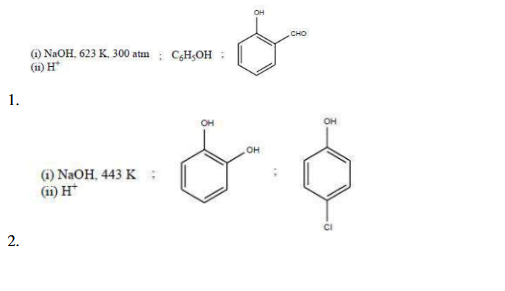
Question 156:

What are X, Y and Z in the given reaction sequence?


Correct Answer: (1) \( \text{NaOH, 623 K, 300 atm; } \text{C}_6\text{H}_5\text{OH} \)
View Solution

Question 157:

Cumene on oxidation in the presence of air gives a compound X. This in the presence of dilute acid gives Y and Z. The total number of \( sp^2 \) carbons in Y and Z is:

  • (1) 8
  • (2) 6
  • (3) 7
  • (4) 9
Correct Answer: (3) 7
View Solution

Question 158:

What are the reagents X and Y respectively used in the following reaction sequence to convert a nitrile to a methyl group?

  • (1) ZnCl\(_2\); Conc. HCl : (i) SnCl\(_2\), HCl (ii) H\(_3\)O\(^+\)
  • (2) (i) SnCl\(_2\), HCl (ii) H\(_3\)O\(^+\) : Zn - Hg|Conc. HCl
  • (3) LiAlH\(_4\) : NaBH\(_4\)
  • (4) (i) DIBAL-H (ii) H\(_2\)O : LiAlH\(_4\)
Correct Answer: (2) (i) SnCl\(_2\), HCl (ii) H\(_3\)O\(^+\) : Zn - Hg|Conc. HCl
View Solution

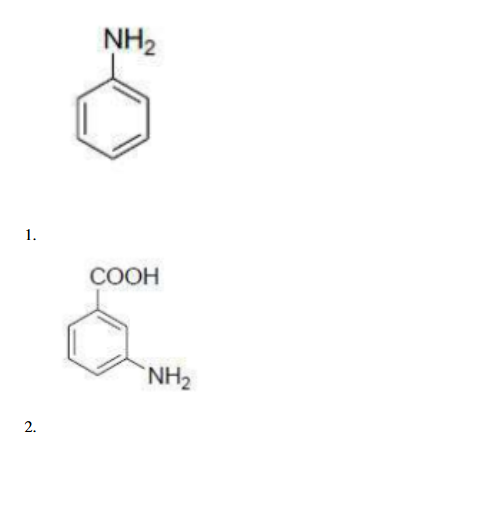
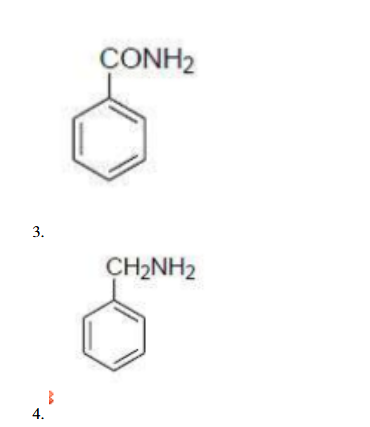
Question 159:

Identify Z in the following reaction sequence.

Correct Answer:

(3) CONH2
View Solution

Question 160:

Aniline on direct nitration at 288 K gives 51% (A), 47% (B) and 2% (C). ‘B’ on diazotisation, followed by reaction with CuCN | KCN gives a compound X. The percentage of nitrogen in X is:

  • (1) 28.92
  • (2) 18.92
  • (3) 38.92
  • (4) 48.92
Correct Answer: (2) 18.92
View Solution

Fees Structure

Structure based on different categories

CategoriesState
General600
sc500

Note: Candidate who want to appear for both the streams have to pay INR 700/-

In case of any inaccuracy, Notify Us! 

Comments


No Comments To Show