




Bihar Board Class 12 Entrepreneurship Question Paper 2024 (Code 218 Set – I) with Solutions pdf is available for download here. The exam was conducted by Bihar School Examination Board (BSEB). The question paper comprised a total of 96 questions divided among 2 sections.
Bihar Board Class 12 Entrepreneurship Question Paper 2024 (Code 218 Set – I) with Solutions
| Bihar Board Class 12 Entrepreneurship Question Paper with Answer Key |  Download Download |
Check Solutions |

DPR is a/an
View Solution
Step 1: Understanding the meaning of DPR.
The term DPR stands for Detailed Project Report.
It is an essential document prepared before the execution of any large-scale project.
The DPR provides an in-depth analysis and detailed description of all aspects of a project — including its objectives, background, financial requirements, feasibility, and technical details.
In simple terms, it acts as a roadmap or master plan that guides the implementation of the project from start to finish.
Step 2: Components of a DPR.
A standard DPR usually includes the following key sections:
- Project background and justification
- Objectives and scope of the project
- Technical specifications and design details
- Cost estimates and financing plan
- Implementation schedule and monitoring mechanism
- Risk assessment and mitigation measures
All of these sections are interlinked and designed to ensure that every stage of the project is properly executed.
Step 3: Why it is an Implementation Plan.
Since a DPR provides detailed guidelines on how the project should be executed, it is primarily an Implementation Plan.
It goes beyond being just a proposal or working plan; it sets out the operational framework for the actual execution of the project on the ground.
It outlines the activities, resources, manpower, and timelines necessary for successful completion.
Step 4: Analysis of Options.
- (1) Working plan: A working plan may refer to an internal short-term document, not a detailed guide for entire project execution.
- (2) Action plan: Although DPR includes actions, it is broader and more detailed than a mere action plan.
- (3) Implementation plan: Correct — because the DPR is intended to provide all necessary details to implement the project.
- (4) None of these: Incorrect, as the DPR clearly fits the description of an implementation plan.
Step 5: Conclusion.
Hence, the Detailed Project Report (DPR) is best described as an Implementation Plan.
Quick Tip: Always remember: DPR = Detailed Project Report = Implementation Plan.
It serves as a comprehensive guide for executing, monitoring, and evaluating a project successfully.
Aspect of project evaluation is
View Solution
Step 1: Understanding project evaluation.
Project evaluation is the process of systematically assessing a project to determine its feasibility, effectiveness, and success.
It helps decision-makers understand whether the project’s goals are being achieved in a cost-effective and sustainable manner.
Evaluation also identifies gaps, inefficiencies, and areas for improvement during or after the project’s implementation.
Step 2: Importance of project evaluation.
Project evaluation ensures that the resources allocated to a project are being used efficiently.
It measures the outcomes against predefined objectives and ensures accountability, transparency, and better decision-making for future projects.
Step 3: Major aspects of project evaluation.
(a) Technical Evaluation: This aspect examines the technical soundness and feasibility of the project. It checks whether the technology used is suitable, efficient, and sustainable for the intended purpose.
(b) Financial Evaluation: This involves a detailed financial analysis, including cost-benefit ratio, return on investment (ROI), and economic viability of the project. It ensures that the project delivers maximum output with minimal expenditure.
(c) Managerial Evaluation: This aspect focuses on the organizational and administrative setup of the project. It assesses the management structure, leadership efficiency, coordination among teams, and decision-making processes.
Step 4: Interrelation of the aspects.
All three evaluations are interconnected — technical soundness ensures feasibility, financial analysis confirms affordability, and managerial evaluation ensures smooth execution.
Without any one of these, project success cannot be achieved.
Step 5: Analysis of options.
- (1) Technical evaluation: True but only one part of project evaluation.
- (2) Financial evaluation: True but incomplete alone.
- (3) Managerial evaluation: True but insufficient by itself.
- (4) All of these: Correct — because project evaluation is a multidimensional process covering all these aspects.
Step 6: Conclusion.
Thus, the correct answer is (4) All of these, as a complete evaluation process includes technical, financial, and managerial perspectives.
Quick Tip: A holistic project evaluation always combines technical, financial, and managerial assessments to ensure efficiency, feasibility, and sustainability of outcomes.
.............. is needed in project identification.
View Solution
Step 1: Understanding project identification.
Project identification is the process of recognizing and defining a project idea that has potential benefits and feasibility for execution.
It involves determining areas where new projects are needed or where improvement opportunities exist in existing systems.
Step 2: Key skills required for project identification.
The process of identifying viable projects is not random — it requires both experience and the use of mind (analytical thinking).
Experience provides practical insight into past projects, industry trends, and lessons learned.
At the same time, intellectual and analytical ability helps assess project feasibility, innovation, and long-term sustainability.
Step 3: Why both are essential.
Only experience without analysis may lead to traditional or repetitive ideas, while only intellectual reasoning without experience might overlook practical challenges.
Thus, combining both — experience and mental analysis — ensures a balanced and realistic project identification process.
Step 4: Analysis of options.
- (1) Experience: Necessary but not sufficient alone.
- (2) Use of mind: Important but incomplete without experience.
- (3) Both (A) and (B): Correct — both are equally vital.
- (4) None of these: Incorrect.
Step 5: Conclusion.
Hence, project identification requires both experience and use of mind.
Quick Tip: Effective project identification blends practical experience with analytical reasoning to ensure both creativity and feasibility.
Core competency is related with
View Solution
Step 1: Understanding core competency.
Core competency refers to the unique capabilities, skills, and expertise that give an organization a competitive advantage in the marketplace.
It is what a company does exceptionally well compared to its competitors.
Core competencies are deeply embedded in an organization’s systems, culture, and employees.
Step 2: Relation with value addition.
Core competencies are directly connected to both intrinsic and external value addition.
- Intrinsic value addition focuses on improving internal processes, innovation, efficiency, and overall organizational strength.
- External value addition emphasizes providing superior products or services that add value to customers and the market.
Step 3: Why both are important.
A company’s true core competency lies in its ability to integrate internal efficiency with customer satisfaction.
For example, a company like Apple has intrinsic strength in design and technology (internal value) and delivers externally through user experience and branding (external value).
Step 4: Analysis of options.
- (1) Intrinsic value addition: True but incomplete.
- (2) External value addition: True but not sufficient by itself.
- (3) Both (A) and (B): Correct — as core competency connects both internal and external value creation.
- (4) None of these: Incorrect.
Step 5: Conclusion.
Hence, core competency is related to both intrinsic and external value addition.
Quick Tip: An organization’s core competency lies where internal efficiency meets external excellence — combining intrinsic and external value addition.
Project is prepared by
View Solution
Step 1: Understanding project preparation.
Project preparation involves the process of planning, designing, and organizing all details required before project implementation begins.
It is the stage where ideas are converted into structured documents outlining objectives, resource requirements, cost estimation, risk assessment, and timelines.
Step 2: Who prepares a project.
A project can be prepared by different stakeholders, depending on its nature, scale, and purpose:
- Promoters: They are individuals or groups who conceive the project idea and initiate its planning. They are responsible for promoting and justifying the project’s feasibility.
- Managers: They handle the organizational and administrative planning — such as defining operational details, manpower, and workflow structure.
- Entrepreneurs: They take on both the creative and financial responsibility of the project, preparing it from an innovation and investment standpoint.
Step 3: Collaborative nature of project preparation.
In most practical cases, all three — promoters, managers, and entrepreneurs — play complementary roles.
Promoters provide vision, managers ensure organization, and entrepreneurs bring innovation and risk-taking ability.
Together, they ensure the project is realistic, efficient, and profitable.
Step 4: Analysis of options.
- (1) Promoters: True, they initiate the project.
- (2) Managers: True, they organize and plan the operational aspects.
- (3) Entrepreneurs: True, they finance and execute the project vision.
- (4) All of these: Correct — all these roles contribute collectively.
Step 5: Conclusion.
Therefore, a project is prepared by promoters, managers, and entrepreneurs — all of them together.
Quick Tip: Project preparation is a team effort — combining the promoter’s vision, the manager’s organization, and the entrepreneur’s initiative.
Gestation period is concerned with
View Solution
Step 1: Understanding the term 'Gestation Period'.
The term Gestation Period refers to the time gap between the conception of a project idea and its actual commencement of operations.
It is the period during which the project is prepared, developed, and brought to an operational stage.
This stage includes activities such as acquiring land, constructing buildings, installing machinery, and completing other preparatory work before production begins.
Step 2: Relation with project phases.
Every project has different phases:
- Idea generation and conceptualization
- Feasibility and planning
- Implementation (gestation period)
- Operation and commercialization
The gestation period lies mainly in the implementation stage — the time when the project is under development but has not yet started producing output.
Step 3: Real-world examples.
For example, when a factory is being constructed, machinery installed, and employees trained — that entire duration is the gestation period.
Only after this period does the plant begin commercial production.
Step 4: Analysis of options.
- (1) Idea creation period: Too early — this involves only concept development.
- (2) Incubation period: Generally refers to startup nurturing, not industrial implementation.
- (3) Implementation period: Correct — as the gestation period covers the time of implementation before output begins.
- (4) Commercialisation period: This comes after the gestation phase.
Step 5: Conclusion.
Thus, the gestation period is concerned with the implementation period.
Quick Tip: The gestation period ends when the project starts generating returns — it’s the implementation phase, not the planning or commercial stage.
Net working capital means
View Solution
Step 1: Understanding the concept.
Net Working Capital (NWC) is a key indicator of an organization’s short-term financial health and liquidity position.
It represents the difference between the company’s current assets and current liabilities.
It shows the amount of capital that a company has available for day-to-day operations.
Step 2: Formula and meaning.
The formula for Net Working Capital is:
\[ Net Working Capital = Current Assets - Current Liabilities \]
If this value is positive, it means the company has enough assets to cover its short-term obligations.
If it is negative, it indicates financial strain or poor liquidity.
Step 3: Examples.
For example, if a company has current assets worth ₹5,00,000 and current liabilities of ₹3,00,000, then:
\[ NWC = 5,00,000 - 3,00,000 = 2,00,000 \]
This means ₹2,00,000 is available as working capital for regular business operations.
Step 4: Importance of NWC.
Net Working Capital helps measure operational efficiency and short-term financial stability.
It ensures that the firm can meet its immediate expenses like salaries, raw material costs, and bills.
Step 5: Analysis of options.
- (1) Current Assets - Current Liabilities: Correct definition.
- (2) Current Assets + Current Liabilities: Incorrect, not used in accounting.
- (3) Current Liabilities - Current Assets: Represents negative working capital, not standard NWC.
- (4) None of these: Incorrect.
Step 6: Conclusion.
Therefore, Net Working Capital = Current Assets - Current Liabilities.
Quick Tip: Net Working Capital measures liquidity; a positive NWC shows strong short-term solvency and operational stability.
Depreciation on plant and machinery is
View Solution
Step 1: Understanding depreciation.
Depreciation is the reduction in the value of an asset over time due to wear and tear, usage, or obsolescence.
It is a non-cash expense recorded in the books to allocate the cost of an asset over its useful life.
Step 2: Accounting treatment.
In accounting, depreciation is charged annually to reflect the decline in value of fixed assets like machinery, equipment, or vehicles.
Although it reduces profits, no actual cash outflow occurs at the time of recording depreciation.
Step 3: Why it is 'No flow of fund'.
Since depreciation does not involve any cash transaction, it is neither a source nor an application of funds.
It simply adjusts the book value of assets and reduces taxable income without affecting the actual cash position of the business.
Step 4: Example.
If a company buys a machine worth ₹1,00,000 and charges ₹10,000 as depreciation annually, this ₹10,000 reduces profit but does not involve any cash flow.
Therefore, it is a non-fund or non-cash item.
Step 5: Analysis of options.
- (1) Source of fund: Incorrect — no cash inflow occurs.
- (2) Application of fund: Incorrect — no cash outflow occurs.
- (3) No flow of fund: Correct — depreciation only affects accounting records, not cash flow.
- (4) None of these: Incorrect.
Step 6: Conclusion.
Hence, depreciation on plant and machinery is classified as No flow of fund.
Quick Tip: Depreciation is a non-cash expense — it affects profit but not the flow of funds in or out of the business.
Which of the following is a non-current asset?
View Solution
Step 1: Understanding the concept of non-current assets.
Non-current assets are those assets that are held by a business for long-term use and not intended for immediate sale.
They provide benefits to the business over multiple accounting periods and include tangible and intangible assets.
Step 2: Nature of goodwill.
Goodwill is an intangible non-current asset that represents the reputation, brand value, and customer trust of a business.
It arises when a company acquires another business at a value higher than its net identifiable assets.
For example, if a business purchases another firm for ₹10,00,000 whose net asset value is ₹8,00,000, then ₹2,00,000 is goodwill — reflecting its market reputation.
Step 3: Why goodwill is non-current.
Goodwill provides long-term benefits to a company and cannot be easily converted into cash.
It is not used up or replaced within a year, so it is categorized under non-current or fixed assets.
Step 4: Analysis of options.
- (1) Goodwill: Correct, as it is a long-term intangible asset.
- (2) Bills Receivable: A current asset since it is expected to be realized within a short time.
- (3) Pre-paid expenses: Also a current asset because they relate to current accounting periods.
- (4) Debtors: Represent short-term receivables, hence a current asset.
Step 5: Conclusion.
Therefore, the correct answer is Goodwill, which is a non-current asset.
Quick Tip: Non-current assets include tangible assets like land and machinery and intangible assets like goodwill and patents — all used for long-term operations.
Increase in fixed assets due to cash purchase is
View Solution
Step 1: Understanding 'application of fund'.
An application of fund refers to the use or outflow of financial resources for various business purposes.
Whenever money is spent on acquiring assets, paying liabilities, or meeting expenses, it is considered an application of funds.
Step 2: Nature of the transaction.
When a business purchases fixed assets such as machinery, equipment, or land by paying cash, the transaction results in an increase in assets.
At the same time, there is a reduction in cash balance, which means money has been utilized or applied.
Step 3: Explanation with example.
For example, if a company buys machinery worth ₹2,00,000 in cash, then:
- Fixed assets increase by ₹2,00,000.
- Cash (a current asset) decreases by ₹2,00,000.
This represents a movement of funds from one form to another — from liquid assets (cash) to fixed assets.
Step 4: Reasoning.
Since cash has been used to acquire the fixed asset, it is treated as an application of fund.
It indicates a decrease in working capital because current assets (cash) have reduced while non-current assets have increased.
Step 5: Analysis of options.
- (1) Application of fund: Correct — cash used for purchasing assets is an outflow of funds.
- (2) Source of fund: Incorrect — it would mean generation of cash.
- (3) Inflow of fund: Incorrect — no inflow occurs here.
- (4) None of these: Incorrect.
Step 6: Conclusion.
Thus, an increase in fixed assets due to a cash purchase is an application of fund.
Quick Tip: Whenever cash is used to buy long-term assets, it’s recorded as an application of fund because working capital decreases.
Opening stock is
View Solution
Step 1: Understanding opening stock.
Opening stock represents the value of goods or materials that a business holds at the beginning of an accounting period.
It is the leftover inventory from the previous year, carried forward to the new financial year.
Step 2: Accounting impact.
In the preparation of fund flow statements, opening stock is treated as an application of fund.
This is because funds have already been invested in purchasing or producing this stock in the previous period, and those funds remain tied up in inventory.
Step 3: Conceptual explanation.
Even though opening stock does not involve a new cash transaction during the current year, it represents the utilization of resources in earlier operations.
Hence, the funds locked in the opening stock are considered as applied funds.
Step 4: Example.
If a business starts the year with ₹50,000 worth of stock, that amount signifies funds already spent and invested in inventory.
Thus, it is recorded as an application of fund since the capital is used and remains blocked in stock form.
Step 5: Analysis of options.
- (1) Source of fund: Incorrect — no new cash inflow arises from opening stock.
- (2) Application of fund: Correct — it represents resources tied up in inventory.
- (3) No flow of fund: Incorrect — it shows utilization from the past.
- (4) None of these: Incorrect.
Step 6: Conclusion.
Therefore, opening stock is classified as an application of fund in financial analysis.
Quick Tip: Opening stock shows funds already utilized in previous periods — hence it is treated as an application of fund, not as a new cash flow.
The term ‘Fund’ as used in Fund Flow Analysis means
View Solution
Step 1: Understanding the meaning of ‘Fund’.
In the context of Fund Flow Analysis, the term ‘Fund’ does not refer merely to cash or money.
Instead, it denotes the Net Working Capital (NWC), which represents the excess of current assets over current liabilities.
This concept helps in identifying the flow of funds — whether the working capital has increased (inflow) or decreased (outflow).
Step 2: Relationship between fund and working capital.
Working capital = Current Assets – Current Liabilities.
If current assets increase or current liabilities decrease, it results in an inflow of funds.
Conversely, if current assets decrease or current liabilities increase, it indicates an outflow of funds.
Step 3: Importance in Fund Flow Analysis.
Fund Flow Analysis focuses on understanding how resources are generated and used within an organization over a given period.
By analyzing the changes in working capital, businesses can evaluate their short-term financial health and liquidity position.
Step 4: Analysis of options.
- (1) Cash only: Incorrect — fund means more than just cash.
- (2) Current assets: Incomplete — fund is not equal to all current assets alone.
- (3) Current liabilities: Incorrect — liabilities represent obligations, not fund.
- (4) Excess of current assets over current liabilities: Correct — this is the actual definition of fund in Fund Flow Analysis.
Step 5: Conclusion.
Thus, in Fund Flow Analysis, the term ‘Fund’ refers to the excess of current assets over current liabilities.
Quick Tip: In Fund Flow Analysis, always remember: Fund = Net Working Capital = Current Assets – Current Liabilities.
Ideal Debt-Equity ratio is
View Solution
Step 1: Understanding Debt-Equity Ratio.
The Debt-Equity Ratio measures the relationship between the company’s borrowed funds (debt) and its shareholders’ funds (equity).
It helps in evaluating the financial structure and the risk level of a company in terms of its reliance on external versus internal capital.
Step 2: Formula.
\[ Debt-Equity Ratio = \frac{Long-term Debt}{Shareholders’ Equity} \]
This ratio reflects the extent to which a company is using borrowed funds to finance its assets relative to the funds invested by the owners.
Step 3: Significance of an ideal ratio.
An ideal Debt-Equity Ratio of 1:1 indicates a balanced capital structure — the company has equal proportions of debt and equity.
It ensures financial stability, moderate risk, and an optimal cost of capital.
If the ratio is higher (e.g., 2:1), it means more dependence on debt, which increases financial risk.
If it is lower (e.g., 0.5:1), it means excessive reliance on equity, which may reduce profitability for shareholders.
Step 4: Analysis of options.
- (1) 1 : 1 — Correct, considered the ideal balance between borrowed and owned funds.
- (2) 1 : 2 — Implies excessive equity; conservative structure.
- (3) 2 : 3 — Not standard; rarely used.
- (4) 1 : 3 — Implies high equity with little debt, not ideal for maximizing return.
Step 5: Conclusion.
Hence, the ideal Debt-Equity Ratio is 1:1.
Quick Tip: An ideal Debt-Equity ratio of 1:1 ensures financial balance — neither too risky (debt-heavy) nor too conservative (equity-heavy).
Ideal current ratio is
View Solution
Step 1: Understanding the current ratio.
The Current Ratio is a liquidity ratio that measures a company’s ability to meet its short-term obligations using its current assets.
It indicates whether the company has enough resources to pay off its immediate debts within a year.
Step 2: Formula.
\[ Current Ratio = \frac{Current Assets}{Current Liabilities} \]
This ratio shows how many times the current assets cover the current liabilities.
Step 3: Meaning of the ideal ratio.
An ideal current ratio is generally considered to be 2:1, which means that for every ₹1 of current liability, the company has ₹2 in current assets.
This ensures sufficient liquidity and safety for meeting short-term obligations without facing a cash crunch.
Step 4: Significance of 2:1.
A ratio higher than 2:1 may indicate excessive idle current assets or poor utilization of resources.
A ratio lower than 2:1 may suggest liquidity problems or over-dependence on short-term financing.
Hence, 2:1 provides a balanced level of safety and efficiency.
Step 5: Analysis of options.
- (1) 4 : 1 — Too high, indicates over-capitalization or inefficient asset use.
- (2) 3 : 2 — Low and risky for creditors.
- (3) 1 : 2 — Illogical; liabilities exceed assets.
- (4) 2 : 1 — Correct, ideal balance between liquidity and efficiency.
Step 6: Conclusion.
Therefore, the ideal Current Ratio is 2:1, signifying sound short-term financial health.
Quick Tip: A 2:1 current ratio means the company has twice as many current assets as liabilities — a safe liquidity position without underutilizing resources.
India Investment Fund was established by
View Solution
Step 1: Understanding the India Investment Fund.
The India Investment Fund was established as a financial initiative to promote investment opportunities and industrial development in India.
The fund aimed to attract both domestic and foreign investors by providing structured investment opportunities and promoting the Indian economy’s growth potential.
Step 2: Establishing authority.
The India Investment Fund was established by the Canara Bank (Can Bank) through its financial subsidiaries.
Can Bank is a major public sector bank in India that has been instrumental in setting up various financial institutions and investment funds to support industrial and infrastructure growth.
Step 3: Role of Can Bank.
Can Bank’s role was crucial in promoting capital formation, supporting industrial expansion, and fostering financial inclusion through long-term investments.
Step 4: Analysis of options.
- (1) IFCI: Focuses mainly on industrial finance, not on the India Investment Fund.
- (2) Grindlays Bank: A foreign bank, not involved in establishing this fund.
- (3) State Bank: A leading public bank but not associated with this specific fund.
- (4) Can Bank: Correct — India Investment Fund was established by Canara Bank.
Step 5: Conclusion.
Hence, the India Investment Fund was established by Can Bank.
Quick Tip: Canara Bank (Can Bank) has promoted several financial institutions like Canbank Mutual Fund and India Investment Fund to enhance industrial finance in India.
The nature of management is
View Solution
Step 1: Understanding management.
Management is both a science and an art — it involves planning, organizing, leading, and controlling an organization’s resources to achieve specific goals efficiently.
Step 2: Inborn ability aspect.
Some individuals possess natural leadership and managerial qualities, such as communication, decision-making, and coordination skills.
This reflects the inborn ability component of management — certain traits are innate.
Step 3: Acquired ability aspect.
At the same time, management requires formal education, training, and experience to understand theories, strategies, and techniques of administration.
This indicates the acquired ability component.
Step 4: Combination of both.
Successful managers combine both — natural talent and acquired knowledge — to adapt to changing organizational needs and environments.
Step 5: Analysis of options.
- (1) As an inborn ability: Partially correct.
- (2) As an acquired ability: Also true but incomplete.
- (3) Both (A) and (B): Correct — management is both natural and learned.
- (4) None of these: Incorrect.
Step 6: Conclusion.
Thus, the nature of management is both inborn and acquired ability.
Quick Tip: Effective management combines natural leadership traits with acquired professional knowledge and practical experience.
Social responsibility of management is
View Solution
Step 1: Understanding social responsibility.
Social responsibility refers to the ethical obligation of management to act in the interest of society and various stakeholders — not just the organization.
It involves ensuring fairness, sustainability, and positive contributions to the community.
Step 2: Scope of responsibility.
The management’s responsibility extends towards:
- Employees: Ensuring fair wages, safe working conditions, and career growth.
- Customers: Providing quality products and services.
- Government: Adhering to laws and paying taxes.
- Environment: Preventing pollution and promoting eco-friendly practices.
- Society at large: Supporting education, health, and social welfare.
Step 3: Why it is towards all.
Management must balance the interests of all stakeholders for sustainable growth and public trust.
Focusing only on one group, such as employees or government, limits ethical responsibility.
Step 4: Analysis of options.
- (1) Towards all: Correct — includes employees, government, customers, and society.
- (2) Towards employees only: Incorrect — too narrow.
- (3) Towards the government: Partial, but not complete.
- (4) None of these: Incorrect.
Step 5: Conclusion.
Thus, the social responsibility of management is towards all.
Quick Tip: Social responsibility in management means maintaining a balance between economic objectives and social welfare for all stakeholders.
Management is an art of
View Solution
Step 1: Understanding the concept of management as an art.
Management is often described as an art because it requires creativity, experience, and skill to achieve organizational objectives effectively through others.
The essence of management lies in achieving desired results by directing and motivating people.
Step 2: Manager’s role.
A manager’s primary responsibility is not to perform all tasks personally but to get the work done efficiently through proper coordination and supervision.
This involves delegation, communication, motivation, and leadership.
Step 3: Why not ‘doing work himself’.
While a manager must understand the nature of work, direct performance of all tasks is impractical in large organizations.
Hence, the real art of management lies in achieving goals through others.
Step 4: Analysis of options.
- (1) Doing work himself: Incorrect — a manager’s role is supervisory.
- (2) Taking work from others: Correct — reflects true managerial skill.
- (3) Both (A) and (B): Not accurate — management emphasizes coordination, not self-execution.
- (4) None of these: Incorrect.
Step 5: Conclusion.
Thus, management is the art of getting work done through others.
Quick Tip: True management lies in achieving goals by effectively directing, coordinating, and motivating others — not by doing every task personally.
............... steps are included in indirect production.
View Solution
Step 1: Understanding indirect production.
Indirect production refers to all the activities that are not directly involved in producing goods but are essential for making production possible and efficient.
It involves processes such as services, transportation, communication, marketing, and other supporting functions that assist the actual production process.
Step 2: Classification of production stages.
Production can be classified into three broad types:
- Primary production: Activities that extract raw materials directly from nature — like agriculture, fishing, and mining.
- Secondary production: Activities that process raw materials into finished or semi-finished goods — like manufacturing and construction.
- Tertiary production: Activities that provide services supporting both primary and secondary production — like transport, banking, and marketing.
Step 3: Indirect production involvement.
Indirect production includes all these steps because they collectively contribute to the creation, movement, and distribution of goods.
Without the combined effort of all three sectors, the overall production cycle would remain incomplete.
Step 4: Analysis of options.
- (1) Secondary: Partly true — it supports production directly.
- (2) Primary: Also part of the chain, providing essential materials.
- (3) Tertiary: Provides services essential for production flow.
- (4) All of these: Correct — indirect production includes activities from all three sectors.
Step 5: Conclusion.
Hence, all three — primary, secondary, and tertiary — are included in indirect production.
Quick Tip: Indirect production includes every stage that supports or facilitates the creation and delivery of goods — from raw material extraction to marketing.
Important aspect of product inspection is
View Solution
Step 1: Understanding product inspection.
Product inspection is the process of examining goods during and after production to ensure they meet quality standards and customer expectations.
It helps in detecting defects, preventing wastage, and maintaining product reliability.
Step 2: Key aspects of product inspection.
Product inspection involves three important aspects:
- Process inspection: Examining the production process to identify errors in machinery, materials, or workflow.
- Production inspection: Checking products during various stages of manufacturing to ensure accuracy and consistency.
- Inspection analysis: Studying inspection data to evaluate performance and identify recurring defects for continuous improvement.
Step 3: Why all are important.
These three aspects are interlinked — process inspection ensures production quality, production inspection validates product accuracy, and analysis provides feedback for further quality enhancement.
Step 4: Analysis of options.
- (1) Process inspection: True, but partial.
- (2) Production inspection: True, but limited.
- (3) Inspection analysis: True, but supportive.
- (4) All of these: Correct — all are vital components of effective product inspection.
Step 5: Conclusion.
Therefore, all the given aspects together constitute the important elements of product inspection.
Quick Tip: Quality control requires process, production, and analytical inspections working together to maintain consistent standards.
For business, marketing is
View Solution
Step 1: Understanding the role of marketing.
Marketing is the process of identifying consumer needs, developing products to meet those needs, and promoting them effectively to maximize sales and satisfaction.
It is an essential part of every business, connecting the producer and the consumer.
Step 2: Importance in modern business.
In today’s competitive world, marketing is vital for survival and growth because it helps in:
- Creating awareness about products and services.
- Building brand identity and loyalty.
- Increasing sales and revenue.
- Adapting products to meet changing consumer demands.
Step 3: Marketing as a necessity.
Without marketing, even the best products may fail to reach customers.
Therefore, marketing is not a luxury or an optional activity — it is a core necessity for every business to sustain and grow.
Step 4: Analysis of options.
- (1) Unnecessary: Incorrect — business cannot survive without marketing.
- (2) Compulsory: Not wrong, but the better economic term is ‘necessary’.
- (3) Necessary: Correct — marketing ensures connection between production and consumption.
- (4) Luxury: Incorrect — it is essential, not extravagant.
Step 5: Conclusion.
Thus, marketing is a necessary function for every business.
Quick Tip: Marketing bridges the gap between production and consumption — making it an indispensable element of business success.
Fixed cost includes
View Solution
Step 1: Understanding fixed cost.
Fixed costs are expenses that do not change with the level of production or sales.
They remain constant over a certain period, irrespective of output levels.
Examples include rent, insurance, salaries of permanent staff, and depreciation of buildings.
Step 2: Distinguishing between fixed and variable cost.
- Fixed cost: Remains constant — e.g., factory rent or depreciation.
- Variable cost: Changes with production — e.g., raw materials, wages, power consumption.
Step 3: Factory cost explanation.
The cost of factory facilities (such as rent, insurance, and maintenance) remains unchanged within a production range.
Hence, it is classified under fixed costs because it does not fluctuate with production volume.
Step 4: Analysis of options.
- (1) Cost of raw materials: Variable, changes with output.
- (2) Cost of labours: Partly variable depending on production.
- (3) Cost of power: Varies with machinery use.
- (4) Cost of factory: Correct — a fixed expense that remains stable regardless of production levels.
Step 5: Conclusion.
Hence, the cost of factory is included under fixed cost.
Quick Tip: Fixed costs remain constant — like factory rent or insurance — while variable costs change with production, like materials and labor.
The source of working capital is
View Solution
Step 1: Understanding working capital.
Working capital refers to the amount of capital that a business requires to run its daily operations.
It is calculated as the difference between current assets and current liabilities.
\[ Working Capital = Current Assets - Current Liabilities \]
A company needs working capital to finance its short-term obligations, pay wages, purchase materials, and meet operational expenses.
Step 2: Sources of working capital.
The main sources of working capital include:
- Debtors: When a company sells goods on credit, debtors represent money to be received — a current asset, thus a source of working capital.
- Bank overdraft: This is a short-term borrowing facility provided by banks to meet immediate cash needs, which serves as a temporary source of working capital.
- Cash sales: Cash sales generate immediate inflow of funds, increasing liquidity and providing working capital.
Step 3: Importance of multiple sources.
In practice, a combination of these sources is used to maintain a steady flow of working capital and ensure business continuity.
Proper management of working capital ensures smooth operations and financial stability.
Step 4: Analysis of options.
- (1) Debtors: Correct, provides short-term capital inflow.
- (2) Bank overdraft: Correct, provides temporary financing.
- (3) Cash sales: Correct, increases liquidity instantly.
- (4) All of these: Correct — all the above are valid sources of working capital.
Step 5: Conclusion.
Hence, the source of working capital is All of these.
Quick Tip: Working capital ensures operational efficiency — manage debtors, cash, and short-term loans wisely for smooth daily functioning.
The source of fixed capital is not
View Solution
Step 1: Understanding fixed capital.
Fixed capital refers to the funds invested in long-term assets such as land, buildings, plant, machinery, and equipment.
These assets are not intended for sale; rather, they are used continuously in the production process to generate income.
Step 2: Common sources of fixed capital.
Fixed capital is usually raised from long-term financial sources such as:
- Issue of shares: Capital obtained from shareholders represents long-term equity funding.
- Issue of debentures: Funds borrowed through debentures are repayable over a long period, suitable for fixed asset investments.
- Loans from financial institutions: Organizations like the Industrial Finance Corporation of India (IFCI) provide long-term loans for setting up industries and purchasing machinery.
Step 3: Why creditors are not a source.
Creditors are individuals or entities to whom the business owes short-term obligations — generally payable within a year.
Since creditors represent short-term liabilities, they cannot be considered a source of fixed capital, which is meant for long-term investment.
Step 4: Analysis of options.
- (1) Issue of debentures: Long-term source — correct for fixed capital.
- (2) Issue of shares: Long-term equity — correct.
- (3) Creditors: Incorrect for fixed capital — a short-term liability.
- (4) Loan from IFCI: Long-term institutional source — correct.
Step 5: Conclusion.
Hence, the source of fixed capital is not creditors.
Quick Tip: Fixed capital is always raised from long-term sources like shares, debentures, and institutional loans — not from short-term liabilities like creditors.
For a joint stock company, payment of dividend is
View Solution
Step 1: Understanding dividend.
A dividend is the portion of profits distributed by a joint stock company to its shareholders as a reward for their investment.
It is declared by the company’s Board of Directors and approved by shareholders during the annual general meeting (AGM).
Step 2: Legal nature of dividend payment.
Payment of dividends is not a legal obligation.
A company may choose to reinvest its profits in business expansion, debt repayment, or other uses.
Only when the Board declares a dividend does it become payable to shareholders.
Step 3: Voluntary nature.
The payment depends on factors like profit availability, liquidity, expansion plans, and dividend policy.
Hence, it is a voluntary decision based on management discretion rather than a compulsory act.
Step 4: Analysis of options.
- (1) Voluntary: Correct — depends on company policy and financial performance.
- (2) Compulsory: Incorrect — no law mandates compulsory dividend payment.
- (3) Necessary: Incorrect — may not always be appropriate.
- (4) None of these: Incorrect.
Step 5: Conclusion.
Thus, for a joint stock company, payment of dividend is voluntary.
Quick Tip: Dividend payments are discretionary — companies may retain profits for growth or declare dividends depending on financial health and strategy.
Fixed capital is required
View Solution
Step 1: Understanding fixed capital.
Fixed capital refers to the funds that are invested in long-term assets of a business.
These assets are not intended for immediate resale but are used over several years to generate income.
Examples include land, buildings, machinery, vehicles, and equipment.
Step 2: Purpose of fixed capital.
Fixed capital is required for the purchase, installation, and maintenance of long-term assets that help in the production of goods and services.
It is essential for establishing and expanding the infrastructure of an organization.
Step 3: Why land purchase is part of fixed capital.
Land is a long-term asset that provides the physical foundation for business operations such as factories, offices, and warehouses.
The expenditure on land is non-recurring and remains fixed regardless of the level of production.
Step 4: Analysis of options.
- (1) For payment of routine expenses: Incorrect — these are short-term and come under working capital.
- (2) For purchase of land: Correct — land is a long-term investment and requires fixed capital.
- (3) For purchase of stock: Incorrect — this is a current asset funded through working capital.
- (4) For payment to creditors: Incorrect — involves current liabilities, not fixed assets.
Step 5: Conclusion.
Hence, fixed capital is required for the purchase of land.
Quick Tip: Fixed capital is invested in long-term assets like land, buildings, and machinery, while working capital meets short-term operational needs.
The determinants of bonus decisions are
View Solution
Step 1: Understanding bonus decisions.
A bonus is an additional payment made by an employer to employees as a reward for their contribution to the organization’s success.
Bonus decisions depend on multiple financial and organizational factors that determine how much and when bonuses are distributed.
Step 2: Major determinants of bonus decisions.
- Age of the company: Older companies with stable finances and established markets are often in a better position to pay bonuses than new firms.
- Liquidity of funds: The availability of cash or liquid assets plays a crucial role — even profitable firms may delay bonuses if liquidity is low.
- Amount of profits: The company’s profitability directly affects its capacity to distribute bonuses, as bonuses are usually paid out of profit reserves.
Step 3: Interrelation of factors.
Each of these determinants interacts — for instance, a profitable but cash-strapped company might postpone bonuses, while a financially stable firm may pay consistently.
Step 4: Analysis of options.
- (1) Age of the company: Correct but not sole factor.
- (2) Liquidity of funds: Correct, determines ability to pay.
- (3) Amount of profits: Correct, source of bonus distribution.
- (4) All of these: Correct — all three factors jointly determine bonus policies.
Step 5: Conclusion.
Thus, the determinants of bonus decisions include the company’s age, liquidity, and profitability — hence, All of these.
Quick Tip: Bonus distribution depends on a firm’s financial strength, liquidity, and profitability — not on a single factor alone.
Current assets include
View Solution
Step 1: Understanding current assets.
Current assets are short-term assets that can be easily converted into cash within one year.
They are used in day-to-day operations and help maintain liquidity in a business.
Examples include cash, debtors, bills receivable, and stock.
Step 2: Role of debtors.
Debtors are individuals or firms who owe money to the business after purchasing goods or services on credit.
Since this amount is expected to be received soon, it is treated as a current asset.
Step 3: Comparison with other options.
- Furniture: Considered a fixed asset as it has long-term utility.
- Investment: May be current or non-current, but generally long-term in nature.
- Goodwill: An intangible fixed asset, not a current one.
- Debtors: Represent short-term receivables, hence a current asset.
Step 4: Importance of debtors as current assets.
Debtors contribute to a firm’s liquidity position and form a vital part of working capital management.
Efficient management of debtors ensures timely inflows and stable cash cycles.
Step 5: Conclusion.
Therefore, among the given options, Debtors are classified as current assets.
Quick Tip: Debtors are part of current assets as they can be converted into cash quickly — unlike furniture or goodwill, which are fixed assets.
Incentives are not concerned with
View Solution
Step 1: Understanding incentives.
Incentives are benefits, rewards, or concessions given by the government or organizations to encourage certain economic or business activities.
They are designed to motivate entrepreneurs, industries, and employees to improve performance, productivity, or investment.
Step 2: Common forms of incentives.
Incentives may include:
- Rebate: Reduction or refund on taxes or duties.
- Exemption from tax: Relief from paying certain taxes for a specific period.
- Provision of seed capital: Providing initial financial assistance to start a new venture.
Step 3: Nature of lump-sum payment.
A lump-sum payment is a one-time financial transaction or settlement not directly linked to performance or motivation.
It is generally considered a compensation or settlement, not an incentive.
Step 4: Analysis of options.
- (1) Rebate: Related to incentives.
- (2) Exemption from tax: An important type of incentive.
- (3) Provision of seed capital: Encourages entrepreneurship.
- (4) Lumpsum payment: Not an incentive; it is a fixed payment unrelated to motivation or promotion.
Step 5: Conclusion.
Hence, incentives are not concerned with lump-sum payment.
Quick Tip: Incentives are benefits aimed at motivation or growth — not one-time financial settlements like lump-sum payments.
Social structure is composed of
View Solution
Step 1: Understanding social structure.
The term ‘social structure’ refers to the organized pattern of relationships and institutions that make up a society.
It defines how different groups and individuals interact within a social framework and how social order is maintained.
Step 2: Functional division concept.
Social structure is based on the functional division of society, meaning different members or groups perform specific roles that contribute to the smooth working of society.
For example, teachers educate, farmers produce food, and administrators manage governance — all of which are essential functions.
Step 3: Why not caste or community.
While caste or community can influence structure in traditional societies, the broader concept of social structure encompasses the overall role and function of individuals in the entire society.
Step 4: Analysis of options.
- (1) Functional division of society: Correct — it forms the base of social structure.
- (2) Functional division of caste: Incorrect — caste is a sub-aspect, not the whole.
- (3) Functional division of community: Limited view, not comprehensive.
- (4) None of these: Incorrect.
Step 5: Conclusion.
Hence, social structure is composed of the functional division of society.
Quick Tip: Social structure organizes society through division of roles and responsibilities ensuring stability and cooperation among individuals.
Learning process involves
View Solution
Step 1: Understanding learning.
Learning is a process through which experience or practice results in a relatively permanent change in behavior.
It involves motivation, action, and feedback that help individuals acquire new knowledge or skills.
Step 2: Components of learning process.
According to the behavioral theory of learning, the process includes:
- Drive: The internal motivation or desire to act (e.g., hunger motivating food-seeking).
- Cue: The stimulus or signal that directs behavior (e.g., seeing food).
- Response: The reaction or behavior resulting from the cue (e.g., eating the food).
Reinforcement then strengthens the learning connection between cue and response.
Step 3: Explanation.
A combination of drive, cue, and response explains how habits and learned behaviors develop through repetition and reward.
Step 4: Analysis of options.
- (1) Drive: Important but incomplete alone.
- (2) Cue: Essential but not sufficient.
- (3) Repayment: Irrelevant — not part of learning process.
- (4) Drive, Cue and Response: Correct — all three form the basis of learning behavior.
Step 5: Conclusion.
Hence, the learning process involves Drive, Cue, and Response.
Quick Tip: Learning is a behavioral change resulting from Drive (motivation), Cue (stimulus), and Response (action) — reinforced through experience.
Subsidy is
View Solution
Step 1: Understanding the term “Subsidy.”
A subsidy is a form of financial assistance granted by the government or an institution to individuals or businesses.
It is intended to promote certain economic activities or to make essential goods and services affordable.
Subsidies may take various forms such as direct cash payments, tax reductions, or price support mechanisms.
Step 2: Meaning of “Concession.”
A concession refers to a reduction in the price, tax, or cost of something as a form of financial relief.
In economics, it aligns closely with the idea of subsidy — both represent financial assistance or relaxation in costs.
Step 3: Analysis of options.
- (1) Concession: Correct — a subsidy acts as a financial concession provided by the government.
- (2) Discount: Incorrect — a discount is a price reduction given by a seller to promote sales, not a government grant.
- (3) Repayment: Incorrect — repayment involves returning borrowed money; it’s the opposite of a subsidy.
- (4) None of these: Incorrect — as “concession” accurately represents a subsidy.
Step 4: Conclusion.
Therefore, a subsidy is best described as a concession.
Quick Tip: A subsidy is financial aid or concession, not a commercial discount. Governments use subsidies to support industries, farmers, and public welfare schemes.
Which of the following factors affect the identification of business opportunities?
View Solution
Step 1: Understanding Business Opportunity Identification.
The process of identifying a business opportunity involves observing and analyzing the external environment to locate gaps or unmet needs in the market.
Entrepreneurs and organizations continuously scan their surroundings to find viable opportunities that can be converted into profitable ventures.
Step 2: Factors Influencing Identification.
One of the key factors influencing opportunity identification is the presence of existing opportunities in the environment.
These opportunities often arise due to technological changes, policy reforms, social trends, or consumer behavior shifts.
Step 3: Analysis of options.
- (1) Volume of internal demand: This affects production decisions, not the identification of new opportunities.
- (2) Created opportunities: These result after identifying opportunities, not before.
- (3) Existing opportunities in the environment: Correct — these help identify new ventures and business ideas.
- (4) None of these: Incorrect — option (3) correctly matches the influencing factor.
Step 4: Conclusion.
Hence, the factor affecting identification of business opportunities is the existing opportunities in the environment.
Quick Tip: Always observe market trends, consumer needs, and technological advancements — these existing opportunities often lead to successful business ideas.
Which of the following is a kind of opportunity?
View Solution
Step 1: Understanding the term “Opportunity.”
In the field of business and entrepreneurship, an opportunity refers to a favorable situation or condition that allows an entrepreneur to start or expand a business.
It arises from changing market conditions, technological innovations, or shifts in consumer behavior.
Step 2: Types of Opportunities.
Opportunities can be classified into different types: natural (or existing) opportunities and created opportunities.
A created opportunity is one that an entrepreneur identifies and develops through innovation, research, or creative effort, rather than waiting for it to naturally exist in the environment.
Step 3: Analysis of options.
- (1) First opportunity: Incorrect — this is not a recognized type of business opportunity.
- (2) Created opportunity: Correct — because it refers to an opportunity generated by entrepreneurial effort or innovation.
- (3) Last opportunity: Incorrect — not a standard classification in business studies.
- (4) None of these: Incorrect — as “created opportunity” is indeed a valid type.
Step 4: Conclusion.
Therefore, among the given options, the correct answer is Created opportunity.
Quick Tip: Entrepreneurs often create opportunities through innovation and market insight rather than waiting for them to appear naturally.
Social behaviour is not concerned with
View Solution
Step 1: Understanding Social Behaviour.
Social behaviour refers to the actions and conduct of individuals or groups guided by societal norms, ethics, and moral values.
It involves behaving responsibly and ethically toward society and ensuring actions contribute to the welfare of others.
Step 2: Role of Social Behaviour in Business.
In the context of business, social behaviour includes:
- Producing goods and services for public welfare.
- Avoiding unethical and exploitative practices.
- Fulfilling social obligations such as environmental protection and employee welfare.
However, earning profit is a business objective, not a social one. Profit-making is necessary for business survival but is not classified as part of social behaviour.
Step 3: Analysis of options.
- (1) Production of goods for public: This is part of social responsibility — hence related to social behaviour.
- (2) Avoidance of unethical behaviour: This is directly part of ethical social conduct.
- (3) Fulfilment of social obligation: Again, an essential component of social behaviour.
- (4) Profit earning process: Correct — as it is an economic activity, not a social one.
Step 4: Conclusion.
Therefore, social behaviour is not concerned with the profit earning process.
Quick Tip: Remember: Social behaviour in business emphasizes ethics, social responsibility, and welfare — not profit-making motives.
Which of the following is not an operating expense?
View Solution
Step 1: Understanding Operating Expenses.
Operating expenses are the day-to-day costs incurred by a business during its normal operations.
These include salaries, rent, advertisement, utilities, and other regular business expenses.
They are directly related to running the business and maintaining operations.
Step 2: Non-operating expenses.
Non-operating expenses are costs that are not directly linked to daily operations, such as interest, depreciation, and preliminary expenses written off.
Preliminary expenses are incurred before a business starts operating (like registration fees, promotion costs), and their write-off is a non-operational cost.
Step 3: Analysis of options.
- (1) Advertisement expense: Operating expense — incurred regularly to promote business.
- (2) Preliminary expense (written off): Non-operating — not part of regular operations.
- (3) Wages: Operating expense — part of daily business operations.
- (4) Rent: Operating expense — recurring business cost.
Step 4: Conclusion.
Hence, Preliminary expense (written off) is not an operating expense.
Quick Tip: Operating expenses occur regularly during business activities, while preliminary expenses are incurred before operations begin.
Current ratio is
View Solution
Step 1: Meaning of Current Ratio.
The current ratio measures a company’s ability to pay short-term obligations with its short-term assets.
It is calculated as:
\[ Current Ratio = \frac{Current Assets}{Current Liabilities} \]
Step 2: Classification of Ratios.
Accounting ratios are generally divided into:
- Balance Sheet Ratios (derived from Balance Sheet items).
- Income Statement Ratios (from Profit & Loss accounts).
- Composite Ratios (from both Balance Sheet and P&L items).
Since the current ratio uses only Balance Sheet items (current assets and current liabilities), it is a Balance Sheet Ratio.
Step 3: Analysis of options.
- (1) Balance sheet ratio: Correct — both numerator and denominator come from the Balance Sheet.
- (2) Profit & loss ratio: Incorrect — it involves income or expenditure accounts.
- (3) Composite ratio: Incorrect — not a mix of P&L and Balance Sheet items here.
- (4) None of these: Incorrect — option (1) fits correctly.
Step 4: Conclusion.
Hence, the Current ratio is a Balance Sheet Ratio.
Quick Tip: The Current Ratio helps assess liquidity; a ratio of 2:1 is generally considered ideal.
Financial position ratio is generally shown in
View Solution
Step 1: Understanding Financial Position Ratios.
Financial position ratios are used to measure a company’s liquidity, solvency, and stability based on its financial statements.
Examples include current ratio, debt-equity ratio, and proprietary ratio.
Step 2: Expression of these ratios.
These ratios are generally expressed in simple ratio form (like 2:1, 1:1), rather than in percentages or times.
This simple ratio format helps compare the relationship between two financial statement items easily.
Step 3: Analysis of options.
- (1) Simple ratio: Correct — expresses relation like 2:1, 3:2, etc.
- (2) Percentage: Incorrect — used mainly in profitability ratios.
- (3) Times: Incorrect — used in turnover or activity ratios.
- (4) None of these: Incorrect — option (1) is correct.
Step 4: Conclusion.
Thus, the Financial position ratio is generally shown in Simple ratio form.
Quick Tip: Liquidity and solvency ratios (like current or debt-equity) are best shown in simple ratio form for clarity.
Operating ratio is
View Solution
Step 1: Understanding Operating Ratio.
The operating ratio measures the relationship between operating expenses and net sales.
It indicates the efficiency of business operations and how much of the total revenue is used to cover operational costs.
The formula is:
\[ Operating Ratio = \frac{Operating Cost}{Net Sales} \times 100 \]
Step 2: Relation to Profitability.
A lower operating ratio indicates higher profitability, as it shows that a smaller portion of revenue is spent on operations.
Therefore, it is a type of Profitability Ratio, since it helps assess operational efficiency and profit control.
Step 3: Analysis of options.
- (1) Profitability ratio: Correct — measures how efficiently expenses are managed to generate profit.
- (2) Activity ratio: Incorrect — measures asset utilization, not profitability.
- (3) Solvency ratio: Incorrect — measures long-term financial stability.
- (4) None of these: Incorrect — as (1) fits best.
Step 4: Conclusion.
Thus, the Operating Ratio is a Profitability Ratio.
Quick Tip: The lower the operating ratio, the higher the business efficiency — an ideal ratio is around 70–75%.
Which is not taken into consideration in Acid Test Ratio?
View Solution
Step 1: Understanding Acid Test Ratio.
The Acid Test Ratio, also known as the Quick Ratio, measures a firm’s ability to meet its short-term liabilities with its most liquid assets.
The formula is:
\[ Acid Test Ratio = \frac{Current Assets - Inventory}{Current Liabilities} \]
This ratio excludes items that are not easily convertible into cash, such as stock or inventory.
Step 2: Reason for exclusion.
Stock or inventory is excluded because it may take time to sell, making it less liquid compared to other current assets like cash or receivables.
Step 3: Analysis of options.
- (1) Cash: Included — it is the most liquid asset.
- (2) Bills receivable: Included — can be quickly converted into cash.
- (3) Stock: Excluded — not easily liquidated, hence not part of the quick ratio.
- (4) None of these: Incorrect — stock is indeed excluded.
Step 4: Conclusion.
Hence, Stock is not taken into consideration while calculating the Acid Test Ratio.
Quick Tip: Remember: Quick Ratio = Current Assets – Inventory / Current Liabilities. Inventory is always excluded as it’s less liquid.
Method of calculation of Break-even analysis is
View Solution
Step 1: Understanding Break-even Analysis.
Break-even analysis determines the level of sales at which total revenue equals total cost — i.e., no profit, no loss.
It helps managers identify the minimum output or sales volume required to avoid losses.
Step 2: Methods of calculation.
Break-even analysis can be calculated using:
- Graphical Method: Represented visually where the total cost and total revenue curves intersect.
- Mathematical Method: Calculated using the formula:
\[ Break-even Point (in units) = \frac{Fixed Costs}{Selling Price per Unit – Variable Cost per Unit} \]
Hence, both graphical and mathematical methods are valid.
Step 3: Analysis of options.
- (1) Graphical method: Correct but not the only one.
- (2) Mathematical method: Also correct.
- (3) Both (A) and (B): Correct — both are recognized methods.
- (4) Neither (A) nor (B): Incorrect.
Step 4: Conclusion.
Therefore, Break-even analysis can be calculated by both the Graphical and Mathematical methods.
Quick Tip: Use Graphical Method for visual analysis and Mathematical Method for precise calculation of break-even points.
Venture capital thought was originated in
View Solution
Step 1: Understanding Venture Capital.
Venture capital refers to financing provided to start-ups and emerging firms that have high growth potential but also carry high risk.
It plays a crucial role in fostering innovation and entrepreneurship.
Step 2: Origin of Venture Capital.
The concept of venture capital originated in the United States of America after World War II.
The first formal venture capital firm, “American Research and Development Corporation (ARDC),” was founded in 1946 by Georges Doriot.
The success of venture capital in America later inspired its adoption in other countries.
Step 3: Analysis of options.
- (1) India: Incorrect — introduced later in the 1980s.
- (2) England: Incorrect — venture funding developed later here.
- (3) America: Correct — birthplace of venture capital.
- (4) Japan: Incorrect — adopted after the U.S. model.
Step 4: Conclusion.
Hence, the concept of Venture Capital originated in America.
Quick Tip: The first venture capital firm “ARDC” was established in the USA in 1946 — marking the beginning of modern venture financing.
Economic policies determine the
View Solution
Step 1: Understanding Economic Policies.
Economic policies are government strategies formulated to guide the functioning of the economy and the business environment.
These include fiscal policy, monetary policy, trade policy, and industrial policy.
Step 2: Role of Economic Policies in Business.
Economic policies directly influence both the volume (extent or scale of business activities) and the direction (nature and type of industries encouraged) of business operations.
For example, liberal trade policies increase business volume, while policies promoting green industries determine business direction.
Step 3: Analysis of options.
- (1) Volume of business: Correct — policies affect the scale of production and trade.
- (2) Direction of business: Correct — policies guide business priorities and sectors.
- (3) Both (A) and (B): Correct — covers both aspects accurately.
- (4) None of these: Incorrect.
Step 4: Conclusion.
Hence, Economic policies determine both the volume and direction of business.
Quick Tip: Economic policies influence both the size and type of industries that develop within a nation.
Which of the following is an importance of environment?
View Solution
Step 1: Understanding the Business Environment.
The business environment includes all external and internal factors that influence business operations such as economic, social, political, and technological forces.
Understanding the environment helps businesses adapt to changes, identify opportunities, and overcome threats.
Step 2: Importance of the Environment.
The business environment is important because:
- It helps in searching for new opportunities by analyzing market trends.
- It aids in maintaining existence by allowing firms to adapt to environmental changes.
- It ensures business success by helping organizations make strategic decisions.
Step 3: Analysis of options.
- (1) Searching of opportunity: Correct but partial.
- (2) Maintaining of existence: Also correct.
- (3) Getting success: True but not the only importance.
- (4) All of these: Correct — covers all aspects of business-environment importance.
Step 4: Conclusion.
Hence, the importance of business environment includes all of the above — searching opportunity, maintaining existence, and achieving success.
Quick Tip: A strong understanding of the business environment ensures long-term growth and adaptability to change.
Market demand is known as
View Solution
Step 1: Understanding Market Demand.
Market demand refers to the total quantity of a product that consumers in a market are willing and able to purchase at various prices during a specific period.
It represents the combined demand of all individual consumers in a market.
Step 2: Meaning of Demand Forecasting.
Demand forecasting is the process of estimating future demand for a product or service based on historical data, market trends, and analysis.
Thus, market demand is closely related to the concept of demand forecasting.
Step 3: Analysis of options.
- (1) Demand forecasting: Correct — market demand helps predict future sales trends.
- (2) Real demand: Refers to actual sales, not estimation.
- (3) Supply: Indicates availability of goods, not consumer demand.
- (4) None of these: Incorrect — option (1) is correct.
Step 4: Conclusion.
Therefore, market demand is known as demand forecasting.
Quick Tip: Demand forecasting helps in planning production, pricing, and inventory management effectively.
Which element does not affect market assessment?
View Solution
Step 1: Understanding Market Assessment.
Market assessment involves studying the various internal and external factors that influence a business’s market position.
It includes analyzing demand, competition, distribution channels, and pricing mechanisms.
Step 2: Role of Micro-environment.
The micro-environment includes factors such as customers, suppliers, intermediaries, and competitors that directly affect the company.
However, while these factors influence business decisions, the “micro-environment” itself is a broader category, not a single influencing element in market value determination.
Step 3: Analysis of options.
- (1) Demand: Strongly affects market conditions and pricing.
- (2) Micro-environment: Correct — it’s a broad category and not a direct element affecting market assessment.
- (3) Market intermediaries: Influence market distribution.
- (4) Competitor: Affects pricing and strategy decisions.
Step 4: Conclusion.
Hence, the Micro-environment does not directly affect market assessment as an individual factor.
Quick Tip: While micro-environment affects business operations broadly, specific factors like demand and competition have more direct market impact.
................. affects market assessment.
View Solution
Step 1: Understanding Market Assessment.
Market assessment refers to evaluating the factors that influence market trends, pricing, and business decisions.
Among these, demand plays a crucial role as it directly determines the level of sales, production, and pricing strategies.
Step 2: Role of Demand.
Demand determines how much of a product consumers are willing to buy at given prices.
A high level of demand leads to increased production and market growth, while low demand results in reduced business activity.
Step 3: Analysis of options.
- (1) Micro-environment: Includes multiple factors, not a single determinant.
- (2) Production cost: Affects profitability, not market assessment directly.
- (3) Demand: Correct — it has a direct and strong influence on market trends and assessments.
- (4) None of these: Incorrect — as demand directly affects the market.
Step 4: Conclusion.
Thus, Demand is the most significant factor affecting market assessment.
Quick Tip: High market demand encourages production expansion, innovation, and competitive pricing strategies.
Which of the following is not a stage of starting a new venture?
View Solution
Step 1: Understanding stages of starting a new venture.
Starting a new business involves several key stages — each representing a different phase in the journey of entrepreneurship.
The major stages are:
1. Pre-start-up stage – Idea generation, feasibility analysis, and planning.
2. Start-up stage – Implementation of plans, setting up operations, and launching products.
3. Growth stage – Expanding operations, increasing sales, and entering new markets.
Step 2: Clarifying the incorrect option.
“Product market stage” is not a recognized stage in standard venture creation models. It refers to a marketing process rather than a business development phase.
Step 3: Analysis of options.
- (1) Pre-start-up stage: A recognized stage in venture initiation.
- (2) Start-up stage: A key phase where the business is launched.
- (3) Product market stage: Incorrect — not part of the recognized stages.
- (4) Later growth stage: Correctly represents business expansion.
Step 4: Conclusion.
Hence, the Product market stage is not a stage of starting a new venture.
Quick Tip: Entrepreneurial venture stages are Pre-start-up, Start-up, and Growth; “Product market” refers to marketing, not venture development.
Which of the following factors is to be considered while selecting a product or service?
View Solution
Step 1: Understanding product/service selection.
Selecting the right product or service is one of the most crucial decisions for an entrepreneur.
It determines the future success, profitability, and sustainability of the business.
Step 2: Factors influencing selection.
An entrepreneur must consider:
- Competition: The number and strength of competitors affect pricing and market share.
- Cost of production: Determines pricing strategy and profitability margin.
- Possibility of profit: Ensures the financial feasibility of the business idea.
Step 3: Analysis of options.
- (1) Competition: Important to assess market position.
- (2) Cost of production: Determines whether production is financially viable.
- (3) Possibility of profit: Core motive for business existence.
- (4) All of these: Correct — all these factors must be evaluated together.
Step 4: Conclusion.
Thus, all the listed factors — competition, cost of production, and profit potential — must be considered before finalizing a product or service.
Quick Tip: A successful entrepreneur always evaluates market demand, cost, and competition before launching a product.
Planning is
View Solution
Step 1: Definition of Planning.
Planning is the process of deciding in advance what is to be done, how it is to be done, and who will do it.
It serves as the foundation of management and provides direction to all organizational activities.
Step 2: Characteristics of Planning.
- Goal-oriented: Planning always aims at achieving organizational objectives.
- Object-oriented: It aligns all activities towards the purpose or mission of the business.
- Mental process: It involves decision-making and problem-solving using logical reasoning.
Step 3: Analysis of options.
- (1) Goal-oriented: Correct — planning sets objectives.
- (2) Object-oriented: Correct — focuses on business aims.
- (3) Mental process: Correct — involves thinking before acting.
- (4) All of these: Correct — includes all above attributes.
Step 4: Conclusion.
Hence, planning is a goal-oriented, object-oriented, and mental process.
Quick Tip: Planning bridges the gap between where we are and where we want to be — it is the first function of management.
Formation of programme is essential in scientific
View Solution
Step 1: Understanding scientific planning.
Scientific planning is a systematic process of setting goals, developing policies, and formulating strategies to achieve organizational objectives efficiently.
It emphasizes logic, data analysis, and factual decision-making instead of guesswork.
Step 2: Role of programme formation.
Programme formation is a key step in planning as it involves setting a sequence of actions to achieve desired outcomes.
Without planning, programme implementation lacks structure and direction.
Step 3: Analysis of options.
- (1) Planning: Correct — programme formation is an integral part of planning.
- (2) Management: Incorrect — management is a broader function.
- (3) Organisation: Refers to resource arrangement, not programme formulation.
- (4) All of these: Incorrect — only planning involves detailed programme creation.
Step 4: Conclusion.
Hence, formation of programme is essential in scientific planning.
Quick Tip: Scientific planning ensures efficiency, reduces risks, and provides a roadmap for achieving business goals systematically.
A project is
View Solution
Step 1: Understanding the concept of a project.
A project is a planned set of interrelated tasks undertaken to achieve a specific goal within a fixed time and budget.
It involves multiple coordinated activities that work together toward a common objective.
Step 2: Project as a cluster of activities.
Since a project involves multiple tasks — such as planning, execution, monitoring, and evaluation — it can be best described as a cluster of activities.
Each activity contributes to the overall completion of the project’s objective.
Step 3: Analysis of options.
- (1) Cluster of activities: Correct — represents interconnected and goal-oriented tasks.
- (2) Single activity: Incorrect — projects consist of multiple interrelated activities.
- (3) Group of innumerable activities: Incorrect — projects have definite scope and boundaries.
- (4) None of these: Incorrect — as option (1) is correct.
Step 4: Conclusion.
Hence, a project is best defined as a cluster of activities.
Quick Tip: Every project is a combination of coordinated activities with a clear goal, timeline, and budget.
Which of the following is not related with quantifiable projects?
View Solution
Step 1: Understanding quantifiable projects.
Quantifiable projects are those whose outputs or benefits can be measured numerically or monetarily — such as production, generation, or supply.
These include industrial and infrastructure projects where performance is measured through physical or financial indicators.
Step 2: Identifying non-quantifiable projects.
Family welfare projects aim at improving social well-being, health, and living standards.
Their outcomes are qualitative in nature — like better family health or reduced mortality rates — which cannot be measured directly in monetary terms.
Step 3: Analysis of options.
- (1) Power generation: Quantifiable — measured in megawatts.
- (2) Mineral production: Quantifiable — measured in tons or value.
- (3) Family welfare: Non-quantifiable — outcomes are social and qualitative.
- (4) Water supply: Quantifiable — measurable in liters or cubic meters.
Step 4: Conclusion.
Thus, Family welfare is not related to quantifiable projects.
Quick Tip: Quantifiable projects yield measurable results, while social projects like family welfare focus on qualitative improvement.
Modernisation improves
View Solution
Step 1: Understanding modernisation.
Modernisation refers to the process of adopting advanced technology, automation, and updated methods to enhance productivity and efficiency.
It involves the replacement of old techniques with new, scientifically developed systems.
Step 2: Impact of modernisation.
The primary objective of modernisation is to improve production processes.
Better processes lead to reduced costs, increased efficiency, and higher quality of output.
Step 3: Analysis of options.
- (1) Products: Modernisation indirectly improves products through better processes.
- (2) Production: It enhances production efficiency but not directly the output level.
- (3) Processes: Correct — modernisation mainly targets production processes.
- (4) Capacity: Refers to expansion, not modernisation.
Step 4: Conclusion.
Hence, modernisation improves processes by upgrading technology and efficiency.
Quick Tip: Modernisation focuses on improving processes through technological advancement and innovation.
Project management is not concerned with
View Solution
Step 1: Understanding project management.
Project management is the systematic process of planning, executing, and controlling a project to achieve defined goals within time and budget.
It emphasizes flexibility, coordination, and decentralisation for effective decision-making.
Step 2: Nature of project management.
Project management operates under a decentralised structure to allow quick problem-solving and efficient execution.
Centralised policy formulation, on the other hand, involves top-level authority and rigid decision-making, which is not suitable for dynamic project environments.
Step 3: Analysis of options.
- (1) Functional approach: Correctly part of project structure.
- (2) Centralised policy formulation: Correct answer — does not align with project management principles.
- (3) Decentralised implementation: Integral for flexibility and quick action.
- (4) Decentralised policy formulation: Supports project autonomy.
Step 4: Conclusion.
Hence, Project management is not concerned with centralised policy formulation.
Quick Tip: Project management thrives on decentralisation and teamwork; centralised control slows decision-making.
Every new business opportunity is
View Solution
Step 1: Understanding Business Opportunity.
A business opportunity refers to a situation that allows an entrepreneur to start a new venture by offering a product or service that meets customer needs.
Every business idea must have novelty, feasibility, and profitability.
Step 2: Why business opportunities are unique.
Each business opportunity is unique because it depends on specific market conditions, customer demands, timing, and available resources.
No two business opportunities are identical since they arise from different circumstances and require innovative approaches.
Step 3: Analysis of options.
- (1) Easy: Incorrect — business opportunities are rarely easy; they involve effort and risk.
- (2) Difficult: Partially true but not defining; difficulty varies by context.
- (3) Unique: Correct — every opportunity has its own distinct nature and scope.
- (4) None of these: Incorrect.
Step 4: Conclusion.
Thus, every new business opportunity is unique.
Quick Tip: A true entrepreneur recognizes the uniqueness of every opportunity and tailors strategies accordingly.
The rate of dividend on preference shares is
View Solution
Step 1: Understanding Preference Shares.
Preference shares are a class of shares that provide shareholders with a fixed dividend before any dividend is paid to equity shareholders.
They are called "preference" shares because they have preferential rights over equity shares in dividend payment and capital repayment.
Step 2: Rate of Dividend.
The dividend rate on preference shares remains fixed at a predetermined percentage mentioned at the time of issue.
This fixed rate ensures regular income to investors, regardless of the company's profit fluctuations.
Step 3: Analysis of options.
- (1) Fixed: Correct — the dividend rate does not change annually.
- (2) Variable: Incorrect — equity shares may have variable returns.
- (3) Semi-variable: Incorrect — not applicable to preference shares.
- (4) None of these: Incorrect.
Step 4: Conclusion.
Thus, the dividend on preference shares is always fixed.
Quick Tip: Preference shares provide steady returns, making them suitable for risk-averse investors.
IDBI was established in
View Solution
Step 1: About IDBI.
The Industrial Development Bank of India (IDBI) was established in 1964 under the Industrial Development Bank of India Act, 1964.
Initially, it functioned as a subsidiary of the Reserve Bank of India (RBI) to provide financial assistance for industrial development in the country.
Step 2: Purpose of Establishment.
IDBI was created to coordinate the activities of other financial institutions, promote industrial growth, and provide long-term financing to industries.
Later, in 1976, it became an autonomous institution.
Step 3: Analysis of options.
- (1) 1944: Incorrect — no such development bank existed then.
- (2) 1954: Incorrect — IDBI was not yet founded.
- (3) 1964: Correct — the official establishment year.
- (4) 1974: Incorrect — though it became autonomous later.
Step 4: Conclusion.
Hence, IDBI was established in 1964.
Quick Tip: IDBI was set up in 1964 as a development financial institution to promote industrial growth in India.
Bond loan is a source of
View Solution
Step 1: Understanding Bond Loan.
A bond loan is a type of debt instrument issued by companies or governments to raise funds from the public or financial institutions.
The borrower (issuer) agrees to pay periodic interest and repay the principal after a specific period.
Step 2: Nature of bond loans.
Bonds generally have long maturities — typically 5 years or more — which makes them a source of long-term finance.
They are used to fund large-scale projects, infrastructure, and capital expansion.
Step 3: Analysis of options.
- (1) Long-term loan: Correct — bonds are issued for longer durations.
- (2) Medium-term loan: Incorrect — applies to 1–5 year borrowings.
- (3) Short-term loan: Incorrect — includes loans like commercial papers.
- (4) None of these: Incorrect.
Step 4: Conclusion.
Thus, bond loans are a source of long-term finance.
Quick Tip: Bond loans provide long-term funds and are a major source of capital for governments and corporations.
Dividend is
View Solution
Step 1: Understanding Dividend.
A dividend refers to the portion of profit that a company distributes among its shareholders.
It represents the return on the shareholders’ investment in the company’s equity.
Step 2: Dividend as appropriation of profit.
Dividends are declared out of profits earned by the company after meeting all expenses, taxes, and legal obligations.
This distribution is an appropriation — meaning allocation — of profit, not an expense of the company.
Therefore, dividends reduce the amount of retained earnings but do not affect the company’s operating profit.
Step 3: Analysis of options.
- (1) Net profit: Incorrect — it represents total profit before appropriation.
- (2) Appropriation of profit: Correct — dividends are distributed from profit after appropriation.
- (3) Reserve fund: Incorrect — funds retained, not distributed.
- (4) Part of undistributed profit: Incorrect — that remains in the company.
Step 4: Conclusion.
Hence, a dividend is an appropriation of profit.
Quick Tip: Dividends are paid from net profits after reserves and taxes — they are a distribution, not an expense.
Fixed cost per unit increases when
View Solution
Step 1: Understanding Fixed Cost.
Fixed costs are those business expenses that remain constant regardless of production levels — e.g., rent, salaries, and insurance.
While the total fixed cost does not change with output, the cost per unit changes inversely with production levels.
Step 2: Behavior of Fixed Cost per Unit.
When production increases, the total fixed cost is spread over more units, reducing the cost per unit.
Conversely, when production decreases, the total cost is spread over fewer units, increasing fixed cost per unit.
Step 3: Analysis of options.
- (1) Production decreases: Correct — fixed cost per unit rises.
- (2) Production increases: Incorrect — cost per unit falls.
- (3) Production remains same: Incorrect — cost per unit remains unchanged.
- (4) None of these: Incorrect.
Step 4: Conclusion.
Thus, fixed cost per unit increases when production decreases.
Quick Tip: Fixed cost per unit and production volume are inversely related — higher production means lower fixed cost per unit.
Project report is a summary of
View Solution
Step 1: Understanding Project Report.
A project report is a comprehensive document that presents the details of a business project.
It is prepared before the project’s implementation to assess feasibility, financial viability, and resource requirements.
Step 2: Components of a Project Report.
A complete project report includes:
- Facts: Actual data such as cost estimates, market analysis, and technical details.
- Analysis: Evaluation of risks, profitability, and operational feasibility.
- Information: Details about project background, objectives, and execution plans.
Step 3: Analysis of options.
- (1) Facts: Correct but partial.
- (2) Analysis: Also correct but incomplete.
- (3) Information: Correct but insufficient alone.
- (4) All of these: Correct — a project report summarizes all three aspects.
Step 4: Conclusion.
Hence, a project report is a summary of facts, analysis, and information.
Quick Tip: A good project report blends data, analysis, and interpretation to support sound decision-making.
Techno-economic analysis deals with identification of the
View Solution
Step 1: Understanding Techno-Economic Analysis.
Techno-economic analysis (TEA) is a method used to evaluate the technical feasibility and economic viability of a project or process.
It integrates technical parameters (like production capacity, efficiency, and technology choice) with economic parameters (like cost, market potential, and profitability).
Step 2: Focus of TEA.
One of the main purposes of TEA is to identify the demand potential of the proposed product or service.
This means understanding the market need, size, and future demand trends for sustainable decision-making.
Step 3: Elimination of other options.
(A) Supply potential: Deals with production capacity, not TEA’s primary focus.
(C) Export potential: Related to trade analysis, not techno-economic study.
(D) Import potential: Focuses on dependency analysis, not overall feasibility.
Step 4: Conclusion.
Hence, TEA primarily identifies the demand potential of a product or service.
Quick Tip: Techno-economic analysis = Technical feasibility + Economic viability; it mainly evaluates demand potential for business planning.
Essential qualities needed for a successful entrepreneur are:
View Solution
Step 1: Understanding the role of an entrepreneur.
A successful entrepreneur must combine multiple abilities such as creativity, leadership, and management to build and sustain a business.
Step 2: Qualities explained.
- Innovation: The ability to create new ideas, products, or services. It drives growth and competitiveness.
- Leadership: Motivates teams, sets vision, and ensures coordination.
- Control: Helps monitor operations, manage resources, and ensure efficiency.
Step 3: Why all qualities are essential.
Entrepreneurship demands a blend of creativity (innovation), direction (leadership), and discipline (control) for success. Lacking any of these leads to imbalance.
Step 4: Conclusion.
Hence, all these qualities are required for a successful entrepreneur.
Quick Tip: Innovation, Leadership, and Control form the “Success Triangle” for every entrepreneur.
............. is defined as the discovery of business opportunities.
View Solution
Step 1: Concept understanding.
The discovery of business opportunities involves finding new ideas, methods, or products that can meet market needs.
This process requires creativity, problem-solving, and a willingness to experiment — all of which define innovation.
Step 2: Why innovation fits best.
Innovation helps identify new business avenues by transforming creative ideas into marketable solutions.
It is the driving force behind entrepreneurship, leading to new markets, processes, and technologies.
Step 3: Elimination of other options.
(A) Marketing: Focuses on selling existing products, not discovering new opportunities.
(C) Promotion: Involves communication and advertising, not opportunity discovery.
(D) None of these: Incorrect, as innovation directly represents opportunity discovery.
Step 4: Conclusion.
Therefore, innovation is defined as the discovery of business opportunities.
Quick Tip: Innovation = Discovery + Creativity + Market Application. It is the seed of entrepreneurship.
Format of business is determined by:
View Solution
Step 1: Understanding business format.
The format or structure of a business refers to how it is organized—whether as sole proprietorship, partnership, or corporation.
Step 2: Influence of size.
The size of a business (small, medium, or large) determines its operational format.
For example, small businesses often choose simpler structures like sole proprietorships, while large firms prefer corporations for scalability and legal benefits.
Step 3: Elimination of other options.
(B) Location: Affects accessibility but not the format.
(C) Study: Refers to analysis, not business structure.
(D) None of these: Incorrect, as size directly influences the format.
Step 4: Conclusion.
Hence, the format of a business is determined by its size.
Quick Tip: Small business → Proprietorship; Medium → Partnership; Large → Corporation.
For small scale production, entrepreneurs prefer:
View Solution
Step 1: Understanding small-scale production.
Small-scale production refers to business activities carried out on a limited scale, often with small capital investment, few employees, and locally sourced materials.
The management and operations are simple, making it suitable for individuals or families.
Step 2: Suitable ownership form.
For such small operations, entrepreneurs prefer the sole trade (or sole proprietorship) form because it allows complete control, quick decision-making, and minimum legal formalities.
Step 3: Evaluation of options.
(A) Sole trade: Correct. Ideal for small-scale businesses due to flexibility and low cost.
(B) Partnership: Involves shared control, which complicates decision-making for small setups.
(C) Company: Requires more capital and complex regulations.
(D) None of these: Incorrect, as sole trade clearly fits.
Step 4: Conclusion.
Hence, entrepreneurs engaged in small-scale production prefer the sole trade form of business.
Quick Tip: Small-scale industries thrive best under sole proprietorship due to autonomy, simplicity, and low legal requirements.
Planning is:
View Solution
Step 1: Understanding planning.
Planning is a fundamental management function that involves setting goals, formulating strategies, and outlining tasks to achieve objectives efficiently.
It acts as a roadmap for an organization’s future activities.
Step 2: Types of planning based on duration.
Planning can be classified according to time span:
- Short-term planning: Covers immediate objectives (e.g., quarterly or annual plans).
- Middle-term planning: Involves intermediate goals (3–5 years).
- Long-term planning: Involves vision-oriented or strategic goals (beyond 5 years).
Step 3: Why all types are included.
Since organizations require a combination of short, middle, and long-term strategies to ensure growth, planning covers all time horizons.
Step 4: Conclusion.
Therefore, planning is short-term, middle-term, and long-term — hence, the correct answer is (D) All of these.
Quick Tip: Planning operates on multiple levels—strategic (long-term), tactical (medium-term), and operational (short-term).
According to George R. Terry, the types of planning are:
View Solution
Step 1: Understanding the concept.
George R. Terry, a well-known management theorist, classified planning into four main types based on time frame, scope, and purpose.
His classification helps in understanding how planning operates at different organizational levels.
Step 2: The four types of planning.
According to George R. Terry, the major types of planning are:
1. Strategic Planning: Concerned with long-term goals and policies of the organization.
2. Tactical Planning: Deals with short- to medium-term goals within departments or divisions.
3. Operational Planning: Focused on day-to-day tasks and activities.
4. Contingency Planning: Prepared for unexpected changes or emergencies.
Step 3: Evaluation of options.
(A) 8: Overstated — George R. Terry did not define eight types.
(B) 6: Incorrect; later authors expanded on his model, but Terry’s core classification is four.
(C) 4: Correct, as per Terry’s theory.
(D) 2: Too limited, does not reflect the complete framework.
Step 4: Conclusion.
Therefore, George R. Terry classified planning into four types.
Quick Tip: George R. Terry’s four planning types provide a full framework: Strategic, Tactical, Operational, and Contingency.
Planning is:
View Solution
Step 1: Understanding the importance of planning.
Planning is one of the most essential functions of management. It provides direction, minimizes uncertainty, and helps in resource optimization.
It acts as a roadmap that guides an organization toward achieving its objectives efficiently.
Step 2: Reasons why planning is necessary.
- It establishes clear goals and strategies.
- It prepares for possible challenges and uncertainties.
- It helps coordinate various organizational activities.
- It enables managers to monitor performance and make timely adjustments.
Step 3: Evaluation of options.
(A) Necessary: Correct — planning is indispensable for success.
(B) Unnecessary: Incorrect — no organization can function effectively without planning.
(C) Wastage of time: Incorrect — time spent in planning saves time during execution.
(D) Wastage of money: Incorrect — effective planning reduces financial losses.
Step 4: Conclusion.
Hence, planning is absolutely necessary for effective management and goal achievement.
Quick Tip: “Failing to plan is planning to fail.” — Planning ensures preparedness, coordination, and efficiency in all management activities.
What is Liquidity Ratio?
View Solution
Step 1: Definition.
Liquidity ratio is a financial indicator that measures a company's ability to meet its short-term obligations using its current assets.
Step 2: Explanation.
It reflects how easily a company can convert its assets into cash to pay short-term debts. A higher liquidity ratio indicates stronger financial stability, while a lower ratio signals potential cash flow problems.
Step 3: Examples.
Common types of liquidity ratios are:
- Current Ratio: Current Assets / Current Liabilities
- Quick Ratio: (Current Assets – Inventory) / Current Liabilities
Step 4: Conclusion.
Liquidity ratio helps assess the firm’s short-term solvency and financial health.
Quick Tip: Liquidity ratio indicates how well a business can cover its short-term liabilities with available current assets.
What is Break-even Point?
View Solution
Step 1: Definition.
The break-even point is the level of production or sales at which total revenue equals total cost. At this point, a business makes neither profit nor loss.
Step 2: Explanation.
It helps determine the minimum output required to avoid losses. Any sales above this point result in profit, while sales below it result in loss.
Step 3: Formula.
\[ Break-even Point (Units) = \frac{Fixed Costs}{Selling Price per Unit - Variable Cost per Unit} \]
Step 4: Conclusion.
Thus, the break-even point is the stage where total cost equals total revenue, resulting in no profit and no loss.
Quick Tip: Break-even analysis helps managers make decisions on pricing, production, and profit planning.
Define Venture Capital.
View Solution
Step 1: Definition.
Venture capital refers to the financing provided to startups or small businesses that have long-term growth potential.
Step 2: Explanation.
It is a type of private equity investment made by venture capital firms or investors in exchange for ownership or equity in the business.
Venture capital supports innovation and helps entrepreneurs scale their businesses when traditional funding sources are unavailable.
Step 3: Importance.
Venture capital plays a critical role in promoting new ideas, technological innovation, and employment generation.
Step 4: Conclusion.
Therefore, venture capital is an investment made in high-risk, high-potential startups or small enterprises to support their early growth stages.
Quick Tip: Venture capital fuels innovation by providing funds to startups in exchange for equity ownership.
What is Labour Intensive Technique?
View Solution
Step 1: Definition.
Labour intensive technique is a production method that uses a higher proportion of human labour compared to machinery or capital.
Step 2: Explanation.
In this technique, human effort plays a dominant role in the production process. It is generally used in countries with abundant labour and limited capital resources.
Step 3: Example.
Examples include agriculture, handicrafts, and textile industries where manual work contributes significantly to output.
Step 4: Conclusion.
Thus, labour intensive technique emphasizes the use of manpower rather than machines to achieve production.
Quick Tip: Labour intensive techniques are ideal for developing economies where labour is plentiful and capital is scarce.
State any two characteristics of management.
View Solution
Step 1: Understanding Management.
Management is a systematic process of planning, organizing, directing, and controlling an organization’s resources to achieve specific goals efficiently and effectively.
Step 2: Characteristics of Management.
Two key characteristics of management are:
1. Goal-oriented: Management always aims at achieving specific organizational goals and objectives.
2. Universal Process: Management principles are applicable in all types of organizations — business, government, or social.
Step 3: Conclusion.
Thus, management is a goal-driven and universally applicable process designed to coordinate human efforts for achieving success.
Quick Tip: Management ensures coordination of efforts and efficient use of resources to achieve desired results.
What are the methods of quality control?
View Solution
Step 1: Understanding Quality Control.
Quality control refers to the process of ensuring that products or services meet the required standards and specifications. It involves monitoring and testing various stages of production.
Step 2: Common Methods of Quality Control.
1. Inspection: Examining materials and finished goods to detect defects.
2. Statistical Quality Control (SQC): Using statistical tools to measure and control product quality.
3. Control Charts: Visual tools to monitor variations in the production process.
4. Sampling: Selecting random samples for testing rather than checking every item.
Step 3: Conclusion.
Hence, quality control ensures that every product maintains the desired level of quality and reliability.
Quick Tip: Effective quality control minimizes waste, improves customer satisfaction, and ensures consistent product standards.
State any two characteristics of planning.
View Solution
Step 1: Understanding Planning.
Planning is the process of setting objectives and determining the best course of action to achieve them in advance. It acts as the foundation of all managerial functions.
Step 2: Characteristics of Planning.
1. Goal-oriented: Every plan is designed with specific objectives in mind.
2. Primary Function: Planning is the first and most essential managerial function on which other functions depend.
Step 3: Conclusion.
Thus, planning serves as a roadmap for the organization, providing direction and reducing uncertainty.
Quick Tip: Planning is both a foresight and a bridge between where we are and where we want to go.
What is Feasibility Study?
View Solution
Step 1: Definition.
A feasibility study is an analysis of the practicality and potential success of a proposed business idea or project. It evaluates all factors — technical, financial, legal, and operational — that affect viability.
Step 2: Explanation.
It helps decision-makers determine whether a project is worth pursuing by analyzing risks, costs, and expected returns.
The study includes components such as market feasibility, technical feasibility, and economic feasibility.
Step 3: Conclusion.
Thus, a feasibility study is a comprehensive evaluation that determines whether a proposed business plan can succeed in real-world conditions.
Quick Tip: A feasibility study acts as a blueprint to assess the chances of project success before major investments are made.
State any two elements of marketing.
View Solution
Step 1: Understanding Marketing Elements.
Elements of marketing, commonly referred to as the marketing mix, are the basic tools or variables a business uses to influence consumer demand and achieve its objectives.
Step 2: Two Key Elements.
1. Product: It refers to what the business offers to satisfy consumer needs — goods, services, or ideas.
2. Price: It represents the amount customers are willing to pay for a product and affects demand and profitability.
Step 3: Conclusion.
Hence, product and price are essential elements that determine the success of any marketing strategy.
Quick Tip: The 4 Ps of marketing — Product, Price, Place, and Promotion — form the foundation of all marketing strategies.
What is Financial Management?
View Solution
Step 1: Definition.
Financial management refers to the efficient planning, organizing, directing, and controlling of financial activities in an organization.
Step 2: Explanation.
It involves the process of managing the firm’s financial resources such as funds procurement, investment, and profit distribution to achieve business goals.
Step 3: Importance.
Effective financial management ensures liquidity, profitability, and stability in operations. It also helps in decision-making regarding capital budgeting and cost control.
Step 4: Conclusion.
Hence, financial management is the science of managing money efficiently to maximize the firm’s value and ensure financial stability.
Quick Tip: Financial management focuses on three key decisions — investment, financing, and dividend decisions.
State two causes for the difference between fixed capital and working capital.
View Solution
Step 1: Understanding the concept.
Fixed capital is the capital required for acquiring long-term assets such as machinery, buildings, and equipment. Working capital refers to funds used for daily operations like purchasing raw materials and paying wages.
Step 2: Causes for the difference.
1. Nature of Business: Manufacturing industries require more fixed capital, while trading firms need more working capital.
2. Production Cycle: A longer production cycle increases working capital requirements, while shorter cycles reduce it.
Step 3: Conclusion.
Thus, differences in the nature of operations and production duration create variations in fixed and working capital needs.
Quick Tip: Fixed capital = Long-term assets; Working capital = Short-term operating funds.
Which assets are included in current assets?
View Solution
Step 1: Definition.
Current assets are assets that are expected to be converted into cash or used up within one accounting year.
Step 2: Examples of current assets.
1. Cash and cash equivalents
2. Accounts receivable (debtors)
3. Inventories or stock
4. Bills receivable
5. Short-term investments
6. Prepaid expenses
Step 3: Explanation.
These assets ensure smooth business operations and help maintain liquidity by meeting short-term obligations.
Step 4: Conclusion.
Thus, current assets represent the liquid resources of a business that are easily convertible into cash.
Quick Tip: Current assets are vital for maintaining liquidity and short-term solvency.
Which two forces function in the birth of an enterprise?
View Solution
Step 1: Understanding enterprise creation.
The birth of an enterprise depends on internal and external motivational forces that drive entrepreneurial action.
Step 2: Two key forces.
1. Internal Force (Entrepreneurial Motivation): The desire, ambition, and creativity of an entrepreneur to start a new venture.
2. External Force (Environmental Influence): Market opportunities, availability of resources, and government policies that encourage business creation.
Step 3: Conclusion.
Hence, the combination of internal motivation and external support gives rise to a successful enterprise.
Quick Tip: Entrepreneurship is born when inner ambition meets favorable external opportunities.
What is Plant Layout?
View Solution
Step 1: Definition.
Plant layout refers to the physical arrangement of machines, equipment, and other facilities within a factory to ensure smooth workflow.
Step 2: Explanation.
It determines the location of different departments, production units, and materials handling systems to optimize efficiency and minimize waste.
Step 3: Importance.
A good plant layout reduces material handling costs, improves productivity, and ensures better supervision and safety.
Step 4: Conclusion.
Thus, plant layout is the systematic arrangement of industrial facilities for maximum operational efficiency.
Quick Tip: An efficient plant layout saves time, reduces cost, and improves production flow.
State any two differences between fixed cost and variable cost.
View Solution
Step 1: Understanding the concept.
Costs in business are divided mainly into two types — fixed cost and variable cost — depending on how they behave with changes in production levels.
Step 2: Key differences.
1. Nature: Fixed cost remains constant irrespective of production level (e.g., rent, salaries). Variable cost changes with production volume (e.g., raw materials, electricity).
2. Relation with output: Fixed cost per unit decreases as output increases, while variable cost per unit remains constant.
Step 3: Conclusion.
Hence, fixed costs are constant in total but variable costs fluctuate directly with production.
Quick Tip: Fixed costs = constant; Variable costs = change with output.
What is Entrepreneurial Discipline?
View Solution
Step 1: Definition.
Entrepreneurial discipline refers to the set of principles, ethics, and self-control that guide an entrepreneur’s actions and decisions in business.
Step 2: Explanation.
It ensures that entrepreneurs maintain consistency, punctuality, and accountability in their operations. Discipline helps them manage time, finances, and employees effectively.
Step 3: Importance.
Entrepreneurial discipline fosters professionalism, enhances productivity, and contributes to long-term success.
Step 4: Conclusion.
Thus, entrepreneurial discipline is the foundation for sustained growth and effective business management.
Quick Tip: Entrepreneurial discipline = consistency + ethics + accountability.
State any two objectives of project report.
View Solution
Step 1: Understanding Project Report.
A project report is a detailed document that describes a business idea, its feasibility, financial requirements, and operational strategies.
Step 2: Objectives.
1. To assess feasibility: It helps in determining whether a proposed project is technically and financially viable.
2. To obtain financial assistance: Lenders and investors use project reports to evaluate the potential return and associated risks.
Step 3: Conclusion.
Therefore, a project report serves as a blueprint for business execution and decision-making.
Quick Tip: A project report is essential for feasibility evaluation and securing funding.
What is the role of financial resources for an entrepreneur?
View Solution
Step 1: Importance of Financial Resources.
Financial resources are the backbone of entrepreneurship as they support every stage of business — from startup to expansion.
Step 2: Roles explained.
1. Capital Formation: Financial resources provide the initial investment needed to start and sustain operations.
2. Business Growth: Adequate finance helps in adopting technology, hiring staff, and expanding production.
3. Risk Management: Funds help entrepreneurs withstand losses and ensure continuity during crises.
Step 3: Conclusion.
Thus, financial resources play a vital role in establishing, operating, and developing entrepreneurial ventures.
Quick Tip: Finance is the lifeblood of business — without it, no idea can become reality.
State the importance of environment.
View Solution
Step 1: Definition.
The business environment refers to the external and internal factors that influence a company’s operations, decisions, and success.
Step 2: Importance.
1. Opportunity Identification: A clear understanding of the environment helps firms spot business opportunities.
2. Adaptability: It enables businesses to adapt quickly to economic, political, and technological changes.
3. Strategic Planning: Environmental awareness supports effective planning and forecasting.
Step 3: Conclusion.
Hence, studying the environment is crucial for making informed and sustainable business decisions.
Quick Tip: A dynamic business environment helps firms stay competitive and innovative.
What is After-Sale Service?
View Solution
Step 1: Definition.
After-sale service refers to the support and assistance provided to customers after they purchase a product or service.
Step 2: Explanation.
It includes services like product installation, maintenance, warranty handling, and customer feedback. Such services enhance customer satisfaction and brand loyalty.
Step 3: Importance.
After-sale services build trust, reduce complaints, and promote repeat sales through better customer relationships.
Step 4: Conclusion.
Thus, after-sale service is an essential part of marketing that ensures long-term customer retention.
Quick Tip: Excellent after-sale service strengthens customer loyalty and brand reputation.
Mention the different kinds of planning.
View Solution
Step 1: Understanding the concept of planning.
Planning is the process of determining objectives and outlining the actions required to achieve them. It acts as the foundation of all managerial functions and provides direction for all organizational activities.
It bridges the gap between the present and the desired future by defining strategies, setting priorities, and allocating resources effectively.
Step 2: Classification of planning.
Planning can be classified based on several criteria — time, function, scope, and hierarchy. The major types of planning are:
1. Strategic Planning:
- Concerned with long-term goals and the overall direction of the organization.
- It is usually formulated by top-level management.
- Example: Planning for expansion into new markets or launching a new product line.
2. Tactical (Functional) Planning:
- Focuses on medium-term objectives and translates strategic plans into actionable programs.
- It is prepared by middle management for specific departments such as finance, marketing, or operations.
3. Operational Planning:
- Deals with short-term plans for routine activities.
- It is prepared by lower-level management to ensure daily operations align with overall organizational objectives.
4. Contingency Planning:
- Prepared to address unexpected situations, risks, or emergencies.
- It ensures business continuity even under adverse conditions.
5. Procedural Planning:
- Defines the sequence of steps or actions to be followed in executing a task.
- Helps maintain consistency and efficiency in operations.
Step 3: Importance of distinguishing these types.
Different types of planning ensure that every level of management has a clear focus and objective. Strategic plans give direction, tactical plans give structure, and operational plans ensure execution.
Step 4: Conclusion.
Thus, planning can be strategic, tactical, operational, contingency-based, or procedural — each contributing to coordinated and effective management.
Quick Tip: All successful organizations integrate multiple types of planning — from strategic to operational — to maintain balance and adaptability.
How is project report formulated?
View Solution
Step 1: Understanding a project report.
A project report is a comprehensive document that provides a detailed account of a proposed business project. It outlines the objectives, strategies, feasibility, financial requirements, and expected outcomes.
The purpose of formulating a project report is to evaluate the viability and ensure that the project can be executed successfully within the available resources.
Step 2: Steps in formulation of a project report.
1. Identification of the project idea:
- The first step involves recognizing a suitable business opportunity or need in the market.
- This stage defines the basic concept and goals of the project.
2. Market and demand analysis:
- Detailed study of market trends, target customers, competition, and demand potential is conducted.
- It helps in determining the project’s commercial viability.
3. Technical analysis:
- This involves the selection of technology, machinery, equipment, and production processes.
- Location and layout of the plant are also finalized at this stage.
4. Financial analysis:
- Estimation of total cost, working capital, sources of finance, and expected profitability are calculated.
- It includes projected income statements, balance sheets, and cash flow analysis.
5. Economic and social analysis:
- Evaluation of the project’s contribution to employment, income generation, and regional development.
6. Implementation schedule:
- Time frame for each stage of the project — procurement, installation, and production — is clearly defined.
Step 3: Significance.
A well-prepared project report serves as a blueprint for the project’s success and acts as a critical document for securing loans or investment.
Step 4: Conclusion.
Hence, project report formulation involves systematic analysis, from identifying the idea to detailed financial planning, ensuring feasibility and long-term sustainability.
Quick Tip: A good project report is realistic, data-driven, and forward-looking — combining market, technical, and financial evaluations.
Discuss the meaning of Fund Flow Statement.
View Solution
Step 1: Definition.
A Fund Flow Statement is a financial report that explains the changes in a company’s financial position between two accounting periods.
It shows how funds were generated (sources of funds) and how those funds were used (application of funds) during the period.
Step 2: Explanation.
The statement is prepared to identify the movement of working capital and understand whether the business is generating or consuming funds.
It differs from a cash flow statement because it focuses on long-term funds rather than only cash transactions.
Step 3: Components of Fund Flow Statement.
1. Sources of Funds:
- Issue of shares or debentures
- Long-term loans raised
- Sale of fixed assets
- Operating profits retained in the business
2. Application (Uses) of Funds:
- Purchase of fixed assets
- Repayment of loans
- Payment of dividends or taxes
- Increase in working capital
Step 4: Importance.
- It helps management analyze how efficiently funds are utilized.
- It assists investors and creditors in evaluating financial health.
- It aids in planning future financial strategies by revealing the pattern of fund movements.
Step 5: Difference from Cash Flow Statement.
While a cash flow statement focuses on actual cash inflows and outflows, a fund flow statement captures all financial resources, including non-cash items like depreciation and working capital changes.
Step 6: Conclusion.
Thus, a Fund Flow Statement is an essential tool of financial analysis that provides insights into the sources and applications of funds, helping management maintain a sound financial balance.
Quick Tip: Fund Flow = Movement of Financial Resources; Cash Flow = Movement of Cash. Both are essential for financial planning and control.
Explain the uses of Ratio Analysis.
View Solution
Step 1: Understanding Ratio Analysis.
Ratio analysis is a powerful quantitative tool used in financial management to assess the performance, efficiency, and stability of a business.
It involves calculating and interpreting financial ratios derived from the company’s balance sheet, income statement, and cash flow statement.
Step 2: Main objective of ratio analysis.
The purpose of ratio analysis is to provide insight into various aspects of a company’s operations such as liquidity, profitability, solvency, and efficiency. It helps stakeholders — management, investors, creditors, and analysts — to make informed financial decisions.
Step 3: Uses of Ratio Analysis.
1. Evaluation of Financial Performance:
- Ratios help in comparing current performance with past performance or with other firms in the industry.
- This helps in identifying strengths, weaknesses, and areas needing improvement.
2. Assessment of Liquidity Position:
- Ratios like Current Ratio and Quick Ratio indicate a firm’s ability to meet short-term obligations.
- This is vital for maintaining solvency and financial stability.
3. Measurement of Profitability:
- Ratios such as Gross Profit Ratio, Net Profit Ratio, and Return on Investment (ROI) show how efficiently resources are being used to generate profit.
4. Analysis of Operational Efficiency:
- Turnover ratios like Inventory Turnover and Debtors Turnover measure how effectively assets are utilized.
5. Creditworthiness Evaluation:
- Creditors and investors use ratio analysis to assess the company’s financial soundness before providing loans or investments.
6. Aid in Decision Making:
- Management uses ratios to formulate future strategies, control costs, and make investment or financing decisions.
7. Trend Analysis:
- By comparing ratios over different periods, long-term trends in performance can be studied to forecast future results.
Step 4: Conclusion.
Thus, ratio analysis is an indispensable tool for evaluating the overall financial health of an organization and guiding decision-making processes.
Quick Tip: Ratio analysis transforms raw financial data into meaningful insights, helping businesses maintain financial control and long-term growth.
Describe the functions of management.
View Solution
Step 1: Introduction.
Management is the process of planning, organizing, directing, and controlling resources to achieve organizational objectives effectively and efficiently.
It coordinates human efforts and material resources in a structured manner to achieve desired goals.
Step 2: Major functions of management.
1. Planning:
- It is the first and most crucial function of management.
- It involves setting objectives, forecasting future conditions, and determining the best course of action to achieve organizational goals.
- Example: A company planning to expand operations into a new market.
2. Organizing:
- It involves arranging resources and tasks in a structured way to implement the plans.
- This includes defining roles, delegating authority, and establishing coordination.
3. Staffing:
- It deals with recruiting, selecting, training, and developing employees to fill organizational roles effectively.
- A competent workforce ensures efficient operations and productivity.
4. Directing:
- It involves guiding, motivating, and supervising employees toward achieving the goals.
- Effective communication, leadership, and motivation are key components of this function.
5. Controlling:
- It involves monitoring performance, comparing it with set standards, and taking corrective measures when deviations occur.
- This ensures that actual performance aligns with planned objectives.
6. Coordinating:
- It ensures harmony and alignment between different departments and individuals.
- Coordination eliminates conflicts and promotes unity of effort across the organization.
Step 3: Importance.
These functions are interdependent and cyclic in nature — planning leads to organizing, which requires staffing, directing, and finally controlling to ensure continuous improvement.
Step 4: Conclusion.
Hence, the functions of management represent a complete framework of managerial activities designed to ensure organizational efficiency and goal achievement.
Quick Tip: The five pillars of management — Planning, Organizing, Staffing, Directing, and Controlling — form the backbone of every successful organization.
Mention the responsibilities of an entrepreneur.
View Solution
Step 1: Understanding Entrepreneurial Responsibility.
An entrepreneur is not just the initiator of a business idea but also the person responsible for managing, innovating, and ensuring the long-term success of the venture.
Responsibilities of an entrepreneur extend beyond profit-making; they include ethical, social, and economic dimensions.
Step 2: Major responsibilities of an entrepreneur.
1. Innovative Responsibility:
- Entrepreneurs are responsible for introducing new ideas, products, or technologies that enhance value and efficiency.
- Innovation helps businesses stay competitive in dynamic markets.
2. Organizational Responsibility:
- Entrepreneurs must organize resources such as land, labor, and capital effectively.
- They ensure proper coordination among all departments and employees.
3. Financial Responsibility:
- They must manage finances prudently, maintain liquidity, and ensure profitability.
- It includes budgeting, cost control, and efficient allocation of resources.
4. Social Responsibility:
- Entrepreneurs should contribute positively to society by creating jobs, maintaining ethical business practices, and minimizing environmental impact.
5. Risk-bearing Responsibility:
- Entrepreneurs take calculated risks by investing time, effort, and capital in uncertain ventures.
- Their risk tolerance and decision-making determine the success or failure of the enterprise.
6. Legal and Ethical Responsibility:
- Compliance with laws, labor rights, taxation, and environmental norms is essential for maintaining trust and sustainability.
Step 3: Importance of these responsibilities.
Fulfilling these responsibilities ensures long-term success, builds a positive brand image, and promotes overall economic development. Entrepreneurs thus act as nation builders.
Step 4: Conclusion.
An entrepreneur’s responsibilities cover innovation, finance, organization, ethics, and social welfare — all directed toward sustainable business growth and societal progress.
Quick Tip: A successful entrepreneur balances innovation with responsibility — ensuring business growth while contributing to society.

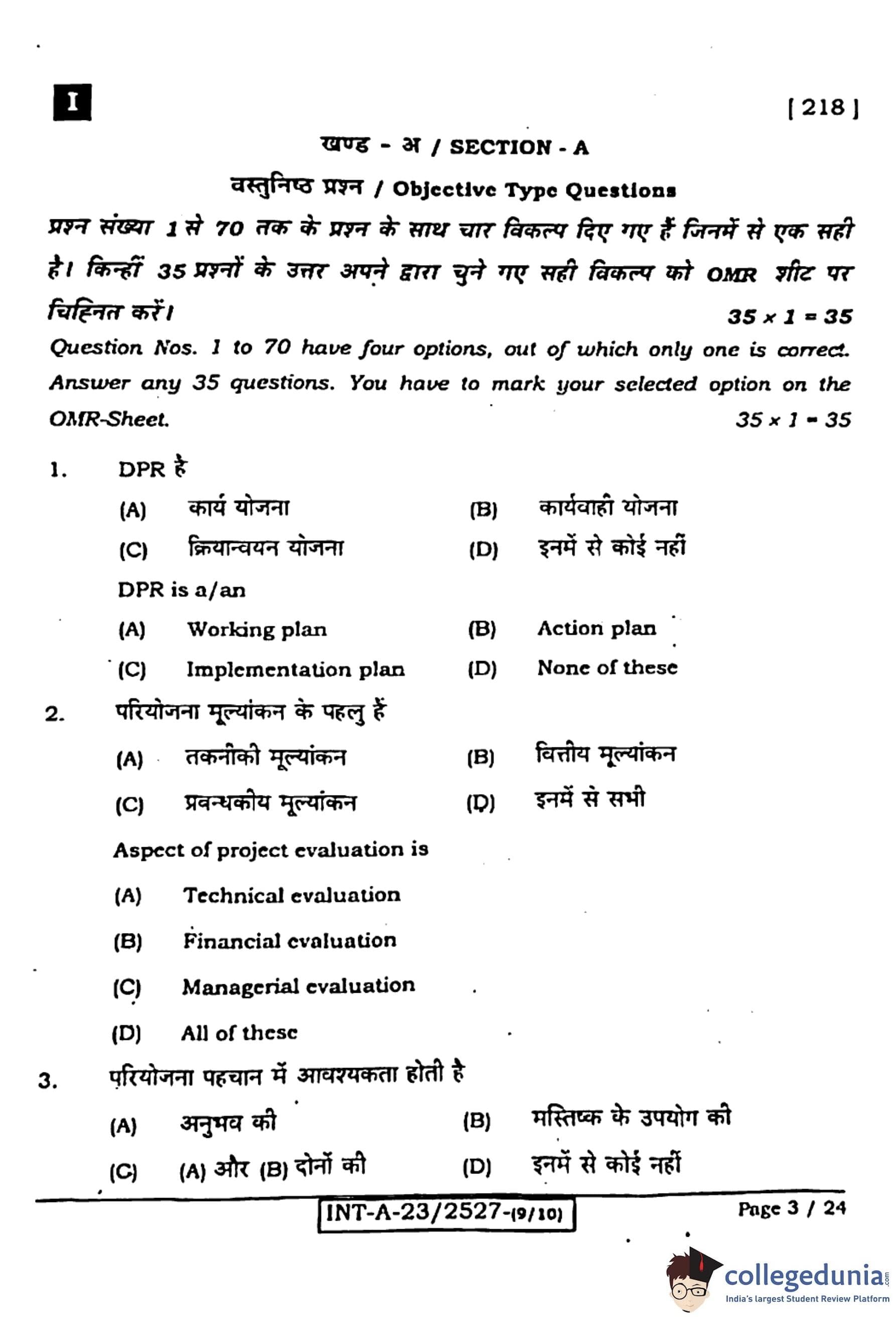
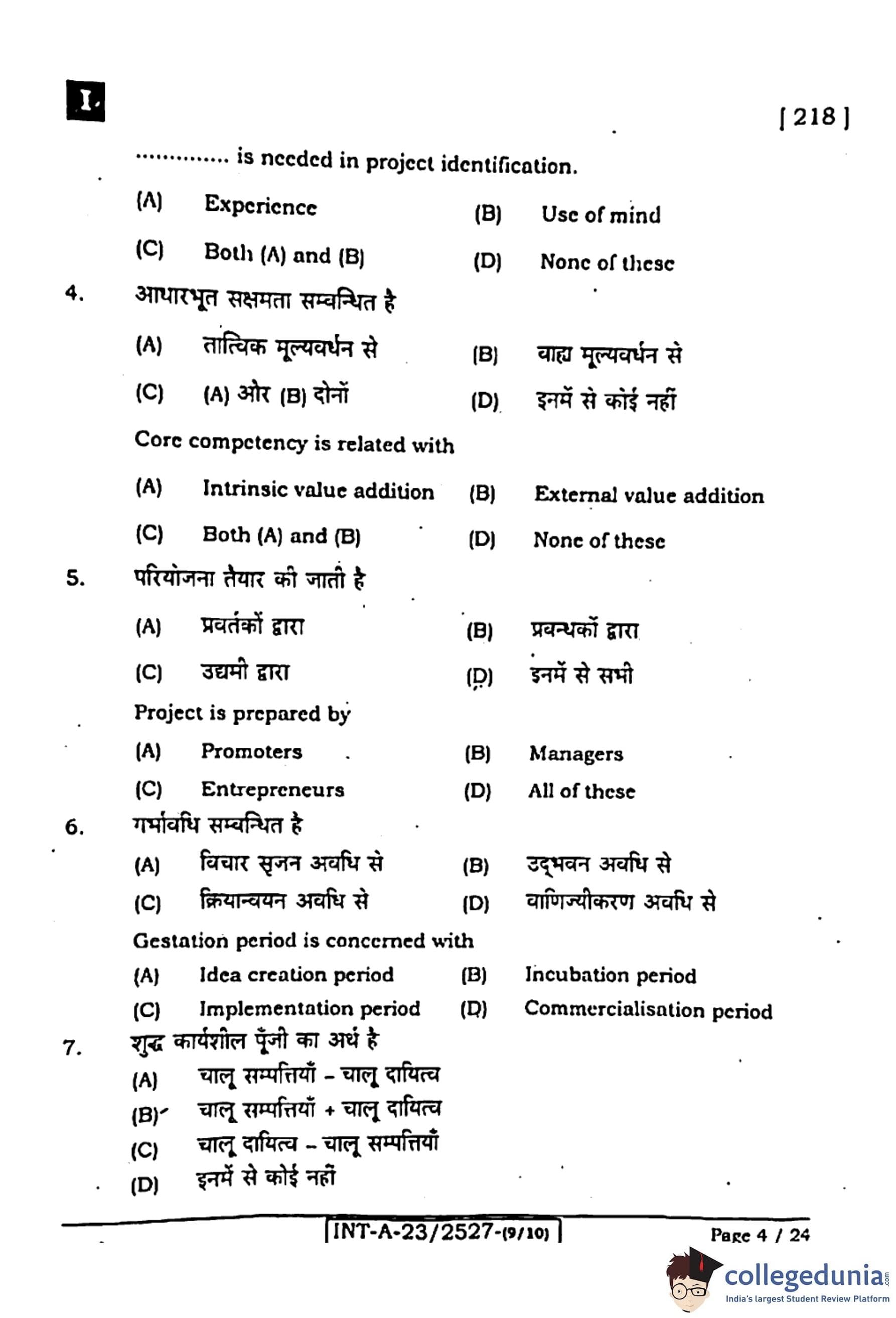

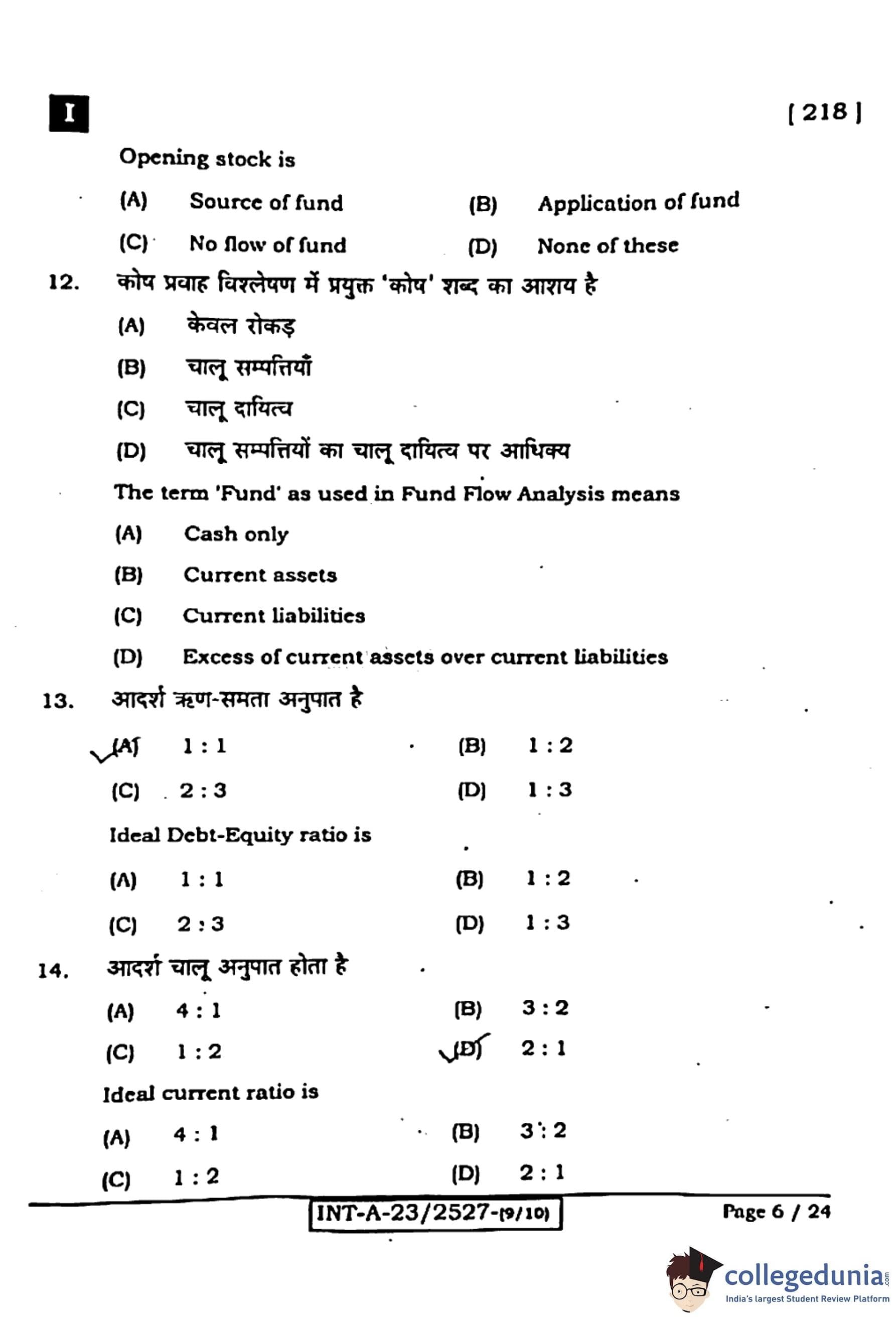
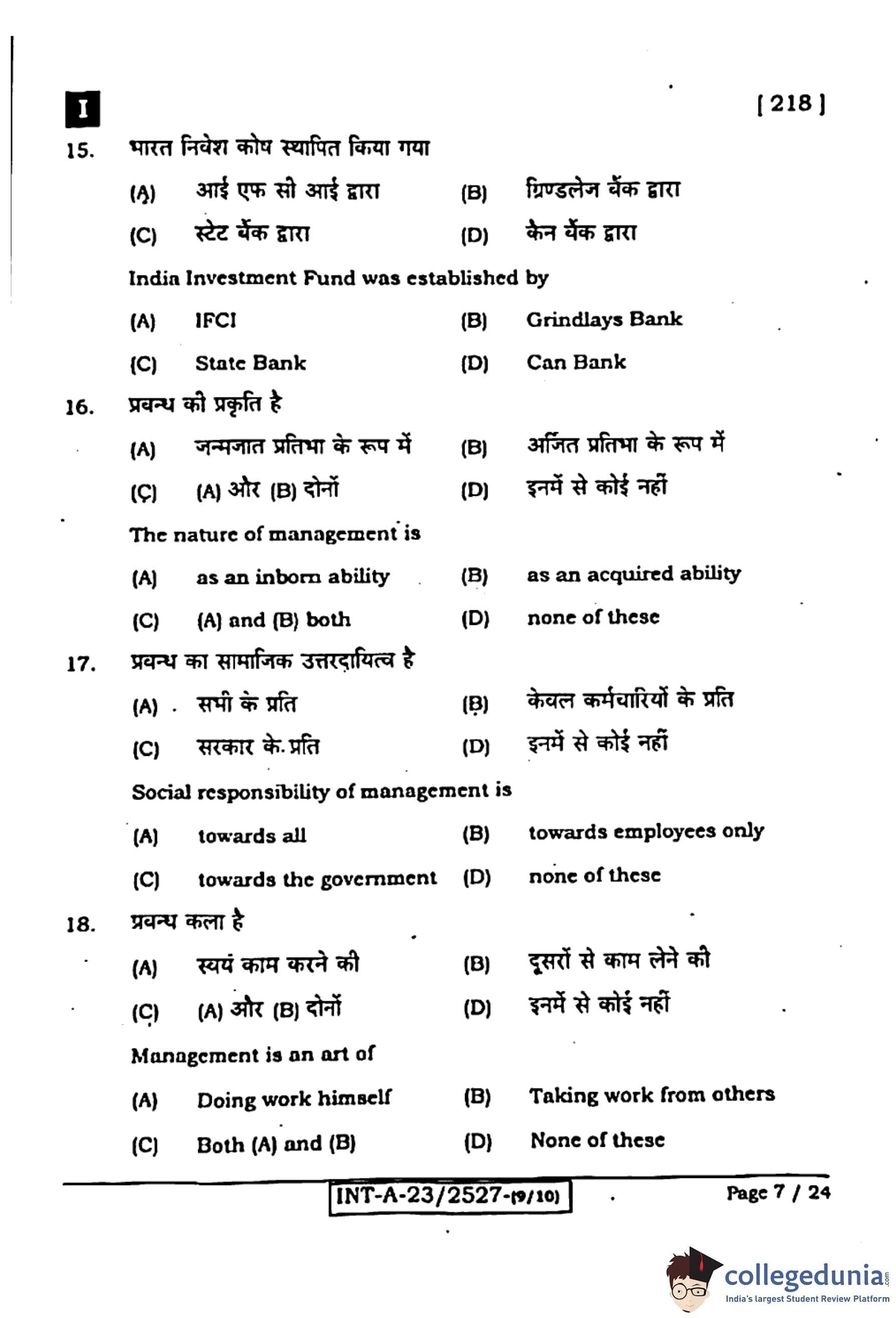
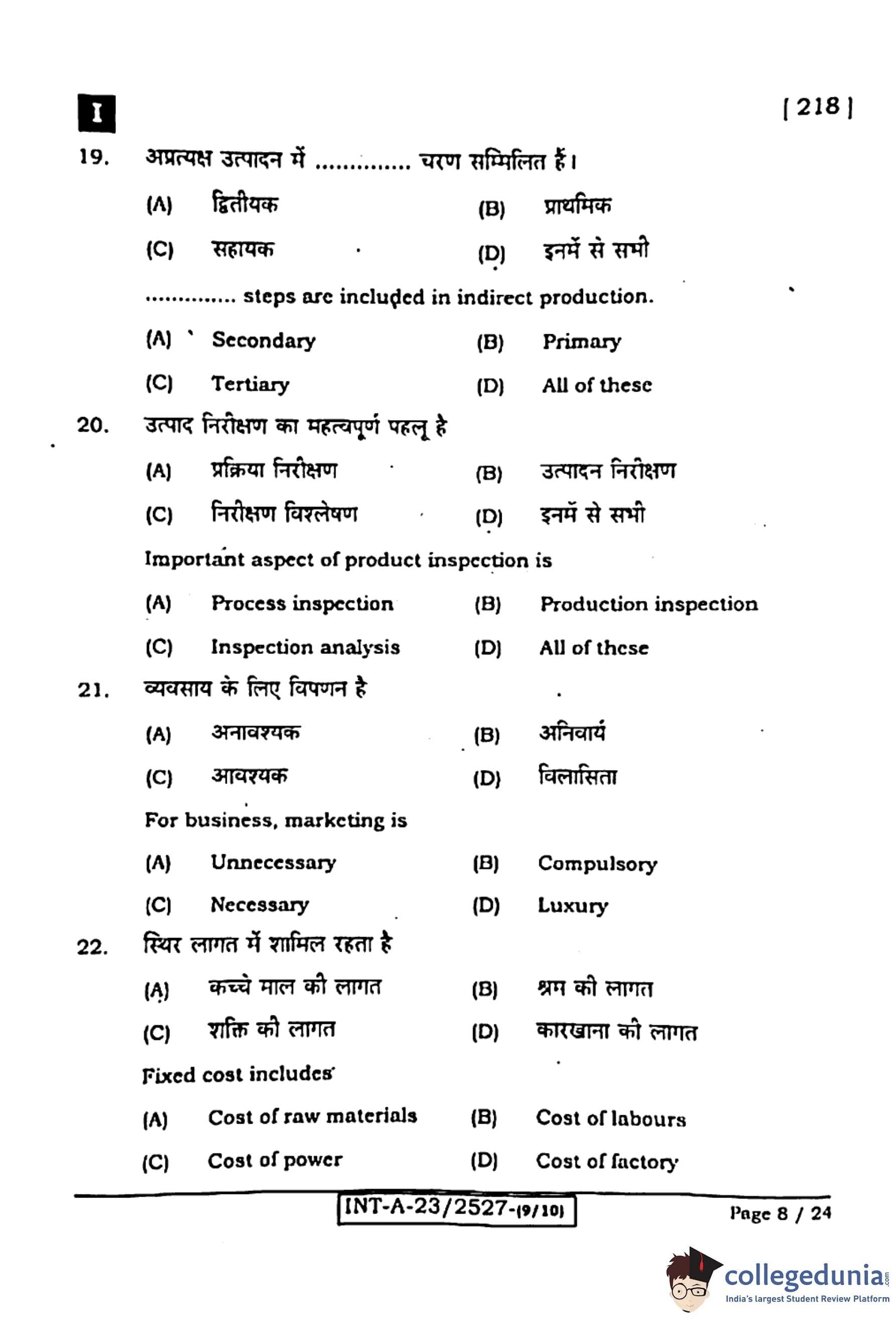
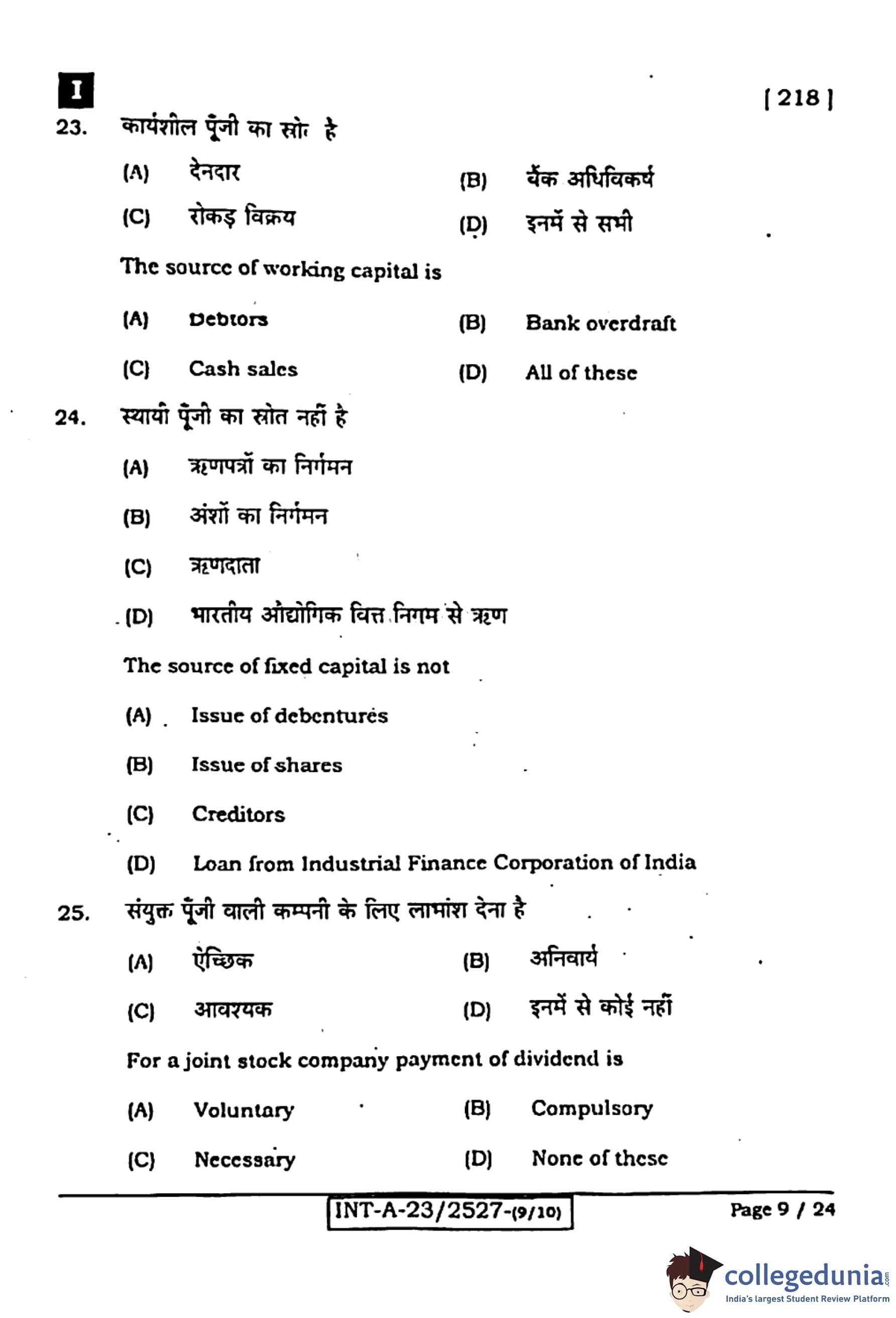

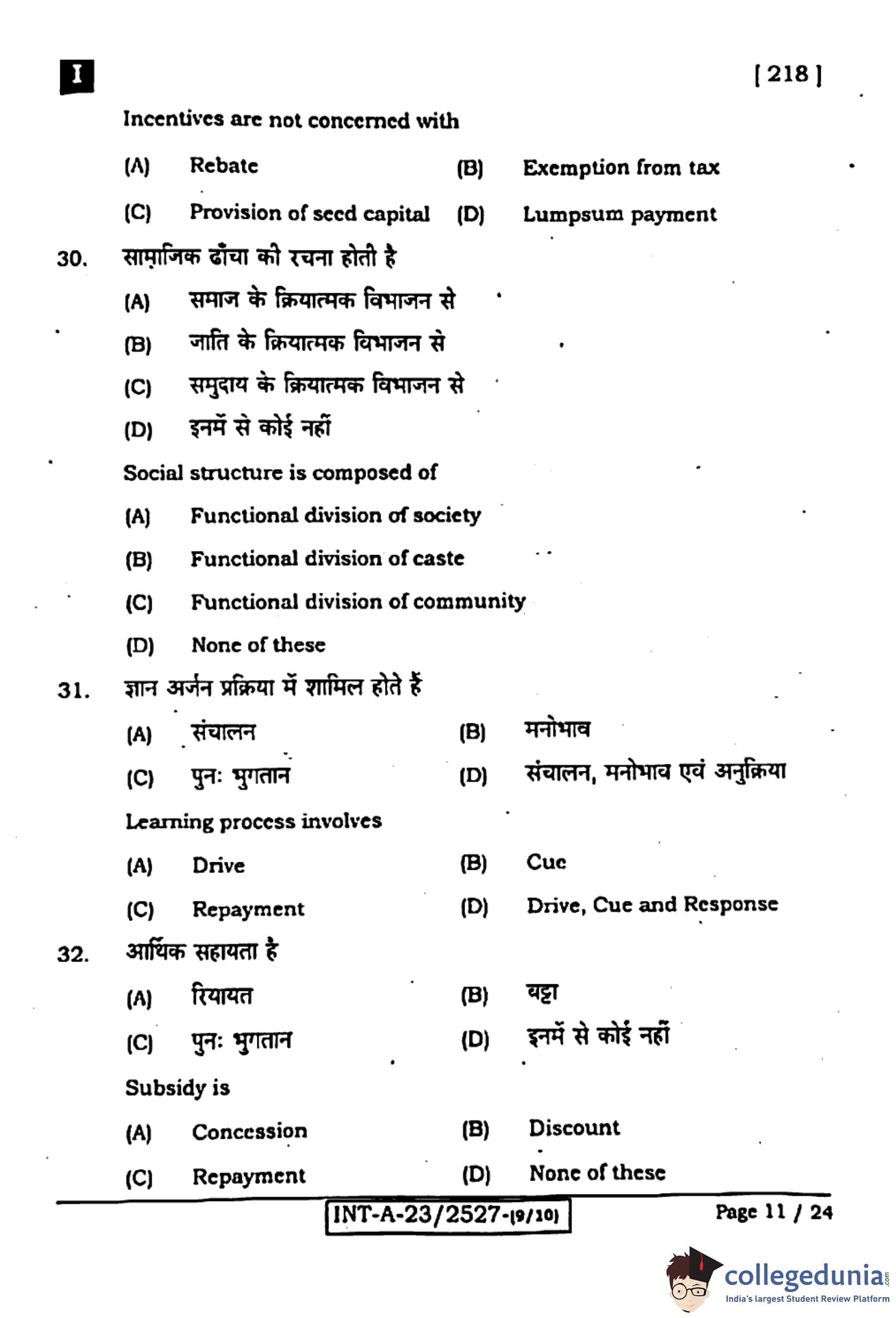
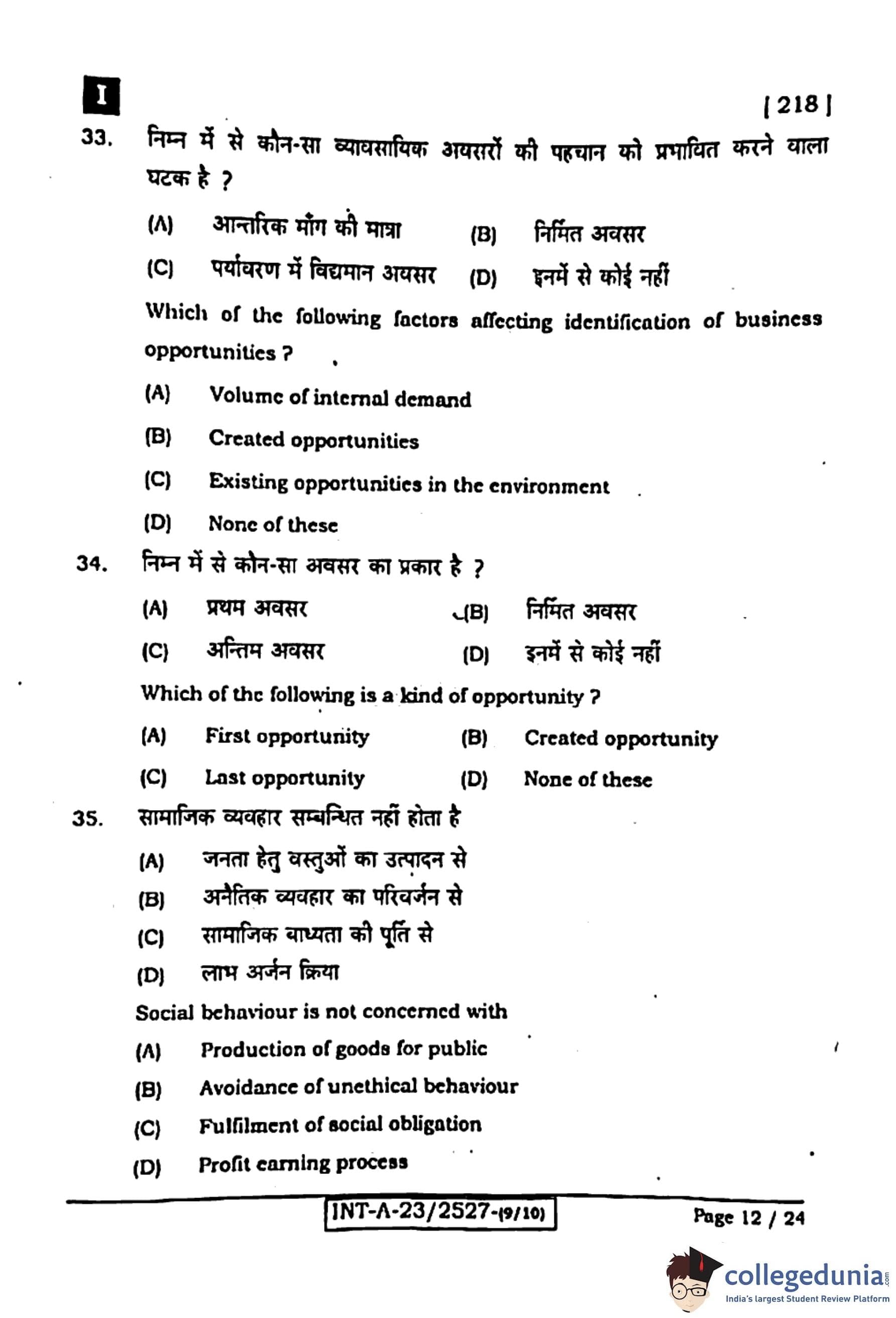
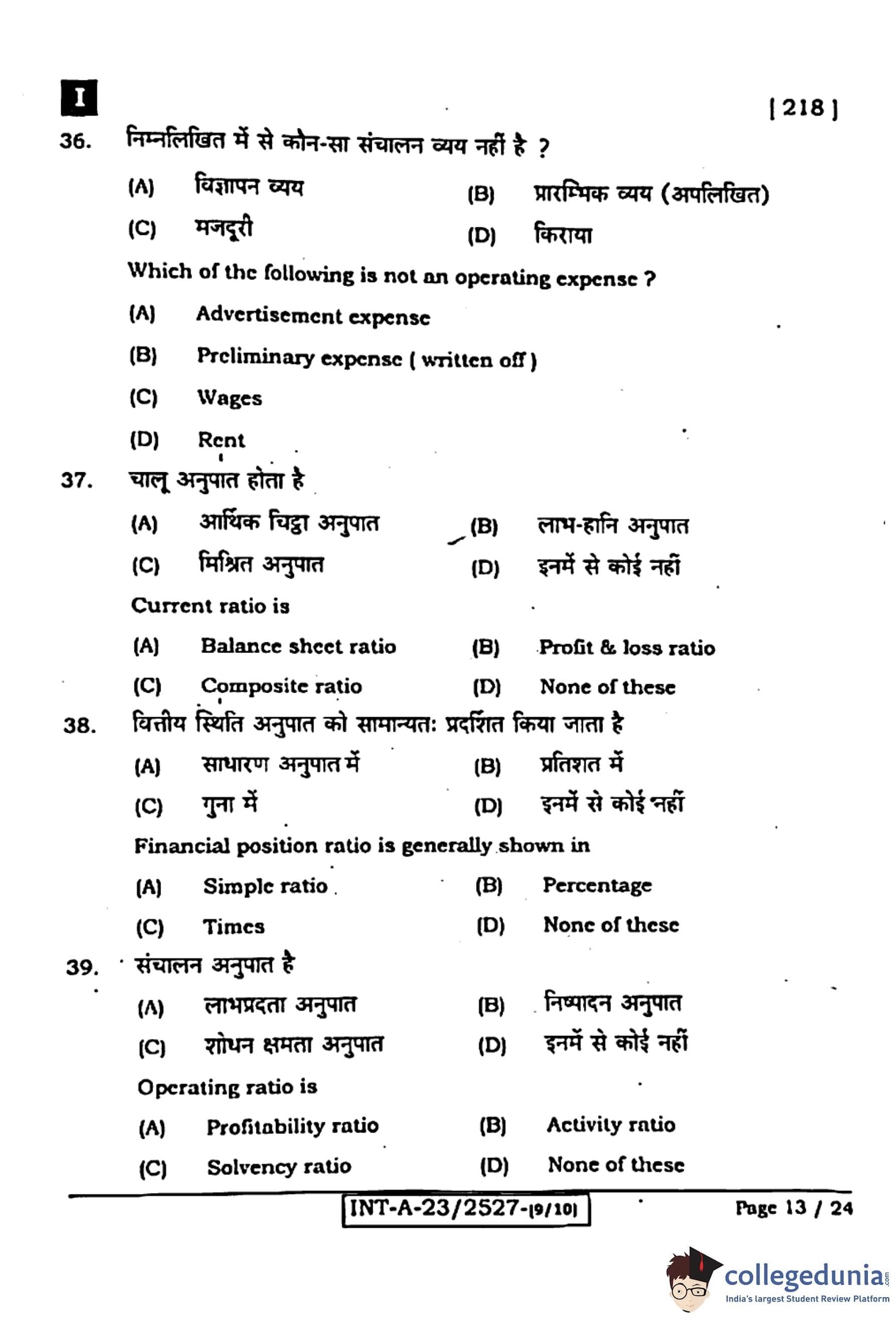
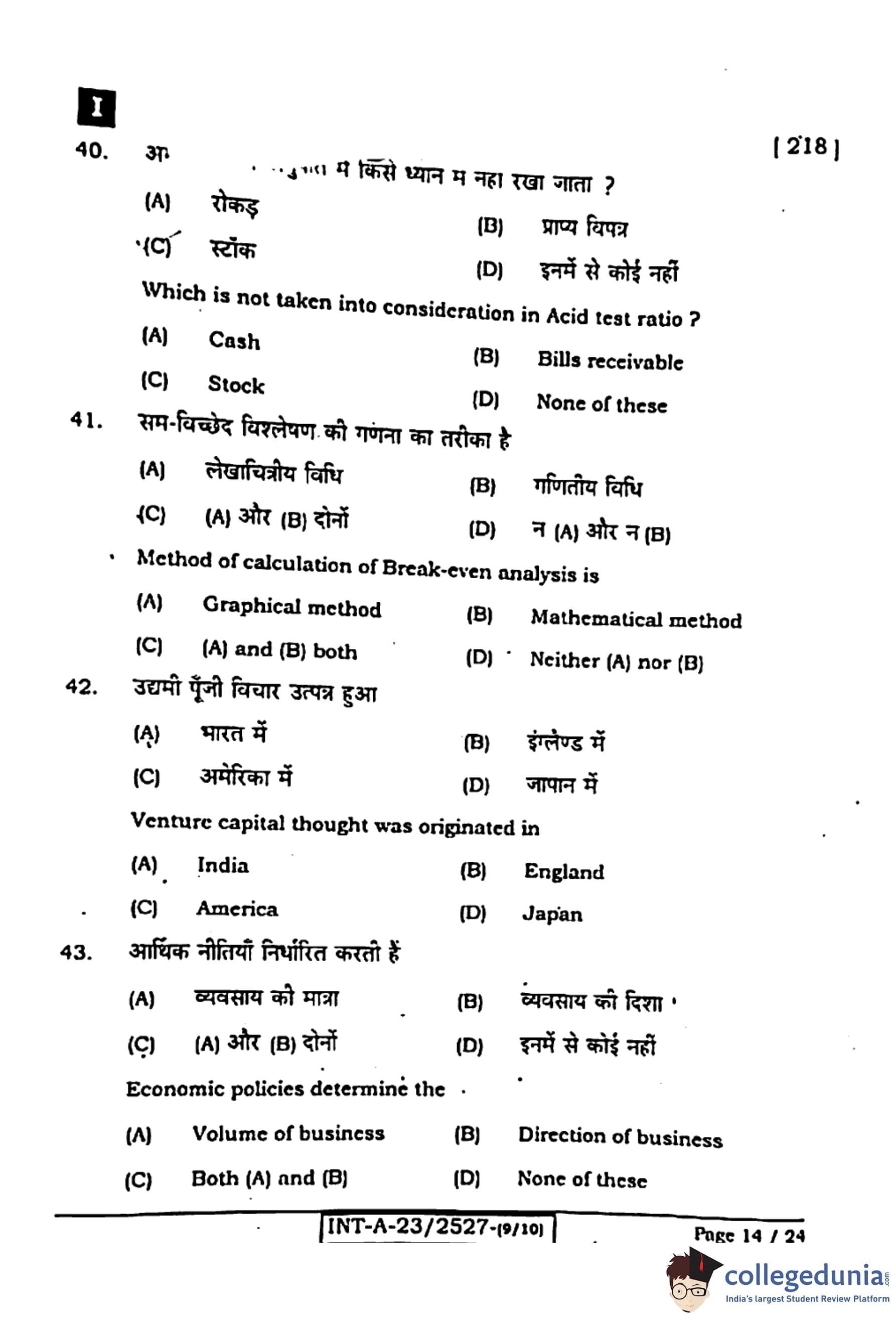
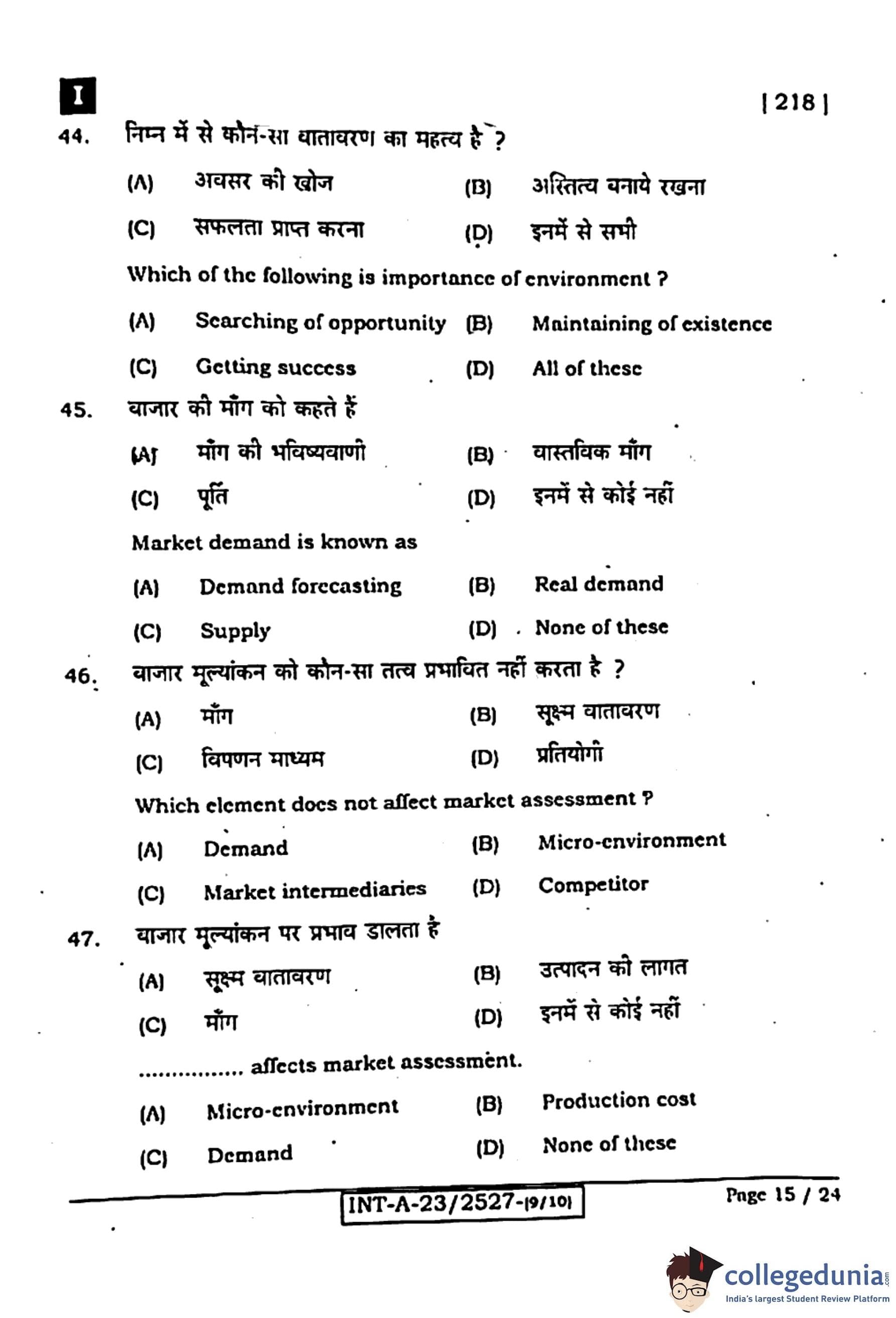
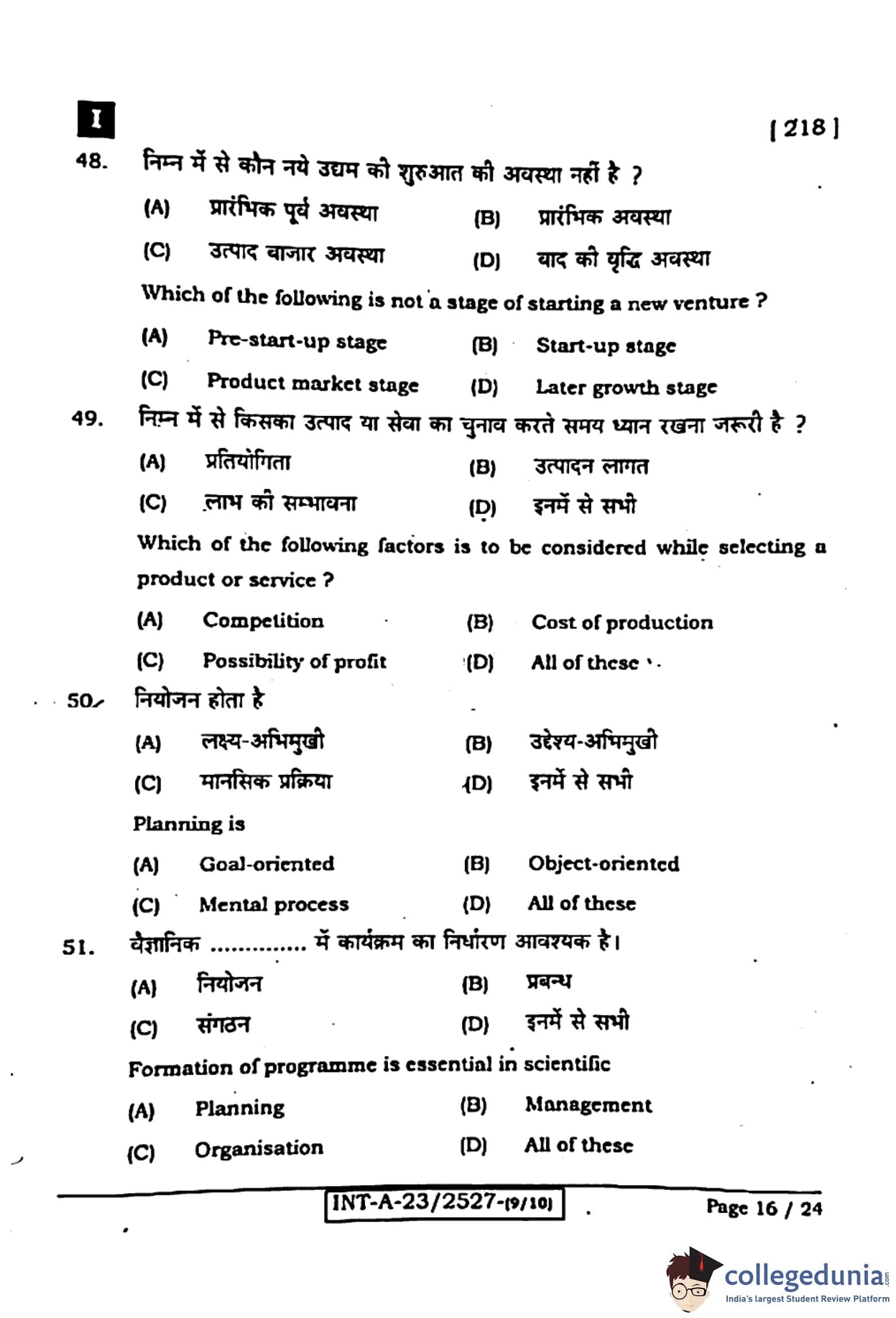
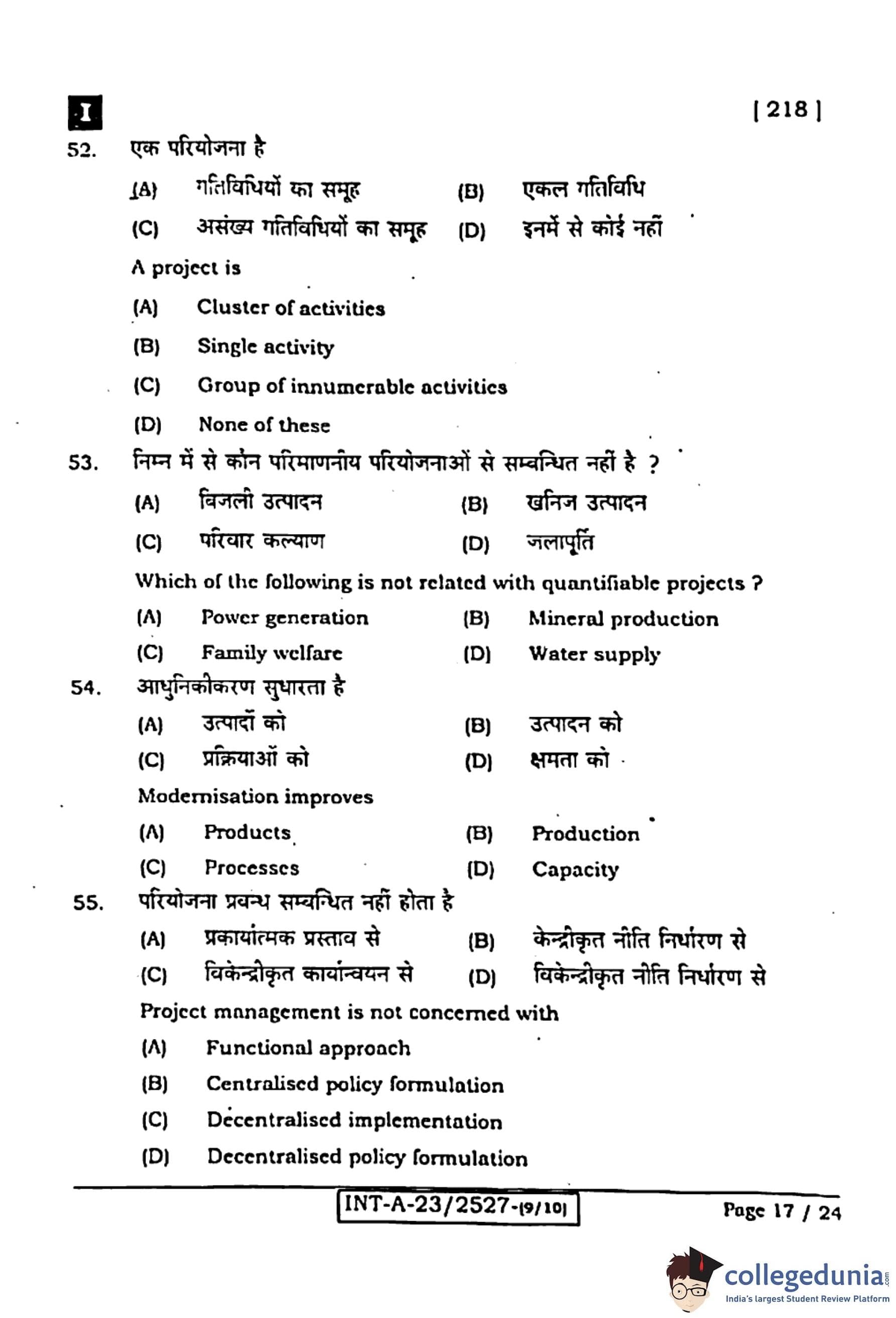
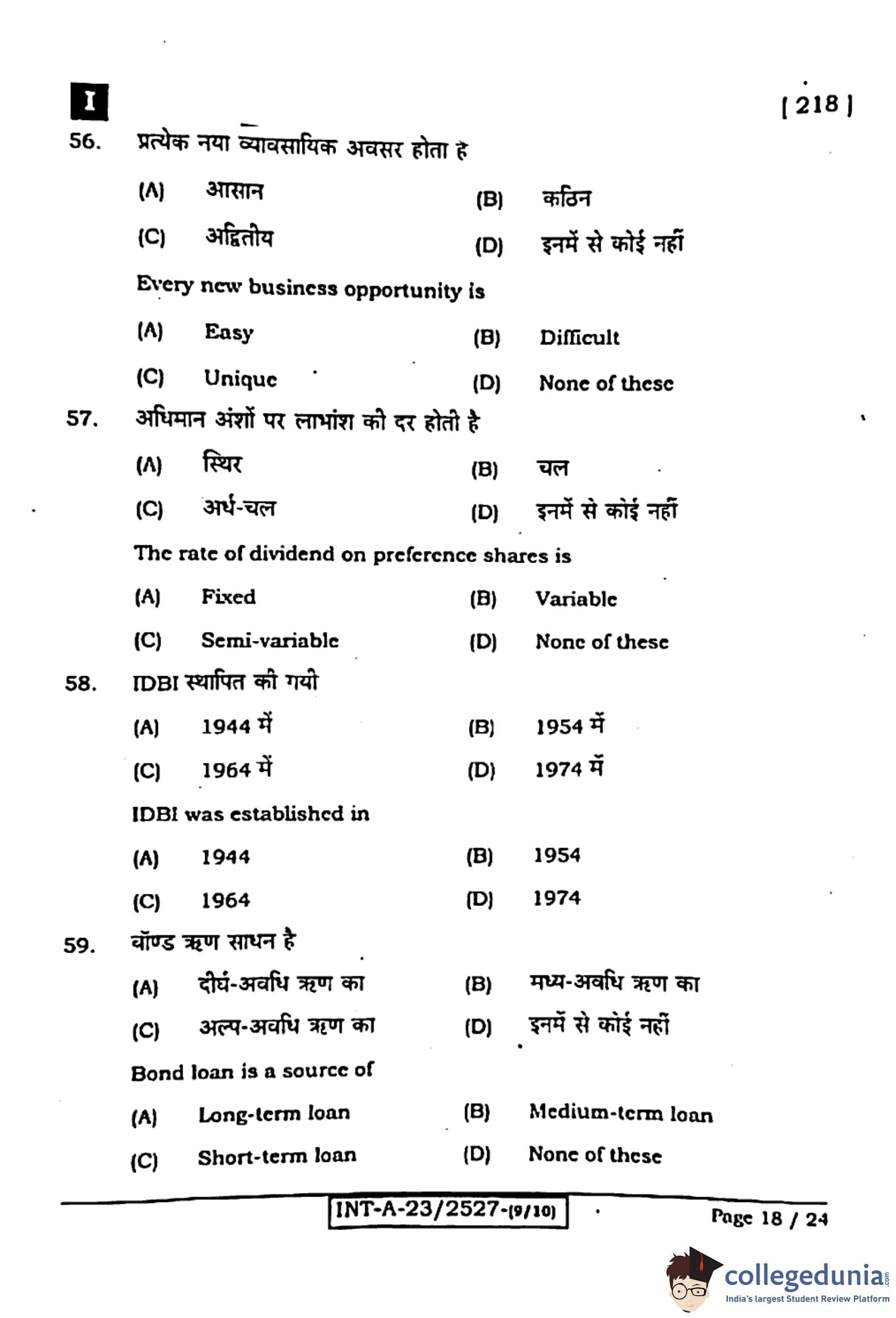
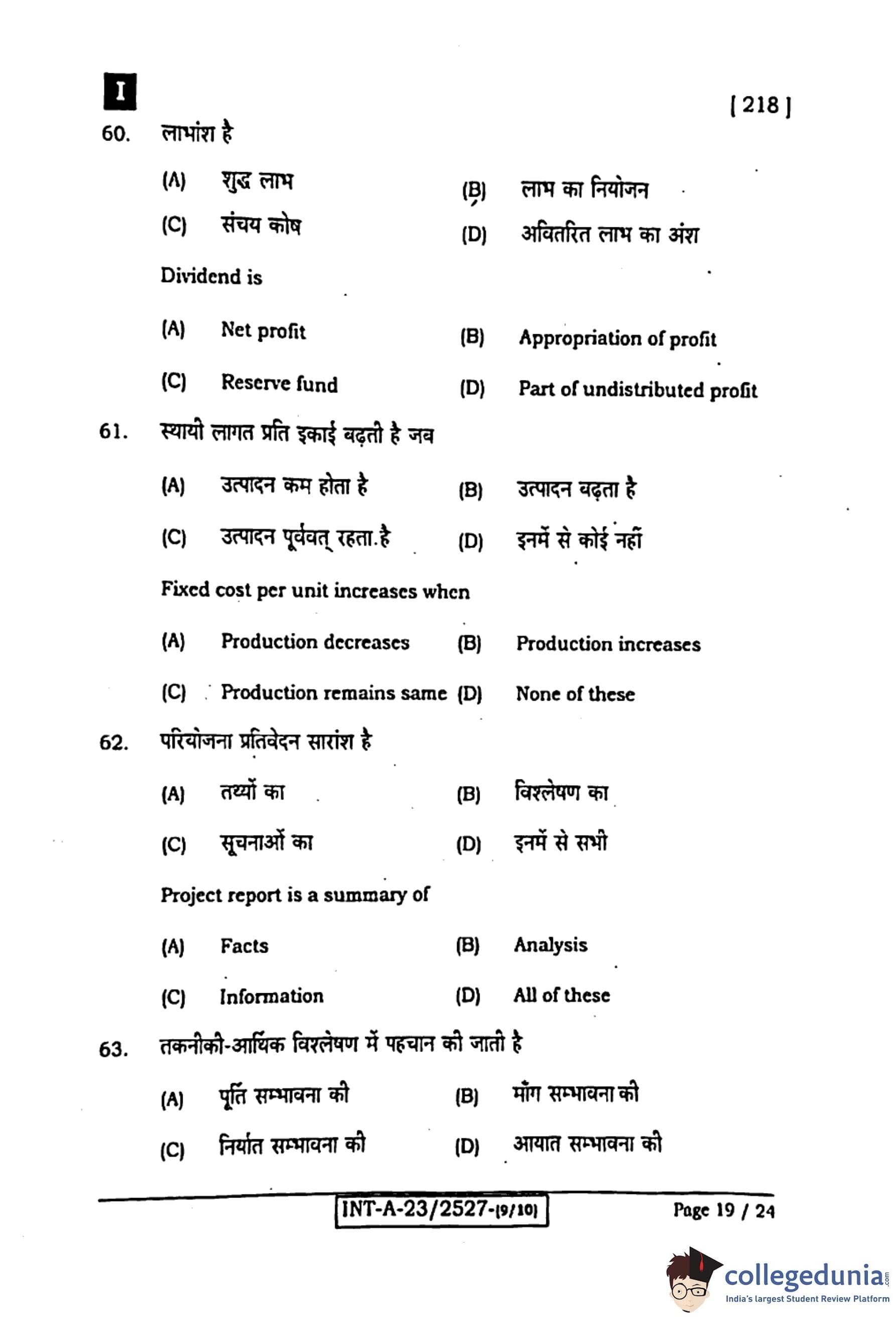
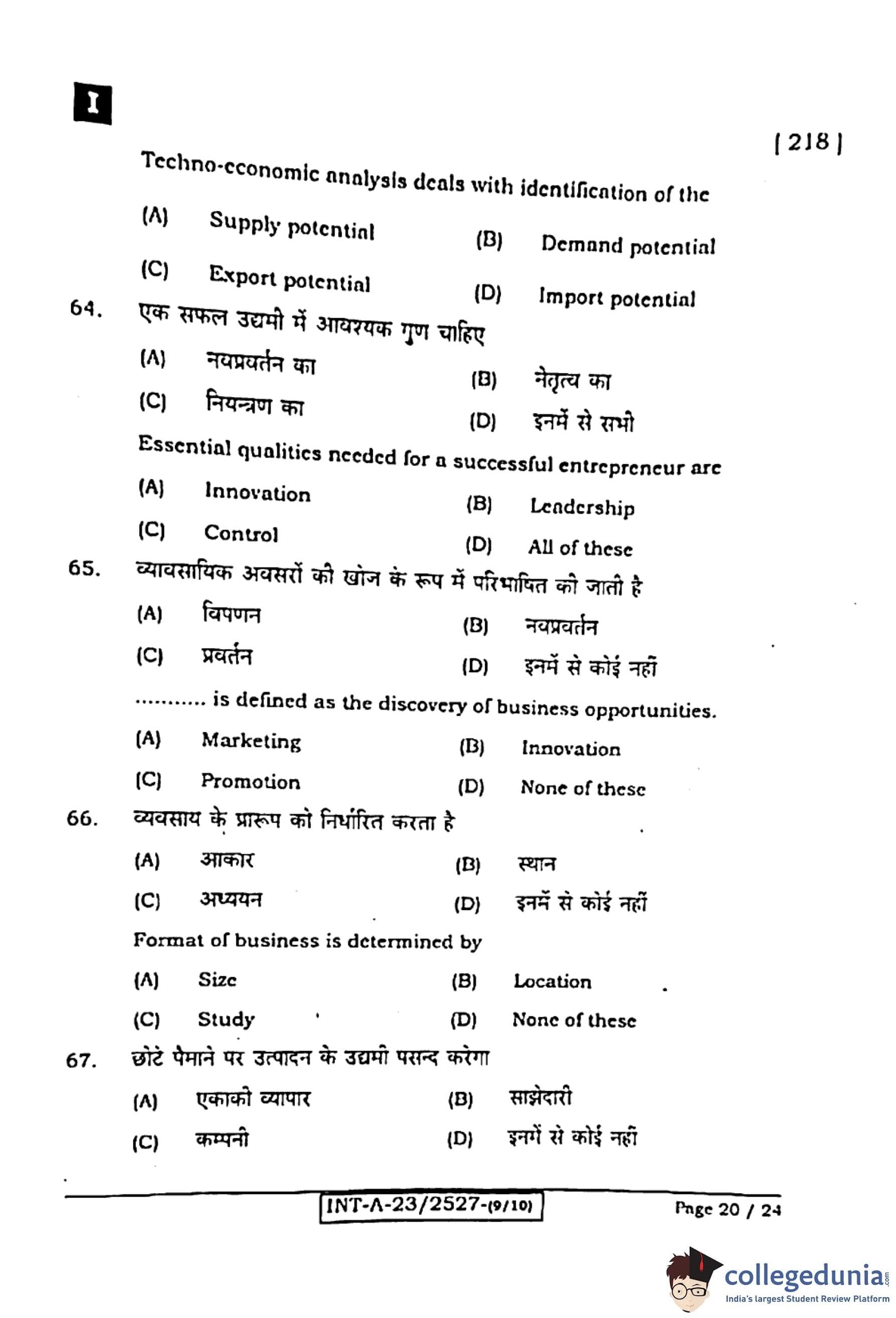

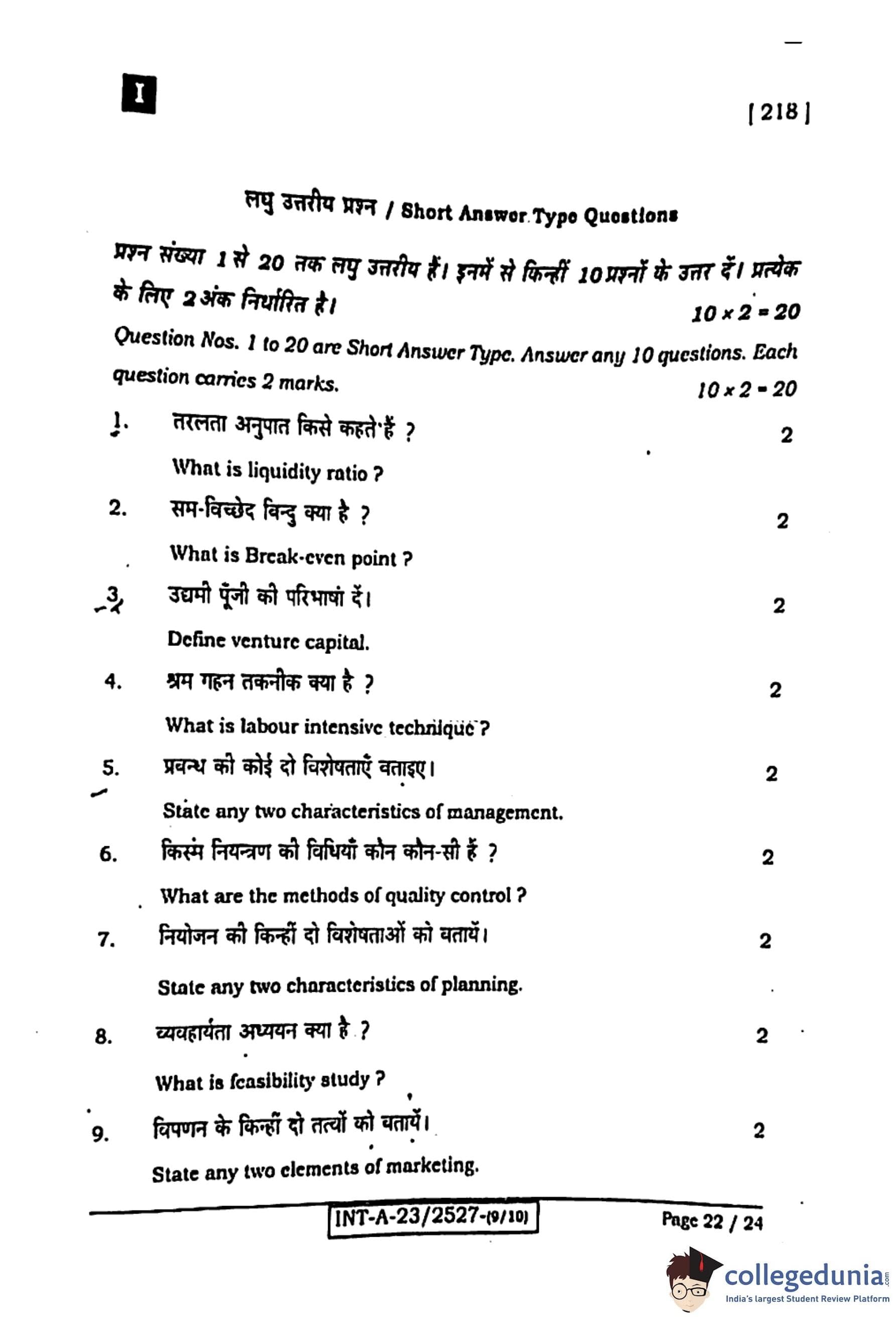
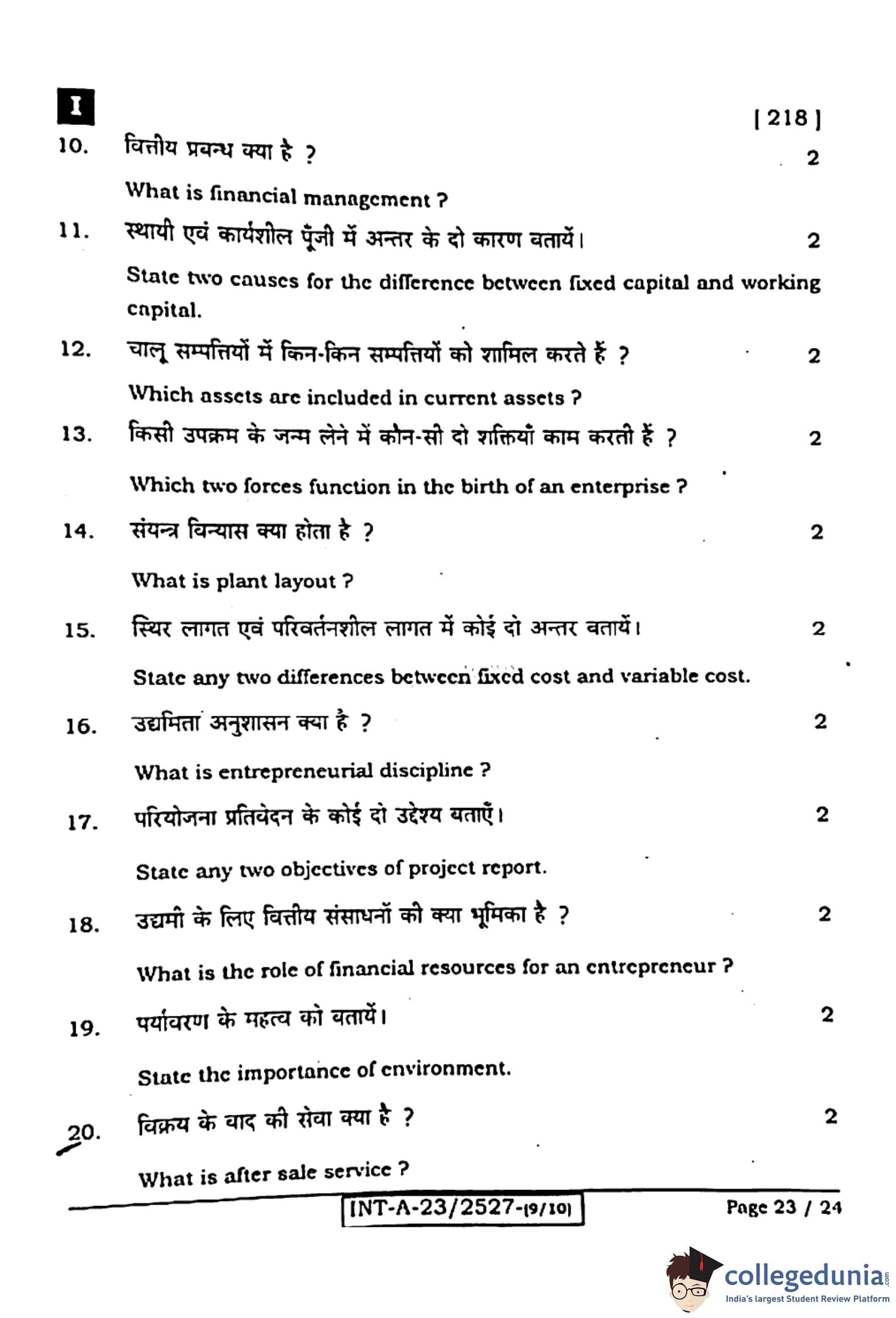
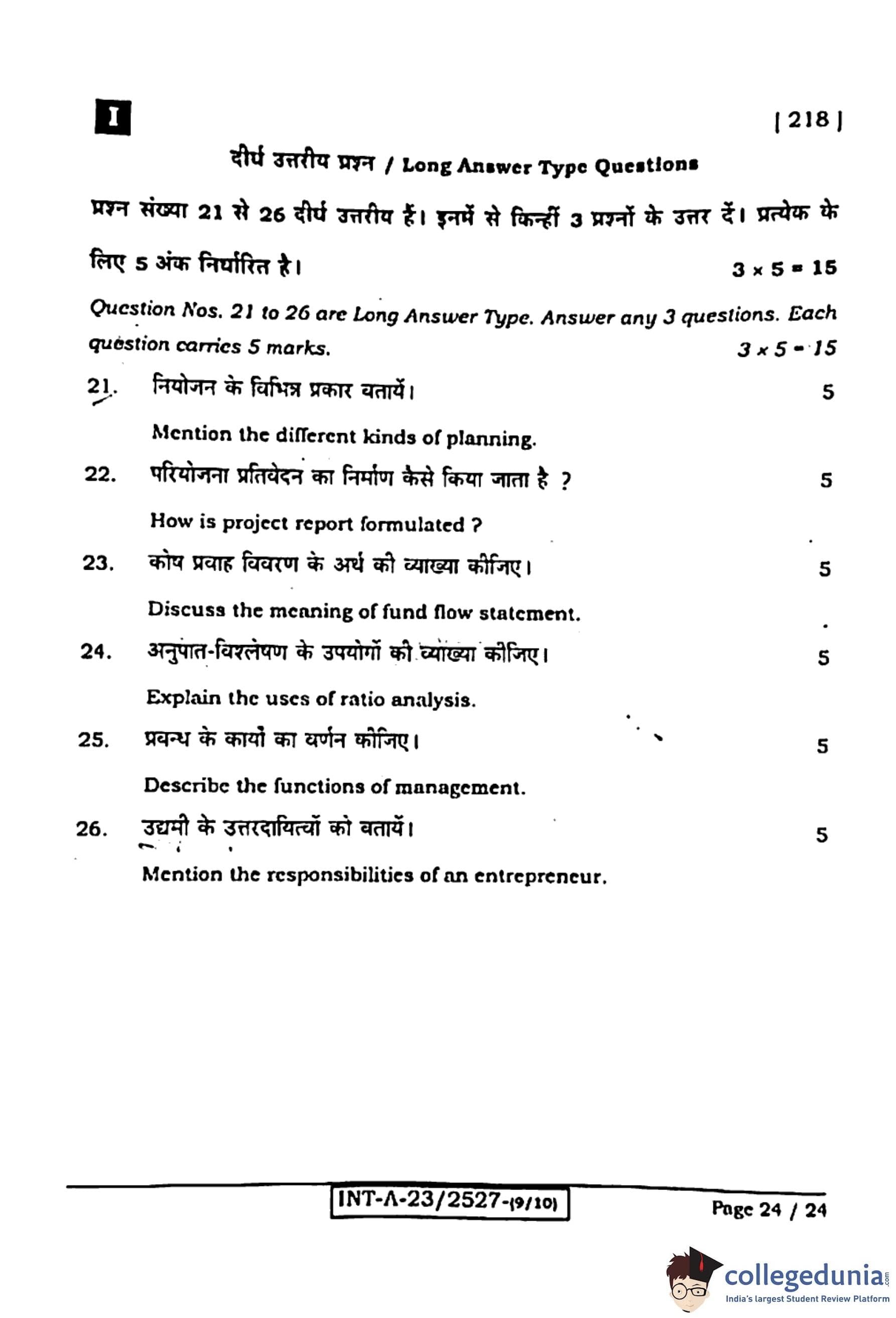













Comments