




Bihar Board Class 12 Chemistry Question Paper 2023 PDF (Code 118) is available for download here. The Economics (Elective) exam was conducted January 10 and January 20, 2023. The total marks for the theory paper are 100. Students reported the paper to be easy to moderate.
Bihar Board Class 12 Chemistry Question Paper 2023 (Code 118) with Solutions
| Bihar Board Class 12 Chemistry Question Paper with Answer Key |  Download Download |
Check Solutions |

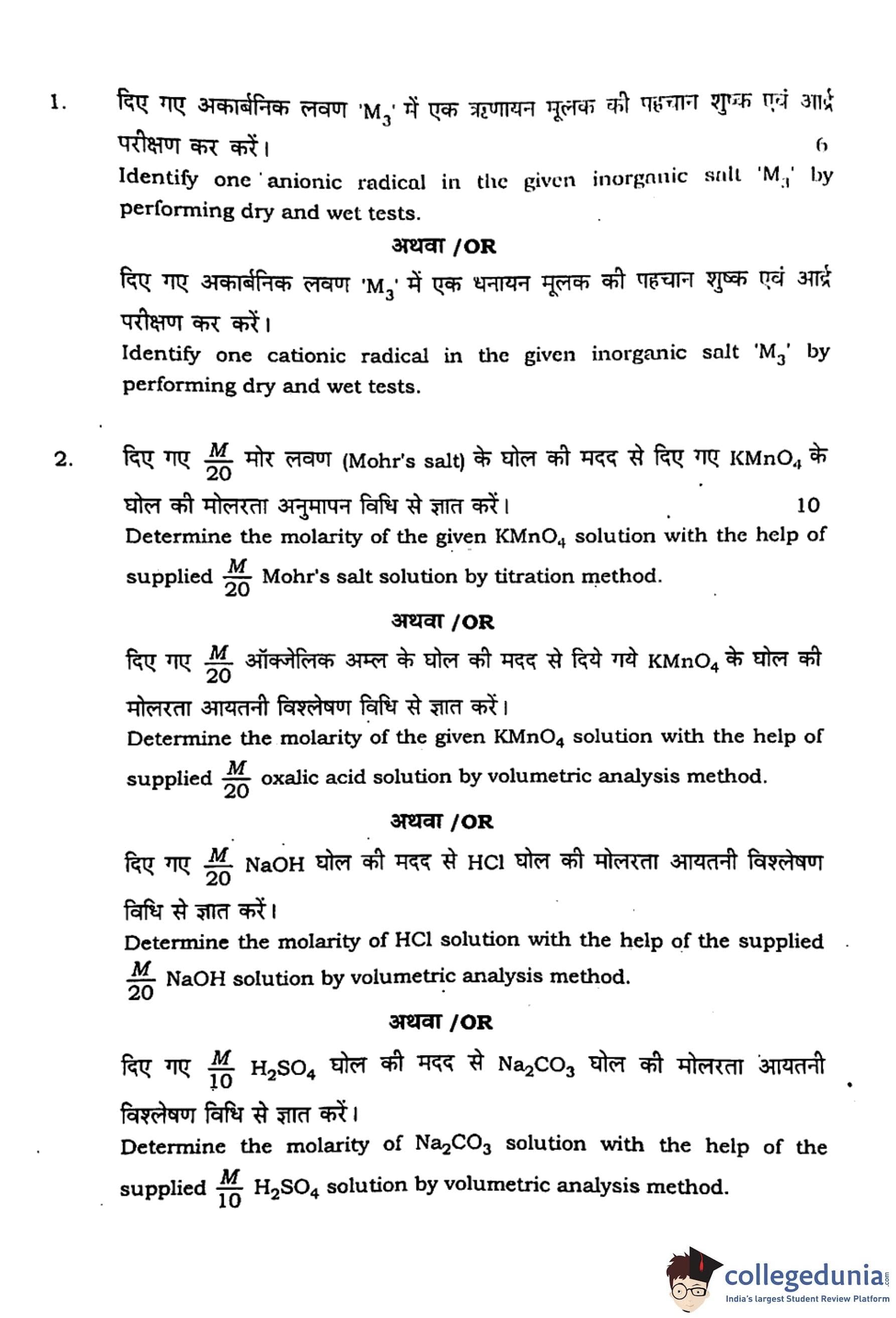
Identify one anionic radical in the given inorganic salt ``M\(_3\)'' by performing dry and wet tests.
View Solution
Aim.
To detect \emph{one acidic radical (anion) present in the sample ``M\(_3\)'' using standard preliminary (dry) and confirmatory (wet) tests.
Apparatus \& Reagents (as needed).
Test tubes, glass rod, dropper, corked test tube for brown–ring, watch glass, lead acetate paper, blue/red litmus, lime water (Ca(OH)\(_2\)), freshly prepared FeSO\(_4\) solution, BaCl\(_2\) solution, dil.\ \& conc.\ H\(_2\)SO\(_4\), AgNO\(_3\), dil.\ NH\(_3\), chlorine water, starch--KI paper, KMnO\(_4\)/acid, etc.
Step 1: Preliminary (physical) check.
Note colour/odour/texture. (Most anion tests are independent of this, but note any vinegar smell \(\Rightarrow\) acetate, rotten‐egg odour on moistening \(\Rightarrow\) sulphide hints.)
Step 2: Dry tests (on solid or with conc.\ acid).
(A) Action of dilute H\(_2\)SO\(_4\) on a pinch of salt. Observe the gas.
\begin{tabular{|p{5.5cm|p{7.5cm|
\hline
Observation & Inference (possible anion)
\hline
Brisk effervescence; gas turns lime water milky, extinguishes flame & CO\(_3^{2-\) (carbonate)
\hline
Pungent gas with smell of burning sulphur; acidified dichromate paper turns green / moist blue litmus turns red then bleached & SO\(_3^{2-\) (sulphite) \(\to\) SO\(_2\)
\hline
Rotten‐egg smell; blackening of moist lead acetate paper & S\(^{2-}\) (sulphide) \(\to\) H\(_2\)S
\hline
Vinegar smell on warming & CH\(_3\)COO\(^-\) (acetate)
\hline
Brown fumes appear only on adding Cu turnings too & NO\(_2\) from NO\(^-\)/NO\(_3^-\) (nitrite/nitrate screening)
\hline
\end{tabular
(B) Action of \underline{conc. H\(_2\)SO\(_4\) (cautiously).
\begin{tabular{|p{5.5cm|p{7.5cm|
\hline
Observation & Inference
\hline
Dense white fumes (HCl) that fume with NH\(_3\) & Cl\(^-\)
\hline
Reddish–brown vapours (Br\(_2\)) & Br\(^-\)
\hline
Violet vapours/black deposit (I\(_2\)) & I\(^-\)
\hline
No obvious change (screen out SO\(_4^{2-\), PO\(_4^{3-\) etc.) & Test by wet method
\hline
\end{tabular
Step 3: Wet (confirmatory) tests on aqueous extract.
Prepare an aqueous extract of ``M\(_3\)'' (boil gently with distilled water, cool, filter). Perform appropriate tests guided by Step~2. Use at most one confirmatory set and record the matching result.
(i) Halides (Cl\(^-\), Br\(^-\), I\(^-\)) — AgNO\(_3\) test:
To 2\,mL extract add dil.\ HNO\(_3\), then AgNO\(_3\). Note precipitate and its behaviour with NH\(_3\).
\begin{tabular{|p{5.5cm|p{7.5cm|
\hline
White ppt.\ \(\to\) dissolves in dil.\ NH\(_3\) & Cl\(^-\) (AgCl)
\hline
Pale cream ppt.\ \(\to\) dissolves only in conc.\ NH\(_3\) & Br\(^-\) (AgBr)
\hline
Yellow ppt.\ \(\to\) insoluble in NH\(_3\) & I\(^-\) (AgI)
\hline
\end{tabular
\textit{(ii) Sulphate (SO\(_4^{2-\)): Add dil.\ HCl then BaCl\(_2\). White heavy ppt.\ that is insoluble in acids \(\Rightarrow\) BaSO\(_4\) confirms SO\(_4^{2-}\).
(iii) Sulphite (SO\(_3^{2-\)): Acidify extract and add acidified KMnO\(_4\) (or dichromate). Decolourisation with smell of SO\(_2\) confirms SO\(_3^{2-}\). Also gives white ppt.\ with BaCl\(_2\) soluble in dil.\ HCl (BaSO\(_3\)).
(iv) Carbonate (CO\(_3^{2-\)): Add dil.\ acid; pass gas through lime water \(\Rightarrow\) milky CaCO\(_3\) which clears on excess CO\(_2\) (due to Ca(HCO\(_3\))\(_2\)) confirms CO\(_3^{2-}\).
(v) Nitrate (NO\(_3^-\)) — Brown‐ring test:
To 2\,mL extract add freshly prepared FeSO\(_4\), then carefully add conc.\ H\(_2\)SO\(_4\) down the side to form two layers. A brown ring at the junction \(\Rightarrow\) NO\(_3^-\).
\textit{(vi) Nitrite (NO\(_2^-\)): Acidify a portion and add freshly prepared starch–KI paper: blue colour (via I\(_2\)) confirms NO\(_2^-\). Also, with dil.\ H\(_2\)SO\(_4\) and Cu turnings \(\Rightarrow\) brown fumes of NO\(_2\).
\textit{(vii) Phosphate (PO\(_4^{3-\)): Acidify with HNO\(_3\), warm, then add ammonium molybdate and heat gently: canary yellow ppt. of ammonium phosphomolybdate confirms PO\(_4^{3-\).
(viii) Acetate (CH\(_3\)COO\(^-\)): Warm the solid/extract with conc.\ H\(_2\)SO\(_4\) + ethanol: fruity odour of ethyl acetate; or heat with conc.\ H\(_2\)SO\(_4\) alone: vinegar smell (acetic acid).
Step 4: Inference and Report.
Match your \emph{observations from Step~2 with \emph{confirmatory evidence from Step~3 and write:
Anion present in ``M\(_3\)'': \hspace{4cm \quad (write the confirmed radical).
Quick Tip: Do \emph{screening with acid tests first, then run only the relevant confirmatory test. For halides: AgNO\(_3\) colour + NH\(_3\) solubility pattern is decisive. For sulphite vs sulphate: Ba\(^{2+\) test + acid solubility separates them. Handle conc.\ H\(_2\)SO\(_4\) and NO\(_x\) fumes in a fume hood.
Identify one cationic radical in the given inorganic salt ``M\(_3\)'' by performing dry and wet tests.
View Solution
Aim.
To identify one cation (metal ion) from the given salt ``M\(_3\)'' using dry and wet tests.
Apparatus.
Bunsen burner, test tubes, glass rod, droppers, conc.\ HCl, BaCl\(_2\), sodium tetraphenylborate, ammonium hydroxide, etc.
Dry Tests:
\textit{Step 1: Flame Test.
Take a small quantity of ``M\(_3\)'' and place it in the Bunsen flame. The flame color will help identify the cation.
- Sodium (Na\(^+\)) will give a yellow flame.
- Potassium (K\(^+\)) will give a lilac flame.
- Copper (Cu\(^2+\)) will give a green flame.
\textit{Step 2: Action with Concentrated Acids.
Place a small quantity of salt in a test tube and add dilute HCl or HNO\(_3\).
Observe any reactions that occur, such as precipitation or gas formation.
Wet Tests:
\textit{Step 1: Precipitation with BaCl\(_2\).
To a portion of the aqueous extract of ``M\(_3\)'', add dilute HCl and BaCl\(_2\). Observe for a white precipitate. This indicates the presence of Pb\(^2+\) or Ca\(^2+\).
\textit{Step 2: Reaction with Ammonium Hydroxide.
Add ammonium hydroxide to the solution. If a blue precipitate forms, this suggests the presence of Cu\(^2+\).
\textit{Step 3: Specific Ion Tests.
- For NH\(_4\)\^+ (Ammonium): Add sodium tetraphenylborate to detect NH\(_4\)\^+.
- For Fe\(^2+\) (Iron): Confirm with potassium ferrocyanide.
Conclusion:
Based on the dry and wet test results, the cationic radical present in ``M\(_3\)'' is identified as \underline{\hspace{2cm. (Write the confirmed cation here). Quick Tip: Perform the dry test first to narrow down possibilities, then use targeted wet tests to confirm. For example, a blue precipitate with NH\(_4\)OH confirms Cu\(^2+\), while a white precipitate with BaCl\(_2\) confirms Pb\(^2+\).
Determine the molarity of the given KMnO\(_4\) solution with the help of supplied Mohr's salt solution by titration method.
View Solution
Aim.
To determine the molarity of the given KMnO\(_4\) solution using Mohr's salt solution (Fe\(^{2+}\)).
Apparatus.
Burette, conical flask, pipette, Bunsen burner, test tube, HCl, H\(_2\)SO\(_4\), Mohr's salt solution.
Procedure.
1. Fill the burette with the KMnO\(_4\) solution.
2. Take a known volume of Mohr’s salt solution (Fe\(^{2+}\)) in a conical flask.
3. Add a few drops of dilute H\(_2\)SO\(_4\) to provide H\(^+\) for the reaction.
4. Titrate the KMnO\(_4\) solution into the Mohr’s salt solution while stirring continuously.
5. A persistent pink color will appear near the endpoint. This indicates that all the Fe\(^{2+}\) has reacted, and the endpoint is reached.
6. Note the volume of KMnO\(_4\) used.
Calculation.
Using the equation: \[ M_1V_1 = M_2V_2 \]
Where:
- \(M_1\) = Molarity of KMnO\(_4\)
- \(V_1\) = Volume of KMnO\(_4\) used in titration
- \(M_2\) = Molarity of Mohr's salt solution
- \(V_2\) = Volume of Mohr's salt solution used in titration
Since the balanced reaction between KMnO\(_4\) and Mohr's salt is: \[ 2MnO_4^- + 5Fe^{2+} \rightarrow 2Mn^{2+} + 5Fe^{3+} \]
The molar ratio between KMnO\(_4\) and Fe\(^{2+}\) is 2:5.
Quick Tip: Always perform the titration slowly near the endpoint to avoid overshooting the pink color.
Determine the molarity of the given KMnO\(_4\) solution with the help of supplied oxalic acid solution by volumetric analysis method.
View Solution
Aim.
To determine the molarity of the given KMnO\(_4\) solution using oxalic acid solution by volumetric analysis.
Apparatus.
Burette, conical flask, pipette, Bunsen burner, test tube, H\(_2\)SO\(_4\), oxalic acid solution.
Procedure.
1. Fill the burette with the KMnO\(_4\) solution.
2. Prepare a known volume of oxalic acid solution in the conical flask.
3. Add a few drops of dilute H\(_2\)SO\(_4\) to the flask to provide H\(^+\) for the reaction.
4. Titrate the KMnO\(_4\) solution into the oxalic acid solution while stirring continuously.
5. A persistent pink color will appear near the endpoint. This indicates that the reaction is complete.
6. Note the volume of KMnO\(_4\) used.
Calculation.
Using the equation: \[ M_1V_1 = M_2V_2 \]
Where:
- \(M_1\) = Molarity of KMnO\(_4\)
- \(V_1\) = Volume of KMnO\(_4\) used in titration
- \(M_2\) = Molarity of oxalic acid solution
- \(V_2\) = Volume of oxalic acid solution used in titration
Since the balanced reaction between KMnO\(_4\) and oxalic acid is: \[ 2MnO_4^- + 5C_2H_2O_4^{2-} \rightarrow 2Mn^{2+} + 5CO_2 + 8H_2O \]
The molar ratio between KMnO\(_4\) and oxalic acid is 2:5.
Quick Tip: Ensure you use fresh oxalic acid solution and maintain a steady titration speed to prevent errors.
Determine the molarity of HCl solution with the help of supplied NaOH solution by volumetric analysis method.
View Solution
Aim.
To determine the molarity of HCl solution using NaOH solution by volumetric analysis.
Apparatus.
Burette, conical flask, pipette, Bunsen burner, test tube, NaOH solution, HCl solution, phenolphthalein indicator.
Procedure.
1. Fill the burette with the NaOH solution of known molarity.
2. Pipette out a known volume of HCl solution into the conical flask.
3. Add a few drops of phenolphthalein indicator.
4. Titrate the NaOH solution into the HCl solution until a persistent pink color appears.
5. Record the volume of NaOH used.
Calculation.
Using the equation: \[ M_1V_1 = M_2V_2 \]
Where:
- \(M_1\) = Molarity of NaOH
- \(V_1\) = Volume of NaOH used
- \(M_2\) = Molarity of HCl (unknown)
- \(V_2\) = Volume of HCl used
Since the reaction is 1:1, the equation simplifies to: \[ M_1V_1 = M_2V_2 \] Quick Tip: Always perform titration slowly near the endpoint to avoid overshooting the pink color.
Determine the molarity of Na\(_2\)CO\(_3\) solution with the help of supplied H\(_2\)SO\(_4\) solution by volumetric analysis method.
View Solution
Aim.
To determine the molarity of Na\(_2\)CO\(_3\) solution using H\(_2\)SO\(_4\) solution by volumetric analysis.
Apparatus.
Burette, conical flask, pipette, Bunsen burner, test tube, H\(_2\)SO\(_4\) solution, Na\(_2\)CO\(_3\) solution, methyl orange indicator.
Procedure.
1. Fill the burette with the H\(_2\)SO\(_4\) solution of known molarity.
2. Pipette out a known volume of Na\(_2\)CO\(_3\) solution into the conical flask.
3. Add a few drops of methyl orange indicator.
4. Titrate the H\(_2\)SO\(_4\) solution into the Na\(_2\)CO\(_3\) solution until a color change from yellow to red is observed.
5. Record the volume of H\(_2\)SO\(_4\) used.
Calculation.
Using the equation: \[ M_1V_1 = M_2V_2 \]
Where:
- \(M_1\) = Molarity of H\(_2\)SO\(_4\)
- \(V_1\) = Volume of H\(_2\)SO\(_4\) used
- \(M_2\) = Molarity of Na\(_2\)CO\(_3\) (unknown)
- \(V_2\) = Volume of Na\(_2\)CO\(_3\) used
Since the reaction is 1:1, the equation simplifies to: \[ M_1V_1 = M_2V_2 \] Quick Tip: Ensure to carefully monitor the color change with methyl orange indicator for accurate results.
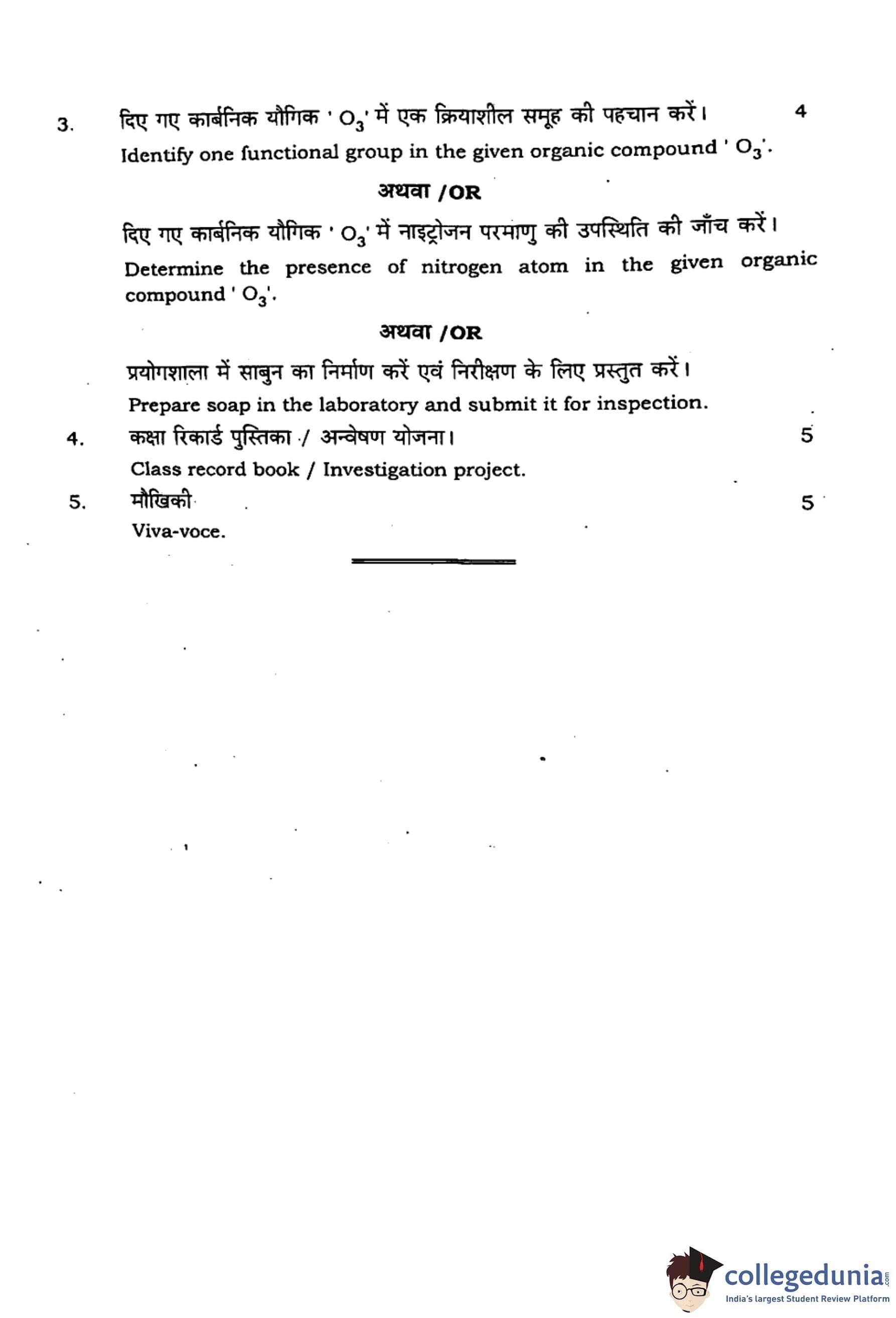
Identify one functional group in the given organic compound O₃.
View Solution
Functional Group Identification.
Based on the molecular structure of O₃, the functional group can be identified as a carbonyl group (\( C = O \)), which is typically found in aldehydes and ketones. This functional group imparts distinctive chemical properties to the compound.
\[ \boxed{Carbonyl Group (C=O)} \] Quick Tip: The carbonyl group is a versatile functional group, present in a wide variety of organic compounds.
Determine the presence of nitrogen atom in the given organic compound O₃.
View Solution
Test for Nitrogen Presence.
To test for nitrogen in O₃, perform a reaction with Nessler’s reagent or Sodium nitroprusside. If nitrogen is present, these reagents will produce a color change, confirming the presence of nitrogen.
\[ \boxed{Presence of Nitrogen: Confirmed by reaction with specific reagents.} \] Quick Tip: Nessler's reagent turns yellow to brown when nitrogen is present, making it a useful test.
Prepare soap in the laboratory and submit it for inspection.
View Solution
Soap Preparation.
To prepare soap, heat fat/oil and add sodium hydroxide solution. Stir continuously until saponification occurs. Once the soap is formed, allow it to solidify, then inspect it for texture and lathering ability.
Inspection.
Check the soap's purity, texture, and lathering ability to confirm it meets the required standards.
\[ \boxed{Soap prepared and ready for inspection.} \] Quick Tip: The saponification reaction involves the reaction of fat with sodium hydroxide to produce soap and glycerol.




Comments