




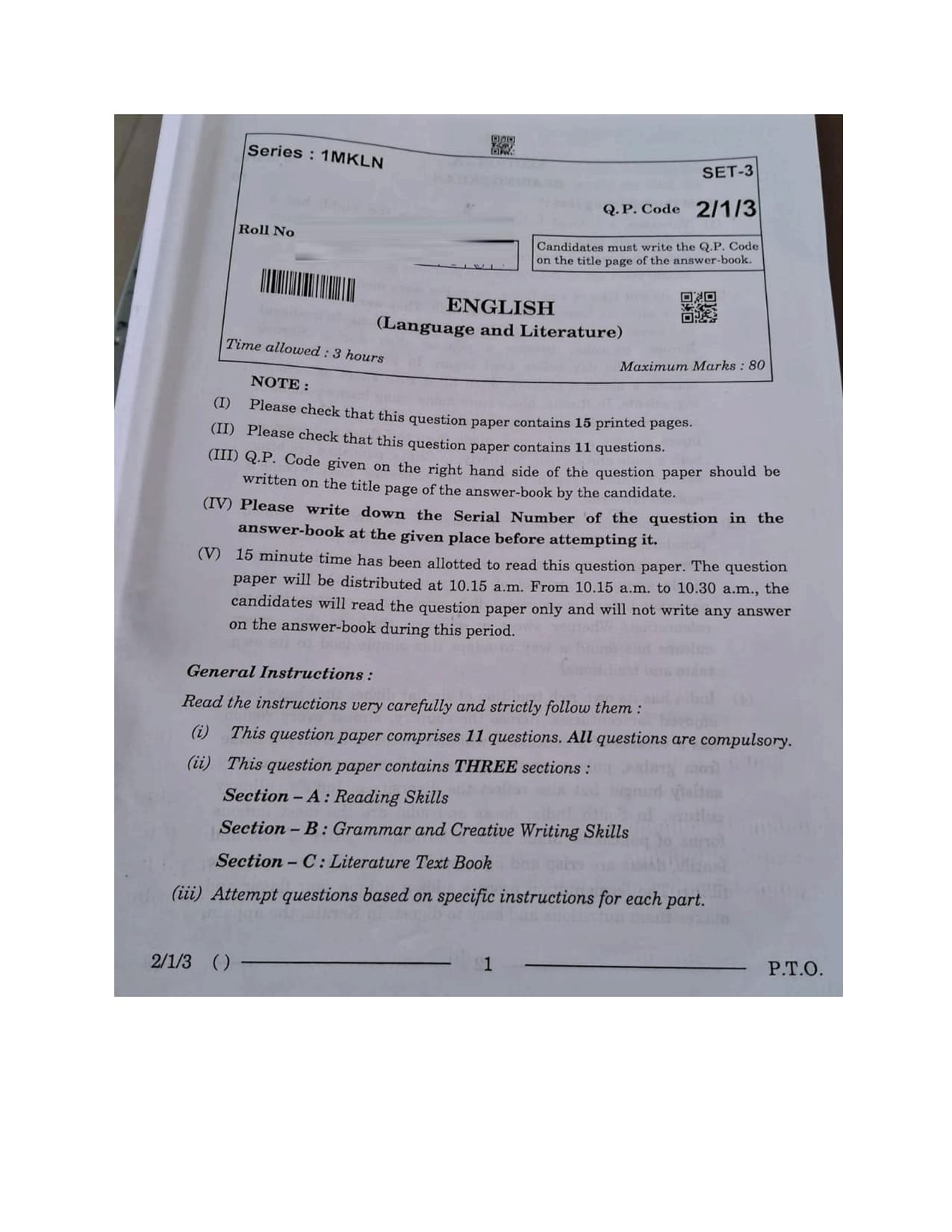
The CBSE Class 10 English Question Paper 2026 (Set-3) is available for download here of CBSE Board Exam 2026. This CBSE 10th English solved question paper includes detailed solutions, answer key, and the latest CBSE marking scheme to help students understand the exam pattern and important topics.
By practicing the CBSE Class 10 English 2026 board exam paper PDF, students can improve answer-writing strategy, time management, and overall exam performance.
CBSE Class 10, 2026 English Question Paper with Solution PDF – Set 3
| CBSE Class 10 English Question Paper 2026 (Set 3) | Download PDF | Check Solutions |

Question 1:
Passage : Read the following text:
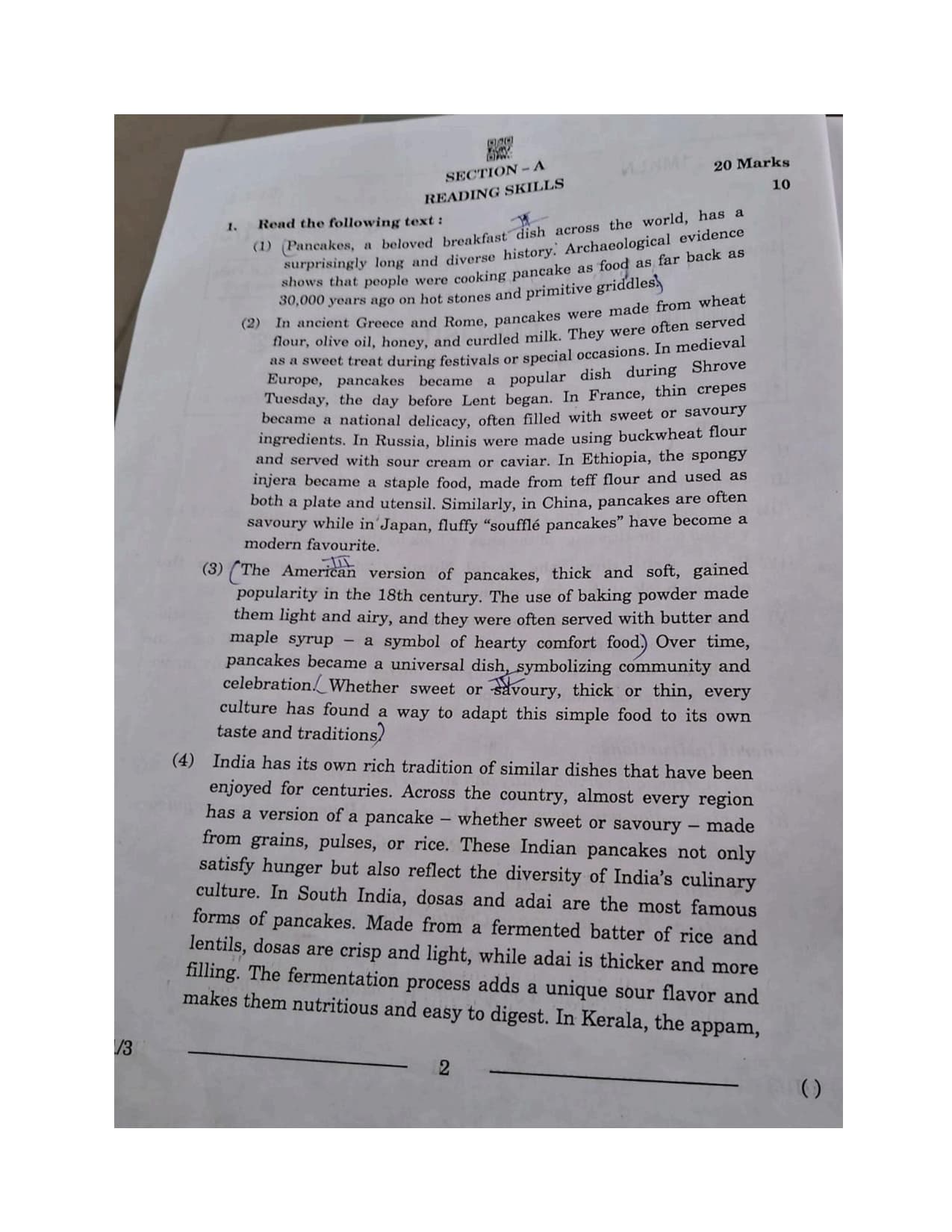
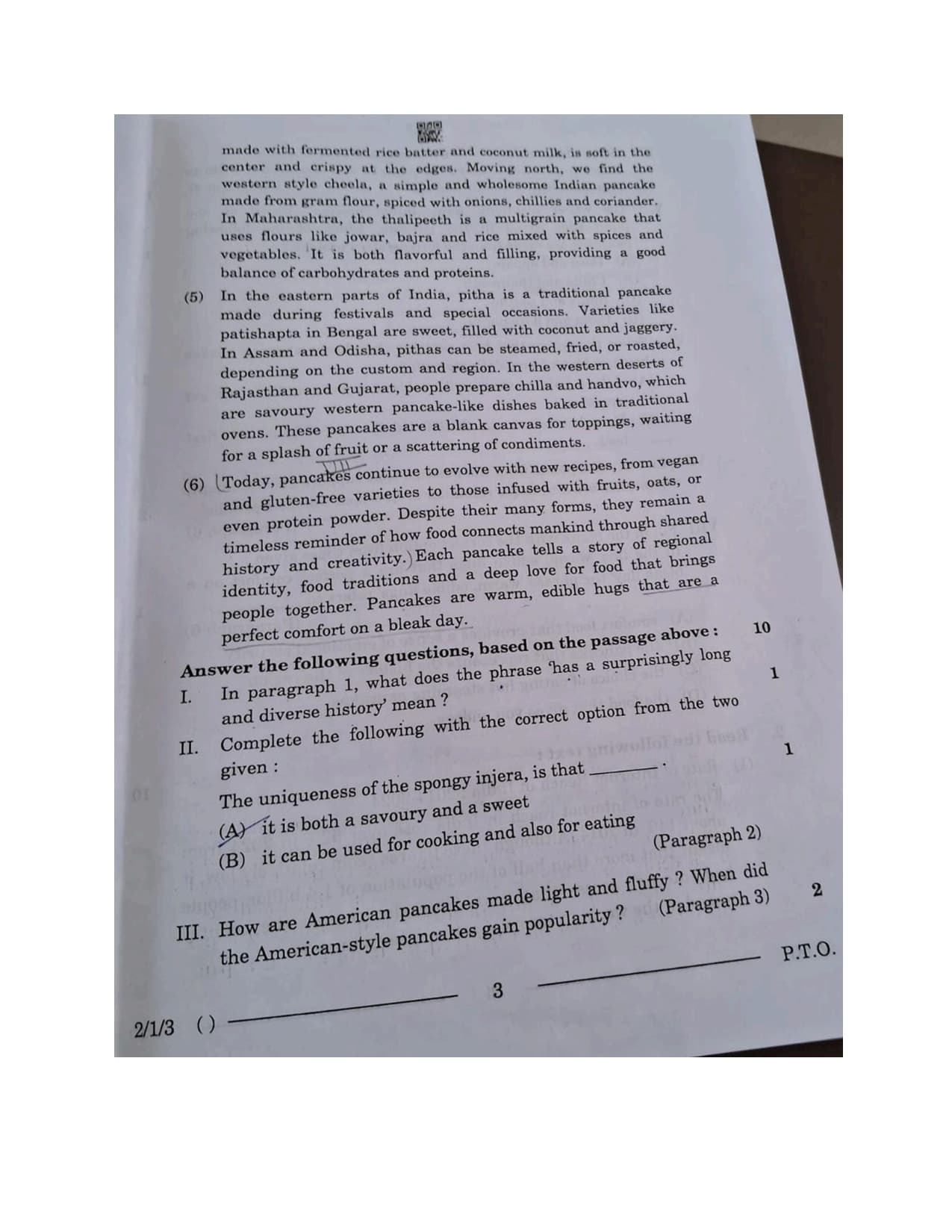
(1) Pancakes, a beloved breakfast dish across the world, has a surprisingly long and diverse history. Archaeological evidence shows that people were cooking pancake as food as far back as 30,000 years ago on hot stones and primitive griddles.
Read More
(2) In ancient Greece and Rome, pancakes were made from wheat flour, olive oil, honey, and curdled milk. They were often served as a sweet treat during festivals or special occasions. In medieval Europe, pancakes became a popular dish during Shrove Tuesday, the day before Lent began. In France, thin crepes became a national delicacy, often filled with sweet or savoury ingredients. In Russia, blinis were made using buckwheat flour and served with sour cream or caviar. In Ethiopia, the spongy injera became a staple food, made from teff flour and used as both a plate and utensil. Similarly, in China, pancakes are often savoury while in Japan, fluffy "soufflé pancakes" have become a modern favourite.(3) The American version of pancakes, thick and soft, gained popularity in the 18th century. The use of baking powder made them light and airy, and they were often served with butter and maple syrup - a symbol of hearty comfort food. Over time, pancakes became a universal dish, symbolizing community and celebration. Whether sweet or savoury, thick or thin, every culture has found a way to adapt this simple food to its own taste and traditions.
(4) India has its own rich tradition of similar dishes that have been enjoyed for centuries. Across the country, almost every region has a version of a pancake - whether sweet or savoury - made from grains, pulses, or rice. These Indian pancakes not only satisfy hunger but also reflect the diversity of India's culinary culture. In South India, dosas and adai are the most famous forms of pancakes. Made from a fermented batter of rice and lentils, dosas are crisp and light, while adai is thicker and more filling. The fermentation process adds a unique sour flavor and makes them nutritious and easy to digest. In Kerala, the appam, made with fermented rice batter and coconut milk, is soft in the center and crispy at the edges. Moving north, we find the western style cheela, a simple and wholesome Indian pancake made from gram flour, spiced with onions, chillies and coriander. In Maharashtra, the thalipeeth is a multigrain pancake that uses flours like jowar, bajra and rice mixed with spices and vegetables. It is both flavorful and filling, providing a good balance of carbohydrates and proteins.
(5) In the eastern parts of India, pitha is a traditional pancake made during festivals and special occasions. Varieties like patishapta in Bengal are sweet, filled with coconut and jaggery. In Assam and Odisha, pithas can be steamed, fried, or roasted, depending on the custom and region. In the western deserts of Rajasthan and Gujarat, people prepare chilla and handvo, which are savoury western pancake-like dishes baked in traditional ovens. These pancakes are a blank canvas for toppings, waiting for a splash of fruit or a scattering of condiments.
(6) Today, pancakes continue to evolve with new recipes, from vegan and gluten-free varieties to those infused with fruits, oats, or even protein powder. Despite their many forms, they remain a timeless reminder of how food connects mankind through shared history and creativity. Each pancake tells a story of regional identity, food traditions and a deep love for food that brings people together. Pancakes are warm, edible hugs that are a perfect comfort on a bleak day.
In paragraph 1, what does the phrase 'has a surprisingly long and diverse history' mean?
View Solution
The phrase 'has a surprisingly long and diverse history' means that the subject being discussed:
Breakdown of the phrase:
'Surprisingly long' \(\rightarrow\) The history extends further back in time than one would normally expect or imagine. It indicates that the origins are much older than commonly believed.
'Diverse history' \(\rightarrow\) The subject has evolved through various stages, forms, or cultural contexts. It has been influenced by different factors, changed over time, and taken multiple shapes or meanings across different periods or societies.
In simple words:
The phrase suggests that the topic has existed for a much longer period than people might think, and throughout this extensive time, it has undergone many changes, adaptations, and variations.
Contextual meaning:
When an author uses this phrase, they are emphasizing that:
The subject is not a recent development
Its journey through time is rich with transformations
It cannot be simply understood by looking at its present form alone
One must study its evolution to fully appreciate its current state
Example for better understanding:
If someone says "The game of chess has a surprisingly long and diverse history," it means:
Chess is much older than most people realize (surprisingly long)
It originated in ancient India, traveled to Persia, spread to the Arab world, then to Europe, changing its rules and forms along the way (diverse history)
Complete the following with the correct option from the two given :
The uniqueness of the spongy injera, is that ________.
(A) it is both a savoury and a sweet
(B) it can be used for cooking and also for eating
View Solution
We need to select the correct option that completes the sentence about the uniqueness of spongy injera.
Step 1: Understand the context of injera.
Injera is a traditional Ethiopian and Eritrean flatbread made from teff flour. It is spongy in texture and serves a unique dual purpose in dining:
- It is used as a food item to eat (consumed as bread)
- It is also used as a utensil for cooking and serving (to scoop up stews and curries)
Step 2: Analyze the uniqueness described in the options.
- (A) it is both a savoury and a sweet — This is incorrect. Injera is primarily savoury, not sweet. Its uniqueness is not about being both savoury and sweet.
- (B) it can be used for cooking and also for eating — This is correct. The uniqueness of injera lies in its dual function: it is both a food item and a utensil. It is used for cooking (as a base for serving stews) and for eating (consumed along with the stew).
Step 3: Conclusion.
The correct option is (B) as it accurately describes the unique dual purpose of spongy injera.
Final Answer: (B) it can be used for cooking and also for eating Quick Tip: When two options seem plausible, look for the specific words used in the text. The passage mentions "plate and utensil," which relates to the process of eating/serving.
How are American pancakes made light and fluffy? When did the American-style pancakes gain popularity?
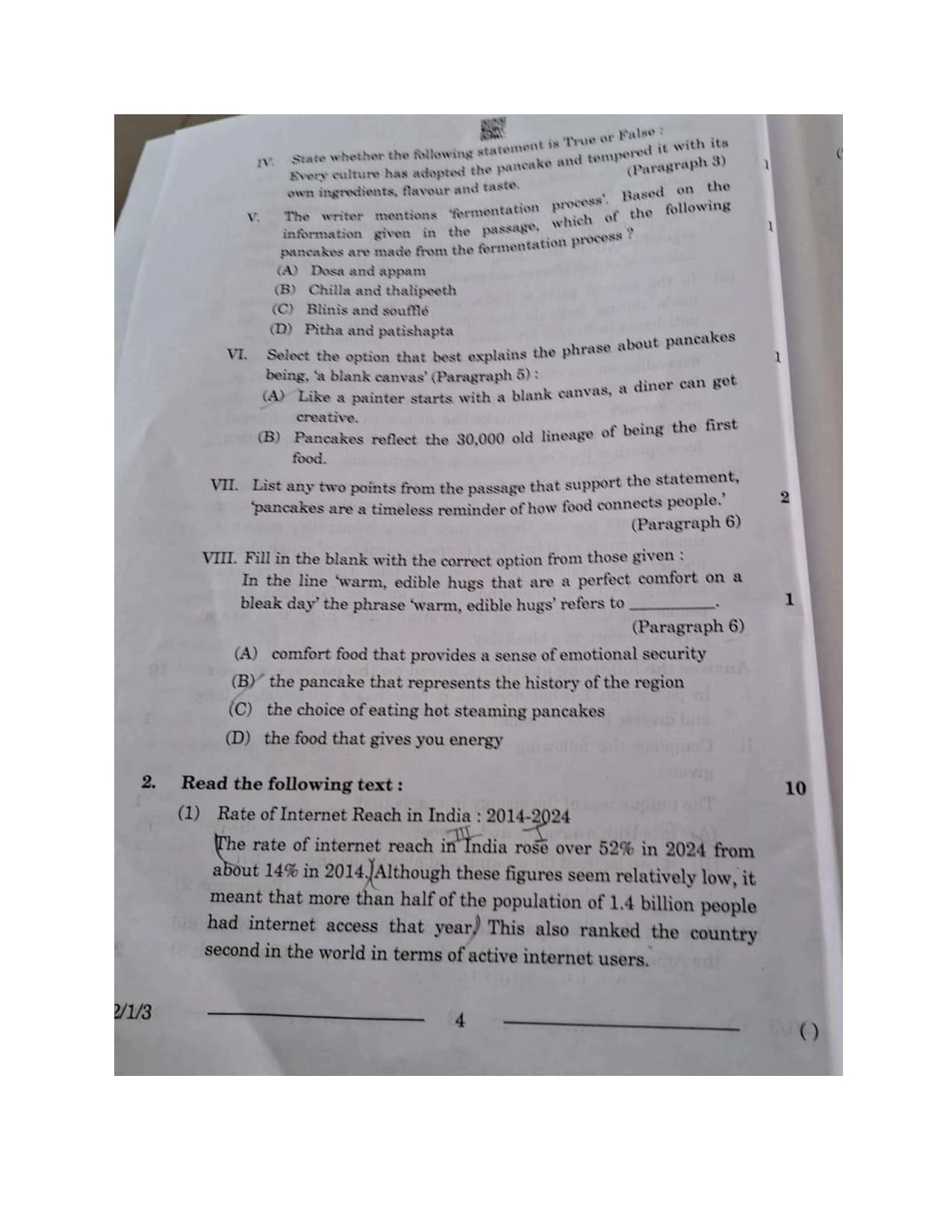
State whether the following statement is True or False:
Every culture has adopted the pancake and tempered it with its own ingredients, flavour and taste.
The writer mentions 'fermentation process'. Based on the information given in the passage, which of the following pancakes are made from the fermentation process?
View Solution
Step 1: Understanding the Concept:
Identify which food items are explicitly linked to "fermentation" in the text.
Step 2: Detailed Explanation:
Paragraph 4 mentions: "In South India, dosas and adai... Made from a fermented batter..."
It further states: "In Kerala, the appam, made with fermented rice batter..."
The other options (chilla, thalipeeth, pitha) are mentioned in contexts of being mixed with spices or filled, but the fermentation label is specifically applied to dosas and appams.
Step 3: Final Answer:
(A) Dosa and appam
Quick Tip: When a technical term like "fermentation" is used, scan the text for that specific keyword to find the associated nouns.
Select the option that best explains the phrase about pancakes being, 'a blank canvas' (Paragraph 5) :
(A) Like a painter starts with a blank canvas, a diner can get creative.
(B) Pancakes reflect the 30,000 old lineage of being the first food.
View Solution
Step 1: Understanding the Concept:
Analyze the metaphorical use of "blank canvas" in the context of food preparation.
Step 2: Detailed Explanation:
The text states: "These pancakes are a blank canvas for toppings, waiting for a splash of fruit or a scattering of condiments."
This implies that the pancake is a neutral base that allows for infinite creative combinations of toppings.
Option (A) captures this idea of creativity and customization, whereas (B) discusses history, which is unrelated to the "canvas" metaphor.
Step 3: Final Answer:
(A) Like a painter starts with a blank canvas, a diner can get creative.
Quick Tip: Metaphors in English usually relate a quality of one object (potential for art on a canvas) to another (potential for flavors on a pancake).
List any two points from the passage that support the statement, 'pancakes are a timeless reminder of how food connects mankind.'
View Solution
Step 1: Understanding the Concept:
Find evidence of global unity and long-term historical continuity associated with pancakes.
Step 2: Detailed Explanation:
Point 1: The text mentions that pancakes have been cooked for 30,000 years, showing they have been a shared experience since prehistoric times.
Point 2: The passage notes that pancakes are part of festivals and traditions in diverse cultures (Greece, Rome, France, Russia, Ethiopia, India, Japan), acting as a bridge between different regional identities.
Step 3: Final Answer:
1. Shared ancient history of 30,000 years.
2. Presence in diverse global traditions symbolizing community.
Quick Tip: When asked to support a "connecting mankind" statement, look for words like "universal," "shared," "community," or "across the world."
Fill in the blank with the correct option from those given :
In the line 'warm, edible hugs that are a perfect comfort on a bleak day' the phrase 'warm, edible hugs' refers to ________.
(A) comfort food that provides a sense of emotional security
(B) the pancake that represents the history of the region
(C) the choice of eating hot steaming pancakes
(D) the food that gives you energy
View Solution
Step 1: Understanding the Concept:
Evaluate the emotional connotation of the metaphor "hugs" as applied to food.
Step 2: Detailed Explanation:
A "hug" is a gesture of comfort, warmth, and affection.
The passage pairs "edible hugs" with "perfect comfort on a bleak day," indicating that the food helps alleviate sadness or loneliness.
Option (A) is the only one that addresses the "comfort" and "emotional" aspect of the phrase.
Step 3: Final Answer:
(A) comfort food that provides a sense of emotional security
Quick Tip: Metaphors related to physical sensations (like hugs) in a positive context usually refer to psychological or emotional states like "comfort."
Question 9:
Passage: Read the following text.
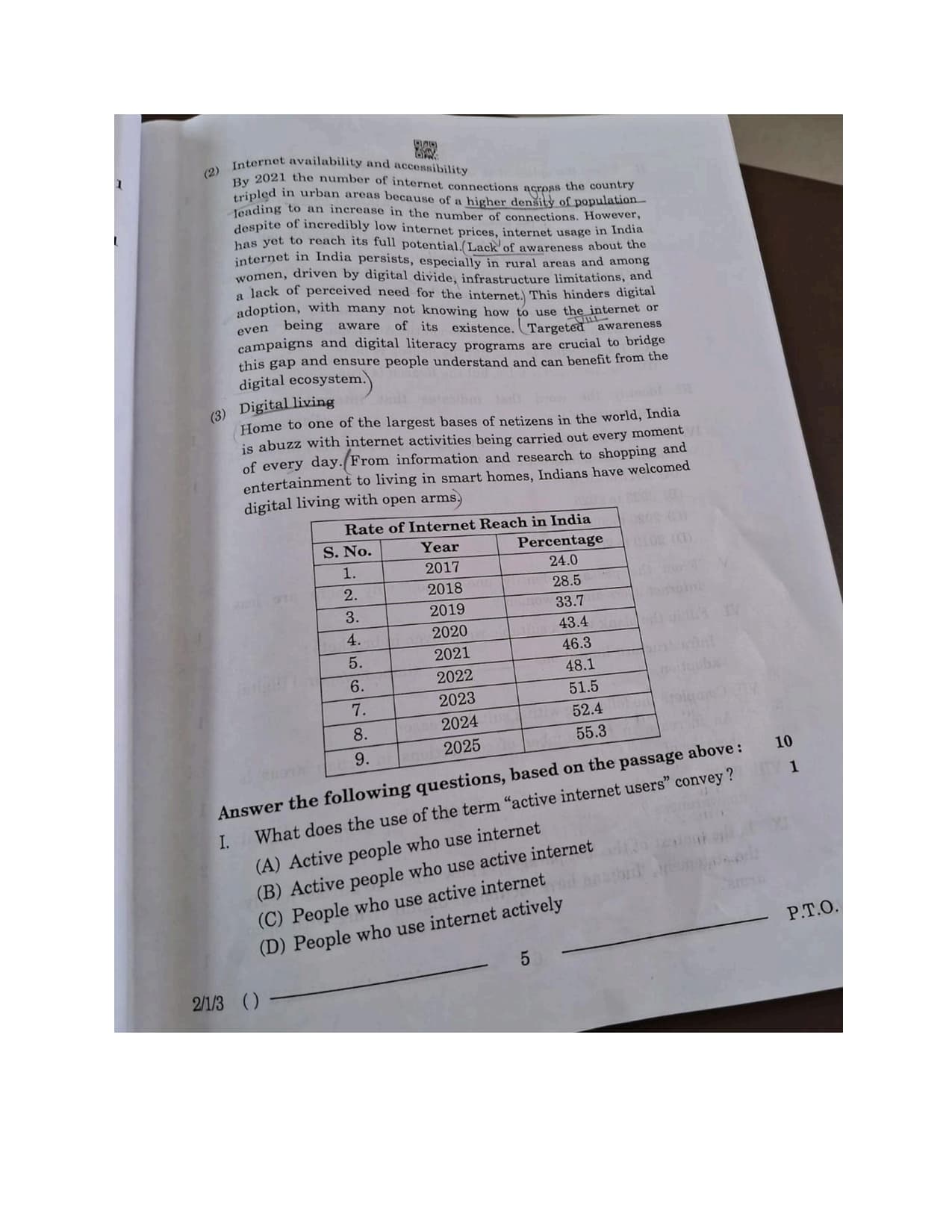
(1) Rate of Internet Reach in India : 2014--2024
The rate of internet reach in India rose over 52\% in 2024 from about 14\% in 2014. Although these figures seem relatively low, it meant that more than half of the population of 1.4 billion people had internet access that year. This also ranked the country second in the world in terms of active internet users.
Read More
(2) Internet availability and accessibility
In 2021 the number of internet connections across the country tripled in urban areas because of a higher density of population leading to an increase in the number of connections. However, despite of incredibly low internet prices, internet usage in India has yet to reach its full potential. Lack of awareness about the internet in India persists, especially in rural areas and among women, driven by digital divide, infrastructure limitations, and a lack of perceived need for the internet. This hinders digital adoption, with many not knowing how to use the internet or even being aware of its existence. Targeted awareness campaigns and digital literacy programs are crucial to bridge this gap and ensure people understand and can benefit from the digital ecosystem.
(3) Digital living
Home to one of the largest bases of netizens in the world, India is abuzz with internet activities being carried out every moment of every day. From information and research to shopping and entertainment to living in smart homes, Indians have welcomed digital living with open arms.
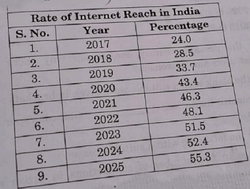
Answer the following questions, based on the passage above :
What does the use of the term "active internet users" convey?
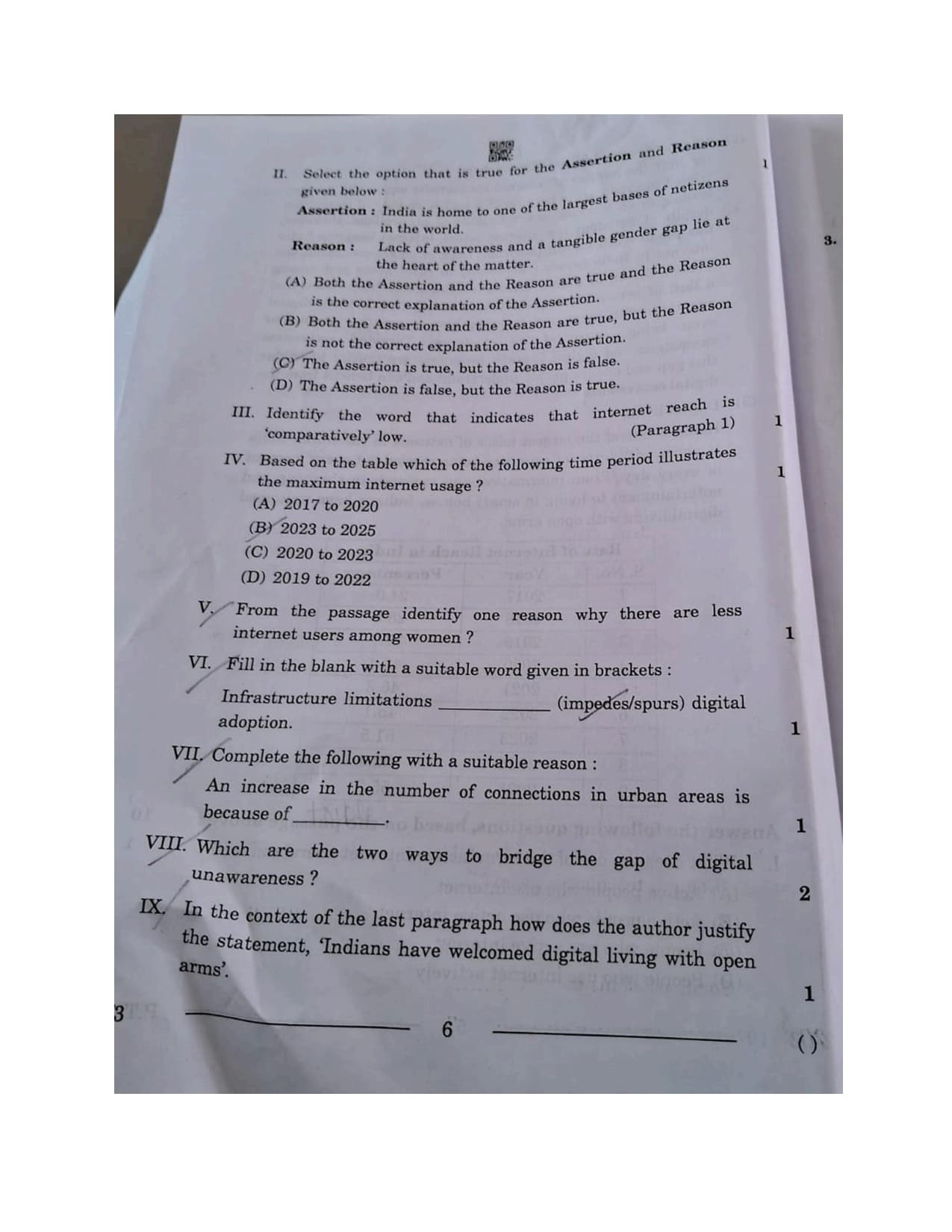
Select the option that is true for the Assertion and Reason given below :
Assertion : India is home to one of the largest bases of netizens in the world.
Reason : Lack of awareness and a tangible gender gap lie at the heart of the matter.
Identify the word that indicates that internet reach is 'comparatively' low. (Paragraph 1)
Based on the table which of the following time period illustrates the maximum internet usage?
From the passage identify one reason why there are less internet users among women?
Fill in the blank with a suitable word given in brackets : Infrastructure limitations ________ (impedes/spurs) digital adoption.
View Solution
Step 1: Understanding the Concept:
This requires understanding the vocabulary used to describe barriers to progress.
Step 2: Detailed Explanation:
The passage mentions infrastructure limitations as a factor that "hinders digital adoption."
Between the choices provided:
- "Impedes" means to delay or prevent someone or something by obstructing them; it is a synonym for hinder.
- "Spurs" means to give an incentive or encouragement to someone.
Since limitations act as a barrier, "impedes" is the correct fit.
Step 3: Final Answer:
Infrastructure limitations impedes digital adoption.
Quick Tip: Negative terms like "limitations" or "deficits" are almost always followed by verbs like "impedes," "hinders," or "stunts."
Complete the following with a suitable reason : An increase in the number of connections in urban areas is because of ________.
View Solution
Step 1: Understanding the Concept:
The question asks for the specific cause mentioned in the text for the concentration of internet growth in cities.
Step 2: Detailed Explanation:
In Paragraph 2, the author explains the growth pattern: "...internet connections across the country tripled in urban areas because of a higher density of population leading to an increase in the number of connections."
Step 3: Final Answer:
...because of a higher density of population.
Quick Tip: Causality is often introduced by words like "because," "due to," or "leading to."
Which are the two ways to bridge the gap of digital unawareness ?
In the context of the last paragraph how does the author justify the statement, 'Indians have welcomed digital living with open arms'.
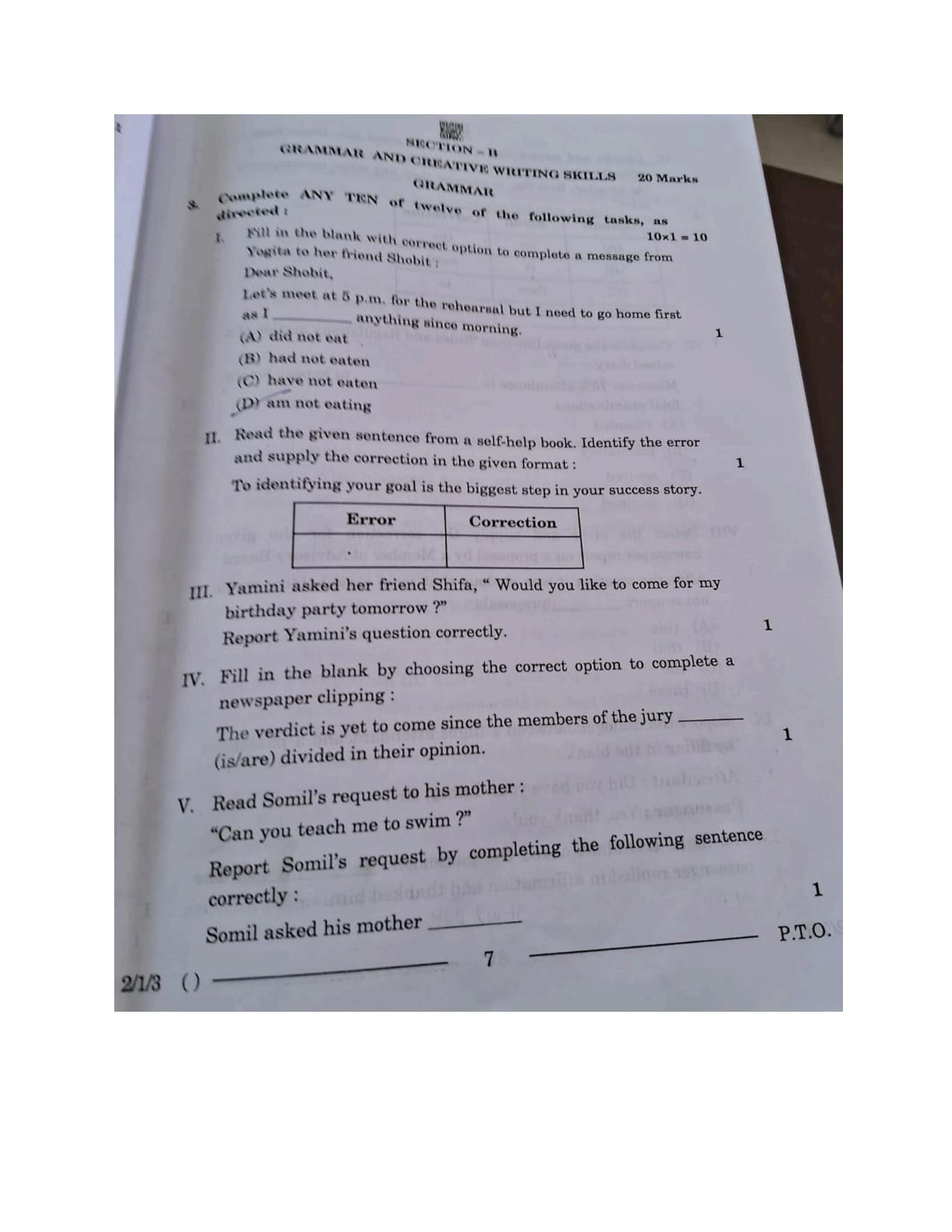
Fill in the blank with correct option to complete a message from Yogita to her friend Shobit:
Dear Shobit,
Let's meet at 5 p.m. for the rehearsal but I need to go home first as I ________ anything since morning.
View Solution
Step 1: Understanding the Concept:
The sentence refers to an action that started in the past and continues up to the present moment, indicated by the time expression "since morning".
The Present Perfect tense is used for actions that began in the past and are still relevant or ongoing in the present.
Step 2: Detailed Explanation:
The phrase "since morning" acts as a temporal marker requiring a perfect tense.
Option (A) "did not eat" is Simple Past, used for finished actions at a specific time in the past.
Option (B) "had not eaten" is Past Perfect, used for an action completed before another past action.
Option (D) "am not eating" is Present Continuous, describing an action happening exactly now.
Option (C) "have not eaten" correctly links the state of not eating from the morning to the current time of the message.
Step 3: Final Answer:
The correct sentence is: "I need to go home first as I have not eaten anything since morning."
Quick Tip: Whenever you see "since" or "for" used with a time duration in a sentence about the present state, look for Present Perfect (has/have + V3) or Present Perfect Continuous (has/have + been + V-ing).
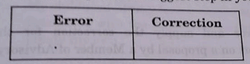
Read the given sentence from a self-help book. Identify the error and supply the correction in the given format:
To identifying your goal is the biggest step in your success story.
Yamini asked her friend Shifa, "Would you like to come for my birthday party tomorrow?"
Report Yamini's question correctly.
Fill in the blank by choosing the correct option to complete a newspaper clipping:
The verdict is yet to come since the members of the jury ________ (is/are) divided in their opinion.
View Solution
Step 1: Understanding the Concept:
Collective nouns (like jury, team, committee) usually take a singular verb when the group acts as a single unit. However, they take a plural verb when the members are acting individually or are "divided".
Step 2: Detailed Explanation:
The sentence explicitly mentions that the members are "divided in their opinion".
This indicates that they are not acting as one unified body.
Furthermore, the phrase "members of the jury" specifically points to the individuals within the group.
Therefore, the plural verb "are" is required to agree with the plural sense of the subject.
Step 3: Final Answer:
The correct verb is "are".
Quick Tip: If a collective noun is acting together, use a singular verb. If they are disagreeing or acting individually (look for words like "divided" or "different"), use a plural verb.
Read Somil's request to his mother:
"Can you teach me to swim?"
Report Somil's request by completing the following sentence correctly:
Somil asked his mother ________.
View Solution
Step 1: Understanding the Concept:
This is a Yes/No question starting with a modal verb "Can". In reported speech, "Can" changes to "Could", and we use the conjunction "if" or "whether".
Step 2: Detailed Explanation:
1. Add the conjunction "if".
2. Change the pronoun "you" (referring to mother) to "she".
3. Change the modal "can" to "could".
4. Change the pronoun "me" (referring to Somil) to "him".
5. The structure changes from "Can you..." to "...if she could...".
Step 3: Final Answer:
Somil asked his mother if she could teach him to swim.
Quick Tip: Always change the tense of modals in reported speech: can \(\rightarrow\) could, may \(\rightarrow\) might, will \(\rightarrow\) would, shall \(\rightarrow\) should.
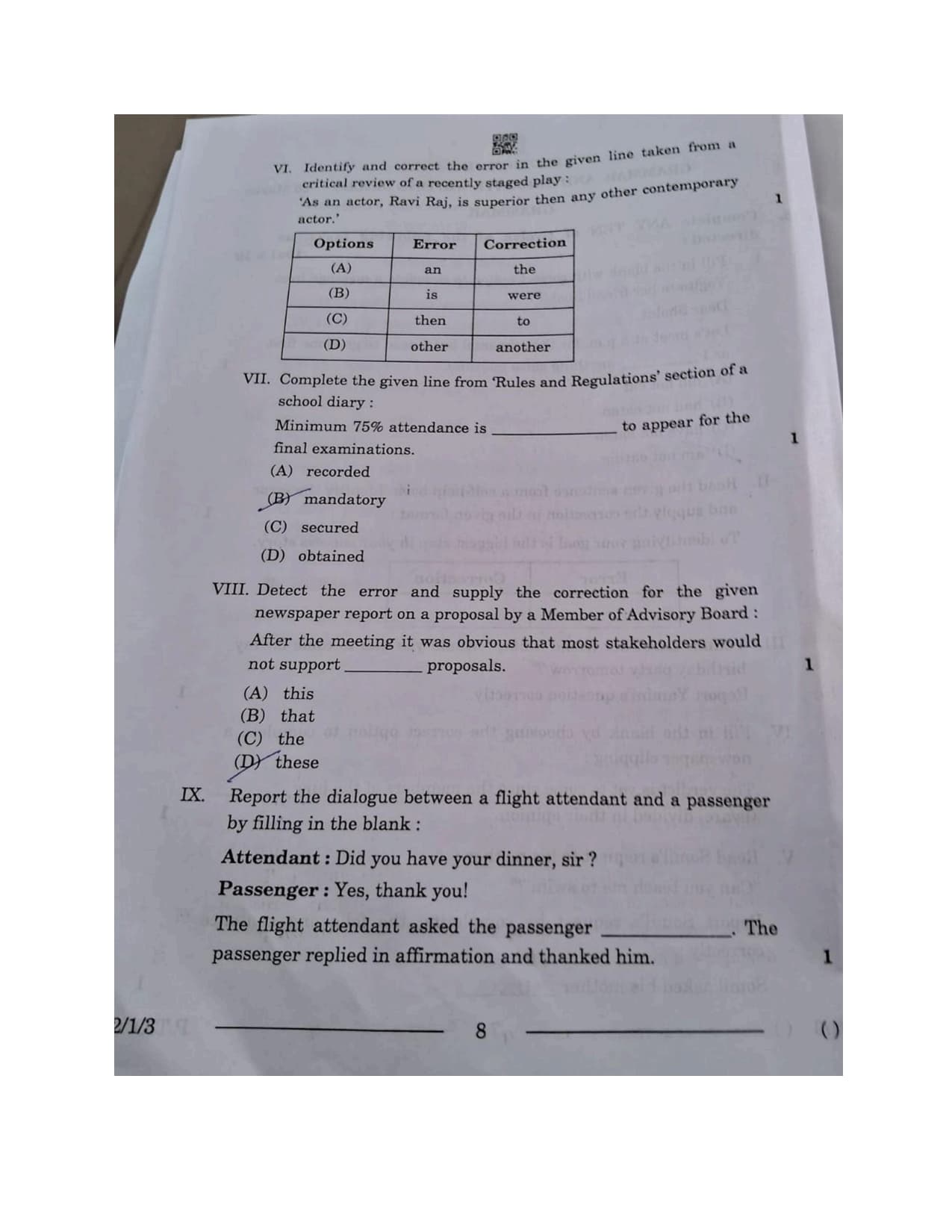
Identify and correct the error in the given line taken from a critical review of a recently staged play:
'As an actor, Ravi Raj, is superior then any other contemporary actor.'
Complete the given line from 'Rules and Regulations' section of a school diary:
Minimum 75% attendance is ________ to appear for the final examinations.
View Solution
Step 1: Understanding the Concept:
The question requires choosing a vocabulary word that fits the context of a rule or requirement.
Step 2: Detailed Explanation:
The sentence discusses a requirement (75% attendance) for appearing in exams.
(A) "recorded": Means written down; doesn't convey requirement.
(B) "mandatory": Means compulsory or required by law/rules. This fits perfectly.
(C) "secured": Means gained or made safe.
(D) "obtained": Means acquired.
"Mandatory" is the standard term used in official rules to denote a prerequisite.
Step 3: Final Answer:
The correct option is (B).
Quick Tip: In formal rules, look for words like "mandatory", "compulsory", "obligatory", or "requisite".
Detect the error and supply the correction for the given newspaper report on a proposal by a Member of Advisory Board:
After the meeting it was obvious that most stakeholders would not support ________ proposals.
View Solution
Step 1: Understanding the Concept:
This question tests the agreement between demonstrative adjectives and the nouns they modify.
Step 2: Detailed Explanation:
The noun "proposals" is plural.
(A) "this": Used for singular nouns near in time/place.
(B) "that": Used for singular nouns far in time/place.
(C) "the": While grammatically possible, the blank usually expects a demonstrative that matches the plural nature. However, between specific demonstratives and a definite article, we check for number agreement.
(D) "these": Used for plural nouns. This matches "proposals" perfectly in terms of number agreement.
In the context of a report referring back to specific items discussed, "these" is the most appropriate choice.
Step 3: Final Answer:
The correct option is (D).
Quick Tip: Always check if the noun following the blank is singular or plural. This/That + Singular; These/Those + Plural.
Report the dialogue between a flight attendant and a passenger by filling in the blank:
Attendant: Did you have your dinner, sir?
Passenger: Yes, thank you!
The flight attendant asked the passenger ________. The passenger replied in affirmation and thanked him.
View Solution
Step 1: Understanding the Concept:
The original sentence is in the Simple Past ("Did you have"). In reported speech, Simple Past changes to Past Perfect (had + V3).
Step 2: Detailed Explanation:
1. The question is a Yes/No type, so use "if" or "whether".
2. The subject "you" becomes "he" (referring to the passenger).
3. The main verb is "have" (meaning to eat). Its V3 form is "had".
4. Simple Past "did have" changes to Past Perfect "had had".
5. The possessive "your" becomes "his".
Step 3: Final Answer:
The flight attendant asked the passenger if he had had his dinner.
Quick Tip: "Had had" looks strange but is grammatically correct! The first "had" is the auxiliary for Past Perfect, and the second "had" is the past participle of the main verb "to have".
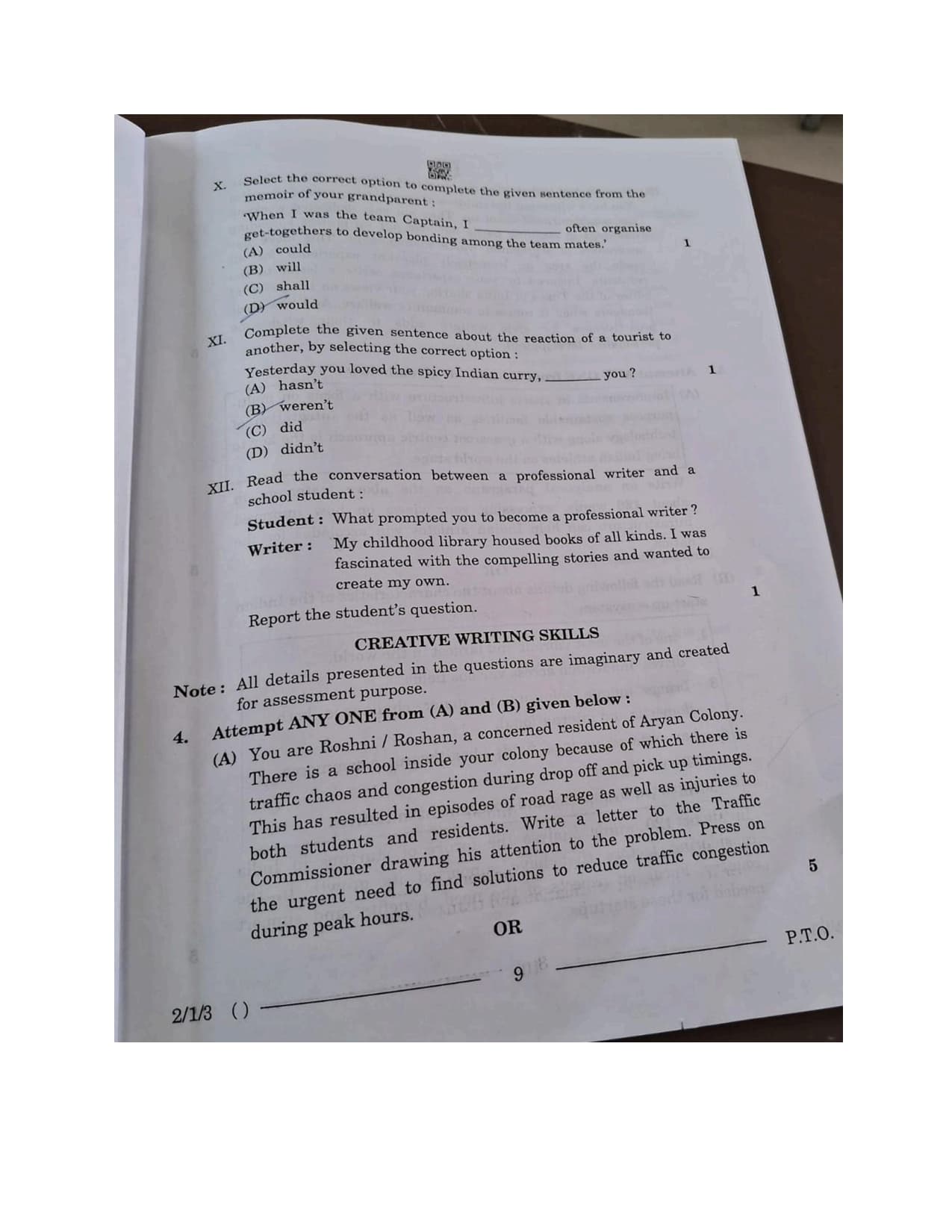
Select the correct option to complete the given sentence from the memoir of your grandparent:
'When I was the team Captain, I ________ often organise get-togethers to develop bonding among the team mates.'
View Solution
Step 1: Understanding the Concept:
The sentence describes a past habit or a repeated action in the past.
Step 2: Detailed Explanation:
(A) "could": Suggests ability in the past.
(B) "will": Suggests future or present certainty.
(C) "shall": Suggests future or suggestion.
(D) "would": Used to describe habitual actions in the past (similar to "used to").
Since the speaker is recalling what they used to do "often" while they were Captain, "would" is the correct modal to express this past habit.
Step 3: Final Answer:
The correct option is (D).
Quick Tip: Use "would" + base verb to talk about things you did regularly in the past but don't do anymore.
Complete the given sentence about the reaction of a tourist to another, by selecting the correct option:
Yesterday you loved the spicy Indian curry, ________ you?
View Solution
Step 1: Understanding the Concept:
This is a question tag problem. A positive statement takes a negative tag, and the tag uses the auxiliary verb of the main sentence's tense.
Step 2: Detailed Explanation:
1. The statement "Yesterday you loved..." is in the Simple Past tense.
2. The statement is affirmative (positive).
3. The auxiliary verb for Simple Past is "did".
4. For an affirmative statement, we need a negative tag: "didn't".
5. Therefore, the tag is "didn't you?".
Step 3: Final Answer:
The correct option is (D).
Quick Tip: Question Tag Rule: Positive Statement \(\rightarrow\) Negative Tag; Negative Statement \(\rightarrow\) Positive Tag. Match the auxiliary verb to the tense of the main verb.
Read the conversation between a professional writer and a school student:
Student: What prompted you to become a professional writer?
Writer: My childhood library housed books of all kinds. I was fascinated with the compelling stories and wanted to create my own.
Report the student's question.
You are Roshni / Roshan, a concerned resident of Aryan Colony. There is a school inside your colony because of which there is traffic chaos and congestion during drop off and pick up timings. This has resulted in episodes of road rage as well as injuries to both students and residents. Write a letter to the Traffic Commissioner drawing his attention to the problem. Press on the urgent need to find solutions to reduce traffic congestion during peak hours.
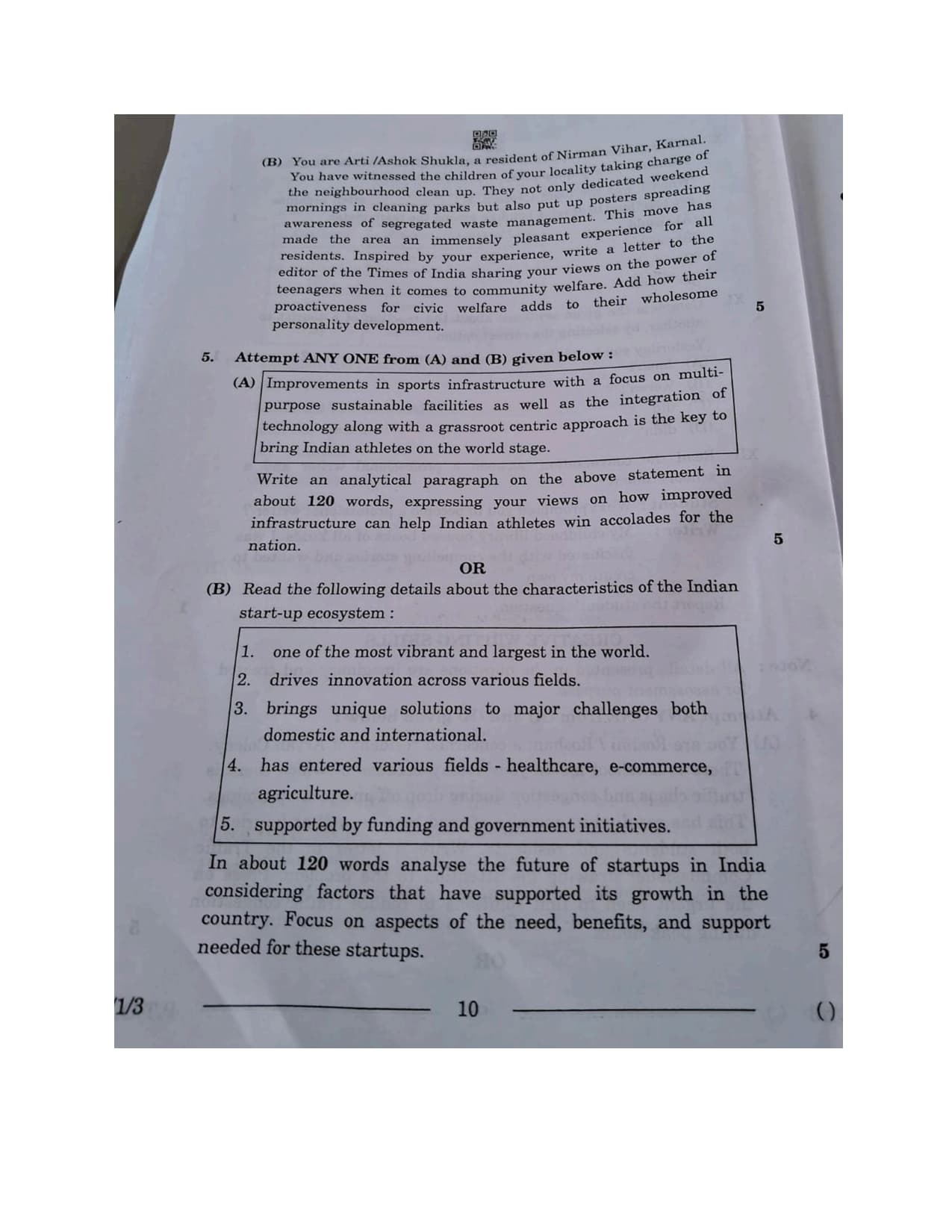
Improvements in sports infrastructure with a focus on multi-purpose sustainable facilities as well as the integration of technology along with a grassroot centric approach is the key to bring Indian athletes on the world stage.
Write an analytical paragraph on the above statement in about 120 words, expressing your views on how improved infrastructure can help Indian athletes win accolades for the nation.
View Solution
Step 1: Understanding the Concept:
The question requires writing an analytical paragraph based on a specific prompt.
The prompt identifies four pillars for sporting success: improved infrastructure, multi-purpose sustainability, technological integration, and a grassroots-centric approach.
Step 2: Detailed Explanation:
An analytical paragraph should systematically explain how the factors mentioned in the prompt lead to the desired outcome.
In this case, the improved infrastructure acts as the physical foundation for training.
Sustainability and multi-purpose designs ensure cost-effective and continuous availability of these spaces.
Technology provides the precision needed for elite competition.
The grassroots approach ensures that no talent is left behind due to geographical or economic barriers.
Connecting these points with logical transitions creates a cohesive analysis that explains the path to national accolades.
Step 3: Final Answer:
The provided paragraph effectively synthesizes the prompt's requirements into a structured 120-word analysis.
Quick Tip: For analytical paragraphs, use cohesive devices like 'consequently', 'furthermore', and 'as a result' to show clear cause-effect relationships between the provided data points.
Read the following details about the characteristics of the Indian start-up ecosystem:
1. one of the most vibrant and largest in the world.
2. drives innovation across various fields.
3. brings unique solutions to major challenges both domestic and international.
4. has entered various fields - healthcare, e-commerce, agriculture.
5. supported by funding and government initiatives.
In about 120 words analyse the future of startups in India considering factors that have supported its growth in the country. Focus on aspects of the need, benefits, and support needed for these startups.
View Solution
Step 1: Understanding the Concept:
This task involves creating a structured analysis based on provided facts about the Indian start-up environment.
The focus must be on the factors facilitating growth, the resulting benefits, and future requirements for sustainability.
Step 2: Detailed Explanation:
The analysis begins by establishing the current global standing of the Indian start-up scene as per the provided notes.
It then details the benefits, such as innovation and problem-solving across diverse sectors like agriculture and healthcare.
The 'support' aspect is addressed by mentioning government policies and funding.
Finally, the paragraph looks toward the future, suggesting what is further 'needed' (like regulatory ease) to ensure continued success.
The logical flow from current status to benefits and finally to future needs fulfills the 'analytical' requirement of the task.
Step 3: Final Answer:
The drafted paragraph provides a comprehensive 120-word analysis covering all aspects of the prompt.
Quick Tip: When analyzing a list of points, try to group them into themes such as 'Current Status', 'Impact/Benefits', and 'Future Requirements' to ensure your paragraph covers all aspects of the prompt.
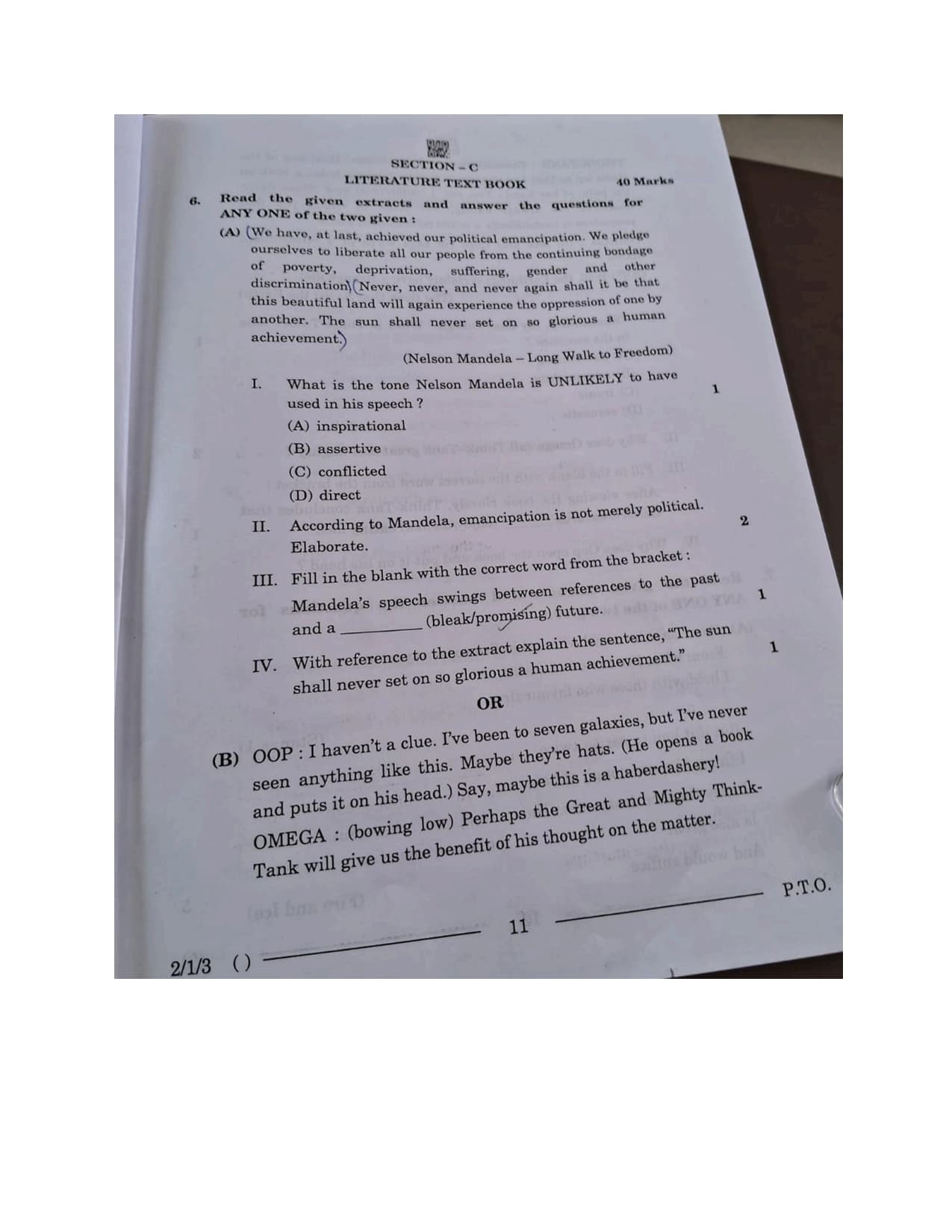
What is the tone Nelson Mandela is UNLIKELY to have used in his speech ?
According to Mandela, emancipation is not merely political. Elaborate.
Fill in the blank with the correct word from the bracket : Mandela's speech swings between references to the past and a ________ (bleak/promising) future.
View Solution
Step 1: Understanding the Concept:
The question requires identifying the correct adjective to describe the future Mandela envisions in his speech.
Step 2: Detailed Explanation:
Mandela refers to the past as a time of "bondage," "poverty," and "oppression of one by another."
In contrast, he describes the future as a "glorious human achievement" where the sun shall "never set" on their freedom.
These positive descriptors indicate that he sees the future as full of hope and potential, which is best captured by the word "promising."
Step 3: Final Answer:
The correct word is promising. Quick Tip: Contextual clues like "glorious human achievement" are clear indicators of a positive or "promising" outlook.
With reference to the extract explain the sentence, "The sun shall never set on so glorious a human achievement."
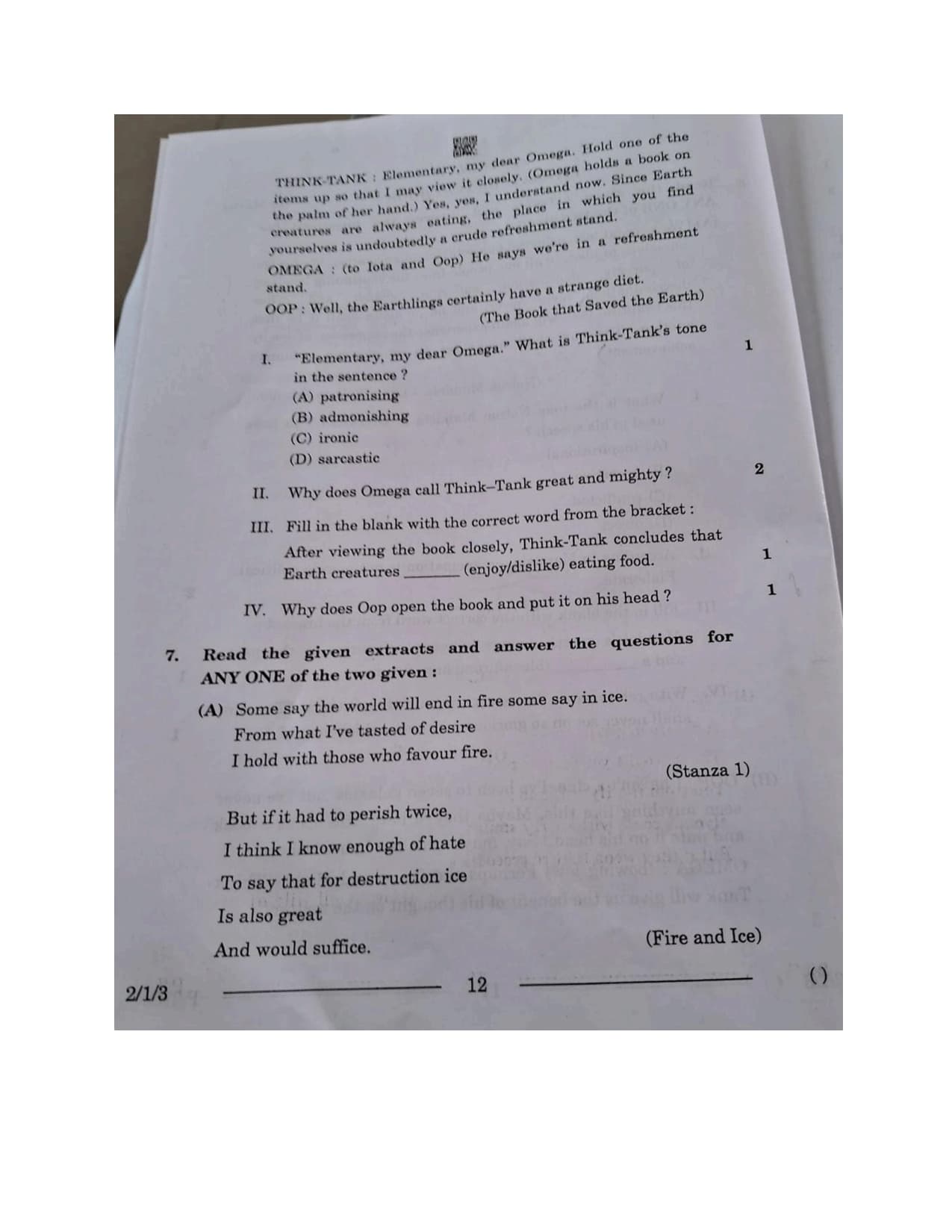
"Elementary, my dear Omega." What is Think-Tank's tone in the sentence ?
Why does Omega call Think-Tank great and mighty ?
Fill in the blank with the correct word from the bracket : After viewing the book closely, Think-Tank concludes that Earth creatures ________ (enjoy/dislike) eating food.
View Solution
Step 1: Understanding the Concept:
Identify Think-Tank’s absurd misinterpretation of human behavior based on his observation of "sandwiches" (books).
Step 2: Detailed Explanation:
Think-Tank mistakenly identifies books as "sandwiches."
He states, "Since Earth creatures are always eating, the place in which you find yourselves is undoubtedly a crude refreshment stand."
This logic stems from his belief that humans are obsessed with food and "enjoy" eating so much that they have "refreshment stands" (libraries) full of "sandwiches" (books) everywhere.
Step 3: Final Answer:
Think-Tank concludes that Earth creatures enjoy eating food. Quick Tip: Think-Tank’s "scientific" observations are always wrong, leading to the comedy of the play.
Why does Oop open the book and put it on his head ?
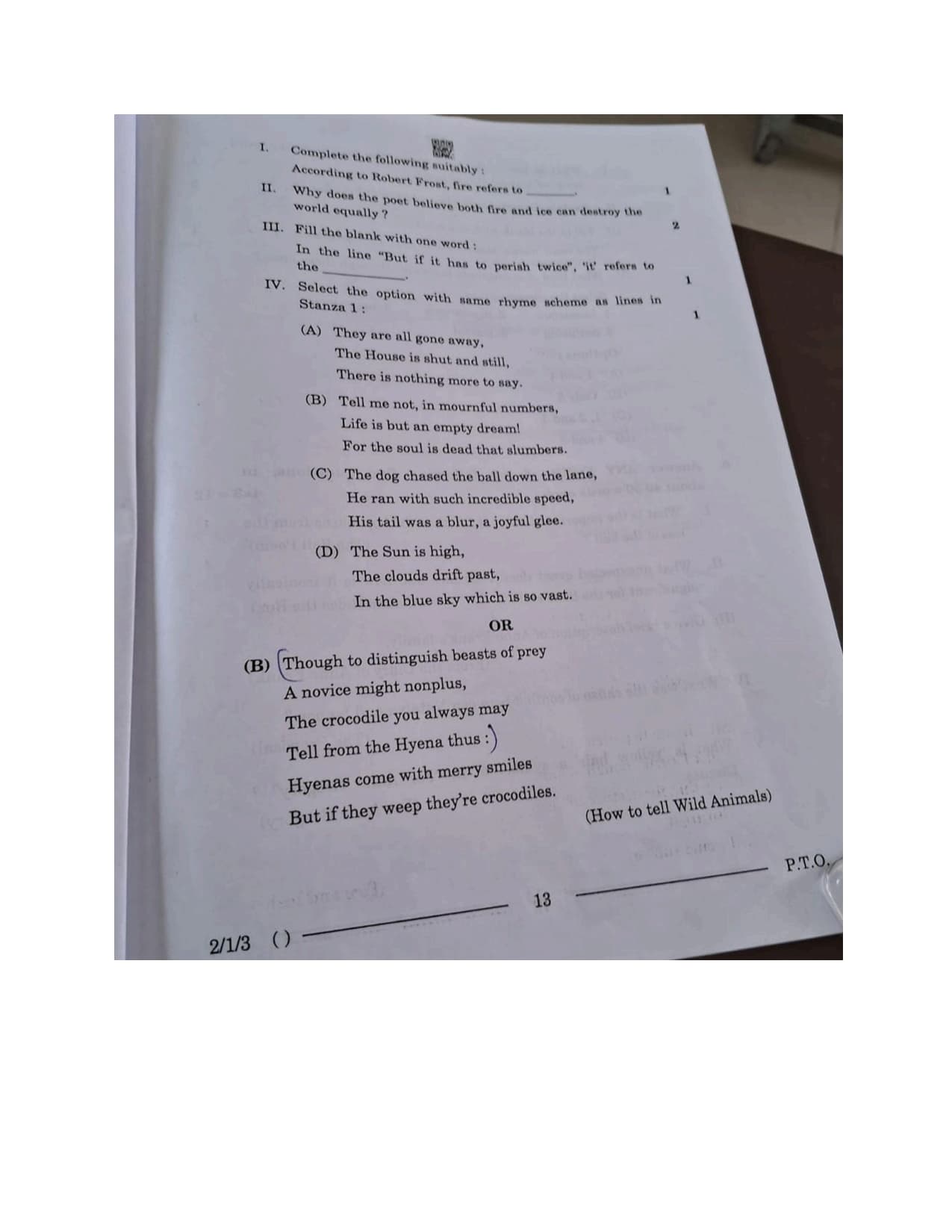
Complete the following suitably:
According to Robert Frost, fire refers to ________.
View Solution
Step 1: Understanding the Concept:
The poem 'Fire and Ice' by Robert Frost uses symbolism to equate natural elements with human emotions.
Step 2: Detailed Explanation:
In the first stanza, the poet explicitly states, "From what I've tasted of desire, I hold with those who favour fire."
Here, 'fire' is a metaphor for the burning nature of human desires, passions, and unbridled greed.
Just as fire can consume everything in its path, uncontrolled human desire can lead to the destruction of the world.
Step 3: Final Answer:
According to Robert Frost, fire refers to human desire or passion.
Quick Tip: In Robert Frost's poetry, look for metaphors where natural elements represent psychological states (Fire = Desire, Ice = Hatred).
Why does the poet believe both fire and ice can destroy the world equally?
Fill in the blank with one word:
In the line "But if it had to perish twice", 'it' refers to the ________.
View Solution
Step 1: Understanding the Concept:
This is a pronoun-referent question based on the context of the poem's opening lines.
Step 2: Detailed Explanation:
The poem begins with "Some say the world will end in fire...".
When the poet continues in the second stanza with "But if it had to perish twice," the pronoun 'it' logically refers back to the subject that is perishing, which is 'the world'.
Step 3: Final Answer:
world
Quick Tip: Always check the preceding lines or stanzas to identify what a pronoun like 'it' or 'this' is replacing.
Select the option with same rhyme scheme as lines in Stanza 1:
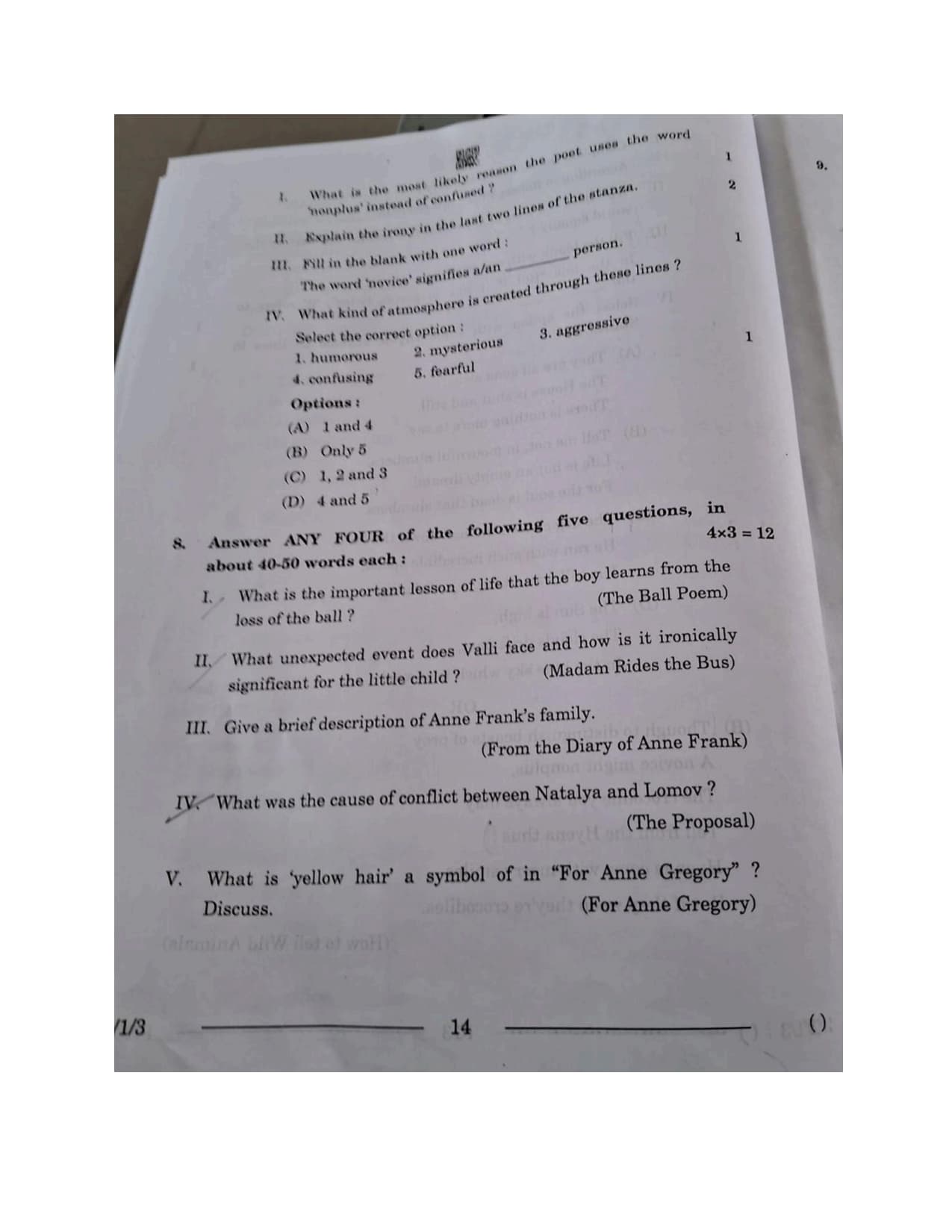
What is the most likely reason the poet uses the word 'nonplus' instead of 'confused'?
Explain the irony in the last two lines of the stanza.
Fill in the blank with one word :
The word 'novice' signifies a/an ________ person.
View Solution
Step 1: Understanding the Concept:
Vocabulary based question testing the definition of a term within the context of the poem.
Step 2: Detailed Explanation:
In the line "A novice might nonplus," the poet suggests that someone who is new to identifying animals might be confused.
A 'novice' is someone who is new to a field or activity and lacks experience.
Step 3: Final Answer:
inexperienced
Quick Tip: A 'Novice' is the opposite of an 'Expert'.
What kind of atmosphere is created through these lines?
Select the correct option :
1. humorous
2. mysterious
3. aggressive
4. confusing
5. fearful
View Solution
Step 1: Understanding the Concept:
The question asks for the 'tone' or 'atmosphere' established by the poet's choice of words and descriptions.
Step 2: Detailed Explanation:
1. Humorous: The entire poem 'How to Tell Wild Animals' is written in a light-hearted, witty, and humorous way, describing dangerous situations as if they were simple identification games.
4. Confusing: The poet mentions that a novice might be 'nonplus' (confused), creating a playful atmosphere of confusion between different predators.
The lines are not truly 'fearful' or 'aggressive' because the poet's intent is to entertain through wit, not to terrify the reader.
Step 3: Final Answer:
(A) 1 and 4
Quick Tip: Carolyn Wells' "How to Tell Wild Animals" is a classic example of "Humorous Verse".
What is the important lesson of life that the boy learns from the loss of the ball? (The Ball Poem)
What unexpected event does Valli face and how is it ironically significant for the little child? (Madam Rides the Bus)
Give a brief description of Anne Frank's family. (From the Diary of Anne Frank)
What was the cause of conflict between Natalya and Lomov? (The Proposal)
What is 'yellow hair' a symbol of in "For Anne Gregory"? Discuss.
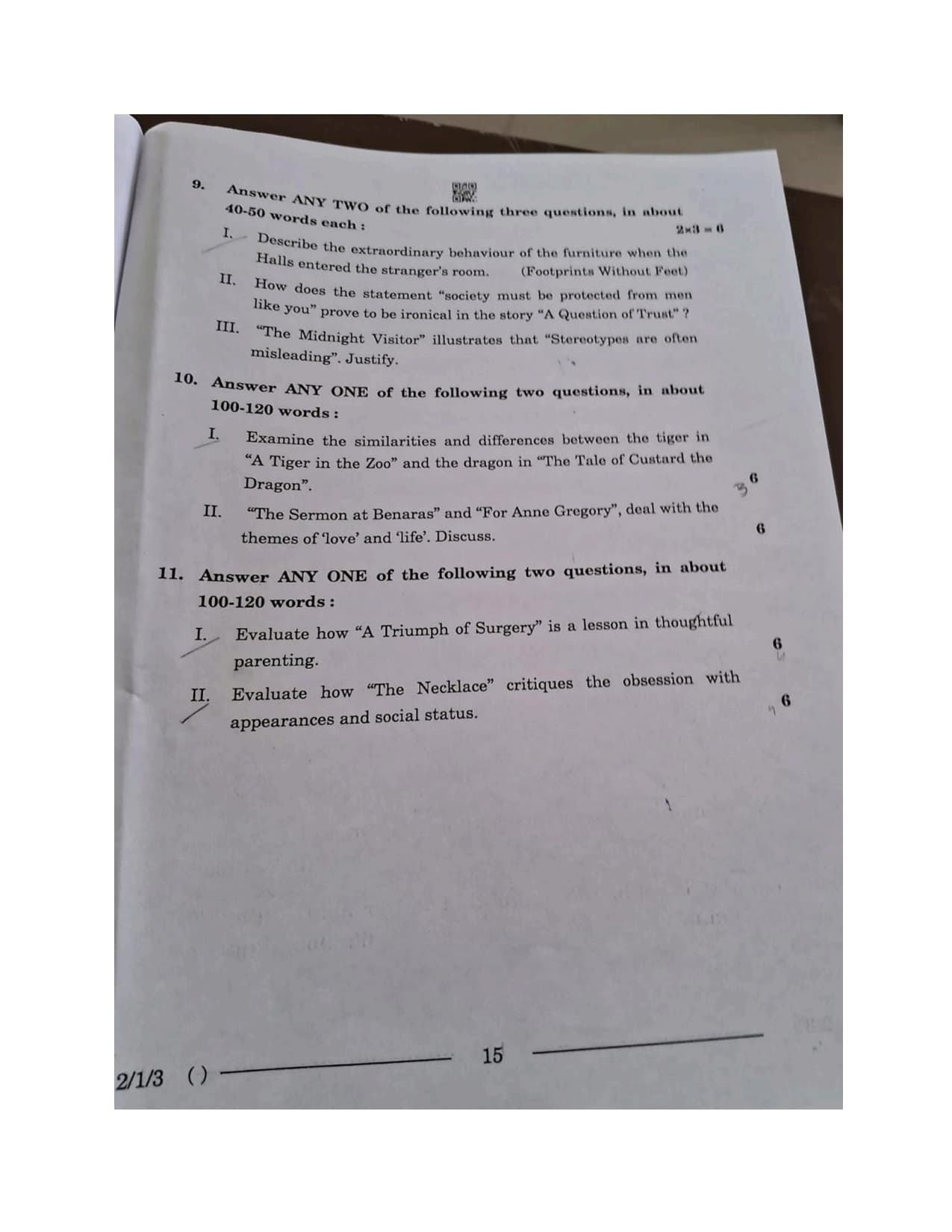
Describe the extraordinary behaviour of the furniture when the Halls entered the stranger's room. (Footprints Without Feet)
How does the statement "society must be protected from men like you" prove to be ironical in the story "A Question of Trust"?
"The Midnight Visitor" illustrates that "Stereotypes are often misleading". Justify.
Examine the similarities and differences between the tiger in "A Tiger in the Zoo" and the dragon in "The Tale of Custard the Dragon".




Comments