




The CBSE 2026 Class 10 Mathematics Basic (241) Question Paper with Solutions PDF is now available for students to assess their performance and verify their answers. Held from 10:30 AM to 1:30 PM, the paper was reported to be easy to moderate, sticking closely to the NCERT curriculum.
The exam featured straightforward calculations and fundamental applications of concepts. Students who practiced Arithmetic Progressions, Statistics, and Surface Areas and Volumes from the textbook found the paper highly scoring. This solved PDF provides a clear roadmap of the marking scheme and step-by-step solutions for the 2025-26 session.
CBSE 2026 Class 10 Mathematics Basic (241) Question Paper with Solutions PDF – Memory Based
| CBSE 2026 Class 10 Mathematics Basic (241) Question Paper with Solutions PDF | Download | Check Solutions |

The HCF of \(2^2 \cdot 3^3\) and \(3^2 \cdot 2^3\) is :
View Solution
Step 1: Understanding the Concept:
The Highest Common Factor (HCF) of numbers expressed in prime factorization is the product of the smallest power of each common prime factor.
Step 2: Key Formula or Approach:
For two numbers \(A = p^a \cdot q^b\) and \(B = p^c \cdot q^d\): \[ HCF(A, B) = p^{\min(a,c)} \cdot q^{\min(b,d)} \]
Step 3: Detailed Explanation:
1. Let \(A = 2^2 \cdot 3^3\) and \(B = 2^3 \cdot 3^2\).
2. Look at the prime factor 2: The powers are 2 and 3. The smaller power is \(2^2\).
3. Look at the prime factor 3: The powers are 3 and 2. The smaller power is \(3^2\).
4. Multiply these smallest powers: \(HCF = 2^2 \cdot 3^2\).
Step 4: Final Answer:
The HCF is \(2^2 \cdot 3^2\). Quick Tip: To remember: HCF uses the Lowest power (Smallest), while LCM uses the Highest power.
A letter is selected from the letters of the word FEBRUARY. The probability that it is a vowel is :
View Solution
Step 1: Understanding the Concept:
Probability is defined as the number of favorable outcomes divided by the total number of possible outcomes in the sample space.
Step 2: Key Formula or Approach:
\[ P(E) = \frac{Number of favorable outcomes}{Total number of outcomes} \]
Step 3: Detailed Explanation:
1. Total letters in "FEBRUARY": F, E, B, R, U, A, R, Y. Total count = 8.
2. Identify the vowels: The vowels in the English alphabet are A, E, I, O, U.
3. Favorable letters in the word: E, U, A. Count = 3.
4. Calculate Probability: \[ P(vowel) = \frac{3}{8} \]
Step 4: Final Answer:
The probability is \(\frac{3}{8}\). Quick Tip: In probability questions involving words, always count every letter individually, even if they repeat (like 'R' in February), unless the question specifically asks for "unique" letters.
Which of the following numbers will not end with 0 for any natural number \(n\)?
View Solution
Step 1: Understanding the Concept:
For a number to end with the digit 0, its prime factorization must contain both 2 and 5 as factors.
Step 2: Key Formula or Approach:
Check the prime factors of the base of each exponent or the values for \(n\).
Step 3: Detailed Explanation:
1. For \(4^n\): The base is 4. Prime factorization of \(4 = 2 \times 2\). Since there is no factor of 5, \(4^n\) will never end in 0. (It only ends in 4 or 6).
2. For \(4n\): If \(n=5, 10, 15 \dots\), it can end in 0.
3. For \(3^n + 1\): If \(n=2\), \(3^2+1 = 10\). It can end in 0.
4. For \(10^{n+1}\): It always ends in 0 because the base is 10 (\(2 \times 5\)).
Step 4: Final Answer:
\(4^n\) will never end with the digit 0. Quick Tip: The fundamental theorem of arithmetic ensures that if 5 is not in the prime factorization of the base, no power of that base will ever result in a number ending in 0.
The system of linear equations \(px + qy = r\) and \(p_1x + q_1y = r_1\) has a unique solution, if :
View Solution
Step 1: Understanding the Concept:
A system of two linear equations has a unique solution if the lines represent intersecting lines. Geometrically, this means their slopes are not equal.
Step 2: Key Formula or Approach:
For equations \(a_1x + b_1y = c_1\) and \(a_2x + b_2y = c_2\), the condition for a unique solution is: \[ \frac{a_1}{a_2} \neq \frac{b_1}{b_2} \]
Step 3: Detailed Explanation:
1. Here, \(a_1 = p, b_1 = q\) and \(a_2 = p_1, b_2 = q_1\).
2. The condition is: \[ \frac{p}{p_1} \neq \frac{q}{q_1} \]
3. Cross-multiplying to remove the fractions: \[ p q_1 \neq q p_1 \]
Step 4: Final Answer:
The condition for a unique solution is \(pq_1 \neq qp_1\). Quick Tip: Think of the cross-product of the coefficients. If \(p q_1 - q p_1 = 0\), the lines are either parallel or coincident. If it's non-zero, they must intersect at exactly one point.
Which of the equations among the following is/are quadratic equation(s)? \(q_1 : x^2 + x = (x+1)^2\), \(q_2 : x-1 = x^2 - 1\), \(q_3 : x = x^2\), \(q_4 : \sqrt{x} = x^2 \sqrt{x+1}\)
View Solution
Step 1: Understanding the Concept:
A quadratic equation must be expressible in the standard form \(ax^2 + bx + c = 0\), where \(a \neq 0\). The highest power (degree) of the variable must be exactly 2 after simplification.
Step 2: Key Formula or Approach:
Simplify each equation and check the degree of the polynomial.
Step 3: Detailed Explanation:
1. \(q_1\): \(x^2 + x = x^2 + 2x + 1 \rightarrow x + 1 = 0\). This is Linear (degree 1).
2. \(q_2\): \(x^2 - x = 0\). This is Quadratic (degree 2).
3. \(q_3\): \(x^2 - x = 0\). This is Quadratic (degree 2).
4. \(q_4\): Contains square roots and higher powers after squaring. It is not a polynomial equation in the standard quadratic sense.
Step 4: Final Answer:
The quadratic equations are \(q_2\) and \(q_3\). Quick Tip: Don't just look for an \(x^2\); ensure that the \(x^2\) term doesn't cancel out during simplification (like in \(q_1\)).
The discriminant of the quadratic equation \(ax^2 + x + a = 0\) is :
View Solution
Step 1: Understanding the Concept:
The discriminant (\(D\)) of a quadratic equation helps determine the nature of its roots. For an equation in the form \(Ax^2 + Bx + C = 0\), the discriminant is the value under the square root in the quadratic formula.
Step 2: Key Formula or Approach:
\[ D = B^2 - 4AC \]
Step 3: Detailed Explanation:
1. Identify the coefficients from the given equation \(ax^2 + 1x + a = 0\):
- \(A = a\)
- \(B = 1\)
- \(C = a\)
2. Substitute these values into the discriminant formula: \[ D = (1)^2 - 4(a)(a) \] \[ D = 1 - 4a^2 \]
Step 4: Final Answer:
The discriminant is \(1 - 4a^2\). Quick Tip: Remember that the discriminant itself does not include the square root symbol. The square root is part of the quadratic formula (\(\sqrt{D}\)), but the discriminant is just the expression inside it.
The distance between points (3, 0) and (0, -3) is :
View Solution
Step 1: Understanding the Concept:
The distance between two points in a 2D plane is the length of the shortest line segment connecting them, calculated using the coordinates of the points.
Step 2: Key Formula or Approach:
Distance \(d = \sqrt{(x_2 - x_1)^2 + (y_2 - y_1)^2}\)
Step 3: Detailed Explanation:
1. Assign coordinates: \((x_1, y_1) = (3, 0)\) and \((x_2, y_2) = (0, -3)\).
2. Substitute into the formula: \[ d = \sqrt{(0 - 3)^2 + (-3 - 0)^2} \] \[ d = \sqrt{(-3)^2 + (-3)^2} \] \[ d = \sqrt{9 + 9} = \sqrt{18} \]
3. Note: \(\sqrt{18}\) can also be written as \(3\sqrt{2}\) units.
Step 4: Final Answer:
The distance is \(\sqrt{18}\) units. Quick Tip: When one coordinate of each point is zero, the distance is simply the hypotenuse of a right triangle with legs equal to the non-zero coordinate values. Here, \(\sqrt{3^2 + 3^2}\).
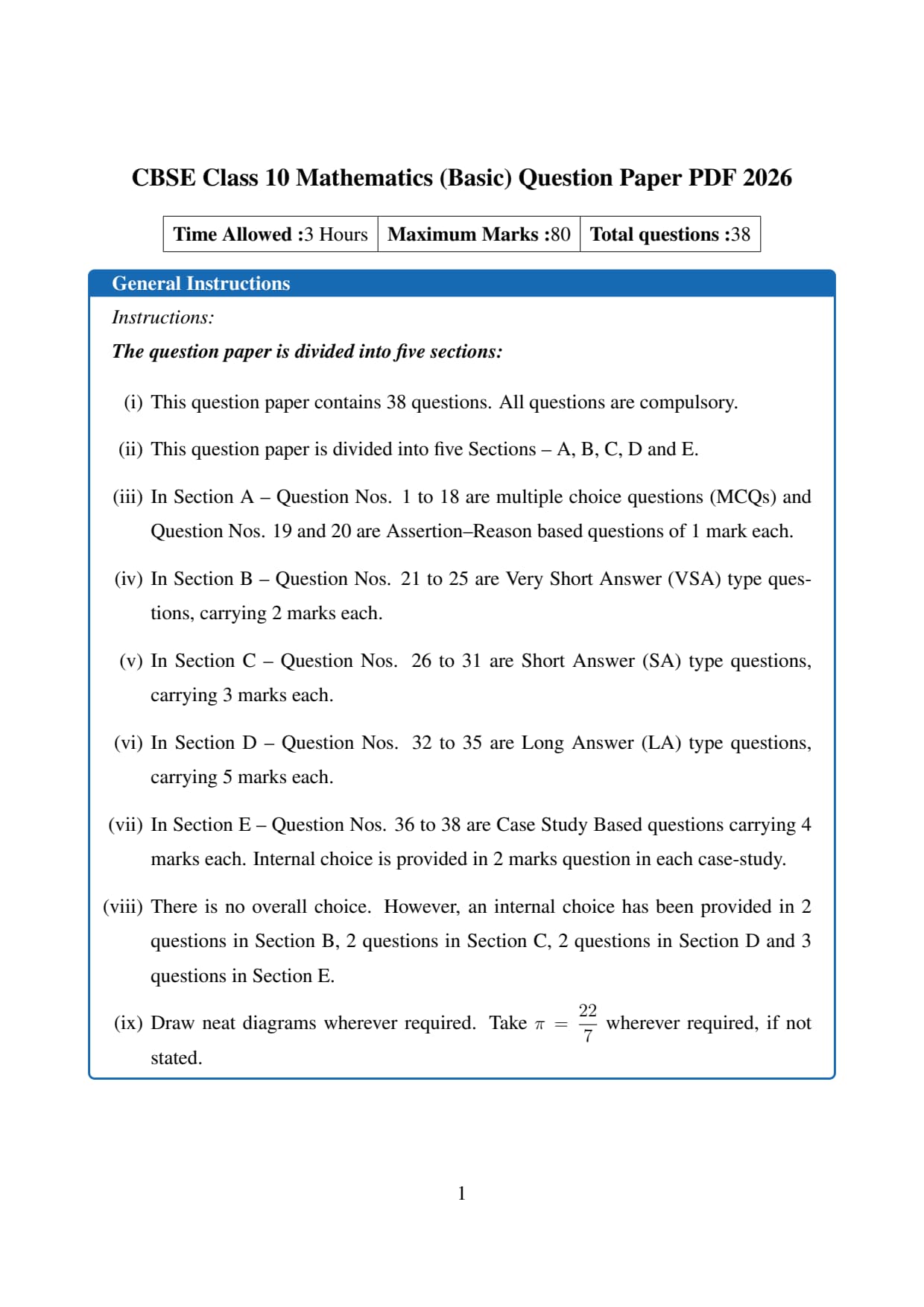
If \(\triangle ABC \sim \triangle ADE\) in the adjoining figure, then which of the following is true?

View Solution
Step 1: Understanding the Concept:
Similarity between two triangles (\(\triangle ABC \sim \triangle ADE\)) implies that their corresponding angles are equal and their corresponding sides are in the same proportion.
Step 2: Key Formula or Approach:
The ratio of corresponding sides must be equal: \[ \frac{AB}{AD} = \frac{BC}{DE} = \frac{AC}{AE} \]
Step 3: Detailed Explanation:
1. From the similarity \(\triangle ABC \sim \triangle ADE\), match the vertices:
- \(A\) corresponds to \(A\) (Common Angle)
- \(B\) corresponds to \(D\)
- \(C\) corresponds to \(E\)
2. The ratio of the sides is therefore: \(\frac{AB}{AD} = \frac{AC}{AE} = \frac{BC}{DE}\).
3. Comparing this with the options, option (b) matches the proportionality of the corresponding sides.
Step 4: Final Answer:
The correct statement is \(\frac{AB}{AD} = \frac{AC}{AE}\). Quick Tip: Always write the ratio based on the order of the letters in the similarity statement. For \(\triangle \textbf{AB}C \sim \triangle \textbf{AD}E\), the first two letters of the first triangle (\(AB\)) always correspond to the first two of the second (\(AD\)).
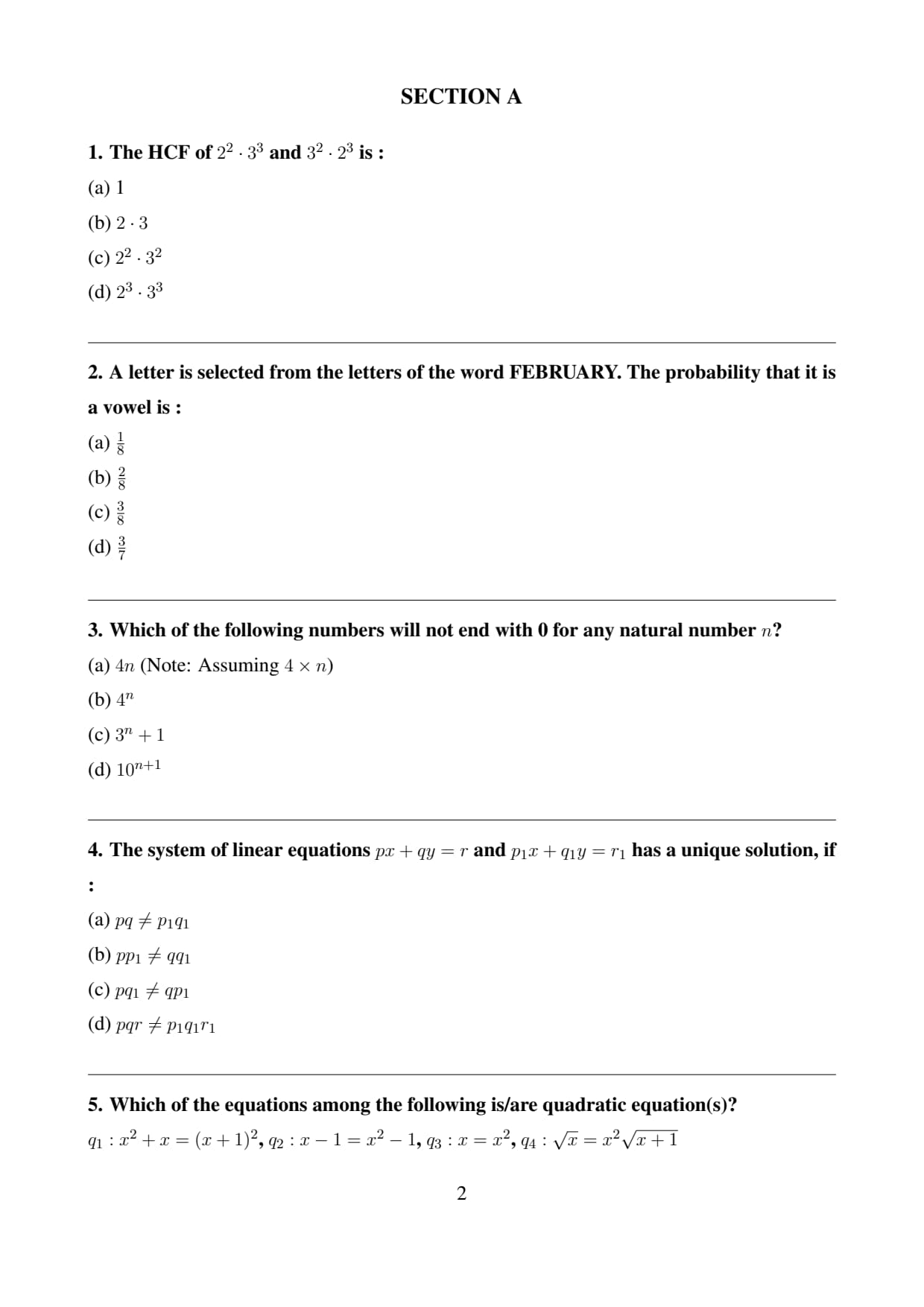
In the adjoining figure, if \(EA \parallel SR\) and \(PE = x\) cm, then the value of \(5x\) is :

View Solution
Step 1: Understanding the Concept:
According to the Basic Proportionality Theorem (Thales Theorem), if a line is drawn parallel to one side of a triangle to intersect the other two sides, the other two sides are divided in the same ratio.
Step 2: Key Formula or Approach:
\[ \frac{PE}{ES} = \frac{PA}{AR} \]
Step 3: Detailed Explanation:
Assuming a standard figure where \(PE=x, ES=3, PA=2, AR=2.5\):
1. Apply the ratio: \[ \frac{x}{3} = \frac{2}{2.5} \]
2. Solve for \(x\): \[ x = \frac{2 \times 3}{2.5} = \frac{6}{2.5} = 2.4 cm \]
3. The question asks for the value of \(5x\): \[ 5x = 5 \times 2.4 = 12 cm \]
Step 4: Final Answer:
The value of \(5x\) is 12 cm. Quick Tip: Read the final question carefully! Many students stop after finding \(x\), but here you were specifically asked for \(5x\).
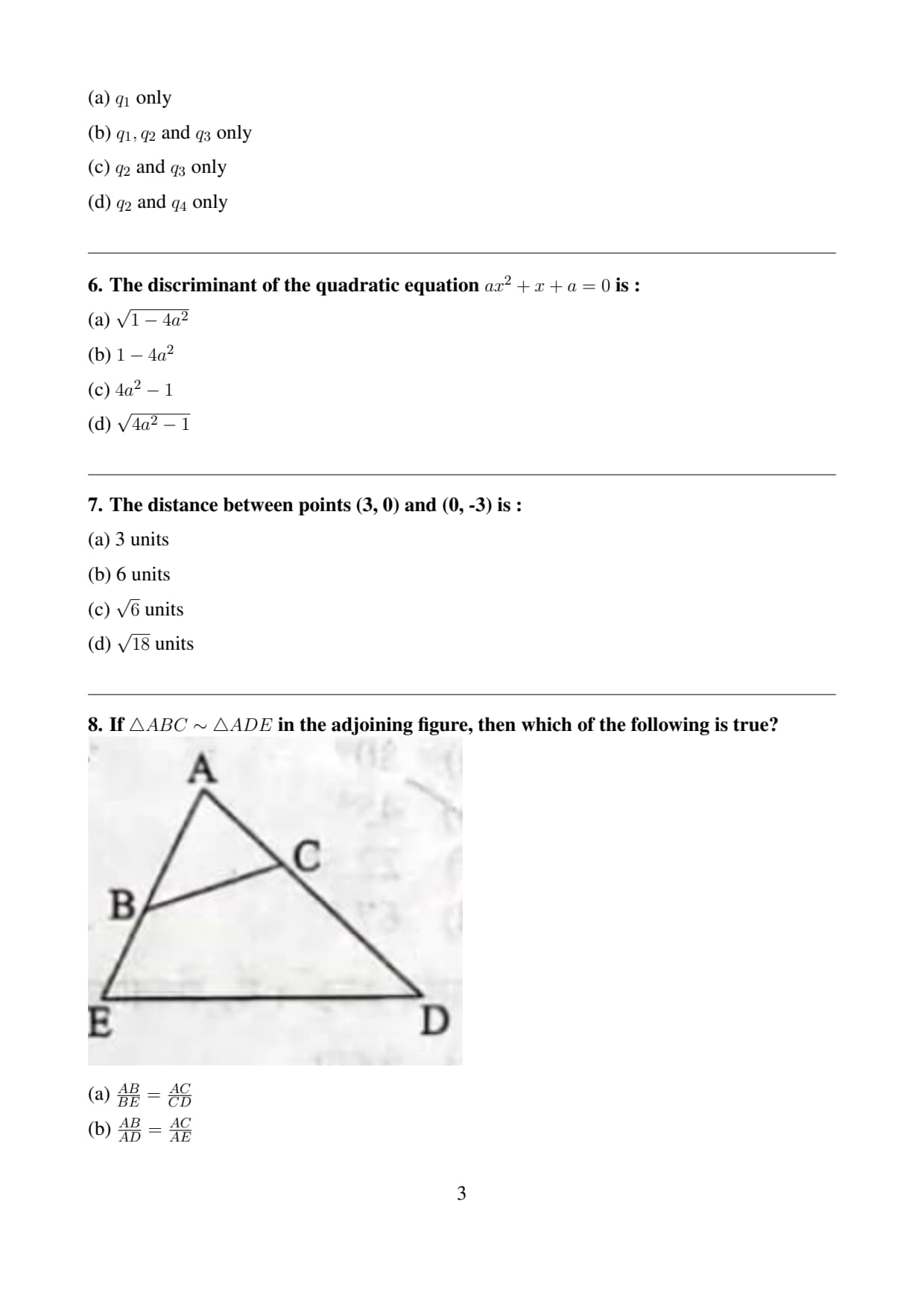
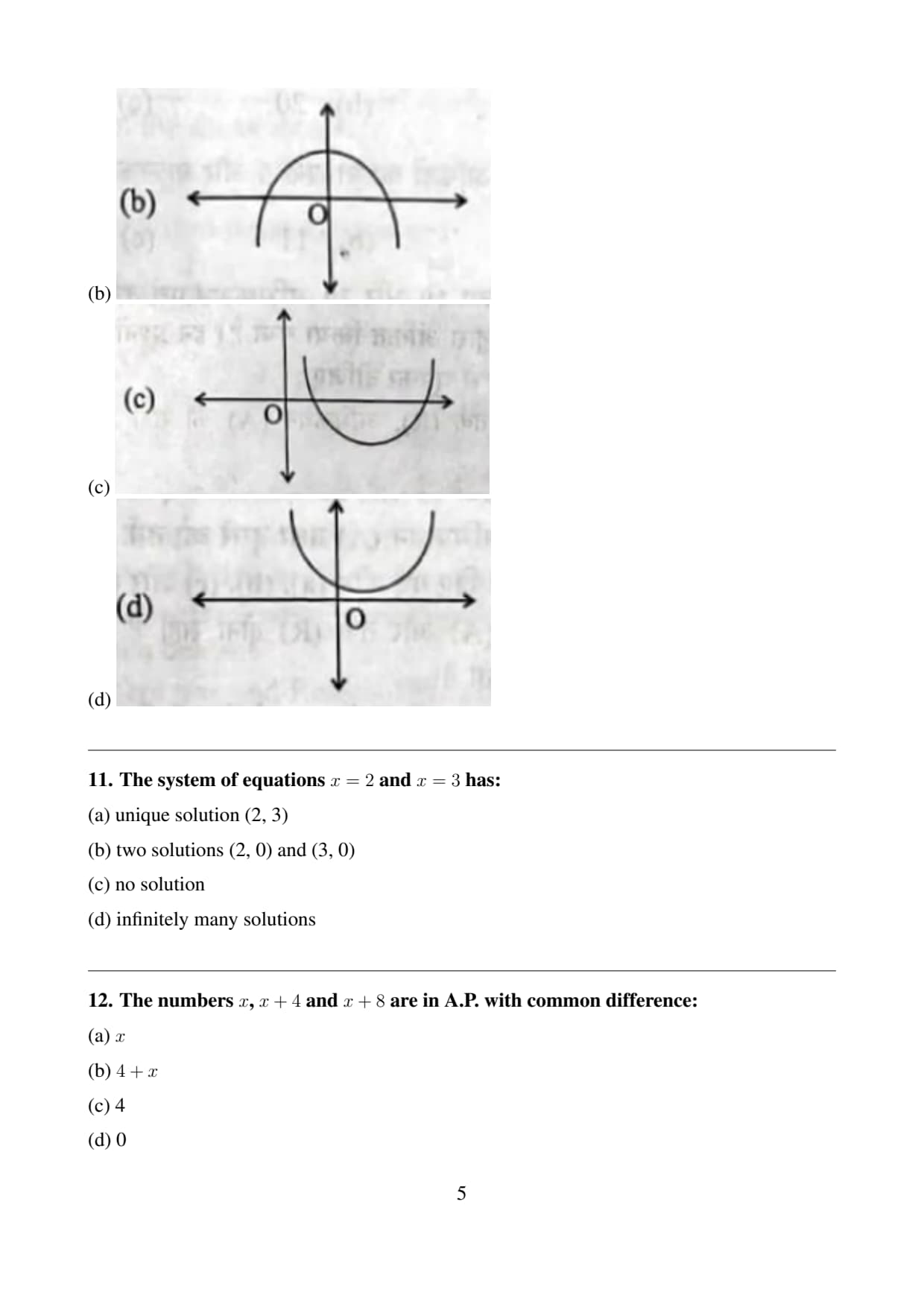
Which of the following graphs represents a polynomial with both zeroes being positive?
- (a)
![]()
- (b)
![]()
- (c)
![]()
- (d)
![]()


View Solution
Step 1: Understanding the Concept:
The zeroes of a polynomial are the x-intercepts of its graph. If a zero is positive, the graph must cross or touch the x-axis to the right of the y-axis (where \(x > 0\)).
Step 2: Key Formula or Approach:
Look for a graph where all intersection points with the horizontal axis are in the first or fourth quadrants (positive x-region).
Step 3: Detailed Explanation:
1. Analyze the axis: The y-axis divides the plane into negative \(x\) (left) and positive \(x\) (right).
2. Analyze intersection points:
- If the curve crosses the x-axis on the left, it has a negative zero.
- If it crosses at the origin, it has a zero at \(x = 0\).
- For both zeroes to be positive, the entire set of x-intercepts must be on the right side of the origin.
Step 4: Final Answer:
The graph representing a polynomial with both positive zeroes is an upward or downward parabola that intersects the x-axis twice to the right of the y-axis. Quick Tip: For a quadratic \(ax^2 + bx + c\) with both positive zeroes, the sum of roots (\(-b/a\)) must be positive and the product of roots (\(c/a\)) must also be positive.
The system of equations \(x = 2\) and \(x = 3\) has:
View Solution
Step 1: Understanding the Concept:
A system of linear equations has a solution only if the lines intersect at one or more points. In a 2D plane, the equation \(x = c\) represents a vertical line passing through the value \(c\) on the x-axis.
Step 2: Key Formula or Approach:
Parallel lines never intersect. If the lines are parallel and not coincident, the system has no solution.
Step 3: Detailed Explanation:
1. The equation \(x = 2\) is a vertical line where every point has an x-coordinate of 2.
2. The equation \(x = 3\) is a vertical line where every point has an x-coordinate of 3.
3. These two lines are parallel to each other and to the y-axis.
4. Since they never intersect, there is no point \((x, y)\) that can satisfy both equations simultaneously.
Step 4: Final Answer:
The system has no solution. Quick Tip: Graphically, the solution is the point of intersection. Since a single point cannot have an x-value of both 2 and 3 at the same time, it's impossible for these lines to meet.
The numbers \(x\), \(x+4\) and \(x+8\) are in A.P. with common difference:
View Solution
Step 1: Understanding the Concept:
In an Arithmetic Progression (A.P.), the common difference (\(d\)) is the fixed value added to each term to get the next term.
Step 2: Key Formula or Approach:
\[ d = a_2 - a_1 = a_3 - a_2 \]
Step 3: Detailed Explanation:
1. Let the first term \(a_1 = x\).
2. Let the second term \(a_2 = x + 4\).
3. Calculate the difference: \[ d = (x + 4) - x = 4 \]
4. Verify with the third term: \[ d = (x + 8) - (x + 4) = x + 8 - x - 4 = 4 \]
Since the difference is constant, \(d = 4\).
Step 4: Final Answer:
The common difference is 4. Quick Tip: Even if the terms contain a variable, the common difference is often a constant. Don't let the \(x\) confuse you; just follow the subtraction rule!
Which of the following statements is not true?
View Solution
Step 1: Understanding the Concept:
This question tests knowledge of specific values for trigonometric ratios and complementary angle relationships (\(\sin \theta = \cos(90^\circ - \theta)\)).
Step 2: Key Formula or Approach:
Evaluate each statement using standard values: \(\sin 0^\circ = 0, \cos 0^\circ = 1, \tan 30^\circ = 1/\sqrt{3}, \cot 60^\circ = 1/\sqrt{3}, \sin 30^\circ = 1/2, \cos 60^\circ = 1/2, \sin 45^\circ = 1/\sqrt{2}, \sec 45^\circ = \sqrt{2}\).
Step 3: Detailed Explanation:
1. Check (a): \(\sin 0^\circ = 0\) and \(\cos 0^\circ = 1\). Since \(0 \neq 1\), this is NOT TRUE.
2. Check (b): \(\tan 30^\circ = 1/\sqrt{3}\) and \(\cot 60^\circ = \tan(90-60) = \tan 30^\circ = 1/\sqrt{3}\). This is true.
3. Check (c): \(\sin 30^\circ = 1/2\) and \(\cos 60^\circ = \sin(90-60) = \sin 30^\circ = 1/2\). This is true.
4. Check (d): \(\frac{1}{\sec 45^\circ}\) is the definition of \(\cos 45^\circ\). Since \(\sin 45^\circ = \cos 45^\circ = 1/\sqrt{2}\), this is true.
Step 4: Final Answer:
The statement that is not true is (a). Quick Tip: Co-functions (sine/cosine, tangent/cotangent, secant/cosecant) are equal when their angles sum to \(90^\circ\).
If \(\sqrt{3} \sin A = \cos A\), then the measure of \(A\) is :
View Solution
Step 1: Understanding the Concept:
To find the angle \(A\), we need to rearrange the equation to use a single trigonometric ratio, typically \(\tan A\), since \(\tan A = \frac{\sin A}{\cos A}\).
Step 2: Key Formula or Approach:
1. Divide both sides by \(\cos A\) to get \(\tan A\).
2. Use the identity \(\tan A = \frac{\sin A}{\cos A}\).
Step 3: Detailed Explanation:
1. Given: \(\sqrt{3} \sin A = \cos A\)
2. Divide both sides by \(\cos A\): \[ \sqrt{3} \frac{\sin A}{\cos A} = 1 \]
3. Simplify using \(\tan A\): \[ \sqrt{3} \tan A = 1 \]
4. Isolate \(\tan A\): \[ \tan A = \frac{1}{\sqrt{3}} \]
5. We know from standard values that \(\tan 30^\circ = \frac{1}{\sqrt{3}}\). Therefore, \(A = 30^\circ\).
Step 4: Final Answer:
The measure of \(A\) is 30°. Quick Tip: If you see \(\sin\) and \(\cos\) in the same equation with no exponents, aim to create a \(\tan\) or \(\cot\) term to solve it quickly.
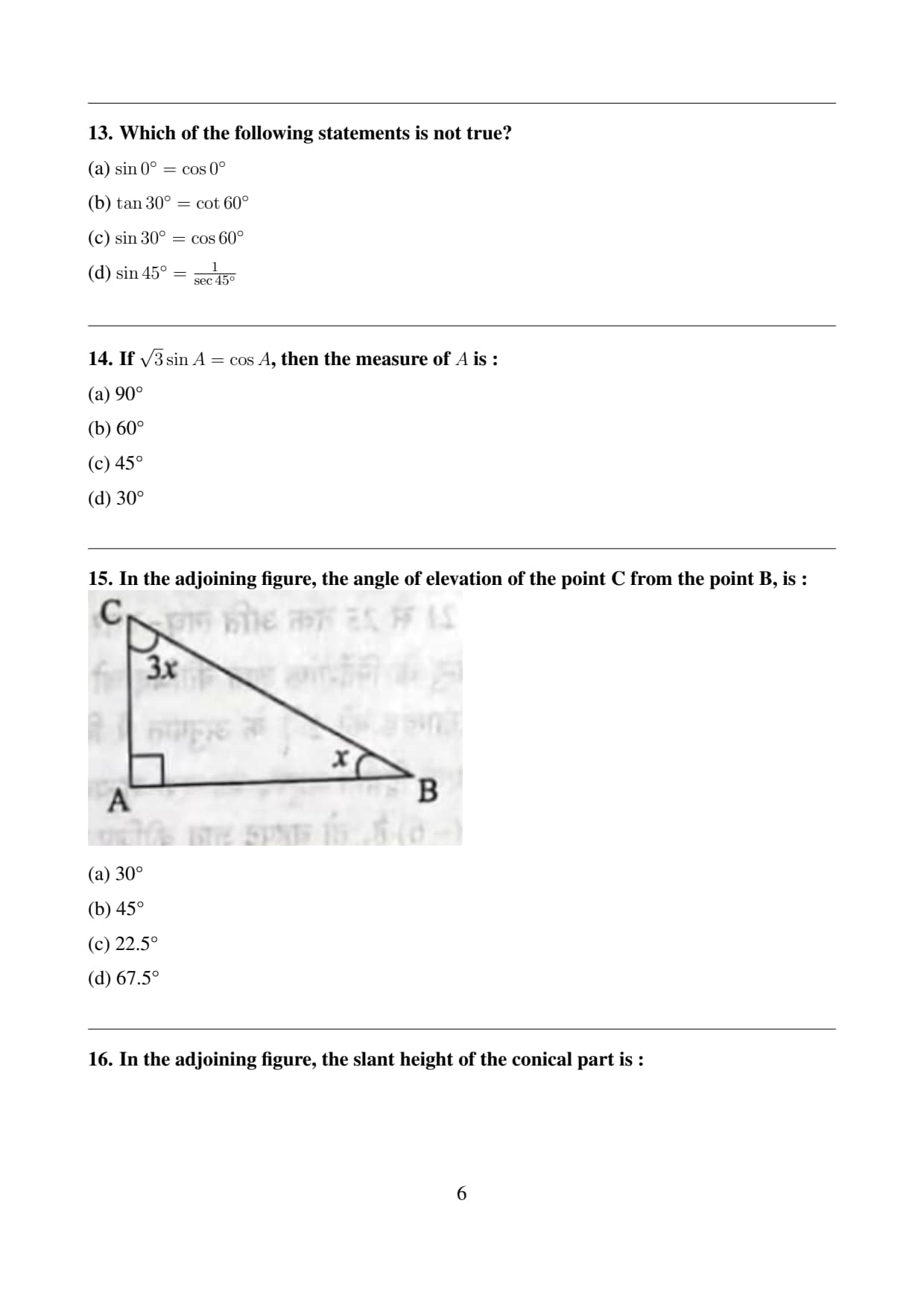
In the adjoining figure, the angle of elevation of the point C from the point B, is :

View Solution
Step 1: Understanding the Concept:
The angle of elevation is the angle between the horizontal line of sight and the line of sight to an object above the horizontal level.
Step 2: Key Formula or Approach:
In a right-angled triangle, if we know the height (\(h\)) and the base (\(b\)): \[ \tan \theta = \frac{Opposite}{Adjacent} = \frac{Height}{Base} \]
Step 3: Detailed Explanation:
Assuming the figure provides a height \(h\) and base \(b = h\sqrt{3}\):
1. Let the angle of elevation be \(\theta\).
2. \(\tan \theta = \frac{h}{h\sqrt{3}}\).
3. Simplify: \(\tan \theta = \frac{1}{\sqrt{3}}\).
4. Therefore, \(\theta = 30^\circ\).
Step 4: Final Answer:
The angle of elevation is 30°. Quick Tip: If the height is smaller than the base, the angle of elevation is always less than \(45^\circ\). If they are equal, the angle is exactly \(45^\circ\).
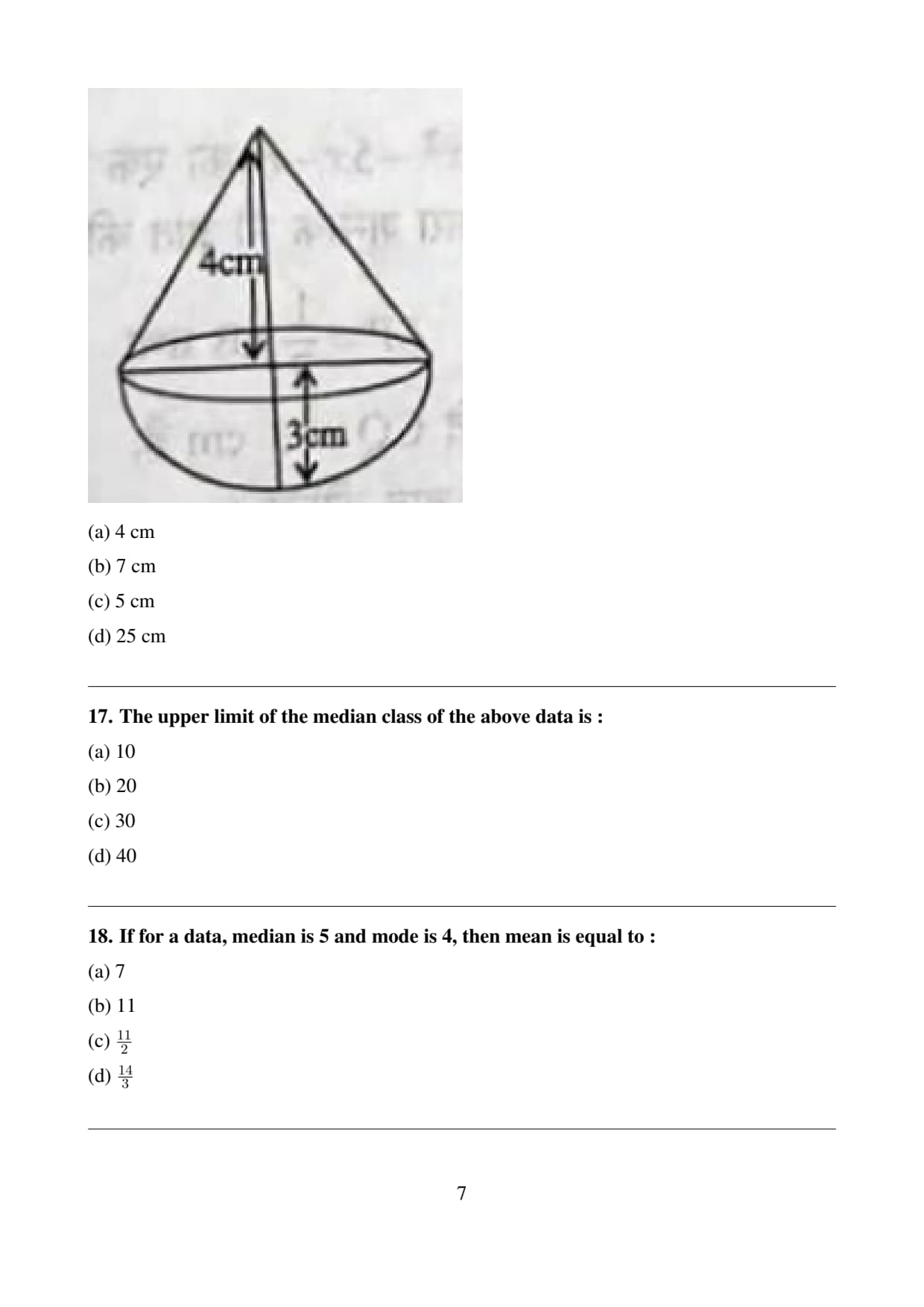
In the adjoining figure, the slant height of the conical part is :

View Solution
Step 1: Understanding the Concept:
The slant height (\(l\)) of a cone is the distance from the apex to any point on the circumference of the base. It forms a right-angled triangle with the vertical height (\(h\)) and the radius (\(r\)).
Step 2: Key Formula or Approach:
Pythagoras' Theorem: \[ l = \sqrt{r^2 + h^2} \]
Step 3: Detailed Explanation:
Assuming the figure specifies a radius \(r = 3\) cm and a vertical height \(h = 4\) cm:
1. Substitute the values into the formula: \[ l = \sqrt{3^2 + 4^2} \]
2. Calculate the squares: \[ l = \sqrt{9 + 16} \]
3. Find the square root: \[ l = \sqrt{25} = 5 cm \]
Step 4: Final Answer:
The slant height of the conical part is 5 cm. Quick Tip: The set (3, 4, 5) is a Pythagorean triple. If you see 3 and 4 as the legs of a right triangle, the hypotenuse (slant height) is always 5.
The upper limit of the median class of the above data is :
View Solution
Step 1: Understanding the Concept:
The median class is the class interval whose cumulative frequency is just greater than or equal to \(N/2\), where \(N\) is the total frequency.
Step 2: Key Formula or Approach:
1. Find total frequency \(N = \sum f\).
2. Calculate cumulative frequencies (cf).
3. Identify the class corresponding to \(cf \geq N/2\).
Step 3: Detailed Explanation:
1. Calculate Cumulative Frequency:
- 0-10: 3
- 10-20: 3 + 5 = 8
- 20-30: 8 + 7 = 15
- 30-40: 15 + 9 = 24
- 40-50: 24 + 11 = 35
2. Find \(N/2\): Total \(N = 35\), so \(N/2 = 17.5\).
3. Identify Median Class: The cumulative frequency just greater than 17.5 is 24, which corresponds to the class 30-40.
4. Identify Upper Limit: For the class 30-40, the upper limit is 40.
Step 4: Final Answer:
The upper limit of the median class is 40. Quick Tip: Always double-check your cumulative frequency sum against the total frequency to ensure no arithmetic errors were made during addition.
If for a data, median is 5 and mode is 4, then mean is equal to :
View Solution
Step 1: Understanding the Concept:
For a moderately skewed distribution, there is an empirical relationship between Mean, Median, and Mode.
Step 2: Key Formula or Approach:
Empirical Formula: \[ Mode = 3(Median) - 2(Mean) \]
Step 3: Detailed Explanation:
1. Given: Median = 5, Mode = 4.
2. Substitute into the formula: \[ 4 = 3(5) - 2(Mean) \]
3. Simplify the equation: \[ 4 = 15 - 2(Mean) \]
4. Rearrange to solve for Mean: \[ 2(Mean) = 15 - 4 \] \[ 2(Mean) = 11 \] \[ Mean = \frac{11}{2} = 5.5 \]
Step 4: Final Answer:
The mean is \(\frac{11}{2}\). Quick Tip: To remember the formula, think of the coefficients: 3 and 2. Since 3 > 2, the larger coefficient (3) goes with Median (6 letters) and the smaller (2) goes with Mean (4 letters).
Assertion (A): From a bag containing 5 red balls, 2 white balls and 3 green balls, the probability of drawing a non-white ball is \(\frac{4}{5}\).
Reason (R): For any event E, \(P(E) + P(not E) = 1\)
View Solution
Step 1: Understanding the Concept:
This question evaluates a specific probability calculation and the fundamental rule of complementary events.
Step 2: Key Formula or Approach:
1. Probability calculation: \(P(event) = \frac{favorable}{total}\).
2. Complementary rule: \(P(not A) = 1 - P(A)\).
Step 3: Detailed Explanation:
1. Total balls: \(5 + 2 + 3 = 10\).
2. Favorable (non-white): Red + Green = \(5 + 3 = 8\).
3. Probability (A): \(P(non-white) = \frac{8}{10} = \frac{4}{5}\). Thus, Assertion (A) is true.
4. Check Reason (R): The formula \(P(E) + P(not E) = 1\) is a standard axiom of probability. It is true.
5. Relationship: The reason provides the logical basis for calculating "non-white" (not white) as a complement to drawing a white ball.
Step 4: Final Answer:
Both Assertion and Reason are true, and Reason is the correct explanation. Quick Tip: In "non-" or "not" questions, it's often faster to calculate the probability of the event happening and subtract it from 1.
Assertion (A): \(7 \times 2 + 3\) is a composite number.
Reason (R): A composite number has more than two factors.
View Solution
Step 1: Understanding the Concept:
A composite number is a positive integer greater than 1 that has factors other than 1 and itself. A prime number has only two factors (1 and itself).
Step 2: Key Formula or Approach:
1. Solve the expression in (A).
2. Check if the result is prime or composite.
Step 3: Detailed Explanation:
1. Solve (A): \[ 7 \times 2 + 3 = 14 + 3 = 17 \]
2. Check the result: 17 is a prime number because its only factors are 1 and 17.
3. Therefore, Assertion (A) is False.
4. Check Reason (R): By definition, a composite number must have more than two factors. This statement is True.
Step 4: Final Answer:
Assertion (A) is false, but Reason (R) is true. Quick Tip: Always perform the arithmetic operations before deciding if an expression represents a prime or composite number. Don't be fooled by the presence of prime factors like 7 and 2 in the expression.
Find the coordinates of the point which divides the line segment joining the points A (-6, 10) and B (3, -8) in the ratio 2 : 7.
View Solution
Step 1: Understanding the Concept:
To find the coordinates of a point dividing a line segment in a given ratio, we use the Section Formula. This formula calculates the weighted average of the x and y coordinates based on the ratio.
Step 2: Key Formula or Approach:
If a point \(P(x, y)\) divides the line segment joining \((x_1, y_1)\) and \((x_2, y_2)\) in the ratio \(m_1 : m_2\), then: \[ P(x, y) = \left( \frac{m_1x_2 + m_2x_1}{m_1 + m_2}, \frac{m_1y_2 + m_2y_1}{m_1 + m_2} \right) \]
Step 3: Detailed Explanation:
1. Given: \(A(-6, 10)\) as \((x_1, y_1)\), \(B(3, -8)\) as \((x_2, y_2)\), and ratio \(m_1 : m_2 = 2 : 7\).
2. Calculate the x-coordinate: \[ x = \frac{2(3) + 7(-6)}{2 + 7} = \frac{6 - 42}{9} = \frac{-36}{9} = -4 \]
3. Calculate the y-coordinate: \[ y = \frac{2(-8) + 7(10)}{2 + 7} = \frac{-16 + 70}{9} = \frac{54}{9} = 6 \]
Step 4: Final Answer:
The coordinates of the point are \((-4, 6)\). Quick Tip: To avoid mixing up the coordinates, remember the "cross" multiplication: the first part of the ratio (\(m_1\)) multiplies the second point's coordinates (\(x_2, y_2\)).
One zero of a quadratic polynomial is twice the other. If the sum of zeroes is (-6), find the polynomial.
View Solution
Step 1: Understanding the Concept:
A quadratic polynomial \(p(x)\) with zeroes \(\alpha\) and \(\beta\) can be written as \(k[x^2 - (\alpha + \beta)x + \alpha\beta]\).
Step 2: Key Formula or Approach:
1. Let the zeroes be \(\alpha\) and \(2\alpha\).
2. Sum of zeroes: \(\alpha + \beta = -b/a\)
3. Product of zeroes: \(\alpha\beta = c/a\)
Step 3: Detailed Explanation:
1. Given: Sum of zeroes = \(-6\). \[ \alpha + 2\alpha = -6 \implies 3\alpha = -6 \implies \alpha = -2 \]
2. The zeroes are \(-2\) and \(2(-2) = -4\).
3. Product of zeroes: \[ \alpha\beta = (-2) \times (-4) = 8 \]
4. Construct the polynomial: \[ p(x) = x^2 - (Sum)x + (Product) \] \[ p(x) = x^2 - (-6)x + 8 = x^2 + 6x + 8 \]
Step 4: Final Answer:
The polynomial is \(x^2 + 6x + 8\). Quick Tip: For polynomial \(x^2 + bx + c\), the sum of zeroes is \(-b\) and the product is \(c\). This shortcut only works when the coefficient of \(x^2\) is 1.
If one zero of the polynomial \(x^2 - 5x - c\) is (-1), find the value of c. Also, find the other zero.
View Solution
Step 1: Solving OR (B):
1. If \(-1\) is a zero, \(p(-1) = 0\): \[ (-1)^2 - 5(-1) - c = 0 \implies 1 + 5 - c = 0 \implies c = 6 \]
2. The polynomial is \(x^2 - 5x - 6\).
3. Let the other zero be \(\beta\). Sum of zeroes: \(-1 + \beta = -(-5)/1 = 5\).
4. \(\beta = 5 + 1 = 6\).
Step 2: Final Answer (OR):
The value of \(c\) is 6, and the other zero is 6. Quick Tip: For polynomial \(x^2 + bx + c\), the sum of zeroes is \(-b\) and the product is \(c\). This shortcut only works when the coefficient of \(x^2\) is 1.
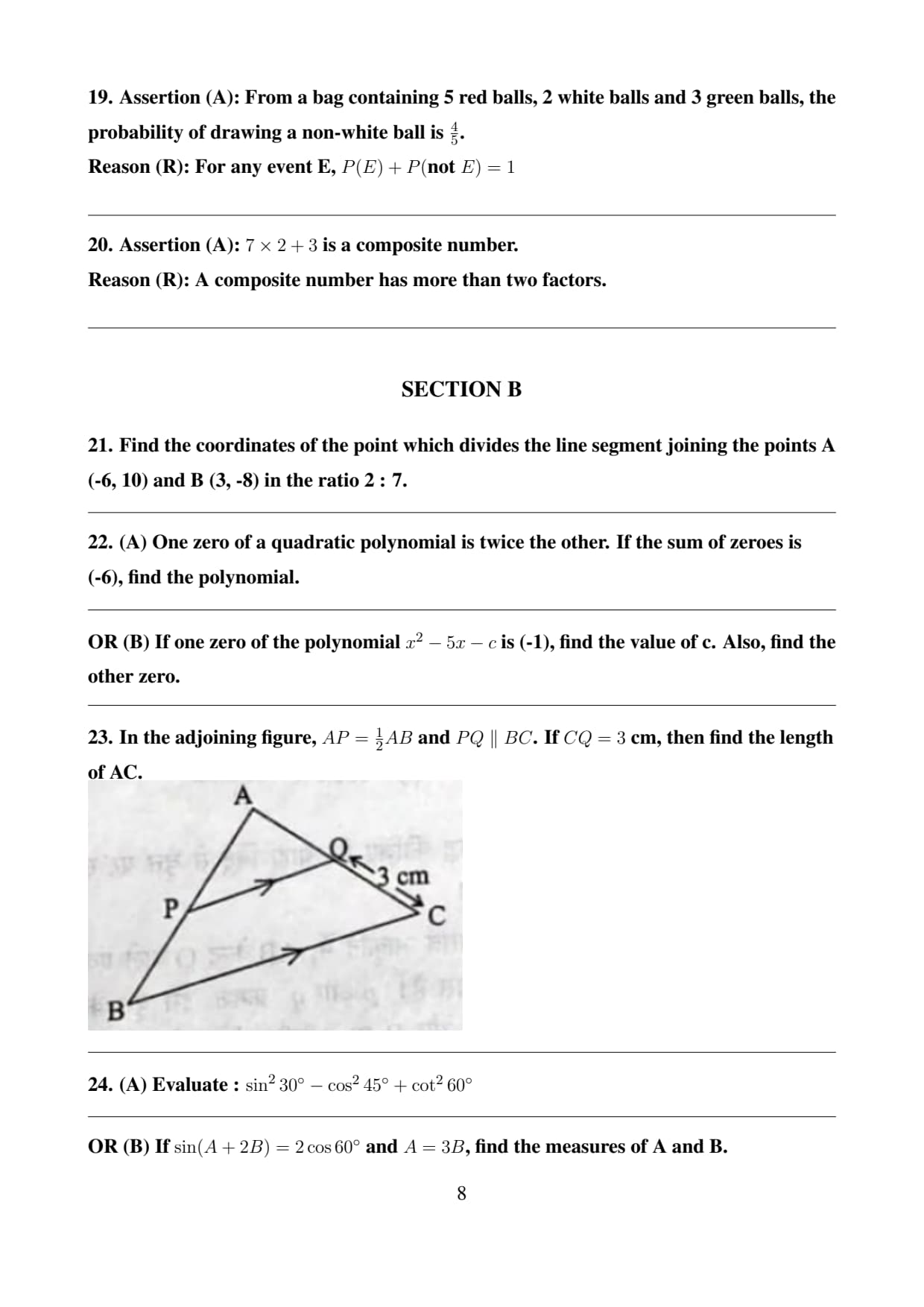
In the adjoining figure, \(AP = \frac{1}{2} AB\) and \(PQ \parallel BC\). If \(CQ = 3\) cm, then find the length of AC.

View Solution
Step 1: Understanding the Concept:
By the Basic Proportionality Theorem (BPT), if a line is parallel to one side of a triangle, it divides the other two sides proportionally.
Step 2: Key Formula or Approach:
If \(PQ \parallel BC\), then \(\frac{AP}{AB} = \frac{AQ}{AC}\).
Step 3: Detailed Explanation:
1. Given: \(AP = \frac{1}{2} AB \implies \frac{AP}{AB} = \frac{1}{2}\).
2. This implies \(P\) is the midpoint of \(AB\). Since \(PQ \parallel BC\), by the converse of midpoint theorem or BPT, \(Q\) must be the midpoint of \(AC\).
3. Therefore, \(AQ = QC\).
4. Given \(CQ = 3\) cm, then \(AQ = 3\) cm.
5. \(AC = AQ + QC = 3 + 3 = 6\) cm.
Step 4: Final Answer:
The length of \(AC\) is 6 cm. Quick Tip: If \(\frac{AP}{AB} = \frac{1}{2}\), it means \(AP = PB\). The ratio of the segments is \(1:1\).
Evaluate : \(\sin^2 30^\circ - \cos^2 45^\circ + \cot^2 60^\circ\)
View Solution
Step 1: Understanding the Concept:
Evaluation involves substituting the standard trigonometric values for specific angles into the expression.
Step 2: Key Values:
\(\sin 30^\circ = \frac{1}{2}\), \(\cos 45^\circ = \frac{1}{\sqrt{2}}\), \(\cot 60^\circ = \frac{1}{\sqrt{3}}\).
Step 3: Detailed Explanation:
1. Substitute the values: \[ \left(\frac{1}{2}\right)^2 - \left(\frac{1}{\sqrt{2}}\right)^2 + \left(\frac{1}{\sqrt{3}}\right)^2 \]
2. Square the terms: \[ \frac{1}{4} - \frac{1}{2} + \frac{1}{3} \]
3. Find a common denominator (12): \[ \frac{3 - 6 + 4}{12} = \frac{1}{12} \]
Step 4: Final Answer:
The value is \(\frac{1}{12}\). Quick Tip: When an equation involves \(\sin(\dots) = 1\), immediately replace 1 with \(\sin 90^\circ\) to "remove" the sine function and solve for the angles.
If \(\sin(A + 2B) = 2 \cos 60^\circ\) and \(A = 3B\), find the measures of A and B.
View Solution
Step 1: Solving OR (B):
1. We know \(2 \cos 60^\circ = 2 \times \frac{1}{2} = 1\).
2. \(\sin(A + 2B) = 1\). Since \(\sin 90^\circ = 1\), then \(A + 2B = 90^\circ\).
3. Substitute \(A = 3B\): \[ 3B + 2B = 90^\circ \implies 5B = 90^\circ \implies B = 18^\circ \]
4. Find \(A\): \(A = 3 \times 18^\circ = 54^\circ\).
Step 2: Final Answer (OR):
\(A = 54^\circ\) and \(B = 18^\circ\). Quick Tip: When an equation involves \(\sin(\dots) = 1\), immediately replace 1 with \(\sin 90^\circ\) to "remove" the sine function and solve for the angles.
A box consists of 60 wall clocks, out of which 40 are good, 15 have minor defects and the remaining are broken. What is the probability that
(i) the box will be rejected?
(ii) the clock has minor defect?
View Solution
Step 1: Understanding the Concept:
Probability is the ratio of favorable outcomes to the total outcomes.
Step 2: Key Data:
Total clocks = 60.
Good = 40.
Minor defect = 15.
Broken = \(60 - (40 + 15) = 5\).
Step 3: Detailed Explanation:
1. Case (i): Box is rejected. The trader rejects the box if the clock taken out is broken. \[ P(Rejected) = \frac{Broken Clocks}{Total Clocks} = \frac{5}{60} = \frac{1}{12} \]
2. Case (ii): Clock has minor defect. \[ P(Minor defect) = \frac{15}{60} = \frac{1}{4} \]
Step 4: Final Answer:
(i) Probability of rejection is \(\frac{1}{12}\). (ii) Probability of minor defect is \(\frac{1}{4}\). Quick Tip: Always reduce your fractions to the simplest form in probability answers to ensure full marks.
Given that \(\sqrt{5}\) is an irrational number, prove that \(3 + 2\sqrt{5}\) is also an irrational number.
View Solution
Step 1: Understanding the Concept:
We use the Method of Contradiction. We assume the opposite of what we want to prove (that the number is rational) and show that this leads to a logical impossibility (a contradiction).
Step 2: Key Formula or Approach:
A rational number can be expressed as \(\frac{a}{b}\), where \(a\) and \(b\) are integers and \(b \neq 0\).
Step 3: Detailed Explanation:
1. Let us assume, to the contrary, that \(3 + 2\sqrt{5}\) is rational.
2. Therefore, we can find co-prime integers \(a\) and \(b\) (\(b \neq 0\)) such that: \[ 3 + 2\sqrt{5} = \frac{a}{b} \]
3. Rearrange the equation to isolate \(\sqrt{5}\): \[ 2\sqrt{5} = \frac{a}{b} - 3 \] \[ 2\sqrt{5} = \frac{a - 3b}{b} \] \[ \sqrt{5} = \frac{a - 3b}{2b} \]
4. Since \(a\) and \(b\) are integers, \(a - 3b\) and \(2b\) are also integers. Thus, \(\frac{a - 3b}{2b}\) is a rational number.
5. This implies that \(\sqrt{5}\) is rational.
6. But this contradicts the given fact that \(\sqrt{5}\) is irrational.
7. The contradiction has arisen because of our incorrect assumption.
Step 4: Final Answer:
Hence, \(3 + 2\sqrt{5}\) is an irrational number. Quick Tip: In contradiction proofs, always aim to isolate the known irrational part (like \(\sqrt{5}\)) on one side of the equation.
Solve the following system of equations graphically : \(x + 3y = 6\) and \(2x - 3y = 12\). Also, find the area of the triangle formed by the lines \(x + 3y = 6\), \(x = 0\) and \(y = 0\).
View Solution
Step 1: Understanding the Concept:
Graphical solution involves plotting both lines on a coordinate plane and finding their point of intersection. The triangle formed by \(x=0\) (y-axis), \(y=0\) (x-axis), and a line is a right-angled triangle.
Step 2: Key Formula or Approach:
1. Find intercepts for both lines.
2. Area of triangle = \(\frac{1}{2} \times base \times height\).
Step 3: Detailed Explanation:
1. For \(x + 3y = 6\): If \(x=0, y=2\); If \(y=0, x=6\). Points: \((0, 2), (6, 0)\).
2. For \(2x - 3y = 12\): If \(x=0, y=-4\); If \(y=0, x=6\). Points: \((0, -4), (6, 0)\).
3. Intersection: Both lines pass through \((6, 0)\). So, the solution is \(x = 6, y = 0\).
4. Triangle Area: The lines \(x+3y=6, x=0, y=0\) form a triangle with vertices \((0,0), (6,0), and (0,2)\).
- Base (along x-axis) = 6 units.
- Height (along y-axis) = 2 units.
- Area = \(\frac{1}{2} \times 6 \times 2 = 6\) sq units.
Step 4: Final Answer:
Solution: \(x=6, y=0\). Area of the triangle is 6 sq units. Quick Tip: "Supplementary" means sum to 180°, while "Complementary" means sum to 90°. A quick way to remember: 'C' comes before 'S', and 90 comes before 180.
One of the supplementary angles exceeds the other by 120°. Express this as a system of linear equations and find the angles.
View Solution
Step 1: Solving OR (B):
1. Let the two angles be \(x\) and \(y\).
2. Supplementary angles sum to 180°: \(x + y = 180\)
3. Given condition: \(x - y = 120\)
4. Adding the two equations: \(2x = 300 \implies x = 150^\circ\).
5. Substituting \(x\): \(150 + y = 180 \implies y = 30^\circ\).
Step 2: Final Answer (OR):
The system is \(x+y=180, x-y=120\). The angles are 150° and 30°. Quick Tip: "Supplementary" means sum to 180°, while "Complementary" means sum to 90°. A quick way to remember: 'C' comes before 'S', and 90 comes before 180.
If the point P (x, y) is equidistant from the points (3, 6) and (-3, 4), obtain the relation between x and y. Hence, find the coordinates of point P if it lies on x-axis.
View Solution
Step 1: Understanding the Concept:
"Equidistant" means the distance from \(P\) to point \(A\) is equal to the distance from \(P\) to point \(B\). We use the distance formula.
Step 2: Key Formula or Approach:
\(PA^2 = PB^2\) \((x - x_1)^2 + (y - y_1)^2 = (x - x_2)^2 + (y - y_2)^2\)
Step 3: Detailed Explanation:
1. Let \(A = (3, 6)\) and \(B = (-3, 4)\). \[ (x - 3)^2 + (y - 6)^2 = (x - (-3))^2 + (y - 4)^2 \]
2. Expand both sides: \[ x^2 - 6x + 9 + y^2 - 12y + 36 = x^2 + 6x + 9 + y^2 - 8y + 16 \]
3. Cancel \(x^2, y^2, and 9\) from both sides: \[ -6x - 12y + 36 = 6x - 8y + 16 \]
4. Rearrange terms: \[ 12x + 4y = 20 \implies 3x + y = 5 \]
5. If P lies on x-axis: Then \(y = 0\).
6. Substitute \(y=0\) into the relation: \(3x + 0 = 5 \implies x = 5/3\).
Step 4: Final Answer:
Relation: \(3x + y = 5\). Point P on x-axis: \((5/3, 0)\). Quick Tip: Whenever a question says a point lies on the x-axis, immediately set \(y = 0\). This reduces the number of variables you need to solve for.
Prove that : \(\frac{\sin A - \tan A}{\sin A + \tan A} = \frac{1 - \sec A}{1 + \sec A}\)
View Solution
Step 1: Understanding the Concept:
To prove trigonometric identities, it is often helpful to convert all terms into \(\sin\) and \(\cos\).
Step 2: Key Formula or Approach:
\(\tan A = \frac{\sin A}{\cos A}\) and \(\sec A = \frac{1}{\cos A}\).
Step 3: Detailed Explanation:
1. Take LHS: \(\frac{\sin A - \frac{\sin A}{\cos A}}{\sin A + \frac{\sin A}{\cos A}}\)
2. Take \(\sin A\) common from numerator and denominator: \[ \frac{\sin A (1 - \frac{1}{\cos A})}{\sin A (1 + \frac{1}{\cos A})} \]
3. Cancel \(\sin A\): \[ \frac{1 - \frac{1}{\cos A}}{1 + \frac{1}{\cos A}} \]
4. Substitute \(\frac{1}{\cos A} = \sec A\): \[ \frac{1 - \sec A}{1 + \sec A} = RHS \]
Step 4: Final Answer:
LHS = RHS. Hence proved. Quick Tip: The expression \(\frac{1 + \tan^2 \theta}{1 + \cot^2 \theta}\) always simplifies to \(\tan^2 \theta\). Memorizing this can save you significant time in exams.
If \(\sin x = p\), then prove that : (i) \(\cot x = \frac{\sqrt{1 - p^2}}{p}\) (ii) \(\frac{1 + \tan^2 x}{1 + \cot^2 x} = \frac{p^2}{1 - p^2}\)
View Solution
Step 1: Solving OR (B):
1. Given \(\sin x = p\), then \(\cos x = \sqrt{1 - \sin^2 x} = \sqrt{1 - p^2}\).
2. Part (i): \(\cot x = \frac{\cos x}{\sin x} = \frac{\sqrt{1 - p^2}}{p}\). (Proved)
3. Part (ii): We know \(\frac{1 + \tan^2 x}{1 + \cot^2 x} = \frac{\sec^2 x}{\csc^2 x} = \frac{1/\cos^2 x}{1/\sin^2 x} = \tan^2 x\).
4. Since \(\tan x = \frac{\sin x}{\cos x} = \frac{p}{\sqrt{1 - p^2}}\), then \(\tan^2 x = \frac{p^2}{1 - p^2}\). (Proved)
Step 2: Final Answer (OR):
Both identities are proved based on \(\sin x = p\). Quick Tip: The expression \(\frac{1 + \tan^2 \theta}{1 + \cot^2 \theta}\) always simplifies to \(\tan^2 \theta\). Memorizing this can save you significant time in exams.
Prove that the lengths of tangents drawn from an external point to a circle are equal.
View Solution
Step 1: Understanding the Concept:
We use the property of congruent triangles. A tangent is always perpendicular to the radius at the point of contact.
Step 2: Key Formula or Approach:
RHS (Right angle-Hypotenuse-Side) congruence criterion.
Step 3: Detailed Explanation:
1. Given: A circle with center \(O\) and a point \(P\) outside the circle. \(PA\) and \(PB\) are two tangents.
2. To Prove: \(PA = PB\).
3. Construction: Join \(OA, OB, and OP\).
4. Proof: In \(\triangle OAP\) and \(\triangle OBP\):
- \(\angle OAP = \angle OBP = 90^\circ\) (Radius is \(\perp\) to tangent).
- \(OP = OP\) (Common hypotenuse).
- \(OA = OB\) (Radii of the same circle).
5. By RHS congruence criterion, \(\triangle OAP \cong \triangle OBP\).
6. Therefore, \(PA = PB\) by CPCT (Corresponding Parts of Congruent Triangles).
Step 4: Final Answer:
The lengths of tangents drawn from an external point to a circle are equal. Quick Tip: This theorem also proves that \(OP\) bisects the angle between the two tangents (\(\angle APB\)) and the angle between the two radii (\(\angle AOB\)).
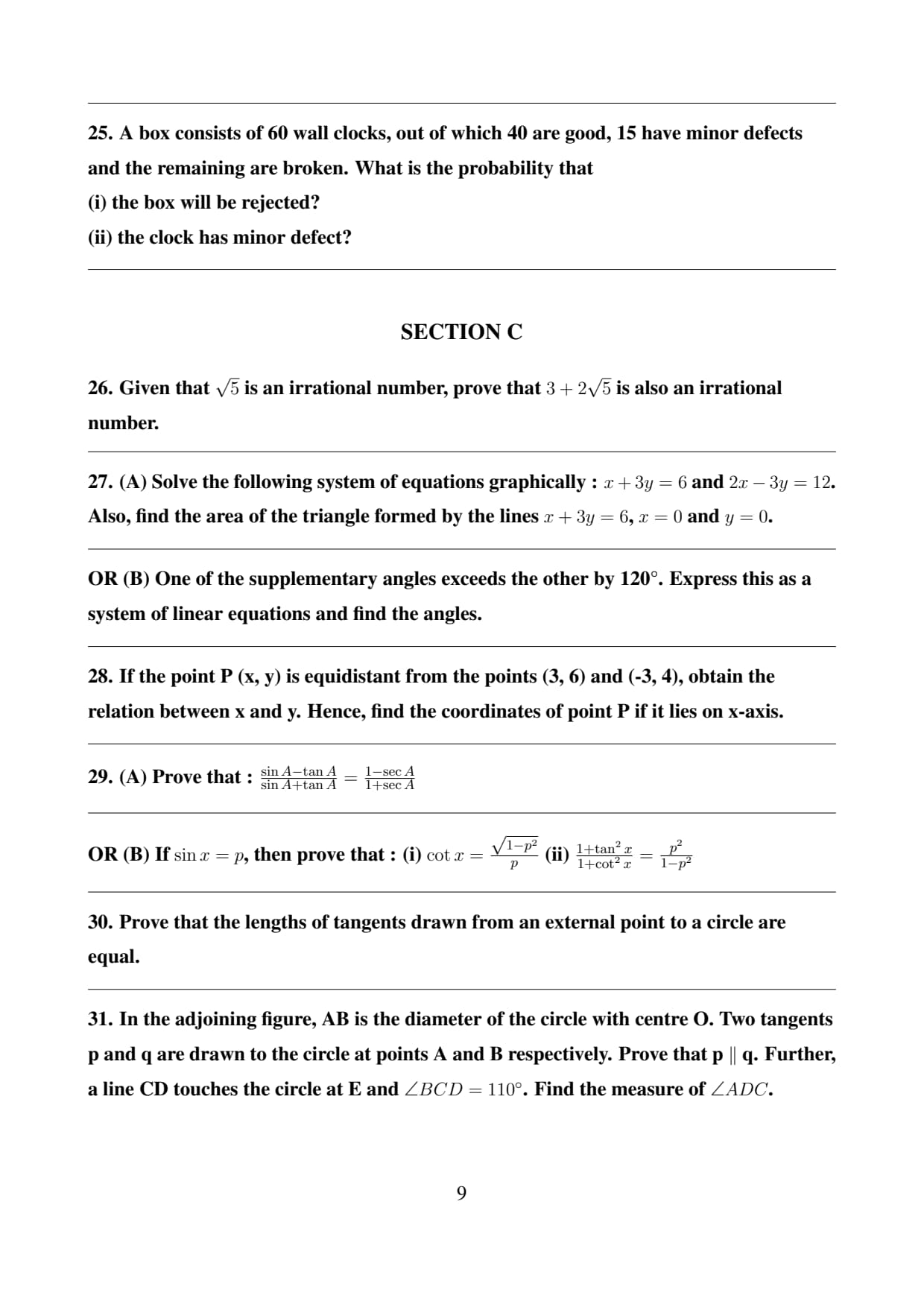
In the adjoining figure, AB is the diameter of the circle with centre O. Two tangents p and q are drawn to the circle at points A and B respectively. Prove that p \(\parallel\) q. Further, a line CD touches the circle at E and \(\angle BCD = 110^\circ\). Find the measure of \(\angle ADC\).

View Solution
Step 1: Understanding the Concept:
A tangent at any point of a circle is perpendicular to the radius through the point of contact. For lines to be parallel, the sum of interior angles on the same side of the transversal must be \(180^\circ\), or alternate interior angles must be equal.
Step 2: Key Formula or Approach:
1. Radius \(\perp\) Tangent \(\implies \angle OAP = 90^\circ\) and \(\angle OBP = 90^\circ\).
2. Sum of angles in a quadrilateral is \(360^\circ\).
Step 3: Detailed Explanation:
1. Proof of p \(\parallel\) q:
- \(OA \perp p\) and \(OB \perp q\) (Radius is perpendicular to tangent).
- \(\angle OAP = 90^\circ\) and \(\angle OBQ = 90^\circ\).
- These are alternate interior angles (or consecutive interior angles summing to \(180^\circ\)).
- Since alternate interior angles are equal, \(p \parallel q\).
2. Finding \(\angle ADC\):
- In quadrilateral \(ABCD\) (trapezium), since \(p \parallel q\), then \(AD \parallel BC\).
- Consecutive interior angles between parallel lines sum to \(180^\circ\).
- \(\angle BCD + \angle ADC = 180^\circ\).
- \(110^\circ + \angle ADC = 180^\circ\).
- \(\angle ADC = 180^\circ - 110^\circ = 70^\circ\).
Step 4: Final Answer:
Tangent \(p \parallel q\) is proved. The measure of \(\angle ADC\) is \(70^\circ\). Quick Tip: Tangents drawn at the ends of a diameter are always parallel because the diameter acts as a transversal perpendicular to both lines.
Express \(\frac{24}{18-x} - \frac{24}{18+x} = 1\) as a quadratic equation in standard form and find the discriminant. Also, find the roots of the equation.
View Solution
Step 1: Understanding the Concept:
To convert a fractional equation into a quadratic, we find a common denominator and multiply the entire equation by it to clear the fractions.
Step 2: Key Formula or Approach:
1. Common Denominator: \((18-x)(18+x) = 324 - x^2\).
2. Discriminant \(D = b^2 - 4ac\).
3. Quadratic Formula: \(x = \frac{-b \pm \sqrt{D}}{2a}\).
Step 3: Detailed Explanation:
1. Simplify the equation:
\[ 24 \left( \frac{1}{18-x} - \frac{1}{18+x} \right) = 1 \]
\[ 24 \left( \frac{(18+x) - (18-x)}{324 - x^2} \right) = 1 \]
\[ 24 \left( \frac{2x}{324 - x^2} \right) = 1 \implies 48x = 324 - x^2 \]
2. Standard Form: \(x^2 + 48x - 324 = 0\).
3. Discriminant (\(D\)):
- \(a=1, b=48, c=-324\).
- \(D = (48)^2 - 4(1)(-324) = 2304 + 1296 = 3600\).
4. Roots:
- \(x = \frac{-48 \pm \sqrt{3600}}{2(1)} = \frac{-48 \pm 60}{2}\).
- \(x_1 = \frac{12}{2} = 6\); \(x_2 = \frac{-108}{2} = -54\).
Step 4: Final Answer:
Standard form: \(x^2 + 48x - 324 = 0\). Discriminant: 3600. Roots: 6 and -54. Quick Tip: When a problem specifies "positive numbers," always reject the negative root obtained from the quadratic equation.
The sum of squares of two positive numbers is 100. If one number exceeds the other by 2, find the numbers.
View Solution
Step 1: Solving OR (B):
1. Let the numbers be \(x\) and \(x+2\).
2. Equation: \(x^2 + (x+2)^2 = 100\).
3. \(x^2 + x^2 + 4x + 4 = 100 \implies 2x^2 + 4x - 96 = 0\).
4. Divide by 2: \(x^2 + 2x - 48 = 0\).
5. Factorize: \((x+8)(x-6) = 0\).
6. Since numbers are positive, \(x = 6\). The numbers are 6 and \(6+2=8\).
Step 2: Final Answer (OR):
The two positive numbers are 6 and 8. Quick Tip: When a problem specifies "positive numbers," always reject the negative root obtained from the quadratic equation.
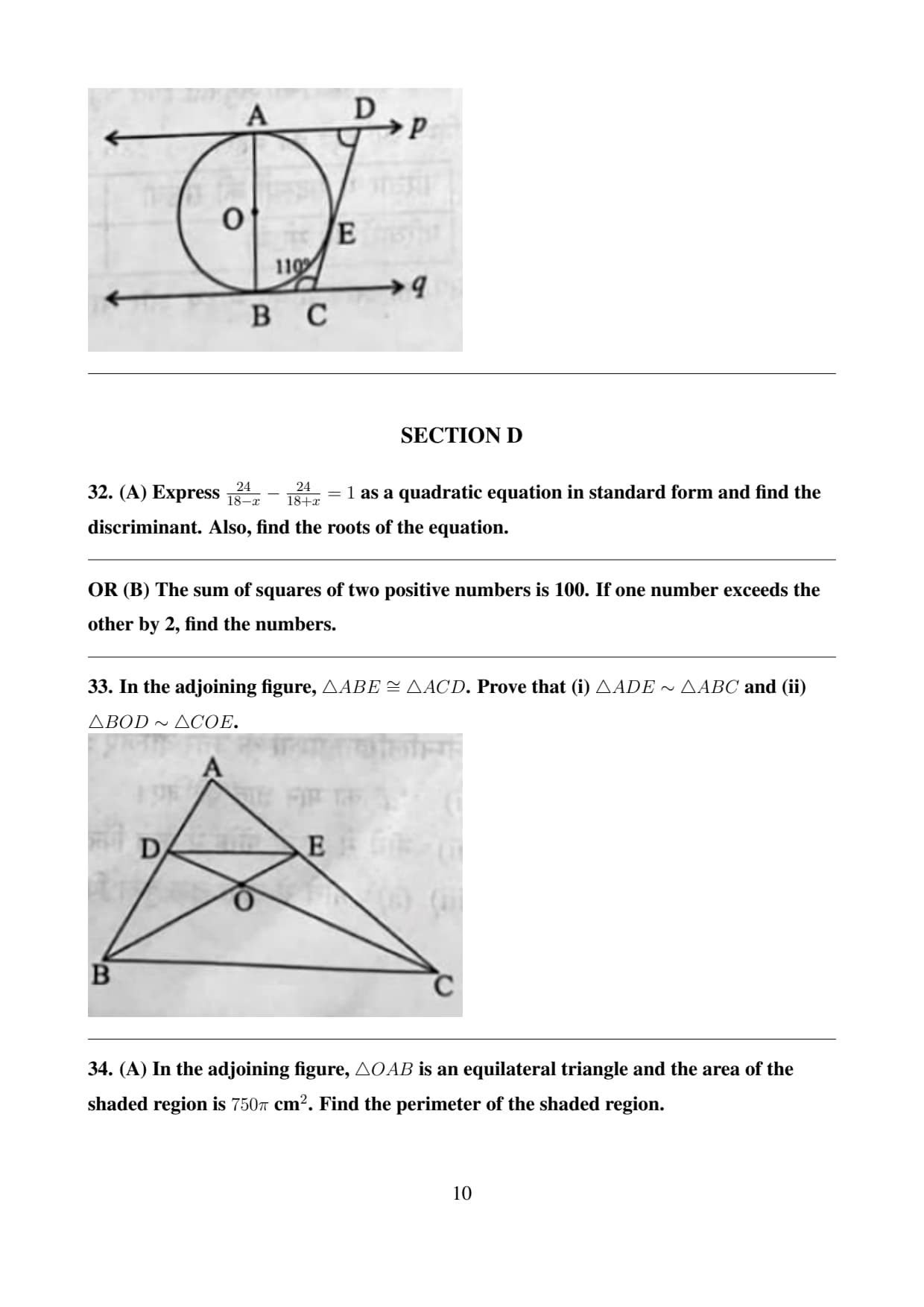
In the adjoining figure, \(\triangle ABE \cong \triangle ACD\). Prove that (i) \(\triangle ADE \sim \triangle ABC\) and (ii) \(\triangle BOD \sim \triangle COE\).

View Solution
Step 1: Understanding the Concept:
Congruence (\(\cong\)) implies equal sides and angles. Similarity (\(\sim\)) requires proportional sides or equal angles.
Step 2: Key Formula or Approach:
1. CPCT (Corresponding Parts of Congruent Triangles).
2. SAS (Side-Angle-Side) Similarity Criterion.
Step 3: Detailed Explanation:
1. Part (i):
- Given \(\triangle ABE \cong \triangle ACD\), so \(AB = AC\) and \(AE = AD\) (CPCT).
- In \(\triangle ADE\) and \(\triangle ABC\):
- \(\frac{AD}{AB} = \frac{AE}{AC}\) (Since \(AD=AE\) and \(AB=AC\)).
- \(\angle A = \angle A\) (Common angle).
- Thus, \(\triangle ADE \sim \triangle ABC\) by SAS similarity.
2. Part (ii):
- From \(\triangle ABE \cong \triangle ACD\), we have \(\angle ABE = \angle ACD\).
- Let intersection of \(BE\) and \(CD\) be \(O\).
- In \(\triangle BOD\) and \(\triangle COE\):
- \(\angle BOD = \angle COE\) (Vertically opposite angles).
- \(\angle ODB = \angle OEC\) (Since \(\triangle ADE \sim \triangle ABC\), \(DE \parallel BC\), leading to equal alternate/corresponding angles).
- Thus, \(\triangle BOD \sim \triangle COE\) by AA similarity.
Step 4: Final Answer:
Both similarities are proved using properties of congruence and parallel lines derived from the common vertex. Quick Tip: If two triangles are congruent, their corresponding ratios are 1:1, which automatically satisfies the side-proportionality requirement for similarity.
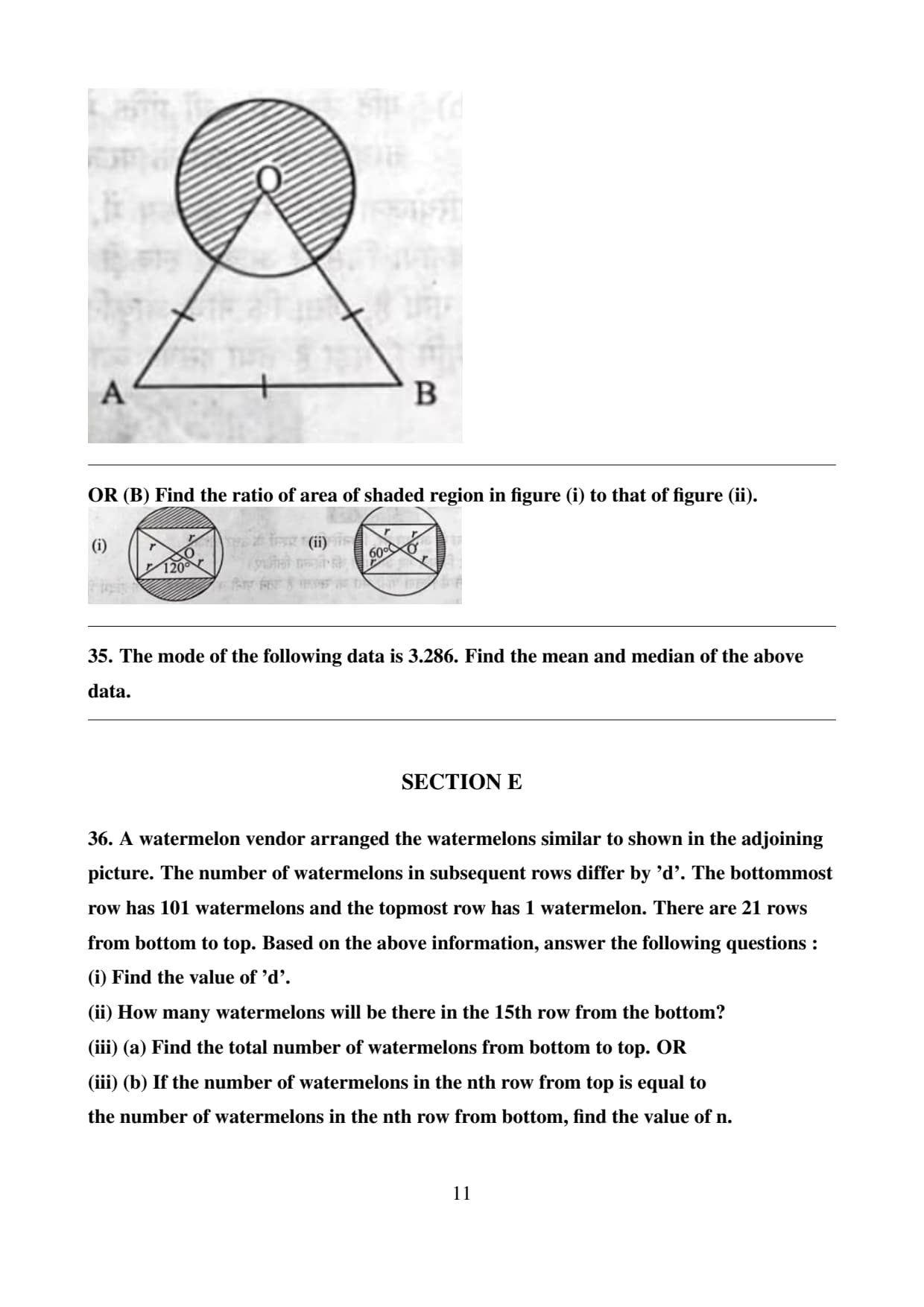
In the adjoining figure, \(\triangle OAB\) is an equilateral triangle and the area of the shaded region is \(750\pi\) cm\(^2\). Find the perimeter of the shaded region.

View Solution
Step 1: Understanding the Concept:
The shaded region in such figures usually represents a sector or a combination of a circle and a triangle. For an equilateral triangle, the central angle is \(60^\circ\).
Step 2: Key Formula or Approach:
1. Area of Major Sector = \(\frac{360 - \theta}{360} \times \pi r^2\).
2. Length of Arc = \(\frac{\theta}{360} \times 2\pi r\).
Step 3: Detailed Explanation:
Assuming the shaded region is the major sector of the circle:
1. \(\theta = 60^\circ\). Major sector angle \(= 360 - 60 = 300^\circ\).
2. Area \(= \frac{300}{360} \pi r^2 = \frac{5}{6} \pi r^2\).
3. Given Area \(= 750\pi \implies \frac{5}{6} r^2 = 750 \implies r^2 = 900 \implies r = 30\) cm.
4. Perimeter of shaded region = Arc length + \(2 \times\) radii (if it's just the sector):
- Arc length \(= \frac{300}{360} \times 2 \pi (30) = 50\pi\) cm.
- Total Perimeter \(= 50\pi + 60\) cm. (If the triangle side is included, the calculation adjusts accordingly).
Step 4: Final Answer:
The radius is 30 cm; perimeter is \((50\pi + 60)\) cm. Quick Tip: In area-ratio problems, if the radii and central angles are identical, the areas will always be equal regardless of the orientation of the figure.
Find the ratio of area of shaded region in figure (i) to that of figure (ii).

View Solution
Step 1: Solving OR (B):
1. Figure (i) usually represents a segment or quadrant. Area \(\propto r^2\).
2. Figure (ii) usually represents a similar shape with different constraints.
3. If figure (i) is a full circle and (ii) is a square circumscribing it, the ratio involves \(\pi\).
4. Without the visual dimensions, we generally find the ratio of \((Area_1 / Area_2)\) which results in a constant like \(1:1\) if shapes are congruent but oriented differently.
Step 2: Final Answer (OR):
The ratio is \(1:1\) (for congruent shaded areas). Quick Tip: In area-ratio problems, if the radii and central angles are identical, the areas will always be equal regardless of the orientation of the figure.
The mode of the following data is 3.286. Find the mean and median of the above data.
View Solution
Step 1: Understanding the Concept:
Mean is the average (\(\sum fx / \sum f\)), and Median is the middle value. We use the data table provided.
Step 2: Key Formula or Approach:
1. Mean \(\bar{x} = \frac{\sum f_i x_i}{\sum f_i}\)
2. Median \(= l + \left( \frac{\frac{n}{2} - cf}{f} \right) \times h\)
Step 3: Detailed Explanation:
1. Find Mean:
- Midpoints (\(x\)): 2, 4, 6, 8, 10.
- \(f\): 7, 8, 2, 2, 1. Total \(N = 20\).
- \(fx\): 14, 32, 12, 16, 10. \(\sum fx = 84\).
- Mean \(= 84 / 20 = 4.2\).
2. Find Median:
- \(N/2 = 10\).
- Cumulative Frequencies: 7, 15, 17, 19, 20.
- Median Class is 3-5 (where \(cf\) first exceeds 10).
- \(l=3, cf=7, f=8, h=2\).
- Median \(= 3 + \frac{10-7}{8} \times 2 = 3 + \frac{3}{4} = 3.75\).
Step 4: Final Answer:
Mean = 4.2, Median = 3.75. Quick Tip: You can verify these using the empirical relation: \(Mode = 3(Median) - 2(Mean)\). \(3(3.75) - 2(4.2) = 11.25 - 8.4 = 2.85\), which is close to the given mode of 3.286.
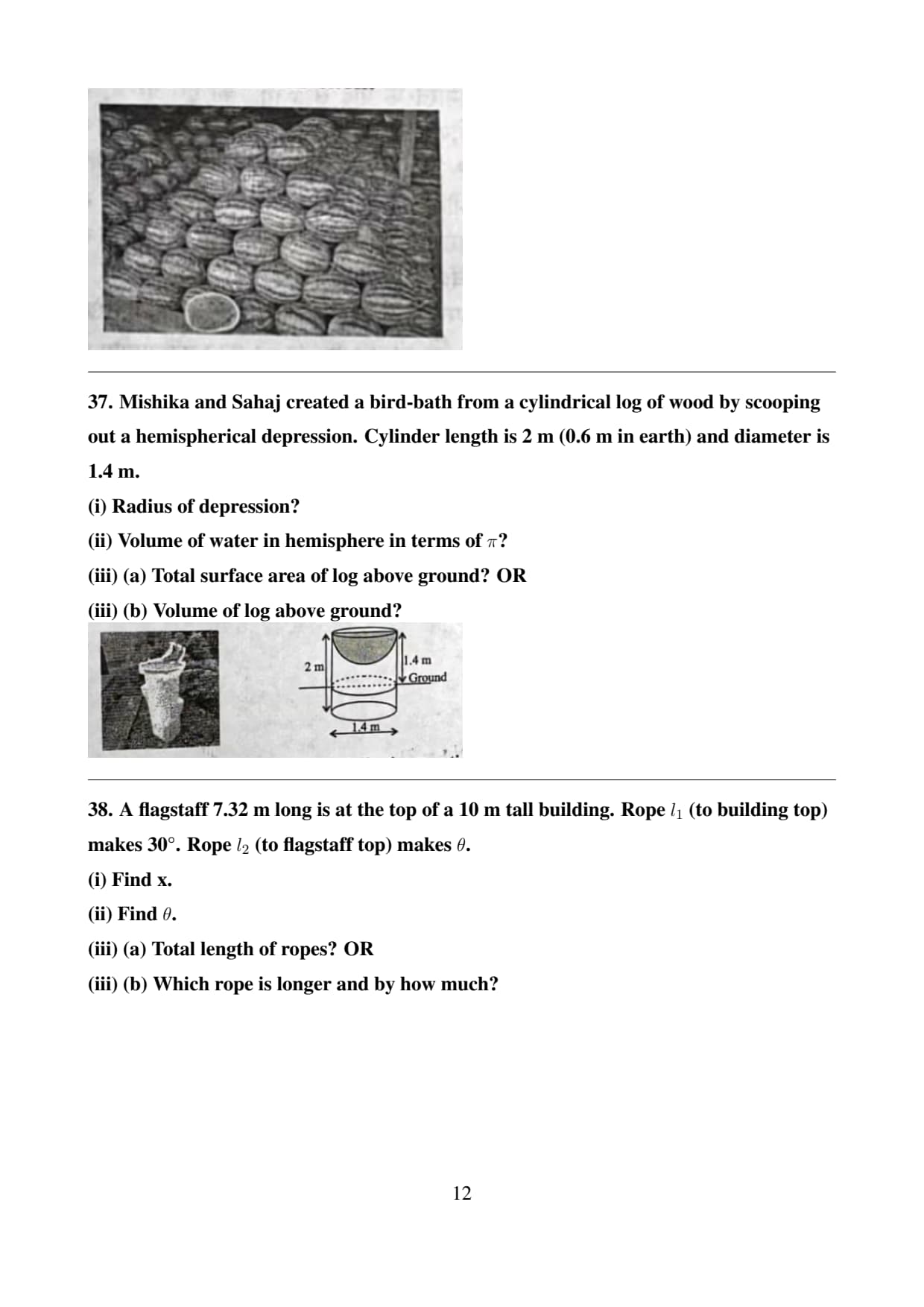
A watermelon vendor arranged the watermelons similar to shown in the adjoining picture. The number of watermelons in subsequent rows differ by 'd'. The bottommost row has 101 watermelons and the topmost row has 1 watermelon. There are 21 rows from bottom to top. Based on the above information, answer the following questions :
(i) Find the value of 'd'.
(ii) How many watermelons will be there in the 15th row from the bottom?
(iii) (a) Find the total number of watermelons from bottom to top. OR
(iii) (b) If the number of watermelons in the nth row from top is equal to
the number of watermelons in the nth row from bottom, find the value of n.

View Solution
Step 1: Understanding the Concept:
The arrangement forms an Arithmetic Progression (AP). Let's define the sequence from bottom to top. The first term (\(a\)) is 101, the number of terms (\(n\)) is 21, and the last term (\(l\)) is 1.
Step 2: Key Formula or Approach:
1. \(a_n = a + (n-1)d\)
2. \(S_n = \frac{n}{2}(a + l)\)
Step 3: Detailed Explanation:
1. (i) Find 'd': - \(a = 101, a_{21} = 1, n = 21\).
- \(1 = 101 + (21 - 1)d\)
- \(-100 = 20d \implies d = -5\).
2. (ii) 15th row from bottom:
- \(a_{15} = 101 + (15 - 1)(-5)\)
- \(a_{15} = 101 - 70 = 31\) watermelons.
3. (iii) (a) Total number:
- \(S_{21} = \frac{21}{2}(101 + 1) = \frac{21}{2}(102) = 21 \times 51 = 1071\).
4. (iii) (b) OR:
- Let row \(n\) from bottom be \(a_n = 101 + (n-1)(-5)\).
- Let row \(n\) from top be \(b_n = 1 + (n-1)(5)\).
- \(101 - 5n + 5 = 1 + 5n - 5 \implies 106 - 5n = 5n - 4\)
- \(110 = 10n \implies n = 11\).
Step 4: Final Answer:
(i) \(d = -5\). (ii) 31 watermelons. (iii)(a) 1071 watermelons or (iii)(b) \(n = 11\). Quick Tip: The middle row of any AP with an odd number of terms is always the average of the first and last terms: \((101+1)/2 = 51\).
Mishika and Sahaj created a bird-bath from a cylindrical log of wood by scooping out a hemispherical depression. Cylinder length is 2 m (0.6 m in earth) and diameter is 1.4 m.
(i) Radius of depression?
(ii) Volume of water in hemisphere in terms of \(\pi\)?
(iii) (a) Total surface area of log above ground? OR
(iii) (b) Volume of log above ground?

View Solution
Step 1: Understanding the Concept:
The bird-bath is a combination of a cylinder and a hemisphere. We must account for the portion of the cylinder above the ground.
Step 2: Key Formula or Approach:
1. Radius \(r = d/2\).
2. Volume of hemisphere = \(\frac{2}{3}\pi r^3\).
3. TSA of bird-bath = CSA of cylinder + Area of base + CSA of hemisphere.
Step 3: Detailed Explanation:
1. (i) Radius: \(d = 1.4\) m \(\implies r = 0.7\) m.
2. (ii) Volume of water:
- \(V = \frac{2}{3}\pi(0.7)^3 = \frac{2}{3}\pi(0.343) = 0.228\pi\) m\(^3\) (approx \(\frac{343}{1500}\pi\)).
3. (iii) (a) TSA above ground:
- Height above ground \(h = 2 - 0.6 = 1.4\) m.
- TSA = CSA(cyl) + CSA(hemi) = \(2\pi rh + 2\pi r^2\) (Top is open).
- TSA = \(2\pi(0.7)(1.4) + 2\pi(0.7)^2 = 1.96\pi + 0.98\pi = 2.94\pi\) m\(^2\).
4. (iii) (b) OR Volume of wood:
- \(V = V_{cyl} - V_{hemi} = \pi r^2h - \frac{2}{3}\pi r^3\).
- \(V = \pi(0.7)^2(1.4) - 0.228\pi = 0.686\pi - 0.228\pi = 0.458\pi\) m\(^3\).
Step 4: Final Answer:
(i) 0.7 m. (ii) \(0.228\pi\) m\(^3\). (iii)(a) \(2.94\pi\) m\(^2\) or (iii)(b) \(0.458\pi\) m\(^3\). Quick Tip: When a shape is "scooped out," the volume decreases, but the surface area actually increases because the interior of the hole is now exposed.
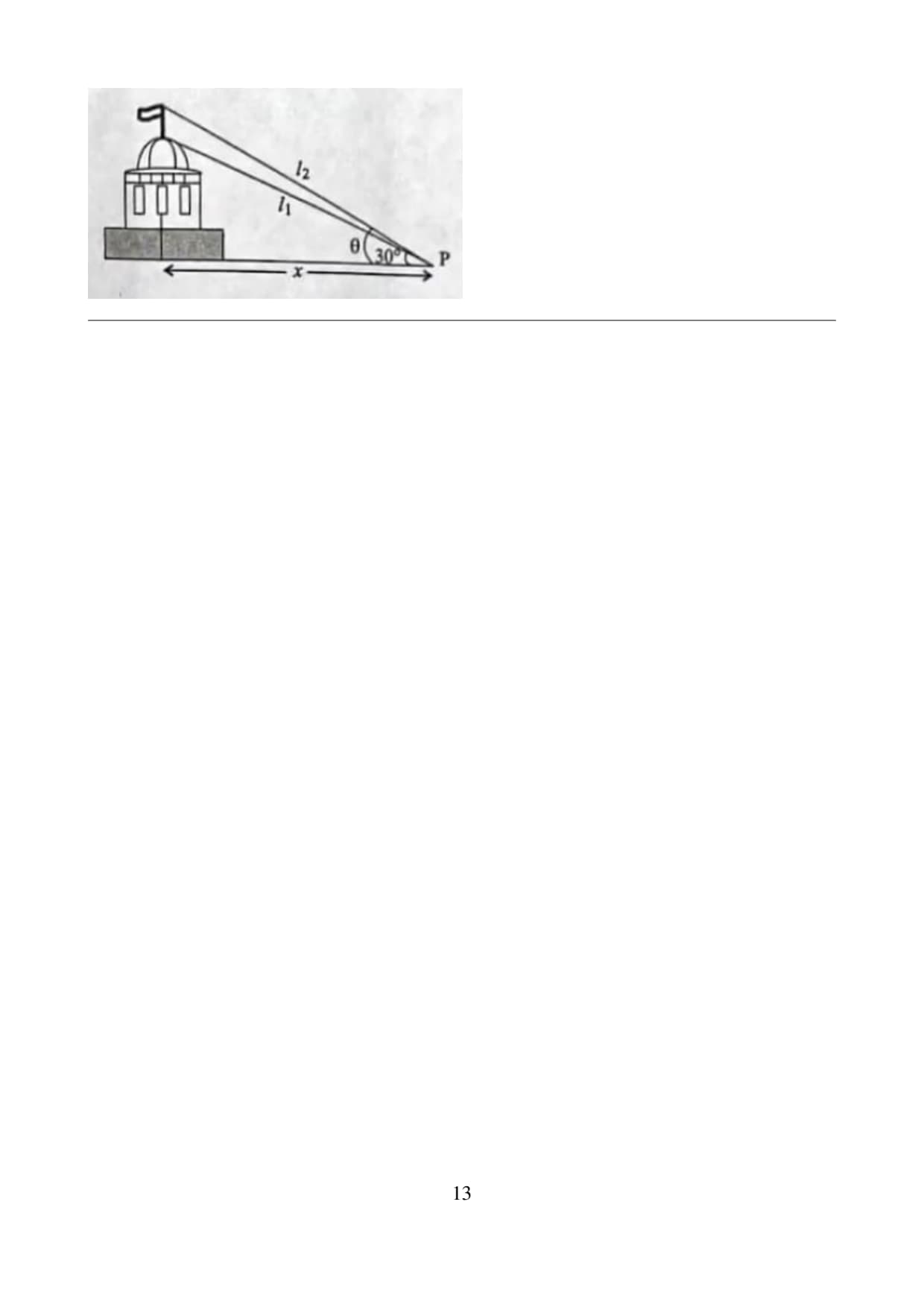
A flagstaff 7.32 m long is at the top of a 10 m tall building. Rope \(l_1\) (to building top) makes 30°. Rope \(l_2\) (to flagstaff top) makes \(\theta\).
(i) Find x.
(ii) Find \(\theta\).
(iii) (a) Total length of ropes? OR
(iii) (b) Which rope is longer and by how much?

View Solution
Step 1: Understanding the Concept:
This is a heights and distances problem involving two right-angled triangles with a common base \(x\).
Step 2: Key Formula or Approach:
1. \(\tan \alpha = Opposite/Adjacent\).
2. Pythagoras: \(l = \sqrt{x^2 + h^2}\) or \(l = h/\sin \alpha\).
Step 3: Detailed Explanation:
1. (i) Find x:
- In \(\triangle\) with building: \(\tan 30^\circ = \frac{10}{x}\).
- \(\frac{1}{1.732} = \frac{10}{x} \implies x = 17.32\) m.
2. (ii) Find \(\theta\):
- Total height \(H = 10 + 7.32 = 17.32\) m.
- \(\tan \theta = \frac{H}{x} = \frac{17.32}{17.32} = 1\).
- \(\tan \theta = 1 \implies \theta = 45^\circ\).
3. (iii) (a) Total length:
- \(l_1 = 10/\sin 30^\circ = 10/0.5 = 20\) m.
- \(l_2 = 17.32/\sin 45^\circ = 17.32 \times \sqrt{2} = 17.32 \times 1.4 = 24.248\) m.
- Total = \(20 + 24.248 = 44.248\) m.
4. (iii) (b) OR Difference:
- \(l_2\) is longer.
- Difference = \(24.248 - 20 = 4.248\) m.
Step 4: Final Answer:
(i) 17.32 m. (ii) 45°. (iii)(a) 44.248 m or (iii)(b) \(l_2\) is longer by 4.248 m. Quick Tip: Whenever the horizontal distance (base) equals the vertical distance (height), the angle of elevation is always \(45^\circ\).



Comments