




The CBSE Class 12 English Question Paper 2026 (Set-1) is available for download here of CBSE Board Exam 2026. This CBSE 12th English solved question paper includes detailed solutions, answer key, and the latest CBSE marking scheme to help students understand the exam pattern and important topics.
By practicing the CBSE Class 12 English 2026 board exam paper PDF, students can improve answer-writing strategy, time management, and overall exam performance.
CBSE Class 12 2026 English Question Paper with Solution PDF – Set 1
| CBSE Class 12 English Question Paper 2026 (Set 1) | Download PDF | Check Solutions |
Passage:
(1) Pancakes, a beloved breakfast dish across the world, has a surprisingly long and diverse
history. Archaeological evidence shows that people were cooking pancakes as food as far
back as 30,000 years ago on hot stones and primitive griddles.
(2) In ancient Greece and Rome, pancakes were made from wheat flour, olive oil, honey,
and curdled milk. They were often served as a sweet treat during festivals or special occasions.
In medieval Europe, pancakes became a popular dish during Shrove Tuesday, the day before
Lent began. In France, thin crepes became a national delicacy, often filled with sweet or
savoury ingredients. In Russia, blinis were made using buckwheat flour and served with sour
cream or caviar. In Ethiopia, the spongy injera became a staple food, made from teff flour
and used as both a plate and utensil. Similarly, in China, pancakes are often savoury while in
Japan, fluffy “souffl´e pancakes” have become a modern favourite.
(3) The American version of pancakes, thick and soft, gained popularity in the 18th century.
The use of baking powder made them light and airy, and they were often served with butter
and maple syrup – a symbol of hearty comfort food. Over time, pancakes became a universal
dish, symbolizing community and celebration. Whether sweet or savoury, thick or thin, every
culture has found a way to adapt this simple food to its own taste and traditions.
(4) India has its own rich tradition of similar dishes that have been enjoyed for centuries.
Across the country, almost every region has a version of a pancake – whether sweet or savoury
– made from grains, pulses, or rice. These Indian pancakes not only satisfy hunger but also
reflect the diversity of India’s culinary culture. In South India, dosas and adai are the most
famous forms of pancakes. Made from a fermented batter of rice and lentils, dosas are crisp
and light, while adai is thicker and more filling. The fermentation process adds a unique
sour flavor and makes them nutritious and easy to digest. In Kerala, the appam, made with
fermented rice batter and coconut milk, is soft in the center and crispy at the edges. Moving
north, we find the western style cheela, a simple and wholesome Indian pancake made from
gram flour, spiced with onions, chillies and coriander. In Maharashtra, the thalipeeth is a
multigrain pancake that uses flours like jowar, bajra and rice mixed with spices and vegetables.
It is both flavorful and filling, providing a good balance of carbohydrates and proteins.
(5) In the eastern parts of India, pitha is a traditional pancake made during festivals and
special occasions. Varieties like patishapta in Bengal are sweet, filled with coconut and jag-
gery. In Assam and Odisha, pithas can be steamed, fried, or roasted, depending on the custom
and region. In the western deserts of Rajasthan and Gujarat, people prepare chilla and handvo,
which are savoury western pancake-like dishes baked in traditional ovens. These pancakes are
a blank canvas for toppings, waiting for a splash of fruit or a scattering of condiments.
(6) Today, pancakes continue to evolve with new recipes, from vegan and gluten-free va-
rieties to those infused with fruits, oats, or even protein powder. Despite their many forms,
they remain a timeless reminder of how food connects mankind through shared history and
creativity. Each pancake tells a story of regional identity, food traditions and a deep love for
food that brings people together. Pancakes are warm, edible hugs that are a perfect comfort
on a bleak day.
Question 1:
In paragraph 1, what does the phrase ‘has a surprisingly long and diverse history’ mean ?
View Solution
Concept:
Understanding phrases in comprehension requires identifying the author's intended meaning using context clues.
Answer:
The phrase means that pancakes have existed for a very long time and have been made in many different ways across various cultures and regions of the world. Quick Tip: Look at surrounding sentences to interpret phrases. Words like “30,000 years ago” signal long history, while examples across cultures indicate diversity.
Complete the following with the correct option from the two given:
The uniqueness of the spongy injera, is that ___________.
View Solution
Concept:
Detail-based questions require locating specific lines in the passage.
Explanation:
Paragraph 2 states that injera is “used as both a plate and utensil.” This means it is not only food but also used for eating.
Therefore, correct option: (B) it can be used for cooking and also for eating. Quick Tip: Scan for keywords from the question (e.g., “injera”) and read that specific line carefully. Direct factual questions usually have exact lines in the passage.
How are American pancakes made light and fluffy? When did the American-style pancakes gain popularity? (Paragraph 3)
View Solution
Concept:
Two-part comprehension questions test both cause and timeline understanding.
Answer:
American pancakes are made light and fluffy by the use of baking powder, which makes them airy.
They gained popularity in the 18th century. Quick Tip: For two-part questions, underline both parts. Usually, one asks “how” (method) and the other asks “when” (time reference).
State whether the following statement is True or False:
Every culture has adopted the pancake and tempered it with its own ingredients, flavour and taste. (Paragraph 3)
View Solution
Concept:
True/False questions test whether the idea matches the passage meaning, even if wording differs slightly.
Explanation:
Paragraph 3 states that “every culture has found a way to adapt this simple food to its own taste and traditions.” This directly supports the statement.
Therefore, the statement is True. Quick Tip: In True/False questions, don’t match exact words — match meaning. Look for paraphrased lines in the passage.
The word ‘fermentation process’. Based on the information given in the passage, which of the following pancakes are made from the fermentation process?
View Solution
Concept:
Vocabulary-in-context questions require identifying where the term is explained in the passage.
Explanation:
Paragraph 4 mentions that dosa is made from a fermented batter and appam is also made using fermented rice batter and coconut milk. Hence both involve fermentation.
Therefore, the correct answer is (A) Dosa and appam. Quick Tip: When a keyword like “fermentation” appears, locate the paragraph where it is explained and extract examples given there.
Select the option that best explains the phrase about pancakes being ‘a blank canvas’ (Paragraph 5).
View Solution
Concept:
Figurative language questions require understanding metaphors used by the author.
Explanation:
Paragraph 5 says pancakes are “a blank canvas for toppings,” meaning they can be customized with different additions like fruits or condiments. This matches option (A), which explains the metaphor of creativity.
Hence, the correct option is (A). Quick Tip: If you see figurative phrases like “blank canvas,” think metaphor. Replace it with its real meaning using context clues.
List any two points from the passage that support the statement, pancakes are a ‘timeless reminder of how food connects people.’ (Paragraph 6)
View Solution
Concept:
Evidence-based questions require selecting supporting ideas directly from the passage.
Answer:
Any two of the following points:
Pancakes exist in many cultures and regions across the world.
They reflect shared history and creativity among people.
Each pancake tells a story of regional identity and traditions.
Food traditions bring people together. Quick Tip: For “list any two” questions, pick short, clear points directly from the paragraph instead of writing long explanations.
Fill in the blank with the correct option from those given:
In the line “warm, edible hugs that are perfect comfort on a bleak day” the phrase ‘warm, edible hugs’ refers to ___________. (Paragraph 6)
View Solution
Concept:
Interpretation questions test emotional meaning and tone.
Explanation:
The phrase “warm, edible hugs” suggests emotional comfort and warmth, similar to how comforting food makes a person feel safe and happy. This matches option (A).
Therefore, the correct answer is (A). Quick Tip: When interpreting emotional phrases, focus on tone words like “warm,” “comfort,” or “bleak day” to find the implied feeling.
Passage:
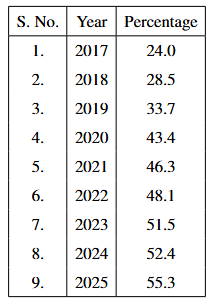
(1) Rate of Internet Reach in India : 2014–2024 The rate of internet reach in India rose
over 52% in 2024 from about 14% in 2014. Although these figures seem relatively low, it
meant that more than half of the population of 1.4 billion people had internet access that year.
This also ranked the country second in the world in terms of active internet users.
(2) Internet availability and accessibility By 2021 the number of internet connections
across the country tripled in urban areas because of a higher density of population leading
to an increase in the number of connections. However, despite of incredibly low internet
prices, internet usage in India has yet to reach its full potential. Lack of awareness about the
internet in India persists, especially in rural areas and among women, driven by digital divide,
infrastructure limitations, and a lack of perceived need for the internet. This hinders digital
adoption, with many not knowing how to use the internet or even being aware of its existence.
Targeted awareness campaigns and digital literacy programs are crucial to bridge this gap and
ensure people understand and can benefit from the digital ecosystem.
(3) Digital living Home to one of the largest bases of netizens in the world, India is abuzz
with internet activities being carried out every moment of every day. From information and
research to shopping and entertainment to living in smart homes, Indians have welcomed
digital living with open arms.
Rate of Internet Reach in India
Question 9:
What does the use of the term “active internet users” convey?
View Solution
Concept:
Vocabulary-in-context questions require understanding how a phrase is used in the passage.
Explanation:
The phrase “active internet users” refers to people who regularly and actively use the internet, not just those who have access. Option (D) correctly conveys this meaning.
Therefore, the correct answer is (D) People who use internet actively. Quick Tip: For vocabulary questions, replace the phrase with simple words and choose the option that keeps the same meaning and grammar.
Select the option that is true for the Assertion and Reason given below:
Assertion: India is home to one of the largest bases of netizens in the world.
Reason: Lack of awareness and a tangible gender gap lie at the heart of the matter.
(A) Both the Assertion and the Reason are true and the Reason is the correct explanation of the Assertion.
(B) Both the Assertion and the Reason are true, but the Reason is not the correct explanation of the Assertion.
(C) The Assertion is true, but the Reason is false.
(D) The Assertion is false, but the Reason is true.
View Solution
Concept:
Assertion–Reason questions test whether both statements are true and whether one explains the other.
Explanation:
The passage confirms that India has one of the largest bases of netizens (Paragraph 3).
It also mentions lack of awareness and gender gaps (Paragraph 2).
However, these reasons explain limitations in usage, not why India has a large number of netizens.
Hence, both are true but the Reason does not explain the Assertion. Quick Tip: In Assertion–Reason questions, first check if both statements are individually true, then see if the reason actually explains the assertion.
Identify the word that indicates that internet reach is comparatively low. (Paragraph 1)
View Solution
Concept:
Word-based comprehension questions require identifying keywords from the passage.
Answer:
The word is “relatively” (as in “relatively low”). Quick Tip: Look for modifiers like “relatively,” “somewhat,” or “moderately” — they signal comparison or limitation.
Based on the table which of the following time period illustrates the maximum internet usage?
View Solution
Concept:
Data interpretation questions require comparing numerical values from tables.
Explanation:
The highest percentages in the table are seen in the most recent years:
2023 – 51.5%, 2024 – 52.4%, 2025 – 55.3%.
Thus, the period 2023 to 2025 shows maximum internet usage.
Hence, the correct answer is (B). Quick Tip: When analyzing tables, look for highest numbers first, then identify the time range that contains them.
From the passage identify one reason why there are less internet users among women?
View Solution
Concept:
Detail-based questions require extracting specific reasons from the text.
Answer:
One reason is the digital divide and lack of awareness, especially due to gender gaps and infrastructure limitations. Quick Tip: For “one reason” questions, give a short phrase directly from the passage instead of long explanations.
Fill in the blank with a suitable word given in brackets:
Infrastructure limitations ___________ digital adoption. (impedes/spurs)
View Solution
Concept:
Contextual vocabulary questions test understanding of word meanings.
Explanation:
The passage explains that infrastructure limitations hinder internet usage.
The word “impedes” means slows down or obstructs, which fits the context.
Therefore, the correct word is “impedes.” Quick Tip: If unsure, replace options in the sentence and choose the one that matches the tone (positive or negative).
Complete the following with a suitable reason:
An increase in the number of connections in urban areas is because of ___________.
View Solution
Concept:
Cause-based questions require identifying stated reasons in the passage.
Answer:
A higher density of population in urban areas. Quick Tip: Look for cause words like “because,” “due to,” or “leading to” to identify reasons quickly.
Which are the two ways to bridge the gap of digital unawareness?
View Solution
Concept:
Listing questions require identifying solutions mentioned in the passage.
Answer:
Targeted awareness campaigns
Digital literacy programs Quick Tip: For solution-based questions, scan for lines suggesting improvement strategies like “programs,” “campaigns,” or “initiatives.”
In the context of the last paragraph how does the author justify the statement, ‘Indians have welcomed digital living with open arms’?
View Solution
Concept:
Inference questions require interpreting supporting details from the paragraph.
Answer:
The author justifies this by describing how Indians actively use the internet for various activities like research, shopping, entertainment, and smart living, showing widespread acceptance of digital lifestyles. Quick Tip: For justification questions, restate the claim and support it with examples directly mentioned in the paragraph.
Fill in the blank with correct option to complete a message from Yogita to her friend Shobit:
Dear Shobit,
Let’s meet at 5 p.m. for the rehearsal but I need to go home first since morning I ___________ anything since morning.
(A) did not eaten
(B) had not eaten
(C) have not eaten
(D) am not eating
View Solution
Concept:
Present perfect tense is used for actions that started in the past and continue to the present.
Explanation:
The phrase “since morning” indicates an action that began earlier and is still relevant now.
The correct present perfect form is “have not eaten.”
Hence, the correct answer is (C). Quick Tip: Use present perfect (have/has + past participle) with time markers like “since” and “for.”
Read the given sentence from a self-help book. Identify the error and supply the correction in the given format:
To identifying your goal is the biggest step in your success story.
View Solution
Concept:
After “to,” the base form of the verb (infinitive) should be used.
\begin{tabular{|c|c|
\hline
Error & Correction
\hline
identifying & identify
\hline
\end{tabular
Correct sentence:
To identify your goal is the biggest step in your success story. Quick Tip: After “to,” always use the base verb (to go, to eat, to identify), not the -ing form.
Yamini asked her friend Shifa, “Would you like to come for my birthday party tomorrow?”
Report Yamini’s question correctly.
View Solution
Concept:
In reported speech, questions change word order and time expressions.
Answer:
Yamini asked her friend Shifa if she would like to come for her birthday party the next day. Quick Tip: In reported questions: remove quotation marks, use “if/whether,” and change time words (tomorrow → the next day).
Fill in the blank by choosing the correct option to complete a newspaper clipping:
The verdict is yet to come since the members of the jury ___________ divided in their opinion. (is/are)
View Solution
Concept:
Collective nouns can take plural verbs when individuals are acting separately.
Explanation:
Here, the jury members have different opinions, so they are acting individually.
Hence, the plural verb “are” is correct. Quick Tip: Use plural verbs with collective nouns when members act individually (team are arguing, jury are divided).
Read Somil’s request to his mother:
“Can you teach me to swim?”
Report Somil’s request by completing the following sentence correctly:
Somil asked his mother _______________
View Solution
Concept:
Requests in reported speech use “asked + object + to + verb.”
Answer:
Somil asked his mother to teach him to swim. Quick Tip: Convert requests using: asked + person + to + verb (e.g., asked me to help, asked her to wait).
Identify and correct the error in the given line taken from a critical review of a recently staged play:
As an actor, Ravi Raj, is superior then any other contemporary actor.
View Solution
Concept:
Comparative sentences use “than” for comparison, not “then.”
\begin{tabular{|c|c|
\hline
Error & Correction
\hline
then & than
\hline
\end{tabular
Correct sentence:
As an actor, Ravi Raj is superior than any other contemporary actor. Quick Tip: Use “than” for comparisons and “then” for time sequence.
Complete the given line from Rules and Regulations’ section of a school diary:
Minimum 75% attendance is ___________ to appear for the final examinations.
View Solution
Concept:
Contextual vocabulary requires selecting the word that best fits meaning and tone.
Explanation:
The sentence refers to a rule. The word “mandatory” means compulsory, which fits best.
Hence, the correct answer is (B). Quick Tip: Look for context clues — rules and regulations usually require words like “mandatory” or “compulsory.”
Detect the error and supply the correction for the given newspaper report on a proposal by a Member of Advisory Board:
After the meeting it was obvious that most stakeholders would not support ___________ proposals.
View Solution
Concept:
Demonstrative adjectives must agree in number with the noun.
Explanation:
The noun “proposals” is plural, so the correct demonstrative is “these.”
Hence, the error word should be replaced with “these.” Quick Tip: Match demonstratives with number: this/that (singular), these/those (plural).
Report the dialogue between a flight attendant and a passenger by filling in the blank:
Attendant: Did you have your dinner, sir?
Passenger: Yes, thank you!
The flight attendant asked the passenger _______________ The passenger replied in affirmation and thanked him.
View Solution
Concept:
Yes/No questions in reported speech use “if/whether.”
Answer:
The flight attendant asked the passenger if he had had his dinner. Quick Tip: Convert yes/no questions using “asked if/whether + subject + past perfect.”
Select the correct option to complete the given sentence from the memoir of your grandparent:
“When I was the team Captain, I ___________ often organise get-togethers to develop bonding among the team mates.”
View Solution
Concept:
“Would” is used to describe habitual actions in the past, especially in memoirs or narratives.
Explanation:
The sentence refers to repeated past actions (“often organise”) while recalling memories.
“Would” correctly expresses habitual past behaviour.
Hence, the correct answer is (D). Quick Tip: Use “would” to describe repeated actions in the past (e.g., We would play outside every evening).
Complete the given sentence about the reaction of a tourist by selecting the correct option:
Yesterday you loved the spicy Indian curry, ___________ you?
View Solution
Concept:
Question tags use the auxiliary verb from the main sentence and reverse polarity.
Explanation:
The main clause is in simple past (“you loved”), so the tag should use “did.”
Since the statement is positive, the tag must be negative → “didn’t you?”
Hence, the correct answer is (D). Quick Tip: For question tags: match tense and auxiliary, then switch polarity (positive → negative tag).
Read the conversation between a professional writer and a school student:
Student: What prompted you to become a professional writer?
Writer: My childhood library housed books of all kinds. I was fascinated with the compelling stories and wanted to create my own.
Report the student’s question.
View Solution
Concept:
Wh-questions in reported speech retain the question word but change word order and tense.
Answer:
The student asked the writer what had prompted him to become a professional writer. Quick Tip: In reporting Wh-questions: keep the Wh-word, remove inversion, and shift tense back (prompted → had prompted).
You are Divya/Divij Kumar, Director, Nurturing India, an organization providing skill education to youth. You believe that today’s youth needs vocational and skill education that will encourage an independent and entrepreneurial lifestyle. Write a letter to the editor of a local daily expressing your views on the need and importance of skill education in creating employability and a self-employed independent generation.
View Solution
Concept:
Formal letters to the editor should include sender’s address, date, editor’s address, subject, clear arguments, and a formal closing.
Letter:
Divya Kumar
Director, Nurturing India
Jaipur
Date: 12 March 2026
The Editor
The Daily Herald
Jaipur
Subject: Importance of Skill Education for Youth Empowerment
Sir/Madam,
I am writing to draw attention to the growing need for skill-based education among today’s youth. While academic learning remains important, it is no longer sufficient to prepare young individuals for the rapidly evolving job market.
Skill and vocational education equip students with practical knowledge and industry-relevant abilities that enhance employability. In a country with a large youth population, promoting such education can significantly reduce unemployment and bridge the gap between education and industry demands.
Moreover, skill education fosters innovation and entrepreneurship. When young people are trained in trades, technology, and vocational crafts, they are more likely to become self-reliant and start their own ventures. This not only empowers individuals but also contributes to economic growth and community development.
Institutions and policymakers must work together to integrate vocational training into mainstream education. Awareness campaigns, government incentives, and industry collaborations can further strengthen this movement.
I hope this issue receives the attention it deserves so that we can nurture a confident, skilled, and self-reliant generation.
Thank you.
Yours sincerely,
Divya Kumar
Director, Nurturing India Quick Tip: In letters to the editor, focus on awareness, public impact, and solutions. Use formal tone and structured paragraphs.
You are Nirmala/Nirmal, a resident of Jhunjhunu Colony. Recently there have been a series of accidents and petty crimes in your colony. One of the reasons is poor street lighting. Write a letter to the Commissioner of the Works department, drawing attention to the urgent need to install street lights to avoid further crimes and accidents.
View Solution
Concept:
Complaint letters should clearly state the issue, its impact, and a polite request for action.
Letter:
Nirmala Sharma
House No. 24, Jhunjhunu Colony
Jhunjhunu
Date: 12 March 2026
The Commissioner
Works Department
Jhunjhunu
Subject: Urgent Need for Installation of Street Lights in Jhunjhunu Colony
Sir/Madam,
I am writing to bring to your notice the alarming increase in accidents and petty crimes in Jhunjhunu Colony due to poor street lighting. Most of the internal roads and intersections remain poorly lit after sunset, making the area unsafe for residents.
Several incidents of theft and road mishaps have been reported in recent weeks. Children, elderly residents, and working individuals returning home late are especially vulnerable. The lack of proper illumination not only encourages anti-social activities but also poses a serious threat to public safety.
I request the concerned department to conduct an immediate inspection and install adequate street lights in the affected areas. Regular maintenance and timely replacement of faulty lights should also be ensured to prevent further inconvenience.
We hope the authorities will take prompt action to safeguard the well-being of residents and restore a sense of security in the colony.
Thank you for your attention.
Yours faithfully,
Nirmala Sharma Quick Tip: In complaint letters, clearly mention the problem, consequences, and a polite request for immediate action.
“Improvements in sports infrastructure with a focus on multi-purpose sustainable facilities as well as the integration of technology along with a grassroots centric approach is the key to bring Indian athletes on the world stage.”
Write an analytical paragraph in about 120 words, expressing your views on how improved infrastructure can help Indian athletes win accolades for the nation.
View Solution
Concept:
Analytical paragraphs should present a clear viewpoint, logical arguments, and balanced reasoning.
Paragraph:
Improved sports infrastructure plays a vital role in shaping world-class athletes and elevating a nation’s global sporting presence. Multi-purpose and sustainable sports facilities provide athletes with access to modern training environments that enhance performance and reduce injury risks. The integration of technology, such as performance analytics, wearable devices, and AI-based coaching tools, enables athletes to monitor progress and refine their skills scientifically. Equally important is a grassroots-focused approach that identifies and nurtures talent from rural and underserved regions. When young athletes receive early exposure to proper training, facilities, and mentorship, their chances of excelling internationally increase significantly. Therefore, investing in inclusive and technologically advanced infrastructure can empower Indian athletes to consistently win accolades and bring pride to the nation. Quick Tip: Start with a clear opinion, add 2–3 strong supporting points, and end with a concluding line reinforcing the main idea.
Read the following details about the characteristics of the Indian start-up ecosystem:
One of the most vibrant and largest in the world
Drives innovation across various fields
Brings unique solutions to major challenges both domestic and international
Has entered various fields – healthcare, e-commerce, agriculture
Supported by funding and government initiatives
In about 120 words analyse the future of startups in India considering factors that have supported its growth in the country. Focus on aspects of the need, benefits, and support required for these startups.
View Solution
Concept:
Analytical writing should interpret given points and present a forward-looking perspective.
Paragraph:
The future of startups in India appears highly promising due to the country’s dynamic entrepreneurial ecosystem and strong support mechanisms. As one of the largest startup hubs globally, India fosters innovation across diverse sectors such as healthcare, agriculture, and e-commerce. These ventures address real-world challenges by offering scalable and technology-driven solutions. Government initiatives, funding opportunities, and incubation programs have further accelerated their growth by reducing entry barriers and encouraging innovation. However, sustained success will require continued policy support, access to global markets, and improved infrastructure. Startups also need mentorship and investment in research to remain competitive internationally. With the right blend of innovation, funding, and institutional support, Indian startups are poised to drive economic growth and position the nation as a global innovation leader. Quick Tip: Use the given bullet points as keywords and convert them into a logical flow: growth → benefits → future needs.
Extract: “We have, at last, achieved our political emancipation. We pledge ourselves to
liberate all our people from the continuing bondage of poverty, deprivation, suffering, gender
and other discrimination. Never, never, and never again shall it be that this beautiful land will
again experience the oppression of one by another. The sun shall never set on so glorious a
human achievement.” (Nelson Mandela – Long Walk to Freedom)
Question 34:
What is the tone Nelson Mandela is UNLIKELY to have used in his speech?
View Solution
Concept:
Tone refers to the author’s attitude conveyed through language and emotion.
Explanation:
The extract reflects hope, determination, and confidence. It is inspirational, assertive, and direct in its message of freedom and unity. There is no sign of confusion or internal struggle, so the tone is not conflicted.
Hence, the correct answer is (C). Quick Tip: Eliminate options that contradict the emotional tone. Words like hope and pride rarely match “conflicted.”
According to Mandela, emancipation is not merely political. Elaborate.
View Solution
Concept:
Interpretation questions require explaining implied meaning using textual evidence.
Answer:
Mandela suggests that true emancipation goes beyond political freedom. While achieving political independence is significant, real freedom also means ending poverty, discrimination, suffering, and social inequality. He emphasizes the need for social justice and equal opportunities so that all citizens can live with dignity and harmony. Quick Tip: When asked to elaborate, explain the idea in your own words and include 2–3 supporting points from the extract.
Fill in the blank with the correct word from the bracket:
Mandela’s speech swings between references to the past and a ___________ (bleak/promising) future.
View Solution
Concept:
Contextual vocabulary depends on the emotional direction of the text.
Explanation:
Although Mandela acknowledges a painful past, his speech focuses on hope and a brighter future. Words like “never again” and “glorious achievement” reflect optimism.
Thus, the correct word is “promising.” Quick Tip: Choose the word that matches the overall mood. Hopeful speeches usually suggest a positive future.
With reference to the extract explain the sentence, “The sun shall never set on so glorious a human achievement.”
View Solution
Concept:
Figurative expressions often use symbolism to convey deeper meaning.
Answer:
The sentence symbolizes the lasting significance of the achievement of freedom and equality. Mandela suggests that the victory over oppression is a historic and timeless milestone that will always be remembered. It highlights the enduring pride and hope associated with the nation’s liberation and the collective triumph of humanity. Quick Tip: When explaining figurative lines, identify the symbol (sun = lasting glory) and explain its deeper meaning.
Extract:
OOP : I haven’t a clue. I’ve been to seven galaxies, but I’ve never seen anything
like this. Maybe they’re hats. (He opens a book and puts it on his head.) Say, maybe this is a
haberdashery!
OMEGA : (bowing low) Perhaps the Great and Mighty Think-Tank will give us the benefit
of his thought on the matter.
THINK-TANK : Elementary, my dear Omega. Hold one of the items up so that I may view
it closely. (Omega holds a book on the palm of her hand.) Yes, yes, I understand now. Since
Earth creatures are always eating, the place in which you find yourselves is undoubtedly a
crude refreshment stand.
OMEGA : (to Iota and Oop) He says we’re in a refreshment stand.
OOP : Well, the Earthlings certainly have a strange diet. (The Book that Saved the Earth)
Question 38:
“Elementary, my dear Omega.” What is Think-Tank’s tone in the sentence?
View Solution
Concept:
Tone reflects the speaker’s attitude toward others.
Explanation:
Think-Tank speaks as if he is intellectually superior and treats Omega condescendingly. His use of “Elementary” suggests he believes the answer is obvious and beneath him.
Hence, the correct answer is (A) patronising. Quick Tip: If a character talks down to others or shows superiority, the tone is usually patronising.
Why does Omega call Think-Tank great and mighty?
View Solution
Concept:
Character-based questions require understanding relationships and hierarchy.
Answer:
Omega calls Think-Tank great and mighty because he is their ruler and leader. She respects and flatters him, believing him to be highly intelligent and authoritative. Quick Tip: Look at how characters address each other — titles and praise often reveal hierarchy or fear.
Fill in the blank with the correct word from the bracket:
After viewing the book closely, Think-Tank concludes that Earth creatures ___________ (enjoy/dislike) eating food.
View Solution
Concept:
Contextual clues help identify correct word choices.
Explanation:
Think-Tank assumes that since books are everywhere, humans must constantly be eating. This shows he believes Earth creatures enjoy eating.
Thus, the correct word is “enjoy.” Quick Tip: Use character assumptions and actions as clues to determine the correct contextual word.
Why does Oop open the book and put it on his head?
View Solution
Concept:
Humour in literature often arises from misunderstanding.
Answer:
Oop puts the book on his head because he does not understand what a book is. Mistaking it for a hat, he assumes it is meant to be worn, which creates a humorous situation. Quick Tip: In humorous extracts, look for misunderstandings or wrong assumptions made by characters.
Complete the following suitably:
According to Robert Frost, fire refers to ___________.
View Solution
Concept:
Poetic symbolism uses elements like fire and ice to represent emotions or ideas.
Answer:
Fire refers to desire or intense human passion. Quick Tip: In poetry, natural elements often symbolize emotions — fire (desire), ice (hatred).
Fill in the blank with one word:
In the line “But if it has to perish twice,” ‘it’ refers to the ___________.
View Solution
Concept:
Pronoun reference questions require identifying the noun being referred to earlier in the poem.
Explanation:
The poem begins with “Some say the world will end,” so the pronoun “it” refers to the world. Quick Tip: Trace pronouns back to the nearest relevant noun mentioned earlier in the text.
Select the option with same rhyme scheme as lines in Stanza 1.
View Solution
Concept:
Rhyme scheme refers to the pattern of rhyming words at the end of lines.
Explanation:
Stanza 1 has the rhyme scheme ABAAB:
fire (A)
ice (B)
desire (A)
fire (A)
twice (B)
Option (B) follows a similar alternating rhyme pattern. Quick Tip: Identify rhyme scheme by marking last words of each line and assigning letters (A, B, C).
What is the most likely reason the poet uses the word ‘nonplus’ instead of confused?
View Solution
Concept:
Poets choose words for rhyme, rhythm, and tone, not just meaning.
Answer:
The poet uses the word “nonplus” to maintain rhyme and rhythm in the poem. It also adds a humorous and poetic effect while conveying the idea of confusion. Quick Tip: In poetry, unusual words are often chosen to preserve rhyme and musical flow.
Explain the irony in the last two lines of the stanza.
View Solution
Concept:
Irony occurs when the meaning is opposite to what is expected.
Answer:
The irony lies in the reversal of expectations. Hyenas are known for laughing sounds, yet the poet says they come with merry smiles, while crocodiles are associated with fake tears. The humorous twist lies in linking crying with crocodiles, referring to the phrase “crocodile tears.” Quick Tip: Look for reversals or exaggerations to identify irony in humorous poems.
Fill in the blank with one word:
The word ‘novice’ signifies a/an ___________ person.
View Solution
Concept:
Vocabulary questions test understanding of contextual meanings.
Explanation:
A novice is someone new to something and lacking experience. Quick Tip: Use context clues — a novice struggles, so it implies inexperience.
What kind of atmosphere is created through these lines?
Select the correct option:
1. humorous
2. mysterious
3. aggressive
4. confusing
5. fearful
Options:
(A) 1 and 4
(B) Only 5
(C) 1, 2 and 3
(D) 4 and 5
View Solution
Concept:
Atmosphere refers to the overall mood created by the poem.
Explanation:
The poem is playful and humorous, creating a light tone. It may also seem slightly confusing due to exaggerated comparisons. Hence, the atmosphere is humorous and confusing. Quick Tip: Humorous poems often mix playful exaggeration with mild confusion to entertain readers.
Lencho’s last letter to God depicts astute faith on one level and irony on the other. Bring out the element of faith and irony in the situation.
(A Letter to God)
View Solution
Concept:
This question requires analysing both character traits and literary devices like irony.
Answer:
Lencho’s last letter reveals his unwavering faith in God. After receiving only a part of the expected money, he still believes that God has sent the help. His trust is so deep that he never doubts divine intervention. However, the situation is deeply ironic. The money was actually sent by the postmaster and his employees, not by God. Yet, Lencho assumes that the postal staff must have stolen the remaining amount and calls them “a bunch of crooks.” The irony lies in the fact that the people who helped him are wrongly accused, highlighting both Lencho’s innocence and blind faith. Quick Tip: For irony questions, explain expectation vs reality clearly.
“Mijbil the Otter” sensitises human beings especially city people to wildlife. What emotions are conveyed through the association of Mijbil and Maxwell?
View Solution
Concept:
Character-based questions focus on relationships and emotional depth.
Answer:
The bond between Mijbil and Maxwell reflects affection, companionship, and empathy towards animals. Maxwell treats Mijbil not as a pet but as a friend, showing patience and care while understanding his playful nature. Their relationship highlights joy, trust, and mutual attachment. Through this association, readers develop sensitivity towards wildlife and realise that animals too have emotions and personalities. The story encourages compassion and respect for nature, especially among urban readers who may be disconnected from wildlife. Quick Tip: Highlight emotions like bond, care, empathy, and companionship in such answers.
What is the contribution of the extended metaphor in the poem “Fog”?
View Solution
Concept:
Extended metaphors compare two things throughout a poem to deepen meaning.
Answer:
In the poem “Fog,” Carl Sandburg uses an extended metaphor by comparing fog to a cat. This comparison highlights the silent, mysterious, and gentle movement of fog as it comes on “little cat feet.” The metaphor makes the natural phenomenon vivid and relatable while creating a calm and contemplative mood. It also emphasizes the temporary nature of fog, which arrives quietly and disappears just as silently. The extended metaphor enriches imagery and enhances the reader’s visual imagination. Quick Tip: When asked about metaphors, explain comparison + effect on imagery and mood.
How does “Madam Rides the Bus” bring out Valli’s attributes and experiences through its narrative style?
View Solution
Concept:
Narrative style questions focus on characterization through storytelling techniques.
Answer:
The story uses a simple yet engaging narrative style to highlight Valli’s curiosity, determination, and innocence. Through detailed descriptions of her planning and observations, the author portrays her maturity and independence. Dialogues and realistic incidents, such as her interaction with the conductor and reaction to the dead cow, reveal her sensitivity and emotional growth. The third-person narration allows readers to closely follow her thoughts and experiences, making her journey both personal and relatable. The narrative style effectively captures her transition from childish excitement to quiet reflection. Quick Tip: Discuss traits + storytelling techniques (dialogue, description, incidents).
Explain why time is probably one of the most valuable possessions that one intensely regrets losing.
(The Ball Poem)
View Solution
Concept:
Theme-based questions require linking the poem’s message to universal life lessons.
Answer:
In “The Ball Poem,” the loss of the ball symbolizes the irreversible passage of time and lost childhood. The boy realises that material things and moments, once lost, cannot be retrieved. This reflects the broader truth that time, once gone, can never return. People often regret wasting time because it carries memories, relationships, and opportunities. The poem teaches that growing up involves accepting loss and understanding the value of time. Thus, time is portrayed as a priceless possession whose loss brings deep realization and maturity. Quick Tip: Connect the symbol in the poem with a universal life lesson.
Working through his project of collecting and tagging butterflies, Ebright developed a scientific temperament. Elaborate.
(Making of a Scientist)
View Solution
Concept:
Character development questions require tracing how experiences shape personality and skills.
Answer:
Richard Ebright’s butterfly collection project played a significant role in shaping his scientific temperament. While collecting and tagging butterflies, he learned patience, observation, and discipline. He carefully recorded data, analyzed patterns, and developed curiosity about how things worked. His participation in science fairs further encouraged him to conduct experiments and present findings logically. This process nurtured qualities like perseverance, critical thinking, and a spirit of inquiry. Instead of merely collecting specimens, he began asking deeper questions about biology and life processes. These early habits laid the foundation for his later success as a scientist and instilled a lifelong passion for research. Quick Tip: Show progression: hobby → curiosity → experimentation → scientific mindset.
Mention how Ausable was always one step ahead of everyone.
(The Midnight Visitor)
View Solution
Concept:
Plot-based questions focus on intelligence and strategic actions of characters.
Answer:
Ausable proves himself smarter than both Fowler and Max through his quick thinking and calm demeanor. When confronted by the armed intruder Max, he does not panic but invents a believable story about a balcony outside the window. His confidence makes the lie seem real. Later, when there is a knock at the door, he claims it is the police, which frightens Max. In desperation, Max jumps out of the window expecting a balcony, only to fall to his death. Ausable’s ability to stay composed and outwit the criminal shows that he is always one step ahead of everyone. Quick Tip: Highlight intelligence through actions, not just description.
Mention any two reasons that substantiate that Bholi’s mother was a negative presence in her life.
(Bholi)
View Solution
Concept:
Character evaluation questions require identifying actions that influence the protagonist.
Answer:
Bholi’s mother was a negative presence in her life for several reasons:
She constantly neglected and underestimated Bholi due to her physical appearance and speech impairment, treating her with little affection.
She readily agreed to marry Bholi off to an older, greedy man, prioritizing social convenience over her daughter’s happiness and dignity. Quick Tip: Use clear examples from the story to justify character judgments.
Examine the similarities and differences between the tiger in “A Tiger in the Zoo” and the dragon in “The Tale of Custard the Dragon”.
View Solution
Concept:
Comparative answers should highlight both similarities and contrasts clearly.
Answer:
Both the tiger and the dragon symbolize strength and power, but they are portrayed differently. The tiger in “A Tiger in the Zoo” represents suppressed strength and helplessness. Though naturally fierce, he is confined to a cage, pacing silently and longing for freedom. His character evokes sympathy and highlights the cruelty of captivity. In contrast, Custard the dragon initially appears cowardly and timid, constantly mocked by others. However, when danger arises, he displays true bravery by confronting the pirate and saving everyone. While the tiger remains trapped and powerless despite his might, Custard proves that real courage lies in actions, not appearances. Thus, the tiger symbolizes lost freedom, whereas Custard represents hidden bravery. Quick Tip: In comparisons, structure your answer as: similarity → difference → concluding insight.
“The Sermon at Benares” and “For Anne Gregory”, deal with the themes of ‘love’ and ‘life’. Discuss.
View Solution
Concept:
Theme-based comparison requires linking philosophical ideas across texts.
Answer:
Both “The Sermon at Benares” and “For Anne Gregory” explore deeper meanings of love and life, though in different contexts. In “The Sermon at Benares,” Buddha teaches that life is full of suffering caused by attachment and that true peace comes from detachment and spiritual understanding. The lesson emphasizes acceptance, compassion, and the transient nature of life. On the other hand, “For Anne Gregory” examines the superficial nature of human love. The poet suggests that people are often attracted to outward beauty rather than inner qualities, implying that true love should go beyond physical appearance. While the former presents a philosophical outlook on life and liberation from worldly sorrow, the latter questions the depth and authenticity of human love. Together, they encourage readers to seek deeper truth in life and relationships. Quick Tip: For thematic discussions, identify the core idea of each text and compare their messages.
Evaluate how “A Triumph of Surgery” is a lesson in thoughtful parenting.
View Solution
Concept:
Evaluation-based questions require interpreting the moral lesson from the story.
Answer:
“A Triumph of Surgery” highlights the importance of responsible and thoughtful parenting through the character of Mrs. Pumphrey and her dog, Tricki. Mrs. Pumphrey’s excessive love and overindulgence make Tricki obese and unhealthy. She feeds him rich food and pampers him constantly, mistaking indulgence for care. However, when Tricki falls seriously ill, Dr. Herriot intervenes with discipline, proper diet, and exercise. Under his care, Tricki regains health and vitality. The story conveys that true love involves setting boundaries and making decisions that promote well-being rather than comfort. It teaches that thoughtful parenting requires balance, discipline, and awareness, rather than blind affection. Quick Tip: In evaluation questions, link character actions with the lesson or moral of the story.
Evaluate how “The Necklace” critiques the obsession with appearances and social status.
View Solution
Concept:
Critical evaluation focuses on theme, character flaw, and author’s message.
Answer:
“The Necklace” sharply critiques society’s obsession with materialism and social status through the character of Mathilde Loisel. Dissatisfied with her modest life, Mathilde constantly dreams of luxury and admiration. Her desire to appear wealthy leads her to borrow a necklace to impress others at a party. When the necklace is lost, she and her husband endure years of hardship to repay the debt, sacrificing comfort and youth. Ironically, the necklace later turns out to be fake, exposing the futility of her vanity. Maupassant uses this tragic twist to highlight how pride, greed, and concern for appearances can lead to unnecessary suffering. The story ultimately warns against valuing status over honesty and contentment. Quick Tip: For critiques, discuss character flaw → consequences → author’s message.



Comments