




CBSE conducted the Class 10th Social Science exam on March 7 2026 from 10:30 AM to 1:30 PM. We have provided the CBSE Class 10 Social Science 2026 Question Paper Set 2 with Solutions PDF.
Initial feedback from students indicates the paper was Moderate, with a balanced mix of competency-based and direct questions.
| CBSE Class 10th SST Question Paper 2026 | Question Paper | Check Solution |
|---|---|---|
| SST Paper Class 10th – Set 1 | Download PDF | View Solution |
| SST Paper Class 10th – Set 2 | Download PDF | View Solution |
| SST Paper Class 10th – Set 3 | Download PDF | View Solution |
CBSE Class 10 Social Science Question Paper 2026 with Solutions PDF – Set 2
| CBSE Class 10 Social Science Question Paper 2026 with Solutions PDF Set-2 (Code:32/5/2) | Download PDF | Check Solution |
Which one of the following pairs is correctly matched?
Column - A (Writer) Column - B (Contribution)
(A) Sudarshan Chakra Anandmath
(B) Kashi Baba Sacchi Kavitayen
(C) Bal Gangadhar Tilak Kesari
(D) Pandita Ramabai Amar Jiban
View Solution
Concept:
Many social reformers and nationalist leaders in India contributed to society through newspapers, books, and literary works. Identifying the correct author and their work helps determine the correctly matched pair.
Step 1: Examine each pair given in the options.
Sudarshan Chakra — Anandmath:
This pair is incorrect. Anandmath was written by Bankim Chandra Chattopadhyay.
Kashi Baba — Sacchi Kavitayen:
This pair is incorrect. Sacchi Kavitayen is associated with Bhartendu Harishchandra.
Bal Gangadhar Tilak — Kesari:
This pair is correct. Bal Gangadhar Tilak started the newspaper Kesari in Marathi to spread nationalist ideas and create awareness among people.
Pandita Ramabai — Amar Jiban:
This pair is incorrect. Amar Jiban was the autobiography of Rassundari Devi.
Step 2: Identify the correctly matched pair.
Among the given options, the correct match is:
\[ \textbf{Bal Gangadhar Tilak — Kesari \]
Therefore, the correct answer is Option (C). Quick Tip: \textbf{Bal Gangadhar Tilak} started the newspapers Kesari (Marathi) and Mahratta (English) to promote nationalist ideas.
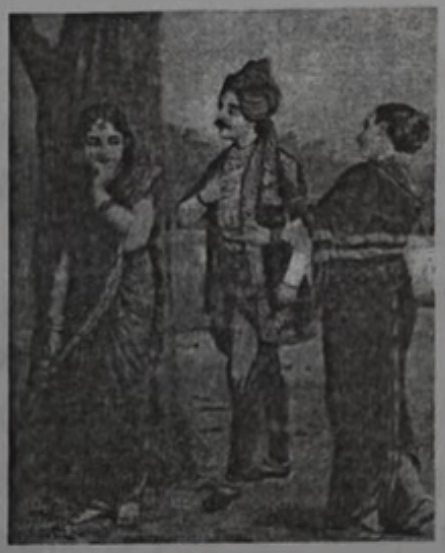
The given image shows a famous painting. Choose the painter of this art work from the following options:
View Solution
Concept:
During the nineteenth century, several Indian artists produced paintings that reflected Indian culture, traditions, and social life. Among them, Raja Ravi Verma became one of the most famous painters known for blending European artistic techniques with Indian themes.
Step 1: Observe the style of the painting.
The painting shows realistic human figures with detailed facial expressions and clothing, reflecting everyday Indian life. This realistic style was a special feature of Raja Ravi Verma’s paintings.
Step 2: Identify the painter.
Raja Ravi Verma was known for portraying Indian mythological and social themes using modern oil painting techniques learned from European art traditions.
Step 3: Match with the correct option.
Among the given options, the painter known for such realistic paintings is:
\[ \textbf{Raja Ravi Verma} \]
Therefore, the correct answer is Option (D). Quick Tip: \textbf{Raja Ravi Verma} is famous for popularizing Indian mythological characters and social themes through realistic oil paintings influenced by European artistic techniques.
Two statements are given below. They are Assertion (A) and Reason (R). Read both the statements carefully and choose the correct option:
Assertion (A): The Indian subcontinent was a crucial point in ‘Indian Ocean trade flows’ during the sixteenth century.
Reason (R): Its geographical location connected East–West Asia and Europe.
View Solution
Concept:
During the sixteenth century, the Indian Ocean became an important center of international trade connecting Asia, Africa, and Europe. India played a central role in this trade network due to its strategic geographical location and active commercial exchanges.
Step 1: Analyze the Assertion (A).
The Indian subcontinent was a key hub in Indian Ocean trade routes. Traders from different regions such as the Middle East, Southeast Asia, China, and Europe exchanged goods through Indian ports. Therefore, the assertion is correct.
Step 2: Analyze the Reason (R).
India’s geographical position placed it between the eastern and western parts of Asia and also connected it to Europe through maritime routes. This strategic location facilitated the movement of goods and merchants.
Thus, the reason is also correct.
Step 3: Determine the relationship between (A) and (R).
India’s geographical location directly explains why it became an important center in Indian Ocean trade networks.
Therefore, both the Assertion and the Reason are true, and the Reason correctly explains the Assertion. Quick Tip: India’s strategic location in the Indian Ocean helped it become a major center for trade connecting Asia, Africa, and Europe during the early modern period.
Arrange the following in chronological order and choose the correct option:
I. Gandhi–Irwin Pact
II. Rowlatt Act
III. Poona Pact
IV. Khilafat Movement
View Solution
Concept:
To arrange historical events in chronological order, we identify the year in which each event occurred and then arrange them from earliest to latest.
Step 1: Identify the year of each event.
Rowlatt Act — 1919
Khilafat Movement — 1919–1924
Gandhi–Irwin Pact — 1931
Poona Pact — 1932
Step 2: Arrange the events in chronological order.
\[ 1919 \rightarrow Rowlatt Act (II) \]
\[ 1919–1924 \rightarrow Khilafat Movement (IV) \]
\[ 1931 \rightarrow Gandhi–Irwin Pact (I) \]
\[ 1932 \rightarrow Poona Pact (III) \]
Step 3: Write the correct sequence.
\[ II \rightarrow IV \rightarrow I \rightarrow III \]
Therefore, the correct answer is Option (C). Quick Tip: Remember the sequence: \textbf{Rowlatt Act (1919) → Khilafat Movement (1919–24) → Gandhi–Irwin Pact (1931) → Poona Pact (1932)}.
(A) How had globalization begun long before sixteenth century? Explain.
OR
(B) How did trade help to spread diseases during the pre-modern world? Explain.
View Solution
(A) How had globalization begun long before sixteenth century?
Concept:
Globalization refers to the increasing interconnectedness of people, trade, culture, and ideas across different parts of the world. Although globalization expanded rapidly after the sixteenth century, its roots can be traced back to much earlier periods.
Step 1: Development of ancient trade routes.
Trade routes such as the Silk Route connected Asia, Europe, and Africa. Merchants traveled long distances to exchange goods like silk, spices, textiles, and precious metals.
Step 2: Exchange of culture and ideas.
Along with goods, cultural traditions, religious beliefs, art, and technologies were exchanged between different regions of the world.
Step 3: Movement of people.
Travelers, traders, priests, and pilgrims moved across countries, spreading languages, customs, and knowledge.
Step 4: Spread of crops and food items.
Various food crops such as potatoes, maize, and tomatoes were transferred across continents through trade and exploration.
Thus, long-distance trade, cultural exchanges, and the movement of people laid the foundation for globalization long before the sixteenth century.
(B) How did trade help to spread diseases during the pre-modern world?
Concept:
In the pre-modern world, long-distance trade connected distant regions through land and sea routes. While trade promoted economic and cultural exchanges, it also contributed to the spread of infectious diseases.
Step 1: Movement of traders and travelers.
Merchants and travelers moved frequently between different countries. They unknowingly carried diseases from one region to another.
Step 2: Spread through trade routes.
Major trade routes such as the Silk Route connected many regions. Diseases spread quickly along these routes due to the movement of people and goods.
Step 3: Limited medical knowledge.
During the pre-modern period, people had little understanding of how diseases spread, which made it difficult to control epidemics.
Step 4: Example of epidemic spread.
The spread of the plague across Asia and Europe is an example of how diseases traveled along trade routes and affected large populations.
Therefore, long-distance trade played a significant role in the spread of diseases in the pre-modern world. Quick Tip: The \textbf{Silk Route} was one of the most important early trade networks that connected Asia, Europe, and Africa and contributed to the early stages of globalization.
(A) Explain the role of Johann Gutenberg in the spread of print culture in Europe.
OR
(B) Explain the role of print in the expansion of Protestant Reformation.
View Solution
(A) Explain the role of Johann Gutenberg in the spread of print culture in Europe.
Concept:
Johann Gutenberg was a German inventor who introduced the first printing press with movable metal type in Europe during the fifteenth century. His invention revolutionized the production of books and played a major role in the spread of print culture.
Step 1: Invention of the printing press.
Around 1448, Gutenberg developed the printing press with movable metal type. This innovation made the printing of books faster, easier, and more efficient compared to manual copying.
Step 2: Printing of the Gutenberg Bible.
One of the earliest major books printed by Gutenberg was the Gutenberg Bible. It demonstrated the effectiveness of the printing press and increased interest in printed books.
Step 3: Increase in the production of books.
The printing press allowed large numbers of books to be produced quickly and at a lower cost. This made books accessible to more people.
Step 4: Spread of knowledge and ideas.
Printed books helped spread knowledge, scientific discoveries, and new ideas across Europe, contributing to the growth of education and literacy.
Thus, Gutenberg’s invention played a crucial role in the spread of print culture and intellectual development in Europe.
(B) Explain the role of print in the expansion of Protestant Reformation.
Concept:
The Protestant Reformation was a religious reform movement in Europe during the sixteenth century that challenged the authority of the Catholic Church. The printing press played a major role in spreading reformist ideas among people.
Step 1: Spread of Martin Luther’s ideas.
Martin Luther wrote the Ninety-Five Theses criticizing the practices of the Catholic Church. These ideas were widely printed and circulated across Europe.
Step 2: Production of pamphlets and books.
Pamphlets, booklets, and translated religious texts were printed in large numbers. These publications helped ordinary people understand and debate religious ideas.
Step 3: Translation of the Bible.
The Bible was translated into local languages and printed widely. This allowed common people to read and interpret religious teachings themselves.
Step 4: Encouragement of public debate.
Printed materials encouraged discussions about religion and church practices, which helped the reform movement spread rapidly across Europe.
Therefore, print played a vital role in spreading the ideas of the Protestant Reformation and challenging the authority of the Catholic Church. Quick Tip: The invention of the printing press by \textbf{Johann Gutenberg helped spread books, ideas, and religious debates across Europe, significantly influencing the Protestant Reformation.
(A) ``Culture played an important role in creating the idea of the nation.'' Examine the statement in the context of eighteenth century Europe.
OR
(B) ``Giuseppe Mazzini played a major role in the unification of Italy.'' Examine the statement.
View Solution
(A) ``Culture played an important role in creating the idea of the nation.''
Concept:
In eighteenth-century Europe, nationalism developed not only through political movements but also through cultural factors such as language, folklore, traditions, literature, and music. These cultural elements helped create a sense of collective identity among people.
Step 1: Role of language.
Language played a crucial role in uniting people and creating a sense of national identity. Nationalists promoted the use of common languages to strengthen cultural unity.
Step 2: Collection of folk traditions.
Nationalist leaders and scholars collected folk songs, folk tales, and local traditions. These cultural expressions reflected the true spirit and identity of the nation.
Step 3: Contribution of artists and writers.
Poets, writers, and artists used literature, paintings, and music to inspire patriotic feelings and spread nationalist ideas among the people.
Step 4: Use of symbols and cultural heritage.
National symbols, traditions, and historical memories helped people develop a shared sense of belonging and pride in their nation.
Thus, cultural practices played an important role in shaping national consciousness in Europe.
(B) ``Giuseppe Mazzini played a major role in the unification of Italy.''
Concept:
Giuseppe Mazzini was a prominent Italian nationalist who strongly advocated for the unification of Italy as a single independent republic. His ideas and revolutionary activities inspired many people to support the cause of Italian unity.
Step 1: Founder of Young Italy.
In 1831, Mazzini founded a secret society called Young Italy. Its main aim was to establish a united and independent Italian republic.
Step 2: Spread of nationalist ideas.
Mazzini spread ideas of nationalism through his writings and speeches. He encouraged young people to participate in the struggle for national unity.
Step 3: Organization of revolutionary movements.
He organized several revolutionary uprisings to overthrow foreign rule and establish a unified Italian nation.
Step 4: Inspiration to other leaders.
Although many of his revolutions failed, his ideas inspired other leaders such as Count Cavour and Giuseppe Garibaldi who later contributed to the unification of Italy.
Therefore, Giuseppe Mazzini played a significant role in awakening nationalist feelings and promoting the idea of a unified Italy. Quick Tip: \textbf{Giuseppe Mazzini is known as the ideological father of Italian nationalism and played a key role in inspiring the movement for Italian unification.
Read the given source carefully and answer the questions that follow:
``To the altar of this revolution we have brought our youth as incense''
Many nationalists thought that the struggle against the British could not be won through non-violence. In the year 1928, the Hindustan Socialist Republican Army (HSRA) was founded at a meeting in Ferozeshah Kotla ground in Delhi. Amongst its leaders were Bhagat Singh, Jatin Das and Ajoy Ghosh. In a series of dramatic actions in different parts of India, the HSRA targeted some of the symbols of British power. In April 1929, Bhagat Singh and Batukeshwar Dutta threw a bomb in the Legislative Assembly. In the same year there was an attempt to blow up the train that Lord Irwin was travelling in. Bhagat Singh was 23 when he was tried and executed by the colonial government. During his trial, Bhagat Singh stated that he did not wish to glorify the ``cult of the bomb and pistol'' but wanted a revolution in society.
``Revolution is the inalienable right of mankind. Freedom is the imprescriptible birthright of all. The labourer is the real sustainer of society. To the altar of this revolution we have brought our youth as incense, for no sacrifice is too great for so magnificent a cause. We are content. We await the advent of revolution. Inquilab Zindabad!''
(8.1) Why is the formation of ‘Hindustan Socialist Republican Army (HSRA)’ considered as a turning point in the freedom struggle of India?
(8.2) How did Bhagat Singh’s trial speeches transform him from a revolutionary to a philosopher of freedom?
(8.3) In what way did Bhagat Singh redefine the meaning of ‘revolution’ for his generation? Explain.
View Solution
Concept:
The revolutionary movement in India played an important role in inspiring people during the freedom struggle. Organizations such as the Hindustan Socialist Republican Army (HSRA) aimed to challenge British authority and spread revolutionary ideas among the masses.
Step 1: Answer to (8.1): Why is the formation of HSRA considered a turning point?
The formation of the HSRA in 1928 marked a turning point because it organized revolutionary activities against British rule in a systematic way. The group aimed not only to challenge colonial authority but also to inspire youth to participate actively in the struggle for independence. Their actions drew national attention to the demand for freedom.
Step 2: Answer to (8.2): How did Bhagat Singh’s trial speeches transform him?
During his trial, Bhagat Singh used the courtroom as a platform to explain his ideas about freedom, justice, and social change. Instead of focusing only on violent resistance, he emphasized the need for a broader social revolution and equality. His speeches reflected deep political thought, which transformed his image from a mere revolutionary to a philosopher of freedom.
Step 3: Answer to (8.3): How did Bhagat Singh redefine the meaning of revolution?
Bhagat Singh believed that revolution was not simply about violence or armed struggle. He defined revolution as a complete transformation of society, including social, economic, and political changes. According to him, true revolution aimed at ending exploitation and establishing a just and equal society. Quick Tip: \textbf{Bhagat Singh} emphasized that revolution meant bringing social and economic justice, not merely using violence against colonial rule.
Two places (A) and (B) have been marked on the given political outline map of India. Identify them based on the information given below and write their correct names on the lines marked on the map near them:
(A) The place where General Dyer ordered firing upon a peaceful gathering on 13 April, 1919.
(B) The place where the Session of Indian National Congress was held in the year 1927.
View Solution
Concept:
Certain places in India are historically significant because important events of the national movement occurred there. Identifying these locations helps understand the geographical context of the freedom struggle.
Step 1: Identify the place related to the firing ordered by General Dyer.
On 13 April 1919, General Dyer ordered troops to open fire on a peaceful gathering at Jallianwala Bagh in Amritsar, Punjab. This tragic incident is known as the Jallianwala Bagh Massacre.
\[ \textbf{Amritsar (Punjab)} \]
Step 2: Identify the place where the INC session was held in 1927.
The Indian National Congress Session of 1927 was held at Madras (present-day Chennai). During this session, the Congress demanded complete independence for India.
\[ \textbf{Madras (Chennai)} \]
Step 3: Write the correct names on the map.
(A) Amritsar
(B) Madras (Chennai) Quick Tip: The \textbf{Jallianwala Bagh Massacre (1919)} in Amritsar and the \textbf{Indian National Congress Session of 1927 at Madras} were important events in India’s freedom struggle.
Which one of the following pairs is correctly matched?
Column – A (National Parks) & Column – B (States)
(A) Periyar & Madhya Pradesh
(B) Manas & Assam
(C) Bandhavgarh & Rajasthan
(D) Corbett & Uttar Pradesh
View Solution
Concept:
National parks are protected areas established to conserve wildlife and natural habitats. Each national park is located in a specific state in India.
Step 1: Check each pair.
Periyar National Park is located in Kerala, not Madhya Pradesh.
Manas National Park is located in Assam. This pair is correct.
Bandhavgarh National Park is located in Madhya Pradesh, not Rajasthan.
Jim Corbett National Park is located in Uttarakhand, not Uttar Pradesh.
Step 2: Identify the correct match.
Among the given options, the correctly matched pair is:
\[ \textbf{Manas — Assam} \]
Therefore, the correct answer is Option (B). Quick Tip: \textbf{Manas National Park} in Assam is a UNESCO World Heritage Site and a famous habitat for endangered species like the one-horned rhinoceros and Bengal tiger.
Choose the correct option related to the factors that determine the land use pattern in India:
View Solution
Concept:
Land use refers to the way land is utilized for different purposes such as agriculture, forestry, settlements, and industries. The pattern of land use in a region depends on both natural conditions and human activities.
Step 1: Physical factors.
Physical factors include natural conditions such as topography, soil type, climate, and availability of water. These factors influence the suitability of land for agriculture, forests, or other uses.
Step 2: Human factors.
Human factors include population density, technological development, culture, and economic activities. These factors determine how people utilize the available land resources.
Step 3: Identify the correct option.
Since land use is determined by both natural conditions and human activities, the correct answer is:
\[ \textbf{Physical and Human factors} \]
Therefore, the correct answer is Option (D). Quick Tip: Land use patterns are influenced by \textbf{physical factors} like climate and soil, and \textbf{human factors} such as population, technology, and economic activities.
Choose the appropriate option to fill in the blank:
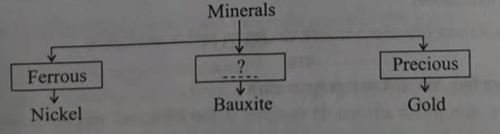
View Solution
Concept:
Minerals are broadly classified into different categories based on their composition and properties. Some major groups include ferrous minerals, non-ferrous minerals, and precious minerals.
Step 1: Understand the given classification.
The diagram shows three types of minerals:
Ferrous minerals — Example: Nickel
Precious minerals — Example: Gold
A missing category with example: Bauxite
Step 2: Identify the category of Bauxite.
Bauxite is the ore used to produce aluminium. Aluminium does not contain iron, so it belongs to the category of non-ferrous minerals.
Step 3: Choose the correct option.
Therefore, the missing category in the diagram is:
\[ \textbf{Non-Ferrous Minerals} \]
Hence, the correct answer is Option (C). Quick Tip: \textbf{Non-ferrous minerals} do not contain iron. Examples include \textbf{bauxite, copper, lead, and zinc}.
Match Column - I with Column - II and choose the correct option:
Column - I (Types of Farming) & Column - II (Features)
I. Primitive subsistence farming & (a) Use of modern inputs with less labour
II. Intensive subsistence farming & (b) Single crop cultivation on large scale
III. Commercial farming & (c) Slash and burn cultivation
IV. Plantation farming & (d) Labour intensive cultivation
I II III IV
View Solution
Concept:
Different types of farming are practiced depending on the level of technology, scale of production, and purpose of cultivation. Each type of farming has distinct characteristics.
Step 1: Match Primitive subsistence farming.
Primitive subsistence farming involves traditional methods such as slash and burn cultivation.
Therefore,
\[ I \rightarrow (c) \]
Step 2: Match Intensive subsistence farming.
Intensive subsistence farming requires a large amount of labour on small pieces of land.
Thus,
\[ II \rightarrow (d) \]
Step 3: Match Commercial farming.
Commercial farming uses modern inputs such as fertilizers, machines, and high yielding seeds with relatively less labour.
\[ III \rightarrow (a) \]
Step 4: Match Plantation farming.
Plantation farming involves single crop cultivation on large scale.
\[ IV \rightarrow (b) \]
Step 5: Write the correct sequence.
\[ (c), (d), (a), (b) \]
Therefore, the correct answer is Option (C). Quick Tip: \textbf{Primitive farming} uses traditional methods, \textbf{intensive farming} is labour intensive, \textbf{commercial farming} uses modern inputs, and \textbf{plantation farming} grows a single crop on a large scale.
Identify the state related with the Chipko Movement:
View Solution
Concept:
The Chipko Movement was a forest conservation movement in India where villagers, especially women, hugged trees to prevent them from being cut down. It aimed to protect forests and promote environmental awareness.
Step 1: Origin of the Chipko Movement.
The Chipko Movement started in the 1970s in the Himalayan region of Uttarakhand (then part of Uttar Pradesh).
Step 2: Objective of the movement.
People protested against the cutting of trees by contractors. Villagers embraced the trees to prevent them from being felled.
Step 3: Identify the correct state.
Since the movement began in the Himalayan region of Uttarakhand, the correct answer is:
\[ \textbf{Uttarakhand} \]
Therefore, the correct option is Option (C). Quick Tip: The \textbf{Chipko Movement} was a famous environmental movement led by villagers in Uttarakhand to protect forests by hugging trees.
Identify the correct soil from the given options to complete the flow chart:

View Solution
Concept:
Laterite soil is formed in regions with high temperature and heavy rainfall. In such conditions, intense leaching occurs, which removes nutrients from the soil and leaves behind iron and aluminium compounds.
Step 1: Understand the formation process.
Heavy rainfall causes high leaching, which washes away many soluble minerals from the soil. This process leads to the formation of laterite soil.
Step 2: Agricultural use of laterite soil.
Laterite soil is suitable for growing plantation crops such as tea, coffee, cashew, and rubber, especially when fertilizers are used.
Step 3: Identify the correct option.
Since laterite soil forms due to heavy rainfall and leaching and supports tea and coffee cultivation, the correct answer is:
\[ \textbf{Laterite soil} \]
Therefore, the correct option is Option (B). Quick Tip: \textbf{Laterite soil} forms in areas of heavy rainfall and high temperature and is suitable for plantation crops like \textbf{tea and coffee}.
Suggest any two measures for better productivity and organic farming.
View Solution
Concept:
Organic farming focuses on improving soil fertility and crop productivity using natural methods instead of chemical fertilizers and pesticides. It promotes sustainable agriculture and protects the environment.
Step 1: Use of organic manure.
Farmers should use organic manure such as compost, farmyard manure, and green manure. These natural fertilizers improve soil fertility and enhance crop productivity without harming the environment.
Step 2: Crop rotation.
Crop rotation helps maintain soil nutrients and prevents soil degradation. Growing different crops in succession improves soil health and increases productivity.
Thus, the use of organic manure and crop rotation are two effective measures for better productivity and promoting organic farming. Quick Tip: Practices such as \textbf{organic manure, crop rotation, mixed cropping, and biological pest control} help promote sustainable and organic farming.
(A) ``Minerals are an indispensable part of our lives.'' Justify the statement.
OR
(B) ``Solar energy has an important role in transforming the energy landscape.'' Justify the statement.
View Solution
(A) ``Minerals are an indispensable part of our lives.''
Concept:
Minerals are naturally occurring substances found in the earth’s crust. They are essential raw materials for many industries and are widely used in daily life.
Step 1: Use in daily life.
Many everyday items such as utensils, electronic devices, vehicles, and building materials are made from minerals like iron, copper, aluminium, and limestone.
Step 2: Industrial development.
Minerals serve as basic raw materials for industries such as iron and steel, cement, and machinery production, which support economic growth.
Step 3: Energy resources.
Mineral fuels such as coal, petroleum, and natural gas are important sources of energy used for transportation, electricity generation, and industrial activities.
Step 4: Infrastructure and construction.
Minerals like limestone, gypsum, and granite are used in the construction of roads, buildings, and bridges.
Thus, minerals play a vital role in modern life and economic development.
(B) ``Solar energy has an important role in transforming the energy landscape.''
Concept:
Solar energy is a renewable and clean source of energy obtained from sunlight. It has become an important alternative to conventional sources of energy.
Step 1: Renewable and sustainable source.
Solar energy is available in abundance and can be used repeatedly without depletion.
Step 2: Environment friendly.
Unlike fossil fuels, solar energy does not produce harmful emissions, thus reducing environmental pollution.
Step 3: Reduces dependence on fossil fuels.
The use of solar power helps decrease dependence on non-renewable resources such as coal and petroleum.
Step 4: Promotes rural development.
Solar energy can be used in remote and rural areas for electricity generation, irrigation, and other basic needs.
Therefore, solar energy is playing a significant role in transforming the global energy landscape. Quick Tip: \textbf{Solar energy} is a clean, renewable, and sustainable source of power that helps reduce pollution and dependence on fossil fuels.
Read the given source carefully and answer the questions that follow:
FLOODS
Basic safety precautions to be taken:
Listen to radio/TV for the latest weather bulletins and flood warnings. Pass on the information to others.
Make a family emergency kit which should include a portable radio/transistor, torch, spare batteries, a first aid box along with essential medicines, ORS, dry food items, drinking water, matchboxes, candles and other essential items.
Keep hurricane lamp, ropes, rubber tubes, umbrella and bamboo stick in your house. These could be useful.
Keep your cash, jewellery, valuables and important documents in a safe place.
If there is a flood, move along with your family members and cattle to safe areas like relief camps, evacuation centers, elevated grounds where you can take shelter.
Turn off power and gas connections before leaving your house.
During Floods
Don’t enter into flood waters; it could be dangerous.
Don’t allow children to play in or near flood waters.
Stay away from sewerage lines, gutters, drains and culverts.
Be careful of snakes; snakebites are common during floods.
Eat freshly cooked and dry food. Always keep your food covered.
Use boiled and filtered drinking water.
Keep all drains and gutters near your house clean.
Stagnation of water can breed vector/water-borne diseases. In case of sickness, seek medical assistance.
Use bleaching powder and lime to disinfect the surroundings.
(18.1) Suggest one precaution before using water after floods.
(18.2) Mention any two measures related to protection of food items during floods.
(18.3) Suggest two actions to be taken before leaving the house during a flood warning.
View Solution
Concept:
Floods are natural disasters that can cause serious damage to life and property. Following safety precautions helps reduce risks and ensures the safety of people during such emergencies.
Step 1: Answer to (18.1)
One precaution before using water after floods is to use boiled and filtered drinking water to avoid water-borne diseases.
Step 2: Answer to (18.2)
Two measures to protect food during floods are:
Eat freshly cooked and dry food.
Always keep food covered to protect it from contamination.
Step 3: Answer to (18.3)
Two actions to be taken before leaving the house during a flood warning are:
Turn off power and gas connections.
Keep cash, jewellery, valuables and important documents in a safe place. Quick Tip: During floods always use \textbf{boiled drinking water, eat covered food, switch off electricity and gas connections, and move to safe places such as relief camps}.
On the same outline map of India, given for Q. No. 9, locate and label any three of the following with suitable symbols:
(19.1) The dam built on Mahanadi river.
(19.2) Nuclear power plant located in Uttar Pradesh.
(19.3) Software technology park located in Maharashtra.
(19.4) Major sea port located in Gujarat.
View Solution
Concept:
Important dams, industries, ports, and power plants are often located on maps to understand their geographical distribution in India.
Step 1: Dam built on the Mahanadi River.
The dam built on the Mahanadi River is the Hirakud Dam, located in Odisha.
\[ \textbf{Hirakud Dam} \]
Step 2: Nuclear power plant in Uttar Pradesh.
The nuclear power plant located in Uttar Pradesh is Narora Nuclear Power Plant.
\[ \textbf{Narora} \]
Step 3: Software technology park in Maharashtra.
The major software technology park located in Maharashtra is Pune.
\[ \textbf{Pune} \]
Step 4: Major sea port in Gujarat.
A major sea port located in Gujarat is Kandla Port (now called Deendayal Port).
\[ \textbf{Kandla Port} \]
Answer (Any three to be labeled on the map):
Hirakud Dam
Narora Nuclear Power Plant
Pune (Software Technology Park)
Kandla Port Quick Tip: Remember key map locations: \textbf{Hirakud Dam (Odisha)}, \textbf{Narora Nuclear Plant (UP)}, \textbf{Pune IT Park (Maharashtra)}, and \textbf{Kandla Port (Gujarat)}.
Two statements are given below. They are Assertion (A) and Reason (R). Read both the statements carefully and choose the correct option:
Assertion (A): Both Sri Lanka and Belgium faced challenges of ethnic and linguistic diversity.
Reason (R): Sri Lanka had majority of Tamils whereas Belgium had majority of French speaking people.
View Solution
Concept:
Both Belgium and Sri Lanka experienced challenges related to ethnic and linguistic diversity. Different communities with distinct languages and cultural identities created political tensions in both countries.
Step 1: Analyze the Assertion (A).
Belgium had linguistic divisions mainly between Dutch-speaking and French-speaking communities. Similarly, Sri Lanka experienced ethnic tensions between the Sinhalese majority and the Tamil minority. Therefore, the assertion is correct.
Step 2: Analyze the Reason (R).
The reason is incorrect because in Sri Lanka the Sinhalese form the majority, not the Tamils. In Belgium, the majority are Dutch-speaking people, not French-speaking people.
Step 3: Determine the correct option.
Since the Assertion is true but the Reason is false, the correct answer is:
\[ \textbf{(A) is true, but (R) is false.} \] Quick Tip: In \textbf{Belgium}, the majority population speaks \textbf{Dutch}, while in \textbf{Sri Lanka}, the majority are \textbf{Sinhalese}, not Tamils.
Read the following statements regarding decentralization steps India took in the year 1992 and choose the correct option:
I. Mandatory regular elections for local bodies
II. Two-third seats reserved for women
III. Formation of the State Election Commission
IV. Seats reserved for Scheduled Castes and Scheduled Tribes
View Solution
Concept:
In 1992, the Indian government passed the 73rd and 74th Constitutional Amendments to strengthen decentralization and empower local self-governments such as Panchayats and Municipalities.
Step 1: Examine Statement I.
The amendments made it mandatory to hold regular elections for local bodies every five years.
Hence, Statement I is correct.
Step 2: Examine Statement II.
The Constitution provided one-third reservation for women in local bodies, not two-thirds.
Hence, Statement II is incorrect.
Step 3: Examine Statement III.
Each state was required to establish a State Election Commission to conduct elections for Panchayats and Municipalities.
Hence, Statement III is correct.
Step 4: Examine Statement IV.
Seats were reserved for Scheduled Castes (SCs) and Scheduled Tribes (STs) in proportion to their population.
Hence, Statement IV is correct.
Step 5: Identify the correct combination.
\[ I,\ III,\ IV \]
Therefore, the correct answer is Option (B). Quick Tip: The \textbf{73rd Constitutional Amendment (1992)} strengthened local self-government by ensuring regular elections, reservation for SC/ST and women (one-third), and the creation of State Election Commissions.
Find the odd one out regarding the Political Parties of India:
View Solution
Concept:
Political parties in India are classified as national parties and regional (state) parties. National parties operate across the entire country, while regional parties mainly function within a particular state or region.
Step 1: Analyze each option.
Indian National Congress and Communist Party of India (M) are national political parties.
Rashtriya Janata Dal and Lok Jan Shakti Party are regional parties mainly active in Bihar.
Indian National Lok Dal and Jan Nayak Janata Party are regional parties in Haryana.
Rashtriya Lok Dal and Jan Satta Dal are regional parties mainly active in Uttar Pradesh.
Step 2: Identify the odd one out.
Option (A) includes national parties, while the other options include regional parties. Therefore, it is the odd one out.
\[ \textbf{Indian National Congress and Communist Party of India (M)} \] Quick Tip: \textbf{National parties} operate across India, whereas \textbf{regional parties} mainly focus on specific states or regions.
Look at the given picture carefully and choose the most appropriate option:
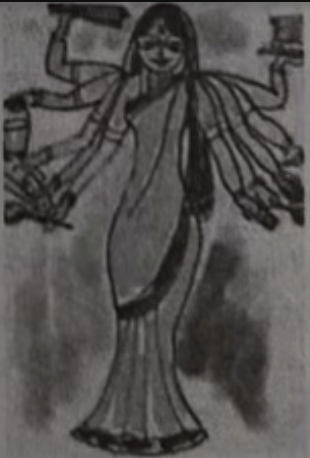
Which of the following values is being reflected through this picture?
View Solution
Concept:
The picture shows a woman with multiple hands performing several tasks simultaneously. This representation symbolizes the ability to manage many responsibilities at the same time with dedication and effort.
Step 1: Observe the image carefully.
The woman in the picture is shown carrying out different activities at once, which suggests that she is handling multiple duties.
Step 2: Interpret the message of the picture.
The image highlights the value of multitasking and the dedication often shown in managing different responsibilities efficiently.
Step 3: Choose the most appropriate option.
Among the given options, the value best reflected by the picture is:
\[ \textbf{Multitasking and Dedication} \]
Therefore, the correct answer is Option (C). Quick Tip: Images showing a person performing many tasks at once often symbolize \textbf{multitasking, responsibility, and dedication}.
Explain any two features of federalism.
View Solution
Concept:
Federalism is a system of government in which power is divided between a central authority and various constituent units such as states or provinces. This division of power ensures that both levels of government function independently within their respective spheres.
Step 1: Division of powers.
In a federal system, the powers of government are divided between the central government and the state governments. Each level of government has authority over specific subjects mentioned in the constitution.
Step 2: Supremacy of the Constitution.
The Constitution is the supreme law of the country in a federal system. Both the central and state governments must function according to the rules and principles laid down in the Constitution.
Thus, the division of powers and supremacy of the Constitution are two important features of federalism. Quick Tip: Key features of federalism include \textbf{division of powers, supremacy of the Constitution, independent judiciary, and autonomy of states}.
Suggest any two measures to inspire women to learn new skills for entrepreneurship.
View Solution
Concept:
Entrepreneurship empowers women by enabling them to start and manage their own businesses. Encouraging women to learn new skills can increase their confidence, economic independence, and participation in economic activities.
Step 1: Provide skill development and training programmes.
Government and private organizations should organize skill development programmes, workshops, and vocational training to help women learn business-related skills and modern technologies.
Step 2: Provide financial support and incentives.
Providing easy access to loans, subsidies, and financial assistance can motivate women to start their own enterprises and apply the skills they have learned.
Thus, skill development training and financial support are effective measures to inspire women to learn new skills for entrepreneurship. Quick Tip: Encouraging \textbf{skill training, financial assistance, mentorship, and awareness programmes} can help women participate actively in entrepreneurship.
``Political parties perform a series of functions in a democracy.'' Explain the statement with examples.
View Solution
Concept:
Political parties are essential institutions in a democratic system. They perform several functions that help in the formation of government, representation of people, and smooth functioning of democracy.
Step 1: Contest elections.
Political parties select candidates and contest elections to gain political power. For example, parties like the Indian National Congress and the Bharatiya Janata Party contest elections at national and state levels.
Step 2: Form and run the government.
The party that wins the majority of seats in elections forms the government and implements its policies and programmes.
Step 3: Formulate public policies.
Political parties develop policies and programmes based on their ideologies. These policies guide the government in making decisions and implementing development plans.
Step 4: Act as a link between people and government.
Political parties communicate the demands and problems of the public to the government and inform citizens about government policies.
Step 5: Provide political education.
Parties educate citizens about political issues and encourage people to participate in political activities and democratic processes.
Thus, political parties play an important role in organizing government, representing public interests, and ensuring the effective functioning of democracy. Quick Tip: Political parties help in \textbf{contesting elections, forming governments, shaping policies, and connecting people with the government}.
(A) ``Democracy is a legitimate government with deep values.'' Examine the statement.
OR
(B) ``Complaints are itself a testimony to the success of democracy.'' Examine the statement.
View Solution
(A) ``Democracy is a legitimate government with deep values.''
Concept:
Democracy is a form of government in which rulers are elected by the people. It is considered legitimate because it reflects the will of the citizens and is based on fundamental democratic values.
Step 1: Government based on people's consent.
In a democracy, the government is elected by the people through free and fair elections. This gives the government legitimacy and acceptance among citizens.
Step 2: Respect for equality and freedom.
Democracy promotes values such as equality, freedom, and dignity of individuals. Every citizen has equal rights and opportunities.
Step 3: Accountability and transparency.
Democratic governments are accountable to the people. Citizens can question the government and demand transparency in decision-making.
Step 4: Protection of fundamental rights.
Democracy ensures the protection of fundamental rights and promotes justice and fairness in society.
Thus, democracy is considered a legitimate form of government because it is based on the consent of the people and upholds important democratic values.
(B) ``Complaints are itself a testimony to the success of democracy.''
Concept:
In a democratic system, citizens have the freedom to express their opinions, criticize the government, and raise complaints about policies and decisions.
Step 1: Freedom of expression.
Democracy guarantees the right to freedom of speech and expression. People can openly express dissatisfaction with government actions.
Step 2: Opportunity for participation.
Citizens can participate in political processes, protests, and discussions to raise their concerns and influence decision-making.
Step 3: Scope for improvement.
Complaints and criticism help governments identify problems and improve policies and governance.
Step 4: Indicator of democratic functioning.
The presence of public debate and criticism shows that democratic institutions are functioning properly and respecting citizens’ rights.
Therefore, complaints and criticisms indicate the healthy functioning and success of democracy. Quick Tip: In a democracy, \textbf{freedom of expression, accountability, and public participation} ensure that citizens can question and improve governance.
Read the given source carefully and answer the questions that follow:
POWER SHARING
Power sharing arrangements can also be seen in the way political parties, pressure groups and movements control or influence those in power. In a democracy, the citizens must have freedom to choose among various contenders for power. In contemporary democracies, this takes the form of competition among different parties. Such competition ensures that power does not remain in one hand. In the long run, power is shared among different political parties that represent different ideologies and social groups. Sometimes this kind of sharing can be direct, when two or more parties form an alliance to contest elections. If their alliance is elected, they form a coalition government and thus share power.
In a democracy, we find interest groups, such as those of traders, businessmen, industrialists, farmers and industrial workers. They also will have a share in governmental power, either through participation in governmental committees or bringing influence on the decision-making process.
(28.1) How do pressure groups influence the government?
(28.2) How do social groups benefit from power sharing?
(28.3) Explain the contributions of citizens in the power sharing process.
View Solution
Concept:
Power sharing in a democracy ensures that different political parties, pressure groups, and social groups participate in the decision-making process. This prevents the concentration of power in a single authority and strengthens democratic governance.
Step 1: Answer to (28.1)
Pressure groups influence the government by organizing movements, raising public issues, and putting pressure on authorities to consider their demands. They may also participate in governmental committees and influence policy decisions.
Step 2: Answer to (28.2)
Social groups benefit from power sharing because their interests and concerns are represented in government policies. Different groups such as farmers, workers, and business communities can influence decision-making and ensure fair representation.
Step 3: Answer to (28.3)
Citizens contribute to the power sharing process by participating in elections, choosing their representatives, expressing opinions, and supporting political parties or movements. Their participation ensures accountability and democratic governance. Quick Tip: Power sharing in democracy involves participation of \textbf{political parties, pressure groups, social groups, and citizens}, ensuring that power does not remain concentrated in one authority.
Choose the correct option to fill in the blank:
Literacy Rate is expressed as a proportion of the literate population in the age group ____ and above.
View Solution
Concept:
Literacy rate is an important indicator of the educational level of a population. It measures the percentage of people who can read and write with understanding.
Step 1: Understand the definition of literacy rate.
According to the Census of India, the literacy rate is calculated for the population aged 7 years and above who can read and write with understanding in any language.
Step 2: Identify the correct option.
Since literacy is measured among people aged 7 years and above, the correct answer is:
\[ \textbf{7 years} \]
Therefore, the correct option is Option (A). Quick Tip: According to the \textbf{Census of India}, literacy rate is calculated for the population aged \textbf{7 years and above}.
Which of the following organisations publishes the ``Human Development Report''?
View Solution
Concept:
The Human Development Report (HDR) is an annual report that measures and compares levels of human development across countries using indicators such as life expectancy, education, and per capita income.
Step 1: Understand the purpose of the Human Development Report.
The Human Development Report evaluates the progress of countries in terms of human development using the Human Development Index (HDI).
Step 2: Identify the organization responsible for publishing it.
The report is published by the United Nations Development Programme (UNDP), which focuses on global development and poverty reduction.
Step 3: Choose the correct option.
Therefore, the organization that publishes the Human Development Report is:
\[ \textbf{United Nations Development Programme (UNDP)} \]
Hence, the correct answer is Option (D). Quick Tip: The \textbf{Human Development Report} and the \textbf{Human Development Index (HDI)} are published by the \textbf{United Nations Development Programme (UNDP)}.
Which one of the following best describes liberalisation?
View Solution
Concept:
Liberalisation refers to the process of removing government restrictions and regulations on economic activities. It allows businesses greater freedom to operate and encourages trade and investment.
Step 1: Understand the meaning of liberalisation.
Liberalisation means reducing or removing barriers such as tariffs, quotas, and other restrictions that limit trade and economic activities.
Step 2: Effect on trade and investment.
By removing restrictions, liberalisation promotes international trade, encourages foreign investment, and increases competition among companies.
Step 3: Identify the correct option.
Among the given options, liberalisation is best described as:
\[ \textbf{Removal of restrictions on trade} \]
Therefore, the correct answer is Option (C). Quick Tip: \textbf{Liberalisation} means reducing government control and removing restrictions to promote free trade and economic growth.
Read the following case and choose the correct option:
Swapna owns a small farm in her village. She wants to take a loan to meet the expense of cultivation. From which of the following sources should Swapna take the loan?
View Solution
Concept:
Loans can be obtained from formal and informal sources. Formal sources include banks and cooperatives that follow government rules and provide loans at reasonable interest rates. Informal sources include moneylenders and traders who often charge high interest rates.
Step 1: Identify the suitable source of credit.
For farmers and small cultivators, it is advisable to take loans from formal institutions such as nationalised banks.
Step 2: Reason for choosing a bank.
Banks provide loans at lower interest rates, follow proper legal procedures, and protect borrowers from exploitation.
Step 3: Choose the correct option.
Therefore, Swapna should take the loan from the:
\[ \textbf{Nearest nationalised bank} \]
Hence, the correct answer is Option (B). Quick Tip: \textbf{Formal sources of credit} like banks and cooperatives provide loans at reasonable interest rates and are safer than informal sources such as moneylenders.
Match Column - I with Column - II and choose the correct option:
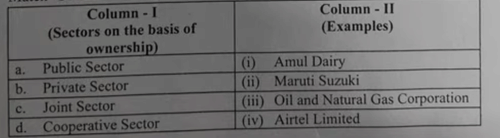
View Solution
Concept:
Sectors of the economy can be classified on the basis of ownership. Each sector represents who owns and manages the enterprise.
Public Sector: Owned and controlled by the government.
Private Sector: Owned and managed by private individuals or companies.
Joint Sector: Owned jointly by the government and private individuals.
Cooperative Sector: Owned and managed by a group of people for their mutual benefit.
Step 1: Match Public Sector.
Oil and Natural Gas Corporation (ONGC) is owned by the government, so it belongs to the Public Sector.
\[ a \rightarrow (iii) \]
Step 2: Match Private Sector.
Airtel Limited is a privately owned company, so it belongs to the Private Sector.
\[ b \rightarrow (iv) \]
Step 3: Match Joint Sector.
Maruti Suzuki is jointly owned by the government and private company (Suzuki), so it belongs to the Joint Sector.
\[ c \rightarrow (ii) \]
Step 4: Match Cooperative Sector.
Amul Dairy operates under a cooperative model owned by farmers.
\[ d \rightarrow (i) \]
Thus, the correct matching is:
\[ a-(iii),\quad b-(iv),\quad c-(ii),\quad d-(i) \]
Hence, the correct option is (C). Quick Tip: \textbf{Examples to remember:} ONGC – Public Sector, Airtel – Private Sector, Maruti Suzuki – Joint Sector, Amul – Cooperative Sector.
Study the data of a State given below and answer the question that follow:
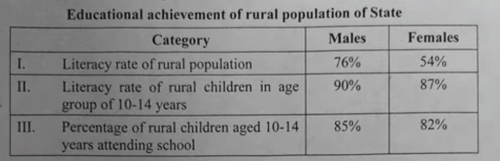
If rural children aged 10--14 years are considered, then how many female children are attending school?
View Solution
Concept:
The table provides information about literacy rate and school attendance of rural children aged 10--14 years. The required value should be taken directly from the category that shows the percentage of children attending school.
Step 1: Identify the relevant category.
Category III gives the percentage of rural children aged 10--14 years attending school.
Step 2: Observe the value for females.
From the table:
\[ Female children attending school = 82% \]
Step 3: Select the correct option.
Thus, the number of female children attending school (out of 100) is:
\[ \boxed{82} \]
Therefore, the correct answer is Option (C). Quick Tip: When questions are based on tables or data, carefully identify the \textbf{correct category and column} before selecting the answer.
``New technology has helped the world to become connected.'' Justify the statement with suitable arguments.
View Solution
Concept:
Technological advancements in communication and transportation have played a major role in connecting people, businesses, and countries across the world. These technologies have made the process of globalization faster and easier.
Step 1: Improvement in communication technology.
Modern communication technologies such as the internet, mobile phones, satellite communication, and social media allow people to communicate instantly across long distances. This has connected individuals, companies, and governments globally.
Step 2: Advancement in transportation.
Developments in transport systems such as faster ships, railways, and airplanes have reduced the time and cost of moving goods and people from one place to another.
Step 3: Expansion of global trade and business.
Technology enables companies to operate in different countries, outsource production, and sell goods in global markets. Online platforms and digital payments also support international trade.
Step 4: Easy flow of information and services.
Information, knowledge, and services can now be shared quickly through digital networks. Educational resources, financial services, and business operations can be accessed from anywhere in the world.
Conclusion:
Thus, new technology has significantly reduced geographical barriers and connected the world economically, socially, and culturally. Quick Tip: \textbf{Technology + Communication + Transport} are the key factors that accelerated \textbf{globalization} and connected the world.
Differentiate between the Reserve Bank of India and other Commercial banks.
View Solution
Concept:
The Reserve Bank of India (RBI) is the central bank of the country and regulates the banking system, whereas commercial banks provide banking services directly to the public such as deposits and loans.
\begin{tabular{|p{6cm|p{6cm|
Reserve Bank of India (RBI) & Commercial Banks
It is the central bank of the country. & These are banks that provide banking services to the public.
It controls and regulates the entire banking system of India. & They work under the regulations of the RBI.
It issues currency notes and manages the country's monetary policy. & They accept deposits and give loans to individuals and businesses.
It acts as the banker to the government and banks. & They act as bankers to the general public.
Example: Reserve Bank of India. & Examples: State Bank of India, Punjab National Bank, etc.
Quick Tip: \textbf{RBI = Central bank and regulator of banking system.} \textbf{Commercial Banks = Banks that deal directly with the public by accepting deposits and providing loans.}
Why is sustainable development essential? Explain with examples.
View Solution
Concept:
Sustainable development refers to development that meets the needs of the present generation without compromising the ability of future generations to meet their own needs. It ensures the balanced use of natural resources while protecting the environment.
Step 1: Conservation of natural resources.
Natural resources such as forests, water, and minerals are limited. Sustainable development helps in conserving these resources so that they are available for future generations.
Example: Afforestation and controlled use of forest resources help maintain ecological balance.
Step 2: Protection of the environment.
Uncontrolled industrialization and excessive use of resources cause pollution and environmental degradation. Sustainable practices reduce pollution and protect ecosystems.
Example: Using renewable sources of energy like solar and wind power instead of fossil fuels.
Step 3: Ensures long-term economic development.
Sustainable development promotes economic growth while maintaining environmental balance. This helps societies develop without exhausting natural resources.
Example: Practicing organic farming and efficient irrigation methods to maintain soil fertility.
Conclusion:
Thus, sustainable development is essential to ensure economic growth, environmental protection, and the well-being of future generations. Quick Tip: \textbf{Sustainable development} means using resources \textbf{carefully and responsibly} so that they remain available for \textbf{future generations}.
(A) Describe the efforts done by Indian government to increase employment in Urban areas.
OR
(B) Describe the importance of Secondary Sector in the economy of the country.
View Solution
(A) Efforts done by the Indian Government to increase employment in Urban Areas
Concept:
Urban unemployment arises due to rapid urbanization, migration from rural areas, and limited job opportunities in cities. To address this issue, the Government of India has introduced several schemes and policies aimed at creating employment opportunities, encouraging entrepreneurship, and improving skill development in urban areas.
Step 1: Skill Development Programs.
The government has launched various skill development initiatives to improve the employability of urban youth. Programs such as Skill India Mission and vocational training centers help individuals gain technical and professional skills required in industries and services.
Step 2: Promotion of Small and Medium Enterprises (SMEs).
The government promotes small businesses and startups by providing financial assistance, subsidies, and easier access to credit. These initiatives help generate employment opportunities in urban areas.
Step 3: Urban Employment Schemes.
Schemes such as the National Urban Livelihoods Mission (NULM) aim to reduce poverty and unemployment in cities by providing self-employment opportunities and wage employment.
Step 4: Infrastructure Development.
Large-scale urban infrastructure projects such as construction of roads, housing, metro rail systems, and smart cities create direct and indirect employment opportunities.
Step 5: Support for Startups and Entrepreneurship.
Programs like Startup India and Make in India encourage innovation, industrial growth, and business creation, leading to increased employment opportunities in urban regions.
Quick Tip:Government policies aimed at skill development, entrepreneurship, and infrastructure expansion play a crucial role in generating employment opportunities in urban areas.
Solution:
Concept:
The secondary sector of the economy involves manufacturing and industrial activities. It transforms raw materials obtained from the primary sector into finished or semi-finished goods. This sector plays a vital role in economic development and industrial growth.
Step 1: Value Addition to Raw Materials.
The secondary sector converts raw materials such as cotton, iron ore, and timber into finished goods like textiles, steel, and furniture, thereby increasing their economic value.
Step 2: Employment Generation.
Industries and manufacturing units provide employment to a large number of people, reducing unemployment and improving living standards.
Step 3: Economic Growth.
The development of industries contributes significantly to the national income and overall economic growth of the country.
Step 4: Development of Infrastructure.
Growth of the secondary sector leads to the development of infrastructure such as transportation, electricity, communication, and urban development.
Step 5: Boost to Trade and Exports.
Manufactured goods produced in the secondary sector are exported to other countries, which helps in earning foreign exchange and strengthening the economy. Quick Tip: Government policies aimed at skill development, entrepreneurship, and infrastructure expansion play a crucial role in generating employment opportunities in urban areas.


CBSE Social Science Class 10 Exam Analysis 2026 | Exam Overview
| Feature | Details |
| Exam Date | March 7, 2026 (Saturday) |
| Time | 10:30 AM – 1:30 PM |
| Subject & Code | Social Science (087) |
| Total Marks | 80 |
| Overall Difficulty | Moderate |
| Time Management | Comfortable (Completed on time) |




Comments