



.png?h=35&w=35&mode=stretch)
The CLAT PG 2026 Question Paper Set B with Answer Key and Solution PDF is available for download. The exam was conducted by the Consortium of NLUs on 7 December 2025. Candidates attempted 120 objective-type questions, each carrying 1 mark, across five core sections: English Language, Current Affairs & General Knowledge, Legal Reasoning, Logical Reasoning, and Quantitative Techniques.
CLAT PG 2026 Question Paper with Answer Key and Solution PDF Set B
| CLAT 2025 PG Question Paper with Answer Key PDF (Set B) | Download PDF | Check Solutions |

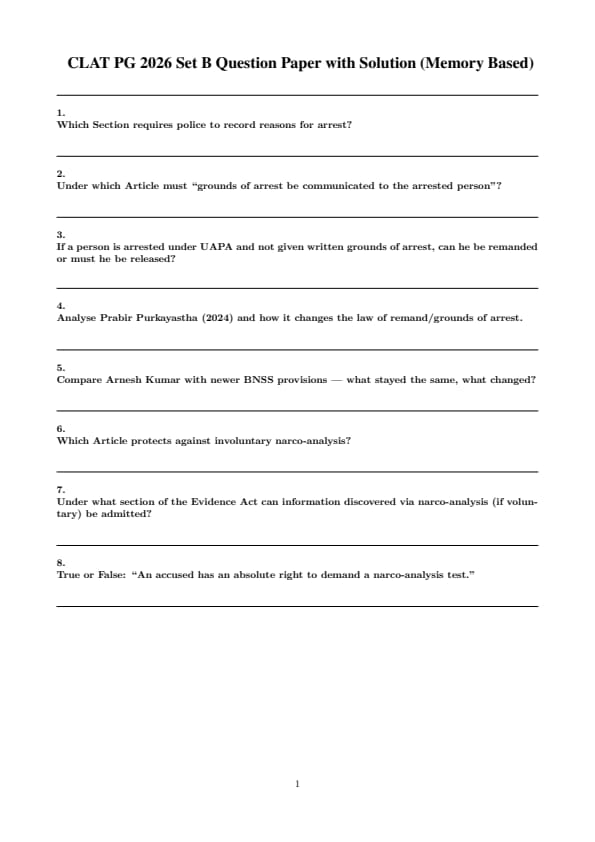
Which Section requires police to record reasons for arrest?
Under which Article must “grounds of arrest be communicated to the arrested person”?
If a person is arrested under UAPA and not given written grounds of arrest, can he be remanded or must he be released?
Analyse Prabir Purkayastha (2024) and how it changes the law of remand/grounds of arrest.
Compare Arnesh Kumar with newer BNSS provisions — what stayed the same, what changed?
Which Article protects against involuntary narco-analysis?
Under what section of the Evidence Act can information discovered via narco-analysis (if voluntary) be admitted?
True or False: “An accused has an absolute right to demand a narco-analysis test.”
CLAT PG 2026 Difficulty Level Analysis (Expected)
| Subject / Section | Estimated Difficulty Level | Typical Challenges / What to Expect |
|---|---|---|
| Constitutional Law | High | Passage‑based questions on fundamental rights, amendments, federal structure — requires strong conceptual clarity and quick comprehension. |
| Jurisprudence & Legal Theory | Moderate to High | Questions on legal philosophies, schools of thought, legal maxims — often conceptual/theoretical rather than factual. |
| Other Core Law Subjects (Criminal Law, Contract, Torts, Company Law, International Law etc.) | Moderate to High | Subject‑based MCQs and passage‑based application questions; often mix of fact‑law and principle‑application. |
| Contemporary Legal Issues / Recent Amendments / Case Law Interpretations | Moderate | Requires updated awareness of amendments, recent judgments — tests ability to apply law in changing contexts. |
| Legal Reasoning / Passage‑Based Legal Reasoning | Moderate | Comprehension + application under time pressure; needs reading speed and analytical accuracy. |



Comments