



.png?h=35&w=35&mode=stretch)
With CLAT 2026 scheduled for December 7, 2025, law aspirants across the country are stepping up their preparations. As nearly 70,000 aspirants prepare for the offline, pen-and-paper test, experts warn that even minor errors in marking the CLAT OMR sheet can lead to loss of marks
The CLAT paper will have 120 multiple-choice questions, each requiring precise bubble-marking that can be accurately read by optical scanners.
This article outlines the key components of the CLAT OMR sheet, official instructions issued by the Consortium, and common mistakes made by students.
Also Read:
- CLAT 2026: Exam (7th December), Difficulty Level Analysis
- CLAT Mock Test 2026: Attempt Free Online Mock Test
What is a CLAT OMR Sheet?
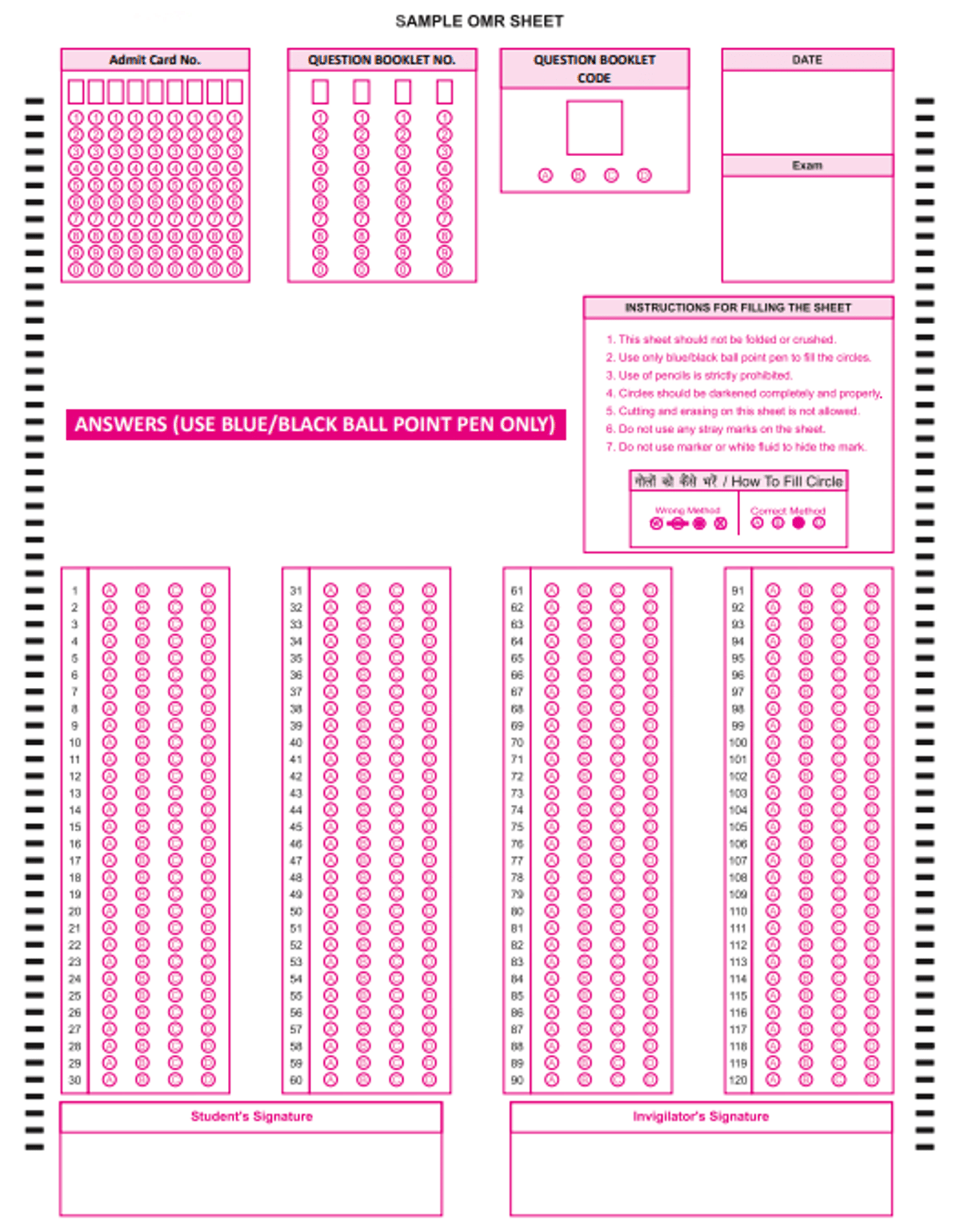
The CLAT OMR sheet is the official sheet used to record your answers for the exam. The test will be held in a pen-and-paper format in a single session from 2:00 PM to 4:00 PM. This specially designed OMR sheet has 120 bubbles, one for each question in the undergraduate section, with four answer options for each question: A, B, C, or D.
According to the guidelines from the Consortium, the CLAT OMR sheet is designed to be read by precise optical scanners that detect which bubbles you’ve filled and then score your answers automatically. Because the sheet is highly sensitive to even small markings, it’s important to fill it in accurately and neatly; mistakes or stray marks can affect the scoring and, in the end, your final result.
Source: CLAT Official PDF
| OMR Sheet Component | Details | Importance |
|---|---|---|
| Total Questions | 120 MCQs | Complete marking required |
| Options per Question | 4 (A, B, C, D) | One correct answer only |
| Marking Mechanism | Optical scanning | High precision needed |
| Pen Type Required | Blue/Black ballpoint | Other pens not detected |
| Personal Information Section | Name, Roll Number, Date | Accurate filling mandatory |
| Year | CLAT Question Paper with Answer Key PDF | CLAT Solution PDF |
|---|---|---|
| 2023 | Check Here | Check Here |
| 2022 | Check Here | Check Here |
| 2021 | Check Here | Check Here |
| 2020 | Check Here | Check Here |
Critical Guidelines for Filling the CLAT OMR Sheet
The Consortium has issued strict rules for filling the CLAT OMR sheet.
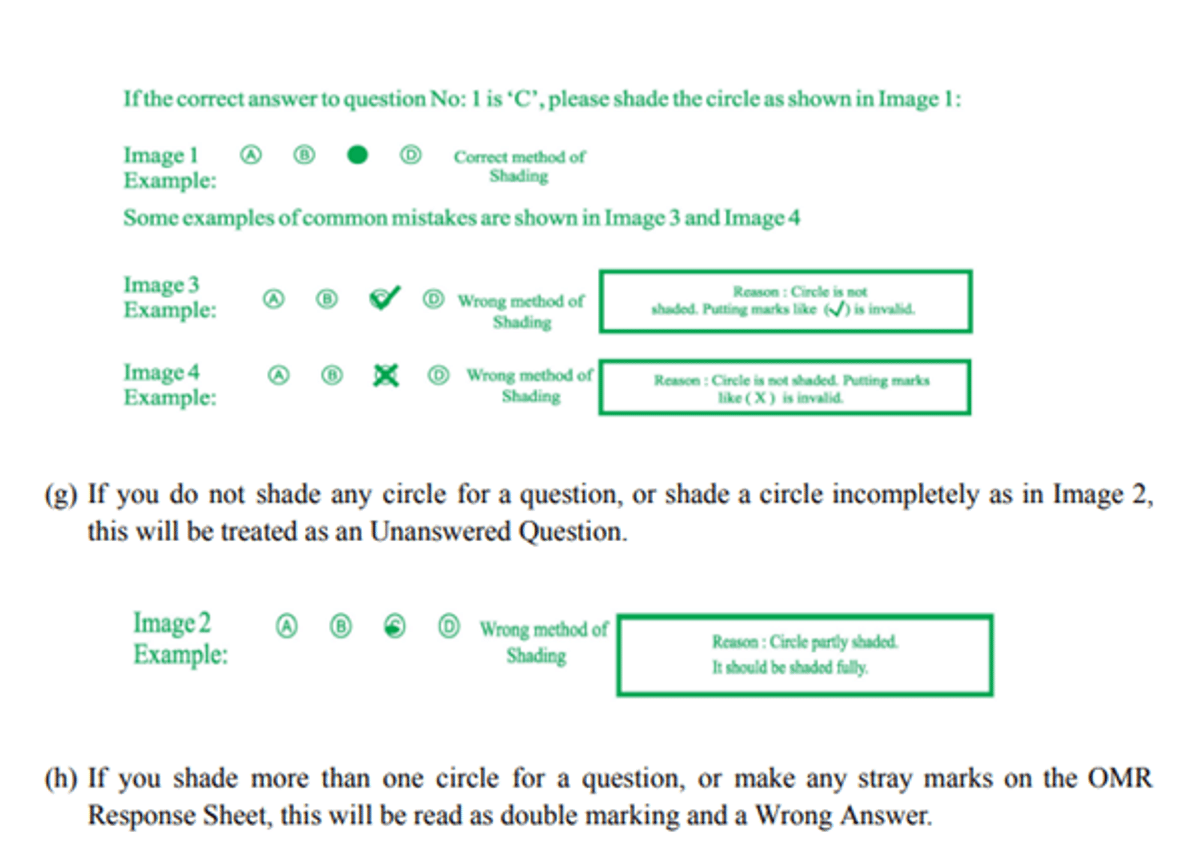
- Use only blue or black ballpoint ink gel pens; fountain pens and pencils aren’t allowed because the scanner may not read them correctly.
- Fill each bubble and darken it enough for the optical scanner to detect it accurately.
- Keep your marks within the circle and inside the designated area; no stray marks, ink spills, or marks outside the boundary.
- Make sure your marks are dark enough for the machine to read, while staying neat and precise.
Source: CLAT Official PDF
| Guideline | Instruction | Consequence of Violation |
|---|---|---|
| Pen Type | Blue or black ballpoint only | The answer may not be scanned |
| Bubble Filling | Complete and dark shading | Incomplete marks not detected |
| Mark Boundaries | Stay within circle limits | Scanner confusion/errors |
| Multiple Markings | One bubble per question | Automatic negative marking (-0.25) |
| Stray Marks | Avoid any extra marks | Potential scanning errors |
| Personal Details | Fill accurately at top | Evaluation complications |
Check: CLAT Exam Pattern 2026: Check CLAT syllabus, Marking Scheme, Exam Mode, Question Paper
Ques. Which pen should I use for the CLAT OMR Sheet?
Ans. Use only a blue or black ballpoint pen to fill the CLAT OMR sheet. Gel pens, fountain pens, sketch pens, and pencils are strictly prohibited because the optical scanner can’t reliably detect marks made with those instruments.
Common Mistakes to Avoid while Filling CLAT OMR Sheet?
Education experts and coaching institutes say there are several common mistakes students should avoid when filling out the CLAT OMR sheet.
- If you mark more than one option for a question, you’ll receive automatic negative marks of 0.25, even if one of the choices is correct.
- Incomplete shading can cause the scanner to miss the answer, marking it as unattempted.
- Stray marks, writing outside the bubbles, or trying to erase or overwrite answers can all trigger scanning errors.
Shruti Dutta, a CLAT preparation expert, notes that the tight spacing between rows makes it easy to accidentally mark the wrong question number. She advises students to practice with sample OMR sheets beforehand to build muscle memory.
| Common Mistake | Why It Happens | How to Avoid |
|---|---|---|
| Multiple markings | Changing answers carelessly | Double-check before marking |
| Incomplete shading | Rushing through questions | Fill bubbles completely |
| Wrong question number | Losing track during exam | Use finger/ruler to track |
| Stray marks | Resting pen on sheet | Keep pen away when not marking |
| Overwriting | Attempting to correct errors | Mark carefully first time |
| Light shading | Insufficient pressure | Press firmly while marking |
Check: CLAT Exam Analysis 2026: Check Difficulty Level, Section-Wise Analysis & Expected Cutoff
Ques. What happens if I accidentally select two options for one question?
Ans. If you choose more than one option for a single question, the scanner will deduct 0.25 marks as a penalty. The question will be marked incorrect, even if one of your chosen options is correct.
Strategic Approaches to OMR Filling
Law-prep experts say there are three common strategies for filling out the CLAT OMR sheet during the exam.
- The first is to mark your answer right after you finish solving each question. This helps reduce the chance of forgetting to fill in an answer and keeps you moving forward in an orderly, steady way.
- The second strategy is simple: finish all the questions in a section first, then fill in all the answers on the OMR sheet at once. This helps you stay focused while you work and can save time for people who think best in batches.
- The third approach is to finish the entire exam first and only then transfer all your answers to the OMR sheet. While this minimises interruptions while you’re solving, it’s risky because you must allocate enough time for the transfer, and you may face time pressure at the end.
| Strategy | Method | Advantages | Disadvantages |
|---|---|---|---|
| Question-by-Question | Mark after each question | No forgotten answers, systematic | Frequent context switching |
| Section-wise Marking | Mark, after completing the section | Maintains focus, balanced | Risk if time runs out mid-section |
| End Transfer | Mark all at exam end | Uninterrupted solving | High risk, time pressure, errors |
Also Read:
Ques. Which OMR filling strategy is best for CLAT 2026?
Ans. The safest approach is to answer the questions in order, so you don’t forget any or lose track of your progress. But use the method you’ve practised most in your mock tests. Consistency and comfort with your chosen strategy matter far more than the exact technique you pick.
Time Management for OMR Sheet Filling
Effective time management is essential when tackling the CLAT OMR sheet within the two-hour exam window. Candidates should divide their time between reading questions, solving them, and accurately marking answers on the OMR sheet to maintain both speed and precision.
| Activity | Recommended Time | Tips |
|---|---|---|
| Reading Instructions | 2-3 minutes | Don't skip, avoid errors |
| Solving Questions | 100-105 minutes | Prioritise accuracy over speed |
| OMR Marking (if continuous) | Included in solving time | Mark immediately after solving |
| OMR Transfer (if at end) | 10-15 minutes | Reserve an adequate time buffer |
| Final Review | 5-10 minutes | Check missed questions, verify markings |
Ques. How much time should I set aside for filling out the OMR sheet?
Ans. If you mark continuously, you don’t need any extra time. If you transfer your answers at the end, reserve at least 10-15 minutes for careful marking. Also, set aside five minutes for a final verification to catch any missed questions or marking errors.
Preparation Through Practice
With CLAT 2026 just 1 day away, coaching centres are urging candidates to practice with sample OMR sheets so they can get a real feel for how the marking works.
The Consortium released its official sample papers on November 27, 2025, giving students a chance to simulate exam conditions and refine their OMR-filling technique."
| Practice Element | Purpose | Recommendation |
|---|---|---|
| Sample OMR Sheets | Familiarisation with the format | Practice with at least 10 sheets |
| Timed Mock Tests | Simulate exam conditions | Take 5-7 full-length mocks |
| Marking Speed | Build efficiency | Track time per question |
| Error Tracking | Identify common mistakes | Maintain error log |
| Strategy Testing | Find the best approach | Test all three methods |
CLAT 2025 Question Paper with Answer Key and Solution PDF
| CLAT Paper | Download PDF | Detailed Solution |
|---|---|---|
| CLAT 2025 Question Paper with Answer Key Set A | Download | Check Solution |
| CLAT 2025 Question Paper with Answer Key Set B | Download | Check Solution |
| CLAT 2025 Question Paper with Answer Key Set C | Download | Check Solution |
| CLAT 2025 Question Paper with Answer Key Set D | Download | Check Solution |
Ques. Where can I find sample CLAT OMR sheets for practice?
Ans. To get the official CLAT sample OMR sheet, visit the Consortium of NLUs website (consortiumofnlus.ac.in), log in to your CLAT account (for your specific year, e.g., CLAT 2026), and navigate to the 'Sample Papers' or 'Question Format' section to download the PDF, which will show the OMR layout (circles for A, B, C, D) you'll fill with a blue/black pen for evaluation by scanners.
Ques. Can I change my answer on the CLAT OMR Sheet?
Ans. Changing answers on the OMR sheet is risky and not recommended. Erasing, scratching, or overwriting can cause scanning errors. If you must change an answer, consult the invigilator for guidance. The best practice is to mark carefully after thorough consideration to avoid corrections.



Comments