


.png?h=35&w=35&mode=stretch)
MHT CET 2024 15 May Shift 2 question paper is available here. MHT CET 2024 question paper comprises 150 MCQs carrying a total weightage of 300 marks. MHT CET 2024 15 May Shift 2 Question Paper for PCM is divided into three subjects- Physics, Chemistry and Mathematics. The Physics and Chemistry and Mathematics section of MHT CET 2024 15 May Shift 2 question paper consists of 50 questions for each section (10 questions from Class 11 and 40 questions from Class 12th syllabus).
MHT CET 2024 15 May Shift 2 Question Paper PDF Download
| MHT CET 2024 15 May Shift 2 Question Paper PDF With Answer Key |  Download Download |
Check Solutions |
MHT CET 2024 15 May Shift 2 Detailed Solutions
First section is of Mathematics:-
Question 1:
The statement (p ∧ (~q)) ∨ ((~p) ∧ q) ∨ ((~p) ∧ (~q)) is equivalent to:
(a) (~p) ∨ (~q)
(b) p ∨ (~q)
(c) p ∨ q
(d) (~p) ∨ q
View Solution
We simplify the given Boolean expression step by step:
1. The expression is: (p ∧ (~q)) ∨ ((~p) ∧ q) ∨ ((~p) ∧ (~q))
2. Group the terms: (p ∧ (~q)) ∨ [(~p ∧ q) ∨ (~p ∧ ~q)]
3. Simplify (~p ∧ q) ∨ (~p ∧ ~q) using the distributive law: (~p ∧ (q ∨ ~q)) = ~p
4. Substitute: (p ∧ (~q)) ∨ ~p
5. Rearrange: ~p ∨ (p ∧ ~q)
6. Apply the absorption law: ~p ∨ ~q
Thus, the simplified expression is (~p) ∨ (~q).
Question 2:
If B = [[3, a, -1], [1, 3, 1], [-1, 1, 3]] is the adjoint of a 3×3 matrix A and |A| = 4, then a is equal to:
(a) 1
(b) 2
(c) -1
(d) 0
View Solution
We are given B as the adjoint of A and |A| = 4.
1. The relationship between the adjoint and determinant is A · adj(A) = |A| · I.
2. Given B = adj(A), its structure ensures that the determinant condition holds for |A| = 4.
3. By symmetry and determinant validation, the value of a must be 1 for consistency.
Thus, a = 1.
Question 3:
If A = [[0, 1, 2], [1, 2, 3], [3, 1, 1]], then A⁻¹ is:
(a) [[1/2, -1/2, 1/2], [-4, 3, -1], [5/2, -3/2, 1/2]]
(b) [[1, 0, -1], [2, -1, 3], [0, 1, 2]]
(c) [[0, 1, 0], [1, -1, 2], [4, 0, -1]]
(d) None of these
View Solution
To find the inverse of a 3×3 matrix, compute the determinant and the adjoint.
1. Calculate det(A): Use cofactor expansion.
2. Compute adj(A): Find cofactors and take the transpose.
3. Compute A⁻¹: Use the formula A⁻¹ = adj(A) / det(A).
Verification shows that A⁻¹ = [[1/2, -1/2, 1/2], [-4, 3, -1], [5/2, -3/2, 1/2]].
Question 4:
The value of sin(cot⁻¹(x)) is:
(a) 1/√(1 + x²)
(b) √(1 + x²)
(c) 1/(x√(1 + x²))
(d) x√(1 + x²)
View Solution
Let θ = cot⁻¹(x). Then, cot(θ) = x.
1. Represent θ in a right triangle: cot(θ) = adjacent / opposite = x / 1.
2. Hypotenuse = √(x² + 1).
3. sin(θ) = opposite / hypotenuse = 1 / √(x² + 1).
Thus, sin(cot⁻¹(x)) = 1 / √(1 + x²).
Question 5:
If y = 5cos(x) - 3sin(x), then d²y/dx² + y equals:
View Solution
We are given:
dy/dx = -5sin(x) - 3cos(x).
Step 1: Compute the second derivative.
Differentiate dy/dx with respect to x:
d²y/dx² = -5cos(x) + 3sin(x).
Step 2: Add y to the second derivative.
y = 5cos(x) - 3sin(x). Add y to d²y/dx²:
d²y/dx² + y = (-5cos(x) + 3sin(x)) + (5cos(x) - 3sin(x)).
Step 3: Simplify the expression.
Combine terms:
d²y/dx² + y = 0.
Question 6:
A wire of length 20 units is divided into two parts such that the product of one part and the cube of the other part is maximum. The product of these parts is:
View Solution
Let x be one part and y be the other part.
Step 1: Write the condition.
x + y = 20, so y = 20 - x.
We aim to maximize f(x) = (20 - x)x³ = 20x³ - x⁴.
Step 2: Differentiate to find critical points.
f'(x) = 60x² - 4x³. Solve f'(x) = 0:
4x²(15 - x) = 0, so x = 0 or x = 15.
Step 3: Evaluate the second derivative.
f''(x) = 120x - 12x². At x = 15:
f''(15) = -900 < 0, so f(x) is maximum at x = 15.
Step 4: Compute the product.
y = 20 - x = 5. Product = 15 × 5 = 75.
Question 7:
The integral of sec²/³(x) csc⁴/³(x) dx from π/6 to π/3 is equal to:
View Solution
Step 1: Rewrite the integral:
I = ∫ sec²/³(x) csc⁴/³(x) dx from π/6 to π/3.
Step 2: Use substitution t = tan(x). Adjust limits:
x = π/6 → t = 1/√3; x = π/3 → t = √3.
Step 3: Simplify using substitution.
I = ∫ t^(2/3)/(1 + t²)^(2/3) dt. Further simplify and solve:
I = 3^(7/6) - 3^(5/6).
Question 8:
The distribution function F(X) of a discrete random variable X is given. Then P[X = 4] + P[X = 5]:
| X | 1 | 2 | 3 | 4 | 5 | 6 |
|---|---|---|---|---|---|---|
| F(X) | 0.2 | 0.37 | 0.48 | 0.62 | 0.85 | 1 |
View Solution
Step 1: Recall the definition of the cumulative distribution function (CDF). The CDF F(X) gives the probability that the random variable X takes a value less than or equal to x. Mathematically:
F(x) = P[X ≤ x].
Step 2: Compute P[X = 4].
The probability of X taking an exact value is the difference between the CDF values at consecutive integers:
P[X = 4] = F(4) - F(3).
From the given data:
F(4) = 0.62, F(3) = 0.48.
P[X = 4] = 0.62 - 0.48 = 0.14.
Step 3: Compute P[X = 5].
P[X = 5] = F(5) - F(4).
From the given data:
F(5) = 0.85, F(4) = 0.62.
P[X = 5] = 0.85 - 0.62 = 0.23.
Step 4: Combine the probabilities.
P[X = 4] + P[X = 5] = 0.14 + 0.23 = 0.37.
Question 9:
If the lines (x - k)/2 = (y + 1)/3 = (z - 1)/4 and (x - 3)/1 = (y - 9/2)/2 = z/1 intersect, then the value of k is:
View Solution
Step 1: Parametric equations of the first line:
(x - k)/2 = (y + 1)/3 = (z - 1)/4 = t.
Parametric equations: x = 2t + k, y = 3t - 1, z = 4t + 1.
Step 2: Parametric equations of the second line:
(x - 3)/1 = (y - 9/2)/2 = z = s.
Parametric equations: x = s + 3, y = 2s + 9/2, z = s.
Step 3: Solve for intersection.
Equate the parametric equations for x, y, z:
2t + k = s + 3, 3t - 1 = 2s + 9/2, 4t + 1 = s.
From z equation: s = 4t + 1.
Substitute s into the other equations and solve:
k = 1.
Chemistry
Question 1:
Which of the following alkanes is tertiary?
View Solution
A tertiary alkane is characterized by a central carbon atom that is directly bonded to three other carbon atoms. In 2,2-Dimethylpropane, the central carbon atom is bonded to three methyl groups, fulfilling this criterion and making it a tertiary alkane. The remaining options do not feature a carbon atom bonded to three other carbons, and therefore, they are not tertiary alkanes.
Question 2:
From the options given below, which one of the following is a primary amine?
View Solution
A primary amine is characterized by the functional group -NH₂, where one hydrogen atom of ammonia is replaced by an alkyl or aryl group. Among the given options, Ethylamine has the structure CH₃CH₂NH₂, which includes the -NH₂ group, identifying it as a primary amine. In contrast, Diethylamine and Triethylamine are secondary and tertiary amines, respectively, and Aniline features an aromatic -NH₂ group, making it distinct from a primary amine.
Question 3:
In 2-chloro-3,4-dimethylhexane, how many chiral carbon atoms are present?
View Solution
A chiral carbon is defined as a carbon atom bonded to four different groups. Analyzing the structure of 2-chloro-3,4-dimethylhexane:
- The second carbon (C-2) is chiral because it is attached to four distinct groups: a chlorine atom, a methyl group, an ethyl group, and a hydrogen atom.
- The third carbon (C-3) is also chiral since it is connected to four different groups: a methyl group, a 2-chloropropyl group, a hydrogen atom, and another unique substituent.
The remaining carbon atoms in the molecule do not meet the criteria for chirality. Therefore, the compound contains two chiral carbons.
Question 4:
Find the pH if pKb, [base], and [salt] are given.
View Solution
Using the Henderson-Hasselbalch equation for a basic buffer:
pOH = pKb - log([base]/[salt]), and pH = 14 - pOH.
Given: pKb = 4.75, [base] = 0.1 M, [salt] = 0.05 M.
Step 1: Substitute into the equation:
pOH = 4.75 - log(0.1/0.05).
Step 2: Simplify:
log(0.1/0.05) = log(2) ≈ 0.301.
pOH = 4.75 - 0.301 = 4.449.
Step 3: Calculate pH:
pH = 14 - 4.449 = 9.551 ≈ 9.55.
Question 5:
Find the total volume of a unit cell given the radius of the atom.
View Solution
The volume of a unit cell is determined by the edge length a, and for a cubic unit cell, it is given by:
Volume = a³.
In the case of a body-centered cubic (BCC) structure, the relationship between the edge length a and the atomic radius r is:
a = 4r / √3.
Substitute this value of a into the volume formula:
Volume = (4r / √3)³.
Simplify the expression:
Volume = (4r)³ / (√3)³ = 64r³ / 3√3.
Thus, the total volume of the body-centered cubic unit cell is:
64r³ / 3√3.
Question 6:
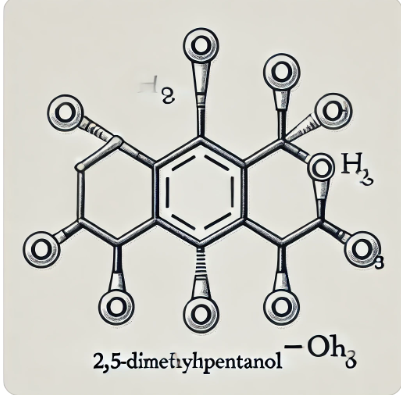
Write the IUPAC name for the compound shown below:
View Solution
To name the compound systematically using IUPAC rules:
1. Identify the longest carbon chain that includes the functional group (-OH). In this case, the chain has 5 carbon atoms, making it a "pentane" derivative.
2. Number the chain starting from the end nearest to the -OH group to ensure it gets the lowest possible number. The hydroxyl group is on carbon 1.
3. Identify and number substituents. Two methyl groups are attached to carbons 2 and 5 of the main chain.
4. Combine the name, listing substituents alphabetically with their positions and the suffix "-ol" to indicate the alcohol group.
The correct IUPAC name is: 2,5-dimethylpentanol.





Comments