



MHT CET 2024 28 April Shift 1 question paper is available for download here. MHT CET 2024 question paper comprises 150 MCQs carrying a total weightage of 200 marks. MHT CET 2024 28 April Shift 1 Question Paper for PCB is divided into three subjects- Physics, Chemistry and Biology. The Physics and Chemistry section of MHT CET 2024 28 April Shift 1 question paper consists of 50 questions (10 questions from Class 11 and 40 questions from Class 12th syllabus). Meanwhile, the Biology paper of MHT CET 2024 28 April Shift 1 question paper consists of 100 questions (20 questions from Class 11th and 80 questions from Class 12th syllabus).
MHT CET 2024 28 April Shift 1 Question Paper PDF Download
| MHT CET 2024 28 April Shift 1 Question Paper 2024 with Answer Key |  Download Download |
Check Solutions |
MHT CET 2024 28 April Shift 1 Questions with Solutions
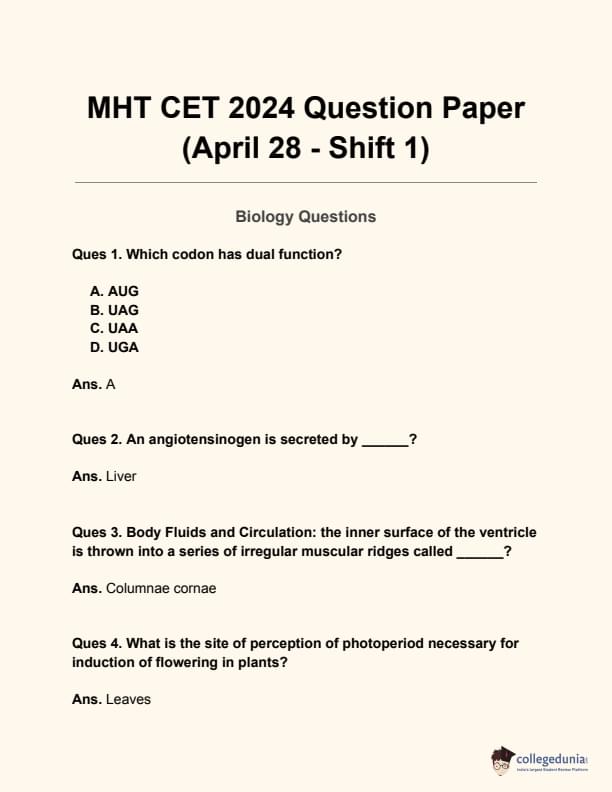
Question 1:
Which codon has a dual function?
View Solution
Detailed Solution:
Codons are sequences of three nucleotides that code for a specific amino acid or signal the start or stop of protein synthesis. AUG, has a dual role in this process:
- Start Codon: AUG serves as the start codon, initiating protein synthesis by signaling the ribosome to begin translation. The start codon is the site where the ribosome begins translation, recruiting the tRNA carrying methionine.
- Codes for Methionine:
- In eukaryotes, the codon AUG codes for the amino acid methionine.
- In prokaryotes, it codes for N-formylmethionine (fMet) which is modified methionine.
- Other Codons: Codons UAG, UAA, and UGA are stop codons that terminate translation by signaling the ribosome to release the polypeptide chain. They do not have a dual role like AUG.
- AUG's Uniqueness: The unique dual role of AUG allows it to initiate translation and recruit the appropriate tRNA carrying methionine.
Therefore, the codon with dual function is AUG.
Final Answer: AUG
Question 2:
An angiotensinogen is secreted by ______?
View Solution
Detailed Solution:
Angiotensinogen is a crucial precursor in the renin-angiotensin system (RAS).
- Angiotensinogen Source:
- Angiotensinogen is a glycoprotein produced and secreted by the liver.
- It is an inactive precursor for the active forms of angiotensin.
- Renin-Angiotensin System (RAS):
- The kidneys secrete renin, which converts angiotensinogen into angiotensin I.
- Angiotensin I is further converted to angiotensin II by ACE in the lungs.
- Angiotensin II acts as a potent vasoconstrictor, stimulates aldosterone release and thus, regulates blood pressure and fluid balance.
- Other Organs:
- Kidneys secrete renin.
- Lungs contain ACE.
- Pancreas is involved in digestion and hormone secretion, not angiotensinogen secretion.
Therefore, angiotensinogen is secreted by the Liver.
Final Answer: Liver
Question 3:
Body Fluids and Circulation: The inner surface of the ventricle is thrown into a series of irregular muscular ridges called ______?
View Solution
Detailed Solution:
The heart's ventricles have specific structures that play roles in proper cardiac function.
- Columnae Carneae:
- Columnae carneae are irregular muscular ridges found on the inner surface of the ventricles.
- They increase the surface area of the ventricular walls and provide support and structural integrity.
- They also prevent the ventricle walls from sticking together during contraction.
- Chordae Tendineae: Chordae tendineae are fibrous cords that connect the papillary muscles to the valves, they are not structural ridges of the wall.
- Papillary Muscles: Papillary muscles are specialized muscles connected to the chordae tendineae that control valve movement, they are not structural ridges of the wall.
- Endocardium: The endocardium is the innermost layer of the heart, but it is a smooth lining and not a series of muscular ridges.
Therefore, the muscular ridges are called Columnae carneae.
Final Answer: Columnae carneae
Question 4:
What is the site of perception of photoperiod necessary for induction of flowering in plants?
View Solution
Detailed Solution:
Photoperiodism refers to a plant's response to the duration of light and dark periods, especially in the induction of flowering.
- Photoperiod Perception: The site where plants perceive the photoperiod is in the leaves.
- Mechanism:
- Phytochromes in leaves act as photoreceptors, detecting the duration of light and dark periods.
- Upon perceiving the correct photoperiod, the leaves produce a flowering signal (florigen).
- Florigen Transport: Florigen is transported to the shoot apical meristem, where it triggers flowering.
- Other Organs:
- Roots do not participate in photoperiod perception.
- Stems are not the primary site of photoperiod perception, though they may be involved in hormone transport.
- Flowers are the result of photoperiodic responses, not the site of perception.
Therefore, the perception of the photoperiod happens in the Leaves.
Final Answer: Leaves
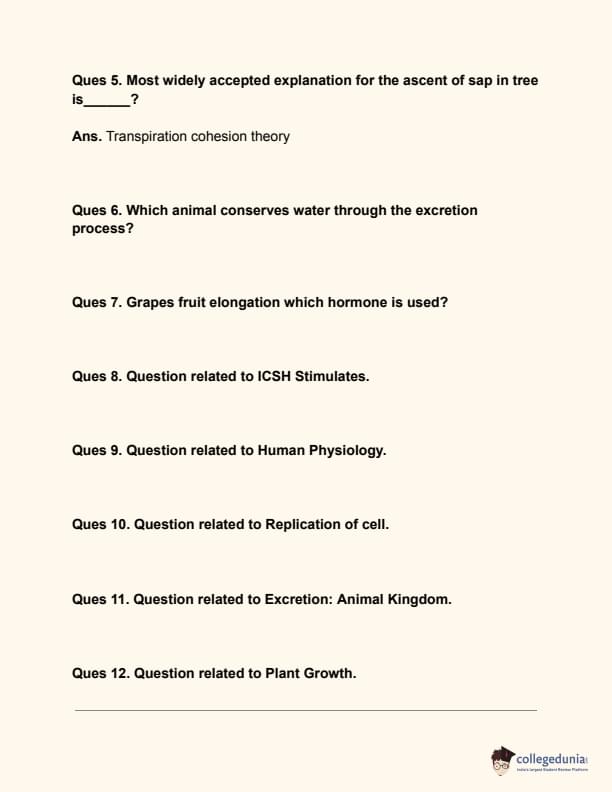
Question 5:
Most widely accepted explanation for the ascent of sap in trees is ______?
View Solution
Detailed Solution:
The ascent of sap in trees refers to the upward movement of water and minerals from the roots to the leaves, often against gravity.
- Transpiration Cohesion Theory:
- This theory, proposed by Dixon and Joly, is the most widely accepted explanation for the ascent of sap in trees.
- It involves:
- Transpiration Pull: Water loss from leaves through transpiration generates a negative pressure or tension that pulls water upward.
- Cohesion: Water molecules are cohesive due to hydrogen bonding, forming a continuous column in the xylem.
- Adhesion: Water molecules adhere to the walls of xylem vessels, counteracting gravity.
- Continuity: The water column remains unbroken, facilitating the upward movement of water.
- Root Pressure Theory: Root pressure pushes water up from the roots, but it is not sufficient to move water to the great heights required by tall trees.
- Capillarity Theory: Capillarity might contribute slightly, but it cannot account for water movement in very tall trees.
- Imbibition Theory: Imbibition is a process where materials absorb water, it is not the primary mechanism for water transport in xylem.
Therefore, the most widely accepted theory is the Transpiration cohesion theory.
Final Answer: Transpiration cohesion theory
Question 6:
Which animal conserves water through the excretion process?
View Solution
Detailed Solution:
Water conservation is crucial for animals living in arid environments. Different animals have adapted in different ways to maintain proper water levels in their bodies.
- Kangaroo Rat:
- Kangaroo rats are desert-dwelling animals that possess excellent water conservation adaptations.
- They produce highly concentrated urine to minimize water loss through excretion.
- Water is efficiently reabsorbed in their kidneys.
- They obtain water primarily through metabolic processes (metabolic water) rather than directly drinking free water.
- They produce very dry feces, minimizing fecal water loss.
- Camel: Camels can tolerate water loss but they don't possess a highly specialized system for excreting very concentrated urine.
- Frog: Frogs live in moist environments and require water. They don't have specific adaptations for water conservation through excretion.
- Fish: Fish live in an aquatic environment and need to maintain water balance. They mostly excrete diluted urine due to their surrounding environment.
Therefore, the Kangaroo rat conserves water through its excretion process.
Final Answer: Kangaroo rat
Question 7:
Grapes fruit elongation: Which hormone is used?
View Solution
Detailed Solution:
Plant hormones play important roles in fruit development and size.
- Gibberellins (GA):
- Gibberellins are plant hormones that promote elongation and enlargement of fruits.
- They are used to stimulate cell elongation, resulting in larger and more uniform grapes.
- Gibberellins reduce cluster compactness, making grape clusters more marketable.
- They also enhance the overall quality of grapes by improving their development.
- Cytokinin: Cytokinins are primarily involved in cell division and delay senescence; they are not the main hormones for fruit elongation.
- Auxin: Auxins mainly promote cell elongation and phototropism; they are not the primary hormones in fruit enlargement.
- Ethylene: Ethylene is involved in fruit ripening and senescence and is not used to increase fruit elongation.
Therefore, Gibberellin is the hormone used for grape fruit elongation.
Final Answer: Gibberellin
Question 8:
What does ICSH stimulate?
View Solution
Detailed Solution:
ICSH, or Interstitial Cell Stimulating Hormone, is a hormone secreted by the anterior pituitary gland and plays a crucial role in reproductive processes in males.
- ICSH (LH) Function: In males, ICSH is also known as Luteinizing Hormone (LH). It has a crucial role in the regulation of male sexual function.
- Leydig Cells Stimulation:
- ICSH (LH) stimulates Leydig cells in the testes to produce testosterone.
- Testosterone is a key hormone in males, responsible for spermatogenesis, development of male secondary sexual characteristics, and the maintenance of libido.
- Spermatogenesis: ICSH does not directly cause spermatogenesis; rather, it stimulates testosterone, which supports spermatogenesis.
- Oocyte Maturation: ICSH is not involved in oocyte maturation, which is a process in females controlled by LH and FSH (follicle-stimulating hormone).
- Growth Hormone Secretion: ICSH does not stimulate growth hormone secretion.
Therefore, ICSH stimulates the Leydig cells for testosterone production.
Final Answer: Leydig cells for testosterone production
Question 9:
What is a key concept in Human Physiology?
View Solution
Detailed Solution:
Human physiology encompasses the functions and processes within the human body.
- Circulation of Blood:
- The circulation of blood, regulated by the cardiovascular system, is a fundamental aspect of human physiology.
- It involves the transport of oxygen, nutrients, hormones, and waste products throughout the body.
- Neural Communication:
- The nervous system controls both voluntary and involuntary actions.
- Neural communication is a fundamental process that allows the nervous system to control all processes of the body.
- Hormonal Regulation:
- The endocrine system regulates metabolism, growth, reproduction, and other bodily functions through hormones.
- Hormonal regulation is crucial for homeostasis.
- Interconnectedness: All these systems are interconnected and work together to maintain homeostasis.
Therefore, all of the above are key concepts in human physiology.
Final Answer: All of the above
Question 10:
Which process is involved in replication of cells?
View Solution
Detailed Solution:
Cell replication is fundamental for growth, repair, and reproduction.
- Mitosis:
- Mitosis is a type of cell division that results in two identical daughter cells.
- It is essential for growth, repair, and asexual reproduction.
- Meiosis:
- Meiosis is a specialized type of cell division that produces gametes (sex cells).
- It reduces the chromosome number by half, which is important for sexual reproduction.
- DNA Replication:
- DNA replication is a prerequisite step for both mitosis and meiosis.
- It involves the duplication of the cell's genetic material to ensure each daughter cell receives a complete and accurate copy.
Therefore, all of the above are involved in the replication of cells.
Final Answer: All of the above
Question 11:
What is the main excretory product in the Animal Kingdom?
View Solution
Detailed Solution:
The main excretory product of animals varies greatly depending on the species and their environmental adaptations.
- Ammonia:
- Ammonia is highly toxic, so it is readily excreted by aquatic animals (ammonotelic) because they can release it into water.
- Ammonia is soluble and can be diluted quickly.
- Urea:
- Urea is less toxic and is excreted by mammals (ureotelic) which require less water for excretion.
- Urea is produced from ammonia by the liver.
- Uric Acid:
- Uric acid is relatively non-toxic and is excreted by birds and reptiles (uricotelic).
- It is an effective way to conserve water as it is excreted in a paste or solid form.
- Adaptations: The type of excretory product is directly linked to the availability of water in their habitat.
Therefore, the main excretory product depends on the species.
Final Answer: Depends on the species
Question 12:
What regulates plant growth?
View Solution
Detailed Solution:
Plant growth is regulated by a complex interplay of various hormones that control different aspects of growth and development.
- Auxins:
- Auxins are a group of plant hormones that promote cell elongation.
- They also play a role in phototropism, the plant's response to light.
- Gibberellins:
- Gibberellins are hormones that stimulate stem elongation.
- They also promote seed germination.
- Cytokinins:
- Cytokinins promote cell division, thus overall plant growth.
- They also play a role in delaying senescence.
- Hormone Interactions: These plant hormones often act synergistically or antagonistically to regulate overall plant growth and development.
Therefore, all of the above (Auxins, Gibberellins, and Cytokinins) regulate plant growth.
Final Answer: All of the above
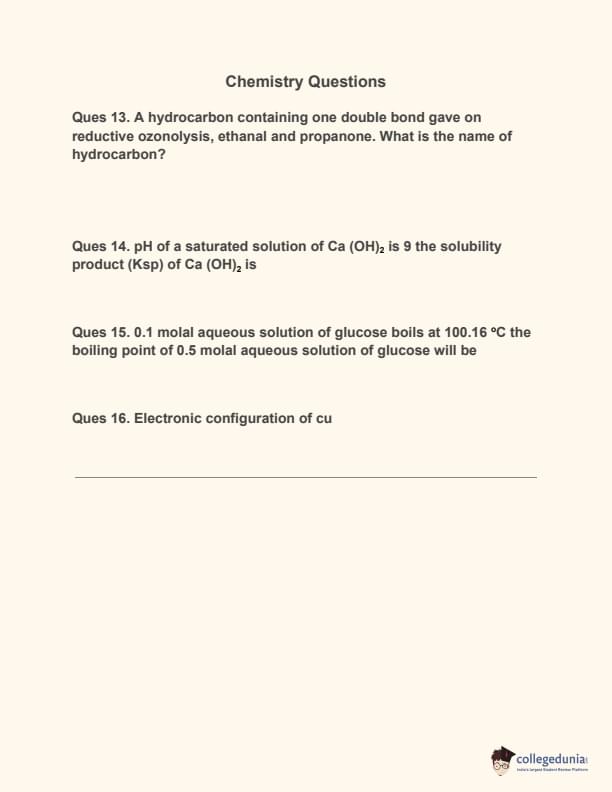
Question 13:
A hydrocarbon containing one double bond gave on reductive ozonolysis, ethanol and propanone. What is the name of the hydrocarbon?
View Solution
Detailed Solution:
Reductive ozonolysis is a reaction that cleaves double bonds to form carbonyl compounds.
- Reductive Ozonolysis:
- In reductive ozonolysis, the double bond of the hydrocarbon is cleaved and oxygen atoms are introduced, forming carbonyl compounds.
- The carbonyl products can be used to reconstruct the original hydrocarbon.
- Given Products: The given products are ethanol (CH3CH2OH) and propanone (CH3COCH3).
- Reconstruction:
- Remove the oxygen atoms from the carbonyl groups to form the original fragments.
- Reconnect the resulting fragments by forming a double bond between the carbon atoms that had oxygen atoms.
- Original Hydrocarbon: Connecting CH3CH2- (from ethanol) and CH3-C(CH3)-(from propanone) would result in 2-Methylprop-1-ene.
- 2-Methylprop-1-ene: 2-Methylprop-1-ene is a four-carbon chain with a double bond at the first carbon and a methyl substituent at the second carbon ( CH2=C(CH3)-CH3 ).
Therefore, the original hydrocarbon is 2-Methylprop-1-ene.
Final Answer: 2-Methylprop-1-ene
Question 14:
The pH of a saturated solution of Ca(OH)2 is 9. The solubility product (Ksp) of Ca(OH)2 is:
View Solution
Detailed Solution:
The solubility product (Ksp) is a measure of how much a sparingly soluble ionic compound dissolves in water.
- Dissociation of Ca(OH)2: The dissociation of calcium hydroxide in water is given by:
Ca(OH)2 ⇌ Ca2+ + 2OH-
- Calculating pOH: Given the pH is 9, pOH can be calculated using the relationship:
pOH + pH = 14
pOH = 14 - pH = 14 - 9 = 5
- [OH-] Calculation: The concentration of hydroxide ions is determined using the pOH value:
[OH-] = 10-pOH = 10-5
- [Ca2+] Calculation: From the stoichiometry of the dissociation:
[Ca2+] = [OH-] / 2 = 10-5 / 2 = 5 × 10⁻⁶
- Solubility Product Calculation: The Ksp is the product of the ion concentrations:
Ksp = [Ca2+][OH-]2
Ksp = (5 × 10-6) × (10-5)2
Ksp = 5 × 10-6 × 10-10 = 5.0 × 10⁻¹⁶
Therefore, the solubility product of Ca(OH)2 is 5.0 × 10⁻¹⁶.
Final Answer: 5.0 × 10⁻¹⁶
Question 15:
A 0.1 molal aqueous solution of glucose boils at 100.16°C. The boiling point of a 0.5 molal aqueous solution of glucose will be:
View Solution
Detailed Solution:
Boiling point elevation is a colligative property, depending on the number of solute particles in a solution.
- Boiling Point Elevation Formula: The boiling point elevation (ΔTb) is given by:
ΔTb = i * Kb * m
where:- ΔTb is the boiling point elevation,
- i is the van't Hoff factor (for glucose, i = 1 as glucose doesn't dissociate in solution)
- Kb is the boiling point elevation constant,
- m is the molality of the solution.
- Given Data: Given the data for 0.1 molal solution is:
ΔTb (for 0.1 m) = 100.16°C - 100°C = 0.16°C.
- Proportionality: The proportionality with molality yields:
ΔTb ∝ m
Since, for 0.1 m solution ΔTb is 0.16°C, this means that for m = 1, ΔTb is 0.16/0.1 = 1.6
ΔTb (for 0.5 m) = 0.5 x 1.6 = 0.80°C
- New Boiling Point: The new boiling point is the sum of boiling point of pure water and the boiling point elevation.
New boiling point = 100°C + ΔTb = 100 + 0.80 = 100.80°C
Therefore, the new boiling point is 100.80°C.
Final Answer: 100.80°C
Question 16:
What is the electronic configuration of Cu?
View Solution
Detailed Solution:
The electronic configuration describes the arrangement of electrons within an atom. Copper has some unique exceptions due to stability of orbitals.
- Expected Configuration: The expected electronic configuration of copper (Cu, atomic number 29) based on the Aufbau principle would be:
[Ar] 3d9 4s2
- Actual Configuration: However, copper deviates from this expected configuration because a completely filled d subshell gives extra stability. Thus, the actual configuration is:
[Ar] 3d10 4s1
- Explanation: The stability gained from a completely filled d-subshell (d¹⁰) is greater than that of having a partially filled d-subshell (d⁹). Thus, one of the 4s electrons moves to the 3d orbital to achieve this greater stability.
Therefore, the electronic configuration of Cu is [Ar]3d104s1.
Final Answer: [Ar]3d104s1
Also Check:
MHT CET Previous Year Question Papers
| MHT CET 2023 Question Paper | MHT CET 2022 Question Paper |
| MHT CET 2021 Question Paper | MHT CET 2020 Question Paper |
| MHT CET 2019 Question Paper | MHT CET 2018 Question Paper |
Also Check:



Comments